New protocol transmits quantum information in complex states of light

Quantum information could be transmitted more efficiently thanks to a new protocol that uses nonlinear optics to transfer high-dimensional, spatially complex states of light. Developed by researchers in South Africa, Spain and Germany, the protocol is similar to quantum teleportation and relies on encoding information in the photons’ orbital angular momentum states.

Quantum communication protocols such as BB84 work by allowing two parties (generally known as Alice and Bob) to exchange encrypted information over an insecure link. To do this, they must share a resource of entangled states. Such states cannot be measured without destroying them, so a third party who does not share the entanglement cannot decrypt the information.

For this setup to work, however, the entangled states must first be generated and securely distributed to Alice and Bob. For perfect security, this distribution should occur via the sharing of single entangled particles. The original BB84 protocol proposed doing this by encoding entanglement in the polarization states of photons, but that only allows each particle to transmit a single bit of entanglement. Researchers have therefore sought more efficient options.

Spiralling wavefronts

One promising possibility is to use a different photon property, such as orbital angular momentum. This arises from the rotation of wavefronts like fusilli spirals. Each wavefront must rotate an integer number of times per wavelength to ensure that the wavefunction does not take multiple values at the same point in space, but in theory it is unbounded. Unlike polarization (which is given by the spin angular momentum quantum number) it therefore provides an infinite set of quantized, orthogonal states and an infinite-dimensional basis in which a photon’s field can be structured.

In the new work, which is described in Nature Communications, researchers led by Andrew Forbes of the University of the Witwatersrand demonstrate a protocol that, in principle, could allow Alice and Bob to transmit high-dimensional spatial information between them using a single photon and nonlinear optics. The protocol begins when Bob pumps a nonlinear crystal with a laser, causing it to (occasionally) produce a pair of entangled, lower-frequency photons with opposite orbital angular momenta via a mechanism called spontaneous parametric down conversion. One photon from each pair is sent to Alice, while Bob retains the other.

Alice, meanwhile, encodes the spatial information she wishes to transmit into the orbital angular momenta of photons emitted from her own laser. She directs these photons into a second nonlinear crystal, which also receives the photons from Bob. The photons from Bob carry no information, but when they enter Alice’s crystal, a small proportion of them undergo another nonlinear optical process called sum-frequency generation. This is effectively spontaneous parametric down conversion in reverse, allowing two photons to occasionally produce a single photon of higher frequency if the photons from Alice and Bob have equal and opposite angular momenta. When Alice reports such a high-frequency photon arriving in her detector, Bob measures the angular momentum of his photon.

Entanglement as a resource

Notably, this process does not achieve an “entanglement swap” of the kind required in a quantum repeater. For that, the photons entering the first crystal would need to become entangled with the photons coming out of the second, and the coherent state Alice sent into her crystal would need to be transferred directly onto the state of the photon remaining with Bob. This would require much greater efficiency in the up-conversion and down-conversion processes than is presently possible in the non-linear optics used here.

Instead, the researchers use the fact that, if a photon takes part in both down conversion and sum-frequency differentiation, the non-transmitted photons from Bob’s spontaneous parametric down-conversion process must have the same orbital angular momentum as the photons Alice used to encode spatial information. By measuring his own non-transmitted photon, therefore, Bob can decipher the information, but nobody who lacks this photon can do so. “We use the entanglement as a resource,” explains team member Adam Vallés of the Institute for Photonic and Optical Sciences in Barcelona.

Confidential information

The researchers believe their scheme, which they demonstrated in the laboratory using 15 different angular momenta for the photons, could produce a quantum-secure authentication system for banks and other entities. “Let’s say you have confidential information you want to send, it could be a fingerprint, an ID document or whatever,” says Forbes. “You have this photon that gets sent to you that makes our scheme work, you overlap this photon from Bob or the bank with the information that you want to send and you get a click in your detector. And when you do this, and you share that information with the bank, then the bank gets the information you want to send.”

Jonathan Leach, a quantum optics expert at the University of Heriot-Watt, UK, who was not involved in the research describes it as “a beautiful experiment and a very significant piece of work.” He adds, however, that the team’s paper, together with a similar work by researchers at China’s Xiamen University, sparked some controversy for the researchers’ initial claims that they had teleported high-dimensional quantum states. “At its heart, the spirit of quantum teleportation and any sort of teleportation is that you have some state that is transported to a new location and in that process the original is destroyed,” Leach says. This is not really true here, he adds, because Alice has to use a laser to generate many copies of the quantum state in order for one to undergo sum-frequency differentiation and be detected by Bob, so the original state is still present at Alice’s end.

Physicist Dan Gauthier of Ohio State University in the US is less enthusiastic, arguing that other groups have done similar work using less elaborate methods. He also sees a drawback in the protocol itself: “In the quantum parlance this is what’s called a projective measurement,” he says; “If the photon happens to be in the state you’re looking for see a click. If it’s not you gain no information. So if they have a d dimensional space the real benefit to what they’re doing is completely lost because every time they make a measurement there’s only a 1/d chance that they picked the correct mode in which to make it.” The researchers accept this criticism and are working to remedy it.
Physicists must consider how they communicate the impact of quantum technologies, before it’s too late

Many new technologies that emerge into public life are met, initially at least, with resistance. Over the past century, we have had to deal with everything from nuclear energy to biotechnology and more recently the emergence of artificial intelligence. While any new technology can have benefits, there are also risks that may not always be clearly communicated, resulting in widespread misunderstanding and sometimes unexpected consequences.

In the US in the 1950s, for example, the introduction of a mechanical tomato harvester have led to over 80% of tomato-growing companies going bankrupt within five years, with an estimated 32,000 farm workers losing their jobs. Many questioned what need the technology fulfilled and whose viewpoints had been overlooked as it was rolled out.

Yet the world doesn’t stand still, which is why it’s important to learn from these historical lessons when discussing quantum technology. We’re still at an early point in the application of quantum information so researchers have an opportunity they shouldn’t miss. By anticipating the impact of quantum technology long before there are any significant consequences for society, we can maximize the potential positive benefits while responding to negative impacts – and perhaps even prevent them altogether.

To do so, quantum scientists – who spend their days thinking over the theoretical, practical and ethical aspects of building quantum technology – must consider how to make their “story” valuable to the public. But rather than simply disseminating knowledge and treating the public as passive recipients, scientists should also pay attention to the public’s questions and concerns, and invest in those relationships.

According to a 2020 study by Cathelijne Reincke and colleagues from Utrecht University, researchers “should not hide behind their expert knowledge”, but instead respond to questions and concerns that may even be outside their field of expertise. Reincke and colleagues say that to help connect with the public and learn from them, it is also better if scientists bring up those questions and concerns themselves. Could, for example, criminal organizations use quantum technology or could it increase the digital divide further between low- and high-income regions?

A different approach

Conveying meaningful information about quantum science and technology to a wider audience, however, has to be done properly. For example, stating that quantum science and technology is “spooky and enigmatic” or not clearly explaining concepts such as entanglement can cause confusion. Framing quantum technology narrowly in terms of public good and having too strong a focus on quantum computing to the detriment of other promising applications is also not giving the audience the full picture.

In our “quantum and society” research group at Leiden University, we collaborated with Sanne Kristensen (Radboud University), Gudrun Reijnierse (Vrije Universiteit Amsterdam) and Ionica Smeets (Leiden University) to gauge how prevalent these issues are in popular quantum discourse. We did this by analysing more than 500 TEDx talks given in English between 2009 and 2020 that included information about quantum science and technology.

We anticipated that phrases such as “spooky and enigmatic”, would be commonly used, but in fact these phrases occurred in only 23% of the talks. Additionally, when mentioning quantum technology, most scientists did their best to explain difficult concepts in quantum physics such as “superposition” or “quantum entanglement”, while non-scientists more often than not just introduced the topic without explanation.

However, we found that the risks associated with quantum technologies were widely omitted in public communication. Both scientists and non-scientists were happy to discuss the benefits of quantum technologies but were reluctant to say much about the downsides. Indeed, the positives were discussed some six times more than the negatives – 34% of talks framing quantum in a positive light while just 5% were negative.

Not everyone should be forced to be the public face of quantum technologies. But if you are a quantum scientist and enjoy giving public presentations about your research, then it can be valuable to reflect upon your own story. Instead of just talking about the benefits, consider touching on the potential risks too. It’s also worth explaining what personal relevance this field has for you – why you got involved in your research, what excites you about it and, of course, the public good it could provide.

In this way, your presentation might contribute to connecting to different people in different ways – which in turn could be valuable for quantum technology as a whole. For all the lessons that history teaches us, when it comes to quantum technologies we have an opportunity to do things differently.

Spiralling phonons turn a paramagnetic material into a magnet

When a material’s atomic lattice vibrates, it produces quasiparticles known as phonons, or quantized sound waves. In certain materials, vibrating the lattice in a corkscrew pattern will make these phonons chiral, meaning they take on the “handedness” of the vibration that produced them. Now, researchers at Rice University in the US have found that these chiral phonons have a further effect: they can make the material magnetic. This finding could be used to induce properties that are difficult to find in naturally-occurring materials.

One such hard-to-find property concerns violations of electrons’ time-reversal symmetry. In essence, time-reversal symmetry implies that electrons should behave the same regardless of whether they are moving forwards or backwards in a material. The most common way of violating this symmetry is to place the material in a magnetic field, but for some possible applications, this is not practical.

Previously, the thinking was that atoms move too little and too slowly in their crystal lattice to affect electrons’ time-reversal symmetry. In the new work, however, a Rice team led by Hanyu Zhu found that when atoms rotate around their average positions in the lattice at a rate of about 10 trillion revolutions per second, the resulting spiral-shaped vibrations – chiral phonons – break the electrons’ time-reversal symmetry and give them a preferred time direction.

“Each electron possesses a magnetic spin that acts like a tiny compass needle embedded in the material, reacting to the local magnetic field,” explains team member Boris Yakobson. “Chirality – also called handedness because of the way in which left and right hands mirror each other without being superimposable – should not affect the energies of the electrons’ spin. But in this instance, the chiral movement of the atomic lattice polarizes the spins inside the material as if a large magnetic field were applied.”

The magnitude of this effective magnetic field is about 1 Tesla, Zhu adds, making it comparable to that produced by the strongest permanent magnets.

Driving the motion of a lattice of atoms

The researchers used a rotating electric field to drive the motion of a lattice of atoms in a spiral pattern. They did this in a material called cerium fluoride, a rare earth trihalide that is naturally paramagnetic, meaning the spins of its electrons are normally randomly oriented. They then monitored the electronic spin in the material using a short light pulse as a probe, firing the light at the sample with varying time delays after applying the electric field. The polarization of the probe light changes according to the spin direction.

“We found that when the electric field had gone, the atoms continued to rotate and the electronic spin kept flipping to align with the rotational direction of the atoms,” explains Zhu. “Using the flipping rate of the electrons, we can calculate the effective magnetic field they experience as a function of time.”

The calculated field agrees with that expected from the team’s models of driven atomic motion and spin-phonon coupling, Zhu tells Physics World. This coupling is important in applications such as writing data on hard disks.

As well as shedding new light on spin-phonon coupling, which is still not fully understood in rare earth halides, the findings could enable scientists to develop materials that can be engineered by other external fields such as light or quantum fluctuations, Zhu says. “I have been thinking about this possibility since my post-doc at UC Berkeley, when we performed the first time-resolved experiments to verify the rotation of atoms in two-dimensional materials,” he explains. “Such rotational chiral phonon modes were predicted a few years back and since then I kept wondering: could the chiral motion be used to control electronic materials?”

For now, Zhu stresses that the work’s main applications lie in fundamental research. However, he adds that “in the long run, with the help of theoretical studies, we may be able to use atomic rotation as a ‘tuning knob’ to enhance properties breaking time-reversal and seldom found in natural materials, like topological superconductivity”.

The Rice researchers, who detail their present work in Science, now hope to apply their method to explore other materials and look for properties beyond magnetization.

Simulations of time travel send quantum metrology back to the future

Have you ever wished you could go back in time and change your decisions? If only knowledge from today could travel back in time with us, we could alter our actions to our advantage. For now, such time travel is the stuff of fiction, but a trio of researchers have shown that by manipulating quantum entanglement, one can, at least, design experiments that simulate it.

Writing in Physical Review Letters, David Arvidsson-Shukur of the Hitachi Cambridge Laboratory, UK; Aidan McConnell of the University of Cambridge, UK; and Nicole Yunger Halpern of the US National Institute of Standards and Technology (NIST) and the University of Maryland propose a set-up in which an experimentalist sends information back in time to retroactively – in effect – change their actions in a way that produces optimal measurements. Intriguingly, the trio reveal that such simulated time travel in entangled systems can facilitate physical advantages that would be impossible to achieve in purely classical systems.

The science of quantum measurements

While actual backward time travel is hypothetical, quantum mechanical versions have been proposed and simulated experimentally. A crucial ingredient of these simulations is teleportation, wherein a state from the experiment’s intermediate step is effectively sent back to the beginning. For this to be possible, the states must be entangled. In other words, they must share a type of quantum connectedness that arises between two (or more) particles such that the state of one cannot be defined independently of the other(s).

Since these simulations of time travel rely on quantum mechanics, they enable researchers to ask meaningful questions about the nature and advantages, if any, of quantum systems. In the new work, Arvidsson-Shukur, McConnell and Yunger Halpern do just that by investigating what advantages simulations of backward time travel can have for quantum metrology – a field of physics that uses quantum mechanics to make highly precise measurements.

A typical quantum metrology problem deals with estimating some unknown parameter of a system or process using quantum mechanical probes. Once the probes are prepared and made to interact with the system, the way the probes’ state transforms will encode information about the unknown parameter. The goal is to learn as much information as possible per probe.

Post-selective measurement can assist in this. In this process, the experimentalist makes a measurement and then, depending on the outcome, chooses to include or exclude certain experimental results from analysis. This concentrates the information learned per probe.

Previously, Arvidsson-Shukur, Yunger Halpern and their collaborators demonstrated that in a quantum system, choosing an optimal input probe state can enable an experimentalist to gain more information per probe than is possible classically. However, typically the experimentalist learns which input state would have been optimal only after the interaction occurs. In a scenario without time travel, this is no good.

Advantage of simulated time travel

If, however, the experimentalist teleports the optimal input state back in time via entanglement manipulation, the trio show that this could produce novel operational advantages. In their proposal, an experimentalist prepares a pair of maximally entangled quantum bits, or qubits, called A and C, plus an additional qubit as the probe. The goal is to measure the strength of an unknown interaction using the probe. Initially, the experimentalist is unaware of the optimal input state for A. At the first step, the probe and qubit A interact. The information about the unknown parameter of the interaction is encoded in the probe’s state. At an intermediate step, however, the experimentalist measures the state of qubit A. This measurement reveals information about the as-yet-unknown optimal state.

Next, the experimentalist uses this information to prepare an auxiliary qubit D in this optimal state. Then, they measure the joint state of the qubits C and D. If this joint state does not match the initial joint state of A and C, the measurement is discarded from the analysis. This effectively picks out instances where optimally prepared state D teleports into the original state of qubit A. The teleportation implies that when the experimentalist measures the probe, they record optimal information gain even though they did not, initially, prepare the probe in the optimal state.

During the experiment, the experimentalist would discard many non-matching measurements. That might seem costly. However, the measurements the experimentalist keeps – the ones where the teleportation is successful – have high information gain per probe. Overall, the information gained from a few optimal probes outweighs the losses when summed over multiple trials.

Whether time travel is physically possible or not is still debated. However, experimentalists can use quantum mechanics and simulate time travel in the lab to perform more precise measurements. As Arvidsson-Shukur, McConnell and Yunger Halpern conclude in their paper, “While [time-travel] simulations do not allow you to go back and alter your past, they do allow you to create a better tomorrow by fixing yesterday’s problems today.”

Whizzing whirligig beetles, the sound of pouring water, shuttlecock mechanics

Whirligig beetles can reach speeds of up to one metre per second – or 100 body lengths per second – as they skirt across the water. Scientists thought the animals did this using their oar-like hind legs to generate “drag-based” thrust, a bit like how a rodent swims.

To do so, however, the beetle would need to move its legs faster than its swimming speed, which in turn would require pushing against the water at unrealistic speeds.

To solve this bugging problem, researchers at Cornell University have used high-speed cameras to film the whirligigs as they swam. They found that the beetles instead use lift-based thrust, which has been documented in whales, dolphins and sea lions.

The trusting motion is perpendicular to the water surface and the researchers calculate that the forces generated by the beetle in this way can produce the speeds seen in the water. According to Cornell’s Yukun, that makes whirligig beetles “by far the smallest organism to use lift-based thrust for swimming”.

Quali-tea result

Visit Morocco and you might see tea being poured from a great height without a single drop being spilled. The aim is to produce a layer of foam on top of the drink, which not only adds to the aesthetic appeal but also to the tasting experience, enhancing the tea’s aromas.

Surprisingly, however, no-one has ever – until now — studied the physics of happens as a liquid is poured into a cup or mug.

Ho-Young Kim from Seoul National University and colleagues sent a jet of water through a nozzle onto a water-filled cylinder and then used an underwater microphone to record the sounds that were produced. They also imaged the patterns of bubbles formed in the water with a high-speed camera.

Turns out that when the jet breaks into droplets – as happens when poured from a great height – it produces a louder sound as more air bubbles are trapped in the liquid. To guarantee no sound, the researchers say, you must pour from a height that may only be a few centimetres from the surface.

And finally, scientists in India have carried out computer simulations of the flight of nylon shuttlecocks, which due to their superior durability have become more widely used compared to those traditionally made from duck feathers.

They found that the flight of modern nylon shuttlecocks can be much different to the feathered variety. When hit at high speed the nylon shuttlecocks deform more, lowering their air resistance and increasing the speed they move through the air. So, a player on the receiving end of a smash shot would find a nylon shuttlecock harder to return.

Award-winning technology allows a paralysed person to walk, new journal focuses on sustainability

This episode of the Physics World Weekly podcast features an interview with Henri Lorach, who is part of the team that won the 2023 Physics World Breakthrough of the Year award. The Swiss–French group bagged the prize for creating a brain–computer interface that allows a paralysed person to walk. Lorach, who is based at EPFL, explains how the technology works and describes the team’s plans to miniaturize and commercialize the system.

Also in this week’s podcast is Jonas Baltrusaitis, who is editor-in-chief of the new journal Sustainability Science and Technology. Produced by IOP Publishing, which also brings you Physics World, the journal will open for submissions later this month.

Baltrusaitis explains that the journal will highlight the roles that scientists and engineers are playing in achieving the UN’s 2030 Agenda for Sustainable Development. He also talks about his research into sustainable catalysis processes, which he does using cutting-edge surface-science tools at Lehigh University in the US.

OncoRay launches world’s first whole-body MRI-guided proton therapy system

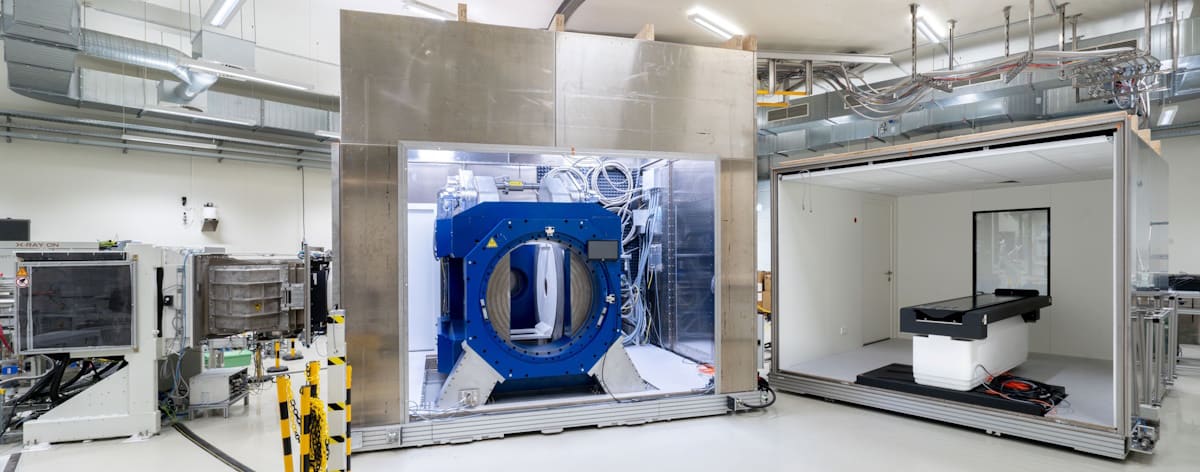
This week saw the official inauguration of the world’s first research prototype for whole-body MRI-guided proton therapy. The launch ceremony, at OncoRay – the National Center for Radiation Research in Oncology in Dresden, marked the start of scientific operation using the prototype, which is designed to enable real-time MRI tracking of moving tumours during proton therapy.

Proton therapy provides a means to treat tumours with extreme precision. The finite range of a proton beam enables extremely conformal dose targeting with reduced dose to nearby healthy tissue. This high conformality, however, makes proton treatments particularly sensitive to anatomical changes in the beam path, which can impair the targeting precision when treating a moving target. Real-time imaging during treatment could help solve this drawback by synchronizing dose delivery with the tumour position.

MRI provides a way to visualize moving tumours and surrounding healthy tissue with excellent soft-tissue contrast. Performing MRI during treatment delivery could enable real-time visualization of tumour motion and the potential for real-time adaptation. MRI can also detect any anatomical changes between consecutive treatment sessions.

And while MRI guidance for photon-based radiotherapy is now commercially available and in clinical use, OncoRay’s is the first such system that exploits MRI to guide proton therapy.

The prototype device – developed by OncoRay’s Experimental MR-Integrated Proton Therapy research group, led by Aswin Hoffmann – combines a horizontal proton therapy beamline with a whole-body MRI scanner that rotates around the patient. Hoffmann notes that this geometry enables innovative patient positioning approaches, including treatment in both lying or in upright positions.

MRI-guided proton therapy system

The ultimate goal of the OncoRay team, along with scientists from the Helmholtz-Zentrum Dresden-Rossendorf (HZDR) and the Dresden University Medical Center, is to use real-time MRI to monitor cancer patients during their treatments and significantly improve the targeting accuracy of proton therapy.

Hoffmann tells Physics World that the first study using the new prototype MRI–proton therapy system is designed to assess the mutual electromagnetic interactions between the proton pencil-beam scanning (PBS) beamline and the in-beam MRI scanner. “We need to answer two questions,” he explains, “do the magnetic fringe fields produced by the PBS beamline affect the MR image quality during irradiation and does the static magnetic field of the MRI system affect the beam delivery system?”

In the longer term, the researchers will use the prototype to demonstrate the added value that whole-body, real-time MRI guidance could bring to treatments of mobile tumours in the chest, abdomen and pelvis.

“I have been working on this specific project since 2018, the last three years of which [I worked] very intensively with the industry partners involved. I am proud that together we have managed to realize and put this system into operation. I look forward with great anticipation to the next phase in which the scientific challenges will be addressed,” says Hoffmann.

US Peregrine lunar lander suffers propellent leak following launch

A US firm has announced that its Moon mission will not successfully land on the lunar surface after its fuel tank ruptured and began to leak propellent shortly after launch. The robotic landing craft, called Peregrine and owned by the private firm Astrobotic Technology, was launched on 8 January from Cape Canaveral, Florida, by a Vulcan Centaur rocket. Peregrine was set to be the first US spacecraft to land on the Moon since the Apollo programme.

Shortly after what seemed to be a successful launch, Astrobotic reported a failure in the probe’s propulsion system that sent it into an “uncontrollable tumble”. Mission controllers then managed to align the craft to charge its solar panels and it began taking data as it made its way to the Moon.

Yet on Wednesday the firm gave up hope that it could make a soft landing on the Moon, which would have been attempted on 23 February. Peregrine carries five NASA payloads, worth $108m.

Astrobotic Technology says that the failure was caused due to a valve that failed to reseal. This caused a rush of high-pressure helium into the fuel tank, which led to an increase in pressure “beyond its operating limit and subsequently ruptured the tank”. Astrobotic adds that it has “no indication that the propulsion anomaly occurred as a result of the launch”.

Peregrine’s demise casts a shadow on the Commercial Lunar Payloads Services (CLPS) programme. A partnership between NASA and 14 aerospace companies, many of them small and relatively new, CLPS aims to ferry NASA payloads to the Moon.

Another CLPS launch, involving a spacecraft built by Houston company Intuitive Machines, is scheduled for launch in the coming months. The programme also calls for Astrobotic to deliver a payload that will include ice-drilling equipment to the lunar south pole.

“We will use this lesson to propel our efforts to advance science, exploration and commercial development of the Moon,” noted Joel Kearns, NASA’s deputy associate administrator for exploration, in a statement.

Lunar woes

The incident represents another failed attempt over the past year to land a craft on the Moon. In April 2023 the Japanese firm ispace announced that its Hakuto-R Mission 1 craft failed to soft land on the Moon, while in August 2023 Russia’s uncrewed Luna-25 craft crashed into the lunar surface after spinning out of control. India’s Vikram lander, however, did make a successful soft landing on the Moon on 23 August.

Peregrine’s woes came as NASA announced on 9 January that it will delay its Artemis II mission, a circumlunar flight of four astronauts that was originally scheduled for later this year. The agency now plans to launch Artemis II in September 2025 while Artemis III, which will land astronauts near the Moon’s south pole, has been shifted back from 2025 to September 2026.

However, the schedule for Artemis IV, the first mission to the Gateway lunar-orbiting space station, remains unchanged at some time in 2028. “We will use the Artemis II flight test, and each flight that follows, to reduce the risk for future Moon missions,” says Catherine Koerner, NASA associate administrator for exploration systems development. “We are closer than ever to establishing sustained exploration of Earth’s nearest neighbour under Artemis.”

Revolutionizing renewable energy: the promise of water splitting

Want to learn more on this subject?

Join us for an exciting webinar, chaired by Katherine Villa Gomez (ICIQ). This event explores innovative solutions in renewable energy, focusing on cutting-edge research in electrochemical energy conversion, advanced solar fuel technologies, and the integration of water splitting with renewable energy systems. Delve into the future of sustainable strategies as we examine new materials and methods that promise to redefine our approach to energy generation and usage, paving the way for a cleaner, more sustainable world.

The webinar format will feature brief presentations from each panellist, showcasing some of their most exciting work in the field. Following these insightful talks, there will be a dynamic Q&A session, offering attendees the unique opportunity to engage directly with the panel and ask questions about their groundbreaking research and visions for the future of renewable energy.

Want to learn more on this subject?

Katherine Villa obtained her PhD in chemistry at the Autonomous University of Barcelona. After two research positions at the Catalonia Energy Research Institute and Institute for Bioengineering of Catalonia, she joined the Center for Advanced Functional Nanorobots at the University of Chemistry and Technology, Prague (Czech Republic), where she worked as a senior scientist for three years. Recently, she moved back to Spain, where she is currently group leader at the Institute of Chemical Research of Catalonia (ICIQ). Her scientific trajectory has been recognized by several awards and distinctions (Young Researcher Award-RSEQ, Young Academy of Spain, Leonardo BBVA, la Caixa Junior Leader, among others), as well as international competitive funding, including a prestigious ERC Starting Grant 2022 for her project (PhotoSwim). Her research interests include photocatalysis, nanomaterials, renewable energy, micro/nanorobots, and environmental remediation.

Elizabeth A. Gibson, Newcastle University. Libby is a professor of energy materials at Newcastle University. Research in her group focuses on developing materials and devices for sustainable power, fuel and feedstocks. This involves materials development, device assembly and characterization of the underpinning photophysics and electrochemistry. Her current roles include being the academic lead for the EPSRC Northeast Transient Absorption Spectroscopy & Microscopy Facility, institution director of the EPSRC CDT Renewable Energy at Northeast Universities (ReNU), and she is the engagement lead for the UKRI Interdisciplinary Centre for Circular Chemical Economy.

Sebastian Sprick obtained his PhD in chemistry from The University of Manchester in 2013. He then joined Prof. Andrew Cooper’s Group at the University of Liverpool, first as a post-doctoral research associate and before working in the same group as a research lead. In the summer of 2020, he joined the University of Strathclyde to start his independent research group. His research group has  major research interests across a wide spectrum of polymer chemistry, but with a particular interest in addressing challenges in sustainability.

Lluís Soler Turu received his PhD in chemistry from the Autonomous University of Barcelona (UAB) in 2010. He has worked as a senior postdoc researcher at the Universitat Politècnica de catalunya-Barcelona Tech (UPC) since autumn 2014. He is currently serving as Deputy Director of the Specific Center for Hydrogen Research at the UPC. Formerly, from 2012-2014, he joined the IFW Dresden and the Max-Planck-Institute for Intelligent Systems in Stuttgart, Germany, in a postdoc position. With over 60 scholarly articles, 3 book chapters and 4 patents, his current research lines span from heterogeneous catalysis and photocatalysis for green hydrogen production to engineered nanomaterials for enhanced sunlight harvesting. https://futur.upc.edu/LluisSolerTuru

Anna Hankin is a lecturer in the Department of Chemical Engineering at Imperial College London. Her principal interests and expertise are in the science and engineering of electrochemical energy conversion, CO2 reduction and separation processes for industrial effluent treatment and material recycling. Her academic research projects have all been aimed at solving industrial problems and involved experimental and numerical modelling components. The strategy followed in former, current, and future projects is to progress from theoretical assessments of a given problem, to small-scale experimental investigations and process modelling, and then on to system design, operation, characterisation and scale-up. Check out her group website for further information:
https://www.imperial.ac.uk/electrochemical-systems-laboratory/


Quantum processor integrates 48 logical qubits

A quantum processor with 48 logical qubits that can execute algorithms while correcting errors in real time has been unveiled in the US. It was created by Mikhail Lukin and colleagues at Harvard University, the Massachusetts Institute of Technology and QuEra . Their success could lead to the development of quantum computers that offer large numbers of logical qubits.

In principle, quantum computers can solve some problems that cannot be computed on conventional processors. However, the quantum processors available today are very susceptible to disruption by environmental noise, which destroys the delicate quantum states that are used to store and process information.

Quantum error correction addresses the noise problem by having a group of qubits (called physical qubits) work together as one qubit, which is called a logical qubit. The idea is that the information held by a logical qubit is spread out over a number of physical qubits, which work together to identify and correct errors as they occur.

Resilient against errors

Researchers hope to use logical qubits to replace individual qubits in quantum computing architectures, making them resilient against errors when running algorithms.

“We are trying to mark a transition in the field, toward starting to test algorithms with error-corrected qubits instead of physical ones, and enabling a path toward larger devices,” explains Dolev Bluvstein, who is the lead author of a paper describing the work. The paper has been accepted for publication in Nature.

This concept is still in its very early stages and recently, experiments reached the milestone of using two logical qubits to operate a single quantum logic gate.

In their study, Lukin and team explored how a much larger system could be created using neutral atom arrays. These are grids of ultracold rubidium atoms trapped by optical tweezers. These atoms can be put into highly excited Rydberg states, which enables the atoms to act as qubits that can exchange quantum information.

Dynamic reconfiguration

Neutral atom arrays are especially well suited for logical qubit architectures as they can be dynamically reconfigured during a computation, while preserving their quantum information.

Taking advantage of these properties, Lukin and colleagues created a programmable quantum processor that is based on the control of logical qubits in neutral atom arrays, and used their platform to run a series of programmable logical algorithms. This approach allowed the team to vastly improve on the results of recent experiments: encoding up to 48 logical qubits, containing up to 228 two-qubit logic gates.

With its in-built error correction, the processor dramatically improved the performance of the algorithms run by the team. This allowed the team to explore several important features of logical operations in quantum computers. These include the application of large-scale error correction across large numbers of qubits, and tolerance against noise and imperfections in quantum hardware.

The scientists are optimistic that their research could pave the way for large-scale logical quantum processors in the not-too-distant future. “I think this is one of the moments in which it is clear that something very special is coming,” Lukin says. “Although there are still challenges ahead, we expect that this new advance will greatly accelerate the progress towards large-scale, useful quantum computers.”

The team is now focusing on running a more diverse set of logical operations on the system.

Copyright © 2026 by IOP Publishing Ltd and individual contributors