Welcome to this year’s first instalment of the Red Folder, which has two tales from the wonderful world of insects.
Fire ants have a remarkable ability to survive floods – something that could come in handy in the UK, which is currently suffering severe flooding in many low-lying areas. When it rains, the ants can be seen to avoid drowning by clumping together to form floating rafts of 10 or more ants.
One possible explanation for this survival strategy is the “Cheerios effect”, which causes floating breakfast cereal to clump together in a bowl of milk. This occurs thanks to the surface tension of the liquid and a “meniscus effect” whereby the liquid sticks to the Cheerios underneath but also along the sides of the object. As liquid molecules are then strongly attracted to a solid’s edge, this acts to stick more and more Cheerios together.
But work from researchers in China and the US now challenges the relevance of this effect to fire ants. They observed live and dead fire ants – as well as a local species of ant – on water while shaking them vertically or horizontally. They found that dead ants and local ants did not stick together to form rafts. But the fire ants could still build rafts when shaken, and this told the researchers that the attractive behaviour is more nuanced and could be triggered by pheromones that are released when fire ants sense danger. Putting the rafts under stress, also resulted in the rafts “self-healing” with ants moving from the top to the bottom to keep it afloat. The buoy-ant mystery continues.
Summer will be buzzing
The buzzing of cicadas is a common feature of warm days in many parts of the world. Resembling elongated, oversized house flies, male cicadas create their mating songs using tymbals, which are resonating structures on the creatures’ exoskeletons. Cicadas spend most of their time burrowed underground in the nymph stage of their life cycle. They emerge for a brief period as flying insects when they mate and the female cicada lays eggs in the branches of trees. The hatched nymphs then fall back to earth — along with the adults, who die after mating.
Some long-lived species in eastern North America are famous for having distinctive broods of flying insects. These broods are synchronized to emerge in huge numbers once every 17 or 13 years. There are several theories for why this happens. One is that having such long lifecycles makes it difficult for short-lived predators such as wasps to specialize in eating the emerging cicadas.
In this Instragram video, the mathematician Hannah Fry points out that 17 and 13 are both prime numbers – and why that could be significant to how the lifecycles evolved. What is more, she says that 2024 marks the first time in more than 200 years that the lifecycles will overlap in some places. So, if piles of dead insects are not your thing, you might want to avoid certain parts of North America this summer.
That’s an interesting question, because they are skills I would never have expected would be so important when I was an undergraduate studying physics. I use a lot of time management and emotional regulation skills. A lot of my work now is self-organized: I have to organize and lead my research group, and I need to know how to prioritize the different activities we’re doing.
The third skill is harder to express succinctly, but I have had the good fortune of doing research in a lot of different areas, and I know the approaches that do or don’t work. So, one skill I really enjoy using is finding parallels between different areas of physics, chemistry or biology, and using those parallels to gain insights into how to make a problem more tractable.
What do you like best and least about your job?
I love the fact that I get to work with motivated and extraordinary people. When I became interested in continuing to be a scientist – and it wasn’t until I was in graduate school that I really thought this was something I wanted to do for my career – one of my main motivations was that you get to work within a community of people who are all very excited about what they do. They’re self-motivated, creative and brilliant, and this is a fun aspect of my job.
Another thing I love is the new opportunities it brings. When I was a PhD student, my main job was working in the lab and making advances in one small area of science. I didn’t quite appreciate how that would lead to, for instance, having an interview with you today. Back then, I didn’t understand how to communicate more broadly to people outside my field, but I love the fact that my career allows me to constantly learn new things, both in physics and outside of physics.
What I don’t like about my job is having to say “no”. I’m constantly having to prioritize and say “no” to opportunities I would love to be able to do. That’s hard, and it makes me feel bad that I can’t do everything. I don’t like that.
What do you know today that you wish you had known at the start of your career?
I spent a lot of time feeling like an imposter – I still do – and I wish I could tell myself 20 years ago that it’s okay to feel that way and you just have to get used to it. I had people tell me this at the time, and I didn’t believe it, but it’s okay to feel uncertain. You just have to manage those feelings. I would have saved myself a lot of stress, worry and time spent not feeling very good about myself if I’d known that.
Under certain conditions, light can cause water to evaporate directly, without heating it first. The process works by cleaving water clusters from the water-air interface, and researchers at the Massachusetts Institute of Technology (MIT) in the US have dubbed it the “photomolecular effect” in analogy with the well-known photoelectric effect.
“The conventional wisdom is that evaporation requires heat, but our work shows that another evaporation mechanism exists,” explains MIT nanotechnologist and mechanical engineer Gang Chen, who led the research. Chen adds that the new effect may be more efficient than heat and might therefore be useful in solar desalination systems and other technologies that use light to evaporate water.
An unexpected turn
Chen and colleagues have been studying evaporation due to interactions between sunlight and material surfaces since 2014. Because water does not, on its own, absorb much visible light, their early studies involved dispersing a black, porous, light-absorbing material in their container of water to aid the conversion of sunlight into heat.
“We had assumed that it was a thermal evaporation process: sunlight is absorbed and converted into heat, which subsequently evaporates water,” Chen says.
However, things took an unexpected turn in 2018 when a separate team of researchers led by Guihua Yu at the University of Texas at Austin, US, repeated this experiment with a black hydrogel (a material that holds water). They found that the material’s thermal evaporation rate was twice as fast as it should have been, given the total amount of heat energy the sample received and assuming the established mechanism was the only one at work.
In 2019, Chen asked a new postdoctoral researcher in his group, Yaodong Tu, to repeat Yu’s experiments. At first, the MIT researchers struggled to make working samples. Eventually, with help from members of Yu’s group, they succeeded in confirming the UT Austin team’s results. However, they were not convinced by the team’s suggested explanation, which was that water in the black hydrogel might have a much lower latent heat than ordinary water.
“I suspected that there were photon effects at play, so we employed light-emitting diodes (LEDs) to study how the wavelength of light used to illuminate the samples affected the rate at which water evaporated,” Chen says. “We indeed observed a wavelength dependence and strange temperature distributions in air that imply some photon effects, but we could not come up with a reasonable physical picture to explain these results.”
A helpful analogy
The MIT researchers spent a year and a half studying the possibility of latent heat reduction, but their experiments yielded negative results. Along the way, though, they learned that a few other research groups were also reporting super-thermal evaporation with different materials, including inorganic ones.
“Mid-2021, I realized that the only thing in common between all these experiments was the increased surface area between the water and air interface,” Chen tells Physics World. “I therefore asked myself if a surface effect was responsible and this is where the photoelectric analogy came in.”
As Albert Einstein explained in 1905, the photoelectric effect occurs when light shining on a material contains enough (quantized) energy to eject an electron from the material. By analogy, and drawing on his understanding of Maxwell’s equations and the polar nature of water molecules, Chen rationalized that the impetus behind his team’s observations might involve a quadrupole force acting on a permanent dipole at the air-water interface.
Although Chen’s theory was still at the “handwaving” stage, it nevertheless guided the MIT researchers in redesigning their experiments. Success came when they were able to show that while neither pure water nor the hydrogels they studied absorb visible light, partially wetted hydrogels do.
The 2019 experiments explained
“Subsequent experiments on evaporation from a pure PVA hydrogel, a hydrogel with black absorbers and a clean hydrogel coated on black carbon paper all checked out,” Chen says. “With the idea that visible light can cleave off water molecular clusters, we were also able to explain the 2019 experiments.”
In photomolecular processes, a photon cleaves off a water molecular cluster from the water-air interface. Compared to thermal evaporation, which evaporates water molecules one-by-one, and therefore needs energy to break the bonds between water molecules, photomolecular evaporation is thus more efficient at evaporating than heat alone.
Chen believes this new mechanism, which he and his colleagues describe in PNAS, could be at play in our daily lives. “It might be important, for example, for understanding the Earth’s water cycle, global warming, and plant growth,” he says. “The discovery could also lead to new engineering applications: we have started to look into desalination and wastewater treatment, but drying could be another area in which this mechanism could be exploited.” Because drying consumes around 20% of energy used in industrial sectors – an amount Chen calls “staggering” – an increase in energy efficiency could have a significant impact.
Looking forward, the researchers say they would like to bolster the evidence in favour of their proposed mechanism and begin to quantify the effect. “We have been doing lots of experiments on single water-air interfaces to this end and also performing cloud experiments to show that this mechanism might also exist in the atmospheric water cycle,” Chen reveals. “The effect might well exist in other materials aside hydrogels and we hope our work will attract the attention of other researchers who will want to study it further.”
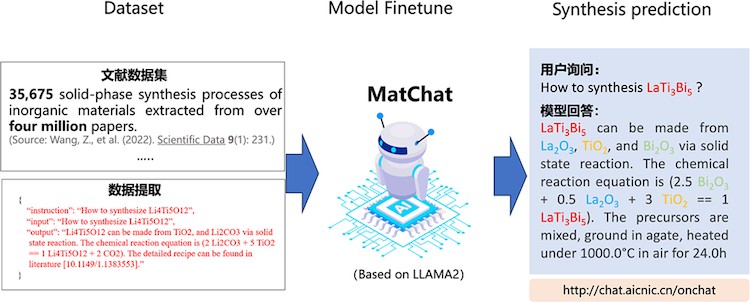
The team trained the new model using chemical synthesis protocols extracted from 13 878 inorganic compounds, which they sourced from a collection of over four million scientific publications. Courtesy: Chinese Physics B
Researchers in China have fine-tuned an existing large language model (LLM) to create a system that can predict the steps required to synthesize an inorganic compound. Although the new model, dubbed MatChat, needs further refinement before it can be employed in the laboratory, its developers say it represents an important early endeavour in applying generative artificial intelligence in a scientific context.
LLMs are a type of artificial intelligence that extracts meanings from a sequence of text. To do this, they must first be trained on huge amounts of data. However, this training can be unsupervised, meaning that LLMs are said to be self-learning. They are also very flexible, able to perform tasks such as answering questions, writing text, translating languages and completing sentences. Well-known examples include Open AI’s GPT-3 model and its accessible spin-off, ChatGPT, which can already make predictions from a relatively small number of inputs or “prompts”.
To create an LLM that “understands” inorganic synthesis, researchers led by Miao Liu, a physicist at the Institute of Physics, Chinese Academy of Sciences, Beijing and founder of atomly.net, supplied a leading open-source LLM called LLaMA2-7B with additional scientific data. In doing so, Liu says, they “empower[ed] it to think akin to human cognition using a minimal dataset”. They trained the model using chemical synthesis protocols extracted from 13 878 inorganic compounds, which they sourced from a collection of over four million scientific publications compiled by Kristin Ceder and colleagues at the Lawrence Berkeley National Laboratory in the US.
“This training data allows the model to understand and respond to inorganic synthesis questions in the same way a knowledgeable expert would,” Liu explains. “For example, when queried about synthesising LiMnO2, MatChat can provide a detailed response that includes reaction precursors, equations and relative references in the literature.”
A typical exchange, he says, might look something like this:
Question: how to synthesize LiMnO2?
Answer: LiMnO2 can be made from Li2CO3, and MnO2 via a solid-state reaction. The chemical reaction equation is (0.5 Li2CO3 + 1 MnO2 == 1 LiMnO2 + 0.5 CO2). The precursors are mixed, calcined at 800.0°C in air for 2.0h, mixed, calcined at 800.0°C in air for 2.0h. The detailed recipe can be found in the literature…
A new project idea
Liu got the idea for the MatChat project in August 2023, after he attended a conference organized by Intel on the subject of information technology and AI. “Although the meeting had nothing to do with science, I learnt a lot about trending topics in AI and its applications,” Liu says. “It inspired me to apply the LLM to synthesis recipe prediction.”
To make the project happen, Liu teamed up with a colleague, Zongguo Wang, and a PhD student, Fankai Xie. While Xie trained the model, Wang built the freely available online platform that enables it to interact with users.
“While MatChat might not be the ultimate solution for this type of application, our work represents one of the early endeavours to apply LLM in a scientific context,” Liu tells Physics World. “We hope that that our study will serve as a catalyst for the creation of similar AI tools across multiple fields.”
Looking forward, the researchers plan to refine MatChat’s capabilities by expanding its dataset and integrating computational and experimental data from their own extensive materials science database, atomly.net, as well as a forthcoming robotic autonomous laboratory for inorganic materials synthesis. “Leveraging these resources, we aim to continue developing advanced AI tools for this field,” Liu says.
Random numbers are used in several important technologies including cryptography and numerical simulation. However, large sequences of truly random numbers are notoriously difficult to generate – and correlations lurking within sequences can have dire consequences.
Quantum systems are inherently random, so they offer a way to generate random numbers. In this episode of the Physics World Weekly podcast, our guest is Ramy Shelbaya who is who is chief executive officer of Quantum Dice – a UK-based start-up that uses quantum optics to generate random numbers.
He explains how the company’s technology creates sequences of random numbers at high speed, and why Quantum Dice is currently miniaturizing its technology so it can be deployed in mobile phones.
A protocol for testing the quantum nature of large objects – that, in principle, could work for objects of any mass – has been proposed by researchers in the UK and India. A key feature of the protocol is that circumvents the need to create a macroscopic quantum state to test whether or not quantum mechanics is valid at large scales. Some physicists, however, are not convinced that the research constitutes a significant advance.
Quantum mechanics does a fantastic job of describing atoms, molecules and subatomic particles like electrons. However, larger objects usually do not display quantum behaviour such as entanglement and superposition. This can be explained in terms of quantum decoherence, which occurs when delicate quantum states interact with noisy environments. This causes macroscopic systems to behave according to classical physics.
How quantum mechanics breaks down at macroscopic scales is not only theoretically fascinating but also crucial to attempts to developing a theory that reconciles quantum mechanics with Albert Einstein’s general theory of relativity. Physicists are therefore keen on observing quantum behaviour in ever-larger objects.
Formidable challenge
Creating macroscopic quantum states and preserving them long enough to observe their quantum behaviour is a formidable challenge when dealing with objects much larger than atoms or molecules held in a trap. Indeed, the quantum entanglement of vibrating macroscopic drumheads (each 10 micron in size) by two independent groups – one in the US and one in Finland – was chosen as Physics World’s breakthrough of the year 2021 for the teams’ experimental prowess.
The new protocol is inspired by the Leggett-Garg inequality. This is a modification of Bell’s inequality, which assesses whether two objects are quantum-mechanically entangled from the correlation between measurements of their states. If Bell’s inequality is violated, the measurements are correlated so well that, if their states were independent, information would have had to travel faster than light between the objects. Because superluminal communication is thought to be impossible, a violation is interpreted as evidence of quantum entanglement.
The Leggett-Garg inequality applies the same principle to sequential measurements of the same object. A property of the object is first measured in a way that – if it is a classical (non-quantum) object – is non-invasive. Later, another measurement is made. If the object is a classical entity, then the first measurement does not alter the outcome of the second measurement. However, if the is object defined by a quantum wavefunction, the very act of measurement will disturb it. As a result, correlations between successive measurements can reveal whether the object obeys classical or quantum mechanics.
Oscillating nanocrystal
In 2018, the theoretical physicist Sougato Bose at University College London and colleagues proposed doing such a test on a cooled nanocrystal that oscillates back and forth in an optical harmonic trap. The position of the nanocrystal would be determined by focusing a beam of light on one side of a trap. If the light passes through without scattering, the object is in the other side of the trap. By observing the same side of the trap later on, one can calculate whether or not the Leggett-Garg inequality is violated. If it is, an initial non-detection of the object would have disturbed its quantum state, and therefore the nanocrystal would display quantum behaviour.
The problem, says Bose, is that the mass must be measured in the same side of the trap twice. This is viable only for masses with short periods of oscillation because the quantum state must remain coherent throughout the measurement. However, large masses of interest will have periods that are too long for this to work. Now, Bose and colleagues propose that the second measurement be made at a location that, if the object obeys classical mechanics, it is expected to have reached.
“It is much better to go to the place where it would go due to its normal oscillation and find out how much it differs about that place,” says Bose.
The benefit of this scheme is that, as long as the object remains in a coherent state, it should be possible to do the experiment for objects of any mass as it is always possible to calculate the expected position of a classical harmonic oscillator. It does become more difficult to isolate larger object, but Bose believes these apparently classical states would be more robust to noise than exotic macroscopic quantum states such as superpositions.
Tracking system evolution
Quantum physicist Vlatko Vedral of the University of Oxford agrees that the researchers’ approach could offer benefits over experiments attempting to use spatially separated macroscopic quantum states. However, he says that “what becomes important in these measurements is not so much the initial state but the sequence of measurements that you make,” and that tracking the evolution of the system after the first measurement so that the correlations are revealed “is not a trivial problem at all”.
He is also sceptical about the claim of mass-independence. “I don’t know in practice how easy this is to achieve,” he says, “but it’s simply correlated to the size, because the more sub-systems you have the more leakage you will have to the environment.”
Tony Leggett (who co-developed the inequality in the 1980s with Anupam Garg) is an expert in the foundations of quantum mechanics who shared the 2003 Nobel Prize for his work on superconductivity and superfluids. Now an emeritus professor at University of Illinois, he sees another issue with the work of Bose and colleagues. “It’s very clear that these researchers are convinced that quantum mechanics is going to continue working – I’m not so confident,” he says.
Leggett notes, however, that evidence for the breakdown of quantum mechanics would be interpreted by most in physics community as the result of decoherence – which could be caused by an invasive measurement. Unlike with experiments on known states – of which he has been part – he says that Bose and colleagues do not present a means to test how invasive their measurement is by, for example, using the same measurement protocol on a different set of states.
Almost 20% of scientists in Ukraine fled the country by the end of 2022 as a result of the Russian invasion that began in February of that year. That’s according to an investigation by Swiss and Ukrainian researchers at EPFL Lausanne, which also finds that 20% of those who stayed have been forced to move elsewhere in the country (Humanit. Soc. Sci. Commun. 10 856).
As of January 2024, the United Nations High Comissioner for Refugees estimates that 6.3 million refugees have left Ukraine while a similar number of people have been internally displaced. Before the invasion, there were estimated to be some 100,000 scientists working in Ukraine. The study surveyed a total of 2559 Ukrainian active researchers who were employed at institutions of higher education or public research organizations when the war struck.
It finds that the top 10% most prolific scientists – those spending more than 20 hours per week on research and those scientists with the highest degrees – were significantly more likely to leave Ukraine compared to others. Yet only 58% of emigrant scientists became affiliated with an overseas academic host institution, and a mere 14% of migrant scientists have since secured long-term contracts.
“Many of these emigrant scientists are under precarious contracts at their host institutions,” says Gaétan de Rassenfosse a science policy researcher at EPFL. “Of the scientists who stay in Ukraine, if still alive, about 15% have left research, and others have little time to devote to research given the circumstances of war.”
The team estimates that as of today, as many as many as 7% of Ukrainian researchers will never return, having either left the country permanently or stopped working in science for good. However, that number may be even greater, given that the survey concluded over a year ago in December 2022, with the war still ongoing.
Those who stayed doing science in the country face significant challenges, with a fifth not able to access their institution in its original location because it either functions online only or because the institute has moved completely.
Reverse-spillovers
Seeds of hope are, however, identified in the report. The authors note that temporary migration can benefit Ukrainian science in the long term due to the “reverse-spillover” of knowledge, as emigrants build new connections abroad and bring back new skills to their home country. Indeed, 87% of Ukrainian scientists believe that their stay at a foreign institution improves their scientific abilities.
The authors call for more longer-term scholarships to be provided for migrant scientists, which echoes similar calls from the international non-governmental organization #ScienceForUkraine. For those who have stayed in Ukraine, the study suggests that “institutions across Europe and beyond” should offer a host of support programmes, such as remote visiting initiatives, access to digital libraries and computing resources, as well as collaborative research grants.
Safer, less painful injections Illustration of the variable stiffness P-CARE intravenous needle, whose mechanical properties can be changed by body temperature. (Courtesy: KAIST Bio-Integrated Electronics and Systems Research Group)
If a medical intravenous (IV) needle could soften upon insertion into the body, to match the softness of biological tissue, patients would experience less pain during drug injection, be more comfortable while receiving IV fluids, and have less risk of tissue damage to the blood vessel wall. A multi-disciplinary team of researchers in Korea has created just such a device.
The researchers, from the Korea Advanced Institute of Science and Technology (KAIST), are developing an IV needle with a rigidity and shape that depends upon body temperature. The phase-convertible, adapting and non-reusable, or “P-CARE”, needle is made of gallium (a soft metal with a melting point of 29.76 °C), which forms the hollow mechanical needle frame, encapsulated within a high-tear-strength soft silicone.
The needle is rigid at room temperature and can puncture soft biological tissue. Once inserted into the body, however, it becomes soft and flexible due to the higher local tissue temperature and can dynamically adapt to tissue deformation while reliably delivering fluid. Importantly, the needle maintains its soft state upon removal from the body, preventing inappropriate reuse or accidental needlestick injuries.
In rigid mode, the P-CARE needle has high bending stiffness and an insertion force similar to that of a standard 18 gauge IV catheter. It has a maximum achievable flow rate comparable to that of a standard 22 gauge IV catheter and can reliably deliver fluid up to a bending radius of 5 mm. Once in softened mode in the vein, the P-CARE needle’s curvature is unaffected by the flow rate of the fluid being delivered through the inner channel (when using typical flow rates of standard IV catheters).
Writing in Nature Biomedical Engineering, the researchers explain that stiffness-tuning with superior tissue adaptability is a unique feature of the P-CARE needle. “[This] overcomes the fundamental limitation of the conventional IV access devices, which have intrinsically high and fixed stiffness and can lead to tissue trauma at the injection site, particularly when the patient moves, because of the large mechanical mismatch between the rigid needle and soft tissue,” they write.
Soft and flexible Performance of common intravenous access devices and the P-CARE needle. Scale bars: 5 mm. (Courtesy: KAIST Bio-Integrated Electronics and Systems Research Group)
Co-principal investigators Jae-Woong Jeong and Won-Il Jeong and colleagues also integrated a thin-film temperature sensor into the P-CARE needle for in-body temperature sensing. During an IV medication, hospitalized patients can experience changes in their core body temperature or unintended leakage of infused fluid in the subcutaneous layers. Such conditions must be properly monitored as they may lead to complications that require additional medical procedures. Through in vivo mice studies and ex vivo experiments in porcine muscle tissue, the researchers demonstrated the reliable on-site temperature-sensing ability of the P-CARE needle.
The team also performed 14-day in vivo biocompatibility studies in mice. Results showed that P-CARE needles caused significantly less inflammation than similar-sized standard IV access devices made of metal needles or plastic catheters when inserted into muscle tissue. The P-CARE needle also was able to deliver medications as reliably as the commercial IV access devices.
The researchers hope that the softening IV needle will be translated for clinical application. This will require several systematic studies, the first to establish the level of safety of the device, benchmarked to US Food and Drug Administration (FDA) requirements. The team is also continuously enhancing the design, structure and packaging of the needle, to further evaluate its long-term reliability and safety of use in the blood vessel.
Ultracold molecules are a step closer to being a viable platform for quantum technology thanks to two independent teams of researchers who showed they could entangle pairs of molecules and encode them as quantum bits (qubits). Because molecules offer new ways to encode quantum information and can interact with each other over long distances, the two works offer new possibilities in quantum computing and quantum simulations beyond those provided by other types of qubits.
Quantum computation is different from classical computation. Whereas classical bits take values of either 0 or 1, qubits can be in a superposition of both. This makes it possible to perform certain complex calculations much more quickly, and the advent of fast and highly capable quantum devices is widely predicted to revolutionize computing.
That said, current qubit platforms such as trapped ions, quantum dots, Rydberg atoms and specially-designed superconducting circuits are restricted to “only” 0s, 1s, and superpositions. Qubits made of molecules could change that. By definition, molecules consist of at least two atoms, and these atoms can vibrate and rotate with respect to each other. These vibrations and rotations create additional states for storing and processing information, meaning that three or more states could become available for computations.
Creating molecular qubits is no easy task, however, because these additional vibrational and rotational states must be tightly controlled. Among other consequences, this means that molecular qubits can only exist at ultracold temperatures, since any heat will cause the molecules to vibrate, rotate and translate so much that they decohere – meaning they lose their quantum nature and their ability to perform computations.
Opposites attract
The latest research, led by Lawrence Cheuk of Princeton University, US and independently by John Doyle and Kang-Kuen Ni of Harvard University, together with Wolfgang Ketterle at the Massachusetts Institute of Technology (MIT) and Eun-mi Chae from Korea University, focuses on molecules of calcium monofluoride (CaF). Because fluoride is such a strong attractor of electrons, these molecules are highly polar, which allows the opposite sides of two molecules to attract and interact via a mechanism called dipolar spin exchange.
This interaction leaves the molecules entangled, meaning that their quantum states are connected regardless of the distance between them. Information can then be encoded into the rotational states of the entangled molecules (the non-rotating part represents a 0 and the rotating part a 1) to create a two-qubit gate, which is one of the building blocks of quantum computing.
Molecool
To implement their two-qubit gates, both groups begin by laser cooling CaF molecules to microkelvin temperatures and using optical tweezers to create arrays of 20–40 individually-trapped molecules. At this point, the Princeton team take the extra step of making its molecular array defect-free by removing empty tweezer sites. Both groups then bring pairs of molecules to within micrometres of each other and allow them to interact. To avoid decoherence, the two groups select a particularly favourable set of rotational states to encode their qubits and apply microwave pulses to decouple the molecules from perturbations caused by interactions with their environment.
By precisely controlling the molecules’ interaction time, the two groups implement a two-qubit gate that brings the molecules into so-called Bell states. These states are maximally entangled, and the Princeton and Harvard-MIT teams created them with a fidelity (or quality) of 0.54 and 0.89, respectively.
The Princeton researchers further showed that this entanglement was created deterministically (that is, on-demand) and demonstrated the robustness of the Bell states by showing that they remain coherent even if the molecules are moved apart. The Harvard-MIT collaborators, meanwhile, demonstrated that they could control the rotational states of the molecules. By rotating the molecules 90 degrees, they showed they could alter the molecular interaction from antiferromagnetic to ferromagnetic and vice versa. This level of control makes it possible to probe the intermolecular interactions, which could be useful for simulating condensed-matter systems such as lattice spin models. Crucially, both teams succeeded in creating a maximally entangled two-qubit gate, which, when combined with single qubit rotations, is sufficient for universal quantum computing.
More complex molecules, higher fidelities
As a next step, Doyle says that his collaboration has already implemented a powerful technique called Raman sideband cooling to cool the molecules further, pushing them towards the motional ground state of the optical tweezer arrays that confine them. These lower temperatures should allow longer coherence times for the dipolar interaction. The collaboration is also planning to entangle more complex molecules like CaOH and SrOH. “We already worked out the necessary milestones before we can entangle these polyatomic molecules, such as laser-cooling and loading them into a magneto-optical trap, as well as creating an optical tweezer array of CaOH molecules,” he tells Physics World.
Cheuk, of Princeton, says his team has several plans for the immediate future. On a technical level, the team’s to-do list includes improving the coherence times of the molecules, the fidelity of preparing the molecular qubits, and the fidelity of the two-qubit gates. On the scientific side, because they have established the key building blocks of preparing and entangling individual molecules, they are interested in using their molecular arrays as a new platform to simulate larger-scale systems. “Typically, this concerns quantum many-body systems that could describe how different materials behave,” he says.
Phil Gregory, a physicist at Durham University, UK, who was not involved in either team’s work, says that both experiments display “remarkable control” over the CaF molecules. In his view, their biggest achievement is directly observing the dipolar spin exchange between two molecules, and he suggests this will be highly important for building stronger links between the quantum computing community and scientists who study ultracold molecules. The next step, he says, will be to increase the fidelity of state preparation and gate operation closer to 0.99 or even 0.999, which are the values needed to make a viable platform for quantum computing. Cooling the molecules further, he adds, should boost these fidelities and produce a significant improvement in gate performance.
A Doubt if it be Us Assists the staggering Mind In an extremer Anguish Until it footing find –
An Unreality is lent, A merciful Mirage That makes the living possible While it suspends the lives.
In her typically mischievous style, the 19th-century American poet Emily Dickinson captures beautifully the paradox of doubt. Her poem is a reminder that on the one hand growth and change depend on doubt. But on the other, doubt is also paralyzing. In his new book The Primacy of Doubt, physicist Tim Palmer reveals the mathematical structure of doubt that underpins this paradox.
Based at the University of Oxford in the UK, Palmer trained in general relativity but has spent most of his career developing robust “ensemble forecasting” for weather and climate prediction. The concept of doubt, which is central to prediction, has unsurprisingly dominated Palmer’s intellectual life. The Primacy of Doubt is an attempt to show there is a deep relationship between doubt and chaos rooted in chaos’ underlying fractal geometry. He suggests that it is this geometry that explains why doubt is primal in our lives and the universe more broadly.
Tim Palmer’s provocative proposal is that the geometry of chaos plays a role in quantum physics too – and that it could even be a fundamental property of the universe
We normally assume that chaos – being a nonlinear phenomenon – emerges at mesoscopic and macroscopic scales, as the Schrödinger equation describing the behaviour of quantum systems is linear. Palmer’s provocative proposal, however, is that the geometry of chaos plays a role in quantum physics too – and that it could even be a fundamental property of the universe.
Before deconstructing Palmer’s thesis, recall that chaos – a term we use colloquially to describe “crazy”, disordered events – from a technical standpoint applies to a system that exhibits non-repeating, time-irreversible behaviour sensitive to initial conditions. Pioneered by the US mathematician and meteorologist Edward Lorenz, chaos has been the subject of numerous books, many of which have covered his famous three equations describing it and the butterfly effect. What sets Palmer’s book apart is its emphasis on Lorenz’s lesser known discovery – the geometry of chaos – and its implications for how the universe evolves.
Uncertainty in all its forms
Even if Palmer’s thesis is wrong, the book is a useful reminder of the various types of uncertainty – such as indeterminacy, stochasticity and deterministic chaos – each of which has its own implications for predictability, intervention and control. The Primacy of Doubt will therefore be useful for scientists and non-scientists alike, given our tendency to equate uncertainty only with stochasticity.
The aim of the book is not, however, to provide a taxonomy of uncertainty or be a how-to guide for dealing with it in climate change, pandemics or the stock market (though those topics are all covered). Palmer is far more ambitious. He wants to introduce his idea – developed in several research papers – that the geometry of chaos is a fundamental property of the universe from which several organizing principles follow.
Palmer’s thesis rests on successfully showing that the Schrödinger equation – which describes the wave function in quantum mechanics – is consistent with the geometry of chaos despite the equation being linear. More specifically, Palmer suggests there is a physical link between a particle’s hidden variables and how the particle is registered or perceived by other particles and measurement devices, mediated through mathematical properties of fractal geometry.
No doubt about it Tim Palmer, based at the University of Oxford, trained in general relativity before moving into weather prediction. (Courtesy: Tim Palmer/Perimeter Institute for Theoretical Physics)
In two chapters (2 and 11), Palmer describes why this explanation is “neither conspiratorial nor farfetched”. Palmer points out, for example, that there are two types of geometries –Euclidean and fractal – with the latter having the advantage of accommodating counterfactual indefiniteness of quantum mechanics and entanglement without requiring spooky action at a distance, which is a controversial idea in the physics community.
If Palmer’s recasting is correct, it would force physicists to reconsider Einstein’s argument – which grew from his dispute with Niels Bohr about whether quantum uncertainty is epistemic (Einstein) or ontological (Bohr) – that the universe is an ensemble of deterministic worlds. In other words, Palmer is saying that our universe has many possible configurations but the one we see is best described as a chaotic dynamical system governed by fractal dynamics.
Presented by Palmer as one of the book’s two conjectures, the idea implies that the universe has a natural language and structure. In his view, this means that the realized configuration of the universe is not a 1D curve as is typically assumed. Instead, it’s more like a rope or helix of trajectories wound together, with each helix yielding yet smaller helixes and each cluster of rope corresponding to a measurement outcome in quantum mechanics.
In other words, we “live” on these strands in fractal space and this geometry extends all the way down to the quantum level. This notion that the universe is a dynamical system evolving on a fractal attractor has several interesting implications. Unfortunately, Palmer does his readers (and his own ideas) a disservice by scattering the implications throughout the text rather than explicitly distilling them into the principles I think they are.
Four principles
Most prominent of these is what might be called the “emergence principle”. Essentially, Palmer favours statistical thinking rather than deriving macroscale behaviour from first principles or mechanisms, which he thinks is often intractable and therefore misguided. It’s a view that comes in part from Palmer’s career spent developing an ensemble approach to forecasting the weather, but it also makes sense if the universe has fractal structure.
To understand why, consider the following. The conditions under which the macroscale can be modelled without recourse to the microscale include two opposite ends of a spectrum. One is when the macroscale is screened off (for example, being insensitive to microscale fluctuations and perturbations due, say, to timescale separation). The other is when there is, in some sense, effectively no separation due to scale invariance (or self-similarity), as in the case of fractals.
In both cases, deriving the macroscale from the microscale is only necessary to show that a macroscopic property is fundamental, not the result of observer bias. When this condition holds, the microscale stuff can effectively be ignored. In other words, macroscale statistical descriptions become powerful for both prediction and explanation.
The issue is relevant to a fiery, long-standing debate in many branches of science – how far down do we need to go to predict and explain the universe at all scales? Indeed, the book would have benefited from a discussion of when the geometry of chaos is and isn’t expected to make derivation irrelevant. After all, we know that for some systems the microscale does matter for prediction as well as explanation – appropriate coarse-grained descriptions of intracellular metabolism can influence interspecies competition just as fight outcomes among monkeys can change power structure.
Other interesting principles that Palmer distils (without explicitly naming) include what I call the “ensemble principle”, the “noise principle” and the “no-scale-primacy” principle. The latter essentially says we should avoid equating fundamental with small scales as is often the case in physics. As Palmer points out, if we want to understand the nature of elementary particles, the fractal nature of chaos suggests that “the structure of the universe on the very largest scales of space and time” is just as fundamental.
The principle of noise, which connects back to Palmer’s preference for statistical models over derivation, captures the idea that one way to approach modelling high-dimensional systems is to reduce their dimensionality while simultaneously adding noise. Adding noise to a model allows a researcher to simplify yet also approximately respect the true dimensionality of the problem. Including noise also compensates for low-quality measurements or “what we don’t yet know”. In chapter 12, Palmer considers how the noise principle is used by nature herself, suggesting (as many have) that neural systems like the human brain are in the business of computing with noise lower order models from higher order ones in order to forecast and adapt at a lower computational cost.
The ensemble principle, meanwhile, is the idea that to capture regularities in chaotic or high-dimensional systems, a model needs to be run many times to quantify a forecast’s inherent uncertainty. In chapter 8, Palmer explores the utility of this approach in markets and economic systems using the agent-based modelling work of the physicist Doyne Farmer and others. Chapter 10 connects the ensemble forecast approach to collective intelligence and explores how useful it is for making decisions on public policy.
The book gave me a much richer understanding of chaos and convinced me that it shouldn’t be relegated to a corner within complexity science
If I have a gripe with the book, it’s the organization. Palmer spreads the background and justification across the first and final thirds of the book, so I often found myself flipping back and forth between those parts. He might have served readers better by first presenting the theory in full before moving on. Palmer should then, in my view, have clearly spelled out his three principles and their link to geometry, with the final part letting the applications take centre stage.
Nonetheless, I found the book provocative and its ideas rewarding to think through. It certainly gave me a much richer understanding of chaos and convinced me that it shouldn’t be relegated to a corner within complexity science. I expect Palmer’s book will be rewarding for readers who are interested in the mathematical structure of chaos, the notion that the universe has a natural language, or the idea that there are principles unifying physics and biology.
Equally, readers who just want to know how chaos can help forecast financial markets or the world’s climate should find it useful too.
2022 Oxford University Press/Basic Books 320pp £24.95/$18.95hb