Placing a superconducting electrode on top of a thin magnet makes it possible to manipulate and control so-called “spin waves” within the magnet simply by changing the electrode’s temperature. This result, from quantum physicists at Delft University of Technology in the Netherlands, could advance the development of spintronics devices, which exploit the spin of an electron as well as its charge.
Spin waves are collective oscillations of magnetic order in magnetic materials, and they show much promise for spintronics because they can travel millimetres or even centimetres in some media with very little loss. This means they could transmit electrical signals over long distances while using less energy than conventional electronics. They can also be manipulated to perform many calculations or operations before the signal from them fades out, which is important for practical devices.
The main problem with spin waves is that they are hard to control. However, researchers led by Toeno van der Sar and Michael Borst have now shown that it is possible to do this in a magnetic thin film using a superconductor. In their study, which they describe in Science, they started with a chip covered by a thin magnetic film of yttrium iron garnet (YIG). On top of this film they placed a gold electrode, which they used to excite spin waves in the YIG. They then placed a superconducting electrode next to the gold electrode and studied how the spin waves travelled underneath it.
Controlling where and how the spin waves propagate
While theory predicts that normal (non-superconducting) metal electrodes should be able to control the wavelength and propagation of spin waves, the group’s previous work revealed that such electrodes “primarily dampen out spin waves and don’t provide this control at all”, Borst explains. He and his colleagues were thus very interested to find out whether a superconductor would give a different result – which it did.
“For the electrode to become superconducting, we cooled the chip to below 9 K and when it became so, we suddenly observed a dramatic change in the spin wavelength,” Borst says. “We found that by changing the temperature of the electrode, we could accurately tune this wavelength. And by creating a temperature gradient in the electrode, we could control where and how the spin waves propagate.”
Monitoring propagation
One major challenge the team had to overcome was finding a way to monitor how spin waves propagate under the electrode. This is not an easy task, but the researchers addressed it by creating a unique magnetic field sensor based on electron spins in diamond that allows them to observe the spin waves directly. “This is a powerful technique that will surely come in useful for characterizing more complex metal-covered spin-wave devices in the future,” Borst tells Physics World.
According to the Delft University of Technology team, the new work could make it possible to create many kinds of spin-wave circuits and devices, such as on-chip spin-wave cavities, spin-wave reflectors and spin-wave gratings.
“Interestingly, we can also learn about important properties of the superconductor by studying these waves,” Borst says. “Indeed, we have demonstrated this by mapping one such fundamental parameter, the superconductor’s London penetration depth (the depth at which an external magnetic field penetrates into a superconductor), as a function of temperature.”
Looking forward, the researchers are now working out ways of developing real-world spin-wave devices and studying how the superconductor interacts with different types of spin waves. “We would also like to further our control over spin-wave propagation by introducing complex temperature gradients in the superconducting electrode,” Borst says.
“Nothing could exceed the grandeur and the beauty.”
These are just some of the phrases used by eyewitnesses to describe the remarkable aurora that danced over much of the globe for three special nights in early September 1859. Visible at unprecedented low latitude locations, including Colombia, Hawaii and Queensland, the light show was the result of the most intense geomagnetic storm in recorded history. Dubbed “The Carrington Event”, the episode was triggered by the direct collision between Earth’s magnetosphere and a major coronal mass ejection from the Sun.
Astonishing phenomena were induced – both literally and figuratively – in the telegraph networks of Europe and North America, and the transatlantic cable that freshly connected them. Currents induced in the cables caused telegraph pylons to spark, some operators reported receiving electric shocks, and many connections failed completely. Other lines, meanwhile, were found to function even once the power to them had been cut.
While the fibre-optic cables that make up the backbone of today’s Internet are, given their composition, immune to the electromagnetic fluctuations of solar storms, the same cannot be said of signal boosters, which punctuate undersea cables to ensure connection can be supported over long distances. Moreover, a major space weather event today could also disrupt radio communications, interfere with satellite operations and take out power grids.
That’s not as unlikely as it sounds – in early 1989 a solar storm triggered by a coronal mass ejection famously plunged nine million people in Quebec, Canada, into a blackout that lasted around nine hours. Some astrophysicists have estimated that there is roughly a 2–12% chance that a solar storm hitting Earth in the next decade could cause catastrophic disruption to modern society.
From fact to fiction
The effect of such a modern-day Carrington Event is explored in Sigh No More, one of the engrossing tales in Communications Breakdown: SF Stories about the Future of Connection – a science-fiction anthology compiled by Hugo Award-winning publisher and editor Jonathan Strahan as part of MIT Press’s Twelve Tomorrows series. The book presents 10 short stories on the future of communication and the pitfalls of inequalities in it. It also includes an interview with surveillance and privacy researcher Chris Gilliard of the Shorenstein Center on Media, Politics and Public Policy.
Written by Ian McDonald, Sigh No More (whose title will be appreciated by theatre aficionados) takes an indirect look at the effect of a series of catastrophic space weather phenomena through the lens of a plucky community theatre production of Much Ado About Nothing. Undaunted by the modern apocalypse, these “idiots trying to put on Shakespeare” overcome enduring blackouts, paralysed transportation systems and muggers exploiting the return of a hard-cash economy, to go “full Bard” in Millwall Park in a neat little ending that relies on some aspects borrowed from the original Carrington Event.
Influencing the fabric of Sigh No More is the fact that Communications Breakdown was compiled in the wake of COVID-19. In fact, the pandemic is referenced multiple times and reverberates throughout the anthology – perhaps because that socially isolating period highlighted the importance of modern communication systems. Sigh No More envisages a reversal of this situation, imagining that “When the Sun blew a ten-billion-ton plasma kiss at Earth, there were no online quizzes, no Microsoft Teams meetings, no Zoom play-readings, no tweeting on shared Netflix experiences. The Event shut down human communications but opened a thousand doors to human contact.”
Battling corruption
Another story that is likely to pique the interest of the scientist reader is Premee Mohamed’s At Every Door A Ghost. In this tale, a pair of researchers turn to covert research in the wake of an AI-driven chemical weapons attack that sees the production of scientific knowledge both constrained and aggressively surveilled.
In fact, many of the stories pit their protagonists against overbearing, corrupt and uncaring systems. For example, in Company Man by Shiv Ramdas the enemy is a medical device firm whose bizarre, impersonal and crushing administrative ethos is straight out of a Franz Kafka novel; while in Moral Hazard by Cory Doctorow it’s a Supreme Court decision that sees all weather warnings placed behind paywalls. (The latter focuses on hacking and punk subculture, which, along with its setting, brought to mind Neal Stephenson’s iconic novel Snow Crash.) It also feels pointed that the two works feature ordinary people becoming corporations to acquire the power not permitted to them under the decidedly neoliberal status quo of their narratives.
As Strahan himself notes in his forward, while such moments in the anthology’s stories can be seen as “dark or depressing”, they also “show the possibility of solutions, of things getting better, of improvement”. Or, as the cast of the Millwall Much Ado might have put it – if “all the world’s a stage, and all the men and women merely players”, then the show must go on!
Researchers in Australia are developing smart glasses for blind people, using a technology called “acoustic touch” to turn images into sounds. Initial experiments suggest that this wearable spatial audio technology could help people who are blind or have significantly impaired vision to locate nearby objects.
Recent improvements in augmented reality, practical wearable camera technology and deep learning-based computer vision are accelerating the development of smart glasses as a viable and multi-functional assistive technology for those who are blind or have low vision. Such smart glasses incorporate cameras, GPS systems, a microphone and inertial measurement and depth sensing units to deliver functions such as navigation, voice recognition control, or rendering objects, text or surroundings as computer-synthesized speech.
Howe Yuan Zhu and colleagues at the University of Technology Sydney (UTS) and the University of Sydney investigated the addition of acoustic touch to smart glasses, an approach that uses head scanning and the activation of auditory icons as objects appear within a defined field-of-view (FOV).
Writing in PLOS ONE, the researchers explain that acoustic touch offers several advantages over existing approaches, including ease of integration with smart glasses technology and more intuitive use than computer-synthesized speech. Such systems may also require less training for users to become proficient.
Working with ARIA Research of Sydney (which recently won Australian Technology Company of the Year for its pioneering vision-tech innovations), the team created a foveated audio device (FAD) to test these assumptions on seven volunteers with no or low vision, plus seven sighted blindfolded participants. The FAD comprises a smartphone and the NREAL augmented-reality glasses, to which the team attached motion-capture reflective markers to enable tracking of head movements.
The FAD performs object recognition and determines the object’s distance using the stereo cameras on the glasses. It then assigns appropriate auditory icons to the objects, such as a page-turning sound for book, for example. When a wearer swivels their head, the repetition rate of the auditory icons changes according to the item’s position within the auditory FOV.
The volunteers took part in both seated and standing exercises. The seated task required them to use various methods to search for and handle everyday items, including a book, bottle, bowl or cup, positioned on one or multiple tables. This task measured their ability to detect an item, recognize a sound and memorize the position of the item.
The researchers designed this task to compare the FAD performance with two conventional speech cues: clock-face verbal directions; and the sequential playing of auditory icons from speakers co-located with each item. They found that for blind or low-vision participants, performance using the FAD was comparable to the two idealized conditions. The blindfolded sighted group, however, performed worse when using the FAD.
The standing reaching task required participants to use the FAD to search and reach for a target item situated among multiple distractor items. Participants were asked to find objects placed on three tables that were surrounded by four bottles of different shapes. This task primarily assessed the functional performance of the system, and human behaviour when using full-body movement during searching.
“This year, we’ve been heavily exploring using the auditory soundscape to support various complex tasks,” Zhu tells Physics World. “In particular, we have explored using different types of spatialized sounds to guide people during navigation and supporting sporting activities, specifically table tennis. Next year, we hope to continue expanding these areas and conduct studies in real-world settings.”
Social media platforms can be toxic environments at times, and tensions can spill over in the real world, as with the storming of the Capitol Building in Washington DC following the last US presidential election. Nowadays, heated polarization seems to emerge everywhere online and connects with our identities – from the music you love, to the food you eat and the sports team you support.
Increasingly, models inspired by physical phenomena – such as phase transitions, shockwaves and turbulence – are helping to better understand online interactions. And in some cases, this knowledge is even helping to develop solutions for improving online discourse. The billion-dollar question is whether social media companies genuinely have the will to change.
Researchers at the University of California in Los Angeles, US, have invented a thermal transistor that uses an electric field to control the flow of heat. This proof-of-concept device is the first of its kind, and its developers say it could be used to cool computer chips or even to reveal how living cells regulate heat at the molecular level.
Electrical transistors are semiconductor devices that regulate how electricity (electrons) move through a chip, and they are widely used to amplify or switch electrical signals and power. They are the building blocks of modern information technology, and their ever-decreasing size means that billions can now be squeezed onto a single chip.
The problem with this increasing density is that electrons generate significant amounts of heat as they propagate. If this heat is not removed, the chip’s performance will begin to degrade. Conventional heat sinks address this by passively drawing heat away from hot areas, but a more dynamic way to regulate heat transport has been lacking. This is because the dissipative nature of heat flow, the spectral distribution of heat carriers (phonons) and the fact that heat generally reacts very weakly with external fields all make the precise flow of heat through materials very difficult to control, explains Yongjie Hu, a mechanical and aerospace engineer who led the new research effort.
Hu and colleagues made their new thermal transistor from a self-assembled molecular interface that acts a conduit for heat. Switching an electric field on and off through a third-terminal gate provides field-effect controls over the atomic bonding dynamics of the interface material and therefore the thermal resistance across it. The result is a device with a switching speed of more than 1 MHz and a thermal conductance ratio of more than 1300% that can be switched more than 1 million times.
“Our new design principle is a big step forward in the field since it manages heat movement with the on-off switching of an electric field, just as what has been done with electrical transistors for decades,” Hu tells Physics World. “This is a very exciting emerging and rapidly evolving area of research, and we are working on novel concepts and designs to make revolutionary developments, just like our predecessors have done in the field of electrical transistors that revolutionized modern information technology.”
Implications for thermal management
Hu thinks the team’s work could have implications for thermal management in electronics, 3D integrated circuit packaging, sustainable energy systems, industrial processing and biomedical thermal therapy. He adds that the concept also offers a new way to understand heat management in the human body at the molecular-level mechanisms active within living cells.
Spurred on by their preliminary results, the researchers, who detail their present work in Science, say they are now exploring ways to improve the performance of their thermal transistors by optimizing their structures and materials. “We are also integrating these advanced thermal transistors into power circuits, such as 3D integrated circuits and chiplet designs,” Hu reveals. “By leveraging these thermal transistors with nanoscale precision control, our system aims to achieve significantly improved computing performance and reliability, surpassing current state-of-the-art technologies.”
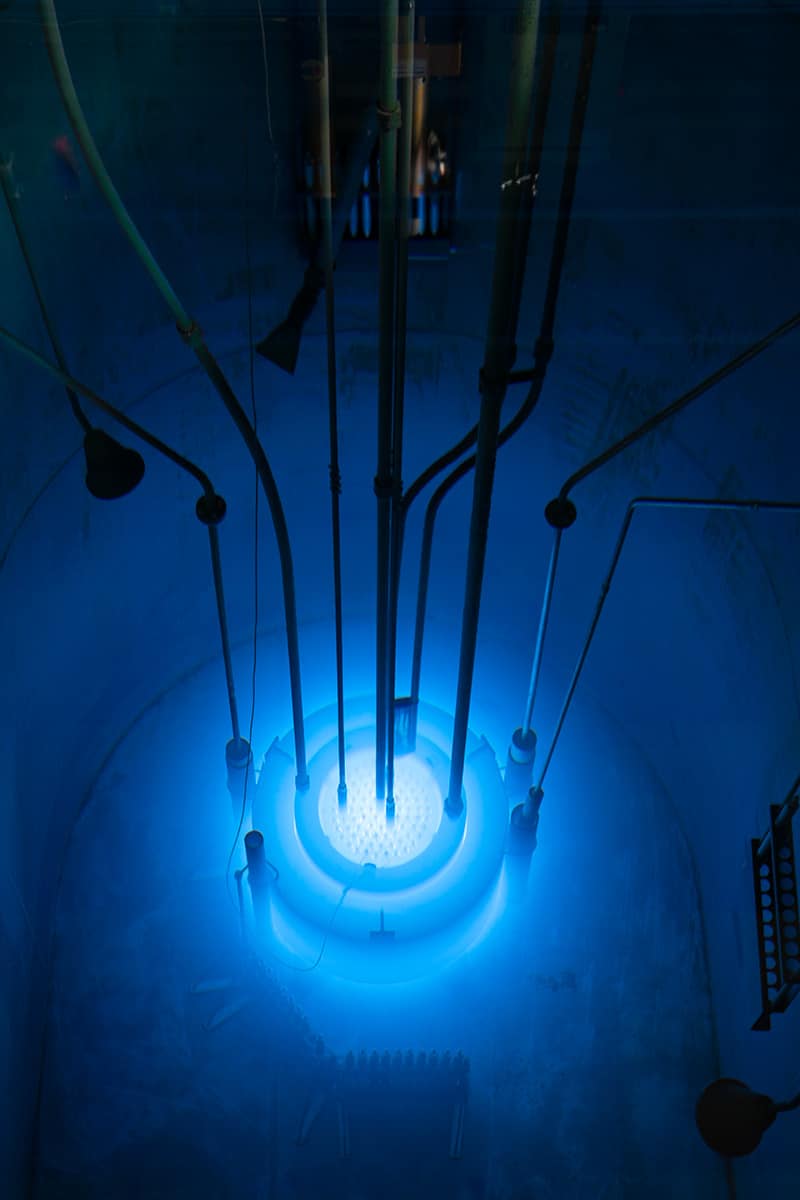
Toria Ellis stands over the pool and shuts off the lights. A half-dozen high-school students from a nearby Roman Catholic girls school gape down at the luminous blue glow that suddenly appears at the bottom. The glow reveals an object that looks like a futuristic car tyre, with a pockmarked white hub surrounded by two rings. “That’s the reactor core,” says Ellis. “The glow is called Cherenkov radiation.”
Look and learn The luminous blue glow of the Reed Research Reactor is due to Cherenkov radiation. It is an “open pool” reactor, meaning that visitors can see the glow with their own eyes. (Courtesy: Toria Ellis)
I’ve travelled to Reed College – a small, prestigious and progressive liberal-arts institution in Portland, Oregon, US. Located in an environmentally conscious city, Reed is unique in being the only purely undergraduate institution that has a reactor operated by students. The Reed Research Reactor has been running continuously since 1968 – a fact that the college proudly advertises on its website.
Ellis, a physicist who is the reactor’s operations manager, uses a laser pointer to highlight features for the visitors. “See that matrix of holes in the centre? They’re for the fuel elements.” The dot moves outwards to the inner ring. “That ring’s for samples to be irradiated. The outer ring is the graphite moderator.” Ellis sweeps the laser dot up and down some pipes. “These are for the control rods, those for experimental samples and detectors.”
As the students watch on, Ellis explains that shutting down a reactor is called “scramming”. Ellis says the term dates back to the first reactor built by Enrico Fermi at the University of Chicago in 1942, where the emergency switch-off method consisted of a control rod attached to a rope. Someone stood by ready to chop the rope with an axe if the rod failed: “scram” is supposedly an acronym of “Safety Control Rod Axe Man”.
Ellis then asks Irina, one of the students, to make a chopping gesture with their hands – the Reed reactor’s scram signal. On the other side of a large window is Vee, a 19-year-old Reed maths and physics student who is the operator on duty in the control room. Vee pushes the scram button, and the blue glow disappears. Almost; its haze lingers a few seconds. Ellis then turns the lights back on.
Open for all
The Reed Research Reactor is one of the few “open pool” nuclear reactors in the world, where you can peer down from the edge and see the Cherenkov glow. It’s also the only reactor anywhere, as far as I know, where they let visitors initiate a scram. What’s unusual too is the diversity of the students who operate the reactor.
Virtually all Reed students receive their reactor operator licences before they are legally permitted to drink (21 in Oregon) and many before they have even learned to drive a car. Stephen Frantz, a former head of Reed’s reactor, told me he once attended a conference of research-reactor directors where one lab boss proudly announced that the average age of his operators was just 50. Frantz made his audience’s jaws drop by saying that, at Reed, the average was 20.
Power to the people A physicist by training, Toria Ellis (left) is operations manager of the Reed Research Reactor. The facility is operated by students such as Meng-Wei Chen (right), who is currently doing a bachelor’s degree in physics at Reed. (Courtesy: Michelle O’Shea; Jerry Newhouse)
Reed’s licensed reactor operators are also unique in that men are a minority. On my visit, Reed students boasted that their reactor operators include more women, and more gender non-conforming people, than at all other research reactors in the US combined. Thanks to Reed’s reactor operators, the Nuclear Regulatory Commission (NRC) no longer questions anyone who wants to change their names from one gender to another on their licences.
The reactor currently has 34 student operators, plus Ellis and current reactor director Jerry Newhouse. But the operators aren’t just those taking science, engineering, technology and mathematics (STEM) subjects: about half are studying non-STEM subjects entirely. On my visit, I met operators majoring in economics, philosophy and studio art. Newhouse himself has a bachelor’s in history.
Some students come to Reed specifically because they want to be reactor operators. Others learn about the opportunity only after starting their studies or by word of mouth. It’s not a shoo-in though. Prospective operators have to take a year-long licensing class and pass a rigorous test administered by the NRC, which oversees the reactor as strictly as it does any other.
They get paid for their services, too. It’s not much – they earn only a bit more than minimum wage – but being a reactor operator is certainly the coolest job on the Reed campus. A common thread of all the operators I encounter is that they are hooked by the blue glow. “It never gets old,” one tells me.
TRIGA happy
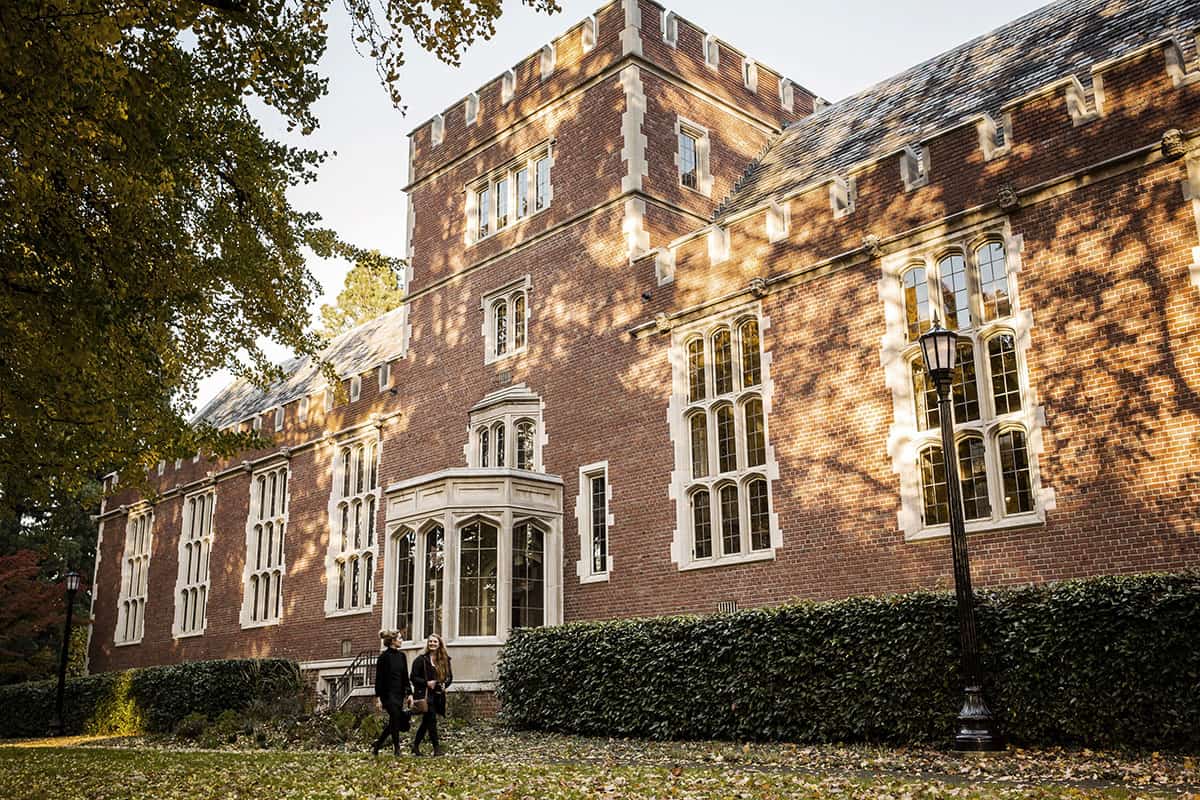
Reed was founded in 1908, and its brick, Tudor-gothic, ivy-covered buildings, surrounded by lawns on one side and a nature reserve and wooded canyon on the other, were modelled on St John’s College, Oxford. The reactor, though, is in a nondescript, single-storey concrete-and-brick garage-like structure next to the psychology building and opposite the chemistry lab. One room houses the pool/reactor, visible from the control room on the other side of a large window. Nearby is a classroom and a radiochemistry lab.
Building the reactor involved a serious trade-off. But Arthur Scott insisted that it was essential to a liberal-arts education
The idea that the college should build its own reactor came from Reed chemist Arthur Scott in the early 1960s (J. Chem. Ed.47 612). His plan was resisted by some staff, who felt the resources of the college – which still does not have an engineering department – were better spent on developing a degree in ethnic studies and supporting students of colour. Building the reactor involved a serious trade-off. But Scott insisted that reactor education was essential to a liberal-arts education. Reed’s trustees approved, and the reactor opened in 1968 at a cost of $321,000.
In terms of spec, it is a non-power “TRIGA” research reactor, designed and manufactured shortly after the Second World War by General Atomics. The core, which sits under 95,000 litres of cooling water, contains about 80 fuel elements in a circular grid array. The elements are made of zirconium hydride and uranium hydride, with the 20% enriched uranium-235 making up 8% of the mass of each element.
According to simple nuclear physics, neutrons of a certain velocity cause uranium-235 nuclei to split into pieces and release more neutrons. The outer, graphite ring that Ellis had pointed out reflects the neutrons back towards the core and slows or “moderates” them sufficiently to cause more uranium-235 nuclei to split, producing more neutrons. And so it goes.
By the standards of national lab facilities, the Reed reactor is a toy. Its 250 kW power is a tiny fraction of what’s found at, say, the Institut Laue–Langevin in France or the Oak Ridge National Laboratory in the US (60 and 85 MW, respectively). It’s also next to insignificant compared with commercial power reactors that supply electricity to national grids, some of which have outputs of over 1000 MW.
But the Reed reactor is used for real experiments. The ring inside the reflector is a rotating “lazy susan” holder that allows samples – metals, seeds, other materials – to be irradiated. There’s also a thimble – basically a pipe about 8 m long and 3 cm wide – leading into the core, allowing samples to be left for long exposures.
Then there’s the “rabbit” – a pneumatic device for short exposures, which shoots samples in and out of the core to a radiochemistry lab just behind the control room. Reed students are currently developing the thimble pipe to eventually allow a neutron beam to pass through to create another experimental facility at the bridge over the pool.
Portland’s high school, college and university students, as well as some local businesses and agencies, use the reactor for activation analysis. This involves putting water, soil or plant samples into one of the experimental facilities and exposing them to neutrons. Doing so “activates” – creates radioactive isotopes in – some of the samples, and the half-lives of the resulting isotopes help identify the materials.
Activation analysis has many uses, including testing for contaminants and identifying where the material in a sample is from. One Reed student’s project involved activating pottery shards and soil samples taken from the Silk Road in Western China to determine where the pottery was made. Another student got into forensics by irradiating fingernail clippings to see if you can tell which finger a wedding ring was on from the traces of gold in the clippings. (You can.)
One Portland dentist even sent in the material used to fill teeth, curious to know if its content was as billed. When the sample emerged from the pneumatic tube, it set off all the radiation monitors in the radiochemistry lab, alarming the students. Turns out the sample was largely silver, which is highly activating. The activated silver wasn’t hazardous, containing two isotopes with half-lives of 25s and 144s. Still, I’ll exercise greater caution the next time I put my teeth inside a reactor core.
Youngsters and pranksters
Reed College fully supports the reactor, meaning that it does not have to depend on outside funding. Reactor operators do sometimes conduct work for private labs – not for money, but in exchange for providing research opportunities for other students. They have, however, refused projects from companies involved in fracking, and the week before my visit, they turned down a military-defence contractor.
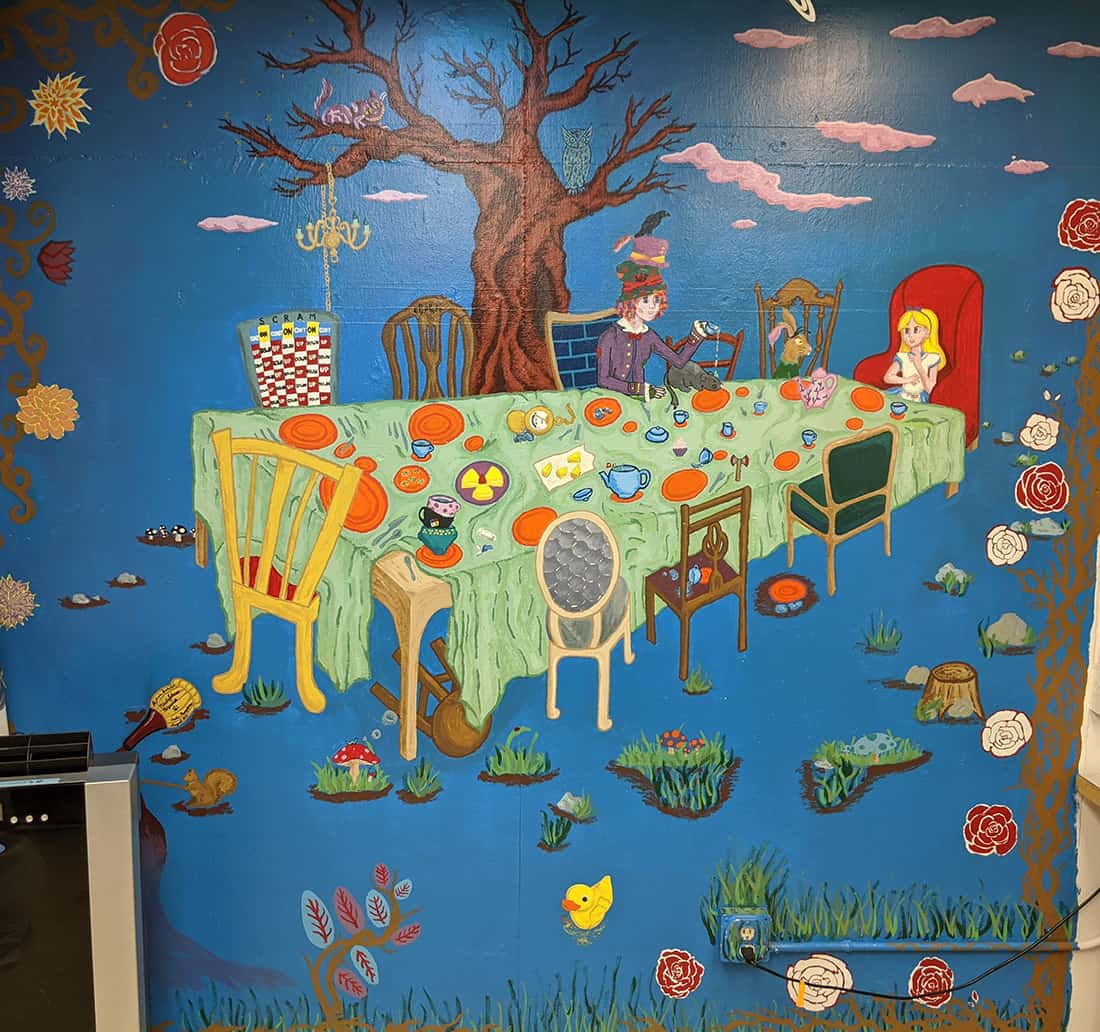
Different world No ordinary nuclear facility, the Reed Research Reactor includes this Alice’s Adventures in Wonderland themed mural on the wall of the control room, painted by a former operator who was an art student. (Courtesy: Jerry Newhouse)
I find the atmosphere at the reactor to be industrious and serious, as you’d expect from a lab, but mixed with the playfulness and liveliness of college students. One wall of the control room has an Alice’s Adventures in Wonderland themed mural painted by a former art-student operator. It depicts a picnic, dotted with reactor imagery: cheese slices arrayed as a radiation symbol, a stopwatch indicating counts per minute rather than time, and plastic plates coloured uranium-glaze orange.
A big sign in another room outlines safety procedures, and scrawled underneath is the advice: “You look cooler wearing a lab coat anyway.” The reactor’s logo is a griffin – Reed’s mascot – emblazoned over the image of a Bohr atom. For many years operators placed rubber ducks in the reactor’s pool, allowing them to eyeball the water flow; if the ducks were swimming around it meant that the water was circulating. Sadly, one year a new NRC inspector said the ducks had to go. “He was probably right,” Frantz admits. “I should have filled out a 50.59 [an NRC form].”
Another time a student crafted a mock certificate with the official NRC logo and signatures declaring Reed’s facility “The funnest reactor in the US” and hung the certificate on the wall. It had to be removed after the next NRC inspection. “Learning limits is part of student education,” Newhouse reminds me.
School for scandal
It’s not been entirely plain sailing for the Reed Reactor, especially as the state of Oregon has long resisted reactors. The Trojan Nuclear Power Plant, the state’s only commercial nuclear-power facility, started operation in 1975 and closed in 1992 after some technical issues, and vigorous and ongoing anti-nuclear protests and lawsuits. Yet Reed’s reactor has remained curiously uncontroversial, despite occasional breathless coverage in the local media of minor safety events.
In November 1991, for instance, the reactor was irradiating samples for three projects: a high-school project looking for traces of selenium in sediment; a Master’s thesis at a nearby university looking at geological samples in Oregon’s hot springs; and a PhD project testing air-filter samples. A small amount of gaseous fission products was released, triggering alarms on facility radiation monitors.
The reactor was shut down, but the reason for the release could not be determined. Even after the NRC let the reactor restart a few weeks later, hoping to locate the cause, it could not be found. The agency then allowed the reactor to return to normal operation – and the release never reappeared. The NRC formally labelled the episode an “unusual event.”
Despite being the go-to person for journalists seeking an angry quote, the only danger Lloyd Marbet could point to was the longevity of the Reed reactor
When local TV networks reported the incident, reporters scoured the campus and the surrounding neighbourhood seeking someone – anyone – who was truly concerned. One station contacted Lloyd Marbet, a vehement anti-nuclear activist and a central figure in the campaign to close the Trojan reactor. Despite being the go-to person for journalists seeking an angry quote, the only danger he could point to was the longevity of the Reed reactor. “All components age over time,” he warned, darkly. In fact, the reactor will probably outlive the building.
Upon being told what had happened, Reed students responded by designing and making T-shirts bearing the slogan “UNUSUAL EVENT”. (I tried to find one, but couldn’t trace anyone who keeps three-decade-old T-shirts.) “That probably sums up the cultural place of the reactor on campus,” one student tells me. A 1991 editorial about the event in The Oregonian, the state’s major newspaper, simply announced: “Reed passes the test”.
Later, in 2005, ABC’s Primetime news-magazine show sent a team of journalism graduate students around the US to report on how easy it was “to infiltrate nuclear reactors on college campuses…filled with just the kind of radioactive materials that terrorists want”. When members of the team got to what ABC called “the laid-back campus of Reed College”, they apparently could not find the reactor (who’d have thought it was behind the psychology building?) but did turn up a damning fact: Reed does not have a nuclear engineering department, or even any engineering department.
Scandalized, ABC’s national chief investigative correspondent Brian Roth dropped this bombshell finding on an unsuspecting NRC representative, demanding to know why they allowed a reactor at such a place. “What’s the useful purpose [of a reactor] at Reed?” Roth demanded, in a tone that implied it was like giving dynamite to children.
More than two decades on from the ABC report, I ask operators what they’ve learned from the reactor. “Problem-solving and communication,” says Vee, the maths-physics major who was on duty during the high-school tour I observed. “Of two kinds, scientific and social. You have to figure out how to handle and talk to different sets of people who are sometimes uncooperative on tours. You have to handle questions about meltdowns and terrorism.”
Auden, 19, another operator, says the reactor engenders confidence and good time-management. “The first times you operate you think, ‘Oh my god I’m operating a nuclear reactor!’ but the anxieties wear off and there’s continuous learning,” Auden says. “Also, you are responsible and there’s a lot of things to manage inside and outside the reactor. Time’s a valuable but limited resource. You have to be able to say ‘No’ to things. Set work–life boundaries.”
“Teamwork and trouble-shooting,” adds Meng-Wei, 21, a physics student working on the theory of open quantum systems. “It’s a big team with people of different skills where there may be a level of danger. You have to trust co-workers. You have to be able to challenge someone about safety – even your supervisor – if you feel uncomfortable, and also learn to be challenged.”
Meng-Wei also credits the reactor with helping her to react coolly to mistakes and surprises, and cope with anger and stress. “This is not the sort of thing you learn in an undergraduate class, or even a lab setting,” she says. When Meng-Wei applied last summer for an internship at Fermilab doing dark-matter research, the first thing the interviewer said was “You’re the one who worked at a reactor!” She got the job.
As for Johnny, a 22-year-old philosophy student interested in sustainability and global warming, the reactor is all about “negotiating idealism and practicality”. Johnny tells me that while nuclear-reactor training may not be directly philosophical, it has given him practical experience in making trade-offs between the ideal and the real.
“It’s the kind of choices we have to make to cope with global warming,” he says. “It also gives me a first-hand account of what working in nuclear technology is like.” Johnny’s experience puts him in a position to speak to others about the rigour, precision, care and importance of science, and of nuclear technology.
The critical point
Reed is a utopian bubble. Its reactor is a protected scientific facility in a place where nuclear fear is banished, science education is integrated with the humanities, and students operate a reactor while also reading Homer and Kant, performing Shakespeare and Brecht, and studying race and gender issues. Any pressure to close the reactor would not come from politicians or anti-nuclear activists but would have to come from Reed’s board of trustees.
Progressive thinking Modelled on St John’s College at the University of Oxford in the UK, Reed College in Portland, Oregon, is a liberal-arts institution founded in 1908. (Courtesy: Leah Nash)
One factor that makes this possible is that the reactor is small and harmless. I hear Reed students say that it has no more power than a washing machine and generates just enough heat to scramble eggs. That’s an exaggeration, but not by much; while the reactor core is about the size of a large washing machine, it produces about 10 times the heat of a home heating furnace. “They gave it to us because they know we can’t do anything bad with it,” says Ellis.
Another reason for the reactor’s success is that Reed encourages creative thinking, and integrates the reactor into the campus curriculum and culture. Those who operate it must learn a wide range of physics, work in interdisciplinary teams on a complex device, participate in a scientific project, and become familiar with the values of a scientific community. After the 1991 incident, Reed’s president briefly considered closing the reactor, but his office was promptly swamped by students of all majors who said that it had changed their lives.
Reed has an open campus. Its gracious large front lawn is an uninterrupted community space where both students and neighbours walk dogs, play on tennis courts and then wander through the trails in the gorge, where they can see Portland’s only fish ladder for salmon to swim upstream. The reactor itself does not look intimidating – there’s no menacing cooling tower belching steam – but is a pool inside a one-storey building.
Reed is fully transparent about the reactor, which is a great asset in a reputable institution. The college gives about 100 tours a year. Visitors are taken to the edge of the pool – whose water is 10,000 times purer than drinking water – and see the core and the unforgettable blue glow. That glow should be a universal part of undergraduate education. If anything’s scandalous about Reed’s reactor, it’s that more liberal-arts colleges and universities don’t have one.
Over the past half century, laser cooling has revolutionized atomic, molecular and optical physics. Laser cooling of atoms and ions has enabled dramatic leaps in the precision of atomic clocks, allowing new tests of fundamental physics and potential improvements in clock-based navigation via the Global Positioning System. Now it is also laying the foundations for quantum computing with atoms and ions.
In this episode of Physics World Stories, you can enjoy a vibrant tour through the history of laser cooling with Chad Orzel, a popular-science author and researcher at Union College in the US, who is in conversation with Andrew Glester. Orzel describes the key research breakthroughs – which have led to several Nobel prizes – but also the personal stories behind the discoveries, involving physics titans such as Hal Metcalf, Bill Phillips and Steven Chu.
You can learn more about this topic via a trilology of features that Chad Orzel has written for Physics World. The final instalment will be available in January and you can already read the first two articles:
Frequency combs – specialized lasers that act like a measuring stick for light – are commonly used to identify unknown molecules in a sample by detecting which frequencies of light they absorb. Despite recent advances, however, the technique still struggles to record spectra on the nanosecond timescale characteristic of many physiochemical and biological processes.
Researchers at the US National Institute of Standards and Technology (NIST) in Gaithersbury, Maryland, Toptica Photonics AG and the University of Colorado, Boulder have now addressed this drawback by developing a frequency comb system that can detect specific molecules in a sample every 20 nanoseconds. Their feat means that the technology could be used to resolve intermediate steps in fast-moving processes, such as those occurring in hypersonic jet engines and protein folding.
Detecting molecular fingerprints
In the new work, NIST project leader David Long and colleagues generated two optical frequency combs in the near-infrared region of the electromagnetic spectrum using electro-optic modulators. They then used these combs as the pump laser for a device known as an optical parametric oscillator which spectrally translates the combs into the mid-infrared. This translation is important because the mid-infrared region is home to so many strong light absorption features (particularly in biomaterials) that it is known as the “fingerprint region”. The combs’ high power and coherence, together with the broad spacing of their frequency “teeth”, allows these molecular line shapes to be recorded at high speeds.
As well as being highly effective, the new set-up is also relatively simple. “Many other approaches for dual comb spectroscopy in the mid-infrared required two separate combs that have to be tightly locked to one another,” Long explains. “This means a greatly increased experimental complexity. What is more, earlier techniques generally did not have as a high a power or the possibility of tuning the comb spacing to sufficiently large values.”
This widely-spaced tuning is possible, Long adds, because the new electro-optic comb only has 14 “teeth”, compared to thousands or even millions for conventional frequency combs. Each tooth thus has a much higher power and is further from the other teeth in frequency, which results in clear, strong signals.
“The flexibility and simplicity of the new method are two of its major strengths,” he tells Physics World. “As a result, it is applicable to a wide range of measurement targets, including chemical kinetics and dynamics, combustion science, atmospheric chemistry, biology and quantum physics studies.”
Supersonic CO2 pulses
As a test, the researchers used their setup to measure supersonic pulses of CO2 exiting a small nozzle in an air-filled chamber. They were able to measure the CO2/air mixing ratio and observe how the CO2 interacted with air to create oscillations of air pressure. Such information could be used to better understand processes occurring in aircraft engines and so aid the development of better ones.
As a follow-up to these experiments, which are detailed in Nature Photonics, the researchers say they would now like to study other scientifically interesting chemical systems.
Magazines have been an effective method of communication since their introduction in the 17th century. They now encompass an endless variety of topics and disciplines from pigs and cranes to trains and, of course, science. Science magazines are an integral part of science communication to the public, with popular-science magazines drawing reader figures above the hundreds of thousands per year across both digital and physical issues.
Digital magazines are becoming increasingly popular and can help make magazines more accessible such as the text being read aloud to readers or having it enlarged for people with visual impairment. However, that accessibility doesn’t necessarily lead to inclusivity, with research showing that science magazines are read mostly by male readers. This is in line with the wider gender gap in science, which sees men being invited to submit papers at twice the rate of women and male-authored papers having a higher impact factor than papers authored by their female colleagues.
Deciding to buy a magazine as a one-off purchase is a complex psychological process that is not well understood but involves readers judging the cover by its image choice, layout, topic, colour and visibility. We explored what could influence this process by analysing the digital readership databases for over 100 covers of the astronomy magazine All About Space, which is published by Future Plc and aimed at non-scientist lay readers. Future gave us access to the magazine’s online database, which included information such as the gender of readership (provided by readers when they subscribe).
In terms of the number of people who open a digital copy of All About Space on the website, the magazine has a digital readership of about 1100 people per month, with an average female readership of 11.1%. We then examined how readership is affected by the themes that appear on the magazine’s cover.
Research suggests that having a question on the front cover can draw people in to find out more and we found that this is the case with overall readership increasing by 13%, on average, while having the theme of ‘”sci-fi” on the cover or in the title also resulted in a higher-than-average overall readership with an average of 1268 readers (see below image for all subject themes that we examined). Neither of these factors, however, increased the proportion of female readers.
One theme that did impact the number of women readers was, somewhat surprisingly, having a main theme of “stars” on the cover, which resulted in a lower-than-average percentage female readership at just 8.8% (and the lowest total reader number). So what did boost the average number of female readers? Research suggests that people tend to select role models of the same gender so one might think that having an image of a woman somewhere on the cover would boost the proportion of women readers. Yet while a woman on the cover increased overall readership by 9.6%, on average, it didn’t do much to encourage proportionally more women to read the magazine. We suspect that potential readers are not necessarily seeing the smaller images of people on the cover as role models.
What’s in a cover? Jemima Coleman and Wendy Sadler looked at over 100 issues of All About Space magazine for their study. They compared the theme of the main cover image with that issue’s overall readership number and the proportion of those readers who are women. (Courtesy: Jemima Coleman and Wendy Sadler)
When a male scientist or person was the subject of the cover feature, however, we saw the highest overall percentage female readership, with an average of 15.9%. This theme was also one of the most popular overall, with an average of 1213 readers. Of the 100 or so covers studied, there were no examples where a woman was the main subject of the cover, which is disappointing. It’s therefore hard to say if the popularity of the male scientist theme is gender-specific, or due to the inclusion of any person-focused content, or because the featured men were simply well-known celebrity scientists such as Brian Cox or Dara Ó Briain.
Yet this lack of female science celebrity points to a wider systemic cultural issue.
Effective science communication depends on considering the audience being communicated with, including how minoritized communities are represented and supported. As scientists, we want to be inclusive in how we communicate with the whole community, including newcomers or those who are still finding their place in science. We hope that magazine publishers feel a responsibility to ensure the accessibility and inclusivity of science to people of all ages, both in and out of the community. Understanding how to increase magazine readership includes trying to appeal to new audiences without losing existing ones.
Magazines should be aware of readership biases and make conscious and intentional choices about the people featured on the cover to challenge these biases. Including more non-stereotypical images and inclusive content would help attract a diverse readership and in turn help to diversify science more generally. After several decades of marginalized groups such as women, people of colour, disabled people and queer communities being systematically excluded from physics, they deserve content that is made for them and about them.
Independent patient QA and secondary dose calculations are key to safe, consistent and efficient radiation delivery within the high-dose-rate (HDR) brachytherapy programme at University Hospitals Birmingham NHS Foundation Trust, a healthcare network serving the West Midlands region of the UK. With this in mind, the Birmingham radiation oncology team has, for the past decade, relied on LAP’s RadCalc QA secondary check software – a suite of widely deployed QA tools that provides medical physicists and dosimetrists with fully automated and independent dosimetric verification of their radiotherapy treatment planning systems (TPS) – for the immediate validation of its brachytherapy plans.
For context, HDR brachytherapy involves the clinical application of radioactive isotopes to deliver therapeutic radiation to internal or superficial tumours – a targeted procedure that allows a higher dose of radiation to the tumour site before or after surgery. In the case of interstitial delivery, the radioactive source (Ir-192, for example) is placed directly into the tumour target, while contact brachytherapy requires placement of the source in a space adjacent to the target tissue (in an internal cavity, for example, or externally on the skin). Either way, HDR brachytherapy is a highly conformal radiation treatment that requires precise planning and verification to avoid collateral damage to healthy tissues and adjacent organs-at-risk (OARs) – including the bowel and the bladder in the case of HDR treatment of gynaecological cancers.
“The first step [in HDR brachytherapy] is to insert empty catheters or applicators into the patient for delivery of the source from the treatment unit to the tumour,” explains Ruth Wyatt, lead physicist for brachytherapy at University Hospitals Birmingham. “Everything happens in one session: the applicators or catheters are inserted; scans are taken; the treatment is planned, checked and delivered. All of which means that speed and workflow efficiency are very important.”
Streamlined checks, workflow efficiency
Within University Hospitals Birmingham, HDR brachytherapy is currently used to treat around 100 patients each year. The programme is geared exclusively for gynaecological indications, although a roadmap for the clinical roll-out of HDR prostate brachytherapy is in place, with the start date dependent on staff recruitment and specialist training.
“We use RadCalc for independent dose-calculation checks of any non-standard plans generated by our Oncentra Brachy TPS [from Elekta],” says Wyatt. The RadCalc software installation also supports independent patient QA more broadly across Birmingham’s external-beam radiotherapy programme, including secondary dose checks on the CyberKnife stereotactic treatment system as well as dose verification of electron-beam therapy for the treatment of superficial tumours.
Safety first: the RadCalc software platform provides medical physics teams with independent patient QA. (Courtesy: LAP)
In daily clinical practice, RadCalc provides an independent check of the standard “Point A” dose points entered for each HDR brachytherapy treatment plan; also at points 5 mm lateral to the ovoid applicators (which deliver the radioactive source to the tumour) for all non-standard treatment plans. “All differences have been well within 1%,” says Wyatt. “In some cases, we also check dose at multiple points around the high-risk clinical target volume and differences are generally <0.5%.”
At a headline level, the upsides of RadCalc for Wyatt and her medical physics colleagues are clear to see. “The main benefit is the immediacy of those secondary-check results – essential for preventing errors in the planned delivery of HDR brachytherapy,” she notes. “We’ve set up a DICOM ‘listener’ to allow the export of treatment plans from the TPS followed by direct import into RadCalc. This means the brachytherapy QA workflow is extremely efficient and, by extension, so too is our patient throughput.”
The QA roadmap
Notwithstanding its importance for daily patient QA, RadCalc was also instrumental in the original set-up and commissioning of Birmingham’s Oncentra Brachy TPS (with RadCalc dose calculations for the Ir-192 HDR Flexisource based on the AAPM Task Group 43 brachytherapy protocol). “We carried out tests by creating a number of plans using single or multiple tandem and ovoid applicators in our TPS,” explains Wyatt. “The standard ‘Point A’ dose points were entered for each plan, along with several other test points.”
In this way, RadCalc automatically calculates the dose at each dose point based on the source activity exported from the TPS, displaying the result alongside the dose exported from the TPS (as well as the dose difference). “We found differences mainly <0.2%, except for positions very close to a source [inside an applicator], where they are of no clinical interest,” says Wyatt. “We also carried out independent manual checks for some plans. The dose differences here were slightly larger for plans containing both tandem and ovoid applicators, because the anisotropy of the dose distribution around the source was not taken into account in the manual calculations.”
As for the clinical roadmap at Birmingham, Wyatt and her colleagues also used RadCalc to independently validate dose calculations for ring-type applicators before they were brought into clinical use. What’s more, the team has road-tested a demonstrator version of RadCalc including the software’s 3D dose-volume functionality, exporting several clinical plans and their structure sets as part of an in-house feasibility study.
With the 3D dose calculations, RadCalc displays the dose-volume histogram (DVH) parameters exported from the TPS alongside its own independently calculated DVH parameters (although the RadCalc value imported directly from the TPS may differ slightly as it depends on the size of the dose grid selected). In addition, the ability to calculate a 3D gamma analysis is a valuable tool for plan evaluation.
“All RadCalc-calculated DVH doses for our clinical plans were within 2% of the TPS values,” concludes Wyatt. “Alongside the DVH comparison, the ability to send the planning CT images to overlay the critical structures also allows us to see the isodose lines within the anatomy.”