Deep-penetrating acoustic volumetric printing Design model (left), and top-view (centre) and tilt-view (right) photographs of a vessel network (82 x 68 x 1 mm) printed using sono-ink and 3.41 MHz focused ultrasound. (Courtesy: Qiangzhou Rong)
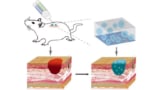
A team of US-based researchers has pioneered an innovative 3D printing technique that uses ultrasound waves to create objects from sonically cured inks. The new approach, dubbed deep-penetrating acoustic volumetric printing (DAVP), could potentially enable printing to be carried out inside the human body – paving the way for a range of minimally invasive procedures such as tissue engineering or targeted localized drug delivery.
Publishing their findings in Science, the researchers describe how they successfully used DAVP to perform 3D printing at centimetre depths through biological tissue and create intricate structures within a variety of different materials – thus demonstrating its effectiveness with materials like hydrogels and nanocomposites, which are crucial in biomedical applications.
As co-senior author Junjie Yao from Duke University’s Photoacoustic Imaging Lab (PI-Lab) explains, the newly created sonicated ink (or sono-ink) contains a mixture of polymers, particles and chemical initiators specifically designed to form a gel when the ink absorbs sound waves. When exposed to high-intensity focused ultrasound, these self-enhancing fluids solidify in precise patterns, enabling the creation of complex structures.
“This is achieved through the unique properties of the sono-inks, which are formulated for optimal response to ultrasound, enabling a deeper penetration at higher resolution compared to conventional light-based printing methods,” he says.
In situ fabrication A 3D bone model printed through 15-mm thick porcine belly tissue using sono-ink. (Courtesy: Qiangzhou Rong)
According to Yao, a key finding of the research is the discovery that the new technique overcomes the physical and optical limits of existing approaches to additive manufacturing, and enables users to “print at depths and in materials previously unachievable by other 3D printing methods”, in particular light-based approaches that are ineffective in opaque or optically scattering media.
The team also speculates that, amongst other things, the technique could help to treat bone defects through the in situ fabrication of artificial bone – and that printed materials formed with sono-ink could elute drugs, thus facilitating localized chemotherapy to prevent the recurrence of tumours after resection.
“[The technique] opens up significant potential applications in clinical and healthcare settings, such as creating scaffolds for tissue engineering, or targeted localized drug delivery systems within the body,” says Yao.
Improved patient outcomes
Elsewhere, co-senior author Yu Shrike Zhang, at Brigham and Women’s Hospital, Harvard Medical School, points out that the primary advantage of DAVP in clinical settings is its minimally invasive nature. In particular, he draws attention to the fact that the new technique can “potentially print biocompatible materials directly inside the body” and thus help mitigate the “invasive and risky” nature of many traditional surgical procedures.
“This could revolutionize treatments by allowing for precise, targeted interventions without traditional surgery, significantly reducing recovery times and improving patient outcomes. Additionally, the versatility in materials and the ability to work in opaque environments make it particularly suitable for varied medical applications,” he says.
Moving forward, Zhang confirms that the team plans to further refine the DAVP technique, with a particular focus on optimizing the sono-inks and the ultrasound printing technology to deliver even greater precision, versatility and biocompatibility.
“Collaborations with medical researchers are planned to explore the practical application of this technology in clinical and healthcare settings,” he adds. “We aim to develop prototypes for specific medical applications, such as regenerative medicine and targeted localized drug delivery, and conduct trials to evaluate their effectiveness and safety in a clinical environment.”
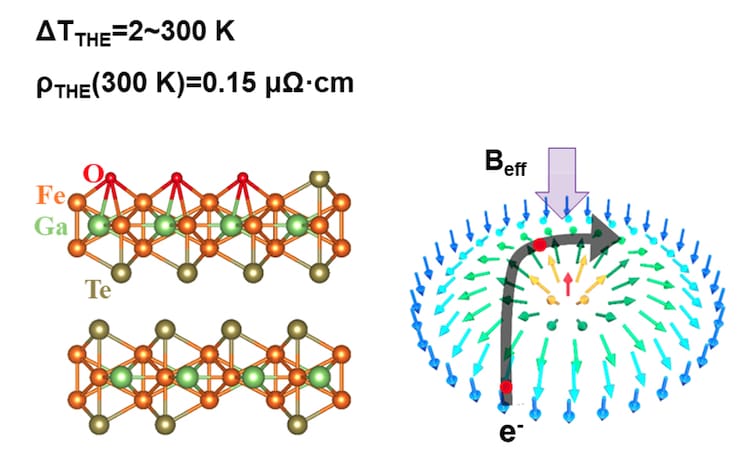
Stable skyrmions: First-principles calculations of the skyrmion-stabilizing Dzyaloshinskii–Moriya interaction in pristine (bottom) and oxidized (top) Fe3GaTe2-x enabled the team to understand why the skyrmions that form (right) are so robust. (Courtesy: H Chang)
Researchers in China have produced a phenomenon known as the giant skyrmion topological Hall effect in a two-dimensional material using only a small amount of current to manipulate the skyrmions responsible for it. The finding, which a team at Huazhong University of Science and Technology in Hubei observed in a ferromagnetic crystal discovered in 2022, comes about thanks to an electronic spin interaction known to stabilize skyrmions. Since the effect was apparent at a wide range of temperatures, including room temperature, it could prove useful for developing two-dimensional topological and spintronic devices such as racetrack memory, logic gates and spin nano-oscillators.
Skyrmions are quasiparticles with a vortex-like structure, and they exist in many materials, notably magnetic thin films and multilayers. They are robust to external perturbations, and at just tens of nanometres across, they are much smaller than the magnetic domains used to encode data in today’s hard disks. That makes them ideal building blocks for future data storage technologies such as “racetrack” memories.
Skyrmions can generally be identified in a material by spotting unusual features (for example, abnormal resistivity) in the Hall effect, which occurs when electrons flow through a conductor in the presence of an applied magnetic field. The magnetic field exerts a sideways force on the electrons, leading to a voltage difference in the conductor that is proportional to the strength of the field. If the conductor has an internal magnetic field or magnetic spin texture, like a skyrmion does, this also affects the electrons. In these circumstances, the Hall effect is known as the skyrmion topological Hall effect (THE).
For quasiparticles to be useful as platforms for two-dimensional (2D) spintronic devices, a large THE is highly desirable, but the skyrmions also need to be stable over a wide temperature range and easy to manipulate using small electric currents. Until now, making skyrmions with all these properties has been difficult, says team leader Haixin Chang.
“Most known skyrmions and the THE are stabilized in only a narrow temperature window either below or above room temperature and require high critical current manipulation,” he tells Physics World. “It is still elusive and very challenging to achieve a large THE with both a wide temperature window up to room temperature and a low critical current for skyrmion manipulation, especially in 2D systems suitable for electronic and spintronic integrations.”
Robust 2D skyrmion THE
Chang and colleagues are now reporting a 2D skyrmion that seems to fit the bill. Not only does the THE they observe remain robust over a temperature window spanning three orders of magnitude, it is also very large, measuring 5.4 µΩ·cm at 10 K and 0.15 µΩ·cm at 300 K. This is between one and three orders of magnitude bigger than previously reported room-temperature 2D skyrmion systems. And that is not all: the researchers found that their 2D skyrmion THE can be controlled with a low critical current density of around just 6.2×10⁵ A·cm-2. The researchers say this was possible due to the high-quality samples they fabricated (which have a finely-controllable 2D ferromagnetism), plus their precise quantitative analyses of the THE electrical measurements.
Chang thinks the team’s work paves the way for room-temperature electrically-controlled 2D THE and skyrmion-based practical spintronic and magnetoelectronic devices. “Room-temperature electrical detection and manipulation of skyrmions by the topological Hall effect are promising for next-generation low-power spintronic devices,” he says.
Where the effect comes from
The team also delved into possible reasons for the robust giant 2D skyrmion THE they observed. Based on their theoretical calculations, they found that the natural oxidation of the Fe3GaTe2-𝑥 ferromagnetic crystal they studied enhanced a known skyrmion-stabilizing magnetic effect called the 2D interfacial Dzyaloshinskii–Moriya interaction (DMI). Hence, by carefully controlling the natural oxidation and thickness of the Fe3GaTe2-𝑥 crystal, they formed a reliable oxidation interface with a sizeable interfacial DMI, and showed that they were able to produce a robust 2D skyrmion THE within a wide temperature window. This is no easy task because excessive oxidation can cause the structure of the crystal to degrade, while insufficient oxidation makes it hard to form a large interfacial DMI. Both extremes tend to hinder the formation of skyrmions and thus the THE.
“Our group has been studying magnetism in 2D crystals since 2014 and we have developed many new magnetic crystals, including the one studied in this work,” says Chang. “Both skyrmions and the topological Hall effect are very interesting topological physical phenomena that are typically observed in some magnetic systems, but which have a lot of intrinsic limitations for practical applications.
“We conducted this study to try and overcome these limitations in traditional magnetic materials.”
The researchers say their work, which is detailed in Chinese Physics Letters, could lead to a general methodology for tuning 2D DMI for spin transport control in 2D ferromagnetic crystals. “It also proves that oxidation can be used to induce a giant 2D THE much better than heavy metal and other so-called strong spin-orbit coupling compounds traditionally employed,” Chang says.
The Huazhong team is now looking into making racetrack memories and logic gate devices based on their 2D skyrmion systems for high-speed and high-density data storage, logic operation and what the researchers call “new-concept quantum computation”.
Over the past few years I have spent more time in my native Canada, where I do enjoy a visit to the supermarket (Fortinos is my favourite). Like in many countries outside of the UK, Canadian supermarkets display apples and oranges in mounds with steep slopes. Indeed, I am often worried that picking the wrong apple from a display will start an avalanche that could engulf me in fruit.
The team’s calculations and simulations suggest that when the slope is very steep, removing just one piece of fruit can lead to collapse. At the other extreme, very gentle slopes never collapse regardless of how much fruit is removed. No surprise there, and it’s the intermediate range of slopes where things get interesting. The team found that in this range, an avalanche occurs after about 10% of the apples are removed.
This, of course, is very important information for people who stock the produce sections of supermarkets – although I suspect that they already know this.
Costly diversions
Despite modern radar systems and satellite imagery, there are still two or three serious incidents involving ships and icebergs ever year in the northern hemisphere. Some of these encounters result in severe damage to vessels and ships being abandoned. And even if a collision does not occur, an unexpected encounter with icebergs can lead to a costly diversion – as could false detections.
Now, two astrophysicists at the UK’s Lancaster University have developed an artificial intelligence (AI) system that uses satellite data to identify icebergs and track their motions. The technology has been adapted from a technique that uses AI to search for and characterize clusters of galaxies in large areas of the sky.
Lancaster’s John Stott and Matthew Chan are now working with the university to commercialize the technology – with help from a £300,000 award from the UK’s Science and Technology Facilities Council.
“We looked to apply our technique to areas beyond astrophysics and the vision for this project is to further develop our automated iceberg and sea ice detection system, such that it can be used as a commercial product,” says Stott.
They say that their system has a 94% success rate and works under any sort of cloud cover. It does this by identifying icebergs and sea ice in satellite images taken using large-area synthetic-aperture radar (SAR). When the commercial system is up and running, the locations of potential hazards will be shared with clients in the maritime industry – including merchant shipping, fishing, tourist vessels and shipping insurers.
The UN’s COP28 conference in Dubai is over. Government delegations have shaken hands, packed up and flown home. Journalists, lobbyists and campaigners have filed their last report, eaten their last canapé and filmed their final despairing or cautiously hopeful videos for social media.
For the rest of us with an interest in the future of the planet, the question now is, did the meeting make a difference?
And for physicists, the question is the same as the Institute of Physics (IOP), which publishes Physics World, posed in its recent report Physics Powering the Green Economy: will physics-powered technologies and physics-based businesses be recognized and supported as being at the heart of the solution?
In fact, we thought this was such an important issue that we took the report to the summit and posed this question there.
We’re worried because physicists are worried. When we asked IOP members as part of the report whether they think the UK is doing enough to address climate change, some 83% said “no”, with 68% thinking that the current level of investment in research and development in the UK is too low to deliver the kind of growth we need in the green economy, which is essential to deliver net-zero targets.
So now the talking is over, has the COP agreement moved the dial on any of that?
The final agreed text was hailed as “historic” by its supporters given that it calls – for the first time – for a “transition away” from fossil fuels (although you would be well within your rights to wonder why that has taken so long).
But detractors point to multiple potential “loopholes” with little by the way of hard deadlines. It includes a discussion of transitional fuels such as liquified natural gas but a lack of acknowledgement over the importance of carbon-capture technologies. Some see this as providing opportunities for backsliding and evidence for the influence of vested interests.
For the IOP and the physics community, it feels that the first global commitment to transition away from fossil fuels warrants a cautious welcome. So does the reiteration of the importance of achieving net-zero by 2050 and pledges from the US and China to keep the 1.5 °C ceiling commitment alive.
It’s great to see the physics-powered technologies that the physics community have highlighted right at the heart of the global solution
That’s partly because these measures should provide those investing or working in the green economy with confidence that there will be a demand for their solutions. That will help to stimulate investment and growth in such areas.
This matters as it is businesses that will deliver the needed change at scale and pace. Indeed, the UK’s physics-based green-economy businesses are already a substantial and growing economic force. Our research shows that the 1772 businesses across the UK and Ireland that deliver green-economy technologies turn over nearly £750bn.
The key point in the agreement for physicists is likely the recognition that technology can play a role in tackling the problems we face.
The final text calls for action on a list of “zero- and low-emission technologies” including renewables, nuclear, carbon capture and storage technologies, and low-carbon hydrogen production.
The IOP report highlights almost the same list of technologies, so it’s nice to see the COP deal text agreeing with the views of the physics community. Not least because our analysis shows that 72% of recent funding for these technologies from UK Research and Innovation is related to physics.
Of course, the agreement could have been stronger and missed things the physics community feels are important. Our report finds, for example, that energy storage is a technology requiring support, but it is not specifically mentioned in the COP deal text.
It is also important to stress that there is no single silver bullet solution to the climate problem, no moonshot technology to save the day, so we will need everything in our technological and scientific armoury to move the dial on climate change.
The COP28 deal, with all its flaws, shines a light on the pivotal role that physics can play in developing and delivering climate solutions
But there’s much to celebrate. It’s great to see physics-powered technologies that the physics community has highlighted right at the heart of the global solution. It’s welcome that ambition is maintained and increased – to give the market the confidence to invest for the long term – to grow and contribute to our economy.
Ultimately success or failure on the climate crisis will be determined by how quickly technology is improved through R&D and deployed by businesses.
The UK and Ireland continue to aspire to be at the forefront of this global effort. So what we now need is a renewed strategic ambition in the UK and Ireland, with physics at its heart. This includes investing in improving and deploying core technologies, supporting green-economy businesses to grow and trade internationally, as part of a broader “systems approach” to show international leadership and to make the most of the potential the deal offers.
The COP28 deal, with all its flaws, shines a light on the pivotal role that physics can play in developing and delivering climate solutions.
It’s up to us now to consider whether we are making the most of the potential of physics to power the green economy – to utilize the growing power of this physics-powered sector, to address our greatest challenge.
The Acoustics 2023 Sydney conference, co-hosted by the Acoustical Society of America and the Australian Acoustical Society, brought together acousticians, researchers, musicians and other experts from around the world to share the latest developments in the field. Several of the presented studies described innovative applications of acoustics in healthcare, including the use of acoustic cavitation for needle-free vaccine delivery, and a wearable ultrasound transducer that tracks muscle dynamics during recovery from injury.
Aiming to circumvent the fear of needles suffered by many adults, and many more children, Dunn-Lawless and colleagues are exploiting an acoustic effect called cavitation, in which a sound wave causes the formation and popping of bubbles. When these bubbles collapse, they release a concentrated burst of mechanical energy.
The idea is to use these energy bursts in three ways: to clear passages through the outer layer of dead skin cells and allow vaccine molecules to pass through; to actively force vaccine molecules into the body; and to open up cell membranes inside the body. To enhance the cavitation activity, the researchers employed nanometre-sized particles called protein cavitation nuclei (PCaNs) – essentially cup-shaped protein particles – to support the gas bubbles.
In tests on mice, the researchers compared the immune response generated by standard intradermal vaccination of a DNA vaccine versus the cavitation approach. For cavitation-based delivery, they mixed PCaNs with the DNA vaccine in a chamber placed on the animal’s skin and exposed to ultrasound for two minutes.
They found that conventional injection delivered several orders of magnitude more vaccine molecules than the cavitation approach. “However, this is where things get interesting,” explained Dunn-Lawless at a press conference. “When you look at the immune response generated by both of these delivery methods, the antibody concentration, you can see that the cavitation group received a significantly higher immune response, even though they received so many fewer molecules of vaccine.”
He noted that this a particularly exciting result, firstly as it confirms that it’s possible to deliver vaccines in this way. But also because it shows that the needle-free technique can, in theory, allow the body to achieve greater immune response with less vaccine, making vaccination more efficient.
The mechanism underlying this effect is not yet clear, but Dunn-Lawless suggested that it may be due to cavitation activity opening up cell membranes and allowing molecules into the cells. Or in other words, although fewer molecules get into the body, the ones that do, get into the correct place. This could be particularly favourable for DNA vaccines, which are currently difficult to deliver as they need to get inside the cell to function.
Monitoring muscle recovery in real time
Recovery from musculoskeletal injury can be a long and difficult process. It’s therefore important to track a patient’s progress as they undergo rehabilitation and slowly rebuild muscle strength. But direct measures of muscle function during physical activity are not readily available, and few medical technologies can be used while the patient is moving, which can hinder treatment and rehabilitation.
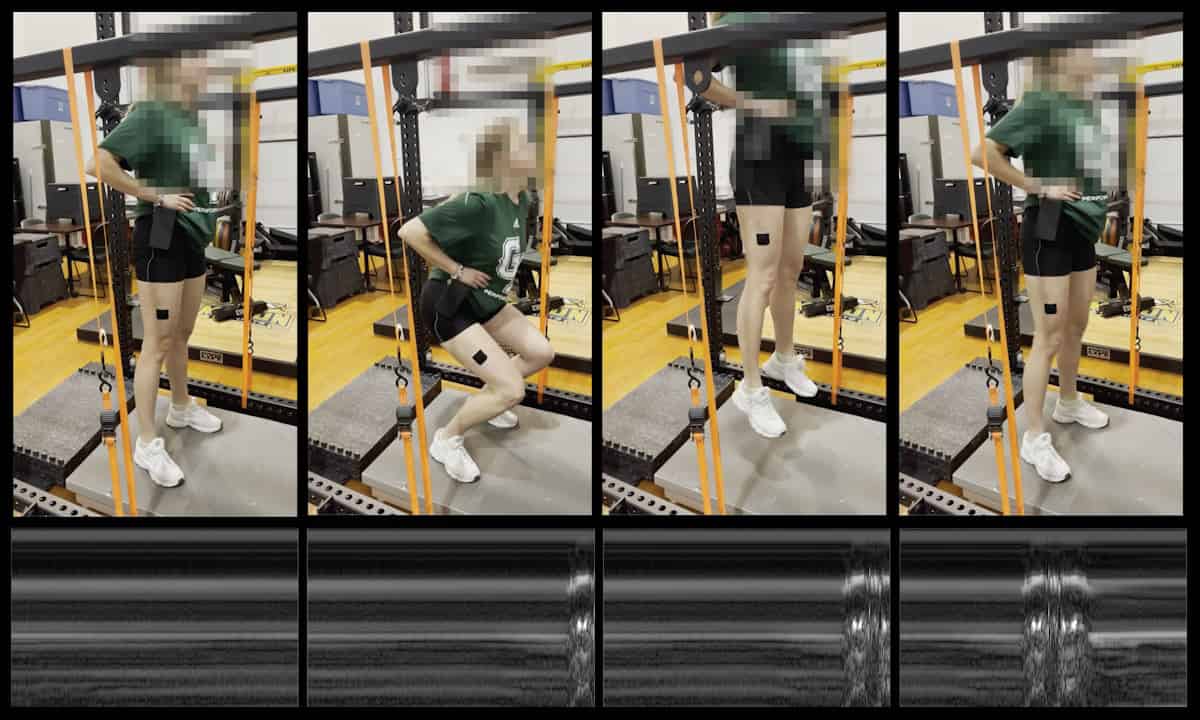
Assessing muscle dynamics A wearable ultrasound monitor can provide insight into dynamic muscle movement during activities like jumping. The lower images show real-time ultrasound feedback during the exercise. (Courtesy: Parag Chitnis)
One option is ultrasonography, which can provide non-invasive images of tissue under the skin and reveal how different muscle groups move and contract during dynamic physical activity. Traditional ultrasound systems, however, are large and cumbersome, require the patient to be tethered to the instrument, and are thus not conducive to real-time imaging during activity.
So Parag Chitnis from George Mason University and colleagues decided to build their own ultrasound device from scratch. They designed a compact wearable ultrasound system that moves with the patient and produces clinically relevant information about muscle function during physical activity.
To do this, the researchers developed new ultrasound technology that relies on the transmission of low-voltage, long-duration chirps – as opposed to the conventionally used very high-voltage, short-duration pulse sequences. This enabled them to employ low-cost electronic components, like those found in a car radio, to design a simpler, portable ultrasound system that could be powered by batteries and attached to a patient. They call the new approach SMART-US, or simultaneous musculoskeletal assessment with real-time ultrasound.
The team tested the approach on a subject performing counter movement jumps (a routine exercise for evaluating the health and function of lower limbs and knee joints) on a force plate with an ultrasound transducer attached to their leg. The SMART-US device provided real-time feedback on the level of muscle activation and function during the jumps, with significant correlation seen between force data and ultrasound measurements. Chitnis added that the technique can also be used to examine several different muscles simultaneously.
“Ultrasound-based biofeedback can help personalize therapy and rehabilitation to improve treatment outcomes,” he explained at a press conference. “Other applications that we envision for our technology include personal fitness, athletic training and sports medicine, military health, stroke rehabilitation and assessing the risk of falls in elderly populations.”
The next goal is technology transfer, to put the device through FDA clearance so the team can perform clinical studies for rehabilitation. Moving forward, Chitnis envisages that clinics would be able to purchase a basic-level system for just a few hundred dollars.
A highly stable laser wakefield accelerator has been created by Bjorn Manuel Hegelich at the University of Texas at Austin and an international team. Their device uses nanoparticles to put electrons directly into its plasma wave, accelerating the electrons to energies as high as 10 GeV.
First proposed in 1979, laser wakefield acceleration offers a way to create compact particle accelerators that can reach energies that are normally the preserve of kilometre-sized facilities.
The acceleration process involves firing an intense laser pulse into a small cell of low-density gas. The light ionizes atoms and molecules in the gas to create a plasma. In the highest-intensity regions of the laser pulse, the electric field separates the lightweight electrons from the heavier ions. Once the pulse has passed, the electrons rush back to the ions, triggering a plasma wave that propagates through the cell much like the wake of a boat.
Huge gradient
This plasma wave has an oscillating electric field that resembles the electromagnetic waves that drive particles through conventional accelerators – but the plasma wavelength is much shorter. The result is an acceleration gradient that can be three orders of magnitude greater than those found in conventional accelerators.
Over the past few decades, physicists have achieved several important milestones in perfecting the design and operation of the laser wakefield accelerator. However, it remains a significant challenge to produce stable electron beams. One important problem is how to ensure that the electrons to be accelerated are in the right place at the right time to get the most out of the wakefield.
In their study, Hegelich’s team tackled this challenge with a modified accelerator setup that features a removable metal plate at the bottom of a helium gas cell. The acceleration process begins by firing a pulse from an auxiliary laser at the plate. This releases aluminium nanoparticles, which mix uniformly with the gas.
The gas is then ionized with a powerful pulse from the Texas Petawatt Laser, which creates the plasma and also releases electrons from the nanoparticles.
Right place, right time
“The nanoparticles release electrons at just the right point and just the right time, so they are all sitting there in the wave,” Hegelich explains. “We get a lot more electrons into the wave when and where we want them to be, rather than statistically distributed over the whole interaction.”
As a result, the team could produce far more stable and consistent electron beams than previous designs. They generated beams at energies in the 4–10 GeV, from a device just 10 cm in length. In comparison, the linear accelerator at the European XFEL in Hamburg accelerates electrons to 17 GeV over a distance of 2.1 km.
For now, the researchers do not have good theoretical understanding of why their system works so well, so they plan to explore the nanoscale mechanisms in more detail.
The team hopes that future generations of laser wakefield accelerators will benefit from their research. The development of practical, room-sized accelerators could be useful across a broad range of fields including materials science, medical imaging and cancer therapy.
A new type of fibre reversibly changes its shape in response to temperature and can be spun into threads to make entire morphing garments. Potential applications for the technology include compression garments for post-surgical recovery, adaptive architectural interiors and even clothing that “hugs” its wearer on activation.
The new fibre was developed by researchers at the Massachusetts Institute of Technology (MIT) and Northeastern University, US, and is compatible with standard textile manufacturing techniques, including industrial and non-industrial sewing/knitting machines and looms. Unlike current shape-changing fibres, it can be combined with conductive thread that heats up when an electric current is applied to it.
Led by Jack Forman, a PhD student in MIT’s Center for Bits and Atoms & Tangible Media Group, the team made the fibre by synthesizing a liquid crystal elastomer (LCE) in a two-stage, one-pot, thiol-acrylate/ene “click” reaction. Although molecules in liquid crystals flow like a liquid, they can also stack into a periodic crystal arrangement. In the material studied in this work, molecules in the crystal become misaligned when the fibre is heated. This misalignment pulls the elastomer network together and causes the material to contract. After the heat is removed, the fibre returns to its original length.
As part of a graduate-level course (MAS.865 Rapid-Prototyping of Rapid-Prototyping Machines: How to Make Something that Makes (almost) Anything), Forman also developed and constructed a machine that can spin the fibre into a continuous thread. The machine heats the LCE resin and slowly squeezes it through a nozzle. As the fibre extrudes, it is cured with UV light. In the final stage, the fibre is coated with a slippery film and cured again. The result is a strong and smooth fibre that is then collected into a top pool and dipped in powder so that it can pass easily into textile manufacturing machinery.
The complete synthesis and spinning process takes about 24 hours from start to finish, and it generates a ready-to-use fibre about a kilometre in length. But Forman admits that developing it was not all plain sailing. “Since the resin and the machine were both made in-house, we had so much more freedom but also a larger scope of issues to debug,” he tells Physics World. “At times it was impossible to tell if an experiment failed because the machine was misbehaving or the material. Both had to be debugged, as there was no room for faulty electrical connections or a lack of precision during synthesis.”
Fibre can be knit, woven and embroidered
As well as fully detailing the manufacturing process in UIST ’23: Proceedings of the 36th Annual ACM Symposium on User Interface Software and Technology, the researchers have made the design of their custom spinning machine open-source. In the long run, they hope the fibre will become something people can easily buy, just like a ball of yarn. “One can imagine a world where adaptive fabrics made from such fibres are part of everyday life,” Forman says.
To date, the team has used an industrial knitting machine to make several garments from the fibre. These include a sports bra that tightens when the wearer exercises, a silent morphing curtain and a lamp that blooms when switched on.
“We also made a sweater for my dog so that when she barks in my office, I press a button on my phone and it gently compresses around her to give her the feeling of being hugged,” Forman adds.
The next step, he says, will be to scale up the production process. “We are now exploring larger ‘human-sized’ devices and wearables. It takes 150 m of fibre to make a pair of jeans so it is a good start that we can reliably make 1 km of fibre in an afternoon.”
Paul Howarth is the CEO of UK’s National Nuclear Laboratory and our guest in this episode of the Physics World Weekly podcast. He talks about the challenges of getting politicians to engage in long-term thinking about the UK’s nuclear-energy policies and explains why small modular reactors offer a practical way for the country to reduce its greenhouse gas emissions.
Howarth talks about what inspired him to follow a career path in nuclear science and technology – and he explains how the National Nuclear Laboratory underpins the safe operation of nuclear facilities in the UK.
Spinal cord injury can disconnect communication between the brain and the region of the spinal cord that produces walking, which can lead to permanent paralysis. To restore this communication, the team developed a brain–spine interface, comprising two implantable systems: one to record cortical activity and the other to electrically stimulate the region of the spinal cord that controls leg movement.
To monitor signals from the brain, a 64-channel grid of electrodes is implanted in the participant’s brain in regions that respond to the intention to move the lower limbs. An artificial intelligence-based algorithm then decodes these brain signals in real time, to predict the user’s motor intentions, and converts them into stimulation commands to activate leg muscles.
The second device is a neurostimulator connected to an electrode array, which is implanted over the region of the spinal cord that controls leg movement. This device delivers the required electrical stimulation to activate leg muscles – essentially creating a digital bridge between the brain and spinal cord. The whole system operates wirelessly, allowing a user to move around independently.
The team tested the system in a 38-year-old male with a spinal cord injury from a bike accident 10 years earlier. Following implant surgery, the bridge enabled the participant to regain intuitive control over his leg movements, enabling him to stand, walk with crutches, climb stairs and traverse complex terrains. The brain–spine interface remained reliable and stable for over one year of use, including at home without supervision.
This research brings hope to people with spinal-cord injuries and that is why we are very pleased to call it our Breakthrough of the Year for 2023.
Selection criteria
The Physics World 2023 Breakthrough of the Year was selected by a panel of Physics World editors, who sifted through hundreds of research updates and news stories published on the website this year across all fields of physics. In addition to having been reported in Physics World in 2023, the winner must meet the following criteria:
Significant advance in knowledge or understanding
Importance of work for scientific progress and/or development of real-world applications
Of general interest to Physics World readers
The nine runners-up that complete our Top 10 Breakthroughs for 2023 are listed below in chronological order of when they were reported in Physics World.
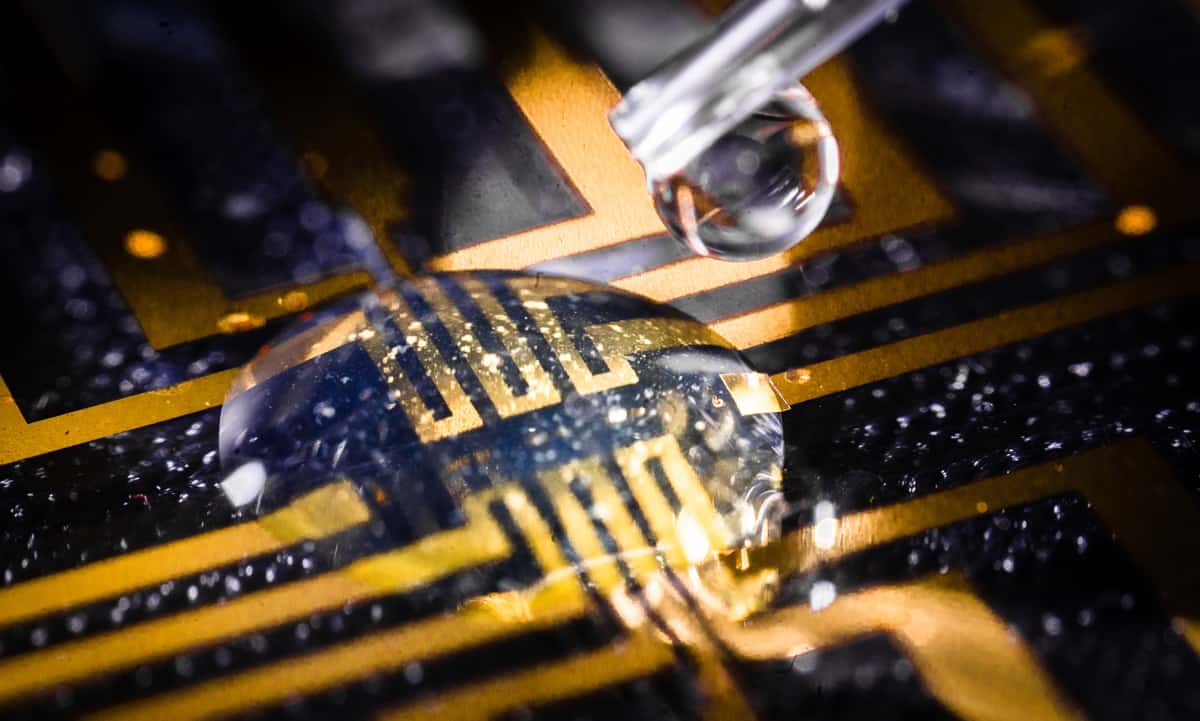
A complex cocktail The injectable gel being tested on a microfabricated circuit. (Courtesy: Thor Balkhed)
To Xenofon Strakosas, Hanne Biesmans, Magnus Berggren and colleagues at Linköping University, Lund University and the University of Gothenburg for developing a way to create electronic circuits directly inside living tissue. Interfacing neural tissue with electronics provides a way to study the complex electrical signalling of the nervous system or modulate neural circuitry to treat disease. However, the mismatch between rigid electronics and soft tissues risks damaging delicate living systems. Instead, the team used an injectable gel to create soft electrodes directly within the body. After injection into living tissue, enzymes in the gel break down endogenous metabolites in the body, which trigger enzymatic polymerization of organic monomers in the gel, converting them into stable, soft conducting electrodes. The researchers validated the process by injecting gels into zebrafish and medicinal leeches, where the gel polymerized and grew electrodes within the tissue.
To Tejin Cai at the University of Rochester in the US and Canada’s York University, and colleagues working on Fermilab’s MINERvA experiment for showing how information about the internal structure of the proton can be gleaned from neutrinos scattering from a plastic target. Neutrinos are subatomic particles that are famous for rarely interacting with matter. So, there were doubts when Cai, a postdoctoral researcher, suggested that the occasional scattering of neutrinos from protons in plastic could be observed. The big challenge for the team was observing the signal from neutrinos scattered from lone protons (hydrogen nuclei) within the much larger background of neutrinos scattered off protons bound-up in carbon nuclei. To solve this problem, they simulated the carbon-scattered signal and carefully subtracted it from the experimental data. As well as providing insights into the structure of the proton, the technique could also shed further light on how neutrinos interact with matter.
To Celia Viermann and Markus Oberthaler of the University of Heidelberg, Germany, together with Stefan Floerchinger of the University of Jena, Germany, and colleagues at the Universidad Complutense de Madrid, Spain, Ruhr-Universität Bochum, Germany and the Université libre de Bruxelles, Belgium, for using a Bose–Einstein condensate (BEC) to simulate an expanding universe and the quantum fields within it. In this simulated system, the condensate represented the universe, while phonons moving through it played the role of the quantum fields. By changing the scattering length of the atoms in the BEC, the team made the “universe” expand at different rates and studied how the phonons seeded density fluctuations within it. Theories of cosmology predict that similar effects were responsible for seeding large-scale structure in the early universe, so the simulated universe may produce valuable insights into how the real one came to be the way it is today.
To Romain Tirole and Riccardo Sapienza at Imperial College London and colleagues for the demonstration of Young’s double-slit interference in time. The 19th-century observation of the interference of light waves by Thomas Young is one of the most iconic experiments in the history of physics and provided fundamental support to the wave theory of light. While that experiment and others like it involve diffraction of light through a pair of narrow slits in space, researchers in the UK and elsewhere showed it is possible to achieve the equivalent effect using double slits in time. The temporal analogue involves fixed momentum but changing frequency. A material in which two slits rapidly appear and then disappear, one after the other, should cause incoming waves to maintain their path in space but spread out in frequency. The researchers achieved this by turning the reflectivity of a semiconductor mirror on and off twice in quick succession and recording interference fringes along the frequency spectrum of light bounced off the mirror. They saw that the interference happens between waves at different frequencies – rather than different spatial positions. The work could have several applications such as optical switches for signal processing and communication or in optical computing.
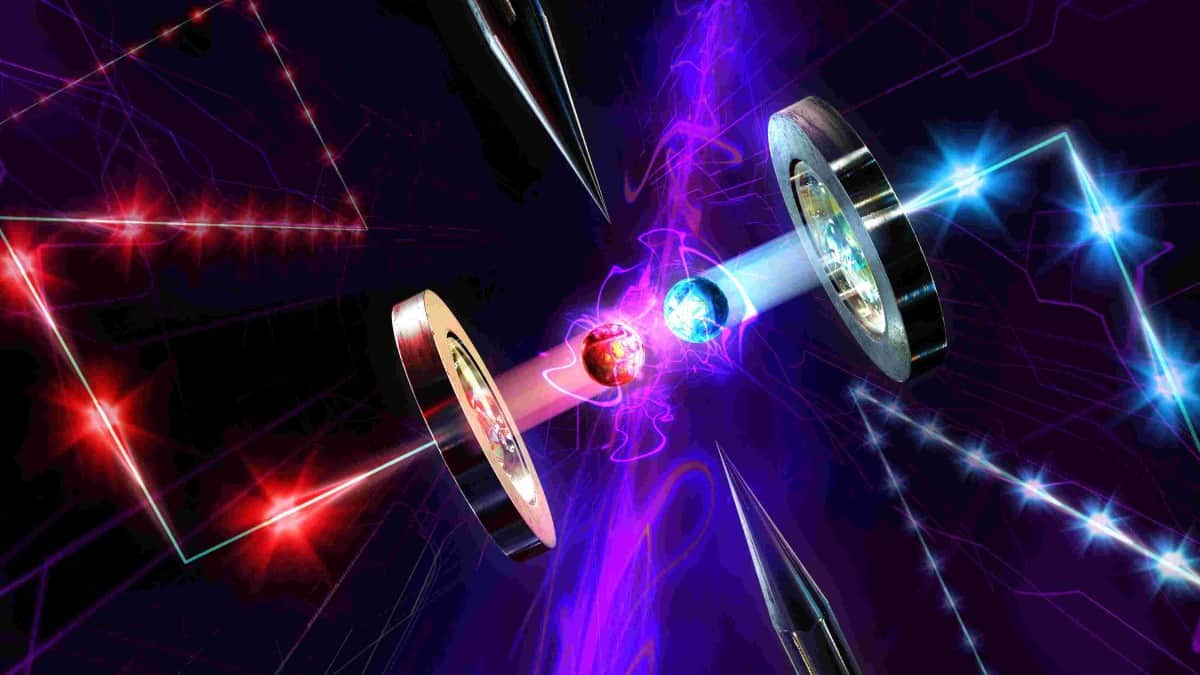
Quantum copier An artist’s impression of the trapped ions at the heart of the quantum repeater node. (Courtesy: Universität Innsbruck/Harald Ritsch)
To Ben Lanyon and colleagues at the University of Innsbruck, Austria, and the University of Paris-Saclay, France, for constructing a quantum repeater and using it to transfer quantum information over a distance of 50 km via standard telecommunications fibres, thereby demonstrating all the key functionalities of a long-distance quantum network in a single system. The team created its quantum repeater from a pair of trapped calcium-40 ions that emit photons after being illuminated with a laser pulse. These photons, each of which is entangled with its “parent” ion, are then converted to telecoms wavelengths and sent down separate 25-km-long optical fibres. Finally, the repeater swaps the entanglement on the two ions, leaving two entangled photons 50 km apart – roughly the distance required to create large-scale networks with multiple nodes.
Saw Wai Hla, Volker Rose at Argonne National Laboratory in the US and colleagues for imaging a single atom with synchrotron X-rays. Until recently, the smallest sample size that could be analysed using synchrotron X-ray scanning tunnelling microscopy was an attogram, which is around 10,000 atoms. This is because the X-ray signal produced by a single atom is extremely weak and conventional detectors are not sensitive enough to detect it. To get around this, the team added a sharp metallic tip to a conventional X-ray detector, which is placed just 1 nm above the sample to be studied. As the sharp tip is moved across the surface of a sample, electrons tunnel through the space between the tip and the sample, creating a current and this essentially detects “fingerprints” that are unique to each element. This allowed the team to combine the ultrahigh-spatial resolution of scanning tunnelling microscopy with the chemical sensitivity provided by intense X-ray illumination. The technique could lead to applications in material design as well as in environmental science through the ability to trace toxic materials down to extremely low levels.
To the EIGER Collaboration for using the James Webb Space Telescope (JWST) to find compelling evidence that early galaxies were responsible for the reionization of the early universe. Reionization occurred about 1 billion years after the Big Bang and involved the ionization of hydrogen gas. This allowed light that would have been absorbed by hydrogen to travel to the telescopes of today. Reionization appears to have begun as local bubbles that grew and coalesced. These bubbles would have been created by sources of radiation, and one possibility is that it came from stars in galaxies. The EIGER researchers used the JWST’s Near Infrared Camera to look at light from ancient quasars that had passed through the ionized bubbles. They found a correlation between the locations of galaxies and the bubbles, suggesting that light from these early galaxies was indeed responsible for reionization.
To Meng Wang, Songlin Shi and Jay Fineberg of the Hebrew University of Jerusalem, Israel, for discovering that cracks in certain materials can spread faster than the speed of sound. The result contradicts both previous experimental results and predictions based on classical theory, which state that supersonic crack propagation should not be possible because the speed of sound in a material reflects how quickly mechanical energy can move through it. The team’s observations may indicate the presence of so-called “supershear” dynamics governed by different principles than those that guide classical cracks, as predicted by Michael Marder of the University of Texas at Austin, US nearly 20 years earlier.
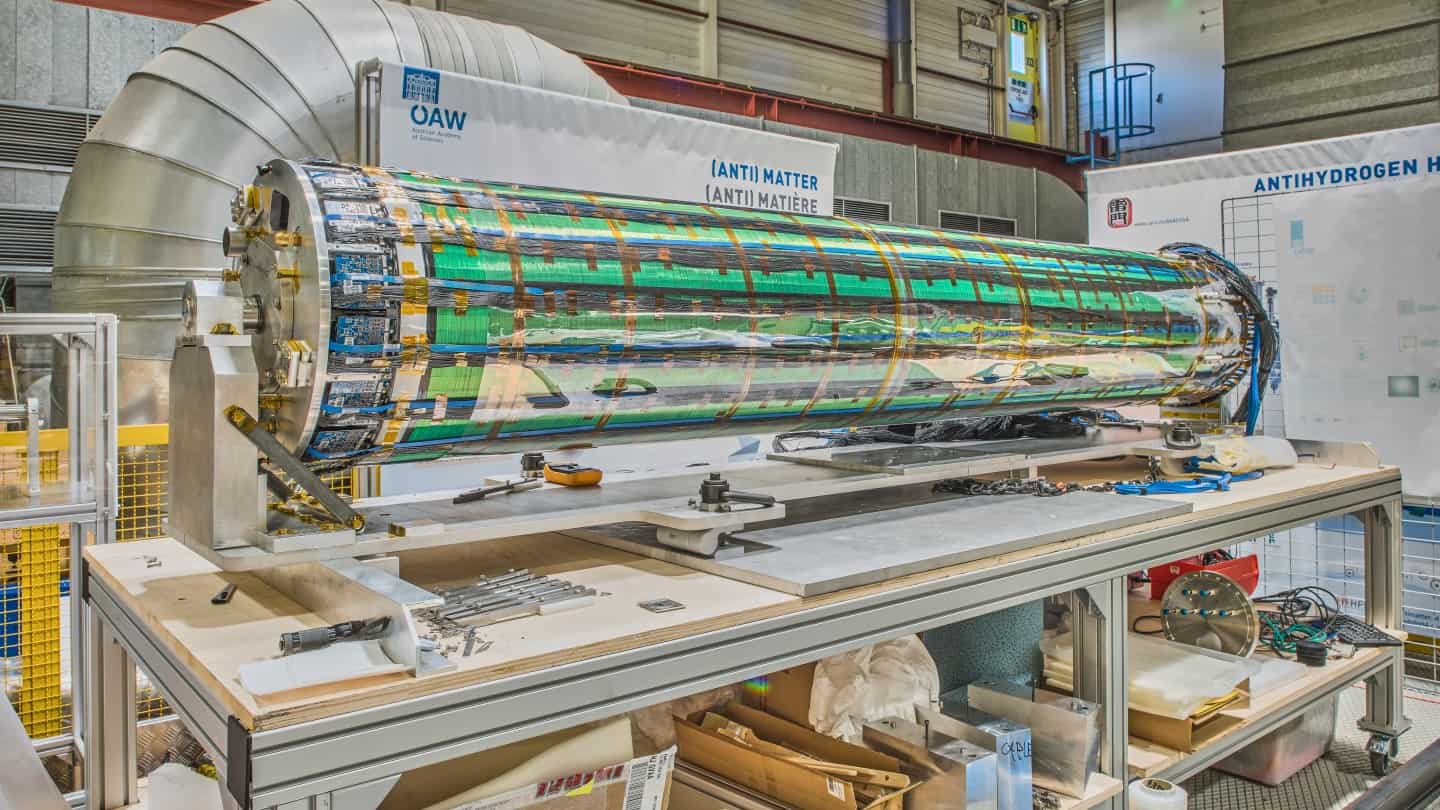
Going down ALPHA-g’s barrel scintillator being assembled at CERN. (Courtesy: CERN)
To the ALPHA Collaboration for showing that antimatter responds to gravity in much the same way as matter. The physicists used the ALPHA-g experiment at CERN to make the first direct observation of free-falling antimatter atoms – antihydrogen that comprises an antiproton bound to an antielectron. This was done in a tall cylindrical vacuum chamber in which antihydrogen was first held in a magnetic trap. The antihydrogen was released from the trap and allowed to annihilate at the walls of the chamber. The team found that more annihilations occurred below the release point than above it. After considering the thermal motion of the antihydrogen, the team concluded that antimatter falls down. Tantalizingly, the antihydrogen’s acceleration due to gravity was about 75% of that experienced by normal matter. Although this measurement has a low statistical significance, it leaves the door open to new physics beyond the Standard Model.
An honourable mention in our top 10 for this year goes to physicists working at the $3.5bn National Ignition Facility (NIF) in the US for work that was performed at the lab late last year after we picked our 2022 winners (and so misses out on our 2023 breakthrough choice too). On 13 December 2022 the lab announced the generation of more energy from a controlled nuclear fusion reaction than was needed to power the reaction. The laser shot, performed on 5 December 2022, released 3.15 million joules (MJ) of energy from a tiny pellet containing two hydrogen isotopes – compared to the 2.05 MJ that those lasers delivered to the target. This demonstration of net energy gain marks a major milestone in laser fusion.
Physics World‘s coverage of the Breakthrough of the Year is supported by Reports on Progress in Physics, which offers unparalleled visibility for your ground-breaking research.
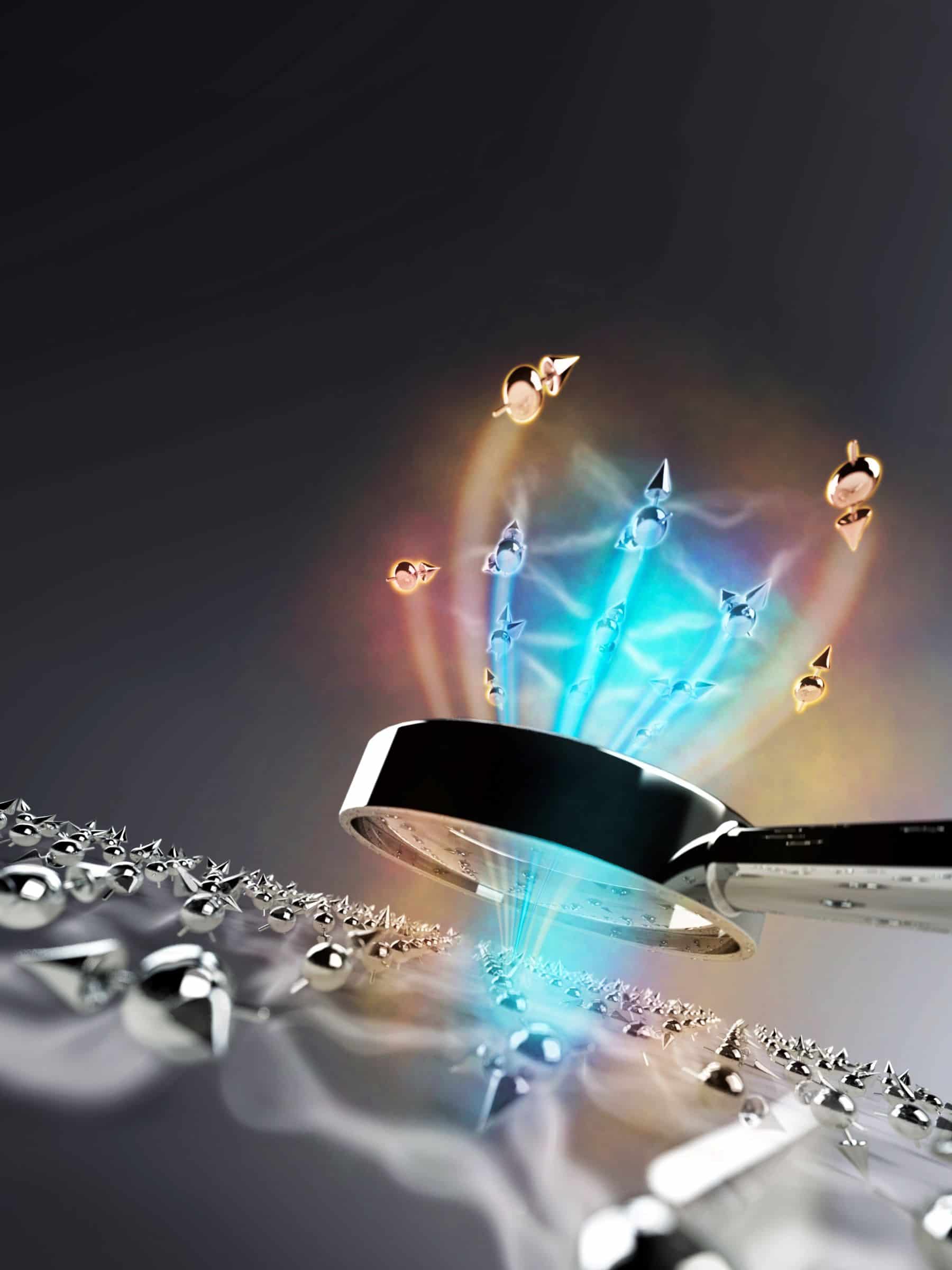
How entangled is it? The researchers obtained temperature profiles of their system showing that particles that interact strongly are “hot” (red) and those that interact little are “cold” (blue). Entanglement is greatest when interactions are strong. (Courtesy: Helene Hainzer)
Physicists in Austria have found a quick and efficient way of extracting information on a quantum material’s large-scale entanglement structure thanks to a 50-year-old theorem from quantum field theory. The new method could open doors in fields such as quantum information, quantum chemistry or even high-energy physics.
Quantum entanglement is a phenomenon whereby the information contained in an ensemble of particles is encoded in correlations among them. This information cannot be accessed by probing the particles individually, and it is an essential feature of quantum mechanics, one that clearly distinguishes the quantum from the classical world. As well as being pivotal for quantum computing and quantum communication, entanglement heavily influences the properties of an emerging class of exotic materials. A deeper understanding of it could therefore help scientists understand and solve problems in materials science, condensed-matter physics and beyond.
The problem is that learning about the internal entanglement of a large number of entangled particles is notoriously hard, since the complexity of the correlations increases exponentially with the number of particles. This complexity makes it impossible for a classical computer to simulate materials made from such particles. Quantum simulators are better equipped for this task, as they can represent the same exponential complexity as the target material they are simulating. However, extracting the entanglement properties of a material with standard techniques still requires an intractably large number of measurements.
Quantum simulator
In their new, more efficient method for evaluating the strength of a system’s entanglement, researchers from the University of Innsbruck and the nearby Institute of Quantum Optics and Quantum Information (IQOQI) interpreted entanglement strength in terms of a local temperature. While highly entangled regions of the quantum material appear “hot” in this method, weakly entangled regions appear “cold”. Crucially, the exact form of this locally varying temperature field is predicted by quantum field theory, enabling the team to measure temperature profiles more efficiently than was possible with previous methods.
To simulate an entangled quantum material, the Innsbruck-IQOQI team used a system of 51 40Ca+ ions held in place inside a vacuum chamber by the oscillating electric field of a device called linear Paul trap. This setup allows each ion to be individually controlled and its quantum state read out with high accuracy. The researchers could quickly determine the right temperature profiles by placing a feedback loop between the system and a (classical) computer that is constantly generating new profiles and is comparing them with the actual measurements in the experiment. They then made measurements to extract properties such as the system’s energy. Finally, they investigated the internal structure of the system’s states by studying the “temperature” profiles, which enabled them to determine the entanglement.
Hot and cold regions
The temperature profiles the team obtained show that regions that are strongly correlated with surrounding particles can be considered “hot” (that is, highly entangled) and those that interact very little can be considered “cold” (weakly entangled). The researchers also confirmed, for the first time, predictions of quantum field theory as adapted to ground states (or low temperature states) of materials via the Bisognano-Wichmann theorem, which was first put forward in 1975 as a way of relating certain Lorentz transformations in spacetime to transformations in charge, parity and time. In addition, the method enabled them to visualize the crossover from weakly entangled ground states to strongly entangled excited states of the quantum material.
Team leader Peter Zoller, who holds positions at both Innsbruck and the IQOQI, says that the results and the techniques – quantum protocols running on a quantum simulator – used to obtain them are generally applicable to the simulation of quantum materials. For this reason, he believes they hold broad importance for quantum information science and technology as well as quantum simulation. “For future experiments we [would] like to do this with other platforms and more complicated/interesting model systems,” he tells Physics World. “Our tools and techniques are very general.”
Marcello Dalmonte, a physicist at the Abdus Salam International Centre for Theoretical Physics in Italy who was not involved in the research, calls the results “a true ground-breaker”. In his view, the method brings our experimentally testable understanding of entanglement to a new level by unveiling its full complexity. He also thinks the technique will improve our understanding of the relationship between entanglement and physical phenomena, and is excited by the possibility of using it to solve key questions in theoretical physics, such as reaching a better understanding of the operator entanglement structure for mixed states. Another possible area to explore might be the mutual entanglement between chunks of matter, though Dalmonte adds that this would require further improvements to the protocol, including boosting its scalability.