(a) Droplets sliding down (l-r) a single fibre, a bundle of two fibres and a bundle of three fibres. A liquid film appears behind each droplet. (b) Horizontal cuts of each system, showing dry fibres in front of the droplet (orange), the droplet cross section (light blue), and the liquid film of thickness δ left behind after the passage of the droplet (dark blue). (Courtesy: Physical Review Fluids (2023). DOI: 10.1103/PhysRevFluids.8.103601)
Water droplets move faster down bundles of fibres than down individual fibres – even when the total perimeter of the two structures is identical. This discovery, from researchers at the University of Liège in Belgium, challenges the expected notion that a droplet would move at the same speed along these different fibres. It also highlights the importance of the underlying structure of the fibres, such as the grooves on a bundle, for the movement of water.
While apparently simple, the movement of a droplet sliding down a vertical fibre or thread is difficult to measure experimentally. This is because the droplet loses volume and speed as it slides, and it may travel several metres before coming to a stop, making its motion hard to monitor. In the new work, researchers coordinated by Matteo Léonard tried an alternative approach. “We approached the problem from a different angle,” Léonard tells Physics World. “What if instead of following the drop’s fall, we made the thread rise at a speed equal but opposite to that of the drop?” In this set-up, he adds, the droplet remains stationary relative to the camera being used to observe it, simplifying the experiment.
Initially, Léonard and colleagues studied how droplets slide down fibres of different diameters. Theory predicts the droplets will move slower when the fibres are thicker, and this was indeed what they observed.
Next, they braided two or more fibres together. In this configuration, which creates a bundle of fibres with grooves, the overall diameter of the bundles increases with the number of fibres braided, and the team observed the same behaviours as in single fibres: the bigger the bundle, the slower the droplets slide, again as predicted.
The Liège team then decided to study what happens when both the single fibres and bundles of fibres have the same diameter. Here, we might expect that droplets will propagate down the fibres and bundles at the same speeds because the contact surface between the liquid and the fibres is the same. But this was not what the team saw. In fact, the speed of the droplet on the bundle of fibres was faster. It also lost more volume after travelling the same distance. This could be because the water “fills” the grooves in the bundle, thus creating a liquid rail over which the droplet slides more efficiently.
Ubiquitous in nature
Substructures like the team’s braided bundles are ubiquitous in nature. Grooves, spines and knots are found in many plant species in arid or semi-arid regions of the world, and similar structures are found on the backs of desert-dwelling animals. From the web of a spider to the back of a lizard and the leaves at the tops of trees, these grooved structures are everywhere. The question, Léonard says, is why, and the new research suggests an answer.
“In the case we studied, it’s a matter of survival,” he says. “The faster the water flows over a surface, be it a leaf or a strand of fur, the better the chances of it reaching the part of the organism where it can be absorbed (or indeed evacuated).”
The insights gained from this research, which is detailed in Physical Review Fluids, could have applications in the design of atmospheric water collection systems, Léonard adds. “Improving the efficiency of a system like ours could help improve water harvesting techniques, especially in arid environments, where water is a precious commodity,” he says.
Moving forward, the researchers say they plan to further explore how fibre substructures affect droplet dynamics. “We’re particularly interested in how variations in the design of fibre bundles could optimize water transport,” Léonard says. “We also aim to test the practicality of our findings by integrating them into prototype water harvesting devices.”
Scientists who suffer from a disability that occurred early in their life earn around $14,000 less per year than their colleagues. That’s according to an analysis of the money earned by more than 80,000 US doctoral graduates in science, technology, engineering and medicine (STEM) subjects. Academics with a disability that developed later in life do not, however, experience a salary penalty, the study finds (Nature Human Behaviour 10.1038/s41562-023-01745-z).
People with disabilities have long been known to be under-represented in STEM and senior academic positions. But to address our lack of knowledge about the pay disparities they face, Bonnielin Swenor, director of the Johns Hopkins Disability Health Research Center in Baltimore, and colleagues examined data from the 2019 Survey of Doctorate Recipients (SDR). It includes information on 80,882 US PhD graduates, who formed a subset of the 1.15 million or so people who got research doctorates between 1973 and 2017.
According to the team, around 700,000 people who received PhDs in the US between 1973 and 2017 are still working in STEM. This total includes about 20,000 people who reported disabilities from early in life (before the age of 25) and around 37,000 individuals who first experienced a disability later in life (aged 25 or above). Of the 700,000 doctoral graduates employed in STEM, around 30% (220,000) are estimated to work at academic institutions.
When the authors compared individuals from the SDR dataset with those with similar socioeconomic, degree and job-related characteristics, they found that doctorate recipients working in STEM with a disability that was first experienced early in life earn $10,580 less per year than their non-disabled peers. But if they work in an academic institution, they earn on average $14,360 less than colleagues without disabilities.
Doctorate recipients with disabilities were also found to be under-represented among professors and tenured academics as well as deans and presidents in academic institutions. No salary differences were found between doctorate recipients with late disabilities and without disabilities in the overall STEM workforce, or among STEM workers in academia.
The researchers say that the disparity between the two groups could be driven by the unique challenges and structural barriers those with early disabilities face when entering the workforce and accessing equal pay and career advancement opportunities. They caution, however, that older workers with disabilities also face pressures such as having to retire early because working conditions fail to accommodate them.
Diverse perspective
“Ableism is pervasive and unchecked across much of STEM,” Swenor told Physics World. “These biased views create inequities for disabled scientists across the STEM pathway, and pay gaps are just one example.”
The researchers argue that structural transformations are required to create institutional environments that foster inclusion and address these disparities. “Our results underscore that STEM professionals face many barriers,” Swenor says. “Focusing on accessibility and universal design in STEM is critical for including more disabled scientists, but we cannot ignore the myriad of other biases and barriers that squeeze researchers with disabilities out of the workforce – and inequities in salary is one of them.”
Swenor adds that diverse perspectives are required to drive scientific discovery and innovation, and to help us face challenges like climate change and public health emergencies. “By excluding STEM professionals with disabilities, we are all losing out and missing opportunities to advance science, making it imperative to address the barriers that people with disabilities in STEM fields face,” she adds.
Meanwhile, a separate study from the Royal Society of Chemistry has found that only 5.5% of UK academic staff working in the chemical sciences are disabled compared with 23% of the working population. The study also revealed that disabled chemists are less likely to hold senior positions or be in roles with supervisory responsibilities as compared with chemists without disabilities. The report provides several recommendations to reverse the trend including improving digital accessibility, hosting more inclusive events and ring-fencing funding.
Graphene boasts many exceptional properties, and researchers in the US have found yet another one: a rare electronic state called multiferroicity that could double the amount of information stored in future graphene-based devices. This state, which only appears when five layers of graphene are stacked together, could be exploited to design ultralow power, high-capacity and high-speed data storage systems for classical and quantum computing.
Graphene is a two-dimensional crystal of carbon atoms arranged in a honeycomb pattern, and some of its amazing properties, such as high electrical conductivity and exceptional strength, were recognized even before it was first synthesized in 2004. More recently, scientists have found that stacking graphene in multiple layers causes a range of unusual electronic behaviours to appear, including superconductivity and “flat” electronic bands.
A team at the Massachusetts Institute of Technology (MIT) led by physicist Long Ju has now added to this list of unusual graphene behaviours by showing that the material exhibits a rare multiferroic state when stacked in five layers. More specifically, this five-layer graphene exhibits both unconventional magnetism and an exotic type of electronic behaviour that the researchers have dubbed “ferro-valleytricity”.
Ferroicity and multiferroicity
Ferroic materials are those that exhibit a spontaneous ordering of their electric, magnetic or structural properties. The best-known example of ferroicity is ferromagnetism, in which the magnetic moments of a material all point in one direction, but other types of ferroic ordering are possible. In ferroelectricity, for example, it is the electric polarization that spontaneously orders itself, while ferroelastic materials display spontaneous strain.
Multiferroicity occurs when several properties of a material have their own individual preferred states. For example, a magnetic multiferroic material might have magnetic moments that point in one direction, and electric charge that also shifts in a certain direction. Importantly, the two phenomena are independent of each other.
Such materials are interesting for electronics because they could double the amount of information that can be stored relative to conventional devices while operating much faster. This is because the magnetic domains could be switched by a fast, lower-power electric field, rather than by an electric current (an energy-intensive and relatively slow process) as conventional domains are.
Coordinated behaviour
In the new work, which is detailed in Nature, Ju and colleagues calculated that a type of coordinated behaviour should emerge in a structure made up of five graphene layers stacked atop each other in a rhombohedral pattern. In such a structure, the electrons move very slowly, so they interact with each other more efficiently. Because of this, Ju explains that they start to correlate and coordinate into certain preferred ferroic orders.
Experiments on real five-layer graphene backed up this hypothesis. In these studies, the team measured how electrons in their samples behaved in response to an applied electric- and magnetic field and found that different types of coordinated ferroic behaviours appeared.
The first of these behaviours is an unconventional form of magnetism in which the electrons exhibited coordinated orbital motion. The second involves graphene’s so-called electronic valley. In conductive materials, electrons can occupy certain energy levels, and a valley represents the lowest of these energy states.
Happy valleys
“As it turns out, there are two possible valleys in graphene,” Ju explains. “Normally, electrons have no preference for either valley and settle equally into both. But we found that they begin to coordinate and prefer to settle in one valley over the other. This second coordinated behaviour indicates a ferroic property that, combined with the electrons’ unconventional magnetism, gives the structure a rare, multiferroic state.”
This is the first time ferro-valleytronics has been observed and also the first time it has been seen to accompany unconventional ferromagnetism, he adds.
Both of the ferroic properties can be controlled using an electric field. This means that if the five-layer graphene was incorporated into a memory chip, for example, its electronic properties could be manipulated in two ways rather than one, effectively doubling the data that could be stored in it compared to conventional materials. However, Ju cautions that there is much work to do before this becomes possible.
Dolomite is one of the most abundant carbonate minerals on Earth, but for 200 years geologists have puzzled over how it is formed in such huge quantities. Now, Joonsoo Kim and Wenhao Sun at the University of Michigan and colleagues in the US and Japan have discovered that dolomite formation involves repeating cycles of supersaturation and undersaturation – a finding that could bring this geological mystery to a close.
Most crystals will readily grow in a supersaturated solution, which has an ionic concentration in excess of a saturated solution at equilibrium. One glaring exception to this rule is dolomite (CaMg(CO3)2) – which makes up some 30% of all sedimentary carbonate minerals in the Earth’s crust. For over two centuries, researchers have attempted to grow dolomite crystals in supersaturated conditions in the lab. Yet despite these sustained efforts – with one experiment even maintaining a 1000-fold supersaturation for an astonishing 32 years – dolomite crystals have refused to grow artificially. This long-standing mystery is called the “dolomite problem”.
In their study, Kim, Sun and colleagues team approached the problem from a computational angle. Instead of trying to grow dolomite crystals in the lab, they modelled the crystals using a combination of density functional theory and kinetic Monte Carlo simulations. This allowed them to model dolomite crystal growth using the principles of quantum mechanics.
Disordered structure
As a result of their simulations, the researchers spotted a key step in the dolomite growth process that had eluded scientists for decades. In supersaturated conditions, they discovered that calcium and magnesium cations are initially deposited in a disordered atomic structure, inhibiting any further crystal growth.
Further simulations revealed that if the solution then becomes mildly undersaturated, these disordered regions are dissolved, and re-deposited in more orderly structures once the solution becomes supersaturated again.
This process appeared to be the missing link in our understanding of dolomite formation. It suggests that dolomite crystals do not simply grow in sustained conditions of supersaturation, but through repeated cycles of supersaturation and undersaturation – with frequent oscillations accelerating crystal growth by some seven orders of magnitude according to the team’s simulations.
Kim and colleagues then verified their calculations by doing laboratory experiments. Using an electron microscope, they observed cations forming a disordered layer on a dolomite crystal surface in a supersaturated solution. They then repeatedly used a pulsed electron beam to dissociate water molecules in the sample. Each pulse lowered the pH of the solution, creating a temporary undersaturated state. As ions re-deposited in supersaturated conditions, a crystalline layer started to grow. This was the first time that dolomite has ever been grown in the lab, after two centuries of failed attempts.
What is more, the research could help explain why recently formed dolomite is often found in environments where conditions such as pH and salinity are fluctuating – thereby creating natural cycles of supersaturation and undersaturation.
The work also raises new questions as to how these fluctuations could have appeared and disappeared on geological timescales in regions where dolomite is no longer growing today – hinting at past changes in factors including climate, shifting sea levels, and biological activity.
Atoms are the world’s most precise timekeepers – so much so that the second is defined as exactly 9 192 631 770 ticks of a caesium-based atomic clock. Commercially-available versions of these atomically precise clocks underpin GPS, navigation, data transfer and financial markets, and they run at microwave frequencies, or billions of tick-tocks per second. After a day, their timekeeping is out by less than ten nanoseconds.
As good as this is, though, the next generation of atomic clocks is even more precise. These lab-based constructions run at optical frequencies, meaning they tick tens of trillions of times per second. The best of them can remain precise to 10 femtoseconds (10-15 s) after a day, or within a second after 50 billion years. And soon, for the first time, you’ll be able to buy one of your very own: Vector Atomic, a start-up based in California, US, has put the first portable optical clock on the market.
“Today the only clocks you can buy are microwave clocks,” says Jonathan Hoffman, a programme manager at the US Defense Advanced Research Projects Agency (DARPA), which funded the work. “If you go to the optical transition, there’s a giant gain in precision, accuracy and performance, but it also typically comes with incredible complexity at the same time. Finding a happy compromise is the real battle.”
Finding the right atoms
The main difference between optical clocks and their microwave predecessors is lasers. To build the most precise clocks possible, scientists use the atoms that offer the narrowest atomic transitions – usually strontium or ytterbium – and design their laser systems around those atoms’ particular requirements. The atoms are kept in vacuum chambers, and different lasers are used to cool and trap them, while other lasers block undesirable transitions or interrogate the desired one used in the clock. All these lasers, up to a dozen total, need to be stabilized to precise frequencies, and maintaining them requires constant supervision.
To build a less precise, but more robust and portable, version of an optical clock, Vector Atomic CEO and co-founder Jamil Abo-Shaeer had to take a different approach. “Instead of designing the system around the atom, we designed the system around the lasers,” he says.
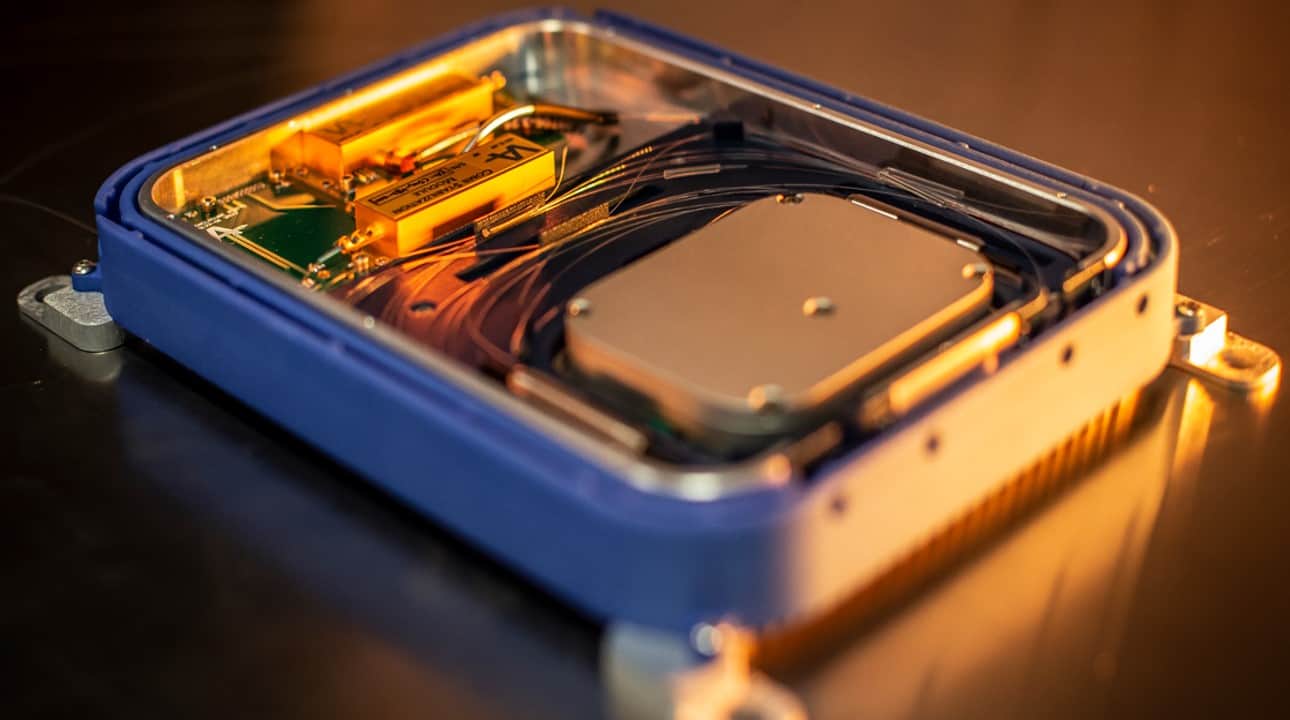
A custom-built compact frequency comb used to read out the optical clock frequency. (Courtesy: Vector Atomics)
The toughest, most time-tested lasers in existence, Abo-Shaeer explains, are those used in telecommunications and industrial machining. Thanks to years (or even decades) of commercial R&D, they are extremely compact and stable, and he and his team chose an atomic species that suits them: molecular iodine. This molecule has convenient transitions near a frequency-doubled infrared laser commonly used in machining. The team also opted for a simple vapour-cell setup that avoids cooling the atoms to frigid temperatures or confining them in an ultrahigh vacuum.
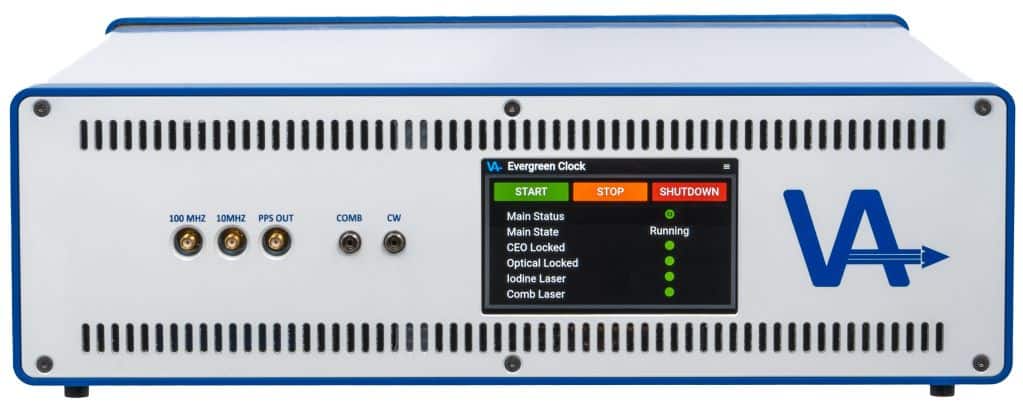
The result was a turnkey optical clock, which the team call Evergreen, with a volume of just 30 litres – roughly the size of a record player. Although the precision of Evergreen’s timing is far from the lab-based state of the art, it is 100 times more precise than existing microwave clocks of a comparable size. It also matches the performance of clocks based on hydrogen masers – devices the size of walk-in fridges that are extremely sensitive to environmental noise.
Sea trials
In the summer of 2022, a prototype of Evergreen spent three weeks aboard a ship at sea for testing. During this time, the clock worked without any intervention. Upon return, the team tested the clock’s performance and found it had not significantly degraded, despite turbulence and temperature swings aboard ship. “When it happened, I thought everyone should be standing up and shouting from the rooftops,” Hoffman says. “I mean, people have been working on these optical clocks for decades. And this was the first time an optical clock ran on its own without human interference, out in the real world.”
Tick tock: Vector Atomic’s Evergreen optical clock in its box. (Courtesy: Vector Atomics)
According to Abo-Shaeer, Evergreen’s size and stability pave the way for widespread adoption of such clocks in navigation, especially when GPS signals are blocked or spoofed; in data centres and telecommunications protocols; and for synchronizing signals from remote detectors for scientific purposes. Currently, GPS is precise to about three metres, but more precise timing on satellites could bring that down to a few centimetres or less, allowing autonomous vehicles to stay in their lanes or delivery drones to land on a balcony. Being able to chop time up into smaller pieces should also allow for higher bandwidth communications, Abo-Shaeer adds.
Whether this particular clock is the one that will power the next generation of GPS and faster data transfer remains to be seen. But the technological advance is significant nonetheless, says Elizabeth Donley, the head of the US National Institute of Standards and Technology (NIST) time and frequency division in Boulder, Colorado. “There’s potentially a lot of other types of optical clocks that could come on the market over the next decade,” says Donley, who was not involved in Vector Atomic’s work. “The heart of this thing is an iodine vapour cell, but the infrastructure can be used for other types of clocks as well.”
A new protocol for cloud-computing-based information storage that could combine quantum-level security with better data-storage efficiency has been proposed and demonstrated by researchers in China. The researchers claim the work, which combines existing techniques known as quantum key distribution (QKD) and Shamir’s secret sharing, could protect sensitive data such as patients’ genetic information in the cloud. Some independent experts, however, are sceptical that it constitutes a genuine advance in information security.
The main idea behind QKD is to encrypt data using quantum states that cannot be measured without destroying them, and then send the data through existing fibre-optic networks within and between major metropolitan areas. In principle, such schemes make information transmission absolutely secure, but on their own, they only allow for user-to-user communication, not data storage on remote servers.
Shamir’s secret sharing, meanwhile, is an algorithm developed by the Israeli scientist Adi Shamir in 1979 that can encrypt information with near-perfect security. In the algorithm, an encrypted secret is dispersed between multiple parties. As long as a specific fraction of these parties remain uncompromised, each party can reconstruct absolutely nothing about the secret.
Secure and efficient cloud storage
Dong-Dong Li and colleagues at the University of Science and Technology of China (USTC) in Hefei and the spinout company QuantumCTek have combined these two technologies into a protocol that utilizes Shamir’s secret sharing to encrypt data stored in the cloud and resists outside intruders. Before uploading data to the central server, an operator uses a quantum random number generator to generate two bitstreams called K and R. The operator uses K to encrypt the data and then deletes it. R serves as an “authentication” key: after encrypting the data, the user inserts a proportion of bitstream R into the ciphertext and uploads it to a central server, retaining the remainder locally. The proportion the user uploads must be below the Shamir threshold.
In the next step, the central server performs what’s known as erasure coding on the ciphertext. This divides the data into packets sent on to remote servers. To ensure against loss of information, the system needs a certain amount of redundancy. The current standard cloud storage technique, storage mirroring, achieves this by storing complete copies of the data on multiple servers. In Li and colleagues’ chosen technique, the redundant data blocks are instead scattered between servers. This has two advantages over storage mirroring. First, it reduces storage costs, since less redundancy is required; secondly, compromising one server does not lead to a complete data leak, even if the encryption algorithm is compromised. “Erasure coding is characterized by high fault tolerance, scalability and efficiency. It achieves highly reliable data recovery with smaller redundant blocks,” the researchers tell Physics World.
When a user wishes to recover the original data, the central server requests the data blocks from randomly chosen remote servers, reconstructs it and sends it in encrypted form back to the original user, who can recover the encryption key K and decrypt the message because they have the proportion of R that was originally retained locally as well as that which was inserted into the message. A hacker, however, could only obtain the part that was uploaded. The researchers write that they conducted a “minimal test system to verify the functionality and performance of our proposal” and that “the next step in developing this technology involves researching and validating multi-user storage technology. This means we will be focusing on how our system can effectively and securely handle data storage for multiple users.”
Further work needed
Barry Sanders, who directs the Institute for Quantum Science and Technology at the University of Calgary in Canada, describes a paper on the work in AIP Advances as “a good paper discussing some issues concerning how to make cloud storage secure in a quantum sense”. However, he believes more specifics are necessary. In particular, he would like to see a real demonstration of a distributed cloud storage system that meets the requirements one would expect in cybersecurity.
“They don’t do that, even in the ideal sense,” says Sanders, who holds an appointment at USTC but was not involved in this work. “What is the system you’re going to create? How does that relate to other systems? What are the threat models and how do we show that adversaries are neutralized by this technique? None of these are evident in this paper.”
Renato Renner, who leads a quantum information theory research group at ETH Zurich, Switzerland, is similarly critical. “The positive part [of the paper] is that it at least tries to combine quantum-inspired protocols and integrate them into classical crytographic tasks, which is something one doesn’t see very often,” he says. “The issue I have is that this paper uses many techniques which are a priori completely unrelated – secret sharing is not really related to QKD, and quantum random number generation is different from QKD – they mix them all together, but I don’t think they make a scientific contribution to any of the individual ingredients: they just compose them together and say that maybe this combination is a good way to proceed.”
Like Sanders, Renner is also unconvinced by the team’s experimental test. “Reading it, it’s just a description of putting things together, and I really don’t see an added value in the way they do it,” he says.
Quantum computers show great promise because they could, at least in principle, solve certain problems that cannot be cracked even by the most powerful conventional supercomputers. But building quantum bits, or qubits – and linking them to create practical quantum computers – is a huge challenge. In particular, quantum computers are incredibly noisy, which quickly introduces errors into quantum calculations.
That’s why many researchers are developing clever quantum algorithms that can do useful calculations even on today’s small, noisy quantum computers. One company contributing to that effort is Phasecraft, which was spun off from University College London and the University of Bristol in 2019. The physicist Toby Cubitt, co-founder and chief technology officer at Phasecraft, talks to Hamish Johnston about how real-world applications could be just around the corner.
Why did you originally set up Phasecraft?
We founded Phasecraft because quantum computing was reaching the point where quantum-computing hardware was no longer just a toy system, but pushing the boundaries of what could be done on conventional computers. We wanted to try to develop the algorithms needed to make use of that early-stage hardware and make quantum applications a reality. That’s a huge challenge scientifically, but a fascinating one to be involved in.
How big is the company at the moment?
We currently have about 20 full-time staff, roughly a third of whom have a background in quantum computing or quantum information theory, a third in materials science, condensed matter and chemistry, and a third on the computing side. They all have a knowledge of quantum computing, but are also very, very good at – and love – programming this stuff, and implementing it, and getting it working on the hardware.
We sponsor PhD students who are at places like University College London and the University of Bristol but who work directly here in the company’s offices. We also have lots of interns – both undergraduates and PhD students. We’re very focused on research and development at the moment. But as useful applications come online, I expect things to become much more commercial in nature.
Would you say quantum software has been ignored in favour of all the hype and excitement of developing new qubits and processor technologies?
Hardware is extremely important and deserves the attention it’s been given, involving as it does some fascinating physics, materials science and engineering. But for us on the software side, it’s all about coming up with clever mathematical ideas to make algorithms more efficient and work on today’s early-stage, small-scale quantum devices. In fact, we’re more likely to make progress through better algorithms than by waiting for improvements in hardware.
Even if quantum hardware grew exponentially, it could be a decade before you could do anything useful with it. Working on algorithms also doesn’t require expensive cryostats, dilution refrigerators, liquid helium or chips – just a bunch of really smart people thinking deeply, which is what we have at Phasecraft. A few years ago, for example, we developed algorithms for simulating the time dynamics of quantum systems that were about six orders of magnitude better than those from Google and Microsoft.
Quantum processors are noisy, which means they quickly lose coherence and make calculations impossible. How do you develop practical algorithms to run on imperfect devices?
Noise and errors are the bane of all quantum applications on real hardware. There have been some incredible improvements to hardware, but we can’t assume quantum computers are perfect, as we can with classical devices. So with everything we do in Phasecraft, we have to think in terms of imperfect, noisy quantum computers that have errors. Run any computation and the errors build up so fast that you’re just getting noise – random data – out, and you’ve lost all of the quantum information.
To get round this problem, it’s critical to make algorithms as efficient as possible and make them less sensitive or susceptible to noise. It’s true that in the 1990s Peter Shor developed the concept of quantum error correction and the fault-tolerant threshold theorem, which shows, theoretically, that even on noisy quantum computers, you can run arbitrarily long quantum computation calculations. But that requires such huge numbers of qubits that we can’t count on this as a solution.
Algorithmic ambition Toby Cubitt (left) co-founded UK quantum start-up Phasecraft with Ashley Montanaro (right) and John Morton (centre) in 2019 to speed up the practical applications of quantum computing. (Courtesy: Phasecraft)
Our focus is therefore more an engineering-type problem, where we try to understand what noise looks like in detail. The better we can understand noise, the more we can design around it so it doesn’t affect the outcome. But there’s a big payoff because if you can make an algorithm less complex, you can get something useful out of these noisy quantum computers. It’s a question of designing the algorithms so we can squeeze more out of them.
I often say that today’s quantum computers are where classical computers were in the 1950s. Back then, people like Alan Turing were coming up with really clever ideas of how to squeeze a bit more out of clunky primitive hardware and actually do incredible things with it. That’s the stage we’re at with quantum computing. In fact, certain algorithms are sometimes more suited for one type of hardware than another.
In terms of hardware, what type of qubits are you using at the moment?
At Phasecraft we’re interested in all types of hardware. Predominantly, though, we’re using superconducting qubit circuits, because that’s the current leading hardware platform. But we’re running ion traps on cold-atom hardware too and we’re also thinking about photonic hardware. But we’re not tied to one particular platform.
Phasecraft’s focus is on algorithms that calculate material properties. Why are those applications so suitable for today’s early quantum computers?
In industry, many companies spend a lot of time and money using classical, high-performance computers to work out the properties of materials. The trouble is, it’s very computationally intensive so they end up trying to simplify the problem. But the danger then is you can get things completely wrong. For example, you may end up predicting a material is an insulator when in fact it’s a conductor. It can be that level of wrong sometimes.
At Phasecraft, we’re focusing on modelling and simulating materials because those applications are within closest reach of current hardware. Other applications, such as optimization, are more demanding in terms of the number of qubits and gates you need. As hardware improves, quantum chemistry simulations will become within our reach. They’re harder to simulate than periodic, crystalline materials because the complexity of an algorithm in molecular systems scales as number of electron orbitals to the power of four.
Can you give us a taste of some specific materials you’ve looked at?
At the moment, the hardware is not yet large enough to be able to do simulations of real materials beyond what can be done classically. So we’re still at the stage where we have the algorithms, but we don’t yet quite have the hardware to run on, although it’s getting close. Having said that, the types of materials that are good targets for early-stage applications of quantum computing are clean-energy-related – battery materials, things like metal oxides.
They also happen to be ones where classical algorithms don’t work very well, because they involve strongly correlated electrons. The same goes for photovoltaics. In fact, we have a collaboration with Oxford PV, which is working with perovskite photovoltaics, where we’re again looking at strongly correlated electron systems. This involves dynamically simulating things like the rate at which particle-hole pairs recombine to emit light.
We’ve also examined strontium vanadate, which happens to have a nice band structure that means that it can fit on a smaller quantum computer than certain other materials. It’s not the smallest, but it’s a metal-oxide system that’s of interest and needs fewer qubits and fewer gates than other metal oxides.
When do you think Phasecraft will reach the point of “quantum advantage” where your algorithms can run on a quantum processor and can calculate things a supercomputer can’t?
That’s the million-dollar question. In fact, it’s probably the billion-dollar question. The quantum industry needs to get to that point where it’s not just demonstrating toy problems but solving real-world problems on quantum computers.
I hope I don’t sound like the guy who supposedly once said there’d only ever be a need for three computers in the world, but I genuinely think we might get there in the next two to three years. Those early questions may be of scientific interest rather than industrial interest – industry might be a little beyond that point. It’s not going to be a case of switching off your high-performance computing (HPC) clusters overnight and moving straight over to a quantum computer. It’s much more likely to be a gradual process whereby more and more useful things will come online. It’s how science works: you make progress, you hit an obstacle and then make more progress. It tends to ratchet up.
Progress depends on lots of hard work by large teams of scientists working diligently for many years. That’s what’s going on in quantum computing, and the first applications might not hit the headlines
When the wider media report on quantum computers, they tend to assume massive breakthroughs emerge out of the blue from nowhere. But they don’t. Progress depends on lots of hard work by large teams of scientists working diligently for many years. That’s what’s going on in quantum computing, and the first applications might not hit the headlines. But scientists will realize when we’ve passed that threshold where you can do things that are impossible with conventional computers. We’re not far off.
Phasecraft recently received £13m in private funding. What do you plan to do with that cash?
For a quantum algorithm company like ours, the vast majority of funding goes on paying people’s salaries. Our staff are the key – our most valuable asset is our team. For a hardware company it’s very different, because hardware is expensive. But we need people to think and code so that money will let us steadily expand our team.
We’ve always got more ideas than we have the resources to pursue and, as we get closer to implementing large computations on quantum computers, we’ll be scaling up the team. It’s still a few years before we will have commercially relevant applications, but when that happens, we’ll go through an inflection point and the whole industry will change. We are always keen to talk to smart people who are excited about using quantum mechanics for real-world applications.
So how will the firm evolve?
All it takes is one amazing, outstanding idea that could completely change the whole quantum industry. We’re keen on making sure we give our research team the space to do that kind of blue-sky thinking that could change the face of where the company goes. Sure, not all ideas will work – 20 might fail but the 21st will turn out to be a significant new direction that no-one else thought of. That’s happened a couple of times at Phasecraft already. Someone gets inspired, and then a new direction opens up.
We’re at a hugely exciting time in quantum computing. I’m still a professor at UCL, and I still have an academic group there, but I find both sides – applied and theoretical – equally intellectually interesting. I’ve theorized about some topics for 20 years but haven’t had any tools to put them into practice. Now, though, I can take that theory and make it real. Instead of just writing a paper, I can run my idea on hardware.
Sure, it might not work at all. It could turn out that the real universe says: “No. That’s not a good idea.” But it could still be an incredibly useful and fascinating problem to tackle. And so the applied side of the research – applying this physics to the technology – I find just as fascinating and interesting as the blue-sky academic thinking.
Rapid TBI diagnostics (A) EyeD technology concept; (B) design of the EyeD with a 3D-printed phantom mimicking the optical properties of the eye and allowing acquisition of Raman spectra through an eye-like lens. (Courtesy: CC BY 4.0/Sci. Advances 10.1126/sciadv.adg5431)
Traumatic brain injury (TBI), caused by a sudden jolt or impact to the head, requires diagnosis as quickly as possible. To prevent irreversible damage, life-critical treatment decisions must be made within the “golden hour” after trauma. Diagnosing TBI at the point-of-care is difficult, however, relying on observations by ambulance crews followed by radiological investigations such as MRI or CT scans upon arrival at a hospital.
To enable more timely intervention, researchers from the University of Birmingham are developing a handheld diagnostic device that detects TBI by shining a safe laser into the eye. The device, described in Science Advances, is targeted for use as soon as an injury occurs – whether at the roadside, on the battlefield or on the sports pitch – to assess patients for TBI, determine the severity of the trauma and direct treatment accordingly.
The eye-safe device (EyeD) is based around Raman spectroscopy – an optical technique that uses inelastic scattering of laser light to probe molecular composition. It works by shining a 635 nm class 1 laser onto the cornea. The collimated beam is then focused onto the retina by the eye’s own optics. To target the laser to the region-of-interest, the EyeD system simultaneously performs fundus imaging and spectroscopic analysis using a smartphone camera to visualize the back of the eye.
Raman spectra collected from the retina and optic nerve are analysed for the presence of TBI-specific biochemical changes, using the artificial neural network algorithm SKiNET as a decision support tool. As the retina and optic nerve are so closely linked to the brain, changes to biomarkers after injury will reflect biochemical changes in the brain microenvironment.
“Our device will allow early-diagnosis of TBI by directly assessing acute distress changes in real time in living neuroretinal/optic nerve tissue. It enables us to interrogate central nervous system tissue directly and non-invasively,” explains team leader Pola Goldberg Oppenheimer. “Analysing the neuroretina as a projection of the central nervous system provides a window into brain biochemistry.”
Spectroscopic studies
To test the performance of their imaging device, Oppenheimer and colleagues constructed a tissue phantom that mimics the physical dimensions and optical characteristics of the eye, while providing a realistic Raman signature of the retina. The phantom includes a lens, a 4-mm diameter pinhole representing the undilated pupil and sample holder for retinal tissue.
The team demonstrated that the EyeD device could effectively focus the laser beam at the desired position on the retina. Spectra measured from the tissue phantom resolved the major Raman bands in the high-wavenumber region, which can be used to distinguish a number of tissue types.
The researchers next used the prototype device to analyse retinal samples from pigs’ eyes, which are similar to human eyes in size, structure, development and composition. They collected 510 measurements from 39 TBI retinal samples and 12 control samples, recording spectra from close to the optic disc. Overall, the Raman spectra showed several characteristic bands in the 1200–1700 cm−1 fingerprint region, plus an enhancement of high-wavenumber bands in the 2800–3200 cm−1 region.
Translatable technology In addition to detecting neurotrauma at point-of-care, the portable EyeD offers potential for application to a multitude of neurological conditions. (Courtesy: CC BY 4.0/Sci. Advances 10.1126/sciadv.adg5431)
Using SKiNET to create self-optimizing maps (SOMs) showing clustering of the retinal Raman spectra revealed a clear separation between retinas with TBI and control samples. This arises because the Raman spectra reflect biochemical variations in the eye after TBI. For example, TBI increases the lipid and protein content in the eye, causing the peaks originating from these to become more pronounced in the Raman spectra.
The most significant spectral changes in response to TBI were due to the contributions of the brain lipids cardiolipin and cytochrome C, which manifested as an increase in the ratio of the 2930 to the 2850 cm−1 peak in the Raman spectra. The researchers used selected features of the 2850/2930 peak ratio and intensities of six characteristic peaks from the TBI spectra to form the SKiNET classification, yielding a spectroscopic barcode for TBI detection.
To assess the EyeD system’s ability to differentiate TBI via retinal changes, they calculated the area under the curve (AUC) for each peak and the 2930/2850 peak ratio, and plotted true-positive against false-negative rates. Using the SKiNET optimization with 10-fold cross-validation on the training data resulted in a classification accuracy of 90.7±0.9%. This result indicates that changes in the 2930/2850 peak ratio following TBI could provide a valuable indicator to discriminate TBI from healthy controls.
“Using simultaneous Raman spectroscopy and fundus imaging, packaged as a low-cost, handheld device, provides the first tangible path towards non-invasive point-of-care diagnostics of TBI,” Oppenheimer tells Physics World.
The next step will be to optimize the prototype for clinical validation. To ease clinical translation, the researchers plan to replace the standalone spectrometer with a compact on-device spectrometer and smartphone readout, enabling fundus photography and Raman spectroscopy via a single smartphone screen.
“We are currently engineering a user-friendly deployable device, integrated with our artificial neural network algorithm for automated interpretation of outputs without requiring specialist support, rapidly classifying spectral data,” says Oppenheimer. “[We are also] clinically evaluating device usability in healthy volunteers and in patients to demonstrate its potential for real-time diagnosis. After establishing device tolerability and usability, we are proceeding to a first-in-human evaluation and small-scale clinical trial.”
Noise measurements suggest that a “strange metal” does not conduct electricity via discrete charge carriers, according to researchers in the US and Austria. Doug Natelson at Rice University, Silke Paschen at the Technical University of Vienna and colleagues have measured low levels of shot noise in nanowires made of a strange metal. Their discovery could open a new area of research into these intriguing materials.
Since the 1950s, the Fermi-liquid theory has done a very good job of describing the behaviour of the conduction electrons in most metals. According to the theory, electrical currents arise through the movement of quasiparticles, which are collective excitations of conduction electrons that behave much like particles. A useful analogy is that the movement of one person in a crowd also involves the movement of surrounding people – who get out of the way and fill in gaps left in the wake of motion.
As a results of its success, Fermi liquid theory has earned the informal title of the “standard model” of ordinary metals. But much like the Standard Model of particle physics, the theory is known to have its limits.
“Over the last 40 years in particular, it’s become clear that there are metals that don’t seem to fit the Fermi liquid picture, and many of them share similar properties,” Natelson explains.
Bold arguments
“There is a lot of discussion over whether there is a unifying picture behind these strange metals, and some bold arguments have predicted that quasiparticles may not be the right description of charge flow in those systems,” says Natelson.
In their study, the team investigated whether measuring shot noise in a strange metal could be a reliable way to test these ideas. Shot noise occurs in ordinary metals because current is carried by discrete quasiparticles. This means that at low currents, small fluctuations in the number of quasiparticles leads to fluctuations in the measured current – and these fluctuations are called shot noise.
If quasiparticles are indeed absent from strange metals, Natelson and colleagues reasoned that shot noise should also be absent. To explore this idea, they experimented with the compound ytterbium dirhodium disilicide (YbRh2Si2), which is one of the most widely studied strange metals.
Entangled spins
“This system shows strange-metal response at the transition between two different Fermi liquid states, each with a different effective number of charge carriers,” Natelson explains. Close to this boundary, previous studies found that electron charges become deeply entangled with their spins, ultimately causing electron quasiparticles to vanish.
The team was inspired by experiments first performed in the 1990s, which carefully measured shot noise in nanowires made from a variety of ordinary metals – including gold. These measurements closely matched the predictions of Fermi liquid theory.
In their own experiments, the researchers used a new fabrication technique to fashion YbRh2Si2 nanowires, and then followed the same measurement procedures used in the previous studies.
Unexplained quietness
“We found that the noise in YbRh2Si2 wires is much lower than that seen in gold wires,” explains Natelson. “Through other measurements in longer YbRh2Si2 wires, we have shown that electron-phonon scattering seemingly cannot explain this noise suppression in this system.”
Their measurements provide strong evidence that quasiparticles are absent from strange metals like YbRh2Si2. This supports the long-standing suspicions of some physicists that the Fermi liquid theory cannot provide a full description of how strange metals behave.
“This is pretty exciting,” Natelson says. “It’s important now to test to see whether this suppressed noise is seen in other strange metals, or whether we can tune between ‘conventional’ and suppressed noise by tuning in and out of the strange metal regime.” If this is the case, this could open up an exciting new area of research – possibly even leading to new families of exotic metals.
A proposed new light source based on plasma accelerators could make it possible to develop super-bright sources as powerful as the most advanced free-electron lasers – but much smaller. If demonstrated experimentally, the design put forward by an international consortium of researchers might be harnessed for a variety of applications, including non-destructive imaging and computer-chip manufacturing.
Coherent light sources such as free-electron lasers are routinely employed in academic research, where they are used to study the structure of biomolecules, the dynamics of chemical reactions and other puzzles in physics, chemistry and materials science. The problem is that they are huge: the most powerful, Stanford University’s Linac Coherent Light Source, is three kilometres long and driven by the Stanford Linear Accelerator (SLAC). Scaling them down would bring them within reach of smaller institutions such as universities, hospitals and industrial labs.
A “Mexican wave” for electrons
Researchers led by Jorge Vieira of the Instituto Superior Técnico (IST) in Portugal, together with John Palastro of the University of Rochester, US, think they’ve found a way of doing just that. Their design, which they developed with colleagues at the University of California, Los Angeles and the Laboratoire d’Optique Appliquée in France, calls for a powerful and bright laser source to be created using a collection of many electrons that move together like a single giant particle, or quasiparticle. “To picture what we mean by this, think of Mexican waves, which seem to go around the arena, even though each participating person stays put,” explains Bernardo Malaca, a PhD student at IST and first author of a study on the design published in Nature Photonics. “Such collective charged particle dynamics is at the heart of plasma physics.”
Just as a Mexican wave can, in principle, travel faster than the individual humans in the crowd (provided they all work together), Malaca says the same thing can happen with electrons. In that case, though, the consequences would be much more profound: “Mexican electron waves could travel faster than the speed of light, even though there isn’t a single electron locally that’s faster than light,” he explains.
When that happens, Malaca adds, the collective electron waves would radiate as if they were a single super-luminal electron. “The collective electron radiation can be pictured as if it originated from a single particle, raising the possibility of creating a hitherto unimagined class of temporally coherent sources,” he tells Physics World.
A quasiparticle version of the Cherenkov effect
In the new work, the researchers, who were supported by the European High-Performance Computing Joint Undertaking, used simulations on supercomputers to study the properties of quasiparticles in plasma. These simulations showed that radiation from a quasiparticle is indeed fundamentally indistinguishable from that produced by a single finite-sized particle.
The Portugal-US-France team also describe the physics of a quasiparticle version of the Cherenkov effect. Cherenkov radiation occurs when charged particles propagate through a medium at a speed that is faster than the speed of light in that medium. According to Einstein’s special theory of relativity, this effect cannot take place in vacuum, where the speed of light is fixed at just under 300 000 km/s. This limit does not apply to quasiparticles, however, which can travel at any velocity, including superluminal ones. “The quasiparticles can move in ways that would be disallowed by the laws of physics governing individual particles,” Palastro explains. “It is this absolute freedom to control the quasiparticle trajectory that may hold the key towards a new class of powerful yet compact light sources.”
Viera adds that quasiparticles may constructively combine the radiation from 1010 electrons. This, he notes, is “about the charge of an electron bunch at SLAC”.
One way to make a real-world light source out of quasiparticles would be to send an intense laser pulse or relativistic particle bunch into a plasma or gas where the density rises with distance, he adds. This configuration is known as a density up ramp and is standard in plasma-based accelerators. These, however, usually use a constant density profile. The new set-up would create a superluminal quasiparticle leading to quasiparticle-Cherenkov emission.
“To create an undulating quasiparticle, leading to undulatory radiation, we could send an intense laser pulse or relativistic particle bunch into a plasma or gas where the density varies periodically (sinusoidally) with distance,” explains Viera. “Different configurations are already available to create such profiles in the laboratory (for example, using the interference pattern between two ionising laser pulses, which ionise the plasma only in regions of constructive interference).
“An enormous impact”
If built and demonstrated in the laboratory, compact light sources based on quasiparticles could bring science and applications that are currently only possible in a few places around the world (as at the LCLS), Viera says. “Light sources have an enormous impact on our lives, from science and technology to everyday applications. For example, they play a crucial role in non-destructive imaging (like scanning for viruses or checking product quality), understanding biological processes (like photosynthesis), manufacturing computer chips and exploring the behaviour of matter in planets and stars.”
The researchers are now investigating ways of making quasiparticles radiate at other wavelengths of the electromagnetic spectrum. X-rays, for example, have wavelengths of around 1 nm, and would be particularly useful.
“We are also trying to experimentally demonstrate our concept,” Malaca says. “While being a conceptual innovation for the moment, we believe that the quasiparticle approach is simple enough to be tried out in dozens or even hundreds of labs around the world.”