Prizes are the lifeblood of science, but the gender of the person they are named after can have a big impact on who is likely to receive that award. That’s the conclusion of a new study carried out by researchers at the University of Birmingham in the UK, who have found that men win almost 90% of awards named after male scientists. The finding, they say, could be affecting career progression for women in science (Nature Hum. Behav. 10.1038/s41562-023-01773-9).
Historically, science has overlooked women’s contributions while rewarding men. Chien-Shiung Wu, for example, carried out experiments that helped disprove the law of conservation of parity, but it was her male colleagues – Chen Ning Yang and Tsung-Dao Lee – who were awarded the 1957 Nobel Prize for Physics for their theoretical work. Astronomer Jocelyn Bell Burnell, meanwhile, missed out on a Nobel prize for the discovery of pulsars, which went to her PhD supervisor Antony Hewish.
To investigate the under-representation of women in scientific awards, Katja Gehmlich and Stefan Krause have now examined the 9000 recipients of 346 prizes and medals across all disciplines of science. Men scooped most prizes, making up 84.6% of awardees, with women accounting for just 15.4% of awardees, on average. But the authors discovered a striking gender difference in this proportion, which depends on who the prizes were named after.
Women, the study finds, comprise only 12% of the recipients of prizes named after male scientists, but they do much better at winning prizes named after female scientists, accounting for 47% of awardees. When a prize is named after both a man and a woman, the average fraction of women is 32%. For awards that are not named after individuals, such as the Breakthrough Prize, women make up 24% of awardees.
Award bias
The study considers several explanations for the findings, such as women being less likely to self-nominate or to encourage their peers to nominate them for a prize, especially if there are few women among its previous winners. Since scientists have been found to preferentially nominate colleagues of the same gender as themselves, the smaller proportion of women in senior scientific roles could contribute to a lower nomination rate for women.
Another factor could be bias among award committees, which could be self-perpetuating. “If nomination committees are made up of former awardees, so have a higher percentage of men, this can lead to unconscious gender bias in nomination and selection processes,” Gehmlich and Krause told Physics World in a joint e-mail.
The study’s proposals for addressing under-representation include diversifying award panels and counteracting bias by raising awareness of the effect that the names of awards can have. They also suggest reducing perceived stigma around self-nomination and changing nomination criteria to ensure that individuals with caring responsibilities are not penalized.
Beyond the importance of fair recognition, the authors point out that prizes are an essential aspect of career progression within academia. “They represent important esteem indicators that are of relevance for hiring, academic promotions and tenure processes,” Gehmlich and Krause say.
The pair highlight the importance of access to data for researching other potential inequalities in academic awards. “We suggest collection and publication of anonymized nomination data by prize awarding committees to identify areas of imbalance,” they add.
Supercomputing study Sayan Roychowdhury of Duke University presents his team’s work on simulating cancer cell transport through the body. (Courtesy: Kevin Jackson)
The SC23 conference, held earlier this month, broke previous audience records with over 14,000 attendees heading to Denver, CO, to find out about the latest achievements in high-performance computing (HPC). Like every other year, the conference hosted a variety of lectures that allowed scientists to discuss how supercomputing positively impacted their fields.
The paper, authored mostly by Duke University scientists along with researchers from Oak Ridge National Laboratory and Lawrence Livermore National Laboratory, focuses on simulations of cancer cell transport through the upper circulatory system. The main issue, Roychowdhury explained, seems to be how far cancer cells travel compared with how small they are.
“[Cancer] hijacks the system that connects the entire body – the circulatory system,” Roychowdhury told delegates in his SC23 presentation. “These cancer cells are on the order of microns, maybe tens of microns. However, the distance they need to travel is measured in metres. We’re looking at cancer cell transport over long distances.”
Relying on a hybrid CPU–GPU (central processing unit–graphics processing unit) architecture on the Summit supercomputer – including 1500 GPUs and 10,800 CPUs – the team was able to extend their adaptive physics refinement (APR) method to track an individual cancer cell as it moved through the bloodstream.
Different resolutions for different results
Among many concerns when it comes to cancer, one major issue is how cancer cells can metastasize and spread throughout the body. As the researchers point out in their paper, metastasis is the underlying cause of over 90% of cancer-related mortalities.
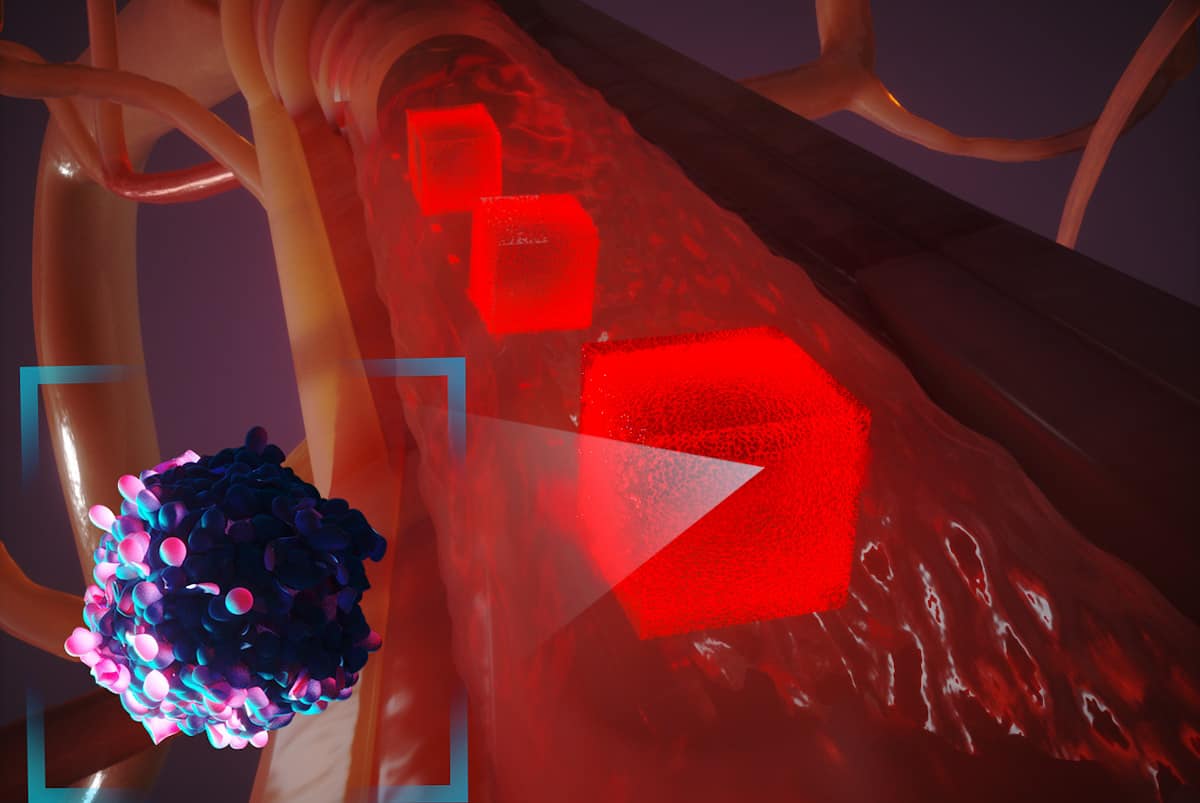
Computational modelling Artistic rendition showing how the system simulates a cancer cell travelling through the blood stream. To account for millions of cellular interactions, it only creates detailed simulations in the immediate vicinity of the cancer cell. (Courtesy: Duke University)
To understand this process further, the researchers applied the APR method to combine a finely resolved region of red blood cells with a coarsely resolved bulk fluid domain. In essence, they took a grid that represented a high-resolution model of red blood cells and moved it through a simulated low-resolution version of an upper body vasculature. The hybrid nature of the computing architecture was important here, as the CPUs were used for the coarsely resolved surrounding area while the GPUs focused on the finely resolved grid.
This grid contained the cancer cell, along with a high-resolution model of the red blood cells that surround it as it moves through the circulatory system. As the cancer cell moved, the grid moved along with it. This approach ensured that the area surrounding the tiny cancer cell was modelled as finely as possible without wasting compute resources on areas in the circulatory system not immediately surrounding the cancer cell.
There were many other important aspects of this work, including the accurate deformation of red blood cells as they flow through the circulatory system, as well as the boundary between the finely resolved grid and the coarsely resolved area outside the grid.
One of the most significant points of this research, Roychowdhury noted, is that the advanced APR method can simulate cancer cell transport using a fraction of the computational power required to run a fully resolved model. “A simulation like this, that should take thousands of nodes, can be shrunk down to just use one,” he said. “Our goal is to make these HPC simulations accessible to scientists.”
There is future work to be done. The team’s current research only focuses on a single cancer cell, while these cells generally break off in clusters rather than singularly. Responding to a question from the audience, Roychowdhury stated that the team is also interested in further research in this area concerning sickle cells.
In the summer of 1960 I set off for the Los Alamos National Laboratory in New Mexico, having just finished my bachelor’s degree in physics from the Polytechnic Institute of Brooklyn, now part of New York University. I had gained a high Q-level security clearance and was qualified to enter Los Alamos on a summer programme for students. It was only 15 years after Robert Oppenheimer and his team of scientists and engineers on the Manhattan project had detonated the world’s first atomic bomb – the famous 1945 Trinity test – but a sense of atomic history already pervaded the lab.
My research group reported to Stanislaw Ulam, the Polish mathematician who had co-invented a working hydrogen bomb with Edward Teller barely a decade earlier. Another member of the group, meanwhile, had helped assemble the Trinity bomb. Holed away on this desert plateau, which sits more than 2200 m above sea level, my abiding impression of Los Alamos was of the thin, crystalline air – flooded with sunshine – that seemed to promote a kind of otherworldly thinking. It was as if these strange conditions were needed for those great minds to develop their world-shaking bomb.
Out of this world Robert Oppenheimer played by Cillian Murphy in the blockbuster movie Oppenheimer (2023), much of which was filmed in the sunlit desert uplands of New Mexico. (FlixPix / Alamy Stock Photo)
Most people, however, have never experienced Los Alamos first hand as I did. Instead, their impressions of Oppenheimer and the Manhattan project will rest on the many movies, documentaries and books made about that war-time era. Interest in his life and legacy is perhaps higher than ever thanks to Christopher Nolan’s blockbuster film Oppenheimer (2023). A huge box-office hit, it is, however, just the latest of many efforts to present the origins of the nuclear age, its science, people and policies including Oppenheimer’s central role.
Nolan’s film tells the Los Alamos and Trinity stories chiefly through Oppenheimer’s story. He is depicted as a person, a scientist and a scientific leader, with the main narrative thread being the loss of his security clearance in 1954 – under suspicion of being a Soviet spy – following an investigation and interrogation by the Atomic Energy Commission (AEC). He is well played by Cillian Murphy, whose subtle facial expressions and body language show the many layers of Oppenheimer’s complex mind and personality: his blend of arrogance and naiveté; the scale of his emotions as he reacts to personal tragedy or to the atomic bombing of Japan.
The movie, for me, is a compelling portrait of a man who bore the burden of having created a terrible weapon that killed tens of thousands of people. He then faced the bitter irony that the same government and country that had asked him to build it declared him to be untrustworthy, ending any further involvement of his in building or advising on nuclear weapons. But even with a running time of three hours, the film cannot fully tell the complex and difficult story of Oppenheimer and the bomb. Fortunately, there are many other movies as well as books and plays (see box below) to turn to.
Oppenheimer through the decades
The very first cinematic portrayal – The Beginning or the End – was released in 1947, barely two years after the end of the war. Part fiction, it is framed as a documentary about the Manhattan Project, made for the benefit of future humanity, should we survive the nuclear age. It tells the story of the bomb from the discovery of nuclear fission to the destruction of Hiroshima and Nagasaki. Actors play Oppenheimer (although he is not a major character), Albert Einstein and General Leslie Groves – the military head of the Manhattan Project – and others in fictionalized but more-or-less historically and scientifically valid scenes.
Significantly, the film is ambivalent about the morality of using the bomb. Members of the fictional bomber crew at Hiroshima are stunned by the inferno they have wrought, but imply that it is payback for Japan’s treacherous attack on Pearl Harbor. A fictional young physicist on the bomb project is its conscience, regularly expressing doubts about the bomb. As he dies of radiation sickness, he wonders if this is retribution for working on the bomb. In a bizarre final scene, though, his voice from the grave predicts that atomic energy will give humanity a golden future.
As Los Alamos and knowledge of nuclear war entered the general consciousness, it wasn’t long before science fiction got in on the act. Several science-fiction movies in the 1950s featured atomic blasts or monsters created by nuclear radiation, notably Godzilla (1954), in which radiation awakens a gigantic prehistoric reptile that rampages through Tokyo. The Day the Earth Stood Still (1951) presented an equally bleak message, as an alien emissary warns humanity to be careful with nuclear weapons or face dreadful consequences.
Other feature films about nuclear war were just as sombre but more realistic. In On the Beach (1959), a catastrophic global nuclear exchange occurs (possibly by accident), after which the inhabitants of Australia and an American nuclear submarine crew despairingly await a radioactive cloud that will kill these last remnants of humanity. Then there is the classic French New Wave film Hiroshima Mon Amour (1959), which intertwines our perceptions of Hiroshima’s nuclear devastation and of a hopeless love affair to heighten our responses to both.
Later movies to deal memorably with nuclear war include Dr. Strangelove or: How I Learned to Stop Worrying and Love the Bomb (1964) and Fail-Safe (1964). Only in 1989, though, did another feature film depict the Manhattan Project. That was Fat Man and Little Boy, which uses the code names for the bulky Nagasaki plutonium bomb and smaller Hiroshima uranium bomb. Oppenheimer (Dwight Schultz) features prominently in the film, but he is overshadowed by Paul Newman as General Groves, though both are superficially drawn.
The film does, however, present the technical challenges in developing the bomb, such as designing trigger mechanisms to rapidly bring sub-critical pieces of fissionable material to critical mass and initiate the nuclear explosion. Fat Man and Little Boy also spotlights nuclear dangers, as a fictional Los Alamos physicist dies miserably from radiation in circumstances portrayed like those that killed two real physicists, Harry Daghlian and Louis Slotin, who died after Trinity while conducting experiments that want horrifically wrong.
Bomb documentaries
The 1980s saw the start of a number of documentaries about the building of the bomb, the most important of which is The Day After Trinity (1981). It relies solely on real US government footage, newsreels and photos. Directed by Jon Else, it also uses filmed interviews with 20 people who knew or worked with Oppenheimer or who were affected by the atomic bomb project. There are even archival appearances by Oppenheimer and other major figures such as US President Harry Truman.
The documentary vividly portrays Oppenheimer’s life, intellect and thoughts. Hans Bethe, who headed the theory section at Los Alamos and later won the 1967 Nobel Prize for Physics for his work on stellar nucleosynthesis, is shown raising one of many questions about Oppenheimer’s complex personality. “We ask,” he wonders on screen, “why people with a kind heart and humanist feelings [would] work on weapons of mass destruction.”
One answer comes from Oppenheimer’s close friend, Berkeley professor Haakon Chevalier. In an interview in the film, he explains that Oppenheimer, who was born in the US into a Jewish family with strong ties to Europe, had been greatly alarmed by the rise of Nazism. We learn too about Oppenheimer’s rare scientific talent, with Bethe claiming he was “intellectually superior” to everyone at Los Alamos. “[He] knew and understood everything…chemistry or theoretical physics or machine shop. He could keep it all in his head.”
Like The Beginning or the End, the film follows the story through to Hiroshima but treats moral questions more deeply. Courageously, it includes painful footage of the suffering of burned and injured adults and children after the Hiroshima bombing, turning abstract issues of morality into the real and devastating consequences for innocent people. It also shows that some Los Alamos scientists were concerned about the moral issues the bomb would raise.
One was the physicist Robert Wilson, who headed the experimental research division at Los Alamos and later became the first director of the Fermi National Acceleratory Laboratory in the US. In the film Wilson tells how, sometime between April 1945 and the Trinity test in July, he called a meeting about whether work on the test bomb should continue. Oppenheimer tried to dissuade him, but the meeting went ahead anyway. Oppenheimer told the scientists present that the Trinity test was essential so the world would know that this “horrible thing” existed as the new United Nations was being formed. The remarks convinced the attendees to continue preparing the bomb, though, post-war, Wilson gave up his security clearance and never again worked on nuclear energy or bombs.
In The Day After Trinity, an interviewer is shown asking Oppenheimer in the 1960s about controlling the spread of nuclear weapons. “It’s 20 years too late,” Oppenheimer says quietly but firmly. “It should’ve been done the day after Trinity.” His idealistic wish for international nuclear control and his opposition to the hydrogen bomb are well known. Indeed, they weighed against him in the 1954 hearing, the stage for which was partly set by the rabid anti-communism of US Senator Joseph McCarthy.
Among those who testified for Oppenheimer were the Nobel laureates Enrico Fermi and Isidor Rabi as well as Bethe and Groves; his former colleague Edward Teller, who championed the hydrogen bomb, spoke against him. But as The Day After Trinity also shows, Oppenheimer’s own unforthcoming testimony served him poorly. As Robert P Crease explains elsewhere in Physics World, he was flummoxed in questioning by attorney Roger Robb, who accused Oppenheimer of going beyond science and trying to counsel on military strategy.
The film makes clear that the revocation of Oppenheimer’s clearance was a great blow. His physicist brother Frank tells us “it really knocked him for a loop;” Bethe relates that “he was not the same person afterwards”; and Rabi says the revocation “actually almost killed him spiritually, yes. It achieved what his opponents wanted to achieve. Destroyed him.”
Oppenheimer in literature and on stage
The inherent drama of the atomic-bomb story, its moral issues, and the intricacies of Robert Oppenheimer’s character have inspired not just countless movies and documentaries (see main text) but also stage plays and an opera. Perhaps the earliest of these is In the Matter of J Robert Oppenheimer by German playwright Heinar Kipphardt, which was first performed in 1964. Whereas Christopher Nolan’s Oppenheimer film weaves the Atomic Energy Commission hearing through a larger story, Kipphardt’s play is set entirely inside the hearing room and is based on thousands of pages of actual testimony. One reviewer in the New York Times said that a 2006 off-Broadway revival posed “questions about moral relativism, the limits of vigilance and human decency”.
Explosive drama The cast of the Royal Shakespeare Company’s 2015 production of Oppenheimer in Stratford-upon-Avon, UK, lie prone on stage as they await the first atomic bomb explosion. (Courtesy: Royal ShakespeareCompany / Keith Pattison)
Later, Oppenheimer by the British dramatist Tom Morton-Smith took a broader view. Premiered by the Royal Shakespeare Company in 2015, it starts with Oppenheimer’s left-wing connections in the 1930s and ends with the Trinity test. It includes the physics of the bomb, depicts figures such as Edward Teller, and comments on Oppenheimer’s moral stance toward building the bomb. Reviewers noted the epic Shakespearean sweep of Oppenheimer’s rise and fall: Physics World credited the play with carrying “considerable emotional punch”, while the Guardian said it evoked “an overall ache for humanity”. Later, the Los Angeles Times said of a California revival in 2018 that “the physics is dazzling, but even more intriguing are the complicated human beings behind the equations”.
If these stories are indeed epic, opera is surely the most powerful medium for telling them, as in Doctor Atomic by American composer John Adams with libretto by Peter Sellars. First presented at the San Francisco Opera in 2005, it concentrates on the reactions of Oppenheimer and others at Los Alamos as tension escalates with the approach of the Trinity test. Writing in Physics World, the historian Robert P Crease called one haunting scene, which conveys the turmoil in Oppenheimer’s soul that he had never openly expressed, “opera at its finest”. But Crease and others took issue with the characterizations of some of the leading figures. A review of a 2018 production at the Santa Fe Opera near Los Alamos says it does “spectacle” well, but “conveys a feeling of grief…rather than telling a story”.
We should not forget either the countless books about the nuclear age, two of the most famous of which each won a Pulitzer Prize. The first is Richard Rhodes’ The Making of the Atomic Bomb (1986), which is the authoritative study of the bomb project and its leading figures, including Oppenheimer. The other is American Prometheus: the Triumph and Tragedy of J Robert Oppenheimer (2005) by journalist Kai Bird and historian Martin J Sherwin. Perhaps the definitive Oppenheimer biography, it inspired Oppenheimer the movie and, as its title shows and as the film replicates, depicts Oppenheimer’s fall from grace in 1954.
For every generation
Taken together, these four movies – The Beginningor the End, The Day After Trinity, FatMan and Little Boy and Oppenheimer – convey the urgency of the atomic project well. Fictional parts aside, they provide a reasonably accurate picture of the start of the nuclear era, while giving a decent scientific explanation of nuclear chain reactions, the difficulties of obtaining enough uranium-235 and plutonium to make bombs, and the technical ingenuity that made the bomb work. The strategic and political thinking behind the decision to bomb Japan – and the opposition to that step – are covered too.
But why do we need to keep recreating the story? One answer comes from Else, who directed The Day After Trinity. As he recently stated: “These stories have to be retold every generation, and they have to be told by new storytellers.” Nuclear weapons, in other words, are so dangerous that we have to underline their menace in new and different ways. Oppenheimer does this by focusing on the personality of Oppenheimer himself and by bringing a roster of Hollywood A-listers.
Excellent though the acting is in Oppenheimer, I feel it is The Day After Trinity that more powerfully shows us the real man and his contradictions, thanks also to comments from those who knew him. Rabi describes, for example, how Oppenheimer proudly strode along immediately after the Trinity blast, like a gunslinger in the classic film High Noon (1952). Later, however, as Rabi reminds us, Oppenheimer spoke out against the hydrogen bomb because it would not serve as a military weapon but only to kill civilians.
Oppenheimer’s doubts are made clear in his photo at the time of the AEC hearing, which shows the gaunt cheeks and haunted eyes of a man who has been spiritually tested and torn by building the bomb as was asked of him, seeing its destructive use that won the war, then finding himself rejected and his career destroyed. It is, in a sense, a tragedy, and why the book American Prometheus was so aptly titled. Oppenheimer was a scientific leader in a time and place that forced him, and others, into impossible moral choices.
A final chapter
Oppenheimer is not the final word. Unmentioned in the film is that in December 2022 Jennifer Granholm – secretary of the US Department of Energy, the successor to the AEC – announced that she had annulled the revocation of Oppenheimer’s security clearance. This was being done, Granholm said, to correct the record and honour his “profound contributions to our national defense and scientific enterprise at large”. This was primarily due to efforts by the authors of American Prometheus.
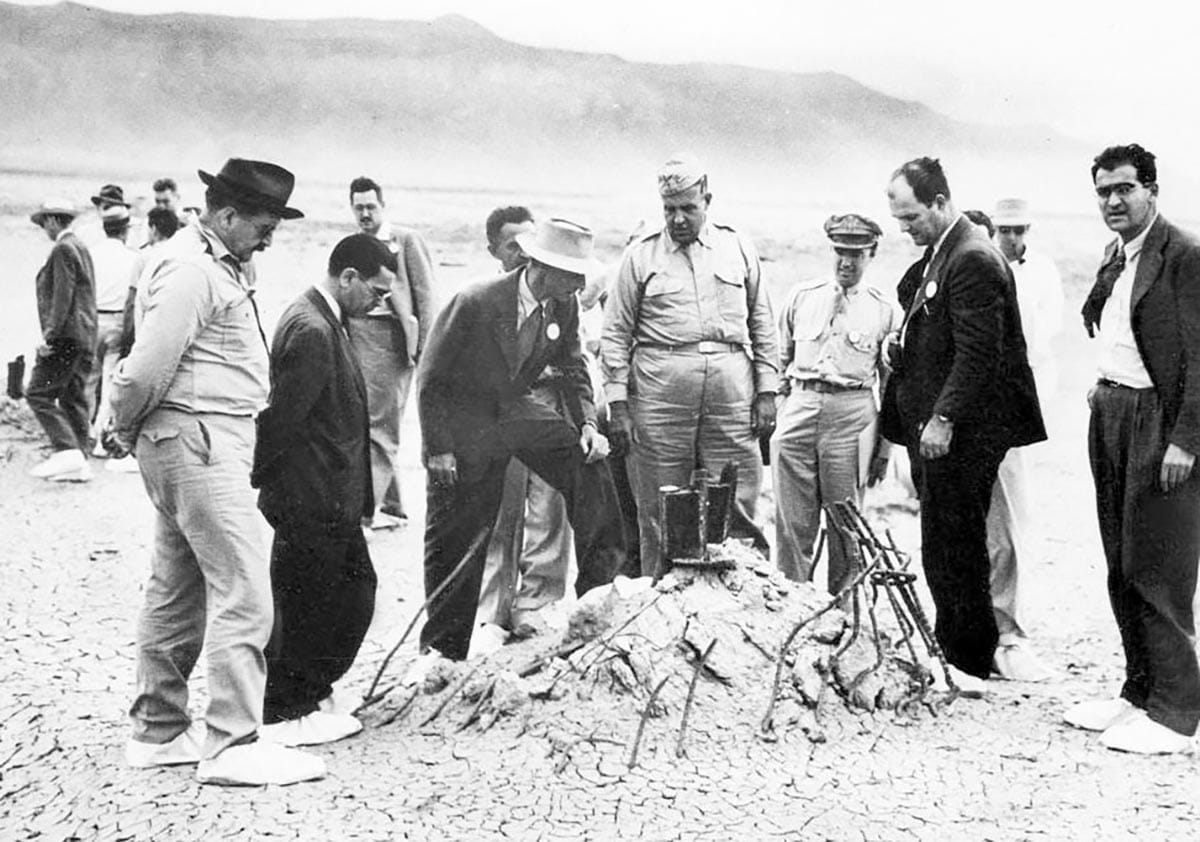
Deadly reality Robert Oppenheimer (centre with light hat) and General Leslie Groves (centre) gather to view the melted remains of the Trinity atomic-bomb tower a few months after the test at Los Alamos in 1945. (Courtesy: United States Department of Energy)
I can, however, personally attest that the scientific community not only rejected the original AEC decision but also revered Oppenheimer. As a graduate physics student in the early 1960s at the University at Pennsylvania, I went to hear him give a public lecture to a crowd of hundreds filling a large auditorium. Then nearly 60, he looked – from my vantage point in the hall – frail and even ethereal, but he must have had a tough core that sustained him through Los Alamos and the AEC hearing to stand before many eager to hear him.
Looking back, it’s clear that the atomic-bomb project affected the entire physics community. Oppenheimer, Einstein and others spoke out against the dangers of nuclear war, and physicists still do, through organizations such as the Bulletin of Atomic Scientists and Scientists for Global Responsibility.
But as the US historian Daniel Kevles wrote in his 1978 book The Physicists: the History of a Scientific Community in Modern America, the success of the Manhattan Project also gave physicists “the power to influence policy and obtain state resources largely on faith”. Nuclear and high-energy physics benefitted from this new regard, but it also raised the prestige of physics in general and led to more financial support. That too is part of the complex scientific legacy and moral reckoning from the story of Oppenheimer and the atomic bomb.
As for me, my last direct link with the nuclear era came in 2002, when with other physicists attending a meeting in Albuquerque, I had the rare chance to visit the Trinity site at Alamogordo, New Mexico. A small stone pyramid with a plaque marked ground zero, in the midst of a nearly infinite sweep of land. The natural barrenness was a sign of what a nuclear bomb could do to a city. Near the pyramid, a fence surrounded a small mound of weathered concrete and metal. This was a remaining trace of the 30 metre-tall steel tower atop which the bomb was detonated, and which had vanished in the blink of an eye.
A cosmic-ray particle with an energy about 36 million times greater than the particles accelerated by CERN’s Large Hadron Collider has been detected. At 244 EeV, this is one of the most energetic particles ever observed and was spotted in 2021 by the Telescope Array in Utah. While the ultrahigh-energy cosmic ray (UHECR) was probably created by a violent astrophysical process, researchers were unable to trace it back to its origins.
The researchers have dubbed the particle Amaterasu, which is the goddess of the Sun in Japanese mythology. The current energy record for a UHECR is 320 EeV, held by the “Oh-My-God” particle, which was detected in 1991 in Utah by a predecessor to the Telescope Array.
UHECRs are subatomic particles such as protons that have energies greater than 1 EeV (1018 eV). While they appear to come from outside the Milky Way, their origins are still poorly understood due to the rarity of observing them on Earth.
Cosmic cut-off
In searching for the origins of UHECRs, astronomers benefit from a phenomenon called the Greisen-Zatsepin-Kuzmin (GZK) cut-off. This occurs because UHECRs with energies above about 60 EeV interact with the cosmic microwave background as they travel through space – losing energy as they go. This means that particles at these higher energies cannot have travelled further than about 300 million light–years before reaching Earth.
Despite this cut-off, the international team that detected Amaterasu is no wiser about the origin of the particle, according to Toshihiro Fujii of Japan’s Osaka Metropolitan University – who was first to notice evidence of the UHECR in Telescope Array data.
“We found this new mystery,” he said, pointing out that the particle does not correlate with any known astrophysical object. Writing in the journal Science, the team suggests several possible origins for Amaterasu.
Darkness and light
Looking within the GZK cut-off and assuming that the particle was deflected by the Milky Way’s magnetic field, one possible origin is galaxy NGC 6946. This is about 25 million light–years away and known for its prodigious star formation and numerous supernovae. However, astronomers have not observed gamma rays or X-rays from the galaxy. Observing this radiation would suggest the presence of an astrophysical object capable of accelerating UHECRs. Amaterasu could also be traced back the Local Void, a nearby region with an unusually low density of galaxies. But again, there is no object there that can be identified as a source.
According to the team, another possibility is that our incomplete understanding of particle physics beyond the Standard Model could mean that Amaterasu travelled farther than allowed by the GZK cut-off. If this is the case, then it could be that the UHECR’s origin is so far away that we cannot detect its electromagnetic emissions.
According to Fujii, the most exotic possible source of Amaterasu is a “dark accelerator” – a hypothetical object that emits UHECRs but no other radiation.
Despite the discovery and speculation, Rafael Alves Batista, an astrophysicist at the Autonomous University of Madrid, told Physics World that the observation reveals “nothing new” about UHECRs.
“I’m a conservative in the sense that I would not jump into any explanation beyond the Standard Model,” he says. “We have astrophysical objects that can indeed generate these high energy cosmic rays. We just don’t know how this happens, or where these objects are, or which objects are doing this.”
He also points out that astronomers have a very poor understanding of magnetic fields outside the Milky Way, which makes backtracking very difficult.
Complete uncertainty
“In our galaxy, we don’t really know [the galactic magnetic field] but at least we have a handle that it’s within specific bounds. But, for extra galactic magnetic fields, it’s completely uncertain,” Batista said.
Both Fujii and Batista agree that more observations of these rare events are needed before we can begin to understand the origins of UHECRs. Also needed are improvements to our understanding of extragalactic magnetic fields.
Some of these observations will surely be made by the Telescope Array. It is the largest cosmic-ray detector in the northern hemisphere and is currently being expanded to be a factor of four larger than its current area.
Today, particles like Amaterasu are detected about once every 15 years, but Fujii says improvements to the Telescope Array could reduce this to once every four years.
Last month I highlighted some of the medical-physics companies that won business innovation awards from the Institute of Physics in 2023. But firms in the photonics and instrumentation sectors have done well too, which is perhaps not surprising given that photonics is one of the UK’s largest physics-based industries. As the Photonics Leadership Group (PLG) said in a recent statement, the UK photonics sector is now worth £15.2bn, with like-for-like revenue growth of more than 7% between 2020 and 2022.
Having sat on the judging panel for the IOP’s business awards, I can say that there were some fantastic entries
The PLG, which includes representatives from more than 60 photonics businesses in the UK, says that there is increased demand for photonics in everything from agriculture, health and communications to defence, satellites and manufacturing. It also points to an increasing commercialization of the burgeoning quantum-technology sector. Indeed, the PLG forecasts that the UK photonics sector will be worth more than £17bn in 2024 and grow to £50bn by 2035.
Having sat on the judging panel for the IOP’s business awards, I can say that there were some fantastic entries, which meant that picking winners wasn’t easy. In no particular order, however, the first winner I’d like to mention is Glasgow-based Coherent Scotland, which makes ultrafast lasers for applications in the life sciences and industry. The firm’s philosophy is to transform complex, physics-based optical technology into equipment that’s easy to use, even by people who aren’t laser experts. Their award recognizes in particular the company’s Axon range of femtosecond lasers, which it has developed over the last six years.
Operating at three wavelengths that are of particular use in biology (780, 920 and 1064 nm), the lasers can be easily fitted into existing imaging and industrial tools where space is at a premium. They exploit the technique of chirped pulse amplification – which was recognized by the 2018 Nobel Prize for Physics – by taking short, low-power pulses and stretching them out in time. The pulses, which now have a lower peak power, can then be safely amplified before being recompressed into short, higher-peak-power pulses.
Traditionally, this technique is only ever found in large, facility-sized laser systems. But the Axon lasers, being so small, have already been used by neuroscientists for in-vivo brain imaging and studying neurodegenerative diseases such as Alzheimer’s and Parkinson’s. Other applications include cancer diagnostics and drug research, pharmaceutical testing, tropical-disease control and immunology. The future looks bright for the physics of ultrafast laser technology in the biological sciences.
Space success
Another winner is KEIT Industrial Analytics. Based at Harwell in Oxfordshire, it makes infrared Fourier transform spectrometers for monitoring and controlling industrial production processes. The technology was originally conceived at the Rutherford Appleton Laboratory in the late 2000s as a compact, rugged high-performance instrument for analysing the atmosphere of Mars. KEIT was spun out of the Rutherford lab in 2012.
Containing no moving parts, the company’s spectrometers use simple optics to generate an interferogram along a detector array. The data can then be Fourier transformed to return the whole spectrum, creating a robust instrument that can be used directly for instantaneous in-line analysis in production plants. That in turn offers real-time spectral data as opposed to delayed, off-line sample analysis which has huge advantages in process control applications on yield and product quality.
KEIT’s technology is sold around the world to companies that use it for in-situ monitoring of everything from bioethanol and biofuels production to pulp and paper manufacturing. With the global analytical instruments market expected to grow at almost 4% a year to $71.4bn by 2027, I think KEIT has a bright future. The original Rutherford technology continues to be developed for future off-planet missions so watch this space.
Focal Point Positioning, meanwhile, won a 2023 IOP business award for its pioneering location-awareness technology. Based in Cambridge, the company was founded in 2015 by the physicist Ramsey Faragher, who was once dubbed “the real life Q” – in a nod to James Bond’s R&D guru – by Top Gear magazine. Faragher invented a technology that improves the accuracy, sensitivity and security of devices that use location data from global-navigation satellite systems (GNSS).
GNSS is a massive business area. More than $1trillion of the US economy and over €800bn of the European economy currently depends on this incredible positioning and timing system. However, GNSS is not perfect, especially in cities, where signals can bounce off buildings, causing location-technology devices – in anything from cars to mobile phones – to be inaccurate. It’s why the blue dot on your GoogleMaps can be in the wrong place or why your Uber driver can’t find you.
The company’s “Supercorrelation” technology gets round this problem by working out the direction of incoming signals through special software rather than needing costly antennas or other infrastructure. By detecting – and ignoring – fake signals, and recognizing reflected signals, the company’s technology allows metre-level positioning to be maintained on smartwatches, fitness devices and other consumer products even in the trickiest environments.
The company has more than 25 patent families and four trademarks on its technology. But Focal Point doesn’t make its own products. Instead, it licenses its technology to other firms, including Switzerland-based u-blox, which is the largest chipset designer in Europe. The company is also currently involved in licensing discussions with various leading global smartphone and car manufacturers, and has a partnership with General Motors already in place.
Finally, let me mention turboTEM, which won an IOP start-up award for its equipment that can make electron microscopes work better and last longer. Based in Dublin, Ireland, turboTEM was set up in 2022 by researchers from the ultramicroscopy research group at Trinity College, who wanted to take a number of emerging technologies from the lab out into the field. The company was recognized for its modular devices that can be easily and cheaply retrofitted to what is a vital imaging tool.
Electron microscopes are great tools but they don’t come cheap, typically costing millions of pounds. Users who want access to the latest advances and improvements in performance can’t easily go out and buy a new one, which is why an upgrade makes a lot of sense. So by extending the useful life of the instrument, turboTEM enables more cutting-edge science and development to be performed on existing tools.
In it to win it
As I have mentioned before, all physics-based firms require time and energy to develop products and become globally significant. There’s also the perennial difficulty of explaining a product idea, which is often quite specialized, to potential investors who have little or no science background. An IOP start-up award can therefore show that your technology has won approval from judges with solid physics and business experience.
As the chairperson of one award-winning company put it at a presentation held at the UK Houses of Parliament at the end of October, the award is “an extra solid data and trusted point for potential investors”. The high-profile event was hosted by the physicist and MP Alok Sharma, who has been a long-time supporter of the IOP business awards and served as president of the COP26 conference in Glasgow in 2021.
As the chairperson of one winning company put it at a presentation held at the UK Houses of Parliament, the award is “an extra solid data point for potential investors”
I hope, therefore, that your company, if you have one, will be inspired to apply. And even if you don’t work in a business, remember the IOP also offers three awards (Katharine Burr Blodgett, Denis Gabor and Clifford Paterson) for individuals or teams who have done innovative physics with a commercial angle. Good luck – and remember, you have to be in it to win it. Award entries for 2024 will be open soon so watch this space.
More than 80% of physicists believe that the UK will fail to meet its 2050 “net-zero” targets, according to a report released today by the Institute of Physics (IOP), which publishes Physics World. It says “we stand at a crossroads” regarding climate change, with more support needed to tackle what the IOP calls “the defining challenge of our time”. Alok Sharma, the physicist who was president of the United Nations COP 26 conference in Glasgow in 2021, says in the report that physics research and innovation is “central” to the energy transition.
The UK government committed back in 2019 to reaching net zero by 2050, following a recommendation by the Climate Change Committee, the UK’s independent climate advisory body. This pledge, which is a legal requirement, would require reducing the country to cut its greenhouse-gas emissions by 100% from 1990 levels by 2050. If met, this would mean the amount of greenhouse-gas emissions produced by the UK would be equal to or less than the emissions removed by the UK from the environment.
The IOP’s report – Physics Powering the Green Economy – sets out the role that physics and physicists can play in fostering the green economy. Indeed, since 2005, some 70% of the £2.2bn that has been spent by the UK Research and Innovation – the umbrella organisation for the UK’s research councils – on green energy has gone on physics-based technologies such as nuclear, renewable energy, energy storage, hydrogen and alternative fuels as well as carbon capture and storage.
Yet the report says that the UK will need more investment and support if the country is to get back on track to meet its climate goals. That conclusion is echoed by the IOP’s survey of 502 physicists working in academia, business and research, 83% of whom think that the UK will miss the net-zero target with 68% believing that the current level of investment in research and development is too low to guarantee net zero.
Martin Freer a nuclear physicist at the University of Birmingham, who steered the activity on the report, told Physics World that the 83% figure is “really worrying” given that the UK has already taken some steps such as reducing the amount of coal-fired power stations. “The signs are currently pointing in the wrong direction,” adds Freer, who is the IOP’s outgoing vice-president of science and innovation.
Meeting the challenge
The report highlights, however, the many opportunities in the green economy, pointing out that there are already more than 1750 companies working green tech in the UK and Ireland, with a combined turnover of £740bn. A healthy physics ecosystem is “essential” to the continued development of green technologies, says the report, which demands a “broad range” of investments to support physics research as well as business innovation and skills.
The IOP also calls for a “systems approach” that, for example, would develop the grid at the same time as pushing forward renewable-energy capacity. Indeed, Freer says the UK government must show “greater ambition” in pushing green technologies. “We need greater investment into research and development,” he adds. “As well as a joined-up approach between different departments in government in terms of their own policies and strategies to make sure they are properly aligned with net zero.”
That view is echoed by Sharma, a former UK business secretary, who is standing down at the next election as a member of the UK parliament. “What is needed in the UK and Ireland is a long term strategic approach – backed by action – an approach which should have physics at its heart,” he says. “This IOP report is timely and provides useful evidence to inform how we can collectively move forward – an important message not just in the UK and Ireland – but across the globe.”
The latest episode of the Physics World Weekly podcast features an interview with a biomedical ethicist who believes that ethical rules and best practices must be developed for research that is done on humans who take part in commercial spaceflights. Vasiliki Rahimzadeh of Baylor College of Medicine in the US says that people who take part in space missions must be fully aware of the risks.
Now, researchers at Florida State University and Wake Forest University have identified a risk to male sexual health that could occur during deep space missions. The team subjected rats to a simulated flux of cosmic rays. This was similar to what humans would experience on a mission to the Moon or Mars – a journey that would take them away from Earth’s protective magnetic field.
When the rats’ tissues were examined after exposure, the team found evidence of oxidative stress in the creatures’ tissues. In male rats, this impaired blood flow to the erectile tissue in the penis. This suggests that astronauts exposed to a similar flux of cosmic rays could develop erectile dysfunction. The study also suggested that weightlessness would have a similar effect – but not as pronounced.
Persistent dysfunction
This dysfunction is expected to persist when an astronaut returns to the protective cocoon of the Earth – however, the researchers say that the effect could be reduced using antioxidant drugs.
It’s coming on winter here in the northern hemisphere and soon roads, buildings and other structures will be suffering frost-induced damage. Naively, one might think that the expansion of liquid water as it freezes is the main cause of this damage, but according to Physics Magazine’s Katherine Wright it’s much more complicated than that. Indeed, she points out that liquids that contract when they freeze can also cause frost damage.
Instead, it appears that most of the damage is related to how a freezing liquid within a porous material can draw in more liquid – eventually causing the object to swell.
Liquid channels
Wright reports on research done by ice expert Robert Style of the Swiss Federal Institute of Technology and colleagues. The team looked at how channels of liquid water that occur in polycrystalline ice contribute to this drawing-in process – and ultimately to frost damage.
They did this by creating a simple porous material by putting silicone between two glass slides. Pores were created in the soft silicone, which was decorated with fluorescent molecules. This allowed the team to watch the pores swell as the ice drew in more liquid water. They we also able to observe the channels in the ice through which liquid water was drawn in.
The Pyrex beaker is still intact but is now missing a significant quantity of its liquid content.
“Oh my god, I’m so sorry!” my partner exclaims as hydrochloric acid spreads across the lab bench in front of us both.
A quick check of the laboratory workbook confirms this is not in the instructions, so we both grab some deionized water, squirt it on to the spillage, and desperately mop it up with blue paper roll. No harm done and we’ve learned a lesson, which is that if you heat a wire in a Bunsen burner until it’s red-hot before dunking it in acid, you’ll get a reaction. Obviously, right?
We’ve been doing the classic flame-test experiment, which reveals what colours various metal salts go when they burn. It’s an experiment familiar to generations of high-school students but I’m doing it for the first time as part of the Open University (OU) level-1 laboratory summer school on its campus in Milton Keynes. My first degree is in computing science but I decided, aged 47, to go back to university to study physics part-time alongside my full-time job as an IT consultant.
My decision to do physics as a mature student came during the pandemic when a chance comment by a friend made me realize how little I understood about the universe. Keen to find out more about the mysteries of time, gravity, the Big Bang and black holes, I started taking some of the OU’s free OpenLearn online courses, which rekindled my joy of learning. From there, it was a short step to doing an OU physics degree.
The beauty of studying with the OU is that, summer schools apart, it’s done almost entirely by distance learning. As long as you have a decent laptop and Internet connection, you can fit in studying for the degree around the rest of your life, which is great if you have busy family or work commitments. When COVID-19 struck, traditional universities scrambled desperately to move online, but it was business as usual for the OU, which already had a superb online education platform.
The downside is you don’t get to mix in person with other students (though there are informal Facebook and WhatsApp groups). Another challenge when studying science remotely is that any experiments you try are rudimentary. Most of us don’t have radioactive isotopes knocking around at the back of the kitchen cupboard to measure half-lives. Unless, that is, you’re Marty McFly from Back to the Future, in which case you’ll already have a cache of weapons-grade plutonium to power your DeLorean (and a penchant for 1980s rock music).
An Open University summer school is the perfect opportunity to fill the gaps in your experimental knowledge, learn from your fellow students’ mistakes and share in each other’s successes
An OU summer school is therefore the perfect opportunity to fill the gaps in your experimental knowledge. It’s also a chance to see and learn from your fellow students’ mistakes and share in each other’s successes. My lab partner is Leeaaron Jones, who works in retail at a zero-waste community enterprise in North Wales but wants to move into microbiology. Together, we’ve been struggling to focus our spectroscope and get a nice sodium light spectrum to make observations. However, other students in the lab have got a great view of this and share a photograph with me.
The lab work is great fun. As is true at many universities, an OU degree involves taking a mix of subjects before specializing and, in fact, I’m surprised how much I’m enjoying the biology practicals. We’re collecting data about the lengths of the roots and the heights of the stems of wheat plants grown in various concentrations of salt water to see how the amount of salt affects growth rate. Aside from confirming that biology is the messy science, it’s a great lesson in statistical analysis and the variability between living things.
I also enjoy a chemistry experiment where we try to identify the metal in different liquid solutions both qualitatively and quantitatively using a colourimeter. We perform a titration on a sample of water we’ve brought from our home towns to pinpoint how hard or soft the water is (I’m from Rochdale and discover the water there’s fairly soft). We do the experiments in pairs and then pool the data from the whole group to get a more accurate analysis. We then validate this against the known water hardness data for that area.
And of course, we get to play with Bunsen burners to perform those flame tests.
The two-and-a-half-day summer school isn’t compulsory: the marks I get won’t count towards my final degree. But it’s been invaluable in terms of gaining real practical experience and working with proper experimental data that I and my group have gathered. Rather than handling made-up theoretical data, I’m learning to draw a straight line through a real, random scattering of dots, which is harder than you might think.
Apart from a day at the start of the course, this has been the only face-to-face contact I’ve had with other students and lecturers on my degree. I hope the OU offers more such opportunities as you can’t beat sharing a love of physics with other students, and receiving direct support and guidance from tutors. Online learning is all well and good, but science is at heart an experimental subject – even if we do need to be reminded of that by a blown-up beaker and a lab bench drenched in acid.
For the first time, researchers have described how it would “feel” to touch a quantum superfluid. Through new experiments, Samuli Autti and colleagues at the UK’s Lancaster University concluded that an ultracold helium-3 superfluid would feel like a heat-conducting 2D surface that encloses an empty bulk.
Superfluidity is a remarkable consequence of quantum mechanics that occurs at ultracold temperatures. Near absolute zero, some fluids will undergo a transition to a zero-viscosity state and can flow forever with zero resistance.
Superfluidity was first observed in helium-4 way back in 1937 and today it is also studied in ultracold atomic gases called Bose–Einstein condensates. But perhaps the most interesting superfluid discovery came in 1970, when three American physicists showed that helium-3 can also become a superfluid – albeit at much lower temperatures than helium-4.
Pairing-up
Unlike helium-4, which is a boson that is prone to condensing into a superfluid, helium-3 is a fermion that should not exhibit superfluidity. However, at very low temperatures, helium-3 atoms pair-up to form bosons, which can then form a superfluid.
This complicated process means that the physics of superfluid helium-3 is much richer than that of helium-4. For example, a helium-3 superfluid exists in two distinct phases: an isotropic “A phase” and an anisotropic “B phase”, which are defined in terms of the relative orientations of the spins of the paired atoms.
The B phase occurs at lower temperatures and involves a spin-triplet configuration. The superfluid reacts to external stimuli via the splitting of pairs, creating quasiparticles that conduct heat through the B phase.
However, the density of these quasiparticles drops drastically as the superfluid cools. At temperatures lower than about 1 mK, the fluid’s interior can only conduct heat efficiently from sources hot enough to create new quasiparticles. Until now, researchers have not considered how this property would affect the macroscopic mechanical behaviour of the B phase.
Mechanical breakdown
One particularly interesting question involves the superfluid’s mechanical breakdown. “Traditionally, superfluids are believed to break down if you hit them hard enough with a mechanical probe,” Autti explains. “How the breakdown happens sounds like a simple question, but it has remained an open problem in superfluid helium.”
To explore this further, Autti’s team designed an experiment where a B-phase helium-3 superfluid is probed by a vibrating, goalpost-shaped wire. As it moves back and forth, the heat introduced by the wire’s crossbar creates new quasiparticles in the superfluid.
“We carefully analysed this heat signature by moving the probe rod in the superfluid, which allowed us to reconstruct the interaction between the probe and the superfluid,” Autti explains.
The researchers discovered that no heat at all is conveyed by the interior bulk of the superfluid. Instead, the quasiparticles are confined to the edges of the container, so any heat generated by the probe is transported along the surface.
Surface superfluid
“At the lowest temperatures, bulk superfluid helium-3 is surrounded by an independent two-dimensional superfluid phase,” explains Autti. “This superfluid has its own heat transport, and primarily interacts with probes inserted in the bulk.”
This effect has some especially interesting consequences for the superfluid’s mechanical properties. “It turns out the bulk superfluid did not break; it remained passive no matter how hard we tried,” Autti continues.
“Instead, we learned that the probe was only interacting with a very, very thin, essentially two-dimensional system that covers the probe. Even more unexpectedly, a closer look revealed that this layer was carrying heat around rather effectively while the bulk played no role in the heat flow.”
From this discovery, the researchers could predict for the first time how such a superfluid would feel to the touch. In stark contrast to a classical fluid, they concluded that the interior bulk of superfluid helium-3 would feel empty, like moving your fingers through a vacuum. Since heat is conveyed across the superfluid’s surface, touching it would feel like pushing into a thin, 2D material, with heat flowing along your fingers.
This discovery marks a breakthrough in our understanding of the macroscopic properties of superfluid helium-3, and it could have important implications for fields ranging from particle physics to cosmology, where exotic quantum fluids are widely studied. “ I think we can safely assume that our view of basic physics elsewhere will change due to these findings in superfluid helium-3,” Autti says.
Our guest in this episode of the Physics World Weekly podcast is the biomedical ethicist Vasiliki Rahimzadeh, who along with colleagues has called for the commercial space industry to adopt ethical policies and best practices for research done on humans during space flights.
Rahimzadeh, who is at Baylor College of Medicine in the US, explains that as well as minimizing risks to paying astronauts who take part in experiments, an ethical framework should also ensure that private spaceflight – which is still the purview of the elite – benefits society as a whole.
Rahimzadeh and colleagues outline their call for an ethical framework in an article in Science