Imaging on an MR-Linac identifies radiation-resistant brain tumours

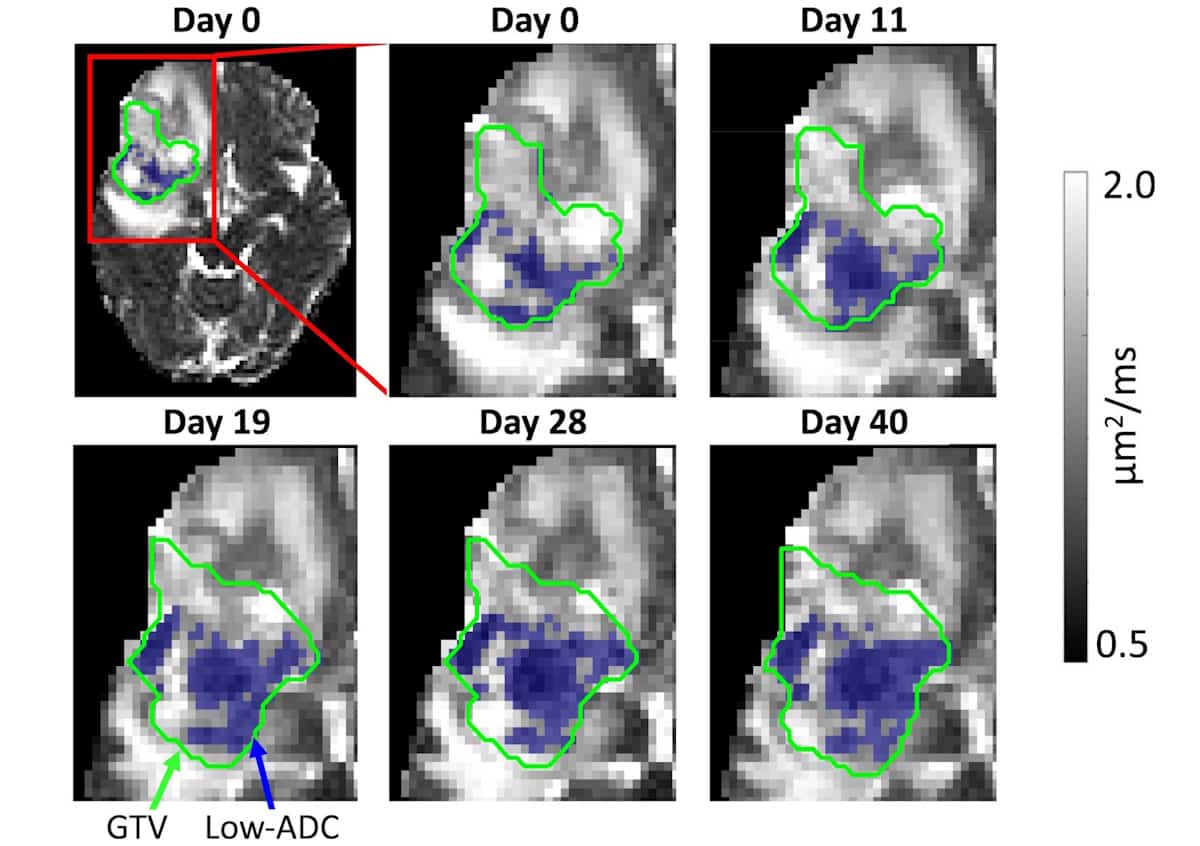
Apparent diffusion coefficient maps recorded on an MR-Linac

Glioblastoma is an aggressive brain cancer with a median survival of just 15 months. Multi-pronged efforts are underway to improve the effectiveness of post-surgical radiation treatment, such as dose escalation, where increased dose is delivered to regions of treatment-resistant tumour. However, this approach requires the ability to rapidly and easily identify tumours that are not responding to radiotherapy.

With this aim, researchers at the University of Toronto’s Sunnybrook Health Sciences Centre have investigated whether diffusion-weighted imaging (DWI) on an MRI-guided linear accelerator (the 1.5 T Unity MR-Linac) can be used to identify such dose escalation targets.

DWI generates MR contrast based on the diffusion of water molecules, with in vivo diffusivity quantified via a parameter called the apparent diffusion coefficient (ADC). Cell membranes restrict water diffusion, resulting in low ADC values. Thus tumour regions of low ADC may indicate highly cellular, dense tumour. A reduction in low-ADC regions during radiotherapy could imply a decrease in solid tumour, while increasing low-ADC volume could indicate that a tumour is not responding to treatment.

First author Liam Lawrence and colleagues investigated whether changes in ADC, identified via daily MR-Linac DWI during treatment, were prognostic for survival. They found that changes in low-ADC regions correlated more strongly with survival than changes in the gross tumour volume (GTV), reporting their findings in Radiotherapy and Oncology.

The study included 75 patients diagnosed with glioblastoma who underwent chemoradiotherapy, 32 of whom were treated on the Unity MR-Linac and 43 with a conventional linear accelerator. All patients were imaged with simulation MRI scanners (MR-sim) at treatment planning, and at weeks 2, 4 and 10 after treatment started.

The researchers analysed 479 DWI scans from the MR-Linac and 289 DWI datasets from MR-sim scans, using voxel-wise fitting to generate ADC maps. They defined “low-ADC” tumour regions as voxels within the GTV with ADC of less than 1.25 µm2/ms. This threshold identifies dense and non-necrotic tumour and is greater than the mean ADC of high-grade glioma.

For both the low-ADC region and the GTV, the researchers computed the median volume changes at each timepoint over all patients. They then classified each patient as exhibiting a volume change above or below this median. They also divided patients into “good” and “poor” response groups, based on whether overall survival and progression-free survival were more or less than 14.6 and 6.9 months, respectively.

Both MR-Linac and MR-sim measurements showed that the low-ADC region decreased in volume as treatment progressed. In the MR-Linac DWI cohort, low-ADC volume changes differed significantly between patients exhibiting early and late tumour progression (at weeks 1, 2, 3 and 5 for the MR-Linac DWI data, and weeks 2, 4 and 10 for MR-sim data). Using the MR-sim data from all patients, the low-ADC changes differed between good and poor responders at weeks 2, 4 and 10.

The researchers report that low-ADC volume changes two to five weeks from the start of radiotherapy showed an association with overall survival for the MR-Linac DWI cohort, although they did not identify any correlation with progression-free survival. They note that MR-sim-based low-ADC changes showed greater correlation with overall and progression-free survival than GTV changes.

“Regions of low diffusivity identified with DWI are potential candidates for dose escalation, as they may represent solid, residual tumour,” the authors write. “Furthermore, regions of low ADC that remain after several weeks of radiation may reflect tumour that is resistant to treatment. Changes in low-ADC regions correlated more strongly with survival than changes in the contrast-enhancing GVT and clinical factors. The results of the present study and previous ones imply that DWI might allow mid-treatment response assessment, which would enable early salvage therapy if first line therapy is ineffective.”


Bursting bubbles accelerate melting of tidewater glaciers

Pressurised bubbles trapped deep inside the ice of tidewater glaciers play an important role in how meltwater is released by these giant structures. That is the conclusion of scientists in the US who were led by Meagan Wengrove at Oregon State University. The team says its findings will help researchers to predict the future melting of glaciers far more accurately than is possible today.

As a result of climate change, many glaciers are in steady retreat. These include tidewater glaciers, which are found at high latitudes where temperatures are cool enough for ice to flow straight into the sea.

Today, glaciologists understand that this loss is being accelerated by feedback between ice melt, glacier flow, and ocean circulation. But even when these effects are incorporated into their models, the calculations consistently underestimate melting rates.

Bursting bubbles

As Wengrove explains, “we believe that there are several important physical mechanisms related to the way tidewater glaciers melt that are missing from these models. One of them could be the bursting and rising of bubbles”. This idea first emerged in 2015, when Erin Pettit, also at Oregon State, observed how glacier melting is impacted by the release of trapped air bubbles.

These bubbles form in the gaps between the snowflakes falling on top of glaciers. These bubbles account for around 10% of the volume of newly formed ice. They then become compressed as fresh snow accumulates, eventually reaching pressures as high as 20 atmospheres as they sink to the bottom of the glacier.

Wengrove explains that this pressure has dramatic effects when the air is finally released: “Pettit found out that once a tidewater glacier reaches the ocean, the ice makes popping sounds as it melts. This is because bubbles encapsulated in the ice explode out into the water, due to a pressure differential between the seawater and the internal bubble pressure.”

Turbulent mixtures

Bubbles are known to have an important influence on how fluids mix together – affecting a range of industrial processes, for example. According to Wengrove, this effect should be no less relevant for glacier melting, which involves the mixing of cold meltwater with warmer seawater. Until now, however, the influence of bubbles on glacier melting had barely been considered.

Building on Pettit’s discovery, Wengrove, Pettit and their colleagues have studied the effect from a multi-disciplinary perspective: covering fields including glaciology, oceanography, and Wengrove’s own speciality of fluid mechanics.

“Our study measured water column velocities and turbulence adjacent to melting real glacier ice, which had never been done before,” Wengrove explains. “We also compared our results to a second set of experiments with clear, bubble-free ice, to mimic how past melt experiments had been performed.“

By including bursting bubbles in their model, the team was able to describe the observed melting of tidewater glaciers far more closely than previous studies. “In a lab setting, we found that glacier ice melts 2.25 times faster than clear bubble-free ice,” says Wengrove. “We also saw that glacier ice produced 20 times more kinetic energy and six times more turbulent kinetic energy than clear ice.”

Based on these observations, the researchers developed a new model that includes the amount of energy the bubbles contribute to the melting process as they burst, then rise to the ocean surface. They also considered how this energy varies with both bubble and water pressure.

Wengrove’s team hope that their work will encourage future studies that will model the melting of tidewater glaciers far more accurately than possible today. If successful, this would provide scientists with important information that could lead to a better understanding of global-scale changes to Earth’s oceans and atmosphere in the coming decades.

The research is described in Nature Geoscience.

CERN opens its new Science Gateway outreach centre

CERN has opened the doors to its new science education and outreach centre – the Science Gateway.

The building, which has been designed by Renzo Piano Building Workshop, is inspired by the tubular structure of the CERN’s accelerator complex and holds five areas that include exhibitions, labs, a 900-seat auditorium as well as a shop and a Big Bang café.

Construction of the centre began in 2020 and it now includes some 4000 m2 of solar panels that supply more power than the buildings need while over 400 trees have been planted around the area to create a “living forest”.

“We want to show the importance of fundamental research and its applications to society, infuse everyone who comes here with curiosity and a passion for science, and inspire young people to take up careers in [science],” notes CERN director-general Fabiola Gianotti. “Science Gateway will be a place where scientists and the public can interact daily. For me, Science Gateway is a dream that has become a reality and I am deeply grateful to all the people who have contributed.”

The centre, which is free to access, is now open for visitors and is aimed at those aged five and above. It is expected to host up to half a million visitors each year.

AI and ethics with Animesh Mukherjee

Want to learn more on this subject?

In this webinar, we will go through the ethical ramifications of the algorithmic decision-making, while talking about some methods to ensure fairness in AI algorithms. We will open a discussion on various aspects, ranging from the effects of proliferation of algorithmic decision-making, autonomous systems, explainability in machine learning, the question of balance between regulation and innovation, the adversarial role of AI in information dissemination, and the questions of individual rights, fairness, and discrimination.

Want to learn more on this subject?

Animesh Mukherjee is a full professor in the Department of Computer Science and Engineering, Indian Institute of Technology, Kharagpur. He is also a Distinguished Member of ACM. His main research interests centre around content governance, which includes (i) content moderation (harmful content analysis, detection, and mitigation), (ii) content dissemination (fairness issues in e-commerce platforms and interfaced systems like facial recognition, automatic speech recognition systems etc.), and (iii) content maintenance (quality analysis and improvement of encyclopedias like Wikipedia and large software systems like Ubuntu releases). He regularly publishes in all top CS conferences including AAAI, IJCAI, ACL, NAACL, EMNLP, The Web Conference, CSCW etc. He has received many notable awards and fellowships including the Facebook ethics for AI research award, India, Google course award for the course AI and Ethics, IBM faculty award, Humboldt Fellowship for Experienced Researchers, Simons Associateship, ICTP to name a few.

About this ebook

AI and Ethics. A computational perspective. Developed from a graduate course this book examines some of the deep issues that have become very relevant due to the increasing use of AI in recent times.


Ion-exchange bead writes under water

Writing requires a substrate, like clay or paper, to fix the written lines and letters in place. Doing the same thing in a liquid such as water is not possible because the movement of the pen creates turbulence that quickly eradicates ink trails. In principle, you could remove this turbulence by using a very tiny pen, since smaller moving objects create fewer vortices, but even a tiny pen would require a substantial reservoir of ink, cancelling out any size advantage. Water-writing, it seems, is doomed to fail.

Or is it? Researchers led by Thomas Palberg of Germany’s Johannes University Mainz (JGU) have now developed a completely new water-writing technique that involves placing the “ink” directly in the water and using a bead 20-50 microns in diameter as the “pen”. This bead is too small to generate any vortices, Palberg explains, and it is made of an ion-exchange resin that alters the local pH value of the water, thereby attracting sedimented colloidal particles – the ink – to its tracks. The new technique could be used for drawing and patterning fluids right down to the microscale.

No swirls

In their approach, which is detailed in Small, the researchers rolled the bead across the base of a water bath. As the bead moves, it trades residual cations in the water for protons, and thus traces out an invisible track of lower pH in the liquid. This track attracts the (finely dispersed) ink particles thanks to a phenomenon known as diffusion-osmotic flow, or phoresis. The particles thus build up in the path marked out by the bead. The result: a fine line measuring just a few tens of microns wide marking out the area of the lowest pH value.

Though the lines thus produced are not permanent, Palberg says they are durable. “Since no swirls are generated, ink-particle dispersion is purely diffusive and thus very slow,” he explains.

To create spaces between lines, the team simply switched the ion-exchange process on and off using laser light. Creating curved shapes such as letters is somewhat trickier, as the water bath must be tilted to make the bead moves under the effect of gravity. “During our first attempts, we moved the water bath by hand, but we have since constructed a programmable stage to do this,” Palberg says.

“No other such technique to produce freely suspended and reconfigurable lines exists,” he adds. “All known methods today rely on solid substrates to fix the ink deposited from a reservoir.”

According to the researchers’ mathematical simulations, the approach is generic and could thus be employed in a variety of forms. “In addition to beads made of ion-exchange resins, ‘pens’ consisting of particles that can be heated by lasers could be employed, or even individually steerable microswimmers,” says team member Benno Liebchen, a soft-matter physicist at TU Darmstadt, Germany. “This could even allow extensive parallel writing of structures in water. Hence, the mechanism could also be used to generate highly complex density patterns in fluids.”

The team says it is now busy refining its technique and exploring ways to create patterns over larger-scale, centimetre-sized, areas.

Physicist Narges Mohammadi awarded Nobel Peace Prize for human-rights work

The 2023 Nobel Peace Prize has been awarded to the Iranian physicist Narges Mohammadi “for her fight against the oppression of women in Iran and her fight to promote human rights and freedom for all”. She becomes the third physicist after Andrei Sakharov in 1975 and Joseph Rotblat in 1995 to have won the prize.

Born in Iran in 1972, Mohammadi studied physics at Imam Khomeini International University. As an undergraduate student in the 1990s, she advocated for women’s rights, writing for the student newspaper and participating in political groups.

After graduating, Mohammadi worked as an engineer at the Iran Engineering Inspection Corporation as well as a journalist for several newspapers. In 2003 she joined the Defenders of Human Rights Center (DHRC) as spokesperson and later became the organization’s vice president before it was closed in 2008 by the Iranian government.

In 2009 Mohammadi was dismissed from the Engineering Inspection Corporation and that same year was arrested for the first time for her campaigning. Since then she has been arrested 13 times, convicted five times and sentenced to a total of 31 years in prison by the Iranian government. She is currently serving a 10-year prison sentence in Tehran.

Mohammadi has been awarded other prizes for her work including the Per Anger Prize in 2011 – the Swedish government’s international award for human rights and democracy.

In 2018 she was also awarded the Andrei Sakharov Prize from the American Physical Society “for her leadership in campaigning for peace, justice, and the abolition of the death penalty and for her unwavering efforts to promote the human rights and freedoms of the Iranian people, despite persecution that has forced her to suspend her scientific pursuits and endure lengthy incarceration”.

In 2022 Mohammadi published a book – White Torture: Interviews with Iranian Women Prisoners – that includes interviews carried out with 12 Iranian women who have experienced solitary confinement.

Campaigning for peace

The Norwegian Nobel Committee remarked that this year’s peace prize also recognizes the “hundreds of thousands of people who, in the preceding year, have demonstrated against Iran’s theocratic regime’s policies of discrimination and oppression targeting women”.

In September 2022 a young Kurdish woman, Mahsa Amini, was killed while in the custody of the Iranian morality police. It triggered the largest political demonstrations against Iran’s regime since it came to power in 1979.

Encieh Erfani, a cosmologist who was a former assistant professor at the Institute for Advanced Studies in Basic Sciences in Zanjan, Iran, says it is “regrettable” that, owing to the political situation in the country, Mohammadi’s former university is unable to extend its congratulations for her “remarkable” achievement.

“In ordinary circumstances, having a Nobel Prize laureate among their alumni would be a source of pride for any university,” adds Erfani. “However, it is unfortunate that in the context of a dictatorship, even the realm of science experiences profound suppression, and the concept of academic freedom remains elusive.”

Competition and co-operation affect the thermodynamic performance of quantum machines

Diagram of two circles, both labelled from 0 to 3pi/2. The circumference of the left circle contains dots at various intensities of red, representing small clocks, and the "hands" of a big clock in the centre pointing in several directions. The circumference of the right circle contains only one blue dot, and the "hands" of the centre clock point towards it, representing cooperation

Imagine a big pendulum clock surrounded by several small ones that start ticking at different rhythms. If the clock pendulums are allowed to adjust their rhythms based on those of their neighbours, over time they can synchronize and move in unison with one another. This synchronization process involves two feedback mechanisms: interactions between the identical small clocks and interaction of each small clock with the big, external one.

In the quantum world, however, this co-existence – and the impact of quantum correlations on it – have been largely unexplored. The possible thermodynamic benefits of synchronization in quantum systems have also not been investigated much.

Researchers from the Center for Theoretical Physics of Complex Systems at the Institute for Basic Science, Korea, and the Indian Institute of Technology Bombay, India,  recently set out to address this gap. Their work sheds light on how the two synchronization mechanisms – interaction between systems and interactions with a common external source – compete or cooperate when exhibiting thermodynamic behaviour in quantum machines.

Interacting quantum machines

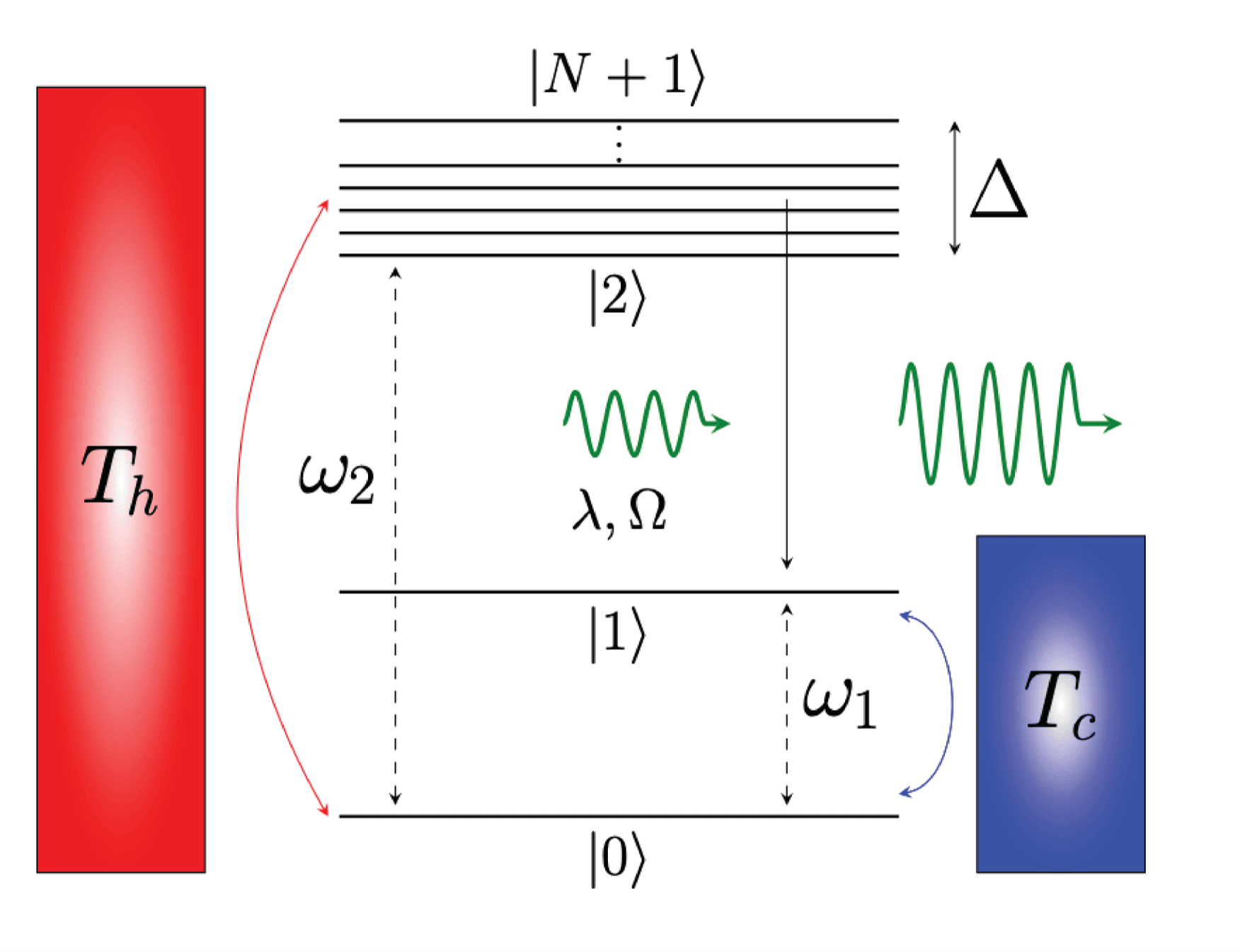
In their study, which they describe in Physical Review Letters, Taufiq Murtadho, Sai Vinjanampathy, and Juzar Thingna consider a set of mutually interacting quantum thermal machines. The machines in question are multilevel quantum systems in contact with a hot and cold reservoir. The most excited level of the system is made up of multiple identical parts with mutual coupling, analogous to the small clocks in the metaphor. To mimic the behaviour of the big clock – a common external unit dragging the system evolution – the machine is also interacting with an external source. Depending on the working regime, this setup can behave as an engine that pumps heat from the hot to the cold reservoir, or as a refrigerator that does the opposite.

Diagram of a multi-level machine

The team began by showing that a simple four-level system, interacting with an external source, is sufficient to investigate the interplay of the synchronization mechanisms and its utility for quantum heat engines. Thingna and colleagues then studied what happens to the multiple identical parts in the machine due to the two synchronization mechanisms when the set-up behaves as an engine and when it behaves as a refrigerator.

Notably, they found that the interaction between the individual parts of the machine can produce a symmetric configuration – all parts match rhythms – and an antisymmetric one – all parts do not match rhythms. In contrast, the external source always drags the multiple parts into a symmetric configuration.

Following this thread, the researchers found that in the engine regime, the two mechanisms – mutual interaction and external drive – favour opposing configurations of states. This leads to competition between the two mechanisms. In the refrigerator regime, however, both mechanisms prefer the symmetric configuration and therefore cooperate.

The team then went a step further and showed that in the thermodynamic limit, when the number of multiple individual parts is very large, competition and cooperation between the mechanisms still occurs. However, as the system is scaled up, mutual coupling becomes the dominant mechanism. This leaves the cooperation regime unaffected, but competition, while still present, becomes less relevant in the engine regime.

Thermodynamic gain

Besides uncovering the interplay between the mechanisms, the authors also shed light on how synchronization effects the thermodynamic performance of quantum machines. In a complementary paper published in Physical Review A, the authors illustrate how synchronization can limit the amount of wasteful heat generated. For a working machine, engine or refrigerator, this implies, beyond the well-known Carnot upper bound, a novel lower bound for efficiency.

According to Thingna and Vinjanampathy, these results will have direct implications for building quantum technologies where external driving and mutual interactions are important. They add that understanding the connections between thermodynamics and different types of synchronization mechanisms in quantum systems will be vital to building and designing energy-efficient machines that operate on thermodynamic principles. This work, they conclude, adds one more piece to the puzzle of the various facets of “quantum” in quantum thermodynamics.

Laser gyroscope measures tiny fluctuations in Earth’s rotation

Ring laser

After 30 years of painstaking development, researchers in Germany and New Zealand have unveiled a laser gyroscope that can track fluctuations in Earth’s rotation in near real time and accurate to several milliseconds. The technique is much simpler than current methods and could provide further insights into phenomena that cause the fluctuations – such as shifts in ocean currents.

The Earth rotates once in one day, but there are tiny fluctuations in the rate and direction of our planet’s rotation. Some of these fluctuations are well understood – for example those caused by the tidal forces of the Moon and Sun.

Other tiny fluctuations are not well understood including those related to the exchange of momentum between the solid Earth and the oceans, atmosphere and ice sheets. These effects can arise from climate events such as the El Niño southern oscillation, which change ocean currents. As a result, measuring fluctuations in Earth’s rotation could shed light on important processes in the atmosphere.

Combined measurements

Most rotation studies involve combining data from global satellite navigation systems; very long baseline radio-astronomy observations of quasars; and laser ranging. Due to the complexity of combining these techniques, only one measurement can be made per day.

Now, a team headed by Ulrich Schreiber at the Technical University of Munich has created a laser gyroscope that can measure the tiny fluctuations in near real time. What is more, their instrument can fit into a large room.

At its heart is an optical cavity that guides light around a square path that is 16 m long. A pair of laser beams are sent around the cavity in opposite directions creating a ring laser gyroscope. This works on the principle that a rotation of the gyroscope affects the interference pattern that is created when the two beams are combined at a detector. Such gyroscopes are used in onboard inertial navigation systems in some aircraft and submarines.

Basement laboratory

“In contrast to other techniques [for measuring Earth’s rotation], our ring laser is self-contained and can fit into our basement laboratory, allowing us to instantaneously read the Earth’s rotation almost in real time,” Schreiber explains. “Now, after 30 years of experimental effort, we have succeeded in recovering the signal of interest.”

To reach this point, the team needed to fine-tune five key aspects of the laser gyroscope’s operation. First, the instrument needed to be sensitive enough to resolve variations as subtle as 3 ppb of Earth’s rotational velocity. In fact, this was one of the easiest challenges they faced, and could be overcome simply by making the gyroscope 16 m in length.

From here, the team’s task only became more difficult. “The sensor needed to be extremely stable,” Schreiber said about the second challenge. “We cannot allow it to develop a drift because even the tiniest lack of stability would generate an apparent signal, which would drown our effort entirely. The stability has been the hardest part to achieve.”

Elaborate error correction

The third task the team tackled was how to deal with the errors introduced by the varying orientation of Earth’s rotational axis. These were addressed using an elaborate error correction method.

“The next problem is that we only have a single gyro component, but three spatial directions,” Schreiber continues. “This means we need to track the tilt of our instrument to the level of 3 nrad, which is a tiny, tiny angle. A change in orientation causes the projection of the Earth’s rotation vector to change, which is nothing else than a drift and that is a false signal.”

Finally, the gyroscope’s dual laser beams do not operate completely independently of each other. This means that the gyroscope’s measurements can drift in the long term. To counteract this problem, the team have spent years developing a laser dynamics model that can recognize and scrub out any drift in the gyroscope’s readings.

Now, following decades of hard work, the team’s instrument controls all five of these factors at the same time – allowing it to monitor Earth’s rotation rate to a resolution of just a few milliseconds over 120 days.

Having passed this impressive milestone, Schreiber’s team is now able to track variations in the length of the day both continuously and real time. This could help to provide deeper insights into how the solid Earth exchanges momentum with the air, water, and ice on its surface.

Looking further ahead, the researchers now aim to extend their gyroscope’s stability even further. “This will enable us to capture the seasonal effect of these momentum transfers,” says Schreiber. “At the moment, we can only look at the prominent signals with a period of roughly 14 days, so there are still a number of challenges ahead of us.”

The research is described in Nature Photonics.

AI-cooked steak, Prada space suits, agriculture starts with a bang

Artificial intelligence is already used in many walks of life and now engineer Suraj Sudera has applied it to cooking the perfect steak.

After studying engineering at Aston University in the UK, Sudera worked on medical devices before turning his attention to grilling. In 2020, he founded the Birmingham-based start-up SEERGRILLS, which is about to release their first AI-inspired product.

Called Perfecta, it contains infrared burners that can cook up to 900 C, and uses AI to calculate the time and temperature needed to cook the food based on its size, surface area and fat content. “We noticed there is often difficulty and inconsistency in cooking food; it’s mostly always overcooked and dry, taking a long time,” notes Sudera. “So, we decided to use our skills and knowledge to apply AI to cook the perfect steak and set up SEERGRILLS.”

Perfecta is now available to pre-order in the US but being able to cook the perfect steak in less than three minutes won’t come cheap – at $3500, it won’t just be the mouth that is watering.

Space style

 The Italian luxury brand Prada has annouced that it is helping to design space suits for NASA’s Artemis III Moon mission, which is currently planned for 2025. Prada will work on the suits together with Axiom Space, with Prada bringing its expertise with materials and manufacturing to the project.

Yet designing new suits won’t be easy. “Although Prada may conjure up images of glamorous space suits, there is a much more serious side to the way in which space suits are designed,” warns mathematician Emma Horton from the University of Warwick.”Comfort, warmth, durability and protection from the radiation are all critical factors. Astronauts must be able to move easily, maintain body temperature and contain an oxygen supply.”

And finally, an international group of scientists have claimed that agriculture in Syria started thanks to a coment that exploded in Earth’s atmosphere some 12 800 years ago.

Writing in the journal Science Open: Airbursts and Cratering Impacts, they say that the explosion and subsequent environmental changes forced hunter-gatherers in the prehistoric settlement of Abu Hureyra to adopt agriculture to boost their chances for survival.

Nanoscale device produces a stream of chiral single photons

A new nanoscale device based on stacks of two-dimensional materials can not only generate a stream of single photons but can also control their chirality, or circular polarization, without the need for an applied magnetic field. Since manipulating a photon’s polarization state is a way to encode information in it, the advance could be important for quantum technologies, according to the researchers at the Los Alamos National Laboratory in the US who developed it.

Until now, circularly polarizing a single-photon stream was only possible by coupling quantum emitters to complicated photonic or electronic nanoscale devices or by applying high magnetic fields to these emitters via bulky superconducting magnets. In the new work, a team led by physicist Han Htoon stacked a single-molecule-thick layer of a semiconducting material, tungsten diselenide (WSe2), atop a thin layer of a magnetic crystal, nickel phosphorus trisulphide (NiPS3). The researchers then made indentations in the heterostructure stack measuring just 400 nm across.

Getting the indentations right

“We obtain two very useful effects from the indentations,” Htoon explains. “First, the indentations create a ‘well’ or depression in the potential energy landscape of the material that confines electron-hole pairs (excitons) within the WSe2 layer. “These excitons, in a quantum state, are capable of emitting a single-photon stream upon excitation with laser light. Second, the indentations also disrupt the magnetic properties of the underlying NiPS3, thereby creating a local magnetic moment that points up out of the heterostructure.”

The combination of this magnetic moment and the “proximity effect” of the quantum state is what creates the circularly polarized photons, he tells Physics World, but getting it right was not easy. “NiPS3 is an antiferromagnetic semiconductor and the spins of its rows of Ni ions typically lead to its magnetic moments cancelling out,” he explains. “Our initial experiments were disappointing due to this effect.”

Xiangzhi Li, the Los Alamos postdoctoral researcher who led the experiment, therefore performed the measurements again, this time using the tip of an atomic force microscope to create the nanoscale indentations in the stacked layers. “That adjustment created what we believe is the strongest effect of circularly polarized single photons yet,” says Htoon. “We were surprised and conducted a series of controlled experiments to confirm our findings.”

Since information can be encoded in the polarization of photons, the advance could have applications in quantum communications, including quantum cryptography, and quantum computing, the team say. “We may even be able to create an ultra-secure quantum Internet because, if we’re able to couple the photon stream into waveguides (conduits of light), we could fabricate photonic circuits that control the direction of the photons’ propagation,” explains Htoon.

The researchers are now searching for the best way of modulating the degree of circular polarization of the single-photon stream using optical, electrical or microwave methods. They report their present work in Nature Materials.

Copyright © 2026 by IOP Publishing Ltd and individual contributors