Researchers in the US have used DNA molecules as a scaffold to help them assemble arrays of quantum rods in an ordered, controlled way. By depositing the rods onto this patterned framework, the team at the Massachusetts Institute of Technology (MIT) kept the rods evenly spaced with their nanostructures aligned in a specific direction, which could be useful for applications such as virtual reality devices and micro-light-emitting diodes (microLEDs) in next-generation displays.
Quantum rods are elongated versions of quantum dots – tiny pieces of semiconductor with unique, particle-like optoelectronic properties. These unique properties lend themselves to a host of technological applications. Because the dots and rods emit tuneable, narrowband light, they could be used to make TV screens and other displays containing microLEDs. These next-generation devices would be superior to today’s state-of-the-art organic LED and liquid-crystal displays in terms of their brightness, colour, minimum pixel size and stability.
Quantum rods are particularly attractive for applications like this because the light they emit is polarized, which could improve the displays’ optical efficiencies. However, to achieve such an improvement, the rods in a device all need to be aligned in the same direction, which is challenging with such tiny objects. They also need to be spaced at a certain regular distance from each other to prevent a phenomenon known as self-quenching, which occurs when the rods are so close to each other that they suppress the light emission of their neighbours.
Precisely assembling arrays of quantum rods
Led by biological engineer Mark Bathe, the MIT team developed a quantum-rod assembly method that ticks both boxes. The team’s procedure is based on a technique known as surface-assisted large-scale assembly (SALSA), and it uses the regular structure of DNA as a template for precisely constructing arrays of quantum rods.
The process Bathe and colleagues developed involves emulsifying DNA into a mix with quantum rods made of CdSe/ZnS and CdSe/CdS, then rapidly dehydrating the ensemble. This process, which takes just a few minutes, allows the DNA molecules to form a dense layer on the surface of the rods. Neighbouring DNA “origami” templates then self-assemble onto a two-dimensional surface made of mica, forming the arrays via overhanging strands of DNA on the template edges that cover the 2D surface.
Importantly, these origami structures can be constructed at a size that allows the rods to be separated by a fixed distance from each other – in this case around 10 nm, which is large enough to prevent quenching. The quantum rods also all slot into the origami template with the same orientation.
Techniques like this could be important for numerous applications, says Bathe, including augmented or virtual reality devices as well as microLEDs. “DNA-based fabrication is important due to its sustainability, scalability and ability to control nanometre-scale materials structures, their orientations and therefore their functions,” he says.
In the current version of the technique, which the team report in Science Advances, the 2D origami lattices cannot be bigger than around 1 μm2 because the uncontrolled nucleation of origami lattices on the surface yields random initial orientations and positions. The MIT researchers now hope to scale up their approach and make arrays that are more hierarchical with programmed structures at many different length scales. This will be critical for integrating them into real-world devices, they say. “We also hope to move away from environmentally-unfriendly quantum rods like the ones employed in this academic work,” Bathe tells Physics World.
Amateur astronomers Marcel Drechsler, Xavier Strottner and Yann Sainty have beaten thousands of amateur and professional photographers from around the world to win the 2023 Astronomy Photographer of the Year.
The image – Andromeda, Unexpected – was taken near Nancy, France, and captures a huge plasma arc next to the Andromeda galaxy (M31), which is the closest spiral galaxy to the Milky Way.
The plasma arc is the largest such structure nearest to us in the universe and astronomers are now investigating the surprising discovery.
As well as winning the £10,000 top prize, the image will go on display along with other selected pictures from the competition at an exhibition at the National Maritime Museum observatory that opens on Saturday.
The award – now in its 15th year – is run by the Royal Observatory Greenwich in association with insurer Liberty Specialty Markets and BBC Sky at Night Magazine.
The competition received more than 4000 entries from 64 countries.
The first universal theory of strange metals could help explain why they behave so oddly – for example, why they resist the flow of electrons more than ordinary metals such as gold or copper. The new theory, developed by researchers at the Flatiron Institute in New York City and Harvard University, both in the US, takes into account two properties of strange metals: the quantum entanglement of their electrons and the non-uniform arrangement of their atoms. The work could advance our understanding of high-temperature superconductors and other correlated quantum materials.
Strange metals lie somewhere between metals and insulators and get their name from the peculiar behaviour of their electrons. Unlike electrons in ordinary metals, which travel freely with few interactions and little resistance, electrons in strange metals move sluggishly and in a restricted fashion. The electrons in a strange metal also lose the “memory” of their past positions at the fastest possible rate allowed by the fundamental laws of quantum mechanics.
More strangely still, researchers recently learned that cuprate (copper oxide) high-temperature superconductors, which were discovered in 1987, contain a strange metal phase as well as a superconducting phase. The strange phase occurs when the copper oxide layer is highly doped with holes, and it puzzles physicists because it cannot be described by conventional theories that treat electrons as independent quantum particles, and largely ignore any quantum entanglement between them.
Subtle interplay between many-electron entanglement and disorder
“Understanding this strange phase is a necessary ingredient in any theory of high temperature superconductivity, and much effort has been expended in this direction in the last few decades,” says Subir Sachdev of Harvard, who co-led the new study together with Aavishkar Patel of the Flatiron Institute’s Center for Computational Quantum Physics (CCQ). “We propose a new theory in our paper that is consistent with existing observations and highlights the subtle interplay between many-electron entanglement and the disorder that is present in all crystals due to the presence of impurities.”
The irregularity of a strange metal’s layout means that the nature of its electron entanglements strongly depends on where the entanglement takes place within the material, Sachdev adds. This inhomogeneity adds randomness to the electrons’ momentum as they propagate though the material and interact with each other. As a result, instead of the electrons flowing together, they collide with each other in all directions and push each other around, generating electrical resistance. And because the electrons collide more frequently as the material’s temperature increases, the electrical resistance increases proportionally with temperature.
A more realistic model
This interplay of entanglement and nonuniformity has never been experimentally documented before in any material, but Patel notes that it is an extremely simple concept – at least in hindsight.
“The initial idea was my proposal in 1993 in (a variation of) what is now called the Sachdev-Ye-Kitaev model,” Sachdev tells Physics World. “This is a simple, solvable, toy model that allows us to study the interplay between quantum entanglement and disorder in a regime in which current flows in an entangled ‘quantum soup’ and not via individual electrons.”
Since then, the researchers have been looking into ways to make this toy model more realistic via collaborations with both experimentalists and theorists – in particular Flatiron’s Antoine Georges and Olivier Parcollet. “After many wrong turns along the way, we finally hit upon the generalization described in our present study, which we detail in Science, during long discussions with my co-authors during the pandemic period,” Sachdev says.
The theory could serve as a “launching pad” towards understanding the complete phase diagram of the copper-oxide-based high-temperature superconductors and a number of other related quantum materials, he adds.
The Flatiron/Harvard team is now computing many observable properties of its theory, including the noise in current flow and the response to strong laser light and magnetic fields. “We will compare these results with ongoing experiments and hope to arrive at a complete picture of the underlying physics,” Sachdev concludes.
A hidden planet with a mass about 1.5–3 times that of Earth could be lurking at the edge of the solar system, according to computer simulations done by researchers in Japan. Kindai University’s Patryk Sofia Lykawka and Takashi Ito at the National Astronomical Observatory of Japan have found that the unexplained properties of some solar system bodies could be evidence for the planet, which would orbit about 200 au from the Sun (200 times the distance between the Earth and the Sun).
The duo uncovered evidence for the hidden planet by focusing on several unexplained phenomena associated with trans-Neptunian objects (TNOs). These are minor planets that orbit in the Kuiper Belt beyond Neptune. These phenomena included the unexplained presence of “detached objects” that have orbits beyond the influence of Neptune’s gravity; and the “high-i” TNOs, which have orbits that are highly inclined in comparison with the majority of Kuiper Belt objects.
Using powerful computer simulations of solar-system dynamics, they concluded that these phenomena cannot be explained by our current view of an outer solar system containing the four giant planets Jupiter, Saturn, Uranus and Neptune. Rather, the simulations suggest that the presence of an Earth-sized planet beyond Neptune can explain these TNO phenomena.
Not Planet Nine
The idea that a hidden planet exists at the edge of the solar system is not new, with the most famous recent example being “Planet Nine”. This was proposed in the 2010s as a planet with a mass about six times that of Earth and an orbit at about 500 au.
While their proposed planet is smaller and closer to the Sun than Planet Nine, Lykawka and Ito did also consider other possible configurations for their hypothetical planet. The duo modelled three possible distances: a large orbit between 200–800 au; a medium orbit of 200–500 au; and a small orbit at 200–300 au. They found only the medium and small orbits were good fits for the TNO properties they considered.
The team also looked at other masses for their hypothetical planet, but found that smaller planets did not produce populations of detached or high-i TNOs large enough to match observations.
While the proposed planet is Earth-like in terms of its mass, its distance from the Sun would make it a very different place, as Lykawka explains. “The planet’s favoured orbits would imply very cold surface temperatures, perhaps never above −240 °C”.
Icy volcanoes
However, such a large object would probably have an internal energy source, implying the existence of subsurface oceans and perhaps higher surface temperatures. It could also have volcanoes that erupt ice instead of lava and other interactions between its interior and surface.
“The planet could also have mountains, ridges, polar caps, glaciers, plains, etc.,” Lykawka adds. “I speculate, therefore, geologically speaking, the planet could also be considered Earth-like — an active icy and rocky Earth.”
Theories of hidden planets are controversial, so Lykawka is ready for some pushback. “Our research is not the first to propose the existence of an undiscovered planet in the outer solar system, and all the surveys performed so far have not discovered a planet beyond Neptune,” he explains. “I expect the scientific community to be sceptical, but perhaps less so than in the recent past.”
This because Lykawka believes their study is the first to tackle and reasonably explain various observational constraints in the distant Kuiper Belt in a single scenario. The research has already caught the interest of the planetary scientist Samantha Lawler, who describes herself as a “Planet Nine sceptic”. Based at Canada’s University of Regina, Lawler works on the Outer Solar System Origins Survey (OSSOS), which has helped diminish evidence supporting prior Kuiper Belt planet theories.
“I expected to be sceptical, but I was actually very impressed,” Lawler told Physics World. “The research doesn’t perfectly explain everything, but it makes some of these weird things that we see with Kuiper Belt objects easier to explain. An Earth-sized Kuiper belt planet is not ‘definitely the right answer’ but this work is on the way to explaining a lot of things that we can’t currently explain.”
Given its distance from Earth, and that the duo have not predicted the precise location of their planet, it would be very difficult to observe. Lawler, however, points to the success of OSSOS, which discovered over 800 new Kuiper Belt objects with the MegaPrime camera on the 3.6 m Canada-France-Hawaii Telescope (CFHT).
“We can keep finding new Kuiper Belt Objects, and this is within the reach of current ground-based surveys,” she says. “It could be discovered if it’s actually out there.”
Photons can collide as if they were massive objects thanks to metamaterials known as time interfaces that undergo abrupt changes in their optical properties. This is the finding of researchers at the City University of New York, US, who say their work could have applications in wireless communications, imaging and energy harvesting technologies.
When two objects bump into each other, they collide and their kinetic energy is either conserved, lost or increased, depending on their mechanical properties. In contrast, two photons (electromagnetic waves) generally pass right through each other, although their encounter may manifest itself via wave phenomena such as interference. However, the situation is very different when they scatter off a lossy structure as they interfere. In this case, energy can pass between them so that it is entirely transmitted or absorbed depending on the photons’ relative amplitude and phase. Such “coherent wave control”, as it is known, can be exploited to create phenomena such as perfect absorption – that is, the destructive interference of waves as their energy is completely dissipated – and to tailor the amount of absorption as required.
Researchers led by physicist and engineer Andrea Alù have now shown they can create a new form of control over energy exchanges between photons. In the process, they realized the photonic analogue of a mechanical collision for electromagnetic waves using metamaterials that can undergo abrupt and large changes in their electromagnetic properties. These variations allowed the team to create a structure known as a time interface.
“When two waves propagating in opposite directions experience such an interface while they are overlapping, they experience extremely fast energy exchanges, as if they were colliding objects,” Alù explains. “The relative phase of the two waves can control the nature of this collision, which can either conserve energy, dissipate it or amplify it.” In this form of temporal coherent wave control, the waves reflected off the time interface destructively interfere with refracted waves. Under suitable conditions, this allows one or even both waves to be cancelled out.
Shaping electromagnetic pulses
The researchers got the idea for their new work after they wondered whether it might be possible to erase an unwanted mechanical wave, such as a tsunami or a seismic wave, by “throwing” another, similar, wave against it to counteract it. “While such an outcome is impossible in conventional wave physics, we knew it was possible, in principle, with a temporal metamaterial,” says Emanuele Galiffi, a postdoctoral fellow in Alù’s lab and the lead author of a study in Nature Physics on the work. “Our experiment allowed us to demonstrate this concept in action for electromagnetic waves.”
This photonic analogue of mechanical collisions could also be used to shape electromagnetic pulses by colliding them against each other. The researchers have demonstrated such sculpting for electromagnetic waves in the microwave regime and are now aiming to achieve this at higher frequencies by using devices such as high-speed graphene transistors instead of time interfaces.
When the Tanzanian schoolboy Erasto Mpemba asked a visiting lecturer why hot water freezes faster than cold, he could not have guessed that his observation – made while making ice-cream – would draw the attention of some of the world’s greatest physicists. The phenomenon is now known as the Mpemba effect, but variants of it have baffled philosophers and physicists since the days of Aristotle, and it has subsequently been observed in other contexts, including magnetic systems that display colossal magnetoresistance and colloidal beads falling through the path of optical tweezers.
A trio of researchers in Japan has now added to this list by demonstrating the Mpemba effect theoretically in a simple quantum system. The result may point towards ways of making quantum computers more efficient, though team member Hisao Hayakawa cautions that it is early days. “So far, we don’t have so many experiments on the quantum Mpemba effect,” he tells Physics World.
Quantum definition
The nature of the Mpemba effect has been much debated, with questions arising not only over its mechanisms and its required initial conditions, but even its definition. Does the speed-up lie in the time taken for freezing (or some other phase change) to begin? Does the phase change need to be complete? Or is the important factor merely the time the system takes to sink below the temperature at which the phase change is expected?
In the latest work, Hayakawa and his Kyoto University colleague Amit Kumar Chatterjee, together with Satoshi Takada of the Tokyo University of Agriculture and Technology, defined the Mpemba effect in terms of a crossing in the quantity they were monitoring. In water, this crossing would occur when the temperature of the hotter liquid, which is cooling faster, “crosses” that of the colder liquid, making the formerly hotter liquid into the colder one.
For Chatterjee, Hayakawa and Takada, this crossing took place in a modelled system composed of a quantum dot connected to two reservoirs acting as heat sinks (a role played by the freezer in the original ice-cream-based Mpemba effect). The reservoirs start off at the same temperature, with the difference in their starting conditions supplied by the chemical potential of the two reservoirs, which can be equal (indicating equilibrium) or not. The trio then characterized the state of the quantum dot, observing whether it had two electrons with opposing quantum spins, a single electron with either an up or down spin, or no electrons at all. Together, these possible states defined a parameter they could track as the system relaxes, or achieves equilibrium – the equivalent of the ice-cream cooling to the temperature of the freezer it is in.
As the quantum dot relaxes, Hayakawa explains that its dynamics – that is, how its state evolves – “remembers the initial state”. In other words, the relaxation is faster when the reservoirs are not initially in equilibrium, and the tracked parameter at equilibrium starting conditions crosses that of its non-equilibrium counterpart – the Mpemba effect in action.
The role of metastability
One of the complicating factors in the original Mpemba effect is that water is a complex substance that can exist in metastable states. Think of these states as being like a chair in a room occupied by an exhausted person. Upon seeing the chair, the exhausted person will likely flop into it, and only later lie down on the floor to fully relax. If the chair was not there, however, the exhausted person would probably lie down straight away and reach a fully relaxed state much quicker.
A lot of emphasis has been placed on these metastable states, and many studies have concluded that it is this slowest relaxation route that drives the Mpemba effect. However, the quantum dot system has no metastable states. What is more, the team’s analysis suggested it was the combined role of the faster relaxation routes that determined the effect – a great surprise.
Chatterjee tells Physics World that while metastability may be “sufficient in some systems”, their simplified quantum dot system reveals “another kind of sufficient conditions”. He suggests that studies to date have not yet pinned down conditions or requirements that are universally applicable, although that may come. “I think the whole community is trying to find different mechanisms to see the quantum Mpemba effect,” he says.
Things get cool
Keen to see if they could demonstrate the Mpemba effect in a way that more closely resembles the original, the researchers then defined a temperature for their system. Since this quantum system lacks the trillions of molecules with statistically meaningful ensemble characteristics that give rise to temperature in the classical world, Hayakawa notes that “the definition of temperature is very subtle”. In fact, there are several ways of translating quantum states into temperature, each of which produces parameters with their own nuanced behaviour.
In this case, the researchers chose to use a temperature defined by the ratio of changes – the partial derivative – in energy and a quantity called von Neumann entropy. Entropy is another slippery quantity for quantum systems, but the von Neumann entropy is quite conventionally related to the possible states of the quantum dot. Using this definition, the team was also able to demonstrate the Mpemba effect.
John Bechhoefer, a physicist at Simon Fraser University in Canada who led an experiment demonstrating the Mpemba effect in a colloid using optical tweezers in 2020, notes that there has been some previous work on “quantum Mpemba effects,” and the Kyoto-Tokyo team acknowledge this. However, Bechhoefer adds that these earlier studies focused on different types of relaxation to equilibrium – for example in magnetization. “It is very satisfying to see that the ‘original’ effect is also predicted in fairly simple quantum systems, and I hope that this paper inspires experimental searches in real-world quantum systems,” Bechhoefer tells Physics World.
Chatterjee, Hayakawa and Takada now plan to look at possible connections between their findings and quantum speed limits, which stem from the uncertainty principle and place restrictions on how fast a quantum system can change from one state to another. Though no-one has yet pinned down this connection, both quantum speed limits and relaxation rates may impact the operation of quantum computers, which need to reach their relaxed states quickly to process information in a timely manner.
Masters of peer review Journal editors at The Electrochemical Society, including (left to right) Alice Suroveic, Rohan Akolkar and Netz Arroyo, play a key role in the peer-review process for the society’s journals. (Courtesy: ECS)
Scholarly publishing has been in constant flux since the first online journals appeared in the 1980s, a key turning point that has triggered disruptive business models, a plethora of new publications, and the transformative power of open access. But through this changing landscape one thing has remained constant: the vital role that peer review continues to play in validating, informing and ultimately improving the scientific record.
Even expert authors writing about their own research can benefit from the independent feedback provided in peer review.
Alice Suroveic, Berry College
“Even expert authors writing about their own research can benefit from the independent feedback provided in peer review,” says Alice Suroveic of Berry College in Georgia, US, who is an associate editor of the Journal of The Electrochemical Society (JES). “An external reviewer can identify any gaps that would provide a fuller picture of the experimental process or the results that have been reported, and also ensures that the science is presented clearly enough for the wider community to understand what has been achieved and how they can use it in their own research.”
Fellow associate editor Rohan Akolkar of Case Western Reserve University in Cleveland, US, agrees that peer review can improve the scientific record and speed up the discovery process. “A key outcome from peer review is to elevate the quality of the manuscript, in terms of both the technical content and its overall presentation,” he says. “Reviewer comments can help the authors to better place their scientific conclusions within a broader context, making their published article more useful and impactful for the research community.”
Associate editors like Suroveic and Akolkar are the driving force behind the peer-review process for journals published by The Electrochemical Society (ECS). They first read the manuscripts to ensure they meet the acceptance criteria of the journal, which might include scope, scientific rigour, and the significance of the work, and then identify a few independent peer reviewers who have the knowledge and experience to provide a meaningful commentary on the article.
I put a lot of work into finding reviewers who can provide an objective critique of the work.
Netz Arroyo, Johns Hopkins University School of Medicine
“I put a lot of work into finding reviewers who can provide an objective critique of the work,” says Netz Arroyo of the Johns Hopkins University School of Medicine in Baltimore, US, who is a technical editor of the open-access journal ECS Sensors Plus as well an associate editor of JES. “By matching the interests of the reviewers to the scope of the paper I want them to provide a proper analysis of the methodologies and figures-of-merit that have been presented in the article.”
In many cases, these independent experts will ask clarifying questions or recommend some revisions to the article, helping the authors to improve the descriptions and explanations of their methods, assumptions or conclusions. “Reviewers typically comment on the experimental or the mathematical modelling approaches employed by the authors, ensuring that every step has been explained in sufficient detail and that all the relevant information and analysis has been clearly presented,” says Akolkar. “The best reviewers provide specific suggestions and quantitative feedback that help the authors to address any issues, which improves the overall quality of the published work.”
Constructive criticism Reviewer comments can help authors make their published article more useful and impactful for the research community. (Courtesy: iStock/ayagiz)
As scientists who have had their own work critiqued by their peers, all three associate editors appreciate the feedback that they receive through an external review. “You’re making yourself vulnerable when you allow other people to criticize your work, but every peer-review process I have gone through has provided positive and constructive feedback that I can use to improve the final article,” says Arroyo.
That external input can be particularly beneficial for early-career researchers, since it helps them not only to write clear and informative scientific communications but also to evaluate and improve their research skills. “Through peer review, students can find out how other experts in their field are thinking, and get feedback from people who aren’t their mentors or supervisors,” says Arroyo. “They can get an idea of the level they are working at, and find out what they need to do to make their science more valuable.”
While the benefits of peer review for the scientific community may be in little doubt, the practicalities can be a little more challenging. With more journals being launched every year, it is becoming increasingly difficult to find reviewers who are committed to providing the in-depth feedback that can deliver a genuine improvement in the quality of the article. “The sheer volume of journals out there is creating a greater burden on the scientific community,” says Suroveic. “We rely on the goodwill of our reviewers to take a few hours to read an article and provide some meaningful feedback, and it’s becoming harder to find reviewers who are willing to share their time and expertise.”
To help reduce that burden, Akolkar points out that the editors of ECS journals read manuscripts within their area of expertise to make sure that they are worthy of external review. “I triage manuscripts that are assigned to me, and only about 30% of them go out for external peer review,” he says. “When I invite someone to review a manuscript, they are more likely to accept my invitation because they know it will most likely be an interesting and enjoyable read.”
Meanwhile, organizations like the ECS can help to build a community of scientists motivated to review for its journals. The society already recognizes the efforts of its reviewers through certificate programmes, best reviewer awards, and social events at its biennial meetings, and is actively discussing other ways to highlight the importance of their contributions. “We want to give our reviewers more attention and recognition, which in some parts of the world can really help a scientist to get established and build a career,” says Arroyo. “It may not be direct compensation for their time and effort, but by showcasing our peer reviewers as active scientific contributors the ECS can support the community and help it to grow.”
Learning opportunity Peer Review Week is an annual event that celebrates the value of peer review for the scientific community
The journal editors are also keen to nurture a new generation of peer reviewers, many of whom are eager to establish new connections within the ECS. “It’s not just about finding a peer reviewer, it’s also about developing the community, and a great way to do that is to get early-career researchers involved,” says Akolkar. “When they review for JES, they are developing a deeper relationship with ECS, and in the future they too may become journal editors themselves.”
Both the ECS and the editors provide plenty of support to help early-career researchers develop their peer-reviewing skills. Akolkar says that he often takes the time to talk to first-time reviewers, guiding them through the process and highlighting which aspects of the review they should focus on. “As with a lot of these things, you learn as you go, but if needed I am always happy to provide feedback to new reviewers to help them learn and improve,” he says.
The ECS has also provided more formal training by hosting the IOP Peer Review Excellence workshop at its latest biennial meeting, which will be repeated at the society’s upcoming event in Gothenburg, Sweden. “The workshop provides training on best practices, things to check for, and what sort of feedback to provide,” explains Suroveic. In addition, each ECS meeting features a meet-the-editors event to enable early-career researchers to find out more about journal publishing, ask any questions, and sign up to be a peer reviewer.
Peer review helps to shape your own understanding and generating new ideas along the way.
Rohan Akolkar, Case Western Reserve University
Even though peer review is often viewed as a service to the scientific community, Akolkar believes that reviewing manuscripts has many unique benefits on its own. “Science and engineering is not a sole endeavour, it is a collective exercise in which different approaches are being developed to solve research problems, often in unexpected ways,” he says. “Peer review gives you greater access to that collective thinking, helping to shape your own understanding and generating new ideas along the way.”
Indeed, all three editors believe that peer review will continue to be the driving force that sustains the quality and impact of electrochemical research for many years to come. The approach may evolve, however, with Akolkar pointing out that the focus of peer review over the last 20 years or so has shifted towards faster processes that enable more rapid publication. “When I was a student, the peer review process would take up to six months, but now reviewers are only given a few weeks to write a report,” he says. “That accelerates publication, but it also means that we give reviewers the time to provide only a selective assessment of the major points in the paper.”
Different models for peer review are also emerging, mainly to ensure that the assessment of scientific work remains as objective and open as possible. Many publishers now offer the option of transparent peer review, in which the full exchange between authors and reviewers is published alongside the manuscript, while a complementary double-blind approach conceals the identities of both the authors and the reviewers. “It’s crucial to assess the paper on its merits, rather than basing an opinion on who has written it or which institution they are from,” says Arroyo. “We can all harbour some bias, whether we are aware of it or not, and we need to ensure that peer review is always scientific and objective.”
The ECS would like to express its gratitude to all of the peer reviewers who have supported its mission to disseminate scientific knowledge throughout its history, and to those who have participated in training workshops that will extend this mission into the future. Anyone who would like to become a peer reviewer for the ECS can register their interest
Truth in fiction The novel Lessons in Chemistry brilliantly illustrates the reality of harassment and discrimination in science. (Courtesy: iStock/MaryLB)
The power of fiction is its ability to elucidate truths that you know are real but have never personally experienced. Fiction can, for example, give a sense of how female scientists were routinely treated in the 1950s and 1960s even if you’ve never been in such a position yourself. And that’s exactly what Bonnie Garmus – a London-based writer – manages to achieve in her bestselling novel Lessons in Chemistry.
Its main character is Elizabeth Zott, who’s a chemist, and a good one, but sexism keeps frustrating her life and career. Worse still, her PhD supervisor sexually assaults her. When she eventually gets a job in a lab, Zott is never allowed to be one of the (otherwise all-male) team. She’s also paid less, excluded from conversations, denied access to equipment and never given an author credit when her research is published. Plus, Zott receives constant sexist remarks and is told she will lose her job if she gets married or pregnant.
A wonderful character who takes none of this lightly, she refuses to play along with expectations, which eventually costs Zott her job. Backed into a corner, she takes the one opportunity she is offered and becomes the host of a TV cooking show. But even here she won’t be the benign housewife-style personality the TV network wants. Instead, Zott uses this chance to teach the women of America about chemistry through the medium of cooking. She never talks down to her audience, knowing that most women are perfectly capable of grasping scientific concepts if only they get access to someone who will teach them.
I have never before read such a clear account of sexism in science, depicting both the big issues and the smaller ones that become big as their numbers and frequency pile up. And while some of Zott’s problems are no longer legal, a lot of these issues remain today in science. Women are still paid less than men. Their careers progress more slowly. They are less likely to be credited as first author on papers (or credited as authors at all). They are more likely to be saddled with admin, and bullying and sexual harassment are still rife.
By making Zott a forthright, no-nonsense, determined character, Garmus has managed to show her readers, by omission, why there were so few women in science at a time when record numbers of women were going to university. Not everyone can stand up to that level of being bullied, belittled, ignored, excluded and/or abused – and neither should they have to.
Despite these heavyweight issues, Lessons in Chemistry is a delight to read. It’s funny, full of warm characters with quirks that are never annoying or subjected to mockery by the author. It is well deserving of its global success and I can only hope that its large readership means more people come to understand the severity of sexism in the workplace – then and now.
Researchers at Princeton University in the US have made a key step towards realizing scalable quantum networks thanks to a rare-earth element: erbium. Erbium is good at emitting and absorbing photons at wavelengths used in the telecommunications industry, which is an advantage because these photons can travel long distances with little attenuation in standard optical fibres. Harnessing this strength in the quantum realm has been a challenge, but the Princeton team managed to coax an erbium-based device into emitting identical photons – a prerequisite for quantum repeaters to share quantum information across vast distances.
“Erbium-doped fibres are used as classical repeaters to make classical fibre amplifiers for all kinds of optical communications links, like long-haul undersea cables,” says Jeff Thompson, a professor of electrical and computer engineering at Princeton and principal investigator on the work. “So, to me, it was very natural to try to come up with a quantum version of that.”
Advantageous, but tricky to work with
Photons may be natural information carriers, but they are hard to hang on to and rarely interact with each other. This means that if a photon is lost or the information encoded in it degrades, other photons cannot come to the rescue. Instead, quantum information needs to be stored in some kind of memory – in this case, an atom. “A quantum repeater is really just a way of mapping quantum information back and forth between light and atoms,” explains Elizabeth Goldschmidt, a professor of quantum optics at the University of Illinois-Urbana Champaign, US who was not involved in the work.
In repeater-based quantum networks, the idea is to establish entanglement between two distant points by dividing that distance into chunks. The way this works is that a quantum repeater at one end of the long-distance channel emits a photon, and, in the process, becomes entangled with it. Another repeater a short distance down the channel also emits a photon in the direction of the first. When the two photons meet, they are measured in a way that entangles them. As long as the photons remain entangled with their respective emitters, the emitters also become entangled. By continuing this process down the chain, eventually the two emitters at opposite ends of the channel will become entangled. Then they can be used as shared keys in a quantum key distribution scheme, or they can share a bit of quantum information via a quantum teleportation protocol.
Repeat after me
Other quantum repeater technologies have been developed using various atoms or defects in diamond. However, these systems generally emit photons at near-visible frequencies, which attenuate quickly in optical fibres. To function optimally, they require frequency conversion, which is complex and can be expensive. A repeater that automatically emits light of the desired colour would greatly simplify the process.
To make an erbium atom function as such a quantum repeater, two main things need to go right. First, the atom needs to emit photons quickly enough to make the scheme practical. Second, the emitted photon must preserve its quantum properties and stay entangled with the atom that emitted it despite disruptions – a property known as coherence.
Unfortunately, erbium atoms in the wild emit telecom-band photons only very rarely. To boost erbium’s emission rate at the desired colour, the team placed the atom inside a crystal, mere nanometres away from the surface. Atop this crystal, they placed a cavity, which is a silicon nanophotonic device designed to trap light at the precise wavelength erbium emits. By the erbium atom to this cavity, the Princeton researchers persuaded it to emit telecom photons almost 1000 times more frequently than it otherwise would.
Choose wisely
To preserve the photons’ quantum coherence long enough to transmit entanglement, Thompson and colleagues had to choose their crystal material very carefully. From thousands of initial possibilities, they tried around 20 in the lab before settling on calcium tungstate, which brought the emitted photons’ coherence high enough for them to participate in quantum interference with each other. This quantum interference is necessary for the photon-entangling measurement stage in the quantum repeater architecture.
The next step, which the Princeton researchers say is within reach, is to demonstrate entanglement between photons emitted from different erbium atoms. After that, it is a matter of daisy-chaining the repeaters together to form a quantum communication channel. The researchers believe this technology should be easy to scale since it leverages the mature silicon photonics industry. “I think this is a very novel and important thing,” Goldschmidt says. “Rare earth atoms can retain much of the excellent coherence that you get with atoms or ions in vacuum, while being highly engineerable and compatible with device integration, as shown so clearly in this work.”
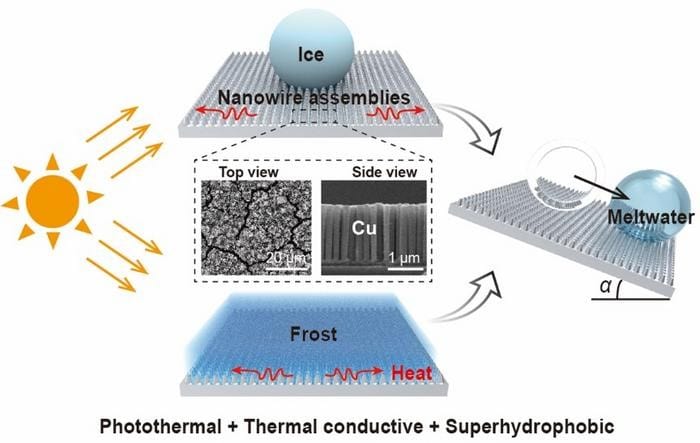
How it works: composite image showing illustrations of the de-icing process and electron microscope images of the nanowire surface. (Courtesy: Siyan Yang, Qixun Li, Bingang Du, Yushan Ying, Yijun Zeng, Yuankai Jin, Xuezhi Qin, Shouwei Gao, Steven Wang, Zuankai Wang, Rongfu Wen and Xuehu Ma)
A passive coating that is almost 100% effective at removing ice and frost from surfaces has been unveiled by researchers in China. The team’s design features an array of copper nanowires that combine excellent photothermal, heat-conducting, and superhydrophobic properties to achieve a very high defrosting efficiency.
The coating was developed by Siyan Yang and colleagues at the Dalian University of Technology, City University of Hong Kong and The Hong Kong Polytechnic University.
The build-up of ice on cold surfaces can pose problems in a wide range of situations from cryogenic freezing to aircraft wings. While a variety of techniques have been developed to remove ice and frost, they all have shortcomings. “Traditional de-icing and defrosting solutions mainly rely on mechanical, thermal, and chemical approaches, all of which are either energy-intensive, labour-intensive, or environmentally unfriendly,” Yang explains. “Additionally, some of these active approaches required direct contact with the material surface, posing risks to delicate coatings.”
Passive approaches
More recently, de-icing and defrosting technology has seen a shift towards passive approaches, which involve modifying material surfaces to prevent ice from forming and building up. This often involves designing slippery, hydrophobic, or even phase-changing surfaces. These can reduce the force required to physically remove ice and frost, or prevent water droplets from adhering and freezing in the first place.
One particularly promising advance has been the development of photothermal coatings that convert sunlight into heat – thereby melting ice and frost, even in freezing conditions. However, this technology has been held back by the limited thermal conductivity of existing coatings. This results in uneven heating, and strong interactions between surfaces and water droplets leading to uneven rates of meltwater removal – with both limiting defrosting performance.
Now, Yang and colleagues have designed a new type of surface that addresses these challenges. The surface features an array of copper nanowires that are assembled using a simple electrodeposition method. According to the team, their design combines excellent photothermal, heat-conducting, and superhydrophobic properties in a single material.
Upright and hydrophobic
The highly-ordered pattern of nanowires is very good at absorbing sunlight – and the high thermal conductivity of copper allows the captured heat to spread quickly and evenly throughout the entire array. Among the nanowire patterns that the team created was an arrangement of upright nanowires, separated by microgrooves about 2–3 micron across. This structure made the surface extremely hydrophobic: allowing meltwater to drain off evenly.
“Through wettability and photothermal tests, we found that most of nanowire assemblies can be treated as superhydrophobic, with a sunlight absorption rate larger than 95%,” explains team member Qixun Li. “Because of the high conductivity of copper materials, nanowire assemblies enable excellent de-icing and defrosting performances.”
The result is that close to 100% of ice and frost is removed from the surface, which the team says is the highest defrosting efficiency ever achieved on a passive surface.
For now, the team’s design is not suitable for practical use. Their nanowire arrays have a limited durability, are vulnerable to chemical damage, and remain difficult and expensive to produce on larger scales. However, the researchers hope that by building on their results, further research could soon lead to materials with a similar defrosting performance a step closer to a commercial rollout.