Co-review: supporting equal recognition

Want to learn more on this subject?

Co–review webinarWith co-reviewing functionality implemented across all IOP Publishing owned journals in 2023, all researchers can now receive recognition for their peer review contributions. Senior and early career researchers are supported by the co-review initiative, encouraging collaborations and promoting equal accountability. In this webinar, Laura Feetham-Walker will provide insight into how co-reviewing can support the various career stages, and how it can be applied. We will also welcome Manuel Glöckler, who will discuss his experience co-reviewing as a PhD student.

Want to learn more on this subject?

Laura Feetham-Walker is the reviewer engagement manager at IOP Publishing. She has over 13 years’ experience in scholarly publishing, working at The Lancet and BMJ before moving to IOP Publishing. Laura works on innovations that future-proof peer review, ensure that reviewers are recognised and rewarded for their work, and safeguard the integrity of the scientific record. These innovations include the launch of IOP Trusted Reviewer status, a comprehensive peer review training programme, and co-review, among others.


Manuel Glöckler is a PhD student at the University of Tuebingen, supervised by Prof. Jakob Macke. His research focuses on the topic of simulation-based inference. He is working on improving the robustness and uncertainty calibration for amortized inference. Manuel undertook co-review with Prof. Macke and Jan Boelts, from which he obtained IOP Trusted Reviewer certification.


Ask me anything: Cathy Foley – ‘I have lots of balls in the air on multiple projects’

What skills do you use every day in your job?

I have been Australia’s chief scientist since 2021, where my role is to advise the government, champion Australian science and support the research system to be as impactful as possible. Although I’m not involved in any research, what I do now is work across research disciplines, including the social sciences. I provide advice based on evidence, whether it’s the water quality of the Great Barrier Reef, quantum applications or RNA vaccine development.

Not surprisingly, I use my knowledge of what quality research looks like to decide whether the evidence at hand is valid. Have the researchers measured what they think they were measuring? Have the correct sample sizes been used to make the claims presented? Did they use the right statistics and present the data in a way that minimizes bias?

Other skills I use every day include collaborating, giving talks, writing and pulling together concepts across a wide range of disciplines to understand the challenges we face. As Australia’s chief scientist, my only lever is influence. Thanks in part to my experience as editor-in-chief of the IOP Publishing journal Superconductor Science and Technology, I also know how publishing works, which has put me in good stead to advise the Australian government on, say, possible approaches to open access.

What do you like best and least about your job?

Working as an adviser to government requires a huge amount of energy and I have lots of balls in the air on multiple projects. Within the space of a few hours, I might have to swap between meetings discussing, say, mineral processing, the energy transition or the circular economy, STEM career pathways and research metrics. I enjoy this aspect of the job but what I like best about this role is that I get to use everything I have ever learnt.

Having worked with people right across Australia and around the world, there’s so much expertise I can call on – people who are willing to drop everything to link me to the evidence I need to advise government. How good is that! Probably the least attractive part is the 4 a.m. starts. Some days I also have to go to Canberra, where it might be –2 °C and I’m freezing cold as I’ve travelled without a coat as I know I’m flying the next day to Townsville or Darwin, where it’ll be boiling hot.

What do you know today, that you wish you knew when you were starting out in your career?

When I started my career, I used to hate practising giving talks. I felt embarrassed and thought a slide deck and knowing my stuff was enough. Over the years, however, I’ve found that practice is critical. Now I aim to run through any talk I give at least six or eight times. Sometimes I even practise out loud, sometimes to a small audience and occasionally with just myself – which can be interesting for the person next to me on a plane.

I also wish I’d known that the things you do outside your job are worthwhile too. For me, this was being involved with the Australian Institute of Physics, giving talks at schools and volunteering. People said I was wasting my time doing these “extra” things, and I felt bad about ignoring their advice. But I’m glad I stuck with what I thought was important. The skills and networks I gained from these extracurricular efforts were critical to building up skills and networks I use in my current role.

Finally, I wish I’d learnt earlier how to peer review research papers with a strong, critical eye. High-quality papers are crucial for us to develop research that can be trusted and built on by others – but I was not critical enough of my own work or that of others. As editor-in-chief of Superconductor Science and Technology, that is my favourite part of working with authors – helping them to consider and demonstrate the rigour and impact of their work as well as possible.

Quantum anomalous Hall insulator carries current in its interior, not just its edges

Insulators are not, by definition, good carriers of electrical current, but researchers in the US have discovered that a special type of insulator known as a quantum anomalous Hall insulator can nevertheless support electrical current within its interior. This surprising result – current was only thought to flow along the edges of such materials – could aid the development of next-generation quantum devices based on so-called topological insulators.

In the ordinary quantum Hall effect, which was discovered in 1980, the interior of a sample becomes an insulator when a strong magnetic field is applied to it. However, an electrical current still flows – in a single direction – along the edges of the sample. This leads to values of the resistance of the sample becoming quantized, or restricted to certain values determined by fundamental physical constants.

The quantum anomalous Hall effect (QAH) is slightly different. Here, the effect arises in a material that is already magnetized, and the material’s resistance is quantized even at even at weak (or indeed zero) magnetic fields. The result is that the current-carrying electrons travel at high speeds along the sample edge without dissipating energy – rather like what happens in a superconductor.

Studying very small currents

In the new work, which is described in Nature Materials, researchers led by physicist Katja Nowack of Cornell University studied a ferromagnetic topological insulator called chromium-doped bismuth antimony telluride. This the material in which the QAH was first observed in 2013. Using high-sensitivity magnetic imaging at very low temperatures, members of the team, which also included researchers at Pennsylvania State University, found that the previous “edge picture” may not be the only explanation for the material’s quantized resistance.

Katja Nowack

“A current generates a magnetic field and it turns out that the current density [within the material] can be reconstructed from an image of one component of this magnetic field,” Nowack explains. “In our experiments, the currents we are studying are very small, below 25 nA, and we needed to go to temperatures as low as around 25 mK to observe a robust QAH. Our probe’s sensitivity and our ability to reach the necessary temperatures allowed us to do a good experiment.”

A fundamental shortfall in understanding

These sensitive measurements revealed that electrons flow within the bulk of the material, not at the boundary edges as expected. According to Nowack, this result could re-open the debate on how current flows in ordinary quantum Hall insulators, as when they were discovered, it was unclear where current actually flowed.

“It’s clear that we don’t even understand some very fundamental aspects of what happens in topological materials,” she says. “Electron behaviour in a material is a very fundamental property and deepening our understanding of how electrons behave in quantum anomalous Hall insulators and in the wider range of topological materials touches on foundational scientific questions as well as being important for developing useful devices based on these materials.”

The next question, she tells Physics World, is to find out how general the team’s findings are. “We have imaged just a few devices from this material class, but a beautiful aspect of quantum anomalous Hall insulators is that many different local current distributions can give rise to the quantization that is observed in a transport measurement,” she says. “Thus, I’m curious to study more of these insulators to learn if the current flows in the same way or differently.”

Rapidly swapping photons make a high-quality quantum gate  

Quantum computers could revolutionize science, but the quantum bits (qubits) they run on are fragile. Being able to manipulate these qubits rapidly, before interactions with their environment cause the quantum information in them to decay, is thus crucial for quantum computations.

A promising way to store a quantum bit is to encode it in the discrete energy levels of light within a quantum resonator such as a superconducting cavity. Manipulating multiple such cavities, however, can be challenging due to spurious interactions or additional error channels that affect the stored quantum information. Researchers from the Yale Quantum Institute in the US have now found a partial solution to this problem by engineering a system that rapidly passes photons from one cavity to another without damaging the photons’ quantum states. This result is an essential step towards fast and high-quality quantum gates for quantum computers based on resonators.

Engineering a beam-splitter interaction using a SNAIL

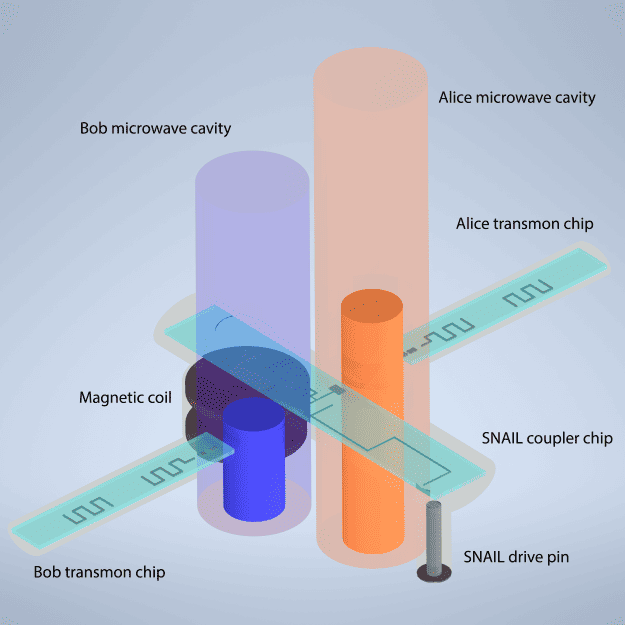
In the study, which is published in PRX Quantum, researchers in Robert Schoelkopf’s lab at Yale used a coupling element called a SNAIL (superconducting nonlinear asymmetric inductive element) to mediate a swapping interaction between two superconducting microwave cavities. By tuning the SNAIL using an external magnetic field, they suppressed spurious interactions between the two cavities, leaving only the so-called “beam-splitter” interaction. Similar to linear optics in which a light beam can be split in two using (for example) a semi-transparent mirror, this interaction lets the two cavities exchange excitations at a 50:50 ratio for a specific interaction time.

To demonstrate this, the researchers initialized one resonator with a single photon, leaving the other resonator in the vacuum. When they tuned the SNAIL coupler to the optimal working regime, they observed the two cavities swapping the photon between them 500 times before the system decohered (that is, it lost its quantum nature due to residual interactions with the environment), with a time of only 250 nanoseconds per swap.

One of the researchers’ goals was for the resonators to swap photons rapidly when the coupling is on, while ensuring that the cavities do not interact when the interaction is turned off, thereby avoiding detrimental effects on the stored quantum information. To this end, the researchers measured the rate at which photons are swapped relative to the most prominent interaction between non-interacting periods. They found that the value of this on-off ratio exceeded 105, indicating minimal unwanted interactions caused by the coupling element.

“The SNAIL coupler presented in this work enables a fast beam-splitter interaction between qubits encoded in adjacent cavities while suppressing both interactions that might degrade the qubit coherence, and also those that induce unwanted couplings between the qubits,” explains Stijn de Graaf, a PhD student at Yale and one of the authors of the study. Both effects, he adds, “ultimately limited previous approaches”.

Controlled swapping of photons with a qubit

As a first application of their new setup, the researchers implemented a swapping operation of the two cavities that can be controlled by a qubit connected to one of the resonators. If this control qubit is in the ground state, no photons between the two cavities swap, but if the control qubit is excited, the states in the cavities change places.

This so-called controlled-SWAP operation is a crucial gate for quantum implementations of quantum random-access memory (QRAM) and many quantum algorithms. By preparing the control qubit in an equal superposition between its two energy levels, the team also created a Bell state – a maximally entangled state in the two cavities that can be made from an equal superposition of swapped and unswapped states in the cavities.

Application to dual-rail qubits

The researchers hope that others will use their findings to design families of error-detectable gates on qubits encoded in the energy levels of quantum resonators. These so-called bosonic codes show great potential for implementing hardware-efficient quantum error correction, which is crucial for developing large-scale quantum computers.

In the nearer term, de Graaf says the team’s primary focus is on using the tool they have to implement one of the key building blocks of the newly proposed superconducting dual-rail qubit. This type of qubit uses a single photon stored in one of two microwave cavities as its logical states, and it allows specific errors to be detected and flagged. An error can then be handled later in the quantum computation.  If errors can be detected with very high efficiency, scalable quantum computation might be possible without the need for active error correction. The fast beam-splitter interaction presented in this work is thus an essential building block for detecting the loss of single photons in the dual-rail qubit, which is currently the most prominent source of errors on this hardware platform.

Getting there will, however, require some technical improvements. “There is no doubt that we will want to continue to increase the fidelity of all of the operations of this scheme,” de Graaf says. “This will enable error rates as far below quantum error-correcting thresholds as possible and therefore allow us to dramatically reduce the number of qubits required for a fault-tolerant quantum computer.”

Quantum-safe cryptography: why we need it now

Cryptography keeps our messages secret, our bank transactions secure, and our data safe from hackers — but there is a threat looming on the horizon. Most cryptographic systems used today are based on computational assumptions that could be resigned to history by quantum computers.

The upshot is that quantum computers of the future could be used to crack cryptographic systems. And what is more, messages sent securely today could be decrypted in the future.

To address this threat, researchers, companies and governments are developing quantum-safe cryptography systems that cannot be cracked by quantum computers.

Our guest in this episode of the Physics World Weekly podcast is Ali El Kaafarani, who is an expert in post-quantum cryptography. He is founder and CEO of PQShield, which spun out of the UK’s University of Oxford and develops quantum-safe cryptography systems for use on chips, in applications, and in the cloud.

He explains why quantum computers pose a threat to today’s cryptographic systems, and what the cryptography community is doing about it.

Delight as UK strikes deal to join the EU’s flagship Horizon Europe funding programme

The UK government has today announced that it will re-join the €95bn Horizon Europe research framework. The agreement between the UK and the European Commission (EC) means that as from today, UK researchers can begin to apply for grants from the scheme.

The deal has been welcomed by UK scientists, who have long expressed dismay at the lack of progress over joining the world’s largest research and innovation funding programme.

“This is wonderful news,” Carsten Welsch, an accelerator physicist from the University of Liverpool, told Physics World. “The best science and innovation comes from international collaboration. Horizon Europe is the world’s flagship science programme and it is great that UK experts can now play a leading role once again.”

Before Brexit, the UK had been a full and highly successful member of previous EU research programmes receiving more money from the programme than it put in. In the seven years to 2013, for instance, UK scientists won €1.7bn in grants from the EU’s European Research Council – more than any other country.

The UK’s participation in Horizon Europe, which runs from 2021 to 2027, was agreed at the end of 2020 as part of the post-Brexit trade deal between the UK and EU. But as an associate member, it would no longer be able to take out more money than it pays in, mean­ing that the UK could lose access to a lot of extra funding.

Associate membership stalled, however, and became a bargaining chip in disagreements over Northern Ireland, which were resolved in March with the Windsor Framework. In recent months, the UK’s association with Horizon Europe has been held up by negotiations on the UK’s financial contribution to the research programme given it has missed more than two years of the seven-year programme.

After some challenging years where uncertainty made real progress difficult, the association with Horizon will boost interdisciplinary research

Carsten Welsch

As an associate member of Horizon Europe, Britain will now join other non-EU nations, including Israel, New Zealand, Norway, Switzerland and Ukraine. The European Commission says that UK participation in Horizon Europe will begin from 1 January 2024, while the UK government says that the UK will not pay for the programme between 2021 and 2024 – the time the UK was not in Horizon Europe. The agreement must be approved by the European Council before it is formally adopted.

The UK also announced today that it will associate to Copernicus, the EU’s €9bn Earth Observation programme. However, the UK says it will not join the Euratom programme, instead carrying out its own fusion energy strategy that will be funded with some £650m per year until 2027. The EC says that the UK will pay around €2.6bn a year to associate with Horizon and Copernicus.

Ian Chapman, chief executive of the UK Atomic Energy Authority welcomes the move and the “clarity” and “certainty” it provides to the sector. “The government’s commitment to an ambitious alternative R&D programme will be hugely important in sustaining the UK’s position as a leader in fusion R&D as well as developing an industrial capability to deliver future fusion power plants,” he says. “We welcome the ambition to retain, and even enhance, our international collaborative relationships through this substantial package of alternative R&D”

Best for science

The agreement has been welcomed by scientific bodies in the UK. “As the Institute of Physics has long highlighted Horizon association brings unparalleled opportunities backed by funding for collaboration – it is best for science, best for business and innovation, and best for the UK,” says IOP group chief executive Tom Grinyer.

Adrian Smith, president of the Royal Society, says association is a “big win”. “Our association to Horizon Europe is fantastic news, not just for the UK but for scientists across the EU and for all the people of Europe,” he says. “Science has so much to offer in terms of tackling global challenges and improving lives. Today the Government and the EU have given that a big boost.”

Smith adds that association will allow the UK “to continue to build on decades of collaborative research with our European partners and step up our global collaborations too to keep us as a nation at the forefront of science and innovation”.

More than money

While pushing to rejoin Horizon Europe, UK researchers have often stated that Horizon Europe is about much more than just finance, such as the research collaborations it enables.

Welsch lost a major EU grant last year because the UK’s association with Horizon Europe had not been finalised. “After some challenging years where uncertainty made real progress difficult, the association with Horizon will boost interdisciplinary research,” he says. “I look forward to embracing the many opportunities the Horizon programme offers.”

Iron oxide nanoparticles boost the contrast in low-field MRI scanners

Portable, low-field (1–100 mT) MRI systems that can safely perform scans outside a dedicated MRI suite could revolutionize the use of this diagnostic imaging modality. In addition to alleviating the need for an expensive, MRI-dedicated imaging room, low-field scanners cost far less and require less space and power than traditional MRI scanners that rely on cryogenic superconducting magnets. Such cost advantages make it feasible to deploy low-field MRI scanners in economically challenged hospitals and clinics, while their portability may enable installation in ambulances or portable vans serving remote communities.

The first commercial point-of-care low-field MRI scanner is Hyperfine’s Swoop Portable MR Imaging System, which has CE Mark and US FDA 510k clearance for neuroimaging. Swoop is increasingly used in hospital emergency departments to image patients with severe head trauma or suspected of having a stroke. This portable scanner operates at 64 mT – at least 20 times lower than the magnetic field in conventional MRI scanners.

To expand the clinical application of low-field MRI scanners, however, better contrast agents are needed to improve the image quality. In addition, more research is required to understand the relationship between low-field images and the underlying tissue properties that they represent.

Nanoparticles as contrast agents

Researchers at the National Institute of Standards and Technology (NIST), the University of Colorado Boulder and the University of Florence have determined that superparamagnetic iron oxide nanoparticles (SPIONs) significantly outperform a commercial gadolinium-based contrast agent (gadobenate dimeglumine, or Gd-BOPTA) used for exams on 3 T MRI scanners. Writing in Scientific Reports, they describe the properties of iron oxide-based contrast agents during acquisition of low-field MRI scans.

Approximately 25% of all MRI exams at clinical field strengths use contrast agents – magnetic materials that are injected into patients to enhance image contrast, enabling anatomical features to be distinguished by their level of brightness or darkness. Contrast agents can help radiologists identify unhealthy tissue based on the MR enhancement patterns of a tumour. For example, the tumour vasculature can accumulate more contrast than healthy tissue, and a tumour that may not have been visible without contrast may become visible.

The efficacy of a contrast agent is directly related to its physical and magnetic properties. Lead author Samuel Oberdick, from NIST and the University of Colorado Boulder, and co-authors characterized monodispersed carboxylic acid-coated SPIONs with diameters ranging from 4.9 to 15.7 nm. Their aim was to understand size-dependent properties of T1 contrast at low field strengths (a T1-weighted MR image demonstrates differences in the longitudinal relaxation times of tissues). By imaging an MRI phantom, they determined the MRI contrast properties at 64 mT using the Swoop system and at 3 T using a preclinical scanner.

The researchers determined that SPION-based contrast agents show favourable qualities as T1 contrast agents for low-field MRI, exhibiting size-dependent longitudinal relaxivities and outperforming Gd-BOPTA by nearly nine times at room temperature and eight times at physiological temperatures. They also observed that the longitudinal relaxivities of SPIONs at 64 mT were nearly an order of magnitude larger than at the standard clinical field strength of 3 T. A high relaxivity enables use of smaller quantities of contrast to create perceptible bright markers on an MR image.

The team also measured the low-field T1 properties of ferumoxytol, an iron oxide nanoparticle-based treatment for iron deficiency. Ferumoxytol also showed enhanced contrast compared with the gadolinium-based agent. Because it is already FDA approved, ferumoxytol could immediately be used off-label to evaluate the T1 contrast of iron oxide nanoparticle-based contrast agents in clinical studies.

Oberdick advises that the team now plans to explore the optimal properties for SPION-based T1 contrast agents at low fields. Future work may use custom synthesis of nanoparticles to create SPIONs with engineered sizes and magnetic properties to increase T1 contrast at specific low field strengths.

Imaging the brain

Elsewhere at NIST, Kalina Jordanova and colleagues have been working to validate methods for creating images with weaker magnetic fields. They recently measured the properties of brain tissue at low magnetic field strength in a study of five male and five female volunteers, reporting their findings in Magnetic Resonance Materials in Physics, Biology and Medicine.

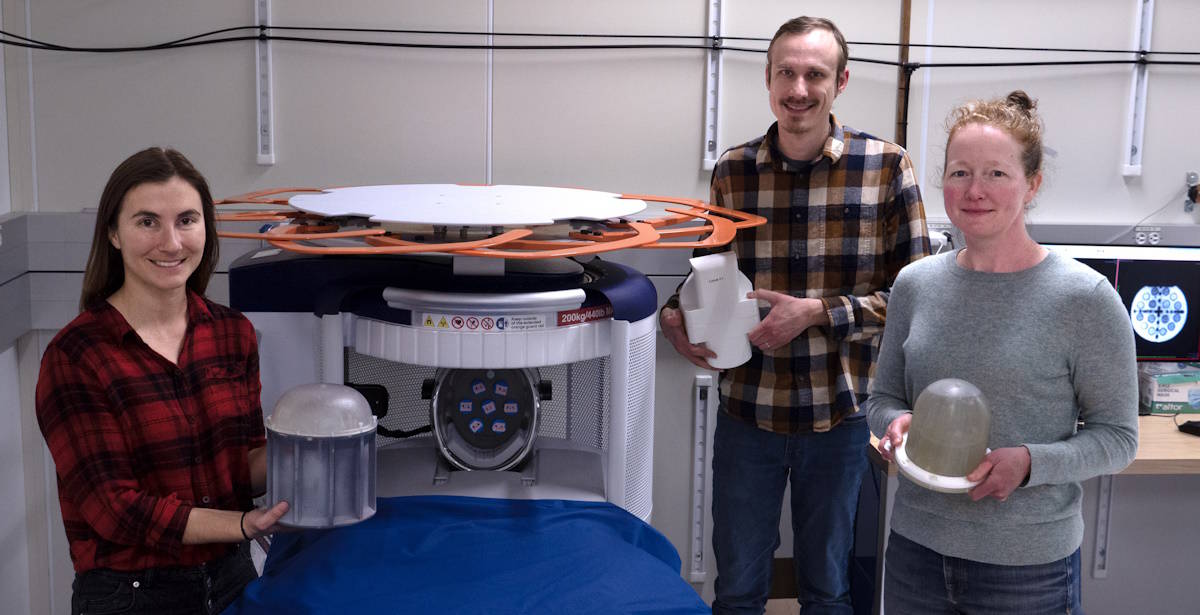
Kalina Jordanova, Stephen Ogier and Katy Keenan

The team collected 64 mT MR images of the entire brain and obtained data from the grey matter, white matter and cerebrospinal fluid. These three brain constituents respond to the low magnetic field in different ways and produce distinctive signals that reflect their unique properties. This enables the MRI system to produce images containing quantitative information about each constituent.

“With low-field MRI systems, the contrast of the images is different, so we need to know how human tissue looks at these lower field strengths,” says Jordanova. “Knowing the quantitative properties of tissue allows us to develop new image collection strategies for this MRI system,” adds co-author Katy Keenan.

Neutrino fluids in supernovae could point to new physics

Neutrinos created in exploding stars could point to physics beyond the Standard Model, according to calculations done by Po-Wen Chang and colleagues at Ohio State University in the US. Their work explains how a hypothetical interaction affects the pulse of neutrinos that is generated in a core-collapse supernova – something that could be seen in existing and future observations of supernovae.

Neutrinos are low-mass and electrically neutral subatomic particles that can travel long distances through matter without interacting. They are produced in vast quantities by some astrophysical processes and astronomers use huge detectors to study the neutrinos that arrive on Earth. As well as telling us something about astrophysics, studying these cosmic neutrinos can provide insights into the nature of the particles themselves.

Now, Chang’s team has explored the possibility that supernovae explosions could trigger neutrino behaviours that cannot be explained by the Standard Model of particle physics.

Extreme conditions

The Standard Model says that neutrinos interact with each other via the weak nuclear force or gravity. But during core-collapse supernovae, the particles are expected to become so densely packed that they scatter off each other far more frequently than usual. In such extreme conditions, some theories that go beyond the Standard Model suggest that a hypothetical interaction called “enhanced self-interaction” (νSI), could emerge. This interaction is predicted to be orders of magnitude stronger than the weak interaction and should therefore affect the behaviour of neutrinos in such supernovae.

For astronomers, an opportunity to observe this effect came in 1987, when 25 neutrinos from SN 1987A were registered in three neutrino detectors.  SN 1987A was a core-collapse supernova that occurred just 168,000 light–years away in the Large Magellanic Cloud.

The general idea is that νSI should have affected the nature of the neutrino pulse that was detected here on Earth. However, in the decades following the event, physicists have struggled to calculate observable effects in SN 1987A’s neutrino signal that would establish the existence of νSI.

Relativistic hydrodynamics

In their study, Chang’s team revisited the problem by considering neutrinos flowing outwards from the newly forming neutron star at the centre of a core-collapse supernova. Under the constraints of relativistic hydrodynamics, their calculations showed that νSI would cause the particles to act collectively to form a dense, tightly-coupled and expanding fluid.

The researchers also suggest that this expansion could follow two possible paths. In the first scenario, neutrinos would flow out in a sudden burst. The result would be a neutrino fluid that extends far beyond the central neutron star – meaning the neutrino pulse observed by astronomers would last for longer. In the second case, neutrinos instead flow in a steady wind with a lower density. Here, the effects of νSI would disappear closer to the neutron star, resulting in a shorter neutrino pulse.

Chang’s team now hope their ideas will be used in further calculations that could enable astronomers to identify evidence of νSI  in neutrino data from SN 1987A. “The dynamics of supernovae are complicated, but this result is promising because with relativistic hydrodynamics we know there’s a fork in the road in understanding how they work now,” Chang says.

Based on their knowledge of neutrino production inside supernovae, the researchers predict that their steady wind theory is more likely than the burst-outflow case – but for now, more work will be needed to determine whether or not both phenomena could occur in the same explosion.

Ultimately, their discoveries could make it far easier for astronomers to gather evidence for νSI once new supernovae are observed in the Milky Way or its galactic neighbourhood – though these may still be decades down the line. “We’re always praying for another galactic supernova to happen somewhere and soon, but the best we can do is try to build on what we know as much as possible before it happens,” says Chang.

The research is described in Physical Review Letters.

Fallout from nuclear weapons testing explains the ‘wild boar paradox’ of radioactive meat

Wild boar and the wooden platforms used for hunting them are a common sight in European forests, but in some areas their meat contains such high levels of radioactive caesium that it cannot be sold for human consumption. Worse, radiation levels in wild boar have remained constant for the past 30 years, even though the well-understood physics of half-lives and a countervailing trend in other forest animals suggest the levels ought to be falling.

This puzzle is known as the wild boar paradox, and a team of chemists and radiation experts at Leibniz Universität Hannover, Germany and TU Wien, Austria, has now come up with an explanation for it. After analysing the ratio of caesium isotopes in samples of wild boar meat from 11 districts of Bavaria, Germany, the team concluded that global fallout from nuclear weapons tests is responsible for a significant fraction of the contamination, even though Bavaria also experienced heavy fallout from the Chornobyl reactor meltdown. Though the exact ecological mechanism for the ongoing contamination remains unclear, the researchers say their result adds to a growing body of evidence indicating that decades-old nuclear tests continue to have a significant impact on the environment.

Ubiquitous radioactivity

From the mid-20th century until 1980, the US, the Soviet Union and other nuclear-weapons states conducted a total of 528 nuclear tests in the Earth’s atmosphere, showering the globe with fission products such as caesium-137 (137Cs). Nuclear accidents such as the ones at Chornobyl, Ukraine in 1986 and Fukushima, Japan in 2011 also released 137Cs, and while the fallout from these events was more localized than the fallout from weapons testing, it still affected large areas. The Chornobyl disaster, for example, spread 137Cs across much of Europe due to a combination of prevailing winds and poorly timed rainfall.

Many countries responded to the health risks of this fallout by adopting regulations that limit the amount of 137Cs in foodstuffs. In Europe, the limit is 600 Bequerels (Bq) per kilogram; in Japan, it is 100 Bq/kg. But while food testing and other forms of surveillance provide useful information about levels of 137Cs contamination, they are silent on its source. This is because “reactor-137Cs” and “weapons-137Cs” are indistinguishable, with the same chemistry and the same 30-year half-life.

To identify the source of radioactive caesium in Bavarian wild boar meat, the Leibniz and TU Wien scientists turned instead to a different caesium isotope with a much longer half-life: 135Cs. Because the parent nuclide of 135Cs, 135Xe, has a large cross-section for thermal neutron capture, the high neutron flux density within a reactor core tends to transmute it into other substances, limiting 135Cs production. In contrast, the neutron flux during nuclear explosions is intense but brief, meaning that more 135Xe “survives” to decay into 135Cs. Hence, a nuclear explosion yields a relatively high 135Cs/137Cs ratio, whereas a reactor yields a low ratio.

The wild boar paradox

In the immediate aftermath of the Chornobyl disaster, levels of 137Cs in Bavaria’s surface soil ranged from 102 to 105 Bq/m, and concentrations in local wild boar meat exceeded the regulatory limit by 1–2 orders of magnitude. Other forest species such as deer were also heavily contaminated, but whereas their 137Cs levels declined substantially over time, levels in wild boar did not. In fact, the decline in wild boar has in some locations been slower than the physical half-life of 137Cs.

A map of southern Germany and Bavaria with areas of higher radioactive caesium contamination marked in red, superimposed with pie charts showing how much of that caesium comes from Chornobyl and how much from earlier atmospheric weapons tests

In a paper published in Environmental Science and Technology, Felix Stäger, Dorian Zok, Anna-Katharina Schiller, Bin Feng and Georg Steinhauser note that this paradoxical non-decline is often attributed to the boars’ tendency to root up and eat underground fungi such as deer truffles. Under the “right” soil conditions, these organisms act as a repository for 137Cs, which “migrates downwards through the soil very slowly, sometimes only about one millimetre per year”, Steinhauser explains.

The long shadow of weapons testing

As for where that 137Cs came from, the Leibniz-TU Wien researchers’ isotope ratio measurements show that it varies by location (see image). Overall, though, about 25% of their wild boar meat samples contained enough weapons-137Cs that they would have exceeded the European regulatory limit even if Chornobyl hadn’t happened. This result suggests that there are, in effect, two separate downward-migrating caesium “fronts” contaminating the boars’ winter food supply: one from atmospheric nuclear weapons tests, which peaked in 1964, and one from Chornobyl 22 years later.

For the Bavarian hunters who supplied the team with samples, this is bad news. With caesium levels at deer-truffle level being continually replenished by this two-front downward migration, the natural decay of 137Cs into stable barium-137 is unlikely to solve the problem of wild boar meat contamination any time soon – especially in areas where caesium from Chornobyl is only now reaching the truffles that boar consume so, well, piggishly. “Strategic decisions to conduct atmospheric nuclear tests 60–80 years ago still impact remote natural environments, wildlife, and a human food source today,” the team concludes. “A similar, long-lasting consequence can be expected from Chornobyl-137Cs deposited in central Europe.”

Study in astronauts could improve health in space and on Earth

Life in space subjects the human body to extreme conditions – exposing astronauts to radiation, inducing fluid shifts and removing physical forces on the skeleton. Space flight can also cause haemolysis, the destruction of red blood cells, leading to “space anaemia”.

To investigate the health implications of long-duration spaceflight, researchers at the University of Ottawa studied 14 astronauts returning from six-month missions on the International Space Station. In particular, they examined changes in the astronauts’ bone marrow before and after their missions. The study, reported in Nature Communications, revealed that space travel depletes red blood cells and bone, but that upon return to Earth, the body recovers with the help of fat stored in the bone marrow.

“We found that astronauts had significantly less fat in their bone marrow about a month after returning to Earth,” says senior author Guy Trudel from University of Ottawa and The Ottawa Hospital in a press statement. “We think the body is using this fat to help replace red blood cells and rebuild bone that has been lost during space travel.”

Recovering from spaceflight

The study included 11 male and three female astronauts. The participants underwent lumbar vertebrae MR imaging and spectroscopy roughly 100 days preflight, and approximately 41 days, six months and one year after returning to Earth. Using three quantitative MR techniques, Trudel and colleagues observed that 41 days after landing, the astronauts’ bone marrow fat had decreased by 4.2% from preflight values.

To investigate potential mechanisms for this reduction in bone marrow adiposity (BMA), the team explored whether it was associated with the astronauts’ recovery from space anaemia, as occurs when the return to Earth’s gravity triggers increased production of red blood cells. Three days after landing, blood sample analysis showed that the astronauts had 10.4% fewer red blood cells than before their space missions, confirming that they suffered from space anaemia.

At 41 days postflight, the researchers measured 18.9% higher concentration of reticulocytes (immature red blood cells) in the astronauts’ blood than at preflight. These changes were spatially and temporally correlated with changes in bone marrow fat, reinforcing the theory that BMA downregulation results from local consumption of fatty acids to support red blood cell production.

As well as losing red blood cells, astronauts also suffer from loss of bone mass, or “space osteopenia”. The researchers thus examined whether BMA reduction was also correlated with astronauts’ recovery from this condition upon re-exposure to gravity. They found that 41 days after landing, serum and urinary markers of bone formation were increased over baseline levels.

They also used dual-energy X-ray absorptiometry to examine vertebral bone mineral density before and after spaceflight. The astronauts lost an average of 0.03±0.03 g/cm2 vertebral bone mass at 3–18 days postflight compared with preflight. Six to nine months after landing, this had recovered somewhat, but was still slightly below baseline levels. These findings support a second possible mechanism for BMA downregulation – the local use of fatty acids to supply energy-intensive bone formation in response to space osteopenia.

“Since red blood cells are made in the bone marrow and bone cells surround the bone marrow, it makes sense that the body would use up the local bone marrow fat as a preferential source of energy to fuel red blood cell and bone production,” explains Trudel. “We look forward to investigating this further in various clinical conditions on Earth.”

Sex-specific differences

The researchers found that the bone loss was only statistically significant for the male astronauts, which prompted them to explore potential sex-specific changes in BMA after long-duration spaceflight. On Earth, premenopausal women generally have lower BMA than men and, in this cohort, the female astronauts had 11.1% lower lumbar bone marrow fat at preflight than the male astronauts.

At 41 days postflight, female and male astronauts showed identical downregulation of lumbar BMA. However, measurements at six months and one year revealed that while male astronauts’ BMA progressively returned to normal levels, BMA accrued considerably in female astronauts. MR data showed that at one-year postflight, the male–female difference had disappeared. The researchers suggest that this sex-specific modulation of BMA merits further investigation in larger populations.

The team also tested the impact of astronaut age on vertebral BMA modulation after long-duration spaceflight. They found that the younger the astronaut, the larger the decrease in bone marrow fat 41 days after landing.

The researchers emphasize that these findings in astronauts can also help people on Earth, such as patients with anaemia who have lost muscle and bone mass after long-term illness and limited mobility. “I’m hopeful that this research will help people recover from immobility on Earth as well as in space,” says Trudel. “Our research could also shed light on diseases such as osteoporosis, metabolic syndrome, aging and cancer, which are associated with increases in bone marrow fat.”


Copyright © 2026 by IOP Publishing Ltd and individual contributors