An effect that normally gets in the way of the magnetic trapping of atoms has been harnessed to create a new method for measuring pressure in ultrahigh vacuum (UHV) systems. Stephen Eckel, Daniel Barker, Julia Scherschligt, Jim Fedchak and colleagues at the US National Institute of Standards and Technology (NIST) have shown that measurements made with a “cold-atom vacuum standard” (CAVS) match closely with a current standard technique for making UHV pressure measurements. The team believes that CAVSs could prove to be a more reliable way of measuring pressure than some existing techniques.
Many applications in science and industry are done under UHV conditions and it is crucial that the very low pressures in such systems are measured accurately. UHV pressures are typically less than 10−10 of atmospheric pressure and are usually measured using ionization gauges. These devices ionize some of the remaining (background) gas molecules in a vacuum and the ions are attracted to a negatively charged electrode. The resulting ion current is measured and this is translated into a pressure.
However, ionization gauges have several disadvantages including the need for frequent calibration; and an accuracy that depends on the composition of the background gas. As a result, these gauges can have significant measurement uncertainties when used in UHV.
Colliding atoms
The magnetic trapping of atoms is an important application that is done under UHV. It involves cooling neutral atoms to close to absolute zero – allowing the ultracold atoms to be used to explore the quantum properties of matter. Yet even when held in UHV, atoms will eventually collide with residual gas, knocking atoms out of the trap.
Recently, researchers have realized that this problem could be turned into an advantage for measuring vacuum pressure. “Over the last decade, several research groups have worked to use the background-gas-induced atom loss, which is detrimental for most quantum science applications, to measure vacuum pressure in the UHV range,” explains Barker.
Recent developments in quantum scattering theory suggest that the rate at which atoms are lost from magnetic traps must vary predictably and consistently with the pressure exerted by the background gas, regardless of its composition. As a result, several studies have explored the idea that magnetic traps could be used as cold-atom vacuum standards that determine pressure using the loss rate of trapped atoms, with no calibration required.
Dynamic expansion
In its study, the NIST team set out show that that a CAVS could be used to measure pressure under UHV conditions. The study involved attaching a pair of CAVSs to a dynamic expansion system, which is regarded by NIST as the gold standard for vacuum measurement. These systems work by injecting a known amount of gas into a vacuum chamber, then removing it from the other end at a carefully controlled rate.
“The dynamic expansion standard sets a known vacuum pressure of a known gas for the two CAVSs to measure,” Barker explains. “If the pressure set by the dynamic expansion standard and the pressure measured by the CAVSs agree within their uncertainties, then the CAVSs are validated: they are truly intrinsically accurate pressure standards for ultrahigh vacuum.”
In their experiment, the researchers measured variations in collision rates between trapped, ultracold atoms of lithium and rubidium, and a variety of room-temperature noble gases. Just as previous quantum scattering calculations had suggested, the loss rates they measured from the magnetic trap CAVSs were a reliable standard for vacuum pressure.
Pressure readings from a CAVS will be trustworthy even years after deployment
Daniel Barker
“We found that the CAVSs and the dynamic expansion standard are in very good agreement; they report the same vacuum pressure,” Barker says. “We now know that pressure readings from a CAVS will be trustworthy even years after deployment.”
Following their success, Eckel and team now hope metrology institutes around the world will try to replicate their results by comparing CAVSs with vacuum pressure measurements made using their own dynamic expansion standards. If an international agreement can be reached, they expect that vacuum pressures could soon be routinely measured far more accurately than with ionization gauges – to the benefit of researchers working in cutting-edge areas of research.
“We anticipate that the long-term reliability of a CAVS may be advantageous in accelerator facilities, gravitational wave detectors, and next-generation semiconductor fabs,” Barker says. “NIST also plans to develop a CAVS as a calibration standard for commercially produced gauges.”
In the late 1960s a small community of researchers began using forces from light to push small objects around. Within the next decade, the field expanded to include laser cooling, a powerful technique that exploits the Doppler shift to produce a force that can only slow objects down, and never speed them up. As the years went by, these new laser cooling experiments developed along the two parallel tracks – ions and atoms – explored in part 1 of this series: “Cold: how physicists learned to manipulate and move particles with laser cooling”.
In many ways, ions had an early advantage. Due to their electric charge, they experience electromagnetic forces, which are strong enough to allow them to be caught in electromagnetic traps at high temperatures and cooled by lasers at ultraviolet wavelengths. By 1981 ion trappers had refined this technique to the point where they could trap and detect single ions and perform spectroscopy on them with unprecedented precision.
Atoms, in contrast, need to be slowed down before they can be trapped by weaker forces exerted by light and magnetic fields. Still, by 1985 Bill Phillips and colleagues at the US National Bureau of Standards in Gaithersburg, Maryland, had used light to slow a beam of sodium atoms almost to a halt, then confined them in a magnetic trap. Beyond that, the principal challenge for would-be atom tamers seemed to involve building on this work to make trapping of neutral atoms more efficient, and pushing the limits of the cooling process itself.
Both projects would succeed beyond anyone’s expectations. And just as we saw in part 1, the roots of this success go back to Arthur Ashkin at Bell Labs.
Good idea, inadequate execution
When we last met Ashkin, it was 1970 and he had just developed the “optical tweezing” technique that would win him a Nobel Prize nearly 50 years later. By the end of the 1970s he was working with his Bell Labs colleagues on experiments involving an atomic beam. “Rick Freeman had an atomic beam machine, and I had some experiments that would be interesting to do with an atomic beam, but I wasn’t too enthused about building an atomic beam machine,” recalls Ashkin’s then-colleague John Bjorkholm.
By overlapping a laser beam with the beam of atoms, Ashkin and Bjorkholm showed it was possible to focus or de-focus the atoms by adjusting the frequency of the light. With the laser tuned to the red – at a slightly lower frequency than the atoms “want” to absorb – the interaction between atoms and light would lower the atoms’ internal energy (the “light shift”), drawing atoms into the laser beam. With the laser tuned to the blue, the atoms got pushed out.
Ashkin had several ideas for turning this phenomenon into an “all-optical” method for trapping atoms (that is, without the magnetic fields Phillips’ group used). Unfortunately, Ashkin and Bjorkholm struggled to implement it because Freeman’s atomic beam was built with plexiglass windows that couldn’t sustain low enough pressures. The atoms and molecules that leaked in from the outside were not affected by the cooling lasers, and as a result, when they collided with atoms in the beam, they kicked the target atoms out of the trap. After a few years of disappointing results, the Bell Labs leadership soured on the experiments and pushed Ashkin to pursue other things.
Swimmers in a viscous fluid
Steven Chu “A guy who could get difficult experiments done”. (Courtesy: The Royal Society)
Around this time, a young researcher with a (self-described) reputation as “a guy who could get difficult experiments done” moved into an office near Ashkin’s in Bell Labs’ Holmdel facility. His name was Steve Chu, and he became interested in Ashkin’s ideas. Together, they built an ultrahigh vacuum system suitable for atom cooling and trapping, plus a system to slow sodium atoms by rapidly sweeping the laser frequency to compensate for the changing Doppler shift. The latter technique is known as “chirp cooling”; by happy coincidence, the scientists who developed one of its key technologies were also at Holmdel.
At this point, Chu suggested they pre-cool the atoms by illuminating them with three perpendicular pairs of counter-propagating laser beams, all tuned to a frequency just below the atoms’ transition frequency as discussed in part 1. This configuration provides a cooling force in all three dimensions simultaneously: an atom moving up sees the downward-going laser beam Doppler shifted up, absorbs photons, and slows down; an atom moving left sees photons in the rightward-going beam shifted up, and so on. No matter which way the atoms move, they feel a force opposing their motion. The similarity to the plight of a swimmer in a viscous fluid led Chu to dub it “optical molasses” (figure 1).
1 Optical molasses
(Copyright: Chad Orzel/IOP Publishing)
An atom is illuminated by pairs of red-detuned beams along perpendicular axes. A leftward-moving atom will see the rightward-going laser Doppler shifted up, and be more likely to absorb light from it, and slow down; the other beams are not shifted, and thus not absorbed. If the atom moves up, it will see only the downward-going beam shifted up, and absorb from it, and so on. The atom experiences a force slowing it down no matter what direction it moves.
The Bell Labs team demonstrated optical molasses in 1985, collecting thousands of atoms from a chirp-cooled beam. As befits the name, the optical molasses was very “sticky”, holding atoms in the overlapping beams for around a tenth of a second (practically an eternity in atomic physics) before they wandered out. While in the molasses region, the atoms are constantly absorbing and re-emitting light from the cooling lasers, so they appear as a diffuse glowing cloud. The total amount of light provided an easy measure of the number of atoms.
Ashkin, Chu and their collaborators were also able to estimate the atoms’ temperature. They did this by measuring how many atoms were in the molasses, switching off the light for a short time, then turning it back on and re-measuring the number. During the dark interval the atom cloud would expand, and some atoms would escape the region of the molasses beams. This escape rate allowed the team to calculate the atoms’ temperature: about 240 microkelvin – right in line with the expected minimum for laser-cooled sodium atoms.
Turning molasses into a trap
Despite its stickiness, optical molasses is not a trap. Although it slows atoms down, once the atoms drift to the edge of the laser beams, they can escape. A trap, in contrast, supplies a force that depends on position, pushing atoms back into a central region.
The simplest way to create a trap is with a tightly focused laser beam, similar to the optical tweezers Ashkin developed for trapping microscopic objects. While the volume of the laser focus is a tiny fraction of the molasses volume, Ashkin, Bjorkholm and (independently) Chu realized that a significant number of atoms could nevertheless accumulate in such a trap through random diffusion in the molasses. When they added a separate, trapping laser beam to their molasses, the results were promising: a small bright spot appeared in the diffuse molasses cloud, representing several hundred trapped atoms.
Getting beyond that, however, presented technical challenges. Trouble is, the shift in atomic energy levels that makes single-beam optical trapping possible hampers the cooling process: when the trapping laser lowers the energy of the atom’s ground state, it changes the effective frequency detuning of the cooling laser. Using a second laser and alternating between cooling and trapping improves the number of atoms that can be trapped, but at the cost of additional complexity. To make further progress, physicists would need either colder atoms or a better trap.
Both were on the horizon. Claude Cohen-Tannoudji and his group at the École Normale Supérieure (ENS) in Paris were primarily addressing laser cooling from the theoretical side. Jean Dalibard, then a newly minted PhD in the group, remembers studying theoretical analyses by Ashkin and Jim Gordon (“a fantastic paper”) and by the Soviet duo of Vladilen Letokhov and Vladimir Minogin, who (with Boris D Pavlik) had derived the minimum temperature achievable with laser cooling back in 1977.
As we saw in part 1, this minimum temperature is known as the Doppler cooling limit, and it stems from the random “kicks” that occur when atoms re-emit photons after absorbing light from one of the cooling beams. Curious about how firm this “limit” really was, Dalibard looked for ways to keep the atoms “in the dark” as much as possible. To do this, he exploited a property of real atoms that is not captured by standard Doppler cooling theory: real atomic states are not single energy levels, but collections of sublevels with the same energy but different angular momenta (figure 2).
These different sublevels, or momentum states, change energy in the presence of a magnetic field (the Zeeman effect). As the field gets stronger, some states increase in energy, while others decrease. These roles are then flipped when the direction of the field reverses. A further complicating factor is that the polarization of the laser light determines which sublevels will absorb photons. While one polarization moves atoms between states in a way that increases angular momentum, another decreases it.
2 Multiple sublevels in sodium
(Copyright: Chad Orzel/IOP Publishing)
In the absence of a magnetic field, the ground state of the sodium atom has five sublevels with the same energy but different angular momentum, and the excited state has seven. All transitions between ground and excited state involve light of the same frequency. When a magnetic field is applied, the sublevels shift up or down by different amounts. As a result, the transition between the “stretched state” sublevels of maximum angular momentum move to higher (blue) or lower (red) frequency.
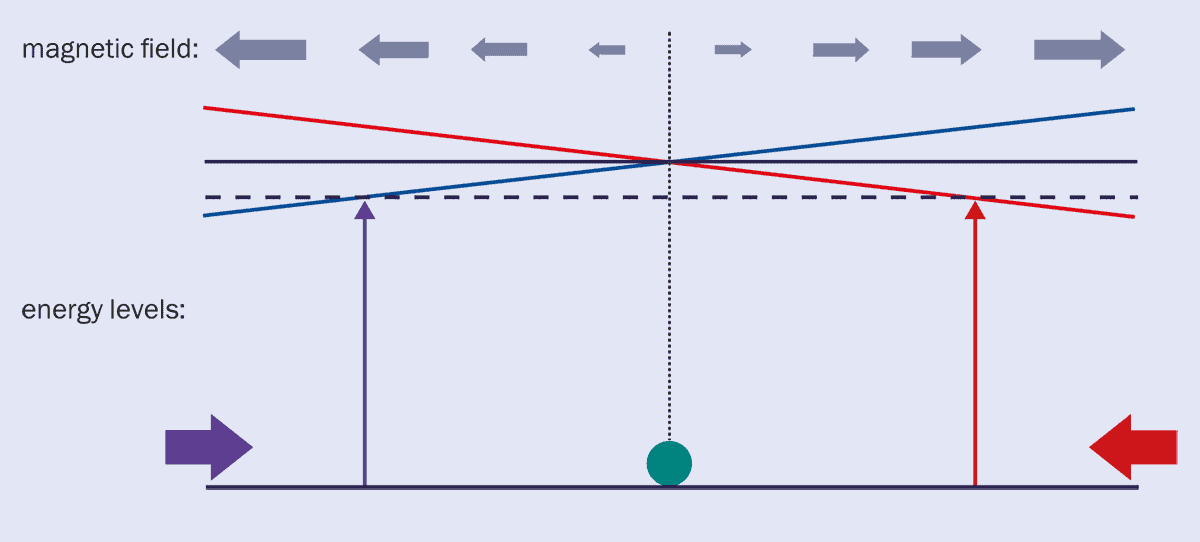
In his theoretical analysis, Dalibard combined these sublevels with a magnetic field that is zero at some point and increases as atoms move outward. In doing so, he created a situation where the effective laser frequency detuning depended on the atoms’ position. (Phillips and colleagues used a similar configuration for their magnetic trap, but at a much higher field.) Atoms could therefore absorb from a particular laser only at the specific position where the combination of detuning, Doppler shift, and Zeeman shift were just right (figure 3).
3 Magneto-optical trap
(Copyright: Chad Orzel/IOP Publishing)
Atoms are illuminated by a pair of red-detuned lasers with opposite polarizations, in a magnetic field that increases moving out from the centre. The sublevels of the excited state shift in opposite directions due to the field, and atoms absorb light only at the position where the combination of detuning, Zeeman shift, and Doppler shift are just right, pushing them back to the centre.
Dalibard hoped that restricting the atoms’ ability to absorb light in this way might lower their minimum temperature. After he calculated that it wouldn’t, he filed the idea away. “I saw it was a trap, but I was not looking for a trap, I was looking for sub-Doppler cooling,” he explains.
That might have been where it ended if it hadn’t been for Dave Pritchard, a physicist at the Massachusetts Institute of Technology who visited the Paris group in 1986. During the visit, Pritchard gave a talk on ideas for producing larger-volume traps, and finished up by saying he would welcome other – better – suggestions.
“I went to Dave, and I said ‘Well, I have an idea, and I’m not too sure it is better, but it is different than yours,’” Dalibard recalls. Pritchard took Dalibard’s idea back to the US, and in 1987 he and Chu built the first magneto-optical trap (MOT) based on Dalibard’s analysis. Dalibard was offered co-authorship of the resulting paper but was happy simply being recognized in the acknowledgements.
It is hard to overstate how revolutionary the MOT was for the development of laser cooling. It’s a relatively simple device, requiring only a single laser frequency and a relatively weak magnetic field to produce strong traps. Best of all, though, is its capacity. Chu and Ashkin’s first all-optical trap held hundreds of atoms, Phillips’s first magnetic trap several thousand, but the first magneto-optical trap held ten million atoms. Together with the introduction of cheap diode lasers by Carl Wieman at the University of Colorado (about which more in part 3 of this series), the advent of the MOT triggered a rapid explosion in the number of groups studying laser cooling worldwide. The pace of research was about to accelerate.
Murphy’s law takes a holiday
While Pritchard and Chu were building the first MOT, Phillips and his Gaithersburg colleagues were encountering an extremely unusual problem with their optical molasses. Contrary to every expectation of experimental physics, the molasses worked too well. In fact, it could cool atoms even with some of its beams partially blocked.
This discovery came about in part because laser cooling was supposed to be Phillips’ side project, so his lab was set up in a prep room connected to a machine shop. To prevent shop dust and grease from accumulating on the lab’s vacuum system, members of the group would cover the system’s windows with plastic or filter paper at night. “Occasionally you would get this really distorted looking molasses,” recalls Paul Lett, who joined the group in 1986, “and then you’d realize that, oh, we didn’t take that piece of filter paper out. It was remarkable that it worked at all.”
This surprising persistence led Lett to push for a more systematic study, including a new set of temperature measurements. The “release-and-recapture” method developed by the Bell Labs group had relatively large uncertainties, so Phillips’ group tried a new method that involved detecting the light emitted as atoms crossed a probe beam placed near the molasses. When the molasses was turned off, the atoms would fly away. The time they took to reach the probe would give a direct measure of their velocity, and thus their temperature.
Like all laser cooling experiments, Phillips’ lab packed a lot of lenses and mirrors into a tiny space, and the most convenient place to put the probe turned out to be slightly above the molasses region. This should have worked fine for atoms travelling at their Doppler-limit speed, but when Lett tried the experiment, no atoms reached the probe. Eventually, he and his colleagues shifted the probe’s position to below the molasses, at which point they saw a beautiful signal. There was just one problem: the Doppler cooling limit was 240 microkelvin, but this “time-of-flight” measurement showed a temperature of 40 microkelvin.
Is it real? The experiment involving optical molasses worked even better than Hal Metcalf and Bill Phillips thought it would. (Courtesy: Kevin Rechin/NIST)
This result seems to violate Murphy’s law, the dictum that “anything that can go wrong, will”, so they weren’t willing to accept it immediately. They re-measured the temperature using several different techniques, including an improved release-and-recapture, but they kept getting the same result: the atoms were much colder than the theory said was possible.
Early in 1988 Phillips and company reached out to other groups in the close-knit community of laser coolers, asking them to check the temperatures in their own labs. Chu and Wieman quickly confirmed the surprising result: optical molasses not only worked to cool atoms, it worked better than theory said it would.
Climbing up a hill
The Paris group did not yet have an experimental programme, but Dalibard and Cohen-Tannoudji attacked the problem theoretically via the same real-world factor Dalibard used to develop the MOT: multiple internal atomic states. The ground state of sodium has five sublevels with the same energy, and the distribution of atoms among those states depends on the intensity and polarization of the light. This distribution process, called “optical pumping,” was central to the spectroscopic research taking place at the ENS in Paris under Cohen-Tannoudji, so his group was uniquely well-suited to exploring how these additional states could improve laser cooling.
The key feature turns out to be the polarization of the laser light, which in classical physics corresponds to the axis of the light’s oscillating electric field. The combination of six counter-propagating beams produces a complicated distribution of polarizations as the beams combine in different ways in different places within the optical molasses. The atoms are constantly being optically pumped into different configurations, extending the cooling process and allowing lower temperatures.
By the summer of 1988 Dalibard and Cohen-Tannoudji had devised an elegant model to explain sub-Doppler cooling. (Chu independently arrived at a similar result, which he recalls deriving on a train between two conferences in Europe.) They considered a simplified atom with only two ground state sublevels, traditionally labelled –½ and +½, illuminated by two laser beams propagating in opposite directions with opposite linear polarizations. This creates a pattern that alternates between two polarization states, labelled σ– and σ+.
An atom in a region of σ– polarization will be optically pumped into the –½ state, which experiences a large light shift that lowers its internal energy. As the atom moves toward the σ+ polarization region, the light shift decreases, and the atom must slow down to compensate, losing kinetic energy to compensate for the increase in internal energy, like a ball rolling up a hill. When it reaches the σ+ light, optical pumping will cause it to switch to the +½ state, which has a large light shift. The atom doesn’t get back the energy it lost climbing the “hill” out of the σ– region, though, so it’s moving slower as the process starts over: the light shift decreases as it moves toward the next σ– region, so it loses energy, then optically pumps to –½, and so on.
This process of losing energy by constantly climbing “hills” supplied a vivid name: Dalibard and Cohen-Tannoudji dubbed it Sisyphus cooling, after the king in Greek myth who was condemned to spend eternity pushing a boulder up a hill only to have the rock slip away and return to the bottom (figure 4). Atoms in optical molasses find themselves in a similar predicament, always climbing hills and losing energy only to have optical pumping return them to the bottom and force them to start over again.
4 Sisyphus cooling
(Copyright: Chad Orzel/IOP Publishing)
A moving atom in the –½ state sees a large light shift lowering its internal energy when bathed in light with sigma-minus polarization. As it moves towards a region containing sigma-plus polarized light (red area of the diagram), the light shift decreases and the atom slows down to make up for the change in energy. When it gets to the σ+ region, optical pumping moves it to the +½ state where its internal energy is low, but it is still moving slower. Then the process repeats: moving toward σ–, slowing down, optically pumping to –½, etc.
The rewards of Sisyphus
The theory behind Sisyphus cooling makes concrete predictions about minimum temperatures and how they depend on the laser detuning and magnetic field. These predictions were quickly confirmed in labs around the world. In autumn 1989 the Journal of the Optical Society of America B published a special issue on laser cooling containing experimental results from Phillips’ group at Gaithersburg, the Sisyphus theory from Paris, and a combined experimental and theoretical paper from Chu’s group, which had by then moved from Bell Labs to Stanford University in California. For most of the next decade, this special issue was regarded as the definitive source for students seeking to understand laser cooling, and Cohen-Tannoudji and Chu went on to share the 1997 Nobel Prize for Physics with Phillips.
Taken to its limit, the Sisyphus effect can cool atoms to the point where they no longer have enough energy to climb even a single “hill” and are instead confined to a tiny region of a single polarization. This confinement is as tight as it is for trapped ions, making the two branches of laser cooling nicely symmetric. By the early 1990s trapped ions and neutral atoms could both be cooled to a regime where their quantum natures become apparent: a single ion in a trap, or an atom in a “well” created in Sisyphus cooling, can only exist in certain discrete energy states. These discrete states were soon measured for both systems; today, they are an essential part of quantum computing with atoms and ions.
A further intriguing avenue of research concerned the wells themselves. These are formed when light beams interfere, and naturally occur in large arrays with a spacing of half the laser wavelength. The periodic nature of these so-called optical lattices mimics the microscopic structure of solid matter, with the atoms playing the role of electrons in a crystal lattice. This similarity makes trapped atoms a useful platform for exploring condensed-matter physics phenomena such as superconductivity.
To really explore superconductivity with cold atoms, though, the lattice must be loaded with atoms at a higher density and an even lower temperature than can be achieved with Sisyphus cooling. As we’ll see in part 3, getting there would require yet another new set of tools and techniques, and would open the possibility of creating not just analogues of known systems, but entirely new states of matter.
Step into the future of clean energy with our upcoming webinar, where we explore the immense potential of ambient energy harvesting materials. Imagine a world where clean power is harnessed from our surroundings, anytime and anywhere, unlocking the path to achieving net-zero emissions. Join a panel of world-leading experts as they discuss a roadmap to advance energy harvesting materials, which enable us to convert waste energy from various sources into electricity. You will journey into the fascinating realms of photovoltaic, thermoelectric, piezoelectric, triboelectric, and radiofrequency energy harvesting, gaining new perspectives on the road ahead for these technologies to propel us towards a more sustainable future. Don’t miss this opportunity to be part of a captivating webinar that envisions a cleaner, greener world powered by the potential of energy harvesting materials.
Left to right: Vincenzo Pecunia, Thomas M Brown, Emmanuel Defay, Zhong-Lin Wang, Mercouri Kanatzidis, Thomas Anthopoulos, Taofeeq Ibn-Mohammed
Vincenzo Pecunia is an associate professor and the head of the Sustainable Optoelectronics Research Group at Simon Fraser University (Canada). In 2009–2016, he earned his PhD in physics and was a postdoctoral researcher at the University of Cambridge (UK). His research covers printable semiconductors for optoelectronics and photovoltaics. A pioneer in lead-free-perovskite photovoltaics for self-powered printed electronics, his work features in top journals including Nature, Nature Electronics,Advanced Materials, andAdvanced Energy Materials. He is a Fellow of the Institute of Materials, Minerals and Mining (FIMMM) and a Senior Member of the Institute of Electrical and Electronics Engineers (SMIEEE). He is an editorial board member for JPhys Materials and executive editorial board member for Nano Futures.
Thomas M Brown investigated polymer OLEDs for his PhD at the Cavendish Laboratory, University of Cambridge. From 2001–2005 he developed OTFTs and E-Paper as senior engineer with Plastic Logic Ltd. In 2005 he was recipient of a ‘‘re-entry’’ fellowship, awarded by the Italian Ministry of University and Research and is associate professor at Tor Vergata University of Rome. Founder and director of the Centre for Hybrid and Organic Solar Energy, and associate editor of Solar Energy, his current research focuses on perovskite solar cells for light harvesting in indoor environments, on a variety of flexible substrates, and on bio-hybrid devices.
Emmanuel Defay is the head of the Nanotech Unit at Luxembourg Institute of Science and Technology (70 researchers) since 2021, and the head of the Ferroic Materials for Transducers group (25 researchers) since 2014. His research interests are about materials able to transform one form of energy in another one, and, more specifically, in those related to electrical energy, such as piezoelectric micro-pumps, haptic actuators, mechanical or thermal energy harvesters or more recently electrocaloric solid-state coolers. His research lies between materials science, engineering and thermodynamics, all of them being required to create innovation in bringing these materials into realistic applications.
Zhong-Lin Wang is the director of the Beijing Institute of Nanoenergy and Nanosystems and Regents’ Professor and Hightower Chair at Georgia Institute of Technology. Wang pioneered the nanogenerators field for distributed energy, self-powered sensors and large-scale blue energy. Wang has received the Nano Research award (2022), Celsius Lecture Laureate, Uppsala University, Sweden (2020); The Albert Einstein World Award of Science (2019); Diels-Planck lecture award (2019); ENI award in Energy Frontiers (2018); The James C. McGroddy Prize in New Materials from American Physical Society (2014); and MRS Medal from Materials Research Soc. (2011). Wang was elected as a foreign member of the Chinese Academy of Sciences in 2009, member of European Academy of Sciences in 2002, academician of Academia of Sinica 2018, International fellow of Canadian Academy of Engineering 2019. Wang is the founding editor and chief editor of the international journal Nano Energy.
Mercouri Kanatzidis is a distinguished scientist and educator with a prolific career spanning over three decades. He is a professor of chemistry at Northwestern University. Mercouri has made ground-breaking discoveries and developed materials that have been instrumental in advancing alternative energy technologies. His work has focused on improving thermoelectric materials for waste heat recovery. With his team, he has developed the first solid-state solar cell device using a film of tin iodide perovskite. He has also mentored over 90 PhD students and nearly 120 postdoctoral fellows, helping to shape the next generation of scientists and engineers.
Thomas Anthopoulos is a professor of material science at King Abdullah University of Science and Technology (KAUST) in Saudi Arabia. He received his B.Eng. and D.Phil. degrees from Staffordshire University (UK). He then spent two years working on organic LEDs at the University of St. Andrews (UK) before joining Philips Research Laboratories (The Netherlands) to focus on soft electronics. From 2006 to 2017, he held faculty positions at Imperial College London (UK), first as an EPSRC advanced fellow and later as a professor of physics. His research interests include novel processing paradigms and the study and application of functional materials.
Taofeeq Ibn-Mohammed is enthusiastic about sustainability because it naturally unearths new discovery, innovation, and opportunities. He is an assistant professor of sustainable industrial ecosystems at WMG, University of Warwick. Before Warwick, he was a senior research fellow at the University of Sheffield and a visiting research scholar at the Materials Research Institute, Pennsylvania State University, USA. Taofeeq holds B.Eng., MSc, and PhD degrees in electrical/electronic, control systems, and energy systems engineering respectively. His research explores how interdisciplinary approaches from the fields of industrial ecology, sustainable systems engineering, and data science can be integrated to balance environmental, economic, and societal needs towards a sustainable future.
The School of Sustainable Energy Engineering (SEE) sits within Simon Fraser University’s Faculty of Applied Sciences. Its research and academic domain involves the development of solutions for the harvesting, storage, transmission and use of energy, with careful consideration of economic, environmental, societal and cultural implications.
About this journal
JPhys Materials is a new open access journal highlighting the most significant and exciting advances in materials science.
Editor-in-chief: Stephan Roche, ICREA professor at the Catalan Institute of Nanosciences and Nanotechnology (ICN2) and the Barcelona Institute of Science and Technology.
The ability to merge electronics and optical sensors with the human body at the single-cell level could one day enable remote monitoring and control of individual cells in real time. Advances in electronics fabrication have made it possible to create transistors and sensors with nanoscale resolution, while innovative nanopatterning techniques enable assembly of these devices on flexible substrates. Such processes, however, generally require harsh chemicals, high temperatures or vacuum techniques that are unsuitable for living cells and tissues.
To overcome these obstacles, a research team at Johns Hopkins University has developed a non-toxic, high-resolution and cost-effective process for printing gold nanopatterns onto living tissue and cells. Reporting their findings in Nano Letters, they demonstrate that the new technique can “tattoo” living cells and tissues with flexible arrays of gold nanodots and nanowires. Ultimately, the method could be used to integrate smart devices with living tissue for applications such as bionics and biosensing.
“If we had technologies to track the health of isolated cells, we could maybe diagnose and treat diseases much earlier and not wait until the entire organ is damaged,” explains team leader David Gracias in a press statement. “We’re talking about putting something like an electronic tattoo on a living object tens of times smaller than the head of a pin. It’s the first step towards attaching sensors and electronics on live cells.”
Gracias, Luo Gu and colleagues have designed a three-stage nanotransfer printing process to bond gold nanopatterns to live cells. In the first step, they used conventional nanoimprint lithography (NIL) to print arrays of gold nanodots or nanowires onto polymer-coated silicon wafers. They then dissolved the polymer, freeing the nanoarrays for transfer onto glass coverslips.
Next, the researchers functionalized the gold surface with cysteamine and coated the gold NIL-arrays with an alginate hydrogel transfer layer. They showed that this approach could reliably transfer 8 × 8 mm arrays of nanodots and nanowires from the glass onto the soft and flexible hydrogels. In the final step, the gold NIL-arrays are conjugated with gelatin to enable their transfer onto living cells or tissue. Dissociating the hydrogel transfer layer then exposes the gold pattern.
The researchers investigated the behaviour of live fibroblast cells seeded onto arrays of 250 nm-diameter gold dots (550 nm centre-to-centre spacing) or 300 nm-wide gold wires (450 nm spacing) on alginate hydrogels. Around 24 h after seeding, cells on the nanowire-printed hydrogel preferably migrated parallel to the nanowires, whereas those on the nanodots exhibited random, but slightly faster, migration. Cells on the nanowires also exhibited roughly twice the elongation of those on the nanodots. These findings demonstrate the ability of the gold NIL-arrays to guide cell orientation and migration.
Biocompatible process Gold nanowire array printed on a rat brain. (Courtesy: Kam Sang Kwok and Soo Jin Choi, Gracias Lab/Johns Hopkins University)
As well as being biocompatible with cells and tissues, alginate hydrogel can also transfer gold NIL-arrays onto living organs and cells. To demonstrate this, the researchers positioned nanowire-printed hydrogels on the cerebral cortex of a whole brain and a coronal brain slice.
After 2 h in culture media and dissociation of the hydrogel, the nanowires remained bonded to the surface of the whole brain. In contrast, nanowires on the brain slice did not adhere, suggesting that adhesion strength varies among different cell types and culture methods. The researchers note that further studies are needed to characterize and optimize adhesion mechanisms for robust long-term bonding.
Finally, to assess biotransfer printing at the single-cell level, the researchers cultured monolayer cell sheets on gold NIL-array-printed alginate hydrogels. After 24 h, they flipped over the fibroblast-seeded hydrogels onto gelatin-coated coverslips and let the cells attach to the coverslips overnight.
After dissociating the alginate hydrogel, fluorescence microscopy revealed that fibroblasts patterned with gold nanodots had a viability of approximately 97%, while those patterned with nanowires had a viability of approximately 98%, indicating that the printing process is biocompatible with live cells. Reflective colours seen on the patterned fibroblast cell sheet suggest that the shape of the gold NIL-array was retained.
The fabrication process is also compatible with microscale photolithography, which enabled the researchers to create 200 µm wide hexagonal and triangular patches of gold NIL-arrays. They then biotransfer printed these onto cell sheets, leading to selective growth of fibroblast cells on the micropatches. Movies recorded over 16 h showed that cells with patches of nanowires printed on top appeared healthy and able to migrate, with the arrays remaining on the soft cells even while they moved.
“We’ve shown we can attach complex nanopatterns to living cells, while ensuring that the cell doesn’t die,” says Gracias. “It’s a very important result that the cells can live and move with the tattoos because there’s often a significant incompatibility between living cells and the methods engineers use to fabricate electronics.”
Gracias and colleagues conclude that their nanopatterning process, combined with standard microfabrication techniques, “opens up opportunities for the development of new cell culture substrates, biohybrid materials, bionic devices and biosensors”. Next, they plan to try to attach more complex nanocircuits that can stay in place for longer periods, as well as experimenting with different types of cells.
For nearly seven decades, a plasmon known as Pines’ demon has remained a purely hypothetical feature of solid-state systems. Massless, neutral and unable to interact with light, this unusual quasiparticle is reckoned to play a key role in certain superconductors and semimetals. Now scientists in the US and Japan say they have finally detected it while using specialized electron spectroscopy to study the material strontium ruthenate.
Plasmons were proposed by the physicists David Pines and David Bohm in 1952 as quanta of collective electron density fluctuations in a plasma. They are analogous to phonons, which are quanta of sound, but unlike phonons their frequency does not tend to zero when they have no momentum. That’s because finite energy is needed to overcome the Coulomb attraction between electrons and ions in a plasma in order to get oscillations going, which entails a finite oscillation frequency (at zero momentum).
Today, plasmons are routinely studied in metals and semiconductors, which have conduction electrons that behave like a plasma. Plasmons, phonons and other quantized fluctuations are called quasiparticles because they share properties with fundamental particles such as photons.
In 1956 Pines hypothesized the existence of a plasmon which, like sound, would require no initial burst of energy. He dubbed the new quasiparticle a demon in honour of James Clerk Maxwell’s famous thermodynamic demon. Pines’ demon forms when electrons in different bands of a metal move out of phase with one another such that they keep the overall charge static. In effect, a demon is the collective motion of neutral quasiparticles whose charge is screened by electrons from another band.
Experimental challenges
However, this long-standing prediction has been hard to confirm experimentally. With the two electron currents out of phase with one another, they cancel out and eliminate long-range Coulomb interactions. That precludes any signature from the demon in the metal’s dielectric properties, meaning that the quasiparticle does not interact with light.
Now, Peter Abbamonte of the University of Illinois Urbana-Champaign (UIUC) in the US, and colleagues have demonstrated how this difficulty can be overcome using a non-standard technique to study the metal strontium ruthenate. As they explain in a press release, they made their finding serendipitously. Rather than setting out to find Pines’ demon, they were instead exploring strontium ruthenate’s electronic properties in order to use the material as a kind of surrogate for high-temperature superconductors – which have similar properties.
The technique they used is known as electron energy-loss spectroscopy. This involves firing a beam of electrons with a well-known, narrow range of energies and recording how much energy is lost at which momenta after the electrons pass through a target material. The technique is well-suited to studying plasmons because electrons are very sensitive to fluctuations in charge density.
Using millimetre-sized single crystals of strontium ruthenate grown by Yoshiteru Maeno and co-workers at Kyoto University in Japan, the researchers recorded quite different spectra using low- and high-energy electrons. In the latter case they found energy loss peaking at around 1.2 eV, which they identify as an interaction with a typical (charged) plasmon. On the other hand, at lower energies they observed an oscillation with a tiny energy gap – less than 8 meV – at zero momentum.
Curious acoustic mode
This second feature, they say, is an acoustic mode with a velocity about 100 times that of sound, which is far too high to be associated with phonons. At the same time, however, the velocity of the mode is about three orders of magnitude lower than that of a surface plasmon. However, the figure is within 10% of that predicted by UIUC theorist Edwin Huang for a quasiparticle made up of two electron bands in strontium ruthenate oscillating out of phase with one another – a Pines’ demon.
To make sure they really had found the demon, the researchers checked its neutrality by examining how its intensity varied with momentum — seen as variations in the electron scattering angle. They worked out that the intensity of a conventional plasmon should vary inversely with momentum raised to the power five. They say that the intensity of neutral plasmon should also vary inversely with momentum, but with a smaller power. That is what they found – establishing that the new quasiparticle was characterized by an inverse power of just 1.83.
“We conclude that this acoustic mode is Pines’ demon, predicted in 1956 but not observed in a 3D material until now,” they write in their paper announcing the result, which is published in Nature.
They argue that the demon could be better understood by carrying out additional experiments with a scanning transmission electron microscope and also by developing a hydrodynamic theory of the quasiparticle. But Abbamonte adds that such studies need not be limited to strontium ruthenate, explaining that the demon ought to be present in other metals with sufficiently different electron bands – including some superconductors, such as magnesium diboride or those based on iron. “It shouldn’t be a rare or esoteric effect,” he says.
Energy accounts for more than three-quarters of our greenhouse gas emissions globally each year. That’s not surprising, given the role of energy in almost every aspect of modern life. To stand any chance of hitting net zero climate targets, we need to accelerate the transition to greener forms of energy generation.
In this episode of the Physics World Stories podcast, Andrew Glester explores two novel forms of renewable-energy generation, both with the potential to scale and not suffer from issues of intermittency.
First up, Nicol Caplin speaks about SOLARIS, an ambitious ESA project investigating the feasibility of sending a fleet of solar cells into space. In principle, the robot-assembled technology could capture solar energy 24/7 and beam it back to Earth in the form of microwave radiation. ESA is currently calling on scientists to submit research activities related to space-based solar power, with a deadline of 25 September.
Next up, Danny Coles from the University of Plymouth, UK, speaks about the potential to upscale tidal stream energy generation. This is a way of harnessing kinetic energy from the movement of water in tidal currents – a predictable source of energy driven by lunar and solar cycles. Coles works on the Tidal Stream Industry Energiser Project (TIGER), designed to drive the growth of tidal-stream energy and bring down its costs.
Of course, introducing any large machinery into the marine environment brings potential risks for marine wildlife. Our final guest, Douglas Gillespie from St Andrews University in Scotland, describes how he is assessing the risks to cetaceans, including dolphins and porpoises. A physicist-turned-biologist, Gillespie and his team have recently been tracking the movement of marine mammals in the vicinity of tidal-energy infrastructure.
To learn more about the challenges associated with energy, take a look at IOP Publishing’s new open-access journal Environmental Research: Energy. You can also register for Environmental Research 2023, a series of free-to-attend online events, from 16 October to 23 November.
The Indian space agency, ISRO, successfully launched the country’s first mission to the Sun on Saturday. The Aditya-L1 mission took off from the Satish Dhawan Space Centre in Sriharikota in the state of Andhra Pradesh at 11:50 local time via a PSLV rocket.
Named after Surya — the Hindu god of the Sun who is also known as Aditya – the craft carries seven scientific instruments including spectrometers and particle analysers. It will use these to study solar activity, such as coronal mass ejections, and the effect the Sun can have on space weather on Earth.
”Congratulations to our scientists and engineers at [ISRO] for the successful launch of India’s first solar mission, Aditya -L1,” noted India prime minister Narendra Modi on Twitter. “Our tireless scientific efforts will continue in order to develop better understanding of the Universe for the welfare of entire humanity.”
The craft is now making its way to Lagrange point 1 – a point in space about 1.5 million kilometres from the Earth towards the Sun – where it is expected to arrive sometime early next year. It will then carry out a series of instrument calibrations before carrying out scientific observations.
Lunar progress
The launch of Aditya -L1 comes just weeks after India successfully landed its Chandrayaan-3 craft on the lunar south pole on 23 August. In doing so, the country became the fourth nation to achieve a soft-landing on the Moon following the US, the former Soviet Union and China.
Once the lander was safely on the surface and checks had been carried out, on August 25 it then released its Pragyan rover, which over the past two weeks has traversed over 100 meters studying lunar rocks and soils with its five instruments that include a laser and X-ray spectrometers.
The lunar rover and lander have now been parked and put into safe mode as that part of the Moon enters the lunar night. The lander and rover are set to be turned back on for 22 September to carry out further investigations.
An international team of researchers has shown that hybrid light–matter quasiparticles can enhance magneto-optical effects in layered crystals. This research has strong implications for the development of magneto-optic devices, such as sensors and imaging devices, which allow the direct determination and mapping of magnetic domains in materials. The research could also lead to the creation of high-speed switches and all-optically controlled magnetic memory devices.
The quasiparticles in this study were exciton–polaritons, which are hybrid light–matter states that can occur in an optical cavity where there is a sufficient interaction between the cavity photon mode and bound electron–hole pairs: excitons. Such a system is described as being “strongly coupled” and the polaritons possess characteristic properties of both light and matter. Due to their low effective mass and short lifetime (photonic properties) and their strong ability to interact (excitonic properties), polaritons are of great interest for an array of high-speed, low-loss technological applications, such as low-light sensors, logic devices and quantum communications.
There has also been significant focus on the development of magneto-optical devices, which allow light to be manipulated using applied magnetic fields. A comprehensive understanding of the interaction between excitons and magnetic fields is needed for creating such devices. To study these interactions, it is necessary to have a material with a strong magneto-optic response. Such a material had been difficult to find, but magnetic van der Waals (vdW) crystals have recently been shown to be very promising.
In this latest research, scientists at the City College of New York and the Advanced Science Research Centre of CUNY in the US in collaboration with an international team have shown that the presence of exciton–polaritons can further enhance the magneto-optical response in these materials. Their study is described in a paper in Nature.
Magnetically-controlled excitons
The vdW crystals used in this study were chromium sulphide bromide (CrSBr), which consists of quasi-2D layers of CrSBr held together by weak van der Waals forces. At low temperatures, the material is in an antiferromagnetic state in which the electron spins of adjacent layers are oppositely aligned. However, it is possible to switch the crystals into a ferromagnetic state (all spins are aligned) by applying a moderate magnetic field. While this transition often results in a magneto-optic effect that changes the polarization or intensity of the light (effects that most existing magneto-optic devices rely on), in CrSBr it is the exciton energy – and therefore the materials’ optical spectrum – that is altered.
In this study, Florian Dirnberger, Jiamin Quan and colleagues studied two types of CrSBr cavities. The first resembled a traditional optical cavity in which external, highly reflective mirrors were deposited on either side of a CrSBr crystal. The second relied on the strong dielectric contrast between the crystal and its environment to confine the cavity photon mode within, forming a “mirrorless” cavity. Due to the extremely large exciton oscillator strength of CrSBr crystals, strong coupling between the photon mode and the magnetic excitons – and therefore the presence of exciton–polaritons – was observed.
Boosting bandwidth
By applying an external magnetic field to the crystals, the researchers were able to reduce the angle between the oppositely aligned spins. This resulted in a decrease in exciton energy and switched the crystals from the antiferromagnetic to the ferromagnetic state. This energy change altered the relative exciton–photon fraction of the polaritons, shifting their energy levels and modifying the measured reflectivity spectrum.
In a weakly coupled CrSBr crystal, the magneto-optic response would only occur around the exciton energy. In this strongly coupled system, however, polariton states exist far below the band gap, giving a significantly increased bandwidth of the magneto-optical response.
The researchers also investigated the effect of magnons on the system. These are quantized oscillations in the angle between the oppositely aligned spins that also alter the exciton energy. Using ultrashort laser pulses to generate coherent magnons, they observed that the cavity reflectivity spectrum exhibited oscillations with a frequency matching that of coherent magnons in CrSBr. While this effect occurs in both cavities, it is greatly enhanced in the sample with external mirrors due to the reduced linewidth of the polaritons.
Coherence not always necessary
Surprisingly, the researchers also observed that incoherent magnons, which are generated thermally, can produce a pronounced magneto-optical response. Until this study, it was thought that coherence was necessary for such an effect. Using theoretical modelling, the researchers have now shown that, below a certain temperature, the temperature-dependence of the excitons in CrSBr is mainly affected by the population of incoherent magnons. This shows that optical spectroscopy of polaritons in such a system can be used as a new method for studying incoherent magnons in magnetic crystals.
In its study, the team has shown that by utilizing the modification of energy levels in a system due to exciton–polaritons, it is possible to enhance the strength and spectral bandwidth of magneto-optic responses in a magnetic vdW crystal. This demonstrated tunability of such responses is highly promising for the development and study of novel magneto-optic switches, sensors and more.
Dirnberger, who is first author of the Nature paper, explains, “Given the strong interactions of magnetism and light observed in our study, it is possible that one day magnetic lasers and all-optically controlled magnetic memory devices may revolutionize magneto-optic technology”.
Quiz question: how many kilometres of new superconducting cables are being made in California for the next generation of focussing magnets at the Large Hadron Collider (LHC) at CERN in Geneva?
If your answer is “more than 2220 km”, you are correct – according to Lauren Biron at the Lawrence Berkeley National Laboratory. That is where 111 cables are being made for the high-luminosity upgrade of the LHC. The upgrade is expected to be completed in 2029, when the magnets will be used to focus high-energy protons and nuclei to tiny collision points at the LHC’s huge detectors.
Each cable is made by twisting 40 individual strands of superconducting niobium–tin wire around a stainless-steel core. The wires cannot touch each other and Berkeley Lab’s Ian Pong, who is leading the effort, describes the process as a ballet. “We have 40 dancers – the wire spools – pirouetting in a circle through the run of about three hours, and our responsibility is to make sure that no single missed step happens during the entire performance,” muses Pong.
The cable making is just one part of the US’s contribution to the LHC upgrade. The Accelerator Upgrade Project (AUP) also includes Brookhaven National Laboratory, the National High Magnetic Field Laboratory at Florida State University, and Fermi National Accelerator Laboratory.
After leaving Berkeley, the cables are wound into coils and heat-treated at Brookhaven Lab and Fermilab. The coils are then sent back to Berkeley, where four coils are assembled into quadrupole magnets.
Motion capture technology
Staying in the US, researchers at the University of Kansas and colleagues have used motion capture technology to study why some basketball players are better than others at taking free throws. If you are not familiar with the game, a free throw is taken unopposed at a distance of 4.6 m from the basket. The team defined a proficient shooter as someone who was on target 70% or more of the time and the study involve 34 men – each of who had at least four years of basketball playing experience.
Each subject attempted 10 free throws and their motions were captured by nine high-speed, high-definition cameras. The images revealed that proficient shooters had more control over their body motion. Furthermore, success was associated with lower knee and centre of mass peaks and lower mean angular velocities when compared with nonproficient shooters. The researchers also found that proficient shooters released their basketballs at greater heights and had less forward trunk lean at the point of release.
“These findings imply that basketball shooting motion is not as simple as some may think. Shooting efficiency can’t be simply attributed to one biomechanical variable. It is founded on a mix of multiple segmental body movements performed in a controlled manner,” explains Dimitrije Cabarkapa, who is associate director of the Jayhawk Athletic Performance Laboratory at the University of Kansas.
Physicists at Stevens Institute of Technology in New Jersey, US have found a new and surprising link between the wave properties of light and the mechanical properties of point masses. Their finding bridges the gap between classical mechanics and the optics of coherent waves via theories put forward 350 years ago by the Dutch mathematical physicist Christiaan Huygens.
Huygens’s biggest discoveries came in the two most prominent fields of 17th-century physics: optics and mechanics. Among other advances, he was the first to propose (in the 1670s) a wave description of light that accounts for optical propagation as well as important phenomena such as interference, diffraction and polarization that were observed later. He also worked on the mechanical concepts of centre of mass and moment of inertia, which are the two fundamental properties that describe how rigid bodies move.
Xiao-Feng Qian and Misagh Izadi of the Stevens Institute of Technology’s Center for Quantum Science and Engineering and the Department of Physics have now discovered a hitherto unexpected connection between these different parts of Huygens’ work. They did this by analysing two optical coherence properties: polarization, or the direction in which waves oscillate, and entanglement, which in a non-quantum context can be thought of as a unique form of wave correlation. They showed that these two properties are quantitatively related to centre of mass and moment of inertia through the so-called Huygens-Steiner theorem for rigid body rotation.
Parallel axes
Also known as the parallel axis theorem, the Huygens-Steiner theorem states that in a rigid body, the moment of inertia around any axis is always greater than or equal to the moment of inertia around a parallel axis passing through the centre of mass. It also states that the difference between these two moments of inertia is directly proportional to the perpendicular distance between the two axes.
In their study, which is described in Physical Review Research, Qian and Izadi used a geometric mapping procedure to convert light wave intensities into mechanical point masses. By interpreting the intensity of a light wave as the equivalent of a physical object’s mass, they were able to map these intensities onto a coordinate system that could be interpreted using the Huygens-Steiner mechanical theorem.
“The Huygens-Steiner theorem establishes a quantitative relationship between moments of inertia and the distance between the parallel axes,” Qian explains. “We have established a quantitative connection of the axes’ distance with optical concepts of entanglement and polarization coherence. The theorem thus serves as a bridge to connect moments of inertia to optical entanglement and polarization.”
A surprising connection
That such a connection should exist is surprising, Qian adds: “A wave is a physical system that spreads out (it doesn’t have a specified location) and a particle (which can be considered as a rigid object) can be localized at a point. Wave optics and particle mechanics are two completely different physics phenomena so the quantitative relation we have established is unexpected.”
Although the connection hadn’t been shown before, it becomes very clear once you map the properties of light onto a mechanical system, he says. “What was once abstract becomes concrete: using mechanical equations, you can literally measure the distance between centre of mass and other mechanical points to show how different properties of light relate to one another.”
While the work is theoretical, Qian and Izadi expect that the quantitative relation they discovered could help develop procedures in which mechanical masses could simulate the behaviour of light wave entanglement. “Measuring entanglement (and polarization) typically requires complex and costly techniques,” Qian explains. “Simulating them by measuring the mechanical centre of mass and moment of inertia will be much easier and economical.
“We’ve known for over a century that light sometimes behaves like a wave, and sometimes like a particle, but reconciling those two frameworks has proven extremely difficult,” he adds. “Our work doesn’t solve that problem – but it does show that there are profound connections between wave and particle concepts not just at the quantum level, but at the level of classical light-waves and point-mass systems.”
The Stevens team is now investigating the quantitative connections between quantum entanglement and classical mechanical point mass systems. “We have already obtained some key results and expect some further unexpected results in the future,” Qian tells Physics World.