Tributes have poured into the University of North Carolina (UNC), Chapel Hill following the shooting death of Zijie Yan, who was a nanoscientist and associate professor in the university’s Department of Applied Physical Sciences. PhD student Tailei Qi, a member of Yan’s group, has been charged with first-degree murder and possession of a firearm on educational property in connection with the incident on 28 August.
The shooting occurred in the early afternoon and the university was locked down for several hours as a result. In the aftermath, UNC quickly went into grief mode. The campus community took a moment of silence two days after the shooting, when bells in the university’s campanile were rung in Yan’s memory. Later that day, thousands of students and staffers attended a candlelight vigil in Yan’s honour.
“Friend to many”
Yan “was a beloved colleague, mentor, and friend to many on our campus” said UNC chancellor Kevin Guskiewicz. The chair of Yan’s department, Theo Dingemans, added, “He was a great asset to the department and to the university. He was very kind and soft-spoken but also a great listener with a wonderful sense of humour.” He said in a statement “Zijie was not only a great colleague, but he was also an outstanding professor, researcher, and mentor. With his research programme, he was pushing the boundaries of nanoscience, as evidenced by the numerous papers he had published in scientific journals. Zijie would’ve wanted us to move forward in educating students and conducting research that would change the world, and we will honour his legacy by doing just that.”
Yan held a PhD in materials engineering from Rensselaer Polytechnic Institute and was an assistant professor at Clarkson University before joining UNC in 2019. His research has the goal of “transcending the boundary between photonics and materials science, by developing techniques to control light–matter interaction”. His group’s research involves the use of holographic optical tweezers to manipulate nanoparticles using shaped laser beams. It has implications for the use of nanoparticles on and within cells, for such applications as intracellular sensing, targeted drug delivery and gene therapy.
Qi, the PhD student charged with Yan’s murder, joined Yan’s group last year. He has a BSc in physics from Wuhan University and an MSc in materials science from Louisiana State University. According to his LinkedIn profile, he “works on the optically trapped nanoparticle arrays and all kinds of their related fascinating phenomena”. He recently wrote a paper on optical binding of metal nanoparticles with Yan in Advanced Optical Materials. No reason for the shooting has emerged. However, Qi had complained on X (formerly Twitter) about bullying and the behaviour of unnamed persons.
Optical coherence tomography (OCT) has emerged as a powerful diagnostic tool for capturing 2D and 3D morphological images at micron-scale resolution within biological tissue. The story so far is one of initial clinical acceptance – think game-changing applications of OCT in ophthalmology and retinal imaging – providing the platform for new streams of applied research, technology innovation and clinical translation across specialisms as diverse as dermatology, cardiology and oncology (for early-stage detection of cancerous lesions).
In terms of the fundamentals, OCT exploits the coherence of light backscattered from the sample microstructure, with interference effects allowing accurate determination of the spatial origin of the retrieved signals. There’s just one snag: the resolving capacity at depth. While cutting-edge OCT systems use near-infrared light to counter this problem, the inherent opacity and turbidity of biological tissue mean it’s often impossible to retrieve discernible optical signals (above the noise level) from depths beyond approximately 1 mm.
What consensus?
Meanwhile, the conventional wisdom among optical scientists is that the OCT signal is dominated by ballistically scattered light (light that has undergone a single backscattering event), whereas multiply scattered light and diffuse light are detrimental to image formation. Not so, argues a consensus-busting study published in Science Advances, in which researchers present an alternative viewpoint that selective collection of multiply scattered light can yield enhanced OCT image contrast at depth – and, in particular, for highly scattering samples.
“We have come up with a completely new way of doing OCT,” explains Peter Andersen, group leader in biophotonic imaging at DTU Health Tech, the department of health technology at the Technical University of Denmark (DTU) in Kongens Lyngby, north of Copenhagen. The approach, dubbed spatially offset OCT (SO-OCT), decouples the incident and collecting light paths, such that it’s possible to tune between the ballistically scattered and multiply scattered light components, respectively.
“It’s worth noting as well that our initial experiments are supported by wave-based modelling of the SO-OCT system,” adds Andersen, “and confirm that we can enhance contrast at depth by using multiply scattered light exclusively.”
The clinical imperative here is self-evident, with delineation at depth a key parameter in the staging of cancerous lesions – and, in turn, figuring out the appropriate course of treatment. “When the imaging contrast at depth is improved, it means the delineation of different tissues is similarly enhanced,” notes Andersen. “With SO-OCT, we have demonstrated that we can better identify tissue borders and the changing thickness of tissue layers at depth and, by extension, link all this back to the detection of disease.”
It’s all about translation
What’s more, clinical translation is already on the agenda for Andersen and colleagues. The current SO-OCT demonstrator, for example, is built as an add-on to a standard commercial instrument, while work is underway to integrate the laboratory set-up with fibre-optic probes, a precursor to endoscopy studies where the increased imaging depth will come into its own.
“There is huge potential for SO-OCT technology to complement conventional OCT endoscopy applications and we aim to take the next steps as soon as possible,” concludes Andersen.
The research on SO-OCT is part of an ongoing collaboration between Andersen’s team at DTU Health Tech and Kishan Dholakia and colleagues at the University of Adelaide, Australia, and the University of St Andrews, Scotland – all working under the auspices of the European Union PROSCOPE project, which is exploiting innovative fibre-optic technologies in tandem with endoscopic delivery to diagnose colorectal cancer in its earliest stages.
Today, it can seem that we are adrift in a swirling sea of claims and counterclaims designed to prod and provoke. So, how can a person make sense of this barrage of information? According to the this week’s guest, a good grasp of some fundamental mathematical principles can make a huge difference when it comes to understanding the world around us.
In this episode of the Physics World Weekly podcast, the mathematical biologist and author Kit Yates is in conversation with the science and technology journalist Anna Demming. As well as talking about the mathematics of daily life, they chat about Yates’ contributions to the public understanding of the COVID-19 pandemic and his latest book – which Demming has reviewed for Physics World.
Artificially dimming the Sun by injecting aerosols into Earth’s atmosphere may help to delay a significant consequence of climate change in Antarctica, but not stop it — researchers in Switzerland and the UK have revealed. Through new simulations, a team led by Johannes Sutter at the University of Bern has showed that the collapse of the West Antarctic Ice Sheet (WAIS) can only be avoided if we eliminate global emissions of greenhouse gases as quickly as possible.
Climate scientists have been warning that global efforts to end our reliance on fossil fuels are not happening fast enough to avoid dangerous consequences for Earth’s climate in the coming centuries. Indeed, some scientists argue that the situation is so urgent that we should investigate geoengineering schemes for cooling the Earth.
“The window of opportunity to limit the global temperature increase to below two degrees is closing fast, so it is possible that technical measures to influence the climate will be seriously considered in the future,” says Sutter.
Reflecting sunlight
One potential type of geoengineering is solar radiation management (SRM). This would involve injecting aerosols into the stratosphere where it would reflect some incoming solar radiation back into space.
At first glance, SRM might appear to be a quick and easy fix. In particular, it could help us avoid reaching dangerous tipping points where feedback mechanisms such as the melting of polar ice would accelerate warming — and would be virtually impossible to reverse. However, many climate scientists predict that SRM would only have a limited success, and it could have dangerous consequences both environmental and political.
In their study, Sutter’s team investigated the potential for SRM to avoid one especially concerning tipping point: the collapse of the WAIS. Containing some 10% of all the ice covering Antarctica, some researchers estimate a collapse of the WAIS could trigger a sea level rise of 3–4 m if it melted entirely over the next few centuries.
Nearing a tipping point
As Sutter explains, “observations of ice flows in West Antarctica indicate that we are very close to this tipping point, and may have already passed it. With our study, we wanted to find out whether a collapse of the ice sheet could be prevented with SRM.”
To answer this question, the team combined ice sheet models with climate simulations. Up until the year 3000, they modelled the cooling effects of SRM in response to different emissions scenarios – ranging from an immediate, coordinated effort to eliminate greenhouse gas emissions globally, to a scenario where our emissions continue to rise unabated.
Our simulations show that the most effective way to prevent long-term collapse of the West Antarctic Ice Sheet is rapid decarbonization
Johannes Sutter
Their calculations revealed that if large-scale SRM is first deployed by the middle of this century, the WAIS collapse could be delayed by between 20–60 years under different emissions scenarios – but not avoided altogether. “Our simulations show that the most effective way to prevent long-term collapse of the West Antarctic Ice Sheet is rapid decarbonization,” says Sutter.
What is more, such a radical alteration to the atmosphere’s composition would come with substantial risks, and the possibility of unintended side effects. For example, SMR would only be successful if global-scale aerosol injection were maintained for centuries, until concentrations of greenhouse gases return to safe levels. If this stopped for any reason, global temperatures would rise sharply.
Altogether, the team’s results provide a robust case against the use of SRM to avoid tipping points like the WAIS collapse, and further emphasise the urgent need to eliminate global carbon emissions as quickly as possible.
“SRM would be another global experiment and a potentially dangerous human intervention in the climate system,” says Thomas Stocker, Sutter’s colleague at the University of Bern. “In any case, it should be prevented according to the UN Framework Convention on Climate Change.”
Stretchy ferroelectrics: a) A new ferroelectric material combines elasticity with relatively high crystallinity. b) The unstrained material. c) The elastic ferroelectric under 70% strain. (Courtesy: NIMTE)
Although polymers are usually flexible, polymer-based ferroelectric materials tend to be rigid. Adding a small amount of crosslinking material can change that, however, and researchers at China’s Ningbo Institute of Materials Technology and Engineering (NIMTE) say that their new “elastic ferroelectrics” are resilient and flexible enough for use in wearable electronics and implantable medical devices.
Ferroelectricity is a material’s ability to change its electrical properties in response to an applied electric field. It was discovered just over a century ago in certain naturally-occurring crystals and is now exploited in a wide range of technologies, including digital information storage, sensing, optoelectronics and neuromorphic computing.
Conventional ferroelectrics can be made from either ceramics or polymers, but even polymer-based ferroelectrics are not very elastic. This is because they contain crystalline regions that are rigid.
Crosslinked polymer network
Researchers led by Run-Wei Li have now solved this problem by adding a cross-linking chemical, soft-long-chain polyethylene oxide, to the ferroelectric polymer poly(vinylidene fluoride-trifluoroethylene).
“Crosslinking is a general way to endow resilience to plastic polymers in which the crosslinking density range is 1-10% (that is, one to ten repeat units crosslinked in each one hundred repeat units in polymer chains),” explains study team member Ben-Lin Hu.
At the higher end of this range, however, Hu adds that the crystallinity of the mixture decreases dramatically, weakening the material’s ferroelectric response. The crosslinking density needed to make elastic ferroelectrics is therefore much lower, leading the researchers to call it “slight crosslinking”.
When the NIMTE researchers limited the density of the crosslinker to just 1-2%, they found that a beta-phase crystalline structure was uniformly dispersed in the crosslinked polymer network. This new crosslinked polymer network can evenly distribute and bear external forces, say the researchers, mitigating damage to the crystalline regions and creating a new ferroelectric material that combines elasticity with relatively high crystallinity. Indeed, the cross-linked film retains its ferroelectricity even under strains of 70% thanks to its improved elasticity.
The new elastic ferroelectric could be used in wearable/implantable electronics, such as sensors and smart healthcare, as well as in information storage and energy transduction, Hu says. Elastic ferroelectrics also have some exotic properties that might be useful for structures such as elastomers with a giant (>1000) dielectric constant, spin valves with a large magnetoelectric coupling effect and dielectric capacitors that have energy densities on a par with lithium-ion batteries, but with charging and discharging times on the order of just microseconds.
The researchers say they now plan to optimize the properties of their elastic ferroelectrics and will focus mainly on materials with high dielectric and high piezoelectric constants. “These could be used in energy storage and transduction and information sensing and memory,” Hu tells Physics World.
Dens Milne, who was a vital part of the Physics World team for more than 25 years, died unexpectedly after a short illness on 16 July 2023 aged 56. A wonderful colleague, Dens served for two decades as the magazine’s production editor, where she interacted with countless readers and authors. For the last seven years, she was lead product and content manager, helping to rebuild the Physics World website, spearheading Physics World Jobs, and – most recently – overseeing the creation of a new digital version of the magazine.
Born on 31 May 1967, Dens grew up in Fife, Scotland, and gained a degree in applied physics from Robert Gordon University in Aberdeen. She joined IOP Publishing straight out of university in 1990, serving initially in the journals-production department, helping to publish scientific research papers. Dens also worked on the production of the major, three-volume reference book Twentieth Century Physics, whose editors included the eminent condensed-matter physicist Brian Pippard.
It wasn’t until 1996 that I got to know Dens when she joined IOP Publishing’s magazines department as production editor on Physics World. I was to work closely alongside Dens during her entire time in that role, which saw her responsible for everything from copy-checking, creating layouts and correcting proofs to handling photos, graphics and multimedia – not to mention liaising with printers and suppliers. It was a role that played to her strengths: Dens was efficient, hard-working, conscientious and thorough, as well as being questioning, detailed, demanding and accurate.
Dens was always completely no-nonsense, never afraid to point out woolly thinking, often with a withering one-liner delivered in her trademark Scottish burr. New editors to the team would dread being summoned for “a chat” about their first article, with Dens brandishing a print-out covered liberally in red ink as typos, waffle and errors were circled and pointed out. Inevitably, though, the baptism of fire was appreciated by staff members who quickly realized that accuracy and rigour are the bedrock for any publication’s trustworthiness with readers. For Dens, getting the thousands of little things right mattered because if you do them properly, then the whole publication can be trusted and believed.
It’s rare these days for anyone to work for a single employer over their entire career, as Dens did. But IOP Publishing, which is a learned-society publisher, suited Dens to the core. She loved ensuring everything was done as efficiently as possible to help the company make money. But equally she knew that IOP Publishing’s profits, 100% of which are gift-aided to the Institute of Physics, help to support the physics community. Work, for Dens, wasn’t about chasing money for the sake of it – it was for the wider good.
As a colleague, Dens was enormously good fun to work with, relishing evenings out or trips away – preferably involving cocktails or drinks. But Dens also had a great knack for spotting if a team-mate was upset or had a problem or if something was up – she had a kind of sixth sense and was always there to support, help, advise, console or just listen. And although she demanded high standards, Dens was a calming influence if a mistake did occasionally creep in. As she’d tell us with a phrase that now has a new poignancy: “Remember, no-one’s died.”
Dens had a great awareness of the wider publishing industry too, keeping an eye on the latest trends, attending media events and seeing what rivals and competitors were up to, which proved vital for her time as Physics World product manager. Only this year, Dens had worked on creating the new jobs board for the American Physical Society in partnership with Physics World. In June Dens travelled to the FIPP World Media Congress in Lisbon: we all expected her to come back buzzing with ideas, but her death was as sudden as it was unexpected.
Dens had a huge impact on IOP Publishing and I’m sure we’ve only realized how big that impact was now she’s gone. In recent weeks, I’ve found myself constantly wondering “What would Dens have said about this?” or “What would Dens’s advice be on that?” And I’m not quite sure how we’re going to replace her, if we ever can. Ewan, her husband, will of course be feeling her loss more than any of us ever can or will.
But I do know that the rules and the plans and the processes Dens put in place are still having a huge influence on how we do things at Physics World – and that they will do so for a long time to come.
When two sheets of graphene are placed on top of each other and slightly twisted, their atoms form a moiré pattern, or superlattice. At the so-called “magic” twist angle of 1.08°, something unusual happens: the weak van der Waals (vdW) coupling between atoms in adjacent layers modifies the atoms’ electronic states and transforms the material from a semimetal to a superconductor. The study of such twist-related electronic effects is known as “twistronics”, and it also includes phenomena such as correlated insulator states that appear at different degrees of misalignment.
Because the moiré pattern that underlies twistronics appears only at the interface between two thin sheets, it was assumed that twistronic effects could only occur in structures containing just a few layers. Although it is possible to produce a moiré pattern at a two-dimensional interface within a three-dimensional structure, it was thought that this pattern would not substantially modify the properties of the bulk material. After all, the 2D moiré region would only comprise a small fraction of the total 3D crystal volume.
New work by two research groups – one at the University of Washington in the US and Osaka University in Japan, the other at the University of Manchester in the UK – shows that this picture is not always correct. In fact, rotating a single layer of a 2D material by a small twist angle within a three-dimensional graphite film can cause the properties of the moiré interface to become inextricably mixed with those of the graphite. The result is a new class of hybrid 2D-3D moiré materials that substantially alters our understanding of how twistronics works.
A profound and exciting transformation
The usual method of making vdW materials begins with cutting a single monolayer in half. The two halves are then stacked on top of each other with a finely-controlled twist angle between them.
The Washington-Osaka researchers used a similar procedure, but with a different starting point. “We started with exfoliated (peeled off) flakes of bulk graphite (that is, 10 or more layers) that had a small area of monolayer graphene attached,” explains team leader Matthew Yankowitz, a physicist at Washington. “We then cut the graphene to separate it from the bulk graphite and stacked the two portions with a twist angle between them.”
To observe the effects of the resulting moiré pattern, the researchers cooled the twisted graphene-graphite structure down to cryogenic temperatures and measured its resistance as they applied a magnetic field. Even when this field was small or zero, they found that the modified electronic states on the moiré surface produced different electrical transport properties than those found in standard graphite.
“We can see this by doping charges into each surface using nearby gate electrodes,” Yankowitz says. Because graphite is a semimetal, it contains fewer charge carriers (electrons and holes) than a normal metal. Adding a substantial amount of charge to the moiré surface therefore gives this surface an outsize influence on the electronic behaviour of the bulk graphite. “Such an effect would be imperceptible in typical metals since there are far more conducting charges in the bulk that would mask the properties of the moiré surface,” Yankowitz adds.
At large magnetic fields, an even more profound and exciting transformation takes place. Under these conditions, the electrons in the graphite form a standing wave that extends across all layers of the bulk material, effectively coupling the graphite-graphene surfaces together. The result, Yankowitz tells Physics World, is a “mixed-dimensional moiré material” in which “properties of the single rotated 2D interface effectively become hybridized with the 3D bulk”.
Flat Landau bands
To understand the physics behind these observations, Yankowitz and colleagues drew on previous work by researchers at Manchester. “We were fortunate that [the Manchester team] had recently worked out the physics behind the unusual standing-wave properties of (untwisted) graphite in a large magnetic field,” he explains. “This work turned out be the key to eventually understanding the complex physics in our 2D-3D moiré hybrid structure.”
A single layer of graphene can be described as a simple repetition of carbon atoms arranged in a crystal structure known as a unit cell. In a moiré superlattice of two graphene layers stacked on top of each other with a small twist angle between them, this unit cell expands to a huge extent, as if the 2D crystal was artificially stretched a hundred times. This stretching causes the material’s electronic band structure to become flattened, dramatically changing its interactions and properties.
In the specific case of the 2D-3D moiré hybrid, Yankowitz says that the coupling across graphene and graphite layers stems from the formation of so-called flat Landau bands. These flat bands only occur in a handful of physical systems, and they give rise to unusual quasi-1D electronic states that explain the phenomena he and his colleagues observed.
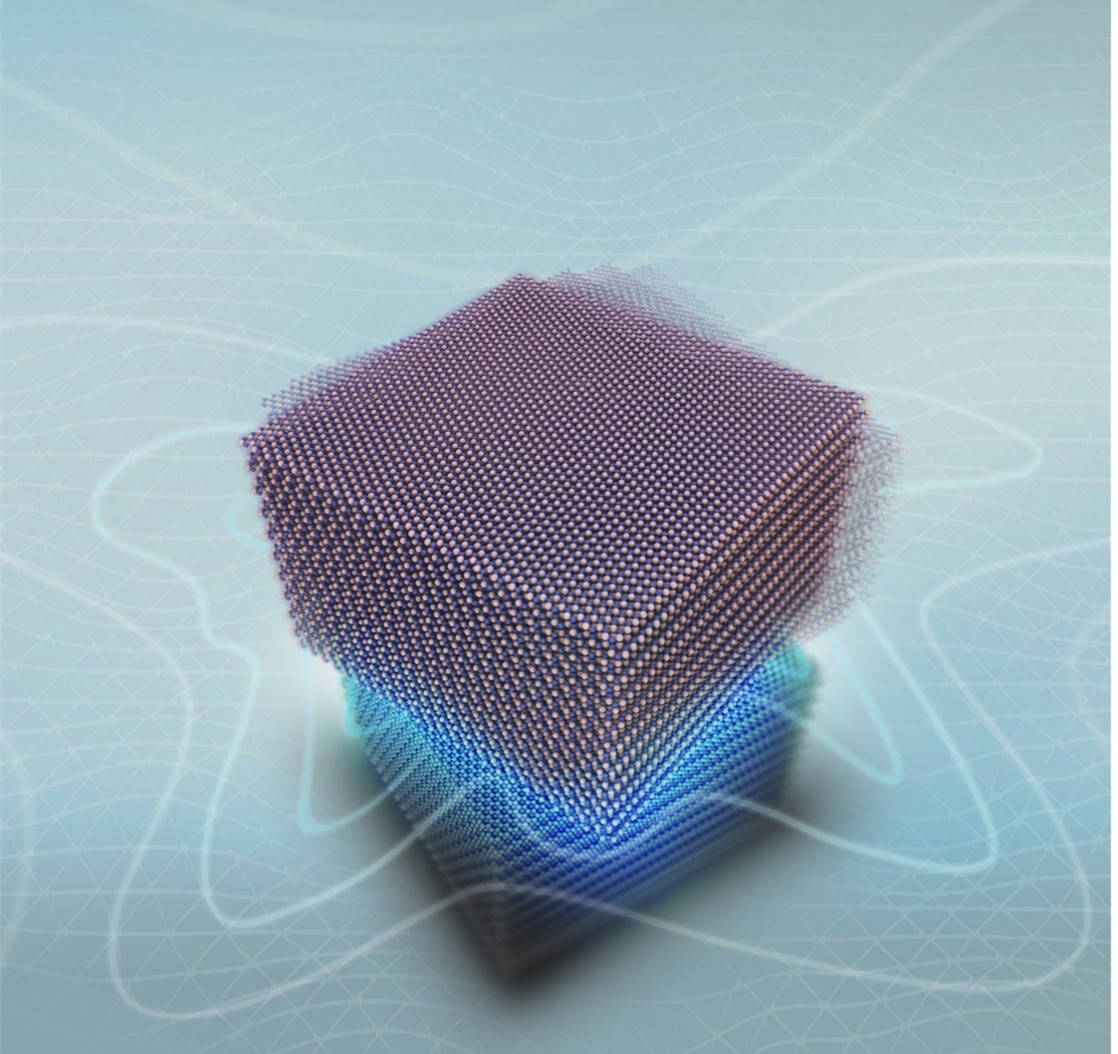
Graphite and boron nitride: The observation of a 2.5-dimensional mixing of the surface and bulk states in graphite manifests itself in a new type of fractal quantum Hall effect – a 2.5D Hofstadter’s butterfly. (Courtesy: Jun Yin)
A 2.5D Hofstadter’s butterfly
Independently, a Manchester team led by Artem Mischenko has also been exploring the effects of moiré potentials on bulk graphite. After calculating that such effects could penetrate more than 40 layers of graphitic atoms, Mischenko and colleagues performed experiments on a different 2D-3D hybrid: bulk hexagonal graphite crystallographically (mis)aligned with hexagonal boron nitride, a 2D material sometimes called “graphene’s cousin”.
In this system, the Manchester researchers observed a 2.5-dimensional mixing of the surface and bulk states in graphite. This mixing manifests itself in a 2.5D version of Hofstadter’s butterfly, which is a striking fractal pattern that arises in the energy levels of electrons moving in a magnetic field while confined in a lattice. The effect can also be understood as a new type of fractal fractional quantum Hall effect.
According to Vladimir Fal’ko, a theoretical physicist at Manchester and director of the UK National Graphene Institute, the new 2.5D quantum Hall effect in graphite stems from the interplay between two textbook phenomena in quantum physics: Landau quantization in strong magnetic fields and quantum confinement, “leading to yet another new type of quantum effect”.
While applications for these discoveries are not yet clear, Yankowitz says that both studies will advance our fundamental understanding of moiré physics. “We are now thinking about exploiting the 2D-3D hybridization effect we have observed to study more complex device geometries, such as multiple twisted interfaces within a single bulk graphite film to see if these hybridize in interesting new ways,” he says.
The two studies are described in back-to-back papers in Nature.
Distant wonders Philip Plait’s new book imagines what future space travellers might experience on distant exoplanets. (Courtesy: NASA/JPL)
As an astronomer, I am passionate in learning more about our place in the universe. As part of this I often give public talks and organize science outreach events. The people who come to them – no matter their age – almost always have the same wonder and awe when it comes to the cosmos. It is, after all, only human to want to learn more about the place we call home.
Since the dawn of our species, humans have looked up to the stars and wondered about these distant curiosities. Thanks to advances in astronomy, we now know a lot more about our local cosmic neighbourhood, and even beyond it. Under Alien Skies: a Sightseer’s Guide to the Universe is your ticket to these stars. With author and astronomer Philip Plait as your guide, this book will transport you across the universe, with many wonderful stops along the way.
Since the dawn of our species, humans have looked up to the stars and wondered what these distant curiosities would be like if we could see them up close
On the first stop of the tour, you will find yourself transported to our closest heavenly neighbour, the Moon. Though only a handful of people have ever been lucky enough to witness the wonder and awe of looking down on our own planet, it’s something I’m sure many of us have tried to imagine. In a series of short stories, Plait transports you to the lunar surface, explaining in great detail what you would experience as a space traveller if you were to set foot on it. From learning how to navigate microgravity to witnessing a lunar eclipse from the Moon itself, Plait brilliantly interweaves science with exploration and adventure to get your tour of the universe off to a great start.
The next leg of the book’s journey takes you to some of our most well-known (and loved) cosmic neighbours: the planets in our solar system. Plait begins with Mars, possibly the most desirable planetary destination right now because it will likely be the next one we visit. Hopefully, Plait’s stories about what you would experience on this ruddy planet are not too far in our future, and his brilliant account of what these first visitors will experience are sure to stir the emotions next time you spot this glowing red dot in the sky.
Next up is my favourite, and the jewel of our solar system: Saturn. With its glorious ring system, this is one of the most easily recognizable planets, and has fascinated astronomers and non-astronomers alike for centuries. From soaring journeys above its icy rings to a stop-off at one of its numerous moons, Saturn is worth an entire travelogue in itself, and the things this chapter taught me have only increased my fascination with this ringed giant.
The tour of our local cosmic neighbourhood ends with Pluto. In a chapter on this now-dwarf planet, Plait explores what it would feel like to stand on the very edge of our solar system, and what you would (and wouldn’t) be able to see. Although Earth is too far away to be visible from Pluto, the physics out here are the same as back home, so we know exactly what it would feel like if, one day, we were able to visit this distant body. By explaining everything from the amount of sunlight you would receive to the freezing temperatures under your feet, Plait makes you feel like you’re already there.
While there is much to see in our solar system, we are but a drop in an ocean of other worlds. The next few chapters contain lots of interesting science about the exoplanets orbiting other stars in our galaxy. From worlds with eternal afternoons and planets with two suns (meaning you would have two shadows to accompany you), to worlds where other planets hang like moons in the sky, Plait explores what life would be like if humans ever came to call one of these distant wonders home. While this may be possible in the future, it will not happen in our lifetimes. For today’s humans, Under Alien Skies is the closest we will get to setting foot on these other worlds, and imagining what future space travellers might experience.
The final chapter is sure to draw every reader in, as the last stop of your tour of the cosmos is a black hole. Plait really did save the best for last: only discovered in the 1970s, black holes are among the weirdest and most mysterious things in our universe. While they are invisible to us, they have such incredibly strong gravity that not even light can escape – hence their name.
The unusual nature of black holes gives rise to many misconceptions. Some people I meet at outreach events, for example, think of them as monsters tearing through space and consuming everything that gets too close. While this can be true, these goliaths come in many different sizes, and this affects how they behave. Plait offers the reader a chance to experience what it would be like to get close to different types of black holes, including all the mind-bending physics involved, minus the danger. A brilliant way to end, this chapter wonderfully wraps up the story Plait tells alongside the science and leaves you with a newfound understanding and appreciation for the beauty that is our universe.
Cervical cancer remains a major public health challenge. According to the International Agency for Research on Cancer, 604,000 new cases were diagnosed and 342,000 people died from cervical cancer in 2020. In high-income countries, screening with cytology and high-risk human papillomavirus (HPV) DNA testing has decreased the level of cervical cancer mortality. But in low- and middle-income countries, the burden of cervical cancer remains constant, due to the lack of established screening programmes.
To mitigate this shortfall, a team headed up by Rice University professor Rebecca Richards-Kortum – in collaboration with researchers from the National Cancer Institute, the Mozambique Ministry of Health, Baylor College of Medicine and the MD Anderson Cancer Center – has developed an innovative, low-cost point-of-care DNA test for HPV infections. This breakthrough test could revolutionize cervical cancer screening in low- and middle-income countries.
HPV is a group of viruses that commonly infect individuals without causing any symptoms. However, persistent infections with certain HPV types can lead to cervical cancer, which is a preventable and treatable condition if detected early.
The novel testing platform, reported in Science Translational Medicine, combines isothermal DNA amplification and lateral flow detection technologies. The researchers unveiled a streamlined six-step HPV test capable of detecting HPV16 and HPV18 – the viruses responsible for about 70% of cervical cancer cases.
The cost-effective test produces results within 45 minutes, using only two pieces of equipment. One of these instruments, a readily available minicentrifuge priced at approximately $500, is supplemented by a specialized dual-chamber heater named NATflow, with a similar price. The NATflow set-up employs disposable cartridges designed to prevent false positives stemming from workspace contamination by amplified DNA, a common challenge in point-of-care molecular testing.
Routine screening has proved effective in identifying precancerous lesions and early-stage cervical cancer, thereby significantly reducing the likelihood of disease progression. However, individuals who have never been screened or lack regular screenings remain at higher risk. The new testing platform addresses these challenges.
The simplicity of the test and its affordability offer potential to democratize screening processes and empower women who have previously lacked access to critical healthcare services. The ability to combine testing, diagnosis and potential treatment in a single visit, even in resource-limited settings such as small clinics or mobile diagnostic units, could mark a turning point in global efforts to eliminate cervical cancer.
The researchers predict that each test will cost below $5. This affordability, and the adaptability of the developed platform, hold potential beyond cervical cancer screening. The researchers envision the platform’s use in DNA tests for other type of HPV with the groundbreaking contamination-prevention measures making it an attractive option for widespread implementation.
While the HPV test is not yet ready for widespread use, as further modifications are needed to detect additional cancer-causing HPV types and additional field testing is required, the researchers are committed to advancing its development. The collaboration between academic and medical institutions, combined with technological innovations, offers a glimmer of hope for a future where cervical cancer is significantly reduced, particularly in regions where access to healthcare has historically been limited.
Most modern computers – from primitive room-filling behemoths like the ENIAC to the smartphone in your pocket – are built according to a set of principles laid out by the mathematician John von Neumann in 1945. This von Neumann architecture, as it is known, incorporates many familiar elements, including a central processing unit, a memory for storing data and instructions, and input and output devices. Despite its ubiquity, though, von Neumann’s model is not the only way of building a computer, and for some applications, it is not the most desirable, either.
One emerging alternative is known as neuromorphic computing. As the name implies, neuromorphic computers are inspired by the architecture of the human brain and use highly connected artificial neurons and artificial synapses to simulate the brain’s structure and functions. For researchers like Limei Zheng of China’s Shandong University, this neuromorphic model offers a fantastic opportunity to develop a new paradigm for computing – as long as we can develop artificial neurons and synapses that have the right properties.
In a recent paper published in Materials Futures, Zheng and colleagues describe how to use a memristor – essentially a switch that “remembers” which electric state it was in, even after its power is turned off – to emulate the function of a synapse in the brain. Here, team member Le Zhao of Qilu University of Technology explains the team’s goals and plans.
What was the motivation of your research?
We are trying to develop neuromorphic systems that can surpass the current von Neumann computing architecture in terms of lowering energy consumption and increasing intelligence. Many of these systems demand electronic devices with multiple dynamics to achieve the desired functions. These diverse requirements, such as the co-existence of volatile and non-volatile switching dynamics, can hardly be achieved in individual memristive devices.
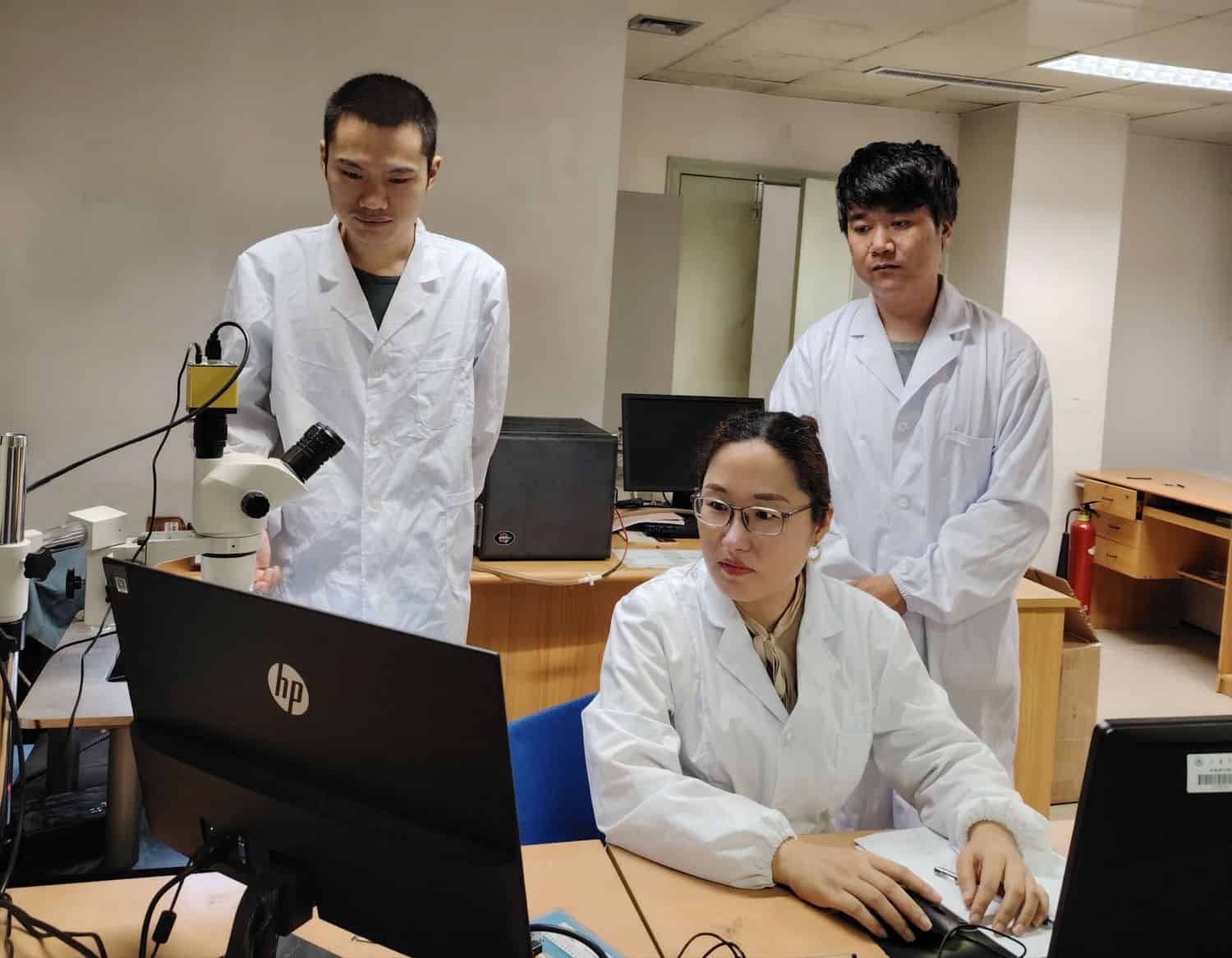
Getting results: Memristor project team leader Limei Zheng (seated) with colleagues YuZhi Zhai (left) and Gang Tian (right) in the laboratory. (Courtesy: Le Zhao)
For this reason, the realization of targeted applications usually relies on tailored neural circuit designs composed of memristors with various dynamic properties. The problem is that this reliance on multiple tailored designs limits the development of compact and low-power neuromorphic systems. It is therefore of great importance to integrate multiple inherent dynamics into an individual device and develop multi-functional neuromorphic devices, such as a versatile synaptic emulator that can fully simulate the functions of biological synapses using just a single device.
The benefits of doing this are that the universality of the device can increase the computational complexity of the system without escalating the material and area budget. In this way, we can achieve highly efficient computing in biological nervous systems. The development of devices with more complex dynamic properties is thus a crucial approach toward realizing a brain-like computing system.
What did you do in the paper?
We have successfully developed an artificial synapse with multiple synaptic functions and highly adaptive characteristics based on a simple SrTiO3/Nb: SrTiO3 heterojunction. This artificial synapse supports many functions of synaptic learning, including short-term/long-term plasticity (STP/LTP), the transition from STP to LTP, learning–forgetting–relearning behaviours, associative learning and dynamic filtering. We implemented all of these functions in a single device in a bio-realistic way.
Our multi-functional synaptic emulator has an advanced computing capability even though it is based on a simple heterostructure. We therefore believe it shows great potential for applications in compact, low-power neuromorphic computing systems. Our results suggest that our artificial synapses, which combine diverse synaptic functions with a simple structure, are potential candidates for versatile neuromorphic computing devices.
What do you plan to do next?
We will work on developing more versatile artificial synapse devices. For example, we are developing multimodal synaptic devices that can simulate the learning and memory process of the human brain by synergizing various perceptions such as vision, smell and hearing.
This article was updated on 31 August 2023 to clarify the roles of different team members.