Visualizing RDT efficacy PET scans of a control mouse (A) and a mouse treated with radiodynamic therapy (B), one week after treatment. The arrows indicate the primary tumour sites; the dotted circles indicate metastases. (Courtesy: D-M Yang et al Biomed. Phys. Eng. Express 10.1088/2057-1976/ac9b5c)
Tumours can be destroyed in many ways. Radiotherapy uses beams of ionizing radiation to damage DNA and destroy tumour cells. A less common approach is photodynamic therapy, which uses a light-activated drug to kill cancer cells via mitochondrial damage. Then there’s the emerging technique of radiodynamic therapy (RDT).
“Radiodynamic therapy is the combination of radiotherapy plus photodynamic therapy,” explained Charlie Ma from Fox Chase Cancer Center, speaking at the recent AAPM Annual Meeting.
Photodynamic therapy typically uses visible laser light to activate a photosensitive drug that’s preferentially localized within tumour cells. The activated drug generates highly cytotoxic singlet oxygen that causes cell death. The limited penetration of laser light into tissue, however, means that the technique is mainly used to treat superficial tumours or sites with endoscopic access. To treat deep-seated tumours that photodynamic therapy cannot reach, RDT uses high-energy photon beams to activate the photosensitizer.
“In RDT, we use 20 to 30 per cent of the dose from radiotherapy,” Ma explained. “And then we also use the Cherenkov light.” He noted that this Cherenkov radiation, which is generated during radiotherapy as the treatment beam interacts with the patient’s tissue, will have an almost identical light distribution to the therapeutic radiation dose distribution and thus can be easily planned.
In addition to accumulating in the primary tumour, the drug will also be absorbed by distributed metastatic cells, which can be killed using a very low dose of Cherenkov light. “Now for the first time, RDT makes radiotherapy not only local and regional, but a systemic treatment technique,” said Ma.
The team at Fox Chase is using a drug called 5-aminolevulinic acid (5-ALA) for RDT. 5-ALA is taken up by the mitochondria in cancer cells, with 10 to 20 times greater uptake in tumours than in normal tissues. Once inside a cancer cell, 5-ALA is metabolized into protoporphyrin IX (PpIX), a photosensitizer with an absorption spectrum peak at around 380–430 nm. This is not ideal for the red laser light often used for photodynamic therapy. It is, however, a great match for the Cherenkov absorption peak at 370–430 nm.
Preclinical proof
Over the last few years, Ma and his team have performed many preclinical studies using different tumour cell lines and various radiation energies. He shared some results from a large study (several hundred animals) assessing RDT of tumour-bearing mice using 100 mg/kg 5-ALA and 6, 15 or 45 MV photon irradiation.
Ma noted that the tumour was highly aggressive, with 4 Gy of radiotherapy alone only killing about 10% of the tumour cells. In addition, RDT at 6 MV did not significantly increase the therapeutic effect. “That’s why people worried that Cherenkov light is not sufficient,” he noted. “But with 15 and 45 MV you see far more tumour growth delay. We are still studying why there is this dramatic change due to energy, we need to find the exact mechanism behind it.”
The team used PET to visualize tumour shrinkage after RDT. One week post-treatment, tumours in control mice had grown and metastasized, while those treated with RDT had much smaller lesions and no metastases. Ma also described a study of a highly aggressive thyroid cancer in rabbits. One week after 3 Gy of radiotherapy, the tumour was still growing. “But if we use RDT at 3 Gy with 5-ALA, the tumour was not seen on the PET images.” He emphasized that PET provides an excellent way to perform early treatment evaluation and could help determine whether or not RDT would be effective in a patient.
Fox Chase is now performing a clinical trial on RDT, with the first phase of the study examining dose escalation (both radiation dose and drug dose) in late-stage tumours. This phase has now reached the final dose level with just three patients left, said Ma, pointing out that so far no toxicities had occurred in any cases. Elsewhere, a second RDT trial at University Hospital Muenster is examining patients with a first recurrence of glioblastoma.
Real-life cases
Finally, Ma presented results from a number of real-life cases. “You will be excited to see these,” he told the audience, noting that “usually, people don’t believe it works unless you have one month imaging with CT, MR or PET”.
In the first example, a treatment of liver metastases, he showed that one month after RDT, PET imaging revealed that no tumours remained. Next, he presented a case of lung cancer with metastases: “you can see very dramatic results with tumours deactivated after RDT,” he said.
Other successful RDT treatments included an oesophageal cancer, a lung tumour with multiple bone metastases, and a patient that had failed chemotherapy but had a good response three days following RDT. Ma noted that most of the patients had late-stage cancers and had failed other treatments. “We do see an effect, so hopefully we can improve their survival,” he added.
“RDT can be a local, regional and systemic treatment that combines radiotherapy and photodynamic therapy,” Ma concluded. “We have a lot of in vitro and in vivo experiments to demonstrate its therapeutic potential, and although clinical trials are few, I hope we will have more results in the future and make this into something really useful.”
When Giorgio Parisi was awarded the 2021 Nobel Prize for Physics alongside Klaus Hasselmann and Syukuro Manabe, news reporters faced a challenge. How the heck were they supposed to understand, let alone explain, what he had won it for? The issues tackled by Hasselmann and Manabe at least touched on a matter everyone recognized: climate change. But Parisi’s speciality – spin glasses and topological frustration – seemed as esoteric as it was baffling. So it was that, in some of the ensuing press conferences, Parisi found himself doing his best to field questions about climate, rather than his own work.
The author’s new book – In a Flight of Starlings: the Wonder of Complex Systems – might be seen as an attempt to redress that imbalance. In the space of just 120 pages, Parisi seeks to explain in lay terms just what it is that brought him such acclaim, which journalists covering his Nobel prize attempted to sweep under a rug modishly labelled “complexity”.
The book attains considerable charm and accessibility with its acute insights into the virtues and vicissitudes of doing science led purely by curiosity
Does he succeed? Not really, but don’t be put off. This slight volume might not be a paradigm of science communication, but it nonetheless attains considerable charm and accessibility with its acute insights into the virtues and vicissitudes of doing science led purely by curiosity.
I once saw Parisi deliver a plenary lecture at a statistical-physics meeting in Paris in the early 1990s, and I could not put that memory out of my mind as I read the gnarlier parts of this book. Throwing to the wind any idea that a plenary lecture should speak to a broad audience, Parisi’s talk condensed into a dense and deeply frustrated state, which he delivered, eyes half-closed, in a manner that conveyed simultaneously a touching faith in the knowledgeability of his audience and an ardent wish (or so it seemed to me) that scientific brilliance did not impose such obligations to take the stage. I’ve learnt that this experience of Parisi in action was not unusual.
I suspect that this book, composed in part of previously published essays, was encouraged by the publisher on the grounds that Nobel-prize winners become public figures with a duty to tell their stories. But it’s surely more than that. Parisi displays a genuine concern that scientists should strive to reach a broad audience. “For science to affirm itself as culture,” he writes, “we must make the public aware of what science is and how science and culture are intertwined, both in their historical development and in the practice of our time.”
Parisi, however, believes there is a “strong anti-scientific tendency” currently at work, complaining that “the prestige of science and popular trust in it is being rapidly undermined”. It’s a problem that is perhaps felt particularly keenly in Parisi’s native Italy, where I have often heard people lament the public’s low levels of understanding of – and interest in – science. This book was originally published in Italian in 2021 under the title In un Volo di Storni. Le Meraviglie dei Sistemi Complessi, and has been translated into English by Simon Carnell.
To his credit, Parisi does confess that scientists themselves sometimes “display an excessive, disingenuous confidence to a public that has a perception of the partiality and limits of their views”. Indeed, one of the attractions of his book is its frank discussion of how scientists arrive at ideas as much by intuition as by deduction, with the breakthrough moments often occurring during reverie or even sleep – albeit only after periods of intense but seemingly fruitless focus on the problem at hand.
In one telling anecdote, Parisi admits he could perhaps have won a Nobel earlier if only he’d been paying more attention. He and the Dutch theorist Gerard ’t Hooft should, he says, have seen in the early 1970s how to develop the quark–gluon theory of nucleons (quantum chromodynamics) using Murray Gell-Mann’s notion of “colour charge”. But they didn’t. The work was instead carried out a short while later by David Politzer, David Gross and Frank Wilczek, who bagged the Nobel Prize for Physics in 2004. Why didn’t Parisi see it, a friend later asked, given that he knew about all the ingredients? “It just didn’t occur to me,” he admits forlornly.
On the other hand, Parisi points out how sometimes it is enough for a scientist to know that a result, a proof or demonstration is possible, to enable them to find it for themselves. He describes how, for one particular colleague, “the simple information that [a certain] property was demonstrable was enough for him to arrive at the long sought-after proof for himself in less than 10 seconds”. Sometimes, he says, only “a minimal amount of information is enough to cause substantial progress in a field to which much thought has been given”. After all, frustrated systems don’t tend to evolve linearly.
Parisi’s admission that communicating science “is no easy task, especially with the hard sciences” is borne out by his text
This is all both valuable and fun. But Parisi’s admission that communicating science “is no easy task, especially with the hard sciences, where mathematics plays an essential role” is borne out by his text. Phase transitions, the frustration of spin glasses, and the trick of renormalization introduced by Leo Kadanoff and Ken Wilson are all presented clearly enough, but how Parisi made significant progress on tricky problems in these fields is harder to follow.
“It was technical, and as such difficult to explain in lay terms,” he confesses at one point, even admitting that a reviewer of his paper on that particular issue pronounced it “incomprehensible”. Indeed, it turns out that Parisi didn’t really understand the issue fully either, which illustrates another point about how ideas are born. Very often, one knows the right answer before being able to demonstrate or even to articulate why. The hard work is not finding the answer but finding the proof.
This notion is nicely illustrated by a story of a colleague who once posed Parisi a tricky question to which he immediately gave the answer. But when that colleague asked Parisi to explain his reasoning, he recalls: “At first I gave a completely nonsensical explanation, then a second that made a bit more sense, and only at the third attempt was I able to properly justify the right answer, which I had at first given for the wrong reasons.” It’s partly for such unveiling of the capricious scientific mind that this book can be enjoyed.
But perhaps most importantly, Parisi explains why reporters who were scratching their heads about how to explain spin glasses were missing the point of his research. His work isn’t about this system or that – a specific metal alloy, or the flocks of starlings in Rome that Parisi studied as a complex system in the 2000s. It’s about the universality of phenomena, whereby systems of many interacting components that look utterly different – be they flocks of starlings, groups of particles or the magnetic atoms in spin glasses – can be described using the same mathematics.
The fact that you can do so isn’t because there is a loose analogy between these systems but because they are all, at root, the same (collective) thing.
2023 Penguin 144pp £20.00/$24.00hb
Find out more about the work of Giorgio Parisi in this video interview he gave for IOP Publishing:
Launched in 2018, the MedPhys Slam is now an established feature of the AAPM Annual Meeting. The popular session is a communication competition in which students and trainees present their research projects in just three minutes using just three slides. The winners are selected by a panel of judges, all non-medical physicists, who assess the talks based on how well the speakers explain their research question, its significance and their methods.
This year, 17 competitors – all winners of their local AAPM chapter competitions – took part. Their presentations covered a wide range of medical physics themes, from proton therapy to radiotherapy, via areas including radiography, preclinical imaging, artificial intelligence, radiobiology and brachytherapy.
Detecting bleeds in the brain
This year’s winner was Aroon Pressram, a masters student at the University of Florida, who presented a talk entitled “The hidden haemorrhage: visualizing brain bleeds”.
Pressram is developing a technique for rapid detection of brain bleeds in stroke patients. He explained that a patient presenting with stroke symptoms will typically be admitted to hospital for a CT scan, which involves injecting a contrast to aid visualization of the vessels in the brain. If a blockage is found, the patient receives revascularization therapy to restore the blood flow. But this treatment can actually put the patient at risk of developing a brain bleed or leakage of contrast into their brain. “That’s why it is essential that we perform follow-up imaging so we can identify the brain bleeds and reverse it,” he explained.
So how best to perform such follow-up imaging? MRI is accurate and provides high-quality images, but it is slow. CT scanning, meanwhile, is much faster but can’t distinguish brain bleeds from contrast in the brain. “There has to be a better way to get something accurate and something fast for the patient,” said Pressram. “Well there is. And It’s called dual-energy CT.”
Winning presentation Aroon Pressram from the University of Florida. (Courtesy: Aroon Pressram)
Dual-energy CT works by performing two scans with different X-ray spectra, then combining the two data sets mathematically. The technique can separate signals due to a brain bleed from those coming from the contrast. Pressram notes that dual-energy CT is also more readily available than MRI and offers quicker scan times.
Following a literature review, Pressram realised that “we were the first people in the world doing research on this dual-energy scanner for stroke patients”. To investigate the application further, he assessed 500 stroke patients with dual-energy CT and found that the approach performed well in all cases, giving accurate results in a timely manner. “Healthcare professionals should be aware of this amazing technology that’s out there that can give them accurate results in a quicker time,” he concluded.
Improving prostate radiotherapy
Second place in the competition went to Ellie Bacon, a medical physics resident at the University of Nebraska Medical Center. Bacon described how a process called offline review could improve radiotherapy for prostate cancer patients.
Offline review – which Bacon referred to as “the single most important task that we do for our patients on a weekly basis” – involves examining the images taken during a patient’s treatment over the previous week to look for any potential errors that need to be quickly addressed and to follow tumour shrinkage over time.
For prostate cancer patients, one important parameter is how well they are able to fill their bladder from day to day. “We found that when patients are unable to fill their bladder 50% full for their treatment, they have a much higher chance of side effects such as bladder toxicity,” Bacon explained. “That got me thinking, is there a way that we can find these patients quickly so we can help them?”
Bacon proposed a simple addition to the offline review process, in which a patient’s bladder is categorized as “good” if it looks above 50% full, or “bad” for those below 50%. She performed a test in which her team assessed patients over three rounds, with additional visual clues provided each time: first, an outline of what a full bladder should look like from the patient’s original treatment plan; then an image of an empty bladder; and finally an estimate of what a 50% full bladder should look like.
“Each round, with more and more visual clues, they were able to quickly identify which patients were good or bad and needing our help,” said Bacon. “This confirmed my suspicion – we are able to quickly use offline review, which we already do for all of our patients, to identify the prostate cancer patients who need help.”
Once such patients are identified, their treatment plan can be adapted to better fit their bladder-fill average. This reduces their chance of side effects and improves quality-of-life following treatment. “The only question left is who else can we help with this offline review?” she concluded.
Keeping track of the tumour
Taking third place in the MedPhys Slam, as well as winning the “people’s choice award” voted for by the audience, was Jason Luce, a PhD student at Loyola University. Luce told the attendees about an adaptive template-based tumour tracking algorithm for lung cancer radiotherapy.
Tumour tracking during radiotherapy is particularly important for patients with lung cancer. Breathing causes tumour motion, which leads to increased uncertainty in the tumour position. This requires the use of a larger treatment beam that can increase irradiation of healthy surrounding tissue. “But if you can actively track the tumour, you can use a more precise treatment beam, which means less radiation to healthy tissues,” Luce explained.
During image-based tracking, however, it’s possible to lose the tumour, particularly when using a large search window to cover all possible ranges of tumour motion. For example, Luce showed a case in which the tracking algorithm misidentified the location of the tumour as that of an extraneous image artefact.
He likened this tracking problem to that of looking for lost car keys. “Rather than search your entire house to find them, you can make your life easier by asking ‘where was the last place I saw them?’ In the kitchen? Just search that area, problem solved,” he said. “We’re taking that idea and applying it towards improving tumour tracking.”
The approach, Luce explained, involves finding the last place that the tumour was seen during tracking, and then reducing the search region to that area. He tested the technique on 229 X-ray images of a tumour in motion, performing tracking using an algorithm with a large search window, as well as one with a smaller adaptive search window.
The smaller adaptive search window provided a notable improvement in tumour tracking. With the static search window, about 12% of images exhibited poor tracking (significant differences between the actual and predicted tumour locations), while less than 1% were poorly tracked by the adaptive search window. “We’re improving tracking results and ideally improving patient care,” he said.
A trio of US astronomers has found compelling evidence for the existence of “dark stars” – hypothetical objects powered by the annihilation of dark matter. Dark stars could explain the unexpected abundance of ancient galaxies seen by the James Webb Space Telescope (JWST). Katherine Freese at the University of Texas, Austin along with Cosmin Ilie and Jillian Paulin at Colgate University used JWST data to conclude that three of these galaxies may actually be dark stars.
Less than two years since its first images were released, JWST has already changed astronomers’ understanding of the early universe. Among its most surprising observations has been the sheer number of extremely bright, ancient galaxies, which would have formed in regions rich in dark matter.
Dark matter is a hypothetical substance that is invoked by physicists to explain the large-scale structure of the universe. While it has never been observed directly, it is a part of the current standard model of cosmology – the lambda cold dark matter model (ΛCDM). This describes the structure and expansion of the universe, while accounting for the gravitational influence of dark matter.
Dark matter heating
In 2007, Freese and colleagues proposed the possibility of “dark stars”, which may have been common in the early universe. While composed mostly of hydrogen and helium, these exotic stars would be fuelled by “dark matter heating” rather than nuclear fusion. This could involve a type of dark matter called weakly interacting massive particles (WIMPs). WIMPs have evaded discovery for decades in Earth-based detection experiments, but according to Freese’s team, the sheer density of dark matter in the early universe could cause them to interact far more frequently with regular matter during the formation of some of the earliest stars.
In the early universe, “WIMPs could have annihilated into photons, electron-positron pairs, and other particles, which collided with the hydrogen in collapsing clouds,” Freese explains. “These particles then get stuck inside the cloud, and deposit all the energy from the mass of the dark matter particles into the cloud. The cloud then stops collapsing, and instead turns into a ‘dark star’.”
Dark stars are stars in every sense, in that the immense gravity of their cold, infalling material is perfectly balanced by outward hydrostatic pressure, generated by energy-releasing processes in their interiors. All the same, Freese says that they have several key distinctions from regular stars.
Cool throughout
“They have no cores, unlike fusion powered stars, which need high temperatures in order for fusion to take place,” Freese explains. “Dark stars are cool throughout, including at the surface, so that they do not produce ionizing photons or winds that would prevent them from accreting mass.”
As a result, Freese and colleagues argue that dark stars balloon in size to some 10 AU, and millions of solar masses. This allows the stars to pull in even more particles of dark matter. In the process, a “supermassive” dark star (SMDS) may become bright enough to outshine an entire galaxy.
Ordinarily, galaxies can be easily distinguished from stars since they take up extended regions of space, whereas stars appear as single points of light. Yet at such vast distances, even JWST does not have a high enough resolution to distinguish between stars and galaxies. If Freese and her colleagues are correct, this would suggest that ancient galaxies appear so numerous in JWST’s data because many of them are SMDSs.
Absorption lines
To search for evidence of SMDSs, the trio examined data from the JWST Advanced Deep Extragalactic Survey (JADES). In the survey, they looked for evidence of light at certain wavelengths being absorbed by candidate stars. In particular, they were interested in the 1640 nm helium-II absorption line which is often observed in the spectra of hot, bright stars.
“A helium-II absorption line would be a smoking gun for a dark star, as galaxies would not produce such lines,” Freese says. “If elements other than hydrogen and helium are found, then it’s not a dark star.”
As they searched with JADES, they identified several objects that closely matched their SMDS criteria. “We found that three of them are good matches to SMDSs,” Freese continues. “They have the right spectra, although the resolution of the detector can’t yet tell whether these are point or extended objects.”
In the future, the team hopes JWST will pick up SMDS candidates that have been magnified by gravitational lensing – which may boost resolution high enough to confirm that the objects are indeed single points of light, rather than extended galaxies. “If some of these early objects are dark stars instead of galaxies, that would help maintain the consistency of JWST’s observations with the standard model of cosmology,” Freese says.
On top of this, this confirmation could be a major breakthrough in our understanding of the nature of dark matter, and provide further evidence for the existence of WIMPs.
“I feel so privileged to have the opportunity to spend every day thinking about some of the big unanswered questions,” says Hannah Banks, a research fellow studying theoretical particle physics at Cambridge University in the UK. “At school I was very uncertain and almost didn’t apply to university, but once I got there it was so liberating to start seeing physics as a field of discovery rather than just a list of facts and formulae to learn.”
Banks is a tutor for The Brilliant Club, a UK-based charity set up in 2011 to improve university access for school students from less advantaged backgrounds – defined in this case as living in a deprived part of the UK, being eligible for free school meals, or having no parental history of higher education. By challenging pupils with ideas and concepts that are beyond the confines of the normal school syllabus, Brilliant Club tutors can offer an insight into the richness and joy of exploring a subject within a more enquiring university environment.
Hannah Banks: “I want to help young people to see a future in which they can pursue whatever it is that interests them.” (Courtesy: Hannah Banks)
“I wanted to get involved with The Brilliant Club to show young people that science is cool and amazing, and also to make them aware that university might not necessarily be what they think it is,” continues Banks. “University changed my life because I was suddenly being asked to take control of my learning and think in different ways, and I want to help young people to see a future in which they can pursue whatever it is that interests them.”
The Brilliant Club provides tutor-led courses for around 20,000 pupils every year, and has also introduced a smaller programme to guide and support students who have recently moved into higher education. All of its tutors are either studying for a PhD or already have their doctorate, with the aim of providing school students with a first-hand insight into the university experience.
“We want to harness our tutors’ love of learning and knowledge of academic life to inspire a new generation of students,” says The Brilliant Club’s Zoë Morgan. “Tutors who are passionate about their research, and can bring that to life in a classroom, can have a huge impact on young people who might not otherwise think that university is an option that’s open to them.”
The charity is particularly keen to recruit new tutors with a background in science, engineering or mathematics, including people who may have moved on from academia. “There is often high demand from schools for physics and maths courses, but we can find it more difficult to attract tutors in those subjects,” says Morgan. “Some of our tutors may have retired or moved into a different profession, and find it really enriching to reconnect with their research and think about it again from a different perspective.”
Under the charity’s flagship initiative, The Scholars Programme, expert tutors design and deliver a short course of seminars based on their own area of research, with The Brilliant Club providing support and training as well as arranging placements with partner schools. To encourage discussion tutors work with small groups of students, who at the end of the course are expected to complete a university-style final assignment.
Lauren Martin: “Opportunities like this gives students the confidence that they can succeed at something that’s quite challenging.” (Courtesy: Lauren Martin)
“The tutorials are designed to be quite interactive, and for some students the small-group environment is a really positive experience,” explains Lauren Martin, another physics tutor who so far has worked with around 350 students in Kent, which operates a selective grammar-school system. “The Brilliant Club works exclusively with students attending non-selective state schools, and opportunities like this can make a real difference because it gives them the confidence that they can succeed at something that’s quite challenging.”
It may seem daunting to create a course that engages school students with complex scientific concepts, but The Brilliant Club provides plenty of support, training and feedback to help tutors pitch their seminars at the right level. “The Brilliant Club organized a fantastic workshop that showed me how to develop my course by thinking about the learning outcomes I wanted to achieve,” comments Banks. “The training made me realize the importance of active learning to get the students involved, by making sure that they work out the solutions for themselves.”
The courses are designed to stretch the students’ knowledge and understanding beyond the national curriculum, with schools choosing participants who they believe will benefit most from the programme. “We want the courses to challenge the students and emulate the learning environment within a university,” says Morgan. “At the end the students also have the opportunity to visit an academic institution to celebrate their graduation, which for many of them will be a completely new experience.”
When creating their courses both Martin and Banks took inspiration from the ideas and experiences that first piqued their interest in science. “It was hard to get started, because when you get involved in research it’s easy to get so focused on the details that you forget the big picture,” recalls Martin. “I went back to the concepts that interested me in physics when I was at school, and so my course explores Einstein’s theory of special relativity and how it changes our perception of time, as well as the importance of symmetry in understanding the universe.”
Martin also valued the coaching and feedback she received from The Brilliant Club when she was developing the course, as well as from the teacher who arranged her first placement. “It was a great first introduction because the teacher was there during my first session,” she explains. “She provided some really useful feedback, to talk a bit slower, to ask questions in a different way, and she gave me some tips on how to engage students who may need more encouragement.”
Martin has also tutored younger pupils, although in this case the courses are pre-designed by The Brilliant Club to ensure they are suitable for each specific age group. “For students in the last two years of primary school I have taught a course on statistics, in particular encouraging them to question how they are interpreted,” she explains. “For years 7 and 8 we have focused on cracking ciphers and codes.”
With ambitions to become a teacher herself, Martin’s experiences with The Brilliant Club have helped her to develop vital classroom techniques within a gentler small-group environment. “I have learnt the importance of adapting the session to meets the needs of the people in the room,” she says. “If your carefully prepared explanation doesn’t work, you need to think on your feet and present the material in a way that works for the students in front of you.”
For Banks, who is intent on pursuing a research career, the experience of tutoring school students has helped her to develop the skills needed to communicate her work to scientists working in other areas. “We are always presenting our research results in seminars and conferences, and working with The Brilliant Club has helped me to introduce my work to people who are not focused on the exact same problem,” she says. “In research it’s important to explain complex topics in an accessible way, and tutoring has helped me to develop those softer skills that are often neglected in formal study.”
The Brilliant Club pays tutors for their time, but for Martin and Banks the biggest benefit has been the opportunity to inspire young people and introduce them to scientific concepts and ideas they would not normally be exposed to. “I have loved the opportunity to meet all these brilliant kids, and hopefully to pass on my love and passion for science to them,” says Banks. “Sometimes you can see the light bulb go on, when they see something differently or have really understood something properly for the first time, and that has been so rewarding.”
Bottled up An optical bottle holds a glass particle aloft at Bell Labs in June 1971. Laser light passing through a lens at the end of the glass tube is being bent by the triangular prism to focus on the transparent particle from below. Vibration from the cylinder above the prism is used to break a molecular attraction between the glass plate and the particle, freeing it to rise in the beam of light. The glass particle is a sphere about 25 microns in diameter. (Courtesy: Nokia Bell Labs, Nokia Corporation and AT&T Archives)
The idea that you can reduce an object’s temperature simply by shining light on it is gloriously counterintuitive. It even surprises physicists. The first time atomic physicist Hal Metcalf heard about the concept we now know as “laser cooling”, he was sure that the speaker – a young PhD student by the name of Bill Phillips – was talking nonsense. “In my best professorial manner, I lectured him and said ‘Look, if you put energy into the system, it can’t cool’,” recalls Metcalf, now a Distinguished Teaching Professor at Stony Brook University in New York, US. “And he said ‘Sit down, Metcalf, you’ve got some stuff to learn.’”
Metcalf’s initial confusion is understandable. Although using energy to cool something is, of course, routine – it’s what happens in your refrigerator – there is something about the idea of using nothing but light to cool a gas of particles, to temperatures a fraction of a degree above absolute zero, that makes even experienced physicists scratch their heads. Temperature is a measure of the average energy of the particles in any system, and in physics as in popular culture, we usually think of lasers as a tool for adding energy to a system: raising electrons to a higher orbit, or blasting a spaceship into vapour in a sci-fi movie. It seems inconceivable that shining concentrated light on a gas could instead remove some of its energy.
With a few Nobel prizes’ worth of care and ingenuity, though, laser cooling is very much possible, and its rewards have been substantial. In the nearly 50 years since Metcalf tried to convince Phillips that it wouldn’t work, laser cooling has revolutionized the fields of atomic, molecular and optical physics. Laser cooling of atoms and ions has enabled dramatic leaps in the precision of atomic clocks, allowing new tests of fundamental physics and potential improvements in clock-based navigation via the Global Positioning System (GPS). It has opened new avenues in the study of quantum-mechanical phenomena like superfluidity and superconductivity, helping us explore regimes that can’t readily be accessed with conventional materials.
More recently, it has provided one of the best current platforms for the study of quantum information and quantum computing, now one of the hottest fields in technology, which has attracted billions in funding from government agencies and major corporations. Cooling atoms to within millionths or billionths of a degree above absolute zero allows their quantum nature and properties to be measured with unprecedented precision. All of this has put atomic and molecular physics on the cutting edge of quantum science.
As usual, everything goes back to Einstein
The essential physics behind laser cooling can be traced back to Albert Einstein’s 1917 observation that photons, the fundamental “particles” of light, must carry momentum, and this momentum can be used to change the motion of atoms. In 1933 Otto Frisch demonstrated this momentum transfer in a tour de force experiment that used light from a sodium-vapour lamp to deflect a beam of sodium atoms. The degree of deflection (around 1 mm) was tiny, however, so the idea of using light to push atoms around remained a curiosity. This remained true until 1960, when the invention of the laser introduced a light source bright enough to generate substantial forces.
The study of manipulating matter with light began in earnest with Arthur Ashkin, a physicist at Bell Labs during its late-1960s heyday as a centre of innovation and basic research. Back then, the concept of a telecommunications company paying someone to study light forces on atoms was not as outlandish as it might be today. “Basically, the instruction we were given was ‘You can do whatever you want to do, but it’s got to be world class,’” recalls Ashkin’s then-colleague John Bjorkholm, who went on to do his own world-class research on the ultraviolet lithography techniques used to make state-of-the-art computer chips.
Thanks to some back-of-the-envelope calculations, Ashkin realized that the forces from laser photons bouncing off a microscopic object could be significant. Encouraged, he began experimenting with an argon laser and polystyrene beads in water. As predicted, the laser pushed the beads through the water and pinned them against the downstream window of their container (figure 1).
1 Light forces on atoms
(Copyright: Chad Orzel/IOP Publishing)
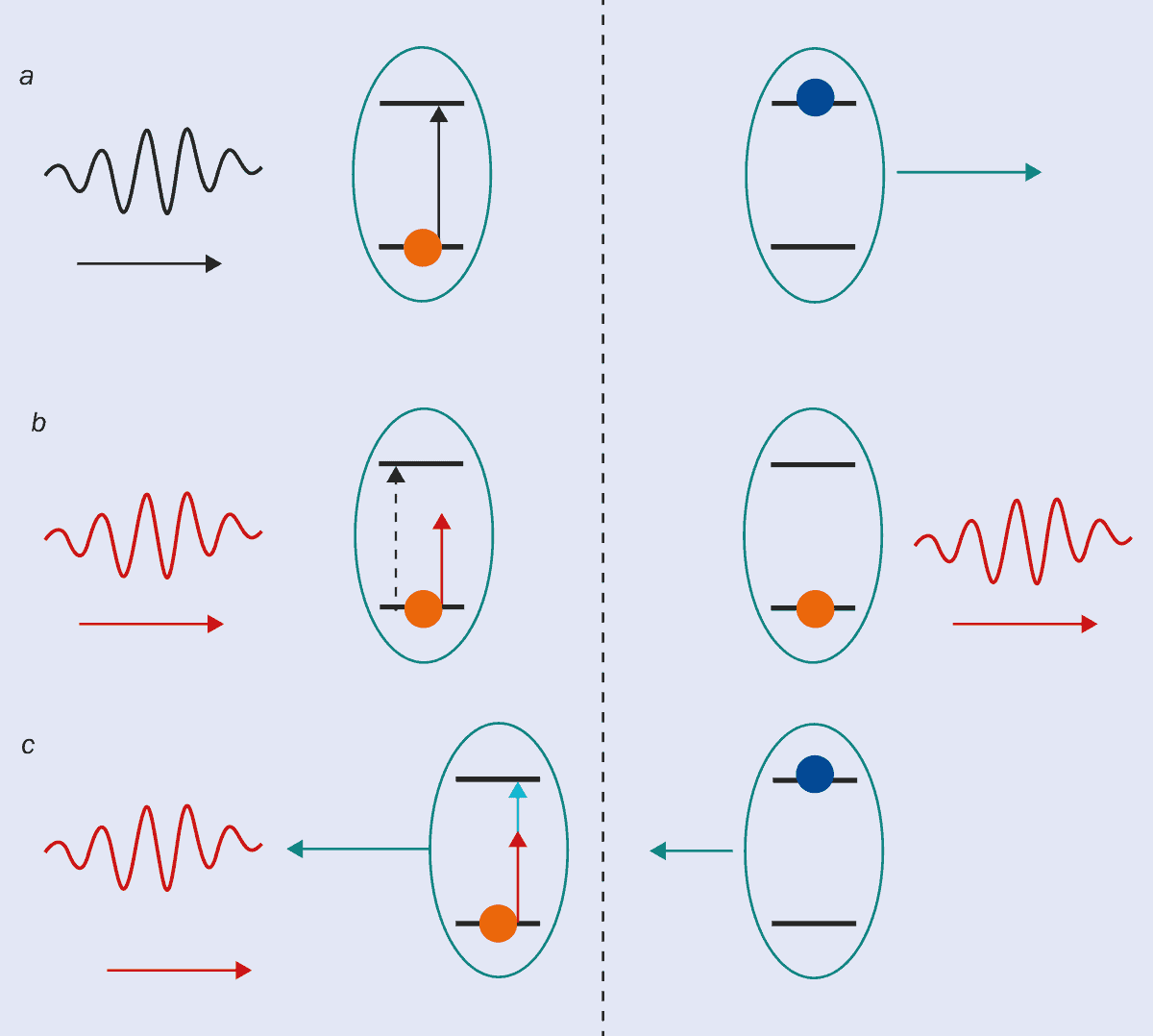
(a) The scattering force arises when an atom absorbs an incoming photon of light, giving the atom a “kick” that starts it moving in the direction of the photon. Re-emitting the light also gives the atom a kick, but in a random direction. Over many cycles, these random kicks cancel out and the net effect is a force in the direction of the light. (b) The “dipole force” arises from an interaction with the light that lowers the energy of the atom’s ground state, with the shift being largest in the centre of a beam where the intensity of the light is highest. The atom experiences this as a force pulling it into the high-intensity centre of the beam.
Ashkin published his first results in 1970, demonstrating that lasers could both accelerate beads and trap them in a region between two laser beams propagating in opposite directions. In subsequent years, he and his Bell Labs colleagues went on to demonstrate the levitation of small objects with vertical light beams and the trapping of small objects in the centre of a tightly focused laser beam. The latter technique allows particles to be manipulated by moving the focus point, and is now known as “optical tweezing”. It has since found numerous applications in biology, and in 2018 Ashkin was awarded half of the Nobel Prize for Physics “for the optical tweezers and their application to biological systems”.
From tweezers to coolers
Ashkin’s work launched the study of light forces on microscopic objects, but for smaller chunks of matter, the baton passed to two other groups: one led by Theodor Hänsch and Arthur Schawlow at Stanford University (each would go on to win their own Nobel prizes for work on laser spectroscopy, Schawlow in 1981 and Hänsch in 2005), and another by Hans Dehmelt and Dave Wineland at the University of Washington. Both groups’ papers appeared in 1975 (the latter as an abstract for a conference presentation, due to Dehmelt’s bad experiences with reviewers), and they considered situations that were superficially very different. While Hänsch and Schawlow pondered the effects of lasers on neutral atoms, Wineland and Dehmelt focused on ions in an electromagnetic trap.
Either way, the key physics was the same. If a laser is tuned to a frequency of light just below the frequency absorbed by a particular particle (“red detuned”), stationary atoms or ions will not absorb its light. When the particles are moving “upstream” against the light, however, they “see” the frequency of the light Doppler-shifted upwards, and become more likely to absorb a photon. When that absorption happens, the resulting momentum “kick” is necessarily in the opposite direction to the atom or ion’s velocity, so the particle slows down (figure 2). The net effect is that the laser only slows things down; it never speeds them up. This reduction in velocity corresponds to a reduction in temperature, which is a measure of the average energy of the atoms in a gas.
2 Light forces and Doppler cooling
(Copyright: Chad Orzel/IOP Publishing)
(a) An atom at rest can absorb a laser photon whose frequency is tuned to match the energy difference between two states of one of its electrons. In this case, the atom also acquires the photon’s momentum, giving it a “kick” so it begins moving in the direction of the photon. (b) When the laser frequency is tuned below that associated with the energy difference, the atom will not absorb the photon, and does not change its motion. (c) If the laser frequency is too low to be absorbed, but the atom is moving in the opposite direction, the atom will see the light Doppler-shifted up (blue arrow) to the correct frequency, and will absorb it. The resulting momentum kick reduces the speed of the atom, producing a cooling force.
The first complete description of the cooling force, including a derivation of what would come to be known as the minimum achievable temperature or “Doppler cooling limit”, was published in 1977 by a trio of Soviet scientists (Vladilen Letokhov, Vladimir Minogin, and Boris D Pavlik Optics Comms19 72). Numerous other calculations followed, all suggesting a lower limit of a millikelvin or a few hundred microkelvin above absolute zero. This expectation would shape the goals for the community for the better part of the following decade. And as we will see in part 2 of this history, it would prove to be stunningly wrong.
Laser whisperers and ion trappers
By the end of 1975, Wineland had moved on to Boulder, Colorado, and a staff position at what was then the National Bureau of Standards (it was renamed the National Institute of Standards and Technology, or NIST, in 1988). The new job came with generous research funding and a great deal of freedom. Though Wineland’s main duty was to support and evaluate the caesium atomic beam clock (then the primary frequency standard for the US), he recalls that “the guy that hired me wanted to try these new things, like laser cooling”.
With his boss’s blessing and some funding from the Office of Naval Research, Wineland began an experiment to laser-cool trapped ions. This required three elements: the ion traps he knew from his work with Dehmelt; a vacuum system to contain the trap and ensure that only ions from the element of interest were present (since the cooling mechanism depends on the characteristic frequency of the atoms, no other element will be affected by the light); and a laser system to cool the trapped ions. By his own admission, Wineland “knew nothing about lasers”, so he recruited a NIST chemist, Bob Drullinger, to be the experiment’s “laser jock”. “At that time lasers were really primitive,” Drullinger says, “and it didn’t take a lot of skill to be considered a laser whisperer.”
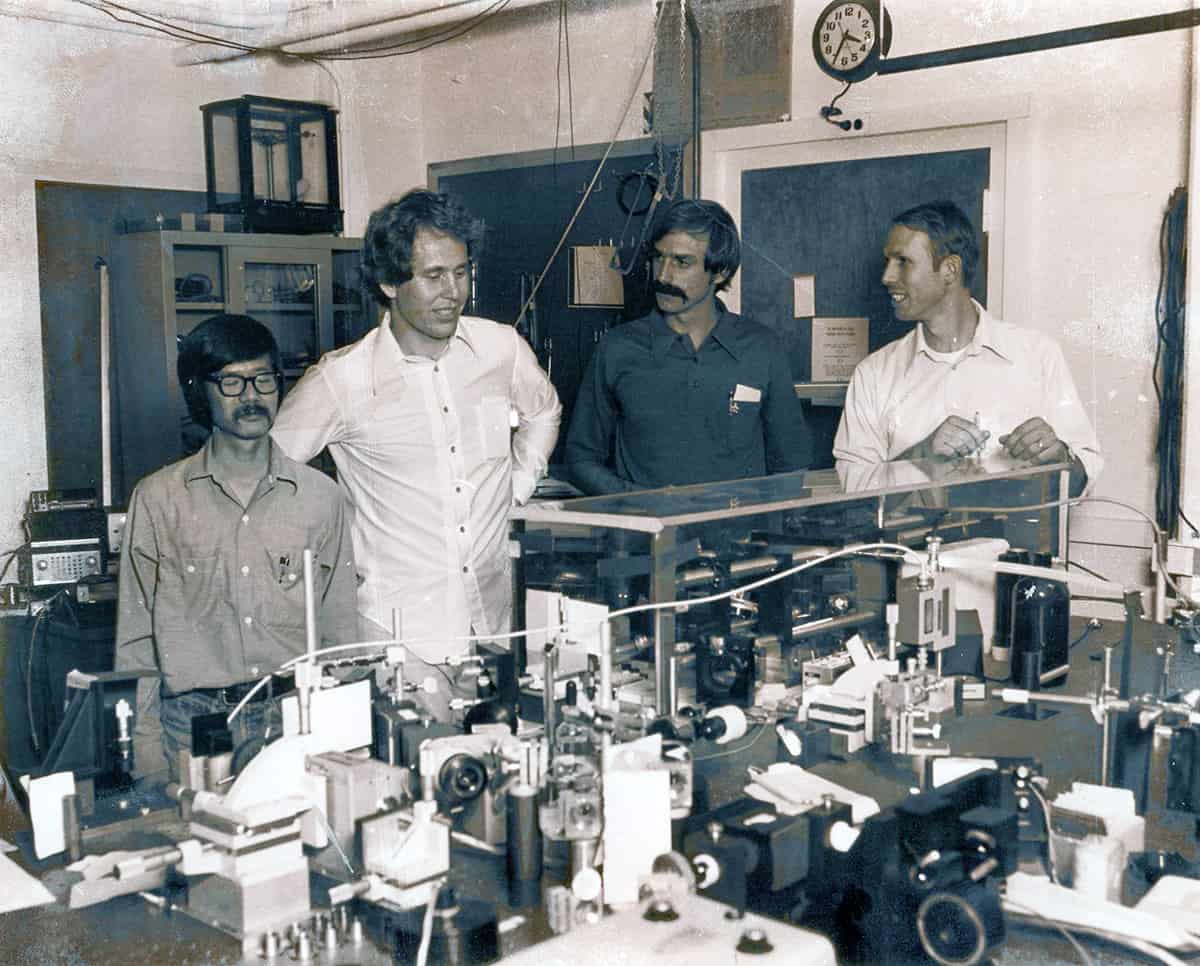
Ion trappers Wayne Itano, Jim Bergquist, Dave Wineland and Bob Drullinger of the National Bureau of Standards (later NIST) Ions Group in 1979. (Courtesy: David Wineland/National Institute of Standards and Technology. Used with permission. Rights reserved.)
Drullinger put together a system that could produce enough ultraviolet light to demonstrate laser cooling on a sample of magnesium ions. This is not a simple process even today, and in 1977 it was a major challenge. According to Drullinger, it took around six weeks of intensive effort, starting from an empty room and a lot of equipment in crates, before he and Wineland were ready to make their first attempt at cooling ions.
The initial experiment used a cloud of around 50,000 trapped magnesium ions. To monitor the ions’ behaviour, Drullinger and Wineland measured the currents the ions’ random motion induced in the trap electrodes. The faster the ions moved, the bigger the currents they created, so the signal they produced was essentially random noise at an overall level that depended on the temperature of the ion cloud.
The first night the apparatus came together, Drullinger recalls that it was nearly midnight before they had everything ready. As we’ll see again with the cooling of neutral atoms, this is fairly typical for such experiments. Wineland and Drullinger fired up the trap, turned on the laser and immediately saw the cooling signature they expected. “We did the first scan, and bang! There it was,” Drullinger recalls. The noise from thermal motion dropped dramatically when illuminated with a red-detuned laser, down to a level so low they could not even estimate the ions’ temperature. When they changed the laser frequency to make it blue-detuned, the trapped ions heated up, exactly as expected. It was a great success.
From delight to disappointment, and back
Of course, it wasn’t quite as simple as that. After taking preliminary measurements, Wineland and Drullinger called it a night. The next day, the signal was much worse; the laser had an effect, but not nearly as dramatic. On the third night, they saw nothing. While the electronic signal indicated ions were trapped, the laser didn’t seem to be doing anything at all.
Baffled and disappointed, they tore down their apparatus and rebuilt it. Eventually, they discovered the problem: they had exhausted their supply of magnesium. In fact, in their efforts to continue trapping ions, they had pushed the temperature of their failing magnesium source (commonly referred to as the “oven” in this field) so high that sodium ions began boiling out of the glass port of the vacuum chamber. Sodium and magnesium have nearly the same atomic mass, so the trapped-ion signal looked similar, but they absorb light at very different frequencies, so it was no surprise that Wineland and Drullinger weren’t cooling anything. They duly reloaded the source with magnesium, and once they resumed trapping the correct element, the cooling signal returned.
Wineland and Drullinger wrote up their results and submitted them to Physical Review Letters (40 1639). Curiously enough, a rival group in Heidelberg, Germany was also doing laser-cooling experiments (aided by a visiting Dehmelt), and the two groups’ papers reached the journal one day apart: first the Heidelberg team’s paper on barium ions, then the Boulder trio’s on magnesium. But as luck would have it, the editing process for the Heidelberg paper (Phys. Rev. Lett.41 233) took longer, so Wineland, Drullinger and Walls’ was the first to print, in June 1978.
I turned to Dave and said ‘Where do we go from here?’ Very slowly, a little grin spread across his face, and he said, ‘Stockholm’
Bob Drullinger
Sometimes, it takes a while for the full significance of a discovery to become clear. This time, it was pretty much immediate. On that first late night, Drullinger recalls that he and Wineland spent some time “sitting there just enjoying the moment. We’re on opposite sides of the table, and the room was dark, just the glow of the lasers. I was eager to get on to the next step, but I couldn’t immediately figure out what that was. So I turned to Dave and I said ‘Where do we go from here?’ Very slowly, a little grin spread across his face, and he said, ‘Stockholm’.”
Wineland was right. In 2012 he shared the Nobel Prize for Physics “for ground-breaking experimental methods that enable measuring and manipulation of individual quantum systems”.
The problems of neutral atoms
Wineland’s prize was not, however, the first Nobel to be awarded to a NIST physicist for laser cooling. That honour went to work that happened chronologically later, in the mid-1980s, on the opposite side of the US. At the same time as Wineland’s group was getting off the ground in Boulder, Bill Phillips was finishing his PhD at the Massachusetts Institute of Technology (MIT). At the celebration following Phillips’ defence, his supervisor joked that it was good that he had done a side project on lasers during his PhD, because if his only work was his original project on magnetic resonance, he would’ve ended up “stuck at the National Bureau of Standards”.
Phillips did, in fact, end up at the National Bureau of Standards, but in Gaithersburg, Maryland, rather than Boulder, Colorado. Like Wineland, he was hired to contribute to a core project – an improved measurement of the ampere, the unit of electric current – with an agreement that he could spend some time, in his words, “fooling around with atomic physics”. And so he set up a small lab for laser cooling sodium atoms.
It’s a trap Arthur Ashkin in 1971 with his lab apparatus capable of levitating small particles in an intense laser beam. (Courtesy: Nokia Bell Labs, Nokia Corporation and AT&T Archives)
Phillips’ inspiration was a 1978 paper in which Ashkin proposed trapping neutral atoms between two tightly focused laser beams (Phys. Rev. Lett.40 729). Neutral atoms are much more difficult to trap than ions, whose electrical charge means they experience large forces from magnetic fields or high-voltage electrodes. In the absence of an electric charge, the only forces that can easily be applied to atoms come from the scattering force (momentum transfer when photons are absorbed) and the dipole force (which lowers the atom’s internal energy in the presence of light, and thus pulls it into the centre of a beam). Both of these are relatively tiny. Making an optical trap strong enough to catch fast-moving atoms from a hot vapour is thus a tricky business.
Still, Phillips was struck by the idea. He even explored it briefly while a postdoc at MIT, only to conclude that the problem was more complicated than he initially thought, and best filed away for when he had his own lab. His trial run encountered two problems with the prevailing simple picture of laser cooling. One of these is the same Doppler shift that makes cooling possible. A sodium atomic beam emerges from an oven at speeds approaching 1000 m/s. This produces an enormous Doppler shift in the frequency of the light needed to slow the beam. But as the atoms absorb photons and slow down, the Doppler shift decreases and the cooling becomes less effective. After a reduction of just a few metres per second, the atoms quit absorbing the light and the slowing stops.
The second problem is that the Doppler cooling concept envisions atoms with only two energy levels: a ground state and an excited state. But real atoms have multiple low-energy states, and only one of them can absorb light from the laser. Hence, after a handful of cycles of photon absorption and re-emission, atoms tend to decay into a “dark” state and stop interacting with the laser.
One really good idea
By the time Phillips was ready to try cooling atoms again, other research groups had identified some potential fixes. The multiple-states problem proved relatively straightforward to solve: adding a second “repumper” laser to the experiment returns atoms from the dark state back to the bright one so that slowing can resume. Fixing the Doppler shift was trickier. Possible solutions included using a broad range of frequencies in the slowing beam (“white-light cooling”) and sweeping the frequency of the cooling laser to follow the changing Doppler shift (“chirp cooling”), but both of these methods require expensive and complicated modifications to the laser source.
After consulting with Metcalf, Phillips opted for a third approach, one that he describes as “the only good idea I’ve ever had”. Rather than adjusting the frequency of the laser to match the changing velocity of the atoms, he used a magnetic field to adjust the frequency of the atoms to match that of the laser. This is possible because of the Zeeman effect: a neutral atom placed in a magnetic field sees its energy levels shift up or down by an amount that depends on the strength of the field (figure 3).
3 Zeeman slowing
(Copyright: Chad Orzel/IOP Publishing)
Fast-moving atoms in the atomic beam enter a tapered electromagnet at the right, and have their energy levels shifted by a large magnetic field (dashed blue arrow), which compensates for the large Doppler shift (light blue arrow), allowing them to absorb photons from the laser. At the left end, the field has decreased significantly, but so has the Doppler shift, allowing the same laser to continue to interact with the atoms.
Thanks to this Zeeman shift, a tapered magnetic field can compensate for changes in the Doppler shift as the atoms slow down. Close to the oven, where the atoms are moving very fast and have large Doppler shifts, the field is very large, leading to a large energy shift. At the far end, where the atoms are moving slowly, the field is much smaller, and both the Doppler and Zeeman shifts are small. With the right choice of fields, then, the same laser beam interacts with both sets of atoms, extending the cooling process.
Phillips’ masterstroke had one further benefit. As well as compensating for the Doppler shift, the magnetic field of the so-called Zeeman slower shifts the atoms’ energy levels in a way that almost completely eliminates the need for repumping. A single laser, shining down the bore of a tapered electromagnet, can bring a beam of sodium atoms to a near-complete stop using only scattered light. “Everything else was just luck,” Phillips reflects, “but [Zeeman slowing] was actually a good idea.”
Catching atoms in a magnetic trap
Phillips and Metcalf next turned their attention to trapping the atoms. Using two coils of wire placed inside the vacuum chamber that keeps the atoms isolated from their environment, they created a magnetic field with a minimum in its centre. The result is, again, a Zeeman shift, but this time it weakly traps the atoms as well as slowing them. In order for an atom to move out from the centre, it has to increase the energy of its orbiting electron, and the energy to do that must come out of its motion, slowing it down. Eventually, it comes to a stop and reverses direction, back toward the centre of the trap.
Much like Wineland and Drullinger a few years earlier, Phillips and Metcalf made their first attempt at magnetic trapping late at night. “Everything always happens late at night,” says Phillips, “because if you could have gotten everything working before late at night, you would’ve done the experiment already, but you have to learn how to get everything working first.”
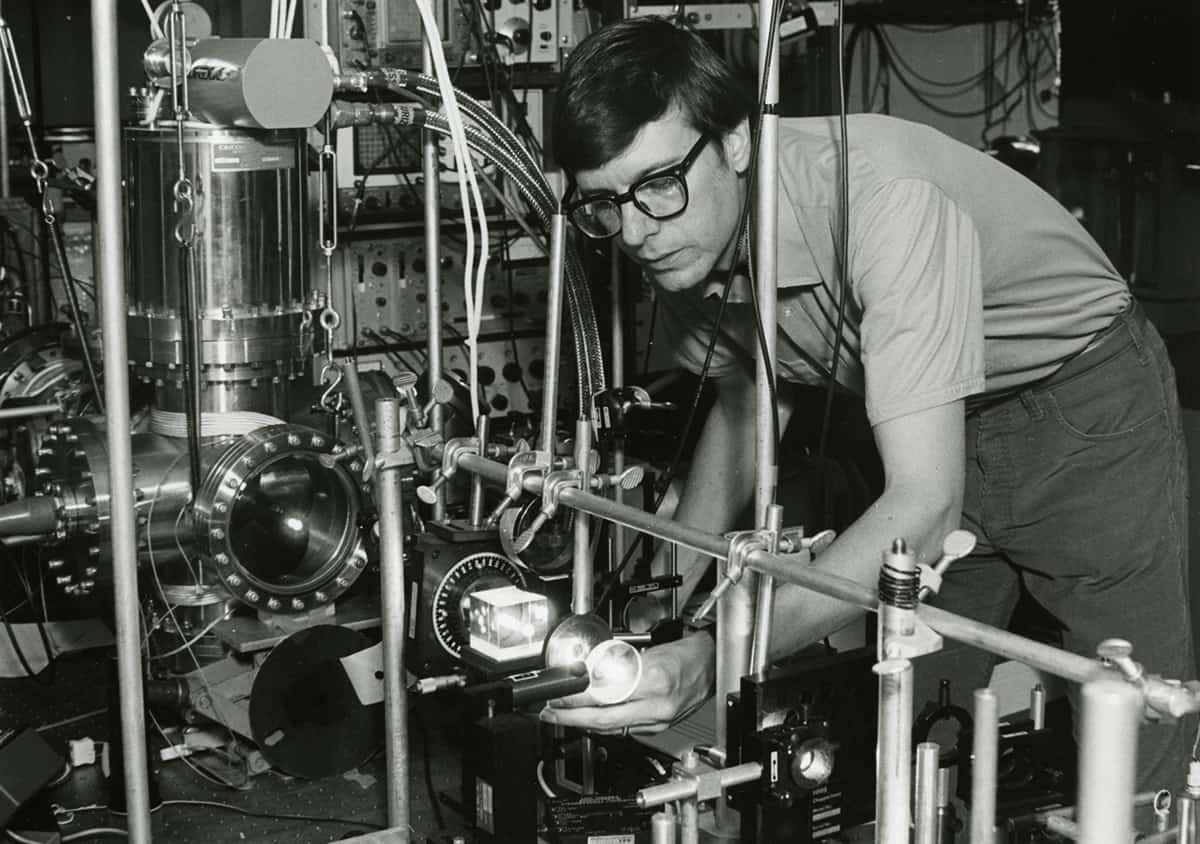
Suspense Bill Phillips working on laser-cooling experiments in his laboratory circa 1986. (Courtesy: Phillips/National Institute of Standards and Technology. Used with permission. Rights reserved.)
In this case, each experimental run consisted of turning on the laser for the fraction of a second needed to slow atoms, then turning the laser off and the magnetic trap on, then waiting an additional period of tens of milliseconds before flashing another laser pulse on to look for fluorescence emitted by atoms held in the trap. The sequence of laser pulses was controlled by a rotating cardboard disc with holes cut in the appropriate places – “These were really prehistoric times,” Phillips jokes – and after a long day, they finally had all the timings right.
Unfortunately, they didn’t see any atoms. “So we said, ‘Okay, let’s get something to eat,’” Phillips recalls. When they returned, they turned the system back on. Immediately, everything worked. Over the course of a very long day, the high current running through the magnetic-trap coils had gradually heated the coils enough to degrade the vacuum inside the chamber. The slow sodium atoms that should’ve been trapped were thus knocked out by collisions with unrelated “background” atoms boiled out of the coils. But during Phillips and Metcalf’s late-night fast-food break, the coils cooled down and the vacuum recovered, so everything worked as designed.
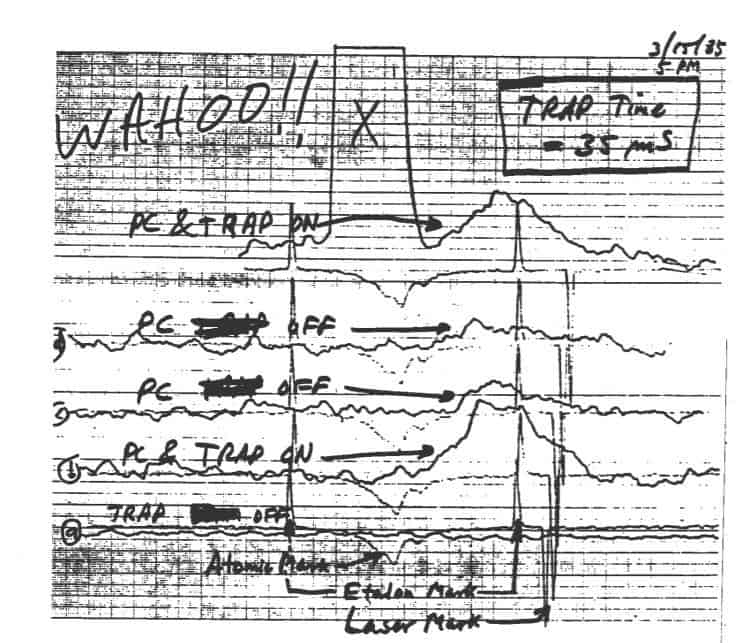
Wahoo This chart, from 15 March 1985, indicated to Bill Phillips and his fellow researchers that they had succeeded in capturing atoms with their magnetic trap. Group member Hal Metcalf labelled the good news with “WAHOO!!” (Courtesy: Bill Phillips/National Institute of Standards and Technology. Used with permission. Rights reserved.)
Buoyed by this success, Metcalf scrawled “Wahoo!” on the chart recorder trace showing the fluorescence signal that confirmed the magnetic trap was holding on to atoms loaded from the slower. The pair then worked through the night. At sunrise, they returned to Phillips’s house. “We hunted around in the fridge and found some ice cream,” Metcalf recalls, “And [Phillips’ wife] Jane came down and said, ‘That ice cream is for the kids! What are you guys doing?’ And so we told her, ‘Well, we had a pretty good night, we’re celebrating.’”
They had earned the ice cream. Phillips and Metcalf’s paper on the first magnetic trapping of neutral atoms was published in 1985 (Phys. Rev. Lett.54 2496). A little over a decade later, in 1997, it helped to secure Phillips a share of the Nobel Prize for Physics “for development of methods to cool and trap atoms with laser light”.
A tale of three Nobels
The early years of laser cooling are thus a tale of three Nobel prizes: Ashkin’s for proving it was possible to manipulate small objects with light; Wineland’s for extending the principle to ions; and Phillips’ for showing that atoms, too, could be trapped and tamed with beams of photons. But in the mid-1980s, new researchers joined the burgeoning field of laser cooling, bringing new technologies and techniques for cooling and trapping, some of which would turn out to work better than theory said was possible. The process of revolutionizing atomic, molecular and optical physics was just getting started.
Researchers in Switzerland have transmitted and received optical data at rates of more than 10 Tbit/s between an Alpine peak and an observatory at the University of Bern – a distance of 53 kilometres. This is more than five times further than would be needed to set up a satellite-to-ground communication link, and the team say the method could be used to create faster and more cost-effective Internet connections for satellite constellations in near-Earth orbit.
Satellite constellation systems such as SpaceX’s Starlink (a network of more than 2000 satellites orbiting close to the Earth) promise to bring Internet access to the world via space-based laser communications. The principle is that areas that do not have access to optical-fibre cable technology, which makes up the backbone of the modern Internet, could instead become connected to the optical network via satellites.
At present, data transmission between satellites and ground stations relies mainly on radiofrequency technologies, which operate in the microwave range of the electromagnetic spectrum and have wavelengths of centimetres. Laser optical systems, in contrast, operate in the near-infrared range, and their micron-scale wavelengths are about 10 000 times shorter than radio waves. This enables them to transport more data in the same amount of time. Indeed, several previous experiments have shown that free-space optical communication technologies can transmit data at rates of 100 Gbits/s over distances of up to 10 km and 1 Tbits/s over distances of up to 3 m in a single channel.
The downside is that such systems rely on advanced high-order modulation formats and therefore require high signal-to-noise ratios, which are only possible over relatively short distances. Future satellite links will also require even higher data rates, on the order of 500 Gbits/s or more.
The researchers achieved this feat by modulating the laser’s light wave in a way that allowed the receiver to detect different states encoded into a single “symbol”. This means that each symbol can transmit more than one bit of information. For example, a scheme comprising 16 states can transmit four bits with each oscillation of the light wave, while one with 64 states can transmit six bits.
“Several key components enabled this success,” says study lead author Yannik Horst. On the transmitter side, he explains that the team encode the information in a power-efficient way by using a coherent modulation format such as a polarization-multiplexed 64-quadrature-amplitude-modulation (64-QAM). They then send it with very high precision (a few tens of micro-radians) in the direction of the receiver at the observatory. Finally, after the light passes through 53 km of turbulent atmosphere, an adaptive optics system at the receiving station corrects the phase front error of the electromagnetic wave.
“The adaptive optics leads to ~300 times stronger signal in the optical fibre,” Horst tells Physics World. “The improvement also comes thanks to the optical building block that has a high receiver sensitivity – only a few photons per bit are needed for error-free data transmission.”
Horst and colleagues say their new technique should bring us a step closer to satellite-Earth and inter-satellite communication links based on optical technologies that can achieve very high date-rates per channel – much higher than is possible for radiofrequency technologies. Such links could one day act as the backbone for the terrestrial fibre network and ultimately “connect the unconnected” in areas where the deployment of mainstream communications technologies such as optical fibre is not feasible.
The researchers, who report their work in Science, are now investigating a novel modulation format known as 4D-BPSK. “We believe this format could be applied to other optical applications thanks to its very high sensitivity too,” Horst says.
Neural networks can estimate the degree of entanglement in quantum systems far more efficiently than traditional techniques, a new study shows. By side-stepping the need to fully characterize quantum states, the new deep learning method could prove especially useful for large-scale quantum technologies, where quantifying entanglement will be crucial but resource limitations make full state characterization unrealistic.
Entanglement – a situation in which multiple particles share a common wavefunction, so that disturbing one particle affects all others – is at the heart of quantum mechanics. Measuring the degree of entanglement in a system is thus part of understanding how “quantum” it is, says study co-author Miroslav Ježek, a physicist at Palacký University in Czechia. “You can observe this behaviour starting from simple two-particle systems where the fundamentals of quantum physics are discussed,” he explains. “On the other hand, there is a direct link between, for example, changes of entanglement and phase transitions in macroscopic matter.”
The degree to which any two particles in a system are entangled can be quantified by a single number. Getting the exact value of this number requires reconstructing the wavefunction, but measuring a quantum state destroys it, so multiple copies of the same state must be measured over and over again. This is called quantum tomography in analogy to classical tomography, in which a series of 2D images is used to construct a 3D one, and it is an unavoidable consequence of quantum theory. “If you could learn about a quantum state from one measurement a qubit would not be a qubit – it would be a bit – and there would be no quantum communication,” says Ana Predojević, a physicist at Stockholm University, Sweden, and a member of the study team.
The problem is that the inherent uncertainty of a quantum measurement makes it extremely difficult to measure the entanglement between (for example) qubits in a quantum processor, since one must perform full multi-qubit wavefunction tomography on each qubit. Even for a small processor, this would take days: “You can’t do just one measurement and say whether you have entanglement or not,” says Predojević. “It’s like when people do a CAT [computed axial tomography] scan of your spine – you need to be in the tube 45 minutes so they can take the full image: you can’t ask whether there’s something wrong with this or that vertebra from a five minute scan.”
Finding good enough answers
Although calculating entanglement with 100% accuracy requires full quantum state tomography, several algorithms exist that can guess the quantum state from partial information. The problem with this approach, Ježek says, is “there is no mathematical proof that with some limited number of measurements you say something about entanglement at some precision level”.
In the new work, Ježek, Predojević and colleagues took a different tack, jettisoning the notion of quantum state reconstruction altogether in favour of targeting the degree of entanglement alone. To do this, they designed deep neural networks to study entangled quantum states and trained them on numerically generated data. “We randomly select quantum states and, having generated the state, we know the output of the network because we know the amount of entanglement in the system,” explains Ježek; “but we can also simulate the data that we would get during measurement of different numbers of copies from different directions…These simulated data are the input of the network.”
The networks used these data to teach themselves to make ever-better estimations of the entanglement from given sets of measurements. The researchers then checked the algorithm’s accuracy using a second set of simulated data. They found its errors were around 10 times lower than those of a traditional quantum tomography estimation algorithm.
Testing the method experimentally
Finally, the researchers experimentally measured two real entangled systems: a resonantly pumped semiconductor quantum dot and a spontaneous parametric down-conversion two-photon source. “We measured full quantum state tomography…and from this we knew everything about the quantum state,” says Ježek, “Then we omitted some of these measurements.” As they removed more and more measurements, they compared the error in the predictions of their deep neural networks with the errors from the same traditional algorithm. The error of the neural networks was significantly lower.
Ryan Glasser, a quantum optics expert at Tulane University in Louisiana, US, who has previously used machine learning to estimate quantum states, calls the new work “significant”. “One of the problems quantum technologies are running into right now is that we’re getting to the point where we can scale things to larger systems, and…you want to be able to fully understand your system,” Glasser says. “Quantum systems are notoriously delicate and difficult to measure and fully characterize…[The researchers] show that they can very accurately quantify the amount of entanglement in their system, which is very useful as we go to larger and larger quantum systems because nobody wants a two-qubit quantum computer.”
The group now plans to extend its research to larger quantum systems. Ježek is also interested in the inverse problem: “Let’s say we need to measure the entanglement of a quantum system with a precision of, say, 1%,” he says, “What minimum level of measurement do we need to get that level of entanglement estimation?”
A big reason why the UK is an attractive place for small businesses is the existence of research and development (R&D) tax credits. Introduced over 20 years ago, they encourage firms to spend more on R&D because they get a proportion of the costs back (if the business makes a loss) or pay less corporation tax (if it makes a profit). Sure, firms sometimes have to wait up to six months after submitting their annual company tax return to get the benefit, but at least everyone knows how the system works.
Recently, however, the UK government has proposed various changes, which were discussed at a business briefing held on behalf of the Business and Innovation Group of the Institute of Physics (IOP) earlier this year. The event, which I hosted, featured speakers from three financial companies recommended by IOP members. The speakers gave an overview of the UK’s R&D tax-credit schemes, explained how they work, and discussed the possible impact of the changes.
Of particular interest to large firms is the Research and Development Expenditure Credit (RDEC). It encourages such firms to invest in R&D by essentially cutting their tax bill by up to 13% of what they spend on R&D. The good news is that from 1 April 2023, the figure has been increased to 20% of these “qualifying costs”. That’s great for large multinational companies as R&D tax credit schemes can make all the difference when deciding which country to set up and run R&D projects in.
As for small- and medium-sized enterprises (SMEs), they could previously apply an enhanced deduction rate of 130% of qualifying R&D costs. Essentially, this provision mean that companies that have failed to make a profit in a particular year can receive money back from the state, which can be vital to fund future development. From 1 April 2023, however, this figure has been reduced to 86%, which means less money back.
Winners and losers
SMEs can, of course, use both schemes but in reality most of their claims will be under the SME scheme. On the flip side, however, the scope of what counts as R&D has been expanded greatly. Firms can now also include the costs associated with data processing and cloud computing; they can even include work on pure mathematics. Overall, the changes will mean there will be both winners and losers.
Firms will also have to grapple with changes to the ways in which they submit their R&D tax claims. From 1 August 2023, companies now have to fill in an “Additional Information Form” before filing their corporation tax return containing the R&D claim. The extra paperwork is designed to cut down on the number of inflated, fictitious or fraudulent claims. But completing the form, which involves explaining exactly what you spent your R&D money on, is a time-consuming affair.
In fact, there is now an entire industry of advisors and accountants who earn money by helping companies submit their claims. Some law firms even offer these services, combining a legal knowledge with tax insights to ensure your claim is technically sound and legally defensible. If you’ve got a business, it’s worth thinking about using such firms as they provide an added layer of protection and make it much more likely that your claim will succeed.
What’s more, the lawyers usually operate on a “no-win-no-fee” basis so if your claim fails, you won’t have to pay a penny. If you do succeed, you’ll typically pay them up to 25% of the benefit gained, with the precise value depending on what you negotiate and the size of the claim. Yes, that’s money that could have gone on further R&D but the advisors can pinpoint activities you might not have realized could count as R&D, which means you can end up saving more than you spent on fees.
Simpler and better
The other good news is that the UK is starting a consultation on reducing this complexity to create a single, simplified R&D tax-relief scheme. First announced in 2022 by chancellor Jeremy Hunt as part of a wider review of R&D tax relief, the government says it wants to “unlock the potential of SMEs”. The consultation document promises to raise R&D tax relief from £6.7bn in 2020–21 to over £9bn in 2027–28 but in a way that “ensures better value for the taxpayer”.
In its response to the consultation, the IOP policy team, headed by Tony McBride, has expressed its support for a single scheme, provided that it maintains the benefits each separate scheme currently affords and that no firm doing R&D becomes ineligible. I personally feel the consultation is a great opportunity for the UK government to fine-tune its R&D tax credit schemes and make the new version much less complex. That will go a long way to boost the UK economy and increase the global competitiveness of British physics-based businesses, which can only be a good thing.
The growing complexity of radiotherapy treatment plans is demanding more rigorous and accurate methods for calculating, measuring and verifying the radiation dose that is delivered to the patient. For stereotactic treatments in particular, where high levels of radiation are concentrated into small target volumes, it becomes critically important for clinical physicists to have access to precise information about the dose profile and how it relates to the anatomy of the patient.
That need for accuracy in the treatment planning process has been the guiding principle behind IBA Dosimetry’s system for patient-specific quality assurance (QA), called myQA iON. First released in 2019 for use in proton therapy and launched in 2022 for the photon radiotherapy sector, myQA iON provides an end-to-end solution that allows clinicians to access comprehensive and reliable verification information to guide and manage the treatment process. By combining independent three-dimensional (3D) dose calculations for treatment plans with real-world measurement data and irradiation log files, the software has been designed to help radiotherapy clinics boost their workflow efficiency while also enhancing patient safety and treatment outcomes.
At the Duke University Medical Center, for example, medical physicist Guoquiang Cui has been evaluating the potential of myQA iON for improving the stereotactic radiosurgery (SRS) treatments that target multiple sites at the same time. “These SRS plans might have anywhere between five and fifteen different targets,” Cui explains. “For delivery efficiency we plan them using a single isocentre so that we only need to deliver one dose of radiation to treat them all at the same time.”
In the clinic, Cui and his team currently exploit a 2D detector array to measure and verify the dose distribution for these single-isocentre multiple-target (SIMT) treatments. However, this measurement-based approach does not allow them to easily access 3D information about the radiation profile, or to evaluate the dose delivered to all of the targets at the same time. “We can only look at the overall plan,” says Cui. “We typically check one or two targets using the 2D measurements, but we don’t verify them one-by-one because it would take too much time.”
In contrast, myQA iON makes it possible to examine the total 3D dose distribution across the whole plan, as well as the dose delivered to each of the individual targets. The independent dose calculation provided by the system exploits the gold-standard Monte Carlo method, which provides a full 3D analysis of the dose distribution in relation to the patient’s anatomy. “The Monte Carlo algorithm provides more accurate dose calculations than the algorithm we usually use in our planning system,” says Cui. “It is slightly slower but it gives accurate dose information across the full 3D volume.”
As an additional verification tool, the software also provides access to the log files generated automatically by the radiotherapy system during treatment, providing accurate measurement data of the delivered dose to check against the treatment plan. According to Mehgan Boone, product manager at IBA Dosimetry for software and integration, access to the log-file data could be particularly useful for fractional treatments, since it allows clinicians to check the dose delivered in each fraction and make any subsequent adjustments to their treatment plan. “By bringing the log files into myQA iON we can calculate the dose delivered to the patient based on the information generated by the treatment machine,” she explains. “These raw delivery data are already available to the user, we’re just providing clinical context, helping users to determine actionable outcomes, and making the data accessible from a single place.”
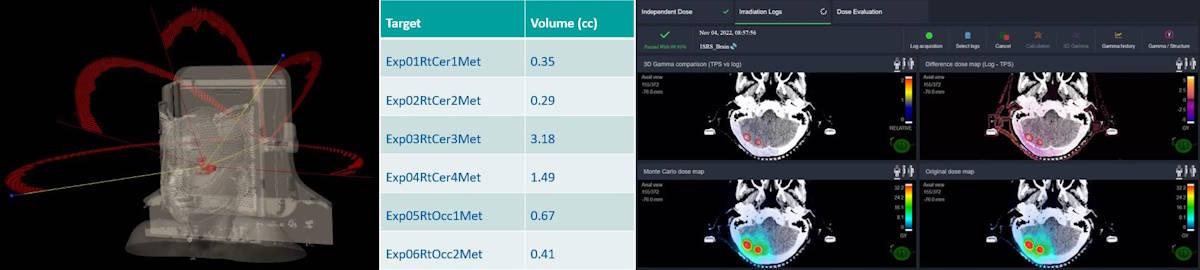
Completing the picture As part of their evaluation of myQA iON, Guoqiang Cui and colleagues at the Duke University Medical Center used the software to verify and evaluate an SIMT-SRS treatment of six separate brain tumours (left). The Monte Carlo algorithm provided in myQA iON yielded accurate dose calculations (right), and allowed the dose to be evaluated for each individual target at the same time. A 3D gamma analysis based on the log-file data from the radiotherapy machine showed an almost identical match between the calculated and delivered doses. (Courtesy: G Cui)
For the evaluation work at Duke University, these log-file data were used to compare the Monte Carlo dose calculations produced by myQA iON against the results from the treatment planning system. In one example, Cui and his team used the software to plan an SIMT-SRS treatment of the brain with six separate targets of varying sizes. They found that the Monte Carlo method provided extremely accurate dose calculations for each of the targets, with a 3D gamma analysis showing close agreement between the planned and delivered doses. “The results so far have been very promising,” says Cui. “By combining the 3D dose information from myQA iON with the measurement data from the log files, we can obtain a more complete picture of these complex SRS plans.”
Boone agrees that the ability to integrate independent dose calculations with irradiation log files and real-world detector measurements can offer additional insights to guide the planning and delivery of complex treatments. “The independent Monte Carlo method provides the additional accuracy, including a full volumetric analysis of the dose distribution,” she says. “Bringing all the information together into a unified and automated software solution provides greater flexibility and efficiency, avoiding the need to pull data from different systems or computers.”
The software solution is easy to install and intuitive to use, with the web-based portal designed to allow clinical teams to access all their QA data from any device that connects to the hospital network. In practice, says Cui, that means that IT expertise is likely to be needed for the system to be implemented in the clinic. “The software needs to operate alongside the firewalls and security systems deployed on hospital networks, which will need careful configuration by the IT specialists in our department,” he says. “For our specific clinical environment and practices the biggest benefit of myQA iON is the additional 3D dose information that we can obtain for our complex SRS treatments.”
For its part, IBA is continuing to use the feedback from early adopters like Cui to refine and improve the myQA iON system. “We will be adding new features to enable our users to make the best possible use of our software,” says Boone. “We want to make the system as seamless as possible, while also delivering further improvements in automation and integration.”