Based near Washington, DC, QEC-C is an international organization that identifies gaps in quantum-related technologies, standards, and workforces and addresses those gaps through collaboration between industry and governments.
Merzbacher is an R&D expert who has recently testified before the US House of Representatives Committee on Science, Space, and Technology on the issues facing the quantum industry. She shares her insights on the challenges of building a quantum workforce and explains why the strong coordination of academia, industry and governments is essential for future success.
Scientists in China want to build a new electron–positron collider to test the Standard Model of particle physics in unprecedented detail and keep the country at the forefront of precision studies on charm quarks and tau leptons. If approved, construction of the 4.5-billion-yuan ($640m) Super Tau-Charm Factory (STCF) in Hefei could begin in 2026. Operations would then start about five years later.
The STCF is seen as a natural successor to the Beijing Electron Positron Collider (BEPC), which opened in 1990. It consists of some 240 m of underground tunnels in the west of the city, where electrons and positrons are first accelerated to near the speed of light before being smashed into each other to generate a variety of subatomic particles. The trajectories, energies and electric charges are then recorded by the Beijing Spectrometer (BES) to reconstruct the reaction processes.
Working in the 2–5 GeV energy range, the BEPC has made a series of important discoveries, especially in charm quark and tau lepton physics. In 1996, for example, researchers used the collider to carry out precision measurements on the mass of the tau particle. It has also been used to study “exotic” particles containing four or more quarks.
At the forefront
Both the accelerator and the spectrometer at the BEPC underwent major upgrades in the 2000s to become what is known today as BEPC-II/BESIII, with the revamped collider expected to operate well into the early 2030s. However, its location and relatively small storage ring mean it will be difficult to achieve further performance improvements, which is why particle physicists in China are now turning to a new machine.
First proposed in 2011 by Peking University particle physicist Zhao Guangda, the STCF will have a similar design to the BEPC but be more than twice the size. Its linear accelerator will be 400 m long, while the two rings for storing electrons and positrons will each be about 800 m in circumference. With new accelerator technologies and a state-of-the-art spectrometer, STCF will operate with a centre-of-mass energy range of 2–7 GeV and with a peak luminosity of more than 0.5 × 1035 cm−2/s, about 100 times better than BEPC-II.
“The BEPC is one of the most fruitful and successful research facilities China has built,” says STCF chief scientist Zhao Zhengguo from the University of Science and Technology of China (USTC). “Yet compared to [BEPC], STCF will increase the collision rates by up to 100 times and open up a brand new energy region that has never been directly studied before.” According to project deputy chief scientist Zheng Yangheng from the University of the Chinese Academy of Sciences, the STCF will collect the same amount of data in three days as BESIII requires a year to gather.
This will make it possible to confirm, for the first time, if a tetraquark really has four quarks. “I expect the STCF would be able to make definitive measurements to finally reveal the internal quark structure of several exotic hadrons,” says Ryan Mitchell from Indiana University Bloomington, who is a member of the BESIII collaboration and supports the STCF conceptual design. “More importantly, it would also help us better understand how the strong force works to bind quarks together.”
We just don’t know what to expect in that energy range
Ryan Mitchell, Indiana University Bloomington
As the 5–7 GeV energy range has never been explored on any particle collider before, the STCF will open the door to uncharted territories and possibly even new physics beyond the Standard Model. “We just don’t know what to expect in that energy range,” adds Mitchell.
To achieve well-controlled collisions inside the STCF, Zhao and his team have been developing key technologies such as high-power electron and positron sources, superconducting magnets, and those for measuring and manipulating the beams with high precision. “Each electron or positron is supposed to pass the potential collision point millions of times during its life span,” says USTC’s Shao Ming, a leading physicist on the project. “For our designed luminosity we need to make sure that it hits the point with no more than a few hundred nanometres’ error.”
For the STCF to be 100 times more luminous than the BEPC-II, its spectrometer will need to be better at handling electronic signals from the detector. To that end, partnerships have been fostered with domestic companies. These include chip, sensor and semiconductor manufacturers that can create components that China cannot buy from western nations due to export embargoes. “The synergy has worked out well for our project and for the industry,” adds STCF chief engineer Yin Lixin from the Shanghai Advanced Research Institute.
The next generation
While funding is less of an issue than it used to be because local governments are putting more money and giving a high priority towards hosting big-science facilities, the STCF does face competition. One is from a next-generation Higgs factory – the Circular Electron Positron Collider (CEPC) – a 100 km ring that will run at much higher energies but be much more costly too.
The CEPC is also aiming to start construction by 2030 but it remains a possibility that both could get the go-ahead. “The STCF and the CEPC don’t need to be contradictory because they do very different science,” says Zhao. “Though the two projects are less likely to happen at the same time, a few years’ gap in implementation might increase the chance for both to be built eventually.”
Discussions about what projects to recommend for China’s upcoming 15th five-year plan, which runs from 2026 to 2030, have already begun within China’s high-energy physics community. While both the STCF and the CEPC will be led by China, the STCF already has about 500 scientists from 74 universities and research institutes in Asia, Europe and the US. Zhao admits it is a challenge to make the STCF a truly international effort due to geopolitical tensions and other factors, but is positive that they will have a minimal impact.
“Like all particle-physics experiments in the world, the STCF will serve the global particle physics community and we welcome colleagues with different expertise to join us in Hefei,” adds Zhao. “The STCF will allow China to continue to lead the world in tau-charm physics and related technologies for decades to come – China is finally standing at the forefront.”
Researchers in the US have isolated a ball of turbulence inside a tank of water and sustained it by firing vortex rings from the corners of the tank. William Irvine and colleagues at the University of Chicago say that their new technique could lead to a transformation in the way turbulence is studied experimentally.
From eddies in a stream to the swirling of gas in interstellar space, turbulence underpins the behaviour of many different systems in nature. Its main characteristics are easy to spot and include irregular and erratic fluctuations in velocity and pressure. Yet despite their ubiquity, researchers struggle to describe exactly how turbulent fluids behave.
“Turbulence appears everywhere around us, but it keeps eluding what physicists consider a satisfying description.” Irvine explains. “For example, if you ask, can I predict what happens next when I poke this region of turbulence? The answer is no. Not even really with a supercomputer.”
Controlled disturbances
While turbulence can be created and studied in the lab, it is very difficult to prevent a turbulent fluid from interacting with the walls of its container, or the stirring apparatus used to generate turbulence. So far, this setback has prevented physicists from understanding how turbulent fluids evolve over time if left undisturbed, or how they respond to controlled disturbances.
To address this challenge, Irvine’s team sought to create a completely isolated region of turbulence using vortex rings. These are circular swirls of fluid that generate turbulence as they collide with each other.
At first, Irvine and colleagues did this by placing vortex-generating ring jets at either end of a water tank. The water was seeded with bubbles to visualize the motions of the rings. Although turbulence was observed initially, the flows eventually recombined to create new sets of rings, which deflected away from the original point of collision.
Eight vortex rings
In the latest study, Irvine’s team instead placed a ring jet at each corner of the tank – with far more interesting results. As the eight vortex rings collided, they created a roughly spherical ball of turbulence at the centre of the tank. Not only was the ball completely isolated from the tank’s walls; it could be sustained simply by firing more vortex rings into the tank periodically.
“No-one knew this was even possible,” says team member Takumi Matsuzawa. “Turbulence is very good at mixing things; if you mix your milk into your coffee, you can only get one or two swirls in before it becomes completely mixed. The fact we can contain it in place is very surprising.”
It’s like calmly sitting in a field with a picnic and watching a storm raging 50 feet away
William Irvine
With this set-up, the team could combine vortex rings like LEGO blocks – controlling parameters including the rings’ energy and helicity – the latter describing whether the vortices rotated clockwise or anticlockwise.
In turn, the researchers could fine-tune the parameters of the turbulence inside the ball, then observe how it evolved as they sustained it with more vortex rings – or how it dissipated as they stopped adding new rings. “It’s like calmly sitting in a field with a picnic and watching a storm raging 50 feet away,” Irvine describes.
The researchers now hope their work could lead to a breakthrough in the development of new techniques for studying turbulence. By sculpting turbulent flows using vortex rings, they suggest that turbulence could be treated as a state of matter with features that can be carefully controlled and manipulated.
In turn, this could pave the way for a diverse array of new experiments, exploring many different examples of turbulent flows in nature. “I really hope this can help open up a new playground in the field,” Irvine says.
A recurring trope in the works of Agatha Christie is that some seemingly ordinary people are – by position or profession – accorded a view of society that offers unique insights into human nature. Among the crime writer’s roster of fictional detectives are the village staple Miss Marple, the gossip-loving Mr Satterthwaite and the expert statistician Mr Parker Pyne. But I’ve always wondered why Christie never created a sleuth based on a taxi driver.
As the University of Edinburgh astrobiologist Charles Cockell explains in Taxi From Another Planet: Conversations with Drivers about Life in the Universe, such people have a unique view of the universe. “Taxi drivers are linked into the collective mind of our civilization in a way that very few of us are,” he says. “They feel the pulse of human thought. Not many other people boast continuous day-to-day exposure to such a wealth of human experience.”
Charles Cockell takes the reader on an engaging tour through leading topics and questions in astrobiology through imaginary conversations with taxi drivers
Drawing on this notion – but also flipping it on its head – the book takes the reader on an engaging tour of leading topics and questions in astrobiology through a series of imaginary conversations with taxi drivers. The idea for this framing device, Cockell explains, came on a taxi ride from King’s Cross Station to Downing Street, where he was due to attend a prime-ministerial reception in honour of the British astronaut Tim Peake. The imminent meeting prompted his cabbie to muse: “Are there alien taxi drivers?”
The resulting discussion, held while crawling through the London gridlock, led Cockell to touch on everything from the origins of life to the development of the wheel. “After that day, I began to use taxi journeys as an opportunity to ask, talk and think about life in the universe,” Cockell explains. “Unencumbered by a cart-load of academic knowledge, technical detail and the conservatism bred by uncertainty,” he says, “taxi drivers have clear perspectives on the sorts of questions that most people find significant.”
For Cockell, such discussions are not only “deeply interesting”, but also capable of offering “an entirely new point of view”. Tapping into these perspectives, Cockell flies engagingly through a wide range of questions in astrobiology. Why do we need oxygen to breathe? Might we ever one day visit, colonize or completely move to Mars? How might we go about communicating with alien lifeforms?
While these questions are diverse, the book is not without its leitmotifs. One recurring theme is the Fermi paradox, which essentially wonders why we haven’t found alien civilizations given they’re so likely to exist. Cockell approaches the quandary from a variety of different perspectives. What’s the risk of Martian invasion? Might the cosmos be completely devoid of extraterrestrial life. Is the Earth actually being preserved as an exhibit in an “alien zoo”?
For this reviewer, arguably the most interesting sections of the book are those that depart from “obvious” astrobiological concerns and stray instead into more philosophical areas. Cockell tackles, for example, the question of whether or not it would be ethical to kill alien microbes in a future Mars base, just as we disinfect buildings here on Earth. I also enjoyed his discussion of why space colonies are inherently vulnerable to despots and tyrants.
Perhaps most delightful about Cockell’s book is its light, engaging writing style. At times, it brings to mind the whimsy of Douglas Adams, talking about the Great Oxygenation Event (when the Earth’s oceans and skies suddenly rose up with oxygen) as “microbial insouciance” and of tentacled cabbies and the merits of the scientific method to the High Priest Zinglebrod, Ruler of the Sixth World.
While reading Taxi from Another Planet, however, I must confess wondering how authentic the reported dialogues between Cockell and his erudite drivers really are. In my experience, many cabbies are affable, engaging and kind but I’m not sure how easy it would be to involve them in esoteric scientific and philosophical discussions of the kind reported here. (I also doubt I could afford as many cab rides as Cockell can.) Still, even if it is a conceit, it is certainly compelling; and there are hints I might be being overly cynical.
In one of the later chapters, for example, the author discusses whether the red planet would be a pleasant place to live. Cockell admits to pouncing on one cabbie who’d made “the terrible mistake, so common among taxi drivers, of offering me an inroad to talking about Mars”. It amuses me to think of Cockell’s photo and details being pinned up in dispatchers’ offices across the country with the word “menace” stamped beneath.
One driver asserts he is fine with extraterrestrial life, just as long as the Martians don’t come to Leicester and take all the jobs
The chapter on the risk of an alien invasion, meanwhile, has a ring of depressing (if comical) authenticity to it, with one driver asserting that he is fine with extraterrestrial life, just so long as the Martians don’t come to Leicester and take all the jobs. While the establishment of a Klingon bridgehead in the Jobcentres of the East Midlands may seem risible, there is nevertheless merit in being reminded that the public’s priorities may be unexpected when it comes to engagement with science.
In short, perhaps we would all benefit from engaging more seriously with taxi drivers. Just remember to give a good tip!
2022 Harvard University Press 304pp £21.95/$26.95hb
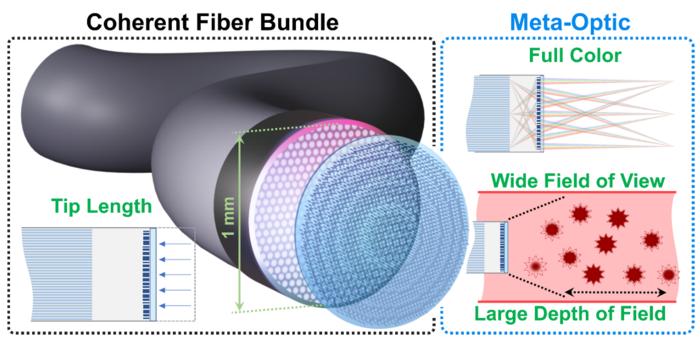
The meta-optical fibre endoscope A meta-optic is optimized for integration with a coherent fibre bundle. The new device achieves a reduced tip length while maintaining a wide field-of-view of 22.5° and a large depth-of-field exceeding 30 mm. (Courtesy: J E Fröch, L Huang, Q A A Tanguy, S Colburn, A Zhan, A Ravagli, E J Seibel, K Böhringer and A Majumdar)
Ultrathin optical elements known as meta-optics can reduce the tip length of endoscopes, which is one of the limiting factors of these medical devices. That’s the latest finding from researchers at the University of Washington, who used an inverse design approach to downsize the tip length by a third. They also demonstrate that the endoscope can capture video in real time over the full visible spectrum, something that has proved difficult with previous approaches.
Endoscopy involves inserting a long, flexible tube (consisting of a camera and a light guide) into the body to obtain images of internal tissues. In existing devices, the tube is tipped with a rigid optical component, the length of which is a fundamental limitation to the device being able to travel through small convoluted ducts such as arteries.
In principle, this problem can be solved by making an endoscope from just a single optical fibre or a bundle of fibres, but the snag here is that some of the light travelling down the fibres is scattered by defects and gets distorted beyond recognition. It cannot therefore be reconstructed to obtain an accurate image. Such devices are also limited to short working distances.
Flat meta-optics provide a promising alternative. These are subwavelength diffractive optical elements comprising nanoscale light scatterer arrays designed to shape an incident wavefront’s phase and amplitude. There is a problem again, however, in that these elements suffer from strong aberrations (or blurring), making large field-of-view (FoV) and full-colour imaging difficult – something that is critical for clinical endoscopy. Indeed, while metalenses typically produce sharp images for a specific wavelength (say green), they strongly blur other colours (red and blue).
Although these difficulties can be solved to some extent by dispersion engineering, the resulting devices suffer from small apertures (around 125 µm, for example), have short working distances (around 200 µm) or require complicated computational post-processing, which makes real-time imaging challenging.
Capturing real-time full-colour images
Researchers led by Johannes Fröch and Arka Majumdar may now have a solution to these challenges with an inverse-designed meta-optics element that they optimized to capture real-time full-colour images with a 1-mm-diameter coherent fibre bundle. Their system allows for a FoV of 22.5°, a depth-of-field (DoF) of more than 30 mm, and a rigid tip that measures just 2.5 mm – that is, 33% smaller than traditional commercial “gradient-index” lens integrated fibre bundle endoscopes. The feat is possible thanks to the shorter focal length and the ultrathin meta-optic.
Device characterization Left: an optical microscopy image of the meta-optic placed in front of the coherent fibre bundle. Right: Scanning electron microscope images of the fabricated device. (Courtesy: J E Fröch et al)
“Meta-optics are optical elements that manipulate light in different ways to the lenses that we are used to in everyday life,” explains Fröch. “Instead of a curved glass surface, meta-optics are composed of small nanostructures that affect how the light is diffracted. This means we can essentially bend it and steer it to specific directions or to have other exotic functionalities.”
Inverse design is an approach in which the structure of the meta-optics is designed based on the required functionality, he adds. “We basically start with the result that we wish and then find the structure that will produce that particular result most closely,” he tells Physics World.
The approach and the fabrication of the meta-optics have to be very accurate and the researchers say they have spent several years developing the right software tools and fabrication conditions to optimize all the steps in the process.
Perfectly suited to endoscopic applications
Achieving full-colour imaging with meta-optics is also extremely challenging since the resolution typically becomes worse as the range of colours is increased. “Meta-optics often only works for one specific wavelength, but when we started working on this topic, we realized that the resolution of the meta-optic fibre endoscope is ultimately limited by the coherent fibre bundle,” says Fröch. “We would thus trade off the colour bandwidth with the resolution in just the right way to achieve full-colour imaging comparable to standard lenses for this application.”
The University of Washington team, reporting its work in eLight, says that meta-optics are perfectly suited to endoscopic applications and could even potentially be exploited to realize much more exotic functionalities, such as hyperspectral imaging or phase-contrast imaging. “They really open up a lot of opportunities and we are now in contact with several other research groups and surgeons to work on many of these possible applications,” reveals Fröch.
Before real-world applications see the light of day, however, he admits that there are still many challenges that need to be overcome. For one, the properties of the meta-optics need to be optimized to achieve an even shorter tip length. “We also need to figure out a way to better integrate the meta-optics with the endoscope to ensure safe operation,” he says. “Ultimately, we want to find a solution that allows for a low-cost and scalable integration of meta-optics with the optical fibre so that the devices can be made widely accessible.”
For the first time, astronomers have observed the signature of methyl cations in a planet-forming disc. Using the James Webb Space Telescope (JWST), a team led by Olivier Berné at the University of Toulouse has shown that methyl cations – an important precursor to complex organic chemistry – are formed in the intense ultraviolet radiation emitted by massive young stars nearby.
In the 1970s astronomers first proposed that the methyl cation molecule (CH3+) could be a key trigger for complex organic chemistry in space – a process that could eventually lead to the emergence of life. Evidence of CH3+ in space could point to the presence of larger molecules – but so far, a combination of factors have meant that CH3+ had not been observed outside the solar system.
The main challenge facing those trying to observe the ion is that CH3+ does not have a permanent dipole moment which makes it invisible to radio telescopes. Alternatively, the ion can be identified from the spectroscopic lines it imprints on infrared radiation. However, these wavelengths are heavily absorbed or scattered by Earth’s atmosphere, making them practically impossible to view from the ground.
Young red dwarf
From its orbit high above Earth, the JWST has now detected this spectroscopic signature in a system called d203-506, which is 1350 light-years away in the Orion nebula. The system comprises a young red dwarf star that is surrounded by a planet-forming disc.
Because CH3+ had been so elusive, Berné’s team struggled to identify the signature, but the team eventually identified it as the first ever detection of interstellar CH3+. “Our discovery was only made possible because astronomers, modellers and laboratory spectroscopists joined forces to understand the unique features observed by James Webb,” explains team member Marie-Aline Martin-Drumel at Paris-Saclay University.
The result is especially fascinating because the Orion nebula is crowded with young, massive stars, which bathe d203-506 in intense ultraviolet radiation. Based on chemical signatures found in meteorites, astronomers now widely believe that planetary systems like the solar system were once bombarded with similar levels of radiation. This radiation may have originated from massive stars, such as those that formed from the same cloud of material that created the Sun. These huge stars then burned out after just a few million years.
Destructive radiation
Although intense ultraviolet radiation is destructive to complex organic molecules, these latest results suggest it could provide the energy needed to ionize methane, triggering the production of CH3+. Another interesting finding was the lack of water detected in d203-506 – which could also be related to high levels of ultraviolet radiation.
“This clearly shows that ultraviolet radiation can completely change the chemistry of a proto-planetary disc,” Berné explains. “It might actually play a critical role in the early chemical stages of the origins of life by helping to produce CH3+ – something that has perhaps previously been underestimated.”
This process could enable more complex molecules to emerge later on, once the massive stars have burned out. At this point the ions could eventually go on to form amino acids, nucleotides, and other key molecular building blocks of life.
Altogether, the result is a key milestone in our understanding of the chemistry of emerging star systems. “This detection of CH3+ not only validates the incredible sensitivity of [the JWST] but also confirms the postulated central importance of CH3+ in interstellar chemistry,” Martin-Drumel says. As JWST continues its exploration of the sky, the team hopes their result will be just the start of a new wave of similar discoveries.
Scientists and engineers are always trying to build better early-warning systems to mitigate the damage to life and property caused by natural disasters such as volcanoes. One technique that researchers are increasingly turning to is, in many ways, heaven-sent. It involves using muons: subatomic particles produced when cosmic rays – mostly high-energy protons originating from events such as supernovae – collide with atoms 15–20 kilometres high up in our atmosphere.
We know that the Earth’s atmosphere is constantly being hit by these primary cosmic rays, with the collisions producing a shower of secondary particles, including electrons, pions, neutrinos and muons. In fact, as many as 10,000 muons from these secondary cosmic rays rain down on each square metre of the Earth’s surface every minute. These particles have all the same properties as electrons but around 200 times the mass, which means they can travel much further through solid structures than electrons.
But what makes muons interesting as a probe is that interactions between the muons and the materials they’re passing through affect their flux, with denser objects deflecting and absorbing more muons than less-dense structures can. It is this difference in flux that is being used to image the internal structure of volcanoes in a technique known as “muography”. The term was coined back in 2007 by Hiroyuki Tanaka at the University of Tokyo and his colleagues, who provided the first demonstration that voids and cavities within the volcano could be detected with the technique (Earth Planet. Sci. Lett.263 1).
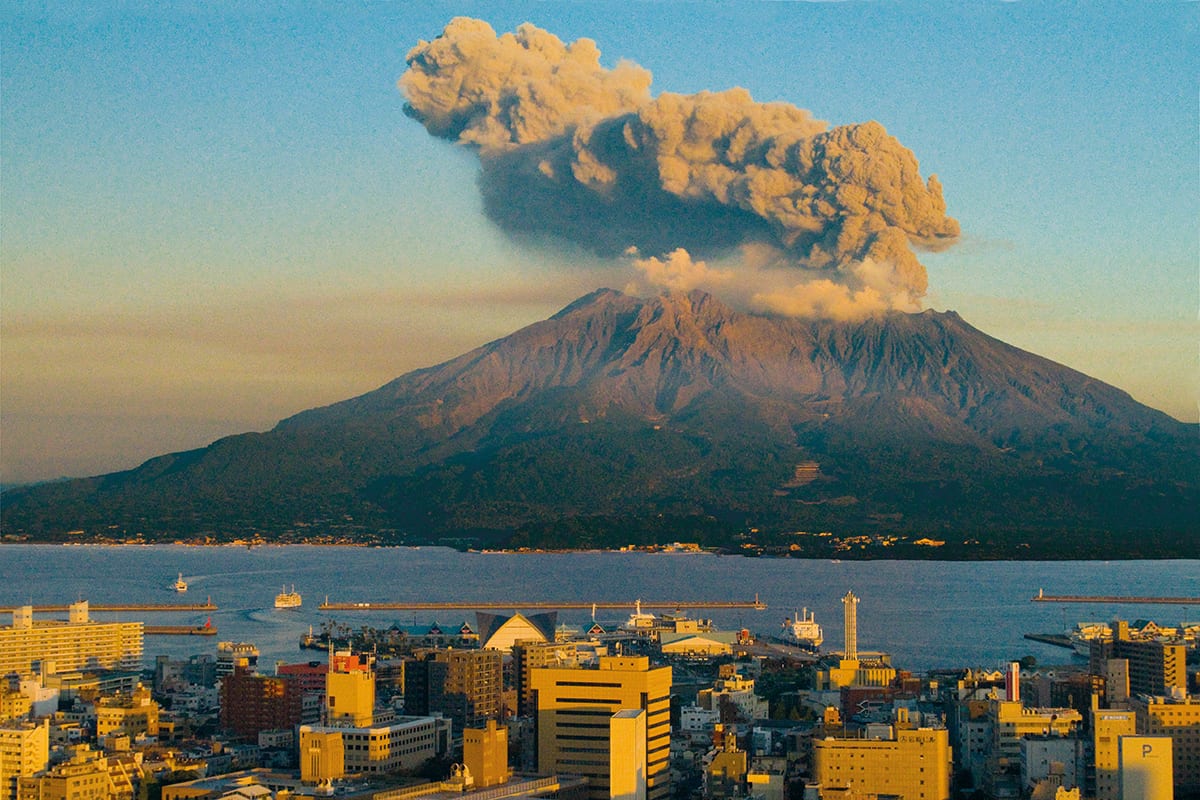
Smoking gun Muon tomography can be used to learn about the internal structure of volcanoes, such as here at Sakurajima in Japan, to predict eruptions in the future. (Courtesy: Kimon Berlin, CC BY-SA 2.0)
Also known as muon tomography, it uses detectors to produce a reverse density map of the object the muons have passed through. Spots where more muons hit the sensors represent less dense areas of the structure, while fewer muons highlight denser parts. Tanaka and colleagues have even tried to forecast volcanic eruptions using muography combined with an AI deep-learning convolutional neural network. In 2020 they used this technique to study one of the world’s most active volcanoes – the Sakurajima volcano in southern Japan, which has erupted 7000 times in the past decade (Sci. Rep.10 5272).
Drawing with muons
Muography is very similar to radiography, according to Jacques Marteau, a particle physicist at the Institute of Physics of the 2 Infinities (IP2I) in Lyon, France. “It replaces X-rays from medical imaging with another particle, namely the muon,” he says. “Muography is basically an imaging process that scans the density of an object in exactly the same way as X-ray imaging.”
Muography is an imaging process that scans the density of an object in exactly the same way as X-ray imaging
Several different devices can be used to detect muons, most of which have been developed as part of particle-physics experiments, such as at the Large Hadron Collider at CERN. When it comes to imaging volcanoes, however, the most commonly used detectors consist of layers of scintillators. As the muons pass through the detector, each layer produces a flash of light that together can be used to reconstruct the incoming trajectory of the particles. The detectors are placed on the lower slopes of the volcano and are angled to detect the muons that pass through it.
But muography has not only been used to image the internal structure of volcanoes. Researchers have also used the technique to detect changes in density within volcanoes linked to rising magma, as well as changes in magma shape, hydrothermal activity and pressure in the cavities and conduits.
Volcanic peeks
Giovanni Macedonio, research director at the National Institute of Geophysics and Volcanology in Rome, Italy, explains that there are three main techniques for studying and monitoring volcanoes. One is to use seismic data. Another is to measure ground deformations with satellites, while a third involves analysing the geochemistry of the fluids in the volcano.
Muography makes it possible to study fluid dynamics because it allows you to see the internal structure of the upper part of the volcano, particularly in smaller volcanoes. This not only reveals the path the magma took in past eruptions, but also makes it possible to model potential activity during future eruptions. Details of the internal geometry, for example, could show where on the cone an eruption might occur and how powerful it could be.
Macedonio and colleagues are studying using muography to study Mount Vesuvius as part of a research project known as MURAVES (J. Inst.15 C03014). Infamous for its destruction of the Roman cities of Pompeii and Herculaneum, Vesuvius remains an active volcano and is a dangerous, brooding presence, particularly as so many people live close by. During the last eruption in 1944, part of the crater was thrown off the volcano, but some dense magma has solidified in the crater.
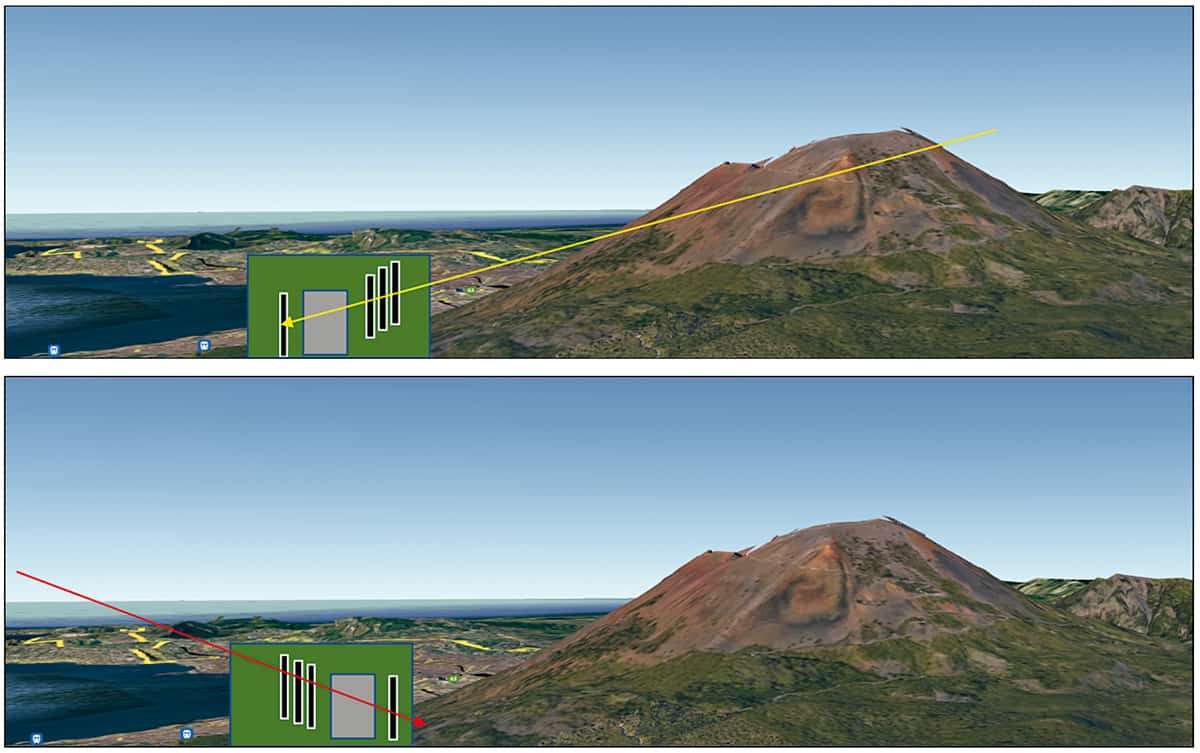
Scintillating stuff The MURAVES experiment, based at Mount Vesuvius in Italy, aims to capture muographic images of the internal structure of the summit of the volcano. The apparatus consists of an array of three independent and identical muon trackers, with a total sensitive area of 3 m2. This image highlights the configuration for the measurement of the muon flux transmitted through the volcano (top) and of the free-sky calibration flux (bottom). The detectors are not to scale. (Courtesy: JAIS2022 273, CC BY 4.0)
What MURAVES aims to do is to learn about the internal structure of the volcano following eruptions in the 19th and 20th centuries, so that its future behaviour can be modelled. As volcanoes are dynamic environments, their structure changes, particularly during eruptions, which can affect how they behave in the future.
Macedonio is also using muons to study Mount Stromboli, an active volcano in the Aeolian Islands, off the north coast of Sicily. Studying the internal structures of both active and dormant volcanoes can help us understand volcanic behaviour and explain why they generate small or large eruptions. “The internal structure, the geometry of the conduits, is an important parameter that determines the dynamics of the volcano,” says Macedonio. This information from active volcanoes can then be used to help model and predict how other volcanoes might behave.
As for Marteau, he has been using muography to study the La Soufrière volcano on the French island of Basse-Terre in the Caribbean. The volcano’s relatively small dome, Marteau explains, can easily be destabilized by activities such as earthquakes and magma movements. This can depressurize cavities filled with hot, high-pressure steam, leading to what is known as a “phreatic” eruption. These are volcanic eruptions that involve high-temperature liquids and vapours, rather than magma.
While such eruptions are not as well known as those involving magma, they can still be powerful and dangerous. In September 2014, for example, the south-western side of the Ontake volcano in Japan erupted with little warning, killing 63 people who had been hiking on the mountain (Earth Planets Space68 72). The steam eruption created an enormous, 11-kilometre-high plume.
In the case of volcanos like La Soufrière, what dictates whether an eruption will happen or not is the mechanical structure of the dome. “You need a technique like muography to understand what and where are the weak points,” Marteau says.
Muography can also be used to monitor the dynamics of fluids in volcanos like La Soufrière. Inside many volcanoes, Marteau explains, there is lots of fluid circulating between different cavities. While the fluids may be liquid, increases in magma activity and heat deep in the volcano can turn them into steam.
With muography you can observe these changes in fluid dynamics within the dome. For instance, if the liquids in one cavity turn to steam there will be a decrease in density, and an increase in muon flux.
Such a change – a filling of a cavity with steam under pressure – is something that could cause an eruption. “This is something you can follow in real time with muography, and this is the only technique that is able to do this,” Marteau says.
In 2019 Marteau and his colleagues demonstrated that muography in combination with seismic-noise monitoring can detect abrupt changes in hydrothermal activity in the dome of the La Soufrière volcano (Sci. Rep.9 3079).
The flux before the storm
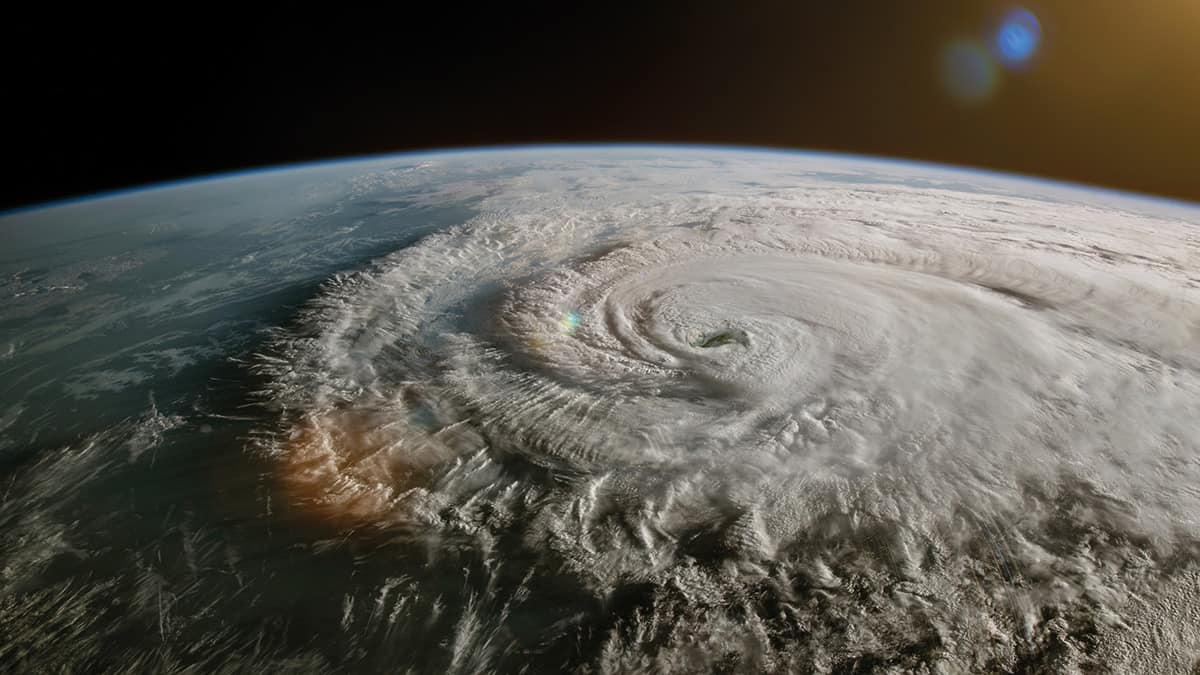
Tanaka, who pioneered the use of muons to image volcanoes, has now set his sights on another dangerous natural hazard: tropical cyclones. Reaching speeds of more than 120 kilometres per hour, these rotating storms cause huge amounts of damage to property and are responsible for many deaths every year. They originate over tropical oceans and are known as hurricanes, typhoons or, simply, cyclones, depending on where in the world they occur.
Eye of the storm The pioneering use of muons is now assisting studies of the internal structure of cyclones and helping to predict when they will form. (Courtesy: iStock/mikolajn)
Cyclones develop when low-pressure air is heated over the warm tropical ocean. Over time, this creates a warm, moist column of rapidly rising air; causing a low-pressure depression to develop at the surface of the ocean. This further strengthens the convection currents, leading to the development of a powerful rotating storm system that gets stronger and stronger.
These tropical storms are currently predicted, monitored and tracked using satellites, radar and other weather data. Reinforced aircraft can even be flown through them to collect data such as air pressure. But none of these techniques provide any detail about the differences in air pressure and density throughout the cyclone. It is these gradients that drive the convection currents and the wind speed.
On Kyushu Island – the southernmost of Japan’s five main islands and a hot spot for cyclones – Tanaka and his team are now investigating how the change in muon flux can show differences in air density and pressure in the cyclone, providing information on wind speed and storm strength. According to Tanaka, their network of scintillator detectors on Kyushu Island can image storms up to about 150 km away. This is possible because while some cosmic rays enter the atmosphere vertically, others hit much more horizontally, creating muons that fly towards the Earth at very shallow angles and can travel as far as 300 km before hitting the ground.
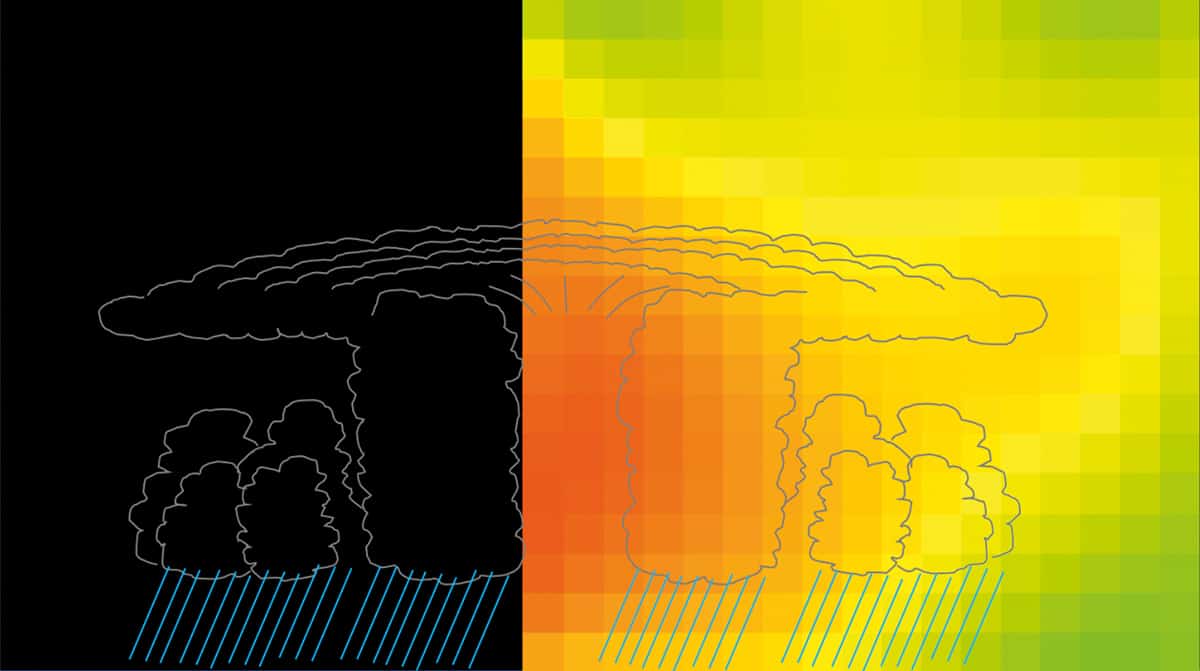
Denser air absorbs more muons, so their flux provides a measure of the density – and therefore the pressure and temperature – of the air at multiple points throughout a cyclone. As a result, Tanaka’s team can create an image of the temperature and pressure gradients inside the cyclone. “[Using this technique] we can measure the horizontal and vertical speed of the wind inside the cyclone,” says Tanaka, whose team has used muography to observe eight cyclones approaching the city of Kagoshima. The resulting images captured the warm low-pressure cores of the cyclones, surrounded by denser, colder, high-pressure air (Sci. Rep.12 16710).
Peering inside This cyclone muograph (overlaid with a line drawing approximating the shape of the visualized data) schematic shows the interior of a cyclone. The redder areas are regions of lower pressure and the greener areas higher pressure. The cyclone imaged here is about 15 km in height. (Courtesy: Hiroyuki KM Tanaka)
Using more muon detectors, Tanaka hopes that it will be possible to create more detailed 3D images of the energy structures inside cyclones. “I anticipate that with muography we can predict how strong a cyclone will be and how much rain it will bring to the ground,” Tanaka says. “This is probably something that can be used for early-warning systems.”
Changing tides
Tanaka has also been using muography to measure another hazard linked to cyclones: meteotsunamis. Short for meteorological tsunamis, they occur in enclosed or semi-closed water bodies like bays and lakes. Unlike tsunamis, which are the result of seismic activity, they are caused by abrupt changes in atmospheric pressure or winds, such as those caused by cyclones and weather fronts.
The extreme water oscillations of meteotsunamis can last from a few minutes to several hours, and can cause significant damage. For instance, 75 people were injured on 4 July 1992 when a meteotsunami hit Daytona Beach in eastern Florida in the US (Nat. Hazards 74 1). With waves reaching three metres in height, the meteotsunami was caused by a squall line – a fast-moving system of thunderstorms.
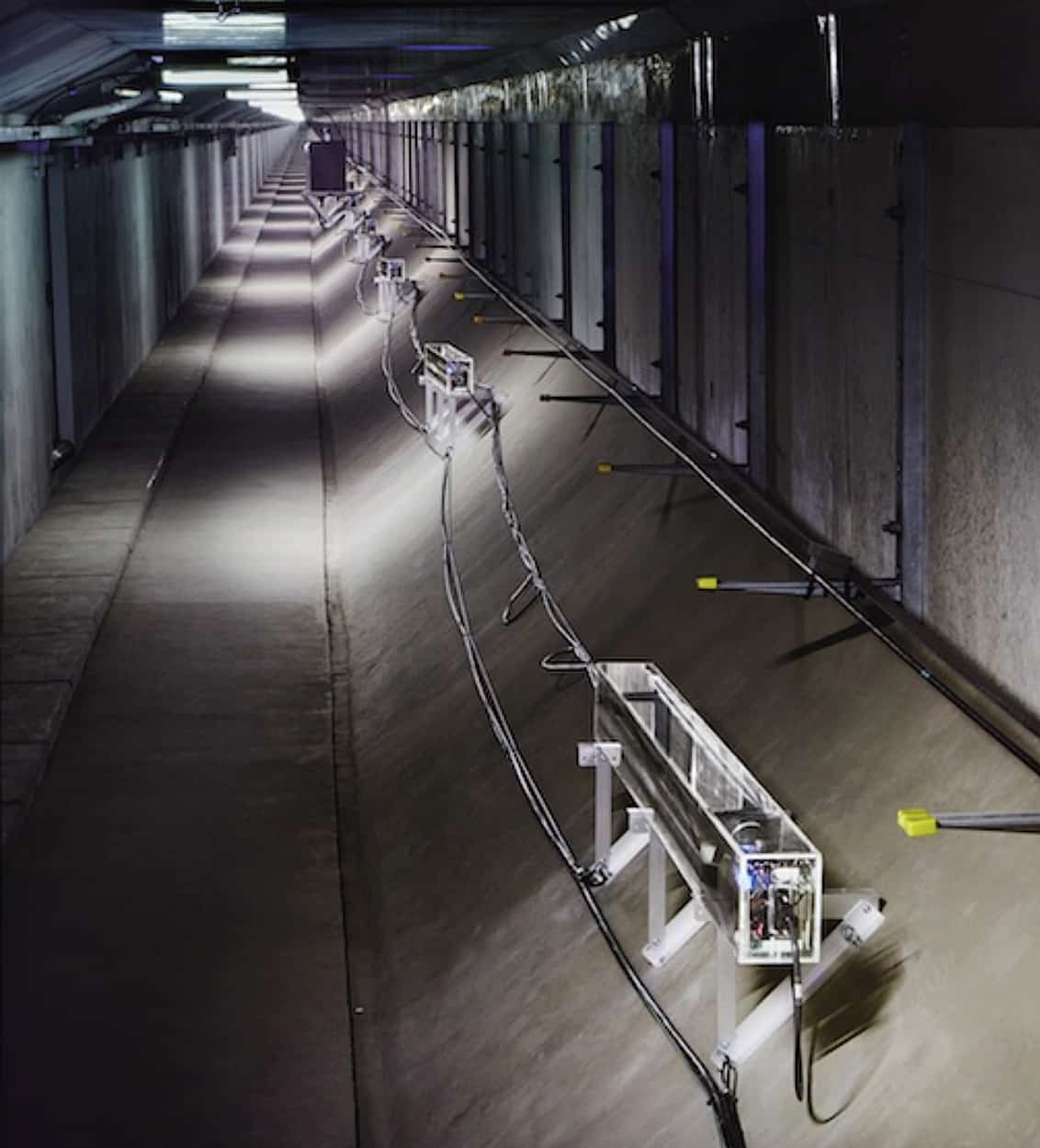
The Tokyo-Bay Seafloor Hyper-Kilometric Submarine Deep Detector (TS-HKMSDD) is a line of muon detectors installed in a nine-kilometre-long road tunnel under Tokyo Bay. The sensors measure muons passing through the water above.
In September 2021 a cyclone travelled through the Pacific about 400 km south of Tokyo Bay. As the storm passed, a large swell moved through Tokyo Bay and the number of muons detected by the TS-HKMSDD fluctuated. The extra water volume caused more muons to scatter and decay, and the numbers reaching the detectors dropped. When the researchers checked their muon data, they found that it closely matched measurements from the tide gauge (Sci. Rep.12 6097).
Under the sea Muon detectors located under Tokyo bay are used to monitor variations in water depth and help observe meteotsunami waves. (Courtesy: Tanaka et al./Scientific Reports)
To measure swells, the detectors do not need to be in a tunnel under the water body. “We can detect anywhere with an underground space near the seashore,” he explains. This could include road and subway tunnels near the shoreline, and other underground spaces like parking lots and commercial basements.
As with cyclones, detecting meteotsunamis would rely on the detectors sensing muons travelling at shallow angles through the atmosphere, and then through the water and shoreline. According to Tanaka, such set-ups could measure water levels up to about three to five kilometres from the shore. “We don’t want to know the moment [the meteotsunami] arrives,” he says. “We want to know before it hits land.”
Tanaka believes that such systems could also be used to measure tide levels and create a dense tide-monitoring network. After all, muon detectors have one big advantage over mechanical tide gauges: they are not in contact with the water. This makes them more reliable because they do not wear out over time and cannot be damaged by large storms. In fact, TS-HKMSDD in the Tokyo Bay Aqua-Line tunnel measured continuously for a year with not even a single second’s worth of missing data. Who’d have thought that the humble muon could do so much to prepare us against natural disasters?
Positron emission tomography (PET) is a medical imaging technology that’s widely used for both clinical and preclinical applications. Within cancer care, the radiotracer 18F-FDG (fluorine-18-fluorodeoxyglucose) is used in PET/CT scans to identify increased glucose intake, a hallmark of cancer cells. And researchers have developed numerous additional radiotracers to target other disease-specific markers.
PET works by detecting two 511 keV annihilation photons created when a positron emitted by the radiotracer annihilates with an electron in the body. However, because all PET isotopes produce the same two 511 keV photons, it’s only possible to image one radiotracer at a time. To detect signatures from more than one tracer requires sequential PET scanning, but this is costly, depends on one tracer decaying sufficiently over time and increases the patient’s radiation exposure from the accompanying CT scans.
“This advance could help increase the depth of molecular information attainable during a single scan, giving scientists and radiologists alike more timely information for a diagnosis and staging that could not be done with a biopsy,” explains co-senior author Grimm in a press statement.
Exploiting the prompt gammas
PET images are created using lines of response (LORs) between detector pairs that detect two annihilation photons (“double” events) within a coincidence-timing window of about 3.5 ns. Some positron-emitting isotopes also emit an additional prompt gamma photon. If this is detected within the coincidence window it gives rise to a “triple” event, which is usually considered spurious and not reconstructed. Often, such isotopes are avoided in medical scans.
But first author Edwin Pratt and colleagues have shown how to use this prompt gamma emission to distinguish between two radiotracers in a PET scan. By increasing the coincidence energy window to include the prompt gamma emission, and developing a method for separating and reconstructing double coincidences from triple coincidences, they can generate two separate datasets for each PET scan.
These datasets can be used to produce quantitative images of two PET radiotracers administered simultaneously, with similar performance to two separate acquisitions. “By using a suitable radiotracer pair (one containing a standard positron-emitting isotope and the other an isotope that also emits a prompt gamma), and a proper image reconstruction method (mPET), true simultaneous dual isotope PET imaging can be achieved in most current PET scanners, without modifications or any need for energy discrimination,” says co-senior author Herraiz.
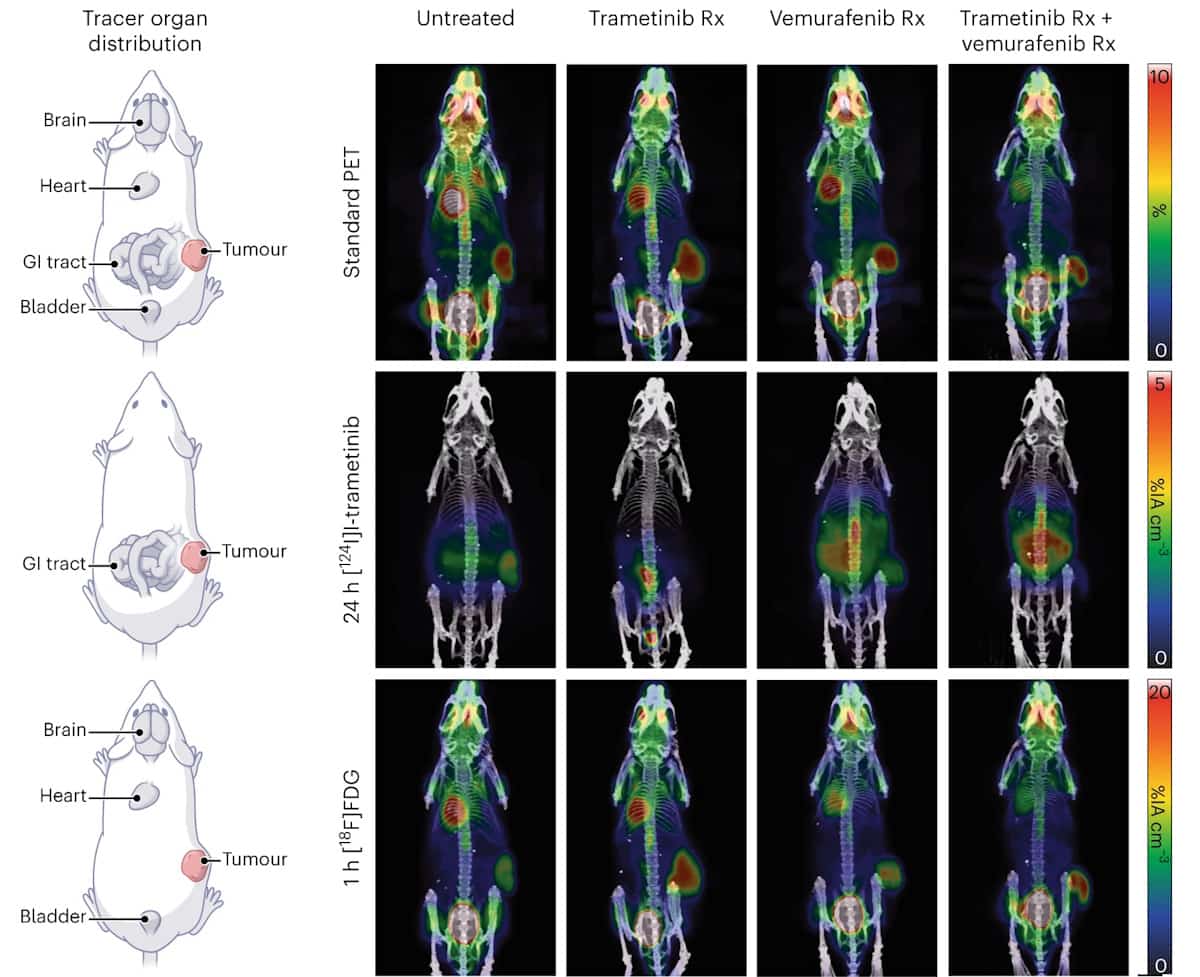
Therapy monitoring Standard PET and mPET images of 124I-trametinib and 18F-FDG in mice with melanoma tumours undergoing various drug treatments. The mPET scans clearly show the different distributions of the two radiotracers. (Courtesy: E C Pratt et al Nat. Biomed. Eng 10.1038/s41551-023-01060-y)
The researchers first tested the feasibility of their mPET method on a preclinical and a clinical PET scanner. They imaged phantoms containing the double-emitting isotope zirconium-89 (89Zr) and the triple-emitting iodine-124 (124I). They found that both systems could acquire data suitable for mPET separation, and that the mPET reconstruction method could create two simultaneous isotope images. They then moved to in vivo preclinical experiments.
In mice with melanoma tumours, the researchers used mPET to track the biodistributions of two injected radiotracers: 124I-trametinib, which targets proliferating tissue; and 18F-FDG, which targets glucose activity. Upon separating the double and triple events, they observed two distinct biodistributions from the two tracers. They also imaged mice receiving various drug therapies, observing that dual imaging with mPET could be used to track the drugs’ effects on the tumour while also maintaining a standard FDG-PET image.
Tracking drug delivery
Nanoparticles are widely used as drug carriers and as agents to alter drug biodistribution, ideally lowering off-target delivery. Often, such drug delivery is assessed by tracking the radiolabelled nanoparticle and assuming that the drug distribution is the same. But this may not always be the case. To investigate this further, Pratt and colleagues used mPET to noninvasively monitor and quantify a radiolabelled drug and nanoparticle separately.
The team administered 89Zr-ferumoxytol nanoparticles loaded with the cancer drug 124I-trametinib to a melanoma-bearing mouse. Using mPET to separate signals from the drug and the nanoparticle revealed that soon after injection, the drug distribution did not match that of the carrier nanoparticle. This finding suggests that, unexpectedly, most of the drug had dissociated rapidly in vivo, demonstrating a valuable application for this new technique.
The researchers also employed mPET to track CAR T-cells used in immunotherapy to target prostate-specific membrane antigen (PSMA)-positive tumours. In mice with a PSMA-positive tumour, they used 124I to visualize the distribution of CAR T-cells and gallium-68 (68Ga)-PSMA-11 to simultaneously measure PSMA-positive tumour location and expression.
The ability of mPET to separate the two radiotracers showed that there were distinct distributions of 68Ga-PSMA-11 in the tumour, kidneys and bladder, while 124I was found in the tumour, thyroid, kidneys, stomach and bladder. Axial slices through the tumour revealed different intratumoural distributions of the two tracers. The mPET reconstruction provided a way to track the targeting of CAR T-cells while confirming PSMA expression during the same PET scan.
The researchers conclude that mPET provides additional information via the addition of a second tracer, exploiting many isotopes previously seen as problematic due to their additional gamma emissions. They emphasize that mPET can be implemented on both preclinical and clinical PET/CT systems without any modifications to hardware or image acquisition software. “The beauty is that mPET is immediately clinically translatable,” says Pratt. “The approach can be done on most existing machines, with minimal modifications.”
The next step will be to apply mPET to different studies, the researchers tell Physics World. This includes using mPET to identify cancer resistance to therapy, evaluating it with other positron–gamma emitters, extending its capabilities to imaging more than two isotopes simultaneously, and testing it in the clinic with patients in the right setting.
Most people strive to keep fungus out of their homes. Now, however, two groups of materials researchers are exploring ways to weave it into the very fabric of buildings.
The first group, led by textile scientist Jane Scott at Newcastle University in the UK, created knitted structures that hold fungal strands called mycelium in place while the fungus grows. The result is a lightweight composite material that could be used to build strong, eco-friendly structures.
The second group, led by nanoengineer Everson Kandare and biotechnologist Tien Huynh of RMIT University in Melbourne, Australia, used mycelium to create compressed sheets of fire-retardant material. The hope is that such sheets could replace flammable cladding panels like the ones that contributed to the deadly Grenfell Tower fire, which killed 72 Londoners in 2017.
Charring fungus has a protective effect
For Kandare, Huynh and colleagues, the source of mycelium’s appeal lies in the way it behaves when exposed to fire and other sources of radiant heat. Instead of bursting into flames, as the Grenfell cladding did, an exposed surface made of mycelium decomposes to form a gritty black substance called char. This layer of char has a two-part protective effect. As well as slowing down the transfer of heat, it prevents volatile materials in the layers beneath it from escaping into the combustion zone.
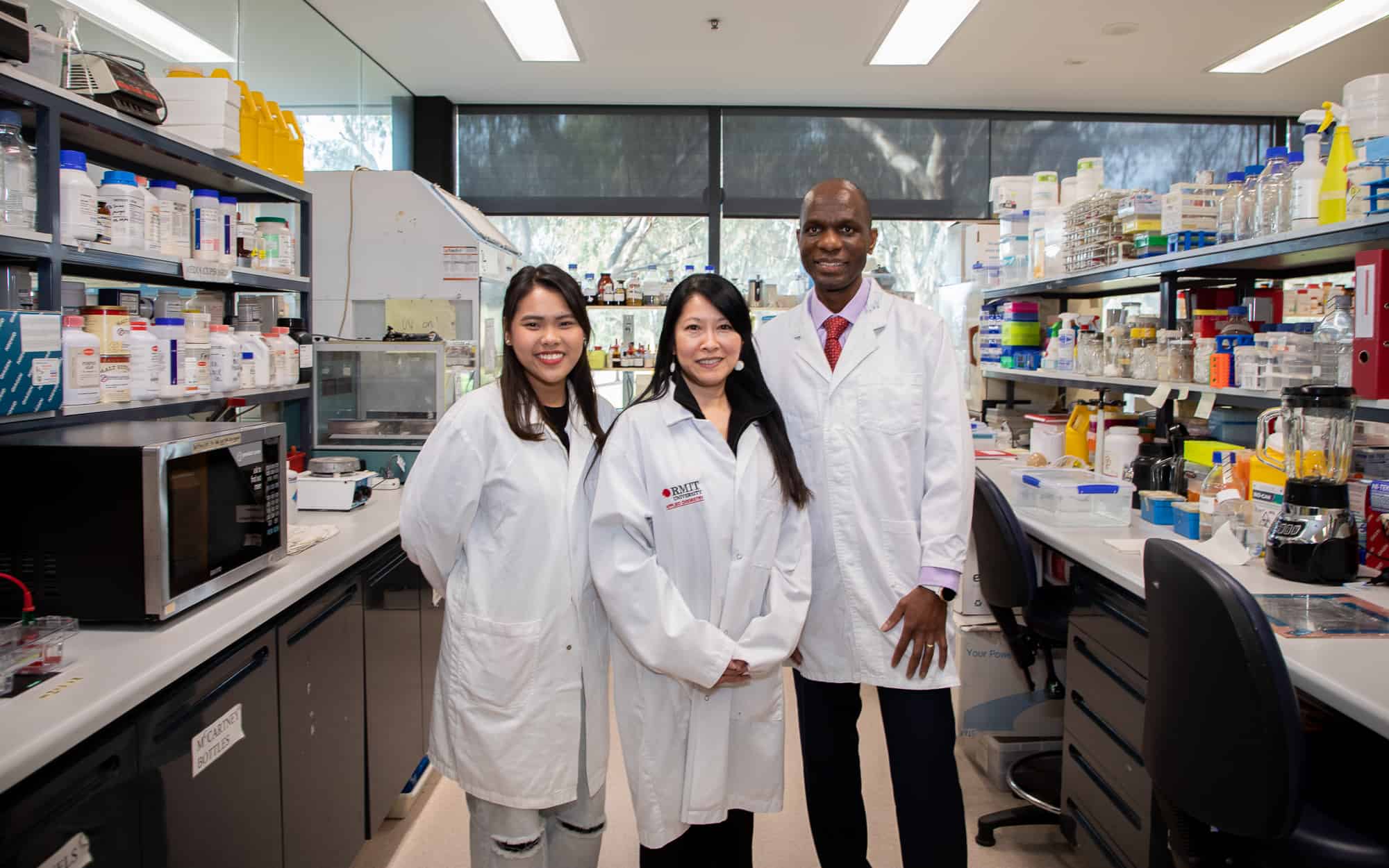
The research team: (l-r) Nattanan (Becky) Chulikavit, Tien Huynh and Everson Kandare in their lab at RMIT’s Bundoora campus. (Courtesy: RMIT)
A further benefit is that when mycelium does burn, it produces only carbon dioxide and water. This is in stark contrast to commercial fire retardants, Huynh tells Physics World. “Currently there are halogenated and non-halogenated fire retardants that have health and environmental concerns,” she explains. “These include bromide and chlorine (halogenated) or phosphorus and nitrogen (non-halogenated) based fire retardants, and when they burn [they] produce toxins.”
Working with the mushroom industry
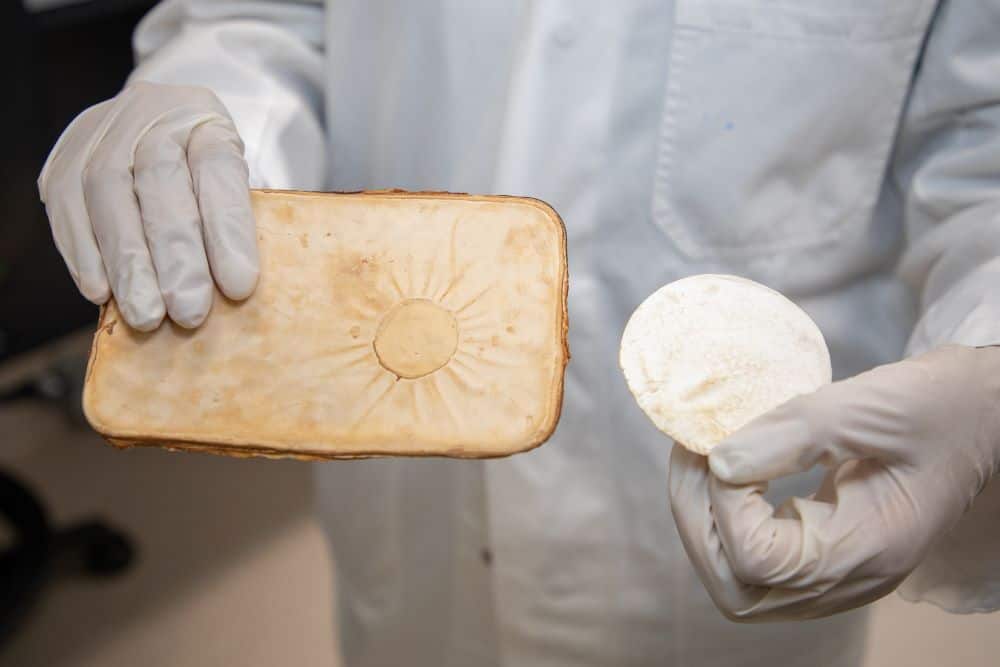
In the latest study, which is published in the journal Polymer Degradation and Stability, the RMIT team worked with colleagues at the University of New South Wales and the Hong Kong Polytechnic University to develop a way of growing sheets of pure mycelium. The results resemble toast-coloured cardboard, and Huynh says the easiest way to incorporate into buildings would be to add it to existing materials like a wallpaper. “It’s light, flexible and versatile so would suit multiple applications used in the building industry,” she says.
Wallpaper-like: PhD student Nattanan Chulikavit shows off the compressed mycelium sheets she created. (Courtesy: RMIT University)
While the RMIT team grew its mycelium sheets from a culture of inedible bracket fungus, Ganoderma australe, Huynh says it should also be possible to produce the sheets from waste generated by commercial mushroom growers. “Creation of these fungal products uses molasses, which is an agricultural waste from the sugarcane industry,” she explains. “Given that [the world] produced ~177 million metric tonnes of sugar in 2022–2023, this is a significant contribution for waste reduction.”
Knitting supports for mycelium structures
Sustainability and waste reduction are also motivating factors for Scott and her colleagues at Newcastle and the Vrije Universiteit Brussel in Belgium. Writing in the journal Frontiers in Bioengineering and Biotechnology, they note that the excellent thermal and acoustic properties of mycelium composites give them “huge potential” as inexpensive replacements for foams, timber and plastics in building interiors. The challenge, they write, is to grow these composites in a way that is scalable and makes complex shapes possible, while still meeting requirements for structure and stability.
Come inside: Another view of the BioKnit prototype. (Courtesy: The Hub for Biotechnology in the Built Environment)
To make mycelium composites, scientists typically begin by mixing fungal spores with grain (a food source) and materials such as sawdust and cellulose (a substrate for the fungus to grow on). The next step is to pack the mixture into a mould and place it in a warm, dark and humid environment. Under these conditions, the mycelium grows relatively quickly, binding the substrate together with its filamentous, root-like structures. Once the composite reaches the desired density, the growth process is halted and the material dried out so that it doesn’t produce mushrooms.
The problem with this is that mycelium needs oxygen to grow, and this requirement restricts the size and shape of the moulds (in the manufacturing sense of the word, not the fungal one) it can grow in. Or at least, it does if the moulds are solid. As an alternative, Scott drew on her textiles training to design a mycelium mixing and production system based on moulds knitted from strong but air-permeable merino wool.
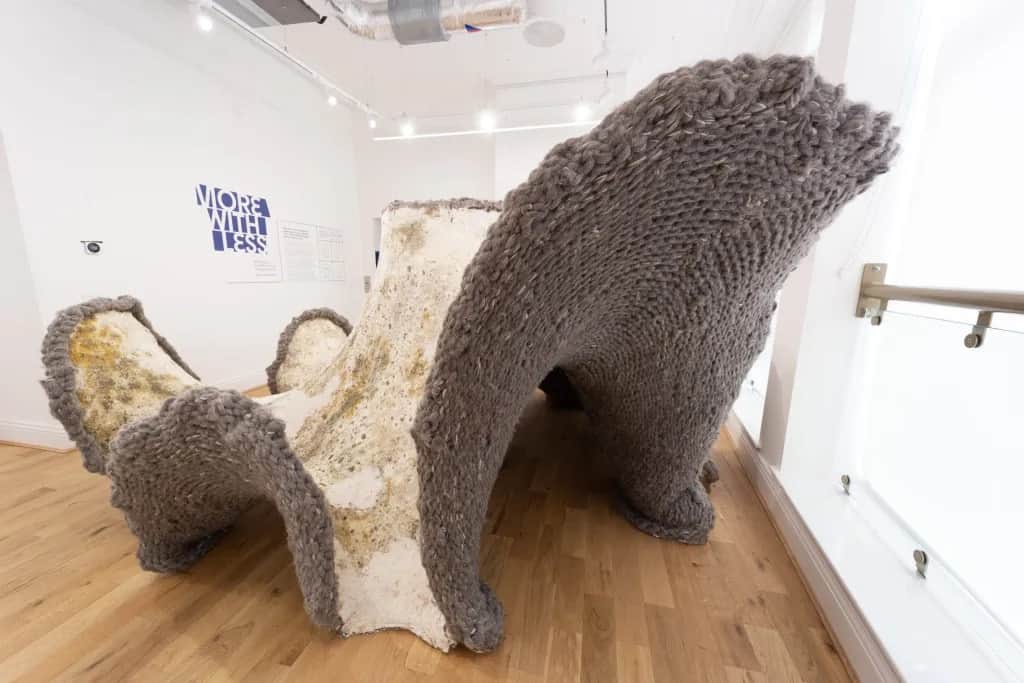
A softer side to mycelium: The Living Room mycelium-textile hybrid on display in Newcastle’s Farrell Centre as part of the More or Less exhibition. (Courtesy: Jill Tate)
“We are an interdisciplinary group of researchers including expertise in 3D knit programming and manufacture, so we have been able to bring together unique skillsets to produce this work,” she tells Physics World. “The major advantage of knitting technology compared to other textile processes is the ability to knit 3D structures and forms with no seams and no waste.”
Once the knitted moulds were complete, Scott and colleagues sterilized them and attached them to a rigid structure to support the mycelium concrete, or myocrete, as it grew. They then used an injection gun to fill the moulds with a smooth, viscous paste containing paper powder, paper fibre clumps, water, glycerine and xanthan gum as well as fungal spores. “This consistency is required when working with 3D knitted formwork, which is versatile and structurally efficient,” Scott says. “The difficulty is in bringing both components together to prototype at an architectural scale.”
Mouldy materials of the future
The team’s first prototype, created in 2022, provides a vivid demonstration of myocrete’s capabilities (see photos). Known as BioKnit, this 1.8 m high, 2 m diameter free-standing structure is made entirely of myocrete and was grown as a unit, meaning it contains no joins that could become weak points. A second prototype, entitled The Living Room, contains a mixture of mycelium spores, wool from hardy Herdwick sheep, and a mix of sawdust and wastepaper from local mills.
For mould-averse consumers, the colours of BioKnit and The Living Room may be a little off-putting – the surfaces bear a strong resemblance to something you might spray with bleach – but Scott notes that different colours and finishes could transform the myocrete’s appearance. In any case, she believes the material’s advantages can overcome any resistance. “The aesthetic is new and different, [but] what we find compelling about this process is the ability to produce new shapes and forms that could help us transform interior spaces,” she says. “Our work includes some of the most common materials and processes, such as wool and knitting, and I think this offers consumers a way to understand mycelium through the lens of something familiar like textiles.”
Astronomers have detected the shortest fast radio bursts (FRBs) ever, with the briefest lasting a mere five microseconds – a thousand times shorter than what is expected of a typical FRB. The bursts are thought to have originated from a galaxy some three billion light-years away, although their exact nature remains unknown.
FRBs are mysterious, intense, bursts of radio waves coming from outside the galaxy. What produces these bursts has remained unclear since they were first discovered in 2007. Yet it is thought that over 10,000 FRBs reach the Earth every day.
Typically, an FRB lasts a few milliseconds but in 2022 astronomer Kenzie Nimmo, who was then at the Netherlands Institute for Radio Astronomy (ASTRON), and colleagues found evidence for bursts on timescales much less. This came from within the bursts of a repeating source known as FRB20200120E and the discovery led astronomers to wonder whether it would be possible for much shorter duration FRBs to exist independently from any larger bursts.
To search for this, the team from the Netherlands and the US painstakingly trawled through existing observations of the repeating source FRB 20121102A that were taken by the Green Bank Telescope in West Virginia, which has a 110 m steerable dish, the largest in the world. The team found 19 new bursts, eight of which were extremely short, independent, bursts lasting between five and 15 microseconds.
“Despite having drastically shorter temporal durations, these ultra FRBs very much resemble the much broader bursts,” lead author ASTRON astronomer Mark Snelders who is also at the University of Amsterdam told Physics World. “We found that a lot of the properties are the same.”
I believe we are missing a significant fraction of all the FRBs that hit Earth
Mark Snelders
It is not clear whether the discovery favours a particular model for FRBs, such as a flaring magnetar or the jet of an accreting black hole. “The discovery would support an emission region close to the magnetosphere of a magnetar or black hole jet, rather than some external location, such as a shock,” theorist Brian Metzger from Columbia University, who was not involved in the study, told Physics World.
However, as Metzger points out, it may instead be that the FRB time structure is an effect of the surrounding environment on the propagation of the FRB, instead of an intrinsic property of its source. FRB 20121102A lies in a dense, magnetised, nebula and it was recently shown that the propagation of an FRB wave through this region could affect its time structure through self-modulation, producing “pancake-like” bursts on microsecond timescales.
Missing fraction
This discovery might then instead be teaching us about the environment of the FRB rather than the source itself. “I think the jury is still out on where the FRB emission originates and what this implies for the central engine,” adds Metzger.
The finding also indicates that the figure of 10,000 FRBs reaching Earth every day may need to be revised upwards. “I believe we are missing a significant fraction of all the FRBs that hit Earth,” says Snelders. This is because these short events have previously not been properly searched for due to the huge computational resources necessary.
As FRBs traverse the interstellar medium, their various frequencies become smeared out over several seconds. Detecting these extremely short bursts thus requires undoing this effect first by performing an extremely costly computation called “coherent de-dispersion”.
Indeed, in the latest work, the team only searched 30 minutes of data, which still took several months of processing. Despite this, Snelders is unfazed. “Our research group is definitely going to change our observation and search strategy for future projects, and other research groups should do the same,” he adds.