A new type of bolometer that covers a broad range of microwave frequencies has been created by researchers in Finland. The work builds on previous research by the team and the new technique could potentially characterize background noise sources and thereby help to improve the cryogenic environments necessary for quantum technologies.
A bolometer is an instrument that measures radiant heat. Instruments have existed for 140 years and are conceptually simple devices. They use an element that absorbs radiation in a specific region of the electromagnetic spectrum. This causes the device to heat up, resulting in a parameter change that can be measured.
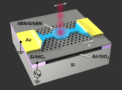
Bolometers have found applications ranging from particle physics to astronomy and security screening. In 2019 Mikko Möttönen of Aalto University in Finland and colleagues developed a new ultra-small, ultralow-noise bolometer comprising a microwave resonator made of a series of superconducting sections joined by a normal gold-palladium nanowire. They found that the resonator frequency dropped when the bolometer was heated.
Measuring qubits
In 2020, the same group swapped the normal metal for graphene, which has a much lower thermal capacity and thus should measure temperature changes 100 times faster. The result could have advantages over current technologies used to measure the states of individual superconducting quantum bits (qubits).
Superconducting qubits, however, are notoriously prone to the classical noise of thermal photons, and in the new work Möttönen and colleagues, together with researchers at the quantum technology company Bluefors, set out to tackle this. The graphene bolometer focuses on sensing a single qubit, and on measuring the relative power level as quickly as possible to determine its state. In this latest work, however, the researchers were looking for noise from all sources, so they needed a broadband absorber. They also needed to measure the absolute power, which requires the calibration of the bolometer.
One of the applications that the team demonstrated in their experiments was the measurement of the amount of microwave loss and noise in the cables running from room temperature components to low-temperature components. Previously, researchers have done this by amplifying the low-temperature signal before comparing it to a reference signal at room temperature.
Very time consuming
“These lines have typically been calibrated by running a signal down, running it back up and then measuring what happens,” explains Möttönen, “but then I’m a little bit unsure whether my signal was lost on the way down or up so I have to calibrate many times…and warm up the fridge…and change the connections…and do it again – it’s very time consuming.”
Instead, therefore, the researchers integrated a tiny electrical direct-current heater into the thermal absorber of the bolometer, allowing them to calibrate the power absorbed from the surroundings against a power supply that they could control.
“You see what the qubit will see,” says Möttönen. The femtowatt-scale heating used for calibration – which is turned off during the operation of the quantum device – should have no meaningful effect on the system. The researchers eschewed graphene, reverting to a superconductor–normal metal–superconductor design for the junctions because of the greater ease of production and better durability of the finished product: “These gold-palladium devices will remain almost unchanged on the shelf for a decade, and you want your characterization tools to remain unchanged over time,” Möttönen says.
The researchers are now developing the technology for more detailed spectral filtering of noise. “The signal that comes into your quantum processing unit has to be heavily attenuated, and if the attenuator gets hot, that’s bad…We would like to see what is the temperature of that line at different frequencies to get the power spectrum,” Möttönen says. This could help to decide on what frequencies are best to choose or help to optimize equipment for quantum computing.
“It’s impressive work,” says quantum technologist Martin Weides of the University of Glasgow. “It adds to a number of existing measurements on the transfer of power in cryogenic environments required for quantum technologies. It allows you to measure from dc up to microwave frequencies, it allows you to compare both, and the measurement itself is straightforward…If you’re building a quantum computer, you’re building a cryostat, and you want to characterize all your components reliably, you probably would like to use something like this.”
High-energy neutrinos emerging from the Milky Way galaxy have been spotted for the first time. That is according to new findings from the IceCube Neutrino Observatory at the Amundsen–Scott South Pole Station that open a new avenue of multimessenger astronomy by observing the Milky Way galaxy in particles rather than light.
Neutrinos are fundamental particles that have very small masses and barely interact with other matter, but they fill the universe with trillions passing harmlessly through your body every second.
Previously, neutrinos billions of times more energetic than those produced by fusion reactions within our Sun have been detected coming from extragalactic sources such as quasars. However, theory predicts that high-energy neutrinos should also be produced within the Milky Way.
When astronomers look at the plane of our galaxy, they see the Milky Way lit up with gamma-ray emissions that are produced when cosmic rays trapped by our galaxy’s magnetic field collide with atoms in interstellar space. These collisions should also produce high-energy neutrinos.
Researchers have now finally found convincing evidence for these neutrinos by using machine-learning techniques to sift through ten years of data from the IceCube Neutrino Observatory, which includes some 60,000 neutrino events. “[Just like gamma rays], the neutrinos that we observe are distributed throughout the galactic plane,” says Francis Halzen of the University of Wisconsin–Madison, who is IceCube’s principal investigator.
Cascade events
The IceCube detector is formed of a cubic kilometer of ice buried beneath the South Pole and strung through with 5160 optical sensors that watch for flashes of visible light on the rare occasions that a neutrino interacts with a molecule of water-ice. When a neutrino event occurs, the neutrino either leaves an elongated track or a “cascade event” whereby the neutrino’s energy is concentrated in a small, spherical volume within the ice.
When cosmic rays interact with matter in the interstellar medium they produce short-lived pions that quickly decay. “Charged pions decay into the neutrinos detected by IceCube and neutral pions decay into two gamma rays observed by [NASA’s] Fermi [Gamma-ray Space Telescope],” Halzen told Physics World.
The neutrinos had previously gone undetected because they were being drowned out by a background signal of neutrinos and muons caused by cosmic-ray interactions much closer to home, in Earth’s atmosphere.
This background leaves tracks that enter the detector, whereas the higher energy neutrinos from the Milky Way are more likely to produce cascade events. The machine-learning algorithm developed by IceCube scientists at TU Dortmund University in Germany was able to select only for cascade events, removing much of the local interference and allowing the signal from the Milky Way to stand out.
Although it is more difficult to obtain information about the direction a neutrino has come from in a cascade event, Halzen says that cascade events can be reconstructed with a precision of “five degrees or so”. Although this precludes identifying specific sources of neutrinos in the Milky Way, Halzen says that it is sufficient to observe the radiation pattern from the galaxy and match it to the one observed of gamma rays by the Fermi space telescope.
The next step for the team is to try and identify specific sources of neutrinos in the Milky Way. This could be possible with the revamped IceCube, named Gen2, which will increase the size of the detector area to ten cubic kilometres of ice when it becomes fully operational by 2032.
Gordon Moore, the co-founder of Intel who died earlier this year, is famous for forecasting a continuous rise in the density of transistors that we can pack onto semiconductor chips. His eponymous “Moore’s law” still holds true after almost six decades, but further progress is becoming harder and eye-wateringly expensive to sustain. In this episode of the Physics World Stories podcast we look at the practicalities of keeping Moore’s law alive, why it matters, and why physicists have a critical role to play.
Right now, one of the key questions is whether computer hardware can keep up with the demands of large language models and other forms of generative AI. There is also concern over whether computing can help tackle today’s complex global challenges without skyrocketing energy demands. New computing paradigms are needed, and optical- and quantum based-computing may have key roles to play, but there are still big question makers over their practical usefulness at scale.
Physics Word Stories is presented by Andrew Glester and this month’s podcast guests are:
Louis Barson, director of science, innovation and skills at the Institute of Physics (which publishes Physics World)
From using supercomputers to tap into new kinds of materials to training machine learning models to study complex properties at the nanoscale, Australian computational scientist Amanda Barnard works at the interface of computing and data science. A senior professor in the School of Computing at the Australian National University, Barnard is also deputy director and computational-science lead. These days, she uses a variety of computational methods to solve problems across the physical sciences, but Barnard began her career as a physicist, receiving her PhD in theoretical condensed-matter physics in 2003.
After spending the next few years as a postdoc at the Center for Nanoscale Materials at Argonne National Laboratory in the US, she began to broaden her research interests to encompass many aspects of computational science, including the use of machine learning in nanotechnology, materials science, chemistry and medicine.
Can you tell us a bit about what you do as a computational scientist?
Computational science involves designing and using mathematical models to analyse computationally demanding problems in many areas of science and engineering. This includes advances in computational infrastructure and algorithms that enable researchers across these different domains to perform large-scale computational experiments. In a way, computational science involves research into high-performance computing, and not just research using a high-performance computer.
We spend most of our time on algorithms and trying to figure out how to implement them in a way that makes best use of the advanced hardware; and that hardware is changing all the time. This includes conventional simulations based on mathematical models developed specifically in different scientific domains, be it physics, chemistry or beyond. We also spend a lot of time using methods from machine learning (ML) and artificial intelligence (AI), most of which were developed by computer scientists, making it very interdisciplinary research. This enables a whole bunch of new approaches to be used in all these different scientific areas.
Machine learning enables us to recapture a lot of the complexity that we’ve lost when we derive those beautiful theories
Simulation was born out of the theoretical aspects of each scientific area that, with some convenient levels of abstraction, enabled us to solve the equations. But when we developed those theories, they were almost an oversimplification of the problem, which was done either in the pursuit of mathematical elegance or just for the sake of practicality. ML enables us to recapture a lot of the complexity that we’ve lost when we derive those beautiful theories. But unfortunately, not all ML works well with science, and so computational scientists spend a lot of time trying to figure out how to apply these algorithms that were never intended to be used for these kinds of data sets to overcome some of the problems that are experienced at the interface. And that’s one of the exciting areas that I like.
You began your career as a physicist. What made you move to computational science?
Physics is a great starting point for virtually anything. But I was always on the path to computational science without realizing it. During my first research project as a student, I used computational methods and was instantly hooked. I loved the coding, all the way from writing the code to the final results, and so I instantly knew that supercomputers were destined to be my scientific instrument. It was exciting to think about what a materials scientist could do if they could make perfect samples every time. Or what a chemist could do if they could remove all contaminations and have perfect reactions. What could we do if we could explore harsh or dangerous environments without the risk of injuring anyone? And more importantly, what if we could do all of these things simultaneously, on demand, every time we tried?
The beauty of supercomputers is that they are the only instrument that enables us to achieve this near-perfection. What captivates me most is that I can not only reproduce what my colleagues can do in the lab, but also do everything they can’t do in the lab. So from the very early days, my computational physics was on a computer. My computational chemistry then evolved through to materials, materials informatics, and now pretty much exclusively ML. But I’ve always focused on the methods in each of these areas, and I think a foundation in physics enables me to think very creatively about how I approach all of these other areas computationally.
How does machine learning differ from classical computer simulations?
Most of my research is now ML, probably 80% of it. I still do some conventional simulations, however, as they give me something very different. Simulations fundamentally are a bottom-up approach. We start with some understanding of a system or a problem, we run a simulation, and then we get some data at the end. ML, in contrast, is a top-down approach. We start with the data, we run a model, and then we end up with a better understanding of the system or problem. Simulation is based on rules determined by our established scientific theories, whereas ML is based on experiences and history. Simulations are often largely deterministic, although there are some examples of stochastic methods such as Monte Carlo. ML is largely stochastic, although there are some examples that are deterministic as well.
With simulations, I’m able to do very good extrapolation. A lot of the theories that underpin simulations enable us to explore areas of a “configuration space” (the co-ordinates that determine all the possible states of a system) or areas of a problem for which we have no data or information. On the other hand, ML is really good at interpolating and filling in all the gaps and it’s very good for inference.
Improved by machine Simulations start with some understanding of a system or a problem, with an output of some data at the end. In machine learning we start with the data, we run a model, and then we end up with a better understanding of the system or problem. (Courtesy: iStock/NicoElNino)
Indeed, the two methods are based on very different kinds of logic. Simulation is based on an “if-then-else” logic, which means if I have a certain problem or a certain set of conditions, then I’ll get a deterministic answer or else, computationally, it’ll probably crash if you get it wrong. ML, in contrast, is based on an “estimate-improve-repeat” logic, which means it will always give an answer. That answer is always improvable, but it may not always be right, so that’s another difference.
Simulations are intradisciplinary: they have a very close relationship to the domain knowledge and rely on human intelligence. On the other hand, ML is interdisciplinary: using models developed outside of the original domain, it is agnostic to domain knowledge and relies heavily on artificial intelligence. This is why I like to combine the two approaches.
Can you tell us a bit more about how you use machine learning in your research?
Before the advent of ML, scientists had to pretty much understand the relationships between the inputs and the outputs. We had to have the structure of the model predetermined before we were able to solve it. It meant that we had to have an idea of the answer before we could look for one.
We can develop the structure of an expression or an equation and solve it at the same time. That accelerates the scientific method, and it’s another reason why I like to use machine learning
When you’re using ML, the machines use statistical techniques and historical information to basically programme themselves. It means we can develop the structure of an expression or an equation and solve it at the same time. That accelerates the scientific method, and it’s another reason why I like to use it.
The ML techniques I use are diverse. There are a lot of different flavours and types of ML, just like there are lots of different types of computational physics or experimental physics methods. I use unsupervised learning, which is based entirely on input variables, and it looks at developing “hidden patterns” or trying to find representative data. That’s useful for materials in nanoscience, when we haven’t done the experiments to perhaps measure a property, but we know quite a bit about the input conditions that we put in to develop the material.
Unsupervised learning can be useful in finding groups of structures, referred to as clusters, that have similarities in the high-dimensional space, or pure and representative structures (archetypes or prototypes) that describe the data set as a whole. We can also transform data to map them to a lower-dimensional space and reveal more similarities that were not previously apparent, in a similar way that we might change to reciprocal space in physics.
I also use supervised ML to find relationships and trends, such as structure-property relationships, which are important in materials and nanoscience. This includes classification, where we have a discrete label. Say we already have different categories of nanoparticles and, based on their characteristics, we want to automatically assign them to either one category or another, and make sure that we can easily separate these classes based on input data alone.
I use statistical learning and semi-supervised learning as well. Statistical learning, in particular, is useful in science, although it’s not widely used yet. We think of that as a causal inference that is used in medical diagnostics a lot, and this can be applied to effectively diagnose how a material, for example, might be created, rather than just why it is created.
Your research group includes people with a wide range of scientific interests. Can you give us a flavour of some of the things that they’re studying?
When I started in physics, I never thought that I’d be surrounded by such an amazing group of smart people from different scientific areas. The computational science cluster at the Australian National University includes environmental scientists, earth scientists, computational biologists and bioinformaticians. There are also researchers studying genomics, computational neuroscience, quantum chemistry, material science, plasma physics, astrophysics, astronomy, engineering, and – me – nanotechnology. So we’re a diverse bunch.
Our group includes Giuseppe Barca, who is developing algorithms that underpin the quantum chemistry software packages that are used all around the world. His research is focused on how we can leverage new processors, such as accelerators, and how we can rethink how large molecules can be partitioned and fragmented so that we can strategically combine massively parallel workflows. He is also helping us to use supercomputers more efficiently, which saves energy. And for the past two years, he’s held the world record in the best scaling quantum chemistry algorithm.
Also on the small scale – in terms of science – is Minh Bui, who’s a bioinformatician working on developing new statistical models in the area of phylogenomics systems [a multidisciplinary field that combines evolutionary research with systems biology and ecology, using methods from network science]. These include partitioning models, isomorphism-aware models and distribution-tree models. The applications of this include areas in photosynthetic enzymes or deep insect phylogeny transcription data, and he has done work looking into algae, as well as bacteria and viruses such as HIV and SARS-CoV-2 (which causes COVID-19).
Applied computing Minh Bui, a bioinformatician developing new statistical models in the area of phylogenomics systems, with the Gadi supercomputer at the National Computational Infrastructure, Australian National University. (Courtesy: Eric Byler, ANU)
On the larger end of the scale is mathematician Quanling Deng, whose research focuses on mathematical modelling and simulation for large-scale media, such as oceans and atmosphere dynamics, as well as Antarctic ice floes.
The best part is when we discover that a problem from one domain has actually been already solved in another, and even better when we discover one experienced in multiple domains so we can scale super linearly. It’s great when one solution has multiple areas of impact. And how often would you find a computational neuroscientist working alongside a plasma physicist? It just doesn’t normally happen.
As well as working with your research group, you’re also deputy director of the Australian National University’s School of Computing. Can you tell us a bit about that role?
It’s largely an administrative role. So as well as working with an amazing group of computer scientists across data science, foundational areas in languages, software development, cybersecurity, computer vision, robotics and so on, I also get to create opportunities for new people to join the school and to be the best version of themselves. A lot of my work in the leadership role is about the people. And this includes recruitment, looking after our tenure-track programme and our professional-development programme as well. I’ve also had the opportunity to start some new programmes for areas that I thought needed attention.
One such example was during the global COVID pandemic. A lot of us were shut down and unable to access our labs, which left us wondering what we can do. I took the opportunity to develop a programme called the Jubilee Joint Fellowship, which supports researchers working at the interface between computer science and another domain, where they’re solving grand challenges in their areas, but also using that domain knowledge to inform new types of computer science. The programme supported five such researchers across different areas in 2021.
I am also the chair of the Pioneering Women Program, which has scholarships, lectureships and fellowships to support women entering computing and ensure they’re successful throughout their career with us.
And of course, one of my other roles as deputy-director is to look after computing facilities for our school. I look at ways that we can diversify our pipeline of resources to get through tough times, like during COVID, when we couldn’t order any new equipment. I also look into how we can be more energy efficient, because computing uses an enormous amount of energy.
It must be a very exciting time for people doing research in ML, as the technology is finding so many different uses. What new applications of ML are you most looking forward to in your research?
Well, probably some of the ones you’re already hearing about, namely AI. While there are risks associated with AI, there’s also enormous opportunity, and I think that generative AI is going to be particularly important in the coming years for science – provided we can overcome some of the issues with it “hallucinating” [when an AI system, such as a large language model, generates false information, based on either a training data-set or contextual logic, or a combination of them both].
No matter what area of science we’re in, we’re restricted by the time we have, the money, the resources and the equipment we have access to. It means we’re compromising our science to fit these limitations rather than focusing on overcoming them
But no matter what area of science we’re in, whether computational or experimental, we’re all suffering under a number of restrictions. We’re restricted by the time we have, the money, the resources and the equipment we have access to. It means we’re compromising our science to fit these limitations rather than focusing on overcoming them. I truly believe that the infrastructure shouldn’t dictate what we do, it should be the other way around.
I think generative AI has come at the right time to enable us to finally overcome some of these problems because it has a lot of potential to fill in the gaps and provide us with an idea of what science we could have done, if we had all the resources necessary.
Indeed, AI could enable us to get more by doing less and avoid some of the pitfalls like selection bias. That is a really big problem when applying ML to science data sets. We need to do a lot more work to ensure that generative methods are producing meaningful science, not hallucinations. This is particularly important if they’re going to form the foundation for large pre-trained models. But I think this is going to be a really exciting era of science where we’re working collaboratively with AI, rather than it just performing a task for us.
Prospective risk management, based on methods like FMEA or FTA risk assessments, represents a powerful approach to establishing a stronger safety culture within a clinic. By implementing guidelines such as the AAPM Task Group 100 report, risks can be effectively assessed, and the necessary corrective actions can be identified. The potential benefits of this approach extend beyond radiation therapy and can be applied to other fields like proton therapy and nuclear medicine. Clinicians face the challenge of carrying out this activity with limited existing resources while ensuring that the investment yields improved safety and workflow efficiency. The utilization of a dedicated software tool can significantly enhance the efficiency and effectiveness of this process. During the presentation, Benjamin Sintay, executive director of radiation oncology and chief physicist at Cone Health, will demonstrate the practical application of myQA PROactive software in conducting risk analysis within a community hospital. Additionally, David Menichelli from IBA Dosimetry R&D will discuss the integration of prospective risk analysis with incident reporting.
Benefits of attending:
Gain insight into the importance of risk assessment
Acquire knowledge on the seamless integration of risk assessment into regular clinical procedures
Discover the tools that facilitate the implementation of a risk management program
Develop an understanding of how incident reporting can be utilized to validate and enhance your ongoing risk analysis.
Benjamin “BJ” Sintay is the executive director of radiation oncology & chief physicist for Cone Health and co-founder & chief innovation officer for Fuse Oncology. Benjamin received bachelor of science degrees in electrical and computer engineering from North Carolina State University in 2004. He received a PhD in biomedical engineering from the Virginia Tech-Wake Forest University School of Biomedical Engineering and Sciences in 2008. Benjamin is board certified in therapeutic medical physics by the American Board of Radiology. His interests include leader development, healthcare technology, radiotherapy quality & safety, software development, and product commercialization.
Feelings of “fear and anxiety” have led many academic scientists of Chinese heritage to consider leaving the US since the launch in 2018 of the “China Initiative“. That is according to a new study from the Massachusetts Institute of Technology (MIT) and Princeton and Harvard universities, which also finds that the atmosphere has stopped Chinese scientists from applying for US government grants. The study’s authors warn that if the situation is not resolved, the US will lose “scientific talent to China and other countries”.
The China Initiative was set up by the Trump administration in November 2018 to root out and prosecute perceived Chinese spies in American research and industry. According to then Attorney General William Barr, the initiative sought to counter “the systemic efforts by the [People’s Republic of China] to enhance its economic and military strength at America’s expense”.
However, the initiative was criticized for unfairly targeting academics. The US Department of Justice (DOJ) brought more than 20 court cases against scientists of Chinese descent, charging that their connections with colleagues in China facilitated the transfer of sensitive US technology and intellectual property to the Chinese government. Most of those cases, however, ended in not guilty verdicts or hung juries.
Losing talent to other countries is actually causing national security issues
Kai Li
The US eventually shut down the initiative in early 2022, owing to what the justice department said were “perceptions that it unfairly painted Chinese Americans and United States residents of Chinese origin as disloyal”. Gisela Kusakawa, executive director of the Asian American Scholar Forum, told Physics World that the initiative “was criminalizing academic activity”.
‘Chilling effect’
The new study, which is based on a survey of over 1300 academic scientists of Chinese heritage in the US, found that over a third of respondents feel unwelcome in the US and 72% do not feel safe as an academic researcher. It also reveals that almost two thirds are worried about collaborations with China and 86% perceive it is harder to recruit top international students now compared to five years ago.
“The data are sobering,” says MIT engineer Gang Chen, who was not involved in the study but was arrested under the China Initiative in January 2021 only to have government drop all charges a year later.
The study also highlights that the US is losing top graduate students from China, who are instead choosing to stay in China or move to elsewhere in Asia or Europe. “The China Initiative and its chilling effects were caused by some policy-makers talking about national security,” says Kai Li, a computer scientist from Princeton University, who was not involved in the study. “But losing talent to other countries [as a result] is actually causing national security issues.”
Junming Huang from Princeton’s Center on Contemporary China who co-authored the study, says that returning to normality will not be easy. “It took one year after the China Initiative started to observe changes in the attitudes of Chinese scientists,” he told Physics World. “It will take longer to observe the change now that it’s ended.”
Indeed, Li thinks the pending cases of the initiative are continuing to have “a chilling effect”. As a result, people are choosing to go back to China while those who remain in the US, particularly in engineering and computer science, are not applying for federal grants for their research over fears of reprisals.
Whether it’s buying Twitter for $44bn, running SpaceX, or winning approval for a clinical trial of the Neuralink brain implant, the physicist-turned-business leader Elon Musk is never far from the headlines. He was again in the news earlier this year when he promised to use an investor’s day in March to lay out his vision for a “fully sustainable future” for Tesla – the electric-car company he’s been chief executive of since 2008. Musk also said he’d explain how Tesla would scale up the firm’s operations.
Many investors and analysts had expected that Tesla would unveil a cheaper, base-model electric car. But when Musk and his team eventually presented what he had dubbed Master Plan 3 (MP3), there was much disappointment. “Master Plan3 looks like a flop” said the Seeking Alpha financial-news website, complaining of a lack of detail, an absence of new vehicles, and nothing about, say, self-driving cars. Tesla’s stock immediately dropped by 8%.
Tesla’s first master plan was published in 2006 and called The Secret Tesla Motors Master Plan (Just Between You and Me). The title was tongue in cheek, but the message was clear. “Build sports car,” it explained. “Use that money to build an affordable car. Use that money to build an even more affordable car. While doing above, also provide zero emission electric power generation options. Don’t tell anyone.”
The strategy proved successful and was followed 10 years later by Master Plan, Part Deux, presumably a nod to the 1993 spoof Rambo movie Hot Shots! Part Deux. In fact, Musk seems to be a fan of old movies. The fastest version of the Tesla Model S car is called the Plaid, while its vehicles have an acceleration mode called Ludicrous Speed, both references to the starship in the 1987 Mel Brooks movie Spaceballs.
Movie gags aside, there was more detail in the second plan than the first. “Create stunning solar roofs with seamlessly integrated battery storage,” it said. “Expand the electric vehicle product line to address all major segments. Develop a self-driving capability that is 10x safer than manual via massive fleet learning. Enable your car to make money for you when you aren’t using it.”
Much of the luke-warm reaction to Tesla’s new master plan was simply down to the US stock markets’ notoriously short-term view of the economy
The final two aims have not yet happened but Tesla’s plan is coming along fast. Indeed, if you watch Musk’s presentation at the investor day, he believes that, with the right measures, we can sustainably support a planet with more than eight billion people. I believe that much of the luke-warm reaction to MP3 was simply down to the US stock markets’ notoriously short-term view of the economy; for them, it’s all about the quarterly figures. Trouble is, dealing with climate change requires a long-term plan.
Well-thought out
When the MP3 was published on the Tesla website in early April, an initial skim read suggested a well-thought plan that covered all the bases. But when I examined it in more detail on holiday, I was extremely impressed. Using data from the International Energy Agency, the plan reminds us that the world currently uses about 165 petawatt-hours of energy per year (PWh/yr), of which 80% is from fossil fuels. Losses and inefficiencies, however, mean that barely 36% of the total energy is actually used for the purpose intended (59 PWh/yr).
But because electrically-driven power sources are far more efficient than combustion engines, the “electric economy” only needs 82 PWh/yr to do the same work. A Tesla Model 3, for example, is 3.9 times more energy efficient than a petrol-powered Toyota Corolla, while a heat pump is 3–4 times better than a gas boiler. Of course, a truly electric economy will need vast amounts of materials to build solar panels, wind turbines, batteries and so on.
What’s more, as the MP3 report estimates, we’d need 240 TWh/yr of battery storage to manage the 30 TW power generated from solar, wind and other renewable-energy sources. That in turn would require us to spend up to $10 trillion mining, refining and manufacturing everything from concrete, glass and steel to all sorts of rare-earth elements needed in batteries.
It is an eye-watering figure but, according to the MP3 analysis, it’s actually less than the $14 trillion the world is projected to spend over the next two decades on fossil fuels. What’s more if the $10 trillion were spread out over 10 years, it would be only 1% of the world’s total GDP (currently $100 trillion) and only 0.5% if spread out over 20 years. It doesn’t sound implausible if we put our minds to it, especially when you realize that fossil-fuel firms made a total of $4 trillion in profits last year.
The challenge will be to persuade oil and gas companies to rethink their strategies because without any compunction, nothing will change how money is invested
In fact, we’d need to turn over less than 0.21% of the global land mass to build enough wind and solar power plants. Another advantage is that less mining would be required in an electrical economy than in a combustion economy. The challenge, I suspect, will be to persuade oil and gas companies to rethink their strategies because without any compunction, nothing will change how money is invested.
Concrete impact Tesla reckons $10 trillion will have to spent if we are to make greater use of wind turbines, solar panels and batteries, but that’s less than the $14 trillion that fossil-fuel firms are projected to fork out over the next 20 years.(Courtesy: Shutterstock/Robert-Lucian-Crusitu)
Five steps to success
MP3 outlines five steps we need to take to reach an all-electrical economy. First, we need to switch to renewable power, which would cut our use of fossil fuels by 35%. Second, move to electrically-powered vehicles (a 21% reduction). Third, install heat pumps (a 22% saving). Fourth, get industry to switch to “green” hydrogen for processing metals and other high-temperature operations (a 17% cut). Finally, sustainably fuel planes and boats (a 5% saving).
Of course, none of this is new. Many companies, governments and institutions around the world have been talking about the need to expand renewable energy production, while many car firms already plan to move mostly (or completely) to electric vehicles at some point in the future. But Musk – and Tesla – make the case much more clearly than most in one well-presented report. Sure, you could challenge some of the assumptions outlined in MP3, but I don’t believe anything would fundamentally change what he has to say.
The world, for example, might adopt more nuclear, geothermal or hydroelectric power. True, but that would only mean it takes us less time to get there. It could also turn out harder than we think to develop batteries and motors for electric vehicles that don’t require rare-earth metals and yet still retain their efficiency. But there are a lot of people working on this problem and who knows what technological breakthroughs lie round the corner?
Some have argued that the investment costs may be higher by 30–50% in certain areas. Yes, but whatever the precise figure, it will not materially change the points eloquently made by Musk at the end of the MP3 presentation. Tesla’s plans are entirely feasible and bring hope and optimism – not just for those who are investors in the company – but for all of us who are, ultimately, investors in the Earth.
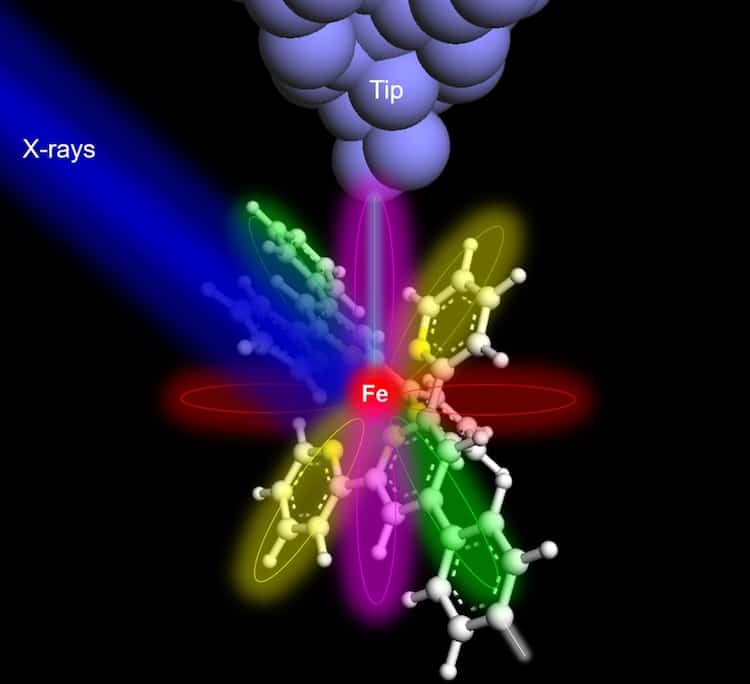
Single atom X-ray mechanism When X-rays illuminate an atom (red ball at the centre of the molecule), core level electrons are excited. X-ray-excited electrons then tunnel to the detector tip via overlapping atomic/molecular orbitals, which provide elemental and chemical information about the atom. (Courtesy: Saw-Wai Hla)
The resolution of synchrotron X-ray scanning tunnelling microscopy has reached the single-atom limit for the first time, thanks to new work by researchers at Argonne National Laboratory in the US. The advance will have important implications in many areas of science, including medical and environmental research.
“One of the most important applications of X-rays is to characterize materials,” explains study co-leader Saw Wai Hla, Argonne physicist and professor at Ohio University. “Since its discovery 128 years ago by Roentgen, this is the first time that they can be used to characterize samples at the ultimate limit of just one atom.”
Until now, the smallest sample size that could be analysed was an attogram, which is around 10,000 atoms. This is because the X-ray signal produced by a single atom is extremely weak and conventional detectors are not sensitive enough to detect it.
Exciting core-level electrons
In their work, which the researchers detail in Nature, they added a sharp metallic tip to a conventional X-ray detector to detect X-ray-excited electrons in samples containing iron or terbium atoms. The tip is placed just 1 nm above the sample and the electrons that are excited are core-level electrons – essentially “fingerprints” unique to each element. This technique is known as synchrotron X-ray scanning tunnelling microscopy (SX-STM).
In the lab: Saw Wai Hla (right) and study first author Tolulope M. Ajayi. (Courtesy: Argonne National Laboratory)
SX-STM combines the ultrahigh-spatial resolution of scanning tunnelling microscopy with the chemical sensitivity provided by X-ray illumination. As the sharp tip is moved across the surface of a sample, electrons tunnel through the space between the tip and the sample, creating a current. The tip detects this current and the microscope transforms it into an image that provides information on the atom under the tip.
“The elemental type, chemical state and even magnetic signatures are encoded in the same signal,” explains Hla, “so if we can record one atom’s X-ray signature, it is possible to extract this information directly.”
Being able to investigate an individual atom and its chemical properties will allow for the design of advanced materials with properties tuned to specific applications, adds study co-leader Volker Rose. “In our work, we looked at molecules containing terbium, which belongs to the family of rare-earth elements, used in applications like electric motors in hybrid and electric vehicles, hard disk drives, high-performance magnets, wind turbine generators, printable electronics and catalysts. The SX-STM technique now provides an avenue to explore these elements without the need to analyse large amounts of material.”
In environmental research, it will now be possible to trace possibly toxic materials down to extremely low levels, adds Hla. “The same is true for medical research where biomolecules responsible for disease could be detected at the atomic limit,” he tells Physics World.
The team says it now wants to explore the magnetic properties of individual atoms for spintronic and quantum applications. “This will impact multiple research fields, from magnetic memory used in data storage devices, quantum sensing and quantum computing to name but a few,” explains Hla.
A craft to explore the nature of dark energy has been launched today aboard a Falcon 9 rocket from Florida’s Cape Canaveral Space Force Station at 11:12 local time. The €1.4bn Euclid mission will study the large-scale structure of the universe with the aim of understanding how it evolved following the Big Bang.
Over 25 years ago physicists were astounded by the discovery that the rate of expansion of the universe was increasing – not decreasing as had been previously thought. Many physicists believe that dark energy is the cause behind the accelerating expansion yet it remains one of the biggest mysteries in cosmology.
To better our understanding of the dark universe, Euclid – a space-based telescope made by the European Space Agency (ESA) – aims to create the most accurate map yet of the large-scale structure of the universe. It uses a 1.2 m-diameter telescope, a camera and a spectrometer to plot a 3D map of the distribution of more than two billion galaxies – a view that will stretch across 10 billion light-years.
At roughly 4.7 m tall and 3.7 m in diameter, Euclid will observe galaxies and clusters of galaxies at visible and near-infrared wavelengths, revealing details of the universe’s structure and its expansion over the last three-quarters of its history or some 10 billion years ago. Euclid will chart this expansion rate much further back in time than existing ground-based telescopes.
“The successful launch of Euclid marks the beginning of a new scientific endeavour to help us answer one of the most compelling questions of modern science,” says ESA director general Josef Aschbacher. “The quest to answer fundamental questions about our cosmos is what makes us human. And, often, it is what drives the progress of science and the development of powerful, far-reaching, new technologies.”
To boldly go
Euclid will now spend the next 30 days travelling to a spot in space called Lagrange Point 2 – a gravitational balance point some 1.5 million kilometres beyond the Earth’s orbit around the Sun. Once there it will then spend about three months in commissioning before studying the universe for at least six years.
Euclid was chosen for launch in 2011 and is a medium-class mission belonging to ESA’s Cosmic Vision 2015–2025. The mission was initially planned to be launched this year by a Russian Soyuz spacecraft rom Europe’s Spaceport in Kourou, French Guiana. But following international sanctions after Russia’s invasion of Ukraine, ESA sought out alternatives, choosing SpaceX and the Falcon 9 rocket in October 2022.
The Euclid consortium brings together over 2000 scientists in 300 labs in 17 different countries in Europe, US, Canada and Japan. The first data release is expected in 2025.
“Boffin” is a quintessentially British word that refers to a stereotypical scientist – usually portrayed as an oddball, grey-haired, white man in a lab coat. It is very popular with the UK’s tabloid press, which revels in headlines like “Boffins say don’t eat too many cakes” etc.
Earlier this year, the UK’s Institute of Physics (IOP) launched its “Bin the Boffin” campaign, saying that the term reinforces a harmful stereotype that may be preventing some people from considering careers in physics. The campaign was very successful in one sense; it was widely reported by the tabloids. Some newspapers were taken aback by the IOP’s drive and responded with headlines such as “Boffins: don’t call us boffins” (that one appeared in the Daily Star).
Now, the IOP has hit back by projecting its message onto the sides of London buildings associated with tabloids, including a skyscraper at Canary Wharf that is home to the Star (see photo).
Not taken lightly
The IOP’s deputy chief executive Rachel Youngman explains, “Running around at night with projectors is not something the IOP does very often or does lightly, but we want to see the word ‘boffin’ binned once and for all.” She adds, “It’s a cliché, no-one knows quite what it means, and young people have told us it puts them off a career in physics.”
The projector campaign also targeted the Sun and Youngman says that she is keen to meet with editors from the two newspapers to talk about guidelines for reporting on physicists and physics that the IOP has drawn up.
Puzzling geoid low
Cast your mind back to your days as a physics undergraduate and you will recall that you used 9.8 m/s2 to calculate force of gravity as felt by objects on Earth. However, this value changes slightly as you move around the planet and it can vary by as much as 0.7% around the globe.
Gravity is particularly weak in the centre of the Indian Ocean – an effect called the Indian Ocean geoid low (IOGL). Geophysicists have long puzzled over the origins of the IOGL, but now two researchers at the Centre for Earth Sciences at the Indian Institute of Science in Bengaluru say that they have worked out why it exists.
According to the Guardian, the researchers reconstructed the last 140 million years of plate tectonics in the region. Debanjan Pal and Attreyee Ghosh believe that as pieces of the oceanic plate travel under the continent of Africa, large amounts of hot and less-dense material are rising in the centre of the Indian Ocean. This creates a large area of low density and therefore low gravity in the region.