Neutrinos probe the proton’s structure in surprising measurement

Following a bold suggestion from a postdoc researcher, an international team has discovered a robust technique for probing the internal structure of the proton by using neutrino scattering. Tejin Cai at the University of Rochester and colleagues working on Fermilab’s MINERvA experiment have showed how information about the proton can be extracted from neutrinos that have been scattered by the detector’s plastic target.

As early as the 1950s, physicists were using high-energy electron beams to determine the size of the proton. By measuring how these electrons scatter from targets, researchers have since managed to probe the interior structure of the proton and measure the charge distributions of their constituent quarks in detail.

In principle, similar measurements should also be possible using a beam of neutrinos, such as the beam generated at Fermilab. Despite being chargeless and almost massless, a tiny fraction of neutrinos in a beam will interact with protons, and scatter at characteristic angles. If this scattering can be measured, it would not only complement electron scattering experiments in probing proton structures; it may also provide important new insights into how neutrinos and protons interact.

Far too diffuse

So far, researchers have only considered the possibility of firing neutrino beams into gaseous hydrogen targets. However, the protons in these targets are far too diffuse to scatter neutrinos in high enough numbers to gain any conclusive results using existing experimental techniques.

In the new study, Cai’s team found a solution to this problem almost by accident. The physicists are currently using the MINERvA experiment at Fermilab to study neutrinos by firing a high-energy beam of the particles into plastic scintillator targets. These are dense, solid polymers that contain lots of hydrogen and carbon.

Subtracting carbon

Cai realized that the hydrogen atoms in this solid target are far more densely packed than they are in hydrogen gas. If the neutrinos scattered by carbon atoms in MINERvA’s detector could be subtracted from measurements, he suggested that the team would be left with the signal scattered by hydrogen nuclei.

Since far more neutrinos are scattered by carbon than hydrogen, many of Cai’s colleagues were not convinced by the proposal. To test his idea, the researchers subtracted simulated neutrino–carbon interactions from nine years of measurements of neutrino scattering at MINERvA. Just as Cai predicted, they were left with scattering data that closely resembled the results of electron-scattering experiments – clearly indicating their technique had worked as intended.

Based on this initial success, the team now hopes the approach could lead to deeper insights into the proton’s interior structure. It could bring researchers a step closer to answering many remaining questions surrounding the nature of neutrinos. This includes neutrino’s elusive interaction with other types of matter and their spontaneous transformation through neutrino oscillation.

The research is described in Nature.

Levelling up: from student to mentor to trainee physics teacher

Ellie Whitehall

I first considered physics as its own branch of science when I began my GCSE studies, but I think my curiosity for the natural world was born much earlier. As a child, I distinctly remember discussing what atoms were made of at family gatherings and solving algebra with my dad for fun. I would spend hours reading about space, asking countless questions on how and why things worked, and watching the BBC show QI with my parents (still a family favourite).

At school I was lucky to have two specialist physics teachers, both of whom showed great passion and enthusiasm for the subject. Around the age of 15, my one and only female physics teacher told my class an anecdote that I remember to this day: during her undergraduate years some male students had boasted that girls could not achieve a first in physics. Motivated by her anger towards this comment, she worked hard and ultimately achieved the grade, proving them all wrong. I remember thinking there and then that I wanted to achieve this in my future (spoiler: I did). It is a cliché, but true: representation at school matters.

However, despite my teachers’ love for physics and my aptitude for the subject, I didn’t initially choose to study physics at A-level. Instead, I opted to take maths, further maths, biology and psychology. I knew I enjoyed and did well in mathematics, so taking the further option felt like a reasonable challenge. Additionally, my interests in science extended to the body and brain, which is why I opted for biology.

It was not until the summer after my GCSE exams that I realized I could combine my passions for maths and science by studying physics. Until then, I, like many others, had seen it as “the hard science”, the one that many people overlook in favour of biology and chemistry. I therefore decided to replace further maths and instead study physics with greater intent, starting to love the subject content more. So much so that I applied to study it at university.

Joining the University of Birmingham in September 2019, I was a first-year student during the early days of the COVID pandemic. Thus began 18 months of pre-recorded lectures, at-home lab projects and video tutorials from my mentor in South Korea. While I mostly enjoyed the content, I missed the social aspects, such as attending events run by the university’s Poynting Physical Society and in-person classes. As a result, I decided to use my free time to volunteer for the Coronavirus Tutoring Initiative – a scheme that lasted until June 2021 and paired secondary school and university students for one-to-one online tutoring. I planned and taught physics sessions for around nine months, and found myself thoroughly enjoying this first foray into teaching.

Level up

Pre-pandemic, I had also become an outreach ambassador for the university’s School of Physics. Over my three years in the job, I was lucky to speak to many young people who were enthusiastic about physics and curious about university life. It was a great opportunity to share my own interests and hear their stories and experiences. Through this, I realised that I had a passion for encouraging the next generation of physicists and for providing the pastoral side of education.

From this experience, I was then asked to join the Institute of Physics (IOP) and became involved in creating their new “Levelling Up” programme, which is designed to encourage and support sixth-form students to study physics at university. The programme is especially aimed at getting more students from under-represented backgrounds to study physics and related subjects.

Physics students at Durham University

I formed part of a team of student mentors who met A-level students fortnightly to offer guidance and support for the university application process. The scheme ran for a year, with the same small group coming together (remotely) twice a month, allowing students to ask for advice and support at each stage of their application. We discussed everything from how to put together a good personal statement, to a typical university timetable; helping them feel confident that their applications were as strong as possible. Being part of this scheme cemented my decision to pursue a pupil-facing role in education, which allowed for both pastoral and academic involvement.

Inspired by my physics teachers and driven by my love for tutoring and mentoring, I applied for an initial teacher education course at Birmingham, which I began in September 2022. Now, almost halfway through the programme, I have taught physics at all secondary-school ages and find great joy in every lesson. To be the first person to show a class what a Van der Graaff generator does is a truly priceless moment, and one I wish to repeat for many years to come. Even seemingly smaller things, such as asking a student about their day or getting them to try answering a question even if they are unsure, are equally rewarding. These connections, which are reinforced every day, are what build an early appreciation of physics; making it more than just a lesson in a timetable and instead a way of understanding the universe.

I do sometimes struggle with impostor syndrome – I often wonder how I am responsible for all these children while only being 22 myself – but the connection with students over a subject I love, and that hopefully they will too, makes every difficult moment worth it. The IOP is also guiding me through the process, via their scholarship programme, which will provide financial support and opportunities for professional development throughout my training years. I aspire to keep teaching across the UK for as long as I can, and encourage many more students to take up physics as a potential career.

Photonic nanospheres help baby shellfish hide from predators

Researchers have discovered a nanomaterial-based reflector that overlies the eye pigments in certain baby crustaceans. The pigments, which are made from tiny crystalline spheres of isoxanthopterin, allow the animals to become completely transparent and so hide from predators. The structures could inspire the development of biocompatible artificial photonic materials.

Many creatures that live in the ocean appear transparent to avoid ending up as prey, but their eyes can give them away because they contain opaque pigments. To better camouflage their eyes, many crustaceans have developed reflectors that cover their dark eye pigments, producing an “eyeshine” that reflects light at wavelengths matching those of the water they live in, that is, the wavelengths of visible light (400 to 750 nm).

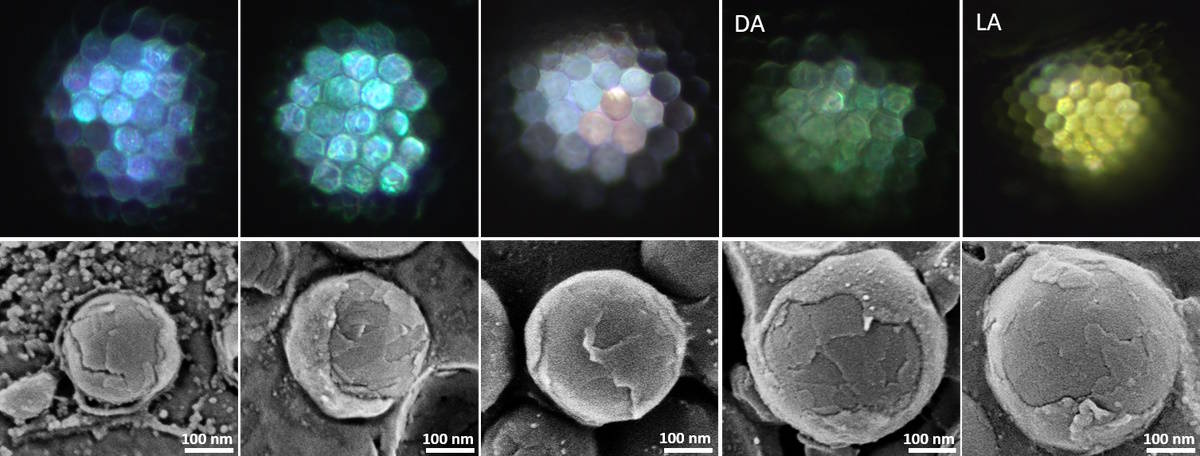
In their new work, detailed in Science, researchers led by Johannes Haataja of the University of Cambridge in the UK and Benjamin Palmer from Ben Gurion University in Israel, used optical and cryogenic scanning electron microscopy to study several species of shrimp and prawns, including the freshwater species Machrobrachium rosenbergi.

They found that the eyeshine is produced by highly reflective cells made from a photonic glass containing crystalline isoxanthopterin nanospheres on the interior of the crustaceans’ eyes. The eyeshine colour ranges from deep blue to green/yellow depending on the size of the nanospheres and how they are ordered. This modulation helps the creatures “blend in” with different background colours, which vary depending on the time of day and the depth that they find themselves in, explains Palmer.

A nice surprise

As sometimes happens in science, the researchers made their discovery quite by chance – as they were initially studying how isoxanthopterin crystals form in certain species of shrimp as they develop. Indeed, in previous work, they had found that that adult decapod crustaceans used a back-scattering reflector (tapetum) lying behind the retina made from these crystals to increase the amount of light they capture.

“We had a nice surprise, however, in that we found that larval shrimp also use crystalline reflectors – albeit for a very different optical purpose to the adults,” explains Palmer. “Our work is based on a previous study by another group who found this effect in larval stomatopod crustaceans. We also found that the eyeshine phenomenon is present in other larval decapod crustaceans with differently coloured eyes.”

Invisible against the background

To discover the material responsible for this reflectance, the team used cryogenic-scanning electron microscopy – a technique that allows biological tissue to be imaged in a close-to-life state without introducing artefacts resulting from the dehydration of wet biological tissue. The images obtained showed that the reflector was made of spheres. Upon closer examination, using transmission electron tomography and electron diffraction, the researchers found that the spheres were made from isoxanthopterin crystals, just like in adult crustacean eyes.

“However, in the larval case, the anatomical position and optical function of the spheres is very different,” Palmer tells Physics World. “The reflector sits atop the absorbing pigments in the eye and reflects light away from the conspicuous eye pigments to render the animals invisible against the background.”

The correlation between eyeshine color and nanoparticle size

The key to the camouflage, he says, is the animal’s ability to control the size of the spheres, which, as mentioned, determines the colour of the reflector. A critical part of the study, he adds, was the computational work performed by Haataja and Lukas Schertel. “Their three-dimensional models allowed us to test the effect of numerous structural parameters on the optical properties of the reflector, including particle size, particle filling fraction, cell size, particle birefringence and particle hollowness,” explains Palmer.

Organic biomineralization

The researchers say that they would now like to better understand how different organisms use crystalline materials to manipulate light for different functions. This field, known as organic biomineralization, is garnering ever more attention in the community, Palmer explains. A key question here is to understand how organisms control the crystallization of these materials, with the aim of developing new ways to synthesize artificial equivalents for use in real-world applications.

“Whilst we are more concerned with the fundamental science, it is very possible that there could be bio-inspired materials generated from this study,” he says. “Isoxanthopterin nanospheres have an incredibly high refractive index (around 2.0 in certain crystallographic directions), which makes them extremely efficient at reflecting light. And the fact that the colour for the reflected light can be tuned by controlling the sphere size makes them, in principle, very versatile optical materials.”

There is currently a lot of interest, Palmer adds, in replacing conventional inorganic scattering materials (used in food additives, paints and cosmetics, for example) with organic analogues. “The material described in this work would be an excellent candidate but there are many fundamental things we need to learn first.”

Debris ejected from the DART impact helped give asteroid Dimorphos an extra push

The impact of a spacecraft into the asteroid Dimorphos last year changed the asteroid’s orbital period around its companion asteroid, Didymos, by 33 minutes, with much of the momentum change coming from the ejecta liberated by the impact. That is one of the findings from a quintet of new papers that has now verified the amount by which the impact knocked the 177 m-wide Dimorphos from its orbit.

The Double Asteroid Redirection Test (DART) was a NASA spacecraft designed as a test of whether it is possible in future to deflect a potentially hazardous asteroid away from Earth.

DART struck Dimorphos on 26 September 2022, obliterating the spacecraft and excavating a crater on the surface that led to streams of ejecta stretching away from the wounded asteroid, which were captured by the Hubble and James Webb space telescopes.

The successful impact resulted in NASA and a team led by the Johns Hopkins Applied Physics Laboratory in the US bagging the Physics World 2022 Breakthrough of the Year award.

NASA had expected that Dimorphos’ orbit would undergo a minimum change by about seven minutes after impact. Yet observations of the double asteroid’s light curve that tracks how the two asteroids orbit around each other, periodically eclipsing one another, as well as radar measurements, indicate that Dimorphos’ orbital period around the larger 850 m-wide Didymos was slowed by 33 minutes.

“A lot of people had this assumption that we were taking two billiard balls and jut crashing one into the other,” says Cristina Thomas of Northern Arizona University, lead author of one of the new papers.

Instead, DART was crashing into little more than a loosely consolidated rubble pile and was able to kick out plenty of material into space.

“That material has its own momentum,” Thomas told Physics World. “We refer to that as ‘momentum enhancement’ because it’s above and beyond what we would expect from an inelastic collision.”

It was this momentum enhancement that made up the difference between seven and 33 minutes in the change in orbital period. This suggests that most of the momentum change imparted on Dimorphos came not directly from DART’s kinetic impact, but from the ejecta causing a recoil on the asteroid.

The finding has consequences for when it may be necessary to deflect a hazardous asteroid away from Earth. The extra push from the ejecta means that it could be possible to deflect an asteroid with less time before impact than originally thought. “[It] really changes the way that we think about the scale of asteroid deflection,” says Thomas.

Thomas points out, however, that DART’s impact “is just one data point” and other asteroids could have different properties. “But as we do think that a lot of asteroids are rubble piles, it gives us a little bit of room when it comes to deflecting them,” adds Thomas.

Other findings

Another paper expands on the momentum enhancement. By Andy Cheng of the Johns Hopkins University Applied Physics Laboratory and colleagues, it finds that the impact itself resulted in an instantaneous reduction in Dimorphos’ orbital velocity of 2.7 mm per second – high enough to implicate recoil from the release of ejecta.

In a third paper, led by Ariel Graykowski of the SETI Institute, and utilising the observations of citizen scientists, the amount of brightening of Dimorphos in the aftermath of the collision led to an estimate of the mass of the ejecta being 0.3–0.5 per cent of Dimorphos’ total mass.

The ejecta streams evolved complexly, as first gravity from the two asteroids, and then radiation pressure from the solar wind, acted on them, according to a fourth paper led by Jian-Yang Li of the Planetary Science Institute in Arizona.

Li led Hubble Space Telescope observations of the impact, which showed a cone of ejecta being twisted by the asteroids’ gravity, before the photon pressure of sunlight pushed the ejecta away in two dust tails. A fifth paper summarises the results for what was a successful test of kinetic impactor technology for planetary defence.

The European Space Agency’s Hera mission, which launched in October 2024, is expected to arrive at the Didymos–Dimorphos system in 2026. Hera will follow up on the aftermath of the impact, image the resulting crater and characterise the two asteroids overall.

The five papers are published in Nature.

Baby physics: conception, pregnancy and early life

“The first thousand days” is a common term used by paediatricians to describe the period from conception to the child’s second birthday – a time in which so many critical developments occur. While biologists and neuroscientists have shone a light on this transformation, physicists too can bring fresh insights on conception, pregnancy and babyhood.

This short film explores some of the areas where physics tools can reveal how processes work – and therefore help to develop solutions where problems emerge. For instance, modelling how sperm swim, and how the placenta enables the efficient exchange of gases between mother and developing fetus. Statistical physics can also conceptualise how a child’s language ability usually undergoes a “phase transition” at the age of two to three, when they quickly start to construct complex – and grammatically correct – sentences.

Find out more by reading the feature article ‘The surprising physics of babies: how we’re improving our understanding of human reproduction’.

Researchers grow electronics directly inside living tissue

Interfacing neural tissue with electronics provides a way to investigate the complex electrical signalling characteristics of the nervous system. Implanted electronic devices can also be used to modulate neural circuitry to prevent or treat various diseases. Unfortunately, there’s a fundamental mismatch between rigid electronic substrates and soft tissues that risks damage to delicate living systems.

Researchers in Sweden have come up with a way around this mismatch, by generating electrodes within the body. The team – from Linköping University, Lund University and the University of Gothenburg – has developed a method of creating soft, substrate-free conducting materials directly inside living tissue, using the body’s molecules as triggers.

The approach, described in Science, starts with an injectable solution made from a complex cocktail of molecular precursors. This gel contains an organic monomer known as ETE-COONa, as well as oxidase enzymes (glucose oxidase (GOx) or lactate oxidase (LOx)) and horseradish peroxidase embedded in a polymer matrix along with crosslinkers. After injection, the enzymes break down endogenous metabolites in the tissue (glucose or lactate), inducing polymerization of the organic monomer to form a stable, soft conducting gel.

“For several decades, we have tried to create electronics that mimic biology. Now we let biology create the electronics for us,” says Linköping University’s Magnus Berggren in a press statement.

In vivo electrode fabrication

Berggren and colleagues validated the enzyme-triggered polymerization process by injecting the cocktail gels into anaesthetized live zebrafish. Gels injected into zebrafish tailfins polymerized in vivo, creating a distinct dark colour along the whole length of the fin cavities. Both glucose and lactate were effective catalysts, with lactate inducing faster polymerization, likely due to its higher concentrations in zebrafish tissues.

The team next injected the cocktail with LOx as the oxidase enzyme into the brains of anesthetized zebrafish, work conducted by Roger Olsson from Lund University. Dissected brain slices contained dark blue polymer, indicating signs of polymerization, which the researchers confirmed via UV-vis absorption spectroscopy.

They characterized the electrical behaviour of the brain slices by placing them on top of gold microelectrode arrays (MEAs) and performing measurements in regions with dark spots. Dehydrated brain slices exhibited a linear current when a voltage of between −0.5 and 0.5 V was applied. This current was higher than seen in control tissue samples.

Importantly, the LOx-based gels appeared to be nontoxic. Three days after gel polymerization in the brain, the zebrafish showed normal swimming behaviour and the injection site had no signs of tissue damage.

Injecting GOx-based cocktail gels into the zebrafish brains did not cause polymerization. This poor performance was expected because zebrafish brains, much like their human counterparts, are known to have low glucose and high lactate concentrations.

Linköping University researchers

The researchers also immersed extracted zebrafish hearts in GOx- or LOx-based cocktail gels. For both gels, they observed dark blue lines on the surface of the hearts, indicating that both glucose and lactate induced polymerization. Hearts removed from the gel and integrated with MEAs exhibited a linear current response to the application of a linear voltage sweep, a behaviour not seen in control samples.

These findings demonstrate that the formation of electronic conductors fuelled by endogenous metabolites can develop soft electronics in various biological tissues and environments. To confirm this, the researchers injected the gels into beef, pork, chicken and tofu samples. They observed polymerization in all of the tissues, but not in the plant-based tofu, due to the lack or low concentration of the required metabolites.

Finally, to investigate the possibility of creating recording and stimulation electrodes for neuroscience applications, the team injected the gel into medicinal leeches, which have a simple and easily accessible nervous system. They showed that LOx-based cocktails polymerized in situ and could interface nervous tissue with gold electrodes on a tiny flexible probe.

“Our results open up for completely new ways of thinking about biology and electronics,” says co-lead author Hanne Biesmans, a PhD student at Linköping’s Laboratory of Organic Electronics. “We still have a range of problems to solve, but this study is a good starting point for future research.”

Berggren says that the team’s current aims include varying the cocktail chemistry to control the binding locations, providing a tool to build up electrodes and electronics at the cell level. “We are also evaluating the cocktails, and modifications thereof, in other larger animal models, to enable contact to external circuits, then to achieve recording or actuation of neuronal signalling,” he tells Physics World.

Why you should concentrate on this form of solar power

Modern solar cells are so good at converting sunlight into electricity that today’s flat-panel photovoltaics (PVs) are cheap, efficient, long lasting and plentiful. As I mentioned last month, they economically outperform concentrator photovoltaics (CPVs), which use lenses or curved mirrors to focus the Sun’s rays onto tiny solar cells. Despite showing much early promise, CPVs today seem far too complicated and expensive to succeed.

There is, though, another kind of solar power I find exciting, which uses sunlight to warm up a heat-retaining liquid. The hot fluid can be used to boil water, with the resulting steam driving a turbine to generate electricity. Known as concentrator solar power (CSP), it is only really economic at large scale, but has one huge advantage. Because the liquids in CSP can be stored, the energy can be converted into electricity even when the Sun isn’t shining.

Concentrated solar power has one huge advantage: the energy can be converted into electricity even when the Sun isn’t shining

According to the US National Renewable Energy Laboratory, three main types of CSP have been tested over the years. First there are linear concentrator systems, which use long U-shaped mirrors to collect the Sun’s energy. Motors actively tilt the mirrors towards the Sun, focusing sunlight onto tubes (receivers) that run the length of the mirrors. The tubes, which contain the hot fluid, are usually placed in troughs lying along the focal line of the mirror, although sometimes a single tube is placed above multiple mirrors.

Another kind of CSP uses a mirrored dish rather like a large satellite dish. To minimize costs, the dish is not one single structure but is usually made up of many smaller flat mirrors. The curved surface directs and concentrates sunlight onto a thermal receiver, which absorbs and collects the heat. The hot fluid heats a gas in a version of the classic Stirling engine, moving pistons to create mechanical power, which drives a generator.

Finally there are “power tower systems”, which use a large field of flat, Sun-tracking mirrors. Known as heliostats, they focus and concentrate sunlight onto a receiver at the top of a tower. As with the other CSPs, a heat-transfer fluid heated in the receiver generates steam to drive a turbine. Most use molten salts as a heat-transfer fluid that can store energy for use at night or when it’s cloudy.

Mixed fortunes

There were more than 90 CSPs in operation around the world by the end of 2021, with Spain and the US accounting for over half the globally installed capacity of 6.4 GW. Examples include the 110 MW Crescent Dunes facility in Nevada (which uses molten salt) and the 394 MW Ivanpah project in California (which runs on water). The beauty of CSPs is that they are all highly efficient. Power-tower systems (where the fluid is at 250–565 °C) can convert up to 35% of all solar energy into electricity, while dish systems (running at 550–750 °C) can be up to 34% efficient.

According to a 2021 report from the International Renewable Energy Assocation (IREA), the levelized cost of electricity (LCOE) – a kind of average net cost – of CSPs has fallen sharply in recent years. In the decade to 2020, the global weighted average LCOE of newly commissioned CSPs plants tumbled by 70% from $0.361/kWh to $0.107/kWh. The reductions have been driven largely by the fact that these plants can operate at ever higher temperatures, which cuts storage costs and allows them to run for longer periods.

For plants commissioned between 2016 and 2020, the IRENA report found that about four-fifths had at least four hours of storage, while 35% had eight hours or more. This trend is expected to accelerate even further with IRENA already finding that the average storage time had risen from 4.7 hours for projects commissioned in 2020 to 17.5 hours for those commissioned the following year. The average CSP project size in 2021 was a respectable 110 MW.

Cost concerns

But CSP systems aren’t perfect. They use lots of water and it’s not cheap keeping the mirrors clean, which is vital if you want to keep their efficiencies high. And, of course, these systems only work well if there’s lots of sunlight, which makes them impractical in many parts of the world. What’s more, the cost of rival renewable sources of energy has been plummeting.

According to IRENA, the LCOE for solar PV has fallen by 88% since 2010 to $0.08/kWh, while onshore wind power has dropped by 68% during that time to $0.033/kWh and offshore wind has decreased by 60% to $0.075/kWh. Despite its recent drop in price, CSP remains much higher at $0.107/kWh. It makes CSP look uneconomic, although this headline figure includes the cost of storing the energy, which is omitted from the other LCOE numbers.

For all the promise, concentrated solar-power systems lag far behind conventional solar photovoltaic panels

Still, for all the promise, CSPs lag far behind conventional solar PV panels, which had a total installed capacity of 957 GW in 2021. Solar PVs are simply such an easy and scalable technology, provided of course that you can store the energy in batteries. Given the huge amount of work going into developing batteries for electric vehicles, I’m sure solar PV will give CSP with thermal storage a run for its money over the next 20 years.

As the IRENA 21 report concludes: “In the absence of strong global policy support for CSP, the market remains small and the pipeline for new projects unambitious”. I find that disappointing, given the remarkable fall in costs for CSP since 2010 and its ability to provide dispatchable power 24/7 in sunny areas at a reasonable price. Sadly, energy production is all about the economics – and CSP is always playing catch-up on cost.

But perhaps all is not lost. First, the batteries needed for solar PV might rocket in price as they require rare materials that might one day become costly. Second, research suggests that the heat stored in CSPs could be used to produce a range of “green fuels”, such as hydrogen or ammonia. Perhaps CSPs might one day even work in partnership with their nemesis – the flat solar PV panel – to produce electricity and fuel round the clock.

Thinner antiferroelectrics become ferroelectric

Antiferroelectric image

Reduced beyond a certain size, antiferroelectric materials become ferroelectric. This new result, from researchers in the US and France, shows that size reduction could be used to turn on unexpected properties in oxide materials and indeed a range of other technologically important systems.

Antiferroelectric materials consist of regularly repeating units, each of which has an electric dipole – a positive charge paired with a negative one. These dipoles alternate through the crystalline structure of the material and such regular spacing means that antiferroelectrics have zero net polarization on the macroscale.

While ferroelectrics are also crystalline, they usually have two stable states with two equal and opposite electric polarizations. This means the dipoles in the repeating units all point in the same direction. The polarization of the dipoles in a ferroelectric material can also be reversed by an applying an electric field.

Thanks to these electrical properties, antiferroelectrics can be used in high-density energy storage applications while ferroelectrics are good for memory storage.

Directly probing the size-driven phase transition

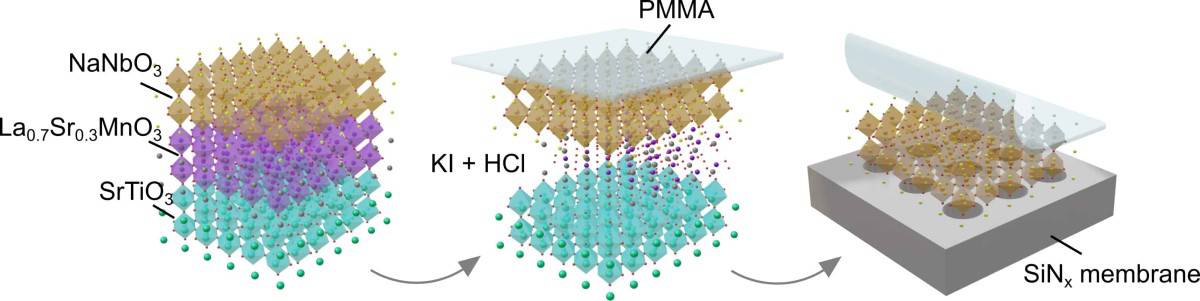
In their work, which is detailed in Advanced Materials, the researchers led by Ruijuan Xu of North Carolina University studied the antiferroelectric sodium niobite (NaNbO3). While previous theoretical studies predicted that there should be an antiferroelectric-to-ferroelectric phase transition as this material was made thinner, such a size effect had not been verified experimentally. This was because it was difficult to completely separate the effect from other phenomena, such as the strain arising from the lattice mismatch between the material film and the substrate it had been grown on.

To overcome this problem, Xu and colleagues lifted the film off the substrate by introducing a sacrificial layer (that they then dissolved) between the two materials. This method allowed them to minimize the substrate effect and directly probe the size-driven phase transition in the antiferroelectric material.

The researchers found that when the NaNbO3 films were thinner than 40 nm, they became completely ferroelectric, and that between 40 nm to 164 nm, the material contains ferroelectric phases in some regions and antiferroelectric phases in others.

Exciting discovery

“One of the exciting things we found was that when the thin films were in the range where there were both ferroelectric and antiferroelectric regions, we could make the antiferroelectric regions ferroelectric by applying an electric field,” says Xu. “And this change was not reversible. In other words, we could make the thin film completely ferroelectric at thicknesses of up to 164 nm.”

According to the researchers, the phase changes they observed in very thin antiferroelectric materials come about as the surface of the films distorts. Instabilities at the surface ripple throughout the material – something that is not possible when the material is thicker.

“Our work shows that these size effects can be used as an effective tuning knob to turn on unexpected properties in oxide materials,” Xu tells Physics World. “We expect to discover more emergent phenomena in other oxide membrane systems using these effects.”

The researchers say they are working on fabricating NaNbO3 thin-film based devices to probe the electrical properties on the macroscale. “We hope to be able to manipulate the phase stability and obtain enhanced electrical properties in these devices, which will be useful for potential applications,” says Xu.

Liquid nitrogen cleans lunar dust, new source of helium may be lurking underground

The Moon is a dusty place, and the fine, sharp particles can cause lots of problems if they get into the wrong areas. This is an important consideration for people who are developing equipment and spacesuits for future missions to the Moon. The dust could also cause lung disease in astronauts if it is inhaled.

During the Apollo missions of the 1960s and 1970s, astronomers used brushes to deal with moondust, but it didn’t work very well. Indeed, the fact that the dust is electrostatically charged means that it tends to stick to surfaces.

Now, researchers at Washington State University have developed a new way to remove moondust that involves the Leidenfrost effect. This occurs when drops of liquid are placed on a hot surface, creating a layer of vapour that levitates the drops. When very cold liquid nitrogen is sprayed on a dust-covered surface, the nitrogen vapour that is formed lifts the dust particles and carries them away.

The team tested their dusting technique at atmospheric pressure and in a vacuum chamber to mimic conditions on the Moon. They found that the technique worked even better in vacuum.

The research is described in Acta Astronautica.

Bubbling up

Helium is a finite resource on Earth and there is currently a shortage of the gas. It is created by radioactive decay deep underground. The gas then rises up through rock and gets trapped in some geological structures. Today, almost all helium being used is a by-product of the extraction of oil and gas – and as we reduce our consumption of fossil fuels, this source will diminish. And to make matters worse, Russia is a large producer of helium, and this source is not available to many users.

As well as floating party balloons, liquid plays a crucial role in cooling the superconducting magnets in medical MRI scanners. So, running low on the gaseous element is not a good thing.

Now, a team lead by researchers at the University of Oxford have taken an important step forward in understanding how helium can sometimes get trapped at very high concentrations in underground structures that don’t contain natural gas or the greenhouse-gas carbon dioxide.

Instead, these helium reserves are associated with nitrogen, which is an environmentally benign gas. The team believes that nitrogen bubbles can form in water deep underground. Helium can then get trapped in these bubbles, which rise until they hit impervious rock, trapping the nitrogen and helium. The team also believe that hydrogen could be trapped in the same way. So, such geological structures could also hold reserves of hydrogen – which could be used as a carbon-free source of energy.

The team reports its findings in Nature.

Innovation in diamond applications from Element Six

Element Six is a company that takes a totally customer-centric approach to R&D and focuses on communication to create solutions for its customers. So says Michael Pearson, head of CVD applications and commercial development at the business, in this short video filmed at Photonics West 2023, which was held in San Francisco, California, in January.

Diamond has many different uses in industry. As Pearson and his colleague Teodoro Graziosi, senior research scientist, explain, the material’s high thermal conductivity makes it great at dissipating heat, while its nitrogen-vacancy centres allow it to be used for quantum applications. It also has a very low optical absorption, making it useful in a wide range of laser and optical applications.


Copyright © 2026 by IOP Publishing Ltd and individual contributors