

Teacher training scholarships support scientists and engineers to inspire the next generation

As any scientist knows, there’s something uniquely delightful about grasping a new concept for the first time, but the enjoyment doesn’t have to stop there. Learning something new is often followed by an urge to share it with others, and helping them understand it can be even more fulfilling. This is something Ruth Cheesman discovered while homeschooling her children during lockdown.

“I got really interested in the cognitive science of learning,” she recalls. “We were doing marble runs across the garden and I got excited about providing that kind of hands-on lesson at home.” At that point, Cheesman had been an engineer for 18 years. But in June 2021, driven by her newfound enthusiasm, she made a snap decision to become a teacher.

Any career switch is a challenge, but Cheesman successfully applied for an Institute of Physics (IOP) Teacher Training Scholarship to help her make the transition. Funded by the Department for Education, this scholarship programme encourages talented scientists and engineers to bring their passion for physics into the classroom. In addition to a tax-free grant of £29,000, scholars have access to a plethora of teaching resources and continuing professional development (CPD) workshops throughout the year.

Beginning her training in September 2021, Cheesman made use of these benefits from the start. She found the CPD workshops particularly helpful, as they included explanations of what students often find hard to understand, and hands-on demonstrations of how to convey tricky topics.

Cheesman also found that a sense of community was invaluable in tackling a busy year of juggling assignments with learning teaching methods and behaviour management. “It’s a lot,” she says, “but there are so many people out there offering support. I’ve tapped in through the IOP and also through the EduTwitter world.”

Bringing science alive

In July this year, after finishing her training, Cheesman attended a meetup of all the IOP scholars at the National Space Centre in Leicester for a day of practical activities, like making launchers for paper rockets. “It was nice to meet likeminded people who had had similar experiences,” she says, “and the support carries on after that first training year.”

Now in her first term teaching at a sixth-form college, Cheesman still takes inspiration from the IOP workshops to be creative in the classroom. While visiting Thorpe Park one day, she brought her physics app on her phone onto the rollercoasters with her, to measure forces and accelerations. She plans to share that real-world data with her students to illustrate the physics of motion.

Scholars have access to a plethora of teaching resources and continuing professional development workshops throughout the year

Besides sharing her passion for physics, Cheesman is enjoying getting to explore topics like particle physics and cosmology, which she didn’t use as an engineer. But her previous job also helps her to emphasize the career relevance of the subject.

For other mid-career professionals thinking about a change, Cheesman says teaching is a refreshing challenge. “Release the fun within and use your passion and experience to inspire the next generation of physicists and engineers,” she says. “As a career changer I know I bring a broader insight to the classroom; I can share real stories of the applications of material science or simple harmonic oscillations and touch on where what we’re learning can take my students in the future.”

Empowering young people

For Emily Adams, who also completed her teacher training earlier this year, it is not only a passion for physics that motivates her, but also a belief in education as a powerful tool to remove barriers in society.

This is something that Adams has personal experience of, having come from an underprivileged socioeconomic background, which gave her only a 12.5% chance of going to university. While her family were very supportive, she was the first family member to pursue higher education, so she felt lucky to have teachers who helped her with the applications.

It’s cool to see my students have the penny-drop moment, and that kind of thing happens every day. It’s kind of like magic and it feels special to be part of it

Adams went on to study physics at university, and in her final year she participated in activities at local schools, such as running a session of an after-school physics club. It was her enjoyment of these activities that prompted her to apply for teacher training. “I hadn’t necessarily always planned on it,” she recalls, “but I realized I have always enjoyed sharing what I know with other people.”

Beginning her training in September 2021, Adams was also awarded an IOP scholarship and, like Cheesman, she found the workshops and resources especially useful. “They gave me loads of ideas for my lessons,” she says, “not only teaching strategies but also really practical things that I could show my students in class, to help them engage with those big ideas in physics.”

High school physics class

Physics for all

Having enjoyed training at her main placement school, Adams is now a teacher there, and continues to find it rewarding. “It’s cool to see my students have the penny-drop moment,” she says, “and that kind of thing happens every day. It’s kind of like magic and it feels special to be part of it.”

Adams continues to make the most of the scholarship resources, including the physics magazines and booklets about influential scientists that the IOP sends her. She finds that the information about these scientists and their life stories helps to bring lessons alive, turning them into a story of discovery, rather than a lecture.

Besides the IOP’s workshops on teaching specific topics, Adams also appreciated their CPD sessions about the importance of improving diversity in physics. This is particularly pertinent to her as a teacher in a girls’ school with students from many different cultural backgrounds. And as a young woman she wants to show her students that the subject is for them as much as for anyone else.

For physics students considering a career in the classroom, Adams recommends applying for opportunities to try it out, like the after-school club she ran a session of during university. “Teaching lets me share what I am passionate about with young people every day and provide opportunities for students who come from marginalized backgrounds like me to get involved with STEM,” she explains. “I would say it’s the best thing I could have done with my degree.”

Has this article inspired you to consider a career in teaching? Take our short survey and tell us your views.
Mercury’s superconductivity explained at long last

More than 100 years ago, the physicist Heike Kamerlingh Onnes discovered that solid mercury acts as a superconductor. Now, for the first time, physicists have a complete microscopic understanding of why this is so. Using a modern first-principles computational method, a team from the University of L’Aquila, Italy, found several anomalies in mercury’s electronic and lattice properties, including a hitherto undescribed electron screening effect that promotes superconductivity by reducing repulsion between pairs of superconducting electrons. The team also determined the theoretical temperature at which mercury’s superconducting phase transition occurs – information previously absent from condensed-matter textbooks.

Superconductivity is the ability of a material to conduct electricity without any resistance. It is observed in many materials when they are cooled below a critical temperature Tc that marks the transition to the superconducting state. In the Bardeen-Cooper-Schrieffer (BCS) theory of conventional superconductivity, this transition occurs when electrons overcome their mutual electrical repulsion to form so-called “Cooper pairs” that then travel unhindered through the material as a supercurrent.

Solid mercury became the first known superconductor in 1911, when Onnes cooled the element to liquid helium temperatures. While it was later classed as a conventional superconductor, its behaviour was never fully explained, nor was its critical temperature predicted – a situation that Gianni Profeta, who led the recent effort to repair this oversight, calls “ironic”.

“While its critical temperature is extremely low compared to high-Tc materials like the cuprates (copper oxides) and high-pressure hydrides, mercury has played a special role in the history of superconductivity, serving as an important benchmark for phenomenological theories in the early 1960s and 1970s,” Profeta says. “This is indeed ironic, that mercury, the element in which superconductivity was reported for the first time, had so far never been studied by modern first-principles methods for superconductors.”

No empirical or even semi-empirical parameters required

In their work, Profeta and colleagues began with a counterfactual: if Onnes had not discovered superconductivity in mercury in 1911, could scientists predict its existence today using state-of-the-art computational techniques? To answer this question, they used an approach called SuperConducting Density Functional Theory (SCDFT), which is considered one of the most accurate ways of describing the superconducting properties of real-world materials.

In first-principles approaches like SCDFT, Profeta explains, the fundamental quantum mechanics equations describing the behaviour of nuclei and electrons in materials are solved numerically, without introducing any empirical or even semi-empirical parameters. The only information required by SCDFT is the arrangement in space of the atoms that form a given material, although some standard approximations are usually employed to keep computational times manageable.

Using this technique, the researchers found that a panoply of phenomena all come together to promote superconductivity in mercury. The behaviours they uncovered included unusual correlation effects on the material’s crystal structure; relativistic corrections to its electronic structure that alter the frequencies of phonons, which are vibrations of the crystal lattice; and an anomalous renormalization of the residual Coulomb repulsion between electrons due to low-lying (at about 10 eV) d-states.

Such effects could be, and were, neglected in most (conventional) superconductors, Profeta says, but not in mercury. The screening effect, in particular, produces a 30% increase in the element’s effective critical temperature. “In this study, we realized that although mercury has been considered as being a rather simple system because of its uncomplicated structure and chemistry, it is in fact one of the most complex superconductors we had encountered,” Profeta tells Physics World.

Spin-orbit coupling effects are important

After taking all these factors into account, the researchers predicted a Tc for mercury that was within 2.5% of the actual experimentally measured value. They also found that if relativistic effects such as spin-orbit coupling (the interaction between the spin of an electron and its orbit around the atomic nucleus) were not included in the calculations, some phonon modes became unstable, indicating a tendency for the system to distort into a less symmetric structure. Such effects thus play a crucial role in determining mercury’s critical temperature. “As our everyday experience shows, mercury at room temperature is in a rather unusual liquid metal state, which is reflected in very low-energy (but not unstable) phonon modes,” explains Profeta. “Describing these modes accurately requires special care.”

The researchers claim that their work, which is detailed in Physical Review B, is of historical importance. “We now know the microscopic mechanisms at play in the first ever discovered superconductor and have determined its superconducting phase transition – information that was lacking for the first ever superconductor to be discovered,” Profeta says.

This new understanding of the world’s oldest superconductor though a material-by-design approach was only possible thanks to high-throughput computations, he adds. Such computations are capable of screening millions of theoretical material combinations and picking out those that could be conventional superconductors at close to ambient conditions. Finding such room-temperature superconducting materials would vastly improve the efficiency of electrical generators and transmission lines, as well simplifying common applications of superconductivity such as superconducting magnets in particle accelerators and MRI machines.

“The peculiar Coulomb renormalization effects discovered in mercury could be exploited to engineer new materials, with an electronic density of states profile similar to mercury, providing an additional knob to enhance the critical temperature of materials,” Profeta says. “We are now exploring this possibility.”

Brightness boost for Berkeley Lab Laser Accelerator upgrade

A second beamline area at the Berkeley Lab Laser Accelerator (BELLA) Center will soon open to users, allowing researchers to study extremely hot plasmas, investigate cancer therapies and discover new materials for quantum science. Dubbed Interaction Point 2 (iP2), the new beamline will be able to produce a laser beam about a thousand times brighter than is currently possible at the lab.

Installation of iP2 began in 2020 at BELLA, which is operated by the Lawrence Berkeley National Laboratory (LBNL). The facility was completed on schedule despite a shutdown in March 2020 caused by the COVID-19 pandemic. The first commissioning runs at iP2 began in September 2022, with engineers successfully delivering petawatt, picosecond laser pulses.

Those initial experiments applied about half the maximum pulse energy to low-density foam targets as well as thin metal or plastic ones. The foam targets allow the laser to penetrate further than the other materials, which creates a very strong magnetic field, like a vortex in the foams. That ability to boost particles to higher energies in shorter distances promises new, and possibly cheaper, means of exploring fundamental physics.

We’re ushering in a new era of high-intensity laser experiments

Cameron Geddes

“By compressing the laser energy into this short pulse and tiny focus, we can produce these very exotic small focal spots in the targets,” says LBNL physicist Lieselotte Obst-Huebl, who led the iP2’s installation.

High intensity 

The facility’s initial experiments will include studies of the FLASH effect, where radiation delivered by protons in short, intense bursts is used to kill cancer cells but not the healthy tissue nearby. BELLA researchers want to extend previous studies of the effect to thicker skin and tumour tissue.

In one early experiment, Obst-Huebl told Physics World, a collaboration with Lawrence Berkeley biologists will irradiate anaesthetized live mice to study whether the higher power produces “the beneficial effects we’ve seen in cell samples” in iP1 investigations. 

Other planned studies for iP2 include methods of improving qubits and high-temperature superconductors. “We’re ushering in a new era of high-intensity laser experiments,” adds Cameron Geddes, director of the LBNL’s accelerator technology and applied physics division. 

Quasars, exoplanets and the atmospheres of distant worlds: more on the first results from the JWST

It was an active final day at the First Science Results from JWST conference at the Space Telescope Science Institute in Baltimore, US, where discussion turned to some incredible observations of quasars above redshift 6, showing them as they existed more than 12.7 billion years ago.

As the compact cores of galaxies with extremely active supermassive black holes, we know that quasars can shine many times brighter than their host galaxy. In his presentation, John Silverman of the University of Tokyo described how data from the JWST’s CEERS (Cosmic Evolution Early Release Science) survey is following up on a dozen high-redshift quasars originally identified by the Subaru Telescope on Mauna Kea.

Throughout the conference, astronomers have joked that high redshift no longer means what it used to mean. Before the JWST came along, high redshift for the Hubble Space Telescope meant resolving the host galaxies of quasars out to about redshift 2, or roughly 10 billion years in the past. Now, the JWST is resolving the structures of host galaxies around quasars at redshift 6 (almost 12.7 billion years ago).

Much happened in the universe between redshifts 2 and 6, and astronomers are keen to see if the ratio of the mass of a supermassive black hole at the centre of a galaxy relative to the mass of its host galaxy (or more specifically the stellar mass of the galaxy’s bulge) still holds at the highest redshifts. The answer will tell us about the conditions under which supermassive black holes and galaxies formed, and how they affected each other’s growth.

The mass ratio between a supermassive black hole and the bulge of a galaxy around it is 1:200, with this value believed to be connected to feedback from the black hole in the form of outflows of radiation spewing out as it accretes matter. The relationship was first quantified by observations with the Hubble Space Telescope in the 1990s, with Silverman calling it “fundamental.”

It turns out that high redshift galaxies do indeed also stick to this relation. Silverman said that astronomers have targeted redshift 6 because it’s at this redshift that simulations of galaxies tend to differ the most. What astronomers really need is some hard and fast data to input into the simulations, and the JWST has been happy to oblige.

The typical galaxy hosting a quasar at this redshift is just 8% as luminous as the quasar. However, it’s actually possible to take the glare of a quasar out of the image – since the quasar itself appears point-like, it manifests as diffraction spikes that can be removed by a point spread function.

The JWST finds the galaxies to be fairly compact and disc-shaped, with surprisingly well-defined spiral arms and central bars just a billion years after the Big Bang. In her talk, Madeline Marshall, of NRC Herzberg in Victoria, Canada, discussed the first high-redshift quasar results from the JWST’s Near-Infrared Spectrometer (NIRSpec), finding these black holes to weigh billions of solar masses, and the mass of their host galaxies to be in the region of hundreds of billions, therefore seeming to maintain the mass ratio observed at lower redshift.

How exactly black holes grew to be so massive so early in the universe is still under debate, but hopefully the JWST will start to provide some answers. Just to give an indication of the telescope’s power, the JWST’s resolution is so fine that some of the quasar images show companion galaxies merging or interacting with the main galaxy, sporting tidal tails and bursts of star-formation at a rate of 30–50 solar masses per year.

Exoplanets and protoplanetary discs

Earlier in the day, exoplanets and protoplanetary discs came under the spotlight. Olivier Berné of the Institut de Recherche en Astrophysique et Planétologie in Toulouse revealed a solution to how planets can form in the ultraviolet-radiation-rich environments of large star clusters.

These star clusters produce their fair share of hot, young, massive stars that emit lots of ultraviolet radiation that ought, in principle, to erode protoplanetary discs around neighbouring lower mass stars. Berné reported how JWST astronomers, working with colleagues from the Atacama Large Millimeter/submillimeter Array, have observed the chemistry of these vulnerable discs and discovered a warm envelope of molecular gas surrounding them.

The envelopes are rich in polycyclic aromatic hydrocarbons, which have a strong infrared spectral signature that stands out to the JWST. They also have a high ultraviolet opacity, so they are able to block a lot of the harmful ultraviolet from outside a disc, protecting the early stages of planet formation.

Inside a planet-forming disc

One protoplanetary disc where planet-formation has proceeded quite far is PDS 70. It hit the news in 2018 and 2021 when astronomers using ALMA were able to image rings in PDS 70’s disc that appear to have been carved out by two young planets.

Giulia Perotti of the Max Planck Institute for Astronomy in Heidelberg revealed how the JWST can now measure chemistry within the inner region of PDS 70’s protoplanetary disc. It appears to be enriched with small dust grains that have been thermally processed, possibly by outbursts from the young star. The inner disc, meanwhile, is warped, possibly from the influence of another, unseen planet. Chemically, water and oxygen have also been detected in the disc. PDS 70 continues to be our best-studied example of planets forming within a disc of gas and dust.

WASP atmospheres

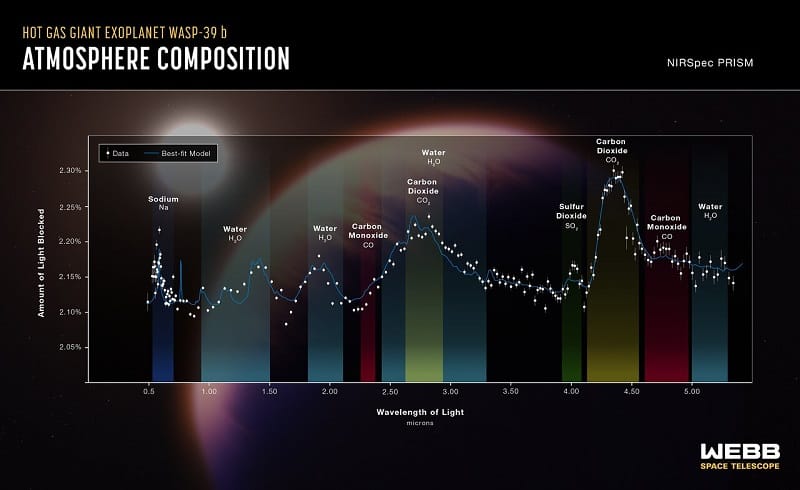
The transmission spectrum of an exoplanet taken by JWST.

Meanwhile, Kevin Stevenson of Johns Hopkins Applied Physics Laboratory updated delegates on the JWST’s observations of the atmospheres of older exoplanets. First, he recounted the space telescope’s observations of WASP-39b – a “hot Jupiter” 700 light-years away.

These observations were made as WASP-39b was transiting its star, with some of the star’s light being absorbed by atoms and molecules in the planet’s atmosphere as it passed through. Using this “transmission spectroscopy”, the JWST detected carbon monoxide, potassium, sodium and water in the atmosphere of WASP-39b, as well as sulphur dioxide, which is a product of photochemistry.

It’s the first time photochemical processes, in which radiation from the star alters molecules, have been detected on any exoplanet. The absence of a strong methane line at 3.3 microns is also evidence that photochemistry is transforming methane into other molecular species.

Stevenson then went on to preview results from another hot Jupiter – the planet WASP-43b, which lies 284 light-years away. When the JWST’s predecessor, the Spitzer Space Telescope, observed WASP-43b it could not detect any thermal emission from the planet’s night-side, which means it must be cold, beyond the limits of Spitzer to detect.

Stevenson revealed that the JWST had now detected this faint thermal emission, and – although he couldn’t give details – he described how making this measurement and measuring the temperature of the night-side would allow scientists to better constrain the properties of the tidally locked planet’s atmosphere.

Tantalizing TRAPPIST-1

We also heard new findings from the TRAPPIST-1 planetary system, which consists of seven planets in orbit around a red dwarf star 40 light-years away. Björn Benneke of the University of Montreal revealed that the JWST had performed reconnaissance of the atmospheres of some of the worlds of TRAPPIST-1.

While he wasn’t able to say anything yet about what the JWST had positively detected in their atmospheres, he did reveal that the seventh planet, TRAPPIST-1g, probably does not have a thick atmosphere rich in hydrogen. This would seemingly rule out it being a so-called ‘Hycean’ world, consisting of an ocean kept warm by a thick swathe of hydrogen. Since planet ‘g’ is at the very outer edge of TRAPPIST-1’s habitable zone, it might mean that without a thick insulating atmosphere, TRAPPIST-1g could be too cold to be habitable to life as we know it.

The three-day conference was an exciting preview of how the JWST is beginning to transform astronomical research and allow us to detect things that were completely beyond astronomers until now. Sometimes the conference presentations were frustratingly light on details – many said they’d have more to say next year, particularly at the 241st meeting of the American Astronomical Society (AAS) on 8–12 January in Seattle.

We have to remember, though, that the JWST has only been collecting data for barely six months. Given the complexity of both the telescope and the information it is collecting, astronomers are making sure to take care with their findings. If the preliminary results from this first JWST science conference are any indication, then the next few years could be some of the most exciting times ever for astrophysicists, cosmologists and planetary scientists.

Construction begins on the €1.3bn Square Kilometre Array

On-site construction for the €1.3bn Square Kilometre Array (SKA) began in Australia and South Africa on 5 December for what will be the world’s largest radio-astronomy infrastructure when complete in 2028. Work began 18 months after the Square Kilometre Array Observatory (SKAO) Council gave the green light for the facility. 

First conceptualized 30 years ago, the SKA project underwent several years of design and engineering work. The SKAO – an intergovernmental organization with 16 partner countries including eight members – will manage the construction and operation of the telescope from its headquarters at Jodrell Bank in the UK.

South Africa will have 133 SKA dishes during this phase, which will be added to the existing 64 that belong to the SKA-precursor telescope – MeerKAT – to form a mid-frequency instrument. Australia will host a low-frequency array of 131,072 antennas, enlarging the area covered by radio frequencies from the two telescopes.

The first two antenna stations are due to be complete by May 2023, while the first dish is set to be installed in April 2024, followed by three to four dishes each month.

On 5 December an event was held at the site of the SKA-Low telescope in Western Australia, attended by Philip Diamond, SKAO director-general. Meanwhile, SKAO council chair Catherine Cesarsky appeared at a ceremony in South Africa’s Northern Cape province where the SKA-Mid telescope will be built.

So far about €500m has been allocated towards construction, with more than 40 contracts worth more than €150m having been delivered over the past 18 months.

During the ceremony to mark the start of construction, Australia’s minister of science and industry, Ed Husic, along with South Africa’s minister of science and innovation Blade Nzimande jointly announced more than €200m for Australian and South African companies to deliver some of the extensive infrastructure required for the telescopes.  

Metallic snowflakes and a new spin on the curveball

The spin imparted on a baseball by a pitcher plays a crucial role in the ball’s trajectory – and how easy it is for the batter to hit the ball. If the ball has lots of spin, the Magnus effect will cause it to take a curved path towards the batter – with the strength of the curve depending on the spin of the ball. So, if a pitcher can vary the spin between pitches, they can confuse the batter and make them strike out.

The opposite strategy is the knuckleball, whereby little or no spin is imparted to the ball. This results in the ball following an erratic trajectory – making it difficult to hit. However, this can be a very risky strategy because the pitcher has little control over the trajectory, and the ball could end up outside of the strike zone.

Some professional pitchers are better than others when it comes to controlling the spin of a baseball. As a result, some players may be tempted to put a foreign sticky substance on their hand to get a better grip on the ball – something that is banned in Major League Baseball, with the exception of rosin.

Level the playing field

Now researchers at Tohoku University in Japan have looked at how sticky substances such as rosin affect friction between fingers and baseball leather. Not surprisingly, Takeshi Yamaguchi, Daiki Nasu and Kei Masani found that the substances increased friction. However, they also discovered that rosin – which can be used by pitchers – increases the friction in a consistent way when different people are tested. As a result, its use tends to level the playing field.

The trio also found that baseballs used in Japan imparted more friction than those used in the US. By increasing the friction of US balls, they suggest, American pitchers may not be tempted to cheat by using sticky substances.

The research is described in Communications Materials.

This is the last Red Folder of the year before we break for the festive season. So I am going to end with news that researchers in Australia and New Zealand have created tiny metallic snowflakes (see figure). The Aussie part of the collaboration grew the crystals by dissolving a number of different metals in gallium – which is a metal that is liquid at just above room temperature.  Then, their Kiwi partners did computer simulations to investigate why different metals formed differently-shaped snowflakes.

They report their findings in Science.

From the secrets of supernovae to the oldest planets in the universe: the first results from the JWST

The life and death of stars; setting sights on minor asteroidal and cometary bodies in our solar system; the oldest planets in the universe; and the secrets of supernovae – a rollercoaster ride of new discoveries was revealed on day two of the “First Science Results from JWST” conference, held at the Space Telescope Science Institute in Baltimore, US.

Stellar nurseries on Cosmic Cliffs

One of the first images to be released from the JWST in July this year was that of the “Cosmic Cliffs” – a section of the Carina star-forming nebula located about 8500 light-years away. Previously imaged by the Hubble Space Telescope, the so-called cliffs are made of molecular gas encircling a giant bubble blown in the nebula by the stellar winds and ultraviolet light of five luminous O-type stars, which are the hottest and most massive type of stars to exist. Embedded within the wall of gas are nascent stars. As astronomer Megan Reiter of Rice University explained, the JWST has now identified 24 new outflows from young stars that are still growing by accreting matter from their surroundings. By tracing these outflows, Reiter and her colleagues are able to locate the sites of star formation within the nebula.

The aim of their observations is to better understand what is triggering star formation in the nebula, said Reiter. Do the winds of the five O-type stars compress the gas in the Cosmic Cliffs on the edge of the bubble and trigger star formation that way, or are the knobbly “cliff tops”, where some young stars are forming, simply made from denser regions of gas that have survived the erosional onslaught of the ultraviolet radiation? As of now, more observations are needed, but the JWST is more equipped than Hubble was to answer these question in the future.

Icy building blocks

Young stars are surrounded by proto-planetary discs, where all kinds of complex carbon chemistry can occur, depending on the distance from the star (and hence the temperature), as well as the density of the gas. Yao-Lun Yang of RIKEN in Japan and the University of Virginia, US, showed how the JWST observations of a young protostar catalogued as IRAS 15398-3359 revealed the spectral signature of ices containing complex organic molecules in the disc around the star.

The JWST’s mid-infrared spectrum of the star contains unprecedented detail, showing molecules such as ethanol, methanol, methane and dimethyl embedded within ices in the disc. These molecules are potentially the building blocks for all kinds of carbon chemistry, including life. “The crazy thing to us is that there is so much detail [in the spectrum],” said Yang.

Delayed detonations

Things got explosive with Chris Ashall’s presentation on a type Ia supernova, SN 2021aefx, which exploded in 2021 in the galaxy NGC 1566, located about 33 million light-years away. Type Ia supernovae mainly involve the death of a white dwarf star, but there are several permutations that could give rise to such a supernova – from the destruction of a single white dwarf to a binary merger. There are also questions about whether the explosion detonates in the core of the white dwarf, or whether it is sparked in its outer shell before travelling into the core.

Ashall, of Virginia Tech, talked about how the key to figuring out the dynamics of the SN 2021aefx explosion was in the JWST identifying the location of certain critical ionized elements in the supernova remnant. The JWST was able to detect emissions from doubly ionized cobalt that had decayed from quantities of nickel-56 that had formed in the violence of the supernova explosion. The location of the cobalt, and hence the nickel, was not at the centre of the explosion, but offset from the centre in the outer layers, whereas the JWST did see an abundance of argon at the centre.

There were also spectral lines of nickel-58, which forms in high density regions, suggesting that the white dwarf that exploded had a mass of at least 1.2 times the mass of the Sun – this is nearly as massive as a white dwarf can get (the Chandrasekhar limit of 1.44 solar masses). Comparing the location of the cobalt, argon and nickel lines, Ashall and his colleagues saw that it matched simulations of delayed detonation supernova, wherein a single white dwarf accreting matter from a companion star experiences a wave of intense internal heating that reverberates around the star before it explodes.

Water on the main

Minor bodies in our own solar system were also under the spotlight, particularly the weird objects that astronomers call “main belt comets”. These are objects that behave like icy comets, with tails and comae – but which leisurely orbit around the Sun, in the main asteroid belt between Mars and Jupiter, along with myriad inert rocky asteroids. Their origins and the mechanisms that drive their pseudo-cometary behaviour are still a mystery, one that the JWST has now shed a little light on.

Michael Kelley of the University of Maryland reported on the JWST’s observations of the main belt comet 238P/Read, detecting the spectral signature of outflows of water vapour, but no carbon dioxide, the absence of which is considered unusual. The lack of carbon dioxide is a big clue as to the origin of this particular main belt comet. Either the carbon dioxide was baked out of the comet after it arrived in the asteroid belt, or it never had carbon dioxide in the first place.

“We think it’s more likely that carbon dioxide was never accreted,” said Kelley. This suggests that 238P/Read represents a new class of cometary body that has become trapped in the asteroid belt.

The oldest ones

The solar system formed about 4.5 billion years ago, but the universe is 13.8 billion years old. How soon after the Big Bang could planets form around stars? One place to try and find the answer is globular clusters, which are ancient, having formed 12–13 billion years ago. Matteo Correnti of STScI, spoke about sifting through the stars of one globular cluster known as 47 Tucanae, in search of white dwarfs with anomalous infrared excesses. A white dwarf is the remains of a Sun-like star that has expired, puffing off its outer layers into deep space to leave an inert, hot core. The fluctuating gravitational tides that occur during this slow process of star death can disrupt orbiting planetary systems, smashing them apart and resulting in planetary debris falling onto the surface of the white dwarf. This has actually been observed on younger white dwarfs in the Milky Way, and the planetary debris has a signature in the infrared wavelengths that the JWST observes at.

The stars of 47 Tucanae are calculated to have formed 13.06 billion years ago, so any planets that once existed around one of these stars that became a white dwarf will also be 13.06 billion years old. Correnti revealed that so far they’ve discovered one possible candidate white dwarf with signs of planetary debris. If confirmed, the discovery would be far-reaching, proof that rocky planets could form in the universe less than a billion years after the Big Bang. If there were planets, is it therefore plausible that there could have also been life at this early time?

  • Keith Cooper’s next blog post will report on the third day of the conference, covering the JWST’s observations of quasars – some of the brightest objects in the universe – as well as numerous exoplanetary updates.

Compact radiation detector could expedite the use of dynamic PET

Dynamic positron emission tomography (PET) is a medical imaging technique that tracks both the spatial and temporal pattern of radiotracer uptake. The approach provides information that can’t be gained by conventional static PET, such as perfusion and diffusion information and pharmacokinetic parameters that help scientists understand how long a tracer stays somewhere in the body, where the tracer came from, and where it goes afterward.

Dynamic PET has been used in cardiology, treatment response assessments, theranostics applications, drug-discovery research, diagnosis and research on neurodegenerative diseases, and more. It can generate multiple types of PET images with complementary information in a single imaging session, such as influx rate, distribution volume and conventional standardized uptake value (SUV)-equivalent images.

Yet, dynamic PET to date is largely confined to academic research centres.

That’s in part because to create a dynamic PET image series, scientists need to obtain an image-derived arterial input function – the radiotracer concentration in the patient’s arterial blood plasma as a function of time. The current gold standard for arterial blood sampling is an invasive and expensive procedure that requires many clinical resources, including anaesthesiologists and surgical space.

Several research groups, including Shirin Abbasinejad Enger’s team at the Jewish General Hospital, McGill University, are working to change that.

“We’re trying to simplify this clinical workflow by removing the invasive arterial blood sampling step,” says Liam Carroll, a PhD student in Enger’s group. “We can measure this radiation by placing a radiation detector on a patient’s wrist, which gives you the same information you would normally collect with arterial blood sampling.”

Carroll and Enger have developed a cost-effective radiation detector that acquires the arterial input function non-invasively. Patients who have been injected with a radiotracer place their wrist on the detector, which measures the radiation escaping from the patient’s wrist. Then, an algorithm is used to derive the arterial input function from the detector data.

The researchers introduced a detector prototype in 2020. Since then, they’ve been working to optimize detector size and geometry and develop a clinical data analysis chain to accurately separate arterial and venous components of arterial input functions. A recent study reported in Medical Physics presents their latest results.

“We would like to provide any centre that already has a PET scanner with an affordable detector that they can use for dynamic PET scanning, if needed,” says Enger. “So one of the first decisions we made was that this detector needs to be affordable such that clinics with less resources can also acquire dynamic PET images, because any PET scanner can be used for dynamic imaging.”

Detectors designed by other research groups, Enger says, are larger and less cost-effective. Several approaches use block crystal scintillators, while others arrange detector elements in rings, similar to a miniature PET detector. While these detectors may have higher detection efficiencies, they also may cause artefacts when placed in the field-of-view of the PET scanner, she explains. Placing detectors elsewhere on the body, such as the leg, still may not be suitable for whole-body dynamic PET scanning.

Carroll and Enger’s detector couples silicon photomultipliers to low-density scintillating fibres surrounded by a 3D-printed plastic shell. The detector has two layers of narrow scintillating fibres, which maximizes the total and intrinsic efficiency of the detector while keeping manufacturing costs and electronic complexity relatively low. Detector efficiency in the first row of scintillators ranges from approximately 53% to 84% for positrons and 51% to 52% for annihilation photons (total efficiency ranges from approximately 62% to 74%) across four radioisotopes used in a variety of dynamic PET applications (fluorine-18, carbon-11, oxygen-15 and gallium-68).

The clinical data-analysis pipeline uses an expectation-maximization maximum-likelihood algorithm. It includes counts from 511 keV annihilation photons, Carroll says, because positrons emitted from low-energy positron emitters do not reach the detector. The research team is planning to incorporate radial artery and wrist diameters obtained during ultrasound imaging to improve their data-analysis pipeline.

Carroll and Enger have already built and tested a prototype detector and have founded a start-up, BetaScint Imaging, to commercialize it. They are currently preparing to validate the detector’s performance in vivo in patient clinical trials, which will begin in early next year.

“Dynamic PET studies right now are benefiting a very small percentage of patients who need it,” Enger says. “Our hope is that more patients will benefit from this imaging technique in the future.”

‘World’s smallest photon’ confined in dielectric nanocavity

Researchers have confined light to dimensions smaller than the diffraction limit in a nanosized dielectric cavity for the first time. The work, which confirms a theoretical prediction made in 2006, could promote the development of new optical chip architectures that consume less energy than their electrical counterparts.

Classical optics theory states that light cannot be focused into a volume smaller than a cube with a side-length of half its wavelength. This is the diffraction limit, and it restricts the resolution of optical microscopes. In recent years, however, researchers used metal nanoparticles to compress rather than focus light. This compressed light is more intense and interacts more strongly with matter.

The problem with metal nanoparticles, however, is that they absorb light as well as compressing it, leading to optical losses. Particles made from dielectric materials ought to be better, since they do not absorb light as strongly, and in 2006 a team led by Michal Lipson at Columbia University in the US showed that substituting them should, in theory, work.

Topology optimization

In the latest study, researchers in the NanoPhoton Center at the Technical University of Denmark (DTU) fabricated their nanoscale optical cavity from silicon, the dielectric workhorse material of modern information technology. Like other such cavities, the new nanostructure is designed to retain light by reflecting it back and forth — as if between two mirrors — so that it does not propagate as it usually would.

To design the cavity, the researchers used a technique called topology optimization that was pioneered by team member Ole Sigmund, who initially used it to design bridges and aircraft wings. “Rather than starting with a design concept and then perhaps adding some elements of numerical optimization around this starting point, we let a computer find the optimum design – that is, the one that compresses light most intensely in the optical cavity,” explains team leader Søren Stobbe.

The resulting computer-generated cavity design features a bowtie-like structure at its centre that spatially confines the light. A ring-like structure surrounding the bowtie helps boost the cavity’s quality factor – an intrinsic property of resonators that relates to the strength of loss mechanisms.

Nanofabrication challenges

Fabricating this design was difficult, Stobbe says. To construct it, they had to build an 8 nm silicon bridge in the centre of the bowtie structure, which in turn had to be fully etched into the 220 nm silicon device layer with near-vertical sidewalls. This would be a demanding nanofabrication task on its own, but the researchers also had to address an even more important challenge: contrary to conventional nanocavities based on, for example, photonic crystals or micropillars, the critical dimension plays a key role for bowtie cavities.

“Indeed, the mode volume of the cavity depends on how small the features a given fabrication process enables,” Stobbe tells Physics World, “but changing the process also changes the optimum design. We solved this by measuring the fabrication constraints and including these in the topology optimization. This approach, which is a first in any field of research or engineering, ensures that we get the smallest possible mode volume given by our fabrication process.”

The work could make it possible to develop energy-saving optical chip architectures for components in data centres, computers and telephones, the researchers say. They are now exploring several new directions, including implanting light emitters inside the silicon. “This would allow [us] to directly measure the enhancement of light–matter interactions over the large bandwidths enabled by our cavities,” Stobbe explains.

Another aspect under investigation will be to push the critical dimension of the cavities, which are already close to the size limit possible. This will require entirely new methods for silicon nanofabrication using self-assembly, which appear to be extremely promising, Stobbe reveals.

The present work is detailed in Nature Communications.

How to deflect an asteroid: DART’s Andrew Cheng on the Physics World Breakthrough of the Year

This episode of the Physics World Weekly podcast features an interview with Andrew Cheng, who is a lead scientist on the Double Asteroid Redirection Test (DART) space mission. In September 2022 the DART spacecraft smashed into an asteroid and was successful in changing the orbit of that near-Earth object.

DART was conceived and executed by NASA and an international team led by the Johns Hopkins Applied Physics Laboratory – and they are the winners of the Physics World 2022 Breakthrough of the Year Award.

Cheng is based at Johns Hopkins and he recalls the final moments in mission control before the impact, which he describes as “one of the greatest moments of my life”. He explains how the DART mission came together and talks about how we could defend Earth from asteroid impacts in the future.

This is the final Weekly podcast of 2022. Thanks for listening and we will be back on 5 January with the first episode of 2023.

Copyright © 2026 by IOP Publishing Ltd and individual contributors