An alternative description of gravity does a very good job of predicting how newly formed star clusters break apart – according to an international team of astronomers. They used new mathematical techniques to show that Modified Newtonian Dynamics (MOND) can reproduce the asymmetry and lifetime of open stellar clusters that have been observed by the Gaia space telescope.
The research was done by Pavel Kroupa at Germany’s University of Bonn, Tereza Jerabkova, now at the European Southern Observatory in Germany, and colleagues.
Open cluster of stars forms rapidly from large gas clouds. When the stars begin to shine, the remaining gas is blown away and the cluster begins to expand. Initially, an open cluster could have as many as a few thousand stars, but after a few hundred million years the stars will have gone their separate ways as the cluster “dissolves”.
Tidal tails
As a cluster travels through space, departing stars accumulate in two “tidal tails”, one pointing in the direction of travel and the other trailing the cluster.
According to Newton’s theory of gravity, roughly the same number of stars should accumulate in the leading and trailing tails. So far, this prediction has been extremely difficult to confirm, which involves identifying a small number of stars with similar velocities and ages within a background of millions of stars.
Rising to the challenge, Jerabkova developed a new mathematical technique for identifying stars belonging to specific open clusters. Now, the team has used the technique to analyse open clusters that have been observed by ESA’s Gaia space telescope.
Exit at the front
The researchers found that a far greater number of stars tended to leave the clusters via the leading tail than did from the trailing tail. This is contrary to Newton’s theory, which predicts equal numbers in each tail. Instead, the observations align closely with predictions of Modified Newtonian Dynamics (MOND). Developed in the 1980s by the Israeli physicist Mordehai Milgrom, MOND aims to explain the motions of galaxies without invoking dark matter.
The team also found that MOND is better than Newton at predicting the lifetime of open clusters. MOND gives a significantly shorter lifetime, which agrees with observations that continue to puzzle astronomers.
The team acknowledges that their mathematical analysis has been relatively simple, and further improvements will be required for more robust tests of MOND’s predictions. For now, MOND remains a controversial theory – but if its predictions can be confirmed for open clusters, it could have far-reaching implications for our understanding of gravity.
Researchers have found quantitative evidence for a mechanism long predicted to be responsible for high-temperature superconductivity. Led by JC Séamus Davis of the University of Oxford, UK, the team used quantum microscopy to study a high-temperature superconductor called bismuth strontium calcium copper oxide (BSCCO). The work reveals that electrons in this material appear to enter a superfluid state due to strong electron pairing, which then allows them to move without any dissipation.
Superconductors are materials that conduct electricity without any resistance when cooled below their superconducting transition temperature, Tc. The first superconductor to be discovered was solid mercury in 1911, but its transition temperature is only a few kelvin above absolute zero, meaning that expensive liquid helium coolant is required to keep it in the superconducting phase. Several other “conventional” superconductors, as they are known, were discovered shortly afterwards, with similarly frigid values of Tc.
Beginning in the late 1980s, however, a new class of “high-temperature” superconductors with Tc above the boiling point of liquid nitrogen (77 K) emerged. These materials were not metals but insulators containing copper oxides (cuprates), and their existence suggested that it might be possible to achieve superconductivity at even higher temperatures. The search for room-temperature superconductors has been going on ever since, as such materials would considerably improve the efficiency of electrical generators and transmission lines, while also making common applications of superconductivity (including superconducting magnets in particle accelerators and medical devices like MRI scanners) simpler and cheaper.
BCS theory falls short
The classical theory of superconductivity (known as BCS theory after the initials of its discoverers, Bardeen, Cooper and Schrieffer) explains why mercury and most metallic elements superconduct below their Tc: their fermionic electrons pair up to create bosons called Cooper pairs. These bosons form a phase-coherent condensate that can flow through the material as a supercurrent that does not experience scattering, and superconductivity is a consequence of this. The theory falls short, however, when it comes to explaining the mechanisms behind high-temperature superconductors. Indeed, the mechanism behind high temperature superconductivity is regarded as one of the fundamental unsolved problems in physics.
One possible theory, put forward by the late American physicist and Nobel laureate Philip Anderson, involves a quantum phenomenon called superexchange. Unlike the more familiar exchange interaction, which affects electrons that are physically close enough to have overlapping quantum-mechanical wavefunctions, superexchange does not require overlap. Instead, it stems from the electrons “hopping” from the copper atom at one lattice site in a crystalline material to another copper atom at the next site – a quantum mechanical process in which the electron tunnels through the oxygen atoms that separate the two copper atoms. During this process, the electron “virtually’ visits its neighbour, only to hop back again picoseconds later.
A key point in Anderson’s superexchange theory is that it implies that electrons seek out situations in which they can more optimally hop – for example, when the spins of neighbouring electrons point in opposite directions, establishing a regular spin-up/spin-down pattern. The virtual hopping phenomenon also forces electrons to remain relatively close to each other, providing a powerful type of quantum attraction that could help form strong Cooper pairs.
Measuring a current of electron pairs
Until now, it had been difficult to test such a theory, but Davis and colleagues found a way to do it using a modified scanning tunnelling microscope (STM) with a superconducting tip rather than the usual normal metallic one. By sweeping this superconducting tip across a sample of BSCCO, they were able to measure a current of electron pairs, rather than just a current of individual electrons. This allowed them to map the density of Cooper pairs surrounding each atom – a direct measure of superconductivity.
Spearheaded by Shane O’Mahony at University College Cork in Ireland and Wangping Ren at the University of Oxford, Davis’ team found that when electron hopping was more difficult, superconductivity was weaker. Conversely, when hopping was easy, superconductivity was strong. This observation was quantitatively in excellent agreement with the superexchange pairing theory, which can now be analysed numerically, say the researchers, and it strongly implies that superexchange is the electron-pairing mechanism in superconductive BSCCO.
JC Séamus Davis. (Courtesy: University of Oxford)
“If this new experimental technique and approach validates a specific theory as being accurately predictive, it should allow theorists to design synthetic materials with different atoms in different locations for which the Tc is higher,” Davis says. “Ultimately, these materials could have far-reaching applications, ranging from maglev trains, nuclear fusion reactors, quantum computers and high-energy particle accelerators, not to mention super-efficient energy transfer and storage.”
According to Cedric Weber of Kings College London, who was not involved in the work, Davis’ team “pioneered new possibilities in our understanding of the microscopic origin of high temperature superconductivity, in particular within the context of the problem of strongly interacting electrons”. Such theories are inherently hard to solve, Weber adds, and the aim is to identify key quantities that can provide markers to achieve room-temperature operations.
“The researchers achieved a tour de force and provided a systematic study of the superconducting properties with respect to changes in the charge-transfer energy, and demonstrating the key relevance of this parameter,” Weber says. “The charge-transfer energy is also a particular variable that defines the super-exchange coupling. This not only brings theory and experiments much closer, it is also a leap towards providing a roadmap for ultimately designing better superconductors.”
The Oxford–Cork team, reporting its work in PNAS, says it will use the new technique to explore the phase diagram of the high-temperature superconducting cuprates to test the theory they have validated experimentally for a range of different parameters. “If successful, we will then attempt equivalent studies of other materials,” Davis tells Physics World.
This webinar will cover the new features released in 7.2.3 of RadCalc. Carlos Bohorquez will walk you through the latest developments and explain how they impact your workflows.
Learn how you can benefit from new workflow features for complete end-to-end automation with RadCalcAIR. RadCalc is your all-in-one, end-to-end patient-specific QA solution with true 3D volumetric composite second check, pre-treatment verification, and in vivo absolute dose reconstruction using existing EPID on all conventional linacs.
Carlos Bohorquez, MS, DABR is the product manager for RadCalc at LifeLine Software Inc, a part of the LAP Group. An experienced board-certified clinical physicist with a proven history of working in the clinic and medical device industry, Carlos’ passion for clinical quality assurance is demonstrated in the research and development of RadCalc into the future.
On 13 September 2022 the religious morality police of Iran’s government, who are required to enforce Iran’s Islamic code of conduct in public, arrested Mahsa Amini in Tehran for not wearing the hijab in accordance with government standards. After three days in a coma in a hospital in Tehran, the 22-year-old died, with officials noting cardiac arrest as the reason. The suspicious circumstances around her death were met with outrage and were followed by waves of protests throughout Iran that are still continuing today.
While official statistics of the number of those arrested is not available, it is thought that protests have been held in 129 universities, with more than 400 students having been arrested.
Large-scale demonstrations in Iran against the government are not new. In November 2019 protests broke out across the country as part of the wider Iranian Democracy Movement, leading to calls to overthrow the government in Iran and Supreme Leader Ali Khamenei. They were quickly shut down by the government.
This time, however, students and the public have continued their demonstrations, which have seen women cut their hair in public, remove their mandatory hijabs and, in some cases, even set them on fire. Since the beginning of the autumn term, the intensity of the protests at universities has remained high.
The protests were initially so large that universities were forced on 23 September to move classes online. Due to a clampdown on access to the Internet by the government, however, classes returned in early October to being held in-person but many students refused to attend.
Indeed, despite the threat of suspensions and even dismissals, students at most universities are still not attending classes. Lecturers have been told they must hold classes even if there is only one person in attendance. In fact, some have even taught empty lecture halls. Students are now being threatened that they will fail courses if they do not attend.
A ‘bloody day’
According to Iranian law, the armed forces are prohibited from entering universities and educational centres. They can do so, however, upon the request of the president of the university “in emergency situations” and with approval from the health minister and the minister of science, research and technology, currently Bahram Eynollahi and Mohammad Ali Zolfigol, respectively.
On 2 October the protests turned to bloodshed as plain-clothed officers attacked students at Sharif University of Technology in Tehran. An unknown number of students were injured while some were arrested and transferred to an unknown location. The violence against the students increased to such an extent that Zolfigol visited the university where, instead of calming the situation, he threatened to expel the students.
In a statement, the Islamic Association of Sharif University described 2 October as a “bloody day” for the university and “another disgraceful stain on the record of governance”.
The international community needs to do more and that starts with providing support for students who are risking their lives for a better life
At the same time as the attack at Sharif University, other universities including Tabriz University were also assailed by police. On 12 October Negin Abdolmaleki, a 21-year-old medical engineering student at Hamadan University of Technology, suffered bleeding to the head after she was hit by a baton. She died after returning to her student dormitory. The government then threatened her family and informed students that Abdolmaleki had died from eating canned fish that had passed its expiry date. On 24 October officials announced the cause of Abdolmaleki’s death as “alcohol poisoning”, denying the existence of injuries that she had sustained.
On 20 October the Iranian Ministry of Science, Research and Technology announced that the military will have an office at some universities – a move that has shocked some in the country. Recently, the oppression of students has been extended to raids in student dormitories, with many students arrested in the night by plain-clothed officers. Some have been offered release but with a bail that many families cannot afford. Most of the released students have lost the right to enter the university, their dormitory or to attend classes.
The aggression shown by the police has increased sharply with the use of firearms and tear gas. On 3 November security forces shot and killed Yaser Narouie, a 25-year-old medical student at Zahedan University of Medical Sciences, in the street in front of the university.
Except in a handful of cases, faculty members have not joined the students in their protests. Many faculty have also not resigned or gone on strike but continue to teach their courses. I felt otherwise and on 23 September – the day universities begin in Iran – I resigned from the physics department at the Institute for Advanced Studies in Basic Sciences in Zanjan.
I now call on my former colleagues to do the same. I would also like to see the presidents of the universities that allow oppressive forces to enter universities being banned from the international community. This would mean they cannot publish their work in scientific journals, travel to international conferences or spend time at institutions outside of Iran.
In the wake of the attack on Sharif University, several universities outside Iran have condemned the violent treatment of students. But the international community needs to do more and that starts with providing support for students who are risking their lives for a better life.
Cerebral palsy (CP), a lifelong condition that impairs sensory and motor function, is the most common motor disability in childhood, affecting about one in 345 children in the US. The standard-of-care treatment for CP often includes activity-based neurorehabilitation therapy, orthopaedic exercises to strengthen groups of muscles and general exercise to sustain motor function through development. However, these treatments only address the symptoms of CP, aiming to decrease traits such as involuntary muscle contractions. There are currently no methods available to address the underlying causes of the condition.
SpineX, a medtech company based in California, has developed a non-invasive device that delivers spinal neuromodulation during neurorehabilitation therapy. The aim is to improve clinical outcomes for children undergoing therapy for CP. A research team, led by Susan Hastings and V Reggie Edgerton, has now used the device to treat a group of children with CP, publishing the results in Nature Communications.
The SCiP (spinal cord innovation in paediatrics) device applies simultaneous electrical stimulation via two non-invasive electrodes attached to the patient’s back. This stimulation involves the application of two alternating pulses of high frequency (10 kHz) followed by low frequency (30 Hz).
Such stimulation is known to affect spinal cord electrical activity and has been used to treat chronic back and lower-limb pain since the late 1960s. However, the team notes that SCiP is the world’s first non-invasive spinal neuromodulation device, as it applies stimulation through the skin, rather than requiring implants.
For the study, the researchers recruited 16 children with CP diagnoses (aged from two to 18). Each child attended two hour-long neurorehabilitation therapy sessions per week for eight weeks, during which they performed a series of activities. These included treadmill walking, standing up from seated, lateral and backwards stepping, and climbing. During this routine, the SCiP device applied stimulation. Importantly, none of the children reported any pain or discomfort during the neuromodulation.
Spinal neuromodulation: The SCiP device aims to treat the underlying neurological dysfunction related to CP. (Courtesy: Parag Gad)
Notably, the study concluded that all 16 children demonstrated clinically significant improvements in their gross motor function measure (GMFM) scores – the gold standard metric for measuring voluntary sensory and motor functions. Crucially, while nine children started the study needing maximum assistance to walk, by the end, only four still required full assistance. Overall, the device–therapy combination led to an improvement in quality-of-life for all 16 of the children.
Parag Gad, co-founder and chief executive of SpineX, and his colleagues are excited to take this device to the next stage. They are now working to set up a clinical trial, proposed to begin in 2023, with the aim of achieving clearance from the US Food and Drug Administration to use the SCiP as a treatment tool for CP.
High-energy neutrinos from the active galactic nucleus (AGN) at the heart of the Messier 77 galaxy have been detected by the IceCube neutrino observatory. Also known as NGC 1068, the galaxy is harbours a supermassive black hole and the observations open a window into the violent processes that are believed to create cosmic rays.
Neutrinos are elusive particles that barely interact with other matter and can easily pass straight through the Earth. IceCube uses a cubic kilometre of ice beneath the South Pole to observe extremely rare collisions between cosmic neutrinos and water molecules. These interactions produce fast moving charged particles that create flashes of light in the ice called Cherenkov radiation. The light is captured by a network of more than 5000 detectors within the ice, allowing physicists working in the IceCube Collaboration to work-out where the neutrinos have come from.
Now, IceCube scientists are reporting their biggest haul of high-energy neutrinos ever. These are 79 particles from M77, which is a galaxy that is 47 million light–years away. The observations were recorded between May 2011 and May 2020 and the collaboration reckons that the neutrinos emerged from the core of M77’s AGN, which is otherwise hidden from our view by a thick torus of dust and gas.
Cosmic-ray connection
Astrophysicists believe that the 79 high-energy neutrinos were created when charged particles such as protons are accelerated to high energies by magnetic fields within the AGN. Some of these accelerated particles will escape the black hole and become cosmic rays. Others will collide with particles or photons within the AGN to produce a smattering of mesons. These mesons then decay quickly into gamma rays and neutrinos. In M77, the gamma rays are attenuated by the galaxy’s dusty torus, but most of the neutrinos pass through unhindered – with some eventually reaching Earth.
It is very likely that the particle acceleration involves the powerful, twisting magnetic fields that exist within an AGN. However, it is not clear where this magnetic acceleration occurs. Possible locations include the accretion disc of matter that swirls into the supermassive black hole or the glowing corona, which is the very hot region immediately surrounding the black hole. Another possibility is that the acceleration occurs in the jets of matter that blast out of the AGN in directions perpendicular to the accretion disc.
Frances Halzen of the University of Wisconsin, Madison, who leads the IceCube Collaboration, tells Physics World that the observations reveal that the neutrinos come from a region of the AGN called the “cocoon”, this is a core region of the AGN in which matter is blown outwards by the jets and enshrouds the corona.
No gamma rays detected
“The [gamma-ray] photons that are inevitably produced along with the neutrinos lose energy in the dense core and emerge at lower energies,” he explains. “This is underscored by the fact that the NASA Fermi [gamma-ray] satellite does not detect the source in the energy range of the neutrinos detected.”
The conventional view is that most particles and radiation emitted by an AGN originate in the hot accretion disc, however doubts have been growing as to the veracity of this thermal model of emission. Andy Lawrence of the University of Edinburgh points out that some AGNs have variable brightness, and these fluctuations occur too quickly to be associated with changes in the accretion disc. Lawrence, who is not involved in the IceCube collaboration, adds “It may be that a more sophisticated disc theory plus accompanying non-thermal emission in the disc corona or jet might do the trick.”
Indeed, this latest observation by IceCube seems to back up the idea that particle acceleration occurs in the corona of the AGN rather than in the accretion disc.
Next generation
Although the mystery of how particles are accelerated in an AGN cannot be solved with these 79 neutrinos, and upgrade of the detector called IceCube Generation 2 should be completed by 2033.
Halzen says that Generation 2 has been designed to study neutrino sources such as AGNs. “The detector will have more than eight times the volume of IceCube and, importantly, better angular resolution as well. The combination of the two will allow detections with a year of data rather than a decade as is the case now.”
Messier 77 is a well-studied galaxy by amateur and professional astronomers alike. Understanding how it produces high-energy neutrinos could therefore allow M77 to become a Rosetta Stone for understanding other active galaxies.
Who’s who: The quantum Alice in Wonderland would like to understand whether the many “Twindeldum-Twindeldees” she sees are really identical or not, and uses the new interferometer for this purpose. (Courtesy: Tenniel illustration in public domain, modified by the researchers)
In a sample of indistinguishable photons, just how indistinguishable are they? An international team of scientists has now answered this question by making the first precise measurement of multi-photon indistinguishability. Using an innovative type of optical interferometer based on interconnected waveguides, the team showed that it is possible to check both the performance of single-photon sources and the generation of multi-photon states in quantum optics experiments – an achievement team member Andrea Crespi describes as adding “an extra element to the toolbox of the quantum optics experimenter”.
In the everyday world governed by classical physics, we can always find ways to tell which macroscopic object is which, even if many objects look superficially identical. In the quantum world, however, particles can be identical in a profound sense, explains Crespi, a physicist at the Polytechnic University of Milan, Italy. This makes it truly impossible to distinguish one particle from the other and leads to wave-like behaviours such as interference.
These unusual behaviours make identical photons a key resource in optical quantum technologies. In quantum computing, for example, they form the basis of the qubits, or quantum bits, used to perform calculations. In quantum communication, they are used to send information over large-scale quantum networks.
Proving genuine indistinguishability
To check whether two photons are indistinguishable, researchers usually send them through an interferometer in which two channels, or waveguides, are so close that each of the photons can pass through either of them. If the two photons are perfectly indistinguishable, they always end up together in the same waveguide. However, this technique cannot be used for larger sets of photons, because even if it was repeated for all possible two-photon combinations, it would still not be enough to fully characterize the multi-photon set. This is why “genuine indistinguishability” – a parameter that quantifies how close a set of photons is to this ideal, identical state – is so difficult to measure for multiple photons.
In the new work, researchers from Milan and the University of Rome “La Sapienza” in Italy; the Italian Research Council; the Centre for Nanosciences and Nanotechnology in Palaiseau, France; and the photonic quantum computing firm Quandela constructed an “indistinguishability test” for four photons. Their system consisted of a glass slab in which they had imprinted eight waveguides using a laser-writing technique. Using a semiconductor quantum dot source, they repeatedly sent the photons into the waveguides, then recorded which ones were occupied with a photon.
Next, they used a microheater to warm up one of the waveguides that contained a photon. The increase in temperature altered the waveguide’s refractive index, inducing a change in the photon’s optical phase and causing it to hop to another one of seven waveguides thanks to interference effects.
The experiment showed that the amplitude of the oscillations between waveguides could be used to determine the genuine indistinguishability parameter, which is a number between 0 and 1 (with 1 corresponding to perfectly identical photons). In their experiment, they calculated an indistinguishability of 0.8.
“In the case of n photons, the concept of genuine indistinguishability quantifies in the most authentic way how impossible it is to distinguish these particles and it is related to how pronounced the collective quantum interference effects are,” Crespi explains. “Our technique to measure this quantity is based on a new kind of interferometer designed to give, at its output, unusual interference effects that ‘distil’ the collective genuine indistinguishability of the full set of n photons with respect to the indistinguishability of partial subsets.”
Tools for quantum optics
While the technique could work with more than four photons, the number of measurements required to observe variations for indistinguishability increases exponentially with the number of photons. It would therefore not be practical for 100 photons or more, which is the likely number required for a future optical computer. That said, Crespi says it could be used in quantum optics experiments in which scientists need to know whether photons are indistinguishable or not.
“The genuine indistinguishability is a crucial parameter that provides information on the quality of a multi-photon source and determines how these n photons could be used complex information states,” he tells Physics World. “To develop reliable technologies that demonstrate quantitative advantages for quantum information process and transfer, it is critical not only to develop good sources but also to develop methods to characterize and quantify the quality of these resources.”
Team member Sarah Thomas, who is now a postdoc in quantum optics at Imperial College London, UK, says the method could be used to quantify how good resource states are for experiments such as Boson sampling. “Such a characterization tool will be useful in understanding the current limitations in building multi-photon states and the implication this has on quantum interference, and therefore potentially finding routes towards improving these resource states,” she says.
According to the researchers, their innovative device allows them to directly observe peculiar interference effects that may open new paths to fundamental research on multi-particle quantum interference, even beyond photonics. “We could explore the implications of these effects in quantum metrology – that is, for the enhanced estimation of physical quantities by means of quantum-enabled effects,” Thomas reveals.
Scientists have explored the use of bacteria for cancer treatment for more than a century, with some strains progressing onto clinical trials. More recently, the idea has emerged of using modified bacteria as “ferries” to carry anti-cancer drugs through the bloodstream to the tumours.
Translation of this technique to the clinic requires an effective way to manipulate the drug-carrying bacteria such that they can effectively cross the blood vessel wall and infiltrate tumour tissue. With this aim, Simone Schürle and colleagues at ETH Zurich are investigating the use of magnetic bacteria controlled by external magnetic fields. In particular, they have shown that a uniform rotating magnetic field (RMF) can increase tumour infiltration by these “living microrobots”.
Magnetic fields are ideal for medical use due to their established clinical safety. To date, however, strategies to control magnetic therapeutic agents often relied on static field gradients to draw them towards target sites. This approach requires active position feedback and is also unsuitable for deep-seated tumours, as magnetic field gradients rapidly diminish with increasing distance from their source. In contrast, uniform RMFs can be generated at clinically relevant scales, can control bacterial microrobots in deep tumours and do not require any positional tracking.
To test their approach in vitro, Schürle and her team investigated Magnetospirillum magneticum bacteria, which are naturally magnetic due to the iron oxide particles that they contain. The researchers combined these magnetic bacteria with fluorescently labelled liposomes (which could act as the drug carrier in future medical applications) and used an RMF to guide them across a monolayer of human microvascular endothelial cells, representing the vascular wall in a blood vessel.
Bacteria exposed to RMF for one hour exhibited 4.6-fold higher permeation across the barrier compared with those exposed to a directional magnetic field or unactuated controls. To understand the mechanisms driving this enhanced translocation, the team employed a computational model in COMSOL Multiphysics.
The simulation showed that while a static magnetic field merely guides the direction of the bacteria (which have to move under their own power), an RMF generates torque in the bacteria that propels them forward along a surface in a circular motion. Importantly, as the bacteria are constantly in torque-driven motion along the blood vessel wall, they are more likely to encounter the narrow gaps that briefly open between cells in the wall and traverse the barrier.
Next, the team examined the transport of fluorescently labelled magnetic bacteria into a three-dimensional tumour spheroid. Confocal imaging revealed that after 24 and 120 h, fluorescence signals in RMF-exposed spheroids to were 9.9- and 21.3-fold higher, respectively, than signals in unactuated controls, with the highest intensity in the centre of the spheroid.
Finally, the researchers evaluated their actuation strategy in vivo in tumour-bearing mice. They injected bacteria into the animals’ tail veins and subjected the anaesthetized mice to an RMF for 1 h. One day after treatment, they observed a high concentration of bacteria in the tumours, with consistently higher fluorescence intensity in tumours exposed to RMF than in controls. Bacteria accumulated preferentially in the tumour rather than in the major organs, except for the liver, where full clearance was expected by day six.
Schürle and colleagues conclude that the magnetic bacteria–liposome platform, combined with RMF actuation, is a versatile biohybrid system that could improve targeting and colonization of therapeutic bacteria in tumours. “By merging the benefits of bacteria-mediated therapy with a scalable magnetic torque-driven control strategy, our approach enables effective, targeted delivery of living microrobots for improved cancer treatment,” they write.
“Flood warnings as heavy rain and thunderstorms hit”
“Torrential downpours trigger travel chaos”
“People stranded as flooding cuts off communities”
Stories about floods are a staple diet in the media. It’s hardly surprising given that heavy rain can have a huge impact on local communities – damaging homes, knocking out power lines and blocking roads. But imagine if an unfortunate combination of intense local flooding in one part of a country unleashed travel chaos across an entire nation.
Such an event is an example of a tipping point in a socioeconomic system – when a relatively small input triggers a disproportionately large outcome that brings about social and economic consequences that cannot be easily reversed. In this scenario, the trigger is flood waters within a relatively small area, and the tipping point is the loss of functionality of the national road network. If people cannot travel, then economic and social activity quickly grinds to a halt. Yes, the floodwaters will subside, but to prevent a similar outcome happening again, the road system would need to be redesigned.
In physics, tipping points – or critical points – are commonplace. They can be found in all sorts of phase transitions, whether it’s a liquid turning to gas, or the sudden magnetization of ferroelectric materials (see box below). But the rising interest in nonlinearity in a social context can be linked to Malcolm Gladwell’s 2000 bestselling “pop-sociology” book The Tipping Point. It deconstructed several confounding social trends, including the dramatic decline in New York City’s crime rates in the 1990s, and the unexpected (and unrelated) resurgence of Hush Puppies shoes that same decade.
Within a few years, the tipping-point concept had also entered climate conversations. Fears grew around catastrophic events with limited reversibility, such as the large-scale dieback of the Amazon rainforest (when plant health progressively deteriorates, sometimes resulting in organism death), and the melting of ice sheets that in turn cause global sea levels to rise. Those concerns led a team of environmental scientists in the UK and Germany to warn in 2008 that “society may be lulled into a false sense of security by smooth projections of global change” (PNAS105 1786). They defined a “tipping element” as a subcontinental subsystem of the Earth that can be switched – under certain circumstances – into a qualitatively different state by small perturbations.
People are already being forced to flee their homes due to rising sea levels, while farmland is being abandoned because of drought
In recent years, the tipping-point concept has extended to human–climate systems, and its terminology even features in reports by the Intergovernmental Panel on Climate Change. The wider impact of local flooding is just one of many potential socioeconomic tipping points triggered by changes in the climate. In fact, people are already being forced to flee their homes due to rising sea levels, while farmland is being abandoned because of drought, and ski resorts are losing their snow because of global warming. But in an attempt to foresee dangerous thresholds and prevent us from crossing them, an entirely new academic field is emerging, in which researchers from across the social and physical sciences are investigating the complex interactions between climate and socioeconomic systems.
The road to a tipping point
One recent study in this growing field assessed the robustness of European road networks to floods (Transportation Research Part D 108 103332). Led by Kees van Ginkel – a climate adaptation and risk management researcher at the Deltares Institute in the Netherlands – the study found that small mountainous countries, such as Slovenia, Macedonia and Albania, are particularly vulnerable, with the worst 5% of one-in-a-hundred-year floods in localized areas potentially isolating entire regions due to a lack of resilience in the road network. Due to the limited number of connections between key economic centresin these nations, an estimated, 32–41% of drivers would have to take detours – many of them extreme – bringing social and economic disruption.
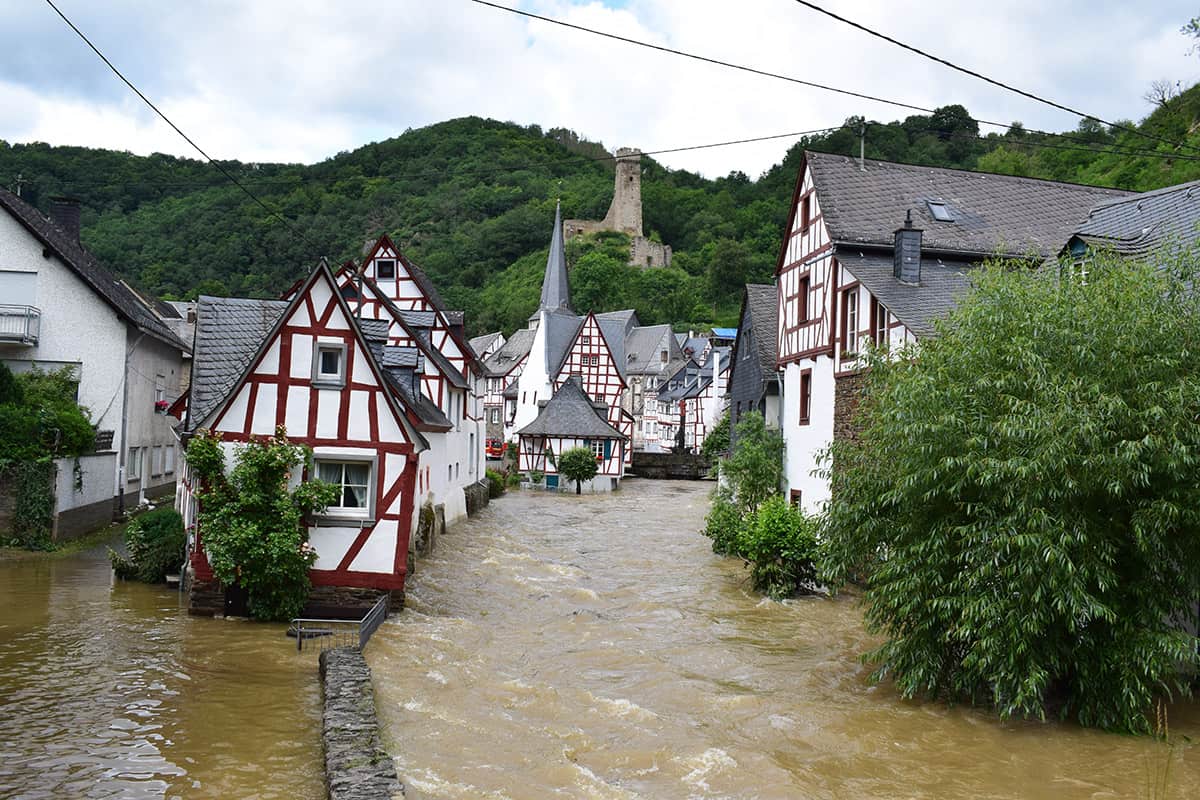
In contrast, road networks in wealthier, larger nations – such as the UK, Germany and France – are generally more robust, although even they can still have local vulnerabilities. Two days of heavy rainfall over central Europe in July 2021, for example, led to extreme flooding in which at least 222 people were killed in Germany and Belgium, with severe infrastructure damage across a wider region. Much of the devastation occurred in the German states of North Rhine-Westphalia and Rhineland-Palatinate, where steep narrow valleys created funnel-like effects. What’s more, flood-water levels were heightened because soils were largely saturated prior to the record-breaking July rainfall in the catchment areas of the Ahr and Erft rivers. Floods and landslides led to road closures, which cut off evacuation routes for several villages.
Streets of water Monreal in Germany was one of many places in central Europe hit by extreme flooding caused by heavy rainfall in July 2021. (Courtesy: Shutterstock/M Volk)
The models used by today’s social-tipping researchers have similarities with recent developments in network theory and critical transitions in physical systems. Van Ginkel’s road study, for instance, adopted a network percolation approach, which is used in physics to model phase transitions in materials. This approach can describe, for example, how a solution of polymers will turn into a rigid gel once enough chains have linked together, with the switch occurring at what is known as a “percolation point”.
Crucially, van Ginkel’s group adapted the physical model to make it relevant for policymakers. That’s because in human systems, unacceptable tipping points can be reached long before the mathematical percolation point. “In our study, the true percolation point is where the whole country is basically flooded – and if that did happen then the lack of a road network is no longer your biggest problem,” he says.
Instead, social tipping points are defined by human factors – in this case, the large loss of functionality of a national road network during a flood, as defined by cut-off routes, route changes and overall delay times. Van Ginkel says that national road authorities are likely already aware of some of the vulnerabilities his group’s study reveals. The value, he says, is that it enables comparisons to be made between nations, which could be useful for policymakers, or for business investors.
For many systems, the tipping point may not be directly triggered by the climate. As van Ginkel points out, it could be due to a policy change that removes support for communities facing the impacts of slow and steady climate changes. Agricultural workers in increasingly arid regions who rely on government subsidies, for example, would be exposed to accumulated slow-onset impacts of climate change if their support was suddenly removed. In other words: the nonlinearity exists in the social system.
Tipping points in physical systems
In physics, the idea of phase transitions or critical points crops up in many contexts. In condensed-matter physics, a material can suddenly switch into a fundamentally different state at critical temperatures, a liquid can become a gas, while a standard metal can transform into a superconductor. Statistical mechanics offers a way of understanding phase transitions via the Ising model, originally developed to explain the spontaneous magnetization in ferromagnetic film.
A related theory, percolation theory, is used to model the sudden emergence of long-range connectivity across a system of random disconnected clusters. Percolation theory has been used to study everything from fracture propagation in materials, to the spread of forest fires and the fragmentation of biological viruses. Today, some of these statistical physics tools are being repurposed to investigate social dynamics – from the way news spreads on social media, to voting patterns and the complex interactions between climate and socioeconomic systems.
Not just doom and gloom
Social tipping-point studies do not only expose vulnerabilities and predict catastrophes. They also help us to understand the mechanics of desirable rapid social change. Why, for example, did it quickly become unthinkable to allow smoking in public spaces after decades of tolerance? Why did the protest of one Swedish pupil energize a generation to campaign about climate threats? Or why did it take a pandemic for hybrid working to become widely adopted?
The simple answer to such questions is that the time was right – but that’s only obvious in hindsight. The more pertinent question for changemakers is: how can you “tip” social and economic systems to facilitate rapid progressive change?
In Gladwell’s The Tipping Point he argues that successful interventions tend to be tightly focused and require modest behavioural changes for individuals. According to him, social-tipping initiatives need to be convenient, and delivered by a combination of salespeople, connectors and experts. He cites a diabetes and breast cancer awareness initiative in the Black community of San Diego, led by the nurse Georgia Sadler. After an initial campaign in local churches had little impact, Sadler shifted her focus to local beauty salons. She knew they were relaxing places where people already trust the stylists, so they were trained to deliver campaign messages in conversation. This tweak in tactics led to great success – a follow-up study co-authored by Sadler found significantly higher rates of mammography among African American women exposed to the salon messaging, compared with a control group that had not (J. Natl Med. Assoc. 103 735).
A push in the right direction Greta Thunberg’s protest in 2018 triggered a generation to campaign about climate change, including this Youth Strike for Climate march in London in 2019. (Courtesy: Shutterstock/Ink Drop)
The challenge with the climate crisis is that slow and steady change may no longer be good enough to avoid catastrophe. Researchers recently found that current global warming of 1.1 °C above pre-industrial levels has already shifted us into the ranges for five climate tipping points (Science10.1126/science.abn7950). These are the collapse of both the Greenland and West Antarctic ice sheets; the thawing of permafrost regions over a short space of time releasing vast amounts of stored carbon dioxide; the complete loss of coral reefs at low latitudes; and the drastic weakening of an important ocean current in the north Atlantic.
To tackle climate challenges, world leaders are meeting now (6–18 November) at the UN Climate Change Conference in Egypt (COP 27), to negotiate key issues such as climate finance, energy pathways and adaptation to climate threats. But any agreements that are made will be of little use if promised changes are not embraced by the individuals, communities and businesses they affect. That’s why decision-makers need to understand the dynamics of social change.
One researcher who investigates the mechanisms of transitions in human–climate systems is Ilona Otto, a social scientist at the University of Graz, Austria. In a 2020 paper, Otto and her team identified six social tipping elements deemed crucial to meeting the Paris Agreement on climate change (PNAS117 2354). They cover energy; decarbonizing cities; divesting from fossil fuels; moral implications of fossil fuels; climate education and engagement; and enhanced information on greenhouse-gas emissions. Strategies were suggested for each tipping element, based on consultations with experts from academia, industry, and civil and governmental organizations. Ideas range from novel building materials and the promotion of meat-free diets, to the formation of a global environmental court.
For Otto, the most powerful drivers for change relate to infrastructure and social norms. Take, for example, the two Nord Stream pipelines, which were built to deliver natural gas from Russia to Europe. After Russia’s invasion of Ukraine in early 2022, the $11bn Nord Stream 2 pipeline was all but abandoned, and Russia has since switched off Nord Stream 1 in response to Western sanctions. As a result, energy and consumer prices across Europe have shot up.
Yet despite the squeeze, most European residents are not shouting for the pipelines to be turned back on – there is a collective acceptance that it would be morally abhorrent to fund Russia’s war. Otto says these recent developments are a clear sign that renewable-energy alternatives should be fast-tracked. She fears, however, that Nord Stream-scale multi-national projects only seem to happen for fossil fuels – despite all the rhetoric about green-energy transitions.
Otto is currently looking at the impact of personal choices on the climate, with provisional analyses of the UK and Germany suggesting that household heating systems are usually the largest variable in individual emissions. To understand the complex economic, social and moral issues that consumers face, Otto uses “contagion models”, which are typically used to study how epidemics spread. The results could help with campaigns to encourage people to eat less meat, use greener forms of travel or trigger changes to school curricula. “Social scientists are now working more quantitatively and are more open to quantitative models,” says Otto.
Global perspectives
Social tipping points also raise moral questions. China could be said to have demonstrated the most effective social tipping in recent history, through state-level interventions such as the one-child policy (1980–2016) and its rapid economic development. But a fixed route for social change chosen by leaders of a one-party state is very different from transitions that emerge through societal choices – whether “tipped” by government policies or not.
Opportunity knocks Workers install solar panels on the roof of a house in Cape Town, South Africa. (Courtesy: iStock/nattrass)
In fact, some countries have unique socioeconomic tipping opportunities. In South Africa, for example, almost 90% of electricity was generated by coal in 2020, yet an ageing infrastructure means the country regularly experiences blackouts. Many hope that climate targets and plummeting costs of renewable energy will enable South Africa to bypass the standard carbon-fuelled development route – instead jumping to a new regime centred on renewable energy. According to a 2022 study led by Jonathan Hanto of the Berlin Institute of Technology, this transition is slowly beginning. New wind and solar installations have been cheaper than new coal plants in South Africa since 2015, while new legislation is supporting low-carbon alternatives (Energy for Sustainable Development69 164).
Reinette (Oonsie) Biggs, a sustainability researcher at Stellenbosch University, South Africa, says shifting the country’s energy system into a new state will be a “game-changer” because so much of the economy and society is built around energy use. But she cautions that changes will only be transformative if the economic model becomes more distributed and equitable. Biggs wants legislation that requires a certain percentage of energy to be generated by community projects, and to lower the bar for small-scale projects to sell into the grid.
With such huge challenges, a combination of local initiatives and state interventions will be needed to tip us away from the brink of climate disaster. But socioeconomic transitions need not be all doom and gloom. If the collective imagination can be activated, perhaps we can tip ourselves into a new world where natural resources are no longer the dominion of the few and prosperity is an option for all.
Across cultures and disciplines, how history has been recorded and taught is being reassessed. Bids to rename buildings, replace statues and repatriate artefacts looted by European Empires are gaining ever more traction. Yet science has lagged behind in the discussion of its own history, with many claiming that looking back is a distraction to the forward vision of discovery.
In Horizons, Poskett – a science and technology historian at the University of Warwick, UK – instead argues that the “future of science ultimately depends on a better understanding of its global past”. He outlines a framework for an international history of science that sheds light on the significant but overlooked contributions of individuals around the world. In doing so, he challenges the idea that international science is purely a thing of the 21st century.
Organized in four chronological parts, Horizons spans five centuries, from 1450 to the aftermath of the Cold War (1990s). Each part explains a different era of scientific history: scientific revolution (1450–1700), empire and enlightenment (1650–1800), capitalism and conflict (1790–1914), and ideology and aftermath (1914–2000).
Poskett begins in the vast botanical gardens of the Aztec city Tenochtitlan, built in 1467. These gardens not only “predated European examples by almost a century” but serve as proof of the detailed understanding the Aztec civilization had of the natural world. He goes on to guide us through to the development of natural history in the Spanish Empire, which conquered Tenochtitlan in 1521. But Poskett does not pull his punches when describing the exploitative nature of this cultural exchange: “Much of what we know about Tenochtitlan comes from accounts written by the people who destroyed it.”
It is in this same vein, straddling specific examples and broader political and historical context, that Poskett traverses the next five centuries. Through each section, he unravels a complex global and geopolitical landscape, highlighting stories of translation, collaboration and struggle against colonial aggression. Poskett’s account of history is in no way self-righteous – his understanding of history is balanced and honest, both challenging empires and understanding their role in cultural exchange.
In my opinion, Horizons’ scope is impressive and handled with deft precision. The book has no want of moments that taught me something new and surprising: from the remarkable fact that the first German-to-English translations of Einstein’s papers on relativity were written by physicists Meghnad Saha and Satyendra Nath Bose in India, under British colonial rule; to Polynesian navigator Tupaia’s beautifully rendered map of the Society Islands in 1769, which replaces traditional compass direction with timings such as sunrise and sunset. Indeed, any reader will come away with their perspective of history shifted.
In his commitment to interesting individuals and scientific detail, however, Poskett’s pace sometimes gets away from him. The volume of examples and fast pace of the narrative means that the facts sometimes feel detached from the greater message. At points I found myself unable to see the woods for the trees, taking away anecdotes more than trends. Yet Poskett does try to counter this, with clear introductions and summaries to each of his chapters. These at times feel slightly repetitive and over-explained, like reading an essay or a set of lecture notes, but they have the benefit of ensuring that the reader comes away with a total understanding of his message.
The moments where Poskett pauses to unfurl a single story in more detail were the ones that captured me the most. An example being the story of Graman Kwasi (born around 1690), a young man captured from what is now Ghana and sold as a slave to the Dutch. Kwasi’s knowledge of natural medicine led to an effective treatment of malarial fever from which other remedies have spawned. These are the moments that allow the reader to really sit with history and examine their own biases about the past. How much more, for example, would we value the knowledge of the natural world provided by Indigenous populations if we had correctly written it into our history of science?
Poskett must walk a very fine line between providing the reader with a rich series of examples, across a range of scientific disciplines and traditions, while also addressing a complicated and often contentious backdrop of geopolitical history
The rapid pace does not undermine the accomplishment and relevance of Horizons. Poskett must walk a very fine line, after all, between providing the reader with a rich series of examples, across a range of scientific disciplines and traditions, while also addressing a complicated and often contentious backdrop of geopolitical history spanning five centuries. That Horizons, which is in this sense hugely ambitious, achieves this in roughly 350 pages is remarkable.
At the end of the book, Poskett summarizes the contemporary crises that modern science faces: climate change, the resurgence of race science, and the “new cold war”. He draws from root to branch how we have arrived where we are today, at a standoff between nationalism and globalization.
“We need to begin by getting the history right,” Poskett concludes. And as he claims in his introduction, Horizons is simply an attempt to reframe our narrative of history in a way that really informs us of the structures of power, national identity and colonial history that have led us to where we are today. To this end, I think he has succeeded. Horizons is an excellent reference text and corrective, a solid kernel around which a new understanding of history can grow.




 This webinar will cover the new features released in 7.2.3 of RadCalc. Carlos Bohorquez will walk you through the latest developments and explain how they impact your workflows.