In this episode of the Physics World Weekly podcast the theoretical nuclear physicist Paul Stevenson talks about the challenges and opportunities of using quantum computers to solve difficult mathematical problems in nuclear physics.
Based at the University of Surrey, Stevenson has received a grant from UK Research and Innovation to develop new algorithms for quantum computers. The aim is to allow physicists to do complex calculations that could help us understand how nuclei are formed in stars, and how they are built up from interactions between protons and neutrons.
Stevenson talks about the challenges of working across the fields of nuclear physics and quantum computing – which includes honing his experimental skills to understand the technical issues involved in operating and improving today’s nascent quantum computers.
Over the years I’ve attended countless scientific conferences devoted to everything from astronomy to particle physics. As an editor, I’m usually the outsider at such events, looking dispassionately at the goings-on and reporting on whatever happens to pique my interest.
But earlier this week I went to a scientific meeting in which I was a protagonist myself. Held at the University of Cambridge, the event had been organized to mark the retirement of Dame Athene Donald, who was my own PhD supervisor at the Cavendish Laboratory many moons ago.
Entitled From Polymers to Biomoelcules, the meeting celebrated Athene’s extensive contributions to science, which have ranged from elucidating the physical properties of plastics to teasing out the microscopic structure of starch and other biological materials.
I had been invited by the meeting’s organizers – Ruth Cameron and Richard Jones – to take part in a panel debate with anthropologist Veronica Strang and biological physicist Mark Leake on the benefits and challenges of interdisciplinarity. It’s a theme that has been at the heart of much of Athene’s 50-year career in science, which has straddled physics, chemistry, materials and bioscience.
My PhD was interdisciplinary too, using techniques from physics to study the behaviour of biopolymers. In fact, I’d been attracted to the topic precisely because it involved thinking at the boundary of disciplines, where there are lots of open questions and many applications.
Trouble is, as I quickly learned, other physicists tended to look down their noses at Athene’s group, whose work (or so it felt) was dismissed as being trivial, unimportant and “not really physics”.
Although I hadn’t heard of the term at the time, I definitely had a sense of “impostor syndrome”: a nagging feeling I didn’t deserve to be there and wasn’t any good at my work either. Other people, it seemed, were better and doing more important science than me – and it would only be a matter of time before I was “found out”.
But as I discovered at this week’s conference, Athene admitted to suffering from impostor syndrome too. Yes, she had already established her physics credentials by the time I worked with her, but she was taking a massive risk as well by moving into uncharted, interdisciplinary waters. Being one of just a handful of women in what was then a highly male dominated department at the time didn’t help her confidence either.
Fortunately, Athene proved her doubters wrong and went on to have a glittering scientific career. In 1998 she became the first female professor of physics at the Cavendish. The following year she was made a fellow of the Royal Society and in 2009 won a L’Oreal/UNESCO award for women in science. For the past eight years she has been master of Churchill College, Cambridge – the first woman to hold that role since the college was founded in 1959.
Another panel debate, featuring Julia Higgins, Beth Bromley and Helen Gleeson, focused on the challenges of making physics a more diverse and equitable discipline. There were also scientific talks about – or related to – Athene’s huge contributions to science. I particularly enjoyed Tony Ryan’s incredible account of how tomatoes are being grown inside refugee camps in Syria using foamy mattresses as a support structure.
But it was the notion of impostor syndrome that resonated most with me from the meeting. As Athene commented in her concluding remarks as the conference drew to a close: “This is the first time I’ve ever been at a conference where the main message is that ‘everyone suffers from impostor syndrome’.”
If even top physicists like her face the problem, the prevalence of impostor syndrome is obviously not down to individuals, but arises from faults in the wider academic system. Quite why that is the case will have to wait for another day.
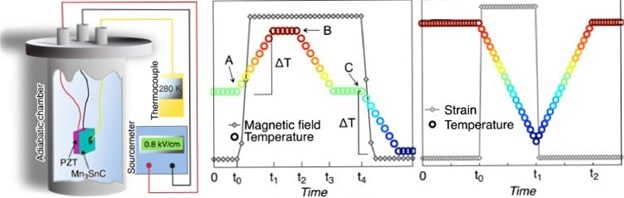
Cool stuff: the diagram on the left shows how the temperature of the caloric material was measured. The plot in the centre shows the temperature change in the sample when exposed to a magnetic field. The plot on the right shows the change in temperature when the sample is strained. (Courtesy: Peng Wu et al/Acta Materialia237 118154)
Researchers in China have shown that applying strain to a composite material using an electric field induces a large and reversible caloric effect. This novel way of enhancing the caloric effect without a magnetic field could open new avenues of solid-state cooling and lead to more energy efficient and lighter refrigerators.
The International Institute of Refrigeration estimates that 20% of all electricity used globally is expended on vapour-compression refrigeration – which is the technology used in conventional refrigerators and air conditioners. What is more, the refrigerants used in these systems are powerful greenhouse gases that contribute significantly to global warming. As a result, scientists are trying to develop more environmentally friendly refrigeration systems.
Cooling systems can also be made from completely solid-state systems, but these cannot currently compete with vapour compression for most mainstream applications. Today, most commercial solid-state cooling systems use the Peltier effect, which is a thermoelectric process that suffers from high cost and low efficiency.
External fields
Solid-state cooling systems based on caloric materials offer both high refrigeration efficiency and zero greenhouse emissions and are emerging as promising candidates to replace vapour-compression technology. These systems employ a solid material as a refrigerant, which when subjected to an external field (electric, magnetic, strain or pressure) undergoes a change in temperature – a phenomenon called the caloric effect.
So far, most research into solid-state caloric cooling systems have focused on magnetic refrigerants. However, practical refrigerants must exhibit a significant caloric effect near room temperature, and such materials are generally hard to find. One potential material is Mn3SnC, which displays a significant caloric effect when exposed to magnetic fields greater than 2 T. But employing such a high magnetic field necessitates the use of expensive and bulky magnets, which is not practical.
Now, Peng Wu and colleagues at ShanghaiTech University, Shanghai Institute of Microsystem and Information Technology, University of Chinese Academy of Sciences and Beijing Jiaotong University have eliminated the need for magnets by combining a Mn3SnC layer with a piezoelectric layer of lead zirconate titanate (PZT).
Doing away with the magnets
In a series of experiments described in Acta Materialia, the team observed a reversible caloric effect without the need for a magnetic field. The adiabatic temperature change achieved was around double that measured for Mn3SnC in the presence of a 3 T magnetic field.
The caloric effect was observed by applying an electric field to the material, which induces strain in the PZT via the reverse piezoelectric effect. The strain is transferred from the PZT layer to the Mn3SnC layer, which results in a change in magnetic ordering of the Mn3SnC. This causes a temperature drop of up to 0.57 K in the material. When the electric field is removed, the temperature increases by the same value.
Wu tells Physics World that he got this idea from microelectromechanical systems (MEMS), which often use piezoelectrical materials for actuation. According to Wu, using electric-field mediated strain could help eliminate the need for costly and large magnets, creating a more efficient and sustainable refrigeration system.
Challenging measurement
The caloric effect is measured either by estimating the adiabatic change in temperature or the isothermal entropy change. In both industry and research, temperature change is the preferred method. While this is a straightforward experiment for pure bulk materials, it is extremely difficult to do for a device-based composite material that is subject to an electric field.
To make the measurement, Wu and colleagues used a system equipped with a thermocouple probe attached to the Mn3SnC surface in an adiabatic environment with precisely controlled magnetic field and temperature.
To assess the accuracy of their measurement system, the researchers carried out several magnetocaloric effect measurements in the temperature range of 275–290 K. They were able to monitor temperature changes down to 0.03 K, hence verifying the system’s high-resolution temperature capacity.
Wu believes the team’s work is a breakthrough in measuring temperature change directly, given the challenge of making an adiabatic temperature measurement while applying a voltage to the PZT. He adds, “This approach of temperature measurement could be useful for other thermal electronic devices.” However, Wu stresses that “the system is not completely adiabatic; it may cause heat loss, hence further improvement is necessary for any heat measurements”.
Interesting and unexplained
The team also observed some very interesting and unexpected phenomena during the temperature measurement. “No matter whether one applies a positive or negative electric field, the surface temperature of Mn3SnC always decreases,” Wu says. The researchers also found that by applying a magnetic field to the composite, the surface temperature of Mn3SnC rises, whereas applying an electric field does the opposite and causes a reduction in the temperature. Wu says that the team does not yet understand these observations.
The researchers now aim to study the underlying physics behind the contrasting behaviour of Mn3SnC/PZT under magnetic and electric fields. To further improve the temperature measurement system, they are also trying to solve the problem of heat loss.
“Think of it as professional preparation,” says Kath, a human-resources administrator at an unnamed university in the US, as she starts a video on her laptop. The video is part of an exercise to train staff in a theatre-studies department in how to defend against and possibly disarm someone who invades the premises with a gun.
As the department is under threat by a university keen to focus more on science, every staff member has to complete the training by the end of the day. If they don’t all pass the course, the school will be decertified and shut down. “My job is to teach you to fulfil your responsibility as educators,” Kath warns.
The scene I am describing is not real, but appears in Preparedness, a play I saw a few months ago. Written by Hillary Miller, a professor of English at Queens College in New York, it conveys both the deadly seriousness of such attacks, which have occurred all too often in the US, and the ludicrous idea that video training courses can equip people to defend themselves against these shootings.
The play made me squirm, for as a university administrator myself, I require faculty to take online training sessions, and have to take them myself. Don’t get me wrong: such sessions can be useful and effective, especially when teaching, say, computer security, data privacy and health protection. In fact, they can be demanding, often lasting an hour and being split into chunks so you can’t skip ahead. There are also quizzes you need to achieve full marks in so you can’t doze off or multi-task.
Some training sessions are not effective in this format, especially those that aim to help people deal sensitively with delicate or volatile issues, such as racial animosity, sexual harassment or suicidal behaviour
But other training sessions are not effective in this format, especially those that aim to help people deal sensitively with delicate or volatile issues, such as racial animosity, sexual harassment or suicidal behaviour. The idea that online video training can certify a person’s ability to cope with incidents arising from such complex matters is disturbing and laughable.
Preparedness captures what is alarming and amusing about such courses. After Kath starts her video, it doesn’t have the desired educational effect but simply makes faculty members laugh. Annoyed, Kath plays a recording of gunshots in the background to simulate “immersion”.
The attendees complain they’re not being trained but “manipulated” and “violated”. They are incredulous that Kath thinks that she can teach them their “responsibility as educators”. Kath then accuses them of “tweezing” – slang for fussily picking apart and ridiculing something serious.
A complex affair
Let me be clear. I fully support the aim of these sessions and am not criticizing them as some kind of grumpy and reactionary technophobe. We all want our places of work to be diverse, kind, caring, hate-free, tolerant and safe. I only object to the means used, which run counter to what they aspire to achieve. For such training sessions can foster the kind of cluelessness and mockery that they mean to dispel. They aim to raise consciousness but actually undermine it by providing a false sense of safety and enlightenment. Click to comply!
Are these training sessions based on empirical studies of preparedness or on some fantasy about what it takes? Are they more dangerous than no training because they provide the delusion that everyone who has passed them knows what to do and how to behave responsibly? Are they, in other words, just a giant exercise in box-ticking?
At Stony Brook University, where I work, one of the questions in a training session about harassment asks who might be affected by it. Eight different groups are listed, but there’s no point even trying to think carefully which to pick, for the only way you can continue through the training is to tick all eight categories. Omit one and you’ve already failed – and have to start all over again.
A few days after I finished the harassment training, a faculty member e-mailed me in exasperation. He’d got as far as a module on “revenge porn” and knew the right answer but after three attempts to take the course, he couldn’t click to proceed further due to a software glitch, and each time had to restart the hour-long course from the beginning.
I told him to do it again; the training was mandatory. A day later he e-mailed me back, this time annoyed not just about his inability to get through it, and his lost time, but of its perceived necessity. He had, after all, been teaching moral philosophy for half a century, and he regarded that as a more competent way to judge the ethics of social situations.
He denounced such training courses as “morally and professionally offensive” because they don’t allow people to think for themselves or recognize that some staff members already take creating an equitable workplace as their professional duty. I had to rescue my almost-decertified colleague by pleading with administrators that he was of excellent character.
But I’m tweezing. I’m not fulfilling my responsibility as an educator. Those sessions are required and I must enforce them without pushback.
The critical point
I laughed all the way through Preparedness until the last scene. In it, the retiring theatre professor – the most talented and inspiring of the bunch – addresses her students after witnessing their final student performance of Sophocles’ Electra, in which the protagonist seeks revenge for her father’s brutal murder.
She’s annoyed and upset that her students are merely reciting the accepted words expected from suffering individuals, rather than truly responding to the turbulent, emotionally charged and morally ambiguous events in which Electra was implicated.
We don’t need box-ticking exercises where there’s only one right answer, no room for debate and no thinking for oneself
That final scene made me think about what it would take to respond to such events authentically. Certainly not box-ticking exercises where there’s only one right answer, no room for debate and no thinking for oneself. Certainly not the conviction that people who pass a training course on a computer are deemed competent and do not need to work further on it.
Preparedness requires each of us continually to stay alert, be discerning and act responsibly. It requires living, not clicking.
A team of US-based researchers has developed an innovative nanoelectronic sensor that simultaneously measures electrical and mechanical activity in heart cells – paving the way for improved approaches to cardiac disease studies, drug testing and regenerative medicine. So, how exactly does the sensor work? What are its key advantages over existing approaches? And what are the next steps for the research team?
Nanoelectronic sensor
Cardiac diseases remain stubbornly at the top of the list of the leading causes of human mortality, and interest in studying them remains a priority within the scientific community. During such studies, it is generally much more convenient to use in vitro tissue that exists outside the human body – and to be able to constantly monitor tissue status with minimal disruption.
In an effort to optimize such processes, researchers from the University of Massachusetts Amherst and the University of Missouri have created a tiny nanoelectronic sensor, much smaller than a single cell, that is capable of simultaneously measuring electrical and mechanical cellular responses in cardiac tissue. And it does this in such a way that the cell or tissue under investigation does not “feel” anything strange plugged into it.
Because the electrical and mechanical responses from cells are intricately correlated, through the excitation-contraction coupling process, their simultaneous measurement is critical for identifying physiological and pathological mechanisms.
As team leader Jun Yao explains, existing sensors can only detect either the electrical or the mechanical activity in the cardiac tissue or cell. “We needed to detect both signals simultaneously to better monitor tissue status and reveal more mechanistic information,” he says.
The new nanosensors are made from inorganic or organic materials that are rigorously tested to ensure they are biocompatible. The sensor incorporates a suspended semiconducting silicon nanowire that is 100 times smaller than a cell and is non-toxic to the cell. “Imagine that it’s a tiny suspended rope – if you pull it, it can feel the strain,” Yao explains. “So that’s the way that it can detect the mechanical signal from cells. Meanwhile, imagine that it’s a conducting cable, meaning it can also detect the electrical signals from cells.”
Device schematic: The sensor structure and cell–sensor interface; the nanowire is suspended across a microbar. (Courtesy: Jun Yao)
Next steps
According to Yao, the nanosensors are currently fabricated on a flat biochip-based substrate, with cardiac cells cultured on top. However, in the future, there is a possibility that they could be embedded into tissue in a 3D distribution.
“The sensors can be placed in tissue models outside the body, which can be used to test key variables like drug effects, so the sensor provides feedback about the effect of the drug on the cardiac tissue or cells,” Yao explains. “The cardiac tissue is driven by the so-called excitation-contractile mechanism – the former an electrical process and the latter a mechanical process – and we need to monitor both in order to give the most accurate feedback. Previous sensors can only tell one of them; we now can monitor both processes together.”
Looking further ahead, Yao reveals that there is also a possibility that the sensors can be integrated onto what he describes as a “deliverable substrate”, so that they can be patched on a living heart for health monitoring and early disease diagnosis.
“This may sound scary – but imagine that everything is so small that it does not introduce perturbation to the heart,” he says. “The next step is that we will translate the current planar biochip integration into a 3D integration, so that the sensors will reach out to cells in the 3D space. A possible way is to integrate these sensors on a soft, porous tissue scaffold that can naturally embed in the 3D tissue.”
Correlations between the waving motions of individual coral polyps have been observed – a discovery that could boost our understanding of coral reefs. Through a carefully-controlled experiment, Shuaifeng Li and Jinkyu Yang at the University of Washington, Seattle and colleagues found that the random swaying of the animals became more synchronized at cooler temperatures, and under red light. This insight enabled the team to build predictive models of the polyps’ behaviour that could eventually inform vital conservation efforts for threatened coral reefs.
The vibrant and diverse structures found in coral reefs are built up by colonies of animals called coral polyps. These roughly cylindrical creatures are attached at their bottom ends to a hard exoskeleton, excreted by previous generations of polyps – sometimes over thousands of years. At its top end, a polyp’s mouth is surrounded by a crown of tentacles, which move in swaying motions to feed, reproduce, and defend themselves from predators.
These motions are remarkably diverse: while some polyp species exhibit unique rhythmic pulsations, the movements of other species are barely perceptible. To better protect corals from the myriad threats they face, researchers are now attempting to quantify and characterize these different types of motion. However, since the movements appear to be inherently random and complex, this level of analysis is exceptionally challenging.
Interconnected colonies
In the study of some biological systems, mathematical models and tracking techniques are already providing a better awareness of how organisms behave. For example, random Brownian motion is now known to be essential to understanding the motions taking place within systems of microbes, like bacteria. Yet for animals like polyps, which exist in extensive, interconnected colonies, it is still unclear whether similar mathematical rules can be applied.
To better understand coral swaying, the researchers took a fragment of coral containing a small number of polyps, and placed it in a 3D-printed octagonal tank – with each side housing an individually-controllable valve. This allowed them to precisely alter the water flowing around the polyps – ensuring that the motions they observed were generated by the polyps themselves, and not from the impact of flowing water.
The team analysed changes to the fragment when they varied the temperature and light conditions inside the tank. The researchers then applied numerical analysis to the motions they observed – searching for mathematical relationships between the swaying of the polyps.
Mathematical model
They discovered that when the fragment was exposed to both cooler temperatures and red light, the polyps’ swaying became more synchronized. This correlated motion disappeared at higher temperatures, and under blue light. Building on this insight, Li and colleagues then constructed a mathematical model of these motions, allowing them to predict the responses of the polyps in response to varying conditions.
Although the team cannot yet explain the biological significance of their findings, the results could lead to a better understanding of how wild corals behave – particularly in response to factors including rising temperatures and ocean acidification. In turn, their insights could help conservationists to better preserve coral reefs, and protect the rich, diverse ecosystems they support.
The carbon footprint of a future Higgs factory could vary by almost a factor of 100, depending on the chosen design and its location. That is the conclusion of an analysis by physicists in Europe who have studied the potential successors to CERN’s Large Hadron Collider (LHC). The researchers conclude that the proposed Future Circular Collider (FCC), which would be based at CERN and linked to the LHC, would be the most environmentally friendly as it would consume less energy and produce lower carbon emissions per Higgs boson produced than competing designs (arXiv:2208.10466).
Following the discovery of the Higgs boson in 2012 at the LHC, particle physicists are planning to build a more powerful particle collider. The future machine, known as a Higgs factory, would smash electrons with positrons to allow more detailed investigation of the properties of the Higgs boson and other particles.
There are currently five proposals for a high-energy positron–electron collider, with the International Linear Collider (ILC) in Japan, the Cool Copper Collider (C3) in the US and the Compact Linear Collider at CERN all based on linear accelerators. The FCC and the China Electron Positron Collider (CEPC) in China, meanwhile, are circular colliders.
There are various arguments around the physics opportunities of the different collider designs, but CERN particle physicist Patrick Janot and his colleague Alain Blondel argue that due to the high energy consumption of any future collider, the significant environmental impact of the designs should also be considered.
“We are proposing that future high-energy physics projects include not only the cost and performance of the collider, but also its carbon footprint per physics outcome, and to use these data in the design and the choice of the ‘best’ collider,” Janot told Physics World.
In their analysis, the duo found that the FCC was the most energy-efficient design, consuming 3 MWh of electricity for each Higgs boson it produced. The next best was the CEPC at 4.1 MWh per Higgs boson, while the most energy intensive design is the C3 (18 MWh/Higgs boson).
The researchers then examined the carbon intensity of electricity production in the different countries hoping to host a future high-energy collider. The FCC was again best, emitting 0.17 tonnes of CO2 equivalents (t CO2 eq.) per Higgs boson produced. The ILC, meanwhile, would produce around 50 times more CO2 equivalents (9.4 t CO2 eq. per Higgs boson). The FCC’s low emissions are in part because around 80% of energy produced in France is from nuclear plants, and therefore mostly carbon-free.
The team found that the carbon footprint of the FCC could be further improved if the design increased the number of interaction points from two to four. In this scenario each Higgs boson produced would consume 1.8 MWh of energy and emit 0.1 tonnes of CO2 equivalents.
Janot adds that the analysis focuses on the environmental impact of the physics outcome and the energy consumption of operating the proposed Higgs factory. He adds that it is part of a much larger feasibility study on the FCC, which will cover among other things, the environmental impact of different phases of the project. This will include, for instance, tunnel building and the installation and operation of the colliders. But he points out that “the energy consumption during operation is the largest contributor to the carbon footprint of a high-energy collider”.
Other factors
Physicist Kumiko Kotera from Sorbonne University in Paris, who has carried out an analysis of the potential carbon footprint of the Giant Array for Neutrino Detection (GRAND) project, told Physics World that energy consumption and carbon emissions per Higgs boson is a sensible comparison. Kotera explained, however, that to produce a more accurate carbon footprint analysis in addition to the energy consumption of the collider, energy consumption related to data analysis and simulations, and other linked digital technologies, such as data storage, also needs to be considered.
Kotera adds that a full analysis also needs to take into account international travel by its members, although she suspects this would be less energy hungry than collider operations and digital technologies.
Janot agrees that more can be done, adding that CERN is working on ways to reduce its carbon footprint. These include, among other things, energy recovery, managing electricity consumption to maximise the use of low-carbon sources as well as ways to develop international collaborations that minimise travel.
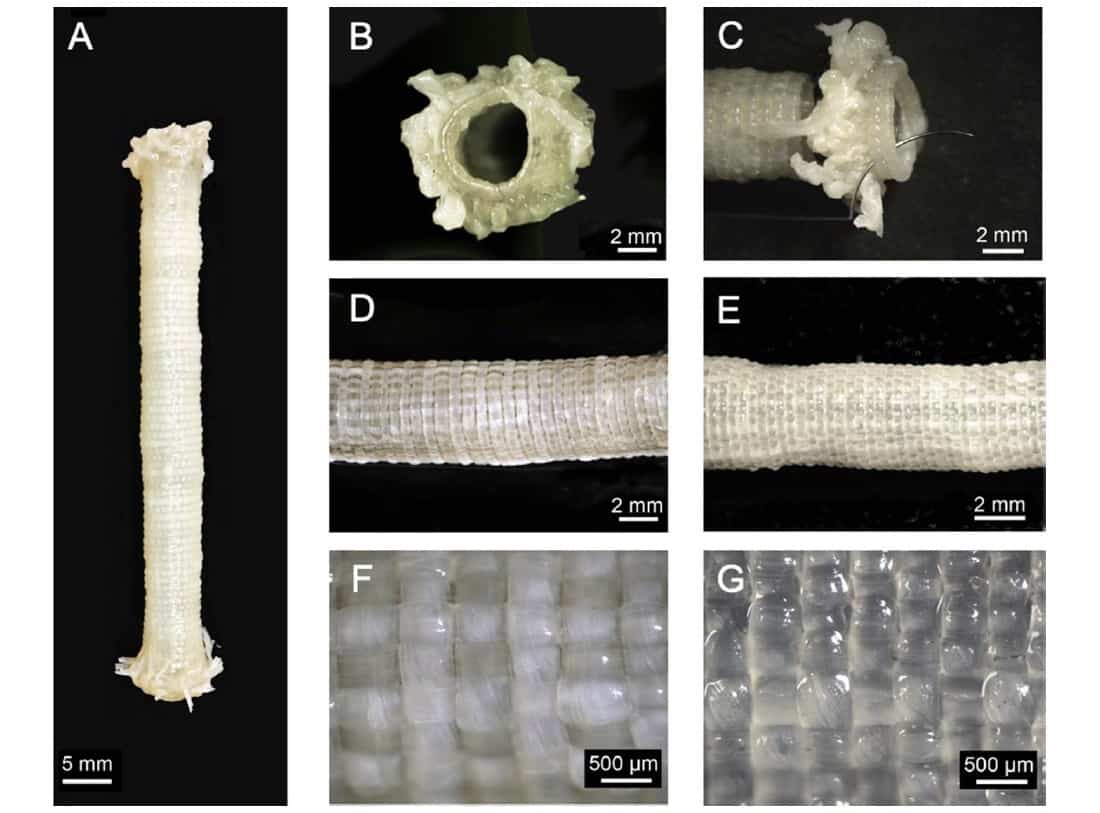
Weaving human amniotic membrane: (A, B) A 5.1 cm long tissue-engineered vascular graft (TEVG) with an internal diameter of 4.6 mm. The ends of the TEVG were “finished” to produce an even collar for suturing (C). Weaving with 5 mm (D) and 10 mm (E) wide longitudinal ribbons created a homogenous wall. Compared with the 5 mm ribbons (F), weaving 10 mm wide ribbons produced a denser wall (G). (Courtesy: A Grémare et al Biofabrication 10.1088/1758-5090/ac84ae)
Blocked blood vessels caused by cardiovascular disease can lead to serious outcomes including heart attack or stroke. The condition can be treated by surgically bypassing the blockage using a vessel from elsewhere in the patient’s body. When this is not feasible, a synthetic vascular graft is generally used. Synthetic grafts have high rates of failure, however, due to chronic inflammation caused by the body rejecting a foreign substance. Another option is human tissue-engineered vascular grafts (TEVGs), which show promising in vivo results, but require lengthy, complex and expensive processes to create.
Now, researchers at INSERM’s Lab for the Bioengineering of Tissues (BioTis U1026) at the University of Bordeaux have successfully fabricated small-diameter TEVGs using human amniotic membrane (HAM) threads combined with a textile-inspired weaving strategy. Describing the process in Biofabrication, they claim that these grafts have remarkable properties that justify moving into in vivo laboratory animal testing.
HAM, the innermost layer of membranes surrounding a foetus during development, provides a viable biological “scaffold” for tissue engineering. It exhibits anti-inflammatory properties, anti-microbial effects, low immunogenicity (the ability to provoke an immune response), blood compatibility, suture-holding capacity and high mechanical strength. It also routinely discarded by hospitals and, consequently, is widely available and affordable.
Yarn production
Principal investigator Nicolas L’Heureux and colleagues created HAM yarns from foetal membranes collected from consenting patients following caesarean deliveries. They prepared the membranes for use by rinsing the tissues repeatedly in distilled water, cutting the membranes into 10 x 18 cm rectangular sheets, and manually separated the amnion and chorion (inner and outer membranes). A motorized cutting device then sliced the HAM sheets into 5- or 10-mm-wide ribbons.
To create mechanically strong threads, the researchers attached these ribbons to a rotating device that twisted them at 5, 7.5 or 10 revolutions/cm. The yarn diameter decreased after twisting, plateauing at 7.5 revolutions/cm, while the ultimate tensile stress increased significantly after twisting at 7.5 and 10 revolutions/cm.
The HAM yarns (ribbons and threads) were dried at room temperature, spooled and stored at -80°C, a process known as devitalization as it kills the cells. When needed, the researchers rehydrated the yarns in distilled water.
Since their aim was to provide an off-the-shelf implant, the researchers examined the effects of decellularization and sterilization with gamma irradiation on the HAM ribbons. Histology showed that decellularization effectively removed cellular components that remained after devitalization, did not affect the HAM strength and increased its stretchability.
When dry HAM ribbons were gamma-sterilized, they became thinner, stiffer and less stretchable. Keeping the HAM ribbons hydrated during sterilization prevented many of these effects. The researchers observed that wet sterilization did not impact the ability of HAM to support endothelial cell attachment and growth.
Weaving the vessels
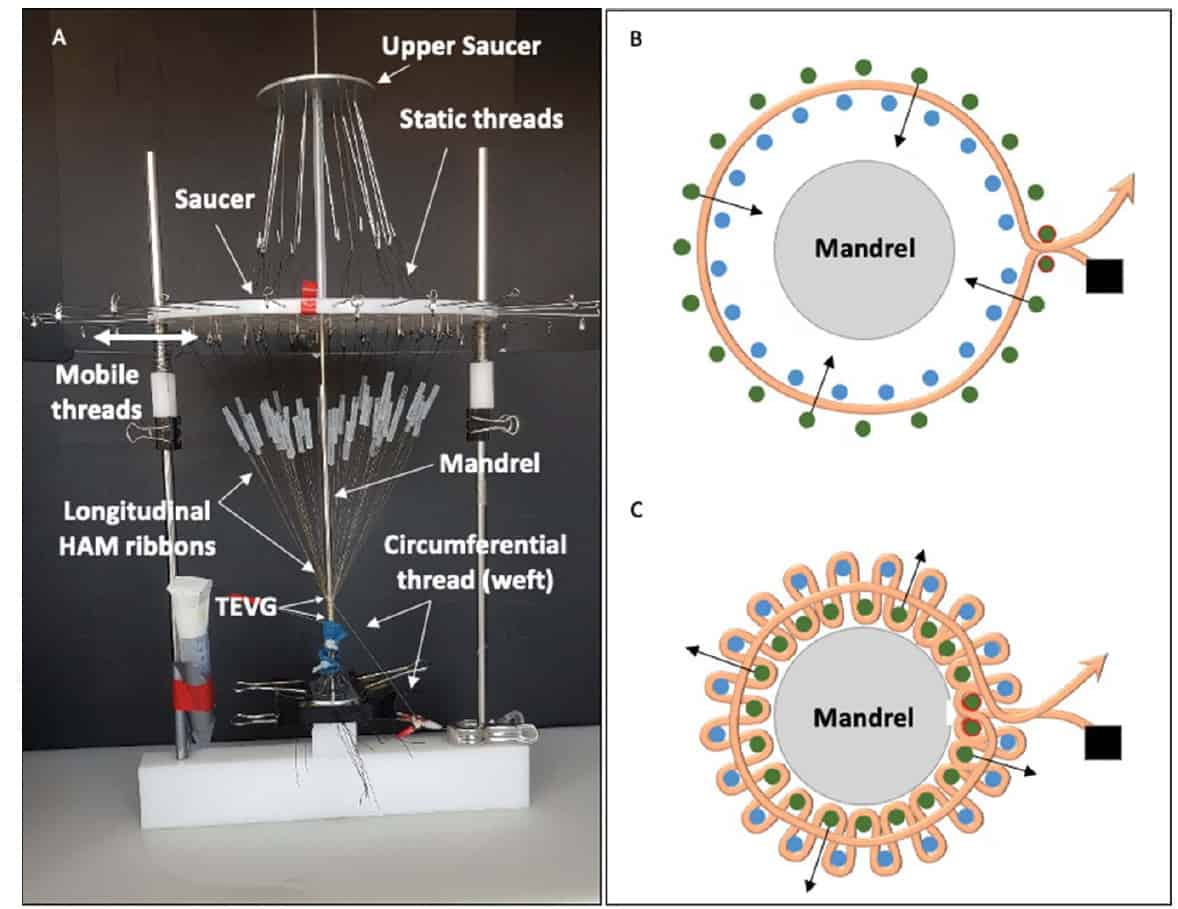
In the final step, the researchers assembled the HAM yarns into TEVGs. They used a custom-made circular loom to weave TVEGs around a stainless steel mandrel. To create a woven tube, a circumferential yarn (the “weft”) was inserted between a movable and a fixed set of tensioned longitudinal ribbons (the “warp”). The two warp sets were moved to cross over the weft, the circumferential yarn was run again between them, and the process was repeated 50 times.
The weaving process: (A) The custom circular loom used to weave the TEVGs. (B, C) Schematics of the weaving process viewed from above; the two sets of longitudinal ribbons are shown in green (mobile set) and blue (static set). (Courtesy: A Grémare et al Biofabrication 10.1088/1758-5090/ac84ae)
The team used 51 longitudinal ribbons (5 mm wide) and one double-ribbon circumferential thread to weave TVEGs with an average internal diameter of 4.4 ± 0.2 mm. The woven TEVGs were mechanically robust, with superior suture retention strength and average burst pressure to those of human internal mammary arteries, the preferred vessel for heart bypass surgery.
However, because the transmural permeability was potentially too high, the team produced a second set of TVEGs using 10-mm-wide longitudinal ribbons and the same circumferential thread design. This created TEVGs with a larger internal diameter of 5.2 ± 0.4 mm. The walls displayed increased yarn density and drastically reduced transmural permeability. The burst pressure increased and suture retention strength remained the same.
“Combining inexpensive HAM with a weaving assembly method decreases the costs to produce TEVGs by avoiding the use of cells and bioreactors, which are necessary in other methods,” write the authors. “No assembly method used today allows inexpensive production of HAM-based TVEGs with proven mechanical properties compatible with arterial implantation.”
The researchers point out that textile-inspired assembly strategies using weaving, knitting and braiding are already widely used to produce medical devices. Thus it should not be difficult to design machines to handle HAM yarn and enable mass production of TVEGs after successful clinical studies are performed. They add that yarn diameter, mechanical strength and other mechanical properties can be easily modified to meet various specification requirements.
Next, the researchers plan to assess the impact of decellularization and post-assembly gamma sterilization of the various properties of the woven TVEG, particularly with respect to permeability and stretchability.
November 2021, Clara Aldegunde on Level 2 of the Central Library, Imperial College London, UK
I’m at the library, deeply engrossed in some research for my first article on quantum physics, when my phone rings and I snap back to reality. My parents are calling, and I hastily leave the silent study area to speak to them.
After the usual greetings and gossip, I can’t help but share with them what I’ve been learning. Some theorists, I’ve learned, think that quantum interactions are responsible for creating the space–time fabric of our universe. Using simplified models and mathematical tools, these researchers hope to explain how both space and time emerged. Although further investigation is vital to extrapolate this theory to a universe with the same characteristics as ours, this could be a promising first step towards quantum gravity and the long-sought “Theory of Everything”.
“Isn’t that exciting?” I ask my parents, who listen dumbfounded on the other end of the line. Carried away by the will to make them understand the incredibly deep implications of this concept, I find I have to begin by explaining the basics of quantum mechanics.
To truly get to grips with quantum mechanics, we must set aside our more classical mindset. Right now, there are two things I am sure of: I’m in South Kensington, London, standing at rest, explaining quantum mechanics to my family, and they are sitting on a sofa 2197 km away. If we were quantum particles, such as a proton and an electron, none of this would be true. In classical mechanics, we have definite answers when asked the position and momentum of a system at a given time. But cross the boundary from the classical to the quantum realm, and you’ll find, as physicists did in the early 20th century, that these rules break down.
At the quantum scale, one can never entirely accurately predict both the position of a particle, and its momentum, at a given time. And to describe any system, we need the wavefunction – a mathematical description of the quantum state of a system, which contains all its measurable information – to handle the probabilistic nature of quantum measurements. That’s why quantum particles are mathematically expressed in a way that embraces multiple possibilities, existing in a “superposition” of states at the same time. When we perform a measurement, the wavefunction collapses and picks a single definite value, corresponding to what we observe: a known definite measurement.
After giving my parents this rapid introduction, and suddenly thinking of the phone bill, I decide to go straight to the focal point of the article I’m working on: quantum entanglement. Too enthusiastic to wonder if they have been following my explanations so far, I try to clarify how this concept is “the characteristic trait of quantum mechanics, the one that enforces its entire departure from classical lines of thought” – just as Erwin Schrödinger declared almost 90 years ago (Math. Proc. Camb. Philos. Soc. 32 446).
Entanglement is a purely quantum-mechanical phenomenon, whereby two or more particles can have a closer relationship than is allowed by classical physics. It means that if we determine the state of one of particle, it instantaneously fixes the quantum state of the other(s), no matter how near or far they may be. It also means that if two such entangled particles are in a superposition of states, the collapse of the wavefunction of one of them means the instant co-ordinated collapse of the other. This strong correlation seems to transcend space and time, such that we can determine the state of one particle simply by measuring its entangled pair, no matter the distance between them. For example, if you know the spin of one particle, you can always determine that of the other. Could it be, perhaps, that it is this deep quantum connection between fundamental particles that threads together space and time?
But what are we ultimately looking for, and what would such a quantum space–time look like? Albert Einstein ousted Isaac Newton’s law of universal gravitation with his general theory of relativity (GR). It describes gravity as a geometric property of space–time, wherein the energy and momentum of matter and radiation directly determines the curvature of space–time – but GR is also formulated within the confines of classical physics. In an effort to unify quantum mechanics and gravity, researchers have long been on the hunt for a consistent theory of quantum gravity. One tempting solution is rooted in the aforementioned idea that, perhaps, the very fabric of space–time may be an emergent property of some kind of quantum entanglement; one that ultimately satisfies Einstein’s relativistic field equations.
“Doesn’t it feel like magic?” I ask my parents. Their bewildered silence doesn’t shake my enthusiasm. After I get off the phone and return to my desk, I picture myself as the pioneering theoretical physicists Juan Maldacena and Gerard ’t Hooft, thinking back to when they were on the precipice of discoveries that started to illuminate the links between the quantum world and space–time.
[Disclaimer: although the scientists featured below are real, the scenarios and quotes are fictional, imagined by the author for the purpose this article]
Building a quantum space–time
(Courtesy: Clara Aldegunde)
Gravity is a force that determines how objects interact with one another on a large scale. On a much smaller end of the scale – where gravity plays a near negligible effect – are the fundamental particles that make up everything in our universe, and their interactions are determined by the laws of quantum mechanics.
Quantum field theories are frameworks that combine classical field theory (which tells us how fundamental particles and fields interact), special relativity (which gives us an equivalence between space and time) and quantum mechanics. They apply to three of the four fundamental forces in the universe – the electromagnetic, strong and weak forces but not gravity.
Unfortunately, the general theory of relativity (GR) – which describes how gravity and space–time work in our universe – is not compatible with quantum mechanics. Indeed, GR says that space–time is continuous, whereas quantum mechanics dictates that everything is in discrete quantized packets of matter and energy.
To unify gravity and quantum mechanics, physicists and mathematicians have long been working on developing a theory of quantum gravity. In an attempt to show how a region of space–time with gravity could potentially be derived from a purely quantum theory, in 1997 Argentinian theoretical physicist Juan Maldacena proposed a conjectured link between two physical theories, which he dubbed the anti-de Sitter space/conformal field theory correspondence (AdS/CFT).
On the one hand are anti-de Sitter spaces (AdS) – a particular kind of space–time geometry that is used in theories of quantum gravity and is formulated in terms of string theory. On the other hand are conformal field theories (CFT) – a special version of quantum field theory that is invariant under conformal transformations. These transformations are such that the angles and velocities of a space–time are preserved and remain unchanged, despite any other changes, such as a change in scale. Unfortunately, this does not hold true for the quantum electrodynamics we observe in our universe, as a change in scale would impact the charges and energies of fundamental particles and fields, meaning that the quantum fields we observe in our reality are not described by conformal field theories.
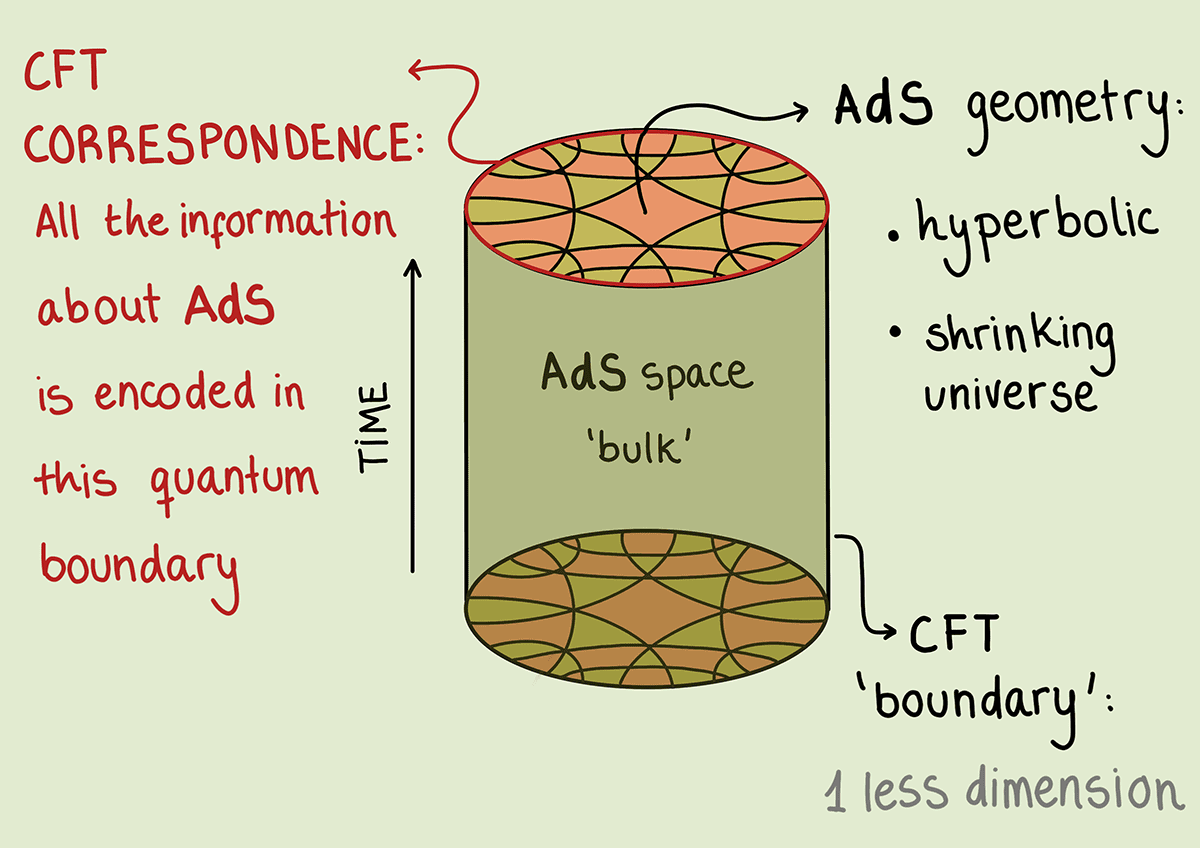
Maldacena’s AdS/CFT correspondence postulates that these two theories provide two different descriptions of the same physical phenomena. In his proposed universe, the AdS is a space–time region that emerges, like a hologram, from the CFT, the gravity-free boundary of this holographic universe. Indeed, the 3D AdS has gravity, and is negatively curved (imagine a saddle shape), which allows it to have a boundary – the 2D CFT, which does not include gravity.
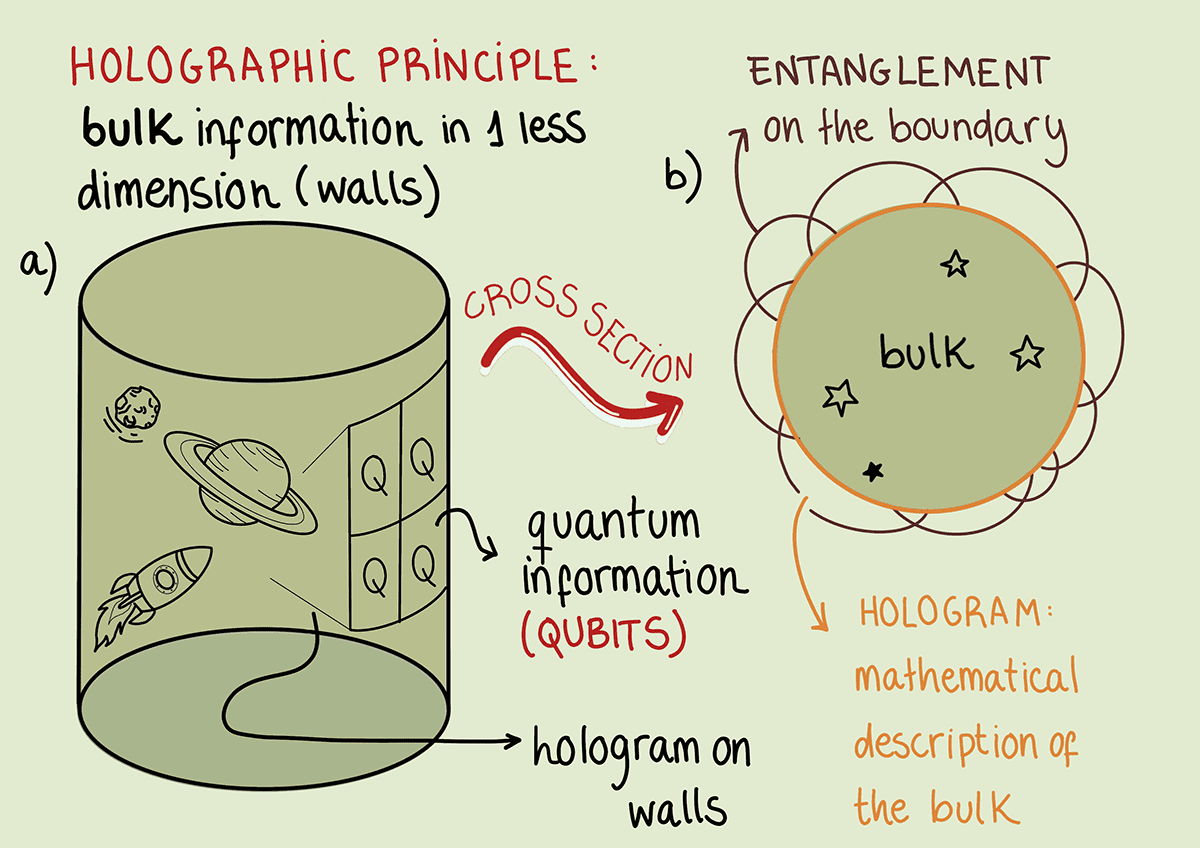
The lower-dimensional boundary is what gives rise to the so called “holographic principle” or duality that gives us two different ways of looking at the same system – just like in a hologram, where all of the 3D information is stored on a 2D surface. As the CFT has one fewer dimension than the AdS space, you can picture it as the 2D surface of a 3D cylinder – one where the quantum mechanics at play on surface includes all of the information of the bulk. And as it happens, it is the quantum entanglement in the boundary that gives rise to the space–time geometry in the bulk.
January 1998, Juan Maldacena in the living room of his home near Harvard University, US
After a long day at work, you (Juan Maldacena) arrive home to find your two-year-old daughter in the living room, surrounded by her toys – miniature versions of everyday objects. You have just published a paper on how particular space–time geometries (“toy universes”) could be found to have certain correspondences to a type of quantum theory without gravity (more specifically known as a conformal field theory, CFT). And just as your daughter’s toys represent a version of reality that is much easier to handle, simplified versions of our universe make the problem of understanding the origins of space–time considerably more approachable.
Passionate about this beautiful symmetry, you start explaining to your daughter that her toys are just like anti-de Sitter space (AdS) – a multi-dimensional space–time with gravity that is used in theories of quantum gravity based on string theories. Indeed, AdS is the most used alternative space–time geometry to study this matter since you discovered the AdS/CFT correspondence (see box above).
By analysing this duality between a specific space–time geometry (easier to handle than our actual universe) and quantum mechanics, we have the right starting point to answer the most fundamental question of physics: what is space–time ultimately made of?
Your perplexed child looks on as you explain how even though an AdS universe is negatively curved and therefore is collapsing in on itself – as opposed to our positively curved and expanding universe – these simplified universes can be of enormous help when studying the physics behind quantum entanglement knitting space–time. “Solving challenging problems is much easier when you can divide them into not-so-challenging little parts,” you solemnly declare.
Nonetheless, there is still a huge conceptual roadblock: the maths of quantum physics operates in three dimensions, whereas space–time accounts for four. Luckily enough, your daughter need not be too concerned, as another theorist is already on the case.
1994, Gerard ’t Hooft in a lecture theatre at Utrecht University, Netherlands
You (Gerard ’t Hooft) are in your regular undergraduate lecture, surrounded by enthusiastic students who want you to explain to them a concept you introduced to the scientific community a year ago: the holographic principle. Developed as a solution for what happens when gravity, quantum mechanics and the laws of thermodynamics truly clash at the event horizons of black holes, the holographic principle suggests that a 4D space–time can be projected onto a 3D surface expressed by quantum mechanics. Just as a 2D array of pixels on a TV represents a 3D image, space–time can be mathematically described by this “hologram” in one fewer dimension.
The holographic principle suggests that 3D space could be threaded by fields that, when structured in the right way, generate an extra fourth dimension, giving rise to space–time. The lower-dimension hologram (3D quantum description) would serve as a frontier to the 4D bulk space, created thanks to entanglement on this boundary (figure 1). As the US theorist Ted Jacobson would later affirm in 1995, more entanglement would mean that parts of the hologram are more tightly connected, making deforming the space–time fabric more difficult, and leading to a weaker gravity as understood by Einstein.
1 Quantum holograms (a) The holographic principle related to AdS/CFT correspondence; information on space–time is stored as quantum information (qubits) of one less dimension (projected onto the walls). (b) Entanglement at the boundary connects different parts of the hologram. (Courtesy: Clara Aldegunde)
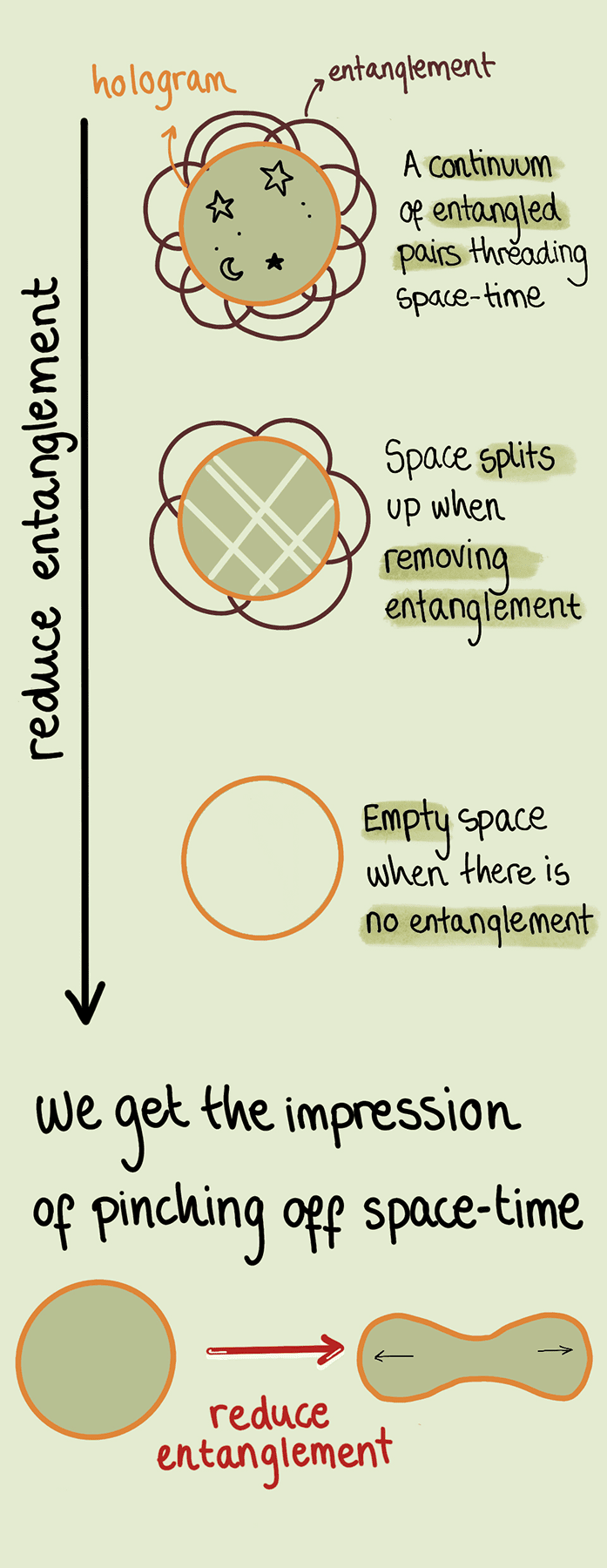
“But what would happen if we mathematically took out the entanglement from this quantum-mechanical description that we called a ‘hologram’?” you rhetorically ask your students. “Well, we find that the space–time splits up. As a matter of fact, if we remove all the entanglement, we are left with no space–time.”
Your students don’t seem convinced, so you decide to go a bit further, introducing the concept of entanglement entropy. This is a measurement of the amount of entanglement between two systems, and theorists have been able to directly relate it to the surface of the bulk, finding that it is proportional to the amount of entanglement.
But to be able to make this connection, you say that we need to consider a continuum of entanglements, leaving the idea of discrete connections behind. When we do this and let the entanglement in the hologram tend to zero, the bulk area (where space–time lives) also vanishes, as would happen if we were to take the threads off a piece of cloth (figure 2).
You pause for dramatic effect, meeting the eyes of your most eager students one by one, before you ask, “Isn’t this a strong argument supporting that space–time is indeed fundamentally quantum mechanical, being held together by entanglement between different parts of the hologram?”
25 December 2021, Clara Aldegunde in the dining room of her family home
“Finally, a well-deserved break,” I think in the middle of the family Christmas dinner when I overhear my dad describing my article as being about “some interaction between particles that, who knows how, forms space and time”. Suddenly, I feel the need to make my whole family understand how vital this hypothesis is for modern physics. Driven by my passion and all the recent knowledge I have absorbed, I decide to have another go at explaining these ideas to them by introducing the concept of a quantum bit, or qubit.
2 Pulling the threads Theoretical prediction of what would happen if entanglement between different parts of the hologram were removed. When mathematically reducing the amount of entanglement on the CFT surface, we find that space splits up (like pinching off a ball of clay). (Courtesy: Clara Aldegunde)
A qubit is a quantum system with two (or more) possible states. While classical bits can take a value of either 0 or 1, qubits (characterized, for example, by the spin of the quantum particle) have quantum properties and can exist in a superposition of the states. And if these qubits are entangled, knowing the state of one of them would mean knowing the state of the other, a concept that could be easily extended to a collection of any number of qubits.
Entangling each qubit with its neighbour would give rise to a completely entangled 2D network, and entangling two such networks would result in a 3D geometry. I then realize that this relates back to ’t Hooft’s ideas, as entangled qubits creating one more dimension beyond the number of dimensions they occur in explains the existence of the bulk and the boundary introduced by the holographic principle.
“But if two distant points of the hologram are entangled to form the space–time bulk in between, and information is travelling from one quantum particle to another instantly, wouldn’t this mean surpassing the speed of light?” asks my aunt who, to my delight, is following my explanation.
In fact, this conceptual problem can be solved by arguing that entangled particles do not really have to cover the space separating them. The speed of light can still be a physical limit, as long as we understand that entanglement does not occur in space–time, it creates space–time. Just as a rock or an orange are made up of atoms but don’t exhibit the properties of atomic physics, so the elements building space don’t need to be spatial, but will have spatial properties when combined in the right way.
Apart from my aunt, most of my family look confused and are unimpressed by my revelation. But I realize that this discussion has cleared up several ideas in my mind, as it dawns on me how quantum mechanics became a geometry that could now be compared to space–time.
Over the course of the holidays, I long to get back to my research into trying to discover the origins of space–time. I take a break from the family festivities and find a quiet room to think about Stanford University professor Monika Schleier-Smith, whose team is working on reverse-engineering highly entangled quantum systems in their lab, to see if some sort of space–time emerges. I ponder how, in 2017, Brandeis University physicist Brian Swingle came to the conclusion that “a geometry with the right properties built from entanglement has to obey the gravitational equations of motion” (Annu. Rev. Condens. Matter Phys.9 345).
2015, Monika Schleier-Smith replying to Brian Swingle’s e-mail from her office at Stanford University, US
“Yes, Professor Swingle, I can reverse time in my lab,” you (Monika Schleier-Smith) say in reply to the very specific question from Brian Swingle. In your laboratory, you are working to control entanglement between atoms so precisely that it becomes possible to reverse their interactions, in the hope that you can experimentally create space–time in your lab.
Theoretical CFT models are often too complex to handle with existing mathematical tools, so trying to find their gravitational (AdS) dual in the lab could be the better option, potentially entailing the discovery of simpler systems than the ones being studied theoretically.
To be able to experimentally test this hypothesis of the origins of space–time, you decide to tackle the problem the other way around. Instead of starting from our universe and trying to explain it through quantum calculations, you study how controlling quantum entanglement may produce space–time geometry analogues that satisfy Einstein’s equations of general relativity.
The desired entanglement geometry forms a tree-like structure, where each pair of entangled atoms is entangled with another pair. The idea is that such individual, low-level entanglement is built up into a completely entangled system. Connecting various structures of this kind gives rise to the space–time bulk, thanks to a circle of connections between different parts of the CFT surface.
The key to observing this emergent space–time in the lab is to trap atoms with light to cause entanglement, and then control them using magnetic fields. To accomplish this, your laboratory is brimming with mirrors, fibre-optics and lenses around a vacuum chamber that contains rubidium atoms, cooled to fractions of a degree above zero kelvin. The entanglement is then controlled using a specially tuned laser and magnetic fields, allowing you to choose which atoms are getting entangled with each other.
This set-up seems to create holography in the laboratory – you can reverse time at the quantum scale. You realize the enormity of this finding. It will lend experimental support to Swingle’s theoretical work, and most importantly allow the scientific community to test the connections between quantum mechanics and gravity, bringing us one step closer to unifying modern physics.
9 January 2022, 23:00, Clara Aldegunde in her study at Imperial College London, UK
After almost two months of researching, discovering and learning, I have finally submitted my article. Concluding this work gave me answers to questions I hadn’t even thought of. More importantly, it left me with hundreds more questions.
Is this thread I am following leading us towards quantum gravity and a Theory of Everything, the ultimate goal of physicists? That is to say, would this quantum model be able to unify general relativity and quantum mechanics under one unique explanation, giving rise to a single theory able to describe our whole universe?
Is this thread I am following leading us towards quantum gravity and a Theory of Everything?
The scientific community strongly supports this idea, and many physicists around the world are currently working on it, firmly expecting hints towards a unification theory. As I write in my recently finished paper, understanding entanglement as a geometrical structure would allow us to compare it to gravity and to check its correspondence with Einstein’s relativistic equations, thereby solving one of modern physics’ biggest quandaries.
Nonetheless, I’m left with the impression of having to make too many assumptions to connect quantum entanglement to the formation of the fabric of space–time. What am I missing, and what should I focus on as I begin my research career?
As I see it, the first problem to tackle would be to describe entanglement as the continuum version of discrete tensor metric in GR, which holds all the information about the geometric structure of a space–time. Once this is done, Einstein’s equations could be derived for this space–time model, explaining how gravity arises from entanglement for the simplified AdS space. The other key issue with an AdS universe is that its collapsing geometry looks nothing like our expanding universe, and several adjustments should be made to fully expand these findings to our reality.
Despite these open questions and concerns, this toy universe has provided both vital theoretical insights and the capacity to make some predictions; for example, volumes and areas scale the same way in AdS and in our universe.
What else can be done to illuminate the connection between entanglement and space–time? One idea would be to investigate more complex space–time structures, both mathematically (with tensor networks that, for example, represent black holes) or experimentally (as Schleier-Smith has only created simple space–time structures so far).
I remember the closing statement in Swingle’s paper: “Interestingly, the interior [of a black hole] continues to grow long after all entanglement entropies equilibrate, which is an observation that suggests ‘entanglement is not enough’.”
After reminding myself of all I have learned, I cannot help but feel extremely fulfilled. I let sleep take me, content in the knowledge that finishing my paper meant nothing but the beginning of my journey towards unmasking how the universe knits space–time.
Firing powerful laser pulses at pieces of plastic has provided new insights into how diamonds could form and rain down on ice-giant planets such as Neptune and Uranus. The experiment by researchers in Germany, France and the US could also lead to a better industrial process for making diamonds here on Earth.
Team member Dominik Kraus at the University of Rostock explains that the group used energetic pulsed optical lasers to drive a shock compression wave into a film of PET plastic. The pressure of the wave was about one million times Earth’s atmospheric pressure, which simulates conditions a few thousand kilometres beneath the surface of ice giants like Neptune and Uranus. The shock wave only travels for a few nanoseconds, but that was enough time for the team to use femtosecond pulses from X-ray free electron lasers to make “movies” of the chemical processes inside the shock-compressed samples.
“We used two main diagnostic techniques,” says Kraus. “X-ray diffraction, which showed us that diamond crystal structures are forming, and small angle X-ray scattering, which provided the in-situ size distribution of the diamonds created.” He adds that the combination of these two techniques in a single experiment is an extremely powerful way of characterizing chemical reactions under such extreme conditions.
Ice giants and plastic bottles
PET is the same material used in plastic bottles, but in this case a simple PET film was used rather than the thicker material found in bottles.
“We used PET plastics because it includes a mixture of light elements which are thought to be the main constituents of the icy giant planets: hydrogen, carbon, oxygen,” says Kraus. “At the same time, PET is stoichiometrically a mixture of carbon and water. We wanted to tackle the question of whether diamond precipitation can happen via demixing of carbon and hydrogen in the presence of oxygen.”
As well as providing important insights into chemical processes that occur on these distant planets, the research also provides clues about how ice giants can form magnetic fields. Earth’s magnetic field is created by the motion of liquid iron in our planet’s outer core. Uranus and Neptune have very different magnetic fields, which some planetary scientists believe are generated much closer to the planets’ surfaces by superionic water. In this form of water, the oxygen atoms form a crystal lattice through which hydrogen ions can flow like a fluid and therefore generate magnetic fields.
“We have not seen direct evidence for the formation of superionic water in these experiments as the pressure was probably too low,” says Kraus. “However, the observed demixing of carbon and water certainly points to the formation of superionic water in planets like Uranus and Neptune.”
Industrial diamonds
The research could also have important implications for the industrial production of diamonds.
“In our experiment the diamonds reached sizes of about 2–5 nm,” says Kraus. “This is just a few 100 to a few 1000 carbon atoms. That’s more than 10,000 times smaller than the thickness of a human hair. It should be noted that in our experiments the diamonds only have nanoseconds to grow. This is why they are so small. In planets, they will of course grow much larger within millions of years.”
As it stands, the method used in this experiment does not produce enough nanodiamonds to come close to being a practical industrial process. However, Kraus points out that the new technique is much cleaner than the current method of using explosives to produce industrial nanodiamonds. These explosive processes are difficult to control and dirty in comparison to the laser shock compression of plastics. While it is unlikely that we will be digging bottles out of the landfill to turn them into diamonds on an industrial scale, Kraus believes this process could become much more efficient than current methods.
“Currently, we create only a few micrograms of nanodiamonds per laser shot,” says Kraus. “But the revolutionary increase in shot rates of those lasers should allow the production of macroscopic quantities.”