Simple sanding technique makes superhydrophobic surfaces

A new solvent-free technique could simplify the manufacture of superhydrophobic and anti-icing materials. The technique, which can be employed to make almost any surface extremely water-repellent, has numerous potential applications, including – but not limited to – aeroplane wings, biomedical devices, drag reduction systems, battery electrodes and catalyst surfaces.

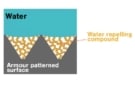
Superhydrophobic materials are defined as those that repel water droplets with a contact angle (the angle at which the surface of the water meets the surface of the material) of more than 150°. These materials also have a low surface energy as well as a rough surface at the micron scale.

Current techniques to make such materials, however, are complex and often involve using harsh chemicals. A team of researchers led by James Tour and C Fred Higgs III of Rice University in the US has now developed a one-step, solvent-free sanding method that can create superhydrophobic surfaces with a contact angle of nearly 164°.

The researchers used commercial sandpaper to introduce selected powder additives, such as graphene, molybdenum disulphide, Teflon and boron nitride, into the surfaces of materials including Teflon, polypropylene, polystyrene, polyvinyl chloride and polydimethylsiloxane. The sandpaper was made from aluminium oxide with grits of between 180 and 2000.

Tribofilm formation

“During the sand-in process, the introduction of powder between the rubbing surfaces facilitates the formation of a tribofilm,” explains Tour. “A tribofilm forms in a chemical reaction on surfaces sliding against each other and functionalizes the surface to repel water even more.”

“The sanding also induces structural changes and mass and electron transfer to lower the surface energy of the substrates,” adds Higgs.

A wide range of surfaces can be made superhydrophobic in minutes, Tour tells Physics World. This highlights the broad range of potential applications of the sanded surfaces.

“Aeroplane manufacturers do not want ice forming on their wings, ship captains do not want drag from attached ocean microbes slowing them down and biomedical devices need to avoid biofouling, where bacteria build up on wet surfaces,” says Higgs. “Robust, long-lasting superhydrophobic surfaces produced from this one-step, sand-in method can alleviate many of these problems.”

Higgs notes that other techniques used to generate hydrophobic surfaces cannot scale up to large surface areas, such as those on planes and ships. “Simple application techniques like the one developed here should be scalable,” he says.

Robust superhydrophobicity

The superhydrophobic materials are extremely robust. Indeed, they remained water-repellent even after 100 sticky tape peeling tests and after being exposed to 130°C in air for 24 hr. Leaving them out in the hot Texan sun for 18 months did not affect their properties either. And when the materials do begin to fail, they can be easily refreshed by simply sanding them again with the same powder additives.

The Rice researchers are now looking to apply their sand-in technique to another type of substrate altogether – the metal surfaces used to make rechargeable batteries. Indeed, they recently reported tests on lithium and sodium foils. “The role of the tribofilm here was to regulate the incoming ion flow in the battery electrolyte to improve the metal deposition/stripping behaviour during the battery cycling,” explains Tour.

The researchers describe their work in ACS Applied Materials.

Erwin Schrödinger: why did he fail at Oxford?

“Biology,” a physicist recently remarked to me, “is too important to be left to the biologists.” In a similar vein, I’m sure there are many scientists who think that “history is too important to be left to the historians”. It was a notion that nagged away at me while reading Schrödinger in Oxford by David Clary, which examines the time spent by the Austrian theorist Erwin Schrödinger at the University of Oxford in the 1930s.

Clary is an Oxford chemist and former president of Magdalen College, where Schrödinger spent three years as a fellow from 1933. He would therefore seem well placed to write a biography about Schrödinger’s time at Oxford. But history is never as easy as scientists like to think. It’s all very well describing who did what and when, but clarifying the motivations of the protagonists and putting their work into context with the wider world are vital ingredients too.

The raw material is certainly here for a gripping story. The book starts on 9 November 1933, the day that Schrödinger takes up his fellowship at Magdalen. After a traditional ceremony in Latin, the pealing of bells and dinner at high table, the college’s then president – George Gordon – is summoned into his office. There he receives a phone call from the Times newspaper, telling him that Schrödinger has just won that year’s Nobel Prize for Physics, jointly with Paul Dirac.

The timing must have seemed impeccable. Here was one of the pioneers of quantum mechanics, lured to a university that had traditionally been weak in science. Surely his presence would be the spark to light up Oxford physics? I can almost picture a Hollywood biopic starting here, with Gordon emerging from his office to congratulate Schrödinger, who goes on to transform the department and win over his contemporaries.

However, Schrödinger was a complex and controversial character. He arrived in Oxford after five years in Berlin. Yet unlike many other physicists who left Germany in the 1930s, he was not Jewish – but Catholic. Schrödinger was married, but had several affairs, including one with Hilde March (the wife of the physicist Arthur March), with whom he had a daughter (Ruth). Disturbing allegations have also recently emerged that he groomed and sexually abused young girls, though these came to light too late to be mentioned in Clary’s book.

Schrödinger’s time at Oxford proved less than successful. The university was dominated by humanities scholars and there were simply not enough good physicists for Schrödinger to work with or challenge him. He never felt at home, despite speaking excellent English (his grandmother was English and Schrödinger had taken childhood trips from Austria to Leamington Spa). He earned a decent salary, but was given no real duties, prompting him to complain he was – as his wife Anny put it – “a charity case”.

Clary pins Schrödinger’s troubled time at Oxford on him being “an independent and informal character”, who did not like traditions, rules and formal dress. “He was a lone scientist and not a collaborator,” Clary writes. What’s more, as a Nobel laureate, Schrödinger was “distracted by many invitations to visit departments overseas and was always receiving job offers which he, sometimes rather foolishly, often took all too seriously”.

Schrödinger did publish four influential articles while in Oxford – including the famous paper in which he coined the term “entanglement” – but he was not happy there. Even trivial matters, such as the supposedly poor quality of British door knobs and bike brakes, caused disgruntlement, according to one colleague. In 1936, just three years into his five-year fellowship, Schrödinger returned to Austria, taking up a chair at the University of Graz and an honorary professorship at the University of Vienna. It seems, with hindsight, a bizarre decision.

Although Austria was still an independent nation at the time – Germany did not annexe the country for another two years – the political situation in Europe was reaching boiling point. The Nazis were on the rise and numerous prominent Jewish physicists, many of whom Schrödinger worked closely with, were fired from their posts. In fact, the despicable treatment of Jewish physicists was one reason why he had left Berlin in the first place.

Just before departing Oxford, Schrödinger wrote a joint letter to the Times with Albert Einstein, thanking the Academic Assistance Council for helping hundreds of scholars to flee Germany. He had also spoken on the theme of “freedom” in a radio lecture for the BBC. Having taken up German citizenship during his time in Berlin, Schrödinger’s views – as a Nobel laureate – would certainly have been noted by the Nazi authorities.

Quite why he returned to Austria is not entirely clear from Clary’s book. His decision appears to have been partly due to banal matters like lecture load, social life and the quality of colleagues and students. Money played a role too: Schrödinger was offered 20,000 schillings for the Graz job topped up with 10,000 schillings for his Vienna post – more than he ever got at Oxford. I would have liked the author to explore more fully Schrödinger’s motivations, but Clary skates over the subject, merely noting that he was “naïve”.

While in Austria, Schrödinger tried to keep up his ties with Oxford, and there was even a suggestion of him coming back to deliver a series of summer lectures. However, this plan was rejected at the highest level by Joachim von Ribbentrop, the German foreign minister. In the words of the British foreign secretary Lord Halifax, who was then chancellor of Oxford, von Ribbentrop viewed Schrödinger as a “fanatical opponent” of the Nazi regime. A trip to England would, von Ribbentrop claimed, let Schrödinger “resume his anti-German activities”.

With life growing more difficult for Schrödinger, he wrote a letter to his local newspaper in Graz, suddenly claiming great support for the Nazis. Schrödinger later admitted to Einstein that the letter was “cowardly”, and Clary suggests he may have written it so he could travel to Berlin for the 80th-birthday celebrations of Max Plank. Schrödinger was eventually fired from his post in Vienna in April 1938 and, leaving his Nobel prize medal in the back of a filing cabinet in his office in Graz, he escaped.

Travelling via Italy and Switzerland, Schrödinger returned to Oxford, arriving exactly a day before his five-year term as fellow would have expired, dining one last time in college as permitted. But there was no role for him in Oxford and, after a stint in Belgium, Schrödinger moved to Ireland in 1940, becoming founding director of the new Institute for Advanced Studies in Dublin. He was to stay there until 1956 – living together with Anny, Hilde and Ruth – before eventually returning to Austria for good.

It was no ordinary life. But I would have liked Clary to give us more of a sense of Schrödinger’s character and personality. Instead, the author too often gets side tracked by lengthy descriptions of the mundane machinations of grant awards, job applications and prizes. People are often introduced without explanation: “Uhlenbeck and Goudsmit”; “Heitler and London”; “Heisenberg, Born and Jordan”; “Maxwell”. And I fear non-scientists will find the scientific explanations of Schrödinger’s contributions to physics, such as his eponymous wave equation, tough going.

While Clary’s style is clear, I feel pertinent information is often missing. We are told, for example, that during the First World War, Schrödinger “studied Einstein’s general theory of relativity when he was at the Italian front in 1916. This allowed him to write two short papers on the topic on his return to Vienna in 1917”. But how was he able to study while a war was raging? How did he have the time, space or ability to think, or access to reading materials?

Schrödinger in Oxford does provide plenty of raw material for historians, with extensive extracts from letters to, from or about Schrödinger. Clary benefited in this regard from archival letters obtained with permission from Schrödinger’s daughter Ruth Braunizer, with whom the author talked before her death in 2018 aged 84. The elephant in the room, though, is Schrödinger’s complex personal life, to which the author makes only oblique references.

I feel that Clary has missed an opportunity to offer his own appraisal of Schrödinger as a person. The book was written before sexual-abuse revelations prompted the school of physics at Trinity College Dublin to announce it would rename its Schrödinger lecture theatre. Having examined Schrödinger’s life so forensically, Clary should, in my view, have addressed his behaviour head-on. As a senior researcher and former president of Magdalen, his opinion counts.

  • 2022 World Scientific 420pp £85.00hb/£35.00pb/£28.00ebook

Open-source tool allows researchers to calculate their lab’s carbon footprint

Researchers in France have developed a new open-source tool to help scientists understand and reduce the carbon footprint of their labs. From the 500 or so labs that have already used the tool – called GES 1point5 – the researchers have discovered that heating, travel and commuting are the main factors that contribute to a lab’s carbon footprint. The team also finds, however, that there is no one-size-fits-all strategy that allows research groups to reduce their emissions (to appear in Environmental Research: Infrastructure and Sustainability).

In recent years there has been increased focus on the energy required to run modern physics labs and facilities as well as what general research activities – such as travelling to conferences – contributes to climate change. This has led to discussions around balancing the impacts of research with the beneficial knowledge it produces, especially when it comes to climate change. Lately, however, there has been a shift towards the notion that researchers should lead by example to mitigate such impacts.

The new tool, which has been developed as part of Labos 1point5 – an international group of academics who aim to estimate, analyse and reduce the environmental impact of research – asks users to enter information about their lab. This includes data such as the buildings’ heating systems, the lab’s electricity usage, how members commute, and how often and how far researchers travel to professional events.

The tool then estimates the lab’s carbon footprint by multiplying the amount of each activity by a greenhouse gas emission factor for that activity as listed in a public database maintained by the French Environment and Energy Management Agency that estimates emissions associated with various activities.

Carbon cost

As well as enabling individual groups to assess their own impact, GES 1point5 collects that data into a national database that allows researchers to investigate the footprint of research more generally. So far, the researchers have concluded that there is no blanket mitigation policy that can be applied effectively to all labs, since each lab has a unique emissions profile with its own requirements for its research. However, heating, travel and commuting are seen as the major components of emissions due to research, while electricity consumption in the lab, digital devices such as computers, and the energy used to cool refrigerant gases are not.

The researchers are now using the data to investigate whether there is a correlation between air-travel emissions and academic success, as well as if there are inequalities in the distribution of the carbon footprint between different labs and how specific mitigation policies affect labs’ impacts. In future, they will further refine GES 1point5 to include more emissions sources, such as purchased goods and services, as well as allowing it to be used to calculate the carbon footprint of large facilities like particle accelerators.

The GES 1point5 team is also working to build a community of academics developing their own mitigation strategies. “We are currently in the process of creating a network of research labs mitigating their emissions,” Tamara Ben Ari from the University of Paris told Physics World. “This network will be a space to exchange ideas and solutions and should be available for any research lab to join in 2023.”

Academics worked longer hours during the COVID-19 pandemic, finds study

Academics in all fields worked longer hours during the COVID-19 pandemic than they did before. That is according to a new study by an international team of researchers, who also found that longer working weeks have become part of a “new normal”. This could exacerbate pre-existing problems around stress and burnout, the authors say (PLOS ONE 17 e0273246).

Chronic overworking and its associated health risks are a longstanding concern in academia, with scholars working longer hours than average even before COVID-19 struck. The latest study reports on a longitudinal survey conducted during 2020 to investigate how the pandemic affected working arrangements.

The researchers used the Scopus academic database to obtain a list of all authors who published research in 2019. In May 2020 they sent a survey to 126,000 randomly selected authors, asking them how much time they had spent on various activities, and how much they would spend under normal circumstances. The researchers collected an effective sample of 525 respondents. They then sent a follow-up survey in November 2020 and received 169 replies.

The data show that academics worked three hours longer each week during the pandemic, on average, bringing the new weekly average to 51 hours in total. This pattern appeared across the board, regardless of country, gender or specialization. The main reasons given for the increase include teaching as well as having to adapt to interacting with students remotely. Time spent on administrative tasks also increased, while time spent on research remained roughly the same. However, rather than being part of a temporary adaptation phase, this new longer work week has now persisted as the “new normal”.

Meeting fatigue

The researchers believe there could be many explanations for the effect, including the difficulty of separating leisure and work time as well as university administrations encouraging longer working hours. There is also continued uncertainty around whether academics will have to resume online teaching, so the community has not yet returned to its pre-crisis state.

Co-author Anna Panova from HSE University in Moscow suggests that universities should have a well-defined crisis plan to reduce the impact of uncertainty should it happen again. “They could increase the number of IT staff, improve digital literacy among faculty members and provide access to psychological support,” she told Physics World. “The phenomenon of online meeting fatigue suggests that we should also reduce the number of these meetings.”

Brain–computer interfaces: tailoring neurotechnology to improve patients’ lives

A brain–computer interface (BCI) is a system that enables information to flow directly between the brain and an external device such as a computer, smartphone or robotic limb. The BCI includes hardware that records brain signals – most commonly electrical signals generated by neurons in the brain – and software that analyses features in these signals and converts them into commands to perform a desired action. The major application of BCIs is to restore abilities such as movement or communication to people with neurological disorders or injuries.

AE Studio, a data science company based in Los Angeles, is developing machine-learning algorithms that will expand the ability of BCIs to interpret brain activity in real time. Sumner Norman, chief neuroscientist at AE Studio and research scientist at Caltech, tells Physics World about the company’s mission to create software that increases human agency.

Can you describe the basic ideas behind the BCI?

When neurons in your brain are active they create electromagnetic fields and changes in haemodynamics, which provide a few different sources of contrast. If you have a way to interact with those physiological mechanisms, you can extract information from the brain.

The brain contains up to 80 billion neurons, which have up to a thousand synapses each. It’s an incredibly complex piece of machinery. So interpreting the extracted signals is actually a really complex problem. We use machine-learning algorithms to decode the information. But once you have interpreted the brain activity then you can use it. This could be as simple as controlling a cursor on a computer screen, or you can scale up to interacting with robotic limbs, anything the mind can imagine.

What is the main focus of current BCI research?

In recent years, efforts have started to translate out of academia and into industry. One line of commercial research is centred around the electrode-based technologies that sense electrical activity from the brain.

Often the most high-performance BCIs are intracortical, where the electrodes are implanted into the cortex itself. One company, Synchron, is investigating how to get electrodes into the brain by inserting a stent into the existing vasculature, which then snakes its way up into the brain and implants itself close to the motor cortex. Neuralink, Elon Musk’s company, is using very fine wire electrodes to create a fully implantable, fully wireless system with an extremely high channel count.

On the academic side, researchers are developing new sensing modalities, moving away from implanted electrodes. Optically pumped magnetometry, for example, senses the magnetic field generated by large populations of neurons firing together. Some of my research has involved the use of ultrasound to detect the motion of individual red blood cells in response to neural activity.

AE Studio recently announced a collaboration with Blackrock Neurotech, which aims to release the first commercial BCI platform next year. What is Blackrock developing?

Blackrock uses the Utah array, an electrode array that’s implanted in the brain, which first came out of the University of Utah. Over the last 20 years it has been developed within academia, with a long track record of safety and success. Blackrock’s goal is to package this into something that people with severe forms of paralysis – late-stage ALS, spinal cord injury and so on – can use to control computerized devices, such as a cursor on a screen.

Decoding an intended direction – moving a joystick to type letters on a screen – can be frustrating and slow. One interesting application, which came out of a group at Stanford, decodes imagined handwriting. Paralysed patients, who sometimes haven’t been able to move for decades, will attempt to write as they remember writing before they were paralysed. And the BCI device can decode that information almost as fast as you or I could write. This is an incredibly fast form of communication.

How is AE Studio involved in this project?

Academics come up with wonderful ideas and we want to bring those ideas into a reliable BCI that potentially millions of people can come to use and trust. We use good data science practices to improve device performance, but we also want to improve the user experience. This includes faster and less frequent calibration, so people spend more time handwriting, for example, and less time training the decoder.

We also need models that adapt quickly to the user’s brain changing or developing new skills. This is a big problem in BCI, that models need to be constantly recalibrated. AE Studio is well positioned to stabilize those models over long periods of time.

Are these examples of “creating software to increase human agency”?

Yes, that’s exactly right. In the near term, what we mean by increasing human agency is restoring function to people who have lost agency over the control of their body. But as with every new technology, BCIs come with possible downsides, and we want to be aware of these even early on.

For example, these machine-learning algorithms benefit from training with huge amounts of data from many people. But how do you pool knowledge gained from thousands or millions of users without compromising their privacy? So we’re thinking up clever ways of protecting user data, while also being able to share these complex models and update them with community use cases.

We want to work with the community, including academics, commercial groups and users themselves, to create devices where user data is encrypted and kept behind firewalls and ideally never even leaves the person’s device. These are the sorts of principles that we’re putting together now and just getting started on what that means in software.

And how could developments in BCI hardware benefit people?

These days, electrodes come with some risks, as implanting them in the brain itself can damage brain tissue. Ideally, we’d be outside of the brain entirely and specifically outside of the dura mater, the brain’s protective membrane.

If you can make the BCI surgery so simple that it’s effectively plugging a hole in the skull but never touching the brain, it becomes a short outpatient procedure and looks a lot less like brain surgery. That, I think, is where future applications start to expand, because then the user base grows beyond just people who have severe forms of paralysis. Once you get to these kinds of scenarios, then even mild to moderate improvements in quality-of-life start to make a lot of sense.

What other BCI applications might be introduced clinically in the next few years?

In the short term, the big move forward is to higher channel counts. Remember those 80 billion neurons? A Utah array only records from maybe a couple of hundred neurons at a time. Being able to record from tens or hundreds of thousands of neurons opens up much bigger possibilities around the type of fidelity for motor intention that you can decode. Decoding intended speech, for example, is right on the cusp of something that we can do quite well today, but it’s not quite ready for commercialization.

In the medium term, there are new, less invasive technologies. Transcranial magnetic stimulation is starting to grow in clinical adoption and efficacy, for treating depression, for example. One company is doing electro­encephalography (EEG)-based motor rehabilitation for people who’ve had a stroke – this is a non-invasive BCI.

In the long term, you could create nanomaterials that move through the body or bloodstream, or combine BCIs with genetic and molecular engineering. You could amplify the ability of these technologies so that instead of sensing a broad signal, they start to sense individual cells or cell types associated with certain diseases. And they could do that throughout the entire brain, rather than just in the tiny scope of an electrode. Now you start to open up the ability to deliver drugs to targeted regions with no side effects. The possibilities become endless. And that’s really the most exciting thing about neurotechnology – we’re just at the beginning.

Infrared light makes tasty popcorn, super-heated steam cleans dishes quickly and efficiently

This edition of the Red Folder comes from the kitchen.

Cooking with infrared light is becoming increasingly popular because it can cook some foods quickly and evenly – often using less energy than more conventional techniques. Now, Majid Javanmard and colleagues at the Iranian Research Organization for Science & Technology have taken a close look at popcorn that was popped using infrared light.

In “Continuous Infrared Popping: Effect on Key Physicochemical Attributes of Popcorn”, the trio look at the popping properties and energy consumption of an infrared system as well as the “sensory properties” and colour of the popcorn. For their study, the researchers created an infrared popping system with a rotating chamber that held corn kernels close to two infrared lamps. The team used three different power levels (600, 700 and 800 W) and found that the 700 W popcorn was superior. The researchers conclude that their infrared system can make tasty popcorn in a more energy-efficient way than traditional methods.

Shock waves

Researchers in Germany have calculated that washing dishes using super-heated steam is more effective and more environmentally friendly than conventional dishwashers. Natalie Germann at the University of Dortmund and Laila Abu-Farah at the Technical University of Munich did simulations which suggested that the technique could kill 99% of bacteria on a plate in just 25 s. What is more, the duo says that the shock waves created as the high-velocity steam is reflected off the internal surfaces of a dishwasher would be very good at removing food from dishes.

“Our study helps determine the strength of the shocks, the position of the shocks and the vortices that are created inside the dishwasher,” says Abu-Farah. “These things are very important for arranging the items or objects inside the dishwasher, and the placement and orientation of the nozzles.”

Although a super-heated dishwasher would cost more than a conventional unit, the researchers say that users would benefit from using less water, detergent and electricity. They also point out that the high level of hygiene achieved by super-heated steam would be attractive to commercial users such as restaurants and hospitals.

The research is described in Physics of Fluids.

Ask me anything: Sara Fry – ‘There are always opportunities to develop simple solutions for complex problems’

What skills do you use every day in your job?

That’s a tricky one as there are so many! The physics-related skills I use are analysing our safety and environmental statistics, and carbon accounting following the detailed guidance from the international Science-based Targets Initiative and the Greenhouse Gas Protocol. But the main skills I use every day are around visible leadership of our safety and environmental programmes, through both internal and external communications. Internally, I collaborate with my direct team, our senior managers and with all our employees; while externally I communicate with customers, trade associations and suppliers. Time management, delegation and prioritization are also key; as is people management of my direct reports in the central sustainability team.

I enjoy that I am constantly learning, as new topics are always coming to the fore in the sustainability landscape

What do you like best and least about your job?

Leading the safety and environmental programme of a major company comes with a great sense of purpose, and my job is to make Atlas Copco Vacuum Technique a better place for our employees and customers. I love the variety of my role – the mixture of different topics, planned and unplanned tasks, as well as leading a fantastic central sustainability team and interacting with colleagues from around the world. 

I enjoy that I am constantly learning, as new topics are always coming to the fore in the sustainability landscape, and there are always opportunities to develop simple solutions for complex problems. 

Now that international travel is possible once more, it’s also a privilege to be able to visit our locations around the world, to get to know our teams there, and to understand a little of the culture of the many countries where we have operations. The challenge can be that it’s all too easy to have my diary filled with too many back-to-back meetings, so I need to make sure to delegate where possible.

What do you know today, that you wish you knew when you were starting out in your career?

What I wish I knew when I started out in my career is that it’s not enough to be a subject-matter expert. Leadership and people management skills are also essential, as are public speaking and communications skills. I’ve had the opportunity to learn on the job and through great training courses in people management and leadership throughout my career but, looking back, I should definitely have started earlier and joined the university debating society!

Spiky magnetic fluid accelerates solar-driven water purification

A magnetic system that dynamically adjusts the surface properties of a material used for solar-driven water purification has been created by researchers in China. Developed by Liangti Qu at Beijing’s Tsinghua University and colleagues, the system achieved higher evaporation rates when compared to static surfaces.

Clean water is in short supply in many parts of the world and purification and desalination processes can be energy intensive. As a result, developing ways of using solar energy to purify water by evaporation has been the subject of extensive research, yet it is far from being in widespread use. Even though this approach utilizes mainly the energy from the Sun to separate water from contaminants, it is still too slow for many practical applications.

Interfacial solar vapour generation offers a way to increase the efficiency of evaporation by concentrating the energy of the Sun’s rays only at the surface of water. Still, with static systems there is little control on the flow of water and its vaporization, and the harsh chemical environment of untreated water leaves such systems prone to rapid deterioration.

Now,  Qu and colleagues have created a dynamic magnetically responsive system with controlled porosity and a shifting surface that achieves much higher evaporation rates than static counterparts.

Transport spikes

At first glance, the glistening spiky fluid in the above figure does not look like a water-purification system. Created by the team, it is a slurry of graphene-wrapped iron oxide nanoparticles that are mixed with the water to be purified. The special graphene coating prevents the nanoparticles from aggregating together, allowing them to dynamically reconfigure under an external magnetic field, or to disassemble simply by washing the slurry with a stream of water. Crucially, the material accelerates the diffusion of water from the bulk to the surface of the system by two orders of magnitude compared to the uncoated nanoparticles.

When the slurry is exposed to an external magnetic field, arrays of cones are formed, in a manner characteristic of ferrofluids. The high surface-area cones move, deform and spin along with the motion or change of the applied magnetic field. Thanks to the spiky surface and the concentration gradient it creates, any salt precipitation that is left behind when the pure water evaporates only occurs at the tips. This allows the sunlight to get through unblocked to the water in the slurry, unlike flat systems where salt precipitation covers the surface entirely. But the spikes are not the only structures of interest. On a smaller scale, a network of pores with diameters between hundreds of nanometres and tens of millimetres allows the rapid transport of water as well as fast disassembly of the structure when needed.

Spinning structures

Generally, porous structures are known to have enhanced performance when it comes to water transport. However, other purification systems that use porous materials rely on the passive flow of liquid water and vapour. As a result, slow water diffusion causes the accumulation of water vapour at interfaces, limiting the evaporation rate.

This problem can be solved by agitating the air around the system, which disrupts the water vapour and speeds up the evaporation process. In the team’s design, this agitation is done by the ferrofluid as the conical arrays rotate in response to a dynamic external magnetic field. This macroscopic motion is also accompanied by the reconfiguration of the magnetic nanoparticles on the microscopic scale to a disordered state while maintaining the conical shape on a macroscopic level – as shown in the figure above. This rearrangement aids salt, heat and water-vapour circulation in the system, enhancing the diffusion of vapour. As a result, the rotating systems show a 23% increase in the evaporation rate compared to the static systems when the rotation speed is above 100 rpm.

Hierarchy of cones

Static and dynamic structures

Movement is not the only way to increase the performance of the magnetic systems. The team also created more complex hierarchal 3D structures, that break the record for the static evaporation rate and exceeded the theoretical limit for evaporation when used dynamically. These proof-of-concept structures were constructed through the synergetic design of the magnetic forces between macroscopic magnets and the magnetic nanoparticles.

The image above shows the well-distributed conical arrays supported on stalks that extend the space for the vapour diffusion process. Since areas with higher evaporation rates lose energy to the atmosphere faster, surface temperature was used to monitor the evaporation rate. Real-time infrared thermal imaging revealed cooler temperature distributions for the dynamic structures compared to static structures.

While the systems are still in their preliminary phase of research, they offer exciting insights into the innovative future possibilities in water management and purification.

The research is described in Nature Communications.

Virtual and real labs with Daniel Erenso

Want to learn more on this subject?

In this webinar, we will address the need for virtual and hybrid learning labs brought on by the COVID-19 pandemic, providing the lab component for Introductory Physics II taught in a remote, on-ground, or a hybrid environment with little or no instructor guidance. Prof. Erenso explains this in his book Virtual and Real Labs for Introductory Physics II, published by IOP Publishing.

Following the presentation, there will be an opportunity for attendees to put their questions to the speakers.

Want to learn more on this subject?

Daniel Erenso has been a professor of physics at Middle Tennessee State University (MTSU) since 2003. Interested in both theoretical and experimental physics research, he has extended his research at MTSU to experimental biophysics and quantum optics/quantum information. He has published more than 35 and presented more than 60 research works, received more than 15 recognitions/honours/awards including the MTSU, College of Basic & Applied Sciences Distinguished Research Award (2016), the Fulbright Scholar Award (2016), the MTSU, College of Basic & Applied Sciences Excellence in Teaching award (2011), Sigma Xi the Scientific Research Society Aubrey E Harvey Outstanding Graduate Research Award UA (2003), the International Center for Scientific Culture (ICSC) World Laboratory Scholarship Award (2001), and The Abdus Salam International Centre for Theoretical Physics (ICTP).

About this ebook

Virtual and Real Labs for Introductory Physics II: Optics, modern physics, and electromagnetism provides the lab component for Introductory Physics II taught in a remote, on-ground, or a hybrid environment with little or no instructor guidance. The book offers the opportunity to realize these purposes by providing virtual and real lab components.

Author: Daniel Erenso, Middle Tennessee State University, USA.

Physicists gather to celebrate the life of Sir John Enderby

Members of the physics community gathered at the University of Bristol earlier this week to pay tribute to Sir John Enderby, who died in August last year at the age of 90.

Enderby was best known scientifically for his development of new techniques using neutrons to study the structure of liquids.

Having worked at the universities of Sheffield, Leicester and Bristol, Enderby also held several senior positions in science, including a three-year spell as British directeur adjoint of the Institut Laue-Langevin neutron lab in Grenoble, France.

He served as vice-president and physical secretary of the Royal Society from 1999 to 2004 and was president of the Institute of Physics from 2004 to 2006. Enderby was knighted for his services to science and technology in 2004.

The event – Understanding the structure of liquids: celebrating John Enderby’s scientific legacy – was attended by family members and colleagues, including former PhD students Philip Salmon (now at the Univeristy of Bath) and Alan Soper from the Rutherford Appleton Laboratory.

John Enderby

Delegates paid tribute to Enderby’s ability as a physicist to see through to the root of a problem, his skill at making the most of difficult situations, and his knack of making colleagues passionate about their work and being excited about its broader possibilities

Antonia Seymour, chief executive of IOP Publishing, outlined Enderby’s keen interest in scholarly publishing and paid tribute to his time as a scientific adviser for IOP Publishing, a position he held until 2011.

Dawood Parker from the hi-tech firm Melys Diagnostics talked about Enderby’s enthusiasm for finding solutions to industrial problems.

Others recalled his ability as an administrator – he was head of physics at Bristol for many years – who could cut through to the nub of an issue, identify ways forward, and say clearly what needed to be done.

There were also lighter moments as Enderby’s colleagues recalled his enjoyment of good food, football (he was a referee and supporter of Leicester City) and family life.

It was obvious to all who attended that Enderby not only contributed greatly to physics – in particular developing methods to analyze the structure of liquids – but also had a simple and straightforward desire to help others.

As the mathematician Sir John Kingman – and former vice-chancelleor of Bristol University – noted at the end of his address: “He was a great man.”

Copyright © 2026 by IOP Publishing Ltd and individual contributors