In this episode of the Physics World Weekly podcast, the explosion expert Sam Rigby talks about his research, which focuses on protecting people, buildings and vehicles from explosions.
A structural engineer at the UK’s University of Sheffield, Rigby chats about the physics of explosions and describes a testing range that he and his colleagues use in the nearby Peak District. He also discusses the difficulties of understanding how a large blast will propagate through an urban area and explains how social media videos of the 2020 Beirut explosion informed his research.
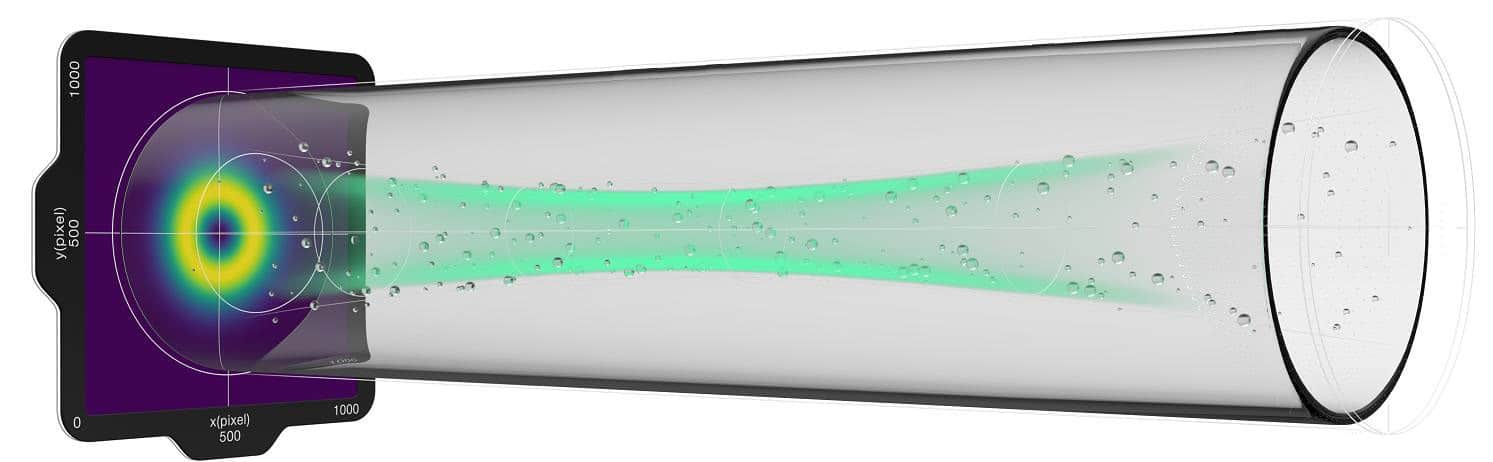
Going with the flow: diagram showing the optofluidic force induction (OF2i) scheme. Liquid containing nanoparticles flows from left to right in a microfluidic channel, which is also the direction of propagation of the twisted laser light. (Courtesy: Marko Šimić et al./Physical Review Applied)
A technique for characterizing nanoparticles in suspended mixtures has been created by researchers in Austria. Developed by Marko Šimić and colleagues at the University of Graz, the new technique drives nanoparticles into spiral trajectories with size-dependent velocities – allowing nanoparticles of different sizes to be studied separately. This new approach could lead to improvements in how nanoparticles are processed.
Nanoparticles are used in a broad range of commercial products and industrial processes including cosmetics, paper, paints and pharmaceuticals. Many of these applications involve suspending nanoparticles inside a liquid or gel, and to ensure the best possible performance of these products it is important to control the size of the nanoparticles.
This can be done using dynamic light scattering – a technique that relies on the random Brownian motion of nanoparticles in a liquid. Brownian motion occurs when a nanoparticle is jostled by surrounding molecules and therefore the motion is more pronounced for smaller particles. The Brownian motion is revealed by measuring fluctuations in the light scattered by nanoparticle mixtures.
Slow motions
While this technique works reasonably well for smaller nanoparticles, larger nanoparticles are less affected by Brownian motion, so their sizes are far harder to monitor. In addition, the technique cannot characterize size in real time, which is an increasingly important requirement for modern manufacturing processes.
Šimić’s team has taken a new approach that it calls optofluidic force induction (OF2i). This involves pumping a nanoparticle mixture through a microfluidic channel, along the same direction as a weakly-focused optical vortex. The latter is a laser beam with a wavefront that twists around the direction of propagation like a corkscrew and carries orbital angular momentum.
Particles of different sizes are accelerated to different velocities by the laser beam, providing a way of characterizing particle size in the sample. However, because differently sized particles move at different velocities, particle collisions are common – which degrades the velocity separation.
Twisted light
Šimić’s team solved this problem by using twisted laser light. This transfers angular momentum to the nanoparticles, driving them into spiral-shaped trajectories. Particles with different masses follow different trajectories, which prevents collisions.
Šimić and colleagues detected the light scattered by the spiralling nanoparticles using a microscope placed beneath the channel – allowing them to track the trajectories of individual particles. From the shapes of these trajectories, they could then determine the velocities of the corresponding nanoparticles. Using this information, they could determine the sizes of the particles in the liquid in real time.
The team tested the set-up using polystyrene nanoparticles, with diameters ranging between 200–900 nm. These sizes are beyond the capabilities of dynamic light scattering. By adapting their technique further, the team hopes that OF2i could also be used to measure other nanoparticle characteristics, including their shapes and chemical compositions.
For now, it is still uncertain whether OF2i will work for materials other than polystyrene, and this will be the focus of the researchers’ future experiments. But if their technique maintains its performance for other nanomaterials, Šimić and colleagues hope it could provide a flexible workbench for nanomaterial processing that paves the way for new advances across a wide array of applications.
Aortic stenosis, the narrowing of the aortic valve, is one of the most common and serious heart valve dysfunctions. Usually caused by a build-up of calcium deposits (or sometimes due to a congenital heart defect), this narrowing restricts blood flow from the left ventricle to the aorta and, in severe cases, can lead to heart failure.
The development of sensitive, cost-effective techniques to identify the condition is paramount, particularly for use in remote areas without access to sophisticated technology. To meet this challenge, researchers from India and Slovenia have created an accurate, easy-to-use and low-cost method to identify heart valve dysfunction using complex network analysis.
“Many rural health centres don’t have the necessary technology for analysing diseases like this,” explains team member M S Swapna from the University of Nova Gorica, in a press statement. “For our technique, we just need a stethoscope and a computer.”
Hear the difference
A healthy person produces two heart sounds: the first (“lub”) due to the closing of mitral and tricuspid valves and the second (“dub”) as the aortic and pulmonary valves close, with a pause (the systolic region) in between. These signals contain carry information about the blood flow through the heart, with variations in pitch, intensity, location and timing of the sounds providing essential information related to a patient’s health.
Swapna and colleagues – Vijayan Vijesh, K Satheesh Kumar and S Sankararaman from the University of Kerala – aimed to develop a simple method based on graph theory to identify aortic stenosis heart murmur. To do this, they examined 60 digital heart sound signals from normal hearts (NMH) and hearts with aortic stenosis (ASH). They subjected the signals to fast Fourier transform (FFT), complex network analyses and machine-learning-based classification, reporting their findings in the Journal of Applied Physics.
The researchers first converted each audio signal into a time series. The signal from a representative healthy heart clearly showed the two heart sounds and the separation between them, while signals from hearts with aortic stenosis displayed diamond-shaped murmurs.
Next, the team used FFT to convert the time-domain signals to the frequency domain, thus providing information on the frequency components in the murmur, which vary with valve dysfunction. The FFT analysis for NMH showed well-defined peaks from the two sound signals in a normal heart. For ASH, however, the FFT spectrum contained a large number of signals over a wide frequency range, with no distinct peaks assignable to the lub and dub sounds. These additional components are attributed to vibrations occurring from calcium deposits blocking the aortic valve and creating turbulence in the blood flow.
While both the time-domain and FFT analyses enable preliminary identification of defective valves, to analyse the sound signals further, the researchers used the data to create a graph, or a complex network of connected points. They split the data into sections, with each part represented as a node on the graph. If the sound in that portion of the data was similar to another section, a line is drawn between the two nodes.
In a healthy heart, the graph showed two distinct clusters of points, with many unconnected nodes. The unconnected nodes are likely due to the absence of a time-domain signal in the systolic region, indicating the proper functioning of the heart. The network of a heart with aortic stenosis was far more complex, with two prominent clusters and an absence of uncorrelated nodes, indicative of a potential valve defect.
The team extracted a set of parameters, known as the graph features, from the graph of each signal. These features (the average number of edges, diameter, network density, transitivity and betweenness centrality) can then be used by machine-learning techniques to classify the signals as either ASH or NMH.
Three supervised machine-learning classifiers – K-nearest neighbour (KNN), support vector machine and KNN subspace ensemble – exhibited prediction accuracies of 100%, 95.6% and 90.9%, respectively. This high accuracy suggests that the use of these mathematical concepts could provide greater sensitivity and reliability in digital cardiac auscultation and could be easily employed in rural health centres.
The researchers have so far only tested the method with existing data, not in a clinical setting. They are now developing a mobile application that could be accessed worldwide. “Currently, we are analysing other heart murmurs to make a comprehensive analysis of heart murmurs,” Swapna tells Physics World. “After that, the work will be extended to real-world data by directly recording the sound with the help of a medical practitioner. The development of software and a mobile application comes in the third stage of work.”
Tracking treatment response: Cardiac amyloid deposits are monitored using cardiovascular MR with extracellular volume (ECV) mapping. Scans performed at baseline (top row), and after six months (middle row) and one year of chemotherapy (bottom row), reveal progressive reductions in CMR (T1; column two) and ECV (column four) over the course of treatment. (Courtesy: UCL)
For the first time, doctors can measure the effectiveness of chemotherapy for “stiff heart syndrome”, using an advanced form of cardiac magnetic resonance imaging (MRI). Researchers at the National Amyloidosis Centre of University College London (UCL) have been developing and refining the non-invasive technique for the past 10 years.
Light-chain cardiac amyloidosis, also known as stiff heart syndrome, is a condition in which the heart muscle thickens due to the build up of amyloid fibrils throughout the heart. In early stages, the pumping function is typically preserved, but eventually the heart muscle can no longer efficiently pump blood and pressure starts to build up, leading to shortness of breath and fluid retention in the lungs and limbs. Without treatment, this can rapidly lead to heart failure and death.
Chemotherapy is the first-line treatment to reduce amyloid protein, but until now there has been no way to efficiently measure its therapeutic effect. A patient’s haematological response to chemotherapy is generally evaluated using measurements of serum free light chains (FLC), while echocardiography parameters and serum concentration of brain natriuretic peptides are currently the reference standards for assessing cardiac organ response. But these indirect biological markers do not directly measure cardiac amyloid burden.
The new imaging procedure combines cardiovascular MR (CMR) with extracellular volume (ECV) mapping to measure the presence and, importantly, the amount of amyloid protein in the heart. This approach can determine whether the chemotherapy is effective in triggering cardiac amyloid regression, information that will help guide better, more timely, treatment strategies for patients.
Principal investigator Ana Martinez-Naharro and colleagues assessed the ability of CMR with ECV mapping to measure changes in response to chemotherapy in a study following 176 patients with light-chain cardiac amyloidosis for two years. They report their findings in the European Heart Journal.
The newly diagnosed patients, who were enrolled in a long-term prospective observational study at the National Amyloidosis Centre, underwent a series of assessments. These included N-terminal pro-B-type natriuretic peptide (NT-proBNP) measurements and CMR with T1 mapping and ECV measurements at baseline and at six, 12 and 24 months after the start of chemotherapy with bortezomib. The team also measured FLC monthly to assess haematological response.
When combined with results of blood tests, the imaging exams revealed that almost 40% of patients had a substantial reduction in amyloid deposition following chemotherapy. “The scans and data made available using this technique, combined with correlating data from indirect markers that currently exist, gave us the information to both see the amount of amyloid protein and also the regression in amyloid during the course of chemotherapy treatments,” says Martinez-Naharro.
Senior author Marianna Fontana, of the UCL Division of Medicine, recommends that the MRI technique should now be employed immediately to diagnose and assess all cases of light-chain cardiac amyloidosis. “By developing ECV mapping for 1.5 T MR scanners, we hope that its use can be made available to more patients. The aim would be to use these scans routinely for all patients with the disease to help improve patient survival, which is very poor in patients who do not respond to treatment,” she explains.
In this study cohort, only patients who achieved complete haematological response or very good partial response experienced regression in cardiac amyloid deposits following chemotherapy. The study also showed that, after adjusting for known predictors, changes in ECV could predict patient outcome, including death, as early as six months into treatment.
“Future management of cardiac amyloidosis is likely to be a multidimensional approach, where haematological, NT-proBNP response and CMR response will have a different role at different time points. The combination of these markers will depict a comprehensive clinical picture that could help clinicians to better tailor chemotherapy treatment in each individual patient,” the researchers conclude, noting that that the ability to measure changes in cardiac amyloid load over time could also provide an endpoint for early-state drug development and dose ranging.
The first neutron interferometer built from two separate crystals rather than one could lead to more advanced measurements of quantum effects, including in gravitational fields. Developed by researchers at the TU Wien, INRIM Turin and ILL Grenoble, the new interferometer is both more sensitive and more flexible than its predecessors, and could become a testbed for measuring distances and angles with very high resolution.
Thanks to wave-particle duality – one of the cornerstones of quantum mechanics – neutrons exhibit a wave-like diffraction pattern when they scatter off a material. Neutron interferometers exploit this property. When neutrons are fired at a crystal, the neutron wave splits into two portions. When these waves are then allowed to combine, they interfere with each other, producing a characteristic diffraction wave pattern that reveals information about the material’s structural and magnetic properties.
“The principle of the interferometer is similar to the famous double-slit experiment, in which a particle is shot at a double slit in a wave-like manner, passes through both slits simultaneously as a wave and then superimposes on itself, so that afterwards a characteristic wave pattern is created at the detector,” explains team member Hartmut Lemmel of the TU Wien. “But while in the double-slit experiment the two slits are only a minimal distance apart, in the neutron interferometer the particles are split into two different paths with several centimetres in between.”
Limited size
Neutron interferometers have been employed in fundamental physics research for many years. However, Enrico Massa of the INRIM, who led the new study, explains that their size – and therefore their sensitivity – has been limited because they only work if carved from a single piece of crystal. This is because the quantum superposition in the devices is extremely fragile and sensitive to tiny misalignments, vibrations, displacements or rotations between the interferometer parts. Because the crystals themselves cannot be made very big, researchers have been trying since the 1990s to make neutron interferometers from two separate crystals that could be placed a greater distance from each other.
Increased sensitivity to weak neutron interactions
Massa and colleagues have now achieved just this by modifying an X-ray interferometer technology created at the INRIM to accurately determine the lattice parameter of separated silicon (Si) crystals. The new apparatus comprises two Si crystals mounted on a piezo-driven tip-tilt platform, which allows the pitch and yaw angles between the crystals to be adjusted on smaller than nanoradian scales.
“Such separate crystals allow for long and spaced interferometric ‘arms’, which will improve the interferometer’s sensitivity to weak neutron interactions – for example with the gravitational field,” explains Massa. “This will give room to place bigger pieces of equipment or samples to be imaged inside the interferometer,” he tells Physics World. “What is more, and from a technological viewpoint, split-crystal interferometry is a testbed for the metrology of macroscopic distances and angles with picometre and picoradian resolution.”
The TU Wien-INRIM-ILL researchers say they are now working on a next generation of split-crystal interferometers that can operate simultaneously with neutrons, X-rays and visible photons. The crystal separation in these new devices will be pushed to distances as large as 1 metre.
Graduation ceremonies are a wonderful part of the academic calendar, where students celebrate their hard-won achievements. And these joyful events have become even happier over the last decade. In 2011 about half (51%) of graduates across all subjects at UK universities achieved an upper second-class degree, while a sixth (16%) were awarded a first-class degree. Just seven years later, 79% of all students were getting these top two degrees, with almost a third (29%) being given a first.
The proportion of students receiving the top grade, in other words, had nearly doubled – a spectacular increase by any standards. But we should hardly be surprised. The alleged quality of a university’s provision is these days measured by student satisfaction and employability – both of which can be enhanced by inflating the number of top grades. The pressure is only in one direction.
First-class questions
Degree classifications matter. Many recruiters, for example, consider only applicants who have “good” degrees. Some professions offer higher starting salaries to graduates with better degrees, while the ability to secure grants for PhD programmes usually depends on degree class. The rapid increase in top grades therefore raises three crucial issues. What does a degree classification mean? How do we compare standards between different subjects and institutions? And does the problem need fixing?
Most universities have descriptors to identify, for example, a first-class performance. While they are useful in telling students what virtues are likely to lead to high marks, these descriptors are far from absolute. Some universities, for example, use terms such as “excellent”, “outstanding” or “very good” to distinguish between grades, without explaining how they differ.
More importantly, degrees are typically awarded based on “norm referencing” not “criterion referencing”. In other words, each university department sets tasks and exam papers to suit their students, marking accordingly. Despite universities pretending otherwise, there is no common currency to degree awards – it depends on the subject and the university. Put bluntly, it’s easier to get a first at some universities and harder at others.
Unfortunately there are no effective ways to compare standards between institutions. Within a given subject, such as physics, neither external accreditation (as happens in the UK and Ireland through the Institute of Physics) nor the system of external examiners leads to a common standard. And I am not even sure how to begin to compare standards between subjects.
So does degree inflation need fixing? Before we answer that, we need to ask why it’s happening. It would be lovely to think that undergraduates have simply got better, but that is hardly likely in all universities across all subjects. I also doubt that teaching has improved dramatically over such a short period. Instead, I believe grade inflation is mainly being driven by external arbiters of quality, such as the UK’s Teaching Excellence Framework (TEF) and university league tables.
Departments don’t consciously set out to award higher grades, but these systems tend to favour high marks. In the case of the TEF, its decisions are informed by the employability of graduates, student satisfaction and the proportion of students who progress from the first year of a degree to the second. As the TEF’s definition of employability includes how many students go on to postgraduate study (rather than just into work), the simplest way for a university to improve its score is to give more students good degrees. Monitoring progression from year one is also an invitation to be more lenient, while student satisfaction will not be harmed by awarding higher marks either.
There are two other inflationary factors. First, some league tables use the percentage of first-class degrees as a measure of quality. Second, and more subtly, it is increasingly a requirement for lecturers to provide a full set of notes for their courses together with worked answers for any problems set. Given that most formal physics exams test little more than rote learning, this arrangement makes it easier for students to do well.
Setting a new standard
Something needs to change. The arbitrary lines (first, upper second, etc) drawn in a continuum of performance make no sense and reinforce the notion of a universal standard. But even a switch to, say, a grade-point average does not address the comparability issue. What’s more, direct comparisons between institutions and, particularly, subjects make no sense because programmes are trying to do different things.
A physics department at one university might be focusing on, say, mathematical physics, while another adopts a more practical approach. In both cases, departments will assess at a level consistent with the students they have, essentially norm referencing. Their grades are not, and cannot be, directly comparable. We also need to ensure that quality assurance does not apply inflationary pressure but recognizes that each programme is unique.
I would therefore like to see all programmes state what they are trying to achieve, indicating the type of students they are trying to attract and the employment destinations of their graduates. A department could succeed against an unchallenging target, but potential students would be aware of that and could make appropriate judgements. Alternatively, if a department asserts high ambition, for example claiming to take students without A-levels and produce graduates with high salaries, they had better be able to demonstrate it.
If we want to prevent grade inflation, we must stop pretending there is a common currency of grades and start measuring universities against what they are trying to achieve. Perhaps then we can shift the emphasis of a degree back towards education, rather than the mere acquisition of a qualification.
Nine teams of research students and early-career scientists lined up at the end of July to compete in the UK’s first quantum computing hackathon. Organized by the National Quantum Computing Centre (NQCC) in collaboration with QuantX, the event challenged the teams to devise novel quantum solutions to problems set by end users such as BT, the NHS and Rolls Royce.
By the end of the two-day event, several teams had run their algorithms on quantum hardware provided by technology partners IBM, Oxford Quantum Circuits and AWS. Others, who had developed solutions beyond the capabilities of current quantum processors, tested their solutions on quantum simulators, with programming experts from each of the technology providers on hand to provide support and advice. “We’ve been checking in with the teams throughout the event, and helping with some of the more technical code,” said IBM’s Frank Harkins. “Some have a good vision of where to go and how to use the code, while for some of the others we’ve helped with a bit of the theory and the algorithms.”
Mentors from each of the end-user organizations also worked alongside the teams to offer expert domain knowledge, explain the context for the problem, and guide the hackers towards potential solutions. The challenge set by Rolls Royce, for example, was to predict the lifetime of a jet engine based on data recorded during operation. “First of all I framed the use case, and from there I guided them through quantum machine learning as a possible approach,” commented mentor Jarrett Smalley, one of the company’s specialists in quantum computing. “They came up with a novel approach that blends some existing ideas together in a new way, and it’s been really cool to watch it develop from nothing to a working model in just two days.”
Another problem, set by the NHS, challenged the hackers to devise a strategy for allocating patients to beds while also taking account of various constraints. “It’s an extremely complex problem that is usually worked out by people on the ground with a lot of domain knowledge,” explained mentor Dan Schofield, a senior data scientist within the NHS Transformation Directorate. “We are probably a few steps off having any quantum computing in the NHS, but it has been really interesting to find out how quantum approaches might be able to solve the sort of problems we’re looking at.”
The hackathon was the first hands-on event organized by the NQCC to bring together quantum developers, end users and technology providers to work on real-world problems. In May 2022 it launched its SparQ applications discovery programme, which aims to provide end users with an opportunity to experiment with quantum algorithms and hardware for tackling relevant use cases within their sector. “It’s all about growing the user community for quantum computing,” said NQCC director Michael Cuthbert. “There’s nothing like running a piece of code yourself, and running it on a real quantum computer, to engage with the technology and understand its capabilities.”
Cuthbert has been encouraged by the level of interest and commitment in the hackathon. “We were oversubscribed for places, and we’ve had terrific support from our industry partners and the quantum technology providers,” he said. “The teams of hackers have been incredibly engaged and enthusiastic – some were working on their solution well into the night – and they have worked together extremely effectively to come up with some impressive solutions in a short amount of time.”
For the students and researchers who made up the teams, the hackathon offered a valuable insight into the advantage that near-term quantum algorithms might offer for industrial applications. Maria Violaris, a PhD student from the University of Oxford, was working on a pursuit-and-evasion problem set by defence company MBDA. Her team was trying to train a quantum neural network to come up with the best strategy for a chaser (the “monster”) to reach the target (the “princess”) in the fastest possible time – a problem that is relevant not just to the defence sector, but also to other applications such traffic control or security systems in museums and art galleries.
“It has been really good to have two days where you are fully focused on one project, and to take a use case and connect it back to the quantum algorithms that could be used to solve the problem,” Violaris commented. “We’ve made a lot of headway given the short timescale, and we generated some promising results when we tested the algorithm both on a quantum simulator and on a real quantum processor. It has been a great way to accelerate learning.”
Such rapid progress was in part made possible by a structured approach to team selection. The NQCC’s Chiara Decaroli, who was responsible for organizing the event, explains that prospective hackers were asked to specify their skill level as well as their prior experience with quantum programming as part of the application process. “We created teams with people from different disciplines and with a range of skill sets, including relative beginners in the quantum field who knew how to build algorithms or models,” she explained. “The teams were quick to identify which of them had the expertise to perform each specific task, and that had a huge impact on the results they produced in a very short time.”
Master’s student Eden Schirman from Imperial College London certainly felt the benefit of that approach. He was assigned to a team working with THALES to develop a quantum algorithm for detecting anomalies in sonar data recorded by submarines, which could be generated by enemy submarines or missiles with an unknown signature. “At the beginning I asked to be put in a team with other people from Imperial, but it was a smart decision to mix up the teams,” he said. “It has been good to collaborate with new people, to listen to new ideas, and to work on a quantum algorithm that is related to my research but not the same. It has opened my mind to new directions for developing quantum algorithms.”
Schirman also valued the input from THALES and the technical experts from IBM. “Our industry mentor told us about the use case and the data, as well as the classical implementations and algorithms that are typically used, while two specialists from IBM helped us throughout the event with the implementation and with new ideas for quantum algorithms. It’s been really helpful to have access to that knowledge and to get a different point of view.”
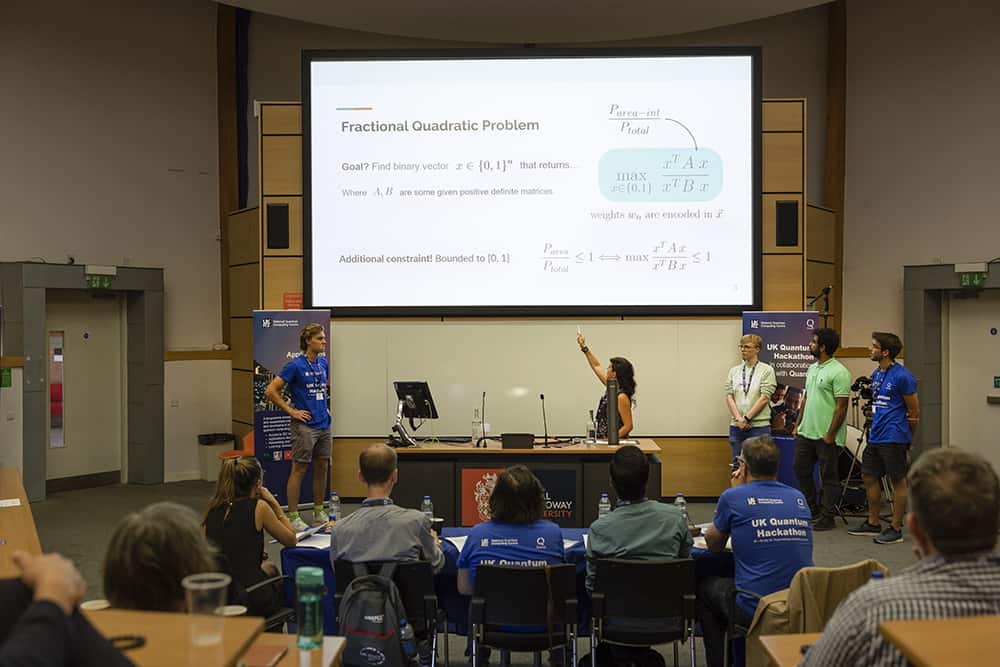
Friendly rivalry: Each of the teams presented their results at the end of the hackathon, with a panel of judges evaluating the creativity and scalability of the solution as well as the quality of the presentation. (Courtesy: NQCC)
At the end of the hackathon – just 30 hours after it started the previous day – the teams presented their solutions to all the other participants, as well as to a judging panel that included Cuthbert, Decaroli, and quantum experts from both industry and academia. “All the presentations were amazing,” said Decaroli. “The criteria for us judges were to look at the creativity of the solution, whether the team had investigated the scalability of their approach to more powerful quantum machines, and how well they presented their results and answered any questions.”
The winning team, who named themselves Quassian, had been working with MDBA on a quantum machine learning approach to speed up complex simulations in aerospace engineering. The Rolls Royce group mentored by Smalley came second, while third went to a BT-sponsored team testing different quantum and classical methods for optimizing the performance of 2D antenna arrays. “All of the presentations demonstrated huge amounts of work, commitment and enthusiasm over the last couple of days,” commented Cuthbert, before presenting the prizes to the winning teams. “You have made friends and contacts that will stay with you for the rest of your career, and I hope it is just the start of your engagement with quantum computing and the NQCC.”
The success of the event paves the way for future hackathons, most likely focused on specific industry sectors to encourage more early-career professionals to take part. It also provides the NQCC team with a useful springboard for its ongoing engagement with the UK’s growing quantum ecosystem. “The hackathon encapsulates all the key elements of SparQ, but on a smaller scale,” said Decaroli. “We can extend this hackathon template to longer term projects where quantum developers, end users and technology providers can work together to develop more complex solutions and test them on multiple hardware platforms.”
Hertha Ayrton (1854–1923) was a woman of formidable intellect and skill – and many labels. She was scientist, inventor, mathematician, engineer and suffragette, and her achievements touched the lives of many.
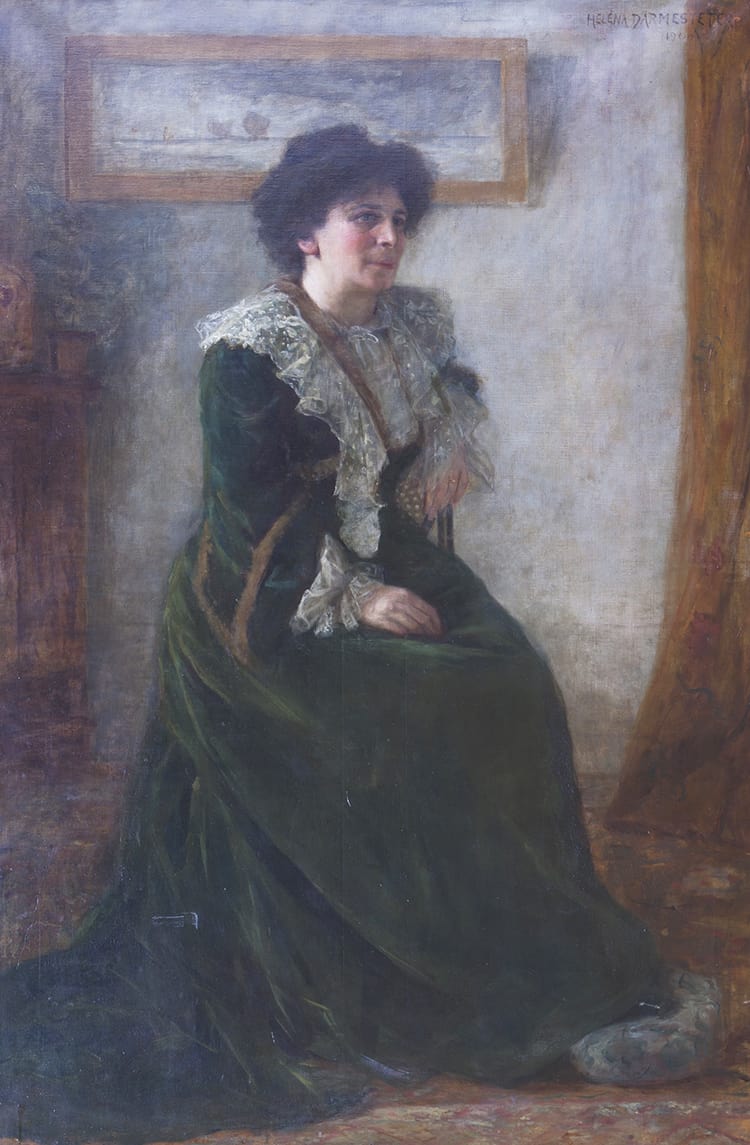
Painting of a pioneer Portrait of Hertha Ayrton in 1906 by Helena Darmesteter. (Courtesy: The Mistress and Fellows, Girton College Cambridge)
The turn of the 20th century was defined by huge strides in engineering, automation and manufacturing. It was an era that gave us technologies such as radio transmission, air conditioning and the diesel engine, and saw the likes of Nikola Tesla, Thomas Edison and Alexander Bell at the forefront of innovation. But one often overlooked name is Hertha Ayrton.
Responsible for developments in fields as diverse as electricity, mathematics and the physics of liquids and gases; Ayrton is widely regarded as one of the most prolific female inventors in scientific history. Her work, which touched the lives of many, ranged from improving the standards of bulbs and lamps across society, to developing the technology used to combat chemical gas in the trenches of the First World War.
Although Ayrton faced much opposition during her career due to her gender, she persevered, and forged a path for the many women who followed in her footsteps. Indeed, her involvement in the women’s suffrage movement only added to her rich legacy. As her close friend, writer and suffragist Evelyn Sharp wrote in a memoir of Ayrton: “She was a physicist, suffragist, democrat, humanitarian and very human woman – but never any of these things in a water-tight compartment.”
The birth of “Hertha”
Born Phoebe Sarah Marks on 28 April 1854 in Portsea, UK, Ayrton was the third child and eldest daughter of Jewish watchmaker and Polish immigrant, Levi Marks, and his wife Alice Theresa, a seamstress from Portsea. When Ayrton was seven, her father suddenly died, leaving her mother to raise seven children, with another on the way.
Despite her family’s hardships, Ayrton thrived as a child and enjoyed unusual freedoms for girls at the time, being encouraged to think freely and play in the streets. It was Alice who safeguarded her daughter’s independence, believing that “women [had] the harder battle to fight in the world” and so needed a better education than men. This opinion propelled Ayrton’s mother to accept an offer from her sisters to send Ayrton to their school in London when she was nine years old – a decision that sharply contrasted with what was considered “the duty” of an eldest daughter in the 1860s.
At school, Ayrton stood out as having a brilliant scientific mind and a strong personality, but given the freedoms she enjoyed at home, she had no patience for arbitrary discipline, rule-setting or the etiquette expected of young girls. “[Her upbringing] was not an upbringing that helped to make her at the age of nine a docile little schoolgirl,” wrote Sharp. Ayrton also did not tolerate injustice, once going on hunger strike for two days when wrongly accused of breaking school rules.
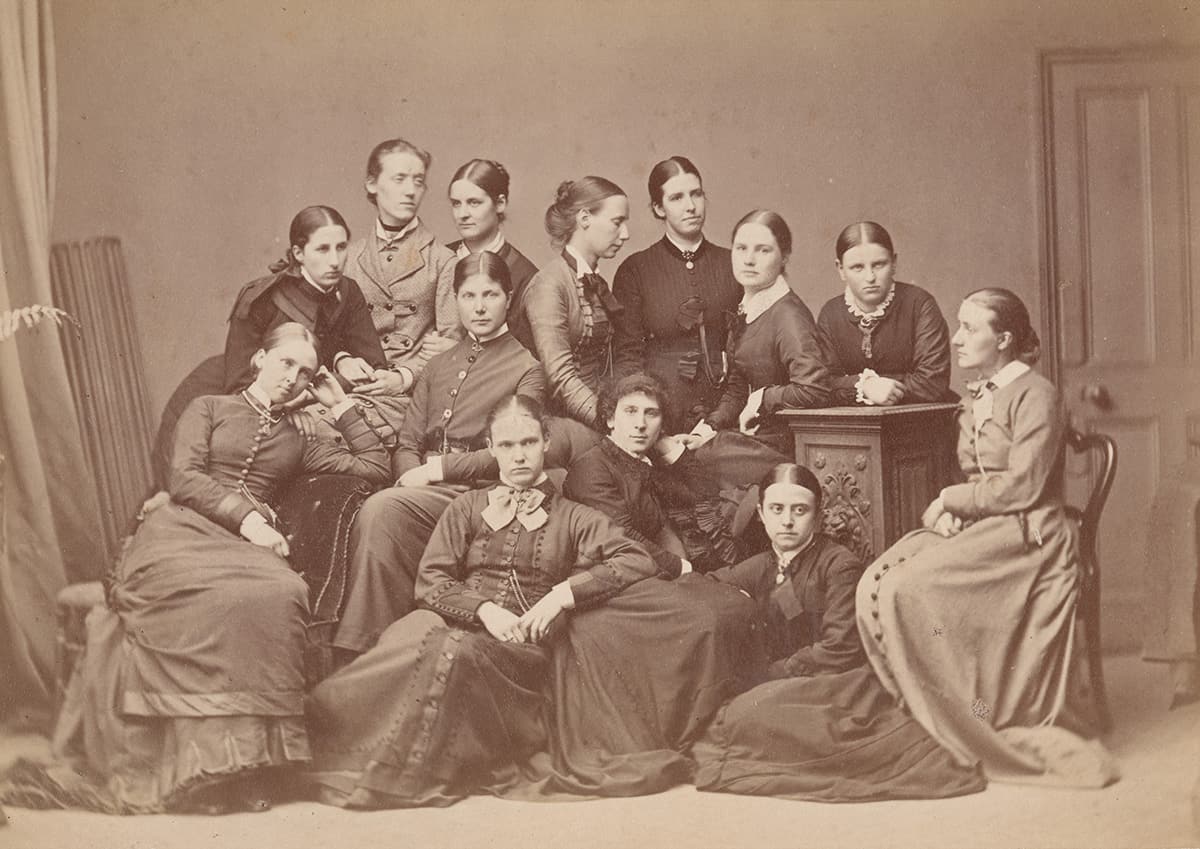
The women of Cambridge A photograph of the first year students of Girton College at the University of Cambridge in 1877. Hertha Ayrton, then Sarah Marks, is pictured in the centre of the bottom row. (Courtesy: The Mistress and Fellows, Girton College Cambridge)
Despite occasional clashes with her teachers, Ayrton excelled at school and by 16 was self-sufficient, working as a governess and supporting her family. During this time she met numerous influential thinkers, in particular associating herself with the early women’s suffrage movement. One new friend was Ottilie Blind, who gave Ayrton the nickname “Hertha”, inspired by Algernon Swinburne’s 1869 poem of the same name. Together, the pair attended women’s suffrage meetings and later coached each other for the University of Cambridge entrance examination for women.
Life as a society governess wasn’t enough for Ayrton, who sought further education, and in 1873 she was introduced by Blind to Barbara Leigh Smith Bodichon. A leading feminist and co-founder of Cambridge’s first women’s college, Girton College, Bodichon became Ayrton’s mentor and confidant, encouraging her to apply to Cambridge. She also introduced Ayrton to Mary Ann Evans, author of Middlemarch who used the penname George Eliot. Indeed, Evans was so inspired by Ayrton that she based the character Mirah in her 1876 novel Daniel Daronda after her.
Ayrton passed the University of Cambridge entrance examination for women in 1874 with honours in English and maths, however, it wasn’t until 1876, sponsored by Bodichon and Evans among others, that she started studying mathematics at Cambridge.
Cambridge and Finsbury
In the 1870s, there were few, if any, classes at Cambridge open to women. Instead, Ayrton worked closely with the handful of other female students, establishing a small, separate study group. She was coached by Richard Glazebrook, a physicist with a specialty in aviation and electricity, both of which became pillars of Ayrton’s career.
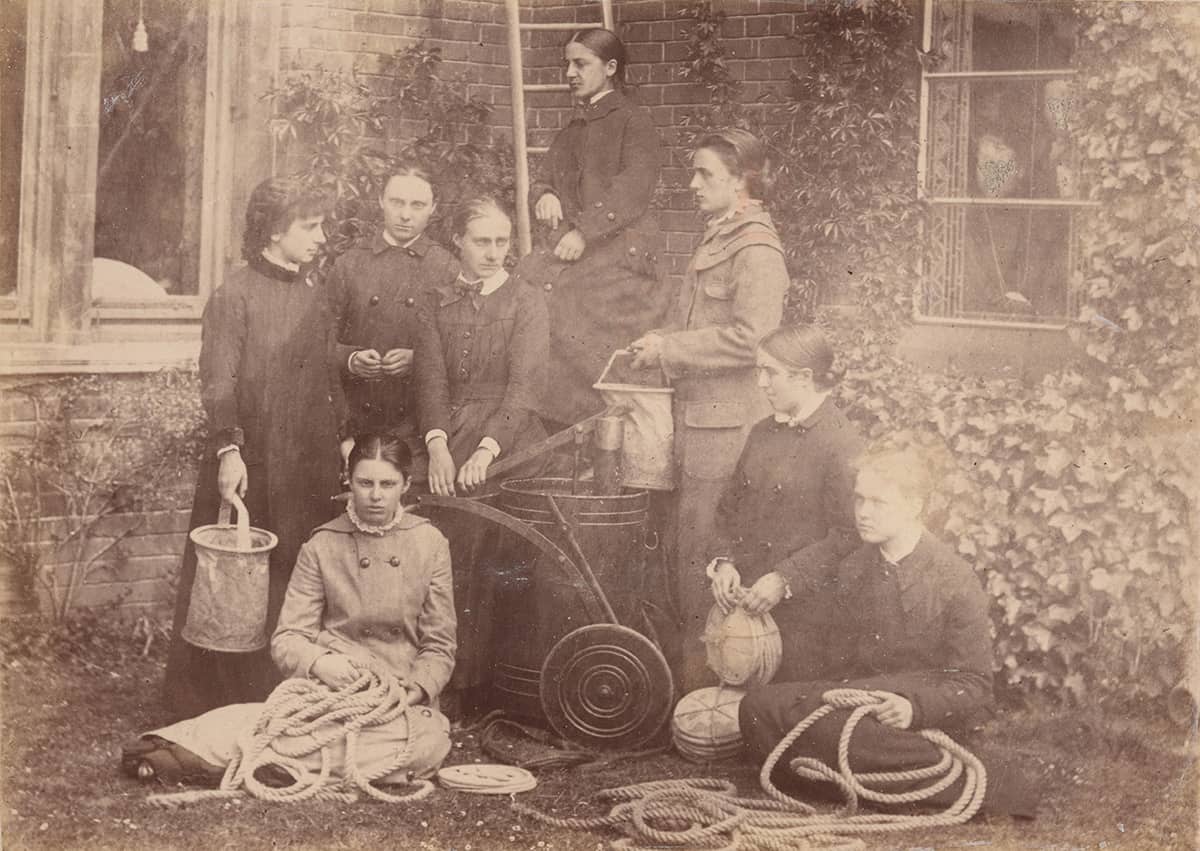
Ayrton was beloved at Cambridge – it was impossible not to know her. Sharp quotes a classmate saying that Ayrton “gave one the impression that she was one of the students of her year with a future before her”. She was heavily involved in college life, establishing the Girton College Fire Brigade, leading the college choral society and forming a mathematics club.
Fighting fires The Girton College Fire Brigade in 1880. Ayrton, who established the group, is standing at the far left holding a bucket. (Courtesy: The Mistress and Fellows, Girton College Cambridge)
It was during her studies that Ayrton began her journey as an inventor, developing an early form of the sphygmomanometer – a device for measuring pulse beats. It consisted of an old watch-spring, fastened around the wrist with a paint brush attached to it. By drawing a piece of paper at a steady pace below the brush, a heartbeat could be recorded. We now know this device as the inflatable cuff doctors fit around an arm to measure blood pressure. The sphygmomanometer was formally patented in 1881 by the Austrian physician Samuel Siegfried Karl von Basch, but Ayrton is not credited in its development.
Life at Cambridge was not easy for Ayrton, who often had the competing priorities of supporting her family and combatting her own insecurities. She was known to rush her mathematical work, having little time and support for mastering the fundamentals. Her friends at Cambridge often said that she tended to self-sabotage, a form of what we now might identify as imposter syndrome. During her studies she also suffered bereavements and a severe illness.
Yet despite her struggles, Ayrton fought hard to complete her degree. In 1880 she passed her Mathematical Tripos examinations – some of the hardest mathematics exams in the world – but placed relatively poorly in the university rankings, a fact that disappointed her for many years. Like all women of the period at Cambridge, she was prevented from sitting her finals in the exam halls, instead having to take them unofficially in a separate lecture room, and she was not allowed to receive a degree despite passing. Consequently, she took an external examination for the University of London – one of the few UK universities that granted women degrees – and received a BSc in mathematics in 1881.
After obtaining her degree, Ayrton began working in London as a maths teacher, first at Kensington High School and then at Wimbledon School. She soon switched to tutoring maths privately, and began devising and publishing mathematical problems for students that became popular among teachers.
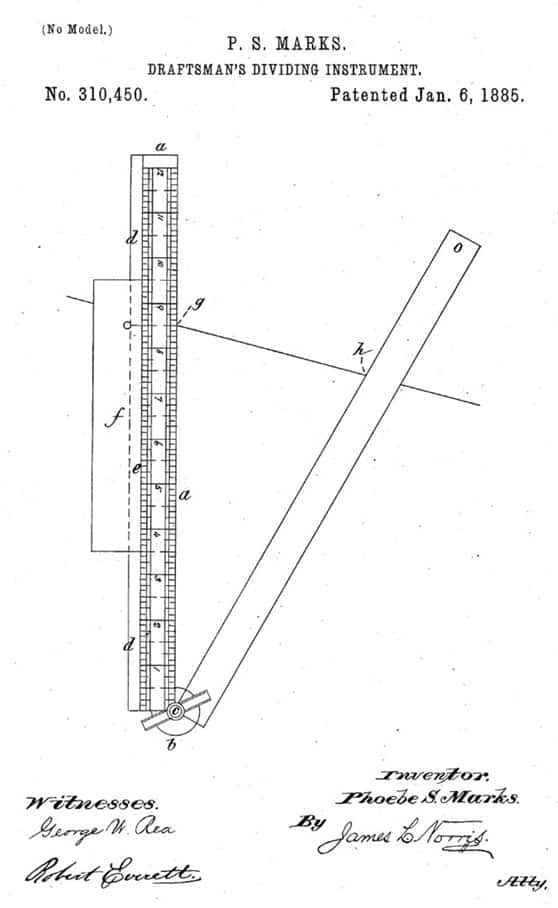
Signed and sealed The cover page of Ayrton’s (then officially Phoebe S Marks) US patent for her mathematical line divider. Patent 310,450 “Draftsman’s Dividing Instrument”, was filed on 3 May 1884 and granted on 6 January 1885.
Ayrton continued her scientific research while she worked, and in 1884 developed a new type of mathematical line divider that could split a line precisely into any number of equal parts. After months of work and numerous failed iterations, she patented the invention in the UK and abroad. The result generated a huge amount of press – in some part because she was a woman – being referenced in Nature in January 1885 (31 275) and in the French publication Revue Scientifique in May of that year.
The success of the patent not only drew congratulations from feminist circles – including leading suffragist Millicent Fawcett – it allowed Ayrton to present a paper before the Physical Society (a precursor to the Institute of Physics) and pushed her to consider pursuing scientific research full-time. With financial hardship holding her back, it was Bodichon – Ayrton’s benefactor at Cambridge – who provided a lifeline, donating a large sum of money to Ayrton so that she could teach fewer pupils and instead focus her energies on science.
Committing herself to this pursuit, in the autumn of 1884 Ayrton began taking four nights of classes per week at Finsbury Technical College (later incorporated into Imperial College London), where she studied electro-technics (electricity and physics) as one of three women alongside 118 men. She was taught by William Ayrton, a physicist and fellow of the Royal Society. William, an ardent champion of women’s education, fought hard for opportunities for Ayrton. The two developed a deep connection, and William relied on Hertha’s expertise in both physics and in life. Their friendship quickly turned romantic, and the two married in 1885. Their daughter, Barbara Bodichon Ayrton, was born in 1886 and they raised her alongside William’s daughter Edith from a previous marriage.
Luminous arc
Following her marriage, Ayrton’s scientific pursuits were limited by ill health, and domestic and family responsibilities, but she persevered. In 1888, she gave a series of lectures on electricity to women at Finsbury Technical College – a progressive act at the time. “That a woman should lecture to women on such a subject…was regarded as a startling innovation,” says Sharp in her memoir of Ayrton.
In June 1891 Ayrton’s mentor and friend Bodichon died. Although a great blow to Ayrton, Bodichon’s final act of generosity was to leave her with money enough to hire a housekeeper so she could once again focus on science. Her husband meanwhile was determined that Ayrton conduct independent research, knowing that if they shared authorship of papers, he would receive sole credit. He therefore ensured she had lab space for her own work and was careful not to directly collaborate with her.
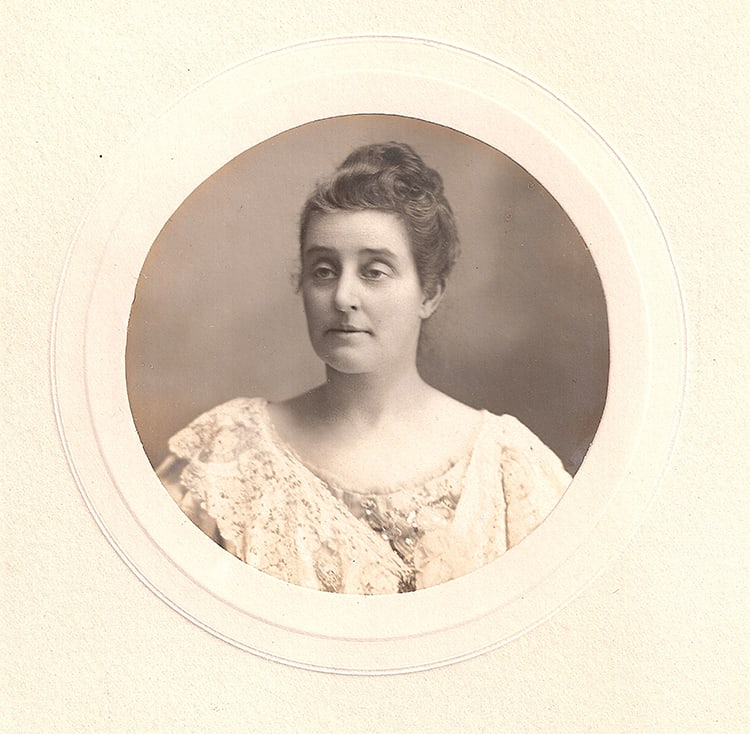
A scientist’s portrait A photograph of Hertha Ayrton taken in 1895. (Courtesy: The Mistress and Fellows, Girton College Cambridge)
Through William, Ayrton developed an interest in carbon arc lamps, the first practical electric lights, which had been invented by Humphry Davy in the early 1800s. To ignite these lamps, a voltage is applied across two carbon conducting rods that are in contact. The conductors are then pulled apart, and the luminous arc is maintained by the carbon vapourizing as it heats up, acting as a bridge for the electrical current.
When her husband visited the US, Ayrton continued his research on arc lamps at the Central Technical College in Kensington (later incorporated into Imperial College London) where William was now a professor. Their resulting paper was one of the few pieces of research the couple collaborated on, but when the sole copy was accidentally destroyed, Ayrton took full ownership of the project.
At the time arc lamps were widely used in lighthouses and to illuminate public places, but their behaviour baffled scientists. They would hiss and flicker, seeming to defy the laws of electricity, and the materials used could not cope with the intense heat produced. Ayrton discovered that the cause of arc instability was oxygen coming into contact with the carbon rods. By excluding oxygen from the lamps, she was able to obtain a steady arc and establish the “Ayrton equation” relating arc length, pressure and potential difference. It was revolutionary work that led to better, more efficient and brighter lighting. Later she also investigated the carbon used in arc lamps, developing rods that lasted longer and were better suited to particular applications.
Ayrton’s work on arc lamps led to several patents, a series of papers and a book. Not only did her research improve general arc lamp technology and street lighting, but also cinema projectors and military searchlights. Her papers were considered exceptional even by her critics, and she became established as a leading expert on electrical arcs, boosting opportunities for her in the scientific community. Ayrton was asked to present her papers in various fora, including the British Association for the Advancement of Science (later renamed the British Science Association), although in the early years she often had to do this immediately before or after her husband.
In March 1899 the Institution of Electrical Engineers (IEE, a precursor to the Institution of Engineering and Technology), which then consisted of 3300 men, defied precedence by inviting Ayrton to read her well-regarded paper “The hissing of the electric arc” – making her the first woman to present her own work to the society, and she went on to become the institution’s first female member. Her advocacy at the International Electrical Congress in 1900 led to women being allowed to serve on general scientific committees in the UK for the first time in history.
Helping women in and out of science
Ayrton later formed a friendship with the Nobel-prize winning scientist Marie Curie, whose reputation she vocally defended in public and in the press in the coming years. For instance, when Pierre Curie died, many UK newspapers proclaimed him to have discovered radium, a feat actually achieved by Marie. As Ayrton wrote in a letter correcting the Westminster Gazette: “Errors are notoriously hard to kill, but an error that ascribes to a man what was actually the work of a woman has more lives than a cat.”
Errors are notoriously hard to kill, but an error that ascribes to a man what was actually the work of a woman has more lives than a cat
She and Curie were close, with Ayrton even tutoring Curie’s daughter, Irène Joliot-Curie, in mathematics. She also brought Curie into the women’s suffrage movement, influencing her to sign an international petition to free British suffragettes who were in jail and on hunger strikes.
Throughout her career, Ayrton profoundly felt the impact of combative attitudes towards women. For example, she was denied fellowship of the Royal Society because married women were not eligible at the time, and her early work had to be presented to the Society by male colleagues. Despite the opposition, Ayrton became the first woman to present a paper in front of the Royal Society in 1904, and she was later awarded the society’s prestigious Hughes Medal, which only two other women have won since.
Ayrton was heavily involved in women’s rights beyond science too. As Sharp describes in her memoir of Ayrton, she had “always been a suffragist as a matter of course…she never required any conversion to the principle of votes for women”. Initially, Ayrton considered her best contribution to the cause was to show, through her own scientific achievements, that women were fit to vote. Her involvement mostly came through attending meetings and giving the campaign the support of her name.
Later, however, she went on to join the more radical “suffragette” branch of the movement, the Women’s Social and Political Union (WSPU). Ayrton donated funds and took part in the demonstrations – including “Black Friday” on 18 November 1910 that saw police and male bystanders violently attack the protesting women. She even sheltered the suffragettes who were recovering from hunger strikes in jail, which meant her home was constantly surrounded by police.
From the beach to the battle field
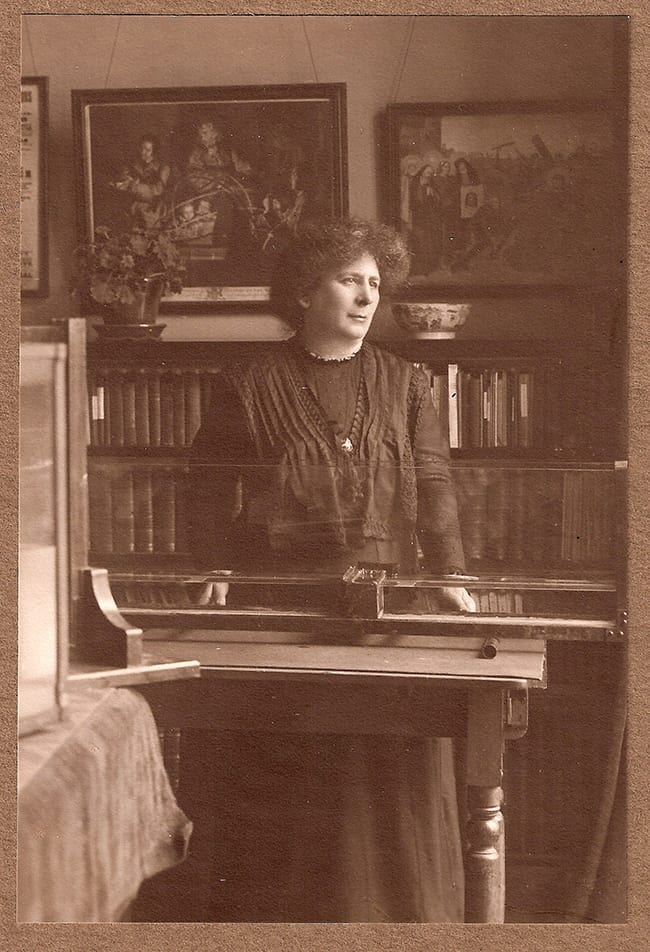
While on holiday in Kent, Ayrton became interested in sand ripples on the beach, and began a new programme of work experimenting on sand and water to examine coastal erosion. Following William Ayrton’s death in 1908, she turned inwards, increasingly spending time carrying out research from home. She moved their home laboratory from the top storey of the house to the drawing room, equipping it with glass tanks filled with water and sand. Here she made great strides in the study of waves and vibrations, and, although her work began out of pure curiosity, it took on real significance following the outbreak of the First World War.
Making waves Hertha Ayrton in her laboratory in 1910, with glass tanks filled with water and sand for studying waves and vibrations. (Courtesy: The Mistress and Fellows, Girton College Cambridge)
Poison gas was first used in April 1915, and Ayrton immediately began applying her study of rippling water to devise a method of repelling it. She even constructed a fake “battlefield” complete with trenches in one of her sand tanks, using smoke from paper fires to simulate the gas. Before long, Ayrton had invented a fan device that released a puff of air when hit against a hard surface, thereby displacing the advancing gas. By May 1915 she approached the army with her design, but the government would not be persuaded, insisting that Ayrton’s design was too simple to be taken seriously. In large part, despite her renown as an inventor, this was due to her being a woman and a suffragette. But Ayrton persisted, and her fan was accepted over a year later.
More than 100,000 “Ayrton Flapper Fans” were deployed in France and Belgium, and they were known for their use in rolling back large clouds of heavy, toxic gases. The late uptake of her device plagued Ayrton, however, who was aware of the number of lives that might have been saved if the fans had been adopted earlier. She continued working on the fan, in conjunction with a budding interest in the labour movement, and her device was later used to improve modern industrial conditions for workers in factories.
Hertha Ayrton died aged 69 on 26 August 1923, from septicaemia caused by an infected insect bite. In her final years, she turned her considerable intellect to advancing the causes she cared most deeply about: women’s suffrage, the rights of working people, and protections for children. She continued her work in science with no sign of slowing down, publishing papers right up until her death, the last of which was read posthumously to the Royal Society. Through her life, she was awarded 26 patents, and her untimely death meant she left behind unfinished research. Ayrton was beloved by the many people whose lives she intersected with, all of whom remarked on her quick wit, passion, and her favourite mantra, often written on her notebooks, to “prove all things; hold fast that which is good”.
All-optical devices promise higher-frequency processing and faster information transfer, compared to their electronic counterparts. An elementary component of this circuitry is a switch fast enough to deal with optical frequencies. Now, Fei Chen at East China Normal University and his colleagues in China, have developed a room temperature ultrafast optoelectronic switch using a Bose-Einstein condensate (BEC) of polaritons. This device pushes the speed frontier of all-optical controlled polaritonic switches at room temperature towards the terahertz regime.
Light and matter quasiparticle
Exciton-polaritons, or polaritons, are quasiparticles made from a coupling between photons and excitons, the latter being electron-hole pairs. Two of the most important properties of polaritons have been used in this work. First, the quasiparticles are bosons and can therefore create a Bose-Einstein condensate composed of a macroscopic number of particles in a single quantum state. In this state, polaritons emit coherent light, which means that a BEC of polaritons can act as a polariton laser. Second, the large exciton binding energy of some semiconductors – for example, zinc oxide (ZnO) – allows the existence of room temperature excitons, an important feature for developing practical devices. These two properties have made polaritons a stimulating platform to study BECs at room temperature and to develop optoelectronics circuitry for quantum and all-optical computing.
The researchers created a polaritonic BEC by exciting the system with a high energy laser pulse (called the “pump”), which increases the polariton population drastically. Instead of waiting for the polariton population to disappear after its characteristic lifetime, on the order of a picosecond, the novel idea of Fei Chen and colleagues is to use a “control” signal to interact with the photonic part of the polaritons and allow their rapid annihilation. Their system exhibits an ultrashort switching time and high extinction ratio, vital features of a high-quality switch.
Switching time
To create their switch, the team used a ZnO semiconductor microcavity and an ultraviolet pump pulse of a few femtoseconds of duration. Pump photons reflect back and forth in the cavity and couple with ZnO quantum wells embedded inside the cavity, creating a high-density profile of a polariton BEC, which comprises close to 20 million quasiparticles. The polaritons leak photons, which can be detected as the output of the device. When applied, the control pulse disturbs the BEC, allowing the depletion of the polariton population. The depletion happens at room temperature and on the hundred femtosecond timescale. This corresponds to the terahertz regime and is 100 times faster than previous optoelectronic switches.
Extinction ratio
Another important feature is the “on-to-off” ratio of the system, also known as the extinction ratio. The greater the ratio, the better the switch, as it will be less sensitive to noise. The extinction ratio of this switch is around one million, which is orders of magnitude greater than previous polariton switches. This high extinction ratio, coupled with the switch’s ultra-fast switching time and room temperature operation of are key features required for the development of future terahertz polaritonic and all-optical devices. Therefore this work represents an important advancement in this direction.
More details about this new switch can be found in a paper published in Physical Review Letters.