A wearable ultrasound device can provide 48 hours of continuous imaging of internal organs while patients go about their daily lives. The device – developed by a team headed up at Massachusetts Institute of Technology (MIT) – consists of a rigid piezoelectric ultrasound array that sticks to the skin via a soft bioadhesive hydrogel–elastomer hybrid. Describing their findings in Science, the researchers demonstrate that the patch can image the heart, gastrointestinal tract, diaphragm and lungs during activities such as jogging or drinking fluids.
Ultrasound is one of the most widely used tools for medical imaging, but it has its limitations. Ultrasonic imaging uses bulky and specialized equipment and requires trained sonographers to position the transducer on the patient’s body. This generally limits its use to short, static sessions.
In recent years there have been significant developments in wearable devices for continuous and non-invasive medical monitoring. While such devices have successfully measured physiological data such as heart rhythm and electrical activity, and metabolites and electrolytes in sweat from the skin, clinical grade imaging of internal organs has proved challenging.
“A wearable ultrasound imaging tool would have huge potential in the future of clinical diagnosis,” explains first author Chonghe Wang, an MIT graduate student. “However, the resolution and imaging duration of existing ultrasound patches is relatively low, and they cannot image deep organs.”
Previous wearable ultrasound devices have tended to rely on stretchable transducer arrays. While these can deform with the skin, this flexibility causes the transducers to move relative to each other, reducing image quality. Flexible substrates also limit the density of transducers in the array, impacting image resolution. There have also been issues with the adhesives remaining attached to the skin and dampening the ultrasound signal.
The new device developed by Wang and colleagues contains a thin and rigid ultrasound probe, consisting of a high-density array of piezoelectric elements, that adheres to the skin via a stretchy hydrogel–elastomer hybrid. “This combination enables the device to conform to the skin while maintaining the relative location of transducers to generate clearer and more precise images,” Wang explains.
The 90% water hydrogel enables high-quality acoustic transmission to the skin, much like the gels used in a standard ultrasound exam, while the two thin elastomers that encapsulate it prevent it from drying out. Coated with bioadhesive to bond it to the rigid ultrasound probe and skin, the total thickness of the elastomer membrane and bioadhesive is less than one-quarter of the acoustic wavelength to minimize its impact on acoustic transmission. The entire patch is similar in size to a postage stamp.
Using a variety of tests, the researchers showed that the wearable device can maintain a strong adhesion to the skin for more than 48 h and withstand high pulling forces. They also used healthy volunteers to demonstrate 48-h continuous imaging of human organs. Ultrasound probes with different frequencies were used depending on the depth of the organs being imaged.
The researchers were able to continuously image the jugular vein and carotid artery in the neck during dynamic body motions such as neck rotations. They observed the diameter of the vein changing as volunteers moved from sitting or standing to lying down, and were able to measure changes in blood flow and pressure in the artery while volunteers jogged. They also imaged lung function, diaphragm movement and the four chambers of the heart before, during and after exercise such as jogging and cycling; and observed the stomach filling and emptying as volunteers drank and the juice moved through their digestive system.
The team is now working to make the stickers wireless and developing artificial intelligence algorithms to help interpret the images. “We imagine we could have a box of stickers, each designed to image a different location of the body,” says senior author Xuanhe Zhao. “We believe this represents a breakthrough in wearable devices and medical imaging.”
Writing in an associated perspective article, Philip Tan and Nanshu Lu caution that despite the opportunities presented by the patch there are obstacles to overcome. In particular, incorporating the extensive circuitry and hardware required to control enough transducers for 3D medical imaging could limit manoeuvrability and mobility – something that “ultrasound on a chip” research could help with.
A sharp ring of light created by photons racing around the back of a supermassive black hole has been spotted by researchers working on the Event Horizon Telescope (EHT). The observation confirms a prediction of Einstein’s general theory of relativity and sheds further light on the mass of the black hole and the powerful jet of material that emanates from the supermassive object.
The EHT is a global array of radio telescopes, which when combined have an aperture wide enough to resolve the immediate surroundings of supermassive black holes. In 2019 EHT scientists produced the first ever image of the glowing disc of gas and “shadow” surrounding the supermassive black hole M87*. This object is at the heart of the Messier 87 galaxy and is thought to be about 7 billion times more massive than the Sun. The EHT was then pointed at the supermassive black hole at the centre of the Milky Way and an image of that object’s disc and shadow was released earlier this year.
Now EHT researchers led by Avery Broderick of Canada’s Perimeter Institute for Theoretical Physics and University of Waterloo have revisited their observations of M87* in search of a sharp ring of light created by photons that do a half-orbit around the back of the black hole before travelling to Earth. This ring is predicted by general relativistic magnetohydrodynamical simulations of the region surrounding M87* but could not be seen because of the bright disc of diffuse light created by photons that travel directly to Earth.
Seeing the fireflies
“We turned off the searchlight to see the fireflies,” says Broderick, adding, “We have been able to do something profound – to resolve a fundamental signature of gravity around a black hole.” The team did this using a new imaging algorithm that they added to THEMIS – an analysis framework that helps researchers understand EHT observations.
Team member Hung-Yi Pu of National Taiwan Normal University says that the new algorithm allows the collaboration to “peel off” elements of an EHT image so that “the environment around the black hole can then be clearly revealed”.
As well as observing the photon ring, the team found evidence for a powerful rotating jet of material being ejected from the region of the black hole. The latter observation confirms the theoretical prediction that the rotation of the black hole creates a powerful outflow of material. This latest analysis combined with previous observations has also allowed the team to give the best value so far for the mass of M87*, pegging it at 7.13 ± 0.39 billion solar masses.
Theory predicts that more rings should exist around M87*, each corresponding to photons doing different orbits around the black hole. The team believes that it should be able to refine its analysis to see at least one more of these rings.
The UK government has outlined contingency plans if the UK fails to join the €95bn Horizon Europe research programme. The proposals, published at the end of July, set out measures to provide UK researchers with the funding that they would have received from the seven-year initiative. The UK government says that the “transitional measures” are designed “to ensure the stability and continuity of funding for researchers and businesses”. For some, however, the delay over whether the UK joins the Horizon programme is already having a huge impact on their work and collaborations.
Participation in Horizon Europe, which began in 2021, was agreed at the end of 2020 as part of the post-Brexit trade deal between the UK and European Union. The UK is meant to be joining Switzerland, Norway and 14 other non-EU nations as an “associated” member of Horizon Europe. The association agreement, however, was not signed when the UK–EU trade deal was agreed and since then it has become a bargaining chip in other political issues related to Brexit, particularly disagreements over the Northern Ireland Protocol. The UK government maintains that it is committed to association with Horizon Europe, but it also needs to protect and support the research and innovation sector should the process not be completed.
There is a danger the UK becomes a bureaucracy superpower rather than a science superpower
John Krebs
In November last year, the UK government agreed to underwrite successful applicants to Horizon Europe. The latest proposals continue this guarantee, with funding for successful applications to Horizon Europe grants being replaced if the UK is unable to associate. The UK government also commits to supporting “in-flight” applications – those that have not been evaluated by the European Commission at the point of “non-association” – by assessing them through UK Research and Innovation (UKRI) grant schemes. If association fails, there will be funding for UK participation in Horizon Europe schemes as “Third Country” applicants – but such projects require at least three other applicants from EU states, or associated countries.
The contingency document also outlines commitments to increase innovation support, particularly for small- and medium-sized businesses, and provides funding for UK institutions that have been most affected by the loss of Horizon Europe talent funding. There are also plans to launch a “new flagship talent offer” that the UK government says will provide the same career benefits and prestige as the Marie Curie and European Research Council (ERC) schemes.
The Institute of Physics (IOP), which publishes Physics World, has welcomed the transition plan. “The announcement of its transitional plans to support UK R&D in the event that the UK does not secure an association… provides much-needed short-term reassurance,” says IOP’s new chief executive Tom Grinyer.
That view is backed by Peter Mason, head of global research and innovation policy at Universities UK. “The transitions document is welcome in that it provides certainty over what would happen in the short-term if non-association were to be confirmed, but there is still this lingering question about clarity over the long-term plans,” he told Physics World. Mason questions how the new flagship talent offer would work and what plans are in place to allow UK universities to attract and retain talent.
Robin Grimes, a materials scientist at Imperial College London and foreign secretary of the Royal Society, fears, however, that UK association with Horizon Europe is becoming increasingly unlikely. He says the research programme is not just about money, but also about the multilateral international collaboration it enables, which will be very difficult to replace. Grimes worries that the UK’s position in the initiative is already being damaged as it is not involved in deciding what research areas will get priority in the future. “I don’t see it so much as when [association] is going to completely fail, I would say it is in the process of failing,” he says.
Indeed, at a briefing for the release of a report in early August from the House of Lords science and technology committee, co-author John Krebs criticized the UK’s failure to finalize association with Horizon Europe. “Cutting ourselves off from the biggest international collaborative programme is a remarkably inept thing to do,” Krebs said. Discussing the government’s plan to become a global science and technology “superpower”, Krebs noted there is no clear strategy to realize the ambition. He said the current approach “feels like setting off on a marathon with your shoelaces tied together” and cautioned that “there is a danger the UK becomes a bureaucracy superpower rather than a science superpower”.
Moving on
UK organizations are still able to apply for funding from Horizon Europe – although cash cannot be released until association has been ratified – but there are signs that this process is starting to fall apart. Accelerator physicist Carsten Welsch, who is head of physics at the University of Liverpool, UK, was recently awarded €2.6m in funding to lead a Marie Curie Doctoral Network. Welsch told Physics World that while he was “extremely happy” to be awarded the competitive grant, a few weeks later the EU informed him that UK institutions can no longer receive such funding or lead projects because the UK’s association with Horizon Europe is not complete.
Welsch says that such decisions are devastating for UK institutions. Liverpool has had to transfer its co-ordinating role to another institute – the INFN in Italy – and he can no longer recruit and supervise PhD students as Marie Curie fellows in other countries. “Liverpool has been completely marginalized,” adds Welsch, whose work relies on collaborations that have been fostered for over a decade. “[To see these] being openly questioned is really heart-breaking.”
UK researchers and institutions are having to go the extra mile to persuade partners to keep them involved due to the uncertainty over our status
Peter Mason
UK-based scientists awarded ERC grants have also had their funding axed. Successful applicants were warned by the ERC that if associate membership of Horizon Europe was not approved by 29 June, they would lose their funding unless they moved institution. When the deadline passed, the ERC confirmed that 19 researchers had decided to relocate to a host institution in the EU, or an associated country, taking their awards with them. Grants awarded to 115 researchers will now be terminated.
Welsch says that the situation is slightly better for grants where the UK institution is a partner in the project. They are still able to carry out the work outlined in the original proposal, but the money comes from the UKRI guarantee fund rather than from Brussels. It does require additional paperwork, however, and Welsch says that European researchers are starting to query whether they should include UK institutions on future proposals. “UK researchers and institutions are having to go the extra mile to persuade partners to keep them involved due to the uncertainty over our status,” adds Mason.
The impasse is also deterring UK-based scientists from competing for European funding altogether. Carla Molteni, a physicist at King’s College London who is president of the Association of Italian Scientists in the UK, says that researchers are still being encouraged by their institutions to continue to apply for European programmes. “But in reality, applications are going down because it is a lot of work, with no guarantee and clarity,” she says. “Brexit has been very demoralizing for European researchers in the UK.” Molteni maintains that since Brexit, European researchers have been leaving the UK and the failure to associate just makes things worse. “It does make the UK less attractive,” she adds.
Karen Kirkby, who leads proton therapy research at the University of Manchester, UK, and the Christie NHS Foundation Trust, describes the current situation as “a nightmare”. Kirkby has led many international projects, forming networks and getting people to work together. “At the moment I can do that, but then I have to hand it over to someone else to lead because we can’t be the co-ordinator,” she says. Kirkby’s work requires international collaborations because many of the cancers she works on are rare and there are not enough cases in one country to conduct clinical trials. Kirkby now expects to lose people given that other countries can offer them the benefits of Horizon Europe.
There is unlikely to be any immediate progress on the UK’s association with Horizon Europe anytime soon as the UK government has said that it will not be making any significant policy decisions before the conclusion of the Conservative leadership race, which is expected on 5 September.
I was recently sitting at my desk, surrounded by coffee-stained empty mugs and a pile of half-read papers, when I glanced at the clock. It was 9.30 p.m. on a Saturday night. I had spent most of the week marking exams, while the week before that I had been frantically trying to hit a proposal deadline. I knew that the week coming, meanwhile, would mostly be swallowed up with peer review.
My to-do list was growing, with every item that I knocked off it being replaced by at least two others, with no end to my tasks in sight. To make matters worse, as I mindlessly swiped through social-media updates as my kettle boiled for another caffeine hit, I was met with a deluge of posts showing family members and friends enjoying themselves. I, on the other hand, am working over 60 hours a week in a job that pays for only 40.
For PhD students there is often no alternative to the onslaught of demands. Earlier this year, I spent a week at a user facility in Tallahassee, US, where every minute of experimental time was precious. When I returned home to Nijmegen, still suffering with jetlag, I then had to run a seven-day morning shift at the lab. The week afterwards was spent holed up at a week-long school in Les Houches, France.
On top of all that, I still had teaching and supervision responsibilities, articles to write, seminars to present and deadlines to meet. I barely had any control over my life, and by the time it was over I couldn’t even fathom going to the lab for several weeks on end. The bottom line is that in a field where work pressure is high and racking up the most hours is a sort of unspoken masochistic competition, the pure joy of physics can easily be lost.
Jumping between unrelated tasks involves expending a wealth of mental energy – and doing this successively over an extended period requires even more. This is particularly the case when you get little feeling of satisfaction, and any sense of achievement is quickly over-ridden by the next looming deadline. Even when you should be celebrating a new paper in a high-impact-factor journal with cake or a glass of fizz, your joy can be overshadowed by several disapproving referee reports for your next publication that need to be addressed.
Breaking the cycle
With regimented days of “wake, wash, work”, scheduling time for hobbies and for other people in your life is vital if we are to survive the devilish cycle of work. Even if it’s one hour built into the day, consider it a priority. Movement and socializing are key to a healthy body and mind – and escaping the environment responsible for your stress is vital. It’s a point that is all too easily forgotten for PhD students who think that their every waking hour should be spent in the lab.
I personally value sports. During those months of travelling and experiments, I sought out the nearest gym at each of my destinations and forgot about the hundreds of data files that awaited my return. I ended up running in the Florida sunrise, sheltering from snowstorms in a Parisian weight room, and taking a quick pit-stop at the local sports centre three minutes from my lab while my samples cooled.
The pursuit of success in academia is an ultra-marathon, not a marathon – and certainly not a sprint
Throughout my PhD, I have recognized the role that sport has in keeping me grounded and providing a hit of success and dopamine, even on the worst days. The camaraderie and cheerleading from people outside the lab and office is refreshing. While not everyone likes to do sports, other recreational activities could be joining a knitting or hiking group – try anything to get your body and mind away from work.
Managing the top-heavy game of academic Jenga isn’t restricted to PhD students, of course. Senior academics must also manage and lead groups as well as foster new and existing collaborations. It’s a gamble to favour one task over another and it can feel like a sign of weakness to pass on the responsibility for one aspect of the job. On the other hand, hoarding these tasks to prove one’s capabilities can also be a sign of weakness and a recipe for burnout – not to mention demoralizingly negative teaching reviews.
The pursuit of success in academia is an ultra-marathon, not a marathon – and certainly not a sprint. It’s vital to know this when starting a PhD – and during the course itself – because the finish line can be far away and the journey is often relentless. Planning is critical – not only of the work itself but also life outside of it. Neglecting yourself and others is like riding a bike with deflated tyres and a rusty chain: you’ll get to your destination, but you risk damaging yourself and others in doing so.
So, when you next find yourself sitting at your desk at 9.30 p.m. on a Saturday, take a breath and remind yourself that you are in it for the long haul. But by making space in your priority list for other things outside work, the journey will become a lot less arduous.
Building on a largely forgotten photography technique, researchers in the US have developed a photographic material that changes colour when stretched. Working at the Massachusetts Institute of Technology (MIT), the team showed how colour images can be created by modifying the nanoscale structure of the film. These structures reflect light at different wavelengths, which change as the film is stretched. The researchers say that their method offers a low-cost, scalable approach to creating new optical materials.
Structural colour is common in nature and familiar examples include the feathers of some birds and the wings of some butterflies. Instead of using pigments, structural colour is created by the interference of light that has been reflected from microscopically textured surfaces. The result is that certain colours are visible at certain viewing angles, while other colours are not. A related phenomenon called iridescence occurs when the structural colour of an object changes with the viewing angle.
Today, researchers are exploring how structural colour can be used in advanced optical materials. However, the appropriate nanoscale structures are often expensive and complex to produce, especially on large scales.
Nobel-winning technique
Now, MIT’s Benjamin Miller, Helen Liu and Mathias Kolle have developed a potential solution to this limitation. It is based on an early photographic technique that was first developed by the French physicist Gabriel Lippmann and which earned him the 1908 Nobel Prize for Physics. To capture images, Lippmann placed a thin, transparent emulsion of tiny, light-sensitive grains between two plates of glass. A mirror is positioned behind the back plate so that it reflects the light that passes through the emulsion.
When exposed to a visual scene, incident light waves entering the emulsion interfere with their reflections. This produces standing waves in the emulsion that gradually alter the nanoscale arrangements of the grains. This causes periodic variations in the film’s refractive index, capturing optical information from the visual scene. After up to several days of exposure, the arrangement of the grains is fixed, and the result is a colour image of the scene – an image that is much like a modern hologram.
However, Lippmann’s process was more time consuming and difficult than other colour photography techniques emerging at the time and has therefore been largely forgotten. Now, Kolle and colleagues have revisited the technique using modern holographic materials.
Light-sensitive polymer
The MIT trio began by placing a thin sheet of a stretchy, light-sensitive polymer against a mirror, and exposing it to a bright projected image. Just like with Lippmann’s approach, this created a pattern of standing waves, which altered the film’s refractive index. After just a few minutes of exposure, they then bonded the film to a silicone backing, creating large and detailed colour images.
As they stretched the film – by pulling on it or pressing objects into it – the nanostructures are distorted in a reversible way. This distortion alters the colour of the light reflected by the film (see figure). When the team made an all-red film, green images could be created by pressing objects onto the back of the film.
The team could also hide secret images in a film by capturing the image at a tilted angle of incidence. The resulting image is only visible in the near infrared – which cannot be seen by the human eye. However, when the material is stretched the image is shifted towards the red and becomes visible.
Kolle and team hope that their fast, scalable and affordable production technique could soon lead to practical optical materials that respond to mechanical stimuli. As well as encoding secret messages, other applications include clothing fabrics that change colour when they are stretched; and bandages that change colour as the pressure on a wound changes.
An international team of physicists has observed electrons flowing in whirlpool-like patterns known as vortices for the first time. Long predicted, but never before seen in experiments, this evidence of fluid-like behaviour could be exploited to make more efficient electronics.
In ordinary materials, the flow of electrons is strongly influenced by impurities and atomic vibrations, both of which cause electrons to scatter. In ultraclean materials and at near-zero temperatures, where such classical processes are absent, the electrons move unimpeded across the material, like billiard balls. In the rare cases, however, when the electrons are strongly interacting between themselves, the electrons are predicted to move collectively, like a fluid.
In 2017, a team led by Leonid Levitov at the Massachusetts Institute of Technology in the US, together with colleagues at the University of Manchester in the UK, observed fluid-like electron behaviour in a sample of graphene (a sheet of carbon atoms just one atom thick) that contained a thin channel with several pinch points. Current sent through the channel flowed through the constrictions with hardly any resistance, implying that the electrons that make up the current could squeeze through the pinch points collectively rather than passing through them individually.
Electrons behave like quantum waves
In the new work, Eli Zeldov, together with Levitov and colleagues from Israel’s Weizmann Institute of Science and the University of Colorado at Denver in the US, studied electrons in tungsten ditelluride (WTe2). This material is an ultraclean type II Weyl semimetal, a recently discovered class of topological material (one that can be insulating in the bulk but has conducting surface states due to symmetry-protected topological order). WTe2 is known to have exotic electronic properties when made into two-dimensional flakes a single atom thick. Indeed, it is one of several new quantum materials in which electrons interact strongly and behave as quantum waves rather than particles, Levitov explains.
To observe electrons flowing in vortices, the researchers first synthesized pure single crystals of WTe2 and shaved off thin flakes of the material. They then used electron-beam lithography and plasma etching to pattern each flake into a narrow channel and two circular chambers connected to its sides.
“This geometry was designed to allow possible shear forces to steer the electron fluid in the chambers by the electric current flowing in the narrow channel,” team member Amit Aharon-Steinberg tells Physics World. “We then used an extremely sensitive scanning magnetometer, designed in our laboratory, which senses the magnetic fields generated by the flowing electric current.”
Finally, the researchers reconstructed the electric current from the measured magnetic field images to explicitly highlight the vortices.
The hydrodynamic regime
The analyses revealed that electrons flowing through the channel caused the electrons in each side chamber to swirl in whirlpools. What is more, the vortices were only present for small apertures, with the flow being laminar (that is, without vortices) for larger ones. Near the vortical-to-laminar transition, a single vortex in the chamber was seen splitting into two – behaviour that is only expected in the hydrodynamic (fluid-like) regime.
The findings suggest that a new hydrodynamic mechanism in thin pure crystals may exist such that the diffusion of the momentum of electrons is enabled by small-angle scattering on the surface of the material rather than conventional electron-electron scattering, which becomes very weak at low temperatures. This surface-induced para-hydrodynamics, as the researchers have dubbed it, shares many of aspects of ordinary hydrodynamics, including vortices.
According to the Weizmann-MIT-Colorado team, the findings could help researchers design and develop more efficient electronics. “We know when electrons go in a fluid state, [energy] dissipation drops, and that’s of interest in trying to design low-power electronics,” Levitov says. “This new observation is another step in that direction.”
A study of the gravitational distortion of dwarf galaxies appears to support a theory of modified gravity rather than the existence of dark matter – the latter being a key component of the Standard Model of cosmology.
Dark matter is a hypothetical substance that is believed to comprise about 85% of the matter in the universe. Its gravitational influence prevents large objects such as galaxies from flying apart as they rotate and evidence for dark matter can also be found in the cosmic microwave background – radiation that was created shortly after the Big Bang. However, despite the abundance of indirect evidence for dark matter, dark matter particles have never been detected. As a result, other theories exist to explain the behaviour of galaxies, including those that modify the law of gravitation.
Dark matter is thought to clump together in halos – large regions of dark matter that are held together by gravity. Halos are believed to play important roles in the development and evolution of galaxies such as the Milky Way, which itself appears to be surrounded by a dark matter halo.
Vulnerable to deformation
In this latest research, Elena Asencio at the University of Bonn and colleagues have looked for evidence of dark-matter halos around dwarf galaxies. These are the smallest and most common types of galaxy and can be found in clusters or surrounding larger galaxies such as the Milky Way. Because of their lower masses, dwarf galaxies are especially vulnerable to deformation by the gravitational forces exerted within a cluster or by a nearby larger galaxy. However, these distortions would be reduced if the dwarf galaxies were enveloped in dark-matter halos.
To explore this idea, Asencio and colleagues examined telescope images of the Fornax Cluster, which abounds with dwarf galaxies. The images were taken by the European Southern Observatory’s Very Large Telescope. The astronomers then tried to reproduce the observations using computer simulations based on the Standard Model of cosmology – which includes dark matter.
Surprisingly, this approach was not successful. Indeed, the team’s calculations suggest under the Standard Model, the Fornax dwarfs would be torn apart by gravity.
MOND hypothesis
Eager to discover what was holding the galaxies together, the team did more simulations – this time without dark matter, and instead using the Modified Newtonian Dynamics (MOND) hypothesis. First developed by the Israeli physicist Mordehai Milgrom in the 1980s, MOND dictates that gravity becomes stronger in the regime of low acceleration. This modification reproduces the rotational observations of galaxies but reverts to Newton’s law in high acceleration environments like the solar system.
Unlike dark matter, MOND was able reproduce the Fornax observations, casting cast fresh doubt on the existence of dark matter. Indeed, this is not the first study suggesting that the dynamics and evolution of some galaxies cannot be explained by invoking dark matter – and the number of such observations is growing. However, MOND and other theories that modify gravity have their own theoretical and observational shortcomings – so it is probably too early to give up on a Standard Model that incorporates dark matter.
It’s a clear sunny day and a bus is driving down the road. It comes to a halt at a bus stop and a group of men get on board. As the driver moves off, he notices a car pull up behind the bus, but it avoids obvious opportunities to overtake. Suddenly, the car accelerates and crashes into the rear of the bus. CCTV recordings show the group that boarded clutch their necks, looking around in apparent surprise. Two of them even throw themselves on the floor of the bus.
The collision is hardly registered by other passengers, some of whom appear bemused by the antics of the men. In fact, data recorders fitted to the bus show it to be travelling at barely 25 km/h when the incident occurs. The bus company’s insurers receive a number of claims for injury, loss of earnings and lifestyle impact. But on viewing the video evidence, the insurers are not convinced by the claims.
While the video recordings indicate a fraud, they alone may not be enough to persuade a judge in a civil court. The insurers therefore instruct GBB – the firm I work for – to investigate. Our job is to use a science-based analysis that will form part of a wider accident investigator’s forensic report. Our analysis has to be impartial and watertight so that it will stand up to the scrutiny of cross examination.
Fortunately, we have information from the bus’s on-board event data recorder, in the form of a graph of the bus’s acceleration versus time. Simple Newtonian physics indicates that the bus would have changed speed by no more than 1.5 km/h during the collision. Even with an uncertainty of 20%, that’s well below the threshold for injury and, in our opinion, the men were unlikely to have been hurt. As for the car, its mass was one-eighth of the bus so its speed would have changed by about 12 km/h, which was consistent with the damage to it.
What a scam!
The case was quite rightly thrown out, but fake claims like this one are a big problem. According to the UK’s Insurance Fraud Bureau, there were 2.7 million motor-insurance claims in Britain between October 2019 and the end of 2020. More than 6% – roughly 170,000 – were linked to suspected “crash for cash” scams. Many were created by a relatively small number of companies or gangs, with plenty avoiding court prosecution entirely.
In these incidents, drivers seek to defraud insurers by deliberately and premeditatively manufacturing a car crash, often involving an innocent party in another vehicle. The fraudsters try to limit the magnitude of the crash – usually by driving at relatively low speeds – so that none of the perpetrators get injured. In general, though, they don’t care what happens to the innocent parties in the other vehicle.
The resulting damage to the vehicles is genuine (even if some may have been caused by earlier incidents) but the claimants will be lying when they say they got hurt. Criminals – often working in cahoots with third parties – can make tens of thousands of pounds by claiming for injury, repair bills (that are often exaggerated) and storage costs. There’s another kind of scam too, in which drivers who have been involved in a genuine and un-premeditated low-speed collision file a claim for a fictitious injury just because “everyone is doing it”.
1 Can you spot the fraud? In this collision, a driver (A) is heading east when another driver (B) heading west crosses over the centre-line of the road in front of A’s car. Driver A assumes B is trying to turn into a north-bound side road, but B later claims that A entered from a side-road and crashed into him. B also claims that the collision made his car spin around and strike a third car (C). The driver of C agrees with A’s version of events, but a cyclist, stationed behind car C, supports B’s story. The law of conservation of momentum quickly yields the answer by indicating that in A’s scenario, the resultant momentum would be in a north-easterly direction from the point of impact, which corresponds well with the final positions of the two vehicles. But in B’s scenario, the resultant momentum would be in a north-westerly direction, which doesn’t lead to the vehicles’ final positions. A’s scenario is therefore correct – later confirmed when it is discovered that the cyclist is a friend of B and wasn’t near the collision at the time.
The police aren’t usually called out to either type of incident as they generally don’t involve serious personal injury or major damage to property (walls, houses, lamp posts and so on). In fact, most claims are quickly settled by insurers, who don’t have the resources to check out every claim. However, the resulting cost of these fake claims – including medical costs, car repairs, replacement hire cars and so on – runs into hundreds of millions of pounds in the UK alone.
That’s why a small proportion of cases do get investigated, especially if the circumstances surrounding the accident are not clear, if a claim appears exaggerated or if there are suspicions of fraud. (Another example is shown in figure 1.) Collision investigators will inspect the damage to vehicles – either in person or from photos – and try to answer the following questions.
Did the vehicles actually collide?
Is the accident geometry described by the claimant or defendant consistent with the damage to both vehicles?
Is there damage, such as paint transfer, that provides a forensic link between the vehicles?
Is there other damage that may have been caused in another unrelated incident?
What might the repair costs be?
How likely is it that the occupants of the claimant’s vehicle were thrown about in the car such that whiplash or other soft-tissue injuries occurred?
The trouble is that whiplash and similar physical injuries are easy to fake because there are no diagnostic tools, such as X-ray scans, that can unequivocally confirm that such an injury has occurred. Experience has shown that a clear and concise “science” section in an accident investigator’s report can carry a lot of weight with judges who are deciding if a claim is fake or genuine. In addition to calculations based on Newton’s laws, the report may also include details of crash tests and possibly even a computer simulation of the collision.
A crash-course in crash physics
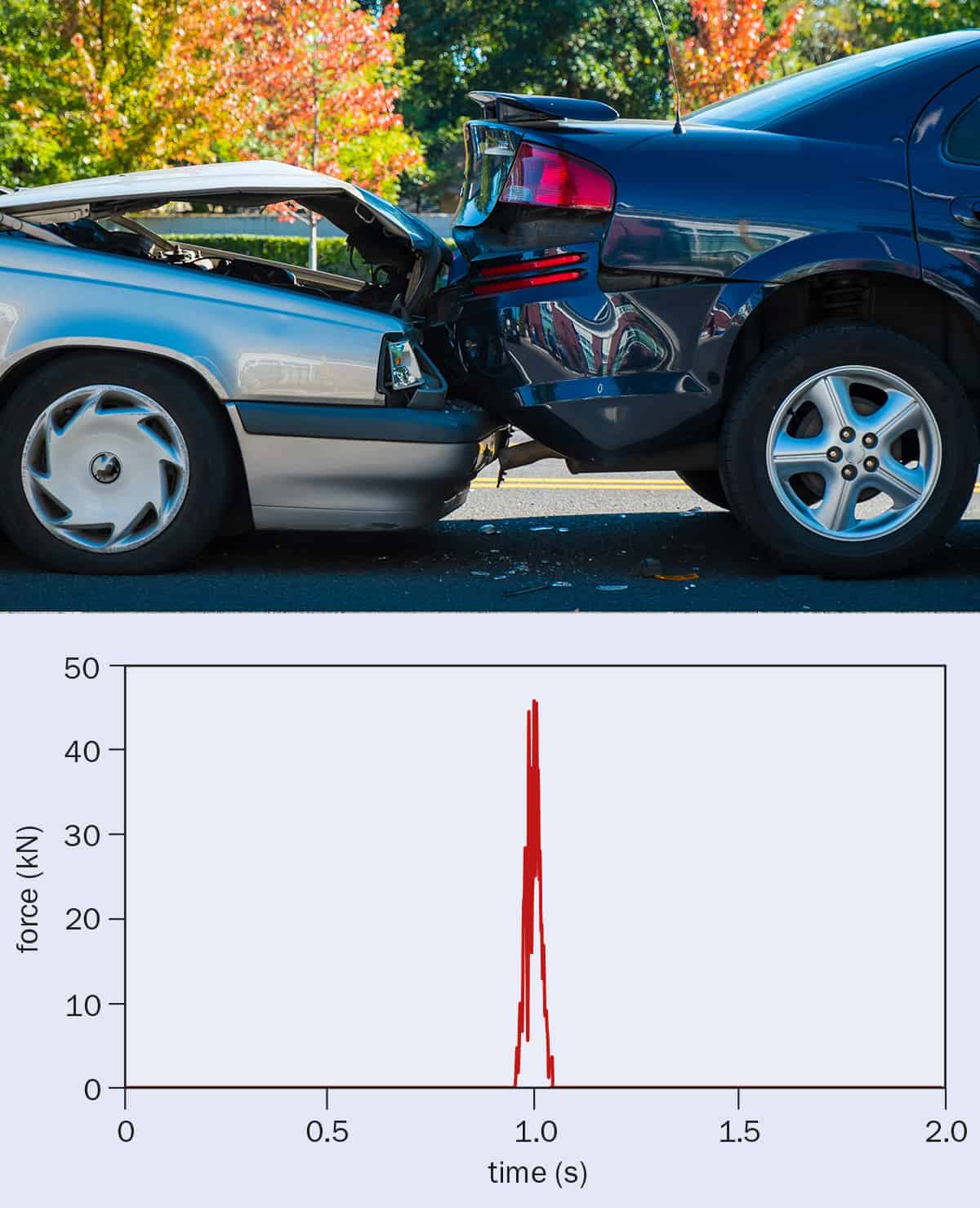
Collisions between objects are a staple of school-physics syllabuses, but there is more to the subject than meets the eye. You’ll know that when two vehicles collide, a force acts between them for the time they are in contact, typically about 0.1 s. However, the force is not uniform. Measurements made using accelerometers fitted to vehicles in experimental crash tests reveal a ragged pulse that peaks about half-way through the crash (figure 2).
As Newton’s second and third laws of motion dictate, the struck or “target” vehicle will experience a positive version of this pulse (causing it to accelerate), while the striking or “bullet” vehicle will experience a negative version of this pulse (causing it to decelerate).
During the collision itself, the two vehicles will become entangled and briefly form a composite system. The vehicles will initially squish together, before expanding as they spring elastically apart and then, finally, separating.
2 Let the force be with you By fitting accelerometers to cars and running full-size crash tests inside a large lab or outside on, say, a disused airfield, physicists can work out how the force changes during a vehicle collision. This graph, which was taken during a typical crash test between two cars, shows the force profile on the car being struck. Starting and ending at zero, the force is raggedy in profile and peaks mid-way during the collision. This car will accelerate. The other car will experience exactly the same force, but in the opposite direction and will decelerate. Braking forces applied by the driver of either vehicle will complicate the physics. (Photo courtesy: iStock/RobertCrum)
However, no two collisions are ever exactly the same. One or both drivers might slam on their brakes. The struck vehicle might have been stationary and had its hand brake on. The bullet vehicle might have been at rest and the other driver reversed into it. One common scam is for the driver of a vehicle in slow-moving traffic to brake hard and hope that the vehicle behind will run into their rear. Quite often, the scammer’s car will have its brake lights disconnected to confuse the driver behind and make a crash more likely.
One scam is for the driver of a vehicle to brake hard and hope that the vehicle behind will run into their rear.
If a car is about to hit your car from behind – and you can’t avoid the impact – there are two things you can do. If you want to minimize damage to your cherished car, don’t brake. Not braking will lead to a lower collision force, making the impact slightly more elastic and leading to less damage to your prized possession. (Remember, though, that if there’s another vehicle in front, you may be shunted into its rear, leading to a three-body collision and a separate insurance claim and all the headaches that involves.)
On the other hand, if you want to minimize the risk of injuring yourself and any fellow passengers, slam on the brakes as hard as you can. That might seem counter-intuitive because the collision force will be greater. However, it will be opposed by the braking force, which will reduce the acceleration of anyone in your car and thus the potential for, say, whiplash. Let’s hope, though, that the driver behind isn’t a crook out to cause a crash: in an ideal world, they would put on their brakes too.
The importance of e
For collision investigators, Newtonian mechanics provides a series of handy equations covering quantities such as average collision force (with or without braking), the change in speed of the target vehicle and the kinetic energy dissipated, which dictates how much the vehicles will be damaged. These equations will require the mass of each vehicle, the relative impact speed (V), the coefficient of restitution (e), the collision time period (Δt) and any braking coefficients.
Defined as the ratio of the relative speed of two vehicles before and after a collision, e is also a measure of the elasticity of the crash. It can range from 1 for a perfectly elastic crash (impossible for a real crash) to 0 for an entirely inelastic smash-up (where the vehicles stick together and don’t spring apart). The value of e is crucial because it dictates the overall speed change of the target vehicle, which in turn influences how likely an occupant struck at low speeds (15 km/h or less) is to suffer from whiplash or other soft-tissue symptoms.
The reason why collision investigators use speed change – rather than acceleration or force – as a metric for assessing injury symptoms is that its value can be accurately determined. There is, in contrast, a much bigger uncertainty over the acceleration during a car crash as it depends on Δt, for which we do not have an accurate figure. Knowing the speed changes also lets us determine what happens to the kinetic energy of the car as it crashes (figure 3).
3 Energy pathways in a collision(top) Newtonian physics can tell us a lot about what should happen in collisions, such as a small car with a mass of 1200 kg crashing at a speed of 16 km/h into the back of a stationary 2.3 tonne SUV. Assuming neither vehicle is braking, data from previous test crashes indicate that the collision is likely to last 0.12 s, with the coefficient of restitution, e, being 0.22. (middle) From this information, we can plot how the small car slows down and the SUV accelerates. At the “point of maximum engagement” (at around 0.08 s) the two vehicles momentarily have the same speed. Immediately after the collision, the SUV is moving at 6.8 km/h – meaning that any correctly seated occupants are unlikely to suffer soft injuries. The small car, however, will have a speed change of –12.9 km/h, which is high enough to lead to injury. (bottom) This flow chart shows what happens to the initial 12 kJ kinetic energy of the small car. At the point of maximum engagement, it has dropped to 4.1 kJ, with the rest (7.9 kJ) causing damage to both vehicles. The bulk of this energy (7.5 kJ) causes “inelastic damage”: broken components, bent or deformed panels, scuffs, scratches and so on. But a small amount of the damage energy (0.4 kJ) will be “elastic” because some parts of the car will deform back to their original shape, effectively springing the vehicle apart. After the collision, the striking vehicle has lost all but 0.5 kJ of its original kinetic energy while the SUV has gained 4 kJ of kinetic energy.
But how do we know the speed change in a particular crash? Collision investigators do this by turning to test crashes carried out under controlled conditions, which contain quantitative data as well as photos of the smashed-up vehicles. We look for examples where similar damage was caused to the case in question, from which we can estimate how fast the vehicles were moving before they collided. Mathematical correlations between Δt (which varies little with impact speed) and e (which depends a lot on impact speed) are used to refine the estimate of e, from which the speed change can be derived.
Another way of estimating the speed change is to look up the kinetic energy dissipated during a similar test crash. Using Newtonian physics, we can use this energy to calculate the impact speed assuming our collision was entirely inelastic (i.e. e = 0). In reality, e will not be exactly 0 so we obtain a more accurate value of it by iterating our calculations until the impact speed converges to within about 1 km/h. With our better value of e, we can then easily calculate the speed change.
A collision investigator who has a reasonable value for the coefficient of restitution, e, can judge the merits of a low-speed claim.
The bottom line is that a collision investigator who has a reasonable value for e can judge the merits of a low-speed claim. Unfortunately, vehicle collisions are nonlinear events, in which small changes in the initial conditions (such as speed, contact height and the angle at which the cars strike each other) result in large changes in e and Δt. No two crash tests will ever be exactly the same and there is large scatter in the value of both parameters, leading to uncertainties of as much as 30% in the calculated value of the collision force (in fact the equations are much more sensitive to uncertainties in Δt than in e).
Claims and counter-claims
To see what this means in practice, my firm was once asked to study a crash in which car A (1370 kg) ran into the back of car B (1645 kg) waiting at traffic lights. The driver of B claimed he sustained a whiplash injury, while A stated he had “barely touched” car B. Our firm inspected the damage to car B, which matched damage visible on photos of A’s car. We then compared the damage with crash test data from similar vehicles, indicating the total damage to both vehicles would have required a dissipation of 3 ± 1 kJ of kinetic energy.
Using Newtonian mechanics, we calculated that the effective mass of the colliding vehicles was 747 kg, while the impact speed (assuming a perfectly elastic collision) would have been 10.8 km/h. Using crash-test data, we assumed the collision lasted 0.12 s, leading to a collision force of ± 25.0 kN. From this, Newton’s second law yielded an acceleration of 15.2 m/s2, with the resulting speed change 5.6–7.4 km/h.
For car A, that speed change is below the threshold for a soft-tissue injury. Indeed, any braking would have reduced these speed changes still further. So in the opinion of the GBB investigator, as expressed in the forensic report, any unusual occupant movement was unlikely. On this basis, B’s claim for injury was dismissed and the insurance company avoided being defrauded.
Be a better driver
Ultimately, you may be involved in a crash through no fault of your own and your best bet is to try to avoid collisions in the first place by driving within the speed limit, slowing down when wet and keeping a good distance from the car in front. But if you are involved in a crash, remember that what happens will be dictated by a simple application of Newton’s laws of motion. A competent collision investigator with sufficient knowledge of maths and physics will be able to comment on the validity of any claim. So if your case ends up before a judge, you can be sure that you have science on your side.
A small alien creature crash lands on Earth before striking up a rapport with a boy. Sound familiar? Two decades before ET was released, Indian director Satyajit Ray wrote a script for a film that would be called The Alien, which bears striking similarities with Steven Spielberg’s Hollywood blockbuster. The movie was never made. Ray was ahead of his time in many ways. Although not primarily remembered for his science fiction, the Bengali polymath was frequently inspired by a scientific way of thinking. Ray’s legacy is revisited in this latest episode of the Physics World Stories podcast.
Born in Calcutta (Kolkata) in 1921, Ray was not only a film director but also an established author, essayist, magazine editor, illustrator, calligrapher and music composer. Between 1955 and 1991, Ray directed almost 30 features, as well as short films and documentaries. Many won leading prizes at international film festivals. In 1991 he was awarded an Oscar for lifetime achievement – the only such Oscar to be bestowed on an Indian director. Ray also received an honorary doctorate from the University of Oxford, the second film director to be awarded this honour after his hero Charles Chaplin.
Ray’s work is explored in this episode of Physics World Stories, presented as always by science communication specialist Andrew Glester. Joining the podcast is Andrew Robinson, author of Satyajit Ray: the Inner Eye, who reflects on Ray’s personality and creative process, having known the Indian director personally. Also featuring is Moumita Dasgupta a biophysicist at Augsburg University in the US, who credits Ray’s work – especially his writing – as an inspiration for her career in science.
Discover more about Satyajit Ray’s work and the story behind The Alien in Andrew Robinson’s feature article from the August issue of Physics World.
Researchers in the US and China have developed a new technique for quickly and accurately diagnosing eye-related diseases, by detecting biomolecular signatures in patients’ tears. Developed by a team led by Luke Lee at Harvard Medical School and Fei Liu at Wenzhou Medical University, the iTEARS system uses oscillating nanoporous membranes to isolate encased biomolecules from impurities, making them far easier to study and classify.
A major challenge faced by current clinical studies is the need to diagnose diseases in non-invasive ways. Valuable information about a wide range of biological processes can be found in exosomes: structures released from nearly all types of living cell, in which complex biomolecules, including proteins, lipids and nucleic acids, are encased in a cell membrane shell. By studying these exosomes, clinicians can identify the biological processes associated with specific diseases, without the need for more intrusive methods.
A particularly useful source of exosomes is patients’ tears – which share key biomolecular components with their blood, and are also far more readily accessible than other fluids in the eye. However, existing techniques for diagnosing patients in this way have so far been limited by long processing times, small sample volumes and low rates of exosome recovery.
In their study, reported in ACS Nano, the researchers introduce a new approach to teardrop analysis, named the “incorporated tear-exosomes analysis via rapid isolation system” (iTEARS). Their method first involves collecting tears on a non-invasive test strip, which is immersed in a salt solution. The fluid then passes between a pair of closely-spaced nanoporous membranes, made from anodic aluminium oxide.
Both membranes are driven to oscillate by the varying pressure difference between the fluid inside them, and the space outside. During these oscillations, small biomolecule fragments could pass through the barriers, while leaving the exosomes trapped inside. Subsequently, the team could remove the exosomes’ cargo from their cell membrane casings, ready for analysis.
Using iTEARS, the researchers analysed the tears of human participants – some healthy, and some suffering from one of a variety of eye-related diseases. For each patient, the technique allowed them to isolate high yields of pure exosomes from just a few teardrops (roughly 10 µl) within just 5 min. Altogether, they identified over 900 types of protein in the samples.
Out of these, 426 were found in exosomes associated with dry eye disease: a common condition where tears provide insufficient lubrication for the eye. By identifying three specific proteins in a patients’ tears, the researchers could also distinguish between two subtypes of dry eye disease, which each require different treatments.
Further, the researchers found that an excess of four types of RNA molecule was indicative of diabetic retinopathy, a complication of diabetes that damages the retina. Based on this early success, they hope that iTEARS could provide fast, accurate and non-invasive diagnosis for a wide range of eye-related conditions and other diseases.