Proton versus carbon-ion therapy: model compares secondary cancer risks

Dose and secondary cancer risk distributions

Particle therapy – cancer treatment using beams of protons or heavier ions – provides highly conformal dose delivery and greater sparing of normal tissues than conventional photon-based radiotherapy. But for long-term cancer survivors, the risk of radiation-induced secondary cancer (SC) is important, and should be considered when selecting their treatment modality.

With epidemiological data scarce for newer treatments such as proton and carbon-ion therapy, a team headed up at the GSI Helmholtz Centre for Heavy Ion Research is developing a model to compare the SC risks between particle therapy modalities. The model, described by Antonia Hufnagl and colleagues in Medical Physics, could ultimately be incorporated into treatment planning systems to include SC risk as an additional optimization criterion.

Lethal versus carcinogenic events

SC risk models typically work by considering the balance between cell kill (leading to cancer suppression) and cell transformation (induction of mutations that eventually lead to cancer). The probability that an irradiated volume will develop cancer is defined using the linear–quadratic (LQ) model, which provides a simple relationship between cell survival and delivered photon dose.

In this study, the researchers used the local effect model (LEM) to predict the relative biological effectiveness (RBE) of SC induction after particle therapy. To account for the increased RBE of particle radiation, they replaced the photon LQ parameters in the risk model with the ion-beam LQ parameters predicted by the LEM. A key feature of their approach is the use of the LEM in both the cell killing and cancer induction terms.

Antonia Hufnagl and Michael Scholz

“The double use of the LEM reflects the competition between the two major processes determining SC development, namely cell transformation and cell kill,” explains senior author Michael Scholz. “With increasing dose and/or effectiveness, cell kill can supress the viability of transformed cells. This leads to a complex interplay, which cannot be simply reflected otherwise in a one-step procedure.”

To investigate which factors impact SC risk, the researchers used the TPS TRiP98 planning system to generate biologically optimized carbon-ion and proton treatment plans based on an idealized geometry. The plans irradiated a 4x4x4 cm target with a single particle beam or two opposing beams, with a 4x4x1 cm organ-at-risk (OAR) in front of the target. Due to uncertainties in the photon LQ parameters used as input for the LEM, they estimated proton-to-carbon ion risk ratios, rather than individual risk values.

For these idealized set-ups, the model did not show a clear preference for either protons or carbon ions, but revealed a complex dependence on various parameters. The reduced lateral scattering of carbon ions leads to a lower SC risk than protons in the entrance channel. However, carbon ions deposit a higher dose behind the target due to the fragmentation tail, increasing the SC risk for OARs behind the tumour after carbon-ion irradiation.

For single-beam plans, the total SC risk was roughly 1.5 times higher for carbon ions than for protons. With two opposing beams, the total SC risk was 1.16 times higher for protons, although this varied strongly depending on the spatial location of the assumed sensitive volume with respect to the target volume.

Tissue radiosensitivity (to photons) had a major impact on the SC risk ratio, with radioresistant OARs benefiting from carbon-ion treatment and sensitive OARs from proton beams. In contrast, the fractionation scheme had little impact on expected risk values.

Patient geometry

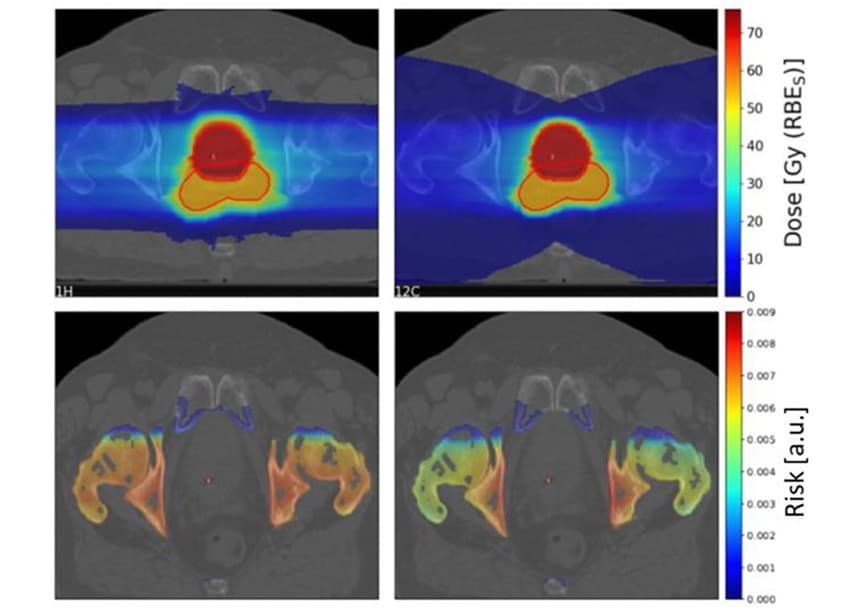
To investigate clinical scenarios, Scholz and colleagues estimated the SC risks for 10 prostate cancer patients previously treated with photon radiotherapy at Karolinska University Hospital. They generated treatment plans for the patients using two laterally opposed scanned proton and carbon-ion fields.

As seen previously, the fragmentation tail of carbon ions resulted in a large low-dose area behind the target. However, the high-dose target region was more conformal for the carbon-ion than the proton plans.

The team calculated the proton-to-carbon ion SC risk ratios for four OARs (bladder, rectum, bones and skin) for the 10 patients. For bone and skin, proton plans yielded a slightly higher SC risk than carbon-ion plans, with median risk ratios of 1.19 and 1.06 for bone and skin, respectively. For bladder and rectum, however, proton plans resulted in significantly lower SC risks, with risk ratios of 0.68 and 0.49 for bladder and rectum, respectively.

The researchers conclude that the insights gained by this model could help optimize future treatments. Currently, relative risk modelling is mainly suitable as a tool for comparing different treatment scenarios for different patient cohorts. But Scholz notes that incorporating such models into treatment planning for individual patients would be straightforward.

“It just requires running the planning for a given dose distribution with two different biological parameter sets representing the cell kill and the cell transformation process, respectively,” he explains. “Then, only some postprocessing of the resulting 3D effect distributions with standard mathematical tools is needed to derive the corresponding risk ratio distributions.”

The next step, he says, is to validate the model via comparison to clinical data. “Since at present these data are scarce, extension of the approach to also include photon treatments and determining the corresponding risk ratios of protons versus photons and carbon ions versus photons would be an important next step,” Scholz tells Physics World.

3D printed sensor lines up for space plasma detection

Researchers at Massachusetts Institute of Technology (MIT) have developed a new 3D printing technique that could make it far easier to build detectors for measuring cold, dense plasma in Earth’s upper atmosphere. Javier Izquierdo-Reyes and colleagues hope that their simple, low-cost approach could open up this region of space to a far wider range of research groups.

As the most abundant state of ordinary matter in the universe, plasma is central to a wide array of cutting-edge technical applications: from fusion reactors to advanced material synthesis. One of the best places to measure its unique characteristics is in Earth’s upper atmosphere – where orbiting electrons have been stripped away from their atoms by powerful solar radiation.

Since the 1950s, researchers have used sensors known as “retarding potential analysers” (RPAs) to study this plasma. These detectors contain a stack of negatively-charged electrode meshes, with holes just a few times larger than the electron’s electrostatic influence. By filtering electrons out of the plasma, while allowing larger positive ions to pass through, RPAs allow researchers to directly measure the energy distribution of ions within atmospheric plasma – providing useful insights into its physical properties.

So far, however, RPAs have faced a key limitation. Since the electron’s electrostatic influence increases with temperature, and decreases with density, it becomes far smaller within cold, dense plasma, as is widely found in the upper atmosphere. To filter out these electrons, RPA meshes must contain the smallest possible holes, while maintaining a precise alignment between each mesh.

The detectors attain this alignment through an insulating housing structure for the electrode meshes, which separates them from the RPA’s metal casing. To withstand drastic and unpredictable temperature swings in the upper atmosphere, this housing is typically made from advanced semiconductor materials. However, as RPA meshes become finer, these costly materials must be machined both to a higher precision, and in more intricate shapes – driving up the time, cost and complexity of the manufacturing process.

To overcome this challenge, Izquierdo-Reyes’ team turned to a 3D printing technique named vat polymerization. The approach first involves lowering a platform into a vat of vitrolite resin: a durable glass ceramic that can withstand very high temperatures with good vacuum compatibility. Once the platform is submerged in a layer just 100 µm thick, the team use UV light to cure the resin.

By repeating the process, the researchers could build up RPA housing structures layer by layer. This resulted in a low-cost material that was stronger, smoother and less porous than would be possible with existing ceramic manufacturing processes. In turn, the ceramic was far better suited to withstanding extreme temperature swings.

Having demonstrated the low cost and relative simplicity of their approach, the researchers now envisage a new generation of miniaturized RPAs – which are both better suited than their predecessors to studying cold plasma, and can operate using far less power. If achieved, the sensors could be easily packed onto CubeSats: miniature satellites measuring just 10 cm across, which can be stowed as secondary payloads aboard launch vehicles for other missions. In turn, smaller research groups around the world could soon gain unprecedented opportunity to study plasma in its natural habitat.

The researchers describe their work in Additive Manufacturing.

Citizen scientist discovers 34 brown dwarfs in binary systems

New research has uncovered 34 new binary-star systems in which low-mass stars partner up with a so-called “failed star” or brown dwarf. The discoveries almost double the number of known systems and could help astronomers better understand where the dividing line between planets and stars is.

A key player in the research was citizen scientist Frank Kiwy, who is part of the public project Backyard Worlds: Planet 9. He searched through the 4 billion celestial objects in NOIRLab’s Source Catalog DR2 to find binary systems featuring brown dwarfs.

“Our new discoveries fill out a unique part of the brown dwarf companion population,” NOIRLab astronomer and co-founder of Backyard Worlds, Aaron Meisner told Physics World. “This will help scientists understand whether these mysterious celestial objects are more akin to Jupiter-like oversized planets or rather undersized stars.”

Meisner praised the contribution of the citizen scientist at the heart of the study, which is described in a paper in the The Astronomical Journal. “An extremely talented citizen scientist named Frank Kiwy single-handedly performed all of the data mining, then led a team of professional astronomers to publish the discoveries.”

Hard to spot “failed stars”

In terms of their masses, brown dwarfs fall between planets and stars. NASA currently defines the mass range of brown dwarfs as being 15–75 times the mass of Jupiter, which itself is about 0.1% the mass of the Sun. As a result, brown dwarfs lack the mass to kick start the nuclear fusion of hydrogen in their cores, so they resemble cooling embers rather than dazzling stars. This lack of significant radiation output, coupled with their small size, makes brown dwarfs difficult to observe.

“Brown dwarfs are small, intrinsically dim, and emit largely in infrared light,” Meisner explains. “All of these factors combine to make them both difficult to detect and easy to miss”. However, he points out that, “The large sky area and excellent sensitivity at red wavelengths provided by the NOIRLab Source Catalog were key in enabling these new discoveries”.

Since the first discovery of a brown dwarf , called Teide 1, in 1995, astronomers have discovered thousands of brown dwarfs by using highly sensitive telescopes. But only a small percentage of these have been in binary systems.

“We don’t yet know with much accuracy how common brown dwarf companions to stars are,” Meisner says. “Brown dwarf atmospheres are known to harbour molecules such as water and are essential laboratories that provide unique insights into planetary atmospheres, so it’s critical to find more examples of these intriguing systems.”

Citizen science superusers

In order to hunt brown dwarfs, Backyard Worlds: Planet 9 employs a network of over 100,000 citizen volunteers to scan telescope images. These people use their eyes to search data for features that machine learning and supercomputers may miss.

The volunteers include hundreds of “superusers”, who work on ambitious and self-directed projects and Kiwy is one of these superusers.

“I love the Backyard Worlds: Planet 9 project! Once you master the regular workflow you can dive much deeper into the subject,” Kiwy said in a statement from NOIRLab. “If you’re a person who is curious and not afraid to learn something new, this might be the right thing for you.”

Kiwy was able to spot 2500 potential ultracool brown dwarfs and discovered that 34 of these were paired with either low-mass stars or white dwarfs. The latter being stellar remnants that are left behind when stars like the Sun run out of hydrogen for nuclear fusion.

Powerful archives

“It’s remarkable that modern data archives are so powerful that they can enable professional astronomers  – and even enthusiastic amateurs  –  to make major discoveries, without ever needing to go to a telescope,” Meisner added.

From these new discoveries and further research Meisner is hoping to better categorize brown dwarfs. The goal is to establish whether they are more like oversized planets, or if they are closer in nature to undersized stars. Citizen scientists look set to continue to play a role in this investigation.

“We’ll be using some of Earth’s premier telescopes to collect more detailed information about these newly discovered binaries,” Meisner said. “We also suspect that there are more of these discoveries still waiting to be uncovered in existing astronomical data archives  –  we may even launch a new citizen science project dedicated to finding them!”

From tick tock to TikTok: how humans keep track of time

The chances are that shortly before you started reading this article you checked the time. Whether you are staring bleary-eyed at an alarm clock, glancing at your wristwatch to see if you are late, or booking appointments into your phone’s calendar app, most of us consult clocks many times a day. It is this familiar and omnipresent tracking of time that forms the starting point for Chad Orzel’s A Brief History of Timekeeping: the Science of Marking Time, from Stonehenge to Atomic Clocks.

In this book, the US physics professor covers the centuries of scientific discoveries, political machinations and societal changes that have led us to current timekeeping methods. Orzel begins in the passage tombs of Neolithic Britain – in which the Sun only shines into the burial chamber at specific times of the year, marking a solstice or equinox – before discussing how the evolution of our modern-day calendar was shaped by religion and politics. As he later remarks, “for everyday purposes, time is not a universal absolute but a social convention”. 

The book cleverly weaves centuries of scientific and technological tales together, taking us from a world of tick-tock to one enabling TikTok. We learn how precision marine chronometers developed in the 18th century led to a boon in reliable long-distance shipping thanks to their ability to correctly track longitude; why 19th-century railway companies were a catalyst for the adoption of global time zones; and how signals distributed via satellites or over the Internet are integral to disseminating today’s international reference time scale. Along the way, we are led through discussions of physics discoveries and phenomena fundamental to the story of timekeeping. These include electromagnetism, simple harmonic motion, celestial mechanics, and special and general relativity, as well as the atomic physics and quantum mechanics behind the atomic clocks that provide national time standards. 

Orzel gives numerous insights into how sophisticated many historic scientific practices were, for their time. Some of the astronomy and mathematics of the Maya civilization sound almost like science fiction. It is incredible, for instance, that Mayan astronomical tables for tracking Venus successfully predicted when the planet will appear and disappear in the sky for several centuries. But we must not get carried away. From 1987 through to the first decade of the 21st century, an extrapolation from the Mayan calendar systems was used to develop mistaken predictions that the world would end on 21 December 2012. Orzel makes a good job of rubbishing the pseudoscience that gave rise to these prophecies of doom. Similarly he skilfully puts scientific results and claims into perspective in later chapters.  

Equally fascinating are the sections highlighted by grey bars down the side of the page, which cover scientific concepts in more detail. Their broad spectrum ranges from describing how fluid mechanics governs the behaviour of water clocks, and delving into thought-experiments to help understand relativity, to explaining how the piezoelectric properties of quartz enable accurate and affordable timepieces, and highlighting why caesium was chosen for the first generation of atomic clocks. 

As well as the science, Orzel includes historical stories, some of which are as amusing as they are engrossing. It made me laugh to learn that outflow water clocks were used to limit the time advocates could speak in Ancient Greek courts, and contemporary records indicate speakers commenting when their time was almost up. Picturing the arrays of several overlapping sand glasses used on board ships when tracking time for navigation was similarly entertaining: this arrangement provided a buffer against lapses in concentration by those delegated to turn over the just-emptied glasses. 

Throughout the book Orzel also highlights how in the past, scientists’ roles could be different to those today. The 16th-century astronomer Tycho Brahe, for instance, cast horoscopes as one of his main duties as court astronomer in Denmark. Orzel also notes how much valuable scientific record can be lost due to invasion, looting and the passage of time; a fact that sadly still resonates today. 

The inclusion of tales of rivalries between scientists, and historic struggles for funding or education, perfectly highlight Orzel’s research process. He also deftly describes how some scientists, like the 17th-century physicist Robert Hooke, had a prodigious talent for self-promotion. Others, though, who were just as important to the development of modern-day timekeeping quietly pressed on with their work – such as 18th century astronomer Tobias Mayer whose meticulous lunar tables later formed the basis for the Royal Observatory’s Nautical Almanac for determining longitude at sea. 

Orzel concludes by looking towards a future in which today’s experimental optical-lattice clocks may eventually enable time measurements so precise that we could track earthquakes via fine-scale monitoring of the Earth’s shape, or possibly even detect particles of dark matter if they interact with the clocks’ atomic tick. 

Throughout A Brief History of Timekeeping, Orzel leads us into some of the topics via events in his own life. This not only helps bring home how much we take the marking of time for granted, but along with his engaging writing style also prevents the physics content from feeling unrelated to our everyday experiences. 

While I mostly feel very positive about this book, it is not without a few flaws. Although the diagrams mainly aid understanding, I found that some would have benefitted from annotations. Equally, Orzel partly based the book on a university course he teaches, and there are sections – such as those on the Michelson interferometer – which seem a bit too obviously derived from that, with some of his explanations requiring a reasonably high level of prior physics understanding. Also, the main text occasionally does not make complete sense if, as Orzel suggests you can opt to do, you have only skimmed over the highlighted sections. Furthermore the book’s title seems a bit of a misnomer in terms of suggesting a quick read. As Orzel himself comments, our personal experiences of time can be subjective, and I don’t consider just over 270 pages “brief”.  

But predominantly A Brief History of Timekeeping is accessible to lay readers, and these are minor quibbles about what is overall an absorbing page-turner.  It never drags, and I’m glad to have invested several hours to learning more about the fascinating history and physics of timekeeping in the hands of this accomplished author.

  • 2022 BenBella Books 272pp $16.95pb

Nanoparticle vaccine protects against diverse coronaviruses in animal models

All-in-one vaccine infographic

As the virus that causes COVID-19 evolves and spreads, scientists and clinicians continue developing innovative ways to combat SARS-CoV-2 by designing vaccines and therapeutics. In a recent study published in Science, researchers present a vaccine that, in animals, protects against a variety of betacoronaviruses – a family of viruses that includes those causing the SARS, MERS and COVID-19 pandemics.

The study was led by a California Institute of Technology research team directed by Pamela Bjorkman. Bjorkman says that designing a vaccine with broad protection against several viruses is important, considering that several SARS-like viruses have emerged in the past two decades.

“We can’t predict which virus or viruses among the vast numbers in animals will evolve in the future to infect humans to cause another epidemic or pandemic,” Bjorkman says in a Caltech press release. “What we’re trying to do is make an all-in-one vaccine protective against SARS-like betacoronaviruses regardless of which animal viruses might evolve to allow human infection and spread. This sort of vaccine would also protect against current and future SARS-CoV-2 variants without the need for updating.”

Mosaic vaccine provides broad protection

Bjorkman’s team designed a nanoparticle vaccine consisting of spike protein fragments from eight SARS-like betacoronaviruses, using vaccine technology initially developed by collaborators at the University of Oxford. In theory, when an immune system is exposed to spike protein fragments attached to this so-called “mosaic” nanoparticle vaccine, it will produce a broad spectrum of antibodies that respond to all viruses represented in the vaccine.

The researchers conducted experiments in mice genetically engineered to express the human ACE2 receptor, which is used by SARS-CoV-2 and related viruses to enter cells upon infection. They found that animals inoculated with the mosaic nanoparticle vaccine produced antibodies to all viruses with fragments in the vaccine.

Mice that received a vaccine containing a nanoparticle without spike protein fragments did not survive infection by SARS-CoV-2 or SARS-CoV (which caused the original SARS pandemic in the early 2000s). Those inoculated with a nanoparticle coated only in SARS-CoV-2 spike protein fragments only survived exposure to SARS-CoV-2. Mice vaccinated with the mosaic nanoparticle, however, not only survived exposure to SARS-CoV-2, but were also protected from SARS-CoV, which was not one of the eight betacoronaviruses incorporated into the vaccine.

The researchers conducted similar experiments in non-human primates using the mosaic nanoparticle vaccine. Again, the animals survived exposure to SARS-CoV-2 or SARS-CoV, and they showed little to no detectable infection.

Working with collaborators at the Fred Hutchinson Cancer Research Center, Bjorkman’s team found that the antibodies developed by non-human primates when vaccinated were in response to the most common elements of receptor-binding domains, such as spike proteins. This result, the researchers say, suggests that the mosaic vaccine could be effective against new variants of SARS-CoV-2 or animal SARS-like betacoronaviruses.

“Animals vaccinated with the [mosaic] nanoparticles elicited antibodies that recognized virtually every SARS-like betacoronavirus strain we evaluated,” says first author Alexander Cohen in a press statement. “Some of these viruses could be related to the strain that causes the next SARS-like betacoronavirus outbreak, so what we really want would be something that targets this entire group of viruses. We believe we have that.”

Next up: clinical trials

With the efficacy of the mosaic nanoparticle vaccine borne out in both laboratory and animal studies, Bjorkman and her collaborators are now preparing a Phase 1 clinical trial to evaluate the vaccine in humans. The trial will enrol people who have been vaccinated and/or previously infected with SARS-CoV-2. Animal model experiments will run in parallel with human studies to compare immune responses in animals previously vaccinated with a current COVID-19 vaccine to responses in animals that haven’t been exposed to the virus or received a vaccine.

Biofinder could detect signs of extraterrestrial life

A highly sensitive instrument has picked up strong bio-fluorescence signals from fossilized organisms that perished millions of years ago. According to its developers, the new Compact Color Biofinder would be similarly handy at detecting signs of life on other planetary bodies and could therefore play a critical role in future missions by NASA and other space agencies.

Biological materials such as amino acids, proteins, lipids and even sedimentary rocks all emit bio-fluorescence signals that can be detected using special cameras. The Compact Color Biofinder, which was developed by Anupam Misra from the Hawai’i Institute of Geophysics and Planetology at the UH Manoa School of Ocean and Earth Science and Technology (SOEST), improves on these older cameras by detecting minute amounts of bio-residues that cling to rock. It can also work at a distance of several metres and scan large areas quickly.

“The first version of Biofinder was made using a large sensitive ICCD [intensified charge-coupled device] detector,” Misra says. “Since the signals from this instrument were very strong, I thought a smaller colour CMOS camera could be used. Thanks to the sensitive, low light CMOS detectors available today, this is now possible.”

Simple working principle

Biofinder’s working principle is simple, Misra tells Physics World. All bio-fluorescence has a very short lifetime of less than 20 nanoseconds, so the system first illuminates an area using an expanded pulsed laser beam with a pulse width of a few nanoseconds. The CMOS camera then takes a fluorescence image using the shortest exposure time (1 µs for the present detector). The system then waits for the next laser pulse to repeat the measurement.

“Our laser fires 20 laser pulses in one second,” Misra explains. “Hence, the system takes 20 image-frames per second and runs at video speed.” The detection limits are below ppm levels at a target distance of one metre, he adds.

Detecting bio-residue in fish fossils

In their work, which they detail in Nature Scientific Reports, Misra and colleagues studied bio-residues in fish fossils from the Green River formation, which dates from the Eocene era 56-33.9 million years ago. They found that the fossils still contain considerable amounts of residue, implying that this organic matter has not been fully replaced by minerals in the fossilization process, even after such a long time.

The team backed up the findings from the Biofinder fluorescence imagery with measurements using a range of other techniques, including Raman and attenuated total reflection Fourier-transform infrared (ATR-FIR) spectroscopies, scanning electron microscopy (SEM), energy dispersive X-ray spectroscopy (SEM-EDS) and fluorescence lifetime imaging microscopy (FLIM).

The results confirm that biological residues can survive millions of years, Misra says, and that biofluorescence imaging is effective at detecting these trace residues in real time.

“Critical in future NASA missions”

The search for life – be it existing or extinct – on other planets is a major goal for planetary exploration missions, and the researchers hope that their technology will one day become a part of missions designed to look for biomarkers on distant worlds. Indeed, they are now applying to get their instrument space qualified.

“If the Biofinder were mounted on a rover on Mars or another planet, we would be able to rapidly scan large areas quickly to detect evidence of past life, even if the organism was small, not easy to see with our eyes, and dead for many millions of years,” Misra says. “We anticipate that fluorescence imaging will be critical in future NASA missions to detect organics and the existence of life on other planetary bodies.”

Study co-author Sonia J Rowley adds that the Biofinder’s capabilities would also be important for NASA’s Planetary Protection programme, which aims to detect contaminants such as Earth microbes on outbound spacecraft as well as any extraterrestrial biohazards that might make the return journey.

Chorizo shines like a star in telescope prank, game creates mechanical versions of electronic circuits

We’ve all been amazed by the incredible images taken by the James Webb Space Telescope. So when leading French physicist Etienne Klein tweeted an image of Proxima Centauri, the closest star to the Sun, people drooled over what looked like a giant, red ball of fire with mysterious white spots. In fact, the object was just a slice of Spanish sausage from Klein’s fridge. As a research director at France’s atomic- and alternative-energy commission (CEA), Klein had posted the image as a joke. He’d wanted to show how we should be sceptical about images we see and not always take comments from supposed figures of authority at face value. Although Klein did apologise for his prank, it looks like his plan worked.

Editor’s note: A follow-up blog about “chorizogate” can be read here.

In the world of physics, spintronics refers to experiments and devices that manipulate the spin of the electron. For example, exploring ways of using spin to create computer chips and memories with the potential to use much less energy than conventional electronics.

Now, I have just discovered a game called Spintronics that teaches children – and anyone else interested – about electronics. Currently in development by the US-based company Upper Story the game has nothing to do with the spintronics of physics research – with the possible exception that they both take advantage of angular momentum.

Chains and gears

Spintronics provides players with chains, gears and other mechanical components that can be connected to create analogues of electronic circuits. Instead of electrons flowing through Spintronics circuits, the gears and chains conduct a mechanical current. When running, the circuits resemble a Heath Robinson/Rube Goldberg contraption.

Some of the analogous components will be immediately obvious to a physicist. For example, in a Spintronics circuit the role of an inductor is played by a flywheel. Just as an inductor opposes change in the current flowing through it, conservation of angular momentum tends to oppose change in the rotational velocity of a flywheel.

The folks at Upper Story have created diagrams to help you mimic just about any electronic circuit and have also created a full set of analogous units. Voltage, for example, is expressed in units of force, whereas current is expressed in units of speed.

Small dynamic range

The small dynamic range of Spintronics means that it cannot be used to simulate all electronic systems. The mechanical equivalent to resistance, for example is limited to the 50–5000 Ω range. Another drawback of Spintronics is size. A Spintronics transistor is about a billion times larger than its modern electronic equivalent, so don’t expect to be doing any large-scale integration. However, Upper Story points out that their transistors are smaller that the first valves (vacuum tubes) that were used to switch electrical current in the early 1900s.

According to Upper Story, the company is currently taking orders for Spintronics and the first products will be shipped to customers in October 2022. You can watch a video about Spintronics at Kickstarter.

China sets out its climate ambitions

As the COVID-19 pandemic rampaged across the world in 2020, resulting in lockdowns and a bold race to create the first vaccine, Chinese president Xi Jinping was keen to tackle another huge scientific issue: the climate. In a surprise announcement to the UN general assembly in September 2020, he announced a bold plan to transition the country from one of the world’s biggest greenhouse gas emitters to a “net zero” carbon society by 2060. 

That ambitious aim came as a shock to many in the country, including regional government officials who are still processing what the goal means and what policies they need to adopt to meet it. Since Xi’s speech, however, dozens of carbon neutrality institutes across the country have already sprung up. In December 2020 the Institute of Atmospheric Physics in Beijing unveiled its carbon neutrality research centre – the first of its kind in China – that aims to strengthen monitoring technologies for carbon emissions. Prominent universities including Tsinghua, Fudan and Shanghai Jiao Tong followed suit, creating their own institutes aimed at fostering carbon-neutrality policies. 

In March the Chinese Academy of Sciences (CAS), meanwhile, proposed an action plan to put China at the forefront of climate change endeavours. This would be achieved, CAS noted, by developing technologies to boost the cleaner use of fossil fuels and safer nuclear energy, as well as the integration of renewable energy into existing power grids. But implementing such initiatives represents a tough challenge. “Meeting China’s carbon goals requires a profound, systematic socio-economic revolution, in which [scientists] have a major role to play by joining force across disciplines and making technological breakthroughs,” said CAS vice president Tao Zhang when announcing the plan.

Part of that net-zero struggle is China’s current reliance on coal. It makes up around 60% of the country’s electricity generation and cutting back on this heavily polluting type of power generation will be key to a net-zero carbon society. That may well require the rapid implementation of carbon capture, usage and storage (CCUS). This involves installing decarbonization facilities in the chimneys of coal-power plants where carbon is collected and transformed before being buried underground or at sea.

Scientists in China have been studying CCUS technologies since 2004 and have so far built 35 demonstration projects that have a total average injection capacity of 1.7 million tonnes of carbon per year. By 2060 that injection capacity is projected to be around 1–3 billion tonnes. Yet CCUS technologies have potential risks including during storage and transportation. Ning Wei from the CAS Institute of Rock and Soil Mechanics in Wuhan, who has been working in this field for some two decades, says that China is lagging behind in some key CCUS technologies such as the monitoring and risk assessment of leaks to prevent the outflow of carbon dioxide, which his team are now working to address. 

The wide implementation of such technology is likely to make energy more expensive – at least in the short term. Wei says that the cost for coal-fired power production is expected to rise by 20–30 cents per kilowatt-hour if CCUS is widely implemented. However, once these technologies have matured, it is hoped that such costs will drop by 50%.

Renewable base

It may come as a surprise to some that China is the world’s leading producer of renewable energy, with around a quarter of demand met by hydro, wind and solar energy. Yet China is not resting on its laurels, with plans to expand its renewable sector by building so-called “green energy bases” in its north-western desert regions. The country aims to have one third of its electricity from renewables by 2025, with a combined wind and solar capacity of 1200 GW by the end of the decade. “The view from west is one of amazement – and some envy,” says technology policy expert David Elliott from Open University in the UK. 

As renewable energy can be intermittent and unstable, a major challenge is integrating it into the power grid. This has prompted researchers to examine different energy-storage techniques. “Energy storage is key to the wide application of renewable energy because it gives a certain degree of flexibility to the power system that requires rigid real-time balance,” notes Xianfeng Li from the CAS Institute of Chemical Physics in Dalian. Li has been studying “flow batteries”, one of the most promising solutions for stationary energy storage thanks to its high energy density and low costs. His team is looking to use advanced materials and design to improve their efficiency and reliability while lowering the costs of commercialization and industrialization. “We would like to see stronger funding for the development of energy-storage technologies, a better-defined market mechanism for such technologies and products, and a top-level innovation centre to lead the country’s efforts in energy storage research,” adds Li. 

Some researchers believe that nuclear power could be a low-carbon option to fill that intermittency gap. China currently produces 55 GW of nuclear capacity across 53 nuclear power plants – about 5% of the country’s electricity generation – but helping to achieve net zero could require installing 560 GW of nuclear power by 2050. That would be a huge challenge, however, with officials urging the government to approve at least six projects a year to bring total capacity up to 180 GW by 2035. 

To do so, China is pushing ahead with fourth-generation nuclear reactors. In September 2021 an experimental reactor opened on the outskirts of the Gobi Desert. It uses thorium as fuel and molten salts as the primary coolant to achieve relatively safe and cheap energy generation. Two months later a demonstrative high-temperature gas-cooled nuclear reactor was connected to the power grid in Shidao Bay, in the eastern coastal province of Shandong, which marked the world’s first use of pebble-bed reactor technology in nuclear reactors. Not everyone, however, thinks nuclear power is the answer to net zero. “I feel it’s an expensive, dangerous diversion,” notes Elliott.

While China’s emissions reduction tends to focus on the energy supply side, the demand side deserves equal attention. This includes how to persuade more people to use electric vehicles and how to integrate solar panels into residence buildings. Above all, for a country that emits more greenhouse gases than any other nation, curbing emissions calls for a paradigm shift not only in government, industry and academia, but also from every citizen. 

China has already made carbon reduction a quantitative goal for national development – a move that will require the country to turn its back on fossil fuels and focus on renewable energy and possibly nuclear – and in the coming decades carbon neutrality will become a national strategy. And while scientists are seeking to develop better technologies to meet that goal, Daizong Liu from the World Resources Institute’s Beijing Office believes that China could manage it without needing to do so. “According to our calculation, China will be able to reduce 89% of its emissions simply by the massive application of existing technologies,” adds Liu. “An entire generation will work together to achieve it.” 

Helical light tells chiral molecules apart

A new optical technique that is very efficient at distinguishing between molecules that are mirror images of each other could have major applications in areas such as drug development, biochemistry and toxicology. Being able to differentiate between such molecules is critical in these areas because the different mirror-image forms, or enantiomers, often produce very different effects in the body.

At present, the main way to distinguish between enantiomers is by sending circularly-polarized light through a sample. Molecules of one “handedness”, or chirality, will absorb more such light than their mirror image, producing a tell-tale difference in the transmitted light. This circular dichroism (CD) method is routinely employed in analytical chemistry, biochemistry and in the pharmaceutical, cosmetic and food industries. Its chief drawback is that the signals produced are very weak, and the sample ideally needs to be in the gas phase. This can be a problem for chemistry and biochemistry experiments that are mainly carried out in aqueous solutions.

Helical rather than circular dichroism

The new method, developed by researchers at Switzerland’s Paul Scherrer Institute, the École polytechnique fédérale de Lausanne (EPFL) and the University of Geneva, overcomes these problems because it works using a form of dichroism, helical dichroism (HD), that involves the shape of light (that is, its wavefront) rather than its polarization.

“One can imagine an optical vortex as a light beam, where the wavefront is twisted like a screw along the propagation direction,” says team leader Jérémy Rouxel, who is now at the Université de Saint-Etienne in France. “Just like a screw, the direction of this wavefront can go in one direction or another, comparable to a left- and a right-handed thread.”

Unlike in CD, which is strongly limited by the fact that light can only be left- or right-polarized, HD has the advantage that optical vortices can twist multiple times within one wavelength of the used light. This can enhance the dichroic signal strongly and can also be used to determine the degree of chirality of a molecule.

Distinguishing between enantiomers

In their study, Rouxel and colleagues used helical X-ray light from the cSAXS beamline at the Swiss Light Source to study a powdered form of a chiral metal complex called iron-tris-bipyridine. This compound absorbs and scatters light with left and right helical vortices differently, Rouxel explains.

“The central point here was to create X-ray optical vortices for the experiment, and to measure the difference in X-ray absorption with the various possible vortices,” Rouxel tells Physics World. “We did this using a special diffractive optical element called a spiral Fresnel zone plate. With this lens, it is possible to focus the light onto a sample and to generate the optical vortex at the same time.”

The team’s experiments showed that the signal derived from HD was several orders of magnitude stronger than that possible from CD. The researchers are now studying other molecules to improve the reliability of the technique and, in Rouxel’s words, “establish it for the community”.

“We also plan to implement it for more liquid samples, which will make HD even more interesting for chemistry research,” Rouxel reveals. “Finally, we have to study more extensively how the dichroism varies as a function of the threading degree.”

The work is detailed in Nature Photonics.

Artificial muscles offer a route to greener air conditioning, breakthroughs in semiconductor physics and hidden consciousness

In this episode of the Physics World Weekly podcast, Paul Motzki of Germany’s University of Saarland explains how artificial muscles have been used to create a new and environmentally friendly refrigeration technology.

Also this week, Physics World editors chat about a breakthrough in the study of the promising semiconductor cubic boron arsenide, a new technique that can reveal hidden consciousness in brain-injured patients, and a scary study about rocket stages that fall from the sky.

Copyright © 2026 by IOP Publishing Ltd and individual contributors