Noise-resistant quantum computing comes a step closer

Quantum computers are a study of extremes. On the one hand, they promise to be far more powerful than classical machines in solving certain problems. On the other, their quantum nature is remarkably fragile and sensitive to environmental noise. To perform scalable, useful quantum computations, therefore, scientists need to correct these errors in an efficient way. One important step towards this goal is to perform quantum computations in a way that stops correctable errors from spreading (and thus becoming uncorrectable). Now, for the first time, researchers in Austria and Germany have experimentally demonstrated a universal set of these so-called fault-tolerant quantum operations, laying the groundwork for large-scale, error-corrected quantum computation.

Error correction

The key to any sort of error correction is adding redundancy to the information that needs to be protected. A classical computer, for example, might make several copies of each bit so that if any one bit incorrectly changes value, looking at all the bits at the end of the computation gives you a very good idea of what its value should have been. In the quantum case, copying and checking information is more complicated, but the idea of adding redundancy is the same: data contained in a single physical qubit is spread among many qubits using entanglement, in a way that lets the machine both detect errors should they happen and perform corrections without compromising the state of the computation. These many physical qubits are referred to as a logical qubit and the entangling transformation is known as encoding.

If keeping the state of the logical qubit unchanged forever were all anyone cared about, error correction would relatively straightforward. The real difficulty arises when the state of this large composite system needs to be manipulated, since each step of the quantum algorithm now has to be performed on the many physical qubits that encode one logical qubit. This adds errors and creates additional problems, as not all quantum operations are straightforward to translate into this large logical form. Notoriously, an important quantum operation known as a T-gate requires complex and resource-heavy methods to perform in a fault-tolerant way – to say nothing of multiple-qubit interactions.

Complete set of building blocks

In the latest work, which is described in Nature, researchers from the University of Innsbruck and RWTH Aachen University demonstrated a full set of fault-tolerant quantum operations on an ion-trap quantum computer. As well as implementing a T-gate, the set includes preparing qubits in configurations known as logical Pauli eigenstates and creating an entangling CNOT gate between two logical qubits. These ingredients allow a single qubit to be transformed to every possible state and to interact with other qubits, making them the basic building blocks of any arbitrary quantum computation in the fault-tolerant setting.

The qubits in the experiment are encoded in electronic states of 16 calcium ions suspended using magnetic fields (a macroscopic Paul trap) and controlled with individual laser beams. The advantages of using trapped ions instead of the superconducting qubits favoured by many quantum computing firms include lower error rates and better connectivity between qubits, though there are challenges with scaling the technology. The researchers use seven physical qubits to make each logical qubit via an encoding known as the colour code, and their system also incorporates additional physical “flag” qubits to signal the presence of dangerous errors in the system. This technique drastically reduces the resources required for error correction. Importantly, the experiment demonstrates that the fault-tolerant scheme performs better than a non-fault-tolerant implementation, despite the additional complexity in the underlying algorithm.

The results mark a big step forward for fault-tolerant quantum computing, although many more steps remain before truly large-scale experiments can be carried out. “Encoding more logical qubits – either by using more small error correction code or by using codes that host multiple logical qubits in one entangled multi-qubit state – is one of the next goals,” says Lukas Postler, a PhD student at the University of Innsbruck and one of the authors of the paper. “A short-term goal certainly is to develop a more refined error model for a better understanding of the error processes and their effect on the logical qubit performance,” he adds. As well as modelling errors and implementing more logical qubits in the short term, in the long term the researchers hope to accomplish repeated rounds of error correction on the system, which are indispensable for large-scale quantum computation.

Elusive tetraneutron is discovered at Japanese lab

A four-neutron particle called a tetraneutron, which forms very briefly as a “resonance”, has been observed in Japan by researchers who collided highly neutron-rich nuclei with protons. The detection was made at a statistical significance greater than 5σ, putting it over the threshold for a discovery in particle physics. This answers conclusively the long-standing question of whether or not uncharged nuclear matter can exist, and it will motivate searches for more exotic – and potentially longer-lived – neutral particles.

Free neutrons decay to protons, electrons and antineutrinos via the weak interaction in around 15 min. However, neutrons in bound systems will not decay under certain conditions. In atomic nuclei, for example, neutrons are kept stable by the strong nuclear force. Neutron stars are also stable thanks to effects of intense gravity on their constituent neutrons. As a result, physicists have wondered for decades whether nucleus-like particles made solely of neutrons could exist, even if fleetingly.

The simplest such particle would be the dineutron – comprising two neutrons – but calculations suggest that this would not be bound. However, there is only a slight potential energy gain associated with dineutron formation. This has encouraged physicists to look for more complex particles such as the trineutron and the tetraneutron, especially since technology to bombard targets with radioactive ion beams was developed at the end of the 20th century. In 2002, researchers in France and elsewhere reported an apparent signature of a tetraneutron in collisions of beryllium-14. Multiple subsequent theoretical analyses, however, suggested that to accommodate a bound tetraneutron researchers would have to modify the laws of physics in ways that would make them inconsistent with well-established experimental results.

Broken springs

The calculations did, however, leave open the possibility that a metastable “resonant” tetraneutron state could exist. Such states occur when a particle has a higher energy than its separated constituents, but the attractive strong nuclear force momentarily hinders the components from separating. James Vary of Iowa State University in the US offers an analogy: “Let’s suppose I have these four neutrons, and each is attached to each of the others by a spring,” he explains; “For four particles you need a total of six springs. Quantum mechanically they’re oscillating all over the place, and the energy stored in the system is actually positive. If the springs break – which can happen spontaneously – they fly apart – releasing the energy stored in those oscillations.”

In 2016, researchers at the RIKEN Nishina Centre in Japan and elsewhere reported tentative evidence for a tetraneutron-like resonant state when colliding a beam of helium-8 – the most neutron-rich bound isotope known – with a helium-4 target. Occasionally, the helium-4 exchanged two pions with the helium-8 to produce beryllium-8 and convert helium-4 into a tetraneutron. The beryllium-8 nucleus then decayed to two more helium-4 nuclei which were detected and used to reconstruct the energy of the tetraneutron. These results were consistent with the inferred properties of the tetraneutron, however, the volume and precision of the data was low. Stefanos Paschalis of the UK’s University of York explains, “Based on that signal, which was four counts, a large proportion of the community remained sceptical regarding the existence of the tetraneutron resonant state”.

More direct approach

In the new research, Paschalis and colleagues took a more direct approach, using the RIKEN Nishina Centre’s Radioactive Ion Beam Factory to shoot helium-8 into liquid hydrogen, thereby scattering the atoms off protons. “Helium-8 has a very well-defined alpha-particle (helium-4) core, and then four other neutrons flying around,” explains Paschalis. “With our proton, we remove suddenly this alpha particle, and then leave the four neutrons in the same configuration.”  

The researchers recorded the momenta of the incoming helium-8, the scattered protons and helium-4 nuclei in 422 coincident detections and plotted the missing energy. They observed a well-defined peak just above zero, indicating a particle unbound by about 2 MeV. “There is no doubt that this signal is statistically significant, and we should understand it,” says Paschalis.

Vary, who was not involved in the research, describes the work as “very significant” for three reasons; “This [observation] has very good statistics, and in my mind it’s completely valid to claim a discovery. The second is that they measure the energy with good precision, and the third is that they measure the width of the resonance – which gives you the lifetime. Those are quantities that theory can calculate and try to compare with experiment.” He says researchers will now seek out even more exotic states: “What about six neutrons? What about eight neutrons? Can they form resonant states, or possibly even longer-lived bound states that decay via the weak interaction?”

Paschalis says the researchers are planning to explore this, as well as probing the structure of the particle they have already found in more detail.

The research is described in Nature.

Magnetic fields can turn medical waste into high-value products

Alternating magnetic fields can be used to rapidly convert medical waste, such as plastic syringes, into hydrogen-rich gases and high-quality graphite, scientists in China have found. This catalytic technique is more environmentally friendly and less energy intensive than other waste management strategies, the researchers claim. It might also help us dispose of other types of medical waste such as masks and protective clothing.

The coronavirus pandemic produced mountains of medical waste. According to the World Health Organization (WHO), between March 2020 and November 2021, the UN shipped 87,000 tonnes of personal protective equipment (PPE), like masks and gowns, to countries around the world. But this is only the tip of the iceberg, as it does not cover items purchased outside the UN initiative by governments and members of the public. More than 140 million test kits have also been shipped and the more than eight billion vaccine doses administered globally have produced 144 000 tonnes of waste products, such as syringes, needles and sharps bins.

In the rush to secure PPE and administer vaccines, less attention was paid to waste disposal. But that plastic and biohazardous medical waste is threatening human and environmental health, according to a recent WHO report. Now researchers in China claim to have developed a new catalytic technique that rapidly decomposes disposable syringe plastic, which they say could help.

Incineration is widely used to dispose of plastic waste. While it is quick and simple, it can produce large quantities of carbon dioxide and other toxic gases, and the only useful by-product is heat. Plastic in medical waste is rich in hydrogen and recently researchers have developed a two-stage technique that uses high-temperature pyrolysis followed by catalytic cracking to turn it into hydrogen-rich gases such as hydrogen, ethanol and methane. But, according to Xifeng Zhu from the University of Science and Technology of China and his colleagues, this process is very energy intensive.

To address the challenge of efficiently converting medical waste into hydrogen-rich gases, Zhu turned to magnetic hyperthermia. Magnetic hyperthermia generates localized intense heat by subjecting magnetic nanoparticles to a high-frequency alternating magnetic field. So far, this technique has been primarily used within medicine to heat and destroy cancer cells.

The researchers created a catalyst that would respond to a magnetic field by joining ten bent disposable syringe needles together in a chain-like loop. They then added crushed disposable syringes, which were mainly made from polypropylene, and a heavy fraction of bio-oil as an initiator.

When the team subjected this mix to a high-frequency alternating magnetic field they found that the chain-shaped needles heated up. This heated the bio-oil, which then heated the rest of the system. As the temperature increased, the bio-oil and the plastic syringes decomposed, generating hydrogen, methane and other gases. Iron carbide also formed, along with high radio-frequency-electromagnetic-wave-absorbing carbon, which was deposited on the surface of the chain-shaped needle. This graphite caused the whole system to heat even further, reaching temperatures as high as 1200 °C.

As more and more crushed plastic syringes were added to the reaction, without further bio-oil, the formation of graphite and the yield of hydrogen increased. The researchers claim the process was able to turn more than 75% of the hydrogen in the syringes into hydrogen gas and around 68% of their carbon into graphite.

After ten cycles of adding additional syringes, electron microscopy confirmed the growth of a large amount of flaky carbon. It showed that there were seven layers of graphite sheets deposited on the chain-shaped needles, with a lattice structure that contained few defects.

According to the researchers, this technique simplifies the treatment of medical waste by converting it into hydrogen and high-value graphite in a one step process. The use of a high-frequency alternating magnetic field also minimizes the amount of energy used compared with other catalytic process, as the whole reactor does not need to be heated simultaneously.

The research is described in Cell Reports Physical Science.

Peter Higgs: the man behind the machine

As someone who was working at CERN at the time, the 2012 discovery of the Higgs boson is close to my heart. So when reading Elusive: How Peter Higgs Solved the Mystery of Mass I was keen to learn the life story of the scientist after whom the particle is named. Written by particle physicist Frank Close and released to coincide with the 10th anniversary of the discovery, Elusive is an anecdote-filled, meandering – and sometimes confusing – glimpse into the life and work of the theorist Peter Higgs, whose name is one of three associated with the Brout–Englert–Higgs (BEH) mechanism that gives elementary particles their mass.

Unfortunately, my enthusiasm was quickly dampened. Just a couple of chapters in, it began to feel as if the title refers to the structure of the book itself, which seemed harder to locate than the elementary particle in question. But while initially disjointed, I suggest you don’t let this put you off the book – it does get better.

I first had alarm-bells ringing as I read the preface, where Close remarks that the Higgs boson was dubbed the God Particle “in media headlines”. However, it was physicist and Nobel laureate Leon Lederman who came up with the epithet for the title of his 1993 book – a fact that Close himself references later in the book. The fact that the media ran with the phrase is neither here nor there, but putting the blame, as it were, on the media seems slightly uncharitable. In the preface Close also only mentions the 2013 Nobel Prize for Physics going to Higgs, ignoring until later on in the book that it was jointly rewarded to François Englert, which feels misleading and unfair on Englert. Even the title makes it seem as if Higgs was the only person involved in the scientific endeavour the book goes on to describe.

But I set this aside and continued. As a friend of Higgs, Close is uniquely placed to tell us the theorist’s story, with all the partiality one might expect from such a relationship. Close draws upon their private and public conversations, as well as referring to other books, scientific papers and primary sources. He begins by introducing us to Higgs’ family, including his grandparents. We are told of Higgs’ early education and how he attended Cotham Secondary School in Bristol, the same school that Paul Dirac once attended. It is not immediately clear, however, what relevance some of these snippets have. For example, Close describes Higgs’ conversion to socialism while coming from a traditionally conservative family, but the paragraph, inserted abruptly, does not seem to lead anywhere.

This unexpected dead-end is unfortunately not an exception. Close varies the attention that he gives different areas of physics in a way that can frustrate. Some ideas are introduced and then dropped almost immediately, while other statements are presented as fact without further discussion. Some terms are defined well after they are first introduced, and others have pages and pages of explanation devoted to them, with occasional (and needless) repetition of ideas and phrases – a proclivity raised in a Physics World review of Close’s previous book Trinity. We are told, for example, that Higgs’ father viewed Oxford and Cambridge as places that “were for the sons of the idle rich to waste their time and also that of their tutors”, and are then reminded of this exact sentiment with near-identical phrasing mere pages later.

Having said that, Close’s scientific narrative presents a more historically accurate description of the meandering path that led to Higgs’ ideas compared with other popular explanations of the significance of the BEH mechanism. Commonly, the tales begin with how the mechanism solves the problem of the W and Z boson masses under the unification of the electromagnetic and weak forces. Close chooses instead to introduce the reader to the crucial work of Jeffrey Goldstone and the problems arising from his ideas that Higgs and fellow theorists were trying to solve, as well as the importance of Philip‌ Anderson’s 1962 paper that first introduced a mass-giving mechanism. Close also explains in welcome detail the link between the 1964 papers proposing the BEH mechanism to superconductivity, providing a rich history of 21st-century particle physics and its relationship with other domains of physics. Higgs is the protagonist of the story Close tells us but Elusive also explores the crucial roles played by many other principal actors on the particle-physics stage. Despite glossing over them in the preface, Close goes into detail about the work of Brout and Englert, and includes that of Gerald Guralnik, Carl Hagen and Tom Kibble.

Close’s writing is peppered with colourful metaphors but unfortunately, some left me scratching my head

Close’s writing is peppered with colourful metaphors but unfortunately, some left me scratching my head. For example, when referring to theorists proposing the existence of new particles, he alludes to trails and peaks before then switching metaphors to cookery and gourmet banquets in the same paragraph. Elsewhere, we are told that the W and Z bosons are bears in a cave, a concept first introduced in pages 44–48 and then dropped in without ceremony some 80 pages later. Bizarrely (or perhaps intentionally?), he later refers to Carlo‌ Rubbia, one of the driving forces behind the discovery of the W and Z bosons, as “a bear of a man”.

None of this is to say, of course, that Close is not a compelling storyteller. There are parts of the book that lead you on with delight: “This particle carried zero charge, so he [Sheldon Glashow] named it Z, and like his native city New York, New York – so good they named it twice – he appended the traditional superscript 0 as well, making it Z0.” But I feel as though the book as a whole could have done with some more forceful editing. Some threads come together to form a unified tapestry, but the images they represent appear disjointed and occasionally without relation to anything else mentioned.

Indeed, on the editorial side of things, the most frustrating aspect of reading Elusive is to constantly gamble as to whether a note at the end of the book is worth looking at: sometimes they are references to papers, while others include a paragraph of contextualizing or expanding information. These notes would have served a better purpose as footnotes on the same pages they are referenced on.

The story of the Higgs boson is longer than the 48 years between the papers that predicted its existence and the announcement that it had finally been found – and it is a vastly more complex journey than is evident at first glance. Elusive is a timely and in-depth narrative, and although Close, as he might put it, has a mountain to climb, at least he is equipped with all of the ingredients needed for a scrumptious meal once at the top.

  • 2022 Allen Lane 304pp £25hb

Physicists detect a new type of molecular bond

A novel type of molecule that is longer than some kinds of bacteria has been detected by physicists at the University of Stuttgart in Germany. Using a specially designed microscope, the team observed a binding mechanism between a charged ion and a neutral Rydberg atom – that is, an atom with a single, highly excited valence electron. The extent of the bond length in the new molecule is as wide as a few micrometres, which is at least 1000 times larger than in usual molecules.

When two particles combine to make a molecule, they usually do so in one of two ways: by electrostatic attraction between two oppositely charged ions (ionic bond) or by sharing electrons between two neutral atoms (covalent bond). In contrast, the bond observed by the Stuttgart team forms when the electric field of an ion deforms a Rydberg atom, inducing a dipole in which one side of the atom is more negatively charged and the other more positive. Depending on the orientation of the electric dipole, the interaction between the induced dipole of the Rydberg atom and the charge of the ion can be attractive or repulsive.

What’s unusual about this molecule is that the ion’s electric field distorts the atom in such a way that it causes the dipole’s orientation to flip at a particular distance. At shorter distances, the atom and the ion repel, while at larger distances, they attract. The distance at which this dipole flip occurs determines the bond length of the molecule.

A very cold recipe

To make this molecule, the researchers prepared a cloud of rubidium-87 atoms at a temperature of just 20µK, since higher temperatures would risk the thermal energy of the atoms and ions overcoming the weak strength of the bond. The team then used laser pulses to prepare the molecule’s constituents: firstly ionizing single atoms, then exciting a nearby rubidium atom in the ultracold cloud to the Rydberg state. The Rydberg atom is 1000 times larger than the ion since the more excited the electron is, the farther away from the nucleus it extends. When the Rydberg atom and the ion are separated by a distance comparable to the bond length, a molecule forms.

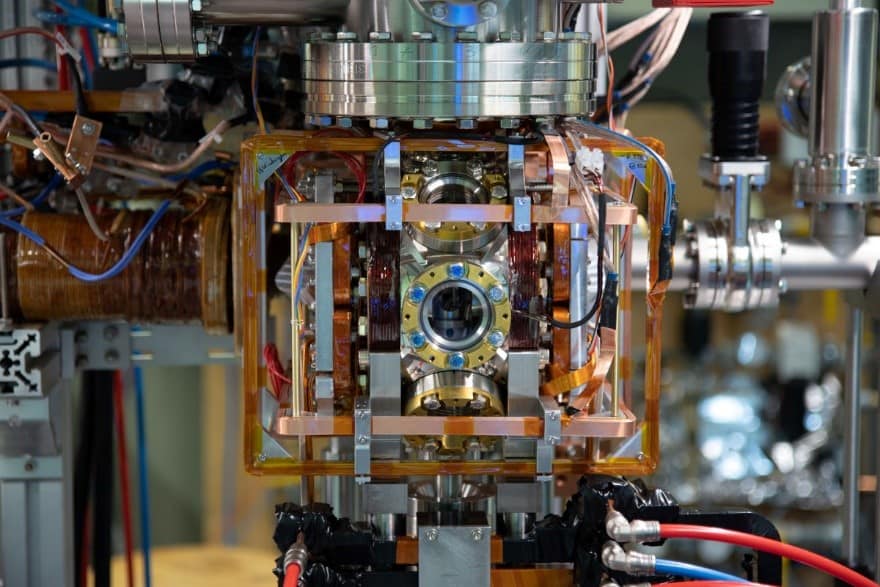
Photo of the experimental chamber showing part of the ion microscope inside a vacuum chamber and surrounded by coils of wire

To verify the molecule’s formation, the researchers devised a special ion microscope. Unlike an optical microscope, which uses light to image an object, in this microscope an electric field separates the molecule and ionizes the Rydberg atom. The now separated ion and Rydberg core are then guided along the microscope and onto a detector. Due to their different charge-mass ratios, the Rydberg core and the ion will arrive at this detector at different times, allowing each of them to be detected individually.

Owing to the molecule’s large size, the microscope should be able to measure the motion of the binding partners in the molecule. “The vibrations in this molecule are relatively slow compared to typical molecules and our ion microscope offers enough time resolution to resolve such processes” explains Nicolas Zuber, lead author of a paper in Nature outlining the results. Zuber adds that in the longer term, the ion microscope could also be used to study the dynamics of Bose-Einstein condensates (BECs), which are gases of cooled atoms all occupying the same quantum ground state. Atoms in a BEC behave like a single macroscopic matter wave that extends across the ensemble, and the spatial resolution of the ion microscope is high enough to probe phenomena on a scale similar to the length at which the matter wave changes. It could therefore make it possible to perform spatially-resolved experiments on these quantum gases, for example studies of ionic impurities and ion-atom scattering in the quantum regime.

Axial Higgs mode spotted in materials at room temperature

An axial Higgs mode has been spotted within the collective quantum excitations of a solid material. Kenneth Burch at Boston College and colleagues in the US and China, discovered the quasiparticle cousin of the Higgs boson in a relatively simple tabletop experiment carried out at room temperature.

In 2012, the discovery of the Higgs boson at CERN’s Large Hadron Collider confirmed a prediction made nearly 50 years earlier about the mechanism by which some fundamental particles acquire mass. The Higgs mechanism is triggered by spontaneous symmetry breaking and was originally devised to explain how photons acquire mass in superconductors. As a result, analogues of the Higgs boson – collective excitations (or quasiparticles) called Higgs modes – can be found in superconductors.

Theory predicts that further symmetry breaking could lead to the emergence of a new type of excitation called the “axial Higgs mode”, which unlike the Higgs mode, has intrinsic angular momentum.

Now Burch and colleagues have observed an axial Higgs mode in rare-earth tritellurides. These are layered materials that harbour charge density waves (CDWs) in which chains of electrons form standing waves. These electrons behave in a highly correlated manner and a CDW is described as a quantum fluid – a category of materials that also includes superconductors.

Raman spectroscopy

Burch and colleagues probed their rare-earth tritelluride samples using Raman spectroscopy, whereby changes in the wavelength and polarization of scattered laser light provide information about how atoms vibrate in a sample. The team identified a peak in the material’s Raman spectrum that corresponds to a Higgs mode. They used a technique called quantum pathway interference to further characterize the Higgs mode. Quantum pathways are the different ways that the laser light can interact with the Higgs mode and the interference occurs because of the quantum nature of the system.

The two pathways of interest to the team were the excitation of a Higgs mode with no intrinsic angular momentum and the excitation of an axial Higgs mode. By varying the polarization of the incoming laser light and the polarization of the detected light, the team was able to observe this interference and confirm the existence of the axial Higgs mode in the material. What is more, the observations were made a room temperature, whereas most other quantum phenomena can only be seen at very low temperatures.

The team now hopes that their relatively simple experimental approach could be used to identify axial Higgs modes in other materials including superconductors, magnets and ferroelectrics. This could prove useful for future technologies because materials containing axial Higgs modes could be used as quantum sensors. And because the mathematics of the axial Higgs mode is analogous to that used in particle physics, studying the quasiparticles could provide clues for what lies beyond the Standard Model of particle physics.

The research is described in Nature.


The Higgs boson discovery revisited

Everyone knew something big was coming. Students had camped outside CERN’s designated seminar hall overnight in the hope of grabbing one of the few unreserved seats. Finally, on the morning of 4 July 2012, the suspense was ended. Spokespeople for the large hadron collider’s two general purpose experiments, ATLAS and CMS, confirmed the rumours: both experimental teams had detected a “Higgs-like particle” and the masses were very similar.

In the July episode of the Physics World Stories podcast, Andrew Glester revisits that historic day in 2012. He’s joined by two guests who were there at the particle physics lab in Geneva to live through that memorable day. Achintya Rao was a communications officer at the CMS experiment and Cristina Botta was a research scientist.

Discover much more about the past, present and future of particle physics in the July issue of Physics World, a special issue to mark the 10-year anniversary of the Higgs boson discovery.

Particle physicists gather at CERN to celebrate the 10th anniversary of the Higgs boson discovery

Officials at the CERN particle-physics lab gathered today to celebrate a decade since the announcement of the discovery of the Higgs boson at the Large Hadron Collider (LHC). Held in CERN’s main auditorium, the anniversary symposium featured talks about the discovery as well as the latest Higgs research and what to expect in the coming decades of particle-physics research.

The event took place in the very same venue in which the ATLAS and CMS collaborations at the LHC announced on 4 July 2012 the discovery of a new particle with features consistent with that of the Higgs boson. ATLAS and CMS measured the Higgs boson’s mass to be 125 GeV.

A year later François Englert and Peter Higgs bagged the Nobel Prize for Physics for the part they played in the prediction of a new fundamental field, known as the Higgs field, which manifests itself as the Higgs boson and gives mass to the elementary particles.

“The discovery of the Higgs boson was a monumental milestone in particle physics. It marked both the end of a decades-long journey of exploration and the beginning of a new era of studies of this very special particle,” says CERN director general Fabiola Gianotti, who in 2012 was spokesperson for the ATLAS experiment.

“I remember with emotion the day of the announcement, a day of immense joy for the worldwide particle physics community and for all the people who worked tirelessly over decades to make this discovery possible.”

Today’s symposium at CERN also featured video messages from Higgs and Englert as well as former CERN director general Rolf-Dieter Heuer, who was leading the lab when the anouncement was made. “I think it’s splendid that you are having a celebration after 10 years,” noted Higgs, who is now 93.

Englert, meanwhile, said he “vividly” remembered the events on the 4 July 2012 and paid tribute to the contribution of the US-Belgian physicist Robert Brout, who died in 2011 and who may well have shared the Nobel prize with Higgs and Englert had he lived for longer. “Today, we celebrate the memory of this great physicist and wonderful man,” noted Englert.

Other talks at the symposium were given by Lyn Evans, who helped to build the LHC, as well as senior officials at the ATLAS and CMS detectors and leading theorists. Wrapping up the morning session, Gianotti noted that the discovery of the Higgs boson opened up a new “era of exploration” that has “wide-ranging implications” for particle physics and beyond.

She also highlighted the “superb” performance of the LHC in the decade since the discovery – noting nine million Higgs bosons have been produced at both ATLAS and CMS to date — as well as improvements in analysis methods and collaboration with theory.

‘Bright future’

Meanwhile, the next science run at the LHC – what is known as “run 3” – will begin tomorrow on 5 July. The was shut down four years ago to allow engineers to carry out maintenance, consolidation and upgrade work to CERN’s accelerator complex. The first beams were injected on 20 April with the two proton beams accelerated to a record energy of 6.8 TeV per beam before the  luminosity and the stability of the beams were improved. ATLAS and CMS are now both expected to receive more collisions during this run than in the two previous physics runs combined.

The third run of the LHC will last until 2025. The LHC will then shut down to make way for a major upgrade where it will be converted into the High-Luminosity LHC (HL-LHC), which is designed to increase the collider’s luminosity increase by a factor of 10 over the original machine. HL-LHC is expected to begin in 2029 and operate until 2041. “The future is bright” noted Gianotti today.

Tracks of my tears: the true meaning of Peter Higgs’ emotion at CERN in 2012

Series of 4 images of Peter Higgs on 4 July 2012

Nobody who has seen the images will forget Peter Higgs’ watery eyes. Captured at CERN’s main auditorium on 4 July 2012, the video shows the British theoretical physicist holding a tissue as lab bosses announce that the Higgs boson has been discovered. Higgs, who was then 83, has welled up and removes his glasses to daub his face. But do those tears reveal the emotion of a particularly sensitive man? Or do they indicate emotional currents intrinsic to life as a physicist?

According to a view long enshrined in textbooks and ratified by traditional philosophers of science, physicists are investigators trained to apply physical and conceptual tools to unravel the puzzles of nature. Whatever moods strike them as that work unfolds reflect only the subjective responses of individuals; the moods on show are irrelevant to the practice of physics. Higgs must be simply a man prone to tears, so this view goes.

Do Peter Higgs’ tears reveal the emotion of a particularly sensitive man? Or do they indicate emotional currents intrinsic to life as a physicist?

But according to a more all-inclusive approach to science, which treats it as consisting not just of products but of practitioners too, those tears are different. Physicists belong to of a way of life that values solving nature’s puzzles – and moods are as intrinsic to that way of life as they are to ordinary life. Living in a world in which nature appears manipulable and measurable – and full of puzzles to be solved – physicists experience everything from awe, boredom, confusion and disappointment to discouragement, obsession, pressure, shock, scepticism and more.

Sure, those feelings aren’t necessarily different from what we experience in everyday life, but they are intrinsic to physics life, and therefore to physics itself. In fact, the puzzle-solving world that physicists inhabit is rather like sport, where athletes bring their all to the ebb and flow of a game. If you spot an emotionless athlete in an exciting match, you assume they’re either good at hiding their moods or are simply disengaged. Similarly, if you encounter a physicist who is blasé about their work or about their setbacks and successes, you can’t help but wonder how talented they really are.

Even the notoriously impassive theorist Paul Dirac was privately moody, as revealed by his recollection of the time he realized the likely relevance of “Poisson brackets” to quantum mechanics. Not knowing enough about this mathematical operation and being unable to find it discussed adequately in his textbooks, Dirac was in despair to find that the library was closed on that particular Sunday. He was forced to wait “impatiently through the night and then the next morning” until the library reopened.

Now and again there is some dramatic and sensational event that provokes a particularly intense and powerful emotion.

The conventional view of science, however, omits these moods, labelling them subjective and dismissing them as something in the domain of psychologists. But there is a “physics world” that practitioners are caught up in. Usually, it’s everyday stuff like conversing with colleagues and learning what others are up to; of hearing about new ideas, reading journals and ordering supplies; of planning and carrying out new projects. Now and again, though, there is some dramatic and sensational event that provokes a particularly intense and powerful emotion.

The mass thing

The announcement of the discovery of the Higgs boson was one such event. What a decisive piece of what an extraordinary puzzle! Hundreds of theoretical pieces had to come together to create the architecture of the Standard Model of particle physics, and decades of development in accelerator and detector technology were required. The Standard Model also had to incorporate all those strange particles discovered first in cosmic rays and then even more produced in accelerators.

That model required theorists to develop countless schemes to organize these particles into families, with experimentalists having to identify all the family members and their properties. All those forces in and between particles had to be consolidated into one. Gauge symmetry and broken symmetry had to be invented. Every now and then some deep flaw would appear in the evolving architecture – parity violation, charge–parity violation – that had to be resolved.

But a piece missing from the beginning was how mass figures in this architecture. The invention of the necessary idea itself took years and required many seemingly unrelated steps from seemingly unrelated fields.

Julian Schwinger discovered that attempts to link the weak and electromagnetic fields were stymied by the fact that electrically charged bosons are not massless. Yoichiro Nambu found the idea of hidden symmetry was key to superconductivity. Jeffrey Goldstone saw that the breaking the symmetry creates massless bosons. Philip Anderson used ideas from plasma physics to show that it’s possible to have massive gauge bosons, while several other theorists showed that bosons can become that way by absorbing the Goldstone boson.

Peter Higgs’ work not only described such a boson but also proposed ways that it might be identified experimentally. All these things, and many other contributions, had to go into fitting that piece into the blueprint of the Standard Model, showing that its blueprint was sound. And then came the enormous technical and experimental challenge of hunting for the boson – a job that was completed in 2012 – almost half a century after the boson’s first description.

The critical point

Peter Higgs was not alone in experiencing feelings that day at CERN during the announcement of that particle. There wasn’t a single mood in the room, of course. Some were celebrating the discovery after contributing to it, or were proud of the discovery despite working in another area in or outside CERN. Others may have been dismayed at having sought – but failed – to contribute, or at having had their contributions unacknowledged. These moods were all present and inseparable from the way of life of a physicist.

It is just that Higgs’ was more visible – and an alert camera operator caught it on film.

US philanthropic organizations spend over $30bn a year on science

Philanthropic funding of science in the US is now on a par with federal research funding. That is according to an analysis of tax returns from non-profit organizations, which finds that philanthropic institutions now spend at least $30bn in total on science each year.

While there has been a lot of work exploring the patterns of government science funding, not much focus has been given to philanthropy even though it is known to contribute significant sums of money for research. Part of the issue has been a lack of data, but recent changes by the US Internal Revenue Service (IRS) has made tax data from non-profit organizations available for research. As well as financial and organizational details, these tax forms also list grants that the organization has awarded.

Louis Shekhtman from Northeastern University in Boston and colleagues analysed more than 3.5 million tax forms filed by US non-profit organizations between 2010-2019. They identified almost 70,000 organizations that are involved in funding scientific research and higher education.

Their analysis shows that over the study period, these organizations gave more than 900,000 grants totalling $208bn. In 2018 and 2019 the total awarded was about $30bn per year, which is comparable to grant funding distributed by the National Institutes of Health and around three times that awarded by the National Science Foundation.

Doling it out

Philanthropic bodies that support science and higher education gave cash to other causes such as the arts, religion and education. Yet about 44% of funders gave more to science than any other area with 16% exclusively funding science. Those funders that focused primarily on science accounted for 93% of all scientific philanthropy.

Unlike government science funding, which relies on a few large organizations, the data shows that philanthropic funding involves a few large foundations and many small funders. The top 200 were responsible for 66% of the cash given to science but made up just 0.3% of grant-giving organizations. The smaller organizations still contributed significant amounts of money, with more than 7000 non-profits giving at least $1m over the study period.

[This is] the first step of at least tracking where the money is going

Louis Shekhtman

Philanthropic funders tend to give more grants and money locally. Approximately 35% of grants went to recipients in the donor’s state and 49% of funds remained in the same state. The researchers found that about half of funders awarded their largest grant to someone within the same state as them.

The study also discovered that once a grant was awarded, 69% of those relationships repeated a year later and 60% two years later. Funding then became more entrenched over time. Donations over two consecutive years had a more than 80% chance of continuing the next year and funding relationships of seven years had an almost 90% likelihood to continuing.

Given that the IRS data does not include money given by private individuals and only accounts for the 80% of non-profits that file their taxes electronically, the researchers say that their figures of the amount of money given to science via philanthropy is likely to be an underestimate.

“[This is] the first step of at least tracking where the money is going,” Shekhtman says. “The next step has to be what are the publication outputs, what new centres are being developed and what researchers are being hired as a result of this funding.”

Yet Shekhtman says that it will be difficult to determine what all of the money is spent on. Universities in the US bring in billions of dollars in donations and while some of that money has strings attached, a lot goes to general operating costs, infrastructure and buildings – things scientists don’t tend to think about or list in their funding acknowledgements. “Who donated the building you work in? Without them your research couldn’t get done,” Shekhtman adds.

Copyright © 2026 by IOP Publishing Ltd and individual contributors