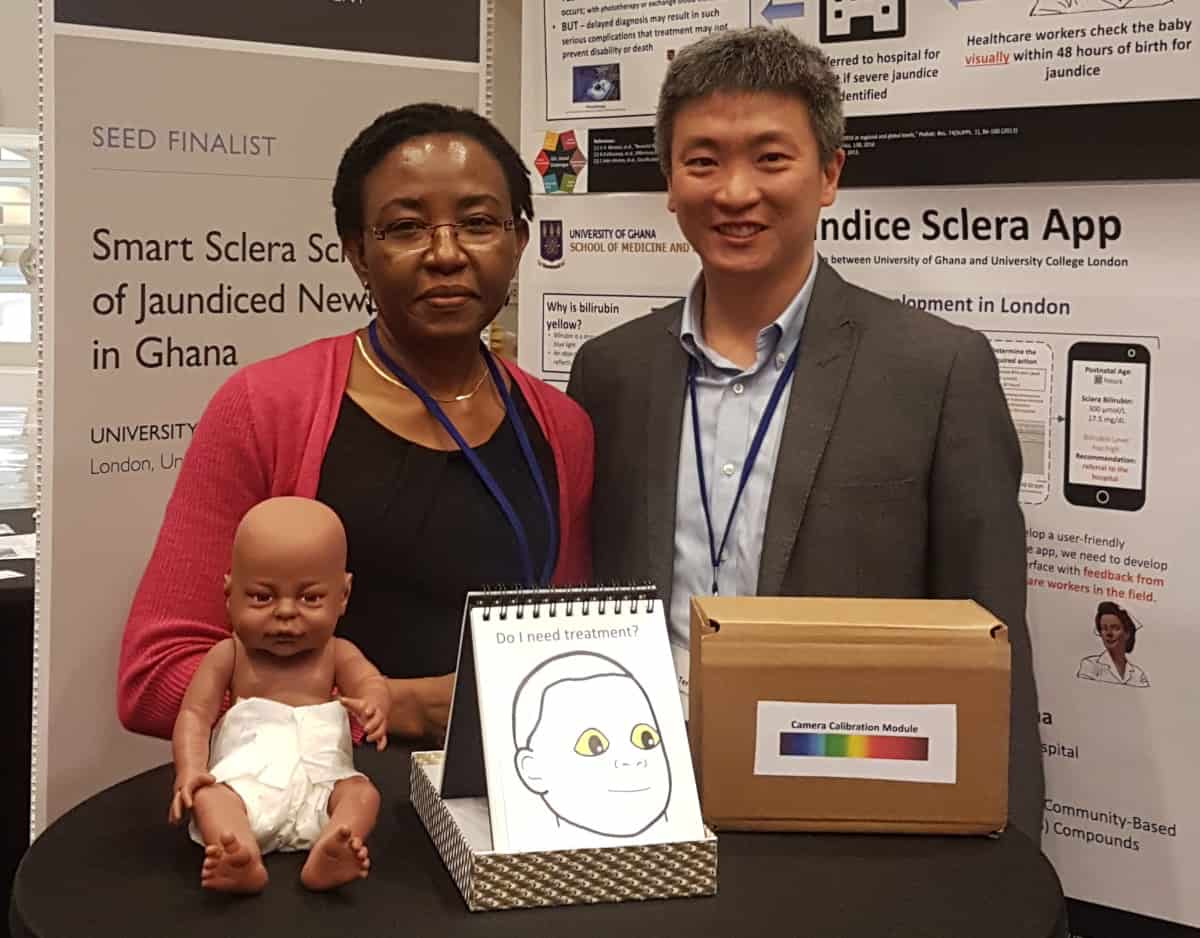
Smartphone screening: The neoSCB app is used to screen a Ghanian newborn for neonatal jaundice. The colour card seen in the photo is not required for the app, but was used to investigate ambient lighting. (Courtesy: Christabel Enweronu-Laryea/Terence Leung)
A smartphone app developed at University College London (UCL) identifies severe jaundice in newborn infants by scanning their eyes. The tool could prove invaluable in areas of the world that lack access to expensive screening devices.
A collaborative clinical study by researchers at UCL and the University of Ghana has now confirmed that the diagnostic performance of the neoSCB (neonatal scleral-conjuctival bilirubin) app is comparable to that of a conventional jaundice screening device.
Neonatal jaundice is caused by high levels of the pigment bilirubin in the blood, which build up when a newborn’s immature liver cannot remove bilirubin rapidly enough. Because bilirubin is toxic to the brain, if it crosses the blood–brain barrier it can cause brain damage. Without rapid treatment, an infant may suffer from permanent neurological dysfunction, developmental delays, hearing loss or even death.
The concentration of bilirubin in an infant’s blood can be assessed using a laboratory blood test or a transcutaneous bilirubinometer (TcB), a point-of-care device that takes a contact-based optical measurement of the skin. However, neither may be available to infants in low-resource countries and remote areas. Inability to test is a serious problem, because neonatal jaundice affects more than half of infants in their first week of life, a significant proportion of whom will need treatment.
Terence Leung, the developer of the technology behind the neoSCB app, explains that the smartphone camera technique works by quantifying the colour of the sclera (the white of the eye), as the degree of sclera yellowing is indicative of the systemic concentration of bilirubin. Leung and colleagues have been investigating the use of digital photography to measure sclera colour, and using this to quantify the scleral-conjunctival bilirubin (SCB), since 2014.
The app also incorporates ambient light subtraction, using the smartphone screen (front camera imaging) or the LED flash (rear camera imaging) to illuminate the subject. “This design explicitly addresses the confounding factors in colour measurement of jaundice – ambient light, camera characteristics and skin tone – while avoiding the need for add-ons or in-shot colour calibration cards,” Leung explains.
Clinical assessment
Following an initial pilot study on 37 newborns at University College Hospital London, the team performed a year-long study on 724 newborn babies in Ghana, publishing the findings in Pediatrics. The study was conducted at the Greater Accra Regional Hospital and at the Holy Family Hospital Nkawkaw, a district hospital in the Eastern Region.
Principal investigators: Christabel Enweronu-Laryea and Terence Leung at the Savings Lives at Birth Grant Challenge in Washington, DC, where they were awarded a grant to perform this study. (Courtesy: Christabel Enweronu-Laryea/Terence Leung)
The researchers used a Samsung Galaxy SB smartphone to record two images of each infant’s eye, with the LED flash on and off, enabling the use of ambient subtraction to minimize the effects of ambient light. To validate the diagnostic performance of the SCB level measured by the app, they also performed a TcB measurement using a Dräger JM-105 jaundice meter, plus a laboratory blood test, the gold standard to verify total serum bilirubin (TSB) levels.
Early in the study, the researchers optimized the neoSCB app by establishing an appropriate subtracted signal-to-noise ratio (SSNR) for quality control. The real-time SSNR is displayed on the app, making it easier to operate. They also added an option to zoom in on the captured image and manually choose an area-of-interest on the sclera to obtain a real-time calculated SCB value.
Principal investigators Christabel Enweronu-Laryea, of the University of Ghana Medical School, and Leung report that of the 336 infants who had not been previously treated for jaundice, the neoSCB app identified 74 out of 79 severely jaundiced newborns. By comparison, the TcB identified 76. The app exhibited reasonably high sensitivity and specificity, with a similar diagnostic accuracy to the JM-105 jaundice meter.
The TcB correlation with TSB was higher than SCB/TSB correlation, which had higher variance particularly when TSB was greater than the screening threshold of 14.62 mg/dl. The neoSCB app underestimated bilirubin at higher values of TSB, while the JM-105 gave no numerical values in similar conditions. The authors note that these findings are not clinically relevant for the smartphone app, which is designed to detect TSB levels that require additional clinical assessment and blood tests. However, they caution that the app should not be used in infants with a gestational age of less than 37 weeks, because it underestimates the scleral yellowness in preterm infants.
In addition to the hospital validation, 11 community healthcare workers in three rural communities in the Eastern region assessed the neoSCB app. They mastered its use with about 30 min of training and believe that it will be a highly effective and easy-to-use screening tool, especially since images and data can be electronically transmitted to hospitals when infants need additional testing.
“The neoSCB method was acceptable to mothers in urban and rural communities where the study was conducted. Mothers easily devised ways to keep the baby’s eye open, most often by initiating breastfeeding,” says Enweronu-Laryea. The researchers find the feedback from both the mothers and community healthcare workers encouraging, because many infants in sub-Saharan Africa have increased risk of severe jaundice due to the high prevalence of a genetic disorder associated with an increased risk of haemolysis (the destruction of red blood cells) and hyperbilirubinemia.
Now that the diagnostic algorithm in the neoSCB app has been validated, its user interface will be improved further to make it more user-friendly for healthcare workers. The researchers hope that the app can either be used independently, or integrated into established maternal–child healthcare apps as an additional functionality. The team is seeking international partners for the next steps of regulatory approval (FDA, CE mark and MHRA, for example) from countries where the neoSCB app would be used.
It’s rare in physics to be able to say “I was there” when a great discovery is announced. But several hundred people certainly enjoyed that privilege 10 years ago on 4 July 2012 as they crammed into CERN’s main auditorium. There they heard Joe Incandela and then Fabiola Gianotti – spokespeople for the CMS and ATLAS collaborations respectively – reveal the latest data from the Large Hadron Collider (LHC). The Higgs boson (or at least “a Higgs boson”) had been discovered. “I think we have it,” as CERN boss Rolf Dieter Heuer declared.
But what was astounding for such a technical discussion was that hundreds of thousands of people had tuned in from around the world to witness the event online. Hardcore particle physics had never been so popular, with non-physicists able to listen to discussions of the Standard Model, decay channels and standard deviations.
The announcement was a high-water mark for CERN. Over the previous few years, news about the LHC had been dominated by its early malfunction and scare stories the collider might make tiny – but potentially Earth-destroying – black holes.
Another celebration for high-energy physics that matches the discovery of the Higgs may be a long time coming.
The announcement of the Higgs boson was brilliantly choreographed by CERN, which let CMS and ATLAS take joint credit. In that way, the lab avoided a repeat of the messiness surrounding the discovery of the W and Z bosons 30 years earlier when one collaboration (UA1) hogged the limelight over the other (UA2). There was more good news in 2013 when Peter Higgs and François Englert shared that year’s Nobel Prize for Physics.
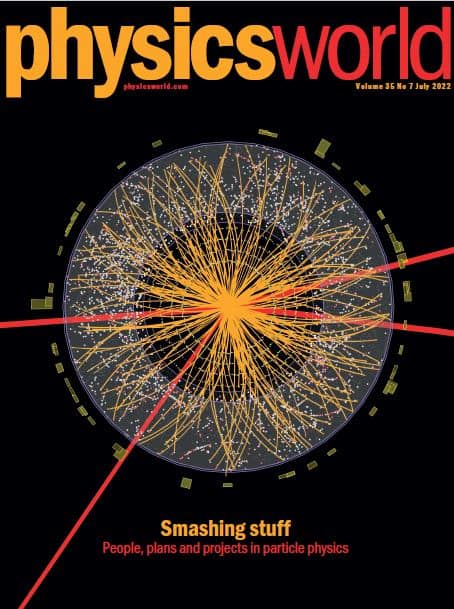
Smashing stuff: People, plans and projects in particle physics
Sadly, that early momentum was not sustained. Particle physicists hoped that signs of supersymmetry would be forthcoming but nature has not played ball.
Headlines over the last decade have instead been dominated by astronomy and astrophysics, with the discovery of gravitational waves and the imaging of black holes. A lot rests on the LHC’s Run 3, which is now under way, and on the subsequent conversion of the LHC into the High-Luminosity LHC. That upgrade will boost the machine’s luminosity 10-fold when it comes online in the 2030s.
In the US, Fermilab’s new director Lia Merminga is concentrating on “high-intensity” experiments, after the shutdown of the Tevatron collider, as she explains in an interview with Laura Hiscott.
Another celebration for high-energy physics that matches the discovery of the Higgs may be a long time coming.
• Satellite explains Betelgeuse dimming – Chance observations by a Japanese weather satellite has shed light on the process that led to Betelgeuse’s ‘Great Dimming’ in 2019. Keith Cooper reports
• ITER seeks new boss after Bigot dies – ITER Council searches for a long-term successor to Bernard Bigot as ITER deputy director Eisuke Tada takes over as interim head of the France-based fusion project. Michael Banks reports
• Gaia releases new Milky Way maps – The third data release from the European Space Agency’s Gaia mission is one of the richest sets of published astronomical information, as Michael Banks finds out
• IUPAP: uniting physicists for the last 100 years – Michel Spiro, president of the International Union of Pure and Applied Physics (IUPAP), talks to Laura Hiscott about the organization’s biggest achievements, its centenary celebrations, and its future
• Tracks of my tears – Physics is often viewed as a dispassionate and purely
objective activity. So how, wonders Robert P Crease, do we explain the reaction of Peter Higgs when the boson that bears his name was discovered?
• Green-sky thinking – The airline industry is emerging from COVID-19 with progress on de-carbonizing air travel, as James McKenzie discovers
• How to become a better supervisor – Rikke Plougmann argues that PhD students can only thrive if their wellbeing – and not just their scientific development – is properly supported
• A day in physics like no other – Achintya Rao recollects the momentous day 10 years ago when CERN announced it had discovered the Higgs boson
• Directing the future of Fermilab – Lia Merminga has just become the seventh director of the Fermi National Accelerator Laboratory in the US. She talks to Laura Hiscott about accelerator science, the future of particle physics and being the first woman to lead this iconic and influential research centre
• Helen Edwards: pioneer of the Tevatron – Helen Edwards was a formidable force in the field of accelerator science, whose impact can still be felt around the world today. Anita Chandran finds out more about her contributions to particle physics
• Making science centre stage – Jim Grozier reviews The Importance of Being Interested: Adventures in Scientific Curiosity by Robin Ince
• The man behind the machine – Achintya Rao reviews Elusive: How Peter Higgs Solved the Mystery of Mass by Frank Close
• On the particle pathway – Experimental physicist Freya Blekman talks to
Tushna Commissariat about the joy of working on big science collaborations
• Keep on keeping on – Exactly a decade after the announcement that the Higgs boson had been found, particle physicist Daniel Whiteson and artist Jorge Cham wonder how we can sustain the excitement of 4 July 2012 and what new particles – if any – might be awaiting discovery
It was around a quarter past midnight on 4 July 2012, and I was sprinting to catch the last tram of the night home from CERN, the particle-physics laboratory in Geneva, Switzerland. I had just spent the last few hours helping to put the finishing touches on an important article (one that was ultimately translated into 20 languages) that would soon appear on the website of the Compact Muon Solenoid (CMS) experiment, one of the two general-purpose particle detectors at the Large Hadron Collider (LHC).
As I rushed to the tram stop, I noticed the queue that had begun to form outside CERN’s main auditorium. A few enterprising students were asleep by the entrance, keen to get one of the handful of available seats for the seminar that was to begin at 9.00 a.m. that day. Outside, the night was clear and quiet, but in just a few hours the laboratory would be abuzz with crowds and excitement. Because today was the day that the CMS and ATLAS collaborations would announce the discovery of the Higgs boson.
An early Christmas present?
Anticipation had been building for months and wasn’t limited to scientific circles. On 13 December 2011, at a special end-of-year seminar at CERN, ATLAS spokesperson Fabiola Gianotti, together with Guido Tonelli, her CMS counterpart, had presented the latest results from each collaboration’s search for the Higgs boson. For years, CERN’s seminars had been publicly broadcast, as a way to serve the wider community of high-energy physicists, both experimentalists and theorists. Despite this being a highly technical seminar, it attracted an extremely wide audience of tens of thousands of viewers – including many journalists – from around the world. Indeed, the CERN IT team was forced to allocate additional resources to its streaming service, both for that seminar and to prepare for the attention that any potential discovery announcement might attract one day.
By late 2011, the LHC had delivered sufficient collisions to ATLAS and CMS at an energy of 7 TeV to allow the collaborations to start hunting through the range of masses where the particle had been predicted to be found. As she spoke, Gianotti could barely hide her excitement when she showed the slide with the regions that ATLAS had excluded in the search for the Higgs boson. The regions that had not been ruled out, however, continued to intrigue.
A slight excess was present at around 125 GeV, with a significance of 2.8σ – significantly less than the 5σ required to claim discovery, but enough to give everyone watching hope that the last piece of the Standard Model of particle physics was within our grasp. When he followed, Tonelli showed a similar excess in the CMS data. Although both collaborations cautioned that more data were needed to determine if the excess was indeed associated with the signal from a real particle, rather than the result of mere background fluctuations, it seemed as though Christmas had come early.
More data, however, were not immediately forthcoming. The LHC is a fantastically complex piece of machinery and requires regular maintenance. The behemoth was on its annual hibernation slumber at the time of the December seminar, and would only awaken in the spring. In February 2012 CERN announced that the accelerator would collide protons at an energy of 8 TeV that year, an increase of 0.5 TeV per beam; it would also deliver more collisions per second. ATLAS and CMS both began receiving collisions on 5 April, as the LHC broke its own record for the highest-energy particle collisions by an accelerator. But what these new data were to reveal would remain hidden for a little while longer.
Double-blind data, under wraps
Looking for a new particle at a particle accelerator involves some detective work. When two protons collide in the LHC, they may produce any of a number of heavy particles, including previously unseen entities such as the Higgs boson. But since these particles are unstable, they transform – or “decay” – almost instantaneously into lighter and more stable particles such as leptons (electrons or muons) and hadrons (e.g. neutrons). These decay products propagate through particle detectors such as ATLAS and CMS, leaving traces and energy deposits in the various layers that make up these instruments.
By aggregating the final states of the tracks and energies of the particles that billions upon billions of collision event leave in the detectors, physicists can work backwards to determine what the original particle produced in the collisions was. The data are typically examined using histograms of the masses of the decay products, with significant bumps in the data corresponding to the presence of a specific particle.
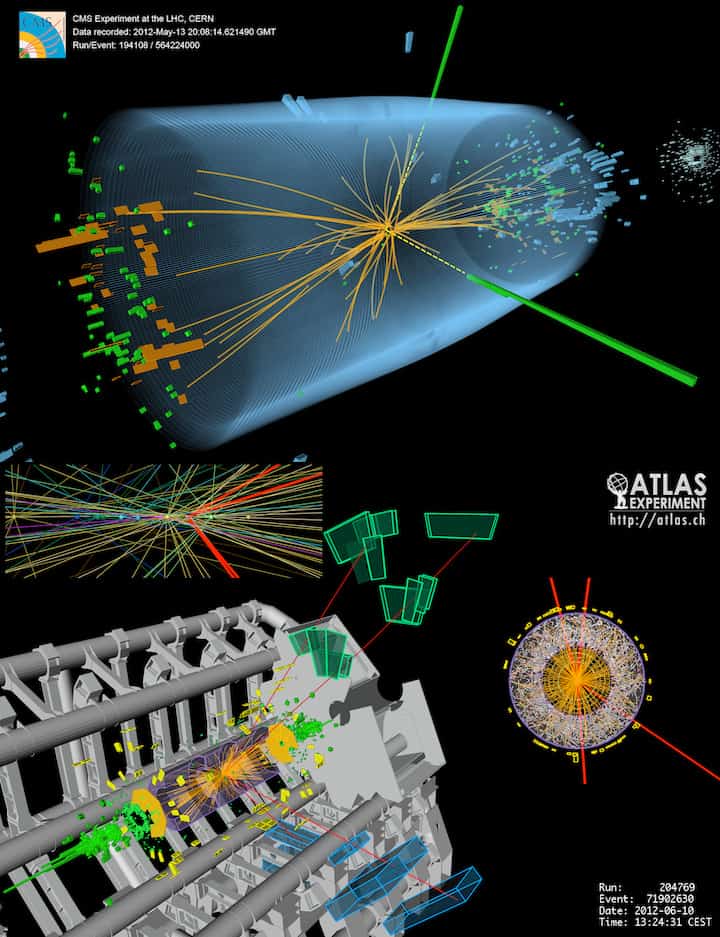
Key event Collision data from CMS (above) and ATLAS (below) showing signatures associated with the production of a Higgs boson. (Courtesy: CERN)
In the case of the search for the Higgs boson, the mass histograms for pairs of photons and for four leptons were critical. That is, the searches focused on cases in which a Higgs boson, after being produced, would transform into two photons; or cases in which it would transform into two Z bosons, with both transforming into pairs of leptons to give four leptons in the final state. Both ATLAS and CMS had reported a slight excess in these two datasets at the December 2011 seminar, and so took certain precautions when analysing the data being recorded in 2012.
To prevent subconscious biases from optimizing the analyses to augment the signals that had been seen in 2011, the collaborations did a “blind” analysis. Data in the mass regions that had been ruled out previously were used to optimize the analyses of the overall data, while the regions that had not been ruled out remained behind metaphorical blinds. Because the Higgs boson’s presence had been excluded in large mass ranges, there was no risk in using these data to minimize noise, and fine-tune the data processing. The mass regions of interest would not be analysed until the scientists were satisfied with their analysis methods. The analysis would then be extended to the entire dataset as part of the “unblinding” process.
Things moved swiftly on the accelerator’s part and in a few weeks the LHC had delivered more data than it had in all of 2011. On 15 June, just over two months after the 8 TeV data first started to arrive, experimental physicist Mingming Yang stood in front of her CMS colleagues, ready to present the results of the unblinding of the “two-photon” data. “With this, my heart is beating even faster,” she said, as she asked those of us gathered to brace ourselves for the next 15 minutes.
This was the first time those outside of the “Higgs to two photons” working group would see the results. Yang showed that the excess in the two-photon channel, from the combination of data from 2011 and 2012, had breached 4σ. Less than two weeks later, on 28 June, André David, who is today a section leader in CMS, presented the results for the same Higgs-to-two-photons channel, but which included the addition of new data collected in the interim.
As he stood in CERN’s main auditorium at an internal talk for CMS, David noted that with the additional data, the excess at 125 GeV seen by CMS now had a significance of 4.1σ. His talk to the packed auditorium took place only 16 hours after the full unblinding had been performed. Although those of us on CMS remained in the dark about what exactly it was that ATLAS had detected, we would soon find out what their data showed.
The room where it happened
On that historic day of 4 July 2012, at 6.15 a.m. after far too few hours of sleep, I took the tram back to CERN. As I made my way down the corridors to the main auditorium, I was amazed to see a serpentine queue outside the entrance, with those enterprising students I’d spotted the night before still at the helm. The queue wound from the auditorium entrance onto the landing and down a flight of stairs; it made its way past the post office, the bank and the kiosk into CERN’s Restaurant 1; it continued all the way to the coffee machines in the wing pointing towards the Alps, and on it went, out of the restaurant.
With the prime seats at the front of the auditorium already reserved for senior researchers and dignitaries, there were enough people in the queues to fill the available spaces several times over. Despite knowing they would not find a way in, those queuing had bright smiles on their faces. Eventually, only a small number were able to make their way into the auditorium and the gathered crowds had to be dispersed to the several conference rooms dotting the laboratory, where the proceedings from the main auditorium were to be screened live.
Over the years, CERN’s main auditorium has been the site of many famous talks and scientific pronouncements. But it was about to witness something never seen in the history of particle physics: hundreds of thousands of people tuning in from all over the world to watch a technical scientific seminar. The original intention had been for updates from ATLAS and CMS to be delivered at the biennial International Conference on High Energy Physics (ICHEP), which was taking place in Melbourne, Australia, that year. But CERN wanted the discovery to be announced “at home”, which led to a particle-physics conference being inaugurated from a different continent for the first time ever. Although taking place in Geneva, Switzerland, the seminar was nominally part of ICHEP itself, with participants connected between the two venues.
CERN director-general Rolf-Dieter Heuer welcomed the attendees at both sites, as well as those watching the webcast. Reversing the order from the December 2011 seminar, CMS would go first this time, with Joe Incandela, who had taken over as CMS spokesperson in the meantime, representing the collaboration. The presentation grew to a crescendo and as Incandela moved to the slide showing the mass and significance of the excess, the audience broke into applause even before he had finished speaking. At least one of the collaborations had seen a new particle.
This was the cue for us in CMS to make our article public. Sitting in the Council Chamber next to the main auditorium to help with the press conference that was to follow, my colleagues and I flipped the switch on the CMS website backend and began to share the article on social media. On the big screen in front of us, Gianotti soon began to speak and we turned our focus to the ATLAS results. Our hearts began to thump and we started to cheer when she showed us the mass and significance of the ATLAS observation. André David recalls being at the front of the auditorium as one of the young experts from CMS: “Seeing the results from the other team for the first time was like riding several rollercoasters all at once. I was connecting the dots, comparing the ATLAS results with our own and realizing that, well, this was more than a statistical fluke.”
Jubilation CERN staff gathered to watch the announcement of the Nobel Prize for Physics in October 2013. (Courtesy: CERN)
Jubilation in the post-Higgs era
What followed remains something of a blur to me. The press conference was held in Council Chamber, and we could barely contain our excitement. It was nearly lunchtime when the seminar and press conference were finished, and although many of us gathered in the restaurant, most were too excited to eat. The afternoon was spent eagerly chatting with colleagues and friends, and we were not keen to go back to work. Given the long hours everyone involved had put in over the previous weeks, no-one begrudged the desire to soak in the celebration. Some of us looked at the buzz on both traditional and social media with a feeling of contentment. The world had changed for ever and we were now in the post-Higgs era.
Despite the data, both ATLAS and CMS were wary of officially dubbing it “the” Higgs boson on that day – the new particle was cryptically described as having properties consistent with those of the Higgs boson. Over the coming months, both collaborations measured various properties of the particle, allowing them to cement the claim that the observed entity was indeed the Higgs boson predicted by the Standard Model of particle physics.
And…relax Achintya Rao celebrates with colleagues at CERN after the announcement in October 2013 that the Nobel Prize for Physics would be awarded to the science behind the Higgs boson. (Courtesy: CERN)
In October 2013, some 15 months after the big announcement of 2012, a different kind of anticipation began to swell at CERN. Rumours had begun to circulate regarding that year’s Nobel Prize for Physics. Without any guarantee for whom it would be awarded to that year, we nonetheless prepared for celebration. A few of us decided to broadcast the announcement, made by the Royal Swedish Academy of Sciences, live onto the screens in the CMS half of CERN’s Building 40, which normally showed the status of the LHC and the CMS detector.
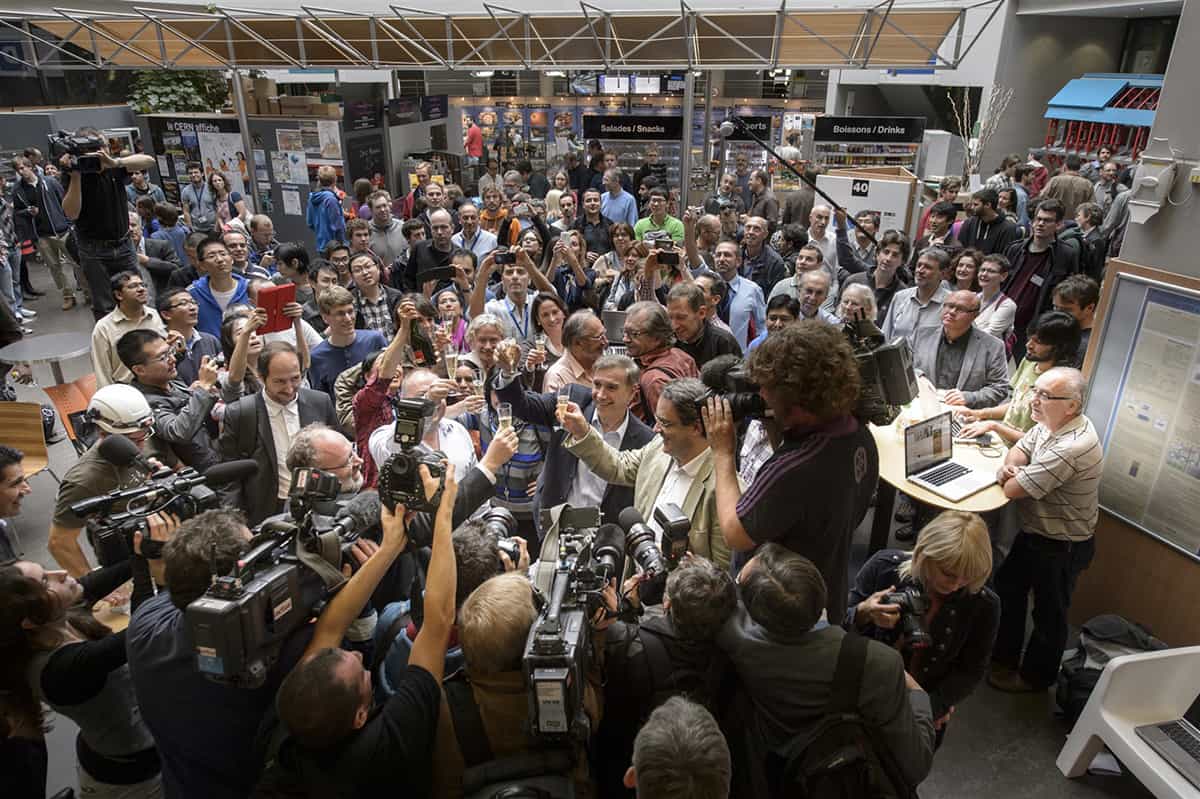
Crowds from both CMS and ATLAS began to gather next to the cafeteria in front of the screens, and a huge cheer reverberated through the building when it was announced that François Englert and Peter Higgs would be the latest Nobel laureates. Glasses of champagne were raised to celebrate the role that the experimental collaborations had played in 2012 to confirm the theoretical work done in 1964.
It is a pity that CERN has had no other celebrations of similar significance in the years since. The oceans at the energy frontier have revealed no new particle islands. But that does not mean that hope has been lost. At the time of writing, the LHC is about to embark on another data-collection run, this time pushing even closer to the maximum collision energy of 14 TeV the accelerator was designed for. After all, well over 95% of the potential data volume of the LHC’s lifetime still remains to be delivered. The Higgs boson has become a vital part of our toolkit to explore the vast unknown and, as David puts it, “We’ve barely scratched the surface.”
Monday 4 July 2022 marks the 10-year anniversary of that famous seminar at CERN when the discovery of a Higgs-like boson was confirmed. It was a shining example of the power of international collaboration and curiosity-driven research, and many hoped it would usher in a new era of discoveries beyond the Standard Model of particle physics.
In truth, the subsequent decade has been underwhelming for particle physics with few significant breakthroughs. But today the community is feeling energised once again as the Large Hadron Collider (LHC) has fired up after a three-year maintenance period. The upcoming third run of collisions will be at 13.6 trillion electron volts – close to the machine’s full capability.
This short film looks back at that historic moment in particle physics in 2012, and looks forward to the future of particle physics. Right now, LHC successor projects are looking precarious amid the turmoil of the pandemic and Russia’s invasion of Ukraine.
To find out more about the past, present and future of particle physics, take a look at July’s Physics World, a special issue devoted to the 10th anniversary of the Higgs boson discovery.
Synchrotrons and many board games have at least one thing are common – objects are accelerated in a circle but going round and round is not the main point of either. In board games, the object is fun and in “Diamond: The Game” there is also an educational element.
Developed by Mark Basham and Claire Murray at the UK’s Diamond Light Source synchrotron and Matthew Dunstan at the University of Cambridge, the game puts players in the role of a researcher at Diamond. By visiting different beamlines while progressing round the board, participants learn about the diversity of science that is done at the facility – including physics, chemistry, cultural heritage, and more.
Research covered in the game include a study of Rembrandt’s painting of Homer, COVID-19 drug screening, and work on the degradation of the Tudor warship Mary Rose.
STEM careers
The game is for two to five players and takes between 20-30 minutes to play. Diamond is suitable for ages 10 and up, and its inventors hope that it provides a realistic picture of what it is like to be a scientist – ultimately encouraging more young people to pursue careers in science, technology, engineering and medicine.
The game was play-tested by over 200 students and released online as a free-to-print game in 2020. The trio says that since then, Diamond has been played by more than 14,000 players in more than 30 countries worldwide. A boxed version of the game is now being delivered 100 schools in underserved areas of the UK.
In the true spirit of science, the researchers have published a paper about the game.
Burger flipping
It’s well into summer in the northern hemisphere so what better time than to get the barbecue out and fill the air with the smell of seared food. But what is the most effective way to grill a burger or a steak– flip the meat once or many times?
One school of thought is that you should flip only once as multiple times will mean less browning and therefore less flavour. Others, however, claim that regular flipping results in a more even cook and is also about 30% faster given that each surface of the meat is exposed to heat relatively evenly and with less time to cool down.
Mathematician Jean-Luc Thiffeault from the University of Wisconsin in the US has now created a “simple” model to demonstrate this speedy cooking time for flipped meat. Under the assumption that the burger is an infinite thin slab and has symmetric thermal properties – i.e. the same at the top and the bottom – he used a 1D heat equation to find that flipping the patty once results in a final cooking time of about 80 s. This reduces, however, for every subsequent flip so that some 20 flips results in a 20% drop in the cooking time.
Taking Thiffeault’s model to its mathematical extreme, the quickest cooking time finally reaches 63 s – or some 29% quicker than a one-flip. The only problem being that you have to flip the burger infinite times, which would challenge even the most experienced griller.
Physicists have created a light wave that is effectively unipolar, meaning it behaves as though it is solely a positive field pulse rather than the usual positive–negative oscillation found in electromagnetic waves. The positive pulse has a sharp peak and high amplitude and is powerful enough to switch or move electronic states, meaning that it could be used to manipulate quantum information and perhaps accelerate conventional computing as well.
Electromagnetic waves, and in particular light pulses, can be used to switch, characterize, and control electronic quantum states with incredible accuracy, explain team leaders Mackillo Kira and Rupert Huber of the University of Michigan in the US and the University of Regensburg in Germany. However, the shape of such pulses is fundamentally restricted to a combination of positive and negative oscillations that sum to zero. As a result, the positive cycle may move charge carriers (electrons or holes), but then the negative cycle pulls them back to square one.
Positive peak is strong enough to switch or move electronic states
An ideal quantum-electronic switch pulse would be so highly asymmetrical as to be completely unidirectional – in other words, it would contain only a positive (or negative) half-cycle of field oscillation. Under these conditions, such a pulse could flip a quantum state, such as a quantum bit, in minimum time (a half cycle) and with maximum efficiency (no back-and-forth oscillations).
This is fundamentally impossible for freely-propagating waves, but Kira, Huber and colleagues found a way to create the “next best thing” in the form of a quasi-unipolar wave consisting of a very short, high-amplitude positive peak sandwiched between two long, low-amplitude negative peaks. “The positive peak is strong enough to switch or move electronic states,” Kira and Huber explain, “while the negative peaks are too small to have much of an effect.”
In their work, the researchers started with a newly developed stack of nanofilms made of different semiconductor materials, such as indium gallium arsenide (InGaAs) that was grown epitaxially on gallium arsenide antimonide (GaAsSb). Each of the nanofilms is only a few atoms thick, and at the interface between them, ultrashort laser pulses can excite electrons mainly in the InGaAs film. The holes left behind by the excited electrons remain in the GaAsSb film, creating a charge separation.
Effective half-cycle light pulses
“We then made use of our quantum-theoretical breakthrough in exploiting the electrostatic attraction between the oppositely charged electrons and holes to pull them back together in a precisely controlled way,” Kira tells Physics World. “The fast charging and slower charge oscillations combined emitted the unipolar wave that we tailored as effective half-cycle light pulses in the far-infrared and terahertz part of the electromagnetic spectrum.”
Huber describes the resulting terahertz emission as “stunningly unipolar”, with the single positive half-cycle peaking about four times higher than the two negative peaks. While researchers have been working for a long time on producing light pulses with fewer and fewer oscillation cycles, the possibility of generating terahertz pulses so short that they effectively comprise less than a single half-oscillation cycle was, he adds, “beyond our bold dreams”.
Kira and Huber say that these unipolar terahertz fields could be a powerful tool for controlling novel quantum materials on time scales that are comparable to microscopic electronic motion. The researchers suggest that the fields could also serve as superior, well-defined “clockworks” for next-generation ultrafast electronics. Finally, the new emitters are, they claim, “perfectly adapted” to operate in combination with industry-grade high-power solid-state lasers and could thus form “an extremely scalable platform for applications in both fundamental science and industry”.
The researchers, who report their work in Light: Science & Applications, say they have begun to use these pulses to explore new platforms for quantum information processing. “Other applications include coupling these pulses into a scanning tunnelling microscope, which allows us to speed up atomic-resolution microscopy to few-femtosecond time scales (1 fs = 10-15 s), and thus capture the real-space and -time motion of electrons in actual ultraslow-motion microscopic videos,” they explain.
In this episode of the Physics World Weekly podcast we explore how climate change is affecting human and natural systems with Noah Diffenbaugh, who leads the Climate and Earth System Dynamics Group at Stanford University in California.
Diffenbaugh is editor-in-chief of the new journal Environmental Research: Climate, which is published by IOP Publishing (which also produces Physics World). He talks about the aims of the journal and how will it help us better understand climate change and its effects.
Also in this episode, Physics World’s Tami Freeman quizzes me on artificial intelligence and how it is being used in medical physics. Try the questions yourself and see if you can beat my score.
If ancient shorelines exist on Mars, they would be largely scoured from view by billions of years of asteroid impacts. That is according to a new study by researchers in the US, who used computer modelling to simulate eons of cratering on the Martian surface.
Since the 1990s, some planetary scientists have argued that certain landforms and surface features on Mars are the relic edges of dried-up oceans that covered huge swathes of the Red Planet. Their existence has been one of the central planks in the argument that vast bodies of water once sat on the planet’s northern plains, but there is still debate over whether they are genuine shorelines.
Among the most prominent features that have been proposed as shorelines are the so-called Deuteronilus and Arabia Levels, the latter of which is thought to date to roughly four billion years ago.
“The Arabia Levelis older and has a higher elevation of the two, so if it is really a shoreline, it would represent a larger ocean,” explains Mark Baum, a planetary scientist at Harvard University in the US. “[While] the Deuteronilus Level may represent a considerably smaller ancient ocean.”
According to Baum, the two potential shorelines roughly follow the boundary between the two parts of what is known as the “hemispheric dichotomy” on the Martian surface – the “dichotomy” being a noticeable difference between the smooth northern regions of Mars’s globe and its cratered southern uplands.
Our study shows that it would be very difficult to observe continuous ancient shorelines [today]
Mark Baum
Baum and colleagues have now used supercomputer simulations to examine what would happen to ancient shorelines, like Arabia and Deuteronilus, under the onslaught of billions of years of asteroid and comet impacts (arXiv:2206.09816). “We assume that if some part of a proposed shoreline is intersected by an impact, it would no longer be observable as a shoreline,” says Baum. “It would be obliterated by the violence of impact.”
The simulations show that some 70% of a four-billion-year-old shoreline would be erased after eons of impacts while 10–50% of a younger one – similar in age to the Deuteronilus Level – would be destroyed.
Geological signs
Elena Favaro, a planetary scientist based at the Open University in the UK, who was not involved with the new research, thinks the study “adds compelling evidence” to the body of research that questions the existence of shorelines on Mars. “There is a fair amount of scepticism within the community for relic shorelines, and the veracity of using this evidence for a global ocean,” she says.
Favaro adds, however, that there is other geological evidence for large bodies of water having existed on the planet, which includes “extensive channel and valley networks terminating at topographically low points”. These, she says, “shouldn’t be dismissed”.
Baum says it “remains possible” that the features are indeed shorelines. “We still can’t say with certainty. At this point though, we should be very cautious with claims that they’re real,” he argues. “Our study shows that it would be very difficult to observe continuous ancient shorelines [today], especially ones that are four billion years old, which would be difficult to observe at all.”
If the Arabia and Deuteronilus Levels aren’t shorelines, it might be that they are a mix of deposits left by volcanoes, floods and Martian glaciers says Baum. “Or perhaps [they’re] simply the result of degrading lithological units along the dichotomy,” he adds. “We should send geologists there to find out.”
The number of aerosol particles exhaled by people who are exercising increases 132-fold on average during periods of peak physical activity. This finding, from researchers at the Universität der Bundeswehr München in Germany, may help explain reports of high transmission of the SARS-CoV-2 virus in poorly ventilated indoor spaces such as gyms, and might also aid in the development of measures to reduce such transmission.
A graded exercise test
In the new work, scientists led by fluid-dynamics expert Benedikt Mutsch developed a way to measure the concentration of aerosol particles in expired (that is, breathed-out) air as people exercise more intensely – “from rest to exhaustion”, as they describe it. Using this method, they tested a group of 16 healthy volunteers – eight men and eight women – aged between 21 and 40. Seven of these volunteers were considered fitter than the others based on their measured VO2max, which is the maximum volume of oxygen (in millilitres) that can be metabolized under load.
The volunteers undertook a graded exercise test on a piece of equipment called a cycle ergometer that was located in a tent containing a reduced concentration of aerosol particles in the ambient air. During this test, volunteers in this “clean air tent” inhaled filtered air with very low aerosol particle concentration. Starting from rest, the researchers measured the subjects’ ventilation and aerosol particle concentration directly in the air they exhaled.
Big increases in aerosol concentration
Mutsch and colleagues found that the concentration of aerosol particles in the air expired by the volunteers increased significantly with exercise, rising from 56 +/– 53 particles/litre when they weren’t exercising to 633 +/– 422 particles when they were. Aerosol particle emission per subject also increased by a factor of 132 on average, rocketing from 580 +/– 489 particles/minute at rest to a “superemission” of 76,200 +/– 48,000 particle/min during times of peak exertion. The results were roughly the same for men and women, but there was a twist: the fitter volunteers exhaled many more aerosol particle particles during maximal exercise than did the other participants.
These results imply that aerosol particle emission increases exponentially above moderate exercise intensity, resulting in superemission during maximal exercise intensity, say the researchers. The new data might also partly explain so-called superspreader events, when large numbers of people are infected simultaneously by a small number of infectious individuals. Several such events have been reported during high-intensity group exercise in indoor spaces like gyms, they add, suggesting that measures need to be taken to prevent disease transmission between people who are exercising in these spaces.
“Mitigation measures might be adjusted to high-risk settings, for example,” Mutsch tells Physics World. “The aim should be to define criteria to make exercise safe.”
Steps for reducing risk
In situations of high risk of infection, the most important steps to take, according to Mutsch, are keeping a safe distance from others; ensuring that a good mechanical ventilation (HVAC) is in place; ventilating rooms by opening doors and windows; wearing face masks whenever physical distancing is not possible (for example, in changing areas); reducing the time spent in spaces where people are exercising with high intensity; and finally limiting the number of people in a given space.
The researchers, who report their work in PNAS, are now investigating a larger group of subjects – up to 80 – spanning different age groups and body-mass indices (BMIs), since there is some evidence that age and BMI may influence the amount of aerosol particle emission. “We also want to study what happens during resistance exercise, since the way people inhale and exhale might be different here,” says Mutsch.
A new bendable organic light-emitting diode (OLED) that produces warm, candle-like light with hardly any emissions at blue wavelengths might find a place in flexible lighting and smart displays that can be used at night without disrupting the body’s biological clock. The device, which is an improved version of one developed recently by a team of researchers from National Tsing Hua University in Taiwan, is made from a light-emitting layer on a mica substrate that is completely free of plastic.
Jwo-Huei Jou and Ying-Hao Chu of the National Tsing Hua University’s Department of Materials Science and Engineering and colleagues recently patented OLEDS that produce warm, white light. However, these earlier devices still emit some unwanted blue light, which decreases the production of the “sleep hormone” melatonin and can therefore disrupt sleeping patterns. A further issue is that these OLEDs were made of solid materials and were therefore not flexible.
Mica, a natural layered mineral
One way to make OLEDs flexible is to paste them onto a plastic backing, but most plastics cannot be bent repeatedly – a prerequisite for real-world flexible applications. Jou, Chu and colleagues therefore decided to investigate backings made from mica, a natural layered mineral that can be cleaved into bendable, transparent sheets.
The researchers began by depositing a clear indium tin oxide (ITO) film onto a mica sheet as the LED’s anode. They then mixed a luminescent material, N,N’-dicarbazole-1,1’-biphenyl, with red and yellow phosphorescent dyes to fabricate the device’s light-emitting layer. Next, they sandwiched this layer between electrically conductive solutions with the anode on one side and an aluminium layer in the other to create a flexible OLED.
Tests showed that when coated with a transparent conductor, the mica substrate is robust to bending curvatures of 1/5 mm-1 – a record high – and 50 000 bending cycles at a 7.5 mm bending radius. The OLED is also highly resistant to moisture and oxygen and has a lifetime that is 83% of similar devices on glass.
“Romantic” light
The new device emits bright, warm light upon the application of a constant current. This light contains even less blue-wavelength light than natural candlelight, Jou and Chu report, meaning that the exposure limit for humans is 47 000 seconds compared to just 320 s for a cold-white counterpart, according to the team’s calculations. This means that a person exposed to the OLED for 1.5 hours would see their melatonin production suppressed by about 1.6%, compared to 29% for a cold-white compact fluorescent lamp over the same period.
“We have fabricated an OLED emitting a psychologically-warm but physically-cool, scorching-free romantic candle-like light on a bendable mica substrate using our patented candlelight OLED technology,” Jou tells Physics World. “This technology could provide designers and artists with more freedom in designing variable lighting systems that fit into different spaces, thanks to their flexibility.”
The researchers now hope to make their OLEDs completely transparent. “When lit, these candlelight OLEDs could then be seen from both sides,” Chu says.