Single metasurface could generate record numbers of trapped neutral atoms

Physicists in China have demonstrated that a structure called an optical metasurface can individually trap up to 78,400 neutral atoms – a promising development in efforts to build a large-scale quantum computer. The method, which is similar to one demonstrated independently by a team at Columbia University in the US, could help overcome a troublesome bottleneck for computers that use neutral atoms as their quantum bits (qubits).

Arrays of trapped neutral atoms are widely employed in physics research, and they are a promising platform for quantum computing. Their main drawback is scalability, explains physicist Zhongchi Zhang, who co-led the new study together with his Tsinghua University colleague Xue Feng. The components normally used to make such arrays, such as spatial light modulators (SLMs) and acousto-optic deflectors (AODs), can only create around 10,000 atom traps at any one time, and are thus limited to a maximum of 10,000 atomic qubits.

Flat optical surfaces made up of 2D arrays of metasurfaces

In their work, which is detailed in Chinese Physics Letters, Zhang and colleagues replaced SLMs and AODs with two-dimensional arrays of metasurfaces – artificial nanostructures that manipulate light in much the same way as traditional optics, but with far less bulk. To do this, they used a method known as a weighted Gerchberg-Saxton algorithm to design a metasurface made up of nanoscale pillars that can transform a single input laser beam into a 280 x 280 array. They then constructed this metasurface from silicon nitride using electron-beam lithography and reactive ion etching. Both methods are compatible with standard complementary metal–oxide–semiconductor (CMOS) manufacturing techniques and are thus highly reproducible.

The result is a set of nanoscale, light-manipulating, pixel-like structures that act like a superposition of tens of thousands of flat lenses. When a laser beam hits these “lenses”, they produce a unique pattern that contains tens of thousands of focal points. As long as the laser light is intense enough, each of these focal points can be used to trap and manipulate atoms via a well-established technique called optical tweezing.

Zhang explains that the main advantage of trapping atoms this way is that the metasurface generates the array of optical tweezers on its own, without the need for additional bulky and expensive optical components such as microscope objectives to focus the light. Another benefit is that such arrays are very robust to high laser intensities, which are a prerequisite when the goal is to trap hundreds of thousands of atoms. Indeed, Zhang says that arrays of this type can handle powers several orders of magnitude higher than is possible with arrays made using SLMs and AODs. The intensity of the light is also highly uniform (90.6%) across the array, and individual beams feature an Airy disk-like profile with an average first dark radius of around 1.017 µm – parameters that Zhang says are “ideal for trapping single atoms”.

Improving fault-tolerant quantum computing

“Our work addresses the critical need for scalable physical qubit arrays required for improving ‘fault-tolerant’ quantum computing and making it more robust to errors,” Zhang tells Physics World. “Since quantum error-correcting codes may call for hundreds of physical qubits to build a single logical qubit, scalability here becomes paramount.”

Researchers at Columbia University also recently demonstrated an atom-trapping array that replaced SLMs and AODs with flat optical metasurfaces. But whereas the Columbia team managed to create 360,000 tweezers with extreme pixel efficiency (around 300 pixels/tweezer, with over 95% uniformity) the Tsinghua University group prioritized the array’s robustness at higher laser power, achieving around 1354 pixels/tweezer. Both studies have validated the use of metasurfaces as a scalable platform beyond the limitations imposed by AODs and SLMs, says Zhang.

Spurred on by their preliminary results, Zhang and colleagues report that they are now fabricating a 19.5 mm-diameter metasurface designed to generate approximately 18,000 optical trapping sites. Their goal is to place this metasurface outside the vacuum chamber that contains the trapped atoms. “Such an external configuration represents a significant departure from conventional approaches and is expected to enable the trapping of over 10,000 atoms, surpassing current records while substantially simplifying the experimental setup,” Zhang explains.

The team is also developing a next-generation integrated architecture in which metasurfaces will replace the fluorescence imaging microscopes used to characterize trapped atoms, as well as the optical tweezer arrays used to trap them. “This approach aims to create a completely new system paradigm for neutral-atom quantum computing that eliminates the need for traditional bulky optics, enabling unprecedented compactness and scalability for future quantum processors,” Zhang says.

Physicists demonstrate long-predicted exotic magnetic phases in 2D material

Physicists in the US and Taiwan have performed new experiments that verify long-standing theoretical predictions of how long-range magnetic order can emerge in atomically thin materials. Led by Edoardo Baldini at the University of Texas at Austin, the researchers showed how the transformation occurs through two distinct phase transitions – possibly paving the way for new generations of ultracompact magnetic materials.

Atomically thin two-dimensional (2D) materials are widely studied for their diverse electrical, optical, mechanical and thermal properties. So far, however, their magnetic properties have generally remained far more elusive. Underlying the problem are inevitable thermal fluctuations, which make it extremely difficult to sustain magnetic order over distances larger than atomic scales.

For decades, theorists have investigated a possible exception to this rule in “2D XY” systems: featuring flat arrays of spins that can rotate continuously within the plane and interact with neighbouring spins. One particularly interesting extension of this model describes how a phase transition can occur when these spins become locked into one of six preferred directions, corresponding to the symmetry of the crystal lattice.

“In the 1970s, theoretical work showed that 2D XY magnetic systems with this six-fold anisotropy could exhibit an unusual sequence of phase transitions described by the six-state ‘clock model’, including an intermediate Berezinskii–Kosterlitz–Thouless (BKT) phase,” Baldini explains. “These ideas became central to the theory of low-dimensional magnetism.”

Since these theories emerged, however, such effects have proven far more challenging to observe in real 2D materials.

Verifying the predictions

To tackle this challenge, Baldini’s team turned to a technique involving nonlinear optical microscopy, based on second-harmonic generation: where a material probed by intense light at one frequency emits secondary light at twice that frequency. Crucially, the polarization of this secondary light is highly sensitive to magnetic behaviour. This allowed the researchers to examine magnetic order in the atomically thin antiferromagnet nickel phosphorus trisulphide (NiPS3) without disrupting the system with invasive electrical contacts.

“By tracking how the optical response evolves with temperature, we were able to directly follow successive magnetic phase transitions and determine the universality class of the emergent magnetic phases,” Baldini explains. “In addition, polarization-resolved measurements allowed us to reconstruct the symmetry of the magnetic order parameter.”

As the researchers cooled the material, their measurements revealed two key phase transitions – each occurring suddenly below a distinct critical temperature. “The first transition marks the onset of a BKT phase, an unusual state in which magnetic correlations extend over long distances without forming conventional long-range order,” Baldini says.

In this phase, the material forms bound pairs of vortices and antivortices: topological defects in the spin field triggered by thermal fluctuations. Within these swirling patterns, spins collectively curl around single points, either in clockwise or anticlockwise directions.

At higher temperatures, these swirling patterns are isolated and can roam freely through the material, disrupting the emergence of long-range magnetic order. But when vortices and antivortices are bound together, their disruptive influences largely cancel each other out: allowing spin correlations to persist over longer distances, while still remaining sensitive to thermal fluctuations.

As the researchers cooled the NiPS3 further they observed a second phase transition, in which vortices and antivortices are suppressed and a six-state clock phase emerges. But this symmetry was constrained even further: across the whole system the six possible spin orientations could themselves be arranged in just two distinct ways. This interplay between six- and two-fold anisotropy ultimately gives rise to stable long-range magnetic order, just as earlier theories had predicted.

Through their experimental validation, the team’s results shed new light on the rich and unexpected magnetic phenomena that can emerge in 2D materials. Revealing two distinct phases, the work highlights how magnetism can arise in fundamentally different ways to that seen in more familiar three-dimensional materials.

“More broadly, these results establish atomically thin magnets as a powerful platform for exploring topological phase transitions and may inspire new approaches to controlling magnetism at the nanoscale for future ultracompact technologies,” Baldini says.

The findings are reported in Nature Materials.

Inside the world’s particle‑physics labs: Global Physics Photowalk 2025 winners revealed

From an image of a detector hunting for signs of dark matter to a picture of a deep-sea neutrino telescope studying astrophysical phenomena, the winning entries for the 2025 Global Physics Photowalk have been announced by the Interactions Collaboration – an international network of particle physics institution.

Some 16 labs around the world took part in the event, in which they opened up their labs for a day in 2025 to amateur and professional photographers.

Each lab then entered their top three images into the global competition and from those 48 images a panel of judges selected their top three photos while the public also chose their top three favourite images via an online vote held on 13–27 January.

Marco Donghia’s photograph, main image above, was picked in first place by the judges. It features a researcher sat in front of the Cryogenic Laboratory for Detectors, which is based at INFN National Laboratories of Frascati. The experiment aims to detect extremely weak and rare signal such as those produced by dark matter.

“Finding out I had won left me speechless,” notes Donghia. “The cryostat I photographed is just a few fractions of a degree above absolute zero, yet this recognition filled me with such warmth and emotion that no cryogenic temperature could cool them down.”

The image on the left won first place in the public vote. It shows the back of the linear accelerator of SPIRAL2 at the Large Heavy Ion National Accelerator, GANIL, based in Caen, France.

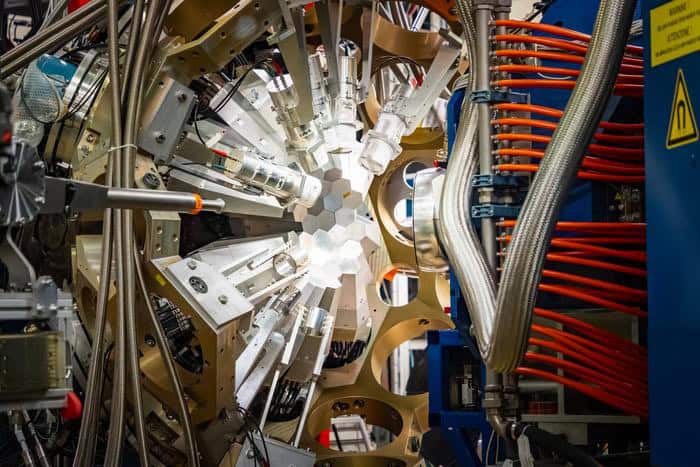
Second place in the judges competition, meanwhile, went to Matteo Monzali for his photo, shown below, of the Advanced Gamma Tracking Array photon detector coupled with PRISMA magnetic spectrometer.

The experiment is based at the TANDEM-ALPI-PIAVE accelerator complex at INFN National Laboratories in Legnaro.

the Advanced Gamma Tracking Array photon detector

Third place in the judges competition, below, goes to a spectacular close-up image of a photomultiplier from the KM3NeT/ORCA experiment, a neutrino telescope currently being installed in the Mediterranean Sea off the coast of Provence, France.

A photomultiplier from the KM3NeT/ORCA experiment

This is the fifth international Photowalk following events held in 2010, 2012, 2015 and 2018.

All 48 images that were submitted to the 2025 competition can be viewed here.

Stripes of Enceladus: a jigsaw puzzle

There are two difficulty settings: choose between an 88-piece jigsaw and the 40-piece version.

Image courtesy: NASA/JPL/Space Science Institute

Fancy some more? Check out our puzzles page.

Self-healing materials could make automobile parts last over 100 years

Researchers from North Carolina State University and the University of Houston have achieved sustained self-healing of a composite material. The findings promise to extend the lifetime of aircraft and automotive parts by a century, according to a recent paper published in the Proceedings of the National Academy of Sciences.

Composite materials bond two or more components to achieve balanced strength, flexibility and durability. Bone is a naturally occurring example, combining flexible collagen fibres with the stiffness of various minerals. Fibre-reinforced polymers (FRPs) are synthetic analogues that embed strong fibres within a polymer matrix to achieve similar material advantages, making them ubiquitous in aerospace, naval and wind energy sectors.

While bonding multiple layers is necessary to enforce strength, it makes the material prone to interlaminar delamination, or the separation of layers. Lead researcher Jack Turicek describes this type of delamination as “one of the most common and life-limiting failure modes in FRPs”. While nature boasts the remarkable ability to autonomously and repeatedly heal from delamination, achieving a similar feat in synthetic materials has only now become possible.

Healing by thermal remending

The researchers used a method known as “thermal remending” to enable self-healing. First, a healing agent, poly(ethylene-co-methacrylic acid) or EMAA, is embedded into a glass-fibre epoxy-matrix composite during curing. This forms strong covalent bonds between EMAA and the epoxy.

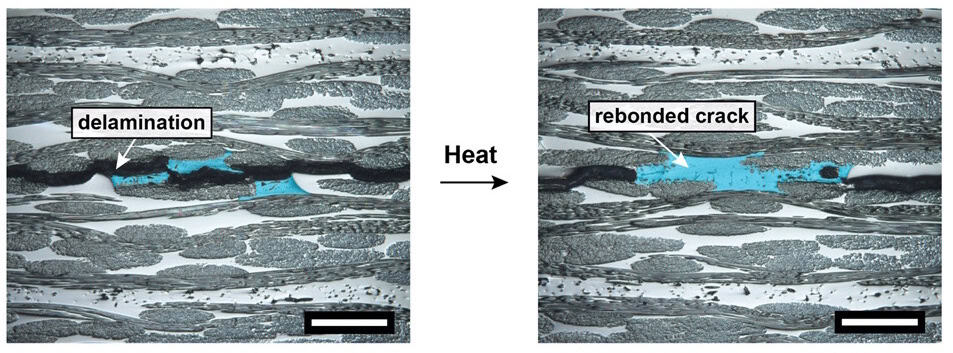
To test their materials, the researchers systematically created a fracture by applying controlled tensile loading until the fracture reached 50 mm. Then, to initiate healing, they warmed the material using built-in electrical heaters. The heat vaporized small water bubbles created during the initial curing process, which produced a microporous network that physically expanded and spread the EMAA into the fracture – the so-called “pressure delivery mechanism”.

Afterwards, 30 min of natural convective cooling to room temperature allowed the EMAA to solidify, forming new hydrogen and ionic bonds between EMAA and epoxy. The bonds reconnected the interfaces that had fractured, recovering the structural integrity of the material.

Self-healing of a composite material

The team repeated the entire procedure over 1000 cycles. Such a prolonged study was previously infeasible due to multi-day cycle lengths. In this work, the researchers set up programmable electrical, thermal and mechanical devices that automatically initiated fracturing, sensed progress to trigger healing, and monitored the rebonded crack before repeating the cycle. This automation reduced cycle lengths to an hour and the full experiment to only 40 days.

Understanding sustained healing

The team quantified the healing effectiveness using the critical strain energy release rate (GIC), a measure of the energy required to propagate a crack. A high GIC means that the material is resilient and well-healed. The EMAA-containing material showed maximum healing at test cycle 7, with 230% the GIC value of an RFP containing no EMAA. The results declined to 180% by cycle 100 and 60% by cycle 1000. When the data was fitted to a Weibull distribution, a common model for material failure, healing asymptotically approached a lower limit of 40% – suggesting that sustained repair is possible.

Optical and electron microscopy revealed two reasons for the observed decline in healing performance. First, the repeated fracture and healing process resulted in accumulation of glass fibre debris in EMAA, which blocked bonding sites. Second, chemical reactions between EMAA and the epoxy matrix are responsible for creating strong covalent bonds between them (necessary for cohesive fracturing of EMAA) and producing the bubbles for the pressure delivery mechanism. The microscopy showed a decline in both reactions, reducing the effectiveness of fracture recovery.

From prototype to practice

Out of the 1000 cycles tested, the self-healing composite maintained over 100% fracture recovery compared with non-EMAA materials for 500 cycles. Based on a 500-cycle lifetime, parts made using the new material could last 125 to 500 years, assuming a quarterly or annual repair schedule – a timeline that far exceeds current design lifetimes of about 40 years.

Integration with existing industry infrastructure is forthcoming. “We have designed both the healing agent interlayers and the resistive heaters to be easily integrated into real-world composites with existing fabrication processes. These functional components enable in situ self-healing (i.e., in the service environment) via electrical power input to the heaters,” says Turicek. “To enable autonomous self-healing, a sensing element that can detect damage is needed to automatically trigger the power on, and power off once repaired. We have such technology on the near horizon.”

The technology has been patented by Jason Patrick, the principal investigator of this research and chief technology officer of the startup company Structeryx. Patrick says that the company intends to “engage with existing and new defence/industry partners to customize the technology for various needs”, in addition to scaling manufacturing.

While we often search for ways to fix broken items, materials of the future may perhaps fix themselves.

A bursting bubble can make a puddle jump

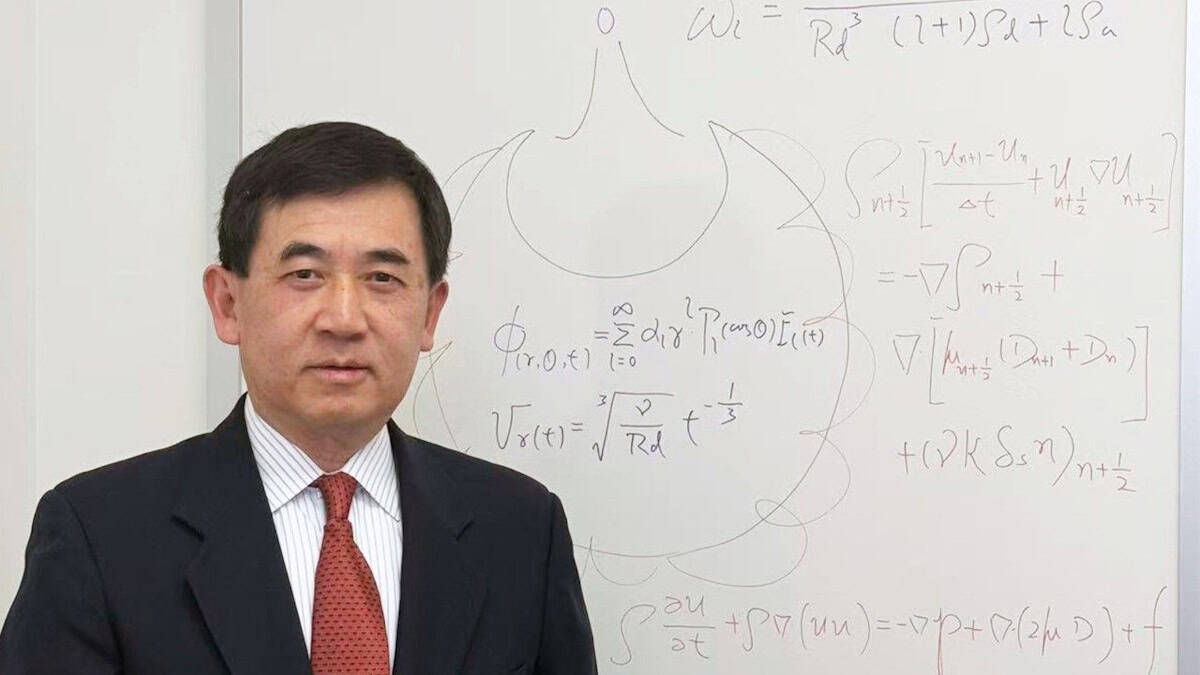
Jiangtao Cheng of Virginia Tech

On a quiet spring morning, when dew settles on leaves, something curious sometimes happens. A droplet sitting there peacefully will suddenly lift off. No wind. No vibration. Just a tiny leap into the air.

Physicists call this phenomenon droplet jumping. In simple terms, it means that a droplet lifts off from the surface it sits on. If a raindrop hits a leaf and rebounds upward, that rebound can also be considered droplet jumping.

While this may seem like a minor detail in fluid behaviour, removing liquid from surfaces is important for many technologies. When droplets detach from a contaminated surface, they can carry away particles, a process that forms the basis of self-cleaning materials. When droplets leave hot surfaces, they remove heat. And on cold surfaces, quickly removing droplets can help prevent ice buildup.

For years, scientists believed that there was a physical limit to how large these jumping droplets could be. A new study published in Nature has now shown that this limit can be broken, with the help of a bubble.

The research was headed up by Jiangtao Cheng’s lab at Virginia Tech, and performed in collaboration with researchers from the Hong Kong University of Science and Technology and Wuhan University of Technology.

A stubborn limit in droplet physics

Within a droplet, two forces compete constantly: the first is surface tension, the other is gravity.

Surface tension tries to pull the droplet into a sphere, which minimizes its surface area and, therefore, its energy. Gravity, meanwhile, pulls the droplet downward, flattening it against the surface.

The balance between these two forces defines the so-called capillary length – which for water is 2.7 mm. Below this length, surface tension dominates and droplets can sometimes propel themselves upward. Above this length limitation, gravity takes over.

This balance has long been a fundamental barrier in the field of self-propelled droplet jumping. “For droplets larger than the capillary length, gravity dominates,” Cheng tells Physics World. “Simply releasing surface energy from shape relaxation is no longer sufficient to generate enough upward momentum for jumping.”

That is why most previous studies have observed droplets no larger than about 3 mm jumping on their own.

Inspiration from nature

The idea behind the new research began with observations in nature. First author Wenge Huang, who grew up in rural South China, often saw dew droplets on lotus leaves containing tiny air bubbles. Occasionally, when those bubbles burst, the droplets moved.

Years later, that observation led to a question: “could a bubble trapped inside a droplet provide the extra energy needed for jumping?”

A bubble-powered launch

To test this idea, the researchers placed a water droplet on a superhydrophobic surface, which strongly repels water. They then injected air into the droplet using a fine needle, forming a bubble inside the liquid. After a short time, the bubble burst.

High-speed cameras captured what happened next: the droplet lifted cleanly off the surface.

What surprised the researchers most was that droplets nearly 1 cm wide were able to jump – far exceeding the previously accepted capillary length limitation.

A bubble inside the droplet creates additional air–liquid interfaces, increasing the system’s stored surface energy while adding almost no mass. When the bubble bursts, that energy is released as capillary waves that focus momentum upward.

“Embedding a bubble increases the system’s surface energy without increasing its weight,” explains Cheng.

Small bubbles, strong possibilities

The researchers also found that the mechanism was extremely efficient, converting more than 90% of the energy into upward momentum, well above that of many conventional droplet propulsion methods.

The implications extend beyond basic physics; the discovery could help improve self-cleaning surfaces, heat transfer systems and anti-icing technologies. The bubble-burst process can also create directional liquid jets, which could be useful for microscale 3D printing and material deposition.

In simple terms, the study revealed something unexpected. A single bursting bubble can launch a much larger droplet than scientists once thought possible, even at the centimetre scale.

Word flower puzzle no. 1

How did you get on?

20 words Warming up nicely

32 words Getting hot, hot, hot

45 words Top dog!

Fancy some more? Check out our puzzles page.

Droplet scientists push the boundary between living and non-living matter

In this episode of the Physics World Weekly podcast, we hear from a trio of scientists with a common interest in the physics of droplets. Specifically, Joe Forth, Rob Malinowski and Giorgio Volpe share a fascination with droplets that are “animate” – that is, capable of responding to their surroundings in ways that resemble the behaviour of living organisms.

As they explain in the podcast, systems must tick three boxes to qualify as animate. First, they must be active, able to use energy from their environment to do work and perform tasks. Second, they must be adaptive, able to move between different dynamical states in response to changes to their environment or their own internal states. Finally, they must be autonomous, able to process multiple inputs and choose how to respond to them without intervention from the outside world.

Incorporating all these behaviours into a droplet – or a system of many droplets – is challenging. The boundary between autonomous and non-autonomous systems is proving especially hard to overcome, and Volpe, Malinowski and Forth have a friendly disagreement over whether any droplet-based system has managed it yet.

Crosses disciplinary borders

Part of the challenge, they say, is that the field crosses disciplinary borders. Although Volpe thinks the community of droplet researchers is getting better at finding a common vocabulary for discussions, Forth jokes that it is still the case that “the chemists are scared of physics, the physicists are scared of chemists, everyone is scared of biology”. The potential rewards of overcoming these fears are great, however, with possible future applications of animate droplets ranging from consumer products such as deodorant to oil spill clean-up.

This discussion is based on a Perspective article that Volpe (a professor of soft matter in the chemistry department at University College London, UK), Malinowski (a research fellow in soft matter physics in the same department) and Forth (a colloid scientist and lecturer in the chemistry department at the University of Liverpool, UK) wrote for the journal EPL, which sponsors this episode of the podcast.

The American Physical Society’s 2026 Global Physics Summit opens in Denver

The Global Physics Summit (GPS) bills itself as “the world’s largest physics research conference”. Organized by the American Physical Society (APS), it combines the previously separate APS March and April meetings, with at least 14,000 people expected to attend this year’s event in Denver, Colorado, which has the theme “science for a shared future”.

The two APS meetings (especially APS March) have long been pilgrimages for physicists. They’re a chance to meet people whose papers you’ve read, learn about new research, land a dream job or perhaps decide what your future physics career should look like. They offer unparalleled opportunities for gossiping, networking and making your name.

Sometimes they even host extraordinary announcements, such as in 2023 when one group claimed to have discovered room-temperature superconductors, or in 1987 when several groups really did present the first data on high-temperature ones.

Due to the current state of US politics, however, physicists from many countries may well have second thoughts about travelling to this and other scientific meetings in the US.

Indeed, if you’re from one of almost 40 nations to which the US government has partially or fully suspended issuing visas – supposedly “to protect the security of the United States” – you probably won’t be able to get into the country at all.

Among the countries affected by the Trump administration’s ban is Ethiopia, which is home to people like the physicist Mulugeta Bekele, who almost single-handedly kept Ethiopian physics alive in the 1970s and 1980s despite being jailed and tortured.

As Robert P Crease recounts in his latest feature, Mulugeta was awarded the APS’s Sakharov human-rights prize in 2012, picking up his award at that year’s APS March meeting in Boston. Would Mulugeta, I wonder, be able to enter the US in current circumstances?

One US physicist told me that outsiders should respond to the situation in America by boycotting the US entirely. To me, that’s a step too far, not least because breaking contact would show a lack of solidarity with US-based scientists suffering from funding cuts or worse. After all, physics is a global enterprise, as two recent Physics World articles make clear.

The first is a feature about quantifying the environmental impact of military conflicts by Ben Skuse. Numbers are hard to come by, but according to a 2022 estimate extrapolated from the small number of nations that do share their data, the total military carbon footprint is about 5.5% of global emissions. This would make the world’s militaries the fourth biggest carbon emitter if they were a nation.

In another feature, Michael Allen examines how climate change could trigger extreme changes in the activity of earthquakes and volcanoes. Worryingly, increased volcanic eruptions not only contribute to the build-up of greenhouse gases but also create other problems too. In particular, a warming climate melts ice caps, lowering surface loads and potentially causing more earthquakes to occur.

Both issues – and many more besides – will only be solved through global, interdisciplinary collaborations. As the theme of the GPS quite rightly puts it, we need science for a shared future.

That’s why it’s great that the APS, along with AIP Publishing and IOP Publishing, which together form the Purpose-led Publishing (PLP) coalition, are hosting a network of 23 satellite events in Africa, Asia and South America to expand participation in this year’s GPS.

PLP’s satellite hubs, which will take place both in person and online, aim to let researchers engage with the summit programme, contribute to discussions, and take part in locally organized workshops and presentations.

Taking place in countries ranging from Brazil and Benin to the Philippines and Pakistan, the events will host livestreamed and recorded content from Denver as well as offering debates, expert-led sessions and opportunities for networking.

One event will be held in Ethiopia, which, I hope, Mulugeta at least will be pleased to hear.

Interplaying hazards: can you solve our crossword on geophysical processes?

See how much you know about the subject by trying our interactive crossword. Most of the clues are based on the article, but there are a few additional brain teasers thrown in. If you’re feeling stuck, check out the “assist” menu for help.

Copyright © 2026 by IOP Publishing Ltd and individual contributors