At the entrance to the quantum physics and information lab at the University of Science and Technology of China (USTC), the country’s premier quantum research centre, visitors are greeted by a message in Chinese: “When I look back on my life, there were many hardships. My only hope is a prosperous homeland with advanced science and technology. We have done all we can, but our country is still poor and lagging behind. We need future generations of selfless and striving youth to carry on this work.”
The quote is from Zhao Zhongyao, who founded the department of modern physics at USTC in 1958. Born in the final days of the Qing empire, Zhao received his doctorate from the California Institute of Technology in 1931. His work was instrumental in the discovery of the positron, for which his colleague Carl Anderson was awarded the Nobel Prize for Physics five years later. After graduation, Zhao returned to China but came back to the US in 1946 with two tasks. One was to observe nuclear testing at Bikini Atoll as one of the two representatives from the Chinese Nationalist government. The other was to learn accelerator technology and acquire equipment for particle-physics research.
Four years later, US authorities interrogated Zhao, detained him for months, and confiscated part of his materials before finally allowing him back to his homeland. The shift in the US government’s view of Zhao had little to do with his actions or beliefs. During his time in the US, the Nationalists lost the civil war to Mao’s Communists. The China that Zhao left had been a major US ally. The China he was returning to was now an adversary in the Cold War. Zhao could have stayed in the US or followed the Nationalist government to Taiwan, but his allegiance lay with the land of his birth and its people.
Great power rivalry
When I was a student at USTC in the late 2000s, the campus buzzed with excitement about an esteemed alumnus named Pan Jianwei, who had just returned from Europe to start a new group in quantum science. I moved to the US in 2009 for my PhD in particle physics and in the decade since have followed the news from my alma mater and from Pan’s group.
My pride in their scientific achievements, however, is tinged with growing unease as the frontiers of quantum computing and secure communications have become a new battleground of “great power” rivalry. Amid rising tensions between my birth country and my adopted home, Zhao’s words – and the story behind them – echo with lessons from history that are pressingly relevant today. Moved by the closing lines in Zhao’s memoir, Pan chose to display them on the front wall of his lab and has often invoked Zhao’s example in essays and speeches. Reading their words from an ocean away, I feel waves of emotion wash over me. Before the dizzying developments in recent years, the China of my childhood and for most of Pan’s life was impoverished and marginalized. For a people emerging from fresh memories of wars and famine, nationalism is a natural sentiment. It can be useful and even necessary to establish a shared identity.
But loyalty to one’s own has its limits. Out of patriotism, naivety, a desire for funding, or direct political pressure, a scientist can become part of the state’s propaganda and even complicit in the state’s actions. Chinese scientists of Zhao’s generation worked for a totalitarian regime and endured brutal persecution. As Beijing tightens its authoritarian grip and seeks new technology for power and control, scientific advancement also comes with a social cost. QuantumCTek, which grew out of USTC, is China’s first commercial provider of quantum-communications technology and works with police bureaus. While there is growing awareness of Beijing’s aggressions, the prevalent discourse in the West is not about ensuring ethical development and peaceful use of technology. Instead, the rhetoric from Washington and Brussels increasingly mirrors that of the Chinese government, where science is a tool of state power, and progress in other countries is perceived as threats to one’s own status and security.
Erecting barriers
While export controls have traditionally focused on preventing weapons proliferation and human-rights abuses, in 2018 US Congress passed laws that curtail technology transfer and foreign investment to preserve America’s technological advantage. “Quantum information and sensing technology” is one of the 14 “emerging and foundational technologies” identified by the US Department of Commerce for controls. The European Union has also placed restrictions on non-EU participation in quantum-computing research, after a proposed ban was met with pushback from the academic community.
As governments rush to assert borders and claim ownership over knowledge, the future of science appears fractured along national and geopolitical divisions. The dangers of a tech race lie in its faulty premise and misguided goal. The important question is not which country gets ahead but how progress is made and whose interest it serves. The recent demonstrations of quantum advantage by Google and Pan’s group respectively have been compared to the Wright brothers’ first flight. Exciting as it is, the history of aviation strikes a sombre note. Before they transported civilians and commerce, planes carried soldiers and bombs. Time and again, nascent technologies have been used for war.
Much of quantum science is still in its infancy. Applications are far on the horizon and the path is not predetermined. Humanity has a choice: to cling to parochial notions of country and creed, or to imagine a different kind of future that transcends artificial boundaries. I am reminded of my first quantum physics class at USTC where I was introduced to another way of seeing – a new concept of motion and space, classical barriers overcome.
The simple addition of nanoparticles to a hydrocarbon fuel can significantly change the characteristics of its combustion, researchers in Canada have discovered. By doping liquid ethanol with tiny particles of graphene oxide under varying conditions, Sepehr Mosadegh and colleagues at the University of British Columbia Okanagan Campus and Zentek in Thunder Bay Ontario showed how the additive can boost the breakdown of the fuel into tiny liquid droplets. Their discovery could one day lead to enhanced fuels for aircraft engines – making them both greener and more powerful.
In several recent studies, researchers have explored how the combustion characteristics of hydrocarbon fuels can be improved by the addition of nanoparticles. Now, Mosadegh and colleagues have studied how nanoparticles enhance atomization in liquid fuels. Atomization involves a liquid forming tiny droplets, which allow for more effective combustion.
There is still much to learn about certain aspects of this process including the rate at which atomization occurs and how atomization affects the rate at which fuel burns. To study the effect further, the team doped a pure ethanol fuel with three different types of graphene oxide nanoparticle – each oxidized to varying degrees. In addition, the team varied conditions including the nanoparticle concentration in the fuel; the fuel’s temperature; and the sizes of the nanoparticles.
Ultra-high-speed camera
For each measurement, the researchers used a combination of infrared spectroscopy, and an ultrahigh-speed camera, to quantify how these variables affected the quality of combustion. They were particularly interested in measuring the ignition delay, which is the time between fuel injection and the start of combustion. They also looked at the rate at which the fuel burned, and the speed at which the ethanol was atomized.
Through their experiments, Mosadegh and colleagues discovered that burning rates could be enhanced by increasing nanoparticle concentrations to 0.1%, while using reduced graphene oxide as the dopant. This provided the best possible conditions for rapid heat transfer throughout the ethanol: triggering intense atomization. In the best cases, the fuel’s burning rate could be enhanced by up to 8.4%.
These results could have important implications for many applications that use hydrocarbons as a fuel source. In particular, Mosadegh’s team proposes that aircraft engines that run on nanoparticle-doped fuels could emit lower amounts of carbon; while simultaneously becoming more powerful. If achieved on commercial scales, this innovation could be a crucial step forward in urgently needed efforts to reduce carbon-dioxide emissions by the aviation industry.
In this episode of the Physics World Weekly podcast, the science writer Philip Ball and Physics World’s Margaret Harris have a lively discussion that cuts through the current hype about quantum computing and focuses on the realities facing the nascent industry.
Also in this programme, the physicist Michael Pepper calls for the Stark effect to be renamed. Johannes Stark was a leading figure in the Nazis’ “German Physics” movement, which persecuted Jewish scientists in the 1930s, and Pepper says it is time to stop using his name.
When the world’s “first quantum computer” hit the market in 2015, the response was decidedly mixed. Perhaps it’s not surprising that demand for the machine was not exactly clamorous, given its price tag of $10m. But some accused the makers, the quantum-computing company D-Wave Systems from Burnaby in Canada, of hyping the abilities of its machine – which was not even unanimously agreed to be making use of quantum principles at all.
It wasn’t an auspicious start to the commercialization of quantum information technologies (QITs). But that’s not unusual for a new technology. The first motor cars, after all, were prohibitively expensive for most people and were considered health-and-safety hazards. Raising great clouds of dust on unsurfaced roads, cars incited such public opposition that drivers sometimes carried guns for self-protection. At least we know now that quantum computers – information-processing devices that exploit the laws of quantum mechanics to develop new capabilities – are possible. “There is no known barrier from the physics side to building such machines,” says physicist Ian Walmsley, provost of Imperial College in London. “But we’re now moving to the very difficult and challenging engineering that you need to make these things work.”
QIT has not yet found its Henry Ford or Bill Gates to democratize the industry with affordable and reliable devices. “At this stage it’s a game of iterative engineering improvement, not conceptual breakthroughs,” says Chad Rigetti, founder and chief executive of the quantum-computer company Rigetti Computing in Berkeley, California. But already the commercial sector is growing fast. “This ramping up of industrial activity has happened sooner and more suddenly than most of us expected,” says quantum theorist John Preskill of the California Institute of Technology in Pasadena.
Private and public investment
Projections for the future size of the quantum computing industry vary – but most are big. “I think quantum computing will represent a $1bn market by the middle of this decade, and perhaps $5–10bn by 2030,” says Doug Finke, who runs the QIT-tracking website Quantum Computing Report. The latter value would be 10–20% of the value of the high-performance computing market today. According to an estimate from Honeywell, QIT could be worth $1 trillion over the next three decades.
Quantum computing will represent a $1bn market by the middle of this decade, and perhaps $5–10bn by 2030
Doug Finke
It’s no wonder, then, that the commercialization of QIT is attracting serious investment, both public and private. The US government is putting about $1.2bn into its National Quantum Initiative (NQI) programme, officially launched at the end of 2018, to provide an overarching framework for quantum information science R&D in academia and the private sector. The UK’s National Quantum Technology Programme (NQTP) kicked off in 2013 with around £1bn promised over a 10-year period, and is now entering its second phase. The level of investment by the Chinese government is largely a matter of rumour, although suggestions that it amounts to a whopping $10bn or so are probably wide of the mark, according to Chao-Yang Lu, a quantum physicist at the University of Science and Technology of China (USTC) in Hefei, near Beijing.
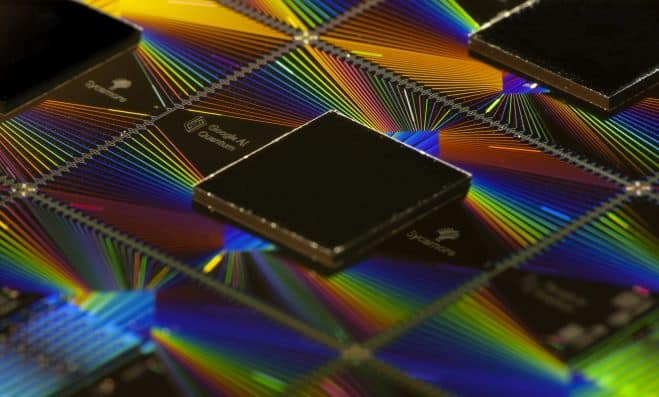
In the private sector, IT giants such as IBM, Google, Hewlett Packard, Honeywell and Microsoft are already heavily invested in quantum initiatives. One recent report claimed there has been more than $1bn of private investment in quantum computing in 2021 alone. In 2019 Google’s quantum-computing team claimed that its Sycamore quantum circuit – with 53 qubits – had demonstrated “quantum advantage” (also referred to as supremacy) carrying out a computation beyond the means of any classical device on a practical timescale. And in mid-2021, Honeywell announced a partnership with quantum-software developer Cambridge Quantum Computing in the UK. The pair came together to form a standalone quantum-computing company that they say will offer “the world’s highest-performing quantum computer and comprehensive quantum software, including the first and most advanced quantum operating system”.
From the cloud to cold atoms
The devices developed by IBM’s quantum- computing division have been made available for use by clients (currently more than 200,000 of them) via a cloud-based service. Users range from academic researchers and companies to schools, and much of it is available for no cost. “You have to get people familiar with this stuff,” says Bob Sutor, who is “chief quantum exponent” at IBM’s T J Watson Research Center in Yorktown Heights, New York state. Those machines have so far been housed mostly on the company’s sites, but IBM has begun to install them elsewhere too, including at one of the Fraunhofer institutes in Germany and at the University of Tokyo, licensed for exclusive use by the clients. However, Sutor thinks that cloud-based services will remain the norm.
Advantageous initiatives Canadian company D-Wave, in collaboration with scientists at Google, has demonstrated a computational performance advantage, increasing with both simulation size and problem hardness, to more than three million times that of corresponding classical methods. D-Wave researchers programmed the D-Wave 2000Q system to model a 2D frustrated quantum magnet using artificial spins (left). (Courtesy: D-Wave Systems Inc)
Rigetti has launched its own cloud-based resource too. “People are using it to do things like developing algorithms for problems in finance, chemistry, logistics, signal and image processing,” Rigetti explains. So, too, has IonQ, a start-up in College Park, Maryland, that has so far run around two billion jobs for customers. The company has produced 32-qubit devices in which the qubits are quantum-entangled ions held in electromagnetic traps in a chip-sized device. Their set-up works at room temperature, with lasers being used for input and output by exciting and probing the electronic states of the ions. The technology was developed by Christopher Monroe and colleagues at the University of Maryland. Having raised $83m of investment funding, IonQ began trading publicly on the New York Stock Exchange in October – the first purely quantum-computing company to do so – and quickly raised well over $600m.
D-Wave, meanwhile, is still producing devices that use superconducting qubits in an approach called quantum annealing, where the qubit resources are pooled to find solutions in an approach similar to the classical method of simulated annealing. The company has announced a new quantum chip called Pegasus, that would be used to make devices with more than 5000 qubits, originally scheduled for 2020 – but which has not yet materialized. There are several QIT start-ups in China too, such as QuantumCTek in Hefei, which specializes in quantum encryption and security, and was spun out from the pioneering lab of Jian-Wei Pan, along with Lu at UTSC – but the level of private investment in these firms remains unclear.
Boom or bust?
Even if the QIT industry grows as its advocates hope, it could be risky for venture capitalists to back a particular horse in a field that is still in flux. “There may be a few winners, but there will be a lot of losers too,” says Finke. Of the more than 200 start-ups in quantum technology that his company is currently tracking, Finke estimates that within 10 years the vast majority of them will no longer exist, at least in their present form. “Some will go out of business, some will be acquired and some will be merged,” he says.
It’s still not clear what the most important technology platform for QIT, and especially quantum computing, will be, says Walmsley (who until 2018 was director of the NQTP’s Networked Quantum Information Technologies hub at the University of Oxford). IBM and Google are placing their bets on qubits made from superconducting devices, while Honeywell is focusing on trapped ions.
I often caution investors not to concentrate their investments in just one quantum company
Doug Finke
Microsoft is taking what some regard as a high-risk strategy of aiming for “topological quantum computing”, in which the qubits are electron quasi particles – called Majorana zero modes – that are protected by their fundamental topological nature from incurring errors that could derail a computation. To pursue these elusive entities, Microsoft has established research partnerships in labs at the Delft University of Technology and the Niels Bohr Institute in Copenhagen. Others are aiming at photonic quantum computing, including the start-ups Orca Computing (cofounded by Walmsley) in Oxford and PsiQuantum in California.
“There is a lot of diversity in these technical approaches, and there could be significant risk in a company pursuing a specific technology,” says Finke. “So I often caution investors not to concentrate their investments in just one quantum company.”
Practical applications and challenges
So who are the first clients of QIT? Finance, oil, energy, automobile and aerospace are some of the sectors showing most interest, with IBM’s high-end quantum computers currently being used by the likes of Exxon, Daimler and JP Morgan Chase. One of IBM’s new installations is at the Cleveland Clinic in Ohio for use in pathogen research. Honeywell says that applications of its new company’s technologies will serve “cyber security, drug discovery and delivery, material science, finance and optimization across all major industrial markets”, as well as natural language processing and quantum artificial intelligence.
Global network IBM’s quantum computer – IBM Quantum System One – has been installed in North America, Germany and Japan. As of 2019, the company launched its Quantum Computation Center in New York, which gives users anywhere in the world access to its advanced cloud-based quantum computing systems. (Courtesy: IBM)
IonQ’s chief executive and president Peter Chapman says that he often only finds out what users have done with IonQ’s cloud-based system when the research is announced later. Volkswagen, for example, has used it for optimization problems in assembly lines, traffic routing and placement of electric-vehicle charging points.
Indeed, quantum computing is well suited to such problems of optimization, where the challenge is to find the “best” solution from a host of other possible ones. That’s a problem faced, for example, in managing supply chains to deliver goods or services to many clients in different locations with differing requirements and deadlines. Typically, there’s no classical algorithm for solving such challenges that doesn’t require trying each option in turn: a number that increases exponentially with the size of the system.
Companies already engaging with quantum computing simply want a head-start with what might soon become possible
Bob Sutor, IBM
Such problems are also common in finance, for example, to work out the optimum pricing of derivatives or to estimate portfolio investment risks. “There is a lot of engagement in quantum computing from the finance industry right now,” says Yianni Gamvros, head of business development at the Palo Alto-based quantum-software company QC Ware. His company has collaborated with Goldman Sachs to develop a quantum algorithm for Monte Carlo simulations, a common optimization procedure that can run on today’s “noisy”, error-prone quantum computers. They claim that the algorithm will be about a hundredfold faster than classical equivalents. IonQ, too, has worked with Goldman Sachs on quantum machine learning. Other possible applications of quantum algorithms in finance, says Gamvros, include fraud detection and trading recommendations. “A lot of the big banks are jumping in with at least one foot, and sometimes two,” adds Rigetti.
IBM’s Sutor stresses, though, that “nobody has a quantum computer that’s doing better than what classical can do yet, so you have to be careful to not sell people on something they think can do more than it can right now”. Companies already engaging with quantum computing, he says, simply want a head-start with what might soon become possible.
Diagnosis to cryptography
Even the most powerful of current quantum computers, such as Google’s Sycamore chip or IBM’s recently announced 127-qubit Eagle circuit, struggle to simulate much more than the simplest of chemical systems, such as small molecules. But it’s hoped that eventually they will be used to predict the properties of new materials and molecules with a precision that can’t be matched by classical simulations. “We expect the market to take off in two to three years for pharma and materials applications,” Gamvros says. But some corporate R&D departments are already laying the groundwork for intellectual-property rights and patents, and to develop the necessary skills. Quantum artificial-intelligence applications that use machine learning, meanwhile, might find uses in biomedical imaging and the detection and diagnosis of disease.
Another growth area for QIT is cryptography. The advent of quantum computers themselves raises the possibility of cracking standard cryptographic methods for secure data transfer via telecommunications networks (such as online credit-card orders) based on the difficulty of factorizing large numbers – quantum algorithms can do that much more quickly. But quantum computing offers a solution to that problem too. Because quantum information can be rendered indeterminate until it is measured, data encoded in this form can be made “tamper-proof”. If information is encoded in entangled quantum bits, such as the polarization states of photons sent along fibre-optic networks or broadcast to satellites, it can be impossible for an eavesdropper to intercept and read the information without being detected.
Quantum cryptography has already been demonstrated and used over long distances. For example, ballot data for regional elections in Geneva were encrypted this way in 2007 by the Swiss company ID Quantique, heralding the wider use of the technology worldwide. The company, founded in 2001, expects to see applications not just for confidential financial and political information but for medical data and as a defence against cyber attacks. A fibre-optic “quantum internet” network has been constructed in China reaching from Shanghai to Beijing, and in 2020 a team led by Pan at UTSC broadcast quantum-encrypted data over a distance of 1000 km within China via satellite.
Dublin-based market-research company Fact.MR has estimated that the quantum-cryptography market will expand at a compound annual growth rate of 30% over the next decade. “From transferring the confidential data of governments to offering secure banking and finance solutions, quantum cryptography is touted to be the future of encryption and security technologies,” say the company’s analysts, adding that the limiting factor in growth is the high cost of installing the necessary infrastructure and hardware, such as quantum-enabled satellites and signal boosters, along the route.
More qubits, less noise
Sutor is confident that the limitations of today’s quantum computers will recede as they get bigger and better. IBM plans to produce a 433-qubit chip in 2022, followed by a 1121-qubit Condor chip in 2023. Sutor forecasts that by the end of the decade there will be some degree of error-correction available from such advances. That’s currently the bugbear of today’s noisy quantum circuits: a fundamental quirk of quantum physics means that errors can’t simply be corrected by keeping multiple copies of each qubit, as in classical devices. Some error-correction schemes look likely to require hundreds or even thousands of physical qubits to make one error-tolerant “logical” qubit.
Cold trap IonQ’s Sarah Kreikemeier tunes an optical assembly. Powered by ions in a cold-atom trap, they became the first publicly traded quantum firm as of this year. (Courtesy: Erin Scott/IonQ)
But Chapman says that trapped-ion qubits have already been shown to do much better than that. Recent work at IonQ showed error correction with a physical–logical qubit ratio of just 13:1, he says. He adds that because they don’t need bulky and expensive refrigeration, trapped-ion quantum computers can also be scaled up compactly and relatively cheaply. “Ultimately, the question is about cost per qubit,” he says. “Our plans are about dramatically reducing that. We think quantum computers need to be rack-mounted, low-cost devices that don’t need cryogenic systems of any kind.” That would make them amenable to portable uses, such as on aircraft, as well as accessible to companies that can’t afford the delay or security risk of submitting jobs into a queue on the cloud.
High hopes and expectations
But can this exponential growth and interest be sustained without producing inflated expectations? “I think a bubble is almost inevitable with the level of government funding and the number of hardware and software start-ups – probably more than 150 and counting,” says Gamvros. “We are now going through a rapid growth phase, but that will definitely be followed by a consolidation phase with mergers and acquisitions.” Walmsley hopes, however, that the diversity of both implementations and applications of QITs might avoid a dotcom-style bubble. “It’s important to ensure that things don’t run ahead of themselves, and overheat and spoil opportunities,” he says. “We shouldn’t be expecting that these machines will be available on your sofa tomorrow.”
To avoid such false expectations, Sutor says that IBM is being “painfully public about what our machines are and how they work”. What’s more, he says, you can run your own tests on them yourself. Still, “there is a lot of hype from the media because most of them don’t understand the technology”, adds Finke. “There is quite a bit coming from individuals in the quantum-computing industry too. Entrepreneurs trying to get funding may exaggerate the potential.” Gamvros thinks there is more of that on the software side, “because everybody can still claim to have a really strong algorithm while very little can be tested or proven”.
Lu agrees that claims for the potential of QIT coming from industry, both in China and globally, can be inflated in order to raise venture capital. “A major misleading message from the industry is that quantum computing can speed up the calculation of everything by ‘parallel computing’,” he says. “This is not true. So far, the computational problems that can truly benefit from quantum computing are still quite limited, and even fewer enjoy an exponential speedup – others can have a more modest speedup.” Lu compares some of the hype to that which has plagued artificial intelligence – which, as a consequence, has experienced several “winters” of disillusion and neglect.
Lu also worries about how easy it is to distort the potential of quantum computing. For example, demonstrations of quantum advantage like that by Google (and which he and his colleagues claimed in a photonic system in 2020) don’t show “how brilliant quantum computers can be, but quite the opposite: they show what an early stage quantum computation is at”. He thinks that over the next five years or so, these technologies will largely remain useful tools for basic science.
In the next few years we will see successes being announced and organizations using quantum computing for real-world applications
Doug Finke
But Finke is not too concerned about the prospects of a bursting QIT bubble. “Although there will be some people who are disappointed because their investment does not pan out, I don’t believe there will be a general crash of investment,” he says. That’s because he thinks that in the next few years we will see “successes being announced, and organizations using quantum computing for real-world commercial or scientific applications”. Such successes “should be enough to keep the investments flowing from both the private and public sectors”.
Despite the risks of hype and disillusion, Lu is, overall, optimistic about the future of quantum computing. “We are just at the start. [So far] we may have discovered only the tip of the iceberg for quantum technologies. Even the brightest people have no idea how they are going to change the world.”
Earth might have received a large amount of its water from interplanetary dust grains interacting with the solar wind, according to new research that has picked apart the atoms in water molecules found in samples brought back to Earth from the asteroid Itokawa.
According to Luke Daly of the University of Glasgow, who led the research, there could be what he whimsically describes as “half a glass of sunshine in every cup of water”.
The mystery of the origin of Earth’s water is one of isotope ratios. A percentage of all water contains deuterium, which is a heavy isotope of hydrogen, rather than regular hydrogen. Earth’s water has a deuterium-to-hydrogen (D/H) ratio of 1.56 × 10⁻⁴, but when astronomers look out into the solar system, they find different D/H ratios. The exceptions include a handful of comets and carbonaceous chondrites, or C-type, asteroids. However, additional reservoirs of water with a similar D/H ratio are required to account for all the water in Earth’s oceans.
A sample of dust
In 2010 the Japanese Aerospace Agency’s Hayabusa mission brought back samples from the near-Earth asteroid 25143 Itokawa, which is a stony type of asteroid expected to contain far less water than C-types because it formed much closer to the Sun.
The asteroid Itokawa: Image from the Japanese spacecraft Hayabusa during its close approach in 2005. (Courtesy: CC BY 4.0/JAXA)
Daly’s co-authors, including Hope Ishii and John Bradley of the University of Hawai`i at Mānoa, used a technique called atom probe tomography to analyse the atoms and molecules in the top 50 nm of micron-sized dust grains sampled from Itokawa. Atom probe tomography combines a field ion microscope with a mass spectrometer to study the structure of materials atom by atom. They found that the grains contained water molecules with the same D/H ratio as Earth’s water. Scaled up, it would amount to 20 litres for every cubic metre of rock.
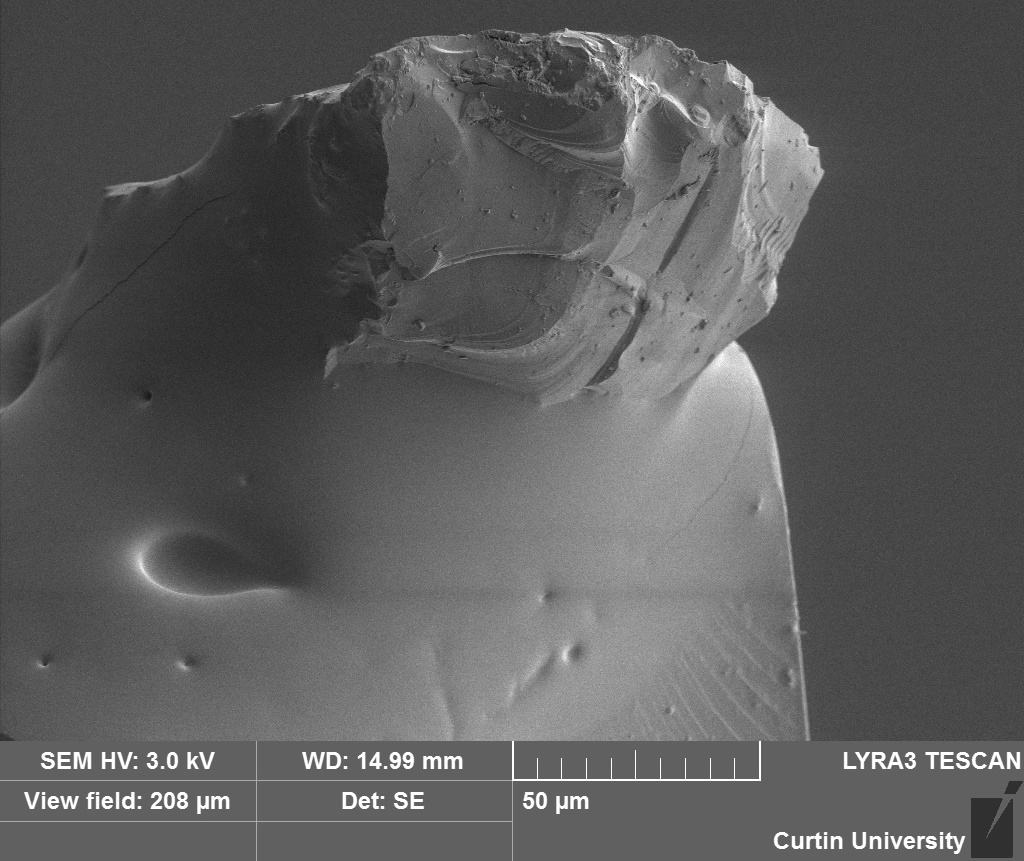
Tiny dust grains: Scanning electron microscope image of an Itokawa fragment. (Courtesy: University of Glasgow/Curtin University)
This water is produced by space weathering. Hydrogen ions – protons – on the solar wind penetrate into the dust grains where they oxidize the minerals, first creating hydroxyl (HO) and then water (H2O). Daly’s team envisages clouds of this water-laden dust raining down on the young Earth in the early solar system, supported by impacts from C-type asteroids.
“Up to around 50% of Earth’s water might have arrived on tiny dust particles affected by the solar wind, and the rest from C-type asteroids,” Daly tells Physics World.
Nebulous problems
Steven Desch, of Arizona State University, who was not involved in the study, finds the results “interesting”, but is “not at all convinced” that dust could have delivered a substantial amount of water to Earth.
The solar system formed from a cloud of gas and dust that astronomers call the solar nebula. In 2018 Desch co-authored a paper suggesting that some of Earth’s water came as a result of hydrogen ingassing from the solar nebula and being soaked up by the early Earth’s magma ocean, where it oxidized minerals to form water.
Desch says that Daly’s team has not properly considered the environment of the solar nebula. To have enough dust to provide the water, he says, it would need to be embedded in the gas of the nebula. “But if there’s gas, it absorbs the solar wind,” preventing it from forming water, he says. Meanwhile, dust itself could block the solar wind from reaching other dust in its shadow.
Instead, “We, and other researchers, feel that there are probably multiple contributors, starting with the major one, the accretion of carbonaceous chondrite material,” says Desch, who argues that the solar-wind process would have contributed only a small amount of water, rather than the significant amount that Daly’s team proposes.
Nevertheless, the space weathering process may have important implications for other bodies in the solar system.
“All the inner planets and moons in our solar system, and potentially across the galaxy, should receive water from tiny dust grains,” says Daly. “Also, water will be forming on the Moon right now from the solar wind hitting the lunar regolith.”
This process has already been observed in action on the Moon by SOFIA, the Stratospheric Observatory for Infrared Astronomy, which is a telescope in the back of a modified Boeing 747. SOFIA has detected water molecules migrating across the lunar surface, water that has formed through space weathering. “It could be a really important resource for future astronauts,” says Daly.
Quantum science and technology is a hot ticket today, with governments, major tech companies and financiers around the world pouring money into research and development. As a result, the need to understand the basics of things like quantum computing and quantum cryptography goes well beyond the academic community. The problem, however, is that the concepts underlying these technologies can be fiendish to understand – even for physicists working in fields other than quantum information.
As a result, there is a growing need for guides to the quantum technology aimed at the layperson who might be interested in investing in a quantum technology company or a businessperson who might want to use the products or services of such a company.
As I read Katwala’s book I imagined myself to be that financier or businessperson and asked: does this book elucidate the basics of quantum science and present a good vision of the myriad technological challenges facing developers of quantum technologies? Despite the book being only about 150 pages, Katwala has succeeded admirably.
He gets off to a good start by providing the reader with enough information to have a basic understanding of the concepts of quantum computing without the danger of having them lose the plot with too much information. The book begins with the standard explanation that a quantum bit (qubit) of information can be in a superposition of two states at one time. Then he pushes his explanation a bit further, writing that the wave nature of quantum mechanics is harnessed by a quantum processor to choreograph the interference between connected qubits such that the wrong answers to a problem cancel each other out and the correct answers reinforce each other. It is this dance that allows quantum computers to solve some problems much more efficiently than conventional, or “classical” computers.
Success is not guaranteed – a very useful bit of information for a potential investor
I think this description is enough for the reader to appreciate the key challenge facing developers today – how to keep that choreographed dance of qubits going long enough to do a useful calculation. Katwala covers this problem in his second chapter, “Building the impossible”. He looks at the challenges of keeping the quantum dance going despite the destructive effects of noise, heat and other environmental factors. This allows him to introduce the very important idea that quantum computing has just entered the noisy intermediate scale quantum (NISQ) era. NISQ describes the nascent quantum processors with 50 or so qubits currently being operated by the likes of Google and IBM.
“It’s all part of a delicate balancing act,” writes Katwala. “Each computation is a frantic race to perform as many operations as possible before a qubit ‘decoheres’ out of superposition.” He then explains that connecting more qubits together to make larger quantum processors worsens this decoherence – thereby identifying the central dilemma facing anyone who wants to build a commercial quantum computer that can solve practical problems and thus make its inventors money. While this challenge is not necessarily insurmountable, Katwala makes it clear that success is not guaranteed – a very useful bit of information for a potential investor.
He explains that most cutting-edge quantum processors today – including those developed by Google and IBM – use tens of superconducting qubits that are coupled using microwaves. Indeed, it is these devices that have been the first to demonstrate “quantum advantage”, whereby a quantum computer can solve a problem in a much shorter time than a supercomputer. Katwala devotes several pages to describing these superconducting processors but makes it clear that there are problems related to coupling, cooling and controlling larger numbers of superconducting qubits.
Qubit numbers are not everything and potential investors in new quantum computing technologies might want to consider a figure of merit called “quantum volume”
The book also points out that qubit numbers are not everything and that potential investors in new quantum computing technologies might want to consider a figure of merit called “quantum volume”, which is a measure of how many useful calculations a processor can do before it succumbs to decoherence.
Katwala explains that decoherence can be addressed in two ways. One is to build better qubits and the other is to use error-correction schemes. The problem with the latter is that it takes many additional qubits to run error correction. He quotes an expert who says that tens of thousands of qubits could be needed to create an error-corrected system with a few hundred “logical” qubits.
Indeed, an investor today might want to eschew conventional superconducting qubits as Microsoft has done. Instead, as Katwala explains, the tech giant is trying to develop topological qubits, which should be much more robust than superconducting qubits – at least in principle. The book also looks at a recent breakthrough in using trapped ions as qubits, making it clear that the winning technology for quantum computing is far from certain – if there ever will be a winner.
Shifting from hardware to software halfway through the book, Katwala presents an overview of the types of problems that are amenable to quantum advantage – and which are not. The upshot is that not all difficult problems are easier to solve on a quantum computer than on a classical processor – so quantum computing is by no means a panacea.
An example of where quantum computers could be particularly useful is Shor’s algorithm, which a quantum computer could use to find the factors of a large number in a much shorter time than it would take a classical computer. Factoring numbers plays an important role in current cryptography techniques to ensure the secure exchange of information – and being able to factor large numbers would be a big advantage to someone trying to crack cryptographic systems. So a practical quantum computer capable of running Shor’s algorithm would be a boon to spies and criminals alike – and would also lead to a shake-up in how confidential information is exchanged.
Another example of where a quantum computer can outshine a classical processor is Grover’s algorithm, which can be used to search databases. Some optimization problems are also amenable to quantum advantage – tasks such as real-time traffic routing and simulating financial markets, which could both benefit from real-time predictions. So, there are several ways that a practical quantum computer could make someone some money.
As well as having the potential to crack cryptography codes, Katwala explains how quantum technology could be used to create secure systems to exchange information. Indeed, practical quantum cryptography systems already exist and are being used commercially.
The book links today’s intense interest in quantum cryptography – particularly in China – with the 2013 release of US classified documents by Edward Snowden. This huge leak revealed the extent to which the US National Security Agency (NSA) had been spying on foreign governments and even American citizens. Katwala claims that the NSA’s capabilities so terrified the Chinese government that it has spent vast amounts of money on developing quantum technologies to keep its secrets secure. This includes the launch of a satellite called Micius, which is an important early step towards the creation of a secure quantum internet. Indeed, if a country could develop a quantum computer capable of cracking cryptography systems, while being able to use quantum systems to secure its own information it would be in an enviable position.
Katwala devotes an entire chapter to how quantum computers are perfectly suited for simulating natural systems – particularly systems such as molecules that are themselves governed by quantum mechanics. The commercial applications of this could be limitless – from designing new drugs to building better batteries. Perhaps this is where a budding quantum investor should be focusing today.
So what is next for the future of quantum computing? Katwala says we should expect much work to be done on improving quantum hardware, hopefully pushing it beyond the NISQ era. He also identifies the need for a much more friendly interface between quantum computers and their users. This will require a move away from the current machine-language approach to higher-level languages such as Q#, which is being developed by Microsoft.
Katwala’s guide to quantum computing is upbeat, but he does end on a cautionary note, pointing out that today, the development of quantum technologies is not at the point where it is a matter of companies competing against each other to create the best quantum processors. Instead, he quotes a quantum researcher at Google who says, “It’s our technology against nature.”
2021 WIRED Guide, Random House Business £8.99pb 160pp
Quantum spin liquid magnets are materials that cannot arrange their magnetic moments, or spins, in a regular, stable pattern because the spins interact in competing ways that cannot be simultaneously minimized. As a result, these “frustrated” spins constantly change direction, behaving like a liquid even at temperatures close to absolute zero. Such behaviour is predicted to give rise to many interesting physical phenomena, but despite great efforts in both experimental and theoretical studies, there is no well-recognized, real-world example of a frustrated magnet hosting a quantum spin liquid state.
In a recent paper published in Chinese Physics Letters, Sizhuo Yu, Yuan Gao, Bin-Bin Chen and Wei Li describe how machine-learning techniques can help us understand how quantum spin liquids behave, and thereby support experimentalists in their study of “candidate” materials that may (or may not) be quantum spin liquids. Here, they discuss their research and goals for the future.
What was the motivation of your research?
The study of strongly correlated quantum materials such as frustrated magnets is challenging yet important for condensed-matter physics as well as quantum science and technology. For example, magnetic quantum materials – especially frustrated magnets in two dimensions – can host highly entangled quantum states and emergent excitations called anyons that follow fractional statistics and can be used to store and manipulate quantum information in a robust, error-resistant manner. Highly frustrated magnets thus provide an intriguing platform for next-generation quantum technologies, including but not limited to topological quantum computation.
One key step in the search for quantum spin liquids in frustrated magnets is to determine the realistic description – the microscopic spin models – of the quantum magnets. These models are like a genome for quantum magnetism – they tell us what types of magnetism are possible. However, inferring the spin model from experimental measurements constitutes a notoriously hard inverse many-body problem. This hinders a precise understanding of spin-liquid candidate materials, including the most prominent ones like the triangular magnet YbMgGaO4, the Kitaev material α-RuCl3, and the Kagome magnet ZnCu3(OH)6Cl2, among others.
What did you do in the paper?
Inspired by recent successes in interdisciplinary research between quantum many-body calculations and machine learning, we proposed an efficient solution for this long-standing problem that greatly facilitates studies of intriguing quantum magnets. Our approach combines accurate many-body methods with highly efficient global optimizers (including the Bayesian and multi-restart auto-gradient strategies) so that we “learn” the effective spin model from the thermodynamic data measured in experiments. This method will not only interest theorists in the quantum many-body physics community, but also experimentalists working on quantum materials.
As part of our research, we also created and made public an open-source many-body calculation package, dubbed QMagen, that includes several state-of-the-art and original many-body methods we developed. Our hope is that such a package can be widely used in the studies of correlated quantum materials.
What was the paper’s most important finding?
We found that we could accurately reproduce the model parameters of a triangular quantum magnet, TmMgGaO4, as determined in a hand-tuned fitting of thermodynamics (see, for example, this paper from 2020), and we confirmed that these previously-determined parameters are located right in the only optimal regime that describes the compound in a rather large parameter space. More recently, we used this same combinative approach to pin down the effective spin model of α-RuCl3, which has interaction parameters that are much debated and quite challenging to determine otherwise. Using QMagen, we find very accurate modelling that convincingly reproduces major experimental observations such as those published earlier this year in Nature Communications.
With these exciting results, we are thrilled by how much computational resource we could save in tackling such tough problems with our approach – including some that are practically impossible to deal with using hand-tuned fittings – and by producing unbiased results free of personal preference.
Why is this research significant?
The framework we proposed creates new possibilities in the research of frustrated quantum magnets and correlated materials in general. With this methodology, it becomes possible to determine the magnetic interactions of 1D and 2D materials in a very efficient manner, which constitutes a very important step towards understanding these low-dimensional quantum magnets and lays down a solid foundation for their applications in future technologies.
What do you plan to do next?
We hope this method can contribute to the exploration of exotic states and phase transitions in frustrated quantum magnetism. We will apply this method to more cases of intriguing low-dimensional magnets and try to decode their accurate spin model descriptions – the magnetism genome. The ultimate goal is to establish a genome library for a vast family of quantum magnets. To achieve this, we plan to make continuous improvements and upgrades to our QMagen package.
Neutrinos are detected by observing the particle showers they create when they strike nuclei, but new research using electrons in place of neutrinos shows that the models used to reconstruct the energy of the incoming neutrinos from these showers usually give wrong answers. Researchers say the work highlights well-known gaps in the theory of neutrino-nucleus interactions, and that improving this theory is crucial if next-generation neutrino detectors such as the Deep Underground Neutrino Experiment (DUNE) in the US and Hyper-Kamiokande in Japan are to realize their full potential.
The study of neutrino oscillations continues to provide tantalizing hints of physics beyond the Standard Model of particle physics. The Standard Model did not originally predict that neutrinos have mass, but both accelerator experiments and astronomical observations have clearly demonstrated that neutrinos can periodically change flavour between electron, muon and tau neutrinos as they propagate. This neutrino oscillation is possible only if neutrinos have mass, thus changing the Standard Model.
Characterizing neutrino oscillations is therefore one of the highest priorities in physics today. Or Hen of the Massachusetts Institute of Technology offers an example. “If there is large violation of charge-parity symmetry in how neutrinos and antineutrinos interact, then under certain assumptions that can explain why we live in a matter-dominated universe,” he says. “We really need to measure whether neutrinos and antineutrinos oscillate slightly differently.”
Energy reconstruction
Neutrinos’ oscillation rates depend on their energy, so one needs to know this to characterize neutrino oscillations and search for any possible anomalies. Unfortunately, neutrinos are notoriously difficult to detect because of their extremely weak interaction with matter. The details of individual experiments vary, but they invariably use an immense volume of matter (Hyper-Kamiokande will use water; DUNE will use liquid argon) surrounded by sensors. When a neutrino interacts with a nucleus in the matter, the sensors pick up ejected particles and reconstruct the energy of the incident neutrino.
One problem is that this requires knowledge of how neutrinos interact with the atomic nuclei. “Reconstructing the energy of a neutrino is like looking at fireworks in the sky and trying to work out the energy that ignited the explosion just by seeing all the beautiful colours,” explains Adi Ashkenazi of Tel Aviv University in Israel; “There are lots of free parameters in the simulation.”
Individual detectors are usually calibrated with beams of neutrinos. However, neutrinos are only produced by particle decay – which is inherently random – so producing a mono-energetic neutrino beam is impossible. This makes calibrating the incoming flux at a detector at each energy in the detection bandwidth unfeasible. Researchers at the e4ν (electrons for neutrinos) collaboration, however, used the simple and surprising alternative of studying how nuclei interact with electrons. Monoenergetic electron beams are simple to generate using particle accelerators, and Hen says that, although the fundamental physics of the electron-nucleus interaction is different from that of the neutrino-nucleus interaction, the real difficulties in the simulations arise from interactions between protons and neutrons in the nucleus, and these are identical in both cases.
Simple version of neutrinos
“In essence, electrons are a simple version of neutrinos, so whatever you think you know about neutrinos, if that same model cannot explain electron data, it’s wrong,” says Hen.
The e4ν researchers therefore teamed up with the CLAS Collaboration, based in Virginia (Hen and Ashkenazi are members of both groups), to study scattering data from 1999 in which electrons of known energies were scattered off either carbon, helium or iron targets. They selected a subset of these in which the scattering was relatively simple – producing only one detected electron and one proton. In a paper in Nature, the researchers analyse the electron interactions as though they were neutrinos, using standard simulations to reconstruct the energy of the incident particle. For carbon, only 30-40% of the simulations estimate the energy to be within 5% of the actual beam energy. For iron, the proportion is only 20-25%.
“You shouldn’t be surprised that the models don’t agree very well with the data,” says Eric Zimmerman of the University of Colorado Boulder; “There’s been a wide variety of neutrino interaction models produced and they’ve had quite a lot of variation in their predictions…I think this work’s principal value is that this dataset will presumably go into making the models better, if it hasn’t already.”
“To anyone who’s paying attention, this should be no surprise,” agrees Daniel Cherdack of the University of Houston in Texas; “The real question is who’s paying attention and why?” Both Zimmerman and Cherdack believe current results from detectors are trustworthy because model uncertainties have been factored into the error calculations. However, Cherdack says that these uncertainties will need to get smaller if larger detectors are to discover smaller effects. “This is an important paper in that it’s highlighting part of the ditch-digging of neutrino physics that doesn’t make it to the front very often, and the fact that Nature is focusing on this is incredibly important because this is one of the things we really need to figure out to make DUNE a successful experiment.”
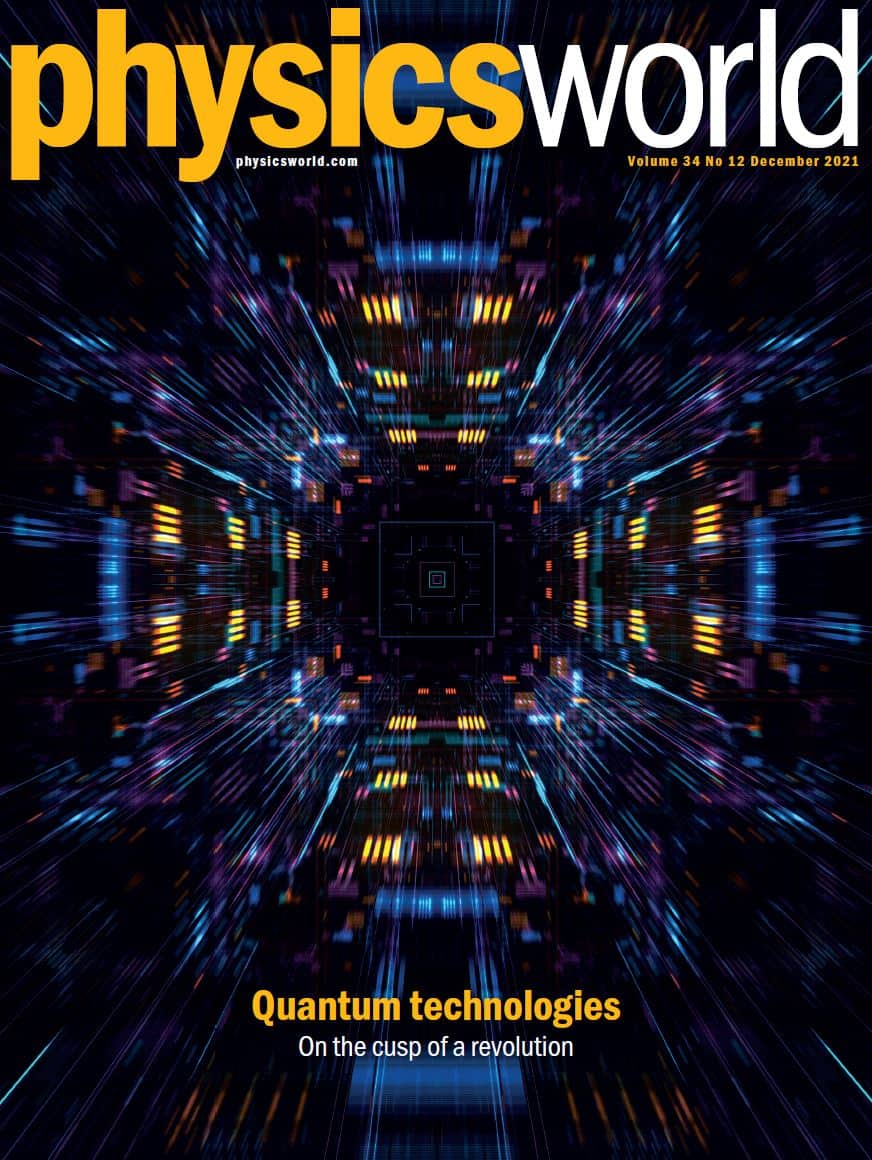
Quantum technology: on the cusp of a revolution. (Courtesy: IOP Publishing)
Physicists have long boasted of their success in “quantum 1.0” technology – semiconductor junctions, transistors, lasers and so on.
But the future will increasingly depend on “quantum 2.0” technology, which taps into phenomena like superposition and entanglement to permit everything from quantum computing and cryptography to quantum sensing, timing and imaging.
According to one estimate by Honeywell, in fact, such technology could be worth $1 trillion over the next three decades.
Philip Ball talks to researchers, business analysts and insiders at firms ranging from IBM to IonQ, while Michael Allen examines the commercial potential of quantum gravity sensors.
There are interviews with Ilena Wisby, chief executive of Oxford Quantum Circuits, as well as with the head of KETS Quantum Security, Chris Erven.
Careers editor Laura Hiscott is on hand to look at the job opportunities in the area, while James McKenzie hot foots it back from a quantum tech showcase that took place in London last month.
And if you need a guide to quantum computing to prime any wannabe investor, Hamish Johnston has the perfect book for you.
• A quantum promise – Freeke Heijman from Quantum Delta NL tells Martijn Boerkamp how the Netherlands is forging ahead in quantum technologies
• Call for “great observatory” to succeed Hubble – Michael Banks reveals the highlights of the long-awaited Astro2020 Decadal Survey, which will define the course of astronomy and astrophysics in the US and beyond over the next 10 years
• Towards quantum 2.0 – James McKenzie is excited about the prospects of firms that are developing technology based on seemingly esoteric fundamental quantum phenomena
• Quantum conundrum – While the technological applications of quantum mechanics are bright, its meaning remains opaque. Thankfully, as Robert P Crease explains, philosophers of science are working on it
• The quantum battleground – Yangyang Cheng examines a historical precedent for the emerging technological rivalry between the US and China
• Ethics in the quantum age – Mauritz Kop assesses the ethical principles we must all adopt so that the application of quantum technologies is equitable and safe
• Setting the scene for a quantum marketplace – As quantum computing makes its first forays from the lab to the real world, are the latest claims mere hype causing a bubble that will burst before the field finds its feet? Or are investors and researchers right to be enthusiastic about this burgeoning technological revolution? Philip Ball investigates the
successes and pitfalls of commercializing quantum information technology
• The key to our quantum future – Safeguarding our communications data and infrastructures will become a much harder task in a quantum-enabled future. KETS Quantum Security chief executive Chris Erven talks to Tushna Commissariat about how integrating quantum based systems into existing communication is key
• Sensing gravity, the quantum way – Devices that exploit the extreme sensitivity of quantum states are making their way out of the lab and into everything from construction and healthcare to seismology. Michael Allen learns more about the
technology that goes into building a quantum gravity sensor, and its multitude of uses in research and industry
• Quantum for all – Building a firm foundation Oxford Quantum Circuits chief executive llana Wisby talks to Tushna Commissariat about UK investments and innovation in quantum technology, and the potentially world-changing impact that it could have
• Quantum physics for investors – Hamish Johnston reviews Quantum Computing: How It Works and Why It Could Change the World by Amit Katwala, WIRED
• Dealing with deniers – Rachel Brazil reviews How to Talk to a Science Denier: Conversations with Flat Earthers, Climate Deniers, and Others Who Defy Reason by Lee McIntyre
• Brilliant polymath, troubled person – Andrew Robinson reviews The Man from the Future: the Visionary Life of John von Neumann by Ananyo Bhattacharya
• A tale of two scientists – Laura Hiscott reviews Flashes of Creation: George Gamow, Fred Hoyle, and the Great Big Bang Debate by Paul Halpern
• How to get ahead in quantum tech – The quantum industry is blossoming and has lots of new and exciting jobs that physicists are well placed to fill. Laura Hiscott talks to experts who have studied the quantum-tech jobs market about what’s on offer and what skills you’ll need to forge a successful career in this area
• Ask me anything – Careers advice from Farai Mazhandu, chief executive and co-founder of Bayete Quantum Technologies
• Winter wonder worlds – The winter holiday season comes but once a year – on Earth. Eleanor Spring takes a tour through some of the seasonal extremities experienced on distant worlds. A chilly Earth winter never looked so inviting!
Crystals all the way down: An artistic rendering of a time crystal. (Courtesy: Google Quantum AI)
Crystalline solids such as diamond have a hallmark property: their structure is periodic in space. For much of the past decade, physicists have wondered whether a similarly robust, repeating structure might also exist in time. By analogy with spatial crystals, this structure is known as a time crystal, and whereas diamonds may be forever, time crystals are both forever and forever changing.
Researchers have proposed several physical systems that could host time crystals, including platforms like nitrogen-vacancy (NV) centres and trapped ions. Most recently, a collaboration between researchers at QuTech, TU Delft and UC Berkeley demonstrated long-lived period-doubling oscillations in carbon-13 NV centres across a variety of initial conditions. However, each of these previous platforms lacked the full slate of capabilities to necessary to realize (and verify) a genuine time crystal.
Now, researchers at Google Quantum AI and Stanford University in the US have constructed a time crystal on Google’s Sycamore quantum processor, demonstrating that these exotic objects constitute their own distinct phase of matter. To do so, they ran a series of “experiments” on Sycamore, treating the computer as a laboratory to test whether their proposed time crystal met certain requirements. The result is the first to experimentally verify that a phase of matter can exist outside of thermal equilibrium. It also shows that even in today’s world of noisy intermediate scale quantum (NISQ) computing, quantum processors already have important implications for our understanding of physics.
Phases of matter
Phases of matter come in many varieties, from ubiquitous liquids and gases to quantum phases like superconductors and Bose–Einstein condensates that only crop up under extreme conditions. Regardless of their properties, all phases share a key quality: each one has some notion of order, a way of quantifying the patterning of particles within the collection.
Crystalline solids, for example, exhibit spatial ordering. When a crystal forms, a discrete set of points from the continuous expanse of space become the loci for its evenly spaced atoms. In so doing, the system breaks a well-known physical symmetry: as far as the fundamental laws of physics are concerned, no point in space should have priority over any other. This cosmic apathy is reflected in a set of symmetries, or transformations, under which these laws must remain invariant.
One such symmetry, known as continuous translation symmetry, implies that shifting a closed physical system by any amount in any spatial direction is inconsequential. During formation, crystals spontaneously break this continuous symmetry; in other words, they break it even though the system is not explicitly swayed towards any particular choice of points. The repeating pattern that remains displays only discrete translation symmetry: if every atom is shifted over by one interval, or unit cell, of the crystal, then the same set of spatial positions (apart from the edges) will retain their distinction.
Time crystals enter the fray
The fundamental forces of nature also regard all points in time with indifference. In other words, the laws of physics stay the same from second to second and day to day. This invariance is referred to as continuous time-translation symmetry. Just as crystalline solids disrupt the continuous translation symmetry of space, systems such as pendulums swinging to and fro and planets orbiting stars carve the infinite extent of time into regular, discrete intervals.
Unlike space, however, the passage of time is indelibly coloured by the second law of thermodynamics, which states that entropy – the amount of randomness or disorder in a closed system – cannot decrease over time. Simple systems, like a single pendulum or a planetary orbit, can exhibit stable, long-lived oscillations, as there are few ways for their constituent pieces to interact with each other and exchange energy. In contrast, oscillations quickly fall out of sync in systems with many degrees of freedom (such as a collection of coupled pendulums), as energy surges through every allowed avenue and the system explores many possible states.
In 2012 the physics Nobel laureate Frank Wilczek proposed that an extended phase of matter could exhibit regularity and ordering in time, while also spontaneously breaking time-translation symmetry. Drawing an analogy with the spatially ordered crystalline solid, Wilczek called this proposed phase a quantum time crystal. At that point, it was unclear whether such a phase could truly exist in the physical world, or whether entropy would extinguish all hope for time-crystalline order.
Wilczek’s original proposal involved the ground state, or lowest energy configuration, of a superconducting ring. By itself, this superconductor supports a steady current that flows without resistance. If an alternating pattern of electric charge known as a charge density wave is then superimposed onto this constant current, the ripples of charge would break down the continuous translation symmetry of space into a discrete translation symmetry. Combining the two, Wilczek hypothesized, would result in a stable many-body system with reduced (from continuous to discrete) time-translation symmetry.
Need for non-equilibrium phases
In 2014 theoretical physicists Haruki Watanabe and Masaki Oshikawa dealt a striking blow to Wilczek’s proposal, and to the prospect of time crystals. Their “no-go” theorem stated that any system in thermal equilibrium, including Wilzcek’s, could not be a time crystal. Instead, any time-crystalline phase would need to enter a strange new realm: non-equilibrium physics.
Time crystal theorist: Vedika Khemani is a condensed-matter theorist and associate professor of physics at Stanford University. (Courtesy: Vedika Khemani)
Around the same time, physicists at Princeton University, US and the Max Planck Institute in Dresden, Germany were working in earnest to define such phases. For years, other physicists had pursued similar research programs with little to show for it, but Vedika Khemani (now a professor at Stanford), Roderich Moessner, Shivaji Sondhi and colleagues succeeded, theoretically demonstrating a stable non-equilibrium phase. Their recipe contained two essential physical ingredients: periodic or Floquet driving, and many-body localization (MBL).
When a system is out of equilibrium, its dynamics must depend nontrivially on time, with the state of the system constantly evolving. Floquet driving evokes such dynamics by making the system interact with a laser (or microwave) pulse. The strength of coupling between the system and the laser is varied periodically, and this periodicity modifies the system’s temporal symmetry. While the fundamental forces don’t depend on time, the dynamical pressures generated by the coupled laser are cyclic. From the system’s point of view, time’s translational symmetry is now discrete rather than continuous, and its governing physics looks the same only at times separated by exact multiples of the Floquet driving period.
Reduction in symmetry alone, however, does not a time crystal make. Whereas the continuous translation symmetry breaking in a crystalline solid is spontaneous, symmetry breaking via Floquet driving is induced by coupling the system to the laser. Any time crystal constructed from a Floquet-driven system must therefore spontaneously break the discrete translation symmetry it inherits from the driving mechanism.
In Floquet-driven systems, this is typically done via a phenomenon known as period doubling, where the system falls into a regular cycle that takes twice as long as the period of the process that governs it. The phenomenon dates back to 1837, when Michael Faraday experimented with thin layers of liquid on top of oscillating piston-like platforms, and observed that the standing waves that formed in the liquid moved at half of the oscillator’s frequency. Period doubling does not guarantee a time crystal either. What it does do, when combined with a Floquet-driven many-body system, is to make time crystalline order possible – with one big caveat.
In most Floquet systems, the driving laser imparts energy to the system with every cycle. As the system absorbs this energy, both its temperature and entropy increase. Eventually entropic randomness overwhelms any information contained in spatial or temporal correlations, and the system no longer exhibits any order, crystalline or otherwise.
Many-body localization to the rescue
There is, however, one special class of physical system that overcomes this problem by skirting the encroach of entropy: systems exhibiting many-body localization (MBL). The term “localization” refers broadly to a set of phenomena in which particles or physical properties are confined in their motion. This confinement often stems from disorder. For example, in Anderson localization, named after the late physics Nobel laureate Phil Anderson, disorder in a crystal lattice immobilizes the electrons that would otherwise be free to travel from one atom in the lattice to another.
Whereas an ideal crystal comprises uniform atomic nuclei, leading to a regular lattice structure, in practice crystals can be dotted with defects – that is, with nuclei of different elements randomly interspersed in the lattice. These defects push and pull electrons in different directions, creating complex potential energy landscapes with deep, narrow trenches that act as traps.
Forever material: An artist’s rendering of a time crystal. (Courtesy: Matteo Ippoliti)
MBL, which Anderson also proposed, is a special type of disorder-induced localization that occurs in interacting quantum systems. When a many-body system is subjected to small quantities of randomness, these disturbances can spoil global symmetries like spatial translation invariance. However, once the degree of disorder exceeds a certain threshold, a set of new, local symmetries emerges, freezing particles in place.
Mired in strong many-body disorder, the particles in an MBL system have no way of absorbing energy. Correlations between particles are fixed from the start, and entropy stays the same, just barely satisfying the second law of thermodynamics. Crucially, the system never achieves thermal equilibrium.
Disorder begets order
In 2015 Khemani and colleagues showed that Floquet driving and MBL together make time crystals a distinct possibility, owing to the spontaneous symmetry breaking of the former and the entropy evasion of the latter. There is, however, one further ingredient. The key to combining Floquet driving and MBL to create a non-equilibrium phase of matter is a property of MBL known as eigenstate order.
In conventional phases of matter, physical quantities are measured and averaged over a thermal ensemble – a collection of states that captures the behaviour of the system at a fixed temperature. Individual states within that collection, known as eigenstates, are for the most part inaccessible and irrelevant. In MBL systems, on the other hand, where thermal equilibrium is never reached, these individual states are essential. For different initial conditions, the localizing randomness drives the system into different eigenstates.
Eigenstate order is also unique in that every eigenstate has a companion eigenstate. When time translation symmetry is broken, it is hard to define a consistent notion of energy. Instead, it makes sense to talk about the closely related concept of a quasi-energy, which is periodically defined, and behaves like a phase. Energies or quasi-energies can in theory be paired up in non-MBL systems; in practice, however, this partnership is sensitive to the slightest imperfections. In MBL systems, energies align not in spite of randomness but because of it. Even under imperfect conditions, this equality is exact – a rigidity that makes MBL well-suited for constructing time crystals.
Putting the pieces together
In their quest to define a non-equilibrium phase of matter, Khemani and her collaborators constructed a theoretical model that integrated Floquet driving and MBL. In this model, they envisioned a 1D chain of particles, each with its own quantum mechanical spin. Every particle in the chain is coupled to its neighbours and is also subject to its own local magnetic field.
Time crystal technicalities Left: In a discrete time crystal, the periodicity of the drive is further broken by the state of the system. Right: Constructing a genuine time crystalline phase requires interaction and disorder, as well as isolation from the outside world.
At equilibrium, even when all the magnetic fields and coupling strengths are uniform, this system can only exhibit magnetic phases. A ferromagnet, for instance, has all spins pointing either up or down, whereas in a paramagnet, each spin individually points up or down but the system shows no overall preference. When disorder is incorporated into the field strengths and couplings, the system hosts an additional, many-body localized phase, where the spins point in random directions. This phase, known as a spin glass, derives its name by analogy with glass, which is an amorphous solid composed of randomly located atoms.
Out of equilibrium, the model hosts a further two phases, one of which is time crystalline. In the scenario Khemani considered, the system is periodically driven with a laser that modulates the strength of the coupling between neighbouring spins, alternating below and above the disorder strength that induces many-body localization.
For a given initial configuration of the spins, the disorder first forces the system into a spin-glass eigenstate. Oscillating between weak and strong interactions, over the course of a single cycle the Floquet drive rotates all the spins 180 degrees into the companion eigenstate with paired quasi-energy. Another cycle rotates the spins by an additional 180 degrees, bringing the system back to the first eigenstate. Under the influence of the Floquet drive, the system endlessly oscillates between these two states, never heating up or gaining entropy.
This system of spins, eternally oscillating with twice the period of the Floquet drive, is known as a pi-spin glass (π-SG). Together, the spins robustly display spontaneous time-translation symmetry breaking in a many-body system with many degrees of freedom. “To get a stable non-equilibrium phase in a many-body system, you need MBL,” Khemani summarizes. “In the future, we might find other ways of generating time crystals, but in the current setting we have done so via Floquet driving and eigenstate order.”
Quantum computer as a laboratory
Over the past few years, time crystals have begun their journey from theoretical model to experimental reality. However, every prior experimental demonstration left something to be desired, both in terms of realization and verification. For one, platforms made out of NV centres or trapped ions lack some of the essential ingredients to construct a Floquet MBL system. To make matters worse, even if these platforms could host time-crystalline order, they would be unable to certify its presence. Demonstrating period doubling for a specific set of conditions is relatively easy in these systems; showing that it occurs for all initial conditions is far more challenging. As a result, prior experiments stopped far short of establishing the time crystal as a phase of matter.
Then, in 2020, Khemani and Matteo Ippoliti, a postdoctoral scholar in her group at Stanford, spotted an opportunity. While quantum processors can, like classical processors, run algorithms and traditional computations, they also offer something else: unprecedented programmatic control over the quantum world. With site-resolved measurements and tuneable interactions, Google’s Sycamore processor gives researchers the ability to systematically run “experiments” on exotic physical systems. “Up until recently, we’ve spent all of our time thinking about equilibrium physics, especially low-temperature properties,” Khemani says. “If you think of NISQ devices like Sycamore not as quantum computers but as experiments, new regimes of physics become accessible. Time crystals are one example of this.”
Welcome to the lab: Google’s Sycamore quantum processor. (Courtesy: Google Quantum AI / James Crawford)
In a recent paper published in Physical Review X, Ippoliti, Khemani, and co-authors outline a series of experiments on Sycamore to establish robust spatio-temporal order in Khemani’s original Floquet-MBL model. Taken together, these experiments would help fill in the gaps in argumentation left by previous experiments, providing the first unambiguous detection of a time crystalline phase in the laboratory. A preprint of this article caught the attention of Pedram Roushan, a researcher at Google Quantum AI, and the Google team and the Stanford researchers began putting the proposed experiments into action.
Establishing robustness
In the latest study, published in Nature, the researchers began by recreating the conditions in Khemani’s original Floquet-MBL model, ordering Sycamore’s qubits into a chain and coupling neighbouring qubits together with a microwave pulse that drives their evolution. Unlike previous experiments that have investigated spatio-temporal ordering, however, for Khemani and the Google team, simulating the system was just the beginning. In collaboration with lead authors Xiao Mi and Ippoliti, the Google Quantum AI team programmed the quantum processor and also rigorously tested the time crystal’s stability under various conditions.
One of the requirements the researchers checked is that period doubling occurs for all initial configurations of the quantum spins. Period doubling is seen for specific states in many systems, but time crystalline order demands that all states display this behaviour. To investigate this, the Google team and their collaborators turned to “quantum typicality” – the notion that random, highly entangled states reveal the system’s typical behaviour. In addition to sequentially sampling a large number of initial configurations to probe for outliers, they used scrambling circuits to generate a few entangled initial states, which they then subjected to Floquet evolution.
A second requirement for phases of matter is that order must survive as the system is made arbitrarily large. Although Sycamore offers only a relatively small number of qubits, the Google team was able to glean insights about infinitely large systems through a technique known as finite-size scaling. This technique, which the researchers exported from its original context in numerical studies of physical systems, uses measurements from systems of various small sizes to extrapolate trends for much larger systems.
Finally, any phase of matter must also exhibit stable ordering for arbitrarily long times. Of course, any real experiment, whether performed on a quantum computer or in a traditional laboratory, is confined to finite times. For Sycamore, the limiting time scales are set by the coherence times of the qubits, and the fidelity of operations performed by the processor. Nevertheless, through a series of control experiments, the researchers were able to distinguish decoherence in the quantum processor itself from the possibility of intrinsic dynamics (and increasing entropy) in the simulated system.
Together, these experiments bolster the case for the time crystal as a genuine non-equilibrium phase of matter. “None of these verification steps alone is definitive,” says Roushan, “but altogether, they provide a rather compelling set of evidence.”
Benchmarks for a burgeoning field
Khemani’s experiments with the Google team on Sycamore mark the first time all the requirements for a non-equilibrium phase of matter have been rigorously checked and verified. In doing so, they also lay vital groundwork for the use of NISQ devices in the study of non-equilibrium phenomena. Given how thoroughly the π-SG has been studied theoretically, the Sycamore results provide a practical benchmark for other quantum processor-based experiments. “We’ve only studied a tiny corner of possible physics,” Roushan says. “Quantum processors make entirely new physical regimes accessible and relevant. Our work should serve as a blueprint for these future explorations.”