Researchers at Imperial College London have shown that the low-cost ventilator they developed for COVID-19 patients meets the international standard for critical care ventilators. This means that it could be used for other conditions and to address the shortage of ventilators in developing countries, where respiratory illnesses such as tuberculosis, malaria and influenza result in millions of deaths every year.
Ventilators are commonly used in intensive care. They supplement breathing when natural respiration is unable to provide the patient with enough oxygen. By delivering pressurized air or oxygen-enriched gas to the lungs they increase the amount of oxygen in each breath. The positive pressure created by the pressurized gas can also open collapsed areas of the lungs.
Most ventilators use proportional valves and flow sensors to control the pressure differences. These specialist parts can be expensive and suffer supply-chain problems. Such issues were laid bare at the start of the SARS-CoV-2 pandemic as countries struggled to meet ventilator demand. Initially, around a third of patients hospitalized with COVID-19 needed ventilation. Estimates suggested that more than 800,000 new ventilators would be needed worldwide, but in 2019, annual ventilator production was less than 80,000.
To address this shortfall, teams of scientists started working on low-cost ventilators to meet the emergency short-term need created by the pandemic. At Imperial College London, one group of researchers led by bioengineer Joseph van Batenburg-Sherwood created a prototype ventilator based on on–off valves. Unlike proportional valves, these off-the-shelf components are widely available from various manufacturers.
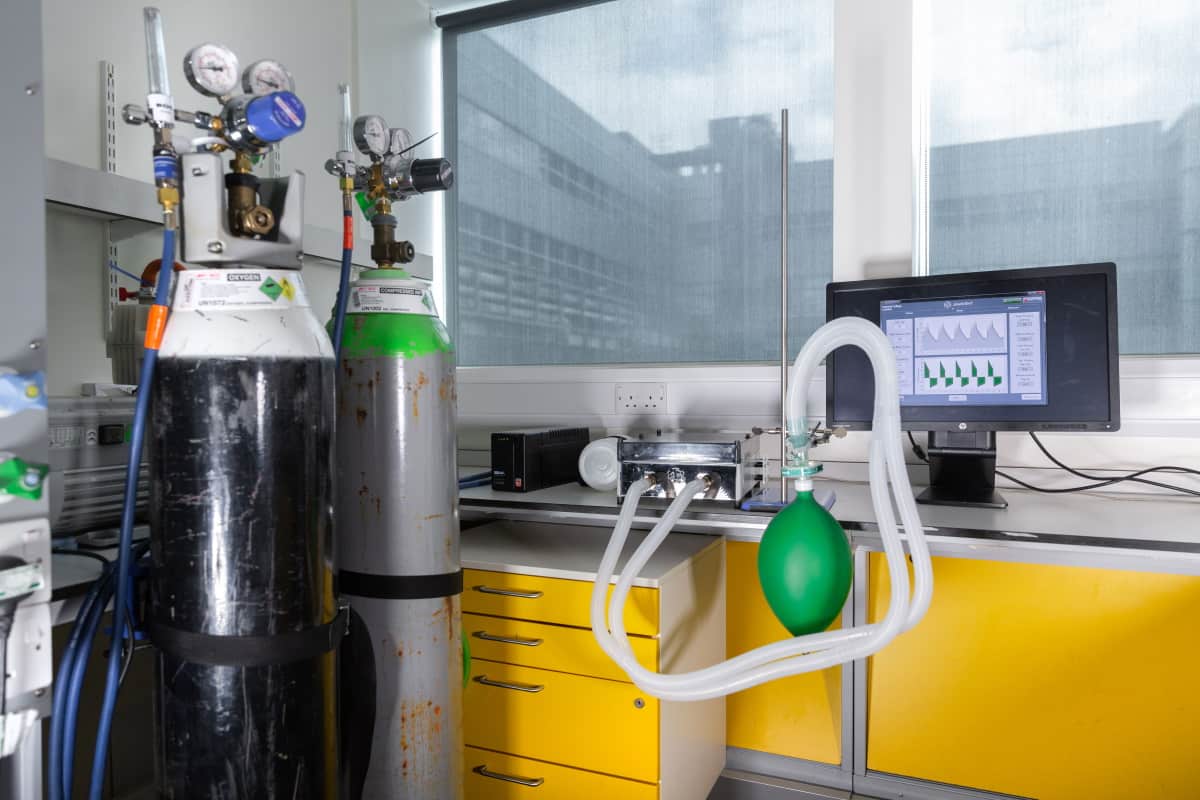
The ventilator uses four on–off solenoid valves, a two-litre reservoir, an oxygen sensor and two mechanical pressure sensors. Unlike most current ventilator designs it does not require pressurized gas supplies, which can be in short supply, particularly in low resource settings. Instead, it can utilize a portable home-use oxygen concentrator.
Proportional valves provide a continuous flow, but on–off valves are unable to do this as they can only be open or closed. To get around this, the researchers used two on–off valves to charge the two-litre reservoir with a mixture of air and oxygen. By controlling the time and sequence in which the valves are open, they were able to regulate the oxygen concentration and volume of each breath stored in the reservoir. Once ready, a third valve opens to deliver the pressurized gas to the lungs. The fourth valve controls the exhalation breath, which is driven by the pressure difference between the patient’s lungs and the ventilator.
Design tests: The new ventilator in the lab. (Courtesy: Thomas Angus/Imperial College London)
The team previously showed that the ventilator can carry out the critical functions of intensive care ventilation for COVID-19 patients. In their latest work, published in Frontiers in Medical Technology, the researchers used a flow analyser and test lungs to demonstrate that the design achieves all the performance requirements set out in ISO 80601, the international standard for critical care ventilators. This includes the ability to maintain pressure during suction to clear the patient’s airways, and a spontaneous breathing mode that supports breaths triggered by the patient – a critical part of the recovery process that helps wean patients off ventilation.
“Ventilators made by big manufacturers have always been too expensive and complex for developing countries to buy and maintain, so many of the less affluent parts of the world simply have minimal access to ventilators. In addition, most of the new ventilator designs created for COVID-19 were based on emergency short-term manufacturing and are not appropriate for long-term intensive care support, which is desperately needed in low-and-middle income countries and newly emerging economies,” says van Batenburg-Sherwood.
“Our ventilators are inspired by the beauty of simplicity. Rather than using the complex control valves used in most ventilators, we conceived a way to use simple on–off valves to provide the high-level performance required of ventilators. This way, we have made the technology much cheaper and less expensive to make and maintain.”
We do love an alternative periodic table here at Physics World, so I was chuffed to discover that the European Chemical Society has put a sustainable twist on its version of the table that displays the elements in terms of their abundance here on Earth
Any guesses regarding the most abundant element on Earth? Judging from the table it is oxygen, followed possibly by silicon and then maybe hydrogen. You might be wondering why I am not certain about the order. The reason, as you can see above, is that there are no numbers associated with the abundances. It is also not clear to me whether the abundances are given in terms of numbers of atoms on the planet or by mass – however, a little digging reveals that the areas are proportional to the numbers of atoms of each element on a logarithmic scale.
New in this latest version is the security of supply of the elements. This is important if they are used in key technologies such as mobile phones, which is designated in the table using an icon. Also highlighted is whether the production of an element occurs in areas of conflict.
Contentious carbon
The one element that had me scratching my head is carbon. According to the table there is a serious threat to some of the global supply of the element and that some of the global supply comes from conflict zones. According to the European Chemical Society this reflects the serious threat to the environment that the burning of carbon-based fossil fuels poses and the fact that some oil is extracted in areas of conflict.
Something I would like to see in the next version of this table is which elements are crucial to developing green technologies, and if we have enough of them.
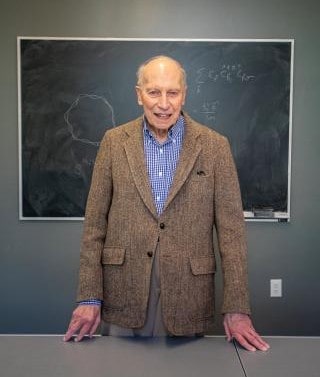
Hat trick: Manfred Steiner is three times a doctor. (Courtesy: Brown University).
As someone who is getting a little long in the tooth, I’m always on the lookout for stories of physicists who have scored major achievements later in life. Meet Manfred Steiner, who at the age of 89 has just completed a PhD in physics from Brown University in the US. In his youth, Steiner loved physics but put that aside to follow his family’s advice and become a medical doctor. He first trained in his native Vienna before moving to the US, where he had a distinguished career in haematology before retiring in 2000.
That is when he rekindled his passion for physics and enrolled in Brown first as an undergraduate, completing his degree part time in 2007. Now he has completed his PhD with the approval of his thesis “Corrections to the geometrical interpretation of bosonization”.
By the way, this is Steiner’s second PhD, he had already done one in biochemistry. So, he is a doctor three times over.
“It is important not to waste your older days,” says Steiner. “There is a lot of brainpower in older people and I think it can be of enormous benefit to younger generations.”
Tiny particles of plastic in the atmosphere can affect Earth’s climate, according to Laura Revell at the University of Canterbury in New Zealand and colleagues. New calculations of the heating and cooling effects of airborne microplastics reveal that the overall influence on climate is strongly dependent on the distribution of microplastics in the atmosphere – which is currently poorly understood.
Today, roughly 5 billion tonnes of plastic waste have accumulated in landfills and natural environments. As the material breaks down over time, it releases vast quantities of microscopic particles – which due to their small size and low density, can be transported across the globe by winds and ocean currents. Although the threats these microplastics pose to natural ecosystems are now being studied extensively, their influence on Earth’s climate is still virtually unknown.
Climate scientists know that aerosols like dust, pollen, and soot will alter temperatures on Earth’s surface as they scatter and absorb sunlight. As a result, the effects of these particles are quantified in climate models that predict future changes in global temperatures. Yet even as airborne microplastics become an ever-larger part of the mix of atmospheric aerosols, their radiative influence is still virtually unknown.
Altitude matters
In their study, Revell’s team present the first detailed calculations of the optical properties and radiative effects of airborne microplastics. Assuming that microplastics are present in atmosphere up to altitudes of 10 km, the team’s models predicted a small positive effective radiative forcing. This means that the particles reflect slightly less solar energy back into space than they absorb, which has a slight warming effect on the surface of the Earth.
However, exactly how microplastics are distributed in the atmosphere is not well known. If instead, the particles are entirely confined to the 2 km layer of the atmosphere lying directly above the Earth’s surface, Revell and colleagues calculate a larger negative effective radiative forcing – and therefore a small cooling effect. This effect, however, is much smaller than that known to be caused by other types of aerosols in the atmosphere.
Regardless of which prediction is more accurate, the researchers found that the influence of microplastics on Earth’s surface temperature is currently far weaker than other types of atmospheric aerosol.
Amounts of plastic waste accumulated in landfill and natural environments has risen rapidly over the past 70 years. It is expected to double over the next 30 years unless significant, global-scale action is taken. As climatologists learn more about how microplastic pollution is being distributed throughout the lower atmosphere, the team’s results will allow for more accurate predictions of how microplastic aerosols could affect the climate.
Wearable pressure sensors are commonly used in medicine to track vital signs, and in robotics to help mechanical fingers handle delicate objects. Conventional soft capacitive pressure sensors only work at pressures below 3 kPa, however, meaning that something as simple as tight-fitting clothing can hinder their performance. A team of researchers at the University of Texas has now made a hybrid sensor that remains highly sensitive over a much wider range of pressures. The new device could find use in robotics and biomedicine.
The most common types of pressure sensors rely on piezoresistive, piezoelectric, capacitive and/or optical mechanisms to operate. When such devices are compressed, their electrical resistance, voltage, capacitance or light transmittance (respectively) changes in a well-characterized way that can be translated into a pressure reading.
The high sensitivity and long-term stability of capacitive pressure sensors make them one of the most popular types, and they are often incorporated into soft, flexible sensors that can be wrapped around curved surfaces. Such sensors are popular in fields such as prosthetics, robotics and biometrics, where they are used to calibrate the strength of a robot’s grip, monitor pulse rates and blood pressure, and measure footstep pressure. However, these different applications involve a relatively wide range of pressures: below 1 kPa for robotic electronic skin (e-skin) and pulse monitoring; between 1 and 10 kPa for manipulating objects; and more than 10 kPa for blood pressure and footstep pressure.
Electrically conductive and highly porous nanocomposite
In the new work, researchers led by Nanshu Lu tackled the trade-off between the sensitivity of soft capacitive pressure sensors and the limited range of pressures over which they can operate. The device they created uses an electrically conductive and highly porous nanocomposite as its sensing layer, while incorporating an extra layer that acts as an insulator. This approach gives the sensor the properties of both piezoresistive and piezoelectric sensors, resulting in a hybrid device that boasts a high sensitivity as well as a large sensing range. Indeed, the researchers found that when they applied the sensor to a person’s forehead and then strapped a tight-fitting virtual reality headset over it, the sensor experienced only a negligible loss in sensitivity.
The new sensor can be wrapped around almost any object, Lu says, and it could be made into an array for pressure mapping. “The most obvious application is wrapping it around robotic hands and fingers to give them the ability to recognize objects by touching them,” she says, “but there are many other things it could do.”
The researchers now plan to address the next biggest bottleneck for soft capacitive pressure sensors: the coupling between their response to in-plane deformations and out-of-plane pressure. “Due to the coupled responses, conventional soft capacitive pressure sensors are not able to offer accurate pressure readings when stretched in plane,” Lu tells Physics World. “The combined high sensitivity and large sensing range of the new hybrid response pressure sensor could help overcome this long-term obstacle.”
With the COP26 climate summit underway in Glasgow, Physics World Weekly is bringing you a two-part series on climate change. Last week’s episode explored how extreme heat will affect global health and the challenges faced by climate modellers. Today’s episode is focussed on climate solutions.
First up I look at some of the latest developments in energy research – wind, solar, nuclear and energy storage. I’m joined by Daniel Kammen from the University of California, Berkeley, in the US, whose research interests span renewable energy, nuclear power and public policy.
Next, I turn my focus to buildings and infrastructure. Smart meters and sensors might be helping to reduce building energy usage. But what’s harder is knowing the carbon footprint of building materials throughout their entire lifecycles. Fortunately, researchers such as Arpad Horvath, an environmental engineer at the University of California, Berkeley, are starting to tackle these data gaps.
Finally, I look at carbon capture and storage (CCS), the process of capturing CO2 and sequestering it in geological formations. I speak with Martin Blunt an engineering physicist at Imperial College London and Juan Alcalde Martín, a geoscientist at the Geo3bcn research lab in Barcelona. As both guests explain, CCS has been around for decades but there are still big challenges in scaling up the technology to have a significant impact on carbon emissions.
Learn about the latest climate science by signing up to Environmental Research 2021, a free to attend virtual conference 15–19 November hosted by IOP Publishing.
New research shows that microscale robots can be made from shape shifting 2D sheets. Itai Cohen and Itay Griniasty of Cornell University in the US have developed a mathematical technique for encoding the motion cycle of a tiny robot onto the surface of a flat material. Working alongside Cyrus Mostajeran of the UK’s University of Cambridge, they believe that their work will make it possible to design microscale swimming robots from materials such as liquid crystal elastomers and hydrogels.
Cohen is confident that microscale robots will one day perform many of the same tasks as their macroscale counterparts. He believes however, that at the micro and nanoscale, “We have to completely reimagine the way that we make machines”.
“The way that we’re going to do it is we’re going to manufacture everything in 2D and then release it from the substrate and get it to fold or assemble itself into some 3D object that can then do work on its environment.”
Microscale manufacturing challenges
Liquid crystal elastomer (LCE) sheets are a leading candidate for making microscale soft robots in this way. These flat materials deform into 3D shapes in response to light, heat and electromagnetic fields, with the initial alignment of the molecules determining the final curvature.
Designing functional machines from these sheets however remains a challenge. To perform useful work such as swimming, a robot needs to have more than one deformation programmed into it when it is manufactured. As an example, Cohen suggests a robot where some molecules respond to blue light and some to red light. However, the deformations would be coupled together, making it incredibly difficult to predict the final shape.
A mathematical solution
Griniasty joined the Cohen lab as a postdoc, bringing with him a mathematical technique that he, Cohen and Mostajeran have adapted to make their breakthrough. Griniasty had been using differential geometry to reverse engineer LCE- type sheets that deform into a single target shape. He predicted that the same method could be applied to a much more complex system, one where he was designing a robot that could deform into all the shapes in its motion cycle depending on the stimulus.
Researchers have experimented with origami-like sheets that fold into multiple shapes, but Cohen says that the advance in this latest work, “is the ability to form multiple shapes without going back the initial flat state… and that’s what opens up being able to do work and locomotion”.
How it works: a flat sheet is shown deforming into a sphere (bottom centre), a face (bottom right) or a wavy pattern (top) depending on the stimulus. (Courtesy: I Griniasty et al/Physical Review Letters)
The researchers found that in most cases, this theoretical technique could find an analytical solution; an alignment pattern that should cycle through an entire sequence of target shapes when deformed. They demonstrate as an example, a sheet that deforms first into a sphere, then a wavy pattern, and finally a face (see above figure).
As proof of concept, they also propose a simple microswimmer that can move through a viscous fluid. The swimmer is a flat LCE type disk made up of two layers with orthogonal molecule alignments. When the layers are stimulated one after the other and then relaxed, the swimmer exhibits a cycle of conical and flat shapes, which the researchers predict will allow it to move through a fluid.
Whilst they have yet to test their theories in the lab, the team is optimistic about the results. As well as LCEs, they are investigating experimental realizations in inflatable and kirigami (cut and folded) sheets. The team has also released a software package that allows researchers worldwide to design shape shifting robots using their theory.
An influential panel of astrophysicists and astronomers has called for a major space-based observatory to be launched in the mid-2040s. This significant new mission would observe extra-solar planets that are 10 billion times fainter than the stars they orbit and provide spectroscopic data about the planets. The recommendation is made in a major, 614-page report released today by the Decadal Survey on Astronomy and Astrophysics 2020, known as Astro2020.
Dubbed the “real” successor to the ageing Hubble Space Telescope, the observatory would contain a mirror with a diameter of at least 6 metres and cost around $11bn. The 20-member panel that wrote the report says that an independent review of the project’s feasibility should, however, be carried out before it is given the green light. Such a review would prevent the project from suffering the cost hikes and delays that have hit previous large space-based observatories.
Entitled Pathways to Discovery in Astronomy and Astrophysics for the 2020s, the decadal survey was written by a committee convened by the US National Academies of Sciences, Engineering, and Medicine. Co-chaired by Fiona Harrison from the California Institute of Technology and Robert Kennicutt from the University of Arizona and Texas A&M University, it is the seventh decadal survey of its type. Astro2020 identifies the highest priority research activities in astronomy and astrophysics in the US over the coming decade.
The new report broadly identifies three “priority scientific areas” for investment over the next decade. One is to identify and characterize Earth-like planets outside the solar system, with the goal of imaging potentially habitable worlds. A second is to probe the nature of black holes and neutron stars. The third area is understanding what happened in the earliest moments in the universe and to improve our understanding of the origins and evolution of galaxies.
The main aim of the proposed observatory – which is the highest-ranked large space-based mission in the report – would be to search for biosignatures from some 25 habitable zone planets and to be a “transformative facility for general astrophysics”. Hubble, which covers wavelengths from ultraviolet to near infra-red, has been in operation in low-Earth orbit for over 30 years but has recently suffered a series of failures in its electronics systems that could limit its lifetime.
The next big thing
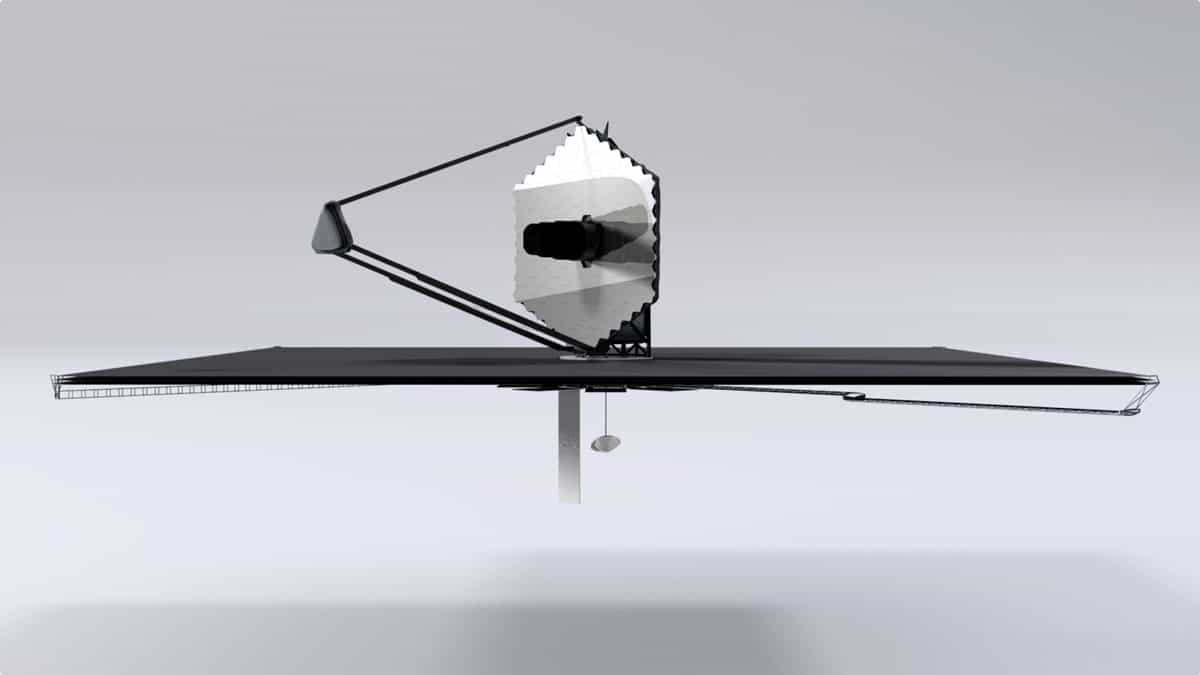
One for the future: the Large UV/Optical/IR Surveyor (LUVOIR) is a multi-wavelength space observatory under consideration in NASA’s Astro2020 decadal survey. (Courtesy: NASA)
The panel says, however, that LUVOIR-A – which would feature a huge 15 m-diameter mirror made up of 36 segments – is too expensive an option. LUVOIR-B, in contrast, would contain a smaller, 8 m mirror and cost only £17bn. It features both a coronagraph and starshade that block out the light from a star so that nearby objects can be resolved. HabEx, meanwhile, is also designed to have a coronagraph and starshade, but with a 4 m diameter primary mirror would cost only $10.5bn. A smaller version of HabEx featuring a 3.2 m mirror would have an even lower price tag of $7.8bn.
The report says that the implementation of a single telescope based on the LUVOIR and HabEx concepts could begin by the end of the decade following a review to consider whether it is ready for implementation. Julianne Dalcanton from the Univeristy of Washington, who sits on Astro2020’s steering committee, told Physics World that the new telescope would be “the result of an intensive design and technology development process that would begin immediately”. She adds that it would “take advantage of the hard work of both the LUVOIR and HabEx concepts, pulling together the best of both to launch a large, capable telescope”.
The new telescope will take advantage of the hard work of both the LUVOIR and HabEx concepts, pulling together the best of both
Julianne Dalcanton, University of Washington
Theoretical cosmologist Michael Turner from the University of Chicago, who has been involved in four decadal surveys and who was a reviewer on the latest incarnation, told Physics World that LUVOIR will do a “panoply of exciting science”. Turner adds that the launch date of early 2040 is daunting. “But as they say all the easy stuff has been done, and the ambitious plans we have these days take a long time to implement,” he adds. “But I believe [they are] worth waiting for.”
Those involved in the LUVOIR mission are equally delighted by the support from the decadal committee. Martin Barstow, a space scientist from the University of Leicester in the UK, who is a member of LUVOIR’s planning team, says the announcement is “a really exciting result” for the search for habitable worlds and life elsewhere in our galaxy, which he says is “one of the most important scientific quests”.
A mission like LUVOIR is the tool we need, and I will look forward to having that answer to the question “are we alone” within my lifetime
Martin Barstow, University of Leicester
Barstow adds that seeing LUVOIR so prominently in the decadal survey is a “testament to the huge effort of the team” over the past few years. “[Exoplanet research] is enormously challenging from an engineering perspective, yet we know how to carry out the search and are close to having the technology with which to do it,” adds Barstow. “A mission like LUVOIR is the tool we need, and I will look forward to having that answer to the question “are we alone” within my lifetime.”
As well as LUVOIR and HabEx, two other large space-based missions were selected by NASA in 2016 to go forward into the Astro2020 process. They are the Lynx X-ray Observatory, which would replace the Chandra X-ray observatory that was launched in 1999. The other is Origins – an infrared space telescope. The committee recommend that NASA begin preliminary studies on both these missions, which would have a target launch cost of between $3-5bn. However, it states that the next decadal survey should decide which one enters the implementation phase.
Chanda Prescod-Weinstein, a theoretical cosmologist from the Univeristy of New Hampshire, is, however, disappointed by the decision to delay a potential go-ahead for Lynx as well as the general lack of emphasis on dark matter given its critical role in the universe particularly in galaxy dynamics. “Perhaps the most disconcerting thing here is the delayed start for the proposed preliminary study for the X-ray mission – I don’t see a reason to wait,” says Prescod-Weinstein. “There’s been a lot of emphasis on optical, but it is also something we can do from the ground and where we already have new missions in the pipeline. We can’t do X-ray from the ground.”
Planning ahead
Another major recommendation in the Astro2020 report is that NASA should establish a dedicated programme to develop the science, mission architecture, and technologies of large mission that are identified as high priority. The so-called “Great Observatories Mission and Technology Maturation Programme” would advance the designs of several major overlapping space missions in the coming decades and provide early investment in the development of multiple mission concepts, changing the way major projects are planned and developed. A Hubble successor would be the first mission to enter this programme.
Making up-front investments helps create mature missions with well-understood trade-offs between science and cost
Julianne Dalcanton, Univeristy of Washington
It is hoped that the programme will lower the risks and costs of projects before they become too complex and expensive. The move is partly since the highest-ranked space telescopes in previous decadal surveys remain on the ground. Astro2000’s top-ranked space project was the $11bn James Webb Space Telescope (JWST), which is finally expected to launch next month following years of delays and budget overruns.
In the 2010 decadal survey, meanwhile, astronomers chose the $3.5bn Wide-Field Infrared Survey Telescope, which then was set to launch in 2020. Planning issues took hold of that project too and the scope of the mission was cut down and it was also renamed the Nancy Grace Roman Space Telescope with a projected launch date of 2025. Both are primarily infra-red telescopes so not seen as a direct successor to Hubble.
“Making up-front investments helps create mature missions with well-understood trade-offs between science and cost and allows NASA to move a sequence of exciting missions forward to launch at a faster cadence than possible if they were developed completely sequentially,” says Dalcanton.
Eye on the sky
The $1bn Giant Magellan Telescope will be located at Las Campanas in Chile’s Atacama Desert and will have seven circular mirrors, each 8.4 m in diameter and weighing 18 tonnes (Courtesy: Giant Magellan Telescope – GMTO Corporation)
For the past two decades two competing designs have been battling it out to become the next US large ground-based facility. They are the Giant Magellan Telescope (GMT) and Thirty Meter Telescope (TMT). The $1bn GMT will be located at Las Campanas in Chile’s Atacama Desert and is on-track for first light in 2029. The GMT will have seven circular mirrors, each 8.4 m in diameter and weighing 18 tonnes. When put together, they will create a telescope equivalent to one mirror 25.4 m wide that has a total collecting area of 368 square metres. The telescope will have space for 10 instruments and can complete a full rotation in nearly three minutes.
The TMT, meanwhile, is designed to have a primary mirror 30 m across made of 492 hexagonal segments enclosed in a structure 66 m wide and 56 m tall, when built the TMT will be able to collect images 12 times sharper than the Hubble Space Telescope, allowing it to resolve the faintest and oldest galaxies. Construction began in 2014 but was halted a year later as native Hawaiians protested over how the astronomical community approached building the telescope on Mauna Kea, which they regard as sacred. Since then, TMT officials have chosen a site in La Palma should it not be possible to build in Hawaii.
Rather than pick one of these telescopes, the report says the National Science Foundation (NSF) should invest in both the GMT and TMT to “ensure significant access to these tools for the entire US astronomical community”. The report notes that the scientific potential of these observatories is “transformative, with the ability to address all three of the scientific priority areas and complement current and future space telescopes”. However, the report recommends that the NSF conduct an external review of the TMT and GMT by 2023 and if only one of these instruments can meet certain conditions, then the NSF should “proceed with investment in that project alone”.
If both are chosen for support then US-based astronomers should receive at least 25% of the time on each telescope but if only one project proves to be viable, NSF should aim to achieve “a larger fraction of the time, in proportion to its share of the costs and up to a maximum of 50%”. “Investing in both telescopes is the ideal outcome for truly transformative science, provided both can be successful,” adds Dalcanton. “Rather than picking a winner and loser, the report offers a framework for evaluating whether the telescopes meet needed milestones before triggering federal investment.”
Turner says that given the progress of the 40 m-diameter European Extremely Large Telescope, which is currently under construction in Chile, the US has fallen behind Europe in the realm of big ground-based telescopes “just at a time when the opportunities for discoveries has never been greater”. He adds that the support by the panel is “essential” to the future of US leadership in astronomy and astrophysics. “Not only will NSF involvement give access to all US astronomers, but it comes at a time when both projects are in need of financial help,” adds Turner. “In the US, I believe we are transitioning from our traditional private support of big telescopes to public support. This will help this transition”.
The most exciting breakthroughs in all of science are occurring in astrophysics and the life and biological sciences. What a great time to be a scientist
Michael Turner, University of Chicago
GMT President Robert Shelton, meanwhile, says the GMT collaboration has been “deeply gratified by the enormous US and global support we have received from the scientific and philanthropic communities”. “We are also incredibly grateful to everyone who contributed to the Decadal Survey process,” he says. “While we have much work still to do, we take great pride in what we’ve already achieved.”
Another ground-based project that is recommended in the report is the cosmic microwave background experiment, known as CMB-S4. The report calls for the NSF and the US Department of Energy (DOE) to “jointly pursue the design and implementation” of CMB-S4. “This endorsement recognizes the enormous CMB prize still out there and the continuing potential of stunning science to come from the CMB,” says Turner. “The big prize of course is the B-mode polarization signature of inflation that would reveal when inflation took place.”
Community focus
Astro2020 was expected to be released last year but was postponed due to the impact of the COVID-19 pandemic and many subsequent meetings had to be moved online just at the time when the process was at the peak time for activities. Astro2020 includes the input of over 150 scientists and drew from the astronomical community through hundreds of white papers, town hall meetings, and the advice of 13 sub-panels. These included six science panels and six programme panels as well as the first panel focussed on the state of the profession and societal impacts.
Indeed, astronomy has been hit by several issues recently from scientific misconduct to a failure to address concerns of indigenous people when building new telescopes, which has affected the TMT. The report recommends that the astronomy community should work with experts from other “experienced disciplines” such as archaeology and social sciences and representatives from local communities to define a “community astronomy model of engagement” that advances scientific research while “respecting, empowering and benefiting local communities”.
The report also calls for funding agencies to improve the diversity of the astronomical community, describing the current racial/ethnic diversity among astronomy faculty in the US as remaining “abysmal”. It calls on NASA, NSF and the DOE to “ensure their policies treat harassment and discrimination as forms of scientific misconduct, and invest in workforce diversity at the division and directorate levels — as well as consider including the diversity of project teams and participants as a criterion when awarding funding”.
Dalcanton says that many students go through their entire academic lives without being taught by faculty who share their lived experiences and who could serve as models “for a future that would treasure their contributions”. “Building intellectual communities that anyone can find a home in will always bring forward the best science,” adds Dalcanton. “Most faculty funding goes towards supporting students and trainee scientists, and money spent to help those faculty build diverse communities of scholars lays a foundation for future discoveries.”
That view is backed by Prescod-Weinstein who says she is “excited” to see a call for graduate and postdoctoral fellowships to improve diversity and inclusivity. “So many of us have asked for these over the years,” adds Prescod-Weinstein. “I agree that broadening participation at the faculty level is also critical. And it is good to see an emphasis on taking harassment seriously.” Yet she says that the devil will be in the detail. “I will be interested to see proposed execution and whether the changes are cosmetic or substantive, with a chance of having real, lasting impact”.
Dalcanton says that the report sets out a clear and “ambitious” vision for the coming decade – a view that is shared by Turner. “The most exciting breakthroughs in all of science are occurring in astrophysics and the life and biological sciences,” adds Turner. “Both are transforming our understanding of our place in it all — and both are powered by instrumentation that is enabling us to be able to explore two these worlds that have been beyond our reach. What a great time to be a scientist!”
For astronauts, staying healthy while in orbit is a top priority. The human body simply isn’t built for outer space: long-term exposure to microgravity can result in muscle loss, weaken bones and even shorten eyeballs. But what happens to an astronaut’s brain once they leave Earth behind?
Research published in JAMA Neurology suggests that long-duration spaceflight could cause minor brain damage and accelerate neurodegeneration. The pilot study, led by senior authors Henrik Zetterberg of the University of Gothenburg and Alexander Choukér of the Ludwig-Maximilians University Munich, followed five Russian cosmonauts onboard the International Space Station. By tracking the concentration of brain-specific proteins before and after the space mission, the researchers concluded that long-term spaceflight presents a slight, but lasting, threat to neurological health. The results may have ramifications for future space missions, including manned journeys to Mars.
“This [brain cell damage] must be explored further and prevented if space travel is to become more common in the future,” says Zetterberg.
Blood-based biomarkers expose brain injuries
The cosmonauts – five men with an average age of 49 – spent almost half a year in space. The researchers took blood samples from the participants both pre-flight (20 days before launch) and post-flight (one day, one week and three weeks after landing). Using single molecule array testing, a technique sensitive enough to detect proteins at the femtogram per millilitre level, they studied the concentration at each time point of five blood-based brain biomarkers: neurofilament light (NfL), glial fibrillary acidic protein (GFAP), total tau and the amyloid-beta proteins Aβ40 and Aβ42.
These proteins shed light on the structural integrity of brain tissue. Increased levels of NfL in the cerebrospinal fluid or blood, for example, are associated with damage to the brain’s connecting fibres, the axons. Meanwhile, amyloid-beta proteins are considered a hallmark of neurodegenerative disease and the aging brain.
To determine biomarker trends, the researchers looked at the mean group response for the five cosmonauts. They found that NfL, GFAP and Aβ40 levels were significantly elevated upon the cosmonaut’s return to Earth, even after three weeks. All three biomarkers reached peak concentration one week after landing. Notably, correlation analysis uncovered a three-way association between each protein concentration over the time course of the study. This suggests that long-term trips to space trigger a widespread response from different types of functional tissue in the brain.
“All relevant tissue types of the brain seem to be affected,” says corresponding author Peter zu Eulenburg, who conceived the idea for the study.
Team work: The Ludwig-Maximilians University Munich researchers, who completed the study along with collaborators in Sweden and Russia. From left to right: Judith-Irina Buchheim, Alexander Choukér and Peter zu Eulenburg. (Courtesy: Peter zu Eulenburg)
Taken together, the results could reflect the brain’s response to prolonged fluid redistribution during spaceflight and its subsequent restoration back on Earth. Moreover, this response appears to continue for weeks post-flight, as the effective half-life of each biomarker is considerably less than three weeks.
Follow-up studies on Earth
While the pilot study uncovered the damage that long-term missions could inflict on the brain, the question remains as to how and why this damage occurs.
“Is it being weightless, changes in brain fluid, stressors associated with launch and landing, or is it caused by something else?” asks Zetterberg. Fortunately, there is plenty of scope for the research to continue back on Earth.
“There are several space analogue environments on Earth,” zu Eulenburg tells Physics World. “This includes social isolation studies in Antarctica and parabolic flight campaigns to investigate gravitational transitions from micro- to hyper-gravity [gravitational force higher than on Earth].”
The promise of quantum computers is starting to turn into reality. Research groups in academia and industry have built early demonstrators with a few tens of qubits, and within the next few years it seems likely that practical quantum computers will for the first time be able to surpass the performance of classical silicon-based processors. Based on current roadmaps, quantum devices will be powerful and reliable enough in 10 to 15 years’ time to tackle complex problems across science, technology and industry that cannot be solved with conventional supercomputers.
If a quantum computer were available tomorrow, however, very few people would know how to use it – or even what it could be used for. “A quantum computer is a new paradigm that depends on the counterintuitive laws of quantum mechanics,” says Chiara Decaroli, the outreach and engagement officer for the UK’s National Quantum Computing Centre (NQCC) – which will be based in a new facility that is now being built on the Harwell campus in Oxfordshire. “Imagining how a quantum computer might be used to solve a particular problem requires a different mind-set and specialist training.”
For that reason, one of the key goals for the NQCC is to develop the skills and knowledge needed for different industry sectors to understand and exploit the future potential of quantum computers – something that the NQCC calls “quantum readiness”. One of its first priorities, says Decaroli, will be to create a user community that will be able to explore the power of quantum computing for different applications. “We need to help end users understand what quantum computing can offer them, and support them in developing the skill sets they need to integrate quantum computing into their businesses,” she adds.
One way the NQCC plans to foster this user community is through a series of workshops and hackathons aimed at specific industry sectors. These will enable scientists and engineers from different backgrounds to explore possible use-cases for quantum computers, and will enable future end users to gain access to emerging quantum computing resources. Bringing these diverse stakeholders together will also help the NQCC to develop a high-level view of the UK’s quantum ecosystem, and to identify any gaps in understanding or resources that will need to be addressed for each industry sector to boost its quantum readiness.
“Although quantum computers are still small-scale, now is the time for expert end-users to engage with the technology to get a head-start on understanding its potential,” comments Ashley Montanaro, a professor of quantum computation at the University of Bristol in the UK and co-founder of the quantum software startup Phasecraft. “The NQCC can help by providing a central point of contact to enable collaboration and joint development.”
The NQCC has already started to commission a series of collaborative R&D projects, even though its physical facility is not due to open until 2023. Some are focused on essential hardware development to support the NQCC’s headline objective of building a quantum computer with 100 qubits within the next five years. But others aim to make quantum computing more accessible to end users in research and industry, and to develop novel applications for the modest-scale machines that are available today.
One of those near-term applications will be to simulate the behaviour of a simple quantum system, such as a small molecule or the interactions between molecules – which some researchers think could be achieved with around 1000 qubits. “Quantum computers will be able to model quantum systems natively, which will allow us to develop and understand novel materials for batteries, solar cells and other key applications in sustainable energy,” comments Montanaro.
Chiara Decaroli, a quantum scientist who is now the NQCC’s outreach and engagement officer, says that it’s important to provide a realistic view of the current and future capabilities of quantum computers. (Courtesy: NQCC)
This ability to simulate quantum systems will also open up applications in the pharmaceutical sector, as well as in chemicals and materials engineering. All of these industries already invest heavily in R&D, and they also rely on high-performance computing to model and predict the behaviour of novel compounds and materials. “The core of their work is to simulate, but certain problems are so complex that they can’t be fully solved using existing computers,” says Decaroli.
In drug design, for example, the limitations of current simulations means that hundreds of candidate molecules must be fabricated and tested to create a single formulation that is both safe and effective. A quantum computer with a modest number of qubits would be able to precisely simulate the behaviour and effects of different molecules, speeding up the development of more effective pharmaceuticals.
While these research-intensive industries are constantly pushing the boundaries of classical computation, individual companies may not yet have the resources to start developing their own capability in quantum computing. Having access to a strong ecosystem of academic researchers, as well as the UK’s vibrant start-up sector, will be crucial for them to identify and realize some of these near-term applications. “For a whole economy to undertake a transformation as enormous as ‘becoming quantum ready’, large institutions need the reassurance of a government-backed organization like the NQCC to mediate between them and the quantum computing ecosystem,” says Carmen Palacios–Berraquero of Nu Quantum, a start-up developing single-photon components for quantum systems. “This ecosystem is still nascent and potentially hard to engage with.”
Decaroli points outs that it will be start-up companies like Nu Quantum that are likely to come up with the most innovative solutions, and to have the skills and motivation to translate novel technologies into commercial applications. “Large industrial players will want to have access to this knowledge, either through acquisition or co-development, and part of our role will be to facilitate those connections,” she says.
Even more disruptive applications beckon for the quantum computers of the future. The performance of today’s machines are limited by errors that arise from the noisiness of the qubits, and eliminating those errors will require machines with millions of qubits – just to create a small subset that can operate without errors. “Stopping the decoherence of qubits of every type, which would unlock the development of quantum processors with large numbers of qubits, is the single biggest barrier to quantum readiness,” comments Steve Brierley of quantum start-up Riverlane. “For that reason our main focus at Riverlane is error correction.”
It will take this type of fault-tolerant quantum computer to address complex problems across a broad range of industry sectors. One example that has come into sharp focus during the Covid-19 pandemic is logistics, ensuring that goods and healthcare products reach the right destinations at the right time. The climate crisis is also demanding urgent responses from both industry and the public sector, ranging from improved weather forecasting and careful management of energy supply and storage, through to the development of more sustainable manufacturing processes.
“We know that quantum computing will impact nearly every industry, from pharma to finance,” comments Ilana Wisby of OQC, a start-up that in July 2021 introduced Europe’s first quantum computing-as-a-service (QCaaS) platform. “Our objective with QCaaS is to enable our customers to experiment with quantum computing, and we are working with the NQCC to bolster the UK’s quantum community by giving its members access to our systems.”
Decaroli believes that organizations that rely on high-performance computing, such as financial services companies that constantly need to optimize their risk profile, already appreciate that quantum machines have the potential to outperform their current systems. “They will be preparing to upskill and learn about quantum computing,” she says. “The NQCC can support them by providing information, organizing workshops, and developing training material for their personnel.”
In the longer term, however, quantum computing has the potential to disrupt industries that are not so familiar with the technology. “Industry experts in those sectors might not know very much about quantum computing, while quantum specialists might lack the domain knowledge to translate the technology into a specific application,” comments NQCC director Michael Cuthbert. “We need to bridge that gap to identify the key applications that will deliver real value for those industry sectors.”
But the NQCC is also keenly aware that it’s important to manage expectations of what the technology will be able to achieve and on what timescale. After all, building and operating even a modest-scale quantum computer remains the focus of intense research effort, and scaling the technology to incorporate millions of qubits presents significant technical challenges. “The innovation that’s needed to scale up the technology and develop future applications may come from unconventional sources and multidisciplinary collaborations,” comments Decaroli, “That makes it even more important to properly communicate what the challenges are and where the technology is.”
The NQCC hopes to avoid the risk of hype by establishing itself as an independent, trusted voice that provides a realistic view of the current capabilities of quantum computers – as well as what they will be able to achieve in the future. “Even though the technology is still at an early stage, there is no doubt that a fully fault-tolerant quantum computer will be transformative for many industries,” concludes Decaroli. “Now is the right time to put more effort into building awareness and skills so that different businesses are ready for that transformation.”
An array of 30 vertical cavity surface emitting lasers (VCSELs) has been made to behave as a single coherent light source for the first time, paving the way for large-scale, high-power applications that were previously out of reach for this popular class of laser. The design of the new array draws on concepts from the field of topological insulators, and its developers are now working with industrial partners to refine the technology for use in medical devices and communications networks.
VCSELs are the most common lasers in the world, routinely used in application areas ranging from portable phones and optical communications to instrumentation, manufacturing, sensing and even facial recognition. Like other lasers, they contain a gain medium in which light is generated and emitted. For VCSELs, this gain medium is made from quantum wells or quantum dots and sandwiched between two mirrors that act as a cavity, providing the optical feedback necessary for lasing. The gain medium is also just fractions of a micron thick, giving VCSELs a high switching speed as well as a compact and lightweight construction.
A VCSEL’s small size does, however, strictly limit its output power. Over the last few decades, researchers have sought to increase this power by combining many VCSELs and forcing them to behave like a single laser. The problem is that inevitable imperfections in manufacturing tend to cause the VCSELs to lase in small, independent groups that are not synchronized with the others, making the array’s output incoherent.
Topological photonics
A team led by Sebastian Klembt of the University of Würzberg, Germany and Mordechai Segev of the Technion-Israel Institute of Technology has now found a way to lock the individual VCSELs together. The researchers achieved this by arranging the VCSELs in a geometry that follows some of the concepts of topological insulators – quantum materials that are insulating in their bulk, but excellent conductors of electricity on their surface.
While topological insulators were discovered many years ago, the field underwent a change in 2013 when Segev, Alex Szameit and students at the University of Rostock, Germany demonstrated the first photonic topological insulator. Their work launched a new field of physics, now known as topological photonics.
When the team began working on topological insulator lasers, the research community was sceptical. All lasers require gain, yet at the time, everything known about topological systems was restricted to systems that are Hermitian – that is, exhibiting no gain and no loss. “We were like a bunch of lunatics searching for something that was considered impossible,” Segev recalls.
Locked within a planar structure
In the team’s first photonic topological laser, light travelled around the edges of a two-dimensional array of waveguides without being deflected by defects or disorder in the waveguides. A few years later, Segev and collaborators from the University of Central Florida, Mercedeh Khajavikhan and Demetri Christodoulides, together with their students Gal Harari, Miguel Bandres and Steffen Wittek, demonstrated that they could force many microlasers to lase together and act as single laser. However, this system, described in two Science papers in 2018, had an important limitation: light circulating in the photonics structure was confined to the same plane as the plane required for extracting the light. This meant that the power output of the system was, again, limited by the size of the device.
The new topological insulator VSCEL array consists of two types of honeycomb lattices with a nanoscale pillar at each vertex. The researchers created an interface between honeycombs that are stretched and honeycombs that are compressed. “When you do this with proper parameters, you get a topological interface where the light must flow from one VCSEL to the next,” explains Segev. “This consistent flow of light (in the plane of the chip) – whose flow is topologically protected – forces the light from every laser to reach all the other lasers so that they lock coherently.” The VCSEL arrays therefore emits at a single frequency and displays interference. Crucially, light is now emitted through the surface of the structure from each laser, making it easy to collect.
“Our experiments show the power of topological transport of light,” say the researchers, who report their work in Science. “The light spends most of its time oscillating vertically, but the small in-plane coupling is sufficient to force the array of individual emitters to act as a single laser.”
The researchers say the platform they have demonstrated can in principle be scaled up to incorporate hundreds of VCSELs. “We would now like to make such an array into real technology, and have started to work with high-tech industry on this project,” Segev tells Physics World.