Fusion industry predicts electricity generation by the 2030s

Most private fusion companies expect fusion power to be supplying electricity to the grid in the 2030s. That is according to the first-ever report on the state of the fusion industry, which has been published today by the Fusion Industry Association (FIA) and the UK Atomic Energy Authority (UKAEA). The report – The Global Fusion Industry in 2021also finds that private fusion endeavours have received over $1.8bn of funding since the 1990s.

The report states that there are at least 35 private fusion companies worldwide – most of which are concentrated in the US and Europe. Of the 35, a dozen declared themselves in the early stage of development or operating “in stealth mode” and so did not participate in the report. For the remaining 23 companies, 12 noted that they had only begun operating only in the past five years.

While not every company declared the amount of funding they had received, the 18 that did so had accrued almost $1.8bn to date plus an additional $85m in grants and other funding from governments. Four of the biggest players in private fusion – Commonwealth Fusion Systems, General Fusion, TAE Technologies and Tokamak Energy – accounted for 85% of that funding.

This report shows how, largely outside the headlines, the private fusion industry is accelerating towards commercial power

Melanie Windridge

Magnetic confinement, in which magnetic fields are used to contain a high-temperature plasma, is the most popular fusion technique being employed by the companies, according to the report. While electricity generation is a main target for private fusion companies, almost half of the firms see the technology also being applied to space propulsion with other markets including marine propulsion, hydrogen fuel and industrial heat.

Ambitious goals

Over the coming decade, the biggest experiment in fusion will be the ITER tokamak, which is currently being built in France and is expected to fire up in the late 2020s. It is a research reactor designed to show fusion gain, whereby more energy is generated by the fusion reaction than put in, and will not therefore supply electricity to the grid. That task is expected to be performed by fusion plants in the middle of the century. The UK, for example, is currently designing the STEP prototype plant, which is expected to be in operation in the 2040s.

Despite this timeline, the report found that most private companies think they can reach that aim sooner – albeit on a smaller scale. Over two-thirds of the companies surveyed for the report believe that electricity generated from fusion would enter the grid in the 2030s, while 20% thought it would more likely be the 2040s or 50s.

“This report shows how, largely outside the headlines, the private fusion industry is accelerating towards commercial power,” says FIA communications director Melanie Windridge. “The ambitious timescales highlighted in our first survey demonstrate the drive and commitment that exists within this growing industry.”

Indeed, Windridge told Physics World that if fusion is to have a meaningful impact on climate-change targets, then the first electricity production will be needed in the 2030s with commercial roll-out ramping up in the 2040s. Yet that will not only emerge from the activity of private firms.

“The companies recognise the importance of public-private collaboration, particularly on technologies such as tritium breeding and new materials,” adds Windridge. “We are calling for more support for public-private partnerships to help them realise their ambitions.”


Business and industry must rise to the challenge of climate change

For nearly three decades the United Nations has been bringing together almost every country on Earth for global climate summits known as the “Conference of the Parties”. In that time climate change has gone from being a fringe issue to a global priority. This year will be the 26th annual summit – hence the name COP26 – with the UK hosting the event in Glasgow on 1–12 November. President of the summit is the physicist and politician Alok Sharma MP, who previously served as business secretary in the UK government.

In the run-up to COP26, the UK has been working behind the scenes with every nation to reach agreement on how to tackle climate change. My hope is that when world leaders arrive in Scotland, alongside tens of thousands of negotiators, government representatives, businesses and citizens, we will see concrete steps being taken to deal with the problem. In fact, as a hard-nosed businessperson, I know that tackling the climate crisis is not just a worthy, altruistic goal. There are plenty of commercial opportunities too – provided that companies look up from their day-to-day concerns and realize the changes that are needed.

According to the latest part of the sixth assessment report from the Intergovernmental Panel on Climate Change (IPCC), released in August, temperatures are likely to rise by more than 1.5 °C above pre-industrial levels within the next two decades. That increase will breach the targets agreed by the 2015 Paris climate agreement set at COP21 and bring widespread devastation and more instances of extreme weather. Only rapid and drastic reductions in greenhouse gases over the coming decade can prevent such climate breakdown, the IPCC says, with every fraction of a degree of further heating likely to compound the accelerating effects.

As a hard-nosed businessperson, I know that tackling the climate crisis is not just a worthy, altruistic goal

James McKenzie

“A code red for humanity” is how António Guterres, the UN secretary general, described our perilous situation as the IPCC’s nearly 4000-page report was launched. “The alarm bells are deafening,” he warned, “and the evidence is irrefutable: greenhouse-gas emissions from fossil-fuel burning and deforestation are choking our planet and putting billions of people at immediate risk.”

Closer to home, Institute of Physics chief executive Paul Hardaker has said that without urgent, collective action “the impacts on all of us will significantly worsen”. Importantly, as he reminded us, physicists have a crucial role to play in developing our understanding of the climate system and finding sustainable solutions to global warming. “There has never been stronger evidence that we need to act now and together,” Hardaker added. “Let’s hope our political leaders in Glasgow can make that a reality.”

Global goals

COP26 has four main aims, the first of which is to reach global net-zero carbon emissions by mid-century and to try to limit warming to 1.5 °C above pre-industrial levels, for example by phasing out coal, stopping deforestation, switching to electric vehicles and investing in renewables. The second goal is to protect communities and natural habitats to avoid people losing their homes, livelihoods and even lives. Third, developed nations have to “make good on their promise to mobilize at least $100bn in climate finance per year by 2020”, with international financial institutions unleashing cash from the private and public sector to secure global net zero. Finally, we all need to help – there’s no point in only a minority of people taking action.

We have to accelerate and smooth the transition both by funding private-sector initiatives and by amplifying the effectiveness of government climate policies

James McKenzie

To me, it’s the third goal that’s most critical. We have to accelerate and smooth the transition both by funding private-sector initiatives and by amplifying the effectiveness of government climate policies. One good example of this in action was last year’s announcement by BlackRock – the world’s largest investment manager – that it would no longer invest in thermal coal. Since then a group of 617 institutional investors, who together control more than $55 trillion of assets, have joined forces as Climate Action 100+ to demand that the world’s 161 biggest polluters (representing 80% of industrial emissions) publish strategies to cut their output of greenhouse gases by 45% by 2030 and to reach net zero by 2050.

Not to be outdone, six of the largest investor alliances, representing assets worth over $103 trillion, last year wrote an open letter, calling on companies and auditors to fully reflect the effects of climate change in their declared results. The group also said that any assumptions made when preparing financial statements must be compatible with the Paris agreement.

As the former governor of the Bank of England Mark Carney – now a finance adviser to COP26 – neatly put it: “Markets require information to operate effectively – what gets measured gets managed. Investors need to understand how extreme weather events and climate policies to achieve net zero affect business models and what could be the associated financial impact.” He went on to warn that “climate change will prompt reassessments of the values of virtually every financial asset”.

I think we’re pushing on an open door. A recent UK government survey found that 68% of UK savers want their investments to consider impact on people and planet alongside financial performance. The UK government has already published its Ten Point Plan for a Green Industrial Revolution policy paper, which lays out an inspiring vision to create a quarter of a million jobs with £12bn of government investment over the next 10 years.

I hope that COP26 succeeds because green technology and growth can go hand in hand to tackle the climate crisis – our planet’s most enduring threat. I am a great believer in using science to solve problems and physicists have a big part to play in all this. But because it’s always easier just to carry on as before, nothing will happen without changes to global government policies and financial markets. In fact, when it comes to climate change, the real challenge is making the change – and doing so fast enough.

Compositions of exoplanets and their stars have a surprising relationship, study reveals

The chemical compositions of rocky planets are linked to that of their host stars, but the relationship is not as simple as previously thought – an international team of astronomers has discovered. The correlation was established by researchers led by Vardan Adibekyan at Portugal’s University of Porto, who studied the abundance of iron in 22 exoplanets orbiting Sun-like stars. The team says that its findings suggest that exoplanets resembling Earth (called super Earths) and exoplanets resembling Mercury (super Mercuries) are the result of different formation processes.

As they form, a star and its planets draw material from the same accretion disc of gas and dust. This has led some astronomers to predict that the chemical compositions of stars and their planets should have a specific relationship.

Except for the lightest elements, the atmosphere of a main-sequence star like the Sun should closely reflect the chemical abundances in the accretion discs from which it formed. Using spectroscopy to analyse light from a star, astronomers can determine the ratios of elements like magnesium, silicon and iron in the atmosphere of the star. From this, they can then work out the composition of the accretion disc from which the star and its planets formed.

Indirect measurements

Determining the composition of a rocky exoplanet, however, requires a direct measurement of its interior, which cannot be done. Instead, astronomers use an indirect technique that estimates the abundances of heavier elements. This involves measuring the radius of an exoplanet as it passes in front of its host star and calculating the mass of the exoplanet by observing its gravitational influence on its star. These measurements give the density of the exoplanet, which is then used to estimate its iron content. This can then be compared to the iron content of its star.

Until now, this been done by studying a small number of exoplanetary systems, or through broad statistical comparisons involving large populations of exoplanets. However, both analyses have their limitations and clear correlation between the elemental abundances of stars and planets had eluded astronomers.

In their study, Adibekyan’s team examined the compositions of 22 rocky exoplanets with masses less than 10 Earths. These exoplanets orbit 21 Sun-like stars. As expected, these observations revealed a clear link between the compositions of the stars and their planets. However, the relationship was not 1:1 as had been expected. Instead, the linear relationship between exoplanet iron and stellar iron has a slope of greater than four.  In addition, the five iron-rich super Mercuries in the study appear as outliers when compared to the 17 super Earths

The astronomers conclude that the large slope suggests that both the chemical composition of accretion discs and planet formation processes play important roles in determining the final composition of planets. They also point out that their study suggests that super-Earths and super-Mercuries are distinctive types of exoplanets and may have been formed via different processes.

The research is described in Science.

Holding onto your identity

Danielle Speller, assistant professor and researcher in experimental nuclear and particle astrophysics at the University of California, Berkeley

Physicists – like artists, artisans and revolutionaries – often pour themselves into their work. In fields like particle physics, nuclear physics and astrophysics, experiments are often huge endeavours that can span decades. A success, then, is not just a single moment of excitement when something works or a measurement is completed. In some circumstances, that success is the affirmation of many years of training, work and planning, as well as of the personal and professional sacrifices made in pursuit of truth and discovery.

This means that what you do can become your whole identity. Without balance, any interruption of what you do – a loss of position or funding, a poor result, getting scooped, a technical setback – can become a direct assault on your person, your livelihood, your reason for being, and your place in the world.

That sounds a bit dramatic, but the stakes are high. I find that the times when I am closest to burnout are when I am placing all my expectation for the future on the success of my work. Now, it should be clear that I am unmistakably invested. I enjoy my work. I want to break the boundaries of knowledge and understand the way that the universe is built. I want to be an interesting colleague and to train my students well. I arrive early, stay late, work hard and dream big.

What I do not enjoy is the frenetic pattern of activity that begins when these things become the primary source of my sense of worth. When this happens, I begin to feel as though I should be able to do everything demanded for multiple projects, simultaneously, and with no need for correction or repetition of any part. (This is extremely unrealistic.) I unintentionally procrastinate as I seek to make perfect preparations for the upcoming work, so that I can give one specific item all the undivided attention it deserves. I begin to jump from task to task, like fighting flying embers, putting out small but urgent fires to “clear up space” until something ignites (the proverbial barn, or in this case, a project deadline) and the conflagration becomes too big to ignore. At long last, that undivided attention is fully vested, albeit involuntarily.

In the end, the structure is salvaged, and the idea survives, but the scarred, fire-worn product is a long way from the masterpiece of my original vision. Coated with ash, I look around and realize that the small fires were never completely quenched; they started growing again while I was consumed with saving the barn. With plans in mind for repairs and the start of the next big thing, I turn again to the small fires in the grass, determined to get things under control, but barely taking a drink of water or a breath of fresh air in the interim. Meanwhile, the embers smoulder. So it begins again, and the result of this cycle is, predictably, burnout.

Below are a few of my strategies to break this cycle.

Reset your identity

Over time I have learnt that one of the most effective strategies to resist the depths of burnout is to “guard my heart”. In practice, this requires that I spend some time each day remembering what is most important in my life, and why I do the things that I do. This knowledge changes the way that I prioritize and protect my time, energy and relationships. In the long run, this encourages habits – time management, planning and good decision-making – that enhance my ability to work and perform. As my graduate adviser describes, it helps me choose the projects that will allow me to make the most impact.

Give yourself some grace

When you remember who you are, you can help to mitigate burnout by remembering your own humanity. Maybe you worry that excuses, breaks and indulgences can dull your self-expectations and lead to taking the easy way out. That could be true. One should avoid the trap of falling into such a pattern. But if you are tired, it is probably time to rest. If you have failed, once you acknowledge the situation, continuing in self-condemnation is counterproductive. Perfection is rare; don’t sabotage your own ability to recover. When the chips are down, breathe, learn and change.

Keep standing

One song from my youth by gospel artist Donnie McClurkin captures it well: “After you’ve done all you can, you just stand”. Sometimes working through burnout requires taking it one day at a time. Knowing your identity can also give you the courage to stand even in those times when it finally means walking away.

Support structures and networks

Standing requires support. Sometimes interpersonal interactions are a contributing factor to burnout, so it is important to acknowledge the context of this suggestion. However, trustworthy family, friends and colleagues – inside and outside of your field, department or institution – can help calibrate your self-expectations, as can counsellors and other mental-health professionals. Furthermore, getting involved in the lives of others, through volunteering, gathering or mentorship, can help put things back into context, provide alternative perspectives on life and remind you that you too can be part of a support network for others.

Don’t forget the basics

I remember being counselled by my mother according to the classic HALT acronym: to never get too hungry, angry, lonely or tired. There have been many times when the world was brighter after a spicy burrito, a sitcom and a good night’s sleep. Nutrition, exercise, sleep, rest and laughter can go a long way toward staving off and mitigating the physical and mental effects of burnout while you regroup.

In this field, the rewards are great, the challenges are many and the road is long. For me, resilience in the face of burnout has required that I place my identity in deeper things. When I step back and remember that there is more to life, the smoke begins to clear and help arrives like a refreshing rain.

Quantum Cheshire cats could have a travelling grin

Since its inception, quantum theory has presented us with many strange and seemingly paradoxical phenomena. One of the oddest examples is the quantum Cheshire cat effect, in which properties of quantum objects become disembodied from the objects themselves. Now, two of the researchers who predicted the effect have shown that it is even weirder than they first thought: not only can quantum properties become detached from their parent objects, these properties can also move of their own accord and interact with distant regions even if the object itself never travels there.

The concept of a quantum Cheshire cat was introduced in 2013 by a team of researchers from Israeli and UK universities who took their inspiration from the eponymous disappearing cat in Lewis Carroll’s novel Alice’s Adventures in Wonderland. Just as Carroll’s Cheshire cat can vanish at will, leaving nothing but a grin behind, a quantum particle may become completely separated from its own properties. While the idea may seem outlandish at first, the effect has since been demonstrated experimentally by separating a beam of neutrons from their magnetic moments.

A new spin on the quantum Cheshire cat

In the latest development, two authors of the original paper, Yakir Aharonov of Tel Aviv University and Sandu Popescu from the University of Bristol, teamed up with Eliahu Cohen of Bar Ilan University to imagine a box with a spin-½ particle in it. If they measure the spin of such a particle along any of three axes in space, they will find it to be pointing in one of two directions: up or down, left or right, forward or back. The box has a partition in the middle (indicated by the yellow line in the figure below), and this partition has an infinitesimal probability of allowing the particle (represented by the red crest) to pass through. The box’s right wall, meanwhile, is transparent if the particle’s spin points up; otherwise, the particle will bounce back. The right wall is also the only place that can affect the particle’s spin; in physical terms, it could be realized with a magnetic field oriented along the up-down (z) axis.

A diagram representing the thought experiment described in the article

At the beginning of this thought experiment, the particle is on the left-hand side of the box with its spin pointing up (+z). It then moves to the right, mostly bounces off the partition and leaks an infinitesimally tiny bit through. This tiny bit should still have its spin pointing up, so it passes through the right-hand side of the box and out into the environment. Over a very long period, the particle should leak out of the box completely.

A box paradox

Surprisingly, the team found that even while the particle is still firmly measured to be on the left-hand side of the box, the direction of its spin along the x-axis (right or left) appears to flip during the experiment. The source of this spin flip is the small amount of the particle’s z-axis spin that leaks through the partition and interacts with the magnetic field barrier at the right wall; the researchers showed mathematically that this interaction flips the particle’s x-axis spin even though the particle mostly remains on the left-hand side. This apparent flip could also be shown experimentally by so-called weak measurements, which do not disturb the particle’s wavefunction enough to collapse it. Such measurements therefore allow researchers to compare the spin’s direction at the beginning of the experiment with its direction after the particle has bounced back and forth several times.

The reason this flip seems strange is that apart from the right wall, no part of the box influences the spin’s direction. However, if at the end of the experiment the particle is measured to be on the left side of the box, and whatever small amount of it that tunnelled through to the right side has leaked out, then intuitively the particle’s spin should not have changed. The fact that it does indeed change shows that the particle’s spin has travelled to the right side of the box without the particle ever leaving the left. This is the quantum Cheshire cat effect, where the “grin” bounces around the box even as the cat itself remains on one side.

Counterfactual communication

One consequence of this novel phenomenon is counterfactual communication – that is, a way of sending information without sending a physical particle. For example, two people could send information from the right side of the box to the left without the particle ever leaving the left side, simply by having the person on the right turn the spin-dependent barrier on or off. The person on the left would then receive information by measuring whether the direction of the x-axis spin has flipped or not.

Although such a protocol would require many measurements to be accurate, the researchers argue that the dynamic quantum Cheshire cat effect could, in principle, be incorporated into existing, more efficient counterfactual communication protocols in the future. This is not, however, their primary concern in the paper, which is published in Nature Communications. “What is the most important for us is not a potential application – though that is definitely something to look for – but what it teaches us about nature,” Popescu tells Physics World. “Quantum mechanics is very strange, and almost a hundred years after its discovery it continues to puzzle us. We believe that unveiling even more puzzling phenomena and looking deeper into them is the way to finally understand it.”

Ultrasensitive frequency comb breathalyser targets real-time disease diagnosis

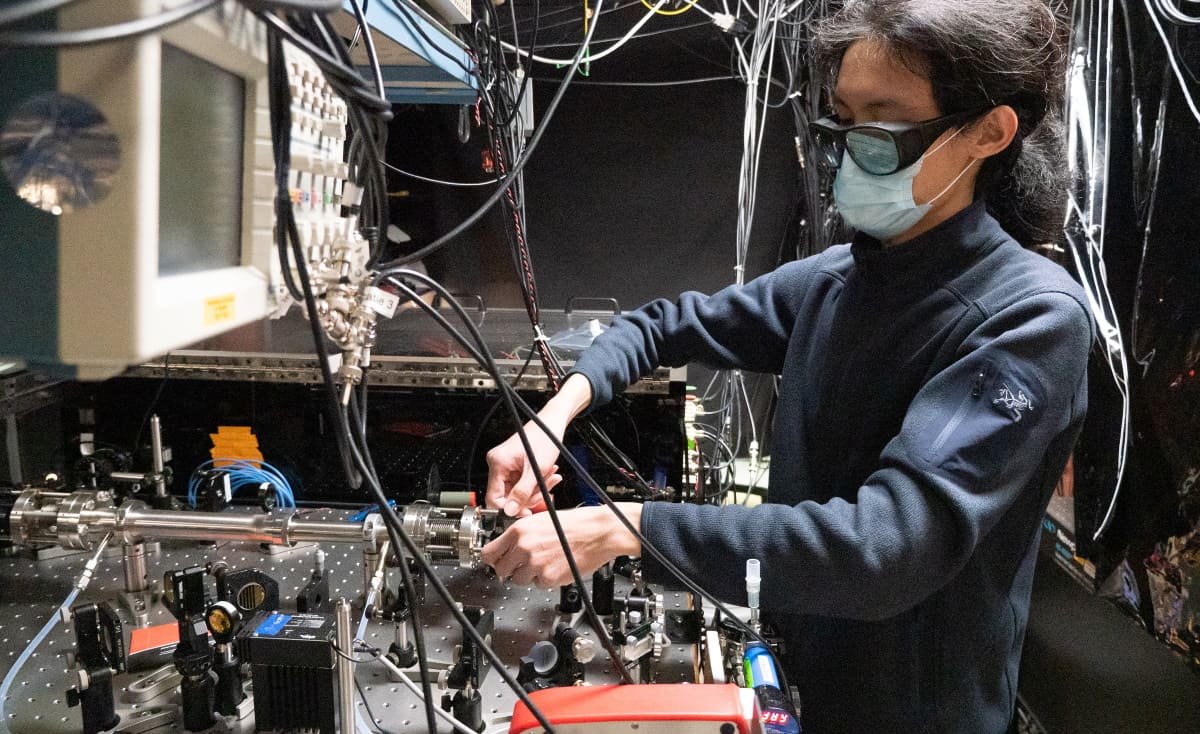
A team of US-based researchers has developed an innovative frequency comb breathalyser that is one thousand times more sensitive to disease biomarkers than the previous version – paving the way for substantial improvements in the use of non-invasive human breath analysis to detect and monitor disease.

The new breathalyser, created by scientists at JILA, University of Colorado Boulder and NIST – as well as the Center for Astrophysics, Harvard & Smithsonian – uses a mid-IR frequency comb to improve detection sensitivity by two orders of magnitude compared with a near-IR frequency comb made in the same lab in 2008. The team present the findings in the Proceedings of the National Academy of Sciences.

As corresponding author Jutta Toscano, postdoctoral researcher at the University of Basel (previously Lindemann fellow at JILA), explains, the new frequency comb, which is tuneable between 3 and 5 μm, allows the team to probe the molecular fingerprint region where fundamental, and more intense, spectroscopic transitions are found. It also enables users to probe a broadband spectrum instantaneously, without the need to scan the laser frequency – meaning that they can observe many molecules simultaneously without needing to compromise on resolution.

Besides probing the mid-IR region, where transitions are more intense, Toscano reveals that the team also enhanced the sensitivity by coupling the frequency comb into a high-finesse optical cavity.

“By matching the frequency of the comb teeth with the cavity modes – the ‘standing modes’ of the cavity – we can increase the interaction path length between molecules inside the cavity and laser light by a factor of around 4000, equivalent to an effective path length of a few kilometres,” Toscano says. “We then probe the light that leaks out of the cavity by sending it into an FTIR [Fourier-transform infrared] spectrometer to find out which exact comb teeth have been absorbed and by how much. In turn, this tells us which molecules are present in the breath sample and their concentration.”

Graduate student Qizhong Liang

Campus study

The team is currently using the new device to carry out a campus-wide study at the University of Colorado Boulder, as part of which it tests students’ breath and uses machine learning to look for correlations between the molecules present in breath and potential conditions affecting the participants – such as being covid-positive, for example, or suffering from asthma, diabetes or intestinal issues.

“After identifying these correlations, we would like to be able to reliably predict the presence or absence of these conditions from looking at the breath alone,” explains Toscano. “So far, the apparatus is not exactly compact or transportable, but our collaborators at NIST and CU Engineering – Scott Diddams and Greg Rieker, respectively – are looking into miniaturizing the frequency comb to make the breathalyser suitable for settings other than a laboratory.”

For Toscano, the main advantages of laser-based breathalysers like this include the collection speed, as well as the ability to easily differentiate between different isomers (molecules with the same mass but different structure, which would appear at the same mass-to-charge position in a mass spectrum) and between molecules of similar mass (which can be challenging to resolve in mass spectra).

“On the other hand, most laser-based breathalysers operate at a single frequency to monitor a single molecule, with the notable exception of devices where a few single-frequency lasers are combined to monitor a few different molecules simultaneously,” she says.

“Adopting frequency combs as a laser source enables us to detect tens of molecules, or potentially even more, simultaneously, circumventing the potential complexity of having to combine tens of different laser sources. This is done by making use of the thousands of comb teeth that compose a frequency comb, which can be thought of as a collection of thousands of very narrow CW [continuous wave] lasers, each with an extremely well-defined frequency,” she adds.

Major US and European labs join forces to tackle climate change

Top physics facilities in Europe and the US have come together to tackle the climate crisis. The labs – including CERN, the European Space Agency, Fermilab and the Los Alamos National Laboratory – have announced that they will step up their scientific collaboration on carbon-neutral energy and climate change as well as share best practices to improve the carbon footprint of big-science facilities.

Large labs demand a huge amount of energy. The CERN particle-physics lab near Geneva, for example, uses 1.3 terawatt hours of electricity annually, which is enough to power 300,000 UK homes for a year. In 2020 the lab released its first public Environment Report that detailed the status of CERN’s environmental footprint. It found that greenhouse-gas emissions emitted by the lab in 2018 was 223,800 tonnes of carbon-dioxide equivalent.

Planned facilities, such as the European Spallation Source that is being constructed in Lund, Sweden, meanwhile, have integrated sustainability into their design such as diverting waste heat into local heating systems instead of it being vented into the atmosphere.

Eager to learn

In a statement, released today by the US National Laboratory Directors’ Council and EIROforum, the 26 labs say that the impacts of climate change are becoming “increasingly visible” through the outbreaks of disease as well as extreme weather events such as heat waves, storms, droughts and flooding.

“Science has a key role to play, and in particular at big-science facilities, where we are constantly pushing forwards the frontiers of knowledge and technology to the highest levels of excellence and inventiveness,” the statement notes. “Research and datasets provide a foundation on which to build innovative technologies and solutions that not only mitigate the impact of climate change, but also help us protect the Earth’s ecosystems, including the human populations around the world vulnerable to a wide array of environmental threats.”

Francesco Sette, director general of the European Synchrotron Radiation Facility, who is also chair of EIROforum, told Physics World that over 25% of users’ research at the facility is linked to climate change and the environment. He also says that the lab has decreased its energy consumption by 20% while at the same time boosting the performance of the synchrotron via a recent upgrade.

“ESRF’s commitment to address and mitigate climate changes is also in identifying the solutions to reduce our carbon footprint,” says Sette. “On a long-term perspective, we are looking for further improvements in energy consumption, and environmental impact thanks to renewable energy sources and improved practices and procedures.”

Sette adds that the labs are “eager” to learn from each other and will now further develop best practices and develop new sustainable technologies.

The move comes just days before the 2021 United Nations Framework Convention on Climate Change Conference of Parties (COP26) in Glasgow, UK, which will be attended by world leaders.

How molecular catalysts mediate the electrochemical generation of fuels

Want to learn more on this subject?

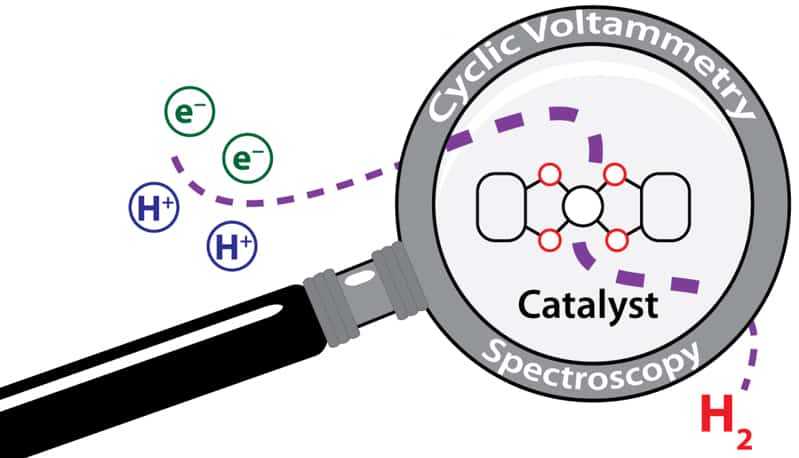
The conversion of energy-poor feedstocks like water and carbon dioxide into energy-rich fuels involves multi- electron, multi-proton transformations. In order to develop catalysts that can mediate fuel production with optimum energy efficiency, this complex proton-electron reactivity must be carefully considered.

Using a combination of electrochemical methods and time-resolved spectroscopy reveals new details of how molecular catalysts mediate the reduction of protons to dihydrogen and the experimental parameters that dictate catalyst kinetics and mechanism. These studies create opportunities to promote, control and modulate the proton-coupled electron transfer reaction pathways of catalysts.

In this webinar, presented by Jillian Dempsey, you will:

  • Learn how molecular catalysts are being used to mediate fuel generation.
  • Learn how to elucidate mechanisms of coupled chemical reactions from cyclic voltammetry experiments.
  • Find out more about proton-coupled electron transfer.

Want to learn more on this subject?

Jillian L Dempsey is associate professor at the University of North Carolina at Chapel Hill (UNC). She received her BS from the Massachusetts Institute of Technology in 2005 where she worked in the laboratory of Prof. Daniel G Nocera. As an NSF graduate research fellow, she carried out research with Prof. Harry B Gray and Dr Jay R Winkler at the California Institute of Technology, completing her PhD in 2011. From 2011–2012, Prof. Dempsey was an NSF ACC postdoctoral fellow with Daniel R Gamelin at the University of Washington. She joined UNC in 2012. Her research has garnered numerous awards including the 2019 Harry B Gray Award for Creative Work in Inorganic Chemistry by a Young Investigator; the 2017 J Carlyle Sitterson Award for Teaching First-Year Students; 2016 Sloan Research Fellowship; and 2015 Packard Fellowship for Science and Engineering. The Dempsey Research Group explores charge transfer processes associated with solar fuel production, including proton-coupled electron transfer reactions and electron transfer across interfaces. Prof. Dempsey’s research bridges molecular and materials chemistry, and relies heavily on methods of physical inorganic chemistry, including transient absorption spectroscopy and electrochemistry. She is currently deputy director of the Center for Hybrid Approaches in Solar Energy to Liquid Fuels.




I had been burned out before. This time was different

Katrina Miller

The summer of 2020 wasn’t my first experience with burnout, but it was definitely the most memorable.

Four months into a global pandemic and weeks into a nationwide racial reckoning, the protesters chanting outside my Chicago apartment window were what pushed me over the edge. “No justice!” they shouted. “No peace!” Make no mistake: it wasn’t that I wanted them to stop. It was that I wanted to be out there with them.

Instead, I was trying to adjust to working from home while drowning in research deadlines, presentation preparations, mentoring duties, outreach initiatives, and the neverending stream of Zoom calls, Slack messages and e-mails. The importance of those responsibilities paled in comparison to living with the fear of how the COVID-19 virus was ravaging the world and to grappling with the grief that police brutality had caused my community.

But the work didn’t stop, so all I could think to do was try to push through my indifference. Let me just get this out of the way, and I’ll join in next time, I’d tell myself as I moved away from my window. Every task I checked off my to-do list, though, was quickly replaced with another. My ability to keep up – and to care about keeping up – was slipping. Eventually my adviser reached out in concern. I was too drained to even talk about it by then; I just asked him for a week off. “Absolutely,” he wrote back without hesitation.

Under-represented and under pressure

Burnout results from chronic, unmitigated stress in the workplace, and although it feels different for everybody, it is a common experience for postgraduates. As a student, there just never seems to be enough time to manage the overload of classes, research and teaching, and to balance it with health, family, relationships, finances and a semblance of a social life.

The stress of competing demands is exacerbated for people who are under-represented in their field. As a Black woman studying one of the least diverse sciences, I feel both internal and external pressure to contribute to efforts toward more equitable academic environments, to make it a little easier for the students who come after me. This responsibility often means saying yes to an overwhelming number of diversity and inclusion initiatives, as well as hyper-managing my time to ensure that it doesn’t affect my research output (which means it cuts into my personal time instead).

As a Black woman studying one of the least diverse sciences, I feel both internal and external pressure to contribute to efforts toward more equitable academic environments

I have burned out enough times in graduate school to know that for me, the most prominent symptom is a loss of interest in, or outright cynicism toward, activities I normally enjoy. But last summer felt different. Though I had experienced detachment from my academic tasks in the past – one particularly bad bout of burnout had me contemplating leaving school altogether – I was always surrounded by other physicists who could affirm the importance of the work. Far away from the hustle and bustle of department culture, however, I was left alone to reflect. Why did any of this matter? And what exactly was I sacrificing for it? Overworked and underpaid, I had little time to contribute to the community organizing efforts happening on the street below. I also had little time to spend with family and friends or even to keep up with basic chores: keeping my house clean and my fridge stocked, for example, or doing the laundry.

Pre-pandemic, I’d usually treat burnout with a trip, but travelling wasn’t an option in 2020 (and, in retrospect, this was just a Band-Aid, anyway). Stuck in my 400-square-foot studio apartment, there was nothing to do but address the real problem. After my week off, I cut back on my work hours and found a therapist, who reminded me of the importance of setting boundaries – not only with others, but also with myself. I created a mental checklist to help me weigh the pros and cons of saying yes to new opportunities. I stopped working in my pyjamas on the couch; instead, I bought a desk, carved out a dedicated workstation and invested in a planner to more formally delineate my school and free time. The most intentional shift I made, however, was pouring myself into passions other than physics. I picked up exercising and writing again, and found new hobbies, like painting and cooking.

Reframing the situation

It took months to overcome the burnout from that summer, and although I’m still searching for that excitement I felt when I started my PhD, I have been able to rediscover some level of enthusiasm for my research. Most importantly, I have done a better job than I did during past stretches of burnout in evaluating whether my lifestyle is sustainable for who I want to be outside of my identity as a physicist. I have detached my worth from my academic productivity because I have cultivated a more well-rounded sense of self. That makes it much easier for me to honour my own needs.

Today, my academic commitment is a lot lower than it was in the summer of 2020. For the most part, I don’t do research on evenings or weekends. I minimize time spent on Zoom and do my best not to respond to messages or e-mails outside standard working hours. Any volunteering I commit to must first pass my mental checklist, an evaluation of whether I have adequate time to devote and whether the opportunity aligns with my values. My research output has gone down, but that, along with the consequences that may arise from it, is a sacrifice I am willing to make. If it’s going to cost my health or my happiness, it isn’t worth it anyway.

My university opened again in September, so I’m now back in the office two to three times a week – the place where I used to pull late nights, eat every meal at my desk (or skip them altogether), and ignore other parts of my life just to keep my head above water. Everything was in the exact same place as before the pandemic. I, however, am not.

I still feel immense pressure to be the role model I didn’t see growing up and to use my voice to make a difference for future Black students. But I reframe that now: saying no, setting boundaries on my time, and asking others to respect my limits may be just as valuable as anything else I could ever do. Rather than encouraging marginalized students to assimilate into current academic culture by making the same sacrifices that I have, I can contribute to normalizing an environment that is healthier and more sustainable for its scholars.

Clinical experience on the independent dose distribution verification with RadCalc

Want to learn more on this subject?

Independent 3D dose check systems play an important role in the patient-specific quality assurance. In this webinar, Dr Ruoxi Wang will share experiences on performing 3D dose distribution verification based on the Monte Carlo Module in RadCalc.
He will highlight the differences between the independent verification and measurement-based QA, explain the detailed resource deployment and commissioning process, and showcase the usage in different clinical settings.

Want to learn more on this subject?

Dr Wang Ruoxi received his doctorate from Université Claude Bernard Lyon 1, France, in 2015. He was engaged in the research and development of new dosimeters in Lyon Institute of Nanotechnology. After graduation he joined Beijing Cancer Hospital in 2017. His main research directions are: Application of Monte Carlo simulation method in the field of medical physics (dose deposition calculation, dosimeter simulation), in-body dose reconstruction, new methods of radiotherapy quality control and assurance, and automatic radiotherapy planning.

Copyright © 2026 by IOP Publishing Ltd and individual contributors