Physicists get under the skin of apple growth

Researchers in the US have used the physics of singularities to study the recess, or cusp, that forms around the stalk of an apple. Based on field and laboratory experiments as well as simulations, they determined that the cusp is self-similar, meaning that it looks the same at different stages of the apple’s growth. They also investigated the emergence of multiple cusps, as are sometimes seen in real fruit.

Singularities are points at which a certain quantity becomes infinite or ill-defined. The infinite space-time curvature thought to exist at the centre of black holes is one well-known example, but singularities also crop up in other areas of physics. In biology, meanwhile, examples include the sharp folds on the surface of the brain and the way bacteria clump together in the presence of certain chemicals.

Move over, Newton

The latest research sees Lakshminarayanan Mahadevan and colleagues at Harvard University explore the singularity created by the abrupt change in the orientation of the apple’s surface at the base of its stalk. In a paper published in Nature Physics, they describe how this singularity develops as the apple grows from a slight bulge in the stem of a blossom into a fully-formed fruit with a seed-containing core, a fleshy cortex surrounding it and a tough outer skin.

To make their observations, Mahadevan and colleagues began by studying the shapes of 100 apples picked at different stages of their growth from the orchard of a college, Peterhouse, at Cambridge University, UK. By slicing each apple in half, they created a series of cross-sections, then arranged them in order as if they were stills from a film depicting the changing shape of a single apple.

The team found that apples measuring less than about 1.5 cm across displayed no discernible cusp, while those with a diameter of more than 3 cm had a distinctive dip at the base of the stalk. This is because in the early stages of the apple’s growth, the contour of the peel varies smoothly. As the cortex starts to expand more quickly than the core, however, a bulge forms away from the core and a discontinuity appears in the apple’s perimeter.

Harvesting data

Next, the researchers analysed the apple’s shape by defining its cross-sectional profile as a one-dimensional curve with a height that depends on both the distance from the stalk and the size of the apple. After generating Taylor expansions of the height and distance variables in terms of the size, they succeeded in expressing the apple’s profile in a self-similar way.

To establish whether real apples also display this self-similarity while approaching a cusp-like singularity, Mahadevan and co-workers rescaled the height and stalk-distance axes using appropriate coefficients and then plotted each apple’s profile. They found, as expected, that the measured profiles all overlapped with one another near the cusp – tracing out what they describe as a “universal curve”.

The researchers went on to confirm this self-similar scaling in three ways. First, they carried out a dynamical analysis on an expanding sphere with its growth restricted at the centre but constant further away. Next, they created a mechanical simulation that treats apples as neo-Hookean materials, meaning their stress-strain curves plateau as they grow. Lastly, they performed experiments using artificial apples made from polymer spheres that swelled when immersed in hexane. By using a second, un-swellable polymer to represent the stalk, they found that a cusp formed within an hour of immersion in the solvent.

On the cusp of greatness

As a final step, the researchers investigated apples with multiple cusps, each of which creates a separate groove on the fruit’s upper surface. Using simulations, they showed that the quantity of cusps depends both on the number of carpels – that is, the apple blossom’s seed-bearing structures – and the ratio of the apple’s diameter to the diameter of its stalk. They confirmed this diameter-ratio dependence in further experiments with the polymer spheres, and they claim that it is also present in their data from real apples.

Mahadevan says that the research was prompted by simple curiosity, rather than any practical end. But he argues that by quantifying apple growth, he and his colleagues have sharpened some outstanding questions – including why the region near the stalk grows more slowly and what biochemical processes are involved. “This will hopefully give us a still deeper view of how nature works,” he says.

Jens Eggers of Bristol University in the UK is enthusiastic about the research but questions whether the Harvard models fully agree with the field data. In particular, he says, it is not completely clear whether the results from real apples show a correlation between cusp number and diameter ratio.

But, he adds, extracting quantitative, testable results from biological data is not easy. “By this measure the paper is doing quite well,” he says.
Frames of reference in science and culture, and how they influence progress

As a Christian, I often consider my faith to be my frame of reference. I’m a Yoruba from Ilesha in Osun State, Nigeria, and was born and raised in the city of Lagos, but I moved around a fair bit during my early years. I attended two British international schools in Nigeria before going to the UK, where I completed my secondary education at Sevenoaks School in Kent. My first degree was in physics at Imperial College London.

I mention all this because I think it strongly informs my engagement with a fundamental concept that the theoretical cosmologist Chanda Prescod-Weinstein explores brilliantly in her new book The Disordered Cosmos: a Journey into Dark Matter, Spacetime, and Dreams Deferred. The concept is that the development of knowledge, be it scientific or any other kind, cannot be completely separated from its social, historical or political context. While this idea is already backed by much historical and scientific evidence, The Disordered Cosmos portrays it from many more viewpoints than I have ever considered.

After beginning the book with a section on cosmology and particle physics, Prescod-Weinstein delves into the culture of the mainstream scientific community, and how it has influenced the progress of science. To illustrate this, she draws deeply on her personal experience as an academic physicist who is a Black feminist, raised by generations of powerful women, and a descendant of Indigenous Africans. Prescod-Weinstein rigorously and extensively makes the case for an urgent paradigm shift in the way we engage with science, knowledge and technology, and how we define what is now popularly known as Afrofuturism – the exploration of the interplay between African culture and technology.

Frames of reference, as Prescod-Weinstein lays out, are present in many wide-ranging fields of study. Perhaps most obviously to physicists, they are a core concept in special and general relativity, but they recur elsewhere: in the highly abstract group theory they are called representations; in the Bible they are referred to as prophecies and visions; in modern English they are often called perspectives; and in feminist theory they are called standpoints.

Although these different examples cannot be mapped perfectly one-to-one onto each other – due to their varying contexts, which inform their axioms and resulting inferences – they share a fundamental similarity: they primarily mean to look at something that is either concrete or abstract from just one among many possible viewpoints. Prescod-Weinstein draws several parallels between the examples, and although I do not agree entirely with all the analogies and equivalences made, I do believe there is a lot of truth in her analysis, which is deserving of further philosophical and scientific study.

Among the most important questions that Prescod-Weinstein discusses is how we can achieve a world where people can hold opposing views without erasing each other’s identities, or forcefully imposing one belief system over another. The Disordered Cosmos suggests one salient solution: sacrifice.

From the perspective of emotional and intellectual resilience, Prescod-Weinstein describes “scientific…and emotional housework”, detailing various personal experiences from her career. She explains how they showed her not only that science is a collective effort that includes non-scientists, but also that pushing for better engagement with science for historically marginalized people means sacrifices must be made. The additional burdens experienced by researchers from minoritized groups – giving up research time to serve on “diversity, inclusion and equity” committees, acting as a mentor to researchers from minority groups – are rarely acknowledged by hiring committees or in performance metrics.

These anecdotes reminded me of when I had my first major paradigm shift, during my time at Sevenoaks School, prompted by my realization that we live in a world of finite resources driven by different interests competing to control them. The International Baccalaureate (IB) programme I studied there focuses on stimulating the mind not just towards learning, but also probing and questioning the process of learning itself. Interestingly, Prescod-Weinstein invokes the concept of “ways of knowing”, which I first came across in an IB module on the theory of knowledge. The Disordered Cosmos is only the second place I have ever seen the phrase used in that way.

Elsewhere in the book, Prescod-Weinstein describes some of the struggles she faced while studying physics and astronomy at Harvard University. Concerned about the treatment of Black employees, she fought tirelessly for the Harvard Living Wage Campaign, eventually winning higher wages for janitors, but these extra efforts impacted her performance academically. She still completed her course, however, and the year she graduated with a degree in astrophysics, she was the only Black American in the US to do so.

As an indigenous Nigerian, I experienced a huge culture shock when I moved to the UK and started school at Sevenoaks, so I feel keenly attuned to these struggles. I often feel like nothing could ever have prepared me for Sevenoaks. Being an indigenous Nigerian means that, unlike Prescod-Weinstein, my predecessors were never barbarically shipped off the coasts of West Africa for slave labour. Nevertheless, I have also suffered the detrimental effects of capitalism.

The sections of The Disordered Cosmos that recount the careless mining of uranium on Indigenous reservations and the fallout left for Pacific Islanders after nuclear weapons tests reminded me of how an Italian company in 1988 dumped hazardous waste in the land of Koko within Warri, where my mother is originally from. This poisoned the rivers and surrounding lands and caused international uproar.

Another probable result of urbanization and the associated pollution that I personally had to live with, is that my younger brother and I had asthma as babies until our preteen years. We had inherited it from our father whose asthma was so severe that he had to carry an inhaler. My mum prayed earnestly that we would all be healed, and this is exactly what happened. This is one of the many miracles we have experienced, which is why I believe in Jesus Christ. This is one area where my beliefs diverge from Prescod-Weinstein, who is a humanist.

Nonetheless, I have immense respect for her, and with this book she achieves an astonishing blend of scientific depth and an intricate understanding of the interplay between science and society. I would like to live in a world where scientists – and people in general – can agree to disagree cordially and respectfully. Like Prescod-Weinstein, I want to believe that science and technology can help to bring this about. It is something I continue to work on, and I do not think I or any Africans need permission from others to define who we are, or how we make our future engagements with science.

  • 2021 Little, Brown £20hb 336pp

Solar farms keep the neighbourhood cool, inspecting solar panels in broad daylight

The Sun may be fading fast here in the northern hemisphere, but the number of solar panels installed here in the UK and elsewhere continues to grow by leaps and bounds. As the area of land covered by solar panels increases, have you ever wondered if converting all that solar energy into electricity is affecting the local environment?

The answer is yes, at least in arid ecosystems, according to a team of researchers at the UK’s Lancaster University, Ludong University in China, and the University of California Davis in the US. They studied two large solar farms – one in California and the other in China’s Qinghai province – and found that the facilities were cooler than their surroundings. This was based on satellite temperature observations taken before and after the installation of solar panels and, in the case of the California facility, measurements taken on the ground.

Both solar farms created “cool islands” that extended about 700 m from the perimeters of the facilities. The cooling effect was significant, with land surface temperatures about 2 °C cooler 100 m from the edges of the solar farms.

While lower temperatures could be a good thing, the researchers caution that they could have a negative effects on some flora, fauna and agriculture – which should be accounted for when sites for solar farms are chosen. You can read more about the study here.

Blinded by the light

Spring cleaning is a ritual in many cultures and at higher latitudes I think its origins might be related to the return of bright sunshine in the spring, which reveals just how dirty a home has become over the winter. You might think that bright sunshine is ideal for looking for defects in installed solar panels – but it turns out that broad daylight is the worst time to do an inspection. This is because the current technique identifies defects using electroluminescence, which involves detecting tiny amounts of light under darkroom conditions.

Now, scientists at the Nanjing University of Science and Technology in China have developed new hardware and software that can detect and analyse defects in solar panels in bright light. The technique involves stimulating electroluminescence using a modulated electrical current. This causes the modulated emission of light from the panel, which is detected using a high-speed camera. By focussing on the changes in light intensity from the panel – and filtering out some sunlight – the team was able to spot defects. You can read more about the imaging system here.


Electrons flow like a fluid in a metal superconductor

A team of researchers in the US has discovered that electrons in a transition metal superconductor called ditetrelide flow like a fluid rather than behaving as individual particles. The finding, which is connected to the physics of electron–phonon liquids, could shed fresh light on the fundamental properties of these technologically important materials and their potential applications.

Electrons usually travel through metals via diffusion, getting scattered by phonons (quasiparticles that arise from vibrations of the crystal lattice) along the way. A recently developed theory, however, suggests that under certain conditions, a coupled electron–phonon liquid can form in which the electrons transition from a diffusive (particle-like) flow to a hydrodynamic (fluid-like) one. In this case, the electrons would flow inside the metal like water flows through a pipe.

The theory also predicts that these electron-phonon liquids should form when certain other interactions (including Umklapp electron–electron scattering) are suppressed, allowing electrons to transfer momentum to the material’s crystal lattice. The electrical and thermal conductivities of such liquids should be higher than those of conventional (Fermi) liquids, in which electrons propagate through metals with weak electron–electron correlations. Until the current study, however, such liquids had not been seen in the laboratory for lack of suitable materials to experiment on.

Three different experimental techniques

Researchers led by Fazel Tafti of Boston College have now found evidence for an electron–phonon liquid in niobium germanide (NbGe2), a superconducting metal also known as ditetrelide. The team studied the behaviour of electrons in this material using three different techniques. The first, quantum oscillations, revealed that the effective mass of electrons was three times higher than the expected value, implying that electron–phonon interactions are present. Second, electrical resistivity measurements revealed a discrepancy between the experimental data and the values expected for standard Fermi liquids. Finally, Raman scattering showed a change in the vibration of the NbGe2 crystal thanks to the fluid-like flow of electrons. In addition, the team found that the Raman spectra of the phonons at different temperatures fit best in a model that takes into account phonon–electron coupling.

The researchers, who report their work in Nature Communications, say that it would now be interesting to conduct more direct experiments on NbGe2 to verify the hydrodynamic behaviour of its electrons. “Our work implies that the heavier-than-expected effective electron mass comes from strong electron–phonon interactions and we have demonstrated this for the first time in a metal superconductor,” says team member Hung-Yu Yang. To back up this finding, Yang suggests that one possible test would be to shrink the sample size to the nanoscale and see if it behaves differently, just as it becomes more difficult for water to flow through a pipe as the pipe gets narrower. “Another direction would be to find more electron–phonon liquid candidates using the design principle we have proposed,” he tells Physics World.

Why the UK should build its own X-ray free electron laser

What is an X-ray free electron laser (XFEL) and what kind of science can be done there?

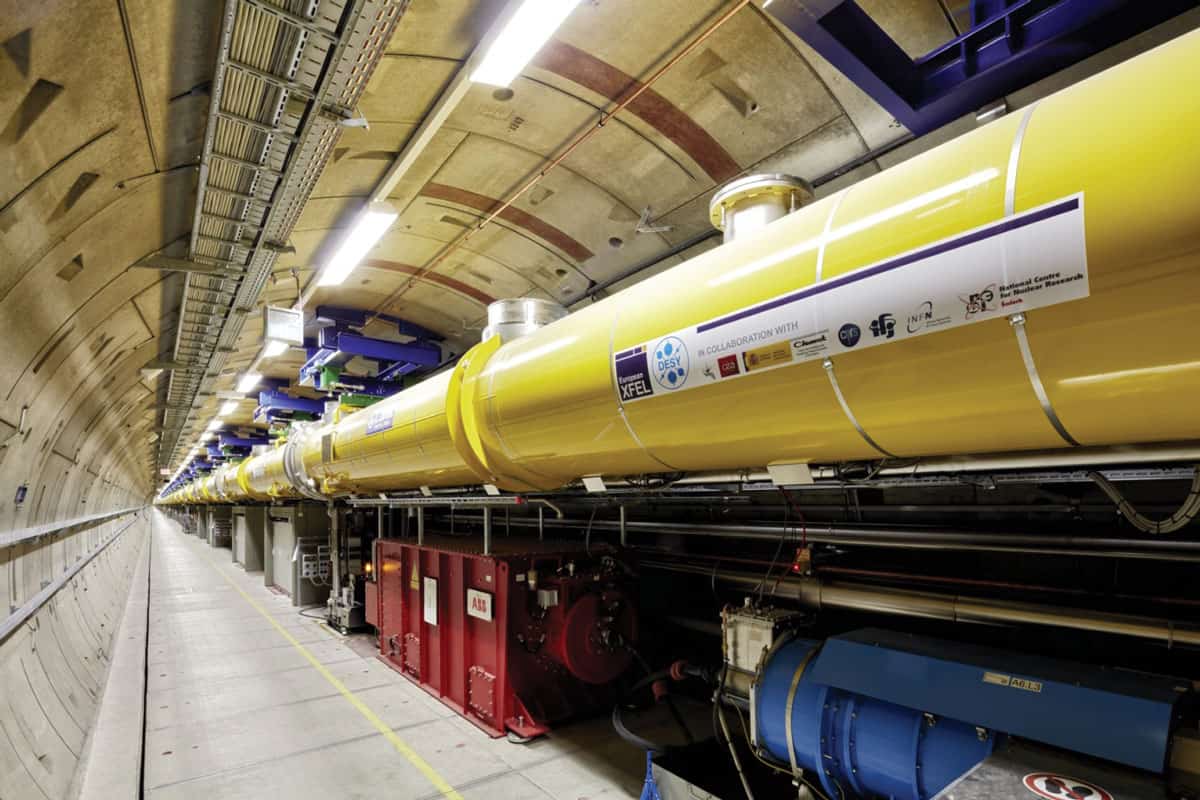
Adam Kirrander: An XFEL is a linear electron accelerator that generates light via a process called self-amplified spontaneous emission or SASE. As a technology it falls somewhere between lasers and synchrotrons and produces light at energies from hundreds of electron volts up to many thousands of electron volts. The light is coherent and emerges in extremely short (sub-femtosecond) pulses. XFELs are also very bright, being many, many orders of magnitude brighter than a synchrotron. 

These unique properties open the door for new research across a broad range of physics, chemistry and biology. We can study chemical processes such as catalysis, study quantum materials and determine the structures of biological molecules. Moreover, XFELs can be used to study matter under extreme conditions that normally only exist in the interiors of stars or giant planets – and they can also be used to probe beyond the Standard Model of particle physics.

The UK is a member of the European XFEL in Germany and British scientists can have access to other XFELs worldwide. Why does the UK need its own facility?

Jon Marangos: Existing and future XFELs all have different characteristics, they are not all the same. I use the Linac Coherent Light Source XFEL in California because I need its sub-femtosecond pulses to study really fast electronic dynamics. So today I can’t really use the European XFEL, but that will change in the future.

The number of UK scientists using XFELs has grown rapidly in the past decade from zero to about 500. While many of these scientists use the European XFEL, they move from one international facility to another to get the best possible experimental conditions for their research. If we were to build a next-generation XFEL in the UK, we would expect it to be a fully international facility. 

What would the UK-XFEL look like?

AK: The facility’s electron accelerator would be about 1km long and would probably be built in a cut-and-cover tunnel. We want to build a superconducting accelerator with a very high pulse rate. Today’s XFELs run at about 100 Hz but we want to reach the 100 kHz level. The accelerator will drive multiple undulators so we can simultaneously deliver X-rays at different energies to many different experiments in a process called multiplexing.

Our vision is a next-generation facility that does some things that are not currently possible at existing XFELs. One thing we are looking at is the possibility of bringing two X-ray pulses of completely different photon energies together in one experiment or combining electron beams with X-ray photons.

European XFEL

What have you and your colleagues done so far to make the case for UK-XFEL? 

AK: This is an ambitious undertaking, and it must be done properly. Over the past 18 months, a large team of scientists has made a very broad assessment of how an XFEL could benefit science and technology in the UK and beyond. This science case has been carefully evaluated by an international panel, which has found it convincing. Now, we need to start thinking about the technical design and eventually there will be a discussion about a location but it is premature to do that now.

JM: At this point in our campaign, we are asking for money to do the conceptual design. We will use this money for technical designs, options analysis and to build our business case carefully. Our proposal would be reviewed by the UK government in about two or three years to decide whether the country will invest in UK-XFEL. The review is conditional on an agreement to fund the next stage of development.

What is next for your campaign?

JM: The next phase will last between two and three years. And it will require some pretty intensive work by some of the UK’s top accelerator scientists and people involved in lasers and photon systems. After that, and if we get the green light, we will go into what’s called a technical design phase where the full details of the facility will be worked out. That will typically take another two years and result in an even heftier volume of material, which would essentially become the blueprint for building the facility. A site can be selected while the technical design is being prepared and construction can start. If everything goes smoothly, we could have first light at UK-XFEL in 10 years, which would be consistent with the timescales of other XFELs

You mentioned choosing a location. Do you see UK-XFEL located at a national lab like Daresbury or Rutherford Appleton, or could the facility be built at a university?

JM: Because of the size of the machine, it’s probably not going to be easy to locate it near the average university. But in principle, yes, it could be built in many locations in the country. It could also be built at one of the existing national research facilities – but it doesn’t have to be. Given the UK government’s current agenda to “level up” deprived parts of the country UK-XFEL could even become part of a new regional science facility – which I think could be a very good thing.

Past, present and the future of gas aggregation sources for nanoparticle synthesis

Want to learn more on this subject?

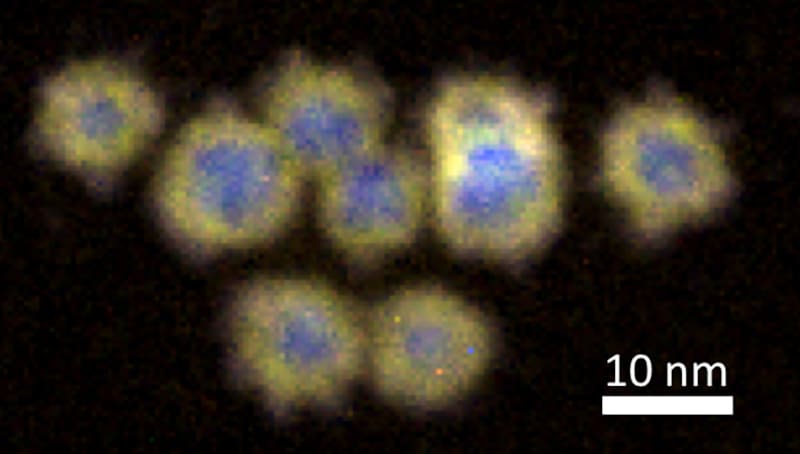
In this seminar, Yves Huttel will present the gas phase synthesis of nanoparticles from a general point of view including historical aspects, main characteristics and examples of nanoparticles generated with this technique1.

After this introduction, Yves will present some recent studies performed using the gas aggregation sources (GAS). He will focus on the proposed applications and challenges that the technique is facing in material science and nanotechnology. In particular he will discuss the possible reasons why the GAS has not penetrated yet the industrial sector although their use for several applications has been proposed.

We will explore some of the issues of the GAS that may explain why they are not implemented in industrial processes as the limitation of the yield of nanoparticles and the short time stability. Possible solutions to overcome these limitations will be presented like the use of a Full Face Erosion magnetron and the injection of controlled doses of gas impurities2. You will see that stable and high fluxes of nanoparticles open the route to real applications.

1 Gas Phase Synthesis of Nanoparticles, Wiley-VCH Verlag GmbH, 2017.
2 Y Huttel et al., MRS Communications 8, 947 (2018).

Want to learn more on this subject?

Yves Huttel received his PhD from the University of Paris-Sud, Orsay, France. After his degree he worked at the Synchrotron LURE, France, at the University of Paris-Sud, France, and at the ICMM-CSIC, Spain. He was also a postdoctoral researcher at the Synchrotron of Daresbury Laboratory, UK, before returning to the CSIC at the IMM. He joined the Surfaces, Coatings and Molecular Astrophysics Department at the ICMM, that belongs to the Consejo Superior de Investigaciones Científicas (CSIC), Spain, with a Ramón y Cajal Fellowship. Since 2007, he has been working at the ICMM as a permanent scientist and leads the Low-Dimensional Advanced Materials Group. His research focuses on low-dimensional systems including surfaces, interfaces and nanoparticles, as well as XMCD, XPS and nanomagnetism.



Novel decoder helps people with paralysis click-and-drag a computer cursor using just their thoughts

Disability can affect anyone; either directly, over the natural course of our lives, or indirectly, by knowing or caring for a person with a disability. It’s difficult to fathom how profoundly different (and challenging) daily life is after stroke or spinal cord injury, or for those with cerebral palsy or amyotrophic lateral sclerosis (ALS).

Computers can significantly improve the quality of life for people living with motor impairment, by allowing web access to social media, games and messaging, for example. But after a catastrophic injury or disease, actions that we typically take for granted, like clicking or scrolling, become ferociously tricky for those with impaired hand function.

A brain–computer interface (BCI) is a promising and increasingly popular avenue for assisting and improving control following motor paralysis. People with paraplegia or quadriplegia, for example, have used BCIs to move computer cursors with their thoughts for decades; yet they have been unable to click-and-drag.

In a paper published in the Journal of Neural Engineering, a team of neural engineers at the University of Pittsburgh describe a new algorithm for deciphering brain signals in BCIs. By applying machine learning techniques to data recorded from an implanted BCI, the researchers improved cursor control and computer accessibility for people who are unable to move a mouse physically.

Decoding brain signals

Our thoughts and behaviours arise from trains of action potentials flashing across vast, interconnected networks of neurons. A BCI measures those brain signals, analyses them for certain features, and then translates the extracted features into commands to execute the desired action. Thus, BCIs circumvent the normal output pathways of muscles, which illness or infirmity may compromise.

BCIs are not mind-reading devices; they do not extract information from unsuspecting or unwilling users. Instead, the user “works with” the BCI via their brain signals, so that they can actively participate in the world without using their muscles. Making sense of the massive datasets generated by these brain signals requires training periods, which also helps us understand some of the mysterious operations of the brain.

First author Brian Dekleva, from the university’s Rehab Neural Engineering Labs (RNEL), used surgically implanted BCIs to decode movement intent in two people with quadriplegia, with the aim of improving the functionality of BCIs for computer access.

Dekleva and colleagues began their investigation by deconstructing a hand grasp. They employed a well-established machine learning technique, Hidden Markov Models, to rigorously characterize the three sub-routines that make up a grasp action: deciding to grasp (onset), holding a grasp (sustained) and deciding to release (offset).

What sets the researchers’ BCI apart is that it doesn’t just examine the persistent neural signals generated when we want to move or click a cursor. Instead, their decoder looks at transitions between states, which are detected more reliably than a sustained response. The team’s technique is also “generalizable”, because it is suitable for a variety of computer applications that require point-and-click or click-and-drag functionality.

Using the BCI with the new decoding algorithm, the study participants could smoothly sweep their cursors across a monitor, be it for a creative outlet (like painting a digital work of art) or something more routine (like simply dragging a file to the trash).

A promising track record

Most of the research in neural engineering pursues clinically useful systems for people with significant impairments that lead to disability. In May of this year, the RNEL team published a proof-of-principle for a bidirectional BCI – a type of BCI that enables not just data reading but also data writing abilities. In other words, a bidirectional BCI enables patients with paralysis to control a robotic arm with their thoughts and also feel how hard that robotic arm is clutching an object.

Controlling a robotic arm with the mind

BCI technology promises to enhance the quality of life for people with paralysis by improving their autonomy and mobility. Jennifer Collinger, the senior author on this latest study and one of the lead architects of the bidirectional BCI, hopes that these results can inform the development of clinical BCI technology – an area experiencing rapid growth within the biotech industry.

The team’s latest experiment was also proof-of-concept for remote clinical trial participation with BCI tech in the home, with one of the participants performing most of the study’s training sessions at home without assistance from the researchers. This is a critical step towards clinical translation.

The study’s success in enabling a natural and generalizable control scheme for computer access provides increasing evidence that BCI studies no longer need to be restricted to an on-site lab. “The pandemic accelerated our plans for in-home testing, but this has been a goal for a long time,” explains Collinger. “We need to get the technology into real-world environments… We just want study participants to be able to do the things they want to do with a BCI.”

Nanocolumnar films: applications in medicine, energy and aerospace

Want to learn more on this subject?

This webinar will start with showing that nanocolumnar films can be manufactured by magnetron sputtering using the glancing angle deposition configuration. Then, various applications of these nanocolumnar films in several fields will be presented, namely in medicine (antibacterial coatings, bioelectrodes for electric stimulation, SERS substrates), energy (black metal coatings, nanostructured layers for perovskite solar cells, photo-induced self-cleaning surfaces) and aerospace industry (anti-multipactor coatings).

Want to learn more on this subject?

Dr J M  García-Martín is a research scientist at the Institute of Micro and Nanotechnology, CSIC. After obtaining his PhD in physics at UCM (Spain) in 1999, he was a Marie Curie postdoc at Paris-Sud University (France) in 2000–2002. He joined CSIC in 2003 and secured a permanent position in 2006. In 2014, he led the project “Nanoimplant” that won the IDEA²Madrid Award (a partnership of Comunidad de Madrid in Spain and MIT in USA). In 2017, he was a Fulbright Visiting Scholar at Northeastern University (USA) and in 2020, co-founded the spin-off Nanostine. He works in metallic nanostructures with applications in magnetism, plasmonics and biomedicine. He has co-authored 99 articles, six book chapters and three patents, and his H-index is 33 (WoS).


Simulations offer observational test for Planet Nine hypothesis

Computer simulations by astronomers in the US have presented a new clue for researchers hunting a hypothesised planet hiding in the far reaches of the solar system. The modelling suggests that searching for “Trans-Neptunian Objects”, or TNOs, in certain orbits could shed light on whether a so-called “Planet Nine” exists beyond Neptune.

The possible presence of a ninth planet in our solar system was first proposed more than five years ago based on the orbital characteristics of certain objects travelling around the Sun at immense distances. Yet despite ongoing searches, no direct detection of the distant world has been made so far.

In their latest work, Kalee Anderson and Nathan Kaib, both at the University of Oklahoma in the US, modelled the evolution of the solar system – including the four giant planets as well as a million “particles” representing the disc of icy bodies in the Kuiper Belt beyond Neptune – over the course of four billion years, up to the present day.

One of their models simulated our familiar eight-planet solar system while the others contained a possible ninth planet with various orbital permutations. “As each simulation ran, the million particles ‘felt’ the gravitational effects of the planets as Neptune migrated through the disc,” Anderson told Physics World. “This process scattered this disc into a simulated present-day Kuiper Belt that we could compare to the actual observed Kuiper Belt and the other simulations.”

Observational test

In the models incorporating a ninth planet, the researchers found that a conspicuous collection of far-off bodies tend to congregate in orbits that have a relatively shallow incline to the plane of the solar system. These objects would be at huge distances from the Sun, never getting closer to our star than 40-50 times the Earth-Sun distance. Crucially, this gathering of TNOs did not materialise in low-inclination orbits in the simulation of an eight-planet solar system. The results therefore suggest that a search for real-life, low-inclination orbit TNOs in faraway regions might offer insights into the presence, or not, of the hypothetical Planet Nine.

These kinds of predictions are critical to testing proposed Planet Nine scenarios

Kat Volk

“This is a very nice study that produces observationally testable predictions for the consequences of an additional large unseen planet in the distant solar system,” says Kat Volk, a planetary scientist at the University of Arizona who works on the Outer Solar System Origins Survey (OSSOS) project, and who was not involved in the new research. “These kinds of predictions are critical to testing proposed Planet Nine scenarios,” she adds.

According to Volk, current surveys of the outer solar system can discover distant bodies with the kinds of orbits identified in the new study, but they face a challenge because of how faint those TNOs would be. And as today’s surveys usually strike a balance between how deep they peer into our planetary neighbourhood and how much of the sky they cover, they would also only find a small selection of the objects in question.

To test which of the new simulations is closest to reality, and therefore explore whether there really is a ninth planet in the solar system, researchers will need a larger sample to examine. That could come from the Vera C. Rubin Observatory’s Legacy Survey of Space and Time (LSST), which will begin observations in 2023.

“The observatory’s 10-year survey is going to be revolutionary because it should be able to detect TNOs almost as faint as dedicated small surveys, like OSSOS, but also cover a huge percentage of the sky,” adds Volk. “I think it is likely that LSST will give us the number of TNOs that Anderson and Kaib estimate that they need to distinguish between their models.”

Exploring the science behind the 2021 Nobel Prize for Physics, travelling 13,000 km to become a medical physicist

Earlier this week the 2021 Nobel Prize for Physics was shared between Giorgio Parisi for his work on complex physical systems and Syukuro Manabe and Klaus Hasselmann for their work on modelling the Earth’s climate. In this episode of the Physics World Weekly podcast I chat with spin-glass expert Steven Thomson of the Free University of Berlin about Parisi’s research legacy and to climate physicist Tim Palmer of the University of Oxford about how Manabe and Hasselman influenced our understanding of climate change.

Also in this episode, Physics World’s Tami Freeman is in conversation with Suman Shrestha, who talks about his experience of moving to the US from his hometown of Kathmandu in Nepal to pursue his interest in medical physics. He also chats about what he plans to do when he completes his PhD at the University of Texas MD Anderson Cancer Center in Houston.

Oxford Instruments logo

Physics World‘s Nobel prize coverage is supported by Oxford Instruments Nanoscience, a leading supplier of research tools for the development of quantum technologies, advanced materials and nanoscale devices. Visit nanoscience.oxinst.com to find out more.

Copyright © 2026 by IOP Publishing Ltd and individual contributors