Getting children interested in science

My seven-year-old son Aneurin is often given books as gifts, whether he wants them or not, and he’s amassed quite the mini library. He has high standards. As a critic, he’s fierce enough to throw a book in a corner and never look at it again.

So, I’ve allowed him complete licence to give his own verdict on Nano, a new children’s book on the science of tiny materials. The book is written by Jess Wade, Imperial College physicist and champion for representation and inclusivity in science, and illustrated by Melissa Castrillon, known for designing the covers for Philip Pullman’s His Dark Materials trilogy.

The following are Aneurin’s words written entirely independently, lightly edited only for punctuation and to correct the occasional spelling:

“The book is about very, very, very small science stuff. The book lets you learn a new science word called ‘nano’. There are materials like graphene and graphite. You also get to learn about microscopic things.

There are over 100 types of atoms, and everything is made from atoms, even air and water

“The best page was the page about tiny atoms, and there are over 100 types of atoms, and everything is made from atoms, even air and water. Each type of atom is called an element and there are 11 elements in the human body. A few of them are calcium, carbon and sodium. In every living thing there is carbon, from daisies to oak trees, from beetles to blue whales.

“I loved this book. The pictures are good, nice, clear and artistic. The words are the same. I liked the whole book. Five stars. I learned new words like ‘nano’ or ‘graphite’ or ‘sodium’ and why pencils draw on paper.”

Sample pages from Nano showing a graphene water filter

There you have it. Kids are a tricky audience, unashamedly judgemental, which makes the work of a children’s author perhaps the toughest of all genres. But this book clearly hasn’t been rushed. Appropriately for the theme, even the smallest details feel wisely judged.

Something I personally value as a parent is that, unlike some children’s books released in recent years, Nano isn’t marketed to a particular gender. Although the narrator appears to be a young girl with blue hair, this feels almost incidental. All you see is pure passion for the subject she describes, and this is something any child can relate to. It’s vital to have characters that girls and minorities can see and feel more included in the story of science, and as Nano shows, this can be done implicitly and be just as powerful.

The real focus here is the science itself. Some of the content is quite advanced for a children’s book, but conveyed so skilfully that it remains accessible. Younger readers of five or six will stay for the pictures, but older readers, even aged 10 or 11, will find themselves learning facts that will be new to them. Indeed, Nano is so packed with information that it includes an index at the end.

But it’s not my verdict that matters, of course. The book wasn’t written for readers my age. All you really need to know is that it passed the Aneurin test.

  • 2021 Walker Books 32pp £12.99hb

Trapped-ion clock passes orbital test

A compact atomic clock that has orbited the Earth since 2019 is far more stable than previous space-based clocks, raising hopes that future spacecraft will be able to keep track of time autonomously. Although technical problems have limited the new trapped-ion device’s performance, the US-based scientists who developed it report that it is reliable enough to substantially reduce the need for back-and-forth communication with controllers on the ground, thereby improving navigation.

Stability is a fundamental attribute of good timekeeping. If a clock is unstable on short timescales, the delay from one tick to the next fluctuates and its output must be averaged to achieve the desired precision. If the clock’s output drifts on longer timescales, it needs to be periodically corrected by a more stable device.

This is the situation for the atomic clocks on board today’s global positioning satellites. These clocks allow each satellite to keep track of both time and position, which in turn enables users on the ground to navigate through triangulation. However, because they experience drift, their recorded time must be very slightly tweaked each day to bring it into line with stabler (but also bulkier and more complex) atomic clocks on the ground.

In the latest research, John Prestage, Robert Tjoelker, Eric Burt and colleagues at the Jet Propulsion Laboratory (JPL) in the California Institute of Technology built a clock that is small and rugged enough to withstand the harsh conditions of space yet also stable enough to operate independently. Such a device, they say, would not only make terrestrial satellite systems more autonomous, it should also allow deep-space probes to navigate in close to real-time.

Clock workings

At the core of the clock is a vacuum tube containing two cylindrical traps, each measuring a little over a centimetre in diameter. The first trap is used to load and prepare a small cloud of several million mercury-199 ions, while the second measures the ions’ “ticking”. Both traps generate electric fields to hold the ions in place and prevent them from colliding with the trap walls, which would cause the clock’s signal to drift.

Mercury-199 ions have a “clock” transition at 40.5 GHz that is insensitive to magnetic fields – a useful feature given the high and fluctuating magnetic fields in space. This transition is used to lock the output of a quartz crystal. A frequency synthesizer referenced to this crystal generates microwaves and is tuned to around 40.5 GHz, while a plasma discharge lamp produces ultraviolet light that further raises the energy level of the ions if they have already been excited by the microwaves. The fluorescence these ions generate when they promptly re-release the ultraviolet energy therefore indicates that the oscillator is at the correct frequency.

Time to fly

Researchers at JPL have been working on trapped-ion clock technology since the 1980s and have obtained excellent results in their laboratory, achieving a short-term stability of 2×10−141/2 (τ being the averaging time) and drifts as low as 2.7×10⁻¹⁷ per day. What’s more, they have done so without using lasers, cryogenics or microwave cavities, all of which would introduce unwelcome complications for space-based clocks.

With these results in the bag, NASA approved the Deep Space Atomic Clock mission in 2011. Under the leadership of principal investigator Todd Ely, the mission team produced a microwave-oven sized clock that was launched into a 720-km altitude orbit in June 2019 alongside other experiments.

Although the clock has now kept time for almost two years, the mission hasn’t been trouble-free. A problem with levels of neon gas used to cool the ions means the scientists have had to measure the clock frequency with the loading trap, which was not designed to make such measurements. This fault affected the clock’s performance, but Prestage and colleagues nevertheless recorded a short-term stability of 7×10−131/2, a long-term stability of 3×10⁻¹⁵ and an estimated drift of 3×10⁻¹⁶ per day, all without controlling the temperature of the apparatus. The drift result, they say, is better than that of existing satellite-based atomic clocks by around an order of magnitude.

Deep space or bust

The researchers argue that this level of performance is already good enough for autonomous timekeeping. That, in turn, means that future spacecraft equipped with such a clock would need only a single communication link with ground controllers – to receive their timing and positioning data – rather than the three links currently required. The researchers add that the clock might also aid Solar System exploration – making it possible, for example, to plot the gravitational field of Jupiter’s moon Europa to see if there might be an ocean under its icy crust.

Looking ahead, the researchers say they are trying to extend the lifetime of their clock technology from up to five years to at least a decade. Among other things, this will mean working out how to improve the ultraviolet light source and optimize the pressure inside the vacuum chamber so as to lose less neon gas.

However, not everyone is convinced. Liang Liu of the Shanghai Institute of Optics and Fine Mechanics in China, who heads a cold-atom clock experiment that has been in orbit since 2016, welcomes the NASA project but finds its long-term stability of around 3×10⁻¹⁵ per day underwhelming. “For deep space navigation, we might need 10-16 or better,” he says.

The research is reported in Nature.

Photo captures the subtleties of the magnetic Sun, synchrotron will image millions of insects

The Magnetic Field of our Active Sun © Andrew McCarthy

The UK’s Royal Observatory Greenwich in London has announced the shortlist for its Astronomy Photographer of the Year 13 competition. I’m not sure what the 13 stands for, but it certainly didn’t bring bad luck to the American photographer Andrew McCarthy who has two images on the shortlist. His photograph of the Sun – pictured above – was selected from over 4500 entries this year. Called The Magnetic Field of our Active Sun, the photo was captured in black and white. McCarthy then used false colour to highlight features on the surface of the Sun in red tones – reminiscent of the red hydrogen-alpha emissions that are used to study features on the Sun.

I love the texture of the Sun, which looks a bit like a peeled grapefruit and the subtlety of the structures on the upper right limb of the Sun, which are bits of the chromosphere being tugged up by magnetic field lines.

The winners of competition’s nine categories and two special prizes will be announced on 16 September 2021 – along with the overall winner, who will receive £10,000. The winning photographs will be exhibited at the National Maritime Museum in Greenwich alongside a selection of shortlisted images.

Insect collection

Staying on the theme of stunning images at London museums, scientists at the UK’s Diamond Light Source synchrotron facility have joined forces with the Natural History Museum to create digital 3D images of some of the 35 million insect specimens in the museum’s collection.

Diamond insect image

Researchers from the two institutions have developed a new way of scanning insect samples rapidly, without any manual input. The technique involves doing a computerized tomography (CT) scan of the insect using coherent X-rays from Diamond. This allows the technique to see details in soft tissue that cannot be resolved when a conventional non-coherent X-ray source is used.

The project is part of an ongoing collaboration between Diamond and the Natural History Museum, which will open a research lab in 2026 on the Harwell Science and Innovation Campus, which is home to Diamond.

Static apertures keep dose on target in pencil-beam scanning proton therapy

Optic glioma plans

Proton therapy can deliver superior dose distributions compared with photon-based radiotherapy, enabling radiation oncologists to precisely target a tumour while reducing the risk of damage to adjacent healthy tissue. Pencil-beam scanning (PBS), the most advanced type of proton therapy, increases this precision by shaping the delivered radiation to a tumour’s exact volume. A team at the West German Proton Therapy Centre Essen (WPE) has now shown that the addition of static apertures to PBS treatments further reduces the dose to nearby normal tissue while maintaining the target dose.

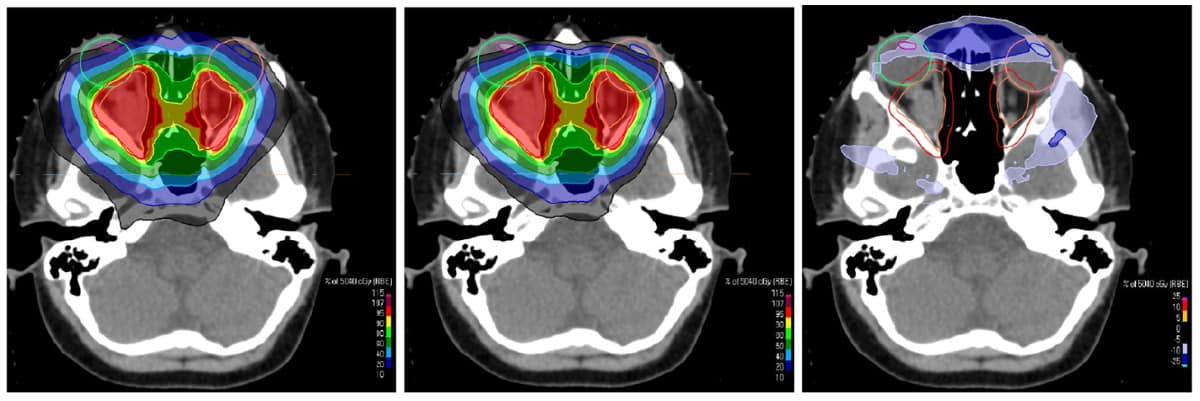
The pencil beams used in PBS proton therapy typically have a spot size of 1 cm (full-width at half maximum) or more, which can impede the sparing of organs-at-risk adjacent to the target volume. The dose fall-off in the lateral direction also limits the options for covering the target while keeping dose to normal tissue at tolerable levels. The WPE team demonstrated that using static apertures to trim these spot-scanning fields reduced the dose to organs-at-risk such as the eye lens and brainstem, and in six brain tumour cases reduced the dose to the brain and hippocampi.

Static apertures enable small air gaps in clinical treatment plans, which is beneficial for the lateral dose gradient. At some proton therapy centres, static apertures are a standard piece of equipment. At WPE, the research team fabricated brass apertures for each individual treatment field using a computerized milling machine. The actual number of apertures used was optimized per treatment field to achieve efficient production and treatment workflow.

Christian Bäumer

Writing in Frontiers in Oncology, Christian Bäumer and colleagues report that “uncollimated” treatment plans for 31 patients with various brain cancers were prepared for conventional PBS delivery. The researchers then inserted apertures for all fields, specifying a lateral margin for the planning target volume (PTV) coverage and blocking adjacent organs-at-risk. They adapted margins for each individual field, and chose the number of fields and their arrangement based on the location of the target.

Quality assurance procedures for treatment plans needed to be modified from the centre’s established procedures to align the X-ray imaging, PBS and aperture systems. The researchers caution that the positioning of the aperture relative to the PBS field is impacted by movement of the snout (the part of the proton delivery nozzle closest to the patient) and the aperture mounting mechanism. The team also performed a robustness evaluation based on perturbed dose scenarios to account for possible deviations of the centre of the pencil beam and the mechanical centre of the aperture holder.

The researchers assessed the dosimetric benefits of the 31 treatment plans delivered using apertures compared with the corresponding plans without apertures. “The volume of the dose gradient surrounding the PTV (evaluated between 80% and 20% dose levels) was decreased on average by 17.6%,” they write. “For the full cohort of 31 cases, the mean brain dose could be reduced on average by 1.2 Gy(RBE) through apertures.”

The most noticeable improvement, they note, was a reduction in dose to the hippocampi of between 1.6 and 4.7 Gy(RBE), with a mean decrease of 2.9 Gy(RBE).

Brain cancer plans

The study included six cases of the brain tumour craniopharyngioma, with targets located near important organs-at-risk including the brainstem, optic nerves, chiasma and hippocampi. The biggest benefit of using PBS with static apertures was achieved for the thalamus, brainstem and hippocampus, where the mean doses were reduced by 5.5, 5.6 and 3.1 Gy(RBE), respectively. For two cases, the mean dose to the eye lens was reduced to below 5 Gy(RBE), which could not have been achieved without using apertures.

In all 31 cases, the dose burden to normal tissue was reduced and the dose target maintained when apertures were used. In four cases, the dose to organs-at-risk was reduced to a level below the tolerance dose, which could only be achieved with the use of the static apertures.

The authors point out that their study was limited to a horizontal beam line. They expect further dosimetric benefits if a gantry is available for the proton treatment. “In the future, we expect an even better dose sparing of normal tissue through the use of dynamic adaptive collimators, which have not yet been clinically released,” says Bäumer.

LIGO mirrors have been cooled to near their quantum ground state

LIGO is designed to detect gravitational waves, but it is also proving to be a fantastic laboratory for pushing the limits of quantum physics. Now, an international team of researchers has cooled the interferometers’ large mirrors close to their quantum ground state. By cooling objects massive enough to potentially feel a detectable gravitational force, the researchers hope to open a new window into gravity’s possible effects on quantum mechanics. The work could also potentially lead to future enhancements in the sensitivity of LIGO to gravitational waves.

The two LIGO observatories (one in Louisiana and the other in Washington state) are famous for their pioneering detection of gravitational waves. In 2015, within days of being switched on, they spotted a signal from merging pair of black holes. Since then, LIGO has detected dozens of black-hole mergers and other events and has been joined in its search by similar instruments in Italy and Japan

Each LIGO detector is laser interferometer with arms 4 km long. Gravitational waves are ripples in space–time that change the relative path lengths in the arms of an interferometer, creating a tiny optical signal. The interferometers must have incredibly low noise to see these signals, which makes them great places to study quantum physics on a macroscopic scale.

Kilograms instead of nanograms

Elsewhere, several groups have published work describing the laser cooling of macroscopic oscillators to their motional ground states, but these have involved trapped objects on the nanogram or picogram scales. In this latest work at LIGO, researchers have looked at a composite object comprising four of an interferometer’s 40 kg mirrors, which together behave as an oscillator with a mass of 10 kg.

Laser cooling would not work for LIGO’s mirrors because the huge optical power required to trap such large objects would itself induce heating. Moreover, the mirrors’ low resonant frequencies would render laser cooling inefficient.

Instead, during what LIGO member Evan Hall of the Massachusetts Institute of Technology (MIT) in the US describes as “some extra time with the instrument when LIGO was on but not actively taking data”, researchers implemented a feedback cooling protocol. They measured the displacement of a mirror from sources such as the radiation pressure from the interferometer laser, before calculating the exact force needed to suppress these oscillations. This force was applied through the silica fibres to keep the mirror almost completely still.

Heisenberg compliant

As radiation pressure comprises the recoil from a stream of photons, applying active feedback to cancel this recoil might seem to involve violating Heisenberg’s uncertainty principle — which forbids knowing both the position and momentum of a particle simultaneously. “It’s not something physicists used to believe was possible 20 years ago,” explains Hall’s MIT colleague Vivishek Sudhir.

The key to experimental success was that the researchers could calculate the force from any given photon by measuring just its phase on impact: “You’ve got a complete record of all the disturbance caused on the mirror, and at that point nothing prevents you from using feedback to suppress the total motion of the mirror,” says Sudhir.  This allowed the researchers to cool the mirror from room temperature to 77 nK – which is almost at its motional quantum ground state.

The team now wants to push towards even colder temperatures. “The low hanging fruit in our experiment is to find what we can say about extraneous sources of decoherence that might prevent extremely large objects from being in pure quantum states,” Sudhir says.

Some theoreticians such as Roger Penrose have proposed mechanisms whereby gravitational fields lead to the collapse of quantum states: “One way to test [collapse theories] would be to have a massive system prepared in a pure quantum state, expose it to a gravitational field and see whether it decoheres,” says Sudhir; “With our work, it becomes possible to think of an experiment where you have an object in a pure, or at least reasonably pure quantum state, which is still massive enough to respond appreciably to gravity.”

Beyond this, he says, it might be possible to enhance the sensitivity of LIGO to gravitational waves, for example by placing the mirrors in entangled states. “It is not out of the question, but not any time soon.”

“Very cool”

“I think it’s a very cool [experiment],” says Hendrik Ulbricht of the UK’s University of Southampton; “The LIGO consortium have really studied this system over such a long period of time and they have such a good understanding of this experimental system and how it works.” He is “struggling”, however, with the idea that the system will be sensitive to gravitational effects on quantum mechanics: “If you want to look at quantum evolution, it is a dynamical measurement,” he says; “You need a system that is evolving according to quantum mechanics, and not according to the feedback you’re doing.”

Markus Aspelmeyer of the University of Vienna, whose group is testing for deviations from expected quantum behaviour in increasingly large objects – is more receptive to the notion of quantum behaviour being visible with the feedback switched on. “You constantly measure the system,” he says “The information you get you compare with a model of the system; the model is actually a stochastic Schrödinger equation.” Any deviations from the behaviour predicted by the Schrödinger equation should, therefore, be detectable immediately. He concludes that “it would be so cool to finally lay to rest all these collapse theories”.

The research is described in Science

James Peebles: a life in cosmology

How has life changed since you won the 2019 Nobel Prize for Physics?

When I got the call from Stockholm, they said that my life will change forever. I am rather unnerved that many people now consider me a god-like figure and that I somehow know everything. I receive many messages from people insisting that their situation could be improved if only I would give attention to their new idea. Maybe among all these theories there are some that are interesting, but who has the time to look?

Throughout your career, you have contributed enormously to several areas of cosmology including the big bang theory, but you dislike the term. Why is that?

The problem I have is that a “bang” connotes an event in space–time. It occurs at a place, at a time. Yet the universe has no special place. There are galaxies everywhere that we can observe. There is no place or time involved, no beginning of time anyway. Instead, this is a theory of what happened as the universe evolved from a dense, hot early state. We do not know with any assurance what the universe was doing before it was expanding.

My new book is an attempt to see the commonality around science, sociology and philosophy

So why then do you still use the term “big bang”?

The name is so embedded in our consciousness that I think there is no chance of changing it. No-one ever said science is logical. Oh, everyone says science is logical, but it’s not true. After all, it is done by people and people are notoriously illogical.

What do you think of current ideas about what the universe was doing before it started expanding?

The standard thinking is that cosmic inflation – a period of accelerated expansion – happened during the universe’s earliest stages. But I believe we need alternative theories about what the universe was doing before it was expanding. In my opinion, inflation is given more weight than it deserves because we have precious little evidence that something like inflation happened, so we should treat it with caution, and we should pay attention to alternative pictures. One is Paul Steinhardt’s ekpyrotic universe, which considers a cyclic universe: expansion, regeneration and expansion again, maybe repeating indefinitely.

If the BICEP2 team’s 2014 detection of gravitational waves had turned out to be correct, would that have convinced you of inflation?

Perhaps not totally convinced, but it would have made a very good case. I am not arguing against inflation, I am only saying we must be cautious because we don’t have a lot of evidence. And in physics evidence is the name of the game.

What do you say to people who believe that disagreement among scientists means that science is not to be trusted?

I think that scientists by and large tend to overestimate the power of their theories. On the other hand, it’s difficult to underestimate them. My favourite example is the mobile phone. It’s an object I hate but you must pause to consider the knowledge of physics that went into its design – it is just gorgeous. How could you distrust science if it could give you such a thing?

On the other hand, although we are right to celebrate the power of science, we should more commonly recognize that all our theories are incomplete.

Does that include Λ-CDM – the current cosmological model?

Yes, absolutely. Λ-CDM is incomplete. We should admit more clearly that although our theories are powerful, they are limited and they are incomplete. That, of course, is why we still have jobs.

Do you think our theories will ever be complete?

No, and that is not a popular opinion. My colleague Steven Weinberg, who wrote the book Dreams of a Final Theory, does not like it when I say that we will never know if we have a final theory because knowledge that a theory is good depends on empirical evidence. And when it comes to the economics, we cannot afford to fund arbitrarily complicated tests of arbitrarily complicated theories.

Last year you wrote Cosmology’s Century: an Inside History of Our Modern Understanding of the Universe. What makes it different from other books of its type?

It’s different for one reason: it is my personal experience. The book is not a popular exposition, which I regret, but I wanted to get the story straight, so I had to be technical. I consider cosmology a good example of how natural science is done because it is relatively simple compared, say, to quantum physics.

I have just finished another book, which is closer to popular science.

Can you tell us more about your new book?

In the late 20th century some sociologists took the position that physical science is a social construction, made up by authority figures who impose their will on students and require students to suspend disbelief and to accept their dogma. Physicists, naturally, were incensed at this proposal. The result is a very serious disconnect between sociology and physical science.

There is a real role for sociology of science, and there is a big role for philosophy in its connection to science, so my new book is an attempt to see the commonality around science, sociology and philosophy. The science, you will not be surprised to learn, is that of cosmology. So I attempted to interweave thinking by sociologists about the way we do science, thinking from philosophers as to what they consider to be science, and how science is really done. It all fascinated me.

You were part of a team in the 1960s, led by Bob Dicke, searching for evidence of a cosmic microwave background. What was the feeling on that day when it was announced by another group – Arno Penzias and Robert Wilson?

I have been asked many times whether I was chagrined at being scooped but the reaction in our group was one of excitement, not chagrin. Here was evidence of something new and for me something to analyse, so it was exciting!

Do you believe that Dicke should have shared the 1978 Nobel Prize for Physics with Penzias and Wilson?

I have never made a secret of it that I was annoyed at the decision to exclude Dicke. The strange thing about that year’s prize was it artificially joined two fields, given that Penzias and Wilson shared the award with Pyotr Kapitza for his work in low-temperature physics. The obvious choice was Penzias, Wilson and Dicke.

When I answered the phone call from Stockholm in 2019 concerning my own Nobel prize, it began very formally: “Are you Professor Phillip James Edwin Peebles?” I said, “Yes,” to which they responded: “We have voted to award you the Nobel Prize for Physics. Do you accept?” At that point I could have been tempted to say, “But first let us discuss the omission of Bob Dicke.” But I did not. I meekly said: “I accept,” and the conversation became a lot more friendly.


Novel sources of tunable laser light

Want to learn more on this subject?

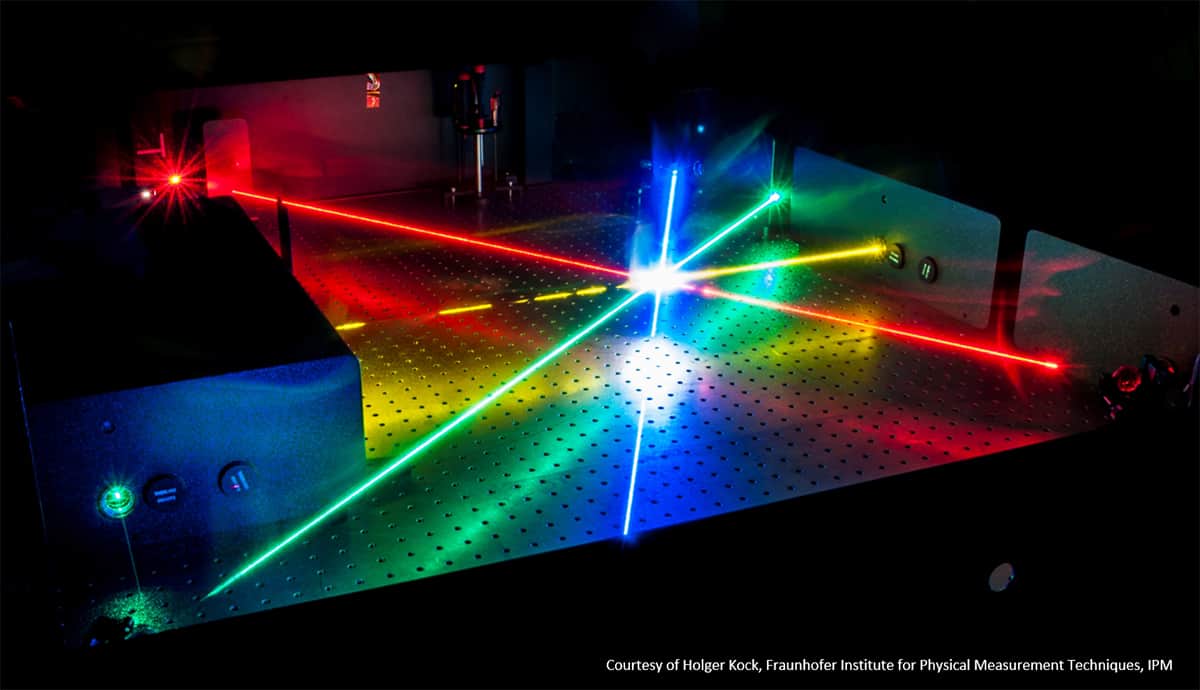
Widely tunable continuous-wave optical parametric oscillators (CW OPOs) are gaining recognition as novel sources of tunable laser light with great potential – not least due to their unprecedented wavelength coverage. Yet, the overall experimental requirements remain often challenging for the performance of turnkey OPO devices.
In this webinar we will discuss the characteristics of state-of- the-art tunable CW OPO designs and describe tuning schemes that have been tailored for applications like colour centre research and other quantum technologies, nanophotonics, holography, high-resolution spectroscopy, and experiments alike. Several recently published studies in these fields will be discussed in an illustrative fashion to showcase the performance of CW OPOs in the real-world laboratory.

Want to learn more on this subject?

Jaroslaw Sperling is global productline sales manager for HÜBNER Photonics. He joined the company in 2016, bringing his passion and experience gained in several sales and marketing-related roles across photonics research and industry. With a background in laser spectroscopy, he holds a PhD in physical chemistry from the University of Vienna, Austria.

Korbinian Hens is a product manager for HÜBNER Photonics. He joined the company in 2015, specializing in terahertz spectroscopy and tunable laser systems based on OPO technology. With a background in laser-induced fluorescence spectroscopy for atmospheric research, he carried out his PhD thesis at the Max Planck Institute for Chemistry in Mainz, Germany.

Ole Peters is applications engineer at HÜBNER Photonics. He joined the company recently and has previous experience in terahertz imaging and spectroscopy systems.

Niklas Waasem is regional sales manager and applications specialist for HÜBNER Photonics. He joined the company in 2014, bringing in profound photonics knowledge gained during his PhD thesis at the Fraunhofer Institute for Physical Measurement Techniques in co-operation with the University of Freiburg, Germany.

Galactic ‘bridges’ could be the largest rotating structures ever discovered

The universe is full of spinning objects. Galaxies, the stars within galaxies, the Earth, the Earth around the Sun, the Moon around the Earth – all rotate around an axis. An international team of astronomers has now added to this list by uncovering evidence that cosmic filaments – tendrils of matter that stretch across hundreds of millions of light years – are also spinning. Rotation on such gigantic scales has never been observed before and the new finding could help explain why galaxies (and indeed every other structure in space) are so prone to rotating.

The origins of cosmic-scale rotation are poorly understood. In the standard model of cosmological structure formation, regions of the early universe with a relatively high matter density grew over time as matter flowed into these denser regions from sparser ones. This type of flow is not, however, associated with rotation (it is curl-free), which means there was no primordial rotation in the early universe. Any rotation we observe today must therefore have been generated as structures formed.

Largest objects known to have angular momentum

One way to understand why this happened is to try to find out where the spinning stops. A team led by Noam Libeskind at the Leibniz Institute for Astrophysics Potsdam (AIP) in Germany set out to do this by investigating whether filaments of galaxies (not just the galaxies themselves) might spin. With lengths in the hundreds of millions of light years and diameters of a few million light years, these filaments are like huge bridges that connect clusters of galaxies to each other, says Peng Wang, a member of the team and lead author of a study published in Nature Astronomy. The filaments also funnel galaxies towards and into the large galactic clusters that sit at their ends.

Previous research had suggested that these clusters might be where spinning ceases, but Libeskind, Wang and colleagues in France, China and Estonia have now turned this idea on its head. “They [galaxies] move on helixes or corkscrew-like orbits, circling around the middle of the filament while travelling along it,” Libeskind explains. “Such a spin has never been seen before on such enormous scales, and the implication is that there must be an as yet unknown physical mechanism responsible for torquing these objects.”

Survey results

The astronomers mapped the motion of galaxies in filaments using data from the Sloan Digital Sky Survey, which recorded the light from hundreds of thousands of galaxies. Since rotation cannot be measured directly on such scales, the astronomers looked for patterns by examining the galaxies’ redshift and blueshift – that is, how quickly the galaxies are moving away from us or towards us.

To do this, they stacked thousands of filaments together and studied the velocity of the galaxies perpendicular to the filaments’ axes. When the majority of galaxies on one side of a filament were redshifted and the majority on the other side were blueshifted, they concluded that the entire filament must be rotating. In some of the filaments they analysed, the velocity of the spin was nearly 100 km/s. From this, the researchers conclude that angular momentum “can be generated on unexpectedly large scale”.

Gravitational effect

Another important finding, Libeskind adds, is that filaments at the end of more massive clumps of galaxies appear to rotate faster. While the full reason for this is unclear, he thinks the relationship between filament rotation and the clusters at either end may indicate a gravitational effect. “It could be that the tidal or gravitational field of these clusters is triggering or somehow causing this spin,” he tells Physics World. “One thing we would like to check in the future is if the galaxies inside the filaments are spinning with the same chirality (‘handedness’) as the filament itself. That would point to a coupling of scales on which spin is generated and endowed that is as yet unknown and could hint towards the origin of cosmic spin in general.”

Physics tracks changes in English dialects, machine learning confused by COVID-19

This episode of the Physics World Weekly podcast features an interview with the physicist James Burridge and the linguist Tamsin Blaxter, who have teamed up to study how local dialects in England have changed during the 20th and 21st centuries. The duo has used probability and statistical physics to chart the evolution of language between two English dialect surveys – one done in the 1950s and the other done in 2016 – and they talk about the factors that change the way we speak.

This podcast also looks at some exciting developments in astronomy that have happened over the past week; and we find out why machine learning algorithms developed to diagnose COVID-19 from chest X-rays are not suitable for clinical use.

How to spark an interest: advice for giving engaging physics presentations to pre-university students

Research may be a mixture of 10% inspiration and 90% perspiration but there is no doubt that it is exciting and rewarding. Sharing the thrill and the intellectual fruits of your work with the next generation of potential physics undergraduates brings its own benefits, not least of which is that it is good fun. Here’s my best advice for how to give an inspiring presentation about physics to school students who are in that all-important 16–18 age range when they may well be deciding whether to study the subject at university.

Your talk

Talks that score highly with pupils are informative and entertaining. Even though your presentation should make links to the exam specification that the students are following (teachers will be happy to advise) they expect that a talk will be different from a lesson. The latter are often presented as logical expositions. However, scientific problems often appear as puzzles and solving a puzzle is an excellent way to stimulate and maintain interest. 

Avoid jargon and acronyms at all costs. Split your story into self-contained chunks rather than one extended narrative. Recapitulate as you go along and keep referring to basic concepts. At the end, summarize the main points and conclusions.

Make sure you prepare thoroughly – even basic definitions of phenomena need rehearsing at least once as they appear in your script. Know your script inside out – ideally your delivery needs to be ad lib.

When you are presenting, try hard to keep eye contact with the audience for as much of the time as possible. Talk to them, not to the slides on the screen. 

Your audience

School or college venues are more intimate than a university lecture hall. Your average audience member will recognize more of what they have already studied than they actually fully understand.

Regularly check your listeners sitting either side of the middle centre of the audience. In my experience, they are usually the ones who will be trying hardest to follow what you are saying. If they look confused you have probably lost most of your audience.

Consider audience participation. It could be as simple as asking them to vote, for example, on which outcome they expect from an experiment. Avoid passing things round as this can be a distraction. Similarly, any handouts are probably best left until the end, otherwise the listeners’ attention is divided.

Your PowerPoint

When composing PowerPoint slides, it is all too easy to put too much information onto each slide as you are by necessity sat close to your computer screen. Check each slide by viewing the screen from about 2.5 m away. Anything unreadable to you at this distance will also be unreadable to your audience when projected onto the average school’s screen. A good rule of thumb is to include no more than 25–30 words per slide.

The type of slide least liked by audiences is a list. So the golden rule is to keep it simple. PowerPoint works best when it adds visual material to punch home what you are saying. Pictures are worth a thousand words and are a genuine visual aid – but do not use clip art just for the sake of having an image. 

Redraw and simplify complex diagrams and graphs from scientific papers. Remove all but essential text. Make sure that important features such as lines on graphs are clearly visible. Always tell an audience what is plotted on each axis. Build up diagrams and formulae one element at a time. An easy way to do this is to compose the last slide in a sequence first. Decide how many steps are needed, and make that number of copies of the last slide, plus an extra. Then edit backwards to the start of the sequence. This ensures that no information or steps are left out. The extra copy of the slide is there in case things go wrong, and can be deleted when you are satisfied with the sequence you have composed.

Keep the slide transitions simple. Cartwheeling text entering stage left is just a distraction. Avoid using the slides as a set of crib sheets for what you want to say. If necessary, use separate notes or the computer screen notes facility in PowerPoint. Insert a blank slide wherever you have something to say and don’t want the audience looking at the last or the next slide.

Don’t just rely on PowerPoint. Holding up a relevant physical object has much more impact. If you plan to do a demonstration, do make sure that it will be easily seen by the audience, and practise it beforehand to make sure it works reliably. Consider designing a demonstration that seems to go wrong in a way that emphasizes the point you are trying to make – this can be a real attention grabber and is likely to be memorable.

Your timing

Unless you invite questions, or encourage audience participation as you go along, 45 minutes is the benchmark. Any more and you will be pushing your audience’s attention span. Experience shows that questions at the end of a talk fill another 10 minutes or so, giving a total time of around one hour.

Giving a talk is a performance, so be a bit larger than life. Dramatic pauses raise expectations. Five seconds may seem like a long silence to you, but it’s not perceived like that by your listeners. Dwell on and talk about a slide for enough time for it to be taken in. Edit your talk in real time rather than rushing to cram it all in. Beware of speeding up as you get more practised at giving the talk.

Your response

Do be tolerant of inexperienced student chairpersons, regarding things like their introductions and votes of thanks. 

Keep notes on what goes down well and what doesn’t (for example, whether the audience laughed at any jokes), and modify your subsequent talks accordingly. Aim to give your talk three or four times a year for at least two years, to make the effort of preparing it worthwhile. Actively seek out opportunities to present. When you feel you have a successful story to tell, why not consider turning it into an article for a magazine such as Physics Review so that it can reach a wider pre-university audience?

Finally, giving talks to young audiences is not something you necessarily learn to do well just by doing it. Feedback on your efforts is vital and should be solicited. You can do this by composing a short e-mail questionnaire and sending it to the organizer of your talk, asking, for example, whether the pace was too slow or too fast, whether the slides were suitable and visible, and whether you could be easily heard. Good luck.

Copyright © 2026 by IOP Publishing Ltd and individual contributors