Three Nobel-prize-winning physicists claim that the European Commission is planning to “drastically cut” funding for photonics in its next €100bn research and innovation programme. Gérard Mourou, Stefan Hell and Theodore Hänsch have warned in an open letter to the commission that such a move will be disastrous for Europe’s technological goals and damage its competitiveness.
The three researchers’ target is Photonics21 – a public–private partnership supported by the European Commission to bring optical researchers and industries together. It had requested a minimum budget of €1.4bn in the Horizon Europe programme, which runs from 2021 to 2027. But in their letter, the laureates claim to have learned from “informed sources in Brussels” that the commission will instead propose around €500m.
This figure, which is barely 35% of the requested budget, would represent a 30% cut on the €700m that the photonics sector received from the EU between 2014 and 2020. The laureates say that the amount of money proposed by the commission for photonics is “not consistent” with planned support for other key digital technologies, such as artificial intelligence and microelectronics, which from 2014 to 2020 had a budget of €2.5bn.
“Europe needs to strengthen, not weaken, its industry and innovation capacity in photonics,” the laureates write, warning that without photonics technologies, Europe will not be fit for developments in quantum computing or to allow “full digital sovereignty”. They also say that the “risk of losing another key digital technology to other regions of the world is serious”.
The laureates point out that the European Commission’s recent industrial strategy identified photonics as a strategically important technology for Europe’s industrial future. The European Investment Bank has also identified photonics as a key technology that will provide secure, sovereign and resilient digital infrastructure.
This support, they argue, underlines how essential photonics is to four EU objectives: digital transformation of industry; the European Green deal; digital sovereignty and resilient digital infrastructure; and strengthening strategic value chains across key sectors. According to Photonics21, the European photonics market could triple in value to more than €200bn by 2030, while some 700,000 new jobs could be created in the sector in Europe by 2030.
In their letter, the laureates call for photonics funding to match Europe’s digital ambitions. “Genuine advancements in photonics are truly essential for powering the future European digital economy,” they write. “They are often driven by fundamental research…We therefore kindly request you to reconsider any cuts to the photonics partnership given its vital cross-sectional importance for Europe.”
This is not the first time the photonics community has raised concerns about funding and the European Commission’s view of the sector. Early last year Mourou, Hell and Hänsch wrote another open letter to the Commission calling for it to recognize photonics as a vital research area and add it as the “tenth technology priority” in the upcoming Horizon Europe programme. At the end of 2018 the European Photonics Industry Consortium released a statement making a similar request and criticizing the Commission’s proposed budget.
A new device that converts laser light into mechanical work could be used to manipulate nano-scale objects for applications in nanofluidics and particle sorting. The device, which is based on a self-assembled hexagonal array of nanoparticles that operates like a gear, can perform work in conventional environments such as room temperature liquids, according to Norbert Scherer of the University of Chicago, who led the research effort to develop it.
The “gear” in this study is made up of optical matter (OM) – a type of material in which metal nanoparticles are held together by light rather than the chemical bonds that unite atoms in ordinary matter. The radii of the nanoparticles are much smaller than the wavelength of the light, and the light-based “bonds” that link them stem from inter-particle interactions that cause them to self-assemble into ordered arrays (see image above).
SAM and OAM
Finding a way to make these optically-powered self-assembling nanomachines perform work has been a long-standing goal in this area of photonics. The new OM machine achieves this objective by converting spin angular momentum (SAM) – one of the two independent components of the angular momentum of light – into the other component, orbital angular momentum (OAM).
SAM is a familiar property of light that manifests itself as polarization. It arises when the electric and magnetic field vectors of light rotate over the course of a wavelength. OAM is less well known (it was only discovered in 1992), and its effect is to twist a beam’s wavefront along its propagation axis so that it takes on a spiral shape, with zero intensity at its centre. A beam can, in principle, twist by any amount; the greater the twist, the faster the rotation of the wavefront.
OAM suitable for a wider range of applications
Because SAM can have only two values – right or left circular polarization – its applications are fairly limited. In contrast, OAM, which results from the rotation of a light wave’s phases, can take on any value. This variability makes it suitable for a wider range of applications, including “optical spanners” – devices that trap and rotate tiny particles using light. Transferring data though optical fibres without crosstalk (multiplexing) is another potential application.
In their previous work, Scherer and colleagues discovered that when they applied circularly-polarized light to optical matter, the nanoparticles rotated like a rigid body in a direction opposite to the rotation of the polarization. Simply put, this means that when the incident light rotates one way, the optical matter array spins in the other. The researchers hypothesised that they could develop a machine based on this “negative torque”, as it is called.
OM machine functions like a mechanical machine
In the new experiments, which are described in Optica, the researchers set out to create an OM machine that functions like a pair of interlocking gears. When the larger gear is turned, a smaller interlocking gear spins in the opposite direction.
To fabricate a machine based on this design, the researchers used silver nanoparticles with radii of just 75 nm, suspended in water, and laser light with a wavelength of 600 nm. The researchers explain that circularly polarized light from the laser causes the nanoparticles to form an OM array that acts like the larger gear in the machine, and spins in the laser’s optical field. This OM “gear” converts the laser’s circularly polarized light into orbital or angular momentum, which in turn causes a nearby probe particle placed outside the OM gear to orbit the nanoparticle array gear in the opposite direction.
According to their experiments, a large gear containing eight nanoparticles was more efficient than one that contained seven nanoparticles. This suggests that the efficiency of a machine could be tuned by using different numbers of particles, they say.
Making machines with many more particles
“We believe that what we demonstrated, with further refinement, will be useful in nanofluidics and particle sorting,” says study first author John Parker. “Our simulations show that a much larger machine made of many more particles should be able to exert more power to the probe, so that is an aspect of refinement that we anticipate pursuing.”
The researchers are exploring the possibility of making OM machines with particles of different materials as well as larger numbers of particles. They are also interested in making their machines more practical by creating patterned gears in which the nanoparticles are stationary. This modification would allow gears to be optically addressed and combined to make more complex machines, they say.
100 not out: the Institute of Physics celebrates its centenary.
When the Institute of Physics (IOP), which publishes Physics World, was founded in 1920, it was to serve as a voice for the fledgling physics community in the UK. Before then, physics had mostly been conducted by a tiny band of elite researchers at a handful of university or private labs.
But with growing demand for physicists in industry, academia and government, more and more people were realizing they could forge successful careers in physics. The IOP was set up to represent their professional concerns, as you can discover in the November 2020 issue of Physics World, which is now out in print and digital formats. You can also read the feature online here.
Elsewhere in the issue, we welcome our new pool of contributing columnists – active and thought-provoking physicists who will bring a new perspective to a range of professional matters such as education, careers, publishing, funding and diversity. There’s also a great feature about the top applications of ferroelectricity and a look at attempts to make air travel greener.
For the record, here’s a run-down of what else is in the issue.
• Superconductivity found at 1.5 °C – Researchers have created a material that can superconduct at room temperature under high pressures, as Hamish Johnston discovers
• Cosmic pioneers bag Nobel prize – Roger Penrose, Reinhard Genzel and Andrea Ghez win award for their work on black holes, as Michael Banks and Hamish Johnston report
• Celebrating Black physicists – Charles Brown, Eileen Gonzales and Xandria Quichocho talk to Michael Banks about the barriers facing Black physicists and how #BlackInPhysics week aimed to boost their visibility
• Reflecting the community – Matin Durrani welcomes Physics World‘s new pool of contributing columnists
• Keeping your eyes on the prize – Chanda Prescod-Weinstein describes the social and political barriers that Black physicists face in their daily lives
• Making a difference where it matters – With COVID-19 further exposing educational divides, Jess Wade says the importance of physics teachers has never been more critical
• Supporting the next generation – Nicolas Labrosse says that UK research funders must recognize their responsibility to support research into university physics education
• Keeping up with opportunities – Caitlin Duffy says it is more important than ever to consider your next career move despite the challenges posed by the COVID-19 pandemic
• A quantum future – With a new era of quantum technology beckoning, James McKenzie reflects on recent milestones in the quantum computing “arms race”
• The bank of success – After helping to set up the first major repository of protein structures 50 years ago, Helen Berman is now significantly expanding its scope, as Robert P Crease finds out
• A century of change – The Institute of Physics was created in 1920 to champion a new generation of professional physicists working in industry, academia and the government, as Susan Curtis describes
• Ferroelectricity: 100 years on – When a PhD student called Joseph Valasek discovered ferroelectricity exactly 100 years ago, few people realized the enormous impact it would have on science and technology. Amar S Bhalla and Avadh Saxena pick their favourite applications of this fundamental physics phenomenon
• Physics challenges for green aviation – Commercial air travel has changed a lot since the first aeroplane took passengers around a century ago. Brian Tillotson explores the future challenges to make aviation greener
• The hunt for another Earth: a love story – Kate Gardner reviews The Smallest Lights in the Universe: a Memoir by Sara Seager
• Black hole diaries – Tushna Commissariat reviews The Shadow of the Black Hole by John W Moffat
• Embracing a life of variables – Steve Bullock is an engineer, physics teacher, science communicator and education consultant. Currently the programme director of undergraduate aerospace engineering at the University of Bristol, UK, he talks to Tushna Commissariat about a career of bold choices, sideways jumps and obstacles overcome
• Ask Me Anything – Michelle Simmons is director of the Centre of Excellence for Quantum Computation and Communication Technology at the University of New South Wales, Australia.
• A matter of evidence – Gary A Atkinson looks at the importance of evidence in science
In case you were not convinced by our immensely popular article “Fighting flat-Earth theory” by Rachel Brazil, the physicist and round-Earther Steven Wooding has created an online calculator that suggests a few fun experiments that you can do to prove to yourself that the Earth is indeed a sphere. These include how to see a second sunset, how to hide an object behind the curvature of the Earth and how to use shadows to measure the radius of the Earth.
Elsewhere in the solar system, astronomers have discovered that an asteroid called (101429) 1998 VF31 bears a remarkable resemblance to the Moon. The chunk of rock is smaller than a kilometre across and trails behind Mars. A spectroscopy study done by researchers at the Armagh Observatory and Planetarium in Northern Ireland and colleagues found that the asteroid reflects light just like the Moon.
One possible explanation is that the asteroid is a chunk of the Moon that was liberated when a large asteroid crashed into the Moon. However, the researchers believe it is more likely that the asteroid was created in a similar collision with Mars.
Doubt has been cast on the supposed discovery of phosphine in the atmosphere of Venus after several papers were published on the arXiv preprint server challenging the result. The discovery had been announced in September when a team of researchers led by Jane Greaves of Cardiff University, UK, claimed it had observed the spectral fingerprint of phosphine (PH3) in the clouds of Venus. If true, the paper would have been our strongest evidence yet of life beyond Earth, but the tone of some of the resulting criticism – as well as a surprising statement from an international body over the press coverage of the work – has outraged astronomers.
Phosphine – a potential biosignature – is created in the high temperatures and pressures within the interiors of Jupiter and Saturn, but on Earth it is only produced by anaerobic microbial life. To detect phosphine on Venus, the researchers used the James Clerk Maxwell Telescope (JCMT) in Hawaii and the Atacama Large Millimeter/submillimeter Array (ALMA) in Chile.
As John von Neumann once said: with four parameters I can fit an elephant and with five I can make him wiggle his trunk
Mark Thompson
Shortly after the announcement, however, the organizing committee of the International Astronomical Union (IAU) Commission F3 on Astrobiology released a statement lambasting Greaves’ team for the resulting press coverage of the claimed discovery. “It is an ethical duty for any scientist to communicate with the media and the public with great scientific rigour and to be careful not to overstate any interpretation which will be irretrievably picked up by the press,” they wrote, adding that the commission “would like to remind the relevant researchers that we need to understand how the press and the media behave before communicating with them”.
The IAU statement was met with scorn from many quarters, including the commission’s own members, many of whom said the organizing committee did not speak for them. The statement was then swiftly retracted by the IAU executive, who insisted that it did not reflect the view of the organization. In its own statement, the executive added that the organizing committee of Commission F3 had “been contacted to retract their statement and to contact the scientific team with an apology”. The IAU said it will now produce a procedure for future public communication that all members will be advised to follow.
Wait and see
The dust had barely settled from that brouhaha when a paper entitled “No phosphine in the atmosphere of Venus” was submitted to Nature Astronomy’s “Matters Arising” section. It argued that Greaves’ team had misidentified the absorption line of sulphur dioxide in Venus’ atmosphere as that of phosphine. Written by a group led by Geronimo Villanueva of NASA’s Goddard Space Flight Center, the team ended its abstract with the “suggestion” that Greaves’ team retract its original paper – seen by some as unduly aggressive.
The furore around this paper led to an apology by Villanueva’s team. “We agree that the sentence calling for retraction was inappropriate and we apologise for harm caused to the Greaves et al. team,” the team notes in a statement. It adds that the specific language had been used because of a misinterpretation of the guidelines issued by Nature Astronomy, which had encouraged Villanueva’s team to post the preprint for public discussion.
Mark Thompson, an astrophysicist from the University of Hertfordshire who has written his own critique of the phosphine discovery, agrees that the statement from the organizing committee of Commission F3 and the abstract to Villanueva team’s paper overstepped the mark. However, he thinks that the IAU statement has a point, agreeing that the fallout “comes in large part from the over-hyping of the result by some parts of the press”.
The key argument of Thompson’s paper is how Greaves and colleagues calibrated their data. The absorption line of phosphine appears against a bright continuum of thermal emission from Venus, which forms a baseline in the spectrum. This baseline has to be removed, which is normally a simple process of subtraction, but when the baseline emission is complex, as is the case with Venus, the baseline needs to be fitted as a higher-order polynomial before being subtracted.
However, the higher the polynomial, the more parameters and assumptions there are. Greaves’ team used a 12th-order polynomial, which is considered exceptionally high and often comes with unintended consequences, potentially including the creation of false positives. “As John von Neumann once said, ‘with four parameters I can fit an elephant and with five I can make him wiggle his trunk’,” says Thompson.
Although Greaves’ team justified its choice of using a high-order polynomial in order to address “ripples” – instrumental artefacts in the data that become apparent when observing an object as bright as Venus – Thompson says that he does “worry that the resulting absorption feature may be the elephant wiggling its trunk instead of being a true detection”.
Similarly, a team led by Ignas Snellen of Leiden Observatory has also come to the same conclusion about the baseline calibration. Whereas Greaves’ team reports the phosphine absorption line as being 15 times stronger than the surrounding noise, “What we see is that the strength of the feature is about a factor of 2 higher than the noise, which is below statistical significance,” Snellen told Physics World.
For now, the phosphine paper is the only set of results that has undergone peer review. Thompson encourages discussion to now wait until the arXiv papers have been similarly vetted and Greaves’ team have conducted their own re-analysis. If, after all that, the results are still in dispute, then it may be that new observations at different frequencies are required. Phosphine is difficult to detect from the ground but NASA’s airborne Stratospheric Observatory For Infrared Astronomy telescope, which flies at an altitude of over 13.7 km on board a modified Boeing 747SP, could confirm or deny the finding.
Researchers in Japan have developed a new mathematical technique to explore the characteristics of time crystals. The team, led by Kae Nemoto at the National Institute of Informatics in Tokyo, used a combination of graph theory and statistical mechanics to show how the exotic quantum materials evolve over time. Their work opens new routes to practical applications for time crystals, including simulations of complex quantum networks.
Time crystals are an exotic newcomer to physics, and researchers have much to learn about their unusual properties. First proposed in 2012, and finally observed experimentally in 2017, time crystals evolve continually as structures that repeat regularly in time. This is analogous to normal crystals, which have structures that repeat regularly in space. A normal crystal breaks translational symmetry in space because it is not the same everywhere in the crystal (some locations have atoms, while locations are empty space). Similarly, time crystals break translational symmetry in time, with the structure changing as a function of time.
When time crystals were first proposed there was a fair amount of debate about whether they could exist in nature. More recently, theory and experiment have shown that some non-equilibrium quantum systems driven by a periodic external force can become “discrete time crystals” (DTCs).
Interconnected groups of nodes
Nemoto’s team further explored DTCs using graph theory – which can model a wide variety of complex discrete systems as mathematical structures containing interconnected groups of nodes. In this case, the nodes represented the different states of a DTC. By mapping out asymmetrical links between states, the researchers could reliably predict how the system evolves over time in various situations.
When a DTC is driven too hard, the system can “melt” – causing it to stop oscillating and lose its time crystal order. To explore this process further, Nemoto and colleagues combined graph theory with statistical mechanics to model how a DTC’s graph structure evolved over time, until melting completely. This gave the team a far more complete insight into the nature of the crystals than ever achieved previously. Where useful applications of the materials have remained speculative until now, the results revealed how a DTC’s characteristics can be exploited to simulate intricately connected systems.
Using their newly developed toolset to translate DTCs into the language of graph theory, Nemoto’s team showed how the materials can be used to simulate networks the size of the global Internet, using just several quantum bits. They also showed that DTCs could be exploited to achieve quantum simulations of quantum many-body systems, whose dynamics are notoriously difficult to model. Through further improvements, the researchers’ techniques could become suitable for applications including advanced machine learning algorithms, the analysis of natural ecosystems and simulations of neural structures in the brain.
Vipers, pythons and boa constrictors all use infrared vision to locate their prey, but the exact source of this slithery sixth sense is unknown. A team of researchers at the University of Houston in the US has now developed a mathematical model for how cells in a specialized snake organ convert infrared radiation into electrical signals. As well as potentially solving a longstanding puzzle in snake biology, the work could also aid the development of thermoelectric transducers based on soft, flexible structures rather than stiff crystals.
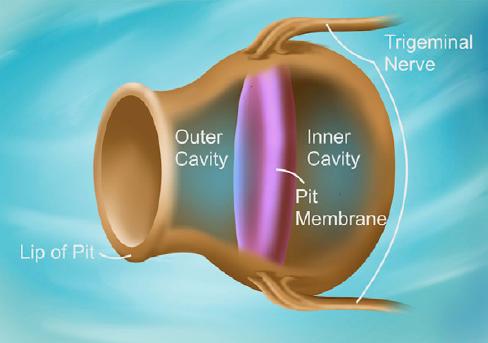
Certain species of snake can generate unsettlingly accurate thermal images of objects that are warmer than their surroundings. Venomous pit vipers, for example, can detect infrared (IR) light at wavelengths between 50 nm and 1 mm, which translates into a frequency range of between 1.8 THz to 2.5 PHz. This heat-sensing ability enables them to hunt warm-blooded prey such as birds and rodents even in total darkness, and scientists believe that it derives from a structure in their heads that acts as an “antenna” for IR radiation. The structure, known as a pit organ, is a hollow chamber about 10 to 15 mm thick, encased in a thin membrane with a surface area of around 30 mm2.
A pyroelectric possibility
Despite extensive studies, the precise mechanism by which the pit organ converts infrared radiation into processable electrical signals remains controversial, notes team leader Pradeep Sharma. He and his colleagues have now constructed a mathematical model to test the theory that cells within the pit organ membrane are pyroelectric – that is, able to generate a temporary voltage when heated or cooled.
This idea is itself somewhat controversial, since pyroelectricity was previously thought to be limited to stiff materials such as crystals. These materials are naturally electrically polarized and so contain large electric fields. When they change temperature, the position of their atoms also changes slightly. This shift in position alters their polarization, which in turn produces a temporary voltage across the material. If the temperature then remains constant at its new value, the pyroelectric voltage slowly dissipates due to leakage current.
To show that snake cells could also act as pyroelectric materials, the researchers used methods from the continuum mechanics of soft matter to couple electric fields and thermal expansion strain. They also factored in material properties such as the elastic modulus and thermal expansion coefficients of the cells. Using these inputs, the researchers calculated that, based on the pyroelectric responses of their pit organ cells, boa constrictors and vipers ought to be able to detect temperature differences at the millikelvin level. This is better than any human-made heat sensor, and according to Sharma, it implies that the snakes can sense the presence of an animal that is a mere 10 degrees warmer than its surroundings, even if it appears for only half a second at a distance 40 centimetres away.
A rattlesnake’s pit organ. Credit: Darbaniyan et al. /Matter
Similar calculations for rattlesnakes and pythons indicate that they can perform the same feat at 100 cm and 30 cm, respectively. All three results agree qualitatively with physiological measurements, Sharma says.
Applications to synthetic materials
The new work shows that soft and flexible structures can indeed display pyroelectricity. Such structures, Sharma explains, contain embedded static, stable electrical charges that don’t leak out. They can also deform in shape and size and are sensitive to temperature.
The researchers are now undertaking preliminary experiments on synthetic soft materials that resemble a snake’s pit organ. The results of these experiments might confirm the new model, they say, although further research would still be needed to prove that the proposed mechanism is indeed occurring in the snakes’ cells. Previous biological studies suggested that protein channels known as TRPA1 were involved, but it remains unclear how these channels might relate to the new model.
“Using this model, I can confidently create an artificial soft material with pyroelectric properties – of that there is no doubt,” Sharma says. “And we are fairly confident that we have uncovered at least part of the solution of how these snakes are able to see in the dark.” Now that they’ve developed the model, he adds, other scientists can do experiments to confirm or disprove their theory about snakes’ IR-sensing abilities.
The researchers, who report their work in Matter, say they now plan to fabricate bespoke soft materials that are highly pyroelectric while also demonstrating the (converse) electrocaloric effect. “Here, applying an electric field can reduce the temperature and thus provide a sort of cooling,” Sharma tells Physics World. “Such an effect has only been appreciably demonstrated in hard materials so far.”
Imagine being a physicist in 1920, the year the Institute of Physics was formed. The ordered world of classical physics was being turned upside down by a rapid succession of startling discoveries and radical ideas. Quantum theory was emerging as the most perplexing and yet most promising way of understanding the secrets of the atomic world, while Albert Einstein had stunned the scientific community with his general theory of relativity. It challenged Newton’s laws of gravity with mind-expanding concepts such as curved space–time and predicted gravitational effects such as the bending of light, the first evidence for which had just been obtained by Arthur Eddington on his eclipse expedition of 1919.
Life for physicists had been very different just 30 years earlier, when it had seemed that all the major problems in physics had been solved. Classical mechanics could reliably predict the movement of objects on Earth as well as the planets and stars; the laws of thermodynamics had been put to work in the development of steam engines; and James Clerk Maxwell’s seminal equations had unified the theories of electricity and magnetism. Such breakthroughs had made sense of much of the observable world, and most physicists thought that their only remaining tasks would be to finesse existing models and improve the accuracy of their measurement techniques.
That view was first challenged in 1895, when German physicist Wilhelm Röntgen discovered X-rays, which could pass through solid objects and the human body – beautifully demonstrating his finding with an image showing the skeletal structure of his wife’s hand. Just a year later, while working at the National Museum of Natural History in Paris, Henri Becquerel was surprised to find that the uranium salts he had locked away in a drawer emitted radiation of their own accord. The discovery inspired Marie Curie, also based in Paris at the time, to perform pioneering experiments that led her to conclude that the radiation was emitted by the uranium atom itself – in conflict with the prevailing notion that atoms were indivisible. Physicists then had to come to terms with the discovery of the electron, made by British physicist J J Thomson in 1897. Five years later the New Zealander Ernest Rutherford and others confirmed that alpha, beta and gamma radiation were emitted by the spontaneous breakdown of heavy atoms into lighter ones.
Keeping up to date The Cavendish Laboratory at the University of Cambridge (pictured left in 1910) was just one of a handful of UK physics labs that existed when the Institute of Physics was founded (courtesy: Cavendish Laboratory). It is currently undergoing further development to create the Ray Dolby Centre (architect’s illustration, right, courtesy: Jestico + Whiles)
Meanwhile, theorists were developing new models to explain puzzling electromagnetic phenomena that could not be reconciled with classical theory. In 1900 German physicist Max Planck had introduced the revolutionary idea that atoms could only absorb or emit energy in discrete “quanta” to resolve the energy distribution of blackbody radiation, a concept that Einstein exploited in 1905 to show that the photoelectric effect could be explained by treating light as quantized particles. That year went down in history as Einstein’s “annus mirabilis”, during which he also published papers on Brownian motion, special relativity and the equivalence between energy and mass.
“No physicist who has reached middle age can forget the romantic interest of the 10 years following 1895,” remarked American physicist Henry Bumstead during a lecture at Yale University in 1920. Summing up the mood of the time, he recalled how “startling discoveries followed each other in rapid succession and the physical journals were awaited with an impatience not unlike the desire for newspapers in wartime. But the news was all good news, and recorded an almost unbroken series of victories”.
Those 10 remarkable years at the turn of the century were followed by further breakthroughs that underlined the need for a new approach to physics, including Rutherford’s work on defining and splitting the atomic nucleus, American Robert Millikan’s confirmation of Einstein’s photon theory of light, and British physicist William Henry Bragg’s conclusion that X-rays must also be “corpuscular” in nature. By 1920, as the horrors of the First World War began to abate, it had become clear that physicists would need to revise some of their most fundamental ideas. In his lecture that year at Yale, Bumstead noted that the laws that govern atoms may be quite different from the laws of mechanics and electrodynamics that were so familiar to physicists of the time, remarking that this would be “rather a wrench for those of us who have been nursed and reared in the old regime”. But this discomfort, he felt, was “much more than compensated for by the fascinating and apparently inexhaustible field for research and speculation which is now being opened up for our use and pleasure”.
That sense of wonder and excitement heralded a new era of modern physics. The discoveries of the past quarter century had been reported widely in the mainstream press, attracting a new generation of scientists who were keen to solve the riddles posed by atomic and quantum physics. The First World War had shown that physics could have practical benefits too. Bragg and Rutherford, for example, developed better hydrophones for detecting enemy submarines, and their research on underwater sound paved the way for Canadian physicist Robert Boyle and Paul Langevin, in France, to produce the first practical pulse-echo system based on piezoelectric transducers in 1918.
There was real concern among physicists about the attitudes towards their occupation, and younger scientists in particular were seeking an improvement in their status
No credit where credit was due
While many of the early pioneers had enough time and money to pursue their own scientific interests, the university laboratories of the time were small and poorly equipped, at least in the UK. “50 years ago physical labs were very few, and very very sparsely populated,” said Thomson in a speech in 1921. “There were few advanced students, and fewer still who intended to make physics the business of their life; and indeed that was a very reckless and dangerous thing because the only positions open to physicists in those days were a few – very few – badly paid professorships.”
By the start of the 1920s, Thomson estimated that between 800 and 1000 scientists were engaged in some sort of physics research in the UK. New laboratories had sprung up across the country for training students and providing facilities for practical work, while the Cavendish Laboratory at the University of Cambridge had become a world-renowned research centre with more than 40 graduate students working alongside senior academics. Physicists were also employed in government laboratories, as well as in a growing number of industries that were making use of advances in electronics, optics and communications.
But there was still very little recognition for physics as a distinct profession. Indeed, there was real concern among physicists about the attitudes towards their occupation, and younger scientists in particular were seeking an improvement in their status. “There was little or no recognized position for physicists,” said Richard Glazebrook in a speech to fellow physicists, shortly after retiring as the first director of the UK’s National Physical Laboratory in 1919. “Men [sic] who have done important work in physics have, in some cases, only been given an official status by being termed research chemists.”
This lack of recognition led to low wages, insecure employment prospects and scant money for experimental apparatus. Newer universities struggled to attract and retain experienced physicists, while even the most established research centres had to cope on meagre finances. George Paget Thomson – the son of J J Thomson – later recalled how, in his early days at the Cavendish Laboratory, senior academics had to rely on college fellowships worth about £250 (roughly £11,000 in today’s money) to top up their salaries. Demand also frequently outstripped supply for standard equipment such as galvanometers, pumps and even resistors.
Timeline of the Institute of Physics
The Institute of Physics headquarters moved to King’s Cross in 2018. (Courtesy: Institute of Physics)
1874 The Physical Society of London meets for the first time to enable scientific discussion and the demonstration of new results and techniques, followed by the first publication of the Proceedings of the Physical Society of London
1914 The first Guthrie Lecture – established to honour the founder of the Physical Society of London, Frederick Guthrie – is given by Robert Wood on “Radiation of gas molecules excited by light”
1920 The Institute of Physics (IOP) is formally incorporated as a professional society for physicists, and its Memorandum and Articles of Association are approved
1923 The Journal of Scientific Instruments is published by the IOP for the first time
1932 The Optical Society and Physical Society of London merge to form the Physical Society
1934 The first international physics conference takes place in the UK, organized jointly by the Physical Society and the Royal Society (the UK’s national academy of sciences) in conjunction with a meeting of the Union of Pure and Applied Physics
1946 The IOP establishes headquarters at 47 Belgrave Square, London
1956 The 1000th fellow of the IOP is admitted to membership, along with the 2000th associate and 1000th graduate members
1960 The Physical Society and IOP merge to create a single learned and professional society
1966 The IOP journal Physics Education is launched to enable professional development among physics teachers
1986 IOP Publishing is created as a separate business unit to manage all publishing activities
1988Physics World is launched
1996 The IOP moves its headquarters to 76 Portland Place, London
2001 The Chartered Physicist programme is introduced to strengthen the professional recognition of qualified physicists
2018 The IOP opens new headquarters at 37 Caledonian Road, London
2020 The membership of the IOP stands at 23,000
A professional physics society
By the end of the First World War the need for a professional association for physics in the UK was becoming clear. While the Physical Society of London had been founded in 1874, its focus was to provide a forum for discussing and demonstrating new scientific results. Back then, scientists such as Maxwell and Rayleigh would not have imagined that anyone would be able to earn a living through physics, let alone that scientific research would be put to practical use by industry or the government.
Now what was needed was an organization that would boost the status of professional physicists, while also co-ordinating the activities of the Physical Society of London and smaller but related learned bodies based in the UK – notably the Optical Society and the Faraday and Röntgen societies. At a meeting in 1918, representatives from all interested parties discussed the possible activities of a proposed “Institute of Physics”, which included awarding diplomas to physicists with adequate training, registering the qualifications of members, creating a shared headquarters and library, and establishing new exhibitions and publications.
A board was formed in 1919, agreeing that Glazebrook would be the first president, and the Institute of Physics (IOP) was formally incorporated in November 1920. By then 300 physicists had joined the new organization as fellows or members. “It is a tribute to the status already acquired by the newly formed Institute that its diploma is now being required from applicants for government and other important positions requiring a knowledge of physics,” the UK newspaper The Times noted, “and the physicist is now being recognized as a member of a specific profession.”
For the next 40 years the IOP ran in parallel with the now simply named Physical Society, the former looking after professional matters with the latter continuing to focus on scientific results and discussion. Speaking at the IOP’s inaugural meeting in 1921, J J Thomson – who later that year was to become the IOP’s second president – clearly defined the scope of the new body. “This Institute is one which, like similar organizations of doctors, lawyers, engineers and chemists, has been founded to promote the interest of the profession,” he said, “to act as a bond of union, to ensure that the highest standard of efficiency is reached by those interested in it, and also to ensure a high standard of professional conduct.”
From 1920 to 2020: a century in publications
Rising resources The number of papers in physics, both in interdisciplinary and core fields, has increased exponentially over the past century. Growth was disrupted during the world wars but was at its steepest between 1950 and 1970. (Adapted by permission from Springer Nature: Nature Phys.11 791)
In 1920, when the Institute of Physics (IOP) was founded, physics as a distinct scientific discipline was still in its infancy. According to a 2015 survey by the physicist Albert-László Barabási and colleagues at Northeastern University in the US, only a few hundred research papers in physics were published that year, representing just 4% of all scientific publications (Nature Physics11 791).
Since then, the research output from the physics community has grown exponentially, aside from a short pause during the Second World War. By 1950 physicists were writing around 1000 research papers every year, rising to 100,000 by 2010, and since the 1980s physics has accounted for some 22% of all scientific publications, with the IOP itself now publishing more than 85 academic journals.
The scientific literature also reveals how physics has changed from an individual, single-minded pursuit to a more collaborative endeavour. A study by US science historians Donald Deb Beaver and Richard Rosen in 1978 estimated that only 20% of physics research published in 1920 involved any sort of collaboration (Scientometrics1 65). Today, in contrast, the average number of authors on a physics paper has risen more than in any other scientific field. According to Nature Index, for papers in the 68 journals it tracks, the average number of authors in the physical sciences more than quadrupled from nine in 2012 to 39 in 2016 – driven largely by the emergence of publications with more than a thousand co-authors.
Physics has also become more interdisciplinary. The analysis by Barabási and colleagues shows that before 1910 almost all research papers were published in core physics journals such as Physical Review and the Proceedings of the Physical Society. But 1920 saw a significant increase in research reports published by physicists in other fields, or in more general titles such as Nature and Science.
At the same time, point out Barabási and colleagues, the myriad of different subfields of physics have developed their own lexicons, methodologies and culture, with papers published in certain domains significantly more likely to cite other publications in the same subfield and not outside it. This behaviour is particularly prevalent in nuclear and particle physics.
To underline its role for representing physicists in government and industry, one of the IOP’s first major initiatives was to launch the Journal of Scientific Instruments in 1923, which is still published today as Measurement Science and Technology. Proposed by Glazebrook, the new journal aimed to deal with “methods of measurement, and the theory, construction and use of instruments as an aid to research in all branches of sciences and engineering”. There was a clear desire even then to make the journal interdisciplinary in nature, with biologists, engineers, chemists and instrument makers invited to join physicists on the scientific advisory committee.
As the IOP expanded, it created subject groups that catered for growing specialization within the field, as well as overseas and regional branches. It also issued certificates to members who were proficient in specific experimental techniques and laboratory arts, such as glass blowing, that young researchers were still routinely required to learn.
A growing community
By the end of the Second World War the IOP was increasingly working with government to help shape science policy and physics education, particularly as it was becoming clear in the post-war years that there were too few physicists to fill the growing number of vacancies in industry, academia and science teaching. Salary surveys offered guidance on the wages that new and experienced physicists could expect to earn, with the 1948 edition suggesting that graduates should be receiving £600 per annum (roughly £22,000 in 2020) by age 30, with an upper limit of around £1250 (about £46,000 now) for the most experienced and able IOP fellows.
The IOP had also assumed much of the administrative work of the Physical Society, and by 1944 the two organizations agreed to co-operate on many of their core activities, including conferences and publications. After a prolonged period of will-they-won’t-they, the two bodies merged in 1960 to create “The Institute of Physics and The Physical Society”, a cumbersome name that was subsequently shortened to “The Institute of Physics” when the IOP was awarded its Royal Charter in 1970.
Since then the combined professional body and learned society has continued to champion physics and professional physicists. The IOP has developed and supported physics education, provided advice and expertise to policymakers, encouraged innovation and growth in industry, worked internationally with other physical societies across the world, and inspired people from different backgrounds to explore the wonders of physics. Meanwhile, its commitment to disseminate scientific research has enabled its publishing business, IOP Publishing, to become a leading international publisher of research journals, ebooks and, of course, Physics World.
Limit Less – the IOP’s new campaign
The physics community has changed hugely in the 100 years since the Institute of Physics (IOP) was founded in 1920. Back then, physics was almost entirely a male preserve, limited mostly to those who had attended the few elite schools where science was properly taught. Thankfully, far more young people are exposed to physics these days, but many who might go on to enjoy a successful career in physics still choose not study the subject beyond the age of 16 – whether due to barriers of race, gender or class, or simply a lack of good careers advice.
To ensure that as many young people are attracted into physics as possible, the IOP has just launched a major new campaign called “Limit Less”. Developed in partnership with the IOP’s members, the campaign aims to combat the prejudices and stereotypes that put potential physicists off the subject. By emphasizing that there are “no limits” to what can be achieved with physics, the campaign will support young people to do physics by correcting misconceptions about the subject, removing barriers to participation – especially among under-represented groups – and highlighting how physics is tackling global issues such as climate change, public health and poverty.
Among the IOP’s lesser-known achievements was the creation of a benevolent fund in 1924, seeded by a donation of £100 from Major Charles Phillips – a British physicist and a founder of the IOP – and topped up by regular contributions from members. The value of the fund had risen to more than £1m by the start of the 21st century, allowing the IOP to provide direct financial support to physicists and their families who are in need. More recently, astrophysicist Jocelyn Bell Burnell – who served as the IOP’s first woman president – donated her £2.3m winnings from the Breakthrough Prize for her work on discovering pulsars, allowing the IOP to launch last year a fund to support PhD students from under-represented groups at universities in the UK and Ireland. Looking to the future, meanwhile, the IOP has just launched a major new campaign to widen participation in physics (see box above).
The physics community of 2020 is very different from the one that existed in 1920 when the IOP was founded. It is far bigger now, of course, but thankfully also much more diverse, and the myriad of careers that physicists today pursue – from IT and engineering to finance and education – would surely have been enthusiastically welcomed by J J Thomson. “I should like, on behalf of those interested in physics,” he said, while addressing the first meeting of the IOP, “to express our obligation to those who have conceived the idea of this Institute, and who have borne the labours in connection with its initiation.” One wonders what Thomson would say were he to address the IOP’s membership today.
If we are to create a colony on the Moon – perhaps as a jumping off point for the human exploration of Mars – we will need a source of water. In this episode of the Physics World Weekly podcast, planetary scientist Hannah Sargeant of the Open University explains how water could be obtained on the Moon and what it would be used for.
We’ve all spent a lot more time at home recently following the COVID-19 pandemic. During lockdown you may have obtained new skills or attended online meetings wearing pyjamas beneath a blouse or shirt. The unprecedented nature of COVID-19 has seen most labs close, leading to more time with the family, the ability to easily flex hours, no commuting as well as instant access to the kitchen and the kettle. Enthusiasm for this new way of working was initially high, but once the difficulty of balancing 24-hour childcare, fighting constant distractions and maintaining a healthy work–life balance became apparent the novelty soon wore off.
For many PhD students, postdocs and academics, the lack of face-to-face communication and the limited access to facilities are an inconvenience. Online meetings are less productive and there’s the constant challenge of engaging a class of students on Zoom when they are just names on a screen. Those of us who are settled are more fortunate, but for graduates, PhD students and postdocs, the prospect of a career “next step” seems more precarious and unsettling than ever.
Before the pandemic, searching for a new position usually involved an in-person meeting with prospective colleagues and seeing workplaces and labs. Travel restrictions have taken this to the virtual world but despite tremendous effort it is not the same. Given the logistical challenges of moving abroad, staying put during a global pandemic might seem the wisest and most attractive option. Yet now could be the perfect moment to look beyond current travel restrictions and quarantines and take advantage of the many positives of working abroad. After all, fortune favours the bold.
The global village
Perhaps the most beneficial part of moving to a new job is making new collaborations and networking. Working alongside active and renowned researchers increases your influence in the field, builds your reputation and exposes you to the heated arguments and bold ideas at the forefront of academic debates. Whether right or wrong, progression in your academic career can very much depend on who you know and with whom you have published. Sometimes funding is only available elsewhere or perhaps the pay and workers’ rights are preferable in another country. In certain European nations, for example, a PhD is considered a job with a contract laying out employee benefits and rights, paid holiday hours, the expected teaching requirements and a fixed salary with bonuses. Financial security and written employee protection are no longer an unpredictability, but a given.
Heading to pastures new will also expose you to a new environment. No two labs are the same and, by switching, scientists develop their own experience-based methods and means of thinking. Perhaps after working in a single-group lab for a few years you might discover that a multi-group lab with a diverse range of experiments and experimentalists is more desirable. Perhaps the new lab accepts external users, allowing interests to develop in the science and materials being studied outside your main expertise. By changing labs, you can leave your mark and take away knowledge with you for future endeavours.
Moving to a new country is daunting and potentially accompanied by language barriers and culture shocks. Deviating from your own comfort zone, you’ll experience new geographical landscapes, cities, people, food and an alternative way of living. In the modern world, the ability to up sticks to another country generates a greater respect and understanding of the world we live in. Many collaborators have made similar choices leading to Christian holidays celebrated together with Thanksgiving, Eid, Russian New Year or Cinco de Mayo – all being a reason to share laughter and time with each other (I’ve thought of teaching ceilidh dances and toasting a haggis on Burns’ Night, but drew the line at reciting Scottish poems to students).
For those chasing the academic dream, the concept of a stable living situation can feel somewhat far-fetched. Maybe there seems little reason to buy a house because dealing with short-term rentals in foreign countries requires less commitment. Feeling “at home”, however, does not need to correlate with owning a piece of land. For some it can simply mean being comfortable in a work environment or getting by easily while out shopping or using public transport. For others, it could be joining a choir, signing up to a sports team, making friends, finding a local café (or wine shop), or simply feeling at peace. Although the transition requires effort in the initial stages, the rewards outweigh the fears.
Science is a global and collaborative endeavour and while conferences and meetings may have gone online for the foreseeable future, information and expertise can still physically travel. Tempting though it may be to stay put during these testing times, keeping an open mind and looking outwards could be worth the risk. If there is an exciting opportunity abroad, overlook the barriers and complications of COVID-19 and pursue it. Don’t reject today what you would regret tomorrow.