“It is not what happens to you, but how you react to it that matters” – Epictetus.
Amid the current challenges of the COVID-19 pandemic, I saw our institution’s core values (caring, integrity and discovery) shine through brighter than ever. Here at MD Anderson, we did much more than react – we responded! As a scientist in training in the biggest medical centre in the world and the number one cancer centre in the US, we were vigilant from the outset. Leadership from both fronts was exceptional, which helped students and trainees like me do our job.
As I write this blog article on my home computer, I am approaching the 14th hour of screen time just for today. For some, this might seem high, but for me, a doctoral research fellow with a computational project involving a vast amount of data and lots of programming, it’s a normal day. Like most well established educational institutions, we have transitioned to online lectures, virtual meetings and remote working now. This is already my third week working from home, so I am well settled (having an excellent home office since the beginning helped a lot).
So, what is different? I don’t get to walk to the office, go to the gym and have social interactions that were part of life a couple of weeks ago. In-class lectures and research meetings are now virtual (but effective); my $29 pull-up bar and living room is my gym. Though I lean towards the introvert side of the personality scale, in the 21st century, we have many ways to stay connected so that is never a problem. As of last week, if needed, I could go to my office after hours and on weekends, as all other workers would be relieved for the day.
Every day I wake up in the morning, freshen up, try some form of a home workout, make some coffee, breakfast, and call home. As an international student from Nepal, family time is a must for me, and now some of it is taken up by COVID-19. I inform my family about real developments and measures to stay safe. Nepal had a first positive case just this week and has gone into lockdown for a week. As a developing country with limited medical capability, stricter measures must be taken to ensure safety. After the call, I move on to my home office and start working as I would any other day.
I am lucky to be educated enough and experienced enough to make an informed decision during the current situation. I have had first-hand experience of chaos and death in the 2015 earthquake in Nepal that took close to 9000 lives and caused about 22,000 injuries. During challenges, what you focus on matters a lot. When some misguided individuals were frolicking on beaches or having picnics in parks, medical professionals were fighting this pandemic on the front line, essential supply-chain personnel were working intensely to get supplies to us, researchers were pushing the boundary of knowledge. It is admittedly frustrating to see some disregard the enormity of the situation, but I know that enough people were doing their best and will do the right thing. We will surely come out on top of this situation. Amid this chaos, institutional leadership and peer support have been excellent here and I am proud to be a part of this establishment.
Though some of my friends have had to stop their research as their lab shuts down for an indefinite time, I can practically keep working as normal with some minor modifications. I am utilizing this time to wrap up two first-author manuscripts from my work in MD Anderson Late Effects Research Group. Many of us are doing our part by staying home and pausing laboratory research to maintain social distance, but some of us can keep pushing the boundary of knowledge as we are uniquely positioned to do so. I think that it is not only possible, but we must do so more than ever before.
As a human, I must admit that I am not always positive or successful in utilizing the whole day. Some social-media posts or news stories break my heart, but some fill me with hope. Amid this chaos, I will personally keep doing my very best and expect the same from everyone out there.
Members of the DarkSide experiment at the Gran Sasso National Laboratory in Italy have temporarily put their hunt for dark matter on hold in an attempt to stem the deadly tide of COVID-19. The 26-strong group of physicists from Europe and North America has designed a new, stripped-down mechanical ventilator that it hopes can be mass-produced quickly and cheaply using off-the-shelf components. Liaising with medical professionals and calling on the expertise of fellow physicists, the researchers aim to produce a prototype device today or tomorrow (27–28 March) and then work flat out to try and get the device into hospitals as soon as possible.
Many of the most seriously ill patients infected with COVID-19 develop pneumonia and need assistance-breathing. That is done using mechanical ventilators, which pump oxygen into the lungs and then remove the carbon dioxide that they breathe out. This is a delicate process that involves regulating the pressure and/or volume of oxygen provided. It can be done either fully automatically on a sedated patient, or to support a patient’s natural breathing.
The new ventilator design has been spearheaded by Cristiano Galbiati, a physicist at Princeton University in the US, and the Gran Sasso national lab, which is run by Italy’s National Institute for Nuclear Physics (INFN). Currently locked down in Milan, Galbiati says that he started working on the design after speaking to a friend on 19 March whose family had made a big donation to an intensive-care hospital rapidly being assembled on the site of Milan’s Expo in 2015 to treat some of Italy’s ever-growing number of coronavirus patients. The friend told him that a consignment of ventilators supposed to be arriving from Germany had been cancelled. “That is when I realized that we need to do something different,” he says.
Mechanical Ventilator Milano
Galbiati quickly brought together colleagues from DarkSide, and using criteria published by the Medicines and Healthcare products Regulatory Agency in the UK, which stipulate the essential features for any new design of ventilator, came up with a blueprint entitled Mechanical Ventilator Milano (MVM). This, he says, is inspired by a 1961 design from Roger Manley of Westminster Hospital in London, which was “basic but very reliable” – one of the main differences being that the new machine will use electrically driven pneumatic valves rather than mechanical switches.
According to Galbiati, the MVM would be compact and require fewer parts than most ventilators on the market today. Its simplicity, he says, derives from the fact that it controls the pressure of oxygen in a patient’s lungs using two fail-safe valves in the form of vent traps – nothing more than columns of water or oil with a specific depth. One trap positioned upstream from the patient ensures a certain maximum pressure during inhalation and another, downstream, dictates the minimum pressure following exhalation.
Unlike more sophisticated ventilators, the MVM would not be able to regulate the volume of oxygen in someone’s lungs (as opposed to the pressure). Galbiati says that he does not know how strictly necessary it is to be able to control both quantities but is nevertheless convinced that the new design would be a life-saver in Italy’s heavily infected Lombardy region and beyond. “I can’t say what is needed in most cases,” he adds. “But what I can say is that there are patients who get no treatment. A mechanical ventilator that only has only pressure control will still be very valuable.”
Laboratory tests
On 20 March, Galbiati and colleagues carried out a first set of tests in a laboratory near the hard-hit city of Bergamo using some of the components of the MVM and a standardized test lung made from a silicone bag. Then on Monday, they uploaded a pre-print on arXiv outlining their design and asking scientists and medics for feedback in order to “speed the process of review, improvement and possible implementation”.
Galbiati says that the first prototype device should be ready as soon as 27–28 March, but adds that developing the machine itself is not that difficult. The main outstanding technical challenge, he says, is producing the software that runs the device. “We have shifted the complexity to the controller and design software,” he explains. “This is something that particle physicists excel at. But if we want to do it quickly, we need the collaboration of the best programmers from the strongest particle physics labs.”
Heading up the effort on the other side of the Atlantic is Art McDonald of Queen’s University in Canada, who shared the 2015 Nobel Prize for Physics for the discovery of neutrino oscillations. McDonald says that he has been “mobilizing resources” from several Canadian particle and nuclear laboratories, including electronics expertise at TRIUMF and mechanical engineering skills from Chalk River Laboratories and SNOLAB. Together with Galbiati, he has also been drumming up support from Fermilab in the US and CERN in Switzerland.
McDonald says that he has had “excellent feedback” on the MVM from medical experts, including those in a group at McGill University in Quebec who are overseeing ventilators in Canada. Although Italy has not yet given formal regulatory approval for the design, he says that informally, authorities have sent very encouraging signals (indeed, Galbiati says that they have granted special permits to re-open factories for the production of necessary items). McDonald is also hopeful that approval will be soon be given in Canada, having spoken to “authorities at the highest level” there.
The biggest remaining question, McDonald says, is whether industry can produce the machine quickly enough to really limit the damage done by the virus in Italy and elsewhere. “I don’t know the answer to that yet,” he says. “But we have a lot of very highly motivated individuals working on this.”
Edwin Cartlidge is a science writer based in Rome
Analysis: can physicists help solve the ventilator shortage?
By Hamish Johnston
As the novel coronavirus continues, its relentless spread across the globe, more hospitals are facing shortages of ventilators and other key equipment and supplies. It is only natural that physicists want to apply their technical skills to creating new ventilator designs that can be quickly manufactured. And it is not just physicists, engineers at companies that supply of a wide range of products from vacuum cleaners to nuclear technologies have joined the effort.
However, these projects face huge challenges. In some places, ventilators are needed right now, yet new devices must go through stringent testing to be approved for use. Also, will it be possible to train already busy intensive-care staff to use the devices and would they have confidence in the new technologies?
Regardless of whether these new ventilators are used on COVID-19 patients, scientists and engineers should be lauded for their efforts. And as often happens in science, there could be spin-off applications of the new ventilators such as use in developing countries where simple and accessible medical equipment is needed.
This past week has been nothing but chaotic. My university closed at 5.00 p.m. on Tuesday 17 March giving everyone only a few hours’ notice. Researchers scrambled to shut down experiments and frantically transfer files so that they could work from home.
With only 30 minutes before the 5.00 p.m. lockdown, I was in the middle of my second-year PhD viva. It felt surreal being in an empty building stressing about my PhD progression when there was so much more to worry about with the ongoing pandemic.
The following two days felt like a whirlwind. In between packing up my life at university to work from home, I also attended and spoke at the Graphene Flagship’s first-ever virtual conference – Women in Graphene 2020 from 18–19 March. The conference was originally planned to be in Bologna, Italy, but shifted in early March to an online platform hosted by Virtway Events.
Around 70 people from around the world attended the event and, despite being online (and free for attendees), it was fully immersive and, in many ways, mimicked a real conference. It was possible to have discussions with groups of people just as you would in real life as well as conduct audience Q&As, applaud and even wave. It felt like we were in The Sims!
Being virtual brought several advantages. It meant that those who may have otherwise struggled to make it to Italy were now able to attend. It allowed more people to ask in-depth questions or perhaps, more personal questions that would be more difficult to ask at an actual event. It also allowed individuals in the Women in Graphene network to connect in a way never done before, such as continuing conversations and discussions after the event.
Finding a new normal
Once the conference was over, I switched my priority to ensuring that my undergraduate students feel that they have the support that they need. I know that many of them have things to worry about beyond their studies and right now, it is even more important to be an understanding tutor.
I have not yet quite found my new “normal” but I am confident that I can keep my head above water for the foreseeable future. I am using the lockdown as downtime to prioritize and plan the remainder of my PhD. I am particularly thankful to those who are supporting me during these unpredictable times and I too am making an extra effort to stay connected with friends, family and loved ones.
Indeed, it is more important than ever to keep connected to the physics community and to show each other kindness, support and care.
At Engender Technologies, our technology is physics-based, so that’s our most critical expertise. Microfluidics and light–matter interactions are key, but we have to pick up essentials across other areas of physics, engineering, micromanufacturing, programming, biology, subsystem integration – the list is crazy long. Certain aspects of our project are seriously blue-skies, which is exciting because they’re ground-breaking, but also risky because we know even less about how (or if) they will help us achieve commercial goals.
There’s also a lot I do beyond the science – for example, I’m continuously co-ordinating R&D threads, managing progress against deadlines, and making sure everything is in place to achieve our complex, multifaceted technology on tight deadlines. One key skill is knowing when to tie off part of the research. When do we stop optimizing? When is performance “good enough”? I constantly analyse and manage risk by evaluating and balancing timeline, technical, IP and commercial risks. Communication skills are important, but rarely taught. Effective project management requires everyone’s input, from the head engineer to the part-time student – it’s truly a team effort.
What do you like best and least about your job?
I operate outside my comfort zone all the time. Virtually every day, I do something I’ve never done before. Luckily, I like this aspect of the work – it’s stressful, and my anxiety about failing is high because of the consequences, but it’s never boring. You have to just go, do your best to avoid obstacles and make adjustments to avoid running into disaster. We have to be resilient, as not every idea works and we encounter difficult patches – poorly performing lasers, misbehaving cells, manufacturing challenges limiting our innovation.
What’s the downside? As a start-up, lurching from funding to funding was miserable. Also, I can’t honestly say I’m good at stress management, and I struggle to prioritize leave. Last year, I travelled the equivalent of 10 around-the-world trips, and I’m a single mother of two teenage boys. At one point, I was ordered to take medical leave, which was a wake-up call. Fortunately, I’m comfortable with change, and the potential for Engender to make a real difference makes up for the downside.
What do you know today that you wish you knew when you were starting out in your career?
Careers are messy. When someone’s introduced at a conference, their career path looks logical and very step-by-step. But when you’re making your way down the path, it’s much more tangled and squirrely. When I moved to New Zealand, I had just been tenured in the US and I thought I was moving laterally, with minimal change in research ambitions. In reality, New Zealand’s research environment was challenging for my ultrafast spectroscopy programme and at first, I thought I’d made a huge mistake. The solution was to exploit our fundamental science and expand our impact through entrepreneurial photonics. Now our research shows up in real products, and we spin out companies left and right.
Another thing I wish I’d figured out sooner is that it’s all about the people. Too often we focus on the grants, publications, citations, medals and awards. But that’s not where the real value lies. A Māori proverb answers the question “What is the most important thing in the world?” with “He tāngata, he tāngata, he tāngata” – it’s the people, it’s the people, it’s the people. Science is ultimately a human activity. Prioritizing this philosophy, with all of its reflected individual and community layers, has made me a better mentor and better scientist.
The British-born mathematical physicist and public intellectual Freeman Dyson, who died on 28 February 2020 at the age of 96, was one of the most celebrated figures in 20th-century physics. He had spent most of his professional life at the Institute for Advanced Study (IAS) in Princeton, New Jersey, where he was a professor emeritus and remained active until his final few days. Dyson died at a hospital near Princeton, due to complications from a fall, according to his son, the science historian George Dyson.
Dyson began his career in the 1940s, making important contributions to the development of quantum electrodynamics (QED). Early on, however, he broadened his interests to include nuclear reactors, space travel, climate and biology – both on Earth and elsewhere in the cosmos. Dyson also wrote numerous popular books that focused on the intersection of science and technology, religion and philosophy. Ever the iconoclast, his contrarian views on global warming drew the ire of some leading climate scientists who accused him of acting irresponsibly.
Dyson was born in Crowthorne, Berkshire, on 15 December 1923 to the lawyer and social worker Mildred Atkey, and the musician and composer Sir George Dyson. Hugely interested in numbers as a child, he went on to read mathematics at the University of Cambridge aged just 17. Breaking his studies, Dyson spent part of the Second World War working as a civilian researcher for the Royal Air Force’s Bomber Command. He later returned to Cambridge, graduating with a BA in mathematics, studying under the likes of Paul Dirac, Arthur Eddington and the mathematician Godfrey (GH) Hardy.
Dyson stayed at Cambridge as a fellow of Trinity College until 1947 when he moved to the US, where he worked towards a doctorate with Hans Bethe at Cornell University. However, he did not complete his PhD and Dyson went on to be one of the world’s most famous physicists never to have a doctorate. In 1948–1949 he was based at the IAS before spending the next two years at the University of Birmingham, UK, working alongside Rudolph Peierls, who had played a role in developing the atomic bomb.
Dyson briefly returned to Cornell in 1951 before accepting a lifetime appointment to the IAS that was arranged by its then director Robert Oppenheimer. There, Dyson rubbed shoulders with such luminaries as Albert Einstein and John von Neumann. Commenting on his early years, he once told Physics World (June 2000) that he had contemplated going to the Soviet Union to work with the theoretical physicist Lev Landau but chose the US instead. “All the young people of my generation had been stuck in England all through the war and you couldn’t travel anywhere. There was a violent desire to get out and see the world.”
Scientific thinking
Much of Dyson’s early work focused on QED, taking disparate ideas developed by Richard Feynman, Julian Schwinger and Sin-Itiro Tomanaga and unifying them. This caused some colleagues to dub him “the midwife to the birth of quantum electrodynamics”. Feynman, Schwinger and Tomanaga shared the 1965 Nobel Prize for Physics for their work on QED and some physicists believed that Dyson should have bagged a Nobel prize – a sentiment that Dyson always played down.
The 1950s saw Dyson diversify his research interests, working on Project Orion, which investigated the use of nuclear power for space propulsion. His described his 15 months on Orion as “the most exciting and in many ways the happiest of my scientific life”. Dyson also joined a project headed by the physicist Edward Teller – who pioneered the hydrogen bomb – that focused on the design of small nuclear reactors for research and the production of medical isotopes. More than 60 of these “TRIGA” reactors have been installed worldwide and are still being produced.
Dyson continued to do some fundamental research and in 1967 he made a major contribution to the understanding of the inherent stability of fermionic matter. In the 1970s Dyson reduced his research activities and began to write popular-science books. He credited this shift to his Cambridge mentor Hardy, who once told Dyson: “Young men should prove theorems, old men should write books.” But Dyson still kept up his research interests, and as late as 2012 published a paper on the mathematics of the prisoner’s dilemma (PNAS26 10409).
He had several fanciful (yet scientifically plausible) concepts named after him including the “Dyson tree”, which is a hypothetical genetically modified plant that lives inside a comet
Dyson’s books are known for their imaginative ideas that verge on science fiction. He had several fanciful (yet scientifically plausible) concepts named after him including the “Dyson tree”, which is a hypothetical genetically modified plant that lives inside a comet. He also popularized the idea of a huge artificial structure that could be built around a star by an advanced civilization – now known as a “Dyson sphere”. Searching for Dyson spheres is an active area of research, with some astronomers looking for changes in the spectral properties of stars that would be the result of such a feature.
In 2006 Dyson published The Scientist as Rebel, in which he questioned the role of human activity in global warming, putting him in conflict with the scientific consensus. Later, in another interview with Physics World (January 2008), he said that the money being spent on addressing climate change should instead be targeted at “other problems that are more urgent and more important such a poverty, infectious diseases, public education and health”. He also said that thinking about potential benefits of climate change “will not do us any harm”.
Dyson believed that the science underpinning global warming is faulty and had challenged the motivations of climate scientists and activists. Referring to the climate campaigner and former US vice-president Al Gore, Dyson once said that “his claims regarding the climate are not based on science. The scientists just go along with it. It’s nice to be important and the way to be important if you are a climate scientist is to say we’re running into a tremendous disaster. It’s a form of corruption in a way”.
Dyson also publicly criticized climate scientist and activist James Hansen, who responded that Dyson was ill-informed about the science. Dyson said that his contrarian views on climate change arose from his philosophical outlook. He described himself as a humanist, rather than a “naturalist”. He said that naturalists believe “nature knows best”, while humanists believe that “humans have the right and the duty to reconstruct nature so that humans and the biosphere can both survive and prosper”.
As a result, Dyson was a proponent of genetic engineering. He believed that it could be used to create new technologies based on living organisms – such as a tree that is engineered to have silicon in its leaves to generate electricity and is also modified to produce liquid fuel.
Religious feelings
Dyson also wrote widely on science and religion, which led him to him winning the Templeton Prize for Progress in Religion in 2000. The award, which included a $600,000 cash prize, is given by the US-based Templeton Foundation to a person who “has made an exceptional contribution to affirming life’s spiritual dimension, whether through insight, discovery or practical works”. Dyson became one of a dozen physicists to have won the prize, which was first awarded in 1972 to Mother Theresa. Dyson’s Templeton citation referred to his “futurist views [that] have consistently challenged humankind to reconcile technology and social justice”.
As for his own person religious convictions, Dyson described himself as a “practising Christian up to a point but not a believing Christian”. In 2000 he told Physics World that his view of Christianity did not include the resurrection of Christ, in which he did not believe, and that he would not use the word “God” to describe a higher entity. Instead, he referred to a “world soul”, adding that “I have a simple feeling that there is something there.”
Dyson appeared to see no conflict between religious faith and science and pointed out in 2000 that Isaac Newton himself “had a very strong Christian faith but was also a tremendously rational person”. He told Physics World that his Christianity “is about taking care of your neighbour and doing good in the world”. Accepting his Templeton prize at a ceremony in Washington DC that same year, Dyson said “neither technology nor religion alone is powerful enough to bring social justice, but technology and religion working together might just do the job”. Despite this call to action, however, Dyson shied away from campaigning roles.
While some of Dyson’s ideas were embraced by scientists and the wider public, others –including the benefits of genetic engineering and climate change – were met with scepticism. This did not deter Dyson. “The rules of the world-historical game change from decade to decade,” he once said, “and the dogmas that we have now will probably become obsolete. In the years to come, my heresies will probably also be obsolete. It is up to the next generation to find new heresies to guide the way to a more hopeful future.”
I work every day with people in academia, industry, government and the public, so my communication skills are key – from writing briefing notes for ministers, to e-mailing news to academics who are active in the areas I support, through to speaking with journalists – and knowing how to pitch my message is very important. It is also vital that I have a decent grasp of the science concepts that I am engaging with – my physics degree and lifelong interest in STEM, with lots of popular-science reading have all helped.
Another key skill is fact-checking, knowing which sources and references to trust, a skill I honed from my days of having to write research papers. Leading a programme as part of the government, I have to manage budgets, collect evidence and write business cases, making the case for why public money should be spent and what benefits it will bring. I have to manage teams, resolve conflicts, spot incoming problems and put mitigating strategies in place.
What do you like best and least about your job?
The part I like the most is that I get to encourage and inspire others to see science and space as areas they can work in, whatever their interests and skills. Every day, I get to work in a field that I have been fascinated by since childhood, as I’ve managed to follow a career path that ended up fulfilling the mad, crazy and (seemingly) impossible goals I had as a teenager. But there are always pros and cons. In my current role, I sometimes find the timescales and bureaucracy of big international meetings challenging. It can take months or years to prepare and make decisions. I am someone who likes being active, and having spent several years working in mission control for the Columbus module on the International Space Station (ISS), where decisions can be made within minutes, I struggle with the slower pace. But in mission control I had to work shifts, and I really don’t ever enjoy being awake at 5 a.m.
What do you know today that you wish you knew when you were starting out in your career?
Things change and that is OK. Seek advice, consider your options, and then make the decision that is right for you, which may well not always be the same as conforming to expectation. And if, after careful consideration, you really can’t decide what to do, it probably doesn’t matter which way you leap, so pick a path and don’t look back. My physics degree taught me that I was never going to be a research physicist. I decided to drop out of the four-year MSci course, swap to a three-year BSc, and then do a different Master’s course. People thought I was crazy, and it cost me more money, but it was absolutely the right thing for me. Don’t be afraid to dream – keep that mad, crazy dream (which may change) in the distance somewhere. Just take each leap as it comes, and you’ll find the path for you. People are generally nice – if they offer you an opportunity it is because they think you can do it, not because they want you to fail. Grab it and run with it
A new type of relay that retains its state even when the power is switched off could be used to make a reliable high-temperature non-volatile digital memory. The device, developed by researchers at the University of Bristol in the UK, could find use in electric vehicles, aircraft or “Internet of Things” devices that operate in harsh conditions and require electronics with integrated data storage.
Conventional transistors are ill-suited for applications in hot environments because their leakage current increases with temperature. In such conditions, nanoelectromechanical (NEM) relays are a promising alternative. They work through electrostatic actuation, in which a voltage applied between a fixed “actuation” electrode (usually called the gate) and a cantilever beam anchored at one or both ends produces an electrostatic force that attracts the beam to the gate.
As the beam moves, the air gap between the gate and beam, which can be as small as a few tens of nanometres to ensure low-voltage (and thus energy-efficient) operation, rapidly reduces. This causes the capacitance to increase. At a critical “pull-in” voltage, the electrostatic force becomes much greater than the opposing mechanical spring force. At this point, the beam snaps in, forming the relay’s “on” state.
The drawback with this mechanism is that the balance of forces immediately before the critical “pull-in” moment is very unstable, which makes it difficult to control the movement of the beam. This tends to make the device less reliable, and it can be especially problematic in non-volatile relays that use surface adhesion forces (stiction) to ensure the relay stays switched on even when the power is switched off.
Eliminating instability
A team of researchers led by Dinesh Pamunuwa has now made the first electrostatically actuated NEM relay that does not suffer from this so-called “pull-in” instability. In contrast to conventional architectures, the new device has a semi-circular beam and a novel arrangement of four gates to control the beam’s movement. One pair of gates is used to rotate the beam anticlockwise and the other pair to rotate it clockwise.
After rotation, the beam tip lands on a stationary electrode and stays connected to it thanks to surface adhesion forces, even when the power is completely switched off. When it needs to be reprogrammed, it can be rotated in the opposite direction using the opposing pair of gates.
Pamunuwa explains that the semi-circular beam and use of diagonally opposed pairs of gates for actuation ensures that the air gap to the gates remains constant throughout relay operation, eliminating pull-in instability. What is more, the architecture allows for low-voltage programming and reprogramming for memory applications, which, combined with the device’s zero off-state current leakage, greatly improves energy efficiency.
High-temperature tests
The Bristol researchers used their structure to make a high-temperature non-volatile NEM relay that successfully underwent 42 on-off cycles at 200°C. They also showed that the device retains its state for more than six months, boasts the highest number of reprogramming cycles to date under any environmental conditions and operates at actuation voltages as low as 1.6 V with a 120 nm actuation air gap.
The work, which is detailed in Nature Communications, is part of a long-term effort to produce digital electronic components that are highly energy efficient. Pamunuwa says that he and his colleagues are working on all aspects of NEM relay-based computing in pursuit of this goal, both at the device and system level and as EDA (electronic design automation) tools for modelling, simulation and design.
“Currently, we are working with partners in a four-year EU project called ZeroAMP, which started in January 2020, with the aim of demonstrating the first NEM relay-based field-programmable gate array (FPGA),” he tells Physics World.
The last-minute decision by the American Physical Society (APS) to cancel its March Meeting came as quite a shock to the physics community – in particular the large number of delegates who had already travelled to Denver – but it was clearly the right thing to do in a rapidly worsening situation with COVID-19. To help continue scientific exchange, a number of initiatives have emerged over the last few weeks to enable researchers to share and discuss their latest results using online tools and forums.
Perhaps the most ambitious is the Virtual APS March Meeting, launched by the APS in collaboration with the community to enable presenters to host a virtual session or record and upload their talk. The APS is also encouraging researchers to add their presentations to the official scientific programme, with the idea that all the content will be synched across the two websites. Meanwhile, a number of community efforts have sprung up around particular interest groups, all of which the APS has listed on the meeting website.
As yet there is no online replacement for the technical exhibit, where more than 150 companies were preparing to share their expertise and to introduce their latest innovations in equipment, services, and software. Some of the notable product launches are highlighted below, plus you can also check out our previous round-up of technical developments that were due to be announced at the meeting.
Control instrumentation empowers quantum computing
Zurich Instruments has introduced the first commercial Quantum Computing Control System (QCCS), which provides all the hardware and software needed by researchers to scale up their experimental set-ups to a large number of qubits while also minimizing complexity. The QCCS makes all the necessary links between high-level quantum algorithms and their physical qubit implementation, and performs all critical tasks such as qubit initialization, control and readout, and real-time feedback to enable global error correction on quantum algorithms.
The first commercial control system for quantum computing is scalable from 1 to 100 qubits. (Courtesy: QCCS)
The QCCS combines three instruments, two of which are industry firsts: the UHFQA quantum analyzer for parallel qubit readout, and the PQSC programmable quantum system controller for component synchronization and control. Along with the HDAWG arbitrary waveform generator and the LabOne control software, these instruments work as one entity, the QCCS, that is scalable from 1 to 100 qubits.
The UHFQA quantum analyzer enables real-time parallel readout of up to 10 superconducting or spin qubits with high fidelity. The UHFQA features two signal inputs and two signal outputs, and achieves sub-nanosecond timing resolution together with a baseband operation over a frequency range of up to ±600 MHz. With its low-latency signal processing chain of matched filters, real-time matrix operations, and state discrimination, the UHFQA supports the development of quantum computing set-ups with 100 qubits and more.
The PQSC programmable quantum system controller enables precise synchronization of all the electronic components needed to control a quantum computer. Real-time communications links with low latency enable the PQSC to perform fast and automated qubit calibration routines. Researchers can program the PQSC to develop new processing solutions for rapid tune-up and error correction, optimized to work with different algorithms and computer architectures.
The HDAWG arbitrary waveform generator provides 8-channel, 16-bit signal generation with ultralow trigger latency – allowing for fast sequence branching to implement complex algorithms. Thanks to its synchronization feature, the PQSC can link 18 units for a total of 144 channels with a skew below 200 ps out of the box.
All instruments are accessed through the LabOne control software, which provides an intuitive and efficient interface to monitor and program the entire system, to control signals and to record the results of all experiments.
Full details are available on Zurich Instruments’ website, or contact info@zhinst.com to arrange a video call
Automation equips atomic force microscopy for industry
Park Systems has shown that an atomic force microscope (AFM) can deliver the high throughputs needed for industrial metrology applications, including the manufacture of semiconductor chips. Combining high-speed scanning with optical pattern recognition and automation software can deliver measurements up to five times faster than with conventional techniques, while still maintaining good image quality and a long tip lifetime.
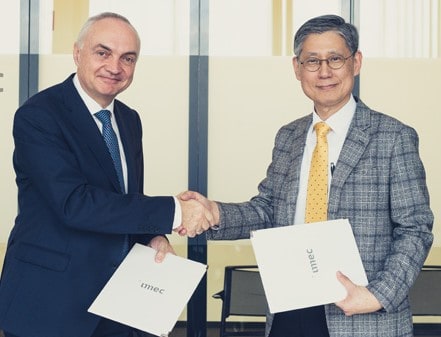
Luc Van den hove, president and CEO of imec, (left) and Sang-il Park, Chairman & CEO of Park Systems renew their joint research agreement. (Courtesy: Park Systems)
The demonstration promises to address the metrology challenge facing the semiconductor industry as it moves to ever smaller feature sizes. Optical microscopy has reached its limits for inspecting nanoscale devices built on 7 nm and 14 nm chip architectures, while existing AFM techniques deliver the required resolution but remain too slow for routine use.
Park Systems believes that full automation of the AFM technique, in which software is used to control critical tasks such as tip exchange, data analysis, wafer handling and recipe optimization, offers a reliable and high-speed solution. In this approach, optical pattern recognition is used for positioning, while automated measurement routines can be configured to perform specific metrology tasks, such as a topography scan or roughness measurements.
Engineers at Park Systems have tested this automated AFM approach in a series of experiments designed to mimic common measurement scenarios. They used one of Park’s NX20 AFMs with the company’s XEA software to measure the surface roughness of a clean silicon wafer, as well as the sidewall angle of a feature on a patterned wafer.
High-frequency cantilevers were used to speed up the image scanning, which was combined with a non-contact mode that increases the number of scans that can be performed without needing to change the tip. The tests showed that it was possible to reduce the scan time by a factor of five, and that at least 1000 images could be recorded with no degradation in image quality.
Park Systems has been working with imec, the leading R&D and innovation hub for nanoelectronics and digital technologies, to show that automated AFM can be used as a metrology solution in the semiconductor industry, and a new joint project will address the current metrological challenges of continuously downscaling the geometrical dimensions of devices and 3D assembly stacking.
HQS Quantum Simulations has released a free and easy to use platform to solve lattice models, which can be accessed at scce.quantumsimulations.de. Simply define a unit cell of your strongly correlated model system in one or two dimensions, add a small amount of information about the system size, and the platform will take care of the rest – including the distribution of the jobs to high-performance cloud computers.
HQS Quantum Solutions has raised 2.3m euros to develop its quantum computing software, which is now available in a beta version. (Courtesy: HQS).
The platform exploits self-consistent cluster embedding (SCCE) to solve large periodic problems. In the SCCE approach, a lattice model is solved iteratively with a combined system divided into a fully-interacting cluster coupled to a non-interacting bath. The simulation proceeds until the result is self-consistent.
This approach is similar to dynamical mean-field theory and density matrix embedding theory, and the company says that a detailed description of the method will be published in the near future. Now available in a beta version, HQS is actively working to expand its capabilities.
“Currently we use the density matrix renormalization group (DMRG) algorithm as the solver for the lattice model, but in the future we would like to replace it by using quantum computers.” says Michael Marthaler, managing director at HQS. “The number of operations to simulate lattice models is relatively small, while simulating lattice models for strongly correlated systems is very challenging for a classical computer. Therefore we feel that this will be one of the first applications for quantum computers.”
In this beta phase each user is granted 100 credits per month, which should be sufficient to gain familiarity with the platform. HQS is keen to capture user feedback on the beta verson, which will allow the company to prioritize the development of additional features, such as support for 3D lattices, access to all underlying parameters of the SCCE and DMRG solver, and access to the cloud-based tool via an API. The SCCE online platform does not yet support the purchasing of additional credits, but users who wish to test the software more extensively should contact HQS directly.
Cryogenic innovation enables simple scale-up for quantum experiments
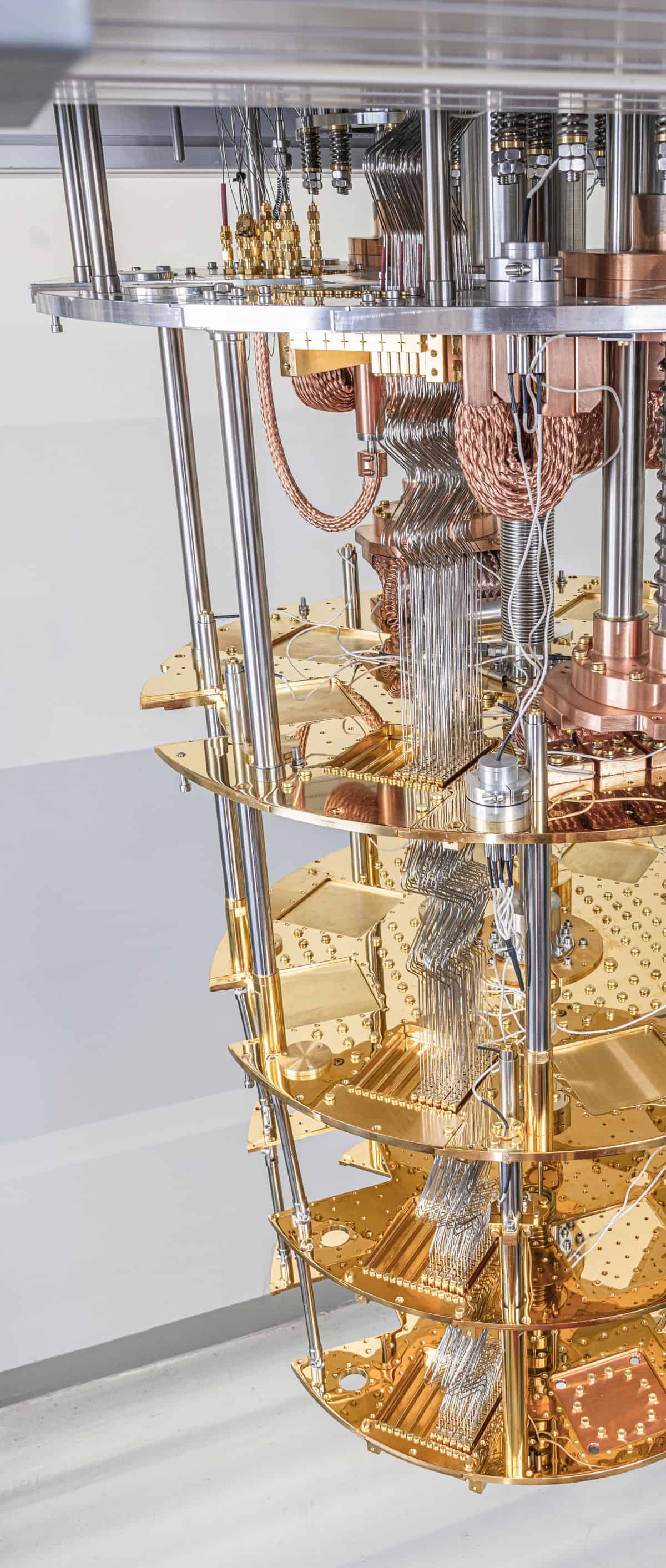
Bluefors has introduced high-density wiring as an option for its modular side-loading XLDsl dilution refrigerator system. The high-density interface enables researchers to build experiments with more than 1000 high-frequency lines in one cryostat, which is becoming increasingly important as scientists seek to increase the number of qubits in their quantum computing systems.
High-density wiring enables researchers to install more than 1000 high-frequency control lines in a single system. (Courtesy: Bluefors)
The interface exploits standard connectors and coaxial cables for the wiring, and the attenuators have been embedded in a single block that fits into the modular system. Wires are installed in blocks of 12 to help researchers ensure that each wire is connected securely. Meanwhile, the modular form factor allows the use of custom components with multiple high-density channels, such as amplifiers, filters and attenuators.
The high-density option forms part of Bluefors’ modular side-loading system, which provides a standard way for loading experiments into the cryostat. All the components and wiring needed for the experiment are assembled inside a module with a standard form factor that simply snaps into one of six side-loading ports on the XLDsl system, allowing for quick maintenance of complex assemblies.
“The modular system makes it possible to increase the number of wires and components in the system, allows rapid testing and troubleshooting, and ensures quick turn-around for busy multi-user environments,” says David Gunnarsson, Bluefors’ chief sales officer. “All this is done without compromising the thermal properties and strengths of the cryogenic system, which still keeps the operating temperature at milliKelvin temperatures.”
There is a very good chance that that you will be reading this while under lock-down somewhere in the world. In this episode of the Physics World Weekly podcast Margaret Harris describes a new initiative that we have launched to chronicle how physicists around the globe are coping with the COVID-19 pandemic.
A plasma to most physicists is an extremely hot state of matter that you would not want anywhere near your lunch or vegetable patch. But as Dave Graves of the University of California, Berkeley explains in this episode, cold plasmas are being used to process food, help germinate seeds and much more.
Graves also talks about a special issue of the Journal of Physics D that is dedicated to plasmas in agriculture and food.
On a normal workday, I would usually write either papers or grant proposals – so in the mornings from around 8 am to 12 pm, I write. I now only have one part-time PhD student who I supervise and meet every week. Some days I’m in the lab working with a focussed ion beam (FIB) instrument on various types of nanoanalysis of materials. Because I’m semi-retired, in the late afternoons, I either go to the gym or play tennis with mates.
When I started to write this at the weekend, we were not yet in full lock-down in Western Australia and it seemed likely we would lock down sometime in the following few weeks. At my university, there was some preparatory work for the anticipated lock-down with courses going online and lectures cancelled.
Events moved quicker than I had anticipated – Western Australia is now in lock-down and the lab is effectively closed. But we are able to operate the Focussed Ion Beam system remotely – my colleague at work loads the samples into the machine and then we’re good to go.
In the next few weeks, I plan to write papers and proposals – so that’s pretty much business as usual. Also I will keep in touch with colleagues via conference calls. I’ve cancelled all travel.
My biggest concerns are around getting the right balance between over- and underreacting – the key to getting the right balance is reliable information. But still I do fear that many people will overreact and that will cause as much harm as the actual virus.
One silver lining is that, from now on, the reaction to this sort of outbreak will be much more finely tuned and we will now urgently invest in technologies that provide protection from contagion. This includes much better infection control technologies, pathogen identification technologies, and more rapid development of vaccines and mono-clonal antibodies.
We need to learn from this outbreak and be thankful that we’ve had an early warning (yet another!) that will hopefully turn out to be not as deadly as it could have been.