After this winter’s storms caused massive waves to batter the UK coastline, it’s easy for us to see that the sea contains vast amounts of power and energy, but is also highly destructive.
In our cover feature of the latest edition of Physics World magazine, Stephen Ornes investigates why the wave-energy industry is struggling to harness the power of the world’s oceans. Both financial and technical hurdles stand in the way, but researchers and pioneers are persevering with the hope that this clean, renewable source could be the answer to our energy problems.
Elsewhere in the issue, we’re excited to launch of a new series of interviews providing careers advice for physics graduates. Tushna Commissariat asks 10 of today’s top physicists three questions to find out about their day-to-day jobs and what they wish they knew when they started their careers. The March magazine, which is now out in print and digital formats, also features an interview with Nobel laureate Steven Chu, a look at how terahertz science is exploring space, and a mind-bending article on time crystals.
Joe McEntee reports from the 2020 Physics in Food Manufacturing conference in Leeds
Nobel laureate Steven Chu from Stanford University talks about his successes as energy secretary and tells Richard Blaustein how the US can collaborate in a competitive environment
Paul Ewart argues that compulsory retirement can be detrimental to physics
James McKenzie looks at why businesses must take action on climate change
Robert P Crease reviews the Hayden Planetarium’s new space show
Huge technical and financial hurdles face anyone seeking to harness the vast power of the world’s oceans. But as Stephen Ornes explains, for a devout band of researchers and hi-tech business pioneers, the dream of “blue energy” lives on
The terahertz range has been barely exploited compared to the rest of the electromagnetic spectrum. Sidney Perkowitz discusses the astronomical applications that have opened up with advances in terahertz detection
Peter Hannaford and Kryzsztof Sacha look at how time crystals could have similar applications to condensed-matter devices
David Appell reviews Prime Suspects: the Anatomy of Integers and Permutations by Andrew Granville and Jennifer Granville
Andrew Robinson reviews Einstein in Bohemia by Michael Gordin
Ask me anything: 10 top physicists share their careers advice for physics graduates, including Helen Margolis (NPL), Sadik Hafizovic (Zurich Instruments), Chao-Yang Lu (UST China) and Cather Simpson (Engender Technologies)
Caitlin Duffy interrogates the lack of experiments around the claims of biodynamic wine growing
Fever, an elevated body temperature of about 38.0–38.3 °C or above, is one of the most common symptoms in children presenting at the hospital. Fever can arise due to a variety of conditions – most commonly infection, followed by autoimmune disease and then malignancy. But in around half of infants up to three years old, and 10–20% of all children, no definitive cause is found, despite extensive diagnostic and laboratory tests. This condition referred to as fever of unknown origin (FUO).
In adults with FUO, PET/CT with the tracer 18F-FDG has been used to diagnose focuses of infection or inflammation. In children with FUO, however, studies are scarce and its usefulness remains unestablished. Now a team from University Medical Center Groningen (UMCG) has examined a large group of children with FUO to determine the value of FDG-PET/CT in finding the cause of fever (Eur. J. Nucl. Med. Mol. Imaging 10.1007/s00259-020-04707-z).
“Fever can be caused by many different diseases, some of which could be fatal if left untreated,” explains first author Jordy Pijl. “If the cause of fever is unknown, it can be very difficult to start the right treatment, leading to increased morbidity or even mortality of patients.”
Data mining
Pijl and colleagues searched UMCG’s electronic patient database for patients aged up to 18 years who had undergone FDG-PET/CT for fever evaluation between 2010 and 2019. For the study, they examined the scans of 101 patients with FUO (fever for eight or more days) and nine patients with fever without source (FWS, fever without a clear source for less than eight days).
In 68 of the 110 patients (62%), a definite cause of fever was found, with FDG-PET/CT identifying the cause in 53 of these cases. Common diagnoses included endocarditis, systemic juvenile idiopathic arthritis and inflammatory bowel disorder. In 42 patients (38%), no cause of fever was found on FDG-PET/CT or any other diagnostics and the children remained as FUO.
In one example case (shown in the above image), a 9-year-old boy presented at the hospital with anorexia, weight loss, fatigue and intermittent fever up to 39.5 °C. He had experienced these symptoms episodically over the past 18 months, but had no definite diagnosis. FDG-PET/CT showed extensive FDG uptake throughout the entire colon, suggesting inflammatory bowel disorder; intestinal biopsy established the final diagnosis of Crohn’s disease.
Based on the reference standard (the final diagnosis at the patient’s discharge), 53 FDG-PET/CT results were true positive, 10 were false positive, 38 were true negative and nine were false negative. These findings correspond to a sensitivity of 85.5%, specificity of 79.2%, positive predictive value of 84.1% and negative predictive value of 80.9%.
The researchers point out that, as the false negatives illustrate, it’s important to remember that not all cases of FUO can be diagnosed with FDG-PET/CT. They suggest precautions that could help avoid unnecessary false negatives, including patients sticking to low-carbohydrate diets, especially when a focus of fever is suspected in tissues with high metabolic activity, and minimizing corticosteroid dose, especially when vasculitis is suspected.
In 58 out of the patients (53%), FDG-PET/CT led to treatment modifications, including a change in antibiotics, starting immunosuppressive therapy and starting treatment with a non-steroidal anti-inflammatory drug.
Associated factors
The researchers also used multivariate logistic regression to look for clinical parameters associated with FDG-PET/CT performance. They found that the level of C-reactive protein was positively associated with FDG-PET/CT determining a true positive focus of fever, while leukocyte count was negatively associated with finding a true positive. No other factors were significantly associated with outcome, making it a challenge to identify FUO patients who may likely benefit from FDG-PET/CT investigations.
While diagnostic tests such as a chest X-ray or urinalysis are quick, easy to perform and relatively cheap, and should thus be considered first, FDG-PET/CT provides a valuable diagnostic tool for evaluating children with FUO, the authors conclude. “FDG-PET/CT is a rapidly developing technique that can provide a quick full-body evaluation with less and less radiation, so in the future, it will likely climb up the diagnostic ladder of fever,” says Pijl.
“Now that we have looked into children with all causes of fever, we would like to focus on evaluating the use of FDG-PET/CT for specific causes of fever,” he tells Physics World. “Also, we are planning studies to evaluate the newest PET/CT scanners that can perform a scan in less time and with less radiation, thereby further establishing the role of FDG-PET/CT in diagnosing patients – and especially children – with fever or other symptoms of diseases.”
A superconductor can switch the magnetic moment of a single-molecule magnet placed on top of it. This novel phenomenon, discovered by researchers in Italy, occurs because of quantum tunnelling of magnetic spins, and might be exploited in future quantum information technologies.
Single-molecule magnets are paramagnetic materials that can switch their magnetization between two states – “spin up” and “spin down”, for example. At low temperatures, these molecular complexes retain their magnetic state even in the absence of a magnetic field because reversing the magnetization would require them to overcome an energy barrier. This magnetic “memory” effect could be exploited in spintronics and quantum computing applications since the spins can act as stable quantum bits, or qubits.
According to study lead author Giulia Serrano, the combination of molecular magnets and superconductors is currently a hot research topic. Among other findings, researchers have discovered that monolayers of paramagnetic molecules can influence the temperature at which an adjacent layer of material becomes superconducting (that is, conducting electricity with no resistance). This change in the superconducting transition temperature Tc occurs because the paramagnetic monolayers create local states in the bandgap of the superconductor.
Influence of the superconducting transition
Serrano and colleagues in Roberta Sessoli’s group at the University of Florence have now found that this interaction also works in the opposite sense: a material undergoing a superconducting transition can influence the spin dynamics of nearby single-molecule magnets. In their experiments, the researchers studied clusters of four iron atoms (Fe4) incorporated into the structure of a complex molecule containing ligands derived from a trialcohol. The geometry of this molecule keeps the iron atoms in a propeller-like arrangement that protects the high spin of the Fe4 magnetic core at low temperatures.
The team did their experiments in a ultrahigh vacuum chamber, where they used a thermal sublimation technique to deposit the Fe4 clusters onto the surface of lead (111). This material, a type-I superconductor, changes from a metal to a superconductor at a Tc of 7.2 K., but Serrano explains that superconductivity is only established if the applied magnetic field is lower than the critical field Hc. For lead, Hc is around 800 oersteds.
The researchers then analysed the magnetism of the Fe4 using synchrotron light and a technique called X-ray magnetic circular dichroism (XMCD). They found that at Hc, the lead superconductor switches the magnetization state of the Fe4 by “activating” the resonant quantum tunnelling of its magnetic spins. Quantum tunnelling is the process by which quantum particles can penetrate energy barriers that would be insurmountable to classical objects.
A new magnetization switching mechanism
Serrano and colleagues say this phenomenon is a new magnetization switching mechanism – a hypothesis they backed up by observing magnetic hysteresis loops, which show how the magnetic flux density, B, of a material changes as a function of an applied magnetic field, H.
As lead undergoes its superconducting transition, an increasing fraction of it enters a so-called Meissner state, which occurs when a material placed in a magnetic field expels magnetic flux from its interior as it becomes a superconductor. This state has the effect of locally cancelling the external magnetic field of the molecular magnet and “unblocking” its magnetization state.
“Single-molecule magnets in contact with these superconducting lead regions thus switch their ‘blocked’ magnetisation state to a resonant quantum tunnelling regime by the activation of the quantum tunnelling process,” Serrano tells Physics World.
As the lead transitions to the superconducting state, the number of switching events increases as more regions of the material become superconducting. This can be seen as a gradual decrease of the magnetization value in the hysteresis loop of the single-molecule magnet, she says.
The beginning of a novel research field
Serrano says that the team’s observations open new perspectives for using such hybrid systems in quantum information technologies. As well as being exploited as qubits with a magnetization that can be switched quickly, single-molecule magnets could also be used as local sensors for probing the superconducting state, she adds.
According to the researchers, who report their work in Nature Materials, the new result heralds the beginning of a novel research field aimed at better understanding how single-molecule magnets – and magnetic molecules in general – interact with various kinds of superconductors. They suggest that superconductors with complex domain structures, such as vortex states, would be particularly interesting to study.
News started to filter out late on Saturday 29 February that the March Meeting of the American Physical Society (APS) had been cancelled due to “rapidly escalating health concerns” over coronavirus COVID-19. But this news came too late for many delegates who were already on their way to Denver, including many flying in from overseas. In this short video, physicists who had made the trip – including students and industry scientists – speak about the impact of the cancellation on them. Physicists are an enterprising bunch, so despite the frustration, some delegates have turned a bad situation into an opportunity, including Itamar Sivan, chief executive of Quantum Machines.
A new type of microscope that can detect terahertz (THz) electromagnetic waves with unprecedented accuracy could be used to reconstruct detailed images that are inaccessible through standard methods. The device, which was developed by researchers at the University of Sussex in the UK, relies on a technique called nonlinear ghost imaging and could find applications in areas such as the life sciences, quality control in manufacturing and airport security.
THz radiation lies between microwaves and infrared radiation on the electromagnetic spectrum. Like X-rays, it easily passes through materials that are opaque to visible light, but its lower energy means that it does so without damaging living tissues. It is thus safe to use on even the most fragile biological samples. Images produced using THz radiation are also hyperspectral, meaning that each pixel in the image contains the electromagnetic signature of the corresponding area of the imaged object. This property enables researchers to visualize the molecular composition of objects and so distinguish between different materials.
Until now, however, microscopes capable of capturing images that preserve the fine details revealed by THz waves were not considered possible. This, explains project leader Marco Peccianti, is because the details you want to see are typically much smaller than the THz wavelength, and the more you focus on them, the more their electromagnetic signature is altered. “The main challenge in THz cameras today is not just about collecting an image but about preserving the object’s spectral fingerprint, which can easily be corrupted by the technique employed,” says Peccianti, who leads the Emergent Photonics (EPic) laboratory at Sussex.
Passing visible light patterns through a thin nonlinear crystal
To overcome this problem, Peccianti and colleagues developed a camera based on visible-light patterns generated by a laser. These patterns change in time, and the researchers pass them through a thin nonlinear crystal that converts them into patterns of THz light. The THz patterns are then projected onto the object being imaged, which – as in an optical microscope – is located very close to the camera.
When this series of known THz light patterns shines onto the object, a single-pixel field detector measures the intensity of the resulting scattered light. By processing multiple signals of varying light intensity from the detector, the researchers are able to reconstruct an image of the object without actually imaging the light scattered directly from it – a computational technique known as ghost imaging.
“The way our technique images the object is based on the fact that each light pattern is actually a THz pulse in time (with an associated shape in space),” Peccianti tells Physics World. “Just as in ultrasound imaging, we receive a wave that contains full information about the object. Our technique captures all the object information and ‘de-shuffles’ its content to produce a hyperspectral image with hitherto inaccessible fidelity.”
Potential applications for the camera include electromagnetic biopsy of skin tumours and quality control in manufacturing. It could also be used to perform chemical analyses of samples in a non-destructive way, such as in airport security, Peccianti says.
The researchers, who report their work in Optica, say they are now applying machine-learning techniques to speed up the image reconstruction process in their system.
A gyroscope sensitive enough to detect Earth’s rotation has been created using a chip-based optical cavity. It was developed by Kerry Vahala and colleagues at Caltech in the US and its performance is currently on par with some commercial chip-based devices that use other measurement techniques. The team says that their design could be improved so that its sensitivity is tens or hundreds of times better than other chip-based gyroscopes – and with further effort, the technology could be adapted to create commercial devices.
Optical gyroscopes work on a physical principle called the Sagnac effect. Under laboratory conditions, optical gyroscopes are among the most sensitive devices available to measure rotation. The Rotational Motions in Seismology gyroscope in Germany, for example, can measure minute variations in Earth’s rotation rate.
“Imagine a ring with a clockwise and a counter-clockwise laser beam,” says Valhala. “If the ring is not rotating, then the round-trip time for the beams to come back to some fixed point on the perimeter is identical. But as you rotate the ring, then the round-trip time becomes different, and the difference is proportional to the rotation rate.”
“Hockey puck” of optical fibres
The effect can be enhanced – and thus the sensitivity of the gyroscope increased – by increasing the distance travelled by the light. This is often achieved by sending the light down a long coil of fibre-optic cable, producing a device that looks, says Vahala, “like a hockey puck”. Producing such a device on an integrated-circuit chip would be difficult or impossible according to Daniel Blumenthal of University of California, Santa Barbara – who is not a member of Valhala’s team.
A possible solution lies in an alternative type of optical gyroscope called a ring laser gyroscope. Instead of using a long coil of optical fibre, ring laser gyroscopes effectively send light waves in both directions repeatedly around the same circular laser cavity. “Rather than having to go around a physical length of 200 m or longer, you’re recycling the light and amplifying it through the lasing action,” explains Vahala. “It’s that recycling action through many round trips that gives ring laser gyroscopes their sensitivity.”
In principle, one could simply send laser light with identical frequencies in both directions around the same cavity. At zero rotation, there would be no beat frequency between the interfering waves, and the beat frequency would grow as the rotation rate increased.
Locked out
Unfortunately, in ring laser gyroscopes, the clockwise and anticlockwise frequencies tend to lock together, suppressing the Sagnac effect at low rotation rates. “Different techniques have been developed in commercial ring-laser gyroscopes over the decades, including mechanically rocking the device back and forth to unlock the frequencies and allow the measurement to proceed,” explains Valhala.
Now, Vahala’s team has developed a more elegant solution, injecting different clockwise and anticlockwise pump laser signals into the cavity. These create the ring-laser signals via a process called stimulated Brillouin scattering. This prevents the two laser signals from locking together and provides a non-zero beat frequency between the signals. Any additional rotation will change this beat frequency.
The researchers applied this technique in an optical gyroscope with a 36 mm ring laser cavity on a silicon chip. They set the device on an optical table and tilted it first North and then South, detecting a frequency difference equivalent to that expected from the rotation of the Earth.
Blumenthal comments, “People, including my group, have put laser gyros on chips before. But the hard part, which this paper overcomes, is breaking this lock-up around the zero point.” He adds, “Measuring Earth’s rotation rate is considered your standard of the best you can do at zero movement because if you can measure that you can measure any other rotation and then subtract out the Earth’s rotation rate.”
Important first step
Blumenthal points out that only the resonant cavity is on a chip – with the pump laser, detectors and other components external to the chip in a stabilized enclosure. However, creating the cavity on a chip is a crucial first step towards a fully on-chip technology. Vahala’s team concur that the technology is not ready for commercialization and are working on ways forward.
However, Vahala says that the group’s chief priority is increasing sensitivity. “There are little MEMS gyroscopes based on the Coriolis effect in cellphones, video games – anywhere you need a very low-cost way of measuring the orientation of something – and these are by far the most commercially successful gyroscopes ever,” he says.
“[Our] gyroscope is competitive with some of these MEMS devices – but why would anyone want to pay for the development of an optical gyroscope on a chip to obtain the same level of performance as a MEMS device? These Sagnac devices have the potential to offer much better performance and, at somewhere between a factor of ten and a factor of a hundred improvement, these devices would probably start to create their own separate application space.”
The laser cavity and Earth-rotation measurements are described in papers in Natureand Nature Photonicsrespectively.
Physics graduates, it seems, remain resolutely unconvinced by the prospects of life in the classroom. The numbers don’t lie. Official data from the Department for Education (DfE) in England show that there were 41,472 new entrants to postgraduate initial teacher-training (ITT) courses in the academic year 2019/20 – an uptick on the postgraduate trainees in 2019/20. Yet while subjects like biology, history and geography exceeded recruitment targets specified in the so-called Teacher Supply Model (TSM) – a government forecast of the number of postgraduate ITT entrants needed to provide sustainable numbers of qualified teachers – it’s notable that recruitment performance against TSM targets was well off in other subjects such as physics (bottom of the pile at just 45%).
Drill down into the data and the situation is most acute for schools serving areas of socioeconomic disadvantage with a history of academic underachievement. “More than one in ten teachers from the most disadvantaged secondary schools leave to teach in other schools – about twice the proportion who make the same move from the least disadvantaged schools,” notes the DfE’s Teacher Recruitment and Retention Strategy (2019). Those higher levels of turnover, argues the DfE, only serve to amplify the problems of attracting subject specialists – not least physicists – to schools within low-income communities.
It’s all about outcomes
Ark Teacher Training is seeking to redress that imbalance with a proactive recruitment strategy to attract more physics graduates into the teaching profession. That’s particularly significant because the specialist training provider is an offshoot of Ark, an international education charity with a network of 38 schools across England – each of those schools serving an economically disadvantaged catchment in Birmingham, Hastings, London or Portsmouth.
“The national shortage of physics teachers is deeply unfair – and especially so in schools serving the most disadvantaged children,” explains Isabel Instone, senior tutor and head of curriculum and assessment at Ark Teacher Training. “We’re targeting physics graduates, in particular, to come and train with Ark because we believe every child deserves to be taught by a subject expert.”
Put simply, says Instone, physicists are best placed to paint the “bigger picture” on their subject, highlighting connections between science and the real world that will inspire children to pursue further study, and ultimately careers, in science and engineering. “With Ark,” she adds, “physics graduates will be part of a network of teachers and schools focused squarely on bridging the attainment gap and delivering better educational outcomes for disadvantaged children.”
Teaching the teachers
One physicist who’s experienced the Ark Teacher Training programme first hand is Phil Entwhistle at Ark Elvin Academy, a secondary school for students aged 11–16 in Brent, North London. After completing a physics degree at the University of Exeter in 2014, Entwhistle spent a gap year in the Canadian Rockies (think snowboarding and mountain-biking) before a two-year stint working for the British Red Cross.
“Seeing what experienced teachers do and how they do it has tremendous value,” says Phil Entwhistle (above), lead physics teacher at Ark Elvin Academy. (Courtesy: Ark Teacher Training)
“You’re in the classroom from day one,” explains Entwhistle. “For me, that’s one of the big selling points of Ark – the training is research-based but very much practice-centric. At the same time, there’s a fantastic level of support from your professional development tutor, your coach [an experienced teacher] and your peer network of fellow trainees.”
That support kicks in upfront with a two-week summer school that brings all new trainees together for an introduction to the Ark programme and the principles of great teaching. “The summer school is all about orientation,” notes Entwhistle. “The main focus is on what we call ‘climate for learning’ – how to manage behaviour in a classroom and practising what to do in various scenarios. The key to getting good quickly as a teacher is having control of the room.”
Continuous improvement
Once formal training gets under way, student teachers from different schools in the Ark network get together for weekly training sessions led by a specialist tutor. The tutor’s role is to support and develop teaching best practice, though the peer interaction and sharing of collective experience are equally important – whether that’s on matters of general pedagogy, how to plan a great lesson, or the strategies and language needed to teach difficult subjects and concepts.
In the classroom, meanwhile, each trainee is assigned a coach, an experienced teacher who they will work with and learn from on a daily basis. From the outset, trainees will teach some classes independently, while others involve “team-teaching” with their coach – managing a small chunk of the lessons and observing the rest of the time. “Seeing what experienced teachers do and how they do it has tremendous value,” says Entwhistle. However, that dynamic shifts, and ultimately flips, as the training year progresses, with trainees assuming the lead role on teaching duties and the coach acting more in an observer/adviser capacity.
To a large degree, the coach’s role is to fast-track continuous improvement of the trainee’s classroom practice. “The coach will observe at least one of your lessons each week and highlight an aspect of your approach that will have the biggest impact if you develop it,” explains Entwhistle. “That bite-sized action step then becomes your main focus for the following week. Incremental changes, week by week, that add up to something much more over time.”
After successful completion of the Ark Teacher Training programme, which comes with qualified teacher status (QTS) and a postgraduate certificate in education (PGCE), Entwhistle took up a newly qualified teacher (NQT) post in science at Ark Elvin Academy. After the NQT year, and becoming a fully qualified teacher, he progressed to lead physics teachers, a role that involves oversight and development of the school’s physics curriculum as well as coaching Ark trainee teachers.
To find out more, register for the Ark Teacher Training webinars here.
Reimagining best practice in the classroom
Ark Teacher Training launched in 2013, an offshoot of parent group Ark’s established network of schools across England. Since then, the organization has seen over 550 graduates complete its teacher training programme, all of them earning qualified teacher status (QTS) and a postgraduate certificate in education (PGCE) accredited by Goldsmiths, University of London. A further 150 student teachers in the 2019/20 cohort are working towards QTS later this year. Isabel Instone, senior tutor and head of curriculum and assessment at Ark Teacher Training, talked to Physics World about the guiding principles of Ark’s training model.
Isabel Instone: “There’s no gap between what is taught – the theory – and what the trainees do in the classroom.” (Courtesy: Ark Teacher Training)
What does your role at Ark Teacher Training involve?
Assessment and moderation are a big part of what I do. I’m responsible for designing procedures to check how well our trainees are progressing through the training year – and, if necessary, to support any students who might be struggling. The curriculum aspect is more geeky – so looking at what and how we teach our trainees, also ways we can improve the training. One aspect of that is to work with specialist subject leads to come up with innovative ways to teach difficult-to-grasp subjects – for example, electricity and energy – without introducing common misconceptions.
What differentiates Ark versus other teacher-training providers?
We have a consistency of approach – the language we use, our training methods – to provide the best possible support to teachers during their training year and the early years of their career. It’s in these formative stages when teachers make the most significant improvements to their daily practice. We talk a lot about the “get it, do it” gap for trainees. It’s not enough to get the theory or to see what great teaching practice looks like. You have to be able to deliver in the classroom.
How do you help trainees to raise the bar in terms of best practice?
We use videos to inform almost every training session – more often than not using lessons filmed in our schools and delivered by former trainee teachers within the Ark programme. It’s a fantastic exercise to deconstruct at a granular level what makes a lesson good – and the steps needed to plan and deliver that lesson. Using those insights, our trainees will practice their own lesson in front of their peers, getting group feedback along the way, so that they can implement in the classroom the next day. It’s too important to practise new teaching strategies for the first time in front of the children.
How do you ensure the programme continues to develop?
We have a continuous improvement mindset at Ark and take a lot of cues from trainees, mentors and senior leaders within our schools. Several recent changes are linked to trainee wellbeing and workplace – for example, getting into good habits early on when it comes to work/life balance.
Why should prospective candidates choose Ark?
The programme ensures there’s no gap between what is taught – the theory – and what the trainees do in the classroom. Our aim is to make them as effective as possible as quickly as possible. Longer term, we want our trainee teachers to build a career in the Ark network and ultimately move into leadership positions in our schools. We support trainees who successfully complete their training year [and earn their QTS/PGCE] to secure an NQT role in their current school or another school in the Ark network.
Scientists in the US claim to have developed a device that can generate electricity from moisture in the air. The device, based around a thin film of electrically conductive protein nanowires, can produce continuous electrical power for around 20 h, before self-recharging. The researchers say that such technology could provide clean energy without the restrictions on location and environmental conditions of other renewable energy solutions such as solar cells (Nature 10.1038/s41586-020-2010-9).
The device consists of a roughly 7 µm thin film of protein nanowires, harvested from the microorganism Geobacter sulfurreducens, deposited on a gold electrode with an area of around 25 mm2. A smaller, roughly 1 mm2, electrode is placed on top of the nanowire film.
Jun Yao, an electrical engineer at the University of Massachusetts, and his colleagues found that this set-up was able to produce a continuous current for more than 20 h. After 20 h, the voltage had dropped from around 0.5 V to 0.35 V, but when the load was removed, it went back up to 0.5 V within five hours, showing a self-recharging process.
The researchers also connected multiple devices together to increase the output. With 17 devices they were able to generate 10 V, and demonstrated that these connected devices could power an LED or a small liquid crystal display.
G. sulfurreducens was discovered by Derek Lovley, a microbiologist at the University of Massachusetts. He tells Physics World that the bacteria use the electrically conductive nanowires to make connections with other microbial species and with minerals. “For example, in soils and sediments, Geobacter feeds electrons to methane-producing microorganisms, which use the electrons to convert carbon dioxide to methane,” Lovley says. “Geobacter also electrically connects to iron minerals in soils and sediments to use iron minerals similarly to how we use oxygen.”
Electricity from thin air
Energy is generated in the device due to a moisture gradient that forms within the nanowire film when it is exposed to the humidity naturally present in air, according to the researchers. The smaller electrode on the top is key, as it leaves one side exposed to the humid air, allowing the moisture gradient to develop.
Yao tells Physics World that the way the device works can be compared with lightning. “The cloud builds up positive and negative charges at the upper and lower sides, and upon a certain threshold, it discharges through the lightening,” he explains. “This indicates that charge can be built up from the ambient environment and we may be able to harvest it for electricity production. One can think of our device to be a small cloud, with one side open to air and the other sealed. Water molecules in the air constantly bump into the open surface, creating more charges than on the other one. The charge difference eventually will build up electric field or potential difference, which will drive the electric current output.”
The team experimentally determined that ambient humidity was the source of energy by sealing the top of the device, to block water-molecule exchange with the nanowires. This cut the electrical output, which returned once the seal was removed. They also found that increasing the ambient humidity, and thus the water-molecule exchange rate, increased the electric output. To check that there were no electrochemical reactions with the gold plates, the team replaced them with inert carbon electrodes, and were able to generate similar voltages. The device also worked in the dark, eliminating a photovoltaic effect.
Yao says that the researchers are now working on connecting devices together to increase the power volume. “We have demonstrated that the devices can be connected to increase the power, so at a certain point, it is proven this will scale,” he says. “We are working on material sciences and engineering strategies to scale up the technology.”
In many ways, the ocean seems like the most obvious place in the world to look for energy.
Water covers about 70% of the planet, and much of it, driven by the Sun, is in constant motion. Surface swells ferry energy from one place to another, while tides and currents, as reliable as the sunrise, move vast volumes of water in very short times. The ocean is essentially a natural engine, converting solar energy into mechanical energy. Hardly surprising, then, that for at least 200 years, visionaries have dreamt of harnessing that constant, reliable motion and using it to power the world.
Numerous proposals have been made in this quest for “blue energy”, ranging from the practical to the outlandish. Perhaps the first known patent was filed in 1799 by a French family who wanted to use a lever – with one end bouncing on ocean waves – to power their sawmill and other machines. Since then, from the straits off northern Scotland to the wind-swept shelf waters near Victoria and Tasmania in Australia, scientists have been searching for the ocean’s “sweet spots”, where energy harvesting is feasible, reliable and cheap.
Harbours, tidal rivers and coastlines around the world have become testbeds for systems that can generate power, plug into the grid and survive the harsh conditions of the sea. Indeed, a study published in Science in May 2019 (364 548) further sweetens the pot. After analysing data from satellites and a global network of floating buoys, ocean engineer Ian Young and mathematician Agustinus Ribal, both from the University of Melbourne in Australia, found that the ocean’s tallest waves are getting taller and that ocean wind speeds are increasing – likely because of climate change. They could therefore have more energy to share.
But at least two variables threaten to submerge these efforts. The first is money. Between 2013 and 2015, at least three big companies with plans to connect wave-power generators to the electricity grid all lost funding and abandoned their projects. One of them, Pelamis, had tested facilities around the world. Another, Aquamarine, based in northern Scotland, had spent 10 years developing a floating-buoy wave-generator system, called the Oyster, but failed to bring in investors. A third, Oceanlinx, began in Australia in 1997 and was sold to a Hong Kong company in 2014.
The sea is an unforgiving environment. It is corrosive, fouling, energetic and forceful
The other big hurdle is the power of the sea itself. In the winter of 1988, for example, a fierce storm in Toftestallen, Norway, slammed a wave-power plant that had been installed barely three years earlier. The unhinged tower collapsed and the station had to be rebuilt, only to be destroyed again by accident during an attempted improvement three years later. In 2009, meanwhile, a dozen underwater turbine blades were wrecked by strong tides in the Bay of Fundy, Canada, less than a month after they had been plumbed in. And in November 2007 a brand new power-generating test buoy that had cost $2m to install took on too much water and sank in the Pacific waters off the coast of Oregon.
“The sea is an unforgiving environment,” admits Elaine Buck, a technical manager at the European Marine Energy Centre (EMEC), an open-sea testing facility based in Stromness, Orkney, Scotland, that studies wave- and tidal-power generators. “It is corrosive, fouling, energetic and forceful. Marine energy is harnessed at the extreme environmental edges.” Hardly surprising, then, that ocean power has made far fewer inroads than other sustainable-energy sources, such as solar and wind.
Ups and downs
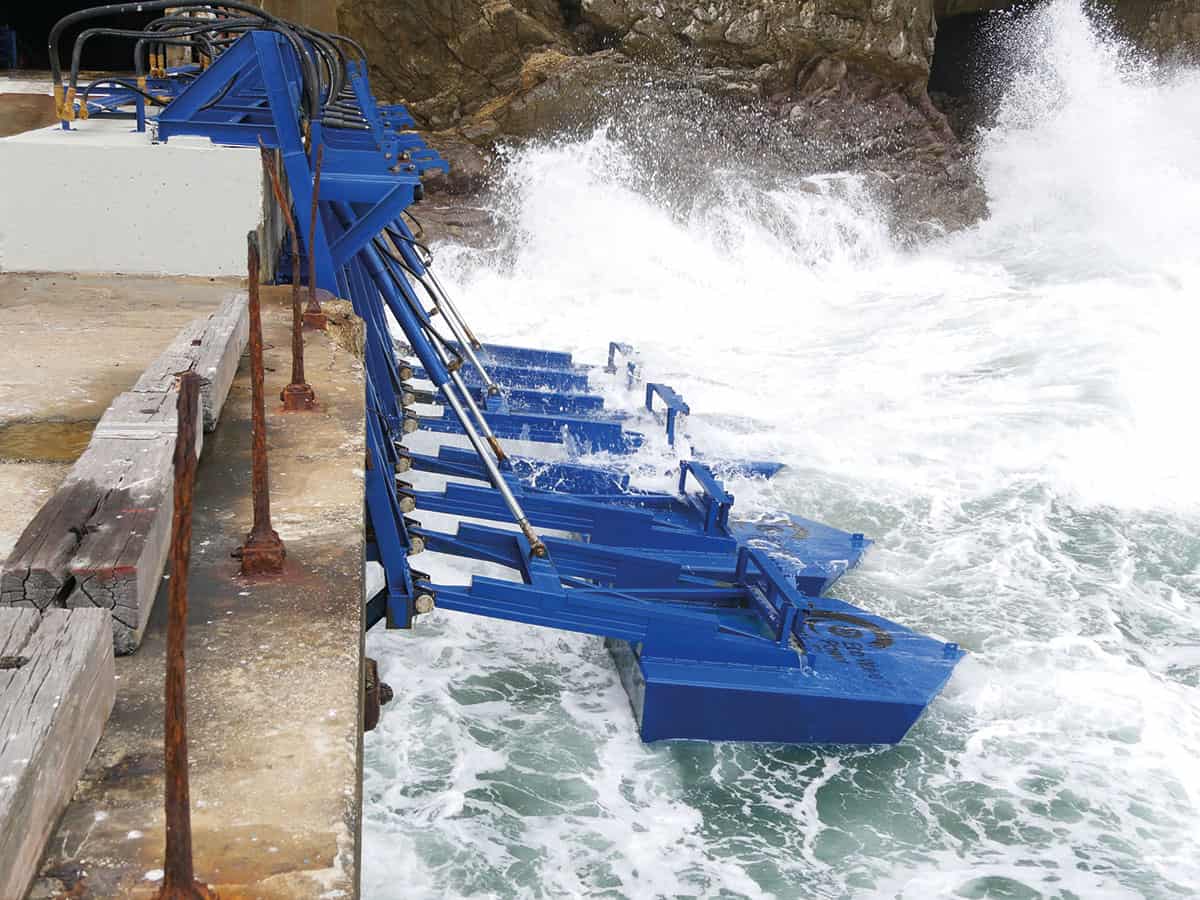
There are, though, signs of progress. To see one in action, you can go to Gibraltar, the British territory that juts out from Spain into the Mediterranean Sea. On the east side of The Rock, on a jetty used during the Second World War to transport ammunition, lie eight blue mechanical arms attached to wide buoys that rise and fall as waves roll in from the sea. When waves reach a height of 0.5 m, the device’s oscillating arms drive pistons that pump hydraulic fluid into an onshore power station. There, the fluid spins a hydro motor, generating electricity that flows into Gibraltar’s grid.
Installed in 2016 by Eco Wave Power – a Swedish firm based in Tel Aviv, Israel – the wave station currently has a capacity of 100 kW of electricity. That should be enough to power a few dozen homes and makes Gibraltar one of the few places in the world where ocean waves supply the electrical grid. Eco Wave Power now intends to scale up the technology by installing more units to provide 5 MW of electricity, which would represent 10–15% of the territory’s demands. The firm is also planning future projects where wave power has potential, including in Portugal, Italy, the Netherlands, Australia, Mexico and the UK. The sum total of all these proposed projects would be 190 MW, says Eco Wave Power’s chief executive, Inna Braverman.
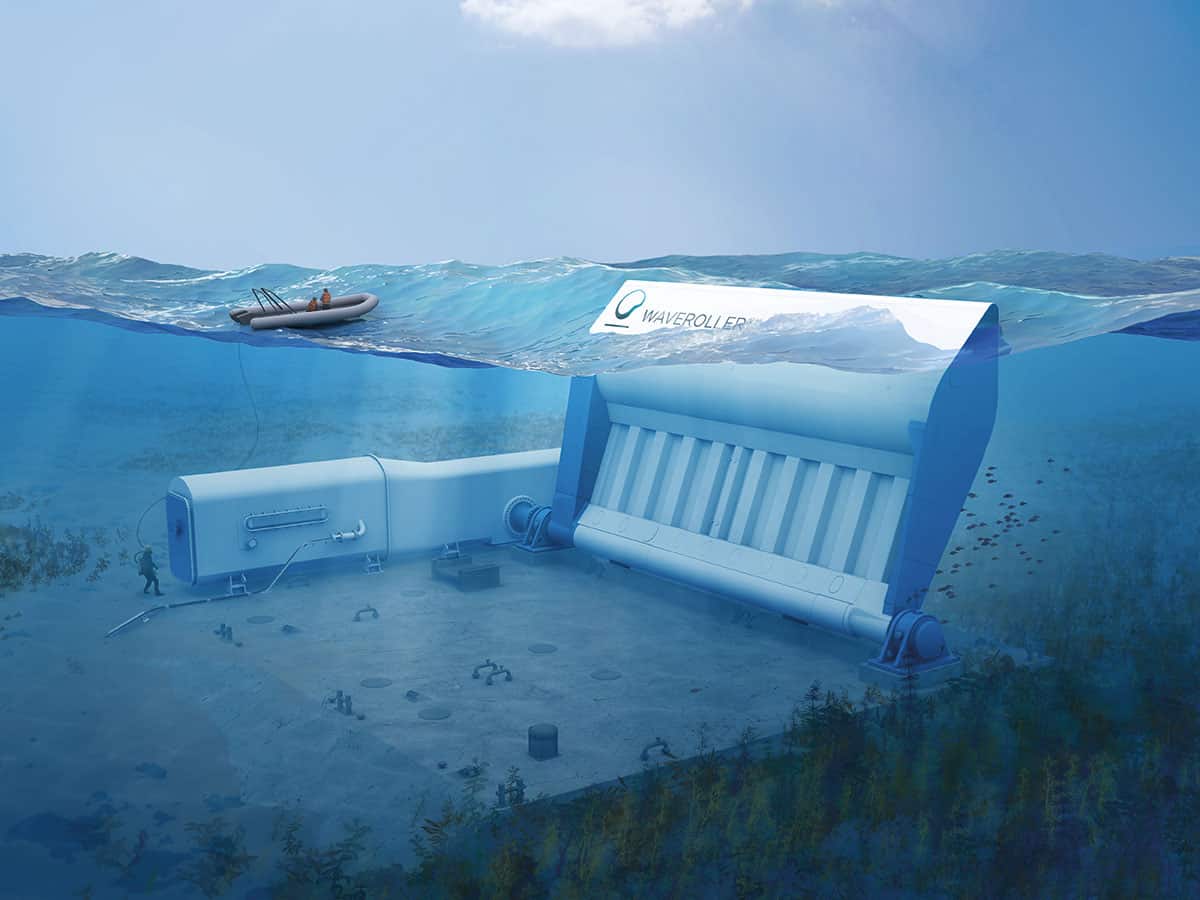
Blue dreams: Artist’s impression of AW-Energy’s WaveRoller – a device that is undergoing testing off the coast of Portugal. (Courtesy: AW-Energy Oy)
Another firm in the blue-energy game is the Finnish company AW-Energy, which last year installed a device called a WaveRoller on an off-shore platform near Peniche, a seaside village in Portugal. It’s a rectangular panel that, unlike the machine in Gibraltar, is anchored to the seabed and oscillates back and forth as waves pass. That action sends hydraulic fluid through a set of sealed pipes, driving a hydraulic motor that generates electricity. The company is currently collecting off-grid test data on the machine.
Perhaps the longest-running blue-energy project is in the Bay of Biscay, off the coast of northern Spain. Completed in 2011, it consists of a set of 16 columns drilled into a 440 m-long artificial breakwater that juts into the sea from the town of Mutriku. Ocean waves push air through the columns, with the resulting high air pressure spinning turbines. Developed by the Scottish firm Wavegen, the facility is owned by the Spanish utility company Ente Vasco de la Energia. It has so far supplied 1.6 GWh of electricity to the local grid – roughly the same as you’d get from burning 650 tonnes of coal.
Despite these inroads, however, wave energy isn’t remotely close to a tipping point where it’s both commercially appealing and sustainable on large scales. “Wave energy development has yet to move past prototype-scale projects, funded by government grants, private investors, and venture capital,” concluded an analysis published by Bloomberg Finance in September 2019.
Too big to fail
According to the US Energy Information Administration, the world will use more than 21,000 TWh of electricity overall in 2020, with roughly three-quarters of that consumption coming from China and the US. Global usage is estimated to rise by 50% over the next 30 years. However, more than four-fifths of the world’s energy currently comes from burning non-renewable fossil fuels such as coal and oil, which release gases into the atmosphere and affect climate change.
Turning to the seas for an energy seems a no-brainer. The ocean is an energy-rich environment, which makes it an appealing alternative to fossil fuels. The Sun heats the land and air, and – as warm air rises and cool air rushes in beneath – winds blow and push the water. Waves rise and race as gravity works to restore equilibrium. The rate at which waves deliver energy (the energy flux) depends on how fast the waves are moving and on the “significant wave height” – a variable that oceanographers use to characterize how high the highest waves tower over sea level. (The energy flux also depends on the density of the water, though that’s treated as a constant for ocean waves.)
The power delivered by tides depends on the volume and speed of water passing a particular point. According to the US Ocean Energy Council, an average coast-pummelling wave towering 1.5 m over the sea’s surface delivers about 16 kW per kilometre of coastline. Meanwhile, a 2017 analysis by the International Energy Agency reckons that the amount of energy stored in waves, worldwide, is about 80,000 TWh, of which about 4000 TWh could be harvested and converted into electricity. More conservative estimates, such as those from the UK-based Carbon Trust, suggest a harvestable range of 2000–4000 TWh.
Ocean currents – rather than waves or tides – are similarly appealing. In 2017 Tsumoru Shintake – an engineer at the Okinawa Institute of Science and Technology Graduate University in Japan – claimed that if energy harvesters could harness the current moving along just 1% of the Japanese seashore, you’d generate more power than from 10 nuclear plants. Scientists at the Coastal Studies Research Institute in North Carolina calculated that capturing just 0.1% of the power in the Gulf Stream, which runs along the east coast of the US, would yield 300 GW – equivalent to more than 150 nuclear plants.
In light of the fact that half of the world population lives within 80 km of a coast, these figures suggest the ocean could, in the future, provide up to 10% of the world’s energy demands. That doesn’t include the energy gained from harnessing tides, which some researchers say has the potential to be even more efficient – and stable – than wave-energy products. So if scientists can find the right approach, then the entire energy demand of the world – or a significant part of it, anyway – could be met by the ocean. But that’s a colossal if.
Sunken dreams
Perhaps the most ambitious blue-energy project – the likes of which the world has never seen – was the brainchild of a German engineer named Herman Sörgel (1885–1952). Dubbed Atlantropa, he described it in a 1929 book and spent his life trying to convince others to get on board. Essentially, Sörgel wanted to build hydroelectric dams around the Mediterranean Sea, including a huge one across the Strait of Gibraltar, which would lower the sea level and connect Europe to Africa through new, usable land masses. A dam across the Congo River, meanwhile, would irrigate the Sahara Desert and produce fertile new plains.
Sörgel’s attempt to harness the ocean never saw the light of day. Nor did many others, despite appearing feasible, at least on paper. Take the Bay of Fundy, which lies between the islands of New Brunswick and Nova Scotia in Canada. Apart from being home to a dizzying variety of whale species, the bay boasts the world’s highest tides, which can reach more than 15 m in height. That fact led one enterprising engineer from Boston to persuade the US government in the 1930s to give him $7m to build machines to harvest the bay’s tidal energy. A plant was built and a small town grew around it, but in 1936 funding ran out and the project was declared too expensive. The town evaporated.
Since then, a steady stream of proposals have washed in and out, like the tides themselves. In 2009, for example, a collaboration between Scottish and Canadian companies built an underwater turbine in the Bay of Fundy, but it was destroyed by powerful tides less than a month after installation. Between November 2016 and April 2017, the same collaborators – working under the name Cape Sharp Tidal – tried again, this time with a grid-connected turbine in the bay’s Minas Passage. But with the firm plagued by technological and financial problems, last April the government of Nova Scotia ordered the turbine to be removed. Undeterred, another firm – Jupiter Hydro from Alberta – has recently obtained two permits to test new turbines in the water.
Beneath the waves
Back at EMEC in Orkney, Buck says many projects have come and gone since the centre was set up in 2003. Indeed, experience has taught her not to try to predict what unknown challenges lay in the future, with Buck joking that “it’s about as realistic as determining the outcomes of Brexit”. In the last two years, for example, EMEC has hosted a grid-connected, floating tidal-power generator, built by a Scottish company called Orbital, that generated 3 kWh in 2018. An upgraded version of the same device has a planned installation for later this year. There have also been some unexpected failures, like an inflatable, floating wave-power harvester that sank to the seabed in March 2019. (It will be recovered later this year.)
Buck says, however, that she’s not daunted by the fact that many projects don’t pan out. “There are successes and failures,” she says, “but learning is in the failures.” And the more projects they test, she says, the shorter the learning curve for future developers with big ideas.
Ultimately, Buck says, she sees the most promise in those devices that can harness the tides as opposed to those powered by waves. “Technological challenges for wave power still remain,” she says, but “tidal [devices] are on pace to deliver grid-scale power.”
Most approaches to harvesting mechanical energy from ocean waves rely on finding a way to move a conducting wire through a magnetic field to generate electricity. It seems the obvious way of going about things, given that electromagnetic generation is the cornerstone of the entire power-generation industry. From fossil-fuel plants to wind turbines, the basic conversion from mechanical energy to electricity is the same.
Watery future: Georgia Tech’s Zhong Lin Wang poses with an array of 1000 light-emitting diodes that can be illuminated by power produced by the force of a shoe striking a triboelectric nanogenerator placed on the floor. The same nano-device could be used to harvest energy from the sea. (Courtesy: Georgia Tech Photo Rob Felt)
But ocean harvesters don’t have to work that way, argues Zhong Lin Wang, an engineer at the Georgia Institute of Technology, in Atlanta. Over the last few years, he has been building triboelectric nanogenerators, or TENGs, which he says could revolutionize energy harvesting. Instead of generating power using moving conductors and magnets, Wang’s TENGs generate a trickle of current using static electricity. In these devices, two materials rub against each other – one donating charges, the other collecting them – and the accumulated charges flow through an attached wire. Wang has used TENGs to design, among other things, keyboards that harvest energy from typing, and table-tennis tables that can record a ball’s trajectory and speed, powered by the bounce of the ball itself.
“These could become a very important energy source,” he says. Wang has, for example, designed TENGs in small plastic spheres, about the size of oranges, that float in water. As the waves jostle the sphere, material inside bumps against the outer shell, generating charges. Those charges then flow through an attached wire. In lab tests – and in night-time experiments conducted at his neighbourhood pool – each one can generate about 10 mW of power.
That’s not much, Wang admits, but he thinks it could be used at first for powering small devices – think sensors on buoys used to collect data on the sea. Moreover, he thinks the technology will scale up. “Imagine we make a network, like a fishing net,” says Wang, who envisages a grid of spheres, each about 10 cm apart, and extending 10 m down into the water. Such a configuration, but scaled up to the size of the state of Georgia (about 400 km wide and long), could power the whole world, he believes.
Wang’s approach offers appealing advantages. Basic physics says that the energy carried by a wave is proportional to the square of its height, as well as the square of the angular frequency. Electromagnetic generators – like those used in most wave-harvesting devices – therefore work best at high frequencies. But Wang’s TENGs follow the rules of electrostatic generators, which means that their output scales linearly with frequency. So while conventional wave harvesters have an advantage for giant swells, TENGs can function even with small vibrations. Rivers, which typically don’t have a strong enough current for wave harvesters, might therefore be good testing grounds for TENGs.
Big ambitions: Eco Wave Power has a wave station on the coast of Gibraltar that currently provides 100 kW to the electrical grid – and hopes eventually to supply up to 15% of the territory’s electricity demands. (Courtesy: Eco Wave Power )
TENGs could also have an advantage in big storms, which pose problems for conventional wave-harvesting. Eco Wave Power’s device in Gibraltar, for example, has to raise its mechanical arms out of the water when big tempests roll in. But a TENG, because of its flexible design, should be able to take a beating. “It works the best with the worst weather conditions,” says Wang.
But if TENGs can withstand the sea, Wang doesn’t have a solution to the financial problems that torpedoed projects in the Bay of Fundy, the islands of Scotland, and other initiatives that seemed promising at first. “People ask me, can you demonstrate it?” he asks. “I say, no, I don’t have funding for that.”
And ultimately, it’s not the swells of the ocean that remains the most formidable challenge; it’s the finite finances of would-be sponsors. So even if physicists and engineers can tame the sea, they’ll have to persuade funding bosses, business executives and the public that it’s worth pumping money into harvesting energy from the Earth’s waters. “For wave and tidal machines to be perfected through testing and demonstration,” says Buck, “the sector requires full support from government and society alike.”