Once a physicist: Chris Lucas

Chris Lucas

What sparked your initial interest in physics?

I suppose it started at school. I remember the older kids warning us how difficult and boring physics classes would be at secondary school, so I was massively relieved to find the complete opposite was true. We were very lucky to have an inspirational teacher who was passionate about the subject and really pushed to share his enthusiasm. Lively experiments and demos were common. One in particular sticks in my memory: building a 5 m long capacitor from a roll of cling-film sandwiched between two rolls of tin foil, both attached to a high-voltage power supply. I remember our teacher casually informing us at the last minute, “Oh yes, don’t touch it after I’ve turned it on…you’ll definitely die.” How could I not be excited?

After years of being encouraged to believe you had to go to university to get a specific job, I’d decided that I should get a degree in engineering. But after multiple university open days, I couldn’t shake the feeling that engineering wasn’t for me. If I was going to do something for four years, then I decided it’d better be something I found interesting and exciting. The decision to study physics at Bristol is still to this day the best move of my life. If you’d told me all those years ago that it would lead to me working on the Large Hadron Collider (LHC), one of the most famous and complex physics experiments in history, I probably would have just laughed.

Did you ever consider a permanent academic career after your PhD in particle physics?

I really loved the work I did as a PhD student on the CMS experiment at the LHC, searching for elusive supersymmetric particles. Working as part of a worldwide collaboration, at the frontier of knowledge, was incredibly exciting, so naturally I considered continuing on the path through academia. The work I’d done at CERN on both data analysis and experimental hardware could have led me down a variety of paths, but I think for me the biggest draw was the prospect of teaching. I’ve always loved sharing my passions with others and could easily see myself as a physics lecturer. Unfortunately, in my field the path to lectureship looked very uncertain, with few roles ever becoming available. Facing this, and the prospect of the long shutdown at the LHC, I made the decision to see what life was like “on the other side”. I was very fortunate to have met and worked with people who had experience in the tech world. Following some lengthy, and occasionally even constructive pub chats, I decided to take the plunge and move to London in search of the table-tennis playing, silicon-roundabout dream.

How did your interest in data science and software engineering emerge?

Most of the work during my PhD involved writing code, largely for performing some fairly heavy-duty statistical analyses on huge amounts of data. I’d done lots of maths and statistics courses throughout my undergrad and postgrad, but only ever basic programming. We basically learnt to code on the job, and so I never quite felt I was doing things “properly”. I felt I had a fairly good grasp of the statistical side of things, and so instead decided to improve my engineering skills. My first role was as a junior software engineer at a small tech start-up where I learnt a lot very quickly, especially how to write reliable and efficient code. I loved my time there, but after a couple years in the role I realized I was missing the excitement and cutting-edge nature of scientific research, and so was lucky enough to be approached for my current position at Babylon Health. With Babylon I’m finally able to combine both my scientific and engineering backgrounds, all within a supportive, flexible and impactful research environment.

What does your current role as a research engineer in machine learning involve?

At Babylon Health I work in the research team. We’re very fortunate to be afforded quite a high level of autonomy, much like in academia. Within this research environment we develop machine-learning approaches to tackle the many challenges associated with digitally delivering healthcare. More specifically, my role encompasses everything from researching and implementing a wide range of machine-learning techniques, building research tools for our group and getting involved in the delivery of this code into the production systems our company currently offers.

I think the thing I love the most about my position is that I’m able to continually learn and grow in such an interesting and dynamic field. Over the last few months I’ve been studying and experimenting with many exciting new fields of research, such as adversarial learning where you train models by having them compete; creating models that can imagine and reason about counterfactual worlds; and developing statistical methods for safeguarding user privacy in a dataset. The cherry on the top being that when we attempt to use these techniques, we do so to positively impact people’s lives by improving the access, affordability and quality of healthcare for everyone.

How has your physics background been helpful in your work, if at all?

I definitely find my physics background a huge help in my day-to-day work. I suppose there are the obvious qualities like analytical thinking and being comfortable with maths, but ultimately the biggest benefit is the capacity for technical problem-solving. As physicists we’re basically trained to approach a complex problem, break it down into digestible components and apply whatever techniques are necessary to tackle them. It’s interesting to find how many ex-physicists there are now working in the machine-learning field. I keep spotting names I recognize at conferences, or finding an increasing number of machine-learning papers emerging with references to classical thermodynamics, gauge-equivariance or quantum mechanics. It’s really encouraging to see that so many physicists are able to take their knowledge and training to help advance and progress the field of machine learning, and ultimately artificial intelligence, in such a positive way.

Any advice for today’s students?

I’m probably echoing what a lot of people have said already, but my main advice would be not to stress if you’re unsure of what direction you want to take with your studies or beyond. A degree in physics is one of the most versatile and sought-after qualifications someone can bring to the table.

Time reversal symmetry breaks in ferromagnetic Weyl semimetals

Left_to_Right

Research on Weyl physics is really taking off with no less than three reports by independent research groups in this week’s Science. The first group, led by Zahid Hasan of Princeton University in the US, says it has observed novel topological Weyl fermion “line” and “drumhead” surface states in a room temperature magnet – made of cobalt, manganese and gallium (Co2MnGa) – for the first time. The second and third groups, led by Yulin Chen at the University of Oxford in the UK and Haim Beidenkopf of the Weizmann Institute of Science in Israel, are reporting on the existence of a time-reversal symmetry-broken (that is, magnetic) Weyl semimetal in a crystal containing cobalt, tin and sulphur (Co3Sn2S2), also through measurements of its band structure using spectroscopic techniques. The findings are an important step forward in the quest for materials in which magnetism and topology could be exploited for future technology applications as well as for fundamental studies in physics.

Topological materials can be insulating in the bulk but can conduct electricity extremely well on their edge via special, topologically protected, electronic states. Topological states are protected from fluctuations in their environment and electrons in them do not backscatter. Since backscattering is the main dissipating process in electronics, this means that these materials might be used to make highly energy-efficient electronic devices in the future.

A Weyl semimetal is a recently discovered class of topological material in which electronic excitations behave as massless, Weyl, fermions. These particles, which were first predicted in 1929 by the theoretical physicist Herman Weyl as a solution of the Dirac equation, behave quite differently to electrons in ordinary metals or semiconductors in that they show the chiral magnetic effect. This occurs when a Weyl metal is placed in a magnetic field, which generates a current of positive and negative Weyl particles that move parallel and antiparallel to the field.

Weyl nodes and Fermi arcs

Fermions that can be described by Weyl’s theory can appear as quasiparticles in solids that have linear electron energy bands crossing at so-called (Weyl) “nodes”. The existence of Weyl nodes in the bulk band structure is necessarily accompanied by the formation of “Fermi arcs” on the surface band structure that connect pairs of Weyl nodes of opposite chirality.

Hasan and colleagues studied an exotic crystal made of cobalt, manganese and gallium (Co2MnGa), which is a room temperature magnet with a transition temperature near 690 K. Chen’s and Beidenkopf’s groups focused on crystal containing cobalt, tin and sulphur (Co3Sn2S2), which becomes a ferromagnet at temperatures below 175 K.

Chen and co-workers used a technique called angle-resolved photoemission spectroscopy (ARPES) to study the electronic structure of their material and identified the Weyl band structure inside the ferromagnetic phase. In ARPES, high-intensity light shone on the sample forces electrons to emit from the surface. These emitted electrons can be measured and provide information about their behaviour when they were in the bulk of the sample.

This technique to pin down the role of topological effects by observing the differences in the behaviour of electrons on the surface of the material compared to those in the bulk was pioneered by Hasan and colleagues in 2015 and used to detect Weyl fermions.

Quasiparticle interference

Beidenkopf’s group identified the same Weyl band structure in Co3Sn2Susing another approach – scanning tunnelling spectroscopy – to measure electron states in the material with atomic-scale resolution.

“We rely on the quantum particle-wave duality of the surface electrons in the material to image, in a scanning tunnelling microscope, the interference patterns the electrons embed in the surface density states as they scatter,” explains Beidenkopf. “This technique is called quasiparticle interference. From these patterns, we can trace the band dispersion and by comparing these patterns to predictions from band-structure calculations, we can identify the Fermi arc bands among the various bands that exist on the surface of the material.

“The existence of these Fermi-arc bands on the surface is synonymous to the classification of the bulk band structure as a Weyl semimetal – because there is simply no other way to create such surface states,” he tells Physics World.

And that is not all: the researchers also found that the arcs connected different Weyl points depending on the chemical composition of the topmost surface of the material. This means that topological currents in circuits containing Co3Sn2Smight be manipulated by varying this composition.

“This varying connectivity would alter the magneto-transport response of these materials since it involves electronic orbits that pass through both surface Fermi arcs and bulk Weyl states,” explains Beidenkopf. “Rewiring the surface connectivity would thus lead to distinct electronic paths. This approach also demonstrates a new tool to manipulate the electronic structure of Weyl semimetals and it would be interesting to study exactly how the Fermi arc connectivity changes across an interface and whether new states bind to it.”

New “drumhead” surface electronic state

Weyl states are also possible in related materials, such as Co2MnGa, as Hasan’s team’s new results attest. In this room-temperature ferromagnet, the bulk node is stretched into a nodal Weyl “line” with a corresponding new kind of “drumhead” surface electronic state, say the researchers. This surface state, which they predicted in 2017, has never been seen before in magnets and is the tell-tale fingerprint of a topological magnet. Again, using ARPES (at the dedicated photoemission spectroscopy beamline recently built at the Stanford Synchrotron Radiation Laboratory) and band structure numerical calculations, they identified this Weyl structure inside the ferromagnetic phase of Co2MnGa.

ARPES is an extremely powerful experimental technique, which in this case allowed us to directly observe that the electrons in Co2MnGa behave as if they are massless Weyl fermions, says team member Daniel Sanchez. By studying these fermions in more detail, the researchers say they realized that the material hosted an infinite series of distinct massless electrons that take the form of a line loop, with some electrons mimicking the properties of particles and some of antiparticles.

This collective quantum behaviour has been dubbed a magnetic topological Weyl fermion loop – a truly exotic and novel system, says team member and study co-first author Guoqing Chang.

Having been able to identify broken time-reversal symmetry Weyl states could allow researchers to now study even more exotic phenomena, comments Eduardo da Silva Neto in a related Perspectives article in Science. These include the quantum anomalous Hall state (in which a Hall voltage is generated without an external magnetic field), which could allow for dissipationless edge currents for future electronic and spintronics technologies.

“The electrodynamics of axions, hypothetical elementary particles that could resolve symmetry problems in quantum chromodynamics, also finds its analogue in certain magnetic topological materials that could be used as part of the search for axion dark matter,” he writes.

Full details of the three research groups’ results (in the order that they appear in the journal Science) are here: Hasan’s group, Chen’s group and Beidenkopf’s group.

Transition from flocking to jamming recreated in the lab 

Millions of tiny self-propelled beads racing around a track will “freeze” like ice when their density reaches a threshold value — reveals an experiment done by physicists in France. The team also found that the resulting solid plug of beads appears to propagate in the opposite direction around the track.  

Denis Bartolo and colleagues at the École normale supérieure de Lyon and University of Paris Diderot say that studying this phase transition in the lab could reveal how dangerous jams develop in human crowds and how these jams could be mitigated 

Crowds can have a mind of their own. Traffic on a busy motorway can come to a halt when there is no obvious obstruction and flocks of birds can move as one large entity without an apparent leaderPhysicists model this collective motion using groups of interacting, self-propelled particles. These models can be simulated on a computer or realized in the lab using tiny particles. 

Critical density 

Previous computer studies suggest that flocking emerges when the density of individuals reaches a critical value at which neighbouring particles become inclined to align their motions. Studying this in experiments involving real particles, however, is difficult because of the practical challenge of creating large numbers of self-propelled particles. Another problem is that tiny particles tend to stick together, which can affect experiments. 

Bartolo and colleagues have overcome these challenges with an apparatus that uses millions of polystyrene microbeads that are suspended in a conductive liquid held between two glass plates. The beads settle onto the lower plate, which features a centimetre-wide looped depression that serves as a tiny racetrack. The beads are powered by a phenomenon known as the Quincke effect, which causes insulating spheres in a conducting fluid to rotate in an applied electric field. The effect involves the development of an electric dipole moment across each bead, which tends to prevent the beads from sticking to each other.  

The team had previously used this setup to explore how flocking can develop in a controlled laboratory setting. They were able to observe a “gas” of randomly moving particles make the transition to a unidirectional flock as more particles were added to the track. 

Jamming transition 

A key feature of the racetrack apparatus is that it can support much higher particle densities than previous studies. By increasing the density, the team found that flocks will flow smoothly until 55% of the racetrack surface is covered in beads. After this point, solid jams begin to nucleate in the flock and combine rapidly to form one single jam of stationary particles.  

What is more, the position of the jam propagates backwards around the racetrack as it loses particles to the surrounding flock at the forward edge and captures new beads when they slam into the rear edge. The jam becomes larger with increasing bead density until it encompasses all the beads at 70% coverage. 

“Interacting motile bodies were known to self-assemble into flocks, says Bartolo. “Studying the collective dynamics of flocks composed of millions of colloidal robots, we showed that interacting motile bodies can also collectively arrest their motion in the form of a phase transition akin to the freezing of conventional liquids.” 

Freezing water 

The jam occurs as a rapid, first-order phase transition and therefore resembles the freezing of liquid water into ice. Largjams emerge from the nucleation of smaller ones in an environment in which the jammed and flocking phases coexist at the same density – a hallmark of a first-order phase transition. 

The team believes that jams develop through a process called mobility-induced phase separation (MIPS). In this process, crowding slows particle motions and leads to clustering of particles, even when individuals are not attracted to each other. In the racetrack, the slowing of particles is triggered by hydrodynamic effects that impede rotation as the spheres get close to each other.  

Until now, MIPS had not been demonstrated experimentallyArianna Bottinelli, a researcher in crowd dynamics and associate editor at Communications Physics comments, “The framework developed by [Bartolo and colleagues] moves a remarkable step towards a unified understanding of the principles underlying jamming and phase separation in active systems”. 

Active solids 

“In real life, we are surrounded by plenty of ‘active solids’, from cars stuck in a traffic jam to people attending a rock concert,” she adds. “Whether the emergence of jamming in living systems falls in the same universality class as the one presented in this work, arises naturally as a fascinating question.” 

“Our experiments are far from being an analogue simulation of a pedestrian crowd,” agreed Bartolo, noting that flocks obey very different rules to those of human crowds. However, he added, “the existence of a brutal transition towards dynamical arrest is likely to be a very robust feature.” 

“Our findings, in principle, could help in determining the range of crowd densities within which massive jams can emerge and give some hint towards effective strategies to ‘melt’ jammed roads.”  

With their initial study complete, the researchers are now setting out to further explore the physics of active solids. This, Bartolo says, is “an areas of active matter physics that remains virtually uncharted”.  

The research is described in the journal Physical Review X. 

Only wet regions may become wetter as climate changes

Climate change is making heavy rainfall extremes in the world’s humid and arid areas more intense, according to researchers in Australia and Spain. But for annual precipitation totals, the outlook is mixed.

Although for humid regions a general increase in annual rainfall is likely, the team found, heavier extreme precipitation events in arid regions do not necessarily imply more rain overall. If arid and semi-arid areas receive the same annual rainfall but with a greater fraction falling in more intense bursts, the consequences could be severe.

“More extreme precipitation may contribute to soil erosion and river flooding or flash flooding,” says Markus Donat of Barcelona Supercomputing Center and the University of New South Wales Sydney. “This would also have implications for water and land-use management decisions—in particular in water-stressed regions—to make sure the precipitation that falls within a few days can be captured to be used in drier periods.”

The researchers defined wet and dry regions by local water availability rather than total annual rainfall.

Rising global temperatures are expected to intensify the hydrological cycle by enhancing the atmosphere’s water-holding capacity. While we can confidently expect an increase in the total amount of rainfall worldwide, predicting precipitation changes on a regional scale is much harder; altered circulation patterns will affect individual areas differently.

Previous research suggested total precipitation is likely to increase only slightly in wet regions, whereas dry climate regimes will see much greater increases. An intensification of extreme events was predicted for all climatic zones.

It turns out that the situation is complicated, however, as there are more ways than one to define “wet” and “dry”. And the forecast for each type depends on the definition you choose.

“In that earlier study, we defined ‘wet’ and ‘dry’ based on precipitation amounts,” says Donat. “There had been a bit of discussion after that as to whether these results hold if wet and dry were defined in a water availability sense.”

Water availability is the difference between water delivered to the ground as rain and that lost to the atmosphere through evapotranspiration. It’s an important measure because even high-precipitation regions can experience water stress if much of what falls disappears into the air before it can be used.

Donat and colleagues divided Earth’s land area into arid, semi-arid, sub-humid and humid zones based on this precipitation–evaporation balance. They looked at rainfall records going back to 1951 for each zone as well as compiling the results of 25 climate simulations out to 2100 for two representative concentration pathways: RCP4.5, which sees greenhouse-gas levels begin to plateau around 2060; and RCP8.5, where levels rise steadily throughout the century.

Although there was some variability at the local scale, the general trend across all regimes was for extreme precipitation events—the one day in a given year that saw the greatest amount of rainfall—to become even more intense.

When it came to total annual rainfall, however, a robust prediction was only possible for humid and sub-humid zones, which can both expect increases. For the drier regions, the projections given by the climate models diverged significantly, averaging out to approximately zero change.

The difference between how warming affects annual precipitation rates in wet and dry climates might be partly a statistical effect, according to Donat. “The signal-to-noise ratio -that is, the magnitude of the long-term change compared to the magnitude of year-to-year variability – seems to be larger in the humid compared to the arid regions, which makes it harder to detect robust changes in the more arid regimes,” he says.

Donat and colleagues reported their findings in Environmental Research Letters (ERL).

1.1 GHz NMR looks deeper into biological processes

St. Jude Children’s Research Hospital has taken delivery of the world’s most powerful nuclear magnetic resonance (NMR) spectrometer – the Ascend 1.1 GHz from Bruker. The system will be used by the hospital’s structural biology department to study proteins, DNA, RNA and other biomolecules, with the goal of understanding disease development at the molecular and atomic level.

“This 1.1 GHz system provides unprecedented capabilities and opportunities for us to answer challenging biological questions,” explains department chair Charalampos Kalodimos. “It will be our most important tool to perform research in the area of dynamic molecular machines that are otherwise not amenable to other technologies.”

The first study to be performed on the Ascend 1.1 GHz, for example, will aim to determine the structure of molecular chaperones involved in cancer and neurodegenerative diseases in complex with non-native proteins.

Before they can start these investigations, however, Kalodimos and his team need to commission and set-up the new NMR system. Steps include cooling with liquid nitrogen and then liquid helium to bring the central coils down to 4.2 K, followed by energizing the magnet. “It is hard to predict, but this step – required to bring the magnet to its full field of 25.9 T – can take anywhere from a few weeks to several months,” says Kalodimos.

Ramping up the field

NMR works by placing the sample under test into the device’s magnetic field, which aligns the spins of atomic nuclei (most commonly 1H, 13C and 15N), and then subjecting the sample to radiofrequency waves. The nuclei resonate at different frequencies according to the magnetic field around the atom, and the resulting emission signals provide information as to the molecule’s electronic and chemical structure.

For biological applications, NMR spectroscopy can be used to study protein structures and how they change and interact with other cellular molecules. It can also help researchers determine how these physical properties relate to biological function and, importantly, how they are altered in diseases such as cancer. And as the field strength of the magnet increases, the spectral resolution increases alongside.

For many years, however, the physical properties of low-temperature superconductors (LTS) limited high-resolution NMR to a magnetic field of 23.5 T, equivalent to a 1H resonance frequency of 1.0 GHz. The discovery of high-temperature superconductors (HTS) provided the potential to create even higher magnetic fields. But until recently, challenges in tape manufacturing and superconducting magnet technology hindered progress.

According to Bruker, the key advance enabling the creation of its 1.1 GHz (or 25.9 T) magnet was the development of LTS–HTS hybrid magnet technologies, which required progress in HTS materials manufacturing, testing and tape jointing, as well as magnet stabilization, homogenization, quench protection and force management. The company says that the 1.1 GHz system is also a milestone towards the first 1.2 GHz NMR magnet, now under development.

Kalodimos explains that while Bruker was exclusively responsible for the magnet development, he and his team were involved in providing feedback to help improve the ultra-high field NMR probes needed to study biological samples.

The extremely high resolution provided by the 1.1 GHz spectrometer will allow determination of atomic-resolution structures of large, dynamic protein complexes, which currently cannot be resolved by any existing structural biology tool, Kalodimos explains. “We also expect to be able to visualize transiently populated conformational states that may be key in protein function and could also be targeted for therapeutic reasons,” he tells Physics World.

The new NMR spectrometer is central to the current expansion of St. Jude’s structural biology department, which is also investing in other high-resolution biophysical tools such as cryogenic electron microscopy, X-ray crystallography and single-molecule imaging.

“In our department, we follow an integrated structural biology approach, meaning that we use as many techniques as possible to fully understand how biological systems function,” Kalodimos explains, noting that other investigations in the pipeline for the Ascend 1.1 GHz include studying drug resistance in protein kinases and drug discovery.

“With the expansion of the structural biology department, we are creating the world’s most comprehensive research centre for defining the structure of the molecular machines that carry out basic functions within cells,” adds James Downing, St. Jude president and CEO. “This information will enhance our ability to understand what drives paediatric cancer and other catastrophic diseases of childhood, and, ultimately, advance cures for these diseases.”

MRI guidance minimizes toxicity in prostate cancer radiotherapy

Hypofractionated stereotactic body radiotherapy (SBRT) combined with MRI guidance to treat prostate cancer patients produced an impressively low incidence of early gastrointestinal (GI) and genitourinary (GU) toxicities, according to a study from the Amsterdam University Medical Centers (VUmc). The low acute toxicity rates seen in 101 men, the majority with high-risk disease, even surpassed the researchers’ estimates, and support the viability and safety of this extreme hypofractionated radiotherapy scheme (Int. J. Radiat. Oncol. Biol. Phys. 10.1016/j.ijrobp.2019.08.007).

VUmc’s radiotherapy department began using MR-guided radiotherapy (MRgRT) in May 2016, and almost immediately started treating prostate cancer patients. MRgRT improves visualization of the target volume and adjacent healthy organs such as the rectum and bladder prior to and during treatment – without requiring implanted fiducial markers. It also enables adaptive planning, such as plan re-optimization, prior to delivery of each fraction.

Anna Bruynzeel

Principal investigator Anna Bruynzeel and colleagues conducted a prospective single-arm phase II study of 101 prostate cancer patients to investigate the impact of hypofractionated MRgRT on toxicities and quality-of-life. They hypothesized that adaptive MRgRT with small uncertainty margins could limit acute grade 2 or greater GU toxicity to 40% and grade 2 or greater GI toxicity to 15%.

The majority of patients (59.4%) had high-risk cancers, 36.6% had intermediate-risk and 4.0% had low-risk localized cancers with no lymph node involvement or distant metastases. Most patients (82%) were also receiving androgen deprivation therapy.

The up-to-14 day treatment regimen comprised five fractions of 7.25 Gy to the prostate, with simultaneous integrated relative sparing of the urethra. Immediately prior to each fraction, the team performed a high-resolution MRI and rigidly registered this to the simulation MRI by alignment on the clinical target volume (CTV). They generated two plans on each day of treatment: a baseline plan recalculated on images reflecting the anatomy-of-the-day; and a re-optimized plan prioritizing coverage of the planned target volume (PTV), which used the same number and direction of beams as the baseline plan.

For each treatment, patients were imaged in real-time with planar MRI to monitor intra-fraction changes and maintain gating with a 3 mm boundary around the CTV. The team compensated for any changes in CTV position using 2D table shifts (applied in more than 20% of fractions). If the CTV position changed by more than 3 mm (seen in 6% of fractions), they halted irradiation and performed a repeat volumetric MR scan to make a 3D table correction.

The authors report that 23.8% of patients experienced grade 2 or higher GU toxicities during the first 90 days from the start of radiotherapy (study hypothesis 40%). The majority experienced radiation-induced cystitis and only 4% reported incontinence, which decreased over time. Six patients experienced grade 3 GU toxicities.

Only 5% of patients experienced grade 2 or higher GI toxicities (study hypothesis 15%), the majority of which were radiation-proctitis, which resolved rapidly without intervention. The patients’ most common complaint was feeling bloated, and only one patient experienced rectal bleeding.

Toxicities peaked after patients received the last radiotherapy fraction. However, the authors note that this peak may have occurred earlier prior to the first follow-up point and suggest that future trials using ultrahypofractionation should also include earlier time points.

The researchers point out that the toxicity levels experienced by patients in this study were significantly lower than seen in a previous phase 3 study comparing conventional and moderately hypofractionated radiotherapy in 820 intermediate- and high-risk prostate cancer patients. In that trial, 42% of patients who had a 19-fraction radiotherapy experienced grade 2 or higher GI toxicity and 60.5% had grade 2 or higher GU toxicity.

“The low incidence of early GI toxicity, despite inclusion of the base of (or entire) seminal vesicles in 96% of patients, is likely to result from benefits of MRgRT, in particular the use of only 3 mm CTV to PTV margins, made possible by online CTV monitoring and daily plan re-optimization,” the researches write. “If our main clinical finding of significantly reduced GI toxicity is confirmed on longer follow-up, this may indicate that MRgRT could be a competitive technique with rectal spacers in combination with external-beam radiotherapy.”

Bruynzeel tells Physics World that she and her colleagues have administered more than 3300 MRgRT fractions in treatments of more than 600 patients, about one third of whom had prostate cancer. Other cancers treated included pancreatic, kidney, lung and adrenal cancers, as well as liver metastases. The main common criterion is the possibility to treat these patients with extreme hypofractionated radiotherapy.

“Our clinical impression is that toxicity is lower than other radiotherapy options. Because MRgRT is a time-consuming procedure, we believe that it best suited for hypofractionated treatment,” Bruynzeel says. “We encourage our prostate cancer patients to elect this treatment, but if they are not suitable candidates for MRgRT, or do not wish to travel to Amsterdam to VUmc, they receive more fractionated radiotherapy, 20 fractions of 3 Gy, after gold fiducials have been implanted.”

Yo-Yo Ma serenades the LHC, frozen poo knife is a bit crap, when nature calls in space

CERN’s Large Hadron Collider (LHC) is currently being upgraded, which means that for the lucky few it is possible to go down into the tunnel and have a look round. Physics World’s Tami Freeman was there last week and has posted some photos in her blog “Photogenic physics: CERN opens its doors to the masses”.

The virtuoso cellist Yo-Yo Ma also visited the LHC tunnel, where he did a solo performance that you can enjoy in the above video.

In his 1988 book Shadows in the Sun, the Canadian anthropologist Wade Davis recounted a story about an elderly Inuit man who fashioned a knife from his own frozen excrement. Apparently, the man’s family had taken away his tools to make him abandon his traditional way of life on the ice and join them in a permanent settlement. Instead, he created the knife and used it to make more equipment to facilitate his escape onto the ice.

Wade admits that the story could be apocryphal, but there is a similar story about a knife-making Norwegian explorer.

Now, Metin Eren and Michelle Bebber have tested the idea in the lab at Kent State University. Using their own poo, the anthropologists fashioned knives and tested their cutting abilities on several different materials. As Jennifer Ouellette reports in Ars Technica, the blades are a bit crap.

From poo knives to pee rainbows, astronaut Mike Massimino  has some practical advice for budding space travellers in “How to go to the bathroom in space”. Expect to train for the tasks here on Earth, with a camera in the toilet bowl to make sure you are positioned properly.

Data storage in DNA gains from a larger ‘alphabet’

A technique for storing data in DNA manages to overcome the information redundancy that is associated with previous implementation attempts. Scientists from Israel recently demonstrated how this process may become more cost-effective and efficient by introducing more “letters” to the DNA “alphabet”.

Storing data in DNA is an attractive prospect as that way the same amount of information may be stored in a much smaller physical volume than is possible with current storage media. Because the DNA molecule is so stable, it can be suitable for long-term archives. The inspiration for using DNA in this way comes naturally, as DNA’s main function is to store the genetic information for all living organisms.

Encoded in letters

DNA strands are polynucleotides and combine four different nucleobases – adenine (A), cytosine (C), guanine (G) and thymine (T). It is the sequence of these bases that determines the information stored. In this way A, C, G and T represent the letters of the DNA alphabet, by which data is encoded. In 2017 a group of US scientists demonstrated a DNA-based storage system capable of storing 215 PB per gram. (A petabyte is a million gigabytes.) This equates to six orders of magnitude more data stored per unit volume than achievable with current storage devices.

To encode a message in DNA, every 2 bits of binary data are associated with a different DNA letter, making up a full sequence, which is then synthesized. One issue with this method, however, is that current DNA synthesis technology produces a large number of molecules with the same sequence, making a lot of the stored information redundant. Now scientists from Tecnion Israel Institute of Technology and the Herzliya Interdisciplinary Centre exploit this quirk of the synthesis process in order to make DNA data storage more efficient. The research team accomplishes this by using the concept of “composite letters”.

Increasing the alphabet

The scientists defined a “composite letter” as a combination of the letters A, C, G and T, in which each one appears a certain number of times. In any given position along the DNA strands, that are synthesised, the four nucleobases will appear with a probability that reflects how often they are represented in the “composite letter”.  This way the large number of synthesized DNA strands becomes an advantage – the “composite letter”, which can encode multiple bits of information, is identified from the distribution of the four bases across all the synthesized strands in a certain position. As a result the same message may be recorded on a shorter DNA molecule and more data is stored for the same number of synthesis cycles.

The “composite letter” method can thus reduce the costs of storing data in DNA. The scientists observed a trade-off between the increasing expense of molecule sequencing versus cheaper synthesis. However, they confirmed that this method provides a net gain and identified that an alphabet of 56 letters reduces the DNA data storage cost by an optimal 56%. Furthermore, with this alphabet the researchers observed a three-fold increase in the bits encoded per synthesis cycle compared with previous implementations of DNA data storage.

While DNA synthesis hardware is not yet ready for large-scale realization of this method, research towards that goal continues. Future work may overcome more of the challenges that DNA data storage systems currently face.

You can read the full paper in Nature Biotechnology.

Photogenic physics: CERN opens its doors to the masses

Last weekend, over 70,000 visitors travelled to Geneva for the CERN Open Days – a rare chance to visit the world’s largest particle physics facility while its accelerators are switched off for the “long shutdown”. I was one of the lucky thousands who got to have a look around the sites.

The scale of the event was massive – CERN shut down roads and laid on an entire bus network to transport people to nine sites in and around the 27 km accelerator ring. The LHC’s big four underground experiments – ALICE, ATLAS, CMS and LHCb – were major crowd-pullers. Visitors flocked to join long queues to don hard-hats, pile into packed lifts, and travel deep underground into the detector caverns.

ALICE

The 14 000-tonne CMS (Compact Muon Solenoid) detector, one of the two experiments that discovered the Higgs boson, was particularly impressive. The detector, which is 21 m long, 15 m wide and 15 m high, currently has its various sectors pulled apart for the scientists to access. This separation granted visitors a full-on, close-up experience of the enormous, complex – and rather photogenic – detector structures.

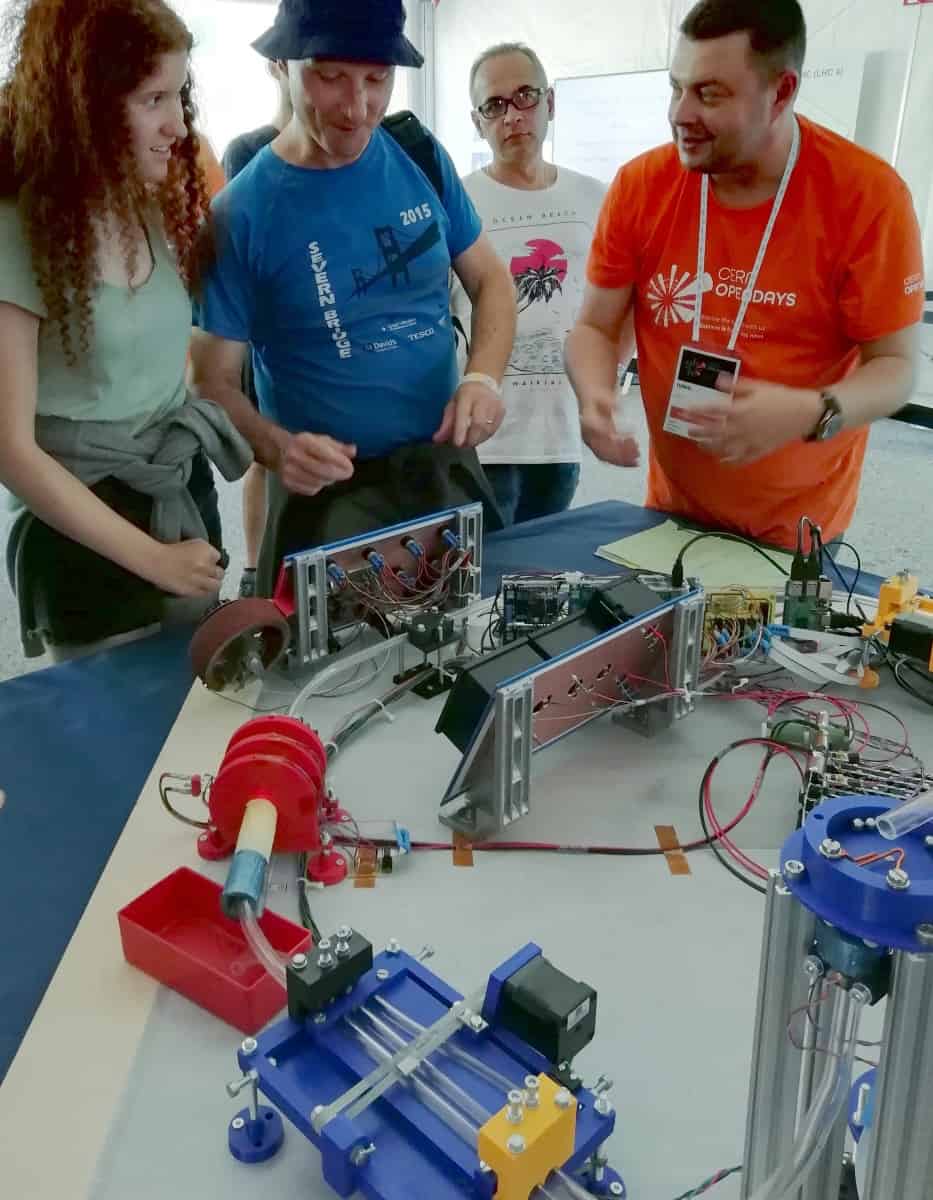
And there was plenty to see above ground too, including numerous hands-on exhibits such as a superconducting levitating scooter shuttling small children back and forth, and the Super Plastic Synchrotron, a fully featured toy particle accelerator. The table-top Super Plastic Synchrotron challenged visitors to inject, accelerate and keep a small steel ball circulating around a plastic ring. The ultimate aim: “to reach the incredible 0.000,001% of the speed of light”.

Super Plastic Synchrotron

CERN’s Martin Söderén and Daniel Valúch built the Super Plastic Synchrotron to echo the structure of the LHC, with eight sectors containing straight and curved portions. The “particles”, ferromagnetic steel balls, are pre-accelerated by gravity (dropping from a height of 22 cm) and then injected into the plastic tubing.

It’s then up to the users to accelerate the ball further by controlling two electromagnets placed around the ring. The accelerator – which took about four weeks to design and build – also includes ball position monitors based on photo-elements, an extraction system and a beam dump.

Another facility that caught my eye was the fantastically named Antimatter Factory. Here, two deceleration rings – the  Antiproton Decelerator and ELENA – slow down antiprotons (created by firing protons from the Proton Synchrotron into a block of metal) to speeds at which they can be confined and studied. CERN researchers then use these particles to perform a range of experiments comparing the properties of matter and antimatter.

ELENA

We received a guided tour of both decelerators (and another foray underground) from an enthusiastic and engaging CERN researcher working on the GBAR (Gravitational Behaviour of Antihydrogen at Rest) experiment. This particularly intriguing study hopes to discover whether antimatter, in the form of antihydrogen atoms, falls up or down under the influence of gravity.

Once the shutdown is over and CERN fires up all its machines once more, hopefully I’ll get to find out.


Mitigating urban heat islands with trees is more effective in dry climates

An extensive analysis of the factors affecting temperatures in urban heat islands (UHIs) in thousands of cities worldwide has been done by Gabriele Manoli and colleagues at ETH Zurich, Princeton University and Duke University. The team discovered that more green urban spaces can lessen the intensity of UHIs in drier climates, but planting trees is less effective in wetter, tropical environments. As climate change raises temperatures globally, the work provides crucial insights into how cities can mitigate local heating.

A UHI is a much-studied and common effect that occurs when a city is significantly warmer than its rural surroundings. This heating can lead to dangerously high temperatures that can harm the health of urban dwellers – particularly infants, the elderly, and the chronically ill  – so predicting the intensity of UHIs is very important.

Previous research has shown that UHI intensity can be correlated with a city’s population and the amount of rain it receives. However, urban areas are so diverse and complex that a universal model that can predict heating in a specific city has remained elusive. This has made it difficult to develop strategies for mitigating the heating effect.

Urban textures

To meet this challenge, Manoli’s team developed simplified models to link summertime UHI intensity with the population and annual precipitation of about 30,000 cities around the globe. The researchers derived universal laws that considered urban populations, city infrastructure sizes and socioeconomic factors. This approach accounts for the fact that as a city grows, its structure and function are modified. Different building materials are used, for example, and human activity and energy consumption increase. The researchers also accounted for the “texture” of cities. This describes the height and densities of buildings, which affects the reflection of sunlight and convection of heat.

The modelling revealed that UHIs tend to be more intense in larger cities with more rainfall. In a wet region, the countryside surrounding a city will support more plant life. This reduces the temperature of the countryside compared to the city, thereby boosting the UHI.

However, the rainfall correlation does not extend beyond an annual precipitation of about 1500 mm (the annual figure for Tokyo, for example). This suggests that cities in drier climates can reduce their UHI intensities by expanding green spaces. This bodes well for London (about 600 mm), which plans to do just that. However, this is a less effective strategy in humid tropical cities like Singapore (2100 mm). In that city, far more green spaces would be needed to have a significant effect, highlighting the need for other cooling mechanisms.

The work of Manoli and colleagues provides urban planners with new guidance for future developments; particularly those in developing countries, where cities have seen far less UHI research. In rapidly expanding cities in tropical regions like Africa and South Asia, their findings suggest a need to increase wind dispersion and shade, while using heat-dispersing building materials which better reflect sunlight. As the global climate heats, the discoveries reveal important insights into how the worst effects of increasingly stifling urban heat can be avoided.

The research is described in Nature.

Copyright © 2026 by IOP Publishing Ltd and individual contributors