Evo CT-Linac eases access to online adaptive radiation therapy

Adaptive radiation therapy (ART) is a personalized cancer treatment in which a patient’s treatment plan can be updated throughout their radiotherapy course to account for any anatomical variations – either between fractions (offline ART) or immediately prior to dose delivery (online ART). Using high-fidelity images to enable precision tumour targeting, ART improves outcomes while reducing side effects by minimizing healthy tissue dose.

Elekta, the company behind the Unity MR-Linac, believes that in time, all radiation treatments will incorporate ART as standard. Towards this goal, it brings its broad knowledge base from the MR-Linac to the new Elekta Evo, a next-generation CT-Linac designed to improve access to ART. Evo incorporates AI-enhanced cone-beam CT (CBCT), known as Iris, to provide high-definition imaging, while its Elekta ONE Online software automates the entire workflow, including auto-contouring, plan adaptation and end-to-end quality assurance.

A world first

In February of this year, Matthias Lampe and his team at the private centre DTZ Radiotherapy in Berlin, Germany became the first in the world to treat patients with online ART (delivering daily plan updates while the patient is on the treatment couch) using Evo. “To provide proper tumour control you must be sure to hit the target – for that, you need online ART,” Lampe tells Physics World.
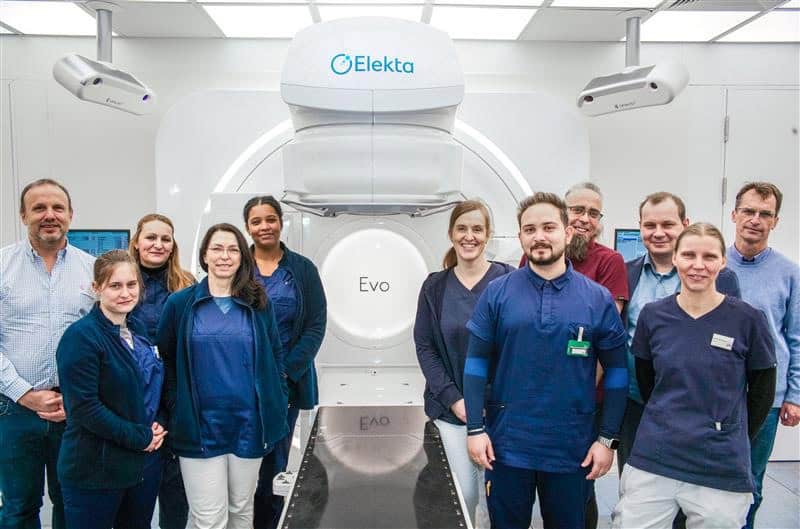
The team at DTZ Radiotherapy

The ability to visualize and adapt to daily anatomy enables reduction of the planning target volume, increasing safety for nearby organs-at-risk (OARs). “It is highly beneficial for all treatments in the abdomen and pelvis,” says Lampe. “My patients with prostate cancer report hardly any side effects.”

Lampe selected Evo to exploit the full flexibility of its C-arm design. He notes that for the increasingly prevalent hypofractionated treatments, a C-arm configuration is essential. “CT-based treatment planning and AI contouring opened up a new world for radiation oncologists,” he explains. “When Elekta designed Evo, they enabled this in an achievable way with an extremely reliable machine. The C-arm linac is the primary workhorse in radiotherapy, so you have the best of everything.”

Time considerations

While online ART can take longer than conventional treatments, Evo’s use of automation and AI limits the additional time requirement to just five minutes – increasing the overall workflow from 12 to 17 minutes and remaining within the clinic’s standard time slots.
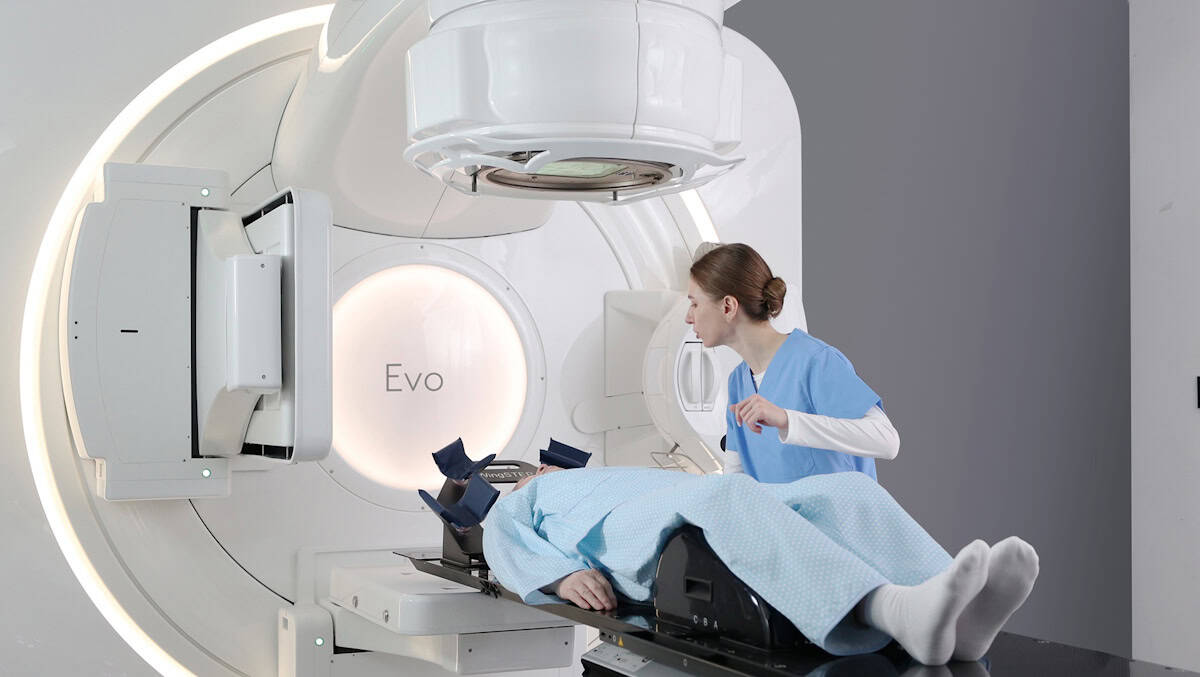
Patient being set up on an Elekta treatment system

The workflow begins with patient positioning and CBCT imaging, with Evo’s AI-enhanced Iris imaging significantly improving image quality, crucial when performing ART. The radiation therapist then matches the cone-beam and planning CTs and performs any necessary couch shift.

Simultaneously, Elekta ONE Online performs AI auto-contouring of OARs, which are reviewed by the physician, and the target volume is copied in. The physicist then simulates the dose distribution on the new contours, followed by a plan review. “Then you can decide whether to adapt or not,” says Lampe. “This is an outstanding feature.” The final stage is treatment delivery and online dosimetry.

When DTZ Berlin first began clinical treatments with Evo, some of Lampe’s colleagues were apprehensive as they were attached to the conventional workflow. “But now, with CBCT providing the chance to see what will be treated, every doctor on my team has embraced the shift and wouldn’t go back,” he says.

The first treatments were for prostate cancer, a common indication that’s relatively easy to treat. “I also thought that if the Elekta ONE workflow struggled, I could contour this on my own in a minute,” says Lampe. “But this was never necessary, the process is very solid. Now we also treat prostate cancer patients with lymph node metastases and those with relapse after radiotherapy. It’s a real success story.”

Lampe says that older and frailer patients may benefit the most from online ART, pointing out that while published studies often include relatively young, healthy patients, “our patients are old, they have chronic heart disease, they’re short of breath”.

For prostate cancer, for example, patients are instructed to arrive with a full bladder and an empty rectum. “But if a patient is in his eighties, he may not be able to do this and the volumes will be different every day,” Lampe explains. “With online adaptive, you can tell patients: ‘if this is not possible, we will handle it, don’t stress yourself’. They are very thankful.”

Making ART available to all

At UMC Utrecht in the Netherlands, the radiotherapy team has also added CT-Linac online adaptive to its clinical toolkit.

UMC Utrecht is renowned for its development of MR-guided radiotherapy, with physicists Bas Raaymakers and Jan Lagendijk pioneering the development of a hybrid MR-Linac. “We come from the world of MR-guidance, so we know that ART makes sense,” says Raaymakers. “But if we only offer MR-guided radiotherapy, we miss out on a lot of patients. We wanted to bring it to the wider community.”
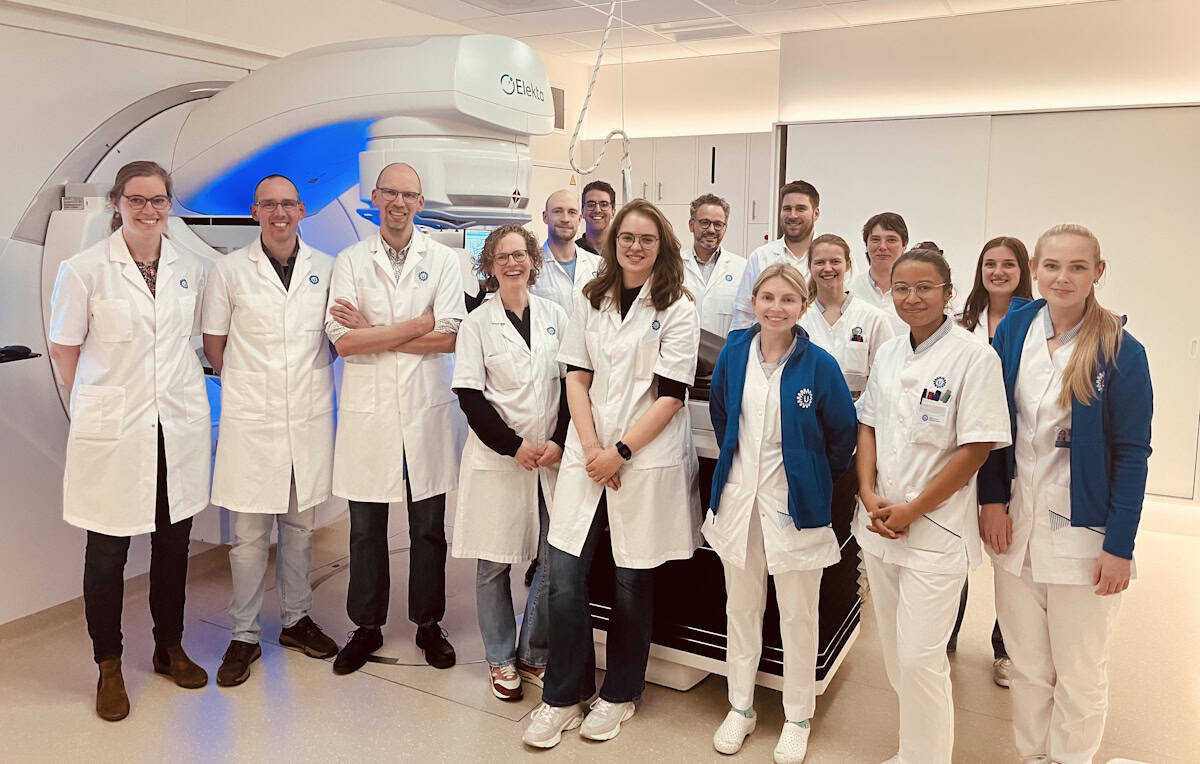
The radiotherapy team at UMC Utrecht

At the time of speaking to Physics World, the team was treating its second patient with CBCT-guided ART, and had delivered about 30 fractions. Both patients were treated for bladder cancer, with future indications to explore including prostate, lung and breast cancers and bone metastases.

“We believe in ART for all patients,” says medical physicist Anette Houweling. “If you have MR and CT, you should be able to choose the optimal treatment modality based on image quality. For below the diaphragm, this is probably MR, while for the thorax, CT might be better.”

Ten minute target for OART

Houweling says that ART delivery has taken 19 minutes on average. “We record the CBCT, perform image fusion and then the table is moved, that’s all standard,” she explains. “Then the adaptive part comes in: delineation on the CBCT and creating a new plan with Elekta ONE Planning as part of Elekta One Online.”

The plan adaptation, when selected to perform, takes roughly four minutes to create a clinical-grade volumetric-modulated arc therapy (VMAT) plan. With the soon to be installed next-generation optimizer, it is expected to take less than one minute to generate a VMAT plan.

“As you start with the regular workflow, you can still decide not to choose adaptive treatment, and do a simple couch shift, up until the last second,” says Raaymakers. It’s very close to the existing workflow, which makes adoption easier. Also, the treatment slots are comparable to standard slots. Now with CBCT it takes 19 minutes and we believe we can get towards 10. That’s one of the drivers for cone-beam adaptive.”

Shorter treatment times will impact the decision as to which patients receive ART. If fully automated adaptive treatment is deliverable in a 10-minute time slot, it could be available to all patients. “From the physics side, our goal is to have no technological limitations to delivering ART. Then it’s up to the radiation oncologists to decide which patients might benefit,” Raaymakers explains.

Future gazing

Looking to the future, Raaymakers predicts that simulation-free radiotherapy will be adopted for certain standard treatments. “Why do you need days of preparation if you can condense the whole process to the moment when the patient is on the table,” he says. “That would be very much helped by online ART.”

“Scroll forward a few years and I expect that ART will be automated and fast such that the user will just sign off the autocontours and plan in one, maybe tune a little, and then go ahead,” adds Houweling. “That will be the ultimate goal of ART. Then there’s no reason to perform radiotherapy the traditional way.”

Jesper Grimstrup’s The Ant Mill: could his anti-string-theory rant do string theorists a favour?

Imagine you had a bad breakup in college. Your ex-partner is furious and self-publishes a book that names you in its title. You’re so humiliated that you only dimly remember this ex, though the book’s details and anecdotes ring true.

According to the book, you used to be inventive, perceptive and dashing. Then you started hanging out with the wrong crowd, and became competitive, self-involved and incapable of true friendship. Your ex struggles to turn you around; failing, they leave. The book, though, is so over-the-top that by the end you stop cringing and find it a hoot.

That’s how I think most Physics World readers will react to The Ant Mill: How Theoretical High-energy Physics Descended into Groupthink, Tribalism and Mass Production of Research. Its author and self-publisher is the Danish mathematician-physicist Jesper Grimstrup, whose previous book was Shell Beach: the Search for the Final Theory.

After receiving his PhD in theoretical physics at the Technical University of Vienna in 2002, Grimstrup writes, he was “one of the young rebels” embarking on “a completely unexplored area” of theoretical physics, combining elements of loop quantum gravity and noncommutative geometry. But there followed a decade of rejected articles and lack of opportunities.

Grimstrup became “disillusioned, disheartened, and indignant” and in 2012 left the field, selling his flat in Copenhagen to finance his work. Grimstrup says he is now a “self-employed researcher and writer” who lives somewhere near the Danish capital. You can support him either through Ko-fi or Paypal.

Fomenting fear

The Ant Mill opens with a copy of the first page of the letter that Grimstrup’s fellow Dane Niels Bohr sent in 1917 to the University of Copenhagen successfully requesting a four-storey building for his physics institute. Grimstrup juxtaposes this incident with the rejection of his funding request, almost a century later, by the Danish Council for Independent Research.

Today, he writes, theoretical physics faces a situation “like the one it faced at the time of Niels Bohr”, but structural and cultural factors have severely hampered it, making it impossible to pursue promising new ideas. These include Grimstrup’s own “quantum holonomy theory, which is a candidate for a fundamental theory”. The Ant Mill is his diagnosis of how this came about.

The Standard Model of particle physics, according to Grimstrup, is dominated by influential groups that squeeze out other approaches

A major culprit, in Grimstrup’s eyes, was the Standard Model of particle physics. That completed a structure for which theorists were trained to be architects and should have led to the flourishing of a new crop of theoretical ideas. But it had the opposite effect. The field, according to Grimstrup, is now dominated by influential groups that squeeze out other approaches.

The biggest and most powerful is string theory, with loop quantum gravity its chief rival. Neither member of the coterie can make testable predictions, yet because they control jobs, publications and grants they intimidate young researchers and create what Grimstrup calls an “undercurrent of fear”. (I leave assessment of this claim to young theorists.)

Roughly half the chapters begin with an anecdote in which Grimstrup describes an instance of rejection by a colleague, editor or funding agency. In the book’s longest chapter Grimstrup talks about his various rejections – by the Carlsberg Foundation, The European Physics Journal C, International Journal of Modern Physics A, Classical and Quantum Gravity, Reports on Mathematical Physics, Journal of Geometry and Physics and the Journal of Noncommutative Geometry.

Grimstrup says that the reviewers and editors of these journals told him that his papers variously lacked concrete physical results, were exercises in mathematics, seemed the same as other papers, or lacked “relevance and significance”. Grimstrup sees this as the coterie’s handiwork, for such journals are full of string theory papers open to the same criticism.

“Science is many things,” Grimstrup writes at the end. “[S]imultaneously boring and scary, it is both Indiana Jones and anonymous bureaucrats, and it is precisely this diversity that is missing in the modern version of science.” What the field needs is “courage…hunger…ambition…unwillingness to compromise…anarchy”.

Grimstrup hopes that his book will have an impact, helping to inspire young researchers to revolt, and to make all the scientific bureaucrats and apparatchiks and bookkeepers and accountants “wake up and remember who they truly are”.

The critical point

The Ant Mill is an example of what I have called “rant literature” or rant-lit. Evangelical, convinced that exposing truth will make sinners come to their senses and change their evil ways, rant lit can be fun to read, for it is passionate and full of florid metaphors.

Theoretical physicists, Grimstrup writes, have become “obedient idiots” and “technicians” (the phrase appearing in an e-mail cited in the book that was written by an unidentified person with whom the author disagrees). Theoretical physics, he suggests, has become a “kingdom”, a “cult”, a “hamster wheel” and “ant mill”, in which the ants march around in a pre-programmed “death spiral”.

Grimstrup hammers away at theories lacking falsifiability, but his vehemence invites you to ask: “Is falsifiability really the sole criterion for deciding whether to accept or fail to pursue a theory?”

An attentive reader, however, may come away with a different lesson. Grimstrup calls falsifiability the “crown jewel of the natural sciences” and hammers away at theories lacking it. But his vehemence invites you to ask: “Is falsifiability really the sole criterion for deciding whether to accept or fail to pursue a theory?”

In his 2013 book String Theory and the Scientific Method, for instance, the Stockholm University philosopher of science Richard Dawid suggested rescuing the scientific status of string theory by adding such non-empirical criteria to evaluating theories as clarity, coherence and lack of alternatives. It’s an approach that both rescues the formalistic approach to the scientific method and undermines it.

Dawid, you see, is making the formalism follow the practice rather than the other way around. In other words, he is able to reformulate how we make theories because he already knows how theorizing works – not because he only truly knows what it is to theorize after he gets the formalism right.

Grimstrup’s rant, too, might remind you of the birth of the Yang–Mills theory in 1954. Developed by Chen Ning Yang and Robert Mills, it was a theory of nuclear binding that integrated much of what was known about elementary particle theory but implied the existence of massless force-carrying particles that then were known not to exist. In fact, at one seminar Wolfgang Pauli unleashed a tirade against Yang for proposing so obviously flawed a theory.

The theory, however, became central to theoretical physics two decades later, after theorists learned more about the structure of the world. The Yang–Mills story, in other words, reveals that theory-making does not always conform to formal strictures and does not always require a testable prediction. Sometimes it just articulates the best way to make sense of the world apart from proof or evidence.

The lesson I draw is that becoming the target of a rant might not always make you feel repentant and ashamed. It might inspire you into deep reflection on who you are in a way that is insightful and vindicating. It might even make you more rather than less confident about why you’re doing what you’re doing

Your ex, of course, would be horrified.

Further evidence for evolving dark energy?

The term dark energy, first used in 1998, is a proposed form of energy that affects the universe on the largest scales. Its primary effect is to drive the accelerating expansion of the universe – an observation that was awarded the 2011 Nobel Prize in Physics.

Dark energy is now a well established concept and forms a key part of the standard model of Big Bang cosmology, the Lambda-CDM model.

The trouble is, we’ve never really been able to explain exactly what dark energy is, or why it has the value that it does.

Even worse, new data acquired by cutting-edge telescopes have suggested that dark energy might not even exist as we had imagined it.

This is where the new work by Mukherjee and Sen comes in. They combined two of these datasets, while making as few assumptions as possible, to understand what’s going on.

The first of these datasets came from baryon acoustic oscillations. These are patterns in the distribution of matter in the universe, created by sound waves in the early universe.

The second dataset is based on a survey of supernovae data from the last 5 years. Both sets of data can be used to track the expansion history of the universe by measuring distances at different snapshots in time.

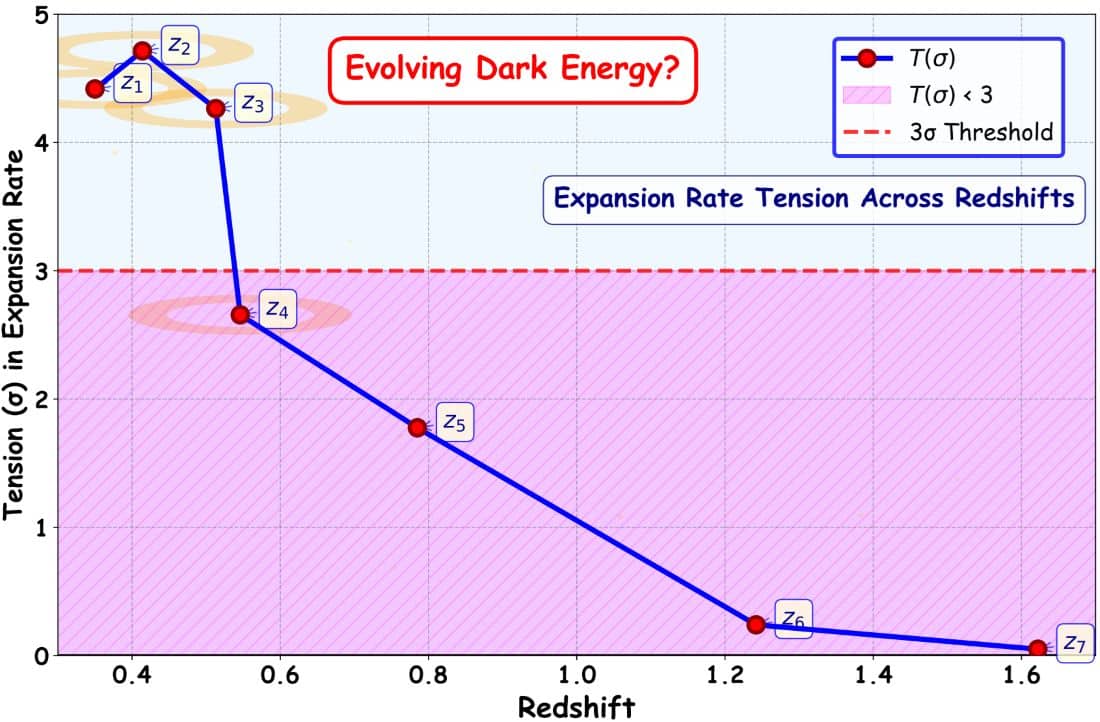
The team’s results are in tension with the Lambda-CDM model at low redshifts. Put simply, the results disagree with the current model at recent times. This provides further evidence for the idea that dark energy, previously considered to have a constant value, is evolving over time.

Evolving dark energy

The is far from the end of the story with dark energy. New observational data, and new analyses such as this one are urgently required to provide a clearer picture.

However, where there’s uncertainty, there’s opportunity. Understanding dark energy could hold the key to understanding quantum gravity, the Big Bang and the ultimate fate of the universe.


Searching for dark matter particles

Dark matter is hypothesised form of matter that does not emit, absorb, or reflect light, making it invisible to electromagnetic observations. Although we have never detected it, its existence is inferred from its gravitational effects on visible matter and the large-scale structure of the universe.

The Standard Model of particle physics does not contain any dark matter particles but there have been several proposed extensions of how they might be included. Several of these are very low mass particles such as the axion or the sterile neutrino.

Detecting these hypothesised particles is very challenging, however, due to the extreme sensitivity required.

Electromagnetic resonant systems, such as cavities and LC circuits, are widely used for this purpose, as well as to detect high-frequency gravitational waves.

When an external signal matches one of these systems’ resonant frequencies, the system responds with a large amplitude, making the signal possible to detect. However, there is always a trade-off between the sensitivity of the detector and the range of frequencies it is able to detect (its bandwidth).

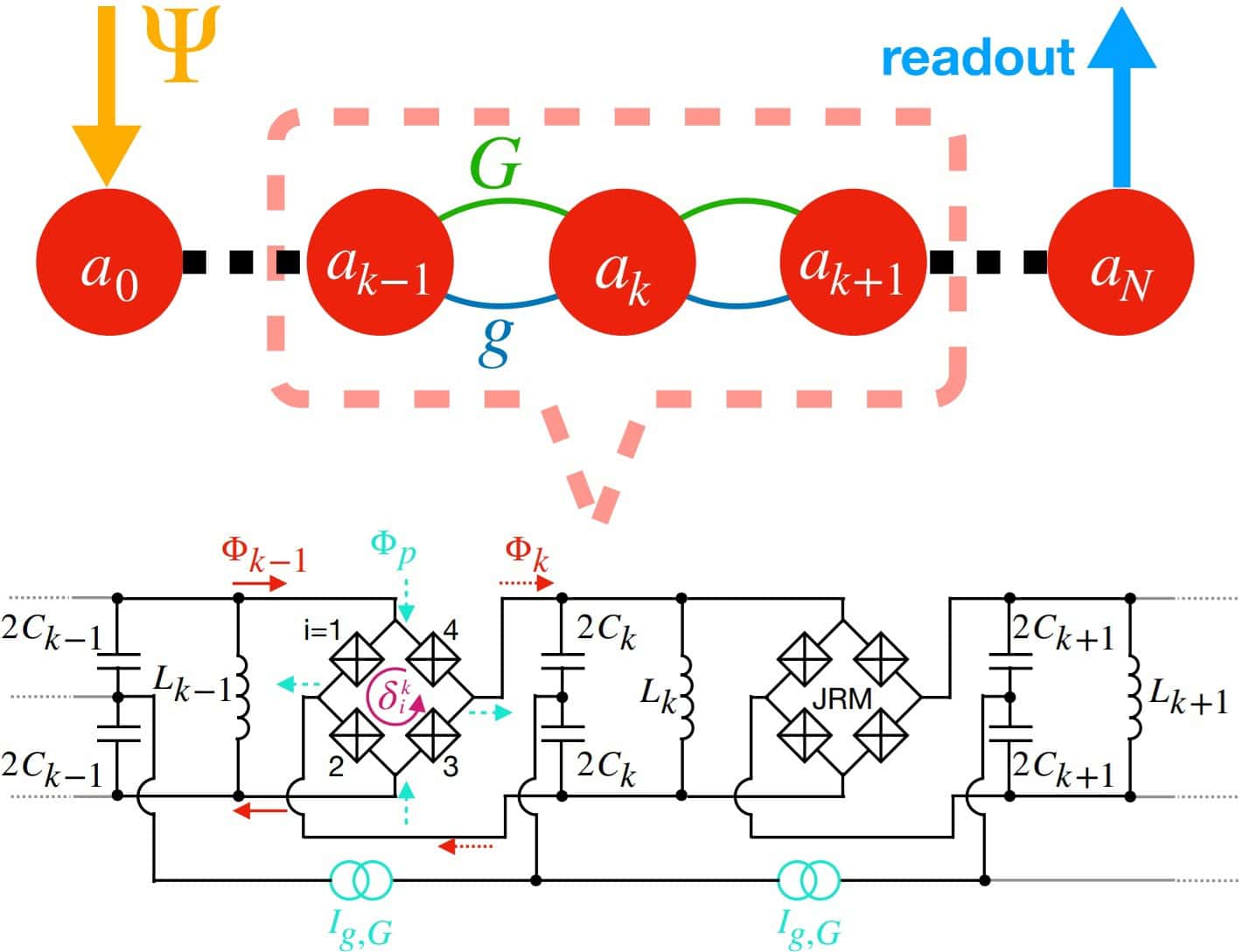
A natural way to overcome this compromise is to consider multi-mode resonators, which can be viewed as coupled networks of harmonic oscillators. Their scan efficiency can be significantly enhanced beyond the standard quantum limit of simple single-mode resonators.

In a recent paper, the researchers demonstrated how multi-mode resonators can achieve the advantages of both sensitive and broadband detection. By connecting adjacent modes inside the resonant cavity, and  tuning these interactions to comparable magnitudes, off-resonant (i.e. unwanted) frequency shifts are effectively cancelled increasing the overall response of the system.

Their method allows us to search for these elusive dark matter particles in a faster, more efficient way.

Dark matter detection circuit

Physicists explain why some fast-moving droplets stick to hydrophobic surfaces

What happens when a microscopic drop of water lands on a water-repelling surface? The answer is important for many everyday situations, including pesticides being sprayed on crops and the spread of disease-causing aerosols. Naively, one might expect it to depend on the droplet’s speed, with faster-moving droplets bouncing off the surface and slower ones sticking to it. However, according to new experiments, theoretical work and simulations by researchers in the UK and the Netherlands, it’s more complicated than that.

“If the droplet moves too slowly, it sticks,” explains Jamie McLauchlan, a PhD student at the University of Bath, UK who led the new research effort with Bath’s Adam Squires and Anton Souslov of the University of Cambridge. “Too fast, and it sticks again. Only in between is bouncing possible, where there is enough momentum to detach from the surface but not so much that it collapses back onto it.”

As well as this new velocity-dependent condition, the researchers also discovered a size effect in which droplets that are too small cannot bounce, no matter what their speed. This size limit, they say, is set by the droplets’ viscosity, which prevents the tiniest droplets from leaving the surface once they land on it.

Smaller-sized, faster-moving droplets

While academic researchers and industrialists have long studied single-droplet impacts, McLauchlan says that much of this earlier work focused on millimetre-sized drops that took place on millisecond timescales. “We wanted to push this knowledge to smaller sizes of micrometre droplets and faster speeds, where higher surface-to-volume ratios make interfacial effects critical,” he says. “We were motivated even further during the COVID-19 pandemic, when studying how small airborne respiratory droplets interact with surfaces became a significant concern.”

Working at such small sizes and fast timescales is no easy task, however. To record the outcome of each droplet landing, McLauchlan and colleagues needed a high-speed camera that effectively slowed down motion by a factor of 100 000. To produce the droplets, they needed piezoelectric droplet generators capable of dispensing fluid via tiny 30-micron nozzles. “These dispensers are highly temperamental,” McLauchlan notes. “They can become blocked easily by dust and fibres and fail to work if the fluid viscosity is too high, making experiments delicate to plan and run. The generators are also easy to break and expensive.”

Droplet modelled as a tiny spring

The researchers used this experimental set-up to create and image droplets between 30‒50 µm in diameter as they struck water-repelling surfaces at speeds of 1‒10 m/s. They then compared their findings with calculations based on a simple mathematical model that treats a droplet like a tiny spring, taking into account three main parameters in addition to its speed: the stickiness of the surface; the viscosity of the droplet liquid; and the droplet’s surface tension.

Previous research had shown that on perfectly non-wetting surfaces, bouncing does not depend on velocity. Other studies showed that on very smooth surfaces, droplets can bounce on a thin air layer. “Our work has explored a broader range of hydrophobic surfaces, showing that bouncing occurs due to a delicate balance of kinetic energy, viscous dissipation and interfacial energies,” McLauchlan tells Physics World.

This is exciting, he adds, because it reveals a previously unexplored regime for bounce behaviour: droplets that are too small, or too slow, will always stick, while sufficiently fast droplets can rebound. “This finding provides a general framework that explains bouncing at the micron scale, which is directly relevant for aerosol science,” he says.

A novel framework for engineering microdroplet processes

McLauchlan thinks that by linking bouncing to droplet velocity, size and surface properties, the new framework could make it easier to engineer microdroplets for specific purposes. “In agriculture, for example, understanding how spray velocities interact with plant surfaces with different hydrophobicity could help determine when droplets deposit fully versus when they bounce away, improving the efficiency of crop spraying,” he says.

Such a framework could also be beneficial in the study of airborne diseases, since exhaled droplets frequently bump into surfaces while floating around indoors. While droplets that stick are removed from the air, and can no longer transmit disease via that route, those that bounce are not. Quantifying these processes in typical indoor environments will provide better models of airborne pathogen concentrations and therefore disease spread, McLauchlan says. For example, in healthcare settings, coatings could be designed to inhibit or promote bouncing, ensuring that high-velocity respiratory droplets from sneezes either stick to hospital surfaces or recoil from them, depending on which mode of potential transmission (airborne or contact-based) is being targeted.

The researchers now plan to expand their work on aqueous droplets to droplets with more complex soft-matter properties. “This will include adding surfactants, which introduce time-dependent surface tensions, and polymers, which give droplets viscoelastic properties similar to those found in biological fluids,” McLauchlan reveals. “These studies will present significant experimental challenges, but we hope they broaden the relevance of our findings to an even wider range of fields.”

The present work is detailed in PNAS.

Quantum computing on the verge: a look at the quantum marketplace of today

“I’d be amazed if quantum computing produces anything technologically useful in ten years, twenty years, even longer.” So wrote University of Oxford physicist David Deutsch – often considered the father of the theory of quantum computing – in 2004. But, as he added in a caveat, “I’ve been amazed before.”

We don’t know how amazed Deutsch, a pioneer of quantum computing, would have been had he attended a meeting at the Royal Society in London in February on “the future of quantum information”. But it was tempting to conclude from the event that quantum computing has now well and truly arrived, with working machines that harness quantum mechanics to perform computations being commercially produced and shipped to clients. Serving as the UK launch of the International Year of Quantum Science and Technology (IYQ) 2025, it brought together some of the key figures of the field to spend two days discussing quantum computing as something like a mature industry, even if one in its early days.

Werner Heisenberg – who worked out the first proper theory of quantum mechanics 100 years ago – would surely have been amazed to find that the formalism he and his peers developed to understand the fundamental behaviour of tiny particles had generated new ways of manipulating information to solve real-world problems in computation. So far, quantum computing – which exploits phenomena such as superposition and entanglement to potentially achieve greater computational power than the best classical computers can muster – hasn’t tackled any practical problems that can’t be solved classically.

Although the fundamental quantum principles are well-established and proven to work, there remain many hurdles that quantum information technologies have to clear before this industry can routinely deliver resources with transformative capabilities. But many researchers think that moment of “practical quantum advantage” is fast approaching, and an entire industry is readying itself for that day.

Entangled marketplace

So what are the current capabilities and near-term prospects for quantum computing?

The first thing to acknowledge is that a booming quantum-computing market exists. Devices are being produced for commercial use by a number of tech firms, from the likes of IBM, Google, D-Wave, and Rigetti who have been in the field for a decade or more; to relative newcomers like Nord Quantique (Canada), IQM (Finland), Quantinuum (UK and US), Orca (UK) and PsiQuantum (US), Silicon Quantum Computing (Australia), see box below, “The global quantum ecosystem”.

The global quantum ecosystem

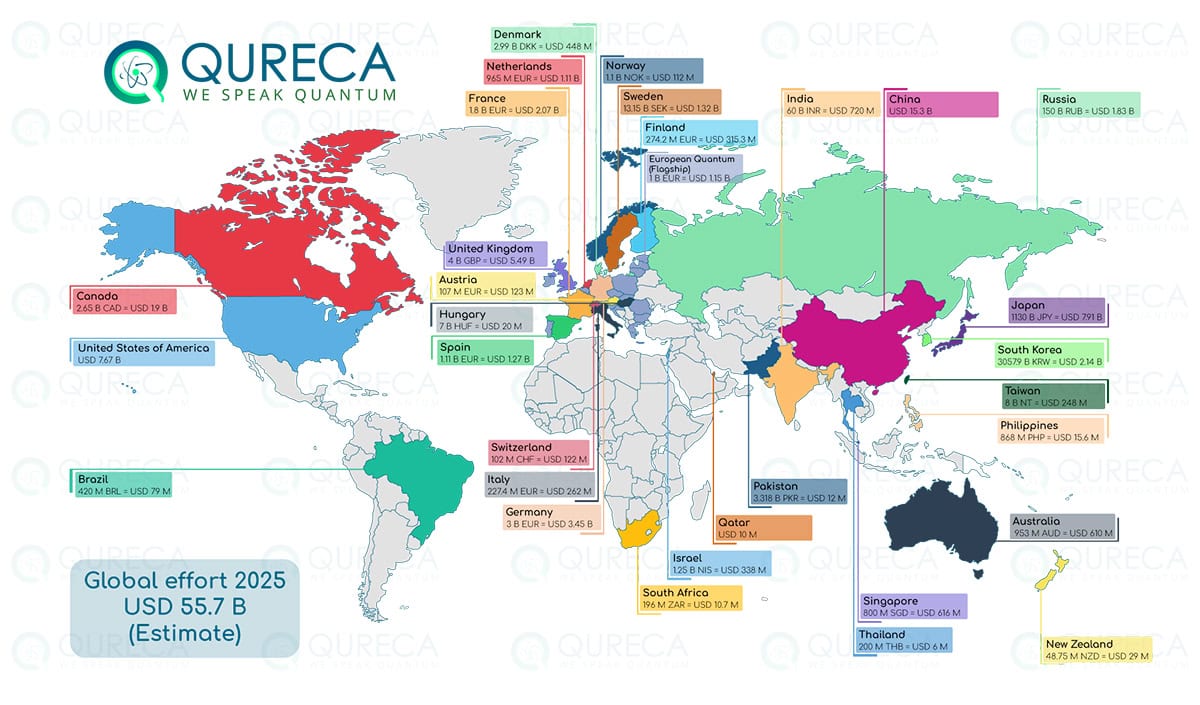
Map showing the investments globally into quantum computing

We are on the cusp of a second quantum revolution, with quantum science and technologies growing rapidly across the globe. This includes quantum computers; quantum sensing (ultra-high precision clocks, sensors for medical diagnostics); as well as quantum communications (a quantum internet). Indeed, according to the State of Quantum 2024 report, a total of 33 countries around the world currently have government initiatives in quantum technology, of which more than 20 have national strategies with large-scale funding. As of this year, worldwide investments in quantum tech – by governments and industry – exceed $55.7 billion, and the market is projected to reach $106 billion by 2040. With the multitude of ground-breaking capabilities that quantum technologies bring globally, it’s unsurprising that governments all over the world are eager to invest in the industry.

With data from a number of international reports and studies, quantum education and skills firm QURECA has summarized key programmes and efforts around the world. These include total government funding spent through 2025, as well as future commitments spanning 2–10 year programmes, varying by country. These initiatives generally represent government agencies’ funding announcements, related to their countries’ advancements in quantum technologies, excluding any private investments and revenues.

A supply chain is also organically developing, which includes manufacturers of specific hardware components, such as Oxford Instruments and Quantum Machines and software developers like Riverlane, based in Cambridge, UK, and QC Ware in Palo Alto, California. Supplying the last link in this chain are a range of eager end-users, from finance companies such as J P Morgan and Goldman Sachs to pharmaceutical companies such as AstraZeneca and engineering firms like Airbus. Quantum computing is already big business, with around 400 active companies and current global investment estimated at around $2 billion.

But the immediate future of all this buzz is hard to assess. When the chief executive of computer giant Nvidia announced at the start of 2025 that “truly useful” quantum computers were still two decades away, the previously burgeoning share prices of some leading quantum-computing companies plummeted. They have since recovered somewhat, but such volatility reflects the fact that quantum computing has yet to prove its commercial worth.

The field is still new and firms need to manage expectations and avoid hype while also promoting an optimistic enough picture to keep investment flowing in. “Really amazing breakthroughs are being made,” says physicist Winfried Hensinger of the University of Sussex, “but we need to get away from the expectancy that [truly useful] quantum computers will be available tomorrow.”

The current state of play is often called the “noisy intermediate-scale quantum” (NISQ) era. That’s because the “noisy” quantum bits (qubits) in today’s devices are prone to errors for which no general and simple correction process exists. Current quantum computers can’t therefore carry out practically useful computations that could not be done on classical high-performance computing (HPC) machines. It’s not just a matter of better engineering either; the basic science is far from done.

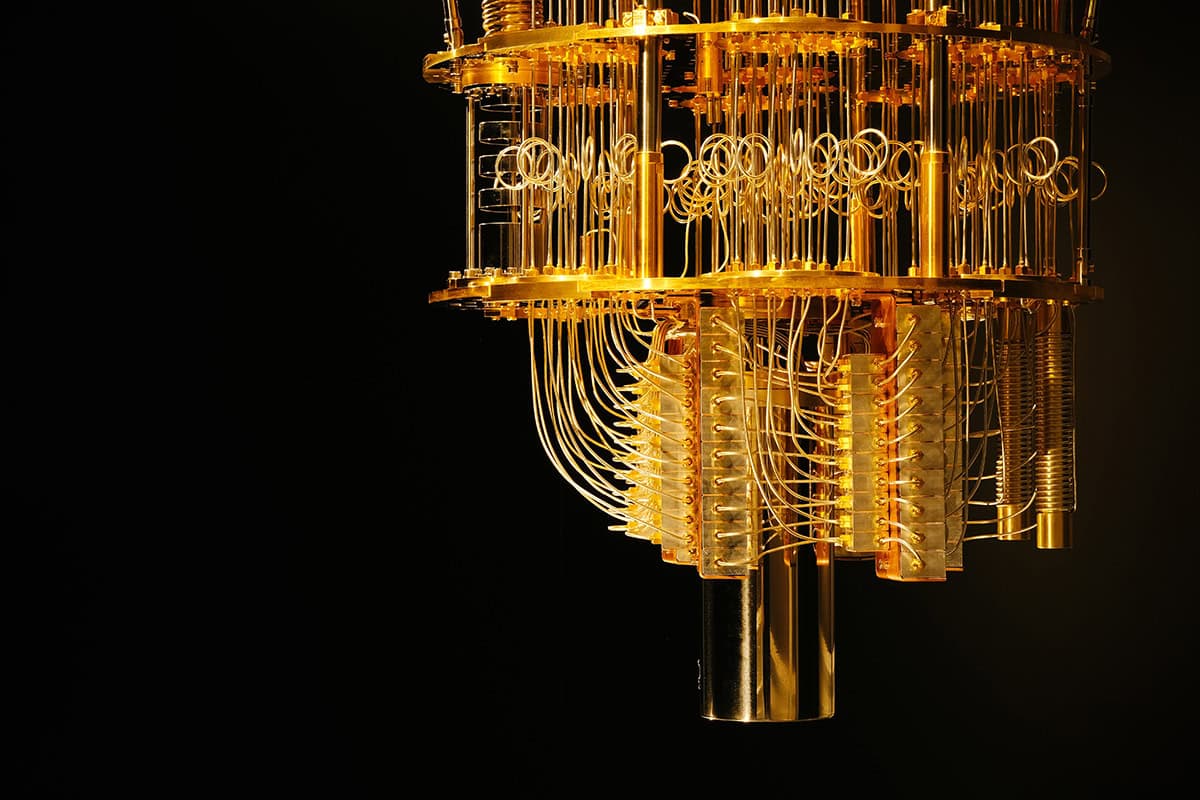
IBM quantum computer cryogenic chandelier

“We are right on the cusp of scientific quantum advantage – solving certain scientific problems better than the world’s best classical methods can,” says Ashley Montanaro, a physicist at the University of Bristol who co-founded the quantum software company Phasecraft. “But we haven’t yet got to the stage of practical quantum advantage, where quantum computers solve commercially important and practically relevant problems such as discovering the next lithium-ion battery.” It’s no longer if or how, but when that will happen.

Pick your platform

As the quantum-computing business is such an emerging area, today’s devices use wildly different types of physical systems for their qubits, see the box below, “Comparing computing modalities: from qubits to architectures”

. There is still no clear sign as to which of these platforms, if any, will emerge as the winner. Indeed many researchers believe that no single qubit type will ever dominate.

The top-performing quantum computers, like those made by Google (with its 105-qubit Willow chip) and IBM (which has made the 121-qubit Condor), use qubits in which information is encoded in the wavefunction of a superconducting material. Until recently, the strongest competing platform seemed to be trapped ions, where the qubits are individual ions held in electromagnetic traps – a technology being developed into working devices by the US company IonQ, spun out from the University of Maryland, among others.

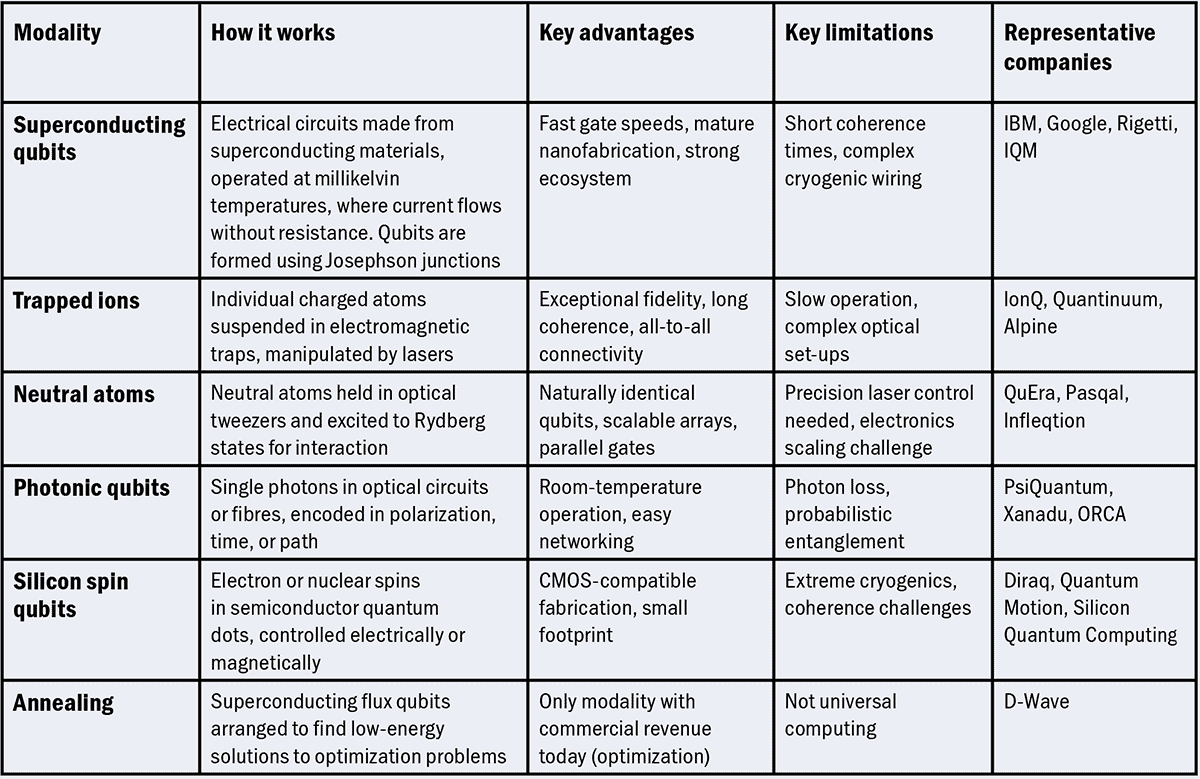
Comparing computing modalities: from qubits to architectures

Table listing out the different types of qubit, the advantages of each and which company uses which qubit

Much like classical computers, quantum computers have a core processor and a control stack – the difference being that the core depends on the type of qubit being used. Currently, quantum computing is not based on a single platform, but rather a set of competing hardware approaches, each with its own physical basis for creating and controlling qubits and keeping them stable.

The data above –  taken from the August 2025 report Quantum Computing at an Inflection Point: Who’s Leading, What They Own, and Why IP Decides Quantum’s Future by US firm Patentvest – shows the key “quantum modalities”, which refers to the different types of qubits and architectures used to build these quantum systems. Differing qubits each have their own pros and cons, with varying factors including the temperature at which they operate, coherence time, gate speed, and how easy they might be to scale up.

But over the past few years, neutral trapped atoms have emerged as a major contender, thanks to advances in controlling the positions and states of these qubits. Here the atoms are prepared in highly excited electronic states called Rydberg atoms, which can be entangled with one another over a few microns. A Harvard startup called QuEra is developing this technology, as is the French start-up Pasqal. In September a team from the California Institute of Technology announced a 6100-qubit array made from neutral atoms. “Ten years ago I would not have included [neutral-atom] methods if I were hedging bets on the future of quantum computing,” says Deutsch’s Oxford colleague, the quantum information theorist Andrew Steane. But like many, he thinks differently now.

Some researchers believe that optical quantum computing, using photons as qubits, will also be an important platform. One advantage here is that there is no need for complex conversion of photonic signals in existing telecommunications networks going to or from the processing units, which is also handy for photonic interconnections between chips. What’s more, photonic circuits can work at room temperature, whereas trapped ions and superconducting qubits need to be cooled. Photonic quantum computing is being developed by firms like PsiQuantum, Orca, and Xanadu.

Other efforts, for example at Intel and Silicon Quantum Computing in Australia, make qubits from either quantum dots (Intel) or precision-placed phosphorus atoms (SQC), both in good old silicon, which benefits from a very mature manufacturing base. “Small qubits based on ions and atoms yield the highest quality processors”, says Michelle Simmons of the University of New South Wales, who is the founder and CEO of SQC. “But only atom-based systems in silicon combine this quality with manufacturability.”

Intel's silicon spin qubits are now being manufactured on an industrial scale

And it’s not impossible that entirely new quantum computing platforms might yet arrive. At the start of 2025, researchers at Microsoft’s laboratories in Washington State caused a stir when they announced that they had made topological qubits from semiconducting and superconducting devices, which are less error-prone than those currently in use. The announcement left some scientists disgruntled because it was not accompanied by a peer-reviewed paper providing the evidence for these long-sought entities. But in any event, most researchers think it would take a decade or more for topological quantum computing to catch up with the platforms already out there.

Each of these quantum technologies has its own strengths and weaknesses. “My personal view is that there will not be a single architecture that ‘wins’, certainly not in the foreseeable future,” says Michael Cuthbert, founding director of the UK’s National Quantum Computing Centre (NQCC), which aims to facilitate the transition of quantum computing from basic research to an industrial concern. Cuthbert thinks the best platform will differ for different types of computation: cold neutral atoms might be good for quantum simulations of molecules, materials and exotic quantum states, say, while superconducting and trapped-ion qubits might be best for problems involving machine learning or optimization.

Measures and metrics

Given these pros and cons of different hardware platforms, one difficulty in assessing their merits is finding meaningful metrics for making comparisons. Should we be comparing error rates, coherence times (basically how long qubits remain entangled), gate speeds (how fast a single computational step can be conducted), circuit depth (how many steps a single computation can sustain), number of qubits in a processor, or what? “The metrics and measures that have been put forward so far tend to suit one or other platform more than others,” says Cuthbert, “such that it becomes almost a marketing exercise rather than a scientific benchmarking exercise as to which quantum computer is better.”

The NQCC evaluates the performance of devices using a factor known as the “quantum operation” (QuOp). This is simply the number of quantum operations that can be carried out in a single computation, before the qubits lose their coherence and the computation dissolves into noise. “If you want to run a computation, the number of coherent operations you can run consecutively is an objective measure,” Cuthbert says. If we want to get beyond the NISQ era, he adds, “we need to progress to the point where we can do about a million coherent operations in a single computation. We’re now at the level of maybe a few thousand. So we’ve got a long way to go before we can run large-scale computations.”

One important issue is how amenable the platforms are to making larger quantum circuits. Cuthbert contrasts the issue of scaling up – putting more qubits on a chip – with “scaling out”, whereby chips of a given size are linked in modular fashion. Many researchers think it unlikely that individual quantum chips will have millions of qubits like the silicon chips of today’s machines. Rather, they will be modular arrays of relatively small chips linked at their edges by quantum interconnects.

Having made the Condor, IBM now plans to focus on modular architectures (scaling out) – a necessity anyway, since superconducting qubits are micron-sized, so a chip with millions of them would be “bigger than your dining room table”, says Cuthbert. But superconducting qubits are not easy to scale out because microwave frequencies that control and read out the qubits have to be converted into optical frequencies for photonic interconnects. Cold atoms are easier to scale up, as the qubits are small, while photonic quantum computing is easiest to scale out because it already speaks the same language as the interconnects.

To be able to build up so called “fault tolerant” quantum computers, quantum platforms must solve the issue of error correction, which will enable more extensive computations without the results becoming degraded into mere noise.

In part two of this feature, we will explore how this is being achieved and meet the various firms developing quantum software. We will also look into the potential high-value commercial uses for robust quantum computers – once such devices exist.

  • This article was updated with additional content on 22 October 2025.

This article forms part of Physics World‘s contribution to the 2025 International Year of Quantum Science and Technology (IYQ), which aims to raise global awareness of quantum physics and its applications.

Stayed tuned to Physics World and our international partners throughout the year for more coverage of the IYQ.

Find out more on our quantum channel.

Physicists achieve first entangled measurement of W states

Imagine two particles so interconnected that measuring one immediately reveals information about the other, even if the particles are light–years apart. This phenomenon, known as quantum entanglement, is the foundation of a variety of technologies such as quantum cryptography and quantum computing. However, entangled states are notoriously difficult to control. Now, for the first time, a team of physicists in Japan has performed a collective quantum measurement on a W state comprising three entangled photons. This allowed them to analyse the three entangled photons at once rather than one at a time. This achievement, reported in Science Advances, marks a significant step towards the practical development of quantum technologies.

Physicists usually measure entangled particles using a technique known as quantum tomography. In this method, many identical copies of a particle are prepared, and each copy is measured at a different angle. The results of these measurements are then combined to reconstruct its full quantum state. To visualize this, imagine being asked to take a family photo. Instead of taking one group picture, you have to photograph each family member individually and then combine all the photos into a single portrait. Now imagine taking a photo properly: taking one photograph of the entire family. This is essentially what happens in an entangled measurement: where all particles are measured simultaneously rather than separately. This approach allows for significantly faster and more efficient measurements.

So far, for three-particle systems, entangled measurements have only been performed on Greenberger–Horne–Zeilinger (GHZ) states, where all qubits (quantum bits of a system) are either in one state or another. Until now, no one had carried out an entangled measurement for a more complicated set of states known as W states, which do not share this all-or-nothing property. In their experiment, the researchers at Kyoto University and Hiroshima University specifically used the simplest type of W state, made up of three photons, where each photon’s polarization (horizontal or vertical) is represented by one qubit.

“In a GHZ state, if you measure one qubit, the whole superposition collapses. But in a W state, even if you measure one particle, entanglement still remains,” explains Shigeki Takeuchi, corresponding author of the paper describing the study. This robustness makes the W state particularly appealing for quantum technologies.

Fourier transformations

The team took advantage of the fact that different W states look almost identical but differ by tiny phase shift, which acts as a hidden label that distinguishes one state from another. Using a tool called a discrete Fourier transform (DFT) circuit, researchers were able to “decode” this phase and tell the states apart.

The DFT exploits a special type of symmetry inherent to W states. Since the method relies on symmetry, in principle it can be extended to systems containing any number of photons. The researchers prepared photons in controlled polarization states and ran them through the DFT, which provided each state’s phase label. After, the photons were sent through polarizing beam splitters that separate them into vertically and horizontally polarized groups. By counting both sets of photons, and combining this with information from the DFT, the team could identify the W state.

The experiment identified the correct W state about 87% of the time, well above the 15% success rate typically achieved using tomography-based measurements. Maintaining this level of performance was a challenge, as tiny fluctuations in optical paths or photon loss can easily destroy the fragile interference pattern. The fact that the team could maintain stable performance long enough to collect statistically reliable data marks an important technical milestone.

Scalable to larger systems

“Our device is not just a single-shot measurement: it works with 100% efficiency,” Takeuchi adds. “Most linear optical protocols are probabilistic, but here the success probability is unity.” Although demonstrated with three photons, this procedure is directly scalable to larger systems, as the key insight is the symmetry that the DFT can detect.

“In terms of applications, quantum communication seems the most promising,” says Takeuchi. “Because our device is highly efficient, our protocol could be used for robust communication between quantum computer chips. The next step is to build all of this on a tiny photonic chip, which would reduce errors and photon loss and help make this technology practical for real quantum computers and communication networks.”

Physicists apply quantum squeezing to a nanoparticle for the first time

Physicists at the University of Tokyo, Japan have performed quantum mechanical squeezing on a nanoparticle for the first time. The feat, which they achieved by levitating the particle and rapidly varying the frequency at which it oscillates, could allow us to better understand how very small particles transition between classical and quantum behaviours. It could also lead to improvements in quantum sensors.

Oscillating objects that are smaller than a few microns in diameter have applications in many areas of quantum technology. These include optical clocks and superconducting devices as well as quantum sensors. Such objects are small enough to be affected by Heisenberg’s uncertainty principle, which places a limit on how precisely we can simultaneously measure the position and momentum of a quantum object. More specifically, the product of the measurement uncertainties in the position and momentum of such an object must be greater than or equal to ħ/2, where ħ is the reduced Planck constant.

In these circumstances, the only way to decrease the uncertainty in one variable – for example, the position – is to boost the uncertainty in the other. This process has no classical equivalent and is called squeezing because reducing uncertainty along one axis of position-momentum space creates a “bulge” in the other, like squeezing a balloon.

A charge-neutral nanoparticle levitated in an optical lattice

In the new work, which is detailed in Science, a team led by Kiyotaka Aikawa studied a single, charge-neutral nanoparticle levitating in a periodic intensity pattern formed by the interference of criss-crossed laser beams. Such patterns are known as optical lattices, and they are ideal for testing the quantum mechanical behaviour of small-scale objects because they can levitate the object. This keeps it isolated from other particles and allows it to sustain its fragile quantum state.

After levitating the particle and cooling it to its motional ground state, the team rapidly varied the intensity of the lattice laser. This had the effect of changing the particle’s oscillation frequency, which in turn changed the uncertainty in its momentum. To measure this change (and prove they had demonstrated quantum squeezing), the researchers then released the nanoparticle from the trap and let it propagate for a short time before measuring its velocity. By repeating these time-of-flight measurements many times, they were able to obtain the particle’s velocity distribution.

The telltale sign of quantum squeezing, the physicists say, is that the velocity distribution they measured for the nanoparticle was narrower than the uncertainty in velocity for the nanoparticle at its lowest energy level. Indeed, the measured velocity variance was narrower than that of the ground state by 4.9 dB, which they say is comparable to the largest mechanical quantum squeezing obtained thus far.

“Our system will enable us to realize further exotic quantum states of motions and to elucidate how quantum mechanics should behave at macroscopic scales and become classical,” Aikawa tells Physics World. “This could allow us to develop new kinds of quantum devices in the future.”

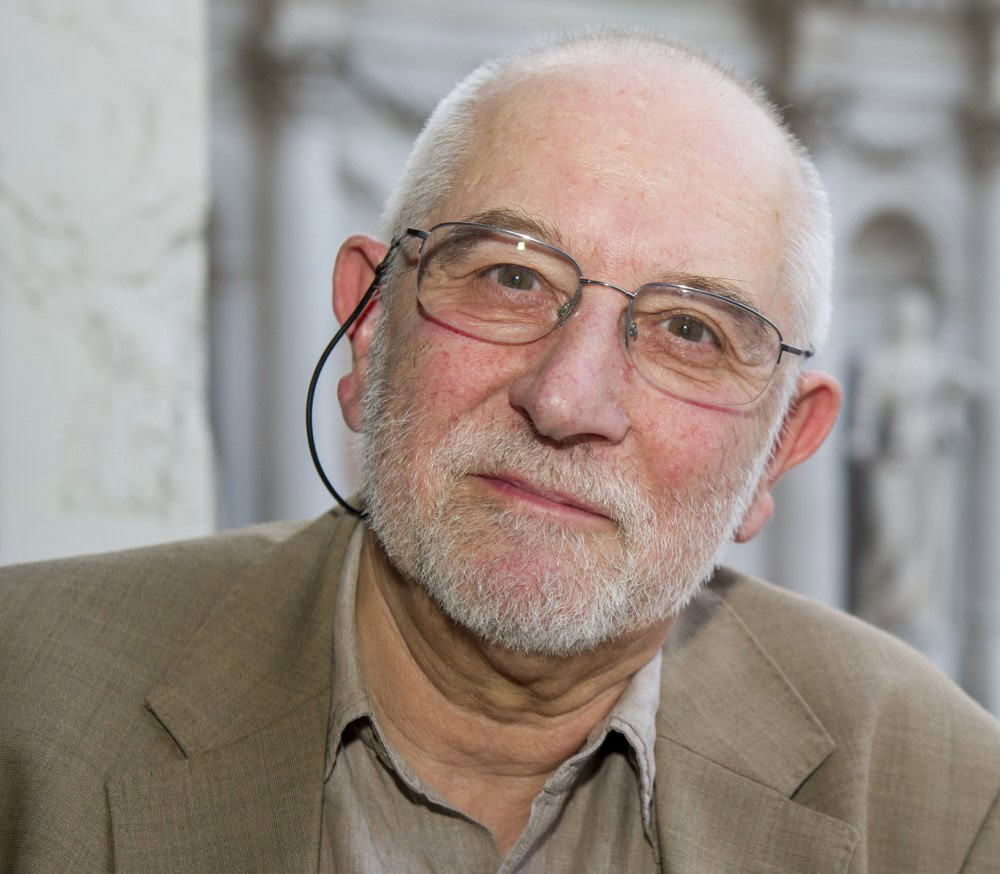
Theoretical physicist Michael Berry wins 2025 Isaac Newton Medal and Prize

Michael Berry

The theoretical physicist Michael Berry from the University of Bristol has won the 2025 Isaac Newton Medal and Prize for his “profound contributions across mathematical and theoretical physics in a career spanning over 60 years”. Presented by the Institute of Physics (IOP), which publishes Physics World, the international award is given annually for “world-leading contributions to physics by an individual of any nationality”.

Born in 1941 in Surrey, UK, Berry earned a BSc in physics from the University of Exeter in 1962 and a PhD from the University of St Andrews in 1965. He then moved to Bristol, where he has remained for the rest of his career.

Berry is best known for his work in the 1980s in which he showed that, under certain conditions, quantum systems can acquire what is known as a geometric phase. He was studying quantum systems in which the Hamiltonian describing the system is slowly changed so that it eventually returns to its initial form.

Berry showed that the adiabatic theorem widely used to describe such systems was incomplete and that a system acquires a phase factor that depends on the path followed, but not on the rate at which the Hamiltonian is changed. This geometric phase factor is now known as the Berry phase.

Over his career Berry, has written some 500 papers across a wide number of topics. In physics, Berry’s ideas have applications in condensed matter, quantum information and high-energy physics, as well as optics, nonlinear dynamics, and atomic and molecular physics. In mathematics, meanwhile, his work forms the basis for research in analysis, geometry and number theory.

Berry told Physics World that the award is “unexpected recognition for six decades of obsessive scribbling…creating physics by seeking ‘claritons’ – elementary particles of sudden understanding – and evading ‘anticlaritons’ that annihilate them” as well as “getting insights into nature’s physics” such as studying tidal bores, tsunamis, rainbows and “polarised light in the blue sky”.

Over the years, Berry has won a wide number of other honours, including the IOP’s Dirac Medal and the Royal Medal from the Royal Society, both awarded in 1990. He was also given the Wolf Prize for Physics in 1998 and the 2014 Lorentz Medal from the Royal Netherlands Academy of Arts and Sciences. In 1996 he received a knighthood for his services to science.

Berry will also be a speaker at the IOP’s International Year of Quantum celebrations on 4 November.

Celebrating success

Berry’s latest honour forms part of the IOP’s wider 2025 awards, which recognize everyone from early-career scientists and teachers to technicians and subject specialists. Other winners include Julia Yeomans, who receives the Dirac Medal and Prize for her work highlighting the relevance of active physics to living matter.

Lok Yiu Wu, meanwhile, receives Jocelyn Bell Burnell Medal and Prize for her work on the development of a novel magnetic radical filter device, and for ongoing support of women and underrepresented groups in physics.

In a statement, IOP president Michele Dougherty congratulated all the winners. “It is becoming more obvious that the opportunities generated by a career in physics are many and varied – and the potential our science has to transform our society and economy in the modern world is huge,” says Dougherty. “I hope our winners appreciate they are playing an important role in this community, and know how proud we are to celebrate their successes.”

The full list of 2025 award winners is available here.

Phase shift in optical cavities could detect low-frequency gravitational waves

A network of optical cavities could be used to detect gravitational waves (GWs) in an unexplored range of frequencies, according to researchers in the UK. Using technology already within reach, the team believes that astronomers could soon be searching for ripples in space–time across the milli-Hz frequency band at 10⁻⁵ Hz–1 Hz.

GWs were first observed a decade ago and since then the LIGO–Virgo–KAGRA detectors have spotted GWs from hundreds of merging black holes and neutron stars. These detectors work in the 10 Hz–30 kHz range. Researchers have also had some success at observing a GW background at nanohertz frequencies using pulsar timing arrays.

However, GWs have yet to be detected in the milli-Hz band, which should include signals from binary systems of white dwarfs, neutron stars, and stellar-mass black holes. Many of these signals would emanate from the Milky Way.

Several projects are now in the works to explore these frequencies, including the space-based interferometers LISA, Taiji, and TianQin; as well as satellite-borne networks of ultra-precise optical clocks. However, these projects are still some years away.

Multidisciplinary effort

Joining these efforts was a collaboration called QSNET, which was within the UK’s Quantum Technology for Fundamental Physics (QTFP) programme. “The QSNET project was a network of clocks for measuring the stability of fundamental constants,” explains Giovanni Barontini at the University of Birmingham. “This programme brought together physics communities that normally don’t interact, such as quantum physicists, technologists, high energy physicists, and astrophysicists.”

QTFP ended this year, but not before Barontini and colleagues had made important strides in demonstrating how milli-Hz GWs could be detected using optical cavities.

Inside an ultrastable optical cavity, light at specific resonant frequencies bounces constantly between a pair of opposing mirrors. When this resonant light is produced by a specific atomic transition, the frequency of the light in the cavity is very precise and can act as the ticking of an extremely stable clock.

“Ultrastable cavities are a main component of modern optical atomic clocks,” Barontini explains. “We demonstrated that they have reached sufficient sensitivities to be used as ‘mini-LIGOs’ and detect gravitational waves.”

When such GW passes through an optical cavity, the spacing between its mirrors does not change in any detectable way. However, QSNET results have led to Barontini’s team to conclude that milli-Hz GWs alter the phase of the light inside the cavity. What is more, they conclude that this effect would be detectable in the most precise optical cavities currently available.

“Methods from precision measurement with cold atoms can be transferred to gravitational-wave detection,” explains team member Vera Guarrera. “By combining these toolsets, compact optical resonators emerge as credible probes in the milli-Hz band, complementing existing approaches.”

Ground-based network

Their compact detector would comprise two optical cavities at 90° to each other – each operating at a different frequency – and an atomic reference at a third frequency. The phase shift caused by a passing gravitational wave is revealed in a change in how the three frequencies interfere with each other. The team proposes linking multiple detectors to create a global, ground-based network. This, they say, could detect a GW and also locate the position of its source in the sky.

By harnessing this existing technology, the researchers now hope that future studies could open up a new era of discovery of GWs in the milli-Hz range, far sooner than many projects currently in development.

“This detector will allow us to test astrophysical models of binary systems in our galaxy, explore the mergers of massive black holes, and even search for stochastic backgrounds from the early universe,” says team member Xavier Calmet at the University of Sussex. “With this method, we have the tools to start probing these signals from the ground, opening the path for future space missions.”

Barontini adds, “Hopefully this work will inspire the build-up of a global network of sensors that will scan the skies in a new frequency window that promises to be rich of sources – including many from our own galaxy,”.

The research is described in Classical and Quantum Gravity.


Copyright © 2026 by IOP Publishing Ltd and individual contributors