Researchers in the US have studied the physics of how cutting onions can produce a tear-jerking reaction.
While it is known that volatile chemicals released from the onion – called propanethial S-oxide – irritate the nerves in the cornea to produce tears, how such chemical-laden droplets reach the eyes and whether they are influenced by the knife or cutting technique remain less clear.
To investigate, Sunghwan Jung from Cornell University and colleagues built a guillotine-like apparatus and used high-speed video to observe the droplets released from onions as they were cut by steel blades.
“No one had visualized or quantified this process,” Jung told Physics World. “That curiosity led us to explore the mechanics of droplet ejection during onion cutting using high-speed imaging and strain mapping.”
They found that droplets, which can reach up to 60 cm high, were released in two stages – the first being a fast mist-like outburst that was followed by threads of liquid fragmenting into many droplets.
The most energetic droplets were released during the initial contact between the blade and the onion’s skin.
When they began varying the sharpness of the blade and the cutting speed, they discovered that a greater number of droplets were released by blunter blades and faster cutting speeds.
“That was even more surprising,” notes Jung. “Blunter blades and faster cuts – up to 40 m/s – produced significantly more droplets with higher kinetic energy.”
Another surprise was that refrigerating the onions prior to cutting also produced an increased number of droplets of similar velocity, compared to unchilled vegetables.
So if you want to reduce chances of welling up when making dinner, sharpen your knives, cut slowly and perhaps don’t keep the bulbs in the fridge.
The researchers say there are many more layers to the work and now plan to study how different onion varieties respond to cutting as well as how cutting could influence the spread of airborne pathogens such as salmonella.
Blur benefit: Images on the left were taken by a camera that was moving during exposure. Images on the right used the researchers’ algorithm to increase their resolution with information captured by the camera’s motion. (Courtesy: Pedro Felzenszwalb/Brown University)
Images captured by moving cameras are usually blurred, but researchers at Brown University in the US have found a way to sharpen them up using a new deconvolution algorithm. The technique could allow ordinary cameras to produce gigapixel-quality photos, with applications in biological imaging and archival/preservation work.
“We were interested in the limits of computational photography,” says team co-leader Rashid Zia, “and we recognized that there should be a way to decode the higher-resolution information that motion encodes onto a camera image.”
Conventional techniques to reconstruct high-resolution images from low-resolution ones involve relating low-res to high-res via a mathematical model of the imaging process. These effectiveness of these techniques is limited, however, as they produce only relatively small increases in resolution. If the initial image is blurred due to camera motion, this also limits the maximum resolution possible.
Exploiting the “tracks” left by small points of light
Together with Pedro Felzenszwalb of Brown’s computer science department, Zia and colleagues overcame these problems, successfully reconstructing a high-resolution image from one or several low-resolution images produced by a moving camera. The algorithm they developed to do this takes the “tracks” left by light sources as the camera moves and uses them to pinpoint precisely where the fine details must have been located. It then reconstructs these details on a finer, sub-pixel grid.
“There was some prior theoretical work that suggested this shouldn’t be possible,” says Felzenszwalb. “But we show that there were a few assumptions in those earlier theories that turned out not to be true. And so this is a proof of concept that we really can recover more information by using motion.”
Application scenarios
When they tried the algorithm out, they found that it could indeed exploit the camera motion to produce images with much higher resolution than those without the motion. In one experiment, they used a standard camera to capture a series of images in a grid of high-resolution (sub-pixel) locations. In another, they took one or more images while the sensor was moving. They also simulated recording single images or sequences of pictures while vibrating the sensor and while moving it along a linear path. These scenarios, they note, could be applicable to aerial or satellite imaging. In both, they used their algorithm to construct a single high-resolution image from the shots captured by the camera.
“Our results are especially interesting for applications where one wants high resolution over a relatively large field of view,” Zia says. “This is important at many scales from microscopy to satellite imaging. Other areas that could benefit are super-resolution archival photography of artworks or artifacts and photography from moving aircraft.”
The researchers say they are now looking into the mathematical limits of this approach as well as practical demonstrations. “In particular, we hope to soon share results from consumer camera and mobile phone experiments as well as lab-specific setups using scientific-grade CCDs and thermal focal plane arrays,” Zia tells Physics World.
“While there are existing systems that cameras use to take motion blur out of photos, no one has tried to use that to actually increase resolution,” says Felzenszwalb. “We’ve shown that’s something you could definitely do.”
In a major advance for nuclear physics, scientists on the STAR Detector at the Relativistic Heavy Ion Collider (RHIC) in the US have spotted subtle but striking fluctuations in the number of protons emerging from high-energy gold–gold collisions. The observation might be the most compelling sign yet of the long-sought “critical point” marking a boundary separating different phases of nuclear matter. This similar to how water can exist in liquid or vapour phases depending on temperature and pressure.
Team member Frank Geurts at Rice University in the US tells Physics World that these findings could confirm that the “generic physics properties of phase diagrams that we know for many chemical substances apply to our most fundamental understanding of nuclear matter, too.”
A phase diagram maps how a substance transforms between solid, liquid, and gas. For everyday materials like water, the diagram is familiar, but the behaviour of nuclear matter under extreme heat and pressure remains a mystery.
Atomic nuclei are made of protons and neutrons tightly bound together. These protons and neutrons are themselves made of quarks that are held together by gluons. When nuclei are smashed together at high energies, the protons and neutrons “melt” into a fluid of quarks and gluons called a quark–gluon plasma. This exotic high-temperature state is thought to have filled the universe just microseconds after the Big Bang.
Smashing gold ions
The quark–gluon plasma is studied by accelerating heavy ions like gold nuclei to nearly the speed of light and smashing them together. “The advantage of using heavy-ion collisions in colliders such as RHIC is that we can repeat the experiment many millions, if not billions, of times,” Geurts explains.
By adjusting the collision energy, researchers can control the temperature and density of the fleeting quark–gluon plasma they create. This allows physicists to explore the transition between ordinary nuclear matter and the quark–gluon plasma. Within this transition, theory predicts the existence of a critical point where gradual change becomes abrupt.
Now, the STAR Collaboration has focused on measuring the minute fluctuations in the number of protons produced in each collision. These “proton cumulants,” says Geurts, are statistical quantities that “help quantify the shape of a distribution – here, the distribution of the number of protons that we measure”.
In simple terms, the first two cumulants correspond to the average and width of that distribution, while higher-order cumulants describe its asymmetry and sharpness. Ratios of these cumulants are tied to fundamental properties known as susceptibilities, which become highly sensitive near a critical point.
Unexpected discovery
Over three years of experiments, the STAR team studied gold–gold collisions at a wide range of energies, using sophisticated detectors to track and identify the protons and antiprotons created in each event. By comparing how the number of these particles changed with energy, the researchers discovered something unexpected.
As the collision energy decreased, the fluctuations in proton numbers did not follow a smooth trend. “STAR observed what it calls non-monotonic behaviour,” Geurts explains. “While at higher energies the ratios appear to be suppressed, STAR observes an enhancement at lower energies.” Such irregular changes, he said, are consistent with what might happen if the collisions pass near the critical point — the boundary separating different phases of nuclear matter.
For Volodymyr Vovchenko, a physicist at the University of Houston who was not involved in the research, the new measurements represent “a major step forward”. He says that “the STAR Collaboration has delivered the most precise proton-fluctuation data to date across several collision energies”.
Still, interpretation remains delicate. The corrections required to extract pure physical signals from the raw data are complex, and theoretical calculations lag behind in providing precise predictions for what should happen near the critical point.
“The necessary experimental corrections are intricate,” Vovchenko said, and some theoretical models “do not yet implement these corrections in a fully consistent way.” That mismatch, he cautions, “can blur apples-to-apples comparisons.”
The path forward
The STAR team is now studying new data from lower-energy collisions, focusing on the range where the signal appears strongest. The results could reveal whether the observed pattern marks the presence of a nuclear matter critical point or stems from more conventional effects.
Meanwhile, theorists are racing to catch up. “The ball now moves largely to theory’s court,” Vovchenko says. He emphasizes the need for “quantitative predictions across energies and cumulants of various order that are appropriate for apples-to-apples comparisons with these data.”
Future experiments, including RHIC’s fixed-target program and new facilities such as the FAIR accelerator in Germany, will extend the search even further. By probing lower energies and producing vastly larger datasets, they aim to map the transition between ordinary nuclear matter and quark–gluon plasma with unprecedented precision.
Whether or not the critical point is finally revealed, the new data are a milestone in the exploration of the strong force and the early universe. As Geurts put it, these findings trace “landmark properties of the most fundamental phase diagram of nuclear matter,” bringing physicists one step closer to charting how everything – from protons to stars – first came to be.
This year’s Nobel Prize for Physics went to John Clarke, Michel Devoret and John Martinis “for the discovery of macroscopic quantum mechanical tunnelling and energy quantization in an electric circuit”.
That circuit was a superconducting device called a Josephson junction and their work in the 1980s led to the development of some of today’s most promising technologies for quantum computers.
To chat about this year’s laureates, and the wide-reaching scientific and technological consequences of their work I am joined by Ilana Wisby – who is a quantum physicist, deep tech entrepreneur and former CEO of UK-based Oxford Quantum Circuits. We chat about the trio’s breakthrough and its influence on today’s quantum science and technology.
This podcast is supported by American Elements, the world’s leading manufacturer of engineered and advanced materials. The company’s ability to scale laboratory breakthroughs to industrial production has contributed to many of the most significant technological advancements since 1990 – including LED lighting, smartphones, and electric vehicles.
Nuclear power in the UK is on the rise – and so too are the job opportunities for physicists. Whether it’s planning and designing new reactors, operating existing plants safely and reliably, or dealing with waste management and decommissioning, physicists play a key role in the burgeoning nuclear industry.
While many see fusion as the future of nuclear power, it is still in the research and development stages, so fission remains where most job opportunities lie. Although eight of the current fleet of nuclear reactors are to be retired by the end of this decade, the first of the next generation are already in construction. At Hinkley Point C in Somerset, two new reactors are being built with costs estimated to reach £46bn; and in July 2025, Sizewell C in Suffolk got the final go-ahead.
Rolls-Royce, meanwhile, has just won a government-funded bid to develop small modular reactors (SMR) in the UK. Although currently an unproven technology, the hope is that SMRs will be cheaper and quicker to build than traditional plants, with proponents saying that each reactor could produce enough affordable emission-free energy to power about 600,000 homes for at least 60 years.
Supported by an investment of £763m by 2030 from the UK government and industry, the plan’s objectives include quadrupling the number of PhDs in nuclear fission, and doubling the number of graduates entering the workforce. It also aims to provide opportunities for people to “upskill” and join the sector mid-career. The overall hope is to fill 40,000 new jobs by the end of the decade.
Having a degree in physics can open the door to any part of the nuclear-energy industry, from designing, operating or decommissioning a reactor, to training staff, overseeing safety or working as a consultant. We talk to six nuclear experts who all studied physics at university but now work across the sector, for a range of companies – including EDF Energy and Great British Energy–Nuclear. They give a quick snapshot of their “nuclear journeys”, and offer advice to those thinking of following in their footsteps.
My interest in nuclear power started when I did a project on energy at secondary school. I learnt that there were significant challenges around the world’s future energy demands, resource security, and need for clean generation. Although at the time these were not topics commonly talked about, I could see they were vital to work on, and thought nuclear would play an important role.
I went on to study physics at the University of Surrey, with a year at Michigan State University in the US and another at CERN. After working for a couple of years, I returned to Surrey to do a part-time masters in radiation detection and instrumentation, followed a few years later by a PhD in radiation-hard semiconductor neutron detectors.
Up until recently, my professional work has mainly been in the supply chain for nuclear applications, working for Thermo Fisher Scientific, Centronic and Exosens. Nuclear power isn’t made by one company, it’s a combination of thousands of suppliers and sub-suppliers, the majority of which are small to medium-sized enterprises that need to operate across multiple industries. My job was primarily a technical design authority for manufacturers of radiation detectors and instruments, used in applications such as reactor power monitoring, health physics, industrial controls, and laboratory equipment, to name but a few. Now I work at Rolls-Royce SMR as a lead engineer for the control and instrumentation team. This role involves selecting and qualifying the thousands of different detectors and control instruments that will support the operation of small modular reactors.
Logical, evidence-based problem solving is the cornerstone of science and a powerful tool in any work setting
Beyond the technical knowledge I’ve gained throughout my education, studying physics has also given me two important skills. Firstly, learning how to learn – this is critical in academia but it also helps you step into any professional role. The second skill is the logical, evidence-based problem solving that is the cornerstone of science, which is a powerful tool in any work setting.
A career in nuclear energy can take many forms. The industry is comprised of a range of sectors and thousands of organizations that altogether form a complex support structure. My advice for any role is that knowledge is important, but experience is critical. While studying, try to look for opportunities to gain professional experience – this may be industry placements, research projects, or even volunteering. And it doesn’t have to be in your specific area of interest – cross-disciplinary experience breeds novel thinking. Utilizing these opportunities can guide your professional interests, set your CV apart from your peers, and bring pragmatism to your future roles.
I studied physics at the University of Leicester simply because it was a subject I enjoyed – at the time I had no idea what I wanted to do for a career. I first became interested in nuclear energy when I was looking for graduate jobs. The British Energy (now EDF) graduate scheme caught my eye because it offered a good balance of training and on-the-job experience. I was able to spend time in multiple different departments at different power stations before I decided which career path was right for me.
At the end of my graduate scheme, I worked in nuclear safety for several years. This involved reactor physics testing and advising on safety issues concerning the core and fuel. It was during that time I became interested in the operational response to faults. I therefore applied for the company’s reactor operator training programme – a two-year course that was a mixture of classroom and simulator training. I really enjoyed being a reactor operator, particularly during outages when the plant would be shutdown, cooled, depressurised and dissembled for refuelling before reversing the process to start up again. But after almost 10 years in the control room, I wanted a new challenge.
Now I develop and deliver the training for the control-room teams. My job, which includes simulator and classroom training, covers everything from operator fundamentals (such as reactor physics and thermodynamics) and normal operations (e.g. start up and shutdown), through to accident scenarios.
My background in physics gives me a solid foundation for understanding the reactor physics and thermodynamics of the plant. However, there are also a lot of softer skills essential for my role. Teaching others requires the ability to present and explain technical material; to facilitate a constructive debrief after a simulator scenario; and to deliver effective coaching and feedback. The training focuses as much on human performance as it does technical knowledge, highlighting the importance of effective teamwork, error prevention and clear communications.
A graduate training scheme is an excellent way to get an overview of the business, and gain experience across many different departments and disciplines
With Hinkley Point C construction progressing well and the recent final investment decision for Sizewell C, now is an exciting time to join the nuclear industry. A graduate training scheme is an excellent way to get an overview of the business, and gain experience across many different departments and disciplines, before making the decision about which area is right for you.
I’d been generally interested in nuclear science throughout my undergraduate physics degree at the University of Manchester, but this really accelerated after studying modules in applied nuclear and reactor physics. The topic was engaging, and the nuclear industry offered a way to explore real-world implementation of physics concepts. This led me to do a masters in nuclear science and technology, also at Manchester (under the Nuclear Technology Education Consortium), to develop the skills the UK nuclear sector required.
My first job was as a graduate nuclear safety engineer at Atkins (now AtkinsRealis), an engineering consultancy. It opened my eyes to the breadth of physics-related opportunities in the industry. I worked on new and operational power station projects for Hitachi-GE and EDF, as well as a variety of defence new-build projects. I primarily worked in hazard analysis, using modelling and simulation tools to generate evidence on topics like fire, blast and flooding to support safety case claims and inform reactor designs. I was also able to gain experience in project management, business development, and other energy projects, such as offshore wind farms. The analytical and problem solving skills I had developed during my physics studies really helped me to adapt to all of these roles.
Currently I work as a principal nuclear safety inspector at the Office for Nuclear Regulation. My role is quite varied. Day to day I might be assessing safety case submissions from a prospective reactor vendor; planning and delivering inspections at fuel and waste sites; or managing fire research projects as part of an international programme. A physics background helps me to understand complex safety arguments and how they link to technical evidence; and to make reasoned and logical regulatory judgements as a result.
Physics skills and experience are valued across the nuclear industry, from hazards and fault assessment to security, safeguards, project management and more
It’s a great time to join the nuclear industry with a huge amount of activity and investment across the nuclear lifecycle. I’d advise early-career professionals to cast the net wide when looking for roles. There are some obvious physics-related areas such as health physics, fuel and core design, and criticality safety, but physics skills and experience are valued across the nuclear industry, from hazards and fault assessment to security, safeguards, project management and more. Don’t be limited by the physicist label.
My interest in a career in nuclear energy sparked mid-way through my degree in physics and mathematics at the University of Sheffield, when I was researching “safer nuclear power” for an essay. Several rabbit holes later, I had discovered a myriad of opportunities in the sector that would allow me to use the skills and knowledge I’d gained through my degree in an industrial setting.
My first job in the field was as a technical support advisor on a graduate training scheme, where I supported plant operations on a nuclear licensed site. Next, I did a stint working in strategy development and delivery across the back end of the fuel cycle, before moving into consultancy. I now work as a principal consultant for Galson Sciences Ltd, part of the Egis group. Egis is an international multi-disciplinary consulting and engineering firm, within which Galson Sciences provides specialist nuclear decommissioning and waste management consultancy services to nuclear sector clients worldwide.
Ultimately, my role boils down to providing strategic and technical support to help clients make decisions. My focus these days tends to be around radioactive waste management, which can mean anything from analysing radioactive waste inventories to assessing the environmental safety of disposal facilities.
In terms of technical skills needed for the role, data analysis and the ability to provide high-quality reports on time and within budget are at the top of the list. Physics-wise, an understanding of radioactive decay, criticality mechanisms and the physico-chemical properties of different isotopes are fairly fundamental requirements. Meanwhile, as a consultant, some of the most important soft skills are being able to lead, teach and mentor less experienced colleagues; develop and maintain strong client relationships; and look after the well-being and deployment of my staff.
Whichever part of the nuclear fuel cycle you end up in, the work you do makes a difference
My advice to anyone looking to go into the nuclear energy is to go for it. There are lots of really interesting things happening right now across the industry, all the way from building new reactors and operating the current fleet, to decommissioning, site remediation and waste management activities. Whichever part of the nuclear fuel cycle you end up in, the work you do makes a difference, whether that’s by cleaning up the legacy of years gone by or by helping to meet the UK’s energy demands. Don’t be afraid to say “yes” to opportunities even if they’re outside your comfort zone, keep learning, and keep being curious about the world around you.
As a child, I remember going to the visitors’ centre at the Sellafield nuclear site – a large nuclear facility in the north-west of England that’s now the subject of a major clean-up and decommissioning operation. At the centre, there was a show about splitting the atom that really sparked my interest in physics and nuclear energy.
I went on to study physics at Durham University, and did two summer placements at Sellafield, working with radiometric instruments. I feel these placements helped me get a place on the Rolls-Royce nuclear engineering graduate scheme after university. From there I joined Urenco, an international supplier of uranium enrichment services and fuel cycle products for the civil nuclear industry.
While at Urenco, I have undertaken a range of interesting roles in nuclear safety and radiation physics, including criticality safety assessment and safety case management. Highlights have included being the licensing manager for a project looking to deploy a high-temperature gas-cooled reactor design, and presenting a paper at a nuclear industry conference in Japan. These roles have allowed me to directly apply my physics background – such as using Monte Carlo radiation transport codes to model nuclear systems and radiation sources – as well as develop broader knowledge and skills in safety, engineering and project management.
My current role is nuclear licensing manager at the Capenhurst site in Cheshire, where we operate a number of nuclear facilities including three uranium enrichment plants, a uranium chemical deconversion facility, and waste management facilities. I lead a team who ensure the site complies with regulations, and achieves the required approvals for our programme of activities. Key skills for this role include building relationships with internal and external stakeholders; being able to understand and explain complex technical issues to a range of audiences; and planning programmes of work.
I would always recommend anyone interested in working in nuclear energy to look for work experience
Some form of relevant experience is always advantageous, so I would always recommend anyone interested in working in nuclear energy to look for work experience visits, summer placements or degree schemes that include working with industry.
During my physics degree at the University of Bristol, my interest in energy led me to write a dissertation on nuclear power. This inspired me to do a masters in nuclear science and technology at the University of Manchester under the Nuclear Technology Education Consortium. The course opened doors for me, such as a summer placement with the UK National Nuclear Laboratory, and my first role as a junior safety consultant with Orano.
I worked in nuclear safety for roughly 10 years, progressing to principal consultant with Abbott Risk Consulting, but decided that this wasn’t where my strengths and passions lay. During my career, I volunteered for the Nuclear Institute (NI), and worked with the society’s young members group – the Young Generation Network (YGN). I ended up becoming chair of the YGN and a trustee of the NI, which involved supporting skills initiatives including those feeding into the Nuclear Skills Plan. Having a strategic view of the sector and helping to solve its skills challenges energized me in a new way, so I chose to change career paths and moved to Great British Energy – Nuclear (GBE-N) as skills lead. In this role I plan for what skills the business and wider sector will need for a nuclear new build programme, as well as develop interventions to address skills gaps.
GBE-N’s current remit is to deliver Europe’s first fleet of small modular reactors, but there is relatively limited experience of building this technology. Problem-solving skills from my background in physics have been essential to understanding what assumptions we can put in place at this early stage, learning from other nuclear new builds and major infrastructure projects, to help set us up for the future.
The UK’s nuclear sector is seeing significant government commitment, but there is a major skills gap
To anyone interested in nuclear energy, my advice is to get involved now. The UK’s nuclear sector is seeing significant government commitment, but there is a major skills gap. Nuclear offers a lifelong career with challenging, complex projects – ideal for physicists who enjoy solving problems and making a difference.
In general, when you measure material properties such as optical permittivity, your measurement doesn’t depend on the direction in which you make it.
However, recent research has shown that this is not the case for all materials. In some cases, their optical permittivity is directional. This is commonly known as in-plane opticalanisotropy. A larger difference between optical permittivity in different directions means a larger anisotropy.
Materials with very large anisotropies have applications in a wide range of fields from photonics and electronics to medical imaging. However, for most materials remains available today, the value remains relatively low.
These potential applications combined with the current limitation has driven a large amount of research into novel anisotropic materials.
In this latest work, a team of researchers studied the quasi-one-dimensional van der Waals crystal: Ta2NiSe5.
Van der Waals (vdW) crystals are made up of chains, ribbons, or layers of atoms that stick together through weak van der Waals forces.
In quasi-one-dimensional vdW crystals, the atoms are strongly connected along one direction, while the connections in the other directions are much weaker, making their properties very direction-dependent.
This structure makes quasi-one-dimensional vdW crystals a good place to search for large optical anisotropy values. The researchers studied the new crystal by using a range of measurement techniques such as ellipsometry and spectroscopy as well as state of the art first principles computer simulations.
The results show that Ta2NiSe5 has a record-breaking in-plane optical anisotropy across the visible to infrared spectral region, representing the highest value reported among van der Waals materials to date.
The study therefore has large implications for next-generation devices in photonics and beyond.
In quantum information theory, secret-key distillation is a crucial process for enabling secure communication across quantum networks. It works by extracting confidential bits from shared quantum states or channels using local operations and limited classical communication, ensuring privacy even over insecure links.
A bipartite quantum state is a system shared between two parties (often called Alice and Bob) that may exhibit entanglement. If they successfully distil a secret key, they can encrypt and decrypt messages securely, using the key like a shared password known only to them.
To achieve this, Alice and Bob use point-to-point quantum channels and perform local operations, meaning each can only manipulate their own part of the system. They also rely on one-way classical communication, where Alice sends messages to Bob, but Bob cannot reply. This constraint reflects realistic limitations in quantum networks and helps researchers identify the minimum requirements for secure key generation.
This paper investigates how many secret bits can be extracted under these conditions. The authors introduce a resource-theoretic framework based on unextendible entanglement which is a form of entanglement that cannot be shared with additional parties. This framework allows them to derive efficiently computable upper bounds on secret-key rates, helping determine how much security is achievable with limited resources.
Their results apply to both one-shot scenarios, where the quantum system is used only once, and asymptotic regimes, where the same system is used repeatedly and statistical patterns emerge. Notably, they extend their approach to quantum channels assisted by forward classical communication, resolving a long-standing open problem about the one-shot forward-assisted private capacity.
Finally, they show that error rates in private communication can decrease exponentially with repeated channel use, offering a scalable and practical path toward building secure quantum messaging systems.
As the Earth moves through space, it wobbles. Researchers in Germany have now directly observed this wobble with the highest precision yet thanks to a large ring laser gyroscope they developed for this purpose. The instrument, which is located in southern Germany and operates continuously, represents an important advance in the development of super-sensitive rotation sensors. If further improved, such sensors could help us better understand the interior of our planet and test predictions of relativistic effects, including the distortion of space-time due to Earth’s rotation.
The Earth rotates once every day, but there are tiny fluctuations, or wobbles, in its axis of rotation. These fluctuations are caused by several factors, including the gravitational forces of the Moon and Sun and, to a lesser extent, the neighbouring planets in our Solar System. Other, smaller fluctuations stem from the exchange of momentum between the solid Earth and the oceans, atmosphere and ice sheets. The Earth’s shape, which is not a perfect sphere but is flattened at the poles and thickened at the equator, also contributes to the wobble.
These different types of fluctuations produce effects known as precession and nutation that cause the extension of the Earth’s axis to trace a wrinkly circle in the sky. At the moment, this extended axis is aligned precisely with the North Star. In the future, it will align with other stars before returning to the North Star again in a cycle that lasts 26,000 years.
Most studies of the Earth’s rotation involve combining data from many sources. These sources include very long baseline radio-astronomy observations of quasars; global satellite navigation systems (GNSS); and GNSS observations combined with satellite laser ranging (SLR) and Doppler orbitography and radiopositioning integrated by satellite (DORIS). These techniques are based on measuring the travel time of light, and because it is difficult to combine them, only one such measurement can be made per day.
An optical interferometer that works using the Sagnac effect
The new gyroscope, which is detailed in Science Advances, is an optical interferometer that operates using the Sagnac effect. At its heart is an optical cavity that guides a light beam around a square path 16 m long. Depending on the rate of rotation it experiences, this cavity selects two different frequencies from the beam to be coherently amplified. “The two frequencies chosen are the only ones that have an integer number of waves around the cavity,” explains team leader Ulrich Schreiber of the Technische Universität München (TUM). “And because of the finite velocity of light, the co-rotating beam ‘sees’ a slightly larger cavity, while the anti-rotating beam ‘sees’ a slightly shorter one.”
The frequency shift in the interference pattern produced by the co-rotating beam is projected onto an external detector and is strictly proportional to the Earth’s rotation rate. Because the accuracy of the measurement depends, in part, on the mechanical stability of the set-up, the researchers constructed their gyroscope from a glass ceramic that does not expand much with temperature. They also set it up horizontally in an underground laboratory, the Geodetic Observatory Wettzell in southern Bavaria, to protect it as much as possible from external vibrations.
The instrument can sense the Earth’s rotation to within an accuracy of 48 parts per billion (ppb), which corresponds to picoradians per second. “This is about a factor of 100 better than any other rotation sensor,” says Schreiber, “and, importantly, is less than an order of magnitude away from the regime in which relativistic effects can be measured – but we are not quite there yet.”
An increase in the measurement accuracy and stability of the ring laser by a factor of 10 would, Schreiber adds, allow the researchers to measure the space-time distortion caused by the Earth’s rotation. For example, it would permit them to conduct a direct test for the Lense-Thirring effect — that is, the “dragging” of space by the Earth’s rotation – right at the Earth’s surface.
To reach this goal, the researchers say they would need to amend several details of their sensor design. One example is the composition of the thin-film coatings on the mirrors inside their optical interferometer. “This is neither easy nor straightforward,” explains Schreiber, “but we have some ideas to try out and hope to progress here in the near future.
“In the meantime, we are working towards implementing our measurements into a routine evaluation procedure,” he tells Physics World.
Susumu Kitagawa, Richard Robson and Omar Yaghi have been awarded the 2025 Nobel Prize for Chemistry “for developing metal-organic frameworks”.
The award includes a SEK 11m prize ($1.2m), which is shared equally by the winners. The prize will be presented at a ceremony in Stockholm on 10 December.
The prize was announced this morning by members of the Royal Swedish Academy of Science. Speaking on the phone during the press conference, Kitagawa noted that he was “deeply honoured and delighted” that his research had been recognized.
A new framework
Beginning in the late 1980s and for the next couple of decades, the trio, who are all trained chemists, developed a new form of molecular architecture in that metal ions function as cornerstones that are linked by long organic carbon-based molecules.
Together, the metal ions and molecules form crystals that contain large cavities through which gases and other chemicals can flow.
“It’s a little like Hermione’s handbag – small on the outside, but very large on the inside,” noted Heiner Linke, chair of the Nobel Committee for Chemistry.
Yet the trio had to overcome several challenges before they could be used such as making them stable and flexible, which Kitagawa noted “was very tough”.
These porous materials are now called metal-organic frameworks (MOF). By varying the building blocks used in the MOFs, researchers can design them to capture and store specific substances as well as drive chemical reactions or conduct electricity.
“Metal-organic frameworks have enormous potential, bringing previously unforeseen opportunities for custom-made materials with new functions,” added Linke.
Following the laureates’ work, chemists have built tens of thousands of different MOFs.
3D MOFs are an important class of materials that could be used in applications as diverse as sensing, gas storage, catalysis and optoelectronics.
MOFs are now able to capture water from air in the desert, sequester carbon dioxide from industry effluents, store hydrogen gas, recover rare-earth metals from waste, break down oil contamination as well as extract “forever chemicals” such as PFAS from water.
“My dream is to capture air and to separate air into CO2, oxygen and water and convert them to usable materials using renewable energy,” noted Kitagawa.
Their 2D versions might even be used as flexible material platforms to realize exotic quantum phases, such as topological and anomalous quantum Hall insulators.
Life scientific
Kitagawa was born in 1951 in Kyoto, Japan. He obtained a PhD from Kyoto University, Japan, in 1979 and then held positions at Kindai University before joining Tokyo Metropolitan University in 1992. He then joined Kyoto University in 1998 where he is currently based.
Robson was born in 1937 in Glusburn, UK. He obtained a PhD from University of Oxford in 1962. After postdoc positions at California Institute of Technology and Stanford University, in 1966 he moved to the University of Melbourne where he remained for the rest of his career.
Yaghi was born in 1965 in Amman, Jordan. He obtained a PhD from University of Illinois Urbana-Champaign, US, in 1990. He then held positions at Arizona State University, the University of Michigan and the University of California, Los Angeles, before joining the University of California, Berkeley, in 2012 where he is currently based.
Neurodegenerative diseases affect millions of people worldwide, but treatment of such conditions is limited by the blood–brain barrier (BBB), which blocks the passage of drugs to the brain. In the quest for more effective therapeutic options, a multidisciplinary research team has developed a novel machine learning-based technique to predict the behaviour of nanoparticles as drug delivery systems.
The work focuses on nanoparticles that can cross the BBB and provide a promising platform for enhancing drug transport into the brain. But designing specific nanoparticles to target specific brain regions is a complex and time-consuming task; there’s a need for improved design frameworks to identify potential candidates with desirable bioactivity profiles. For this, the team – comprising researchers from the University of the Basque Country (UPV/EHU) in Spain and Tulane University in the USA, led by the multicentre CHEMIF.PTML Lab – turned to machine learning.
Machine learning uses molecular and clinical data to detect trends that may lead to novel drug delivery strategies with improved efficiency and reduced side effects. In contrast to slow and costly trial-and-error or physical modelling approaches, machine learning could provide efficient initial screening of large combinations of nanoparticle compositions. Traditional machine learning, however, can be hindered by the lack of suitable data sets.
To address this limitation, the CHEMIF.PTML Lab team developed the IFE.PTML method – an approach that integrates information fusion, Python-based encoding and perturbation theory with machine learning algorithms, describing the model in Machine Learning: Science and Technology.
“The main advantage of our IFE.PTML method lies in its ability to handle heterogeneous nanoparticle data,” corresponding author Humberto González-Díaz explains. “Standard machine learning approaches often struggle with disperse and multi-source datasets from nanoparticle experiments. Our approach integrates information fusion to combine diverse data types – such as physicochemical properties, bioassays and so on – and applies perturbation theory to model these uncertainties as probabilistic perturbations around baseline conditions. This results in more robust, generalizable predictions of nanoparticle behaviour.”
To build the predictive models, the researchers created a database containing physicochemical and bioactivity parameters for 45 different nanoparticle systems across 41 different cell lines. They used these data to train IFE.PTML models with three machine learning algorithms – random forest, extreme gradient boosting and decision tree – to predict the drug delivery behaviour of various nanomaterials. The random forest-based model showed the best overall performance, with accuracies of 95.1% and 89.7% on training and testing data sets, respectively.
Experimental demonstration
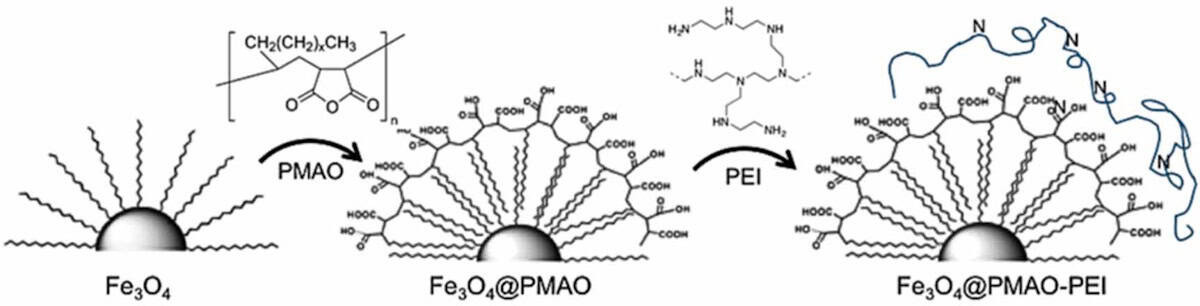
To illustrate the real-world applicability of the random forest-based IFE.PTML model, the researchers synthetized two novel magnetite nanoparticle systems (the 31 nm-diameter Fe3O4_A and the 26 nm-diameter Fe3O4_B). Magnetite-based nanoparticles are biocompatible, can be easily functionalized and have a high surface area-to-volume ratio, making them efficient drug carriers. To make them water soluble, the nanoparticles were coated with either PMAO (poly(maleic anhydride-alt-1-octadecene)) or PMAO plus PEI (poly(ethyleneimine).
Preparation process Functionalization of Fe3O4 nanoparticles with PMAO and PEI polymers. (Courtesy: Mach. Learn.: Sci. Technol. 10.1088/2632-2153/ae038a)
The team characterized the structural, morphological and magnetic properties of the four nanoparticle systems and then used the optimized model to predict their likelihood of favourable bioactivity for drug delivery in various human brain cell lines, including models of neurodegenerative disease, brain tumour models and a cell line modelling the BBB.
As inputs for their model, the researchers used a reference function based on the bioactivity parameters for each system, plus perturbation theory operators for various nanoparticle parameters. The IFE.PTML model calculated key bioactivity parameters, focusing on indicators of toxicity, efficacy and safety. These included the 50% cytotoxic, inhibitory, lethal and toxic concentrations (at which 50% of the biological effect is observed) and the zeta potential, which affects the nanoparticles’ capacity to cross the BBB. For each parameter, the model output a binary result: “0” for undesired and “1” for desired bioactivities.
The model identified PMAO-coated nanoparticles as the most promising candidates for BBB and neuronal applications, due to their potentially favourable stability and biocompatibility. Nanoparticles with PMAO-PEI coatings, on the other hand, could prove optimal for targeting brain tumour cells.
The researchers point out that, where comparisons were possible, the trends predicted by the RF-IFE.PTML model agreed with the experimental findings, as well as with previous studies reported in the literature. As such, they conclude that their model is efficient and robust and offers valuable predictions on nanoparticle–coating combinations designed to act on specific targets.
“The present study focused on the nanoparticles as potential drug carriers. Therefore, we are currently implementing a combined machine learning and deep learning methodology with potential drug candidates for neurodegenerative diseases,” González-Díaz tells Physics World.




 This podcast is supported by