NASA should fund a dedicated space-based infrared-survey telescope to detect potentially dangerous asteroids and other objects approaching Earth. That is according to a report by the National Academies of Sciences, Engineering and Medicine, which states that detecting asteroids with thermal infrared radiation would allow for a much better determination of their diameters than optical methods.
NASA has been required to track and assess the threat of near-Earth objects (NEOs) following the George E Brown, Jr Near-Earth Object Survey Act, which was passed in 2005. This required the agency to track asteroids with a diameter greater than 140 m – a number that was obtained via several assumptions about an NEO’s intrinsic brightness and therefore how dangerous it is to Earth. However, this method could fail to detect objects that appear dim to optical telescopes but are actually large enough to cause destruction on a regional scale.
Space-based infrared telescopes to detect asteroids already exist. NASA’s main instrument is NEOWISE, part of the Wide-field Infrared Survey Mission operated by NASA’s Jet Propulsion Laboratory (JPL). According to JPL’s Amy Mainzer, who is NEOWISE’s principal investigator, the mission has already far exceeded its expected lifetime. “At some point we won’t be able to operate it anymore,” says Mainzer, who was not part of the academies panel. “It gets warmer in the summer, then cooler during the rest of the year; for a heat-sensitive telescope, staying cool is the name of the game.”
Keeping cool
While infrared telescopes typically rely on liquid helium for cooling, panel chairman Jay Melosh from Purdue University says that the new telescope could be passively cooled instead. This would be achieved by positioning the telescope at Lagrangian point 1 – a position in space about 1.6 million kilometres from Earth in the direction of the Sun, in which the gravitational forces of the Earth and Sun effectively cancel out. Being placed here would allow the telescope to operate at around 40 K. “That [location] is far enough from Earth not to have Earth’s radiation impact it,” adds Melosh,”but close enough for good communications.”
The nine-strong panel that wrote the report also recommend that missions such as asteroid detection, which meet “high-priority planetary defence objectives”, should not be required to compete against missions that are a high priority for science. “This [new mission] isn’t primarily a science mission,” says Melosh. “Its primary goal is to satisfy requirements that Congress put on NASA.”
Turbulence is a common phenomenon in nature and is also important for many industrial processes. However, the way in which turbulence arises and then sustains itself is still not completely understood. Indeed, Richard Feynman once described turbulence as the last great unsolved problem of classical physics.
Researchers are making real progress, however, by studying turbulence in 2D fluid flow. In a classical fluid, such as water or air, flow can be described by a dimensionless number known as the Reynolds number, which expresses the ratio of inertial and viscous forces in the fluid. A fluid flowing smoothly becomes turbulent once this number becomes sufficiently large.
The situation is different in 2D fluids, however, because turbulence acquires new features, such as the formation of large-scale vortex structures (or circulation of the fluid) that are like tiny cyclones. This means that a system that is initially chaotic will become more ordered and structured as increasing amounts of energy are supplied to it, which is counterintuitive since we would expect the opposite to happen. Such vortices have been seen in systems ranging from soap films to atmospheric flow on planets (the best-known example being Jupiter’s Great Red Spot).
When I meet God, I am going to ask him two questions: Why relativity? And why turbulence? I really believe he will have an answer for the first. Werner Heisenberg
Onsager’s statistical model
70 years ago, physicist Lars Onsager proposed a statistical model based on point vortices (individual vortices with quantized unit circulation) to explain this behaviour. He showed that vortices that rotate in the same direction (clockwise or anticlockwise) tend to cluster as more energy is put into the system. One of the more interesting aspects of Onsager’s work is that the statistical distribution of these vortices is characterized by absolute negative temperature states (that is, those that are below absolute zero), which correspond to low entropy (more ordered) states. This behaviour is the opposite to most normal systems in which increasing the energy decreases the order (and increases the entropy).
Two independent research groups in Australia have now confirmed Onsager’s statistical model in experiments for the first time in quantum fluids known as superfluids.
A team led by Tyler Neely from the ARC Centre of Excellence for Engineered Quantum Systems (EQUS) at the University of Queensland created its superfluid (a Bose-Einstein condensate) by cooling a gas of rubidium-87 atoms down to nearly absolute zero and trapping it in the focus of laser beams. “We shape the laser beam using digital micromirror devices, a technology that is usually found in video projectors,” explains Neely. “The superfluid then takes on the shape of the laser beam. Using this control, we first create a ‘tank’ of superfluid and then produce ‘paddles’ that we use to stir vortices into the superfluid.
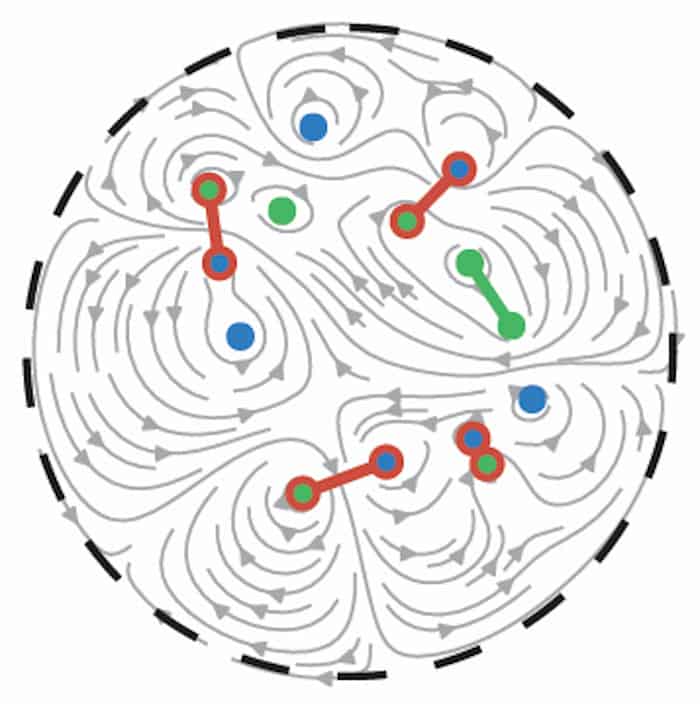
Dipole dominated vortex (Monash study). Courtesy: FLEET (ARC Centre of Excellence in Future Low-Energy Electronics Technologies). By permission from K Helmerson
Long lasting vortex clusters
“Our technique isn’t actually much different than stirring a spoon through your coffee, except that we can do this with light and at such a small, micron scale.”
Interestingly, the absolute negative temperature vortex clusters last for a very long time – around 10 seconds. “We were not necessarily expecting this since these vortices can potentially couple to other excitations in the superfluid, dissipating their energy,” says Neely.
Indeed, absolute negative temperature states are sometimes described as being “hotter than hot” since they want to give up their energy to a normal system at positive temperature.“Our experiments show that vortices are relatively isolated from other excitations, however. This means that such superfluids can retain high vortex energies, making them ideal systems in which to study 2D vortex dynamics.”
Meanwhile, researchers led by Kristian Helmerson at Monash University injected point-like vortices into a uniform planar superfluid, also a Bose-Einstein condensate made of rubidium-87 atoms, by dragging a grid of elliptical obstacles formed by an array of laser beams through the atomic cloud.
Towards more clustered, high energy flow states
Helmerson’s team then observed how the resulting states evolve by identifying the sign and location of each vortex in their superfluid. “This technique allows us to directly measure the distribution of the vortices and calculate their temperature, just as Onsager did,” says group member Shaun Johnstone. “We find that this temperature increases, through to negative absolute temperatures, as the flow field increases in energy – just as Onsager described.”
The researchers also saw that initially randomly distributed vortices tend to evolve towards a distribution of vortices corresponding to more clustered, high-energy flow states, thanks to vortex-antivortex annihilation.
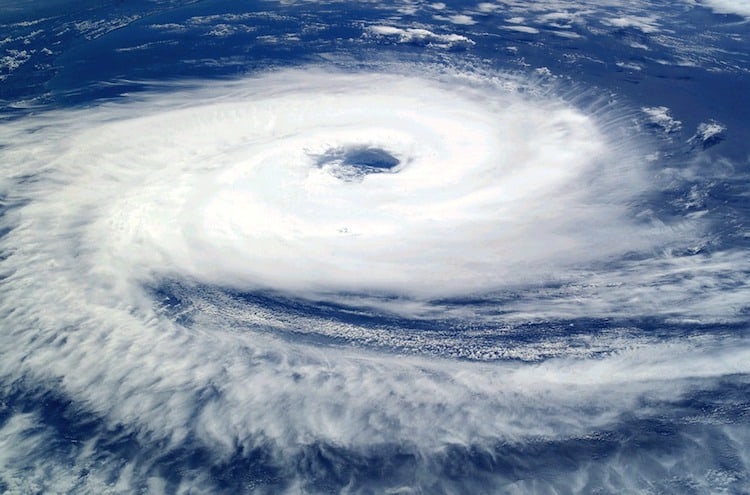
A cyclone weather system viewed from space: another 2D vortex. Courtesy: Pixabay
The techniques employed in both studies could come in useful for investigating other systems that can be described with Onsager’s model of point vortices. These include helium films, nonlinear optical materials, fermion superfluids and plasmas. From a broader perspective, the results obtained thus far offer some important insights into emerging turbulent phenomena and a better understanding of the non-equilibrium behaviour of interacting quantum systems.
Studying far from equilibrium systems and vortex temperatures
“In our experiments, we essentially created a high energy clustered vortex state that is near equilibrium (at negative temperatures) and observed its very slow decay,” Neely tells Physics World. “The next step in our work will be to initialize arrangements of clusters that are far from equilibrium and then observe how they subsequently relax to a negative temperature state. This is an example of a strongly out-of-equilibrium system – such as what characterises turbulence.”
Helmerson’s team, for its part, says that it is now looking for stronger signs of the dynamic clustering of vortices, which will mean generating greater numbers of vortices. “We are also studying the temperatures of the vortices in more detail, and are, for example, looking for heat transfer when a hot vortex arrangement and a cold vortex arrangement are generated on opposite sides of a BEC,” Helmerson tells Physics World. “We will also investigate the transition to vortex clustering when we input continuous energy.”
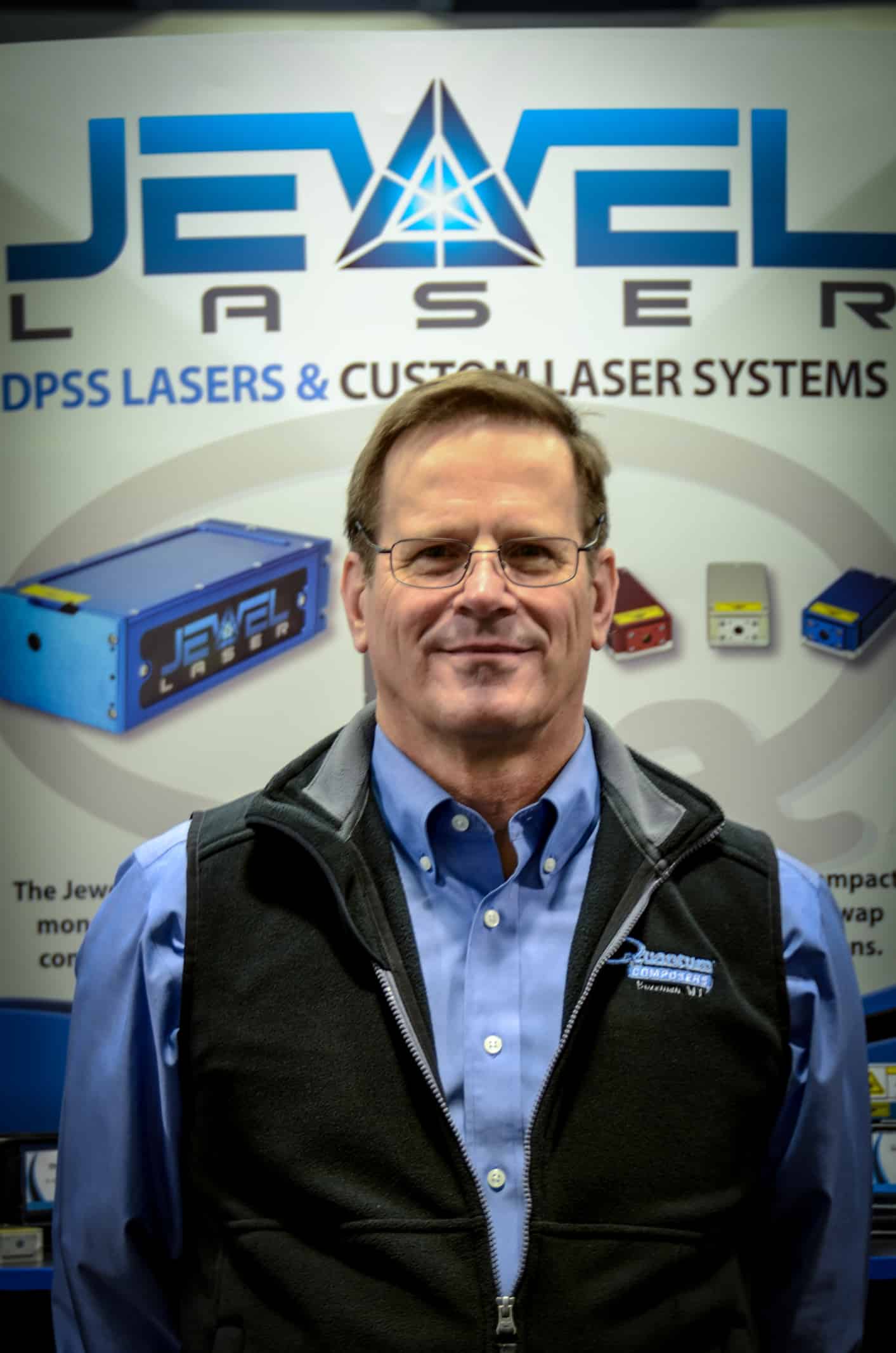
Steve Birrell is the founder and chief executive officer at the laser and photonics firm Quantum Composers. (Courtesy: Quantum Composers)
What led you to start Quantum Composers?
I spent 10 years at Hughes Aircraft back when they were doing stuff with laser range finders and target designators, and that was a great experience from a technical standpoint, but I was travelling quite a bit and I didn’t really enjoy the big corporate environment. So I quit and started my own company in my basement, designing an energy meter. I did that for a year, and I got it ready to go into production, but at that point I realized it would require a lot of money to take it to the next step, especially since energy meters were a fairly well-established technology. You couldn’t just introduce a new one and say, “Trust me.” Luckily, I managed to convince someone at Moelectron Detector (now part of Coherent) to license the technology, and it became their top-performing instrument.
At around the same time, I got an offer to help start a laser company in Bozeman, Montana. I was living in Los Angeles with young kids, and my wife and I were looking for a better environment. So we moved, and I helped start a company called Big Sky Laser, which is now owned by Quantel. I was the third employee and I saw it grow to 45 people, but then I started chafing again at having someone tell me what to do, so I started Quantum Composers. Our first product was a line of pulse generators that was less accurate, but also less expensive, than the competition. It had more features as well; for example, it had multiple channels that were fully independent, so you could set up a Q-switched laser very easily. It has been our base product ever since, although of course we have developed others as well.
Some of those product lines have been split off into separate companies. How has that worked out?
The first time we did it, it was not a great situation. We had built a system for laser ablation, helped develop the market and were just gaining a presence in it when two of my four partners, who were under some personal financial stress, decided they wanted to sell. The offer we got was quite low, but the ones who wanted to sell had slightly more sway, so they forced the sale, and our system became a very good product line for its new owners.
That taught me the importance of picking your partners wisely and making sure everyone is on the same page. The next time we sold a product line, it was a much better experience. We sold it to a major player in the market, and I actually worked for them for a couple of years. Then I arranged to buy back the Quantum Composers name and some of our other product lines, such as the pulse generators. That gave me seed stock, essentially, to re-start the company.
What other challenges have you faced?
The big thing for us in the early years was managing cash flow. We were self-funded and I didn’t have a lot of capital to start with. More recently, we have had some difficulty hiring laser technicians. Generally, we’ve been lucky with our employees; the people I hired when I started Big Sky Laser were mostly fresh out of Montana State University, which has very good mechanical engineering and physics departments, and they turned out to be excellent – I still have some of them working with me now. But otherwise, we have to convince people who trained somewhere else to come and work in Bozeman, and that can be a challenge. The final thing I’ll mention is marketing. You can spend a lot of money on marketing, but we adopted more of a guerrilla approach, doing everything we could to get our name out as cheaply as possible. That has worked well for us, but in the early days of the company, before the World Wide Web, it was definitely a challenge.
You mentioned being self-funded. Why did you go down that route?
When I was at Hughes Aircraft, all we did was government projects, and I wanted to avoid the overheads associated with those kinds of contracts. That decision, in effect, removed a major potential source of funding for us. For a lot of our early contracts, we looked not only at what money they would bring in, but also at what technology we would have to develop. At the end of the day, even if it didn’t turn into a big product for us, it would help us develop our technology base.
Your background is a mixture of physics and engineering. How has that helped you?
I did my undergraduate degree in physics at the Massachusetts Institute of Technology, but I also took upper-level courses in electrical, mechanical and software engineering. In the laser world, that has been very useful, because laser problems involve a lot of interplay between thermal and electrical issues. You need to understand all those disciplines, at least at some level. I also think there is a difference in the way that physicists and engineers think. One of my employees summarized this well. He was moving house, and he had to tie up a trailer-load of stuff. Another employee, a physicist, got the ropes laced so that everything was secured, but there was only one knot at each end, so if the rope broke anywhere, the whole thing was going to fall. That’s a physicist solution – it works and it requires a minimum of rope and effort. But an engineer would look at it and say, “Hmm, you need some redundancy in your system.” So to me, having a little engineering experience, plus a physics background, is the perfect combination.
What do you know now that you wish you’d known when you started?
I think my biggest regret is what happened with our laser ablation system. If we had been able to stick with that, it potentially would have catapulted us to a new level. So the main thing I have learned is that if you identify a market like that, you have to stick with it, believe in it, and not get cold feet about the cost of getting there. Part of success is luck – being in the right place at the right time. But a lot of it is just having the nerve to stick with a product or a market even if it’s not quite there yet.
Any advice for someone starting a new optics company?
Make sure your product has a customer that’s willing to pay at least what it costs to produce it. Then, once you’ve got a few customers, be very open to what they are saying they really need, because it may be slightly different from the product you originally developed. Finally, be very aggressive in responding to those needs. I think the rest will take care of itself.
My 18-year old-nephew was recently sitting across the table from me, searching for a video about the mathematical Mengoli series. He is studying calculus as a first-year computer-science student at the University of Coimbra in Portugal, where I teach physics. I was just about to lecture my nephew and tell him that he should be using the beautiful LaTeX-written lecture notes provided by his teacher, which would include many pedagogical, and successively more complex, examples. But then I realized that I had just been watching a video on how to bake a pudding with Christmas leftovers, and another on how to try to fix my boiler that is refusing to heat water*. Indeed, I was not searching the Web for written information but instead for videos, because they provide a more efficient way to absorb information – so how could I censure my nephew?
I then asked him about the practice of the majority of students when it came to studying for their exams, and I also asked my colleague, Pedro Silva, to similarly question his freshman son. Their answers were revealing: both prefer to learn everything using online videos; preferably in Portuguese, or, if not, in English. They try to avoid proofs at all costs, and instead prefer to learn only the most efficient methods on how to solve the exercises. For a common topic such as the Mengoli series, one can easily find 20 online videos in Portuguese (and twice as many in English), each describing the mathematical series and how to solve exercises based on it.
This made both Silva and me reflect on our own teaching practice. We spend a lot of time compiling good lecture notes, making appealing slides and looking for the most pedagogical manuals to follow. All the while, it seems that students are ignoring our efforts and basing their study on videos that we do not control or monitor. And reversing students’ appetite for easy, quick videos is not really an option. In Portugal, the vast majority of young adults own a smartphone or a laptop, and university students are permanently connected to the Internet via eduroam, or commercial Internet service providers. They watch videos on public transport, listen to content while jogging and biking, and even in bed before sleeping. These videos are always available, even at that peak of adrenalin that is the eve of an exam, when a teacher is not around.
So what can we university teachers do to resolve the situation? First, we should start making such videos ourselves. It would initially be a time-consuming task, but once a set of high-quality videos about introductory physics, say, are made, they would be useful for all courses from biology to civil engineering. As the videos would be created by a college teacher, the explanations would be more nuanced and accurate – for example, by stating exactly the validity of the approximations being made (or by injecting tips for exercise solving).
Second, the teaching hours attributed to each subject have to change, in type and duration. If it is possible to replace a two-hour problem-solving class with a few four-to-five-minute-long videos, what are we doing with our time? Between sitting everybody down, waiting for all the students to try tackle the exercise, and waiting for all of them to finish taking notes from the blackboard, only part of the time is used to answer the students’ questions. But it is this face-to-face interaction that is most important, and is what we traditional, old-school teachers fear losing. Today’s video technology would greatly reduce the contact hours students have with teachers – indeed, a course could be done at a distance. That could have its drawbacks, though on the plus side it would open up well-structured and strongly taught courses to students all over the world.
But we should also change the curricula of teacher-training courses. Currently, teachers are encouraged to practise in front of a blackboard, and are trained to go through high-school manuals and look at text and written exercises with a critical eye. But there is no training in video-making or how to appraise educational videos. A lot more could also be said on the use of students’ smartphones as an instrument to record images and sound, or allowing the video analysis of moving bodies (projectiles, pulleys, rotating discs). A smartphone could also be used as a measuring device that incorporates some useful sensors for a physics class, such as an accelerometer, a gyroscope, a magnetometer or a light sensor.
And let’s not forget about researchers – should they be trained to share their research via video too? Graduates and doctoral students are often asked to give talks in front of audiences as part of their evaluation, but they are rarely asked to make a video. However, if you look closely at the homepages of most of today’s scientific journals, more and more of them are asking researchers to provide video abstracts, so that readers can quickly establish the purpose and results of the research.
We college teachers must catch up with video, before we are left too far behind
So it seems that we college teachers must catch up with video, before we are left too far behind. Our students have certainly moved on (without us noticing), making use of all the content available on YouTube and similar sites. They have reduced their studying time, freeing up more hours to spend on other activities – some of which involve videos too!
(*The pudding came out delicious; the boiler still jams; our kids passed the calculus exam.)
Excitement is mounting in our Battle of the Elements as we reach the third and final knockout round.
In the latest Physics World Weekly podcast, Margaret Harris argues the case for lithium, Liz Kalaugher explains why nitrogen should top the table and Hamish Johnston flies the flag for iron. After listening to the arguments, you can help us celebrate 2019 as the International Year of the Periodic Table by voting for your favourite out of these three in our latest Twitter poll.
We also hear from the theoretical physicist Jose D’Incao, who explains why he is part of a team that is doing ultracold-atom experiments on the International Space Station. Moving even further away from Earth, we chat about astrobiology and the scientific and philosophical implications of life on other planets.
An “atomic recording studio” has been used by physicists in the US to record music using atoms in a vapour. The system was used to simultaneously record sound from two guitars and also to capture and reproduce the iconic sound of the rock band Queen.
The studio was created by Chris Holloway and colleagues at the National Institute for Standards and Technology (NIST) in Boulder, Colorado. The team used concepts of Rydberg physics to store audio information on two species of atoms within the same vapour. Their research could lead to improvements in secure quantum communications, particularly in deep space where very weak signals must be used.
Rydberg physics is a burgeoning field that focuses on the properties of Rydberg atoms, which have one or more electrons that are excited to very high energy levels. Since these excited electrons are relatively far away from their host nuclei, Rydberg atoms have huge dipole moments. This means that the atoms interact strongly with the radio and microwave signals that are used in telecommunications.
Quantum-scale receiver
A Rydberg radio uses a vapour of Rydberg atoms contained within a small chamber to receive, store and output radio and microwave signals. These devices have been demonstrated in several recent studies and are examples of practical quantum-scale receivers.
The NIST researchers pushed the capabilities of Rydberg radio further than ever before in their study. They created an “atomic recording studio” that stored Holloway’s own improvised guitar solos inside a Rydberg vapour cell in real time. They were able to do multitrack recording of two guitars using a vapour that contained two different types of Rydberg atom. One guitar track being recorded by caesium and the other by rubidium.
Finally, they used the same setup to record Queen’s track “Under Pressure”. While one atom species handled the instrumental part of the track, the other recorded the vocals and managed to cope with Freddie Mercury’s extensive vocal range. Holloway’s team acknowledges that limitations in sound quality mean that Rydberg radio won’t be replacing digital recording devices any time soon, but still hope to produce an “atomic record” in their studio; potentially inspiring a new generation of quantum researchers.
Their setup also shows promise for improving secure quantum communications, particularly by detecting the very weak signals characteristic of transmissions used in deep space communications. Holloway and colleagues now aim to determine just how weak these signals can be before they become undetectable to Rydberg atoms, and determine the maximum speed at which data can be transmitted.
The recording studio is described in AIP Advances.
Self-organized and complex neural network activity has been observed in cerebral organoids – artificially grown 3D tissue cultures that resemble the cerebrum of the human brain. These organoids could help advance our understanding of various brain functions such as memory and intention as well as the fundamental mechanisms underlying neuropsychiatric diseases.
Recent advances in stem cell technology have allowed researchers to construct cerebral tissue from human pluripotent stem cells (hPSCs) in 3D. Cerebral organoids have the same architecture and physiology of the cerebrum, which is the largest and most complex tissue in the brain, comprising assembled activated cells organized in neural networks. The good thing about these organoids is that they mimic cerebral development and can thus be used as a substitute for the cerebrum, not only to model its development but also cerebrum-related diseases such as microcephaly, glioblastoma and Timothy syndrome, to name just three.
Researchers led by Jun Takahashi of the Center for iPS Cell Research and Application (CiRA) at Kyoto University in Japan have now imaged synchronized and unsynchronized activity in the networks and connections between the individual neurons of cerebral organoids they grew in the laboratory. Synchronized neural activity is responsible for various brain functions, including memory.
Mimicking the developmental process of the cerebrum
The researchers grew active cerebral organoids from a ball of hPSCs by placing the cells in a culture medium that mimicked the environment necessary for cerebral development. They generated the organoids via the SFEBq (serum-free floating culture of embryoid body-like aggregates with quick reaggregation). This method was pioneered by the stem cell pioneer Yoshiki Sasai and is now one of the most common procedures for producing this tissue.
“One of the most interesting properties of these organoids is that they actually recapitulate the developmental process of the cerebrum in their shape,” explains team member and lead author of this new study, Hideya Sakaguchi. “Their layered structure is very beautiful and looks just like actual brain tissue.”
The team cultured the organoids for 70-100 days, dissociated them into single cells and then disseminated them into another culture dish. The disseminated cells created neuronal networks in a self-organized manner, says Sakaguchi.
Synchronized bursts
The researchers then measured the activity of calcium ions (Ca2+) of all of the neuronal cells in a field and built maps of patterns reflecting the activity of over 1000 cells. The concentrations of Ca2+ fluctuate during neuronal activity and abnormal Ca2+ signals are thought to be implicated in brain disorders, such as epilepsy and Alzheimer’s disease. By imaging the intracellular calcium dynamics of the network in this way, Sakaguchi and colleagues showed that the cells in the networks show synchronized bursts of activity with some spontaneous individual activity.
The researchers used a popular technique to measure neuronal activity in their organoids that relies on using confocal or multi-photon microscopy to detect the fluorescence produced when Ca2+ ions bind with calcium indicators in neurons.
“We chose this method because it can be used to detect the shape of a neuronal network and relate it to its function,” explains Sakaguchi. “Combining this technique with our high-content analytical approach allows us to visualize synchronized and non-synchronized network clusters and divide the synchronized ones into several smaller clusters, to provide us with information on cell distribution.”
Ethical concerns
Growing artificial brains in the lab is a sensitive area of research to say the least and many have raised concerns about the ethical issues – for instance, regarding the neural function of these cerebral organoids. Since these structures mimic the developmental process of the brain, could they also acquire mental activities such as consciousness in the future? Takahashi and Sakaguchi think not – simply because the organoids lack sensory input from their surrounding environment. The famous “brain in a vat” thought experiment, proposed by the philosopher Hilary Putnam, is thus still safely in the realms of science fiction.
“Consciousness requires subjective experience, and cerebral organoids without sensory tissues will not have sensory input and motor input,” says Sakaguchi in a press release issued by CiRA. “However, if cerebral organoids with an input and output system develop consciousness requiring moral consideration, the basic and applied research of these cerebral organoids will become a tremendous ethical challenge.”
Three main application areas
Organoid research such as ours will have three main application areas in the future, he tells Physics World. The first is in drug discovery. “Our analysis technique could allow us, for instance, to detect the minimum dose of a drug that causes abnormal neural network activity – something that could come in useful for pharmaceutical companies wishing to replace conventional drug evaluation methods that rely on animal models.”
The second area of research is in the modelling of neuropsychiatric disorders (especially complex, currently untreatable ones) and better understand those that degrade neuronal activity by analysing cell activity patterns, he says. Ultimately, this could lead to reliable psychiatric disease models using patient-derived induced pluripotent stem cells (iPSCs).
The third area involves regenerative medicine – for example, attempting to improve loss of brain function caused by specific diseases such as cerebral haemorrhage, cerebral infarction or physical trauma.
In light of their models, the researchers argue for continued upwards ratcheting of fuel-economy standards for new vehicles, and for policies that encourage the replacement of the most inefficient vehicles.
Introduced in the US in the 1970s in answer to rapid rises in the price of oil, Corporate Average Fuel Economy (CAFE) standards led to a gradual improvement in the fuel efficiency of cars and light trucks over subsequent decades. Targets set by the Obama administration would have seen the trend continue beyond 2020, reaching 39 miles per gallon (MPG) in real-world terms in 2025.
This continuous improvement requires constant innovation on the part of automakers, however, and the sector has lobbied for standards to be relaxed. Responding to these calls, the US Environmental Protection Agency and the Department of Transportation under the Trump administration have proposed freezing standards at the 2020 level of 31 MPG.
Keith and colleagues modelled the effect that such a freeze would have on the cumulative emissions from light vehicles out to 2050. The researchers assumed that the pause would last until 2026, after which standards would continue to be tightened. The trajectories with and without the freeze would then converge at 2050 on an allowable greenhouse gas emissions figure reduced by 75% from the 2018 level.
On this timescale, a six-year hiatus in efficiency improvements might not seem so significant, especially if the same standard is ultimately achieved whatever the near-term policies. As the researchers’ model showed, however, the longevity of modern vehicles imparts a great deal of inertia to the makeup of the fleet, so decisions taken today will have an effect for years to come.
If, for example, electric vehicles instantly became so popular that they accounted for all new purchases from tomorrow, in 20 years’ time 10% of the cars on the roads would still be combustion-driven. This lag means that just six years’ worth of sales of slightly less efficient vehicles could, according to Keith and colleagues, result in the emission of an extra 2.5 gigatonnes of CO2 over the modelled period.
The same effect implies that, even if standards are driven up relentlessly, keeping transport-related emissions to a minimum might require an acceleration of the slow natural vehicle replacement rate. To achieve this, the researchers propose a feebate system in which financial penalties are applied to the least efficient vehicles while more efficient choices are rewarded.
The level of inducement would have to be set carefully, so that the emissions savings from having a more efficient fleet are not cancelled out by the carbon cost of manufacturing new vehicles.
“Greenhouse gas emissions occur throughout the vehicle lifecycle, from manufacturing and operation to retirement,” says Keith. “Determining the optimal time at which an individual vehicle should be retired depends on the attributes of the vehicle it will be replaced with. Models such as the one we demonstrate in this paper can inform the design of fleet management policies to ensure that real reductions in emissions are achieved.”
If the freeze does go ahead, its effects could extend far in space as well as time.
“Several other countries set their fuel-economy standards based on US policy — including Canada, Mexico and Saudi Arabia — so a rollback of CAFE could have wide-reaching consequences,” says Keith.
Heavy ion therapy is a promising cancer treatment technique, with beams of heavy ions delivering sharper Bragg peaks and less lateral scattering than a proton beam. But as tumour targeting gets more precise, it becomes increasingly critical to perform accurate verification of dose delivery. With this aim, researchers at National Institute of Radiological Sciences (NIRS) and Nagoya University in Japan have investigated the use of optical imaging for high-resolution range estimation in heavy ion beams.
The NIRS team used imaging of prompt luminescence and Cerenkov light to estimate the range of radioactive 11C and 15O ion beams created at the Heavy Ion Medical Accelerator in Chiba (HIMAC). They found that in-beam luminescence imaging can measure the Bragg peak, while offline Cerenkov imaging can determine the stopping position of the ion beams (Phys. Med. Biol. 10.1088/1361-6560/ab1ccf).
“The main benefits of optical imaging over other approaches being developed for beam range verification are its high resolution and low cost,” explains first author Han Gyu Kang. “The optical imaging is performed using a lens and a CCD camera, thus submillimetre spatial resolution can be achieved, which is hardly possible for PET or prompt gamma-based range verification. In addition, the optical imaging system costs less than $1000, while PET or prompt gamma systems require a number of scintillation crystals, photosensors and a complex signal processing unit.”
Han Gyu Kang (right) and Seiichi Yamamoto.
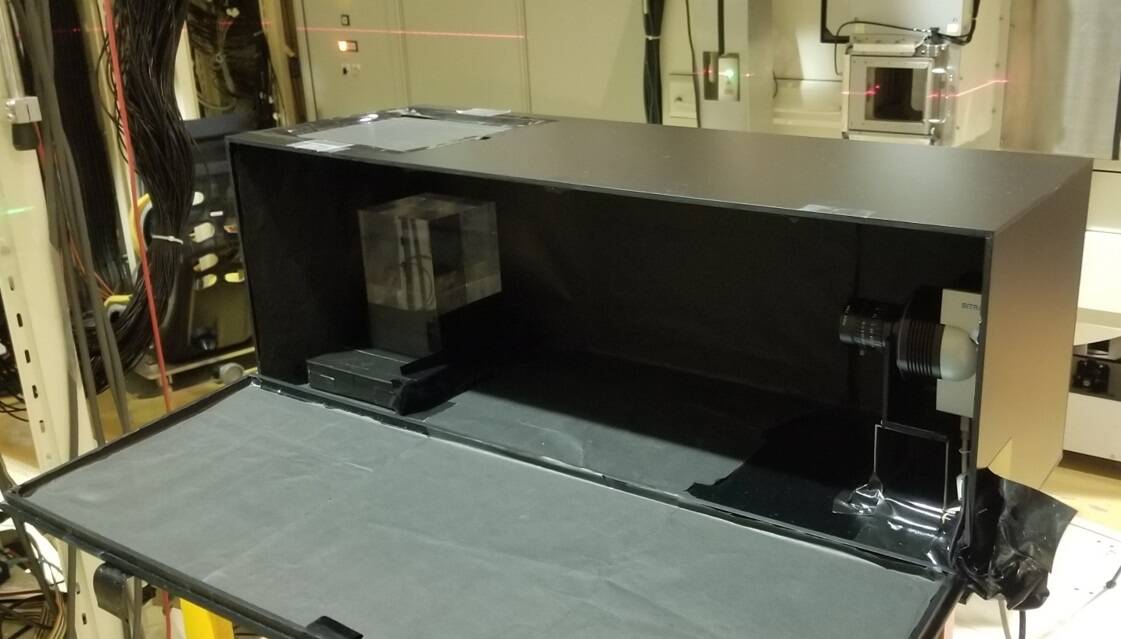
To assess their proposed optical imaging approach, Kang and colleagues irradiated a PMMA phantom with radioactive 11C and 15O ion beams (for 30 and 8 min, respectively) produced at HIMAC’s secondary beam line. They used a cooled CCD camera to measure the generated luminescence and Cerenkov light.
Since prompt luminescence light is only produced during irradiation, the researchers recorded luminescence images in-beam; Cerenkov images were obtained offline immediately after irradiation to exclude the luminescence signal. They recorded luminescence images for 4 and 2 min, and Cerenkov images for 30 and 2 min, for the 11C and 15O ion beams, respectively.
The longer Cerenkov imaging time required for the 11C ion beam is due to its relatively long half-life of 20 min, compared with 2 min for 15O. This imaging time could be reduced, say the authors, by replacing the current front-illuminated CCD camera with a back-illuminated CCD camera with higher quantum efficiency at 400 nm.
The optical imaging setup at the HIMAC secondary beam line. (Courtesy: Han Gyu Kang)
To validate the Cerenkov images, the team performed in-room PET, which maps positron emitters generated during irradiation. For both ion beams, the Cerenkov image had a similar shape to that of the PET image, indicating that Cerenkov imaging can visualize the stopping position of the ion beam as effectively as PET.
Comparisons of line profiles revealed that, for the 11C ion beam, the Bragg peak (at 44.0 mm) showed a good correlation with the peak of the luminescence profile (45.0 mm). Likewise, for the 15O ion beam, the Bragg peak (at 46.8 mm) corresponded well with the luminescence peak (47.2 mm).
The peaks of the Cerenkov profiles (50.6 and 49.7 mm, for 11C and 15O, respectively) matched the peaks of the PET profiles (50.5 and 49.5 mm). The authors note that the positional differences between the Bragg peak and the Cerenkov peak seen in both cases is due to the energy spread of the ion beam, which was larger for 11C ions.
For the 11C ion beam, the FWHMs of the line profiles were 16.0 and 18.1 mm, for the Cerenkov and PET signals, respectively. For the 15O ion beam, the respective values were 12.3 and 16.5 mm. These results demonstrate that Cerenkov imaging could provide better resolution than PET, the spatial resolution of which is limited by size of the scintillation crystal (typically 2 to 4 mm).
The authors conclude that optical imaging could be used to visualize the Bragg peak and stopping position of radioactive ion beams with sub-millimetre resolution. Due to the low penetration depth of optical photons, typically less than 10 mm, the technique cannot be used during patient treatment.
“Nevertheless, the optical imaging technique is a promising method for high-resolution and cost-effective Bragg peak measurement of radioactive ion beams,” says Kang. “Our next step is to investigate the feasibility of optical imaging for daily quality control of radioactive ion beams at NIRS.”
Gravitational waves are distortions in space–time that carry energy and information across the universe. Predicted by Albert Einstein in 1916, they were first observed by the two detectors of the LIGO observatory in 2015. Since then, these detectors have measured ten gravitational wave signals from binary black hole mergers and one from a system of binary neutron stars spiralling towards each other. However thermal fluctuations in the detector mirrors can compromise the sensitivity of these detectors.
Scientists at the University of Glasgow and collaborators have now developed a multimaterial coating design for the mirrors used in gravitational wave detectors. They suggest their coating will minimize thermal fluctuations at cryogenic temperatures for the next generation of detectors and will contribute to improving their sensitivity at 10 Hz by a factor of 100.
Loss limitations
The Einstein Telescope is a proposed third-generation gravitational wave observatory with the goal of a factor of at least 10 improvement in sensitivity of existing detectors such as Advanced LIGO. At low frequencies, where current detectors are quite insensitive, a factor of 100 improvement is planned, increasing the frequency band observed for gravitational waves. The hope is that this improved sensitivity will increase the observable volume of space by a factor of 1003 . This may then allow for detection of known young pulsars as well as the first detection of galactic Ia supernova.
Jessica Steinlechner, one of the researchers, aligning a pulsed laser deposition system at Hamburg University to make an optical coating layer. Credit: Hamburg University
The mirrors in gravitational wave interferometer arms are commonly coated in oxides of silicon (SiO2) and tantalum (Ta2O5). Although the optical absorption of these materials is very low, they are prone to mechanical loss (vibrations arising from thermal energy) at the low-temperature operation range of the Einstein Telescope.
Quiet coatings
Iain Martin at the University of Glasgow in the UK, alongside researchers in the UK, Germany and the US instead propose a multimaterial approach using amorphous silicon and SiO2:HfO2 with two bilayers of SiO2 and Ta2O5 deposited on top. They investigated the mechanical loss and optical absorption of their multimaterial coating using cantilever ring-down tests and photothermal common-path interferometry respectively.
The team found the mechanical loss of SiO2:HfO2 to be less than half that of SiO2. In addition, the team demonstrated that this coating structure would be 25 times less noisy than current coatings (at a frequency of 10 Hz) and could contribute to increase the sensitivity of detectors by a factor of 100. The application of this novel multimaterial coating promises to usher in a new era of ultralow noise, super-sensitive gravitational wave detectors.