An internal audit has slammed NASA over its handling of the Dragonfly mission to Saturn’s largest moon, Titan. The drone-like rotorcraft, which is designed to land on and gather samples from Titan, has been hit by a two-year delay, with costs surging by $1bn to $3.3bn. NASA now envisions a launch date of July 2028 with Dragonfly arriving at Titan in 2034.
NASA chose Dragonfly in June 2019 as the next mission under its New Frontiers programme. Managed by the Johns Hopkins University Applied Physics Laboratory, it is a nuclear-powered, car-sized craft with eight rotors. Dragonfly will spend over three years studying potential landing sites before collecting data on Titan’s unique liquid environment and looking for signs that it could support life.
The audit, carried out by NASA’s Inspector General, took no issue with NASA’s tests of the rotors’ performance, which were carried out via simulations. Indeed, the mission team is already planning formal testing of the system to start in January. But the audit criticized NASA for letting Dragonfly’s development “proceed under less than ideal circumstances”, including with a “lower than optimum project cost reserves”.
Its report aims to now avoid those problems affecting future New Horizon missions. Specifically, it calls on Nicky Fox, NASA’s associate administrator for its science mission directorate, to document lessons learned from NASA’s decision to start work on the project before establishing a baseline commitment.
It also says that NASA should maintain adequate levels of “unallocated future expenses” for the project and make sure that “the science community is informed of updates to the expected scope and cadence for future New Frontier missions”. A NASA spokesperson told Physics World that NASA management agrees with the recommendations in the report adding that the agency “will use existing resources to address [them]”.
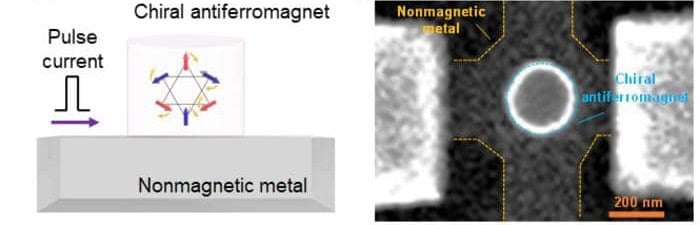
How it works On the left is a schematic illustration of memory device consisting of a chiral antiferromagnet Mn3Sn / nonmagnetic metal heterostructure. On the right is a scanning electron microscope image of the fabricated device with a Mn3Sn nanodot and a nonmagnetic metal channel. (Courtesy: Yutaro Takeuchi et al)
While antiferromagnets show much promise for spintronics applications, they have proved more difficult to control compared to ferromagnets. Researchers in Japan have now succeeded in switching an antiferromagnetic manganese–tin nanodot using electric current pulses as short as 0.1 ns. Their work shows that these materials can be used to make efficient high-speed, high-density, memories that operate at gigahertz frequencies, so outperforming ferromagnets in this range.
In antiferromagnets, spins can flip quickly, potentially reaching frequencies well beyond the gigahertz. Such rapid spin flips are possible because neighbouring spins in antiferromagnets align antiparallel to each other thanks to strong interactions among the spins. This is different from ferromagnets, which have parallel electron spins.
Another of their advantages is that antiferromagnets display almost no macroscopic magnetization, meaning that bits can be potentially packed densely onto a chip. And that is not all: the values of bits in antiferromagnetic memory devices are generally unaffected by the presence of external magnetic fields. However, this insensitivity can be a disadvantage because it makes the bits difficult to control.
Faster than ferromagnets
In the new work, a team led by Shunsuke Fukami of Tohoku University made a nanoscale dot device from the chiral antiferromagnet Mn3Sn. They were able to rapidly and coherently rotate the antiparallel spins in the material using electric currents with a pulse length of just 0.1 ns at zero magnetic field. This is faster than is possible in any existing ferromagnetic device, they say.
The device is also capable of 1000 error-free switching cycles – a level of reliability not possible in ferromagnets, they add.
This result is possible because, unlike conventional antiferromagnets, Mn₃Sn exhibits a large change in electrical resistance thanks to its unique symmetry of the internal spin texture, explains Yutaro Takeuchi, who is lead author of a paper describing the study. “This effect provides us with an easy method for electrically detecting (reading out) the antiferromagnetic state. Doing this is usually difficult because antiferromagnets are externally ‘invisible’ (remember, they have zero net magnetization), which means their spin ordering cannot be easily read out.”
Until now, Mn₃Sn had mainly been studied in bulk samples, but in 2019, Fukami’s group succeeded in growing epitaxial thin films of the material. “This allowed us to perform clear-cut experiments using antiferromagnetic thin films and finally answer the question: can antiferromagnets really outperform their ferromagnetic cousins?” says Takeuchi. “Moreover, in this study, we took on the additional challenge of integrating antiferromagnetic thin films into nanoscale devices.”
New types of devices could be possible
Fukami and colleagues have been working on spintronics using ferromagnets for more than 20 years. “Although the fabrication of antiferromagnets was initially difficult, we finally managed to produce high-quality Mn₃Sn nanodot devices and demonstrated high-speed and high-efficiency control of the antiferromagnetic state,” Takeuchi tells Physics World. “We would say that our work represents a fusion of our two key strengths: a new method for depositing antiferromagnetic thin films and our conventional core technology in the nanofabrication of magnetic materials.”
As for potential applications, the most likely would be a high-performance non-volatile memory (MRAM), he says. “While MRAM technology is now commercially available, its applications remain limited. By further improving its high-speed and low power consumption, we anticipate a broader range of markets, including data centres and AI chips.”
The research, which is detailed in Science, has also highlighted some dynamical aspects of antiferromagnets not seen before in ferromagnets. “In particular, we found that the rotation frequency of an antiferromagnet can be modulated by an applied current, thanks to the unique dynamical equation it obeys,” explains Yuta Yamane, who did the theoretical modelling part of the study. “This distinct property may open the door to new types of devices, such as frequency-tuneable oscillators, and emerging concepts like probabilistic computing.”
Looking ahead, the team will now focus on improving the readout performance of antiferromagnets and pursuing new functionalities. “Thanks to their unique transport properties, chiral antiferromagnets allow us to detect spin ordering in experimental settings, but the readout performance has still not reached the level of ferromagnets,” says Takeuchi. “A breakthrough will be required to overcome this gap.”
Nothing is really known about the origin of the world-famous “pitch-drop experiment” at the School of Physics, Trinity College Dublin. Discovered in the 1980s during a clear-out of dusty cupboards, this curious glass funnel contains a dark, black substance. All we do know is that it was prepared in October 1944 (assuming you trust the writing on it). We don’t know who filled the funnel, with what exactly, or why.
Placed on a shelf at Trinity, the funnel was largely ignored by generations of students passing by. But anyone who looked closely would have seen a drop forming slowly at the bottom of the funnel, preparing to join older drops that had fallen roughly once a decade. Then, in 2013 this ultimate example of “slow science” went viral when a webcam recorded a video of a tear-drop blob of pitch falling into the beaker below.
The video attracted more than two million hits on YouTube (a huge figure back then) and the story was covered on the main Irish evening TV news. We also had a visit from German news magazine Der Spiegel, while Discover named it as one of the top 100 science stories of 2013. As one of us (SH) described in a 2014 Physics World feature, the iconic experiment became “the drop heard round the world”.
Pitching the idea
Inspired by that interest, we decided to create custom-made replicas of the experiment to send to secondary schools across Ireland as an outreach initiative. It formed part of our celebrations of 300 years of physics at Trinity, which dates back to 1724 when the college established the Erasmus Smith’s Professorship in Natural and Experimental Philosophy.
An outreach activity that takes 10 years for anything to happen is obviously never going to work. Technical staff at Trinity’s School of Physics, who initiated the project, therefore experimented for months with different tar samples. Their goal was a material that appears solid but will lead to a falling drop every few months – not every decade.
After hitting upon a special mix of two types of bitumen in just the right proportion, the staff also built a robust experimental set-up consisting of a stand, a funnel and flask to hold any fallen drops. Each was placed on a wooden base and contained inside a glass bell jar. There were also a thermometer and a ruler for data-taking along with a set of instructions.
On 27 November 2024 we held a Zoom call with all participating schools, culminating in the official call to remove the funnel stopper
Over 100 schools – scattered all over Ireland – applied for one of the set-ups, with a total of 37 selected to take part. Most kits were personally hand-delivered to schools, which were also given a video explaining how to unpack and assemble the set-ups. On 27 November 2024 we held a Zoom call with all participating schools, culminating in the official call to remove the funnel stopper. The race was on.
Joining the race
Each school was asked to record the temperature and length of the thread of pitch slowly emerging from the funnel. They were also given a guide to making a time-lapse video of the drop and provided with information about additional experiments to explore the viscosity of other materials.
To process incoming data, we set up a website, maintained by yet another one of our technical staff. It contained interactive graphs showing the increased in drop length for every school, together with the temperature when the measurement was taken. All data were shared between schools.
After about four months, four schools had recorded a pitch drop and we decided to take stock at a half-day event at Trinity in March 2025. Attended by more than 80 pupils aged 12–18 and teachers from 17 schools, we were amazed by how much excitement our initiative had created. It spawned huge levels of engagement, with lots of colourful posters.
By the end of the school year, most had recorded a drop, showing our tar mix had worked well. Some schools had also done experiments testing other viscous materials, such as syrup, honey, ketchup and oil, examining the effect of temperature on flow rate. Others had studied the flow of granular materials, such as salt and seeds. One school had even captured on video the moment their drop fell, although sadly nobody was around to see it in person.
Some schools displayed the kits in their school entrance, others in their trophy cabinet. One group of students appeared on their local radio station; another streamed the set-up live on YouTube. The pitch-drop experiment has been a great way for students to learn basic scientific skills, such as observation, data-taking, data analysis and communication.
As for teachers, the experiment is an innovative way for them to introduce concepts such as viscosity and surface tension. It lets them explore the notion of multiple variables, measurement uncertainty and long-time-scale experiments. Some are now planning future projects on statistical analysis using the publicly available dataset or by observing the pitch drop in a more controlled environment.
Wouldn’t it be great if other physics departments followed our lead?
George Smoot, who shared the Nobel Prize for Physics in 2006 for his studies of the cosmic microwave background (CMB), died on 18 September at the age of 80. Smoot’s work on the blackbody form and anisotropy of the CMB radiation provided strong evidence that the universe was created in a massive explosion called the Big Bang.
Born in Yukon, Florida on 20 February 1945, Smoot studied mathematics and physics at the Massachusetts Institute of Technology (MIT), graduating with a dual major. He then completed a PhD in particle physics at MIT in 1970.
Smoot then moved to the University of California, Berkeley, and the Lawrence Berkeley National Laboratory, where he began working on the NASA-funded High Altitude Particle Physics Experiment. The instrument was designed to search for particle interactions at higher energies than accelerators could produce at the time.
After devising other balloon-borne detectors to search for antimatter, in 1973 Smoot switched to studying the CMB, which had been discovered by Arno Penzias and Robert Wilson in 1964.
Smoot and colleagues conceived several experiments to detect possible variations in the CMB, which at the time was thought to be isotropic. This included using a differential microwave radiometer (DMR) aboard a Lockheed U-2 plane that could measure differences in temperature as small as one-thousandth of a degree in the microwave radiation between two points.
Smoot then proposed a space-based mission to measure possible anisotropies. The probe eventually became NASA’s Cosmic Background Explorer (COBE) satellite, which went into space in 1989 containing a DMR instrument that Smoot led.
Following two years of observations, in April 1992 the COBE team announced that the CMB still bore the black-body signature, albeit at a much lower temperature (2.7 K) due to the ongoing expansion of the universe. The COBE researchers also announced that they had detected tiny temperature fluctuations – as small as one part in 100 000 – in the CMB.
For the work, Smoot together with John Mather who worked on another instrument aboard COBE, shared the 2006 Nobel Prize for Physics “for their discovery of the blackbody form and anisotropy of the cosmic microwave background radiation”.
After COBE, Smoot led another balloon experiment – the Millimeter Anisotropy eXperiment IMaging Array – that refined the measurements of the anisotropies of the CMB.
Smoot also collaborated with the journalist Keay Davidson on the 1993 book Wrinkles in Time, which chronicled efforts to measure variations in the CMB.
Media star
After winning the prize, Smoot continued his studies of the CMB as one of the founders of the European Space Agency’s Planck satellite, which launched in April 2009. He also worked in other areas of cosmology such as the study of gamma-ray bursts.
In 2007 he became founding director of the Berkeley Center for Cosmological Physics, in which he used the money from his Nobel prize as seed cash. Two years later he joined Université Paris-Diderot VII (now known as the Université Paris-Cité) where he founded the Paris Center for Cosmological Physics.
Smoot also made several media appearances throughout his career including playing himself on the hit-TV show The Big Bang Theory and in a TV commercial for Intuit TurboTax. He also appeared in the TV show Are You Smarter Than a 5th Grader? where he bagged the top $1m prize.
As a planetary scientist, I use mathematics, physics, geology and atmospheric science. But as the principal investigator of Juno, I also have to manage the Juno team, and interface with politicians, people at NASA headquarters and other administrators. In that capacity, I need to be able to talk about topics at various technical levels, because many of the people I’m speaking with are not actively researching planetary science. I need a broad range of skills, but one of the most important is to be able to recognize when I don’t have the right expertise and need to find someone who can help.
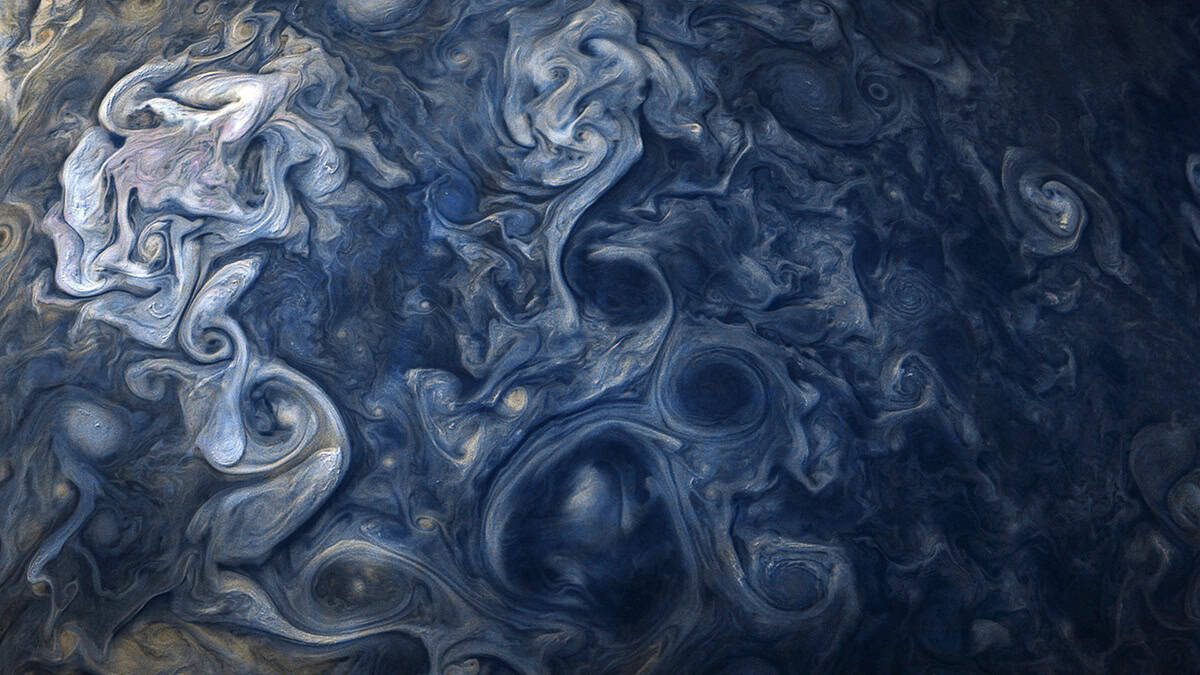
Pretty amazing Hurricane-like spiral wind patterns near Jupiter’s north pole as seen by NASA’s Juno mission, of which Scott Bolton is principal investigator. (Courtesy: NASA/JPL/Caltech SwRIMSSS Gerald Eichstädt, SeánDoran)
What do you like best and least about your job?
I really love being part of a mission that’s discovering new information and new ideas about how the universe works. It’s exciting to be at the edge of something, where you are part of a team that’s seeing an image or an aspect of how nature works for the first time. The discovery element is truly inspirational. I also love seeing how a mixture of scientists with different expertise, skills and backgrounds can come together to understand something new. Watching that process unfold is very exciting to me.
Some tasks I like least are related to budget exercises, administrative tasks and documentation. Some government rules and regulations can be quite taxing and require a lot of time to ensure forms and documents are completed correctly. Occasionally, an urgent action item will appear requiring an immediate response and having to drop current work to fit in a new task. As a result, my normal work gets delayed, and this can be frustrating. I consider one of my main jobs to shelter the team from these extraneous tasks so they can get their work done.
What do you know today that you wish you’d known at the start of your career?
The most important thing I know now is that if you really believe in something, you should stick to it. You should not give up. You should keep trying, keep working at it, and find people who can collaborate with you to make it happen. Early on, I didn’t realize how important it was to combine forces with people who complemented my skills in order to achieve goals.
The other thing I wish I had known is that taking time to figure out the best way to approach a challenge, question or problem is beneficial to achieving one’s goals. That was a very valuable lesson to learn. We should resist the temptation to rush into finding the answer – instead, it’s worthwhile to take the time to think about the question and develop an approach.
Regular readers of Physics World will know that the UN chose 2025 to be the International Year of Quantum Science and Technology (IYQ). With a global diary of events, conferences, talks, workshops and more, its aim is to raise awareness of the impact of quantum physics and its myriad future applications, from healthcare and energy to infrastructure and optimization.
Despite us celebrating a century of quantum advances, it’s interesting to note that most physicists are still undecided on some of the very foundational aspects of quantum theory. Even 100 years on, we cannot agree on which interpretation of quantum mechanics holds strong; whether the wavefunction is merely a mathematical tool or a true representation of reality; or the effects of an observer on a quantum state.
Indeed, some of the biggest open questions in physics – where exactly is the boundary between the quantum and the classical world; and how do we reconcile gravity and quantum mechanics – lie at the very heart of these conundrums. As we all gather at the IOP’s conference, to look back and ahead, perhaps some answers to these puzzles will become apparent.
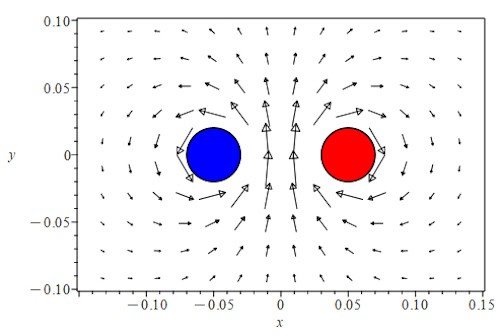
Accessible system What the vortices look like in a film. (Courtesy: P Stamp)
Vacuum tunnelling – an exotic process by which empty space can become temporarily filled with virtual particles when an extremely strong electric or magnetic field is applied to it – has never been observed in an experiment. This is because the field required to produce this “Schwinger effect” in the laboratory is simply too high and is usually only generated during intense astrophysical events. Theoretical physicists at the University of British Columbia (UBC) in Canada are now saying that an analogous effect could occur in a much simpler, tabletop system. In their model, a film of superfluid helium can be substituted for the vacuum and the superfluid flow of this helium for the massive field.
The physicist Julian Schwinger was the first to put forward the effect that now bears his name. In 1951, he hypothesised that applying a uniform electric field to a vacuum, which is theoretically devoid of matter, would cause electron–positron pairs to spring into existence there. The problem is that this field needs to be, literally, astronomically high – on the order of around 1018 V/m.
Pair production can also occur in superfluid helium-4
A team led by Philip Stamp says that a similar type of spontaneous pair production can occur in superfluid helium-4 just a few atomic layers thick and cooled to very low temperatures. In this liquid, which behaves essentially like a perfect, frictionless quantum vacuum state, pairs of quantized vortices/anti-vortices (spinning in opposite directions to each other) should occur in the presence of strong fluid flow. This process should be analogous to the Schwinger mechanism of vacuum tunnelling.
“The helium-4 film provides a nice analogue to several cosmic phenomena, such as the vacuum in deep space, quantum black holes and even the early the universe itself (phenomena we can’t ever approach in any direct experimental way),” says Stamp. “However, the real interest of this work may lie less in analogues (which may or may not accurately portray the ‘real thing’) and more in the way it alters our understanding of superfluids and of phase transitions in two-dimensional systems.”
“These are real physical systems in their own right, not just analogues. And we can do experiments on these.”
According to physicist Warwick Bowen of the University of Queensland in Australia, who was not involved in this study, the new work is “very interesting” and “exciting” because it describes a new mechanism to produce vortices. “This description might even tell us more about the microscopic origins of turbulence and represents a new kind of quantum phase transition,” he tells Physics World. “Importantly, the effect appears to be accessible with extensions to existing experimental techniques used to study thin superfluid helium films.”
Physicist Emil Varga of Prague’s Charles University in the Czech Republic, who was not involved in this study either, adds: “The work seems quite rigorous and might help clean up some outstanding discrepancies between theory and experiment. And the possible analogy with the Schwinger effect is, as far as I can tell, new and quite interesting and fits well into the emerging field of using superfluid helium-4 as a model system for high-energy and/or astrophysics.”
Stamp and colleagues say they would now like to better understand the vortex effective mass and look at analogues in full quantum gravity with no “semiclassical approximations”. They will also be focusing on how the effect they propose will lead to phenomena like quantum avalanches – which are different to quantum turbulence – and in particular, how it modifies the so-called “Kosterlitz-Thouless” picture of 2D transitions.
Even very small changes in the size and shape of a meniscus that forms between an object and the surface of a liquid can dramatically affect how much wave energy passes through this interface. The effect, seen for the very first time in an experiment, could come in useful for a host of practical applications that require fluid control, say the researchers at the University of Mississippi in the US who observed it.
When the upper surface of a liquid comes into contact with the container it is in or with another object, the layer of liquid at the interface curves upwards. This well-known capillary effect, produced by surface tension, is known as the meniscus.
In the new study, a team led by Likun Zhang at the National Center of Physical Acoustics and the Department of Physics at the University of Mississippi wanted to find out how the size and the shape of the meniscus affects the way waves move across it. In their experiments, the researchers filled a tank measuring 106 cm × 6.8 cm × 11 cm with distilled water to a height of 9.2 cm. They then placed a thin acrylic sheet 6.8 cm wide on the surface of the water to create the meniscus. Next, they sent surface waves with a frequency of about 15 Hz through the set-up using a paddle wavemaker and measured the ripples on the surface that resulted.
Precise adjustments
By varying both the frequency of the surface waves and the height and surface properties of the acrylic barrier (thanks to a surface coating to make it hydrophobic or hydrophilic), they were able to steadily adjust the meniscus very precisely – in steps of just 0.1 mm.
The researchers found that a slightly curved meniscus allows more wave energy to pass through the barrier. Conversely, if the meniscus curves more steeply, it reduces the energy transported by the fluid.
This is a counterintuitive result – we expect a barrier to block waves, explains Zhang. Instead, they observed that certain meniscus shapes can allow waves to pass through more easily. “Indeed, an adjustment of just a few millimetres can change the wave transmission by up to 60%, either going up or down depending on the meniscus shape,” he tells Physics World. “This is exciting because it’s the first time this effect has been observed in an experiment.”
The discovery could open up new ways to control fluids more precisely – just by adjusting the meniscus, he adds. “This could be useful in open fluid channels, where liquids flow with a free surface exposed to air instead of being in a closed pipe. Such channels are common in nature and are also important in engineered systems, for example, in microfluidic devices, thermal control, and even technologies employed in space.”
The researchers, who report their work in Physical Review Letters, say they now plan to develop theoretical models to better explain the effect they have observed. “For example, why do waves transmit less when the meniscus height is tall, but more when it is short?” ponders Zhang. “In the longer term, our goal is to exploit this knowledge to design better ways of controlling fluids for practical applications.”
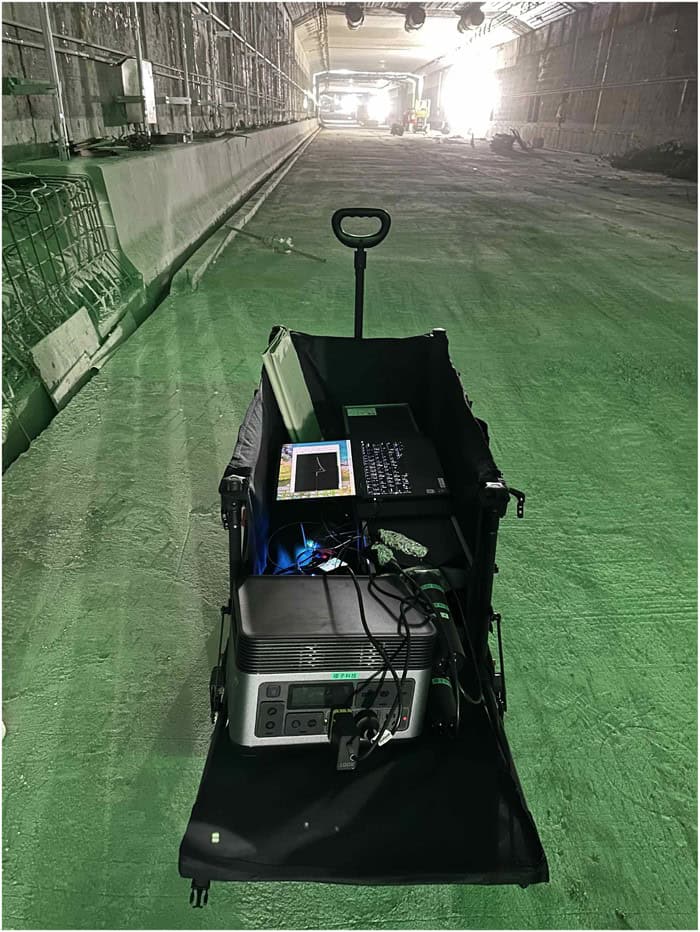
Trundling along A portable version of the team’s muon detector was used along the length of the tunnel. (Courtesy: Kim Siang Khaw et al/Journal of Applied Physics/CC BY 4.0)
Researchers in China say that they are the first to use cosmic-ray muography to monitor the region surrounding a tunnel. Described as a lightweight, robust and affordable scintillator setup, the technology was developed by Kim Siang Khaw at Shanghai Jiao Tong University and colleagues. They hope that their approach could provide a reliable and non-invasive method for the real-time monitoring of subterranean infrastructure.
Monitoring the structural health of tunnels and other underground infrastructure is challenging because of the lack of access. Inspection often relies on techniques such as borehole drilling, sonar scanning, and multibeam echo sounders to determine when maintenance is needed. These methods can be invasive, low resolution and involve costly and disruptive shutdowns. As a result there is often a trade-off between the quality of inspections and the frequency at which they are done.
This applies to the Shanghai Outer Ring Tunnel: a major travel artery in China’s largest city, which runs for almost 3 km beneath the Huangpu River. Completed in 2023, the submerged section of the tunnel is immersed in water-saturated sediment, creating a unique set of challenges for structural inspection.
Time-varying stresses
In particular, different layers of sediment surrounding the tunnel can vary widely in their density, permeability, and cohesion. As they build up above the tunnel, they can impart uneven, time-varying stresses, making it incredibly challenging for existing techniques to accurately assess when maintenance is needed.
To address these challenges, a multi-disciplinary team was formed to explore possible solutions. “During these talks, the [Shanghai Municipal Bureau of Planning and Natural Resources] emphasized the practical challenges of monitoring sediment build-up around critical infrastructure, such as the Shanghai Outer Ring Tunnel, without causing disruptive and costly shutdowns,” Khaw describes.
Among the most promising solutions they discussed was muography, which involves detecting the muons created when high-energy cosmic rays interact with Earth’s upper atmosphere. These muons can penetrate deep beneath Earth’s surface and are absorbed at highly predictable rates depending on the density of the material they pass through.
A simple version of muography involves placing a muon detector on the surface of an object and another detector beneath the object. By comparing the muon fluxes in the two detectors, the density of the object can be determined. By measuring the flux attenuation along different paths through the object, an image of the interior density of the object can be obtained.
Muography has been used for several decades in areas as diverse as archaeology, volcanology and monitoring riverbanks. So far, however, its potential for monitoring underground infrastructure has gone largely untapped.
“We took this ‘old-school’ technique and pioneered its use in a completely new scenario: dynamically monitoring low-density, watery sediment build-up above a submerged, operational tunnel,” Khaw explains. “Our approach was not just in the hardware, but in integrating the detector data with a simplified tunnel model and validating it against environmental factors like river tides.”
With its durable, lightweight, and affordable design, the scintillator features a dual-layer configuration that suppresses background noise while capturing cosmic muons over a broad range of angles. Crucially, it is portable and could be discreetly positioned inside an underground tunnel to carry out real-time measurements, even as traffic flows.
Sediment profiles
To test the design, Khaw’s team took measurements along the full length of the Shanghai Outer Ring Tunnel while it was undergoing maintenance; allowing them to map out a profile of the sediment surrounding the tunnel. They then compared their muon flux measurements with model predictions based on sediment profiles for the Huangpu River measured in previous years. They were pleased to obtain results that were better than anticipated.
“We didn’t know the actual tidal height until we completed the measurement and checked tidal gauge data,” Khaw describes. “The most surprising and exciting discovery was a clear anti-correlation between muon flux and the tidal height of the Huangpu River.” Unexpectedly, the detector was also highly effective at measuring the real-time height of water above the tunnel, with its detected flux closely following the ebb and flow of the tides.
Reassuringly, the team’s measurements confirmed that there are no as-yet unmapped obstructions or gaps in the sediment above the tunnel thereby confirming the structure’s safety.
“Additionally, we have effectively shown a dual-purpose technology: it offers a reliable, non-invasive method for sediment monitoring and also reveals a new technique for tidal monitoring,” says Khaw. “This opens the possibility of using muon detectors as multi-functional sensors for comprehensive urban infrastructure and environmental oversight.”
London-based artist Oksana Kondratyeva has created a new stained-glass artwork – entitled Discovery – that is inspired by the detection of the Higgs boson at CERN’s Large Hadron Collider (LHC) in 2012.
Born in Ukraine, Kondratyeva has a PhD in the theory of architecture and has an artist residency at the Romont Glass Museum (Vitromusée Romont) in Switzerland, where Discovery is currently exhibited.
In 2023 Kondratyeva travelled to visit the LHC at CERN, which she notes represents “more than a laboratory [but] a gateway to the unknown”.
“Discovery draws inspiration from the awe I felt standing at the frontier of human knowledge, where particles collide at unimaginable energies and new forms of matter are revealed,” Kondratyeva told Physics World.
Kondratyeva says that the focal point of the artwork – a circle structured with geometric precision – represents the collision of two high-energy protons.
The surrounding lead lines in the panel trace the trajectories of particle decays as they move through a magnetic field: right-curved lines represent positively charged particles, left-curved lines indicate negatively charged ones, while straight lines signify neutral particles unaffected by the magnetic field.
The geometric composition within the central circle reflects the hidden symmetries of physical laws – patterns that only emerge when studying the behaviour of particle interactions.
Kondratyeva says that the use of mouth-blown flashed glass adds further depth to the piece, with colours and subtle shades moving from hot and luminous at the centre to cooler, more subdued tones toward the edges.
“Through glass, light and colour I sought to express the invisible forces and delicate symmetries that define our universe – ideas born in the realm of physics, yet deeply resonant in artistic expression,” notes Kondratyeva. “The work also continues a long tradition of stained glass as a medium of storytelling, reflecting the deep symmetries of nature and the human drive to find order in chaos.”