In the past three decades astronomers have discovered more than 6000 exoplanets – planets that orbit stars other than the Sun. Many of these exoplanets are very unlike the eight planets of the solar system, making it clear that the cosmos contains a rich and varied array of alien worlds.
Weird and wonderful planets are also firmly entrenched in the world of science fiction, and the interplay between imagined and real planets is explored in the new book Amazing Worlds of Science Fiction and Science Fact. Its author Keith Cooper is my guest in this episode of the Physics World Weekly podcast and our conversation ranges from the amazing science of “hot Jupiter” exoplanets to how the plot of a popular Star Trek episode could inform our understanding of how life could exist on distant exoplanets.
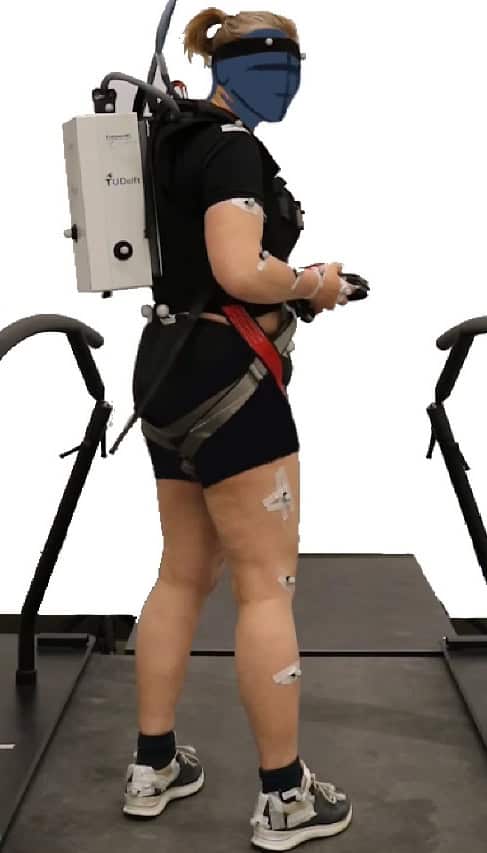
A robotic backpack equipped with gyroscopes can enhance stability for people with severe balance issues and may eventually remove the need for mobility walkers. Designed to dampen unintended torso motion and improve balance, the backpack employs similar gyroscopic technology to that used by satellites and space stations to maintain orientation. Individuals with the movement disorder ataxia put the latest iteration of the device – the GyroPack – through its paces in a series of standing, walking and body motion exercises.
In development for over a decade, GyroPack is the brainchild of a team of neurologists, biomechanical engineers and rehabilitation specialists at the Radboud University Medical Centre, Delft University of Technology (TU Delft) and Erasmus Medical Centre. The first tests of its ability to improve balance performance with ataxia-impacted adults, described in npj Robotics, produced encouraging enough results to continue the GyroPack’s development as a portable robotic wearable for individuals with neurological conditions.
Degenerative ataxias, a variety of diseases of the nervous system, cause progressive cerebral dysfunction manifesting as symptoms including lack of coordination, imbalance when standing and difficulty walking. Ataxia can afflict people of all ages, including young children. Managing the progressive symptoms may require lifetime use of cumbersome, heavily weighted walkers as mobility aids and to prevent falling.
GyroPack design
The 6 kg version of the GyroPack tested in this study contains two control moment gyroscopes (CMGs), which are attitude control devices that control orientation to a specific inertial frame-of-reference. Each CMG consists of a flywheel and a gimbal, which together generate the change in angular momentum that’s exerted onto the wearer to resist unintended torso rotations. Each CMG also contains an inertial measurement unit to determine the orientation and angular rate of change of the CMG.
The backpack also holds two independent, 1.5 kg miniaturized actuators designed by the team that convert energy into motion. The system is controlled by a laptop and powered through a separate power box that filters and electrically separates electrical signals for safety. All activities can be immediately terminated when an emergency stop button is pushed.
Lead researcher Jorik Nonnekes of Radboud UMC describes how the system works: “The change of orientation imposed by the gimbal motor, combined with the angular momentum of the flywheels, causes a free moment, or torque, that is exerted onto the system the CMG is attached to – which in this study is the human upper body,” he explains. “A cascaded control scheme reliably deals with actuator limitations without causing undesired disturbances on the user. The gimbals are controlled in such a way that the torque exerted on the trunk is proportional and opposite to the trunk’s angular velocity, which effectively lets the system damp rotational motion of the wearer. This damping has been shown to make balancing easier for unimpaired subjects and individuals post-stroke.”
For the study, 14 recruits diagnosed with degenerative ataxia performed five tasks: standing still with feet together and arms crossed for up to 30 s; walking on a treadmill for 2 min without using the handrail; making a clockwise and a counterclockwise 360° turn-in-place; performing a tandem stance with the heel of one foot touching the toes of the other for up to 30 s; and testing reactive balance by applying two forward and two backward treadmill perturbations.
The participants performed these tasks under three conditions, two whilst wearing the backpack and one without as a baseline. In one scenario, the backpack was operated in assistive mode to investigate its damping power and torque profiles. In the other, the backpack was in “sham mode”, without assistive control but with sound and motor vibrations indistinguishable from normal operation.
The researchers report that when fully operational, the GyroPack increased the user’s average standing time compared with not wearing the backpack at all. When used during walking, it reduced the variability of trunk angular velocity and the extrapolated centre-of-mass, two common indicators of gait stability. The trunk angular velocity variability also showed a significant reduction when comparing assistive to sham GyroPack modes. However, the performance of turn-in-place and perturbation recovery tasks were similar for all three scenarios.
Interestingly, wearing the backpack in the sham scenario improved walking tasks compared with not wearing a backpack at all. The researchers attributed this to possibly more weight in the torso area improving body stabilization or to a placebo effect.
Next, the team plans to redesign the device to make it lighter and quieter. “It’s not yet suitable for everyday use,” says Nonnekes in a press statement. “But in the future, it could help people with ataxia participate more freely in daily life, like attending social events without needing a walker, which many find bulky and inconvenient. This could greatly enhance their mobility and overall quality of life.”
More than a quarter of UK university physics departments could be shut down within the next couple of years, according to a survey carried out by the Institute of Physics (IOP). It also reveals that almost 60% of departmental heads expect physics degree courses to close within that time, while more than 80% of those questioned say they expect to see job losses.
The survey findings are published in a new report – Physics Matters: Funding the Foundations of Growth– that says UK university physics is a “major strength” of the UK university system and vital to “national security and technological sovereignty”. The UK currently has about 17,000 physics undergraduates and more than 6000 physics department staff, with about 1 in 20 jobs in the UK using physics-related knowledge and skills.
However, the report adds that this strength cannot be taken for granted and points to “worrying signs” that university physics has started to “punch below its weight”. This is compounded, the IOP says, by a drop in the number of students studying physics at UK universities and flat grant funding for UK physics departments over the past decade.
In addition, UK universities are being hit by financial challenges and funding shortfalls caused by inflationary pressure and a drop in international student numbers. Given that physics comes with high teaching costs, the report states this threatens a “perfect storm” for university physics departments.
Close to breaking point
The survey of 31 departmental heads, which was carried out in August, found that three unnamed departments face imminent closure, with a further 11 anticipating shutting courses. When asked to look ahead over the next two years, eight say they expect to face closure, with 18 anticipating course closures.
One head of physics at a UK university told the IOP, which publishes Physics World, that they are concerned they are “close to breaking point”. “Our university has a £30m deficit,” the anonymous head said. “Staff recruitment is frozen, morale is low. Yet colleagues in our school continue to deliver with less and less and under increasing pressure.”
Jonte Hance, a quantum physicist at Newcastle University, told Physics World that the threat of closures is “horrifying”. In 2004, Newcastle closed its physics department before reopening it over a decade later. “Worryingly, this approach – ignoring, or even cutting, any departments that don’t make a massive short-term profit – doesn’t just seem to be a panicked knee-jerk response on the part of vice-chancellors, but part of a concerted and planned strategy, aiming to turn universities into business incubators,” adds Hance.
Towards a cliff edge
The IOP is now calling on the UK government to commit additional funding for science and engineering departments to help with the operation, maintenance, refurbishment and building of labs and technical facilities. It also wants an “early-warning system” created for departments at risk as well as changes to visa policy to remove international students from net migration figures, retain the graduate visa in its current form, and make “global talent and skilled worker” visas more affordable.
While we understand the pressures on public finances, it would be negligent not to sound the alarm
Keith Burnett
In addition, the IOP wants the UK government to develop a decade-long plan that includes reform of higher-education funding so universities can fund the cost of teaching “important subjects such as physics”. Keith Burnett, the outgoing IOP president, warns that without such action, the UK is “walking towards a cliff edge”, although he believes there is still time to “avert a crisis”.
“While we understand the pressures on public finances, it would be negligent not to sound the alarm for a national capability fundamental to our wellbeing, competitiveness and the defence of the realm,” says Burnett, who is former vice-chancellor at the University of Sheffield and former chair of physics at the University of Oxford. “Physics researchers and talented physics students are our future, but if action isn’t taken now to stabilise, strengthen and sustain one of our greatest national assets, we risk leaving them high and dry.”
Brain metastases – cancerous lesions that have spread from elsewhere in the body – are increasingly treated using stereotactic radiotherapy (SRS), a precision technique that targets each individual lesion with a high dose of radiation. Compared with whole-brain irradiation, SRS may lead to higher local control and increased cognitive sparing, as well as a shorter overall treatment duration. But to target and treat multiple brain metastases, each lesion must first be detected on an MRI scan and accurately delineated. And this can be a complex and time-consuming task.
“There are two challenges that we face in the clinic,” explains Evrim Tezcanli, professor of radiation oncology at Acibadem Atasehir Hospital in Turkey. “First, we want to treat all the lesions. But very small lesions, particularly those under 0.1 cc, can easily be missed by untrained eyes. Larger metastases, meanwhile, are more challenging to contour – you want to cover the whole lesion without missing a pixel, but don’t want to spill radiation over into the brain tissue. It’s time-consuming work, especially if there are multiple lesions.”
To address these challenges, Siemens Healthineers has developed an AI-powered software tool that automates the contouring of brain metastases. The software – integrated into the company’s syngo.via RT Image Suite and AI-Rad Companion Organs RT packages – employs advanced deep-learning algorithms to rapidly analyse a patient’s MR images and contour and label metastatic lesions. Alongside, it delineates key organs at risk, such as the brainstem and optic structures.
“One of the main strengths of this software is that it reduces the manual workloads really well,” says Tezcanli.
Meeting clinical standards
To evaluate the accuracy and time efficiency of the new software tool, Tezcanli and her team compared AI-based delineation with the performance of two experienced radiation oncologists. The study included data from 10 patients with between three and 17 brain metastases. The radiation oncologists manually contoured all lesions (82 in total) based on patients’ contrast-enhanced MRI scans; the same images were also processed by the AI software to automatically contour the metastases.
Tezcanli reports that the software performed remarkably well. “One of the most significant findings was that the manual contours and the AI-generated contours showed strong agreement, especially for lesions larger than 0.1 cc. In terms of geometric similarity, the AI-generated boundaries were well within our clinically acceptable levels,” she says.
Comparing the manual and AI-generated contours revealed a medium Dice similarity coefficient of 0.83, increasing to 0.91 when excluding very small lesions, and a median Hausdorff distance (the maximum distance between the two contours) of 0.3 mm.
AI will definitely have a place because of the time savings and accuracy it delivers
Evrim Tezcanli
To quantify the overall time efficiency, the researchers timed the contouring process for the radiation oncologists and the AI tool. They also measured the time taken for expert review of the AI-generated results, in which a radiation oncologist checks the contours and performs any necessary adjustments before they are approved for treatment planning.
The AI software completed the contouring for each patient in just one to two minutes, reducing the workload by an average of 75%, and in some cases saving over 30 minutes per patient. “We still needed to review the AI contours, but the correction time was only three to four minutes,” says Tezcanli, emphasizing that expert review remains essential when using AI. “One case required nine minutes, but even with that patient we had a time saving of 75%.”
As well as saving time for the oncology staff, AI-based contouring has a lot to offer from the patient’s perspective. Spending less time on demanding manual contouring frees up the physician to spend more time with the patient.
Lesion detection
For their study, the researchers analysed post-contrast T1 MPRAGE sequences recorded using a 3 Tesla MRI scanner. To maximize lesion enhancement, they acquired images several minutes after contrast injection, though Tezcanli notes that this timing may vary between treatment centres. They also used image slices of 1 mm or less. “This is a very precise treatment and we want to make sure everything is accurate,” she adds.
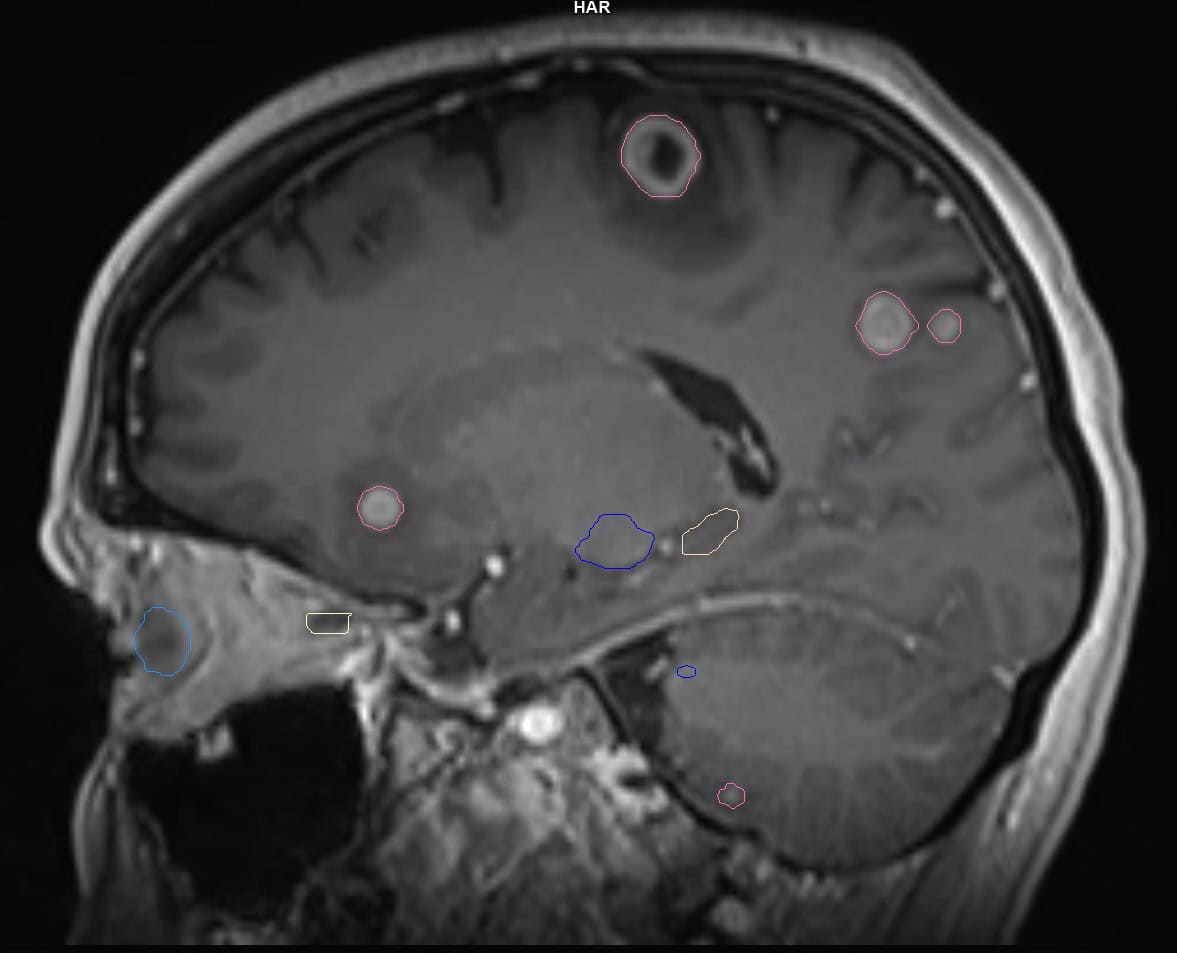
Reducing manual workload Autocontouring of brain metastases on an MR image. (Courtesy: Acibadem Atasehir Hospital, Istanbul, Turkey)
The study deliberately included patients with varying numbers of different sized metastases, to assess the algorithms under diverse clinical scenarios. In terms of lesion detection, the software exhibited an overall sensitivity of 94% – finding 77 of the 82 metastases. The five missed lesions were extremely small, 0.01 to 0.03 cc, a volume that’s challenging even for physicians to detect. The software did, however, find three additional lesions that were not originally identified and which were later confirmed as brain metastases.
The false positive rate was 8.5%, with the software mistakenly identifying seven vascular structures as metastases. “Because the algorithms work with contrast enhancement, any vascular enhancements that mimic the tumour can be mistaken,” says Tezcanli. “Here we needed to use a dedicated MRI sequence to define whether it was a metastasis or not. That’s just one thing to be cautious about. Other than that, we were very satisfied with the software’s ability to detect small lesions and find ones that we hadn’t detected.”
Automation with HyperArc
The contours generated by the AI software are exported in DICOM RT Struct format, enabling direct transfer into the treatment planning system. At Acibadem Atasehir Hospital, this next step is performed using HyperArc, a radiosurgery-specific software module within the Eclipse treatment planning infrastructure. HyperArc performs automated treatment planning and delivery, enabling fast and efficient SRS on the Varian TrueBeam and Edge linacs.
“HyperArc has proven to be highly effective, even when treating patients with multiple brain metastases,” says Burcin Ispir, a medical physicist working alongside Tezcanli. “One of its biggest powers is its ability to perform single isocentre, automated planning for multiple targets, which significantly reduces planning time while maintaining excellent plan quality. In our experience, HyperArc-generated plans offer high conformity and steep dose gradients, which are critical for sparing normal brain tissue.”
Unlike conventional radiotherapy where homogeneity is desirable, SRS plans intentionally allow controlled heterogeneity within the target volume to improve sparing of normal tissue. HyperArc also offers automation of the beam geometry, including collimator and couch angles, ensuring consistent, fast and highly reproducible plans “For selected cases, we have found this enables a same-day workflow where contouring, planning and treatment can all be completed within a single day,” Ispir explains.
The automation in AI contouring and HyperArc planning speeds up the treatment planning process, and when compared to traditional workflows, potentially allows patients to commence radiation therapy treatments earlier. The ability to commence treatment as soon as possible after the MRI scan is imperative when treating brain metastases. Most patients will also be receiving systemic therapies, which need to be delivered on schedule. But perhaps more importantly, the high spatial precision of SRS makes the technique sensitive to even small anatomical changes within lesions. If the delay between MR imaging and radiotherapy treatment is too long, any changes occurring during that time could decrease targeting accuracy.
“We are in an era where we are using the technology to have even same-day treatments,” says Tezcanli. “We have rapid contouring with AI, a quick review of a few minutes by the expert radiation oncologist, treatment planning with HyperArc, and then a few hours later the patient is treated. This is where the technology is taking us.”
Look to the future
Continuing improvements in cancer treatment techniques mean that patients are living longer, but this also increases the likelihood of metastases developing. In addition, higher quality MRI scans and enhanced imaging protocols lead to more metastases being detected. These factors combine to increase the workload on centres treating multiple metastases with SRS.
“I think we will be treating brain metastasis more and more,” says Tezcanli. “And I think radiosurgery will be the main treatment modality in the future. AI will definitely have a place because of the time savings and accuracy it delivers. And this is only the first version of the software; I’m sure it can be improved to find even smaller lesions or differentiate vascular structures.”
Following the initial software evaluation, the team has not yet fully integrated it into their clinical routine, but Tezcanli tells Physics World that they would be happy to use the software in every one of their brain metastases treatments. “I think we will be using it routinely in the future in all of our clinical cases,” she says.
The statements by customers of Siemens Healthineers described herein are based on results that were achieved in the customer’s unique setting. Because there is no “typical” hospital or laboratory and many variables exist (e.g., hospital size, samples mix, case mix, level of IT and/or automation adoption) there can be no guarantee that other customers will achieve the same results.
The products/features mentioned herein are not commercially available in all countries. Their future availability cannot be guaranteed.
Autocontouring results are generated by Siemens. The displayed renderings are created with software that is not commercially available.
NASA has launched a two-year mission to study the boundary of the heliosphere, a huge protective bubble in space created by the Sun. The Interstellar Mapping and Acceleration Probe (IMAP) took off today aboard a SpaceX Falcon 9 rocket from the Kennedy Space Center at Cape Canaveral in Florida. The mission is now on a four-month journey to Lagrange point 1 (L1) – a point in space about 1.6 million kilometres from the Earth towards the Sun.
The solar wind is a stream of charged particles emitted by the Sun into space that helps to form the heliosphere. IMAP will study the solar wind and its interaction with the interstellar medium to better understand the heliosphere and its boundaries, which begin about 14 billion kilometres from Earth. This boundary offers protection from harsh radiation from space and is key to creating and maintaining a habitable solar system.
IMAP, which is 2.4 m in diameter and almost 1 m high, will also support real-time observations of the solar wind and energetic particles that can harm satellites as well as disrupt global communications and electrical grids on Earth. From L1, IMAP will provide a 30-minute warning to astronauts and spacecraft near Earth of harmful radiation.
To do so, IMAP contains 10 instruments that capture data on energetic neutral atoms, the solar wind and interstellar dust.
They include a high-energy ion telescope, an electron instrument as well as a magnetometer that has been developed by Imperial College London. It will measure the strength and direction of magnetic fields in space, providing crucial data to improve our understanding of space weather.
“Our magnetic field instrument will help us understand how particles are accelerated at shock waves and travel through the solar system,” notes Imperial’s Timothy Horbury. “I’m especially excited that our data will be made public within minutes of being measured over a million miles away, supporting real-time space weather forecasts. It’s a great example of how scientific measurements can positively impact society.”
The IMAP mission is led by Princeton University and managed by the Johns Hopkins Applied Physics Laboratory with contributions from 25 institutions across six countries.
The world is changing rapidly – economically, geopolitically, technologically, militarily and environmentally. But when it comes to the environment, many people feel the world is on the cusp of catastrophe. That’s especially true for anyone directly affected by endemic environmental disasters, such as drought or flooding, where mass outmigration is the only option possible.
The challenges are considerable and the crisis is urgent. But we know that physics has already contributed enormously to society – and I believe that environmental physics can make a huge difference by identifying, addressing and alleviating the problems at stake. However, physicists will only be able to make a difference if we put environmental physics at the centre of our university teaching.
Grounded in physics
Environmental physics is defined as the response of living organisms to their environment within the framework of the physics principles and processes. It examines the interactions within and between the biosphere, the hydrosphere, the cryosphere, the lithosphere, the geosphere and the atmosphere. Stretching from geophysics, meteorology and climate change to renewable energy and remote sensing, it also covers soils and vegetation, the urban and built environment, and the survival of humans and animals in extreme environments.
Environmental physics was pioneered in the UK in the 1950s by the physicists Howard Penman and John Monteith, who were based at the Rothamsted Experimental Station, which is one of the oldest agricultural research institutions in the world. In recent decades, environmental physics has become more prevalent in universities across the world.
Some UK universities either teach environmental physics in their undergraduate physics degrees or have elements of it within environmental science degrees. That’s the approach taken, for example, by University College London as well as well as the universities of Cambridge, Leicester, Manchester, Oxford, Reading, Strathclyde and Warwick.
When it comes to master’s degrees in environmental physics, there are 17 related courses in the UK, including nuclear and environmental physics at Glasgow and radiation and environmental protection at Surrey. Even the London School of Economics has elements of environmental physics in some of its business, geography and economics degrees via a “physics of climate” course.
But we need to do more. The interdisciplinary nature of environmental physics means it overlaps with not just physics and maths but agriculture, biology, chemistry, computing, engineering, geology and health science too.
Indeed, recent developments in machine learning, digital technology and artificial intelligence (AI) have had an impact on environmental physics – for example, through the use of drones in environmental monitoring and simulations – while AI algorithms can catalyse modelling and weather forecasting. AI could also in future be used to predict natural disasters, such as earthquakes, tsunamis, hurricanes and volcanic eruptions, and to assess the health implications of environmental pollution.
Environmental physics is exciting and challenging, has solid foundations in mathematics and the sciences via experiments both in the lab and field. Environmental measurements are a great way to learn about the use of uncertainties, monitoring and modelling, while providing scope for project and teamwork. A grounding in environmental physics can also open the door to lots of exciting career opportunities, with ongoing environmental change meaning lots of ongoing environmental research will be vital.
Solving major regional and global environmental problems is a key part of sociopolitics and so environmental physics has a special role to play in the public arena. It gives students the chance to develop presentational and interpersonal skills that can be used to influence decision makers at local and national government level.
Taken together, I believe a module on environmental physics should be a component of every undergraduate degree as a minimum, ideally having the same weight as quantum or statistical physics or optics. Students of environmental physics have the potential to be enabled, engaged and, ultimately, to be empowered to meet the demands that the future holds.
Organic solar cells are a rapidly advancing third-generation solar technology, offering a combination of high efficiency, low production cost, and mechanical flexibility. With reported power conversion efficiencies now exceeding 20%, organic solar cells are beginning to rival traditional silicon-based cells. They also enable new applications, such as integration into building materials and wearable electronics.
A key metric for evaluating solar cell performance is the fill factor, which measures how close a cell comes to delivering its theoretical maximum power. Fill factors are influenced by both the materials used and the design of the device. Historically, recombination losses have been considered the primary limitation to maximising fill factors. This is where electrons and holes recombine before contributing to the electrical current.
Recent research has highlighted another critical variable called transport resistance. In organic semiconductors, which typically have low electrical conductivity, charge carriers move slowly through the material. This slow transport increases the likelihood of recombination before the charges reach the electrodes, leading to significant fill factor losses even in highly efficient devices. If the electrons and holes were runners in a race, recombination losses are runners giving up before they finish. In organic materials, charge transport occurs via hopping: it is like the runners moving through mud, it is much harder – increasing the transport resistance – and they are more likely to give up before the end.
To address this, the authors developed an analytical model that incorporates the nature of this slow transport, energetic disorder, and systematically evaluates transport resistance using experimental data. By analysing current-voltage characteristics and light intensity-dependent open-circuit voltage across a range of temperatures, the model distinguishes between losses due to recombination and those due to charge transport.
This refined approach enables more accurate predictions of fill factors and offers practical strategies to minimise transport-related losses. Improving fill factors not only enhances the performance of organic solar cells but also provides insights applicable to other emerging photovoltaic technologies, helping to guide the future design of third-generation solar power.
Understanding periodically driven quantum systems is currently a major line of research.
These Floquet systems provide versatile platforms to investigate new physical phenomena such as time crystals, and can also be used to create fault-tolerant states for quantum computing.
What’s important here is the ability to precisely control the behaviour of the quantum system by designing its effective Hamiltonian – the mathematical object that governs how the system evolves over time.
When researchers want a system to behave in a very specific way, they engineer the Hamiltonian to match a desired target. This is called Floquet engineering.
Unfortunately, it’s not possible to create a simple (analytical) Floquet Hamiltonian for any given system, and mathematical tools such as the Magnus expansion are usually required to get a Hamiltonian that is sufficiently precise.
However, when you engineer a Hamiltonian using approximations, you get errors – not great for most applications and especially quantum computing.
Mitigating these errors is possible to some degree although up until now it’s been a one system at a time approach. What we really need is a systematic approach for mitigating these errors for any given system.
This is the problem that the latest paper by researchers Xu and Guo tries to address.
They used symmetries (like rotational or mirror symmetry) to simplify the design of these correction terms. This makes the calculations more manageable and the system more predictable.
They also provided a numerical method to calculate these corrections efficiently, which is important for practical implementation
They validated their method by creating Hamiltonians that are directly relevant for quantum computers.
The authors expect to further refine their method in the future, but this represents a big step forward towards practically engineering arbitrary Floquet Hamiltonians.
“Negative time” might sound like science fiction, but an international team of theorists and experimentalists has determined that a photon can, in fact, spend a negative amount of time in an excited atomic state while passing through a cloud of atoms. The finding could have applications in studies of light-matter interactions and quantum sensing – though not, alas, in time travel or other sensational effects.
Quantum mechanics has produced a lot of weird results, and the latest originated in 2022 with an experiment conducted by physicists at the University of Toronto, Canada. Led by Aephraim Steinberg, they found that when a photon passing through a cloud of atoms excites an electron in one of the atoms, it seems to spend a similar amount of time in this atomic excitation as a photon that passes straight through the cloud, apparently without exciting an atom at all.
A theoretical framework
To understand the theory behind this counterintuitive result, Steinberg and colleagues worked with researchers from the Massachusetts Institute of Technology in the US, Griffith University in Australia, and the Indian Institute of Science Education and Research. The framework they developed, which they now describe in APL Quantum, involves a single photon being sent into an atom cloud that is continuously monitored with a so-called “weak probe” that detects the presence of an atomic excitation anywhere in the cloud. Integrating this weak-probe signal over time thus provides a measure of how long the photon spends in an excited atomic state before it leaves the atom.
After crunching the numbers, the researchers made a prediction that surprised even them: the average excitation time can be negative. They also found that this excitation time should be the same as another, more familiar, time known as the group delay.
The team’s lead theorist, Griffith’s Howard Wiseman, says it is important to distinguish between these two times. A negative group delay, he observes, can be explained in a relatively intuitive way. Because the front of the photon pulse exits the atom cloud before the peak of the pulse enters it, and the peak never exits because most of the photons are scattered, there is, he says, an “illusion” that the photons leave the medium before they arrive.
However, he continues, what this framework actually measures is the time a transmitted photon spends in the atom cloud. It says nothing about whether such a photon excites an atom on its way through the cloud. Although it is normally assumed that any photon that excites an atom gets randomly scattered and never reaches the detector, says Wiseman, “We now say that this is not true and forward-scattered photons actually contribute a lot to the average measurement”.
Real-time measurements
To test this theory, Steinberg and colleagues set up a new experiment that sends two counter-propagating laser beams into a cloud of 85Rb atoms that have been cooled to 60–70 µK. The first beam contains the photons that may give rise to atomic excitation and may be either transmitted or scattered. The second beam is used for the weak measurements and detects the presence of an excitation via tiny shifts in its phase. These measurements required a high level of stability and a low level of interference in all parts of the setup.
After refining their system, the researchers measured average atomic excitation times for transmitted photons ranging from (–0.82 ± 0.31)𝜏0 for the most narrowband pulse to (0.54 ± 0.28)𝜏0 for the most broadband pulse. Here, 𝜏0 is the excitation time averaged over both scattered and transmitted photons, which is always positive and ranges from 10–20 ns, depending on various parameters. This result shows that negative excitation times do indeed have a physical reality in quantum measurements.
A matter of time
According to Steinberg, while he and his colleagues previously knew that negative numbers could pop out of the mathematics, they tended to sweep them under the rug and make excuses for them, assuming that while they correctly described the location of a peak, they weren’t physically relevant. “I am now led to revisit this and say: those negative numbers appear to have more physical significance that we would previously have attributed to them,” he tells Physics World. As a result, he hopes to “begin to investigate more deeply what we think the meaning of a ‘negative time’ is”.
Jonte Hance, a quantum physicist at Newcastle University, UK, who was not involved in this research, warns that interpreting negative time too literally can lead to paradoxes that aren’t necessary for the physics to work. Nevertheless, he says, the “anomalous” values recorded in the weak measurement “point to something interesting and quantum happening”.
Hance explains that in his view, a negative value for the mean atomic excitation time for transmitted photons implies contextuality – a property of quantum systems whereby measuring the system in different ways can make it look like it has incompatible properties if we assume that measuring the system does nothing to it. “Contextuality seems to be one of the tell-tale signs a quantum scenario may provide us with an advantage at a certain task over all possible classical ways of doing that task,” he says. “And so it makes me excited for what this could be used for.”
In this episode of the Physics World Stories podcast, Rosemary Coogan offers a glimpse into life as one of the European Space Agency’s newest astronauts. Selected as part of ESA’s 2022 cohort, she received astronaut certification in 2024, and is now in line to visit the International Space Station within the next five years. One day, she may even walk on the Moon as part of the Artemis programme.
Coogan explains what astronaut training really entails: classroom sessions packed with technical knowledge, zero-gravity parabolic flights, and underwater practice in Houston’s neutral buoyancy pool. Born in Northern Ireland, Coogan reflects on her personal journey. From a child dreaming of space, she went on to study physics and astrophysics at Durham University, then completed a PhD on the evolution of distant galaxies.
When not preparing for lift off, Coogan counts sci-fi among her interests – she loves getting lost in the world of possibilities. She’s also candid about the psychological side of astronaut training, and how she’s learned to savour the learning process itself rather than obsess over launch dates. Hosted by Andrew Glester, this episode captures both the challenge and wonder of preparing for an imminent journey to space.