The health of living plants could soon be reliably probed throughout their entire life cycle, thanks to recent research. In work published in Science Advances, a group from the University of Massachusetts at Amherst has shown that conducting polymers applied to the surface of plants can be used as electrodes to detect damage to tissues. This ability to perform long-term, on-demand health tests has huge potential for its effective use in food farming, crop management and biohazard signalling.
Health monitoring devices have previously stuck electrodes to the organism by applying a film to the surface. However, these can suffer problems with longevity as they are susceptible to peeling off the organism. They can also perturb transport of air, water and nutrients at the surface, meaning they are not feasible for long term use. Now, the group led by Trisha Andrew has taken a novel approach to applying a thin, robust and durable coating by vapour-printing the polymer electrodes.
Vapour-printing
The team showed that introducing vapours of an oxidant and polymer building blocks into a reactor at room temperature led to growth of a conducting polymer film on any exposed surface, without harming the plant. They printed the functional polymer films directly onto the surface of live seedlings, resulting in long-lasting electrode pads.
Despite the complex and varied surfaces of plants, the vapour-printing method evenly coated all of the plant specimens without blocking any pores in the leaves. Unblocked pores are required for normal mass transport processes and therefore long-term use of the coating. The team proved that this vapour coating process did not perturb any biological functions, showing that coated flowers were able to uptake air, water and nutrients just as well as uncoated flowers.
The Andrew group. Credit: T. Andrew
Bioimpedance as a signal
The vapour-printed coatings displayed conductivities high enough for the group to use them as electrodes for bioimpedance spectroscopy in order to measure the health of living plants. This is a sensitive technique that can measure the water content of cells and reveal details about the composition of cell walls.
The researchers were able to detect damage resulting from drought and UV damage by identifying different components of the impedance. This includes the intrinsic conductivity of the coating, the capacitance due to the insulating leaf epidermis, and the ion diffusion between leaf cells and the coating. Crucially they were able to distinguish between different types of damage using the impedance measurements.
Detecting the damage
When they gradually dehydrated leaves of a pothos plant in a vacuum oven, the group observed a significant decrease in the capacitance of the cell membrane and resistance of the extracellular fluid (fluid not contained in cells). This was due to the cell membranes breaking down, causing the ion-rich intracellular fluid to leak out into the extracellular fluid. A 13% drop in the water content in leaves resulted in a 70% decrease in membrane capacitance, demonstrating superior precision to existing methods used to remotely detect drought stress.
As well as water loss, ultraviolet A radiation is also capable of causing deep tissue damage to plants, particularly the hosta plant, a shade-loving perennial. This kind of photodamage can often go undetected by conventional on-surface detection systems. However, the Massachussets group also showed that they could identify photodamage by monitoring bioimpedance of leaves coated with the vapour-printed electrodes after exposing leaves of the plant to UVA radiation. In this case, the measurements were able to identify deep tissue damage from a huge increase in the resistance of the fluid inside vacuoles (storage organelles inside cells). In contrast to damage caused by dehydration, the research showed an increase in membrane capacitance, highlighting the ability of this technology to distinguish between stressors, which is essential for health-monitoring.
Around much of the world, coal-fired electricity generation is on the way out, due to its high carbon emissions and the increasing availability of cheap renewables. In the UK coal-fired generation, already at a low level, is to be phased out entirely by 2025. Much of the rest of the EU is following suit, although there are big issues and some laggards. Amongst them is Germany, which has done well phasing out nuclear with renewables but is still burning coal, mainly to feed the lucrative power-export market. A German government commission has been looking at the phase-out options. A further acceleration of renewables is one but it’s a big ask.
However, a 2038 final deadline for German coal phase-out is now on the cards, and with a few central and eastern EU exceptions, the real problem areas are elsewhere, especially in the developing world and in the fast expanding economies of Asia. China certainly has big problems; it uses around 50% of total global coal output. It’s trying to cut back, and is expanding renewables massively, but it is still building coal-fired plants so its emissions are still rising. And it is also exporting coal plant technology. India is another problem area, still pushing coal alongside renewables and nuclear, but it’s also trying to cut back.
Some progress
So the global picture is mixed, and is arguably worsened by the slow progress being made on carbon capture and storage: as I noted in earlier posts, that short-term technical fix option no longer looks like being very significant. Nevertheless, overall, progress on phasing out coal is being made. Certainly there is some good news. Over 90% of South Africa’s power comes from coal at present. However, it now plans to get that down to 46% by 2030, without new nuclear. And it’s talking of the coal share falling to 30% by 2050. That’s because it’s ramping up renewables. The plan envisages wind power supplying 15% of the nation’s electricity by 2030 from 8.1 GW of new wind turbines, solar producing 11% from 5.7 GW and hydro 10% from 2.5 GW, topped up with 16% gas and just 1 GW of new coal plant. Nuclear stays at 2% from South Africa’s one existing 1.8 GW plant. “There will be a study to determine if more nuclear is needed after 2030,” said energy minister Jeff Radebe. “But until then, there is no increase in nuclear generation envisaged.”
The market value of renewable resources, as captured by the wholesale market, is rapidly diminishing with each additional MW of solar capacity added to the California grid
Energy Institute at Haas
One problem is that the trade unions in South Africa, many of whose members work in coal mining and in the big state-controlled coal-based power utility, don’t like the Independent Power Project approach that is being used to develop renewables – it’s all private-sector led. They fear that their jobs will go and be replaced by less well-paid and less secure employment. But across Africa, for good or ill, state utilities are increasingly seen, in the drive to market liberalization, as blocks to progress. And the greens have been pushing sustainable energy as a job-creating alternative. So there is a political battle ahead with differing views on what’s best for the future. Though it’s pretty clear that coal, and nuclear, are on the way out.
The Californian dream
At the other extreme, there is California — already (almost) there. The state will soon have no coal or nuclear generation and has set a 100%-carbon-neutral-by-2045 target but it is having problems with renewables. The aim is to get 60% of power from these by 2030 but they are already supplying too much low-cost power at times, unsettling the energy market. This problem has already emerged in Germany and indicates some of the issues that lie ahead for renewables.
A study from the Energy Institute at Haas, Berkeley, US, looked at how wholesale electricity prices have responded to the dramatic increase in utility-scale solar capacity in California. It says “while a substantial decline in daily average prices can be attributed to the solar capacity expansion, this average price impact masks a substantial decrease in mid-day prices combined with an increase in shoulder hour prices. These results imply that short-term power markets are responding to the renewable expansion in a fashion that could sustain more flexible conventional generation, while seriously undermining the economic viability of traditional base-load generation technologies”.
So far so good – it’s clear that the old system and the new system don’t work well together. But the Haas study found that, as costs fall “the market value of renewable resources, as captured by the wholesale market, is rapidly diminishing with each additional MW of solar capacity added to the California grid”. That’s the so-called “market cannibalization” effect. Falling sale prices from market success reduce the incentive to invest in expansion.
The Haas report says that, under the market system in California, “the marginal revenue generated by the tenth gigawatt of California’s grid-level solar capacity is less than half of the marginal revenue generated by the second gigawatt of capacity”. So there is no incentive for suppliers to produce more. And providing subsidies to entice them just accelerates the market cannibalization process: “Renewable portfolio standards and production tax credits continue to incentivize investment in renewable capacity that has little to no market value”. Even with a high carbon tax “there will be little incentive to continue to invest in clean energy sources that are only able to produce during periods that are already experiencing a glut of clean energy”. There’s just too much, some at the wrong time.
An obvious technical answer is storage and demand management: excess daytime solar can be used to offset expensive conventional plant at night, and night-time peak demand can be time-shifted to fit better with what’s available, topped up with grid imports from other states, and exports at times of surplus. Haas doesn’t go that far, and of course adding this flexibility may add costs, but they do say their results show that base-load generation is “being penalized by renewable expansion, but that fact is consistent with the view that this market does not need base-load generation. In contrast, the market does need flexible generation, and the market responses are reflecting that this value is, at least qualitatively if not fully, reflected in prices”.
Hope for the future
California is clearly ahead of most other states in the US but it is worth noting that, overall, the US isn’t doing too badly on emissions. That is partly due to the decarbonization programmes that Obama set in train, including the expansion of renewables, which Trump has not yet managed to significantly reverse. Indeed, cannibalization issues in some states apart, renewables are booming as prices fall (so far). However, in parallel there has been a switch from coal to gas generation, enabled by the boom in shale gas production. That may not last long — well productivity has been falling — and it has major environmental implications but burning gas, while it lasts, does produce much less carbon dioxide than burning coal. So despite Trump’s attempts to revive coal, while global carbon dioxide emissions from energy in 2017 grew by 1.6%, in the US they fell by 0.5%.
Clearly not all of that small US gain is due to shale gas, and it has to be set alongside the 26-28% emissions cut by 2025 that the US committed to under Obama. What’s more, it must be noted that the shale gas boom means the US now exports a lot of coal, creating emissions elsewhere. So better US policies are needed and are unlikely to come from Trump. Or, sadly, from the new Australian administration. Under the Paris climate agreement, Australia committed to reduce its carbon emissions by at least 26 to 28% on 2005 levels by 2030 but that now looks uncertain. Coal, a major Australian export, is back centrally on the agenda with the nation’s emissions on the rise — over 60% of its power comes from coal and only around 15% from renewables. This in a country ideally suited to exploiting solar energy and hard hit by climate and weather shocks. Though, plainly, not everyone sees it that way and the battle continues. With Canada’s climate policies also under threat, it seems it may take a while for coal to go in some places.
It’s fascinating to look at how emissions have risen since the industrial revolution, first led by the UK, then the US, now China. But, although it is still patchy and gas is still a major player, a new direction of travel is becoming clear — coal is on the way out in most places, with renewables increasingly taking over. Meanwhile, nuclear is still trying to find a way back in; see my next post on the NEA (Nuclear Energy Agency’s) new study.
Snow is crucial to survival for Arctic wildlife. But climate change is altering the extent, timing and properties of Arctic snow and little is known about the detail of these changes. Now a team has demonstrated why it’s vital to understand more and recommended an approach to predict the impact on nature.
In November 2013 tens of thousands of reindeer starved to death after a “rain on snow” event in Russia’s Yamal peninsula. Just as the reindeer reached their winter foraging grounds, rain created a layer of ice, preventing the reindeer from scraping away the snow to reach the vegetation beneath. It was a classic case of “the wrong kind of snow” and was hard to detect remotely.
Such events are anticipated to become more frequent as climate changes but our knowledge is limited because it’s tricky to observe them directly. Natalie Boelman from the Lamont-Doherty Earth Observatory at Columbia University, US, and colleagues argue in a paper in Environmental Research Letters (ERL) that we need to get serious about modelling Arctic snow.
In their paper, the scientists describe three case studies. For polar bears it’s snow drifts that matter. “In the winter the females den up to have their pups – on sea ice or on land – and the main condition is a sufficient accumulation of snow on the lee side of a ridge of a particular size,” says Eliezer Gurarie from the University of Maryland, US.
Meanwhile, Dall sheep, a species endemic to the mountain ranges of Alaska, seek out wind-exposed patches of vegetation along ridge-lines during the depths of winter. Trends of increased winter precipitation may put the sheep at risk, with the snow too deep to have enough of these windblown “holes”.
Finally, caribou in central Canada undertake their massive spring migration a few weeks before snowmelt begins in earnest. They time their arrival at their calving grounds for when the snowmelt is about to start so that “greening up” of the landscape is imminent. Exactly which cues caribou use to determine when to start their journey isn’t known, but it’s likely they take note of snow depth and hardness.
The properties of snow crucial to these animals are not visible in remotely sensed images of the region. Neither are they highlighted in the climate and hydrological models currently in use. This gap in our knowledge has serious implications, both regionally and globally. For example, caribou — and reindeer — are central to subsistence and culture for most of the human populations throughout the Arctic, and recent declines in caribou numbers have hit Arctic peoples hard.
“The more we know, the better we can…consider what we might do to manage the things we can control, like harvest, industrial development and perhaps even more dramatic interventions like translocations, reintroductions and maternity penning,” says Gurarie. Looking at the bigger picture, changes in wildlife affect vegetation, which in turn affects climate. Feedbacks in the Arctic such as increased greening can have surprising knock-on effects in distant locations.
Boelman and colleagues believe that it is time to take Arctic wildlife into account, and to coordinate data collection and modelling.
“If you combine wind data with temperature data and topography you can get more nuance, like the location of the kinds of snow drifts that the polar bears use,” says Gurarie.
The researchers suggest that in situ measurements need to be integrated with airborne and satellite data, and combined with modelling tools to understand the snow variables that are relevant to wildlife. Only then will we be able to anticipate the changes that lie ahead and their impacts on wildlife.
The world’s leading supercomputers are invaluable tools for various fields of science and engineering. They are used to develop advanced materials, design new drugs and even for simulating complex astrophysical phenomena. But with great power can come great cost: vast amounts of energy are required to perform calculations and thousands of litres of cool water are used every minute to keep these machines from overheating.
In the April 2019 issue of Physics World, Niladri Banerjee writes about an emerging field of research that could lead that could lead to a new generation of “green” supercomputers. Banerjee, from Loughborough University in the UK, explains how some of the existing inefficiencies could be reduced by designing new supercomputers based on superconducting spintronics. For a brief introduction to the core concepts, take a look at the video above.
A range of exotic quantum effects have been spotted in class of materials called “topological chiral crystals”. The materials were studied by a team of physicists let by Zahid Hasan at Princeton University, who predicted and then measured properties including the emergence of magnetic monopoles.
Chiral crystals have unit cells that cannot be superimposed onto their mirror images – a property that can lead to very interesting and potentially useful magnetic, optical, and electronic properties.
In a previous theoretical study, Hasan’s team predicted the collective behaviour of electrons in nonmagnetic chiral crystals. They found that the materials should contain particle-like electronic excitations called “Weyl fermions”. These quasiparticles resemble electrons, but are massless and have chiral properties
Chiral fermions
Now, Hasan and colleagues have used the group theory of crystals to look deeper into the properties of these materials. Their calculations predict the existence of a special types of Weyl fermion, which they have dubbed “chiral fermions”. Furthermore, their calculations suggest that these materials should be called “topological chiral crystals” because they are expected to have an intriguing set of electronic, optical, and topological behaviours.
One particularly striking feature predicted by the calculations is the existence of large, distinctive “Fermi arcs” in the momentum-space representation of electrons on the surface of the materials. These arcs are indicative of the presence of Weyl fermions within a material. The calculations also suggest that the collective behaviour of spins will create quasiparticles that behave like magnetic monopoles.
After making these predictions, Hasan’s team identified several real materials that are expected to be topological chiral crystals. Rhodium silicide and cobalt silicide proved to be the most promising and using a scanning tunnelling microscope in Hasan’s lab, the team measured large Fermi arcs on the surfaces of samples – arcs that are 100 times larger than those in previously-analysed topological materials.
Hasan’s team then used high-energy X-rays – created at the Advanced Light Source at the Lawrence Berkeley National Laboratory in California – to knock electrons out of the material and measure their energies as a function of emission angle. They found that electrons emitted from the bulk of the materials confirmed the existence of quasiparticles with zero effective mass. Furthermore, the velocity and spin distributions of the electrons confirmed the chiral and magnetic monopole-like properties of quasiparticles in the materials.
Having confirmed their predictions, the physicists now hope to explore a more diverse range of potential topological chiral crystals. In the future, their discoveries could allow for new advances in applications including quantum technologies and nanotechnologies.
“We expect this is the tip of the iceberg,” says Princeton’s Ilya Belopolski. “There are so many chiral crystals in nature. It would be great to check how many of those are topological. This would be a fantastic playground for new types of quantum phenomena.”
Summit. It’s an apt name for the world’s most powerful computer – a 200-petaflop behemoth at the Oak Ridge National Laboratory in Tennessee. Capable of performing 200 × 1015 calculations per second, it’s so big that its underground mainframe requires a room the size of two basketball courts. It’s not cheap either, having cost an eye-watering $200m. Unveiled last year, Summit knocked the former champ – China’s Sunway TaihuLight – off the supercomputer top spot as the US and China battle to outspend each other and create the planet’s most formidable number cruncher.
Summit will be used for a myriad of “big-data” calculations such as advanced genomics and climate modelling. It’s also the first supercomputer created specifically for artificial-intelligence (AI) applications including developing cancer treatments, designing advanced materials and understanding diseases such as Alzheimer’s. But those benefits come at a price, which is that Summit requires as much power as a small town. And like all supercomputers, a huge fraction of that power is lost as heat.
That’s the problem with supercomputers. Even with the latest cooling technology, which uses water to remove waste heat, it’s tricky for engineers to keep the processor at the right operating temperature. It’s hard to say exactly how much heat they generate, but Summit needs more than 17,000 litres of water every minute to keep it running safely. And with plans for even faster, 1000-petaflop machines on the cards, the search is on for innovative ways to stop such devices guzzling so much energy.
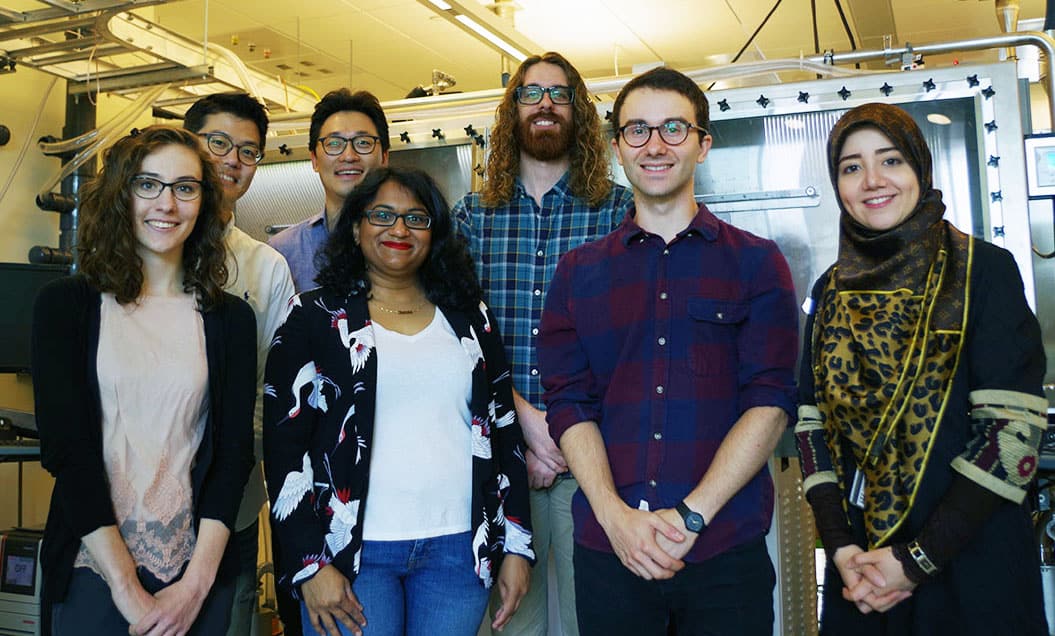
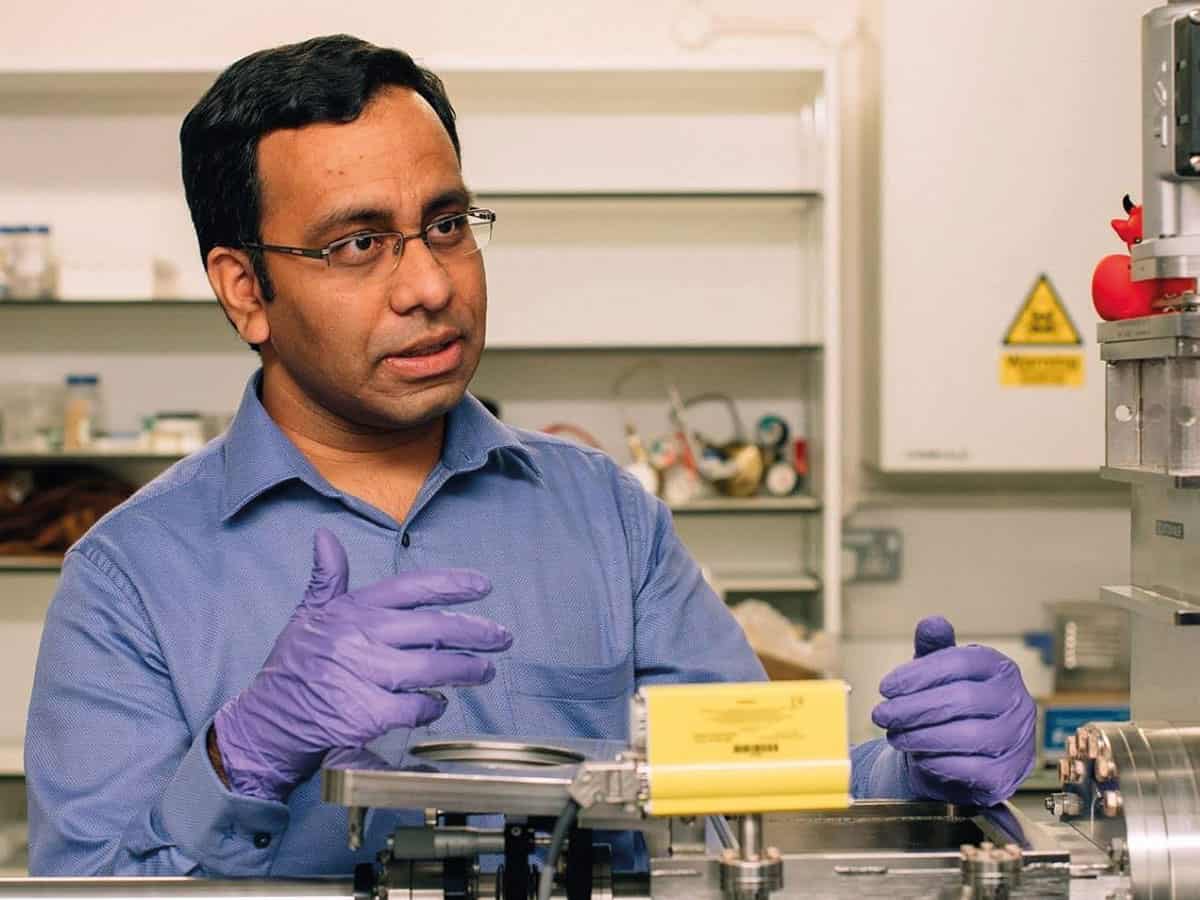
In safe hands: Niladri Banerjee at Loughborough University. (Courtesy: Loughborough University)
In a spin
One solution could lie in the new field of “superconducting spintronics”, which marries superconducting electronics with room-temperature spintronics. The first part of this union – superconducting electronics – relies on materials such as niobium in which current flows with no resistance and hence no heat loss. The overall energy loss, or “dissipation”, from a supercomputer built entirely from such materials would be much reduced. Unfortunately, we don’t yet know how to make the components of superconducting circuits as small as those found in conventional electronic circuits, roughly tens of nanometres in size.
The second half of the partnership – room-temperature spintronics – exploits the spin as well as the charge of electrons to store and process information. The spin – or intrinsic angular momentum – of an electron can point up (↑) or down (↓), which offers a way to efficiently store, process and manipulate information as 0s and 1s. One way we can do this is using magnets a few atomic layers thick, made from cobalt, nickel or iron. The resulting current of spins lets us do interesting things like switch the magnetization using spin-polarized currents, in which all the spins point in the same direction.
Spintronic components aren’t fiction. They already exist in computer hard drives as magnetic-field sensors consisting of copper sandwiched between two ultrathin ferromagnetic layers – one to spin-polarize the electrons injected into it and the other to analyse their orientation. Depending on the direction of an external magnetic field, the magnetic moments of the two layers either point in the same direction (a low spin-scattering, low-resistance state) or in opposite directions (a high spin-scattering, high-resistance state). Known as giant magnetoresistance (GMR), the discovery of this effect led to Albert Fert and Peter Grünberg winning the 2007 Nobel Prize for Physics.
GMR sensors are brilliant at reading data by detecting the direction of magnetic fields of the small magnetic bits encoding information in your hard drive. But to generate the spin-polarized current that they require involves sending a dissipative electric current through these ultrathin magnetic layers, which leads to heat dissipation. For other similar spintronic applications such as switching a magnet using spin-polarized currents, this heat dissipation is far more. And this is where superconducting spintronics wins out. By integrating superconductivity (no loss of heat) with spintronic devices (lots of functionality), you get the best of both worlds.
By integrating superconductivity (no loss of heat) with spintronic devices (lots of functionality), you get the best of both worlds
Exotic solution
For superconducting spintronics to work, however, you cannot use conventional Cooper pairs, which are responsible for the remarkable ability of electrons to flow without losing any energy. Consisting of two electrons with spins pointing in opposite directions (↑↓ or ↓↑), their overall spin is zero, making them useless for spintronics. In 2001, however, three theoretical physicists – Sebastian Bergeret, Anatoly Volkov and Konstantin Efetov from the Ruhr University in Bochum, Germany – predicted the existence of “exotic” spin-polarized Cooper pairs, in which both spins point in the same direction (↑↑ or ↓↓). As long as these pairs can survive inside a ferromagnet, it ought to be possible to exploit both their spins and their superconductivity. Spin-polarized Cooper pairs offered the prospect of information-processing devices that are small, lose hardly any energy and have interesting functionalities.
It took physicists almost a decade, however, to firmly establish the existence of these Cooper pairs. The breakthrough came in a series of experiments carried out in 2010 by Mark Blamire and colleagues at the University of Cambridge and Norman Birge’s group at Michigan State University (Science 329 59 and Phys. Rev. Lett.104 137002). The trouble is, it proved tricky to generate these spin-polarized Cooper pairs. They only form in artificial thin-film heterostructures of superconductors and two ferromagnets whose magnetic moments are perpendicular to each other.
Recently, however, researchers (including myself) at Loughborough University, Cambridge and the Norwegian University of Science and Technology have been able to hugely simplify the structure needed to generate spin-polarized Cooper pairs, opening the door to practical applications (Phys. Rev. B97 184521). Instead of having to delicately align several magnets to form the bridge between superconductivity and spintronics, we have found that similar effects are possible using a single magnet and the subtle relativistic effect of “spin-orbit coupling”, which links the electron’s spin with its motion around the nucleus of an atom.
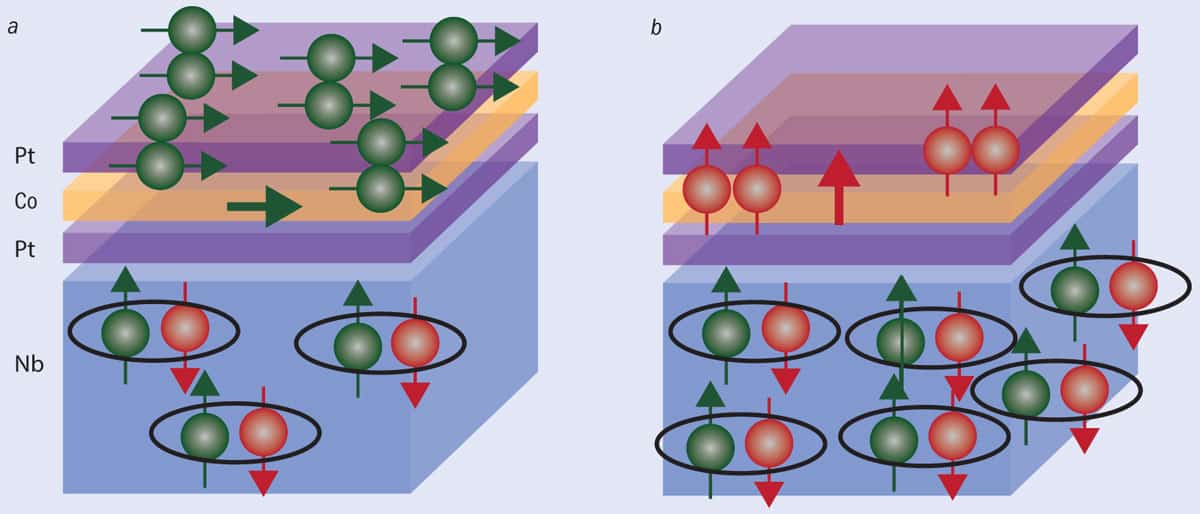
1 Controlled spin The key to practical superconducting spintronics is to use spin-polarized Cooper pairs of electrons, in which the spins point in the same direction (↑↑ or ↓↓) rather than in opposite directions (↑↓ or ↓↑). Researchers have recently found an easier way to generate these “exotic” Cooper pairs, which involves a niobium superconductor (blue) coated with thin layers of platinum (purple), cobalt ferromagnet (yellow) and platinum. (a) If you apply an external magnetic field so that the cobalt layer’s magnetization lies in the plane (green arrow), that favours the formation of exotic Cooper pairs, which drains the niobium of ordinary Cooper pairs, lowering its transition temperature. (b) But if cobalt’s magnetization is out-of-plane (red arrow), the exotic Cooper pairs are not favoured, which keeps more ordinary Cooper pairs in the niobium, keeping its transition temperature higher. So long as the exotic pairs can survive inside the ferromagnet, then both their spins and their superconductivity can be exploited.
What we did was to take a standard superconductor such as niobium and deposit on its surface an atomically thin layer of platinum, followed by a layer of ferromagnetic cobalt and finally another layer of platinum (figure 1). With the thicknesses of the platinum and cobalt layers carefully selected, we looked at the impact of tilting the magnetization of cobalt with respect to the film plane. When we applied an external magnetic field so that the magnetization of the cobalt layer was fully in the plane, we were surprised to find that the temperature at which the niobium starts superconducting fell dramatically compared with when there was no magnetic field. Although we knew that applying an external magnetic field reduces the superconducting transition temperature, the drop we saw was far bigger than expected.
Over the next two years, we performed rigorous experiments to nail down exactly why there is such a big fall in transition temperature. It turns out, it’s all to do with the number of ordinary Cooper pairs. If the magnetism lies along the plane of the cobalt layer, the exotic Cooper pairs survive, which drains the superconductor of ordinary Cooper pairs and lowers its transition temperature. But if the magnetism of the cobalt layer points out of the plane of the film, the exotic Cooper pairs find it hard to survive, which means fewer Cooper pairs leak out, increasing its transition temperature.
Thanks to spin-orbit coupling (in the platinum), we can control superconductivity (in the niobium) by adjusting the magnetization direction of a single magnet (the cobalt).
The bottom line is that, thanks to spin-orbit coupling (in the platinum), we can control superconductivity (in the niobium) by adjusting the magnetization direction of a single magnet (the cobalt). The spin-orbit coupling lets us generate exotic Cooper pairs in a controllable way simply by adjusting the direction of a single ferromagnet. In essence, our stacked structure of platinum and cobalt has given us a spin-orbit-coupled ferromagnet. This effective communication between superconductivity and magnetism is like forming a bridge between the two phenomena, dramatically simplifying the structures needed to make useful circuit components in superconducting spintronics.
Feeling green
This form of superconducting spintronics, driven by spin-orbit coupling, makes it much easier to build the components needed for a fully functioning and practical superconducting spintronic circuit, taking us one step closer to more efficient supercomputers. However, our work goes far beyond practical applications. It shows that three very exciting phenomena can coexist in this niobium–cobalt–platinum system: superconductivity, magnetism and spin-orbit coupling. Indeed, under specific conditions, entirely new phases of matter can emerge, including – in our case – a novel form of “magnetic superconductivity” (usually magnetism kills any superconducting behaviour). Such phases are not possible to generate in nature and exist only in these kinds of artificially engineered structures.
For those involved in superconducting spintronics, it is like being back in the mid-19th century when researchers had discovered electricity but had not yet invented the light bulb.
For those involved in superconducting spintronics, it is like being back in the mid-19th century when researchers had discovered electricity but had not yet invented the light bulb. What we now need is a device that can exploit our exotic Cooper pairs. One possibility would be to build a superconducting version of a “spin transfer torque” (STT) device – a conventional spintronics component in which the magnetization of a ferromagnet can be flipped using a spin-polarized current.
Such devices are already being used for STT magnetic random-access memory (STT-MRAM) chips. They are not only cheaper, use less energy and can store more information than conventional memory chips, but also let us precisely switch the magnet of one device without disrupting the magnetic alignment of nearby devices, which is always a danger when you switch a magnet using an external magnetic field.
In the spintronics version of STT, we could switch the magnetization of a nanomagnet by transferring spin angular momentum from the spin-polarized current. Building an STT device that uses superconducting spin-polarized currents might not be easy, but it would massively improve the energy efficiency of such devices. While it is hard to predict how information technology will evolve, I envisage today’s supercomputers, which exploit only the charge of the electron, one day becoming obsolete – replaced by a new generation of superconducting spintronics supercomputers. Green supercomputers will then have finally arrived.
Inspiring the next generation of scientists is an important and challenging task, and physics teachers work hard to help students develop a genuine understanding of core physical concepts. Students can sometimes find it difficult to grasp some of the abstract ideas underpinning the study of electricity, so it was fitting that effective methods for teaching electricity was the focus for a recent workshop for nine physics teachers from Egypt and six from the UK.
The workshop was organized in a co-operation between the Institute of Physics (which publishes Physics World), the Egyptian Ministry of Education and Technical Education, and the Egyptian Knowledge Bank – one of the world’s largest digital libraries that since 2016 has been free to access by educators, researchers, students, and Egypt’s general population. The event, held on 13 March at the Institute’s London headquarters, was designed to allow the teachers to exchange ideas and share best practice.
Particular focus placed on using demonstrations and modelling techniques to foster a deeper understanding of the physical processes at play. “In one demonstration all participants formed a circle and held hands to light up an LED at the top of the circle,” says Linsey Clark, International Relations Manager at the Institute of Physics. “Everyone was surprised to see the LEDs light up when the circle was complete, and requested information about where to find the equipment to use in their own classrooms.”
The teachers also explored the rope-loop model, in which participants holding a loop of rope take the role of different components within a circuit. Different configurations can be made to demonstrate concepts such as series and parallel circuits, offering a versatile technique that can help explain electricity to school children at different stages of their education.
The Egyptian delegation, led by Egypt’s minister for education, Dr Tarek Shawki, was keen to explore more practical approaches for teaching physics in the classroom. They said that science education in Egypt is often dominated by note-taking and rote learning, with few opportunities for creative problem solving or critical thinking. Students gain little appreciation of how to think and study like scientists – which is a major problem for a country that believes that science and innovation holds the key to its future economic prosperity.
As a result, Shawki is leading sweeping reforms of Egypt’s education system, with the government investing heavily in new curricula, improved learning methods, and more progressive assessment criteria. As a scientist himself – with an extensive academic record that includes 13 years studying theoretical and applied mechanics at the University of Illinois at Urbana-Champaign – the minister is well aware that science teaching in Egyptian schools needs particular attention, and in pre-workshop discussions he talked about ambitious plans to introduce more interactive techniques that build understanding as well as knowledge.
“Teachers from both nations enjoyed the sessions and gained some useful techniques to use in the classroom,” adds Clark. “The Egyptian teachers who attended could certainly use the examples from the workshop to demonstrate how physics can be taught in a more practical way.”
By the end of next week, the UK may have left the European Union (EU) after 46 years as a member of one of the world’s biggest and most successful trading blocs. Or perhaps, given the huge political division over Brexit – and the resulting parliamentary impasse – the UK is still a member and leaving has been deferred again. Even if the UK has quit, the government’s proposed Withdrawal Agreement largely maintains the status quo, with the UK still paying into EU coffers until the end of 2020 (but having no say in any EU decisions).
In short, despite a (slim) majority voting to leave the EU in a referendum that took place more than two and a half years ago, no-one has any clear idea what kind of Brexit we will get. The situation is hugely uncertain and it may be another two years before we really know the full details of the UK’s future relationship with the EU. I sympathize with politicians, for whom Brexit is a hornet’s nest of issues that will affect every aspect of the economy and our lives.
As physicists, we’re all familiar with Heisenberg’s uncertainty principle. But most people operate by another uncertainty principle, which is that the more uncertainty there is, the less likely they are to do something new. It’s why high-street spending has fallen since the referendum and why people are increasingly reluctant to move house, buy a new car or book a holiday – especially in Europe.
The uncertainty over Brexit is also affecting business. Fewer people are being hired. Companies are investing less in new facilities or products. The potential for extreme currency fluctuations is making profit margins unpredictable especially for hi-tech equipment manufacturers. And to people who say, don’t worry, the UK can just trade under World Trade Organization rules if there is no Brexit deal, I’m afraid you’ve missed the point entirely. Such an arrangement would be disastrous.
Beyond Brexit
At the recent Business Innovation and Growth conference held at the Institute of Physics (IOP) at the end of February, Brexit was the word on which no-one wanted to dwell. Business leaders, scientists, investors and officials from government agencies, such as Innovate UK and the Knowledge Transfer Network, instead focused on how the UK and Ireland can realize the full benefits of the next technological and industrial revolutions underpinned by physics. The conference also heard from successful companies – including IOP Business Award winners – about their innovation stories, with delegates keen to find out what more could be done to support and nurture such high-growth businesses.
Physics-based firms currently contribute around £177bn and €23.3bn each year to the UK and Irish economies respectively, which is fantastic. But if you look at the 36 countries in the Organization for Economic Co-operation and Development, the UK is firmly mid-table for R&D investment. As a percentage of gross domestic product (GDP), the UK spends less than half as much as France, Germany, South Korea or the US. So what needs to change if the UK is to meet its target of boosting R&D investment from 1.7% of GDP to 2.4% by 2027?
No company will fork out money on R&D without being sure they’ll get a decent return on investment (meaning that any cash they do spend should dramatically boost overall GDP). One important initiative in this regard will be the UK’s Industrial Strategy Challenge Fund, which seems well thought out and was described at the BIG conference by Innovate UK director Mike Biddle, who is a physicist and a fellow of the IOP.
A recurring theme at the meeting was that physics-based businesses take far longer to develop than, say, a restaurant. But once off the ground, such firms have a sustained competitive advantage and often export globally. Thankfully, investors are aware of the long start-up times and an increasing number of patient capital investors are realizing that the future lies in “deep” technology businesses – those that are underpinned by science and depend on know-how, patents, skilled staff and advanced manufacturing techniques.
However, many physics-based businesses are still at risk even after they develop their technology, with product scale-up costs often being tens or hundreds of times more than for developing the initial prototype. Unfortunately, most government initiatives to support firms are focused on early-stage R&D and we need more help for firms to cross the so-called “valley of death” so they can go from designing prototypes to selling real products.
Cashflow is another challenge. Take the EU’s Horizon 2020 programme, which gives businesses grants to get products out of the lab and into markets across Europe. The grants are paid in advance, which is great because UK government grants, in contrast, are generally paid quarterly in arrears – forcing firms to find cash up-front. What’s worse, we don’t know if UK firms will still be eligible for EU funding post-Brexit, which merely adds to the overall uncertainty.
Even the UK’s successful R&D tax-credit scheme, which lets firms claim back part of their research spending, is not perfect. The tax authorities, for example, don’t always accept a company’s claim for how much money it invested. Moreover, the scheme requires a firm to file annual accounts before making a claim, which can mean a long wait (up to 18 months) until it gets any money back. I believe the time is ripe to reform the tax-credit system to make it easier for a company to prove it has invested in R&D and/or get funding for later-stage work.
Next steps
It’s clear there are huge global businesses opportunities in photonics, medical, clean tech, quantum technology and many other areas of physics. If we can reduce the barriers to market, get the Brexit uncertainty out of the way as fast as possible, and free us from unnecessary EU regulations, then perhaps the UK government can more fully capitalize on the world-class research base it has already invested in.
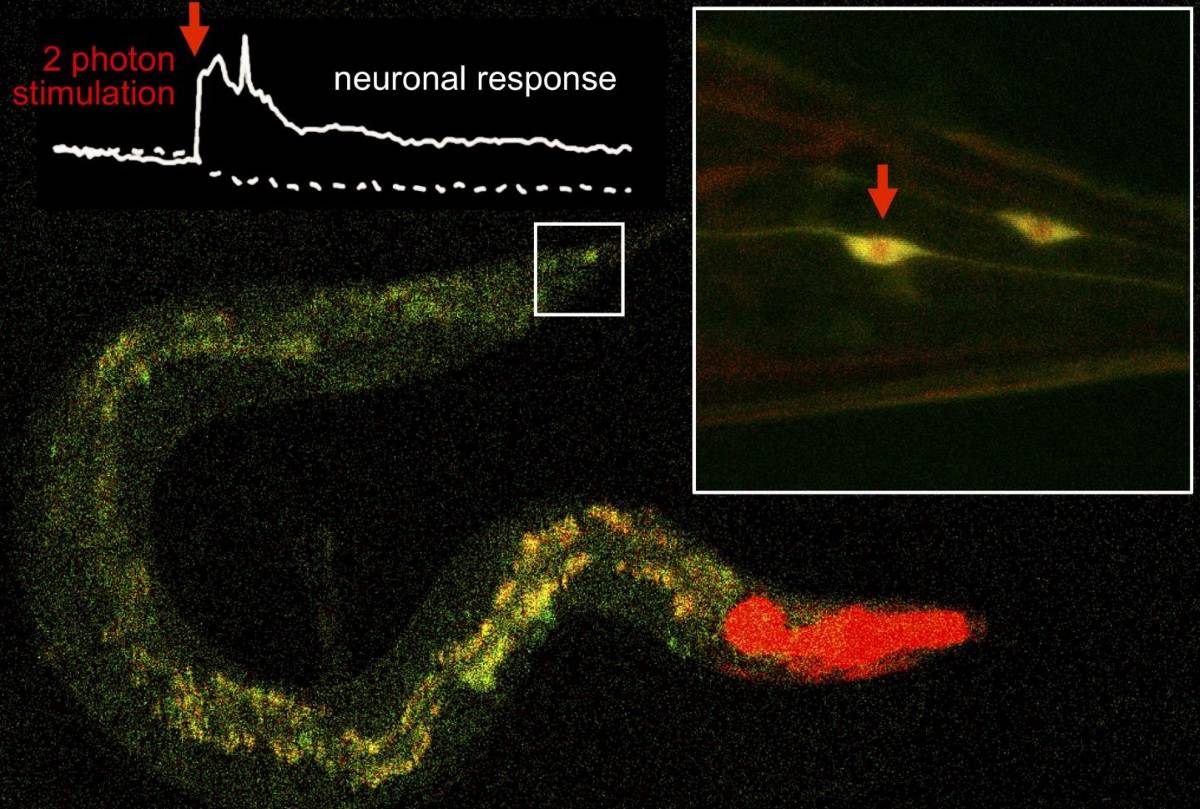
Worm neurons are individually activated by two-photon stimulation thanks to azobenzene photoswitches. (Courtesy: Montserrat Porta; Aida Garrido)
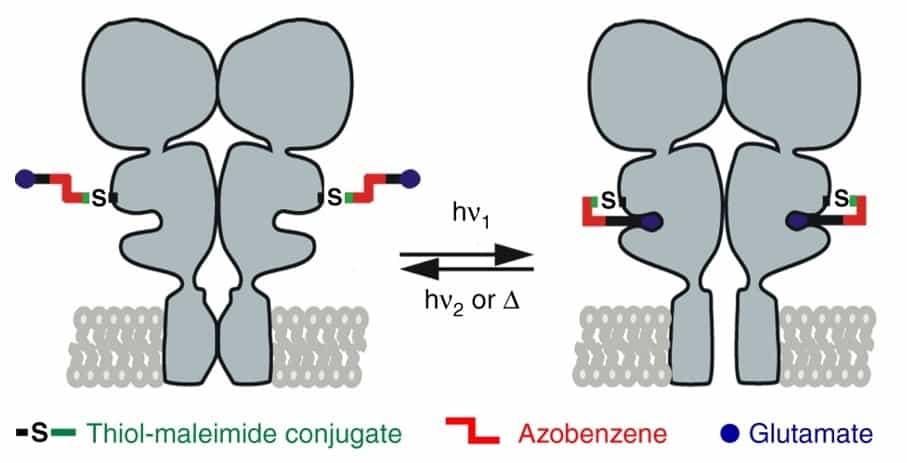
Researchers in Spain have developed azobenzene “photoswitches” that are able to efficiently and selectively activate neurons in brain tissue and in living nematodes, an animal model for the study of neuronal circuits (Nature Communications 10.1038/s41467-019-08796-9).
Azobenzenes are aromatic molecules that change their shape (configuration) under light excitation. Recently, researchers have designed azobenzenes conjugated with ligands that attach to neuronal channel receptors, and demonstrated control of the cell channels with infrared light. This approach means that cells located under the light beam in a tissue can be selectively and remotely activated.
Azobenzene conjugated with a ligand changes its conformation and opens the cell-channel after being illuminated. (Courtesy: Nature Communications 10.1038/s41467-019-08796-9/CC BY 4.0)
Activating cells at a particular depth, rather than along the whole path of the light beam, requires two-photon (2P) excitation. To this end, near-infrared light pulses are employed, since they easily penetrate tissue, offer good spatial resolution and cause low photodamage in cells. Unfortunately, azobenzenes do not absorb much energy from 2P infrared pulses, resulting in a very low cell activation efficiency.
Rational development of precise photoswitches
To address this shortfall, Pau Gorostiza from the Institute for Bioengineering of Catalonia (IBEC), Ramon Alibés from Univeristat Autonoma de Barcelona (UAB) and colleagues have used computational models to design azobenzenes with improved 2P absorption, while maintaining a suitable thermal stability.
Once the researchers identified suitable candidates, they synthesized the photoreactive compounds and tested their photochemical properties. They subsequently selected two of these compounds for cell activation assays in vitro.
When tested on genetically modified cells, the chosen photoswitches precisely activated cell receptors using determined wavelengths of near infrared light. In addition, one of the azobenzene photoswitches presented a remarkable 2P stimulation efficiency, which encouraged its trial in brain tissue slices. In these tests, the photoswitch not only maintained this high efficiency in the cells of the tissue slices, but also allowed selective activation of different cells at selected depths. Furthermore, the team also demonstrated photoswitching in living nematodes, manipulating the activity of individual neurons.
A new tool for studying neural networking
These findings represent new possibilities in the study of single-cell behaviour and photoactivated drugs. As Gorostiza points out: “It’s a development that opens the door to a large number of applications. From drugs that only act at the point of our body that is illuminated and are therefore free from unwanted side-effects in other regions, to the spatial and temporal control of any protein whose function we want to study in the context of an organism.”
A new type of robot made by multiple units – called “particles” – can respond to external stimuli and execute different tasks.
These particles, all identical, are able to expand and contract but incapable of independent movement in space. However, they can weakly interact with each other via weak magnets which bind the particles together. The collective system, called “particle robot”, can perform different functions such as migration towards a light; moving an object or avoiding an obstacle.
Reporting in a recent paper published in Nature, a team of researchers from Columbia University, MIT, Cornell University and Harvard University, led by professor Hod Lipson, developed the technology.
Collective technology
In their working mechanism, a signal activates the expansion-contraction cycle of the single particles, and the individual response becomes collective locomotion that allows various tasks to be completed.
For this purpose, the team implemented an algorithm inspired by biological phenomena such as collective cell migration. Each particle responds to the external stimuli according to its intensity (and thus, its distance from it) and does not require individual programming. The researchers show the mechanism behind their particle robot in a video.
They ran experiments with 25 physical particles and simulations with up to 10,000 particles. In addition, the simulations show the robot still works when 20% of the units are malfunctioning.
Towards miniaturization
This new approach to robotics has different advantages. Firstly, simple particles are easier to build than more complex ones designed to perform specific tasks. Moreover, being all identical, working particles can easily substitute for broken ones (self-heal) and the robot can grow as long as more particles are added. Finally, weak coupling provides more freedom in response to external stimuli and an unknown environment so that the particles can easily separate, overcome obstacles, and reaggregate.
In the foreseeable future, the particle robots will be made of thousands of miniaturized particles and simulate more complex systems, such as “biological systems comprising billions of cells” as the researchers conclude in the Nature article.