While radiotherapy technologies continue to evolve and progress, tumour motion and anatomic variations remain challenging for optimizing the conformality of radiation delivery. Adaptive procedures, where patient plans are redesigned online or offline, and real-time strategies such as intra-fraction motion compensation offer the potential to reduce dose to organs-at-risk and increase dose in the target.
But how widespread is the implementation of such adaptive and real-time strategies? That’s the question being investigated by the POP-ART RT (pattern of practice for adaptive and real time radiation therapy) study. Established by participants of the “Realtime and adaptive management of anatomical variations” track at last year’s 2nd ESTRO physics workshop, the study is based on an online survey for all institutions that perform radiation therapy to complete.
The study has two aims. First, to determine to what extent, and in what way, adaptive and real-time radiotherapy are being used in clinical practice. Second, and more importantly, the researchers hope to understand the barriers to implementation or increased use.
The survey contains questions on the current use of gating or tracking for respiratory motion management and for adaptive radiotherapy using multiple treatment plans to manage inter-fraction motion. It also includes questions regarding plans for further or new implementation of real-time and adaptive motion management techniques, and asks about the challenges preventing wider use.
The research team are keen for as many institutions as possible to participate in the survey, including those that are not currently performing any type of adaptive or real-time radiotherapy. They point out that for such institutions, the survey will only take five minutes to complete.
The researchers plan to disseminate the findings of their study through a scientific paper. “The results will enable us to identify the necessary action to be taken by vendors, users and society to implement adaptive and real-time radiation therapy more widely in clinical practice and to increase confidence in using this new technology,” they write.
An add-on device for smartphones could replace blood glucose meters for measuring blood sugar. Blood sugar measurements are essential for diabetes patients who need to know their blood glucose concentration in order to regulate it with insulin. Failure to do so might result in complications from the disease. The device, designed by researchers in Taiwan, achieved 100% accuracy in a test with 20 blood samples from diabetes patients (J. Biomed. Opt. 10.1117/1.JBO.24.2.027002).
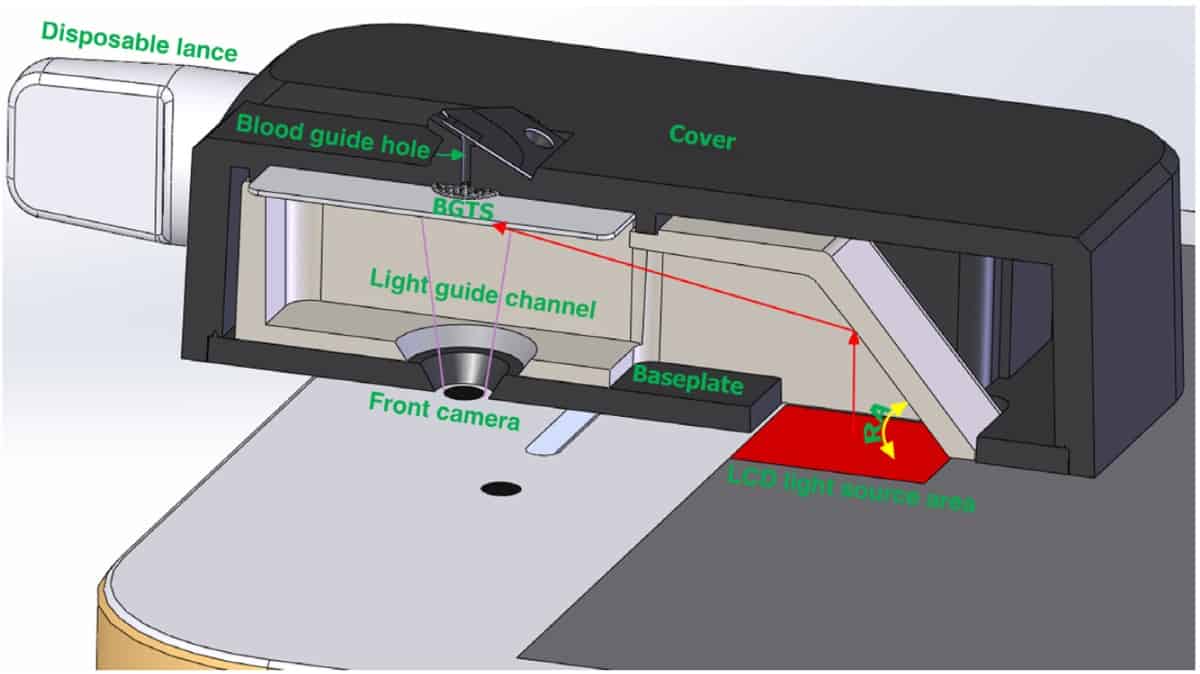
The researchers designed a compact device containing no electrical components that can be used in combination with a smartphone. The light from the smartphone’s display reflects onto the blood glucose test site (BGTS) inside the device, which contains a colorimetric test strip. The user adds a blood drop to the test strip, which is then assessed for a colour change using the phone’s front camera.
In this study, the blood drop was obtained from a vein, but the device is designed to work on drops extracted from the patient’s finger using a disposable lance that is then inserted into the device. The observed colour is split into its red, green and blue components. The researchers used the green component as an indicator of blood glucose concentration, as it could reliably distinguish the widest concentration range out of the three components.
The integrated blood glucose detection device uses light from the phone’s display and detects the colour change using the front camera. (Courtesy: J. Biomed. Opt. 10.1117/1.JBO.24.2.027002)
Four out of five of the authors are members of iXensor, a mobile health company that developed the PixoTest technology that analyses colorimetric assays using smartphone cameras. As well as the blood glucose measurements presented in this study, the company is also using PixoTest technology to develop blood cholesterol, blood lipid and other medical tests.
Testing blood samples
The researchers have now reported the results of tests on the new smartphone-compatible device. First, they used blood samples devoid of sugar and added known amounts of glucose. The device, as well as existing blood glucose meters, correctly determined the resulting blood sugar concentrations.
The authors then moved on to blood samples from 20 diabetes patients. Again, all of the samples were measured accurately, confirming that the device operates in accordance with the International Organisation for Standardization (ISO 15197:2013) requirement for blood glucose monitors.
Less bulky, more convenient
Current blood sugar measurements employ either a test strip that requires a drop of blood from a finger prick, or an electric continuous glucose monitor, which uses a sensor that is worn just under the skin. Such continuous monitors don’t actually measure blood glucose but the glucose in the fluid surrounding cells and need to be complemented with occasional test strip readings for calibration and comparison.
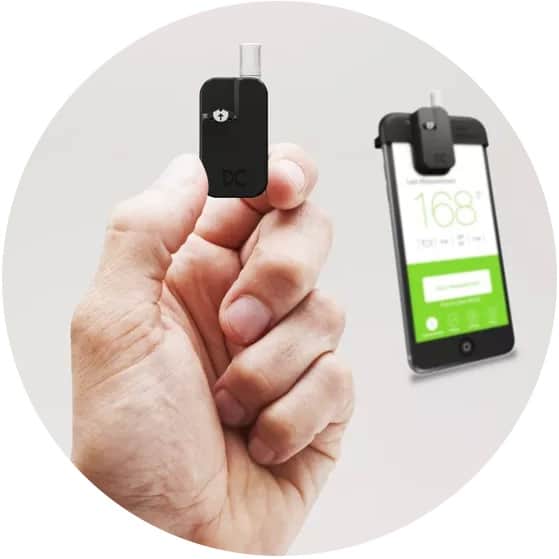
The new device is much smaller than current blood glucose meters. (Courtesy: iXensor)
Blood glucose measurements using test strips are currently assessed by eye or using a dedicated blood glucose meter that users carry around with them, in addition to any phones they would carry for personal use. By-eye assessment of the test strip’s colour is less accurate than automated read outs.
The new device is considerably smaller and lighter than the blood glucose meters currently in use with test strips. Considering that more than a third of the world population already owns smartphones, the add-on device might make frequent blood glucose measurements more feasible in limited resource settings.
1 Ubiquitous pointer from Mickey (5) 4 Conflagration goes up against bricks to protect computer user (8) 9 See 21 down 10 One piece of winter sports equipment, speaking drunkenly, represents characters (5) 11 Military physics detected in Find My iPhone icon (5) 13 No-strings alternative for digital communications acronym (4) 14 Offline activities can be found in their laptop (1,1,1) 16 Escape drive with Bond car feature (5) 18 Malicious online coder wears dark headgear (8) 21 Files that need interpreting found around barycentres (8) 22 Telephone replacement is in the sky, perhaps? (5) 25 Vital computer circuitry made from bits of carbon and plutonium (1,1,1) 26 Bid website created when bishop leaves rebuilt abbey (4) 29 Chatting with the face seen in supremo jingoism (5) 30 Install video player to accompany army (5) 31 Rock formation has anonymity in store (3) 32 Excited, anxious feeling when streaming online thriller (8) 33 Short software exhibitions, e.g. shareware, freemium services or beta versions (5)
Down
1 Damaging download puts conflict into gender (7) 2 Twisted ruse is beneath the system administrator (4) 3 Digital communication has scrambled Amile (5) 5 First things, making up WWW, HTML and URL (8) 6 Peripheral devices assembled from aural parts (9) 7 Byte, nibble, bit – the first, relatively (7) 8 Muddled coins all over your desktop (5) 12 Learner quits US computer manufacturer to go back on his words (3) 15 Could Web have originated within nicer neighbourhood? (4) 17 A precious shade in the bad magic phrase: 40E0D0 (9) 19 Informal greeting: 01101000, 01101001, 01111001, 01100001 (4) 20 Online community devotees heard to acquire assents with meditative state (8) 21 and 9 across Notable NeXT machine user hears fiery rocket stages on downwind slope (7-3) 23 Increasingly professional online diversions that French art harbours (7) 24 Internet award like mallard toes (5) 25 A big cheese like Cook, Dorsey or Zuckerberg (1,1,1) 27 Did basic maths to get connected in online network (5) 28 Something in your online shopping cart? It’s reorder time! (4)
Download the crossword as a PDF here. Answers will be published in the May issue of Physics World. Please note that this crossword is just for fun; there are no prizes.
A grooved surface that collects water by encouraging large dew droplets to form rapidly and then trickle away has been created by Pierre-Brice Bintein and colleagues at the Superior School of Industrial Physics in Paris. The researchers say that a square metre of the surface could be used to collect more than 500 ml of water in one night. The team believes their technique could provide people in some arid regions with a reliable source of fresh water.
When an inclined surface is left outside overnight in relatively cool temperatures, dew droplets will form and grow. A droplet will dislodge when its weight overcomes its surface adhesion and collecting these droplets can provide a vital source of clean, fresh water in arid climates. However, the technique is not particularly efficient with conventional surfaces because droplets can remain stubbornly pinned to inclined surfaces – and then evaporate when the surface heats up in the morning.
Researchers have reduced this sticking time using ultra-smooth and micropatterned surfaces. Droplets on these surfaces experience less of a pinning force and are therefore at shed at smaller sizes.
Bigger droplets
Another way of improving water yield is to boost the rate at which droplets form on the surface. This is important in many places where dew formation is sporadic – rather that occurring all night. To deal with this issue, the researchers created a surface that forms large droplets more quickly.
Made from a wafer of silicon dioxide, their surface has deep, micrometre-wide grooves etched into it. Bintein and colleagues tested the surface by placing it in a climate-controlled chamber, alongside two smooth-surface wafers. They then took videos of dew formation on each surface for two hours.
The videos reveal that dew collects initially inside the grooves, forming long filaments of water. As it builds up, the water in some filaments spills over into adjacent grooves, forming droplets. Since multiple droplets can be connected by the same filament, emerging pressure gradients caused smaller droplets to drain into larger ones, causing groups of droplets to coalesce into a small number of large droplets. Whereas droplets on the smooth surfaces only began to shed after two hours, the researchers observed shedding after just half an hour on their grooved surface.
Bintein’s team is confident that their technique will allow for an effective way to capture up to 500 ml litre of water per night, provided that resilient micro-grooving can be affordably manufactured on large scales. With many communities now facing an increasingly uncertain access to fresh water, the discovery could help many people in the coming decades.
In one of the bizarre quirks of the universe, the “ordinary” matter that we encounter in our daily lives only accounts for a small amount of all the stuff out there in the cosmos. Significantly more of that stuff is dark and mysterious, something scientists refer to as dark matter. In this video, Physics World’s James Dacey introduces the theory of dark matter and some of the ways that scientists are trying to detect dark-matter particles using direct and indirect methods.
This video is the first in a new series of animated videos called Physics World Explains. Look out for more in the coming months.
The first energy-harvesting, triboelectric fabric that is both waterproof and capable of converting energy from multiple sources – such as wind, rain and human movement – has been developed by researchers in Taiwan and the US. The development could lead to myriad applications in wearable technology, self-powered sensors and ambient energy harvesting.
Triboelectric energy is generated when certain materials are rubbed together. Friction causes electrons to be transferred from one material to the other – creating an electrical potential when the surfaces are separated. Familiar examples include the electrical shock one can experience after walking on a carpet or a balloon sticking to a wall after it has been rubbed on someone’s hair.
Because it converts kinetic energy to electrical energy, there is a great deal of interest in using the effect to harvest energy from both human movement and ambient motion such as wind or rainfall. A number of small-scale triboelectric “nanogenerators” have been developed and are particularly well-suited to harvesting energy from irregular, low-frequency motion.
Difficult to waterproof
Although these devices are low-cost and reliable, they do have some limitations. They tend to be designed to harvest energy from one specific type of motion, for example. They are also unable to function in wet or excessively humid conditions because the presence of water tends to inhibit the triboelectric effect. Devices can be waterproofed, but this is difficult to implement and is not long lasting.
Now, Ying-Chih Lai and colleagues at the National Chung Hsing University and the Georgia Institute of Technology have created a new nanogenerator design made out of layers of waterproof, high-triboelectric effect fabric. The material is as flexible as fabrics used in conventional clothing and its elastic features enable it to collect energy from multiple sources. As a result, the nanogenerator can harvest energy from tiny impacts – such as gusts of wind or individual raindrops – as well as from the motion of a person wearing a garment incorporating the technology.
The nanogenerator uses a “contact-separation” mode of energy gathering, whereby the triboelectric effect is the result of interactions between two active fabrics that make up the device. This design, Lai explains, provides a higher electrical output than other modes. Unlike previous fabric nanogenerators, the conducting fabric in the new design is made by weaving together silver fibres and lyocell rayon.
“Multifunctional yet nimble”
“The multifunctional yet nimble fabric nanogenerator design can not only address the long‐lasting challenge of waterproof, adaptive, deformable, and universal energy devices for locally accessible energy, but also bring a new class of wearable energy and smart fabric articles,” says Lai.
In a paper in Advanced Science, the researchers describe a variety of practical demonstrations of their new fabric, illustrating its potential for use in flags, tents, roof coverings, shoe soles, umbrellas and raincoats.
“The nanogenerators on the umbrella and raincoat can harvest water drops’ impact energy, transforming this into electricity to light up tens of light‐emitting diodes,” notes Lai. He adds that the fabric could be used to develop self-powered, illuminated rain gear to help prevent traffic accidents on rainy days. Under 125 mL/s of rainfall, the nanogenerator charged a 1 μF capacitor up to around 9 V in 5 min. Repeated washings did not diminish the harvester’s performance.
Audio player
The researchers also demonstrate a rudimentary wearable, wireless interface for controlling an audio player. Wrapped around the user’s arm, the controller has icons that can be pressed to start and pause playback, change tracks and adjust the player’s volume.
“Constructing such triboelectric nanogenerators with properties including wearability, flexibility and water resistance will have paramount importance in the creation of portable, durable and autonomous electronic systems that are practically applicable for future technologies,” says Ishara Dharmasena, an engineer from the University of Surrey, who was not involved in this study.
James Chen – an engineer from the State University of New York at Buffalo – agrees, noting that the new material will help to reduce the size of the largest component in current wearable electronics, which is the battery.
“The most amazing part was that [Lai and colleagues] were able to combine multiple functions with one material,” Chen adds. “That can be read as the first crack for theoreticians like myself to explore why this material is so special.”
The team is now developing commercial applications for its nanogenerator fabrics.
In vivo vascular imaging in mice after labelling with polymer dots, fluorescein and QD605 semiconductor quantum dots; scale bars = 100 µm. (Courtesy: Biomed. Opt. Express 10.1364/BOE.10.000584)
Multiphoton fluorescence microscopy, in which a fluorophore absorbs more than one photon and emits light at a shorter wavelength than the excitation source, can be used to create 3D tissue images at depths of 1 mm or more. Recently, studies have shown that in vivo two- and three-photon microscopy can image neurons and vascular structures beyond the cortex in the brains of mice.
Imaging the vasculature requires intravenous injection of contrast agents that absorb strongly in the near-infrared and have prolonged blood circulation times. Traditionally, organic dyes are used, despite their poor photostability and low quantum yields. Quantum dots represent a brighter, more stable class of contrast agent, but they introduce substantial toxicity concerns.
Instead, a team headed up at the University of Texas at Austin propose the use of highly fluorescent semiconducting polymer dots (pdots). The 10–100 nm pdots are brighter than traditional fluorophores, have intrinsically low cytotoxicity and can be functionalized for molecular targeting (Biomed. Opt. Express 10.1364/BOE.10.000584).
“We were searching for bright, photostable contrast agents with biocompatible features for in vivo studies,” explains first author Ahmed Hassan. “Moreover, we’re limited to a finite set of excitation wavelengths by the availability of specific laser sources and the absorption and scattering properties of complex, heterogeneous tissue environments. We found that polymer dots fulfilled our requirements and suspected they might be particularly useful for multiphoton microscopy.”
Comparing contrasts
For deep in vivo imaging, three-photon microscopy offers advantages over two-photon imaging, such as suppression of out-of-focus background fluorescence, reduced scattering and improved signal-to-background ratio (SBR). So Hassan and colleagues first identified which excitation wavelengths produce two- versus three-photon absorption in pdots. They examined three pdots — poly(phenylene vinylene)-based CNPPV and fluorene-based PFBT and PFPV — excited by 790–850 nm, 1060 nm, and 1200–1350 nm laser light.
At 800 nm, all three pdots exhibited two-photon fluorescence. For CNPPV and PFBT, this persisted out to 1060 nm, while PFPV began to demonstrate three-photon excitation at this wavelength. Pure three-photon fluorescence was strongest at 1300 nm for CNPPV, 1350 nm for PFBT and 1325 nm for PFPV.
To evaluate the use of pdots for deep in vivo vascular imaging, the researchers injected C57 mice with organic dye (dextran-conjugated fluorescein), quantum dots (QD605), or pdots. They imaged the animals’ vasculature via an optical cranial window, using line scanning and 800 nm excitation from a Ti:sapphire laser.
Comparing 100 μm-thick maximum intensity projections at equivalent cortical depths, the pdot images were brighter than either the fluorescein or quantum dot images. PFPV produced the largest SBR, followed by PFBT then CNPPV. Relative to QD605 and fluorescein, pdot SBR was larger throughout the entire depth range.
The authors note that the mouse injected with inorganic quantum dots did not survive. Conversely, mice repeatedly injected with pdots over several months showed no signs of cytotoxicity or deleterious effects, supporting claims of pdot biocompatibility.
Imaging deeper
Pdots have a wide absorption spectrum that makes them compatible with a number of excitation sources, including longer wavelength lasers that penetrate deeper into tissue. The researchers used 1225 nm excitation (Ti:sapphire laser light shifted by an optical parametric amplifier) to image CNPPV-labelled vasculature.
Excitation at 1225 nm, where CNPPV exhibits a combination of two- and three-photon processes, attained an imaging depth of 1300 µm, compared with 850 µm for 800 nm excitation. The SBR of images collected at 1225 nm greatly exceeded those recorded at 800 nm, for all depths, producing a much higher quality 3D volume.
The imaging system. (Courtesy: Ahmed Hassan)
The team also used a custom-built 1060 nm ytterbium-fibre laser to image PFPV-labelled mouse vasculature. “Fibre lasers are low-cost, high power and available at longer excitation wavelengths, three key features that we believe are necessary for their mass adoption in academic and industry settings,” says Hassan.
While excitation at 1060 nm did not significantly extend the penetration depth, it substantially improved image contrast and increased SBR by about 3.5 times over 800 nm excitation, particularly at depths beyond 600 µm.
The researchers attribute this to three factors: the higher average power of the fibre laser relative to the Ti:sapphire source; the reduced number of photons lost to scattering and absorption at 1060 nm versus 800 nm; and the fact that PFPV exhibits a partial three-photon fluorescence at 1060 nm versus a two-photon excitation signature at 800 nm.
“Overall, pdots present an exciting new approach to multiphoton in vivo imaging,” the authors conclude. “With brighter, biocompatible probes, researchers will be able to resolve vascular architecture in living organisms with improved clarity and depth, enabling critical insights into fundamental biological problems.”
Hassan notes, however, that much work remains before pdots and multiphoton microscopy could be used clinically. “Careful toxicity studies would need to be conducted, and a clearing mechanism for polymer dots has yet to be identified in vivo. In addition, the penetration depth would be limited to shallow cortical layers, meaning endoscopic multiphoton technology would need to be advanced quite a bit for this to be useful in clinical brain imaging,” he tells Physics World.
Geo politics: William Smith’s 1815 geological map shows the UK’s coal seams (black), which match areas of strong support for Labour today. (Courtesy: William Smith/Natural History Museum)
In this era of Brexit, Trump and myriad other political upheavals, a deluge of election and ballot analyses can seem inescapable. The news is teeming with pollsters and pundits putting forth models that attempt to factor in all manner of local and national factors to forecast voter behaviour. But are they also taking the local geology into account? Unexpected connections between our modern civilization and the rocks beneath our feet are fascinatingly drawn out by author Lewis Dartnell in his latest book, Origins: How the Earth Made Us.
As curious as it might seem, the Earth itself has, in places, left a lasting mark on politics. In the south-eastern US, for example, a swathe of consistently Democrat-voting counties cuts an arc of blue through the otherwise Republican-red of the political map. The band starts in the Carolinas, runs across Georgia and Alabama, and ends up along the banks of the Mississippi River. Intriguingly, this electoral-college anomaly – which dates back to shortly after the American Civil War – closely follows the exposed geological remains of a 75-million-year-old sea.
The metamorphosed clays that made up the bed of this ancient ocean have ultimately broken down to create the so-called “black belt”– a stripe of dark, nutrient-rich soils that attracted the development of slave-tended cotton plantations in the 19th century. Today, one of its legacies is a concentration in the population of predominantly Democrat-voting African-Americans along the belt. In the UK, a comparable geology-driven voting phenomenon can be observed, with strongholds of support for the Labour Party in the last two general elections matching the locations of buried coal seams underfoot, formed from the repeated burying of plant matter in the mid-Carboniferous-era swamps of around 325 million years ago.
In writing Origins, Dartnell complements the focus of his previous book, The Knowledge – an exploration of how human ingenuity and scientific discovery built the modern world – by undertaking a broader examination of how our world built us. Starting with the tectonic upheaval that drove the evolution of our early hominin ancestors from the apes, Dartnell takes the reader on a seamless journey through time – passing through such milestones as the development of animal domestication and our adoption of baked mud, steel alloy and myriad other construction materials sourced from the Earth – and in doing so lifts the veil of our history to reveal the geology behind the curtain.
Origins’ strength lies in the way it manages to conjure a tight, linear narrative from what would otherwise be an overwhelming wealth of insights, a feat aided by Dartnell’s soothing, conversational writing style. A particular joy comes from the many fascinating titbits that Dartnell uses to punctuate his work, including how democracy owes its development, in part, to the mountainous landscape of Greece, and how there exist small pockets of primordial Earth-like atmosphere in the gut of every cow, populated by anaerobic methane-producing microbes.
Dartnell also invites us to consider an intriguing series of what-ifs that emphasize the tangible impact that geology has had on our world community. For example, if Britain had remained connected by a land-bridge to France, it would doubtless have had a profound impact on both European politics and the British sense of identity – something to ponder in this time of Brexit negotiations. Yet it would only have taken a weaker ice age or a different configuration of the Scandinavian and Scottish ice sheets 425,000 years ago for the conditions that began scouring out the English Channel to have never occurred, leaving intact the strip of buckled rocks (formed when Africa and Europe tectonically collided) that once connected Calais directly to Dover.
It is only in the penultimate chapter – which addresses the impact of the Earth’s circulation on maritime trade and exploration – that the crisp execution of the book’s core geological conceit does perhaps become diluted by historical detail. However, Dartnell fashions such a vivid picture of how sailors learnt to decipher the oceans’ winds and currents in the so-called Age of Discovery, to plot more economical trade routes across the globe, that this change in pace is hardly to the book’s detriment. Overall, Origins is a captivating and enriching read, with as much to recommend it to those with an interest in geophysics as to students of human history and civilization.
Helping hand: Jocelyn Bell Burnell picking up her Special Breakthrough Prize at a ceremony in Mountain View, California, in November 2018; the prize money will be used to support PhD students in the UK and Ireland. (Courtesy: Frank Micelotta / National Geographic / PictureGroup / REX / Shutterstock)
The fund has been made possible thanks to you being awarded last year’s $3m Special Breakthrough Prize for the discovery of pulsars. How did you hear you’d won?
I had a phone call from Ed Witten, chair of the [prize] committee, whom I know from teaching his daughter physics at Princeton. I’m not usually speechless but I was on that occasion because this prize just wasn’t on my radar. I hadn’t ever assumed it would be anything to do with me.
They describe it as the “Oscars of science”. You walk in along this red carpet with photographers and press lined up along one side and flashes going off all the time and you stop every so often to answer questions. Yes, it was glitzy – fanfares, swirling lights, music, film stars. Pierce Brosnan was doing the continuity.
So who is the Bell Burnell Graduate Scholarship Fund aimed at?
The fund will give PhD students in physics departments in Britain and Ireland extra money for things they might need help with. They will already have the standard PhD studentship from whichever university they’re hoping to – or going to – attend. It’s a top-up fund to help them because some of them might have young children, or disabilities or visa issues.
How will the scheme be run?
The Institute of Physics (IOP) has agreed to administer the whole thing, which is fantastic, and a panel is being appointed to judge applications. The rules are being formulated and they look pretty good (see box below), but the idea is that no more than one [PhD student will be funded] per university per year. I’m sure over the first few years it’ll evolve and we’ll reach a steady-state about five years in.
What are the benefits of making universities more diverse?
Diversity strengthens a place. There are echoes of my own PhD studentship because I turned up at the University of Cambridge [in 1965] as one of the few women there and one of the few people not from the south of England. It felt alien and I wasn’t sure I was going to make the grade, so I worked very hard. That’s how the discovery of pulsars came about. I have this maybe vain hope that by increasing the diversity in physics departments, there’ll be more people who feel a bit unconventional, out of the normal mould, working like the clappers, thinking a little differently and maybe finding things.
Has improving diversity been on your mind for a while?
I’ve been concerned about the shortage of women in physics for a very long time. I’m one of the founders of the Athena SWAN scheme [to support diversity in universities], which started with women in science and has now expanded a lot. But I never thought I’d have this kind of money, so it was all a bit hypothetical. It would be nice to enable those who want to – refugees and people from minority and other under-represented groups – to stay on and do PhDs.
Would a fund like this have helped when you were a student?
Do you foresee criticism from those white, middle-class male physicists who might wonder why they can’t be supported by the fund?
Yes. But they are in the majority and I think if they look around a physics department they can see they’re in the majority. The Bell Burnell Graduate Scholarship Fund is not going to deprive anybody. It is more of a top-up of an existing studentship.
You’ve been as closely involved with astronomers as physicists. Were you ever tempted to award the money to the astronomy community?
Actually, as far as women go, there are a lot of women in astronomy compared with the rest of physics. Astrophysics is already more diverse than the rest of physics, so I thought going through the IOP was probably a better bet. Besides, it will reach a larger cohort of people as well.
What’s been your reaction to recent high-profile cases of sexual misconduct in astronomy?
My main reaction is: how long has it taken to come to any point of action? It’s probably affected generations of students, but times are changing.
Did you suffer any discrimination?
When I was an undergraduate [studying physics at the University of Glasgow], it was the “tradition” that when a woman entered the lecture theatre, everybody whistled and stamped and catcalled and banged the desk and made as much noise as they could. I was the only female in the honours physics class, so I had to face that on my own. It wasn’t nice.
What made you carry on despite those difficulties?
I knew I wanted to do a PhD in radio astronomy and getting a physics degree was the first step in that.
With the Breakthrough Prize being so big financially, do you think the prestige of the Nobels is ebbing away?
It’s being challenged. Breakthrough is not the only big prize. There’s the Shaw prize in mathematics, the Kavli prize in astrophysics. There are now four, five, six big prizes like that, all of which aim to thumb a nose at the Nobel. They go about things in a slightly different way and they reach, probably, a slightly different audience. But the Nobel prize is limited by [Alfred] Nobel’s will so they don’t have a lot of room for manoeuvre.
Why do you think it took until last year for only the third woman – Donna Strickland – to win a Nobel Prize for Physics?
Physics is getting more diverse. But it takes time for these changes to work through. One problem is that the prize is awarded to a maximum of three people because it was set up when the perception of the way we did physics, and maybe all science, was that there was a senior man or two and a fleet of minions under them who didn’t count. These days we work much more in teams. That’s going to make it more and more difficult for [the Nobel committee] to do justice to work that’s done.
What have you been up to since winning the Special Breakthrough Prize?
I’m doing quite a lot of lecturing. In fact, I have far more invitations than I can manage.
Looking back on your career – if you were a student now, would you still go into astrophysics?
Undoubtedly, yes.
The Bell Burnell Graduate Scholarship Fund
What is the fund?
Managed by the IOP, it supports full- or part-time graduate studentships for people from groups that are currently under-represented in physics.
Who can apply?
PhD students studying a physics-related topic at a recognized graduate degree-awarding institution in the UK and Ireland. They must also be in a physics department, school or faculty that has a Juno or Athena SWAN award.
How are “under-represented” groups defined?
The definition will be kept under review, but in this first instance it includes: women; students of Black-Caribbean, Black-African and other minority ethnic heritage; students who require support for disabilities or inclusive learning; LGBT+ students; and those from disadvantaged backgrounds struggling to complete their studies. People with qualifying refugee status who meet the above criteria are also encouraged to apply.
What will the scholarships cover?
They will normally be paid to support course fees, living support grants and any additional funding to support accessibility, including carer responsibilities.
How will students be selected?
By a small panel convened each year by the IOP. Priority will be given to students who meet multiple criteria.
How much funding will each student receive?
This has not yet been decided.
How long will funding last for?
As a contribution for up to four years (or equivalent if by part-time study) of PhD studies.
How will students receive funds?
Funds will be paid annually and will be tied to the student, so if they move university, the funding will move with them.
Further information about the fund – and details of how to register your interest – can be obtained here.
Heat pump system being installed at the Institute of Physics’ London office. (Courtesy: GI Energy)
When it comes to developing low-carbon technology solutions, one of the answers lies right beneath our feet. Ground-source heat pumps harness the heat from the shallow Earth – providing a source of renewable energy for heating (and sometimes cooling) buildings. As with all renewable energy, however, the uptake of these systems is dependent on a range of economic and political factors, which can vary widely between nations.
Heat pump specialist Neil Lawson.
To learn about the science and technology of these systems, Physics World’s James Dacey catches up with Neil Lawson from GI Energy. An engineer with a range of international experience, Lawson shares his thoughts on the prospects for this technology in the UK against the backdrop of renewables commitments and Brexit uncertainty. He also speaks about the innovative dual heat pump system installed at the new London office of the Institute of Physics (which publishes Physics World magazine).
What are the different types of geothermal energy?
Geothermal energy is heat from the Earth. It’s considered clean and sustainable and we can think about it coming from two main sources. One is hot water and hot rock, which are found a few miles beneath the Earth – unless you are somewhere like Iceland where it bubbles to the surface. The other is shallow ground, or ambient geothermal energy, and that’s where my interest lies.
How did you become interested in this subject?
I find this topic so inspiring and interesting because of its simplicity. I’ve hosted a number of school tours around installations that we’ve carried out at the University of Oxford, because it encapsulates many of the theoretical subjects learnt as part of the physics school curriculum today. The heat pump and shallow geothermal represents a real living, breathing example of how classroom theory works in real life, and the benefit it gives us.
This heat pumps deals with Boyle’s Law, Charles’ Law, leading to the Combined Gas Law. It encapsulates conservation of energy, change of states, fluid dynamics. This is all at the heart of the geothermal heat pump system, which compresses a low-grade heat or an ambient heat and turns it into high grade heat, where it becomes useful.
Do you find the general public share your enthusiasm for the underlying scientific principles of heat pumps?
When I do a talk, I ask people to put their hands up if they have a heat pump in their house. You might get 5–10% put their hands up, but the answer is, “actually, you all have them, because you’ve all got fridges in your kitchen”. A fridge basically has a radiator in the back of it giving out warmth, while it’s cooling the inside. We’re just transferring energy from one phase to another, in heating or cooling.
So in the case of our heat pumps, the plate on the back of the fridge is actually what we’re using as a radiator or to heat a process, and the cold inside the fridge is the energy we’re absorbing from the ground. So in a fridge, the heat comes from food to keep it cool, but in a heat pump it comes from the ground.
The heat pump and shallow geothermal represents a real living, breathing example of how classroom theory works in real life, and the benefit it gives us
What technologies are involved in harnessing heat from shallow ground?
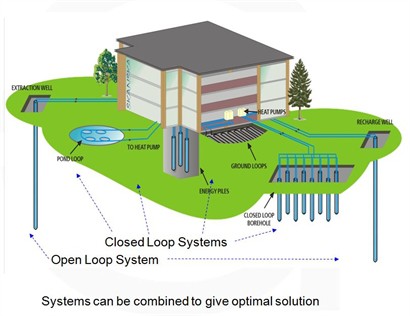
There are a number of methods in shallow, where we look at open-loop or closed-loop. Open loop deals with a fluid that’s open to the elements, so it could be a river, a lake or an aquifer. Whereas in closed loop we bury pipes in the ground or in a thermal pile and we put a heat transfer fluid through those pipes and we absorb energy. In London, most of the commercial jobs we do use vertical boreholes, or an aquifer, or energy piles, or a mixture of all three.
The beauty of the closed-loop system is that the environment it’s in is controlled, and we have a barrier between our fluid and what we’re absorbing from. Open loop is susceptible to foreign bodies coming in, so there’s a high amount of filtration required. For example, if we’re taking from a river, there might be debris floating upstream, such as silt. Or if you’re close to the sea, the salt content can start to play havoc with pumps and heat exchangers.
In these systems, what do you need to do before you can get a useful amount of heat – to warm radiators for instance?
This is where we go back to our high-school physics. We might be using a compressor, it might be a scroll compressor or a screw compressor or a reciprocating compressor. We’re taking a low-grade heat, so the common refrigerants that are available, something like R4O7C, R410A, they boil at –20 °C. It’s all about this change of phase from a gas to a liquid and then back to a liquid again, and how we can compress and expand a gas. That’s what we’re exploiting.
Heat pump systems. (Courtesy: GI Energy)
On the low-pressure side of the heat pump cycle we have a liquid at less than –20 °C. When it comes into contact with a relatively warmer fluid, we can turn that cold liquid into a gas. That gas absorbs heat from the ground. We then pass that gas into a compressor, where it’s compressed and that’s where we convert our low-grade heat into high-grade heat by using electricity to compress it. We’ve got something at say, plus 5 °C on the source side, that’s gone into the compressor, we’ve compressed it up to 30 bar. We’ve then got a refrigerant running at potentially 120 °C. We then put that through a plate heat-exchanger and we transfer that heat into a thermal fluid. It might be water through your radiators, it might be a heating process.
How do you measure the efficiency of your system?
There’s a figure called the coefficient performance, which is the heat pump’s equivalent of “miles per gallon”, as in a car. Heat pumps are measured under a European standard called EN14511, which defines the conditions that they operate at, very similar to a car running at 50 mph. A source side temperature of zero degrees centigrade, and heating water temperature of 35 °C, gives us a coefficient performance that with modern heat pumps is around five, or in excess of five. So, when running at peak power, for one kilowatt of electricity we can generate thermal heat at 5 kW. That equates to an efficiency of 500%. If you equate that to a gas boiler, they’re at 80-plus per cent efficient. So you can see, in terms of transferring energy from one medium to another, heat pumps are very attractive.
In terms of looking at the UK, as it stands, how widespread is this technology?
The technology’s available to everyone, but the take up has been disappointingly slow. Prior to 2008 there was something called the Merton Rule, where Merton Council came out with a guidance that all new developments should have 10% renewables. That promoted the uptake of ground source heat pumps, because it was easy to achieve that. Then in 2008 legislation changed and moved in favour of combined heat and power (CHP), so burning gas to produce electricity and heat. But in the last six months to a year, we’ve seen it go back the other way now. So CHP has had its 10 years of glory, and now it’s coming back to heat pumps. This has been due to the reducing carbon content of grid electricity generated with renewable forms of energy such as wind, PV and hydro.
In the Spring Statement on 13 March 2019, the UK’s chancellor of the exchequor announced the end of fossil-fuel heating in all new homes from 2025. Not wanting to be too cynical, but this was meant to be the case from 2016 but the house builders had all the building codes watered down.
In terms of the UK’s situation with renewables, are you positive that things are moving in the right direction?
Well the Renewable Heat Incentive is here until April 2021, which isn’t that far away. If we look at where politicians are focusing their energy at the moment, it’s Brexit, and unfortunately they’ve taken their eye off everything else. There’s no time between now and 2025, any parliamentary time to put anything new through. So I think we’re going to have a bit of a void between 2021 and 2025, with regards to renewables in general. Not just heat pumps.
But we are seeing results with the London Plan. There’s certainly, in central London, a great emphasis on not burning fossil fuels. Where I’m based in Oxford, we’ve also established a zero emissions zone, banning the use of fossil fuels and fossil-fuel vehicles in the centre, as they declared a climate emergency a couple of weeks ago. Which is probably similar for many cities. We’re seeing with new planning regulations that you can’t burn fossil fuels in the centre of towns, and the only solution is therefore a heat pump. The beauty of the heat pump is that 50% of an office’s load is cooling, and that’s already done by a heat pump, it just happens to be an air-cooled one. If you take the same technology ground coupled, that piece of equipment will do heating and cooling.
How do other European nations fare when it comes to heat pumps?
If you look at somewhere like Scandinavia, Sweden especially, they don’t have natural gas and oil of their own, therefore their heating oil prices were at petrol pump prices, whereas in England we’re quite heavily subsidized. So for them, economics necessitated innovation, and meant that heat pumps have been mainstream in Sweden since the 1950s. You go into any house there and it has a heat pump. It’s very mature technology for them. In Sweden, if you gave a Swedish plumber a condensing gas boiler, he wouldn’t have a clue what to do with it. In England, if you give a condensing gas boiler installer a heat pump, they don’t really have a clue what to do with it. Our biggest challenge here is gearing people up and educating the market.
The wider context is that Germany is certainly driving the renewables mantra. They’re quite reliant on Russian gas and therefore they’ve put a huge investment into PV, wind, etc. I think, on good days, their grid has no fossil fuels on it.
If we look at where politicians are focusing their energy at the moment, it’s Brexit, and unfortunately they’ve taken their eye off everything else. There’s no time between now and 2025, any parliamentary time to put anything new through
Your company, GI Energy, was also involved in the heat pump at the new London office of the Institute of Physics (which publishes Physics World magazine). Tell me about that project?
In that case, we’ve got two heating-only heat pumps, but we have them coupled up in such a way that they can transfer the heat and cold to do what we call “simultaneous heating and cooling”. So in the building you have server rooms or lecture theatres electric theatres which need cooling. In doing so, we can absorb that waste energy and transfer it to places that need heating, and that makes heat pumps 700% or more efficient.
Was that a bespoke design, or is it a system that’s been used elsewhere previously?
One of the new technologies we’ve tried out at the Institute of Physics, was the GeoKOAX probe. Our challenge now is to monitor how much energy we can get from the ground, and try to do it for a more economic price. We’ve installed a very large diameter pipe with a smaller pipe inside it, and that gives us a greater thermal mass in the ground, and allows us to deal with higher peaks. It meant that we could drill at half the depth and get the same energy out, 75 m whereas we would normally drill to 150 m or more.
This is something we’re trialling and watching very closely. It’s popular in Germany because they have a legislation that you can’t drill below 75 m, which is where the technology has been driven. We’ve been putting it into UK geology to see what we can get out and how it works for us.
The IOP building has been described as like a living lab, where data about its performance will be provided to the physics community. From analysis of this data, do you believe the heating/cooling system can be evolved to become even more efficient?
Yes. A theoretical model was put together of how the building’s going to work – how many people will be in it and how it would be built. But, quite often, the reality is very different. So we put in a big system, we start operating it as per the design parameters, and we’ll go in every quarter for the seasonal commissioning and review and tweak and improve. In addition, as a business, we monitor all our systems remotely. 80% of breakdowns we can attend to through the phone line, effectively, and we can monitor and tweak.
What other exciting projects do you have coming up?
Well, we’ve worked on a number of Sainsbury’s supermarkets across the UK, I think about 30 in total, where they’re wasting a lot of heat into the air – all the chilling for their food and freezers uses air-cooled chillers. So we’ve captured that heat, stored it in the ground, and then used it to heat the buildings. Now, here at the Heyford Hill roundabout in Oxford, there’s a big Sainsbury’s store based right next to one of the poorest communities in Oxford, Rose Hill, where a lot of people experience fuel poverty. That store wastes around 600 kW peak of thermal energy. This could be captured, stored in the ground, and then used as a low-grade heat source for those people. If we can get the ground temperatures up to around 25 °C, which we can with refrigeration waste heat, we can offer coefficient of performances of around six or seven. So people will be heating their homes not a £1000 a year, but potentially £100 a year.
And Sainsbury’s themselves, they’re on board with the new project?
Yes, the big benefit to Sainsbury’s is that it halves the cost of their refrigeration, just by ground coupling it. So the ground is a more consistent temperature and in some of them it’s cooler than the air, and that’s where their biggest costs are. They, Sainsbury’s, each year, support a number of academic studies in universities, and I think it’s about three years ago one of the MSc students came up with proof that ground coupling the refrigeration saves your costs. We turned around to Sainbury’s and said “But we’ve been doing that for you for a number of years now, you just call it a heat pump.”