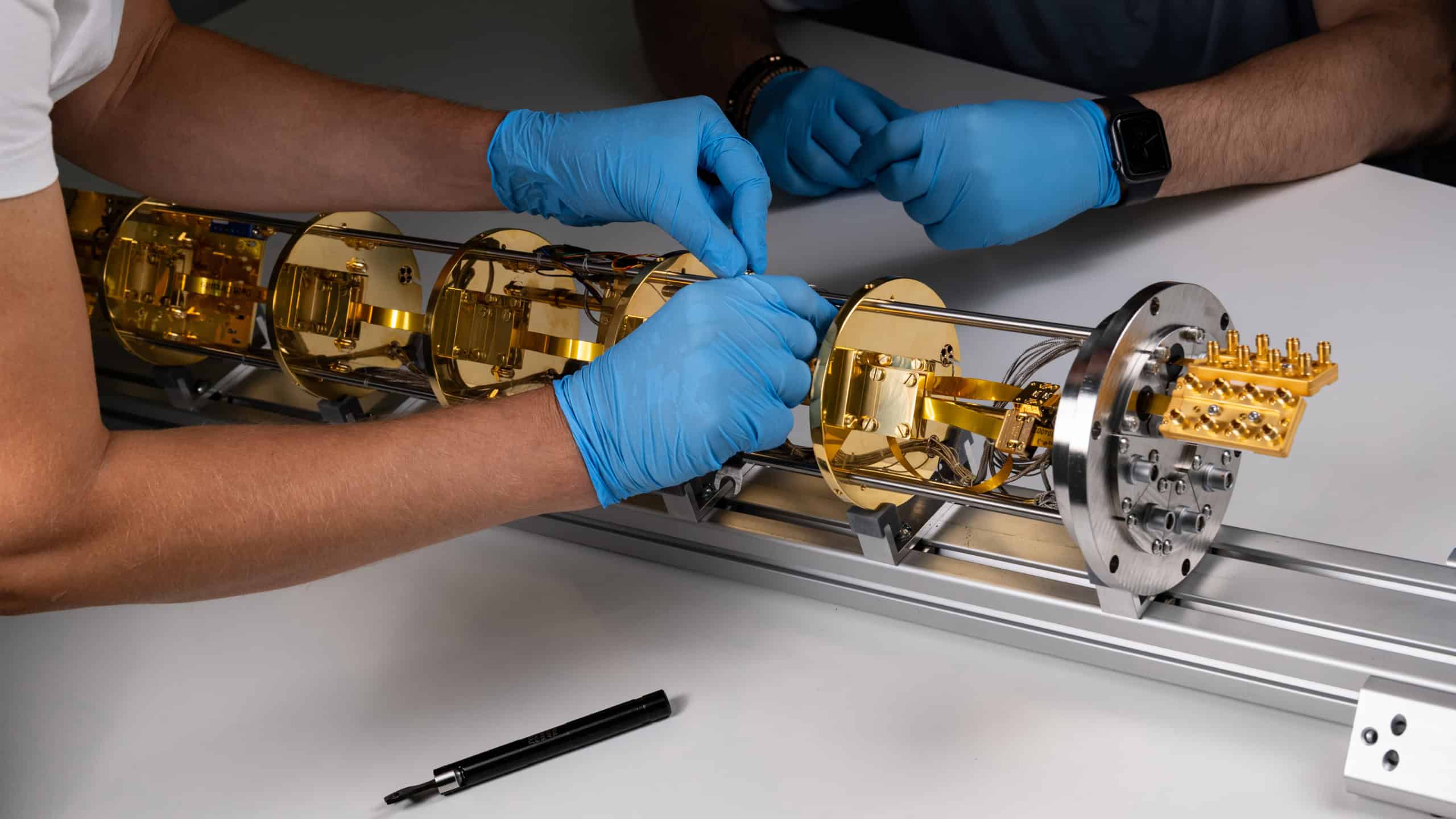
Bridging the gap between scientists, policy makers and industry to build the quantum ecosystem

When we started our PhDs in physics at Imperial College London, our paths seemed conventional: a lot of lab work, conferences and a bit of teaching on the side. What we did not expect was that within a couple of years we would be talking with MPs in the House of Commons, civil servants in Whitehall and business leaders in industry. We found ourselves contributing to policy reports and organizing roundtable discussions alongside policy-makers, scientists and investors; focusing on quantum technology and its impact on the economy and society.

Our journey into science policy engagement started almost by chance. Back in 2022 we received an e-mail from Imperial‘s Centre for Quantum Engineering Science and Technology (QuEST) advertising positions for PhD students to support evidence-based policy-making. Seeing it as an opportunity to contribute beyond the lab, we both took up the challenge. It became an integral part of our PhD experience. What started as a part-time role alongside our PhDs turned into something much more than that.

Mixing PhDs and policy
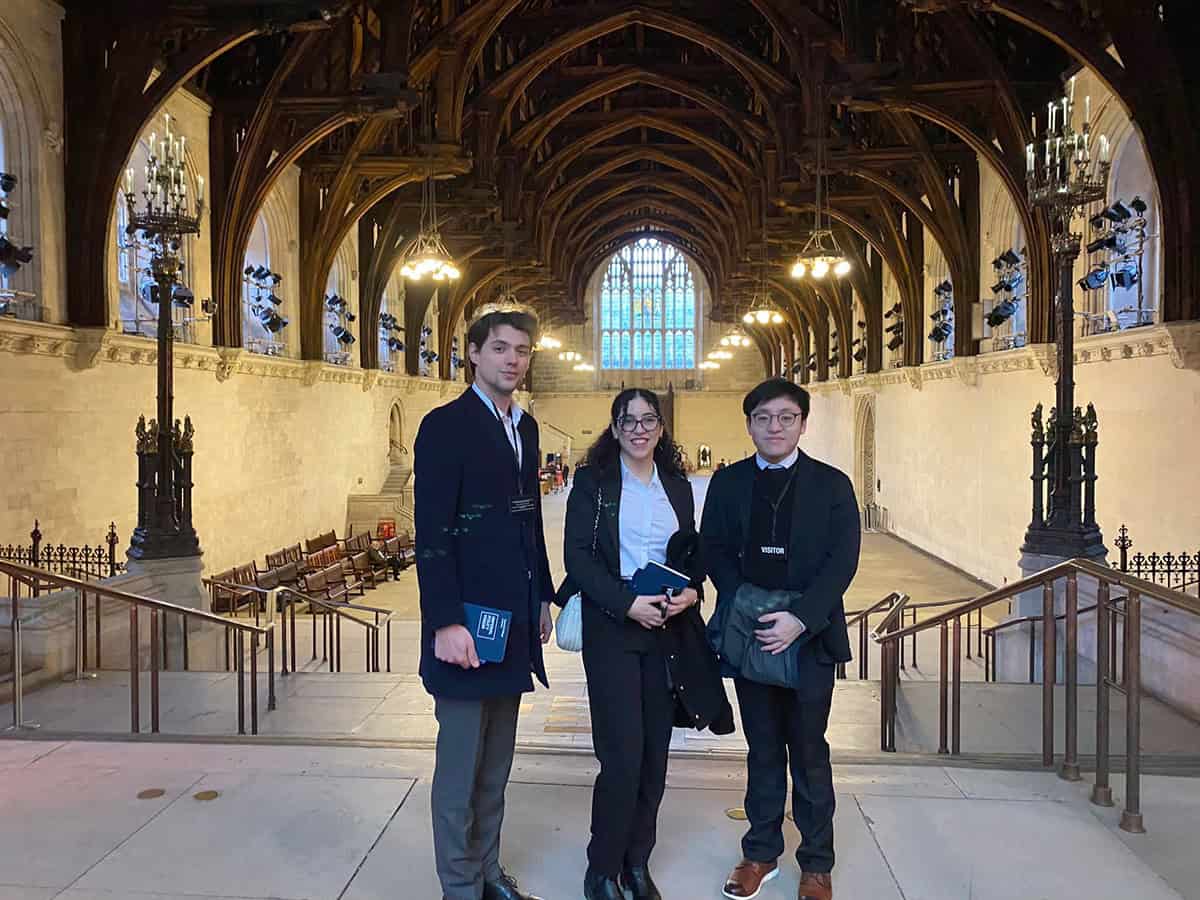
Three people stood in an otherwise empty large stone built chamber

Elizabeth Pasatembou

Elizabeth Pasatembou started her PhD in 2021, working with the particle-physics group and Centre for Cold Matter at Imperial College London. Her research focused on quantum sensing for fundamental physics as part of the Atom Interferometer Observatory and Network (AION) project. She will soon start as postdoctoral fellow working on quantum communications with the Cyprus Quantum Communications Infrastructure (CyQCI) team at the Cyprus University of Technology, which is part of the pan-European Quantum Communication Infrastructure (EuroQCI) project.

Her interest in science policy engagement started out of curiosity and the desire to make a more immediate impact during her PhD. “Research can feel slow,” she says. “Taking up this role and getting involved in policy gave me the chance to use my expertise in a way that felt directly relevant, and develop new skills along the way. I also saw this as an opportunity to challenge myself and try something new.”

Pasatembou also worked on a collaborative project between the Imperial Deep Tech Entrepreneurship and QuEST, conducting interviews with investors to inform the design of a tailored curriculum on quantum technologies for the investors community.

Dimitrie Cielecki

Dimitrie Cielecki joined Imperial’s Complex Nanophotonics group as a PhD candidate in 2021. The opportunity to work in science policy came at a time when his research was evolving in new directions. “The first year of my PhD was not straightforward, with my project taking unexpected, yet exciting, turns in the realm of photonics, but shifting away from quantum,” explains Cielecki, whose PhD topic was spatio-temporal light shaping for metamaterials.

After seeing an advert for a quantum-related policy fellowship, he decided to jump in. “I didn’t even know what supporting policy-making meant at that point,” he says. “But I quickly became driven by the idea that my actions and opinions could have a quick impact in this field.”

Cielecki is now a quantum innovation researcher at the Institute for Deep Tech Entrepreneurship in the Imperial Business School, where he is conducting research on the correlations between technical progress, investors’ confidence and commercial success in the emerging quantum sector.

We joined QuEST and the Imperial Policy Forum – the university’s policy engagement programme – in 2022 and were soon sitting at the table with leading voices in the nascent quantum technology field. We had many productive conversations with senior figures from most quantum technology start-ups in the UK. We also found ourselves talking to leaders of the National Quantum Technology Programme (including its chair, Sir Peter Knight); to civil servants from the Office for Quantum in the Department of Science, Innovation and Technology (DSIT); and to members of both the House of Commons and the House of Lords.

Sometimes we would carry out tasks such as identifying the relevant stakeholders for an event or a roundtable discussion with policy implications. Other times we would do desk research and contribute to reports used in the policy-making process. For example, we responded to the House of Commons written evidence inquiry on Commercialising Quantum Technologies (2023) and provided analysis and insights for the Regulatory Horizons Council report Regulating Quantum Technology Applications (2024). We also moderated a day of roundtable discussions with quantum specialists for the Parliamentary Office of Science and Technology’s briefing note Quantum Computing, Sensing and Communications (2025).

A two-way street

When studying science, we tend to think of it as a purely intellectual exercise, divorced from the real world. But we know that the field is applied to many areas of life, which is why countries, governments and institutions need policies to decide how science should be regulated, taught, governed and so on.

Science policy has two complimentary sides. First, it’s about how governments and institutions support and shape the practice of science through, for example, how funding is allocated. Second, science policy looks at how scientific knowledge informs and guides policy decisions in society, which also links to the increasingly important area of evidence-informed policy-making. These two dimensions are of course linked – science policy connects the science and its applications to regulation, economics, strategy and public value.

Quantum policy specifically focuses on the frameworks, strategies and regulations that shape how governments, industries and research institutions develop and deploy quantum technologies. Many countries have published national quantum strategies, which include technology roadmaps tied to government investments. These outline the infrastructure needed to speed up the adoption of quantum technology – such as facilities, supply chains and a skilled workforce.

In the UK, the National Quantum Technology Programme (NQTP) – a government-led initiative that brings together industry, academia and government – has pioneered the idea of co-ordinated national efforts for the development of quantum technologies. Set up in 2014, the programme has influenced other countries to adopt a similar approach. The NQTP has been immensely successful in bringing together different groups from both the public and private sectors to create a productive environment that advances quantum science and technology. Co-operation and communication have been at the core of this programme, which has led to the UK’s 10-year National Quantum Strategy. Launched in 2023, this details specific projects to help accelerate technological progress and make the country a leading quantum-enabled economy. But that won’t happen unless we have mechanisms to help translate science into innovation, resilient supply chains, industry-led standardization, stable regulatory frameworks and a trained workforce.
cyber-security abstract illustration

Quantum technologies can bring benefits for national security, from advanced sensing to secure communications. But their dual-use nature also poses potential threats as the technology matures, particularly with the prospect of cryptographically relevant quantum computers – machines powerful enough to break encryption. To mitigate these risks in a complex geopolitical landscape, governments need tailored regulations, whether that’s preparing for the transition to post-quantum cryptography (making communication safe from powerful code-cracking quantum computers) or controlling exports of sensitive products that could compromise security.

Like artificial intelligence (AI) and other emerging technologies, there are also ethical considerations to take into account when developing quantum technologies. In particular, we need policies to ensure transparency, inclusivity and equitable access. International organizations such as UNESCO and the World Economic Forum have already started integrating quantum into their policy agendas. But as quantum technology is such a rapidly evolving new field, we need to strike a balance between innovation and regulation. Too many rules can stifle innovation but, on the other hand, policy needs to keep up with innovation to avoid any future serious incidents.

Language barriers

Policy engagement involves collaborating with three sets of stakeholders – academia; industry and investors; and policy-makers. But as we started to work with these groups, we noticed each had a different way of communicating, creating a kind of language barrier. Scientists love throwing around equations, data and figures, often using highly technical terminology. Industry leaders and investors, on the other hand, talk in terms of how innovations could affect business performance and profitability, and what the risk for their investments could be. As for policy-makers, they focus more on how to distinguish between reality and hype, and look at budgets and regulations.

We found ourselves acting as cross-sector translators, seeking to bridge the gap between the three groups. We had to listen to each stakeholder’s requirements and understand what they needed to know. We then had to reframe technical insights and communicate them in a relevant and useful way – without simplifying the science. Once we grasped everyone’s needs and expectations, we offered relevant information, putting it into context for each group so everyone was on the same page.

To help us do this, we considered the stakeholders as “inventor”, “funder”, “innovator” or “regulator”. As quantum technology is such a rapidly growing sector, the groupings of academia, industry and policy-makers are so entangled that the roles are often blurred. This alternative framework helped us to identify the needs and objectives of the people we were working with and to effectively communicate our science or evidence-backed messages.

Finding the right people

During our time as policy fellows, we were lucky to have mentors to teach us how to navigate this quantum landscape. In terms of policy, Craig Whittall from the Imperial Policy Forum was our guide on protocol and policy scoping. We worked closely with QuEST management – Peter Haynes and Jess Wade – to organize discussions, collect evidence from researchers, generate policy leads, and formulate insights or recommendations. We also had the pleasure of working with other PhD students, including Michael Ho, Louis Chen and Victor Lovic, who shared the same passion for bridging quantum research and policy.

Having access to world-leading scientists and a large pool of early-career researchers spread across all departments and faculties, facilitated by the network in QuEST, made it easier for us to respond to policy inquiries. Early on, we mapped out what quantum-related research is going on at Imperial and created a database of the researchers involved. This helped inform the university’s strategy regarding quantum research, and let us identify who should contribute to the various calls for evidence by government or parliament offices.
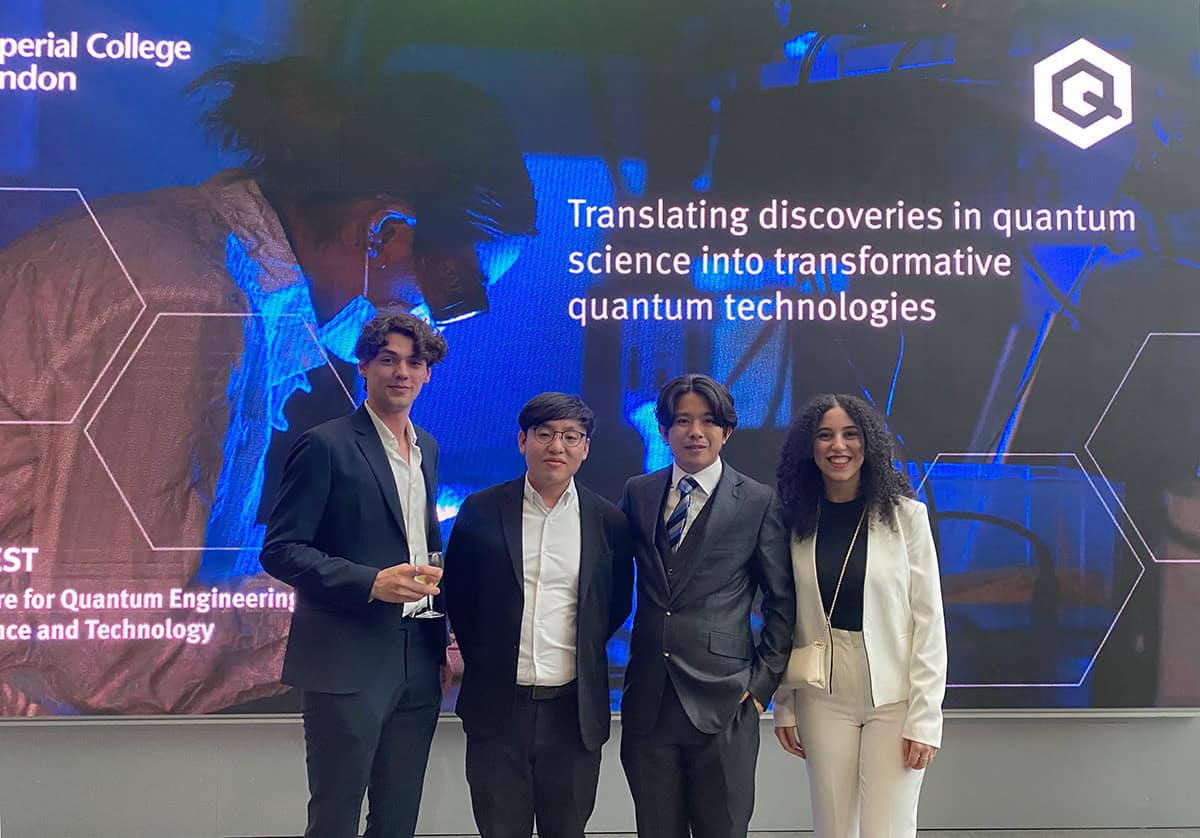
Group of four people in front of large banner advertising QuEST

PhD students are often treated as learners rather than contributors. But our experience showed that with the right support and guidance, early-career researchers (ECRs) such as ourselves can make real impact by offering fresh perspectives and expertise. We are the scientists, innovators or funders of the future so there is value in training people like us to understand the bigger picture as we embark on our careers.

To encourage young researchers to get involved in policy, QuEST and DSIT recently organized two policy workshops for ECR quantum tech specialists. Civil servants from the Office for Quantum explained their efforts and priorities, while we answered questions about our experience – the aim being to help ECRs to engage in policy-making, or choose it as a career option.

In April 2025 QuEST also launched an eight-week quantum primer for policy-makers. The course was modelled on a highly successful equivalent for AI, and looked to help policy-makers make more technically informed policy discussions. The first cohort welcomed civil servants from across government, and it was so highly reviewed a second course will be running from October 2025.

Our experience with QuEST has shown us the importance of scientists taking an active role in policy-making. With the quantum sector evolving at a formidable rate, it is vital that a framework is in place to take research from the lab to society. Scientists, industry, investors and policy-makers need to work together to create regulations and policies that will ensure the responsible use of quantum technologies that will benefit us all.

Harnessing quantum duality for object imaging

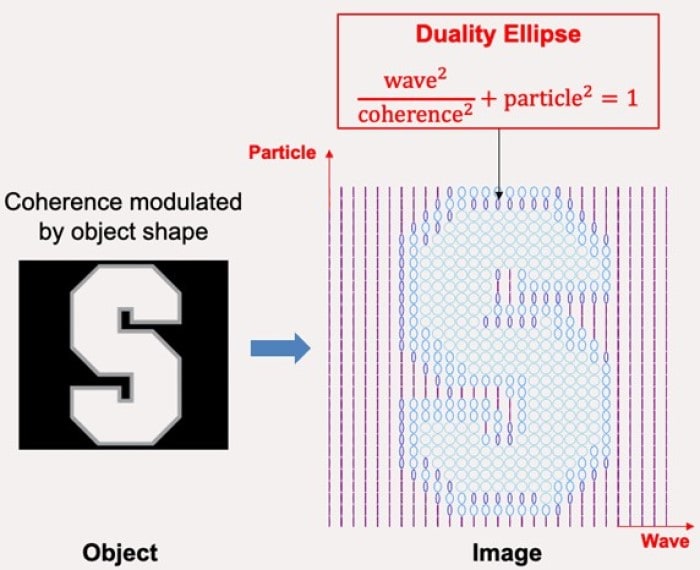
Diagram showing the ellipse relation

The theory of quantum mechanics was born out of the need to explain how an object could behave both as a particle and as a wave. Since then, researchers have been attempting to understand and quantify the degree of “waveness” and “particleness” of quantum systems.

Now, Pawan Khatiwada and Xiaofeng Qian, both based at the Stevens Institute of Technology in the US, have published a paper in Physical Review Research unveiling the missing piece of the puzzle in the unique relationship between the wave and particle nature of a quantum object. The key piece is coherence, which describes the statistical phase relationship between the possible states a quantum system can adopt. If the phase relationship is well-defined, that is, stable and consistent, the system is coherent and therefore has the potential to exhibit interference, a wave-like property. If the system is incoherent, the phase relationship is random and variable. Coherence therefore characterizes the total capacity or potential of a quantum system to exhibit wave-like behaviour. The degree of waveness that is then realised and can be observed is known as the visibility and is characterized by the intensity of the maxima and minima in the interference pattern. The amount of particleness, known as the predictability, is a measure of how well we can predict the path a particle will take and is defined by the degree to which the particle is taking only one of the two paths.

The amount of interference that an object exhibits (the visibility) may only be a fraction of its total capacity to exhibit wave-like behaviour (its coherence) and can change according to how we choose to observe the system. For example, it we decide to track the position of the photon through a double-slit diffraction grating, no interference effects are observed, and the photon will behave as a particle. However, if we remove this tracking, the usual patterns of dark and light bands that are characteristic of interference emerge, and the photon behaves as a wave. In the first situation the visibility is low, but the coherence can nonetheless be high; it is our access to information about the path of the photon that destroys the interference pattern.

New quantum duality relation

Half a century ago, the relationship between a quantum object’s visibility and predictability was characterized by an inequality that restricted the sum of the square of the visibility and predictability to be less than or equal to one. However, this inequality could not have been telling the full story since it failed to capture the exclusivity of wave and particle-like behaviours such that if an object is more wave-like, it should display less particle properties and vice versa. The inequality instead permitted both wave and particle properties to increase or decrease simultaneously.

Qian and Khatiwada recast this inequality into a precise equality relation by introducing coherence as an additional variable.  The relation then describes a trade-off between the coherence, visibility, and predictability, where the sum of the square of the predictability and the fraction of visibility exhibited out of the total coherence, must be equal to one.  This relationship forms an ellipse equation, with the eccentricity determined by the coherence, where maximum coherence yields a circle and partial coherence an ellipse and is thus known as a duality ellipse relation.

Duality as a resource

Qian applies this formula to a technique for measuring quantum objects called quantum imaging with undetected photons (QIUP) first conceived by Nobel laureate Anton Zeilinger’s research group. One of a pair of entangled photons interacts with the object and depending on its shape, the coherence will change and can be tracked by following the behaviour of the second photon, without ever detecting the first. Information about the object is then given by the second photon even though it has never interacted with it. The more coherence is present at a specified location in the object, the more circular the duality ellipse relation (see figure).

Finding the eccentricity of the duality ellipse relation at each point in the object thus provides a map of its shape, and therefore an image of the object. Since the coherence is related to the visibility and predictability of a quantum object, Qian explains that their formula then becomes a crucial link between ‘fundamental properties of a quantum system like waveness and particleness and operational properties which hold information about an object’.

Of course, most experimental scenarios are not ideal, and Qian accounts for these experimental imperfections in a modified relation. Remarkably, the overall pattern of the elliptical duality relation remains the same and therefore this imaging technique proves to be robust even under such conditions.

Qian explains that ‘in a similar way quantum entanglement is a useful resource in quantum information and quantum computing, quantum duality also proves to be too for certain quantum tasks’. His group are now working on uncovering further avenues through which quantum duality can act as a quantum resource.

Compact diamond magnetometer detects metastatic tumours

Researchers at the University of Warwick in the UK have created an ultrasensitive magnetometer based on nitrogen-vacancy centres in diamond that’s small enough to be used for keyhole surgery. The sensor, which currently measures just 1 cm in diameter and could be made even smaller in the future, is designed to detect small cancer metastases via endoscopy or laparoscopy.

“It’s really bad news when tumour cells spread from their original site, and so it’s very important to detect this metastatic cancer as soon as possible,” says physicist Gavin Morley, who led this research effort together with his doctoral student Alex Newman. “The new cancers are often lodged in the lymph nodes and our device could be used to detect these cancers early when they are still small.”

Existing techniques to detect metastatic tumours include MRI and CT, but these technologies can only detect tumours that are at least 2 mm across. While alternatives like sentinel lymph node biopsy can detect tumours with a volume that is 1000 times smaller, this technique typically involves the use of radioactive tracer fluids that require special safety precautions, or blue dyes, which cause an allergic reaction in one in a hundred people.

Tracer travels to the lymph nodes

Medical device company Endomag recently developed a clinical technique that involves the surgeon injecting a magnetic tracer into a breast cancer tumour, explains Morley. “The tracer fluid travels to the lymph nodes and the surgeon can then identify the metastatic cells there and remove them.”

While this approach is efficient for breast cancer, the magnetometers employed today to detect the tracer are too large for use in keyhole surgery or endoscopy, he explains. “We wanted to create a device that can be used to detect the metastatic tumours and so built a version that’s smaller. The surgeons we’ve spoken to say that colorectal cancer could be the best place for us to focus on first for our magnetometer.”

NV magnetic sensor

Morley’s group has been working on magnetic field sensors using diamonds and lasers for ten years now. The diamonds are grown by the company Element Six in Oxford and they contain quantum defects known as nitrogen-vacancy (NV) centres. These are created when a pair of adjacent carbon atoms in the diamond lattice is replaced by a nitrogen atom, leaving one lattice site vacant. An NV centre is basically an isolated spin that is highly sensitive to an external magnetic field and it emits florescent light in a way that depends on the intensity and direction of this field. Measuring this light allows it to be used as a magnetic sensor.

“Our speciality is using optical fibres to send laser light into the diamond and detect the red light that comes back,” says Morley.

In this work, reported in Physical Review Applied, it was Newman who built the new sensor, Morley tells Physics World. “Alex likes fixing old sports cars and I liked the way he applied that thinking to this new technology. He tries different strategies and has built new types of diamond sensors that no-one has managed to build before.”

The Warwick researchers are now working on a number of applications for their sensors: as well as use within healthcare, they could be employed in space applications and future fusion power plants, says Morley. “Indeed, for Alex’s project, we were working on detecting damage in steel to help the National Nuclear Laboratory who have nuclear waste stored in steel containers. I then met Stuart Robertson, who is a breast cancer surgeon at the University Hospitals Coventry and Warwickshire: he told me how useful the Endomag solution is for breast cancer metastatic cells and I thought we could build a magnetometer that would help.”

Working with several surgeons, Morley, Newman and colleagues are now developing this work as part of the UK Quantum Biomedical Sensing Research Hub (Q-BIOMED). “For example, Jamie Murphy in the Cleveland Clinic in London is an expert on keyhole surgery, with a big interest in colorectal cancer,” says Morley. “And Conor McCann is an expert on gut health at the UCL Great Ormond Street Institute of Child Health. We’re interested in spinning out a company ourselves to take this forward alongside other applications of our diamond sensors.”

The researchers are also busy making the sensor even smaller. “At the moment the probe is 1 cm across, but we think we can get it down to be only 3 mm,” says Morley. “While 1 cm is small enough for keyhole surgery and endoscopy, getting it even smaller would make it useful for even more types of surgeries.”

Delft Circuits: cryogenic RF cable innovations offer a flexible path to quantum scalability

As manufacturers in the nascent quantum supply chain turn their gaze towards at-scale commercial opportunities in quantum computing, the scenic city of Delft in the Netherlands is emerging as a heavyweight player in quantum science, technology and innovation. At the heart of this regional quantum ecosystem is Delft Circuits, a Dutch manufacturer of specialist I/O cabling solutions, which is aligning its product development roadmap to deliver a core enabling technology for the scale-up and industrial deployment of next-generation quantum computing, communications and sensing systems.

daan-kuitenbrouwer-cofounder-headshot

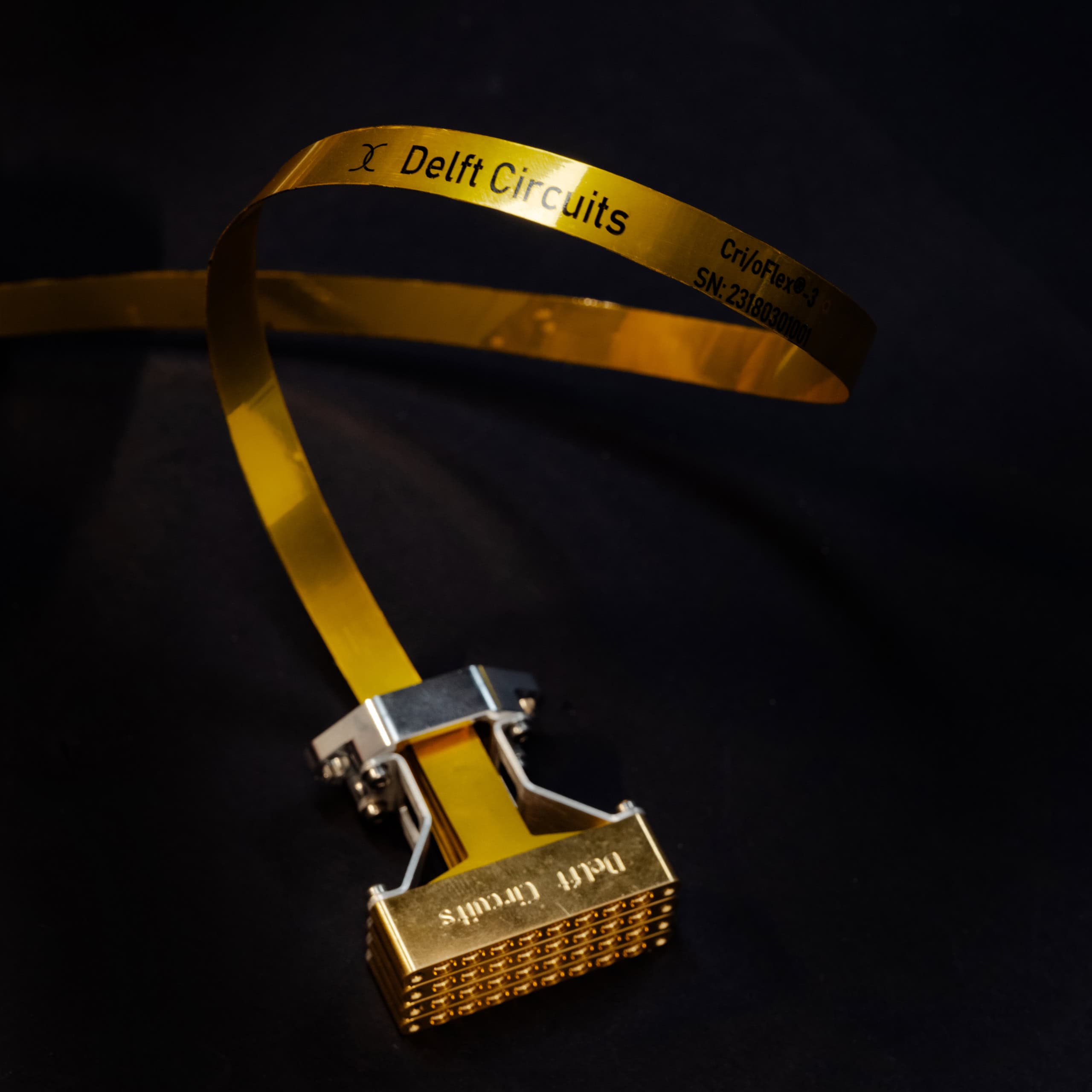
In brief, the company’s Cri/oFlex® cryogenic RF cables comprise a stripline (a type of transmission line) based on planar microwave circuitry – essentially a conducting strip encapsulated in dielectric material and sandwiched between two conducting ground planes. The use of the polyimide Kapton® as the dielectric ensures Cri/oFlex® cables remain flexible in cryogenic environments (which are necessary to generate quantum states, manipulate them and read them out), with silver or superconducting NbTi providing the conductive strip and ground layer. The standard product comes as a multichannel flex (eight channels per flex) with a range of I/O channel configurations tailored to the customer’s application needs, including flux bias lines, microwave drive lines, signal lines or read-out lines.

“As quantum computers evolve – think more and more qubits plus increasingly exacting requirements on gate fidelity – system developers will reach a point where current coax cabling technology doesn’t cut it anymore,” explains Daan Kuitenbrouwer, co-founder of Delft Circuits. “The key to our story is that Cri/oFlex® allows us to increase the I/O cabling density easily – and by a lot – to scale the number of channels in a single system while guaranteeing high gate fidelities [minimizing noise and heating] as well as market-leading uptime and reliability.”

Quantum alignment

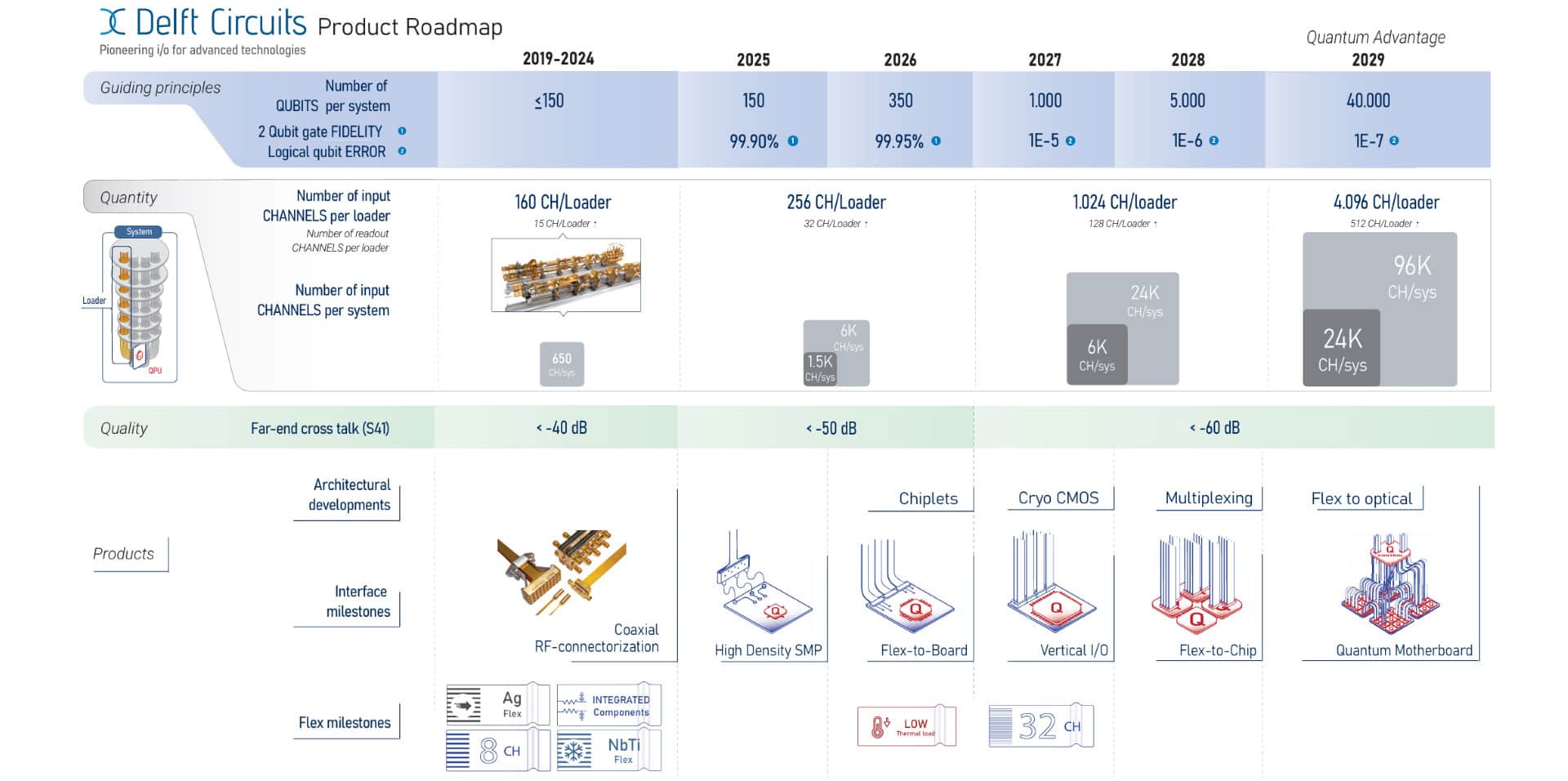
To put some hard-and-fast performance milestones against that claim, Kuitenbrouwer and colleagues have just published a granular product development roadmap that aligns Cri/oFlex® cabling specifications against the anticipated evolution of quantum computing systems –  from 150+ qubits today out to 40,000 qubits and beyond in 2029 (see figure, “Quantum alignment”).

dc-roadmap

“Our roadmap is all about enabling, from an I/O perspective, the transition of quantum technologies out of the R&D lab into at-scale practical applications,” says Kuitenbrouwer. “As such, we studied the development roadmaps of more than 10 full-stack quantum computing vendors to ensure that our ‘guiding principles’ align versus the aggregate view of quantity and quality of qubits targeted by the system developers over time.”

Notwithstanding the emphasis on technology innovation and continuous product improvement, Delft Circuits is also “coming of age” in line with the wider quantum community. Most notably, the company’s centre of gravity is shifting inexorably from academic end-users to servicing vendors large and small in the quantum supply chain. “What we see are full-stack quantum computing companies starting to embrace horizontal thinking – which, in our case, means a technology partner able to solve their entire I/O cabling challenge,” explains Kuitenbrouwer.

To gain traction, however, systems integrators at the sub-stack level must, as a given, design their product offering with industrial metrics front-and-centre – for example, scalability, manufacturability, reliability, cost per I/O channel and second-sourcing. Equally important is the need to forge long-term vendor-customer relationships that often move beyond the transactional into the realm of co-development and collaboration – though all against a standardized package of cabling options.

“We integrate Cri/oFlex® with cryostats that have relatively standard vacuum feedthroughs and thermalization – more or less the same across the board,” says Kuitenbrouwer. What changes is the type of qubit – superconducting, spin, photonic – which in turn determines the configuration of the I/O line and where to place the attenuators, low-pass filters and IR filters. “This is something we can adjust relatively easily – at high volume and high reliability – with the whole I/O package installed and tested at the customer premises,” he adds.

Timing is key for quantum advantage

Commercially, Delft Circuits is already making real headway, getting “in the door” with many of the leading developers of quantum computing systems in North America and Europe. One of the main reasons for that is the ability to respond to customer requirements in an agile and timely fashion, argues Sal Bosman, a fellow co-founder of Delft Circuits.

sal bosman cofounder headshot

“We work on the basis of a very structured design process, playing to our strengths in superconductor fabrication, integrated microwave components and cryogenic engineering,” Bosman notes. “We have also developed our own in-house software to simulate the performance of Cri/oFlex® cabling in full-stack quantum systems. No other vendor can match this level of customer support and attention to detail.”

Right now, though, it’s all about momentum as Delft Circuits seeks to capitalize on its first-mover advantage and, what Bosman claims, is the unique value proposition of its Cri/oFlex® technology: a complete and inherently scalable I/O solution with integrated flex cables incorporating filters and high-density interconnects to quantum chips or control electronics.

With this in mind, the company is busy constructing a new 750m2 clean-room (with an option to double that footprint) alongside its existing 1000m2 in-house pilot-production and test facility. “Currently, we are the only industrial supplier able to deliver flexible circuits of superconducting materials at scale,” concludes Bosman.

“Over the next two to three years,” he adds, “we have a credible opportunity to grab significant market share when it comes to cabling I/O for quantum. Watch this space: a lot of customers are already coming to us saying ‘we don’t want to buy more coax, we want to work with you.’”

Location, location, location

loader persons modular scalable design feature image

Delft Circuits sits within a thriving regional cluster for quantum science and technology called Quantum Delta Delft, which is centred around the canal-ringed city of Delft between The Hague and Rotterdam.

Formed in 2017 and initially located at the Faculty of Applied Sciences at Delft University of Technology (TU Delft), Delft Circuits has since grown as an independent company and is now based in the historic Cable District, where its facilities include a dedicated fabrication, pilot-production and testing area.

TU Delft is itself home to a high-profile interfaculty research institute called QuTech, a collaboration with the Netherlands Organisation for Applied Scientific Research (TNO) that’s tasked with developing full-stack hardware and software layers (including enhanced qubit technologies) for quantum computing and quantum communications systems.

Alongside this academic powerhouse, the Delft region has seen the emergence of other quantum tech start-ups like QuantWare (quantum chips), Qblox (control electronics) and Orange Quantum Systems (test solutions). All three companies work closely with Delft Circuits as part of the ImpaQT UA cooperative, a joint effort to develop open standards and interoperable technologies that enable system integrators to build quantum computing hardware stacks from off-the-shelf components.

“The ImpaQT UA story is ongoing,” explains Kuitenbrouwer. “As partners, we are super-complementary and collaborate closely to shape the future of quantum computing.” That’s why the new development roadmap is so important for Delft Circuits: to communicate a vision from the “component layer” up the value chain to the full-stack quantum computing companies.

As well as the talent pipeline that comes with proximity to TU Delft and QuTech, Quantum Delta Delft is home to TNO’s Quantum Information Technology Testing (QITT) Facility, which enables European companies to evaluate their cryogenic or non-cryogenic quantum devices and software in a full-stack quantum computing set-up.

‘Father of the Internet’ Vint Cerf expresses concern about the longevity of digital information

A few weeks ago, I experienced a classic annoyance of modern life: one of my computer games stopped working. The cause? An “update” to the emulator that translates old games into programs that today’s machines can execute. In my case, this update broke the translation process, and the tenuous thread of hardware and software connecting my laptop to the game’s 30-year-old code was severed.

For individuals, failures like this are irritating. But for the wider digital ecosystem, they’re a real problem – so much so, in fact, that Vint Cerf, who’s known as one of the “fathers of the Internet”, made them the subject of his talk at last week’s Heidelberg Laureate Forum (HLF) in Heidelberg, Germany.

“My big worry is that all this digital stuff won’t be there when we would like it to be there, or when our descendants would like to have it,” Cerf said.

How it used to work

Historically, the best ways of preserving information involved writing it on durable materials such as clay tablets, high-quality paper, or a form of animal skin known as vellum. These media, Cerf observed, “have one thing in common: they don’t require electricity to be stored and preserved.”

Digital media, in contrast, are much less robust. “Many of them are magnetic, and the magnetic material wears away after a while,” Cerf explained. Consequently, some old tapes are now so fragile that attempting to read them can actually lift the magnetic material off the surface: “You read it once and that’s it. It’s now transparent tape,” he said.

Being able to read data is just the beginning, though. As my broken computer game shows, you also need programs and equipment that can persuade those data to do things. “That’s often the thing that goes first,” Cerf told me in a press conference after his talk. For example, when Cerf recently tried to retrieve data from an old three-and-a-half-inch floppy disk, he discovered that doing so would require three additional components: a drive that could read the disk, a program that could open the files stored on the disk and an old computer that could run the program. “I needed a whole lot of software help and several stages in order to make that digital content useful,” Cerf said.

Creating ‘digital vellum’

As for how to fix this problem and create a digital version of vellum, Cerf, who has been the “Chief Internet Evangelist” at Google since 2005, listed three ideas that he finds interesting. The first involves a New Jersey, US-based company called SPhotonix that does research and development work in the UK and Switzerland. It’s using lasers to write bits of data into chunks of quartz crystal, which is a very long-lasting medium. However, each crystal is roughly the size of a hockey puck, and Cerf thinks that “real work” still needs to be done to organize the information the material holds.

The second idea is partly inspired by the clay tablets that proved so successful at preserving cuneiform writing from ancient Mesopotamia. Cerabyte, a start-up with facilities in Austria, Germany and the US, has developed a ceramic material that its founders claim could “store all data virtually forever”.

The third idea, and the one that seems to appeal most to Cerf, is to write digital information into DNA. That might sound like an inherently fragile medium, but as Cerf pointed out, “It’s actually a very robust molecule – otherwise, life wouldn’t have persisted for several billion years.” Provided you dehydrate the DNA first, he added, it lasts for “quite a long time”.

The question of how to read such information is not an easy one, and Cerf doesn’t have an answer to it. He is, however, hopeful that someone will find one. At the HLF, where he is such a revered figure that even the journalists want to take photos with him, he issued a call to arms for the young researchers in the audience. “I want you to appreciate the scope of the work that is required to preserve digital things,” Cerf told them. Without that work, he added, “recreating a digital environment in 100 years is not going to be a trivial matter.”

Unconventional approach to dark energy problem gives observed neutrino masses

An unconventional approach to solving the dark energy problem called the cosmologically coupled black hole (CCBH) hypothesis appears to be compatible with the observed masses of neutrinos. This new finding from researchers working at the DESI collaboration suggests that black holes may represent little Big Bangs played in reverse and could be used as a laboratory to study the birth and infancy of our universe. The study also confirms that the strength of dark energy has increased along with the formation rate of stars.

The Dark Energy Spectroscopic Instrument (DESI) is located on the Nicholas U Mayall four-metre Telescope at Kitt Peak National Observatory in Arizona. Its raison d’être is to shed more light on the “dark universe” – the 95% of the mass and energy in the universe that we know very little about. Dark energy is a hypothetical entity invoked to explain why the rate of expansion of the universe is (mysteriously) increasing – something that was discovered at the end of the last century.

According to standard theories of cosmology, matter is thought to comprise cold dark matter (CDM) and normal matter (mostly baryons and neutrinos). DESI can observe fluctuations in the matter density of the universe known as baryonic acoustic oscillations (BAOs), which are density fluctuations that were created after the Big Bang in the hot plasma of baryons and electrons that prevailed then. BAOs expand with the growth of the universe and represent a sort of “standard ruler” that allows cosmologists to map the universe’s expansion by statistically analysing the distance that separates pairs of galaxies and quasars.

Largest 3D map

DESI has produced the largest such 3D map of the universe ever and it recently published the first set of BAO measurements determined from observations of over 14 million extragalactic targets going back 11 billion years in time.

In the new study, the DESI researchers combined measurements from these new data with cosmic microwave background (CMB) datasets (which measure the density of dark matter and baryons from a time when the universe was less than 400,000 years old) to search for evidence of matter converting into dark energy. They did this by focusing on a new hypothesis known as the cosmologically coupled black hole (CCBH), which was put forward five years ago by DESI team member Kevin Croker, who works at Arizona State University (ASU), and his colleague Duncan Farrah at the University of Hawaii. This physical model builds on a mathematical description of black holes as bubbles of dark energy in space that was introduced over 50 years ago. CCBH describes a scenario in which massive stars exhaust their nuclear fuel and collapse to produce black holes filled with dark energy that then grows as the universe expands. The rate of dark energy production is therefore determined by the rate at which stars form.

Neutrino contribution

Previous analyses by DESI scientists suggested that there is less matter in the universe today compared to when it was much younger. When they then added the additional, known, matter source from neutrinos, there appeared to be no “room” and the masses of these particles therefore appeared negative in their calculations. Not only is this unphysical, explains team member Rogier Windhorst of the ASU’s School of Earth and Space Exploration, it also goes against experimental measurements made so far on neutrinos that give them a greater-than-zero mass.

When the researchers re-interpreted the new set of data with the CCBH model, they were able to resolve this issue. Since stars are made of baryons and black holes convert exhausted matter from stars into dark energy, the number of baryons today has decreased in comparison to the CMB measurements. This means that neutrinos can indeed contribute to the universe’s mass, slowing down the expansion of the universe as the dark energy produced sped it up.

“The new data are the most precise measurements of the rate of expansion of the universe going back more than 10 billion years,” says team member Gregory Tarlé at the University of Michigan, “and it results from the hard work of the entire DESI collaboration over more than a decade. We undertook this new study to confront the CCBH hypothesis with these data.”

Black holes as a laboratory

“We found that the standard assumptions currently employed for cosmological analyses simply did not work and we had to carefully revisit and rewrite massive amounts of a lot of cosmological computer code,” adds Croker.

“If dark energy is being sourced by black holes, these structures may be used as a laboratory to study the birth and infancy of our own universe,” he tells Physics World. “The formation of black holes may represent little Big Bangs played in reverse, and to make a biological analogy, they may be the ‘offspring’ of our universe.”

The researchers say they studied the CCBH scenario in its simplest form in this work, and found that it performs very well. “The next big observational test will involve a new layer of complexity, where consistency with the large-scale features of the Big Bang relic radiation, or CMB, and the statistical properties of the distribution of galaxies in space will make or break the model,” says Tarlé.

The research is described in Physical Review Letters.

Physicists extend the wave nature of large objects

Can quantum mechanics fully describe macroscopic reality? Everyday objects are typically well-described by classical mechanics, whereas atomic-scale objects are governed by quantum mechanics. Exploring the boundary between the two domains could enable fundamental tests of quantum mechanics and the development of new sensing technologies for gravitational measurements.

Now, a team of researchers at Switzerland’s ETH Zürich and Spain’s Institute of Photonic Sciences in Barcelona has taken an important step towards bridging the two regimes by extending the quantum wave nature of nanoparticles — objects a thousand times larger than atoms.

Quantum mechanics posits that even large objects behave as waves. However, the spatial extent of this wave-like behaviour, known as the “coherence length”, is far smaller than the size of large objects. This renders quantum phenomena effectively unobservable for such systems. “To push quantum physics into the macroscopic domain, we need to increase both [mass and coherence length] simultaneously”, explains lead researcher Massimiliano Rossi. This pursuit motivated the team’s recent study, which is described in Physical Review Letters.

Playing with light

The researchers studied large objects called silica nanoparticles, which are 100 nm in diameter. The nanoparticles were held and levitated in vacuum using a tightly-focused laser beam.

Nanoparticles naturally scatter the laser light, and the phase of the scattered photons encodes information about the nanoparticle’s centre-of-mass position. The researchers used this information in a feedback loop, applying electric fields to cool the nanoparticles close to their quantum ground state. The colder sample is in a more “pure” quantum state, such that the quantum wave-like behaviour extends farther in space and the coherence length is longer than in a hot sample. The team measured an initial coherence length of 21 pm (21 × 10-12  m).

Further extending the coherence length required careful manipulation of the laser light. The researchers started with high-power light, which provided a tight harmonic potential for the nanoparticles – like a marble trapped at the bottom of a steep bowl. An advantage of using a light-induced potential is that the curvature of the bowl is easily tuned over a large range by adjusting the laser power.

The researchers lowered the laser power in two pulses, each of which caused the bowl to become shallower, therefore allowing the marble to roll around and explore more of the bowl. In the experiment, this translated to an expansion of the nanoparticle’s coherence length to 73 pm, more than three-fold that of the initial value.

Preserving quantum information

Rossi notes that the main experimental challenge was limiting decoherence, a process that destroys quantum information. He explains that when a nanoparticle interacts with its surroundings, it becomes correlated with a noisy and unmeasurably complex environment. This interaction causes the nanoparticle’s motion to become increasingly random when measured. As a result, the nanoparticle’s quantum mechanical behaviour is washed out and the particle is well described as a classical ball.

It was therefore critical that the researchers expand the coherence length faster than the rate of any decoherence. To achieve this, they meticulously measured, identified, and suppressed all sources of decoherence, with the dominant source being laser light scattering. Scattering was reduced during the expansion pulses because of the lower laser power.

The achieved 73 pm remains orders of magnitude smaller than the size of the nanoparticle, which was 100 nm in diameter. However, Rossi remarks that “we do not know of any fundamental reason why achieving nanometre coherence lengths should be impossible.” One next step could be to use more expansion pulses to increase the coherence length further.

With a longer expansion time, the main challenge would be to outpace decoherence. Researchers propose using hybrid traps that employ both light and electric fields to confine the nanoparticles, since an electric trap would reduce the decoherence from light scattering. Rossi is now pursuing this direction in his new research group at the Delft University of Technology in the Netherlands.

Quantum gas keeps its cool

Adding energy to a system usually heats it up, but physicists at the University of Innsbruck in Austria have now discovered a scenario in which this is not the case. Their new platform – a one-dimensional fluid of strongly interacting atoms cooled to just a few nanokelvin above absolute zero and periodically “kicked” using an external force – could be used to study how objects transition from being quantum and ordered to classical and chaotic.

Our everyday world is chaotic and chaos plays a crucial and often useful role in many areas of science – from nonlinear complex systems in mathematics, physics and biology to ecology, meteorology and economics. How a system evolves depends on its initial conditions, but this evolution is, by nature, inherently unpredictable.

While we know how chaos emerges in classical systems, how it does so in quantum materials is still little understood. When this happens, the quantum system reverts to being a classical one.

The quantum kicked rotor

Researchers have traditionally studied chaotic behaviour in driven systems – that is, rotating objects periodically kicked by an external force. The quantum version of these is the quantum kicked rotor (QKR). Here, quantum coherence effects can prevent the system from absorbing external energy, meaning that, in contrast to its classical counterpart, it doesn’t heat up – even if a lot of energy is applied. This “dynamical localization” effect has already been seen in dilute ultracold atomic gases.

The QKR is a highly idealized single-particle model system, explains study lead Hanns-Christoph Nägerl. However, real-world systems contain many particles that interact with each other – something that can destroy dynamical localization. Recent theoretical work has suggested that this localization may persist in some types of interacting, even strongly interacting, many-body quantum systems – for example, in 1D bosonic gases.

In the new work, Nägerl and colleagues made a QKR by subjecting samples of ultracold caesium (Cs) atoms to periodic kicks by means of a “flashed-on lattice potential”. They did this by loading a Bose–Einstein condensate of these atoms into an array of narrow 1D tubes created by a 2D optical lattice formed by laser beams propagating in the xy plane at right angles to each other. They then increased the power of the beams to heat up the Cs atoms.

Many-body dynamical localization

The researchers expected the atoms to collectively absorb energy over the course of the experiment. Instead, when they recorded how their momentum distribution evolved, they found that it actually stopped spreading and that the system’s energy reached a plateau. “Despite being continually kicked and strongly interacting, it no longer absorbed energy,” says Nägerl. “We say that it had localized in momentum space – a phenomenon known as many-body dynamical localization (MBDL).”

In this state, quantum coherence and many-body interactions prevent the system from heating up, he adds. “The momentum distribution essentially freezes and retains whatever structure it has.”

Nägerl and colleagues repeated the experiment by varying the interaction between the atoms – from zero (non-interacting) to strongly interacting. They found that the system always localizes.

Quantum coherence is crucial for preventing thermalization

“We had already found localization for our interacting QKR in earlier work and set out to reproduce these results in this new study,” Nägerl tells Physics World. “We had not previously realised the significance of our findings and thought that perhaps we were doing something wrong, which turned out not to be the case.”

The MBDL is fragile, however – something the researchers proved by introducing randomness into the laser pulses. A small amount of disorder is enough the destroy the localization effect and restore diffusion, explains Nägerl: the momentum distribution smears out and the kinetic energy of the system rises sharply, meaning that it is absorbing energy.

“This test highlights that quantum coherence is crucial for preventing thermalization in such driven many-body systems,” he says.

Simulating such a system on classical computers is only possible for two or three particles, but the one studied in this work, reported in Science, contains 20 or more. “Our new experiments now provide precious data to which we can compare the QKR model system, which is a paradigmatic one in quantum physics,” adds Nägerl.

Looking ahead, the researchers say they would now like to find out how stable MBDL is to various external perturbations. “In our present work, we report on MBDL in 1D, but would it happen in a 2D or a 3D system?” asks Nägerl. “I would like to do an experiment in which we have a 1D + 1D situation, that is, where the 1D is allowed to communicate with just one neighbouring 1D system (via tunnelling; by lowering the barrier to this system in a controlled way).”

Another way of perturbing the system would be to add a local defect – for example a bump in the potential of a different atom, he says. “Generally speaking, we would like to measure the ‘phase diagram’ for MBDL, where the axes of the graph would quantify the strength of the various perturbations we apply.”

Andromeda image bags Royal Observatory Greenwich prize

Photographers Weitang Liang, Qi Yang and Chuhong Yu have beaten thousands of amateur and professional photographers from around the world to bag the 2025 Royal Observatory Greenwich’s ZWO Astronomy Photographer of the Year.

The image – The Andromeda Core – showcases the core of the Andromeda Galaxy (M31) in exceptional detail, revealing the intricate structure of the galaxy’s central region and its surrounding stellar population.

The image was taken with a long focal-length telescope from the AstroCamp Observatory, Nerpio, Spain.

“Not to show it all − this is one of the greatest virtues of this photo. The Andromeda Galaxy has been photographed in so many different ways and so many times with telescopes that it is hard to imagine a new photo would ever add to what we’ve already seen,” notes astrophotographer László Francsics who was a judge for this year’s competition. “But this does just that, an unusual dynamic composition with unprecedented detail that doesn’t obscure the overall scene.”

As well as winning the £10,000 top prize, the image has gone on display along with other selected pictures from the competition at an exhibition at the National Maritime Museum observatory that opened on 12 September.

The award – now in its 17th year – is run by the Royal Observatory Greenwich in association with the astrophotography firm ZWO and BBC Sky at Night Magazine.

Protein qubit can be used as a quantum biosensor

A new optically addressable quantum bit (qubit) encoded in a fluorescent protein could be used as a sensor that can be directly produced inside living cells. The device opens up a new era for fluorescence microscopy to monitor biological processes, say the researchers at the University of Chicago Pritzker School of Molecular Engineering who designed the novel qubit.

Quantum technologies use qubits to store and process information. Unlike classical bits, which can exist in only two states, qubits can exist in a superposition of both these states. This means that computers employing these qubits can simultaneously process multiple streams of information, allowing them to solve problems that would take classical computers years to process.

Qubits can be manipulated and measured with high precision, and in quantum sensing applications they act as nanoscale probes whose quantum state can be initialized, coherently controlled and read out. This allows them to detect minute changes in their environment with exquisite sensitivity.

Optically addressable qubit sensors – that is, those that are read out using light pulses from a laser or other light source – are able to measure nanoscale magnetic fields, electric fields and temperature. Such devices are now routinely employed by researchers working in the physical sciences. However, their use in the life sciences is lagging behind, with most applications still at the proof-of-concept stage.

Difficult to position inside living cells

Many of today’s quantum sensors are based on nitrogen-vacancy (NV) centres, which are crystallographic defects in diamond. These centres occur when two neighbouring carbon atoms in diamond are replaced by a nitrogen atom and an empty lattice site and they act like tiny quantum magnets with different spins. When excited with laser pulses, the fluorescent signal that they emit can be used to monitor slight changes in the magnetic properties of a nearby sample of material. This is because the intensity of the emitted NV centre signal changes with the local magnetic field.

“The problem is that such sensors are difficult to position at well-defined sites inside living cells,” explains Peter Maurer, who co-led this new study together with David Awschalom. “And the fact that they are typically ten times larger than most proteins further restricts their applicability,” he adds.

“So, rather than taking a conventional quantum sensor and trying to camouflage it to enter a biological system, we therefore wanted to explore the idea of using a biological system itself and developing it into a qubit,” says Awschalom.

Fluorescent proteins, which are just 3 nm in diameter, could come into their own here as they can be genetically encoded, allowing cells to produce these sensors directly at the desired location with atomic precision. Indeed, fluorescent proteins have become the “gold standard” in cell biology thanks to this unique ability, says Maurer. And decades of biochemistry research has allowed researchers to generate a vast library of such fluorescent proteins that can be tagged to thousands of different types of biological targets.

“We recognized that these proteins possess optical and spin properties that are strikingly similar to those of qubits formed by crystallographic defects in diamond – namely that they have a metastable triplet state,” explain Awschalom and Maurer. “Building on this insight, we combined techniques from fluorescence microscopy with methods of quantum control to encode and manipulate protein-based qubits.”

In their work, which is detailed in Nature, the researchers used a near-infrared laser pulse to optically address a yellow fluorescent protein known as EYFP and read out its triplet spin state with up to 20% “spin contrast” – measured using optically detected magnetic resonance (ODMR) spectroscopy.

To test the technique, the team genetically modified the protein so that it was expressed in human embryonic kidney cells and Escherichia coli (E. coli) cells. The measured OMDR signals exhibited a contrast of up to 8%. While this performance is not as good as that of NV quantum sensors, the fluorescent proteins open the door to magnetic resonance measurements directly inside living cells – something that NV centres cannot do, says Maurer. “They could thus transform medical and biochemical studies by probing protein folding, monitoring redox states or detecting drug binding at the molecular scale,” he tells Physics World.

“A new dimension for fluorescence microscopy”

Beyond sensing, the unique quantum resonance “signatures” offer a new dimension for fluorescence microscopy, paving the way for highly multiplexed imaging far beyond today’s colour palette, Awschalom adds. Looking further ahead, using arrays of such protein qubits could even allow researchers to explore many-body quantum effects within biologically assembled structures.

Maurer, Awschalom and colleagues say they are now busy trying to improve the stability and sensitivity of their protein-based qubits through protein engineering via “directed evolution” – similar to the way that fluorescent proteins were optimized for microscopy.

“Another goal is to achieve single-molecule detection, enabling readout of the quantum state of individual protein qubits inside cells,” they reveal. “We also aim to expand the palette of available qubits by exploring new fluorescent proteins with improved spin properties and to develop sensing protocols capable of detecting nuclear magnetic resonance signals from nearby biomolecules, potentially revealing structural changes and biochemical modifications at the nanoscale.”

Copyright © 2026 by IOP Publishing Ltd and individual contributors