Rethinking power: pipes versus wires

Underlying the policy debate on energy is a fault line – a chasm between two basically different approaches. Not the usual one between big centralized and small decentralized energy, although that is part of it. This goes deeper. It concerns the basic, often unspoken, assumption that electricity is the key energy vector. We have the idea that electrification is modernization. It’s not just Lenin who said that, it’s everyone ever since, everywhere. It made sense. Electricity was clean, fast, controllable, and it has become increasingly valuable.

However, that means it’s become increasingly expensive, in part since the main ways of producing it involved the use of increasingly scarce fossil fuels. Interestingly that, and the ever-growing environmental impacts of burning those fuels, led to drives to use it more efficiently.

We have a polarity of views – essentially between backers of “pipes” and “wires”

That has worked in some places. Demand in some industrial countries has fallen, and not just because energy-intensive manufacturing activities have been exported to developing countries. For example, US residential electricity use fell in recent years and is now flat. Electricity use overall, i.e. in all sectors, also fell in the UK, back to 1994 levels, partly due to energy-saving measures, despite continued economic growth. It’s also fallen elsewhere – in 18 of the 30 IEA (International Energy Agency) member countries.

That is good news, surely, although it may worry the companies who generate and sell electricity. Help may be on hand for them though, since demand for electric vehicles is growing. And some governments are looking to electricity as the way to provide heating.

Gas on?

However, there is another viewpoint from which these possible new electric-power-demand-boosting developments do not look such good news. It’s based on a rival assessment of what makes sense in terms of meeting energy needs — the use of gas as an energy vector. This option is claimed to be more efficient and less costly than electricity for heating, and possibly for other purposes.

It is certainly easier to transmit gas with lower energy losses. And it can be stored, unlike electricity. In the UK gas is the main source of heat. With heating demand being high at times, the UK gas grid carries about four times more energy than the electric power grid. That is why some say it is foolish to try to switch over to electric heating — the power grid could not cope without massive expansion.

We have a polarity of views – essentially between backers of “pipes” and “wires”. Moving the context to the climate debate, the electric wire lobby says the energy system can best be decarbonized by sending power from wind, solar and other renewables to energy users down wires, including for heating and for charging electric vehicles (EVs). The pipe lobby says that, for heating, it makes more sense to stay with the gas grid and standard appliances but switch over to green gas. That way, you don’t have to make many changes whereas to use electricity efficiently you would have to install expensive heat pumps in every house. Green gas can also be used for vehicles, as compressed natural gas already is. So we have something of a stand-off of views.

Heat and power

The situation is complicated by the addition of another pipe option — the supply of heat direct to users. In high-density urban environments, district heating can make more sense than individual domestic boilers, and heat networks could supply perhaps half of UK heat. What’s more, local gas-fired Combined Heat and Power (CHP) plants can supply heat much more efficiently than small domestic heat pumps. Heat pumps can have a coefficient of performance (COP) of 3 or 4, i.e. they can get three or four times more useful heat out of the input electricity than using it directly. However, CHP plants have a COP equivalent of maybe 9 or more; they use heat from burning fuel that would otherwise be wasted.

The gas/heat pipe versus electric wire debate continues. The electricity lobby is still dominant, although other views are gaining traction, and concessions have been made. The UK government’s advisory Committee on Climate Change suggested a compromise, with electric heat pumps used for bulk heating but gas-fired boilers retained to meet peak demand. In time, the committee says, the natural gas can be replaced by green gas.

A similar approach has been backed EU-wide, with the European Commission still pushing for electrification as the main route ahead but recognizing the potential of green gas and heat. That formulation might be challenged but the gas/pipe lobby is hampered by the fact that the biogas resource is limited — there are land-use constraints on expanding biomass production — and most of the other green gas options are in their infancy, although Ecofys has suggested that this could change soon. The growing interest in so-called “power to gas” (P2G) hydrogen options certainly suggests that a new and large source of green gas could emerge.

All power to gas

P2G involves the use of electricity from renewables to produce hydrogen from the electrolysis of water. In some cases, the hydrogen is then converted to methane gas using captured carbon dioxide. That methane can be injected into the gas mains, as can hydrogen, or used as a vehicle fuel. Since there are likely to be increasing amounts of wind and solar capacity, there will at times be excess output over demand. Converting that surplus to hydrogen and/or methane makes more sense than curtailing the output of wind and solar plants.

What’s more, these gases can be stored and then used to generate power when there is a shortage of renewable power. So P2G provides not just valuable fuels but also a partial solution to the problem of the variability of renewable sources like wind and sunshine — assuming there is enough surplus to go around. Conversion efficiencies for P2G do need attention but they are rising and costs are falling as new electrolysis technology develops.

At present most P2G projects, for example in Germany and the UK, are dedicated to producing vehicle fuels or, to a lesser extent, gas for grid injection. But the grid-balancing role could grow and, neatly, will be made both possible and necessary by the growth of wind and solar generation. It could be a way ahead.

The P2G grid-balancing approach essentially offers a way to store power until it is needed, with hydrogen or methane storage being much easier than direct electricity storage, for example in batteries. Large volumes can be stored over long times. However, there is another approach; heat can also be stored in bulk over long periods with low losses. Devotees of CHP argue that, if linked to heat stores, it too can offer a grid-balancing option, given that the ratio of power to heat output can easily be changed. When there is plenty of green power, the power output from a CHP plant can be lowered and the heat output stored, if it too is not needed. When power demand rises, the CHP plant power output can be raised, and if heat is needed, it can be supplied from the store.

Most CHP plants use fossil gas but are highly efficient (70–80% or more) so relatively low-carbon. Increasingly they use biomass or biogas, in which case they are near-zero net carbon.

Pipe dreams

As can be seen, the gas/heat pipe lobby has some powerful arguments on its side. Some argue for total conversion to green gas as, for example, in the proposed Leeds H21 project. That would produce hydrogen by steam reformation of natural gas, with the resulting carbon dioxide stored to make the process lower carbon. The P2G approach, however, looks to a zero-carbon system that uses electricity-producing renewables to produce storable 100% green gas for heating or other purposes, including grid-balancing. CHP also offers balancing and, if using a green fuel, near-zero carbon power. There are also other approaches to green heating. Electricity from wind or photovoltaics (PV) can be converted to heat and stored. Large heat pumps, powered by wind or PV electricity, can upgrade the heat from stores. In some locations all these systems could be combined, with solar heat also feeding into the heat stores.

Integrated systems that cross the boundaries between heat and power may prove to be the way forward. But if we are to seek optimal mixes of heat and power, wires and pipes, we must move away from assuming that electricity is always the best option. It is invaluable in some contexts, particularly for local “peer to peer” trading by prosumers, and also for long-distance high-voltage direct current (HVDC) supergrid balancing, but many end-uses now do not need a 240 V 50 Hz grid supply, and some are better served by other energy vectors. And, aiding balancing, “hydrogen could eventually become a way to transport renewable energy over long distances”, according to the International Renewable Energy Agency (IRENA). So the future may not be “all electric” after all.
Digital opportunities: combining computing and high-energy physics

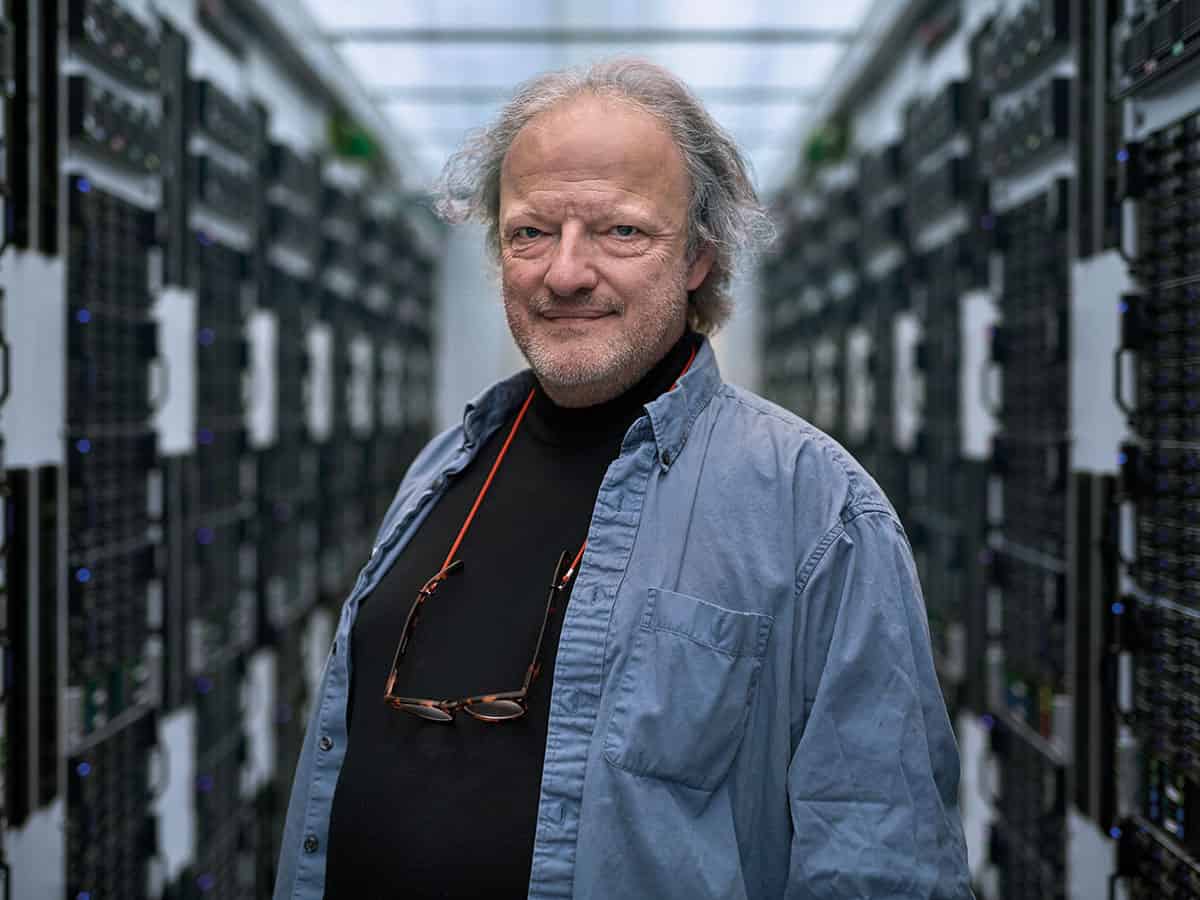
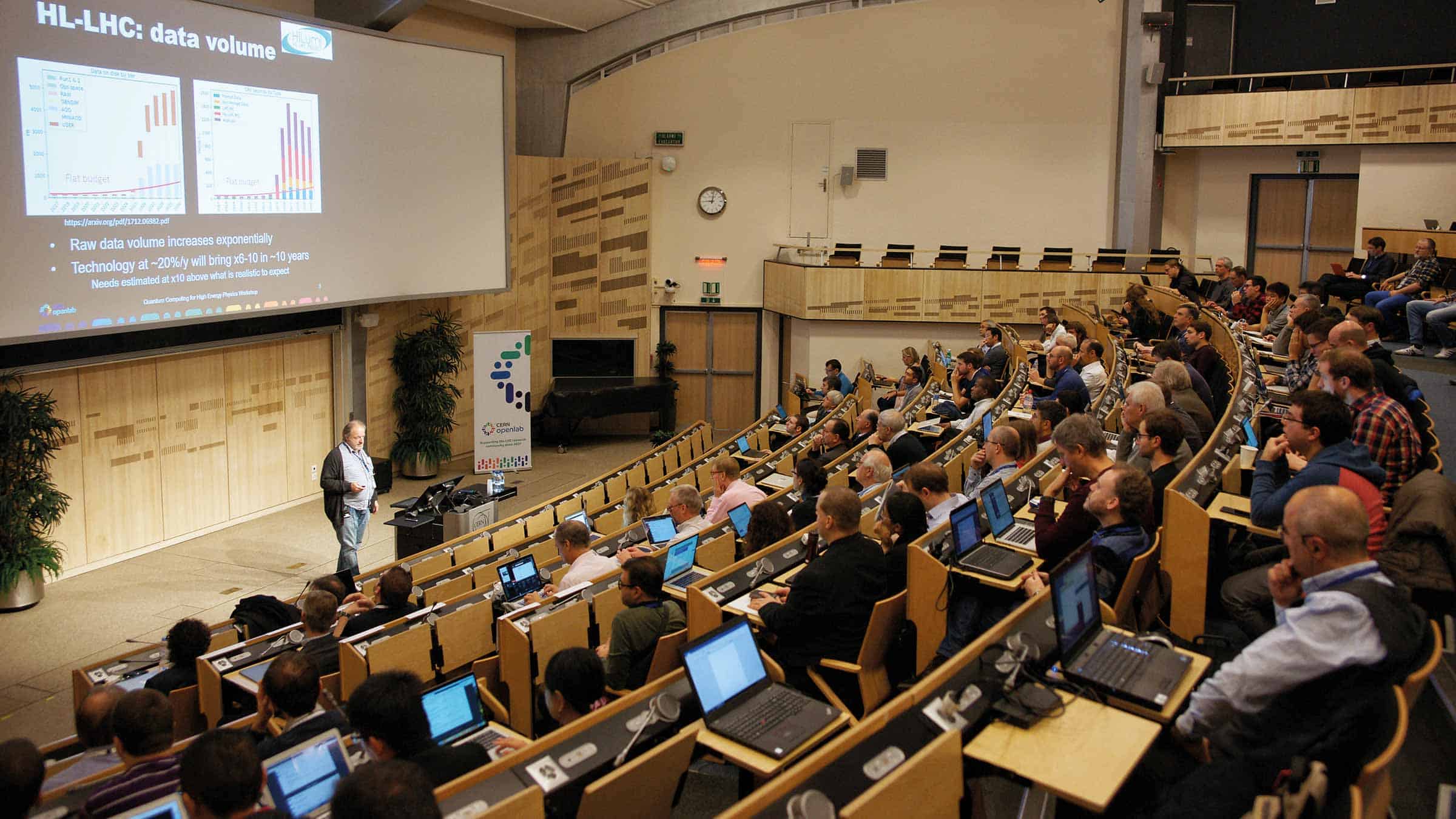
As we celebrate the 30th anniversary of the World Wide Web, the spotlight is on pioneering computer scientist Tim Berners-Lee, who developed the concept at the CERN particle-physics lab near Geneva. He originally studied physics at the University of Oxford, but Berners-Lee is far from the only physicist to have had a fruitful career in computing. Just ask Federico Carminati, who is currently the chief innovation officer at CERN openlab. This is a public–private network that links CERN with other research institutions – as well as leading information and communications technology companies such as Google, IBM and Siemens – to investigate the potential applications of machine learning and quantum computing to high-energy physics.

With a keen interest in natural sciences from childhood – he begged his parents for a microscope, and wanted to study animals – Carminati’s interest in physics peaked towards the end of high school, thanks to his mathematical prowess. He graduated from the University of Pavia, Italy, in 1981 with a master’s degree in physics. Strangely, there were no Italian universities offering PhDs in physics at the time. “So, I decided to start working immediately. My first job was at the Los Alamos National Laboratory, where I worked as a high-energy physicist, on a muon-decay experiment,” Carminati says.

He spent a year working at Los Alamos, before his contract ended and was not renewed. “I began writing a number of letters looking for a job and, at the encouragement of my wife, I wrote to Nobel-prize-winning physicist Samuel Ting. Honestly, it was a very long shot and I didn’t think I was going to receive any answers,” he recalls. Luckily, the eminent physicist found Carminati’s CV interesting and wrote to ask him whether he was “better” at computing or hardware. “I said I was better in computing. So he put me in contact with the California Institute of Technology,” where Carminati spent the next year, before being hired by CERN in a computing role.

Federico Carminati at CERN

Carminati has been at CERN since 1985, where he has held a variety of jobs, the first of which was at the CERN Program Library, which handles the organization’s data. The library essentially started as a collection of programs written for physicists at CERN experiments. “But it became a worldwide standard for computing in high-energy physics, “ Carminati says. “My task was to co-ordinate the development of this very large piece of code, and to distribute it. This was before the Web existed, so distributing it meant shipping large reel tapes of data.”

Later, Carminati became responsible for one specific part of this library – the GEANT detector simulation program. The idea here was to carry out detailed and precise simulations of the very high-energy experiments they hoped to run on actual detectors in the future. Carminati worked on this until 1994. “I then decided to join the small team that was set up by the CERN director and Nobel-prize-winner Carlo Rubbia, who decided to start working on the design of a new kind of reactor that would combine the technology of nuclear-power reactors and of high-energy accelerators.” Carminati worked as part of this small team for the next four years, which proved interesting even though the team’s prototype never saw the light of day.

From 1998 to 2012, Carminati worked on the ALICE experiment, one of the four main detectors at the Large Hadron Collider (LHC). Among his roles was that of computing co-ordinator, which meant that he was in charge of designing, developing and co-ordinating the computing infrastructure for this experiment. “I was also very involved in the development of CERN’s computing grid,” he says.

Formidable requirements

Launched in 2002, CERN’s Worldwide LHC Computing Grid was a pioneering concept, as it allowed physicists across the globe to exploit the many petabytes of data generated each day when the LHC is running. It was key in allowing researchers to pin down the Higgs boson in 2012. While this global collaboration of computer centres is well established today – connecting more than 8000 physicists to thousands of computers in some 190 centres across 45 countries – it was a gargantuan task.

“We were asked to put down the computing requirements for the LHC on paper, in the late-1990s, and it emerged that they were so formidable that we were nearly accused of sabotaging the project,” exclaims Carminati, who says that it seemed as though the computing power needed was far beyond the funding provided to CERN. It was equally impractical to build and host such a large computing centre at the European lab.

The idea emerged to harness all of the computing facilities of the different laboratories and universities across the world that were already involved in the LHC, and integrate them into a single computing service. “Nowadays, everybody is talking about cloud computing, but at the time it was little more than science fiction,” says Carminati. “The interesting thing was that the funding agencies agreed to give us this computing power. But they wanted to make local investments by helping create centres of computing excellence in all the different countries,” he says, explaining that funders hoped that these centres would hire home-grown people and develop know-how in information technology locally. “It was a fantastic adventure because I travelled to places such as South Africa, Thailand and Armenia to help them set up computer centres.”

It was not all smooth sailing, though, as Carminati encountered “a tremendous amount of negotiation, and it took a lot of hard work to sell the concept to local politicians”. Carminati says a particular highlight was negotiating the South Korean computer centre for ALICE. “I had to work with the country’s ministry of science and education, and the local scientists too. I also did the same for India.”

Carminati’s role also involved helping users to exploit the computing power once it was established. “I was co-ordinator for ALICE’s experimental computing infrastructure between 1998 and 2012, which was much too long if you ask me. It was fun and creative until the LHC was switched on. When the machines started, it was exhausting. When the LHC is running we are in ‘production mode’,” says Carminati. “You have to be ready to process the vast amounts of data. It becomes a very complex organizational task where you have to co-ordinate hundreds of developers, distributed around the world, providing software to a central depository, all on a very tight time schedule. There are some very hard choices you have to make, when it comes to time versus quality, and the whole thing is tough and exhausting.”

Carminati spent 2013–2017 back at GEANT, working on improving the performance of the simulation program on new computing architectures, and developed the new generation of code used to simulate particle transport at CERN. During that time he also managed to obtain his PhD, from the University of Nantes in France.

Open for business

Now based at CERN openlab, Carminati explains that computing technologies are currently evolving so fast that evaluating them only once they are on the market is “not good enough”. CERN openlab is one of the few units at the European lab explicitly carrying out research into computing.

The aim is for CERN to reach out to high-energy physics users, as well as commercial users, to highlight techniques developed in-house, while also collaborating on projects with other institutions. For example, CERN openlab is currently working with Unosat, the UN’s technology platform that deals with satellite imagery and analysis, which has been hosted at CERN since 2002. One of their joint projects is to evaluate the movement of large refugee populations across the globe, to know how many people are at any given refugee camp, which can often be difficult or even dangerous to reach. One way to assess population density is to count the tents at a camp. “We are experts in machine learning and artificial intelligence,” says Carminati, “so we are working with Unosat to develop programs to automatically count the tents in satellite pictures.”

Another planned collaboration is with Seoul National University’s Bundang Hospital in South Korea, which Carminati says has a “fantastic health information system and patient records, from many years”. CERN openlab is trying to find the resources to begin a project with the hospital to “use machine learning to see whether we can correlate the classifications that artificial intelligence can make of patient records in actual diagnosis”. The idea is to find out if a machine-learning system could learn to make a diagnosis of its own, or pick up people who may have a “double diagnosis” – those with two diseases that are always coupled – thereby having a case for creating a new diagnostic category.

Federico Carminati lecture at CERN

When it comes to the impact of quantum computing on the future of high-energy physics, Carminati is convinced that CERN must start thinking about tomorrow’s computing technology today. “It is so important to explore this, because 10 years from now we will have a shortage of a factor of 100, when it comes to computing time.” The other vital issue is the amount of data being taken at the LHC, and any future colliders, as they search for physics beyond the Standard Model. “We are now looking for something very subtle. With the Higgs we said that we were looking for a needle in a haystack. Now the new game is that we will make a stack of needles, and then look within it for the odd one out.”

This means that particle physicists will be taking and classifying an incredible amount of data, and then processing it with extreme precision, all of which will require an increase in computing power. “We may be increasing the amount of data that we take and the quality of the detectors. But we cannot expect our computing budget to be increased by a factor of 100,” says Carminati. “We are just going to have to find new sources of very fast computing, and quantum computing is a strong candidate.”

While he is clear that none of today’s quantum computers are anywhere near that mark, he believes that quantum computing will mature, partly thanks to investment by industry. “Whenever this happens, I think we have to be ready for it, to exploit it as best we can. We would be able to use a quantum computer across the board – from simulation and detector construction, through to data analysis and computing speed-ups. It is very important to start developing our programs and software now.”

Carminati points out that, were the quantum revolution to arrive, scientists would have to completely rewrite their codes, as he believes there is nothing like a universal quantum computer. “Can we have software that is agnostic of the specific kind of computing that we are using? We will have to develop a new angle, and so this is a large part of our research”. Last November Carminati organized the first ever workshop on quantum computing in high-energy physics at CERN, to get a head start on these very issues.

Outside the box

All of this means that today’s physics graduates will have a wide variety of opportunities when it comes to jobs across the fields. “A physicist is trained to creatively solve complex problems using mathematics, with a lot of thinking outside the box,” says Carminati. “We train so many physicists at CERN, and sometimes it is frustrating to see them leave, but we cannot keep everybody, this we know. Our consolation is knowing that we’re giving them a skillset that it is really applicable to many other research fields, and across industry.”

Today, there is a global hunger for machine-learning and quantum-computing experts, with countries from the US to India and China looking to train and develop such expertise. Carminati has a very optimistic outlook for today’s graduates who may be considering one of these fields. “Try to have as much constructive fun as you can in doing your research, because it’s a fascinating job.”

Monolayer resets record for thinnest non-volatile memory device

Thinnest Non-volatile Memory

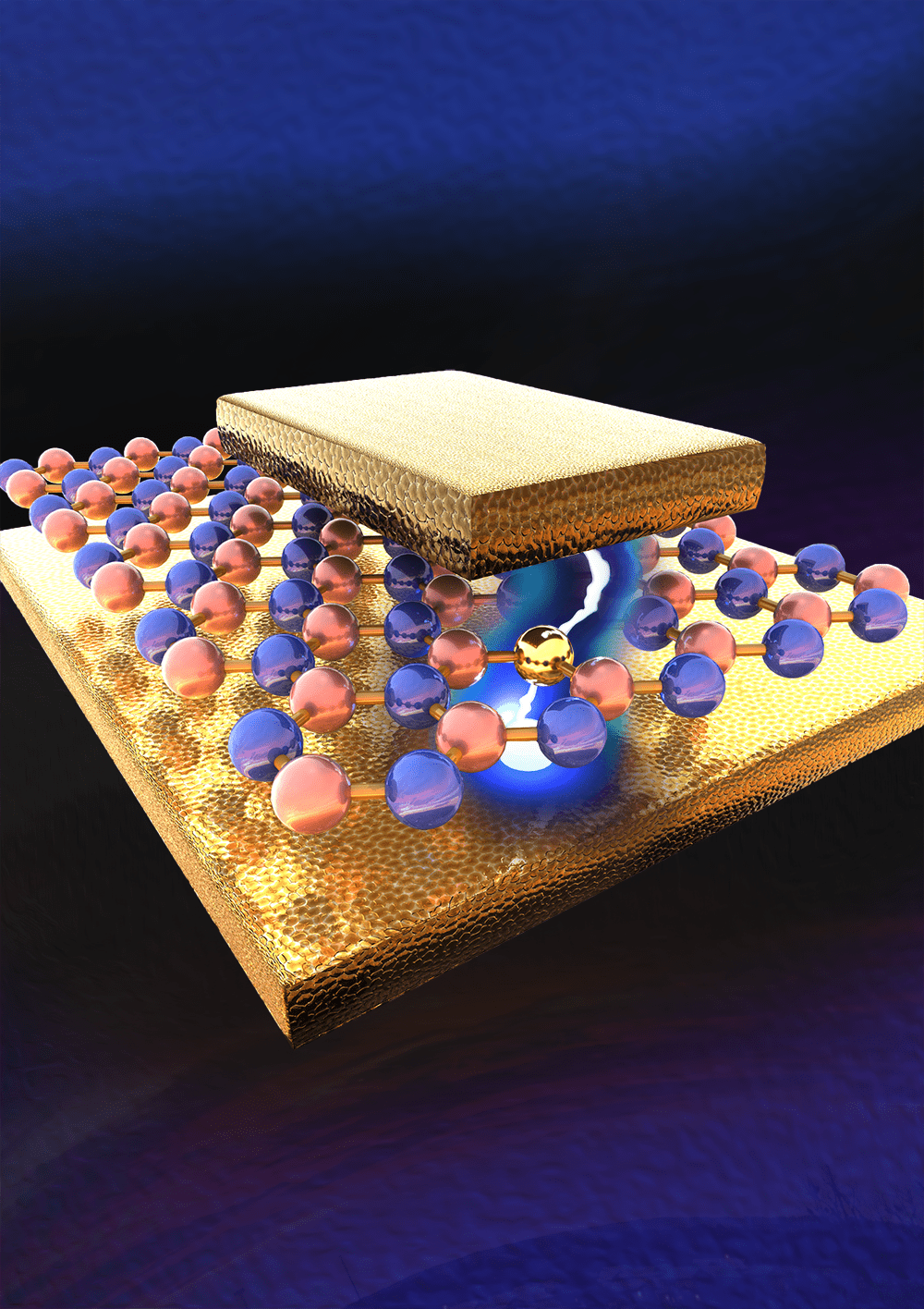
It may seem that anything traditional materials can do 2D materials can do better, but when it comes to a resistive device you can switch on or off, leakage currents can pose problems when materials are atomically thin. Drawing on their expertise in high-quality monolayer device fabrication Jack C Lee and Deji Akinwande at the University of Texas at Austin Microelectronics Research Center in the US and their colleagues in the US and China have now demonstrated resistive switching across monolayer hexagonal boron nitride (h-BN) bringing the record thickness for a memory material down to around 0.33 nm.

Non-volatile resistance devices switch between high and low resistance states when a voltage is applied, a process described as setting and resetting. They have attracted interest for memory that persists without a power supply, as well as high-density memory and next-generation neuromorphic computing that mimics the operation of synapses in living organisms.

“We pioneered monolayer 2D memory last year initially based on MoS2,” says Akinwande. So-called transition metal dichalcogenides (TMDs) like MoS2 are semiconductors – they only conduct electrons when a potential field provides the energy needed to overcome the material’s bandgap. As Akinwande tells Physics World, they then began to consider h-BN as a possibly more suitable candidate for memory phenomena compared with TMDs because of the more insulating characteristics such as the high bandgap. “The main challenge was that monolayer h-BN is two times thinner than MoS2, so it was not clear if the device would work because any pinholes in the h-BN would result in an electrical short.”

Fabricating perfection

The researchers took several measures to ensure the quality of their sample devices. They grew h-BN monolayers directly on the bottom electrode and then grew the top electrode directly on the h-BN to avoid any impurities and defects arising from transfer processes. They also used gold, an inert metal, for their electrodes. This helped to rule out the role of oxides forming at the interface so the researchers could attribute any switching behaviour to the h-BN layer with certainty.

“After many rounds of sample experiments we were able to work on high-quality h-BN monolayer films grown by collaborators at University of Texas and also samples from Peking University that resulted in observation of memory effects in the thinnest atomic monolayer, a materials science record,” says Akinwande.

Filling in the gaps

Measurements of the effect of temperature on the electronic properties revealed that while the devices shared the characteristics of TMD devices in the low resistance state, in the high resistance state the behaviour differed. The increasing current with temperature in the high-resistance state suggests the role of charge traps in the electronic behaviour.

Based on ab initio simulations the researchers explain the switching behaviour as the result of boron vacancies. In the low resistance state, gold atoms can occupy these vacancies forming a conductive bridge.

The ratio of the high and low resistance states was 107. Switching occurred in less than 15 ns, and tests demonstrate that the resistance states were stable for at least a week after over 50 switching cycles. “We are now conducting further experiments to improve the reliability and explore applications including and beyond information storage,” says Akinwande.

Full details are reported in Advanced Materials.

Facing up to the decarbonization challenge

How can we satisfy the world’s energy needs while also reducing its carbon emissions?

Of all the scientific and social questions facing humanity, this is arguably the most important. Indeed, the future of our civilization may even depend on finding an answer, especially as the climate consequences of dumping carbon dioxide (CO2) into the Earth’s atmosphere become ever more apparent and alarming.

It was therefore interesting to hear this question being posed by a senior scientist at ExxonMobil, one of the world’s major oil and gas firms. In 2018, ExxonMobil announced that it plans to produce 25% more oil and gas by 2025 than it did in 2017. The company expects global demand for oil to rise by 19% between 2016 and 2040, and demand for gas to rise by 38% in the same period. In contrast, the Intergovernmental Panel on Climate Change estimates that keeping the Earth’s temperature within 1.5 °C of pre-industrial levels would require oil and gas production to fall by 20% over the next few decades.

Amy Herhold, director of physics and mathematical sciences at ExxonMobil Research and Engineering in New Jersey, US did not mention the company’s plans for increasing production during her talk at an APS March Meeting session devoted to the company’s physics research over the last five decades. Instead, Herhold began by pointing out that the world’s population is expected to grow by 1.7 billion between 2016 and 2040. According to the company’s forecasts, demand for energy (in all forms) will go up by 25% over the same period, leading to a 10% rise in CO2 emissions. The small silver lining in this dark cloud is that CO2 production per unit of gross domestic product (GDP) is predicted to drop by 45%, as improvements in efficiency, coupled with increasing use of renewable energy, reduce the “carbon intensity” of the global economy.

Much of the rest of Herhold’s talk was devoted to an overview of the physics research that scientists at Exxon (later ExxonMobil) have done since the 1950s, on topics as varied as subsurface sensing; the behaviour of emulsions and foams; fluid flow; and even, in the early days, nuclear fusion. Towards the end, though, she returned to the subject of energy efficiency and decarbonization.

One of ExxonMobil’s current research goals is to develop membranes that can separate different types of hydrocarbons. The aim is to replace or reduce the use of distillation, in which crude oil is heated (an energy-intensive process) and successively-heavier fractions separated out. Another research project focuses on developing advanced biofuels for use in hard-to-decarbonize sectors such as commercial shipping. And a third relates to carbon capture, in which concentrated CO2 obtained from (say) the flue gas of a power plant is injected into underground rock formations to sequester it from the atmosphere.

Replacing distillation with mechanical filtration seems like a clear win for ExxonMobil; no company wants to spend money on fuel if it doesn’t have to. But it wasn’t so obvious what it stands to gain from working on carbon capture or non-fossil-fuel forms of energy, so at the end of the talk, I asked Herhold if she could elaborate.

Her response, roughly, was that ExxonMobil is an energy company, so it’s interested in all options. The company’s scientists also know a lot about underground rock formations and how fluids flow through them, so she thinks they have something to offer on carbon capture. But beyond that, Herhold was pretty tight-lipped. “What our business model looks like in the future is not something I can comment on,” she said. “It’s going to be an interesting journey.”

  • This article was updated on 28th March to clarify the second paragraph.

Curved camera chips may be the next leap in astronomical imaging

It’s not just televisions and smartphones that are looking forward to a curved future. Astronomers are now looking to put curved camera sensors into spacecraft exploring the depths of the Universe – since they promise to provide better imaging performance in a more compact package – and recent tests by researchers in the US and France show that prototype curved devices are more than up to the task.

In the study, Simona Lombardo of the Laboratoire d’Astrophysique de Marseille and her colleagues tested five CMOS chips that they curved into both concave and convex shapes, and with different radii of curvature. Using commercially available flat CMOS devices, the team first thinned the sensors to increase their mechanical flexibility and then glued them onto a curved substrate to create a spherical shape.

The researchers found that in almost all cases the characteristics of the curved sensors matched those of a flat CMOS chip – confirming that there was no degradation in performance as a result of the curving process. But they also found that the curved detectors generated a much lower dark current – one of the main sources of noise in image sensors – than the flat version.

“The dark current is due to intrinsic movement of electrons in the pixels of the sensor, even when not exposed to light,” explains Lombardo. “These electrons are then collected in the pixels and become indistinguishable from the electrons generated by the incoming light (from a star or a nice landscape).”

Aiming for longer exposure times

Lombardo cautions that the apparent reduction in dark current could simply be caused by the flat sensor and its curved counterparts coming from different batches. But a genuine enhancement resulting from the curved nature of the detectors could be good news for astronomers.

“In astronomy one is generally interested in measuring the most correct number of charges coming from an object (or its flux) and quite often the objects under study are faint and require long exposure times,” says Lombardo. “Having a lower dark current decreases the error in the measurement and, most importantly, allows longer exposure times.”

One of the reasons that curved camera chips hold promise for spacecraft engineers is that some past missions have had to use special optics to correct distortions produced by their inbuilt telescopes. A detector with a curvature that is able to cancel out this distortion would negate the need for those extra components, allowing the designers to make lighter, more compact orbiting observatories. And, given the enormous cost of launching every extra kilogram into space, that could lower the price tag of a mission. “Since there are fewer and smaller optical elements, the manufacturing becomes easier and the costs are reduced,” adds Lombardo.

According to the researchers, one project that could make use of curved sensor technology in its camera is the proposed MESSIER satellite – which would image, among other things, the extraordinarily faint tendrils of material that stretch vast distances around and between galaxies. “As the goal of the mission is the observation of large astrophysical structures, a wide field of view is required for the telescope,” says Lombardo. “Curved detectors allow [one] to greatly simplify the design while keeping the performances at [a] high level.”

Dave Walton, Head of Photon Detection Systems at UCL’s Mullard Space Science Laboratory in the UK, agrees: “I’m sure there’ll be other space missions that will want to use curved sensors. As with all space applications, the issues will be demonstrating that the technology is sufficiently mature, and that it will survive the rigours of spaceflight.”

Walton, who was not involved in the new study, continues: “Which proposed future missions will actually survive/evolve to reach the launchpad is always an interesting question, but some of the studies that might benefit from curved sensors include ESA’s GaiaNIR and NASA’s LUVOIR.”

Gravitational waves could reveal ultralight bosons lurking near black holes

Hypothetical particles called ultralight bosons could be spotted lurking near supermassive black holes by the Laser Interferometer Space Antenna (LISA), according to calculations by a team of astrophysicists. LISA is a space-based gravitational-wave detector that should be operational in 2034, when the team says it could determine whether ultralight bosons are a component of dark matter.

According to the conventional model of the universe, about 85% of its mass is dark matter. This mysterious substance neither emits nor absorbs electromagnetic radiation and physicists have little idea of its composition. One possibility is that dark matter is made of ultralight bosons such as axions, which are not part of the Standard Model of particle physics. Now Tjonnie Li of the Chinese University of Hong Kong and an international team have shown that LISA may be able to detect or rule out the existence of ultralight bosons by looking at gravitational wave signals from supermassive black holes.

If ultralight bosons exist, calculations suggest that clouds of them will form outside the event horizon of spinning supermassive black holes, which reside at the centres of many galaxies. Like other particles, these hypothetical ultralight bosons must have a Compton wavelength, which is a quantum-mechanical property of a particle that is inversely proportional to its mass. Because ultralight bosons have very small masses, they would have relatively large Compton wavelengths.

Superradiance

An interesting effect called superradiance should occur if the Compton wavelength of ultralight bosons is comparable to the Schwarzschild radius of the black hole (the distance from the centre to the event horizon). The boson field couples to the spinning black hole and extracts energy from it until the boson cloud is rotating with comparable velocity to the black hole. Superradiance was first predicted in 1971 by the Soviet physicist Yakov Zel’dovich for a spinning metal cylinder in an electromagnetic field. “If it exists for a spinning cylinder, it also exists for a spinning black hole,” explains gravitational astrophysicist Vitor Cardoso of the Center for Astrophysics and Gravitation in Lisbon — who was not involved in this latest research.

This transfer of energy from a supermassive black hole to a surrounding cloud of ultralight bosons would alter the black hole’s gravitational wave signal. Researchers have already suggested that this could be used to identify ultralight bosons and measure their mass, but Li points out that this would be very difficult to do using existing ground-based detectors.

Now, Li and colleagues have outlined a protocol whereby LISA could potentially settle the debate over ultralight bosons by avoiding much of the noise that limits ground-based detectors such as LIGO. More importantly, LISA should detect low-frequency gravitational waves produced by supermassive black holes with Schwarzchild radii between 1000-1,000,000 km. There is some evidence that dark matter could comprise ultralight bosons with Compton wavelengths of this order and therefore superradiant coupling between the black hole and the hypothetical boson cloud should cause a reduction in the spin of the black hole.

Black hole geometry

“If we measure the black hole geometry – such as we can with gravitational waves – it will give us a prediction for what the bosonic cloud looks like,” explains Li’s PhD student Otto Hannuksela, who led the research. “The black hole geometry with the bosonic cloud already encodes some information about the boson particle.”

According to Li, even more information could be gleaned from gravitational waves if a smaller black hole happened to be spiralling into the supermassive black hole. “With LISA, we can track the orbit of the smaller black hole over timescales of years.” As the smaller black hole orbits, it would pass through any bosonic cloud surrounding the larger black hole. This would alter the orbit, and consequently the gravitational wave signal of the smaller black hole. This could provide a completely independent measurement of the shape of the larger black hole’s bosonic cloud. If the shape of the cloud inferred from the small black hole orbit were consistent with the shape predicted from the large black hole geometry, this could verify the existence of the bosonic cloud and therefore the light boson hypothesis. Otherwise, it could rule out ultralight bosons.

“I think it’s a very important question to ask and I think they have a very important set of tools to discriminate [the existence of light bosons],” says Cardoso. Nevertheless, he notes that the researchers have modelled the orbits using simple Newtonian gravity rather than full general relativity, and have neglected two other important influences on a smaller black hole spiralling into a supermassive one. Therefore, he says, “we don’t yet know whether we can really tell precisely whether such a cloud exists.”

The calculations are described in Nature Astronomy.

Chiral surface excitons spotted on topological insulator

The first ever observations of chiral surface excitons have been made by Girsh Blumberg and colleagues at Rutgers University in the US. The team made their discovery after detecting circularly-polarized light emerging from the surface of a topological insulator. Their work could have a range of applications including lighting, electronic displays, and solar panels.

An exciton is a particle-like excitation that occurs in semiconductors. It comprises a bound electron-hole pair, which can be created by firing light at the surface of a semiconductor. After a short period of time, the electron and hole will annihilate and create a photon of photoluminescent light. Photoluminescence spectroscopy is an established technique for studying the electronic properties of conventional semiconductors and is now being used to study topological insulators – a family of crystalline materials with highly conductive surfaces, and insulating interiors.

The surfaces of topological insulators contain 2D gases of Dirac electrons, which behave much like photons with no mass. Theoretical calculations suggest that when such electrons are excited, the resulting holes have mass. Until now, however, physicists have had scant experimental information about excitons comprising massless Dirac electrons and massive holes.

Spiralling electrons

In their study, Blumberg’s team looked at the surface of bismuth selenide, which is a well-known topological insulator. Using a broad range of energies to excite surface excitons, the physicists found that the circularly-polarized photoluminescent light is emitted when the excitons decay. This they say indicates that the electrons are spiralling towards the holes as they recombine. Since spirals cannot be superimposed onto their mirror images, Blumberg’s team describe the quasiparticles as chiral excitons.

The researchers believe that this chirality is preserved as a result of strong spin-orbit coupling, which affects both electrons and holes. This coupling locks the spins and angular momenta of the electrons and holes together. This preserves the chirality of the excitons by preventing them from interacting with thermal vibrations on the surface – even at room temperature. This is unlike conventional excitons, which lose their chirality rapidly through thermal interactions and therefore do not emit circularly polarized light.

The precise dynamics of chiral excitons is still not entirely clear. In future research, Blumberg’s team hopes to study the quasiparticles in using ultrafast imaging techniques. The researchers also believe that chiral excitons may be found in materials other than bismuth selenide.

From a technological point of view, Blumberg and colleagues say that circularly-polarized photoluminescence could make topological insulators ideal for a wide variety of photonic and optoelectronic technologies. They say that bismuth selenide optical coatings would be easy to mass-produce, making them ideal for applications ranging from ultra-clear television screens to highly efficient solar cells.

The research is described in Proceedings of the National Academy of Sciences.

Wireless neurostimulator modulates rats’ behaviour

The e-Particle neurostimulator

Deep brain stimulation (DBS) using implanted neurostimulators is a promising treatment for neurological disorders such as Parkinson’s disease, essential tremor and epilepsy. But wired neurostimulators often come with adverse side effects such as infection, discomfort and the need for surgeries to repair fragile components and replace batteries. For pre-clinical studies, meanwhile, the wires restrict animals’ movement and limit potential applications.

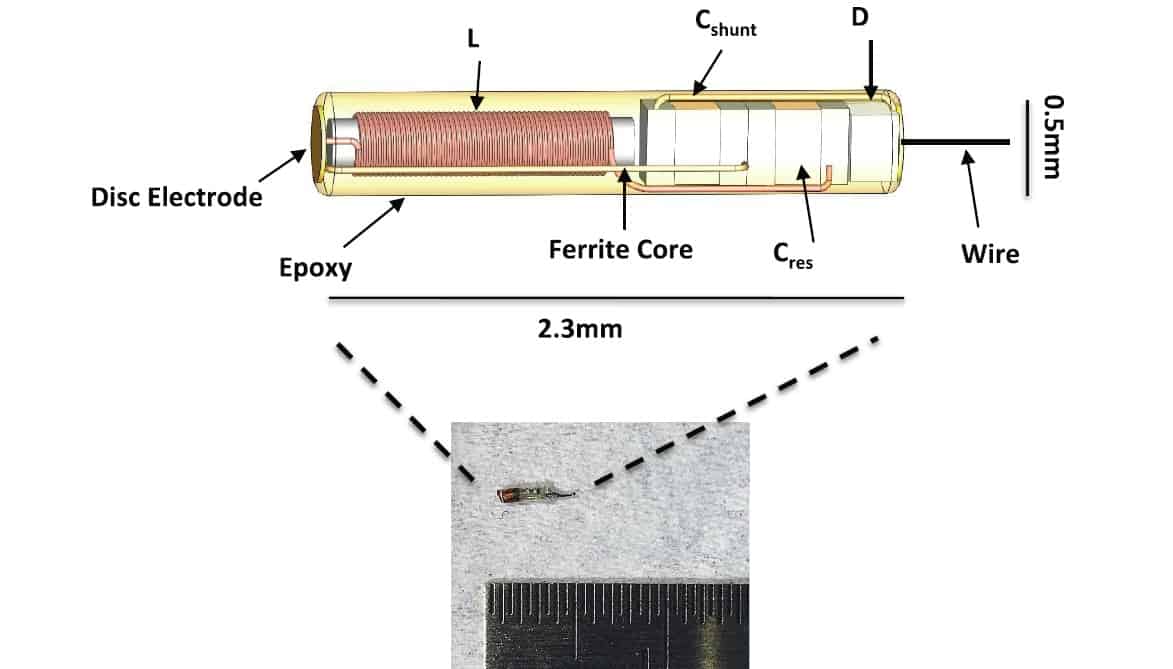
As such, there’s a need for a wireless technology that enables precise, minimally-invasive modulation of deep brain structures. To meet this requirement, a team at Massachusetts General Hospital and Draper is investigating the potential of e-Particle, a novel wireless neurostimulator (J. Neural. Eng. 10.1088/1741-2552/aafc72).

“If we understand how changing brain activity changes behaviour, we can understand the brain better and can design better treatments,” explains senior author Alik Widge. “One of the best ways to change the brain is by stimulating it. “The challenge is that, in animal models, we often do that through big head-mounted tethers, which limit what you can do. You can’t do social behaviour experiments because the tethers will tangle; you can’t let the animals explore burrows and tunnels the way they do in nature. A good wireless technology could change all that.”

Research team

Behaviour modulation

The sub-millimetre sized e-Particle is inductively powered and does not require a battery or head-mounted tethers. To test the device, the researchers performed a conditioned place preference (CPP) task in eight adult rats. They surgically implanted the e-Particle on one side of each animal’s brain, targeting the medial forebrain bundle (MFB), a common target for behaviour experiments. For comparison, they also implanted Plastics One electrodes (a wired stimulator) on the other side.

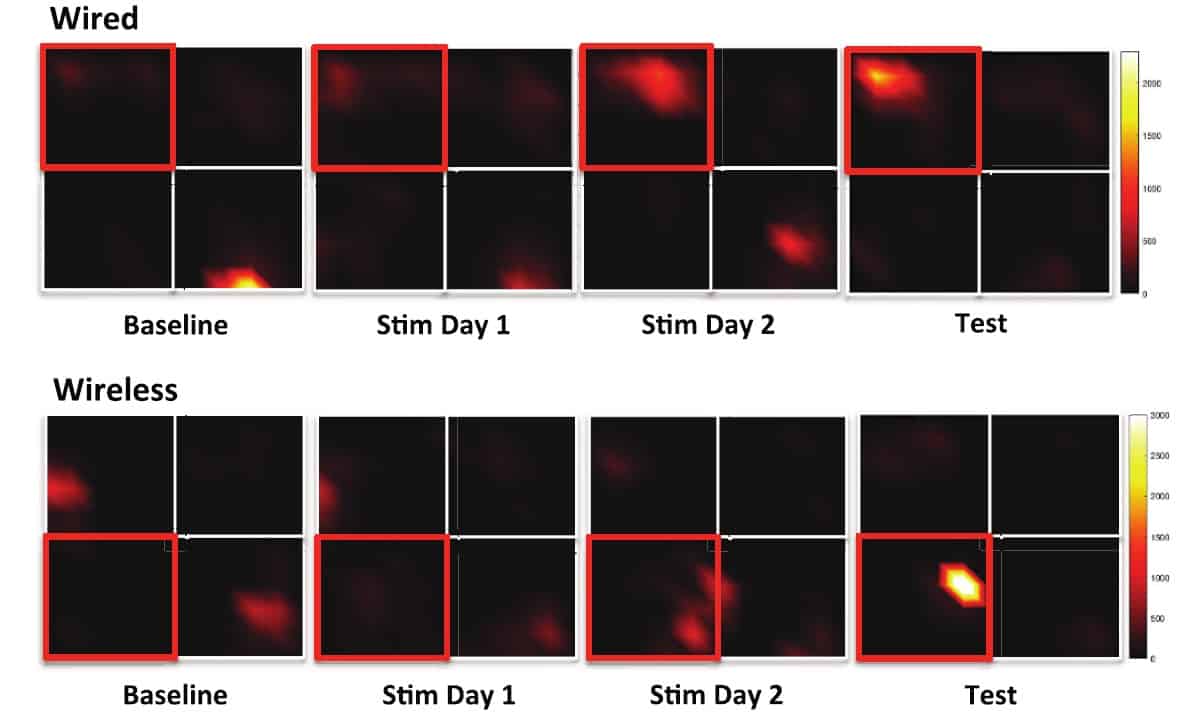
After recovery from surgery, animals were placed in the CPP field without stimulation for five 15-minute habituation sessions. On the next two consecutive days, they underwent 15-minute stimulation sessions, during which a stimulation pulse was triggered every time they entered a chosen stimulation quadrant (initially, each animal’s least preferred quadrant).

In each round of CPP testing, the rats were randomly assigned to receive either wireless (tens of microamps, 50 Hz) or wired (350 μA, 170 Hz) stimulation. The authors note that the animals remained tethered during e-Particle stimulation, to match conditions. Finally, the researchers performed a test session where animals were placed in the CPP field for 15 minutes with no stimulation.

This analysis revealed that, for the wired group, time spent in the stimulation quadrant significantly increased during the first and second stimulation sessions (indicating strong place preference conditioning) and the test session, compared with the baseline session. Animals in the wireless group also spent more time in the stimulation quadrant during the second stimulation session and the test session, but not during the first stimulation session.

Behavioural results

These results confirmed that the e-Particle could modulate rats’ behaviour by MFB stimulation. Wireless stimulation took slightly longer to achieve CPP than wired stimulation, but ultimately did not differ in the degree of place preference. This longer training time may be related to the e-Particle’s lower pulse amplitude compared with the wired device.

“One of the challenges of this technology design, and of these battery-less, energy-harvesting wireless systems more generally, is that they are limited in their current delivery by the physics of the energy-harvesting system,” explains Widge. “Getting more efficient field-to-current conversion in the same or smaller form factor would be important.”

Brain activity

After completing the CPP tests, each rat received 15 minutes of e-Particle and wired stimulation. Sixty minutes later, the animals were sacrificed and the researchers performed immunohistochemistry to measure c-fos, a marker of recent brain activity.

On the side of the e-Particle implant, there was significantly greater c-fos expression in the nucleus accumbens (which receives MFB projections) than in the motor cortex (which does not). This suggests that the e-Particle successfully activated the MFB and its projections. Widge notes that, although they deliver different amounts of current to the target area, wired and wireless stimulation affected brain activity in a very similar way.

The researchers concluded that the e-Particle can stimulate a specific target and that this stimulation can effectively modulate behaviour. They are now focusing on increasing its ability to activate neural structures while reducing tissue damage.

“To that end, we have a grant with Polina Anikeeva of MIT, who has developed nanoscale particles that similarly harvest energy from frequency-tuned magnetic fields,” Widge tells Physics World. “We’re looking at using her technology to modify reward behaviours very similar to those seen in this study.”

Why artificial intelligence has brought scientists and philosophers together

When the concept of artificial intelligence (AI) was developed in the 1950s, its founders thought they were on the verge of fully modelling human thought processes and intelligence. Indeed, the US economist Herbert Simon – a future Nobel laureate – was so confident of AI’s prospects that in 1965 he predicted machines would, by 1985, “be capable of doing any work a man can do”. As for Marvin Minsky, the Massachusetts Institute of Technology (MIT) cognitive scientist who co-founded its Artificial Intelligence Laboratory, he boldly announced that “within a generation…the problem of creating artificial intelligence will substantially be solved”.

Not everyone was so sure. Hubert Dreyfus, an MIT philosopher, argued that these ambitions were conceived in such a way as to be unachievable in practice and impossible in principle. AI research was doomed to fail because it was based on an incoherent rationalist philosophy. Intelligent human behaviour, he argued, is much richer than information processing. It requires responding to situations with “common-sense knowledge”, which was not amenable to programming.

Dreyfus outlined his thinking in a 1964 article, commissioned by the Rand Corporation (a policy think-tank) entitled “Alchemy and artificial intelligence”. He elaborated the arguments in his 1972 book What Computers Can’t Do. Many arguments concerned what had already been dubbed the “frame problem”.

Get in the frame

Robots, Dreyfus thought, can be programmed to execute complex human tasks like walking over rough surfaces, smiling or placing reasonable bets. But to do so in a human way requires taking into account the specific situation in which these actions occur. To place a judicious bet on a racehorse, for instance, a human normally looks at the horse’s age, past history of wins, the jockey’s training and history, and so forth, all of which change with each race.

No problem, argued Minsky. A robot can be programmed to do that, turning these factors into information for the robot to process with a complete set of rules or “frame”. If you give the robot a frame, it’ll be able to bet on racehorses like a human – maybe better.

But there’s more to it, Dreyfus argued in What Computers Can’t Do. Many other factors are present in racehorse betting, such as the horse’s allergies, the racetrack’s condition, and the jockey’s mood, all of which change from race to race. However, when computer programmers analyse the relevant factors, Dreyfus noted, they end up behaving more like novices and amateurs (who often get things wrong) and less like experts (who get things wrong much less often yet appear to rely on no set “programming” method at all). In this regard, a true expert more closely resembles someone exercising common sense than someone consciously analysing factors.

Some AI enthusiasts accused Dreyfus of using the frame problem to try to drive a stake through the heart of AI. To counter Dreyfus’s objection, they felt, one simply programmed the robot to identify these other factors if and when they are relevant, thus putting another frame around the first. Dreyfus responded that the computer would need still another frame to recognize when to apply this new one. “Any program using frames,” he wrote in his 1972 book, “was going to be caught in a regress of frames for recognizing relevant frames for recognizing relevant facts.” The common-sense knowledge storage and retrieval problem, in other words, “wasn’t just a problem; it was a sign that something was seriously wrong with the whole approach”.

Two approaches

The frame debate turned on a fundamental philosophical difference between a “Cartesian” and a “Heideggerian” approach. In a Cartesian approach, the world in which humans live and cope is assumed to exist entirely apart from the minds that consciously try to “know” it. In this view, to be human is to cope with life using knowledge and beliefs to assess the meaningful factors that they confront. Programming a computer to respond to a situation humanly therefore means supplying it with knowledge and information-processing capacity. If those prove inadequate, the solution is to add in more of the right kind of knowledge or processing ability. This Cartesian-inspired strategy is known as “Good Old Fashioned AI”, or GOFAI.

The Heideggerian approach, in contrast, begins with a very different conception of the human–world relation. It says that the fundamental human experience of the world is not of an external realm of objects that we theorize about. Rather, humans are immersed in the world in a web of connections and practices that make the world familiar. Coping with the world is more like enacting common sense than employing theories and analysing them. Theorizing comes later, as a guide to some forms of deliberate action, where spontaneous employment of common sense is ineffective or otherwise insufficient.

Putting a frame around a situation transforms it from a situation in the world into an artificial world. That’s valuable for executing many tasks, such as playing chess or evaluating complex systems. But if the aim is to make a robot respond to all situations, adding more knowledge or computing capacity won’t do. There is no “frame of all frames” that would allow this. Heideggerian AI, Dreyfus writes, “doesn’t just ignore the frame problem nor solve it, but shows why it doesn’t occur”.

The critical point

AI research has come a long way in the last half-century, and no longer depends on the crude conceptions of intelligence taken for granted in GOFAI. In fact, the more sophisticated recent conceptions were developed in part by incorporating elements of Dreyfus’s initial critique. Mostly absent now, for instance, is the claim that AI will fully model human thinking and intelligence. Arguments about the frame problem have become quite technical, but it remains a core issue. It is one of the few areas where philosophers and scientists have managed to engage each other productively.

Extreme extratropical cyclones could triple in number by century-end

Unmitigated climate change will cause substantial increases in large-scale rainfall events in Europe and North America, according to researchers from the UK.

The analysis suggests that policy makers could need to develop new management strategies “to take into account the changing frequency and intensity of these events”, says Matt Hawcroft of the University of Exeter, UK.

Warmer climates are expected to deliver precipitation extremes of greater frequency and intensity. Precipitation intensity is a product of the Clausius–Clapeyron relation, which describes how much more water the atmosphere can hold as its temperature increases. But the relation is a simple scale that gives little indication where new intense precipitation will occur.

Unfortunately for climate modellers, there are many competing processes that determine the paths storms travel, including equator-to-pole temperature gradients, sea-ice loss, sea-surface temperature patterns and land-sea temperature contrasts, not to mention feedbacks from the storms themselves. The result at present is a large uncertainty in where storms will move under climate change.

Yet Hawcroft and his colleagues at Exeter and the University of Reading, UK, believe it is still possible to gain an insight into the nature and frequency of extreme precipitation changes at the regional level — by analysing the behaviour of the storms themselves in Europe and North America in simulations of both present-day climate and climate change under unmitigated greenhouse-gas emissions.

The team used an algorithm that seeks out vortices to identify storms in their models so that they could assign precipitation to individual events. Then they compared the number and intensity of the cyclones in the present-day and future climate-change simulations.

Hawcroft and colleagues found a big increase in the frequency of extreme extratropical cyclones, with above today’s 99th percentile of precipitation intensity, by the end of the century under unmitigated climate change; the number of extratropical cyclones delivering such intense rainfall more than tripled.

“Even with this uncertainty [in the underlying storm paths], there is quite a lot of consistency in the increase in extreme-storm-associated precipitation,” says Hawcroft.

Hawcroft is now exploring the dynamics that drive inter-annual and sub-seasonal variability in storms producing extreme rainfall, and how those dynamics could change in a warmer climate. The team reported the findings in Environmental Research Letters (ERL).

Copyright © 2026 by IOP Publishing Ltd and individual contributors