

Patient rotation enables fixed-beam radiotherapy system

Radiation therapy plays a fundamental role in cancer treatment, but there is a global shortage of radiotherapy centres, with many low-to-middle-income countries having limited or no treatment capability. This situation exists in part due to the cost of facilities and the expense of acquiring and operating radiotherapy systems. Linear accelerators with simplified designs, such as fixed gantry systems, could reduce these costs.

Researchers at the ACRF Image X Institute at the University of Sydney are developing a 3D conformal radiotherapy system with a fixed vertical X-ray beam, horizontal patient rotation and image guidance. The full-size proof-of-concept prototype, which offers high-quality radiation therapy from a smaller, more robust and more cost-effective system, has now been successfully commissioned (Med. Phys. 10.1002/mp.13356).

From a financial perspective, there are many potential advantages of a such a fixed-beam system. Without a rotating gantry, the system has fewer moving parts, which could improve reliability and robustness, and potentially reduce maintenance costs. It would also require less bunker shielding to operate safely, thereby reducing the cost of building new bunkers or renovating bunkers housing older radiotherapy equipment such as cobalt-60 units.

The prototype system — developed by Paul Liu and colleagues working on the Nano-X project to improve global access to radiotherapy — is based on the concept of patient rotation, specifically, keeping the radiation beam stationary while still achieving the necessary beam angles to achieve a desired dose distribution. Image guidance technologies will identify the tumour and adapt the treatment in real-time to ensure that the radiation dose is precisely delivered to the target.

The prototype comprises a standard Synergy linac with the gantry fixed at 0° and a horizontal patient rotation system (PRS). The PRS is a custom-designed radiotherapy couch equipped with straps for the head, chest, hips and legs, plus three independently controlled airbags that inflate over a patient’s chest and sides. The couch can move with two degrees-of-freedom to position and rotate the patient.
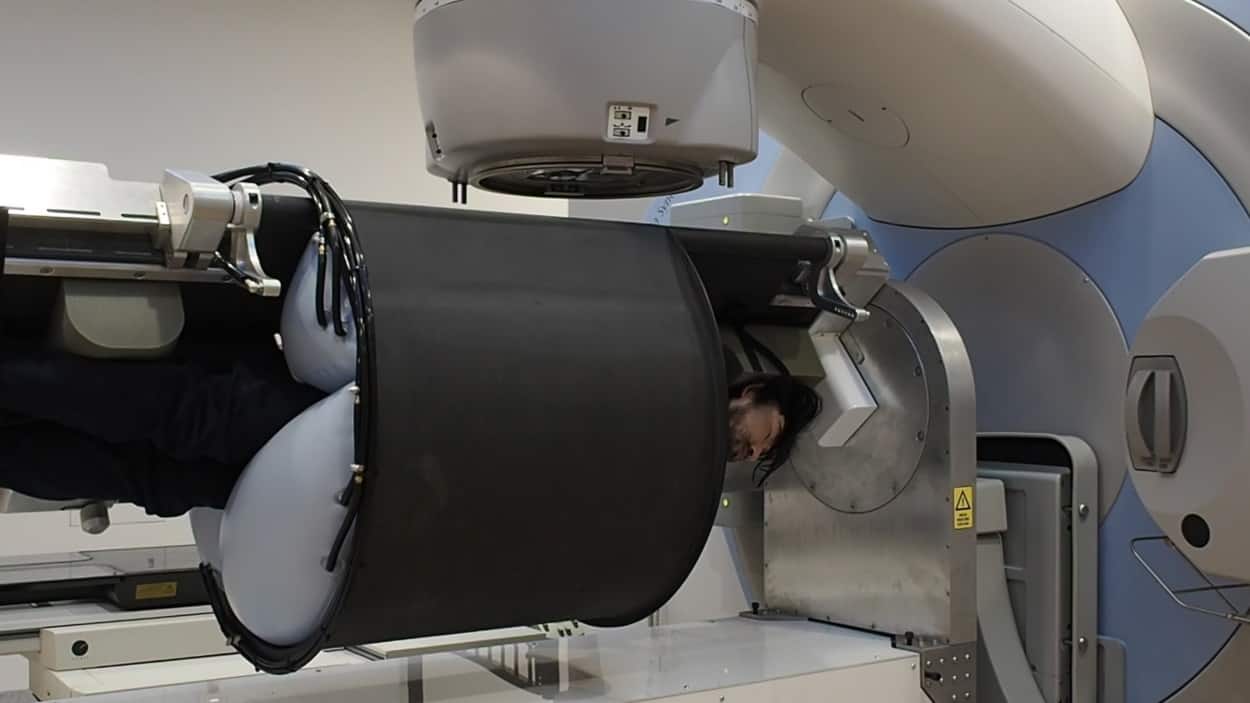
Patient rotation

After the patient is immobilized and in a specified treatment position, they can be rotated to a specific angle for either kilovoltage (kV) imaging via the on-board imager or treatment with the megavoltage beam. The software operating the PRS allows for precise motion control, setting the target position or angle along with the desired velocity, acceleration and deceleration. It can also follow a series of queued motion commands, or execute quick-stop, return-to-home and patient egress commands.

The system passed all commissioning steps, which involved verification of geometric and dosimetric accuracy following conventional radiotherapy guidelines. The team also performed thorough testing of safety and interlock systems.

Clinical potential

The authors note that three essential steps will be needed before treating patients. Cone-beam CT image reconstruction under gravitational deformation may require advanced image reconstruction algorithms. They also need to develop methods to shift the beam to account for gravitational deformation-induced target motion.

Additionally, a patient’s tolerance of, and anxiety level relating to, horizontal rotation is unknown. It could be as much of a problem as an MRI exam is to a claustrophobic or noise-averse patient. An upcoming clinical trial will investigate and quantify how patients respond to strap and airbag immobilization and horizontal rotation.

Liu discussed the challenges with Physics World. “While we initially focused on static targets, an important part of the system will be its ability to adapt to motion, both from the patient’s normal physiological functions like breathing and from gravity as the patient is rotated,” he explains. “The next stage of the project will focus on implementing and testing algorithms that we’ve developed to both identify the amount of motion and to compensate for it accordingly.”

To enable real-time image guidance, the researchers are testing kilovoltage intrafraction monitoring (KIM), a novel tumour localization system developed at the University of Sydney that accurately estimates the 3D position of a target based on the 2D position of segmented markers in kV projections.

“KIM will offer real-time 3D target tracking with sub-degree and sub-millimetre accuracy,” Liu says. “We have successfully tested KIM together with real-time multileaf collimation tracking on a miniature version of this system, and are currently scaling these algorithms to our full-size prototype. We will be using KIM with a deformable phantom where the target will move as it undergoes rotation.”

The researchers are also investigating intensity-modulated radiotherapy and volumetric-modulated arc therapy, which are under various stages of implementation. Liu says that both are technically feasible, because the software and hardware control of the PRS has sufficient precision and flexibility.

Much work, followed by testing with veterinary radiation treatments, will be required before the first palliative treatments on human cancer patients can be undertaken. The system is not designed for infants, very small children or obese patients. But for all other cancer patients, this prototype radiotherapy system has potential to fill the existing and expanding gap between available treatment and need, especially for patients living in economically challenged areas of the world.

Modernizing classical physics

Physics education has a high inertia towards change. While high-school students in today’s biology labs are doing genetic engineering and making bacteria glow green, while students in physics labs are still dropping lead weights and finding differences of squares almost the same way as Galileo did back in 1610. Even as undergraduates, physicists end up learning about topics that were last researched seriously about 100 years ago. The time is overdue for the physics curriculum to catch up with the times.

Open any textbook on modern physics and you will see chapters on the usual topics: special relativity, quantum mechanics, atomic physics, nuclear physics, solid-state physics, particle physics and astrophysics. Missing, however, are modern topics in dynamics that most physicists will use in their careers such as nonlinearity, chaos, network theory, econophysics, game theory, neural nets and curved geometry among many others.

These topics are at the forefront of physics that drive hi-tech businesses and start-ups today, which is where almost half of all physicists end up working. However, they have not yet filtered down to the undergraduate curriculum. And it is my hope is that they soon will.

The purpose of physics

There are two reasons why the physics curriculum lags behind most other disciplines. The first has to do with the expectation that all physics students will become academics. We think such students will see advanced physics topics once they are graduates and therefore restrict the undergraduate curriculum to the basics, the idea being to help them obtain a solid foundation on which they can build later.

This might seem logical, but the problem is that many undergraduate physicists do not go on to postgraduate study. Indeed, in the US, 40% enter the workforce after their undergraduate degree. Even for those who do enrol in graduate studies, a sizable fraction enter graduate programmes other than physics. For these students, the undergraduate curriculum has stranded them with 100-year-old knowledge.

The second reason for the lag in upgrading many physics curricula is the generally false expectation that advanced topics are too conceptually challenging for undergraduates. It is thought that understanding them requires advanced mathematical methods that undergraduates will not yet have mastered. Yet I believe that students are hungry to learn the latest physics and willing to grapple with such concepts.

Fortunately, many of the advanced topics that spark their interest, such as economic dynamics, game theory or network dynamics, have strong phenomenological aspects that can be understood intuitively without the need for advanced mathematics. Students learn concepts quickly and can explore the systems with simple computer codes and interactive websites – such as WolframAlpha – that physics undergraduates are handling better than ever.

Dynamic variations

Modernizing the teaching of classical mechanics by introducing undergraduate students to topics usually reserved for graduate studies is, however, possible. By using the pedagogical principle of multidimensional dynamical flows, many traditional topics take on a new light. For example, within both special and general relativity, dynamics becomes a study of geodesic flows in space–time. Despite the apparently advanced nature of these topics, they can be easily taught by combining linear algebra with partial differentials without requiring students to have seen tensor calculus or differential geometry.

One example of a central archetype that needs updating is the simple harmonic oscillator (SHO). Admittedly, most dynamics can be reduced to a SHO, but it is the most “pathological” of all oscillators: its frequency does not depend on amplitude. While this is a great asset for clocks, it is such a special case that it skews a student’s intuition about real-world oscillators for which anharmonic effects are the rule rather than the exception. Anharmonic oscillators break frequency degeneracy, opening the door to important topics like Hamiltonian chaos and islands of stability while providing the foundation for a broad range of modern topics like synchronization, business cycles, neural pulses and social network dynamics.

Time for change

The time has come to bring undergraduate physics into the 21st century. By relaxing our insistence that every student know how to construct difficult Lagrangians or calculate Poisson brackets (Lagrange and Poisson were at their peak about 200 years ago) there is plenty of room and time in the undergraduate curriculum to introduce them to truly modern dynamics.

This task will be helped in part by burgeoning web resources and the increasing breadth of knowledge that students bring with them. It also will be helped by a new crop of textbooks that adopt a modern view of the purpose of physics in today’s world.

Conducting highways boost performance of stretchable semiconductor

A stretchable, high-performance semiconductor device with fully integrated electronics and logic circuits has been created by Cunjiang Yu and colleagues at the University of Houston. Their low-cost semiconductor material retained its high charge carrier mobility, even when subjected to 50% stretching. The team’s work could lead to the development of practical new technologies including robotic skins and wearable electronics.

Researchers around the world are trying to develop electronic devices that can stretch and then return to their original shape. If realized, stretchable semiconductors could have a diverse range of potential applications including robotics, bioelectronics, and medicine.

So far, efforts to create commercially-viable stretchable electronics and logic circuits have included semiconductors with intricate microscopic structures that allow them to stretch on macroscopic scales; taking the form of either foldable molecular concertinas, or rigid islands connected by stretchable links. Yet these structures are expensive to create, and would be difficult to manufacture on large scales.

Alternatively, recent research has seen progress towards stretchable, rubbery semiconductors made from polymer nanofibers percolated in a silicone matrix. These materials have a far more scalable manufacturing process, but because of their polymer structures, they are currently hindered by a low charge carrier mobility. This occurs because electrons must travel over large distances in such materials, meaning they cannot carry charge quickly enough to be commercially competitive.

Conducting highways

In their study, the Houston physicists aimed to fabricate an intrinsically stretchable rubbery semiconductor with both a high carrier mobility and a low-cost, scalable manufacturing process. To do this, the team introduced metallic carbon nanotubes as dopants on the surface of a rubbery semiconductor composite. The nanotubes provided a network of conducting “highways” across the material, greatly reducing distances over which electrons need to travel; therefore, improving their semiconductor’s carrier mobility.

Yu’s team then integrated circuits of transistors into their doped semiconductor, allowing them to demonstrate fully-integrated logic gates and electronics. In addition, the researchers demonstrated its performance as a sensitive, elastic skin which can map physical touch. During these tests, the material retained its electrical performance even with 50% stretching, with little substantial loss in carrier mobility.

The team’s results show promise for future developments of applications including robotic skins which are sensitive to touch, implantable bioelectronics for use in medicine, and improved interfaces between humans and machines. In the future, Yu and colleagues hope to improve carrier mobility even further, allowing them to build yet more complex digital circuits.

The new material is described in Science Advances.

Road freight: cutting the emissions load

Making road freight less carbon-heavy involves hard technical problems. So is it better to shift to rail or water? Parth Vaishnav and Lynn Kaack reviewed approaches to freight around the world in a systematic review in Environmental Research Letters (ERL)

Why did you decide to review decarbonization of road freight?

Road freight emits a large share of total greenhouse gas emissions but few serious attempts have been made to lower its contribution. While there is considerable potential for efficiency gains in trucks, deeper decarbonization of road freight is difficult. In particular, the need for trucks to carry heavy loads for long distances between refills or recharges makes it very hard to electrify road freight.

We wanted to take stock of what the literature said about the problem, and the various solutions on offer: from inventing carbon-free liquid fuels to using hydrogen or clean electricity. We concluded that most of these approaches involved hard technical problems that were unlikely to be solved in the near future.

Shifting freight to lower-emissions and electrified modes, most importantly rail, is crucial to making deep cuts in greenhouse gas emissions, particularly in the medium term. Limiting this effort to industrialized countries is not sufficient, as much of the growth in freight is happening in developing countries. This is why our topical review provides an overview of modal shift in all regions of the world.

What did you discover?

We compiled and published a dataset of freight activity (in tonne-km) for road, rail and water for 157 countries for 2000–2017, which allows us and other researchers to observe changes in modal split.

We found that road freight activity already dominates in many parts of the world and its share is still on the rise. Two-thirds of land freight is transported on road, rather than by rail or on inland water, we discovered, based on countries where data are available. It surprised us that, despite its relative importance, only 75 countries reported data on road freight. This may be because the fragmented nature of the road freight sector and the reluctance of truck operators to collect and share data make it expensive for governments to collect this data through surveys.

With our topical review, we also provided a detailed overview of strategies for promoting modal shift in freight transportation. We analysed which policy approaches are taken in different regions of the world and identified barriers to shifting freight to rail for all or part of its journey. In many places, rail is seen as less reliable and flexible than trucks. It is also the case that supply chains are run to optimize what matters for firms: their profits. Policies generally do not “charge” firms for the long-term damage that greenhouse gases and other emissions cause to the environment and to human health.

the need for trucks to carry heavy loads for long distances between refills or recharges makes it very hard to electrify road freight

Parth Vaishnav and Lynn Kaack

We found that rail and rail intermodal – when a good is transferred between different modes of transport in a single container — could be strengthened by infrastructure investments that help rail to run more efficiently and reliably, and to shift cargo (e.g. containerized goods) quickly and without damage between rail and other modes. This includes terminal investments and new information and communication technologies (ICT). Governments should also level the playing field by charging trucks for the pollution they cause and for the damage they do to infrastructure such as roads and bridges; or by banning the most polluting types of vehicles outright. This would create a financial incentive to shift to modes such as rail.

We also discovered that not many countries have sufficiently robust, or even any, policies in place.

We have made public the raw data on freight activity that we collected from various government and academic sources; we are not aware of any other source that makes these data available in one place.

The topical review draws partially on a workshop we organized in February 2017 that involved 30 participants from industry, academia, NGOs and government.

What action should we take as a result of your findings?

There is a great deal of attention paid to decarbonizing light and passenger transport, for example, through electric cars. However, growth in demand for liquid fossil fuels is likely going to be driven by growth in heavy freight (see this article based on the IEA World Energy Outlook). Staying off this trajectory will require robust policies.

In regions such as the EU, policy-makers have worked for some time to reduce the amount of freight transported on roads. However, many other countries, including the US, are not using many of the policy instruments that could promote modal shift. We need to start a more serious worldwide attempt to decarbonize freight, and we hope our topical review can provide a stepping-stone for both researchers and policy-makers to work on this topic.

How will you take your research forward?

We were astonished by how few data are collected on road freight transportation, especially in developing countries. We are currently exploring whether passively-collected data and new analysis and computing methods could open new opportunities for governments to monitor the freight sector. We are working on a project that is intended as a proof of concept.

We also want to address other research questions, for example, what technical or engineering advances are needed? What infrastructure needs to be built and where? What policies ought to be put in place and what unintended consequences might they have? If less coal is transported by rail, as is occurring in the US, might that have an effect on — or create an opportunity for — modal shift?

New cooling mechanism uses normal light, instead of lasers

A new method for photonic cooling using light from a conventional LED has been demonstrated by researchers in the US. They achieved a modest cooling flux of about 6 Wm–2, but the scientists believe that future advances in nanophotonic surfaces could increase this by least two orders of magnitude – making the technique a promising candidate for cooling electronic devices.

In photonic cooling, a substance absorbs low-energy photons and then emits higher-energy photons – thereby losing energy. Success relies on the precision of a coherent single-frequency laser and attempting the same technique with a regular LED would fail because LEDs emit a wider range of frequencies. Instead, an LED would just heat the material.

In the last few years, however, scientists at Stanford University in the US, have theorized that normal LED light could be used to cool down matter. What is more, the cooling technique could someday rival widely-used thermoelectric devices. Now, Linxiao Zhu and colleagues at the University of Michigan have created such a cooling system that uses a normal LED.

Negative luminescence

The researchers made use of a phenomenon called “negative luminescence”. This occurs when an LED is connected to a reversed electrical bias, causing it to emit less thermal radiation than when under no bias at all. “In a sense”, says Michigan’s Pramod Reddy, “the reverse biased LED radiates photons as if at a much lower temperature”.

This effect on its own would normally lead to negligible cooling. However, such heat transfer can be greatly enhanced when the gap between the LED and the object to be cooled is shrunk to the nanoscale. In fact, recent research has shown that in this regime heat transport may significantly exceed the blackbody radiation limit. This increase is the result of photons that can “tunnel” from one object to another, explains Reddy.

Measuring this heat flow involved placing an LED at a nanoscale distance to a calorimeter, which was no easy task. According to Zhu, making the gap small enough would be impossible with a normal commercial LED, which has a surface roughness some 50-100 times larger than the required gap. Therefore, the team had to develop a custom approach for nanopolishing such devices.

Photonic tunnelling

The researchers performed their experiment in a high vacuum and ultra-low vibration chamber. When they decreased the distance between the LED and the measurement device down to 55 nm, they observed a huge jump in the calorimeter’s optical detection signal. It was at that point that the photonic tunnelling took effect. Then, having the diode’s bias oscillate between being zero and reversed, the team took a many-interval time-averaged measurement to accurately resolve the heat flux. What they found was that the calorimeter was indeed being cooled by the LED.

The team is adamant about taking this research further and exploring what the fundamental limits to this cooling approach are. The researchers are hoping that with a suitably engineered diode, they could approach the theoretically predicted cooling flux of about 1000 Wm-2. At such efficiency, Reddy claims, this novel approach would rival cooling technologies based on thermoelectric materials. In the future this method could find application in electronic devices, providing on-chip cooling.

Full results are published in Nature.

Tales of the 118 elements

Twitter has a reputation as a time sink and a cesspit for political bickering (and worse), but for the past few days I have been watching something really lovely unfold across the platform, under the #ElementTales hashtag.

The project began when Mark Lorch, a chemist and science communicator at the University of Hull, UK, posted this tweet:

Lorch got the idea while developing a version of the periodic table that uses only the 1000 most common words in the English language. (A similar periodic table appears in Randall Munroe’s book Thing Explainer — Munroe being the cartoonist and physicist who popularized the common-words idea with his 2012 xkcd comic “Up Goer Five”.) As Lorch was working on his table, he explains, “A number of links between elements jumped out at me. I jotted some links down, then got to wondering if the chain could flow through the whole table. I thought about trying to make the whole thread myself, but team efforts are always more fun.”

Lorch kicked off the project with element 101, mendeleevium, in honour of Dmitri Mendeleev, who created the first periodic table on 1 March 1869 (17 February in the Julian calendar). Shortly thereafter, Twitter users @sciencenotscary and @Stare_At_Air added links to tellurium and gold. Over the next few days, more people joined, crafting links based on elements’ histories, names, uses, chemical or physical properties and, occasionally, personal anecdotes.

I made my first contribution on 8 February, linking helium and xenon with a “don’t try this at home” story I heard from a former colleague.

After that, my Twitter mentions exploded, with new links flying in thick and fast, alongside regular updates about which elements had been covered; complaints about the occasional “fork” in the chain; exhortations to find links to ultra-heavy elements wherever possible so as to avoid a boring finish; and even a selfie one participant took at the famous mine near Ytterby, Sweden, that produced ores used to isolate yttrium, ytterbium, erbium and terbium. Sadly, the elements I studied in my PhD thesis (rubidium and caesium) got “taken” by other participants, but I managed to link together a few of the other alkali metals, and also (thanks to a tip from Lorch) palladium and niobium.

The chain finally ended earlier today (with gadolinium, as it happens). However, you can find most of it if you search Twitter for the #ElementTales hashtag, and Lorch is working on a way of preserving all of the links – possibly in book form. Watch this space…

Piezoelectric nanoparticles promise improved brain tumour treatments

In efforts to improve the treatment of brain tumours, researchers in Italy are developing piezoelectric nanoparticles that target and electrically stimulate tumour cells upon exposure to ultrasound. In a preliminary in vitro study, the researchers observed reduced proliferation and increased sensitivity to chemotherapy of the tumour cells using the nanoparticles, as well as the first transit of a piezoelectric material across a simulated blood–brain barrier (J. Colloid Interface Sci. 10.1016/j.jcis.2018.12.014).

The most common brain tumour in adults, glioblastoma multiforme has a poor prognosis, with an average survival of 14 months following diagnosis. Drug resistance acquired during chemotherapy and disease recurrence through the spread of microscopic tumour foci are major factors limiting the success of treatment, which typically involves surgery followed by chemotherapy and/or radiotherapy.

As part of a treatment regime, electrical stimulation has the potential to overcome both issues. Previous research has demonstrated that electrical stimulation reduces drug resistance by impeding P-glycoprotein, a protein that pumps damaging substances, including chemotherapy drugs, out of the tumour cells. Low-intensity stimulation is also known to reduce cell proliferation, which the Italian Institute of Technology (IIT) researchers previously demonstrated in breast cancer cells. It does so by disrupting the regulation of extracellular levels of calcium and potassium ions and impairing cellular components instrumental in cell division.

Nanoparticles have two key advantages over stimulation approaches already used to treat diseases such as epilepsy. “Traditional electric stimulation is either invasive, with electrodes penetrating the skull and brain parenchyma, or non-specific, with electrodes attached to the scalp,” says joint first author Attilio Marino, of IIT’s Smart Bio-interfaces group. “Our goal is to perform precision nanomedicine only on diseased cells.”

The targeting of tumour cells is desirable to avoid any adverse effects on healthy cells that are also disrupted by electrical stimulation. To achieve this, the researchers functionalized their barium titanate nanoparticles by incorporating the anti-transferrin receptor antibody. By seeking out transferrin receptors, which are overexpressed on the surface of several types of cancer cells including glioblastoma, the nanoparticles target the tumour over healthy tissue. The antibody also promotes transport of the nanoparticles across the blood–brain barrier via transferrin receptors on the surface of the endothelial cells that form the barrier.

In their experiments, the researchers investigated the ability of the functionalized nanoparticles to cross the blood–brain barrier, mimicking it with a layer of brain-derived endothelial cells in a dish. Another experiment investigated uptake of the nanoparticles into human glioblastoma cells. These revealed significantly greater transport across the mimicked blood–brain barrier and increased uptake by the tumour cells than when using non-functionalized nanoparticles.

In further tests, tumour cell proliferation decreased markedly when the functionalized nanoparticles were combined with ultrasound, compared with a control of ultrasound alone. When the chemotherapy drug temozolomide was added, the anti-proliferative effect increased further still, with 72.1±1.7% cell survival versus 100.0±7.2% in a control. The combination also resulted in significant cell death at drug concentrations that in isolation were non-toxic for the tumour cells. Levels of the tumour suppressor gene nuclei p53+ were used as an indicator of apoptosis (28.3±6.6% versus 1.0±0.7% in control cultures).

Imaging proliferation and apoptosis

Having successfully provided proof-of-principle, the researchers are now working to develop an organic, biodegradable piezoelectric material to replace the barium titanate nanoparticles. This is the biggest challenge in advancing the technology towards regulatory approval and clinical use, says Gianni Ciofani, senior author and leader of the Smart Bio-interfaces group.

“There are several concerns in the scientific community about the clearance of such material from the body, and to date, there are no data about long-term biocompatibility following accumulation in the target organs,” explains Ciofani.

Ciofani and his colleagues are also designing the first in vivo experiments with glioblastoma tumours, which they plan to begin within the next 12 months.

Pathway to Pluto

I am not usually a fan of knowing the ending to a story before I have read it. But despite the globally publicized and incredible outcome of one of the most celebrated NASA missions in recent years, Chasing New Horizons: Inside the Epic First Mission to Pluto by Alan Stern and David Grinspoon, is a thrilling tale of how this huge success came to be. In the summer of 2015, more than three billion miles from Earth and after a 9.5-year journey, New Horizons – the fastest spacecraft ever to leave our planet – screamed past the dwarf-planet Pluto and its moon Charon, finally unveiling these far-away icy worlds that have long evaded our Earth-bound cameras.

Unlike nearly every other popular-science book, Chasing New Horizons is written and reads like a novel. The easy, comfortable and accessible language draws you into the life story of Alan Stern, the not-always-fearless leader of the NASA mission, as told by his friend and formidable astrobiologist David Grinspoon. Grinspoon was peripherally involved with the mission itself, but acts as the book’s narrator, sharing the story from the perspective of Stern as told to him through phone conversations the two had every Saturday morning for a year and a half. Their goal is to give us a sense of what it took to get this landmark mission off the ground, sharing the good, bad and ugly sides of scientific exploration and bureaucracy, and to tell the largely untold story of how icy Pluto actually came to be explored.

We start with a brief introduction, as all good space books seem to have, on the history of missions to explore the solar system, in which the authors explain why Pluto was not seen as a priority for so long. What is interesting here is the detailed timeline of discoveries – from Pluto’s confirmed discovery in 1930, until it finally moved up the chain to become a fundable project. In the 1950s Pluto’s length of day was calculated as being 6.4 times as long as Earth’s. In the 1970s scientists revealed that the planet was small and had a reddish hue; they found subtle fingerprints of frozen natural gas on its surface; and discovered that it had a moon. A few years after the discovery of this moon, dubbed Charon, astronomers noticed that the pair were about to start repeatedly eclipsing each other every few days, for up to six years, creating a scientific bonanza. This spawned a whole generation of “Plutophiles” and the seeds for a mission to explore it were sown in the late 1980s.

What follows next however is the story of decades of disappointment and a real insight into how hard it is to get any space mission off the ground. Going into this part of the book, I thought I would be a bit bored – who really wants to read about funding wars and academic rivalries? Well, it turns out that I do. The narrative of this part of the story is incredibly emotive and almost exciting. Grinspoon portrays NASA’s Jet Propulsion Laboratory staff as the villains – trying to control and influence a project that was never theirs to begin with. His obviously biased view positions Stern as the hero – a veritable rebel fighting “the establishment”.

This battle of good versus supposed evil is played out through the story of funding wars, institutional grudge matches and politics until, in 2003, 14 years after it all began for Stern, good finally triumphed. The real hero of this tale, however, is the Maryland senator Barbara Ann Mikulski. A Democrat and a member of House of Representatives from 1977 to 1987, Mikulski championed and supported New Horizons from the beginning, both financially and within the Senate. Without her there might never have been a New Horizons.

We then follow the building of the spacecraft, its launch on 19 January 2006 and its journey to Pluto. The book discusses the precarious and precise nature of the Jupiter fly-by and gravity assist, and describes how through “pure dumb luck” the New Horizons team managed to image a time-lapse sequence of a volcano erupting on Jupiter’s moon Io. Grinspoon reveals the number of panics the team had when the main computer suddenly rebooted and went into safe mode, hypothesized to be due to radiation damage associated with Jupiter’s powerful magnetosphere. Grinspoon also talks about one of the truly innovative aspects of New Horizons – its ability to go into hibernation. Using the analogy of a television, Grinspoon asks the reader to imagine a scenario in which they bought a TV in January 2006 and still expect it to be operational in mid-2015. Would it be better to leave it on continuously for those nine and a half years, or to turn it off and check in on it periodically? The team’s engineers clearly thought the latter was the better option. Thanks to this protocol, the spacecraft and its primary systems had only clocked 3.5 years’ worth of use when New Horizons reached Pluto, despite being nearly 10 years old.

The rest, as they say, is history. New Horizons transmitted spectacular images back to Earth following its 2015 fly-by of Pluto, reawakening a dormant public fascination with space exploration and dramatically increasing our scientific knowledge of the distant reaches of the solar system. The interplanetary craft is now on a five-year extended mission to do a New Year 2019 fly-by of an ancient Kuiper Belt Object, 2014 MU69, a billion miles further out than Pluto. Power and fuel projections indicate that – with continuing funding and motivation – New Horizons could operate into the mid-2030s, exploring the nearest reaches of interstellar space.

This book is really Grinspoon and Stern’s chance to pay homage to the thousands of people who played a part in making this mission a success

I highly recommend Chasing New Horizons, which is sure to teach you something new. Did you know that the ninth planet in our solar system was given the name “Pluto” not just because it followed the naming convention of classical deities, but because the first two letters, PL, served nicely to honour astronomer Percival Lowell, who first began the search for a ninth planet? Me neither. Be warned though – if you are looking for a book about Pluto itself then this isn’t the one for you (despite the many beautiful colour inserts and appendix of top 10 findings). I feel this book is really Grinspoon and Stern’s chance to pay homage to the thousands of people who played a part in making this mission a success, not least their families; when you take on the time commitment of a space mission, so do your nearest and dearest. As a scientist working on space missions myself, I recognize this story all too well, both the positives and the many negatives. Yet Stern’s hands-on and infectious passion when talking about New Horizons enables him to make even the potentially dull material – seeking committee approvals, and managing academic and personal relationships – as interesting as the science.

  • 2018 Picador 320pp £21.99hb

Wave energy in the UK – is it dead?

The UK has a very good wave energy regime, with big swells from the winds rolling over long fetches of the Atlantic. In principle, this could generate the equivalent of up to 20% of UK electricity, or perhaps more. Back in 1978, Glyn England, chairperson of the nationalized utility the Central Electricity Generating Board, said that in theory wave power systems could “supply the whole of Britain with electricity at the present rate of consumption”. It may be worth looking back at what happened.

The Labour government had launched a major deep-sea wave energy programme in 1975, with a 2 GW reference design target. Several small-scale prototype devices were developed, including the Salter Nodding Duck. Some were tested in open water. In 1980, incoming Conservative energy minister John Moore claimed at the opening of a large wave energy test tank at Southampton, that “whatever other problems our wave energy researchers may face, lack of Government support will not be among them”.

However, evidently doubts were beginning to emerge about wave power. The new Conservative government required R&D spending cuts and in 1982, after around £15 million had been spent on wave power, a review was carried out. One of the results was that, on the basis of some high – and disputed – cost estimates, the deep-sea wave programme was abandoned.

For some that was very controversial. Quite apart from claims about errors in the data used in the assessment, it did seem premature, with little time having elapsed since the start of the programme. Wave energy pioneer Stephen Salter said it was like trying “to decide our aviation policy on the data available in 1910”. In 1984 the Select Committee on Energy also complained about what it saw as the premature closure of the programme. Wave energy was, it said, “effectively withdrawn before the race began”.

Nevertheless, the decision remained. In 1985 the wave energy programme results were duly written up in a report, which concluded that “there was only a low probability of any device achieving an energy cost below 8 p/kWh”. The programme target had been to get under 5 p/kWh.

The more we deploy, the cheaper the technology will become

RenewableUK

That was not to be the end of it, however. Some research teams continued and some progress was made with shore-mounted Oscillating Water Column (OWC) devices, like Wavegen’s 250 kW Limpet, installed on the Orkneys. What’s more, given the huge potential resource, the wave power issue, along with enthusiasm for tidal power, has regularly resurfaced in policy debates with, for example, in 2001 a Select Committee concluding that “given the UK”s abundant natural wave and tidal resource, it is extremely regrettable and surprising that the development of wave and tidal energy technologies has received so little support from the Government”.

After a new review in 1998, which reported “a considerable improvement in the costs of devices, so that there are now several with costs of 5 p/kWh (or less) at 8% discount rate”, a new wave energy programme emerged, in part supported by the Scottish Government.

Still struggling

The programme revamp did push things on a bit but, despite continued efforts, the technology for exploiting this huge resource has so far been much slower to develop successfully than tidal stream devices. Costs are still high – too high for Contracts for Difference (CfD) support.

Why? The R&D funding has certainly been very limited and erratic but, even so, there may be more fundamental reasons. It does seem to be hard to design sea-going devices that can survive in – and extract energy from – the complex multi-energy vector interface between air and water. It’s far easier to do that in the calmer tidal flows beneath the surface. Although we have, over the centuries, managed to develop ships that deal with waves, they do so by avoiding or minimizing energy transfer. With wave energy devices we want to do the opposite.

So energy extraction and survivability are two key opposing design issues. The wave energy field had taken something of a knock from the very visible loss of the EU-supported 1 MW offshore OWC prototype after a (summer) storm off the north of Scotland in 1997, while it was being positioned and filled with sand ballast for final near-shore sea-bed mooring. An Australian near-shore OWC prototype later suffered a similar fate.

Boosting survival

To improve survivability, most wave devices since then have opted to reduce energy take. For example, in the floating segmented Pelamis “sea snake” design, the nose of the long articulated device is tethered to the sea bed, so that waves hit it head on and move down its flanks, causing the “snake” segments to rise and fall, this motion driving air pumps and turbines. Most of the wave front passes by, with most of the energy thus being un-intercepted. But it survives, like a boat, by cutting into, rather than broadsiding, the waves.

Tethered Wave Buoys also have more survivability. We have after all used buoys at sea for a long time. The wave buoy systems have hydraulic links to the sea bed to generate power from the bobbing effect, but that is low efficiency.

As can be seen, there is a fundamental problem with sea-going wave energy. Mounting OWC-type systems on the shore is one answer, providing a secure and protecting base, but the wave energy resource there is much less than out to sea. Either way, the economics of wave energy suffers.

That is unfortunate, since not only is the wave resource large, but being in effect stored wind power, it is also less variable than wind power; waves continue for some time after the wind has dropped, adding to the value of the resource. The UK also has extensive access sites off Scotland and the south-west coast of England and has the marine engineering experience to develop them. It is a leader in the field and there could be a significant technology export potential. That is one reason why, despite the problems, projects are still going ahead.

However, this area of innovation is risky. Scotland has led the way but in 2014 its pioneering Pelamis sea snake and Oyster hinged-flap projects both ran into financial problems and progress has been halted. Nevertheless, developers keep trying, as for example with Wello’s 500 kW Penguin floating device on test in Scotland, and many other designs are still being developed around the world.

Unwarranted gloom?

There have been some recent assessments of wave energy’s potential in the UK, which mostly make for gloomy reading. Yet hope rises eternal and trade lobby group RenewableUK says that now is not the time to give up: “The UK is right at the forefront of a global race to develop wave power on a commercial scale. It’s vital that we don’t lose our lead to other countries, who stand to benefit from the years of investment and progress we’ve made. The more we deploy, the cheaper the technology will become.”

So what’s the bottom line? If the original 1970s programme had been allowed to continue, would we have large-scale wave power now? The assessments of wave energy that were made then have been subject to much debate and there does seem to be evidence of some errors and perhaps even bias.

However, subsequent programmes – albeit of a limited scale – have not led to very significant improvements. That may still happen, although it might take some time. At the moment there is very little UK funding available for this area, although work at EMEC on the Orkneys continues. In theory, wave projects can apply for support under the Contracts for Difference (CfD) system, but none have so far – their costs are still too high. Even tidal stream projects, which are somewhat more developed, have not so far been able to get support under CfD. So, barring more funding and some technological breakthroughs, sadly it doesn’t look too promising for wave energy in the immediate future.

Though it would be unwise to write wave energy off just yet. For example, the novel sea-bed-mounted membrane-pad m-Wave system being developed by Australian developer Bombora, via its EU base in Pembrokeshire, has just won £10.3 m from the EU for a 1.5 MW prototype. With no external moving parts, it should be more survivable.

The full wave power story is covered in my new book Renewable Energy in the UK: Past, Present and Future, published by Palgrave.

Unveiling the topological nature of electromagnetic surface waves

Maxwell’s electromagnetic theory, formulated 150 years ago, was one of the greatest breakthroughs in the history of physics, and continues to yield new results today.  In a recent paper published in Nature Communications, scientists show that surface electromagnetic waves at certain interfaces, which arise as solutions of classical Maxwell’s equations, also have a purely topological origin.

Maxwell’s electromagnetic theory unified electricity and magnetism, providing the ultimate description of electromagnetic waves, including light, and anticipating relativity and the field theories developed in the 20th century. About 60 years ago, scientists found that electromagnetic radiation can propagate, not only in free space, but also as surface waves at interfaces between different media, for example between metals and air or glass. This resulted in the development of plasmonics and metamaterials, where surface electromagnetic waves underpin numerous phenomena and useful applications.

Topological quantum systems are another area of modern physics, where surface waves play a crucial role. In these systems, surface modes are very robust against small perturbations and continuous deformations, which is why they are often referred to as topologically protected states. In this latest work researchers – a collaboration from Japan, Korea, Australia and the US – show that the familiar surface electromagnetic waves at interfaces between different homogeneous isotropic media have origins similar to these quantum topological states.

In their description, Konstantin Bliokh at RIKEN and the Australian National University and his colleagues show that the “helicity” of free-space (or bulk) photons plays the key role. Electromagnetic helicity is a scalar property corresponding to the projection of the photons’ spin along the momentum direction. In free-space, or in a bulk medium, it can have two eigenvalues – either +1 or -1, corresponding to the two circular polarizations, left and right. When one of the medium parameters (dielectric permittivity or magnetic permeability) changes its sign, e.g., at a metal-air interface, the helicity spectra in the two media are mutually twisted in the complex-helicity plane. What Bliokh and co-authors show is that this twist results in the appearance of surface electromagnetic waves with zero helicity, such as surface plasmon-polaritons, at the interface.

Moreover, they prove that the number of surface modes is determined by the number of the bulk-medium parameters changing their signs at the interface, which is called “bulk-boundary correspondence” in the topological formalism. This means that at an interface where only the permittivity (or the permeability) changes its sign, one surface mode will exist. However at the interface between two materials with both permittivity and permeability different in sign, two surface modes will exist.

How does this change what we know of Maxwell waves?

The first author, Bliokh, says: “There is a crucial difference between the topological description of surface Maxwell waves and that of previously known topological surface modes. So far, topological properties and classification of various wave systems relied on mathematical properties of the Hamiltonian (i.e., energy) operator characterizing the system. In contrast, topological properties of Maxwell’s waves are described by the so-called helicity operator, which characterizes the chirality of circularly polarized electromagnetic waves. Thus, our theory also extends the range of applicability of the topological approach to other wave systems: it shows that the topological classification can be associated not only with the Hamiltonian but also with other operators corresponding to conserved physical quantities.”

Franco Nori continues: “Our work provides a new twist and insights for several areas of wave physics: Maxwell electromagnetism, topological quantum states, and plasmonics/metamaterials.”

The discovery of nontrivial topological phases in condensed-matter quantum systems and the existence of topological surface modes at interfaces between topologically different materials resulted in the Nobel Prize in physics in 2016. While it was initially thought that topological properties were exclusive to complex engineered structures mimicking quantum condensed-matter systems, such as photonic crystals, this work shows that exquisite topological features are also present in the simplest continuous isotropic optical media described by the most fundamental form of Maxwell equations.

  • edited 13th February 2019
Copyright © 2026 by IOP Publishing Ltd and individual contributors