The “Day Zero” water crisis that threatened the city of Cape Town in South Africa last year was due to an expansion of stable conditions in the subtropics that pushed rainfall farther south, according to a meteorological analysis. The researchers believe their study highlights the vulnerability of the Cape Town area – and other areas with dry, Mediterranean-type climates – to climate change.
“Although droughts are relatively frequent in these areas, the severity and frequency of occurrence in regions like Cape Town, California [in the US] and the Iberian Peninsula [in south-west Europe], among others, appears to be rising,” says Pedro Sousa of the University of Lisbon in Portugal. “This has been particularly notable in the last few years, which correspond exactly to the warmest years ever observed at the global scale.”
The South African government announced the risk of “Day Zero” in the latter half of 2017. The country’s largest city, which together with the greater Cape Town area has 3.7 million residents, faced the unprecedented prospect of having to turn off water supplies due to the worst drought in a century. To avoid the crisis, citizens were limited to 50 litres of water per person per day.
One year later, Day Zero has not yet arrived. But water use is still restricted, and researchers still debate the sequence of events that led the region to the brink of crisis.
“[There was] the real chance of Cape Town being the first large metropolitan area in the world to run out of water,” says Sousa. “This immediately led us to raise some scientific questions and to rapidly analyse the event purely from a meteorological and climatological point of view.”
Sousa and colleagues based at the University of Lisbon and the University of Cape Town examined daily meteorological data going back to 1979 in a bid to understand the large-scale atmospheric dynamics that led to particularly low rainfall in South Africa.
The team found that the main driver was an expansion of the usual stable anticyclones in the subtropical Southern Atlantic and Southern Indian oceans. This expansion pushed the storm corridor – the one carrying the storms that in the past provided Cape Town with much of its rain – farther south, away from South Africa.
As a result, weather fronts have missed the city, particularly during the transition seasons of spring and autumn, leading to the prolonged severe drought.
In addition, the team reckons the fact that the government’s water restrictions allowed the city to avoid the worst scenario demonstrates how much of a factor rising water-demand was in the near-crisis.
“We strongly believe that our work shows how the combined effects of unfavourable regional meteorology and human errors led to this complicated situation,” says Sousa. “I am confident that lessons like the one learned with the Day Zero water crisis will result in more awareness and better water-resources management, in order to prevent upcoming meteorologically-driven episodes of water scarcity, which will undoubtedly occur again.”
Researchers in France and Japan have created antispiral waves – in which the spiral rotates inwards rather than outwards – in a viscous liquid as it flows through an array of fine holes. Such antispiral waves are rarely seen in physical systems, and the scientists hope that their experimental set-up could offer an insight into certain astrophysical phenomena – particularly rotating galaxies that appear to follow an antispiral pattern.
While spiral waves are commonly found in nonlinear optical, biological and chemical systems, the arms of the spiral usually follow the direction of rotation. As the same suggests, an antispiral rotates in the opposite direction, with the arms leading the rotation.
In this new work, Harunori Yoshikawa and Christian Mathis from the University of Côte d’Azur (UCA) in France have shown that antispirals can form spontaneously when silicone oil held in a cylindrical reservoir falls through an array of fine holes at the bottom. As the silicone oil leaks through the holes, a liquid film forms underneath the circular plate. The liquid film becomes destabilized by gravity, causing the liquid to fall down from the plate in droplets, columns or uninterrupted curtains – depending on the size of the plate and rate at which the oil leaks through the holes.
Inwards rather than outwards
When the conditions were right to create falling curtains of liquid, the researchers found that the oil started to inwardly rotate around a central region – forming antispiral waves with up to six spiral arms that could rotate clockwise or counter clockwise. “The size of the holes on the grid plate is so small that it has no effect on the formation of antispirals,” explains Yoshikawa. “The plate diameter, in contrast, affects the patterns. We observed eight-armed antispiral curtains with a 188 mm plate, though we did not report it in the published article.”
Yoshikawa says that the current study was inspired by previous work by Laurent Limat of the Université Paris Diderot and his colleagues. While Limat’s group studied the dynamics of liquid columns falling from the edge of a circular dish, the UCA set-up extends this 1D system into a more generalized 2D arrangement.
According to Limat, who was not involved in this new research, “studies with such a fundamental character should be put in a historical perspective”. He points out that researchers realized a few decades ago that other fluid modes must exist between regular fluid flow and fully turbulent conditions. “In some cases, these modes are dependent on the geometry imposed on the fluid, but also give rise to sometimes surprising geometric patterns that are very impressive,” Limat comments. “It says a lot about the secret links between hydrodynamics, physics and mathematics.”
No induced asymmetry
One surprising feature of the new approach is that there is nothing asymmetrical in the experiment. “The antispiral formation is a very exciting phenomenon because we had nothing that can break the symmetry in the experimental set-up,” says Yoshikawa. “The system is completely symmetric, we did not introduce any perturbations, disturbances or any initial conditions that would favour the formation of something non-symmetric. And yet, what we observed, is a formation of antispirals.”
The viscosity and surface tension of the liquid are key parameters in creating the antispiral pattern. Researchers have tried to perform similar experiments with water, but have never observed any regular pattern formation – possibly due to the inability to form a uniform thin film.
In the UCA system, the mechanisms that underpin pattern formation do not seem to emerge from the film itself, but rather from dynamical processes taking place at the border of the liquid film. The detailed processes that lead to the formation of antispirals are not yet understood, however, and Yoshikawa says that the team now plans to “focus on the theoretical investigations by model equations, such as the Ginzburg-Landau and phase-diffusion equations”.
These investigations, they hope, might suggest possible applications in other fields. Understanding the mechanism of antispiral formation could offer novel insights into self-organization processes occurring in nature, including the antispiral patterns that have been observed in some galaxies.
Limat notes that Mathis was involved in a previous study that observed liquid spirals, but comments that this new work is “a much more thorough and aesthetic study”. He goes on to say that the “photos and videos attached to the article are really spectacular”.
Mapping rigidity in tumour cell spheroids: dark red indicates the most rigid areas, towards the interior of the tumour; the edge (yellow-green) is less rigid. (Courtesy: Thomas Dehoux/ILM/CNRS)
The mechanical response of a tumour to high-frequency oscillation conveys information about its metastatic potential and response to therapy, researchers at the University of Lyon have shown. Jérémie Margueritat and colleagues probed the viscoelastic properties of cultured cancer cells by measuring how spontaneous acoustic waves affected the scattering of incident laser light (Phys. Rev. Lett. 10.1103/PhysRevLett.122.018101).
The researchers exploited a phenomenon called Brillouin light scattering (BLS), in which naturally occurring pressure waves change the medium’s local refractive index. As the size of the effect is determined by the material’s viscoelastic modulus, small-scale variations in the frequency of backscattered light give a high-resolution image of the sample’s mechanical properties.
In this case, Margueritat and colleagues shone a monochromatic laser onto spheroids (3D cell cultures) derived from colorectal carcinoma lines. Focusing the beam to a spot 10 μm across, the researchers measured the behaviour of poroelastic units of just a few cells.
A tumour’s mechanical properties arise from two components, which each react differently to stress at high and low frequencies.
“A tumour is composed of a rigid frame formed from the connected cytoskeleton. This is invaded by biological fluids, pretty much like a sponge,” explains co-author Thomas Dehoux. “If you compress this sponge slowly (low frequency) the fluids can escape freely, and the resistance to deformation is only borne by the frame (cytoskeleton). If you compress the sponge very fast, the fluids have no time to escape, and the resistance to deformation comes from the frame and the compressibility of the fluids that are trapped within the tumour.”
Investigations in the slow-compression regime have already suggested the importance of the elastic framework to tumour growth and treatment response, leading to therapies that aim to disrupt proteins governing intercellular adhesion. The fluid contribution at GHz frequencies, in contrast, has been relatively unstudied until now because of instrumental limitations.
“The interferometers used to analyse changes in the wavelength of the light that exits the sample were slow and required a lot of adjustments,” says Dehoux. “BLS thus remained used mostly in solid-state physics. Thanks to recent improvements in acquisition time, such techniques are now increasingly used in biophysics.”
This new approach revealed a marked heterogeneity across the cell spheroids in response to high-frequency deformation. The researchers found that spheroids consistently exhibited a distinct feature at their edges, defined by a step-like change in the storage and loss moduli — quantities that describe how the material stores and dissipates energy.
This structure is important for what it says about the likelihood that a tumour will proliferate, says Dehoux: “We have shown in a previous paper that this peripheral layer contains live cells that can potentially form tumours elsewhere. In less metastatic tissues, this layer is reduced, suggesting that the presence of the layer is linked to metastatic potential. We are now exploring the possibility to quantify metastatic potential from the probing with BLS of this process.”
Response monitoring
The technique also offers insight into processes that occur during chemotherapy. When the researchers bathed the spheroids in a solution of fluorouracil — a commonly used cancer drug — disaggregation of the cells was reflected in a rapid lowering of the storage modulus at the edge of the structure. Meanwhile, the storage modulus at the centre of the tumour remained unchanged, indicating a greater resistance to treatment.
Accessing such information would let clinicians see quickly and in detail whether a cancer treatment was effective, allowing them to modify the course if necessary. Until now, only a crude measure of treatment progress has been available, based on overall tumour volume.
“We are working to design an in vivo endoscopic probe that would allow measurement of the mechanical signature of a tumour in situ,” says Dehoux. Tumours start to change as soon as they are removed, so this is an important consideration. “Another main point is that our technique is label-free: it does not require fluorescent tags that would potentially alter the normal tissue physiology and response to drugs.”
When Spanish artist Pablo Picasso painted Mother and Child by the Sea in 1902 (see below), he inadvertently launched a hi-tech game of hide-and-seek. The painting – completed during the artist’s “Blue Period” (1901–1904) – depicts a shrouded figure holding an infant on a beach, with a boat in the background. The work has not only attracted the attention of art enthusiasts, conservators and historians, but also scientists. Equipped with state-of-the-art spectroscopic techniques, researchers have been able to reveal details hiding mere microns beneath the surface.
Spectroscopic techniques – which study what happens when matter and radiation interact – have long been able to reveal the chemical composition of objects, ranging from distant stars to compounds in a lab. Now, scientists are training these methods on old works of art, uncovering new findings at the intersection of culture and science. Thanks to decades of advancements in the technology, it’s possible to observe the spectrum emitted by the paints, pigments, binders and other materials used to create the painting.
One physicist at the forefront of this field is John Delaney, who’s been the senior imaging scientist at the US’s National Gallery of Art in Washington, DC, for more than a decade. Having trained as an optical physicist, Delaney has developed near-infrared imaging techniques to analyse historical artefacts, ranging from ancient Egyptian paintings and 15th-century illuminated manuscripts to artwork from the Italian renaissance. He’s also analysed Picasso’s Mother and Child by the Sea.
From Cubism to cubes
One method Delaney specializes in is hyperspectral imaging, which combines digital imaging with spectroscopy. Like other forms of spectroscopy, the technique measures the wavelengths of radiation reflected by a material in order to identify it. The incident illumination that shines on the artwork may come from ambient light or an additional source of visible light. Experimental techniques may even analyse heat released by the pigments or paints. Importantly, hyperspectral imaging can differentiate between the illumination and the signal from the materials themselves.
For every pixel in an image, a hyperspectral camera collects the spectrum of electromagnetic radiation in hundreds – or even thousands – of narrow wavelength bands. As each band can be less than 10 nm wide, the spectrum appears to be continuous. Hyperspectral imaging can also look at the near-infrared region – Delaney’s camera, for example, can detect wavelengths in the visible and near-infrared range, from about 750 to 2500 nm. This is far superior to the human eye, which can see only visible light in the bands of the three primary colours.
“With hyperspectral imaging, what you’re seeing essentially are colours, but not in a qualitative way like in our brains,” says Koen Janssens at the University of Antwerp in Belgium, who has used scientific imaging tools to look at René Magritte’s Le Portrait and Vincent van Gogh’s Sunflowers among others (see box on p28). “Instead, you try to measure it in such a way that you can make more subtle distinctions between colours and hues.”
This type of analysis produces an image “cube” for each pixel – a 3D array showing which wavelengths of the spectrum are represented, and in what distribution. These can be connected to the known spectra of pigments, paints, binders and other materials used by an artist.
Hyperspectral imaging is also appealing for conservation and preservation because, unlike other methods of spectroscopy, it’s non-invasive, and findings can reveal surprising details about the history and culture in which the art was created. Furthermore, some paints and pigments become transparent to radiation at large wavelengths – like in the near-infrared region – which is why imaging spectroscopy can see things hidden to the human eye.
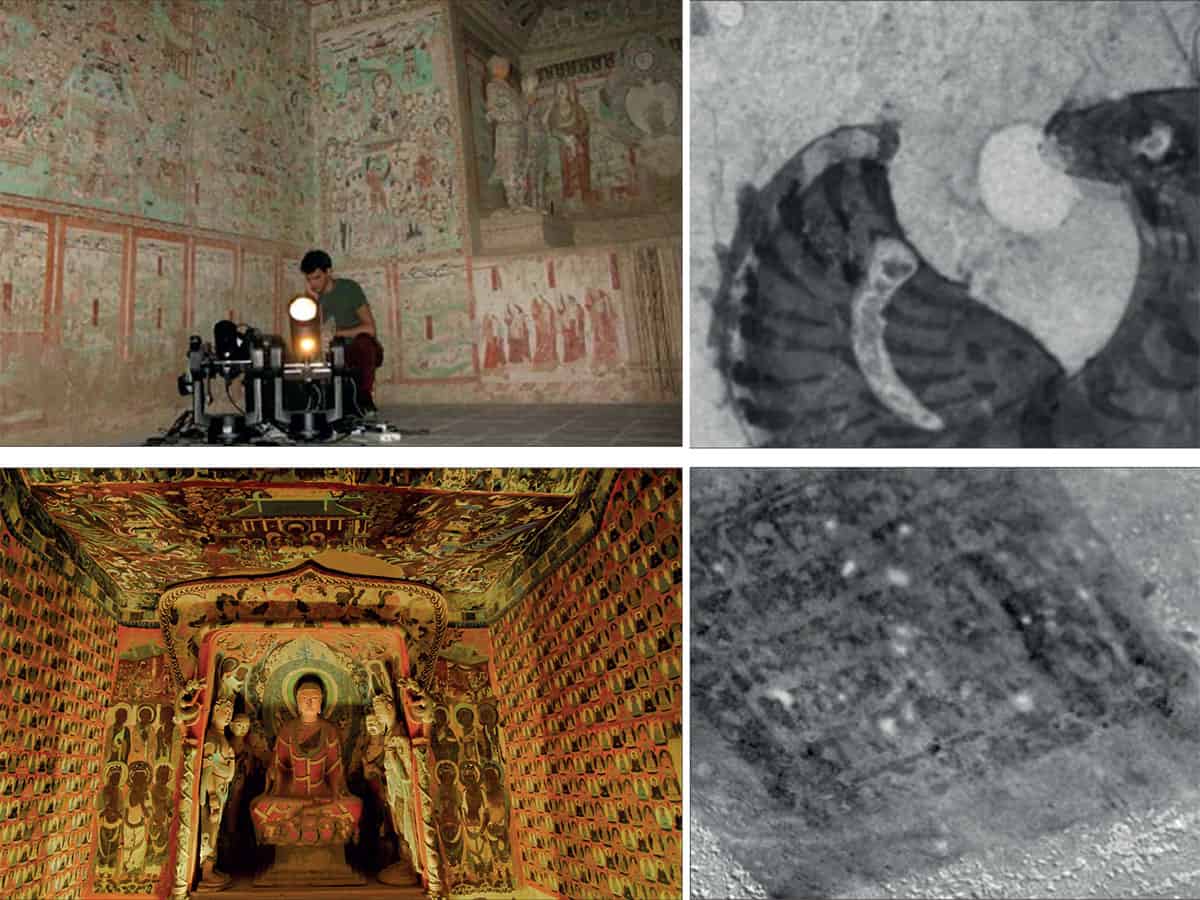
Unseen details: Haida Liang and colleagues from Nottingham Trent University have taken their hyperspectral imaging instrument to the Mogao caves in the Gobi desert.
From canvases to caves
Hyperspectral imaging of art is not limited to canvas paintings in museums. Seven years ago Haida Liang of Nottingham Trent University in the UK took the technique to the Mogao Caves at the edge of the Gobi Desert, in central China. Also known as the Caves of a Thousand Buddhas, it’s an immense, UNESCO-protected site that includes nearly 500 cave temples, the walls and ceilings of which are covered with paintings from the 4th to the 14th century, including repeating painted Buddhas. Liang and her team have been studying the paintings using a range of proprietary tools.
Some of the cave ceilings, however, reach more than 10 m high. “Because of those lofty heights, they’re difficult to get to,” Liang points out. In the past, researchers had to climb up scaffolding or lift instruments to get a close look at paintings on or near the ceilings. But Liang saw a different way. “Astronomers don’t have to climb to the Moon to get a good look at the Moon,” she says. Instead, they use telescopes – so she would too.
Liang and her team used PRISMS (Portable Remote Imaging System for Multispectral Scanning) – a device that produces high-resolution spectral and 3D topographic images of large surfaces, like wall paintings (ISPRS J. Photogramm. Remote Sens.95 13). The system combines the imaging abilities of telescopes, lenses, filters and CCD cameras. In the caves, the scientists set up gentle lights for illumination and put the PRISMS system on the ground, where it could collect data from a large field, like the ceiling or entire wall. In 2014 the group reported images with a resolution of 80 μm, taken from a distance of 10 m. In addition to showing which pigments were used, the imaging revealed previously unseen features, including faded Sanskrit writing on the ceiling and invisible drawings. Studies like this one can help researchers better determine when the caves were built and decorated.
Spectral synergy
While hyperspectral imaging is powerful, some researchers have found that it’s even more revealing when combined with other techniques, such as X-ray fluorescence and X-ray powder diffraction. Data collected using X-rays complement those gathered by hyperspectral imaging because they can penetrate deeper into a painting. Fusing data from multiple modalities can reveal new information lost to any individual one.
Delaney says that such technique combinations are the horizon for the field. He’s also investigating new ways to record spectrographic data from images. Most cameras use reflected light, but in his lab in Washington he and his collaborators are also developing techniques that look at thermal emissions from paintings in cool, pitch-dark chambers.
Back in her lab at Nottingham, Liang is developing a way to automatically process PRISMS data obtained from large surfaces – such as entire walls of caves, the outside of buildings, or even large amassed collections of paintings and manuscripts. Thanks to advances in machine learning and artificial intelligence, she says, processing such large datasets could be quick and efficient. She envisions online galleries where visitors can view the art and download its spectral data or view a chemical map of the pigments used.
Over in Antwerp, Janssens says researchers are finding ways to not only probe deeper into existing artworks – identifying pigments or hidden writing, say – but also distil valuable cultural and historical information from looking at the details at increasing depths. “If the artist is the constructor, then we do the inverse, and de-construct it,” he explains. “But in a virtual way, of course. With no damage.”
More secrets
An X-ray fluorescence instrument was used by researchers including Emeline Pouyet of Northwestern University and Sandra Webster-Cook of the Art Gallery of Ontario to scan Pablo Picasso’s La Miséreuse accroupie. (Courtesy: Art Gallery Ontario)
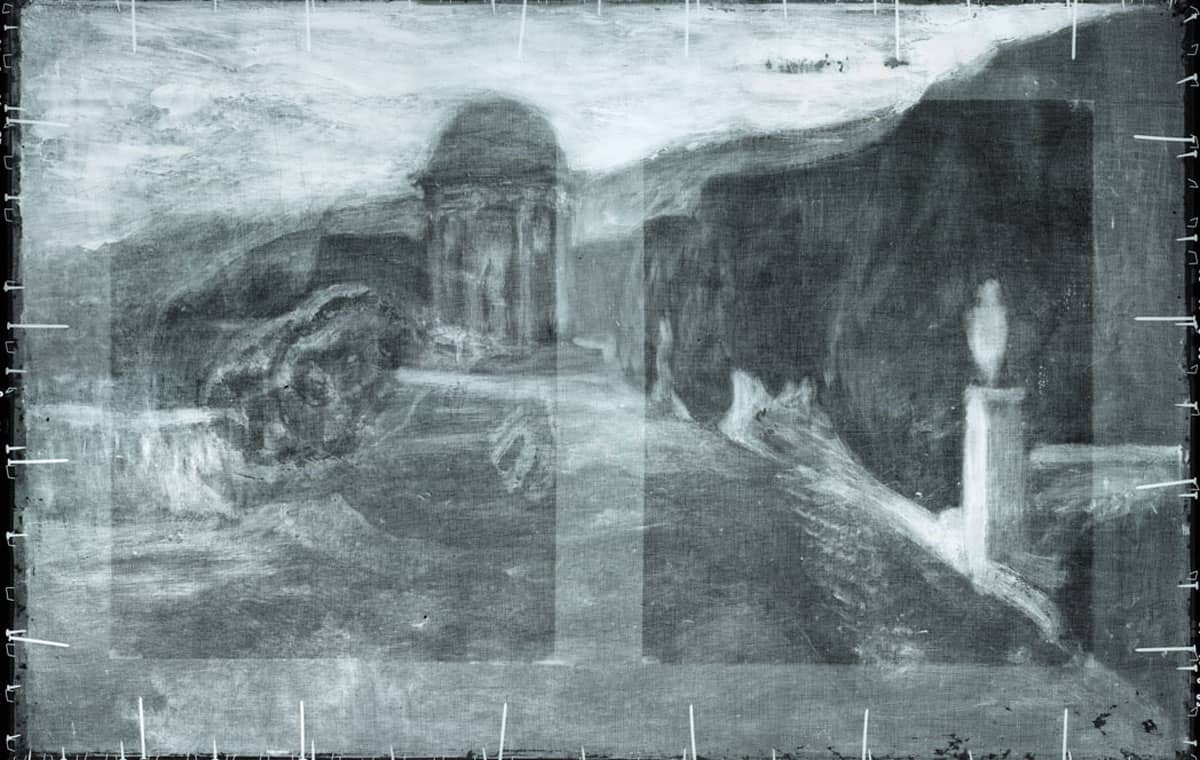
X-ray radiography revealed a landscape hidden beneath the visible surface of Pablo Picasso’s La Miséreuse accroupie. (Courtesy: Art Gallery Ontario)
Hyperspectral imaging data have not only been used to analyse Mother and Child by the Sea. John Delaney from the US National Gallery of Art has also used the technique to study another of Picasso’s Blue Period paintings – La Miséreuse accroupie (The Crouching Beggar). The analysis revealed that Picasso had first painted over a landscape scene by another artist and incorporated elements of the original canvas into the final product. The curve of a mountain, for example, became the curve of the beggar’s cloak. In addition, the study shows how Picasso changed his mind about composition, by covering the beggar’s bare arm with a cloak.
Meanwhile, working with Delaney and others, Koen Janssens at the University of Antwerp has studied Belgian artist René Magritte’s Le Portrait by combining hyperspectral imaging with X-ray fluorescence in 2016 (Applied Spectroscopy70 57). The work revealed a hidden composition by the artist that would show up in his 1927 painting La pose enchantée.
Janssens and his collaborators later studied the painting Sunflowers by the 19th-century impressionist artist Vincent van Gogh, using X-ray powder diffraction, a chemical-mapping technique. Van Gogh used many different yellow pigments to execute the famous painting, but previous studies have noted that the yellow is darkening over time. In a 2018 paper, the scientists discovered that the culprit is one of the chrome yellow pigments, which loses its lustre when exposed to sunlight (Angewandte Chemie57 7418).
Back to Picasso
That’s exactly what Delaney was able to do when he looked at Picasso’s Mother and Child by the Sea through his hyperspectral camera. He immediately made an unexpected finding: a jumble of printed letters in the face of the mother figure. Further investigation revealed that those letters ran backwards and were newsprint. Two of the words that could be seen clearly were “l’Automobile” and “président”.
This revelation was enough to lead Keiko Imai – chief curator at the Pola Museum of Art in Japan, where the painting is kept – to figure out that the newsprint came from the 18 January 1902 issue of Le Journal, a daily French newspaper. Exactly why the newsprint was there remains a mystery, but it suggests that Picasso – who was well known for recycling canvases and painting over existing works (both his own and other artists’) – had in fact covered the canvas with the paper before he created Mother and Child by the Sea.
As well as providing an insight into Picasso’s methods, the finding means the painting could be dated more accurately – it had to have been created some time after 18 January 1902. It also explained some unusual texture features of the paint itself, which would have emerged because the paint was on newsprint, not directly on canvas.
“The Blue Period Picassos are particularly fun,” says Delaney, who has previously looked at another piece from the period called La Miséreuse accroupie (The Crouching Beggar). The technology has advanced to a point, he explains, where images of the canvas that underlies a painting can be used by art historians to identify the original artwork on it (see box above).
In the case of Mother and Child by the Sea, hyperspectral imaging uncovered even more secrets. Details of the painting that Picasso had painted over became clearer, revealing a woman, seated, holding a glass of absinthe. Delaney and his colleagues also found an upside-down signature by Picasso – suggesting there may be another undiscovered image that has yet to be observed. Perhaps the next generation of imaging spectroscopy will reveal more.
A new, real-time technique to measure the changes in chirality of biomolecules in the deep ultraviolet part of the electromagnetic spectrum could be important for improved drug development and applications in medicine. The method, which is based on time-resolved circular dichroism spectroscopy, could also further our understanding on how structural changes affect the function of biomolecules.
Chiral molecules come in two versions called enantiomers, which are mirror images of each other – much like a pair of human hands. Chirality is a property related to the 3D structure of a molecule and it is crucial for the biochemical function of biomolecules. Indeed, biological processes are “homochiral”, which means that they are highly selective for when it comes to the handedness of the molecules involved. For example, most amino acids found in living organisms are left-handed, whereas most natural sugars are right-handed.
Chirality is also an important property of drugs and enantiomers of the same molecule can have entirely different chemical and biological properties. Distinguishing between them is thus particularly of interest to those developing new pharmaceuticals.
Circular dichroism spectroscopy
The main way to detect different enantiomers is using a technique called circular dichroism (CD) spectroscopy, which makes use of the fact that left-handed and right-handed molecules absorb circularly polarized light differently. CD spectroscopy is most commonly used at wavelengths below 300 nm, where biomolecules such as amino acids, DNA and peptide helices absorb most light. However this technique is challenging to perform on the time-scales of less than one picosecond at which molecules undergo structural changes that affect their chiral properties.
Light waves are oscillating electromagnetic fields and when they are circularly polarized – that is, transformed to oscillate like a circular spiral around the direction of their propagation – they can sense molecular chirality, explains study lead author Malte Oppermann. A chiral molecule will thus always absorb one of the spiral directions (left- or right-handed) more than the other.
Ultrashort laser pulses
“The innovation in our instrument is that instead of using continuously radiating lamps – like in commercially available CD spectrometers – we adapted the technique so that it can use ultrashort laser pulses (with durations shorter than 0.5 picoseconds). This allows the instrument to take series of extremely fast snapshots of a molecule’s chirality as if it was a video camera capable of taking two million frames per second.”
The laser pulses employed are unique in their extreme bandwidth in the deep-UV, continuously spanning wavelengths of between 250 and 370 nm, which allows us to track chirality ranges in the range where amino acids and DNA nucleobases absorb, he tells Physics World. “Technically speaking, our instrument is special since it can record a complete CD spectrum over the whole wavelength range of our laser pulses from laser shot to laser shot. In commercial instruments, a CD spectrum has to be scanned wavelength by wavelength, which is more time consuming.”
Unearthing previously inaccessible details
Static CD spectroscopy is already a popular technique in analytical biochemistry and pharmaceutical research to investigate the structure and function of many classes of molecules, he explains. These properties are dynamic, however and can change quickly depending on the molecule’s environment – through changes in temperature, pH, chemical activity or light absorption, for example. “We are now able to observe the extremely fast time scales on which these changes occur, something that we hope will lead to new insights into how molecules, like proteins, regulate their function through their structural changes. This will be important for understanding biological activity such as protein folding, for example, or how they bind to drugs.
Since there are only very few experimental techniques that can measure structural changes that occur on these very fast time scales, the researchers say that they now hope to unearth details that were not previously accessible. Indeed, they will now use their new instrument to study myoglobin and haemoglobin. The structures of these molecules change on the picosecond timescale when they bind or eject oxygen.
“We also want to measure the real-time and ultrafast motion of molecules, such as molecular motors, for example, that can be driven and controlled by flashes of light,” says Oppermann. “These motors were the subject of research that won the 2016 Nobel Prize in Chemistry.”
Physicists are drawing up plans to dismantle two of the largest experiments at the Gran Sasso National Laboratory in central Italy. The experiments, known as Borexino and the Large Volume Detector (LVD), are both used to detect neutrinos but require large amounts of organic compounds to do so – chemicals that environmentalists claim threaten the safety of local water supplies.
The laboratory is located next to a motorway tunnel under the Gran Sasso mountain chain between the towns of L’Aquila and Teramo. Operated by the National Institute for Nuclear Physics (INFN), it is home to several experiments studying neutrinos, dark matter and other rare sub-atomic phenomena. Because the lab lies under 1400 m of rock, it is shielded from cosmic rays. However, it also sits in the middle of an aquifer that supplies water to several hundred thousand local residents. Concerns over contamination of the aquifer were raised two years ago after small quantities of chemicals were accidentally released within the lab and ended up in the drinking water.
I understand that the scientists want to do their experiments but they aren’t in an ivory tower, they are in a society
Augusto De Sanctis
In September last year, prosecutors from Teramo charged four lab heads – including INFN president Fernando Ferroni and lab director Stefano Ragazzi – with endangering water supplies. Part of the lab had already been temporarily sealed off by a judge in Teramo in 2003 following the accidental spillage of 50 litres of the hydrocarbon pseudocumene from Borexino a year earlier. Now, Ferroni and colleagues are accused of defying a 2006 law that forbids the storage of dangerous substances within 200 m of drinking water sources, by failing to remove Borexino’s 1300 tonnes of pseudocumene and LVD’s 1000 tonnes of white spirit.
Prosecutors have still to declare whether they would like the indicted to stand trial. Meanwhile, Gran Sasso bosses are establishing what needs to be done to properly isolate experiments from the aquifer. These measures are likely to include sealing the lab’s floors and walls as well as overhauling the drainage system – work that was started following the 2002 leak but never finished. It is also part of a broader plan being overseen by the Abruzzo regional government that includes refurbishing the motorway tunnels and modernising the aqueducts that carry water out of the mountain.
A race against time
In November, the INFN awarded contracts to the Rome-based engineering company Ramboll to develop plans to decommission and dismantle of both Borexino and LVD. Then at a meeting the following month of a committee set up to coordinate the various works inside the mountain, the regional government presented a draft resolution – due to be approved by the end of January – stating that the decommissioning work should be completed no later than the end of 2019. INFN engineer Stefano Gazzana responded by asking that the deadline be pushed back to the end of 2020 – in part, according to Abruzzo government official Sabrina Di Giuseppe, to satisfy commitments given to institutions from other countries working on the experiments.
Former Borexino spokesperson Gianpaolo Bellini of the University of Milan says it is likely to take “a few months” to carry out the delicate operation of draining and dismantling the experiment. But he reckons that might still leave time for a significant discovery – observing neutrinos from the carbon–nitrogen–oxygen (CNO) cycle within the Sun – if the detector can run until 2020. Having to shut down the experiment by the end of 2019, in contrast, would, he says, make such a measurement “almost impossible”.
I hope I am mistaken that the current controversies put off other groups from working there
Gianpaolo Bellini
Bellini says that Borexino’s miniscule levels of radioactive impurities make it unique in being able to measure very low energy (solar) neutrinos. He explains that these particles are far more abundant than those at higher energies, so their detection raises the odds of snaring neutrinos from the CNO cycle – which is thought to provide just 1% of the Sun’s energy (but far more in heavier stars). However, making a sighting will be a race against time, he points out, given the huge amounts of data needed to spot these events above residual radioactivity within the nylon vessel used to hold the scintillating pseudocumene.
Bellini adds that he does not know of any plans for other detectors to fill the space to be freed up by Borexino and LVD. Indeed, he worries that researchers with ideas for new underground experiments will now avoid Gran Sasso. “I predict, but I hope I am mistaken,” he says, “that the current controversies put off other groups from working there”.
However, Augusto De Sanctis, president of the environmental group Abruzzo Ornithological Station, who filed the complaint that led to the current legal action, insists that the lab should lose no time in removing the chemicals. “That material can’t stay there, by law,” he says. “I understand that the scientists want to do their experiments but they aren’t in an ivory tower, they are in a society.”
Radiation exposure to the hippocampus during whole-brain radiotherapy is associated with cognitive decline. As such, hippocampal irradiation should be minimized at the treatment planning stage. Intensity-modulated radiation therapy (IMRT) and volumetric-modulated arc therapy (VMAT) are both able to reduce radiation dose to hippocampi. Radiation oncologists at Mayo Clinic hypothesized that intensity-modulated proton therapy (IMPT) — with its capability to modulate both proximal and intermediate doses and provide distal target conformity — could deliver even less dose.
Lead author Joshua Stoker and colleagues created VMAT and IMPT treatment plans for 10 adult and 10 paediatric patients who had been previously treated with X-ray therapy at Mayo Clinic Arizona, the majority for central nervous system (CNS) malignancies. IMPT systems utilize individual beamlets that have optimized intensities to provide a balance between target dose and dose to normal tissues. They offer improved efficiency, proximal dose sparing and flexible applications compared with legacy double-scattering proton delivery systems.
The researchers delineated target structures and organs-at-risk (OAR), and contoured the hippocampus around the grey matter signal in the medial temporal lobe. They defined the clinical target volume (CTV) as the brain, including meninges, but excluding the hippocampi. Treatment plans for adults specified a 30 GyE (radiobiological gray equivalent) dose to be delivered in 10 fractions to 95% of the CTV; the paediatric plans specified 36 GyE in 20 fractions. The CTV was identical for the IMPT and VMAT plans to validate dosimetric comparison.
The authors recorded the volumes of total CTV receiving at least 95% of the prescribed dose, and also evaluated the mean, maximum and minimum doses for hippocampi, cochlea and lenses. They found that IMPT maintained CTV coverage but reduced the homogeneity index by roughly half.
For adults, the mean dose to both hippocampi was reduced from 11.7 Gy with VMAT to 4.4 GyE with IMPT. For paediatric patients, IMPT reduced the mean doses from 13.7 Gy to 5.4 GyE. IMPT also reduced dose to the lenses and to the cochlea, by approximately 50% and 15–18%, respectively.
The authors caution, however, that the hippocampi must be accurately delineated to achieve these outcomes, and that this process can be difficult for some clinicians.
The researchers point out that while IMPT could potentially benefit any patient receiving radiotherapy for malignant brain tumours, paediatric patients and patients with primary CNS malignancies (who have superior survival expectations compared with patients with metastatic disease) might receive the greatest benefit.
“The cognitive and quality-of-life benefits of hippocampal avoidance IMPT in paediatric patients could be substantial,” they wrote. “This increased dosimetric benefit to OAR may warrant inclusion of the IMPT modality as part of any upcoming clinical investigations into hippocampal avoidance for paediatric populations.”
The 2nd State of the Carbon Cycle Report (SOCCR-2) reports on changes to sources and sinks of atmospheric carbon in North America. Although addressed to policy makers and citizens alike, the report does not offer policy recommendations of its own.
Focusing on scientific developments since the first report a decade ago, SOCCR-2 finds that the global carbon cycle is changing at a much faster pace than at any time in geological history. Since SOCCR-1, atmospheric carbon dioxide and methane concentrations have been on the rise, the scientists report. They attribute the changes in carbon dioxide primarily to fossil fuel combustion.
Among the innovative research projects underlying SOCCR-2 was one on the subsurface sequestration of carbon conducted by Marc Kramer of Washington State University, and Oliver Chadwick of the University of California, Santa Barbara, both in the US.
At the American Geophysical Union (AGU) Fall Meeting in December, Kramer reported that globally, soils hold three times as much carbon as the atmosphere, and that 90% of the carbon held in soil at depth is chemically bound to iron- and aluminum-bearing minerals. The scientists investigated soils as far as 2 m below the surface. This discovery, Kramer said, “opens a new possibility for dealing with [carbon] as it continues to warm the Earth’s atmosphere”.
The global study comprised 67 sites in a wide variety of biomes. Reactive minerals retained from 6 to 72% of organic matter, depending on the local climate. What’s more, Kramer said, a relatively slight shift in effective moisture in the soil could cause a big shift in the role of the minerals.
As the climate warms, Kramer added, drying soils would not be able to sequester as much carbon at depth; the water needed to leach carbon from organic matter on the surface and send it below ground would not be available. Currently, he estimates that 600 Pg of carbon is retained in subsurface minerals, nearly as much as found in Earth’s atmosphere and twice as much as emitted by anthropogenic activities since the industrial revolution.
Abhishek Chatterjee of the US Universities Research Association, a contributor to SOCCR-2, summarized three main findings specifically regarding North America. Emissions from fossil fuel combustion and changes in land cover will continue to be the primary contributor to carbon cycle change, he said. By 2040, between a 12.8% decrease and a 3% increase in fossil fuel emissions is possible.
Natural carbon sinks, including land, the ocean, and coastal and freshwater systems, are diminishing in strength and are at risk into the future, Chatterjee continued. They could eventually turn into a net source of atmospheric carbon.
Finally, accelerated warming in the high latitudes of Alaska and Canada makes large stores of carbon — between 5 and 15% of all carbon currently held in permafrost soils — vulnerable to release into the atmosphere by 2100.
Stephen Hawking liked to claim that, if his most famous prediction had been verified experimentally, he would have won a Nobel prize. The prediction was that, as he once put it, “black holes ain’t so black”. These stars, which collapse to an infinitely dense singularity, can emit intense radiation from just outside their event horizon – the point of no return beyond which even light can’t escape from the intense gravity.
Few doubt that this Hawking radiation, predicted in 1974, is a real phenomenon – but no-one has ever seen it. Direct astronomical observations are very challenging because the radiation is too feeble; the X-rays streaming from suspected black holes are instead emitted by incredibly hot gas as it spirals inwards. But researchers believe that the equivalent of Hawking radiation might be seen emerging from laboratory experiments that mimic black holes in other media, such as light, acoustic or water waves. Now, a team at the Weizmann Institute of Science in Rehovot, Israel, has reported experiments that they say come one step closer to producing Hawking radiation in an “optical black hole”.
Virtual particles drive Hawking radiation
Hawking radiation is caused by quantum events near the event horizon. According to quantum theory, the vacuum of empty space is alive with “virtual particles”: pairs comprised of a subatomic particle and its antiparticle (such as an electron and positron), which may pop briefly into existence in a random quantum fluctuation before annihilating one another. But at the event horizon, one of the pair might fall into the back hole while the other escapes and becomes a real particle. This process draws gravitational energy from the black hole, in effect lowering its mass. In this way the black hole slowly evaporates as Hawking radiation streams from its surface.
In laboratory analogues of black holes, researchers create a kind of event horizon in a wave medium such as light or sound, within which region waves cannot escape. These systems are not gravitational at all, but the mathematics describing them is formally equivalent to the equations of general relativity that apply to black holes. Such analogues were first proposed in 1981 by William Unruh of the University of British Columbia in Vancouver, Canada, who explained how they might be mimicked by sound waves in a flowing liquid.
The fact that both the mathematics is so similar and that observations in the analogues are what is predicted gives, to me at least, additional weight to Hawking’s predictions.
William Unruh, University of British Columbia
These systems, Unruh showed, can have an equivalent of Hawking radiation, in this case corresponding to a particular spectrum of sound waves emitted from a “sonic horizon”. Optical physicist Ulf Leonhardt, who led the new study, comments: “Hawking radiation is a much more general phenomenon than originally thought. It can happen whenever event horizons are made, be it in astrophysics or for light in optical materials, water waves or ultracold atoms.”
Possible analogues stimulate debate
Several different systems have been explored as black-hole analogues, but observing Hawking radiation from them has proved difficult and contentious. “Observations of analogues of Hawking radiation in the laboratory seem to have been vexed with problems,” says Leonhardt.
Meanwhile, Jeff Steinhauer of the Technion-Israel Institute of Technology in Haifa reported an experiment on a cloud of ultracold atoms held in a collective quantum state called a Bose-Einstein condensate (BEC), in which he claimed that a black-hole analogue showed self-amplifying Hawking radiation: a kind of lasing. But this experiment too has drawn criticism, although Steinhauer stands by his claim.
Unruh comments: “There is now a competition between BECs and optical systems for the first unarguable sighting of spontaneous emission of Hawking radiation by an event horizon.”
“I greatly admire the heroism and skill of the people doing this work, but it’s a difficult subject,” says Leonhardt.
Towards an optical event horizon
Leonhardt’s team has now claimed not quite the ultimate goal of seeing spontaneous Hawking radiation from an optical black hole, but a “milestone” towards it: the stimulation of such radiation by an external probe beam. Such stimulated emission was in fact what Unruh and colleagues claimed in their experiments on water waves in 2011. “Einstein noted in 1919 that there is a very close link between spontaneous emission and stimulated emission, in that the latter implies the former,” says Unruh.
In the optical analogue experiment, a short and intense pulse of light travelling in an optical medium like a fibre produces a change in refractive index of the medium because of nonlinear effects. This can appear to bring light in the fibre to a standstill at the leading edge of the pump pulse: an optical event horizon. The analogue of Hawking radiation shows up as light emitted from the horizon that contains “negative frequencies”, which means that the photons – like virtual particles falling into a black hole horizon – have negative energies. This shows up as a signature in the output light from the fibre: in effect it means energy is drawn from the pump pulse.
In the Weizmann team’s experiment, a second “probe” pulse stimulates this emission. In other words, the probe injects fluctuations – they don’t arise spontaneously. “The probe plays the role of vacuum fluctuations, but has an amplitude we can make reasonably large without destroying the effect,” Leonhardt explains.
But he admits that there is still a problem his team doesn’t fully understand. “Our numerical calculations predict a much stronger Hawking light than we have seen,” he says. He thinks this might arise from the way the fibre can support other, unwanted modes at ultraviolet frequencies. “We plan to investigate this next,” he says. “But we are open to surprises and will remain our own worst critics.”
No easy answers
Sergio Cacciatori of the University of Insubria in Italy, who has participated in some of the earlier studies of analogues of Hawking radiation, says that the results are hard to assess because the optical model of a black hole is rather complicated. In particular, different frequencies each see a different effective “speed of light” and therefore a different event horizon. “The community needs to agree on what exactly the definition of Hawking radiation should be [in such an experiment],” he says.
“The advantage of working with an optical system is that, among all the possible analogue setups, these are the only ones allowing the possibility to detect Hawking photons directly,” he adds. “But it is more difficult to identify what exactly Hawking photons are in this case.”
What’s more, he says, the stimulated emission seen here is a classical effect that does not derive for certain from amplification of the analogue of spontaneous Hawking radiation – it could just be amplifying other classical sources of emission. Leonhardt, however, says that his team has checked carefully for other potential sources of the radiation. “We are confident that we are seeing the real thing, and are not falling for a red herring,” he says.
Would the unambiguous sighting of spontaneous Hawking radiation from one of these laboratory analogues validate Hawking’s prediction anyway? That is maybe a matter of taste. “While it is obvious that the behaviour in fluids [and optics] is not the same as the behaviour in spacetime,” says Unruh, “the fact that both the mathematics is so similar and that observations in the analogues are what is predicted gives, to me at least, additional weight to Hawking’s predictions.”
Ferroelectric materials, which were discovered nearly a hundred years ago, and have led to a huge range of applications, including digital information storage and neuromorphic computing, are still not completely understood. One theory that describes them well is the Landau theory, but this also predicts that the materials could, peculiarly, have a negative capacitance. Researchers at the Nanoelectronics Materials Laboratory (NaMLab gGmbH), Dresden University of Technology and the National Institute of Materials Physics in Romania, have now confirmed this prediction for the first time by performing electrical measurements on ferroelectric hafnium zirconium oxide (Hf0.5Zr0.5O2). Negative capacitance could be exploited to improve the energy efficiency of electronics devices and since this material is already found in today’s computer chips, real-world applications might be possible relatively quickly.
Ferroelectric materials have permanent electric dipole moments – in the same way that their ferromagnetic counterparts have permanent magnetic dipole moments. Ferroelectrics can be used in a wide range of devices because their dipole moments can be oriented using electric fields, which are much easier to create than the magnetic fields used to manipulate ferromagnetic materials.
Since the 1940s, researchers have modelled these materials using the Landau theory of phase transitions. This theory was first applied to ferroelectrics by physicists Ginzburg and Devonshire, and models based on the Landau-Ginzburg-Devonshire (LGD) approach, as it is called, are important for understanding the basic physics of ferroelectricity.
Double-well shape
In this theory, a ferroelectric material can have a negative capacitance, which shows up in the double-well shape of the free energy in a ferroelectric as an electric field is applied. Although predicted over 70 years ago, most scientists believed that negative capacitance was impossible to observe in an experiment. Observing the signature of negative capacitance is important, however. This is because it can amplify an applied voltage and could thus be exploited to reduce the power dissipation of future electronics devices beyond conventional limits.
Researchers led by Michael Hoffmann have now measured the double-well energy landscape in a thin layer of ferroelectric Hf0.5Zr0.5O2 for the first time and so confirmed that the material indeed has negative capacitance. To do this, they first fabricated capacitors with a thin dielectric layer on top of the ferroelectric. They then applied very short voltage pulses to the electrodes of the capacitor, while measuring both the voltage and the charge on it with an oscilloscope.
“Since we already knew the capacitance of the dielectric layer from separate experiments, we were then able to calculate the polarization and electric field in the ferroelectric layer,” Hoffmann tells Physics World. “We then calculated the double-well energy landscape by integrating the electric field with respect to the polarization.”
The advantages of Hf0.5Zr0.5O2
The negative capacitance is a direct result of the intrinsic energy barrier between two stable polarization states of the ferroelectric layer, he says. In regular ferroelectric capacitors with two metal electrodes, this barrier region is not accessible because the ferroelectric polarization is screened by free electrons in the electrodes. In this work, the researchers were able to inhibit this screening by inserting another dielectric layer.
“Most ferroelectric materials are very difficult to integrate into current semiconductor fabrication processes but Hf0.5Zr0.5O2 is already employed in modern electronics,” explains Hoffmann. “This means that future products utilizing this effect might not be far away. Another advantage of Hf0.5Zr0.5O2 is that it retains its ferroelectric properties even for films thinner than 10 nm, which is important for further miniaturization.”
The researchers say they also need to closely match the positive capacitance of the dielectric layer to the negative capacitance of the ferroelectric layer in their devices, which is much easier to do when using Hf0.5Zr0.5O2 compared to many other ferroelectrics. “This is thanks to the relatively high coercive field (that is, the electric field at which the ferroelectric switches from one polarization to another) of Hf0.5Zr0.5O2 compared to these other materials,” says Hoffmann.
Future applications
One of the most promising applications utilising negative capacitance are electronic circuits with much lower power dissipation that could be used to build more energy efficient devices than any that are possible today, he adds. “We are working on making such devices, but it will also be very important to design further experiments to probe the negative capacitance region in the structures we made so far to help improve our understanding of the fundamental physics of ferroelectrics.”