UNESCO has designated 2019 as the International Year of the Periodic Table (IYPT) to commemorate 150 years since the first periodic table was created by Russian chemist Dimitri Mendeleev. Many people who are celebrating this anniversary might want to make a pilgrimage up to the University of St Andrews, Scotland, home to what is thought to be the oldest classroom periodic table in the world.
This historic chart, which dates back to 1875, was found by accident during a storage room clear-out back in 2014. It has since been restored and is now being kept in climate-controlled conditions, while a full-scale replica is put on display in the School of Chemistry. The University has already planned several events to fuel the interest around the IYPT celebrations.
On the other side of the world in Maddison, Wisconsin, US scientists are trying to work out how hagfish secrete copious amounts of slime to kill approaching predators. When attacked, a hagfish explosively releases many times its body volume in slime, choking its assailant.
Unlike mucus, which eventually hardens, hagfish slime remains soft and fluid – and has also been found to have many other interesting properties. It seems to be composed of densely entangled microscopic threads that spontaneously unravel as part of the creature’s defense mechanism.
S’cool LAB, a new hands-on physics teaching facility at CERN, has developed schematics for a particle trap that anyone can build using a standard 3D printer. The schematics are available for free, and include helpful instructions and tutorials.
This particular particle trap is meant for isolating and suspending macroscopic particles such as spores, rather than particle physics. But the principles it’s based on are similar to those used in larger devices, providing a great opportunity to explore this type of physics at home or in the classroom.
The exact nature of the reactions that underpin heterogeneous catalysis remains an important question in fundamental chemistry research, with implications for many industrial applications. A group of researchers in the Netherlands led by Ludo Juurlink at Leiden University have laid to rest a long debate on the exact mechanism of molecular reactions at surface defects.
Heterogeneous catalysis describes a set of reactions in which the reactants and catalysts differ in phase (e.g. gases reacting on solids), the most well studied of which is hydrogen gas molecule (H2) dissociation at platinum (Pt) surfaces. But scientists have not been able to agree on the role of the catalyst surface in such reactions. Indeed, two competing models have been developed in recent years to describe the underlying reaction mechanism. The first suggests that molecular H2 physisorbs to the Pt as a mobile reaction intermediate and diffuses freely along the surface until it dissociates at a defect site. The second model does away with mobile precursors and, instead, suggests that H2 gas directly dissociates upon impact with defects on the Pt surface.
In order to investigate this reaction in detail, the researchers designed a curved Pt crystal with highly controlled local concentrations of two common Pt defects, which are step sites and are defined by the lattice plane of the crystal surface: {100} (A-type) and {110} (B-type). Using a home-built supersonic incident molecular beam, they evaluated the initial sticking probability of H2 at regions of varying defect type and density with high precision by measuring the drop in background pressure as beams of molecules adsorb to the sample (known as the King and Wells method).
H2 dissociates by direct impact at defect sites
Comparing the adsorption behaviour of molecular H2 at high and low incident energies, as well as at high and low temperatures, the researchers were able to show that their results were inconsistent with the first model proposed. Indeed, they showed that high surface temperature increased or left unchanged the overall adsorption of H2 onto Pt. In contrast the first model predicts that at a higher temperature, physisorbed H2 will have a shorter residence time on the Pt surface, giving it less time to find a defect and dissociate, instead returning to the gas phase.
Furthermore, model 1 relies on the assumption that the surface density of defects dominates adsorption. The authors, however, again proved this model wrong by showing that H2 adsorption can be independent of defect type and density at higher incident beam energies.
Finally, the researchers showed that at lower incident beam energies there was a significant increase in adsorption at B-type defects as compared with A-type defects. Model 1 does not take into account site-specific reactivities but only the overall surface density of defects hence model 2 again proves more accurate. These results greatly improve our understanding of defect-mediated reactions and present benchmarks for the future design of high energy surfaces for catalytic applications.
Full details of the research are reported in Science.
Photodynamic therapy (PDT) uses a light-activated drug to create reactive oxygen species that kill nearby cancer cells. Its use is limited, however, by the low penetration of light into tissue and insufficient accumulation of the photosensitizing drug in tumours. Nanoparticles engineered to deliver the photosensitizer can improve its targeting to tumour sites, but drug accumulation is highly variable between tumours and patients.
A team of scientists in Russia has devised a technique that uses MRI to identify the time of peak photosensitizer accumulation in the tumour, enabling irradiation when the concentration of the drug is at a maximum. The team has now proved the effectiveness of this approach in preclinical tests (Pharmaceutics 10.3390/pharmaceutics10040284).
The researchers — from NUST MISIS, the Moscow Technological University (MIREA) and the Pirogov Russian National Research Medical University — created magnetic nanoparticles (MNPs) loaded with photosensitizer molecules. They evaluated the potential of these hybrid particles for PDT of mice bearing colon carcinoma tumours.
After injecting the mice with the photosensitizer-loaded MNPs, the researchers used MRI to track the particles in the animals’ bloodstream in real time and monitor their accumulation in tumour tissue. MR imaging revealed peak MNP accumulation in the tumours 60 min after injection.
The team verified this finding using atomic emission spectroscopy to measure iron concentration and fluorescence imaging to measure drug accumulation in tumour tissue. Importantly, the photosensitizer delivery profile in tumours was consistent with the MNP accumulation dynamics, suggesting that the two components were delivered to the tumour site together and behaved as a single complex in vivo.
The researchers treated the animals with PDT at different time points after injection and evaluated the resulting tumour growth curves. “We conducted a series of preclinical tests on three groups of mice for 21 days,” explains co-author Maksim Abakumov. “The first group received radiation 30 minutes after injection of the test drug, the second one at 60 minutes, the third after three hours or more.”
Consistent with the MRI-predicted drug accumulation peak, PDT performed 60 min after injection was more efficient in inhibiting tumour growth than treatment scheduled 30 or 240 min post-injection.
In the first week after treatment, all animals that received PDT demonstrated delayed tumour growth compared with a control group. At day 7, no tumours were found in mice irradiated 30 or 60 min after injection, while tumours in the 240 min group were smaller than those in the control group. From day 10 onwards, however, tumour regrowth was observed in the 240 min group. Animals in the 30 min group exhibited relapse at day 14, but all animals in the 60 min group were tumour-free up to day 22.
“Almost all mice from the second group demonstrated a stop in tumour growth, which proved the correctness of the proposed hypothesis,” says Abakumov.
The researchers concluded that tracking MNP accumulation using MRI can predict peak drug concentration in tumours, enabling scheduling of PDT to maximize anti-tumour response. In the near future, the team plans to start clinical trials of the hybrid nanoparticle.
A simple metamaterial made from alternating steel and copper plates has been used to improve the tunability and beam quality of wakefield particle accelerators. The work was done in the US by physicists led by Richard Temkin at the Massachusetts Institute of Technology and could lead to a new generation of highly-compact particle accelerators that produce high-quality beams.
Wakefield accelerators operate by firing intense pulses of charged particles into a plasma or dielectric material. The pulses separate positive and negative charges in the target creating a short, intense pulse of microwaves. The electric field associated with the microwave pulse accelerates charged particles that trail in its wake. Since plasmas and dielectrics can sustain far stronger microwave electric fields than the periodic metallic structures comprising the walls of conventional accelerators, wakefield accelerators can boost particle kinetic energies to gigaelectronvolt levels over distances of just metres. In comparison, conventional accelerators can achieve around 100 MeV/m.
However, when it comes to beam quality and tuneability, wakefield accelerators lag far behind conventional accelerators.
Best of both worlds
In their study, Temkin’s team aimed to construct a “best of both worlds” device that achieves the strong acceleration gradients characteristic of wakefield acceleration, while improving the quality and tunability of the beams they produce. This involved constructing a simple, periodic metallic metamaterial that replaces the plasma or dielectric material. Their 8 cm-long structure comprises a stack of 2 mm-thick wagon wheel-shaped plates; alternating between steel and copper.
Since the separation between plates of the same material is far smaller than the wavelengths of the microwaves produced by driving electrons, the waves were not affected by the presence of individual plates. Rather, the metamaterial behaves as a single composite medium with its own unique properties.
By adjusting their metamaterial’s geometry, the team could tune its properties to allow for shorter, more intense microwave pulses. This minimizes both the risk of electric breakdown, and the electric field escaping from the structure’s walls.
Reverse velocity
The physicists carried out preliminary testing of their metamaterial’s performance at the Argonne Wakefield Accelerator Facility in Chicago, allowing them to measure an acceleration gradient of 75 MeV/m for one driving electron pulse. Through adjusting the metamaterial, they also caused the group velocity of the microwaves to point backwards relative to the driving electrons. This allowed allow more energy to be extracted from the electrons.
From these tests, the physicists estimated that with shorter, more energetic driving electron pulses, they could achieve acceleration gradients as high as 300 MeV/m, with high beam qualities compared with previous wakefield accelerators. This could be feasible with the upcoming FACET-II facility at the Stanford Linear Accelerator Center, which will begin operation later in 2019.
The team believes their work will lead to progress towards a new generation of accelerators that are compact and reliable enough for everyday use in hospitals and university labs, while also allowing for new advances in fields ranging from particle physics to medical research.
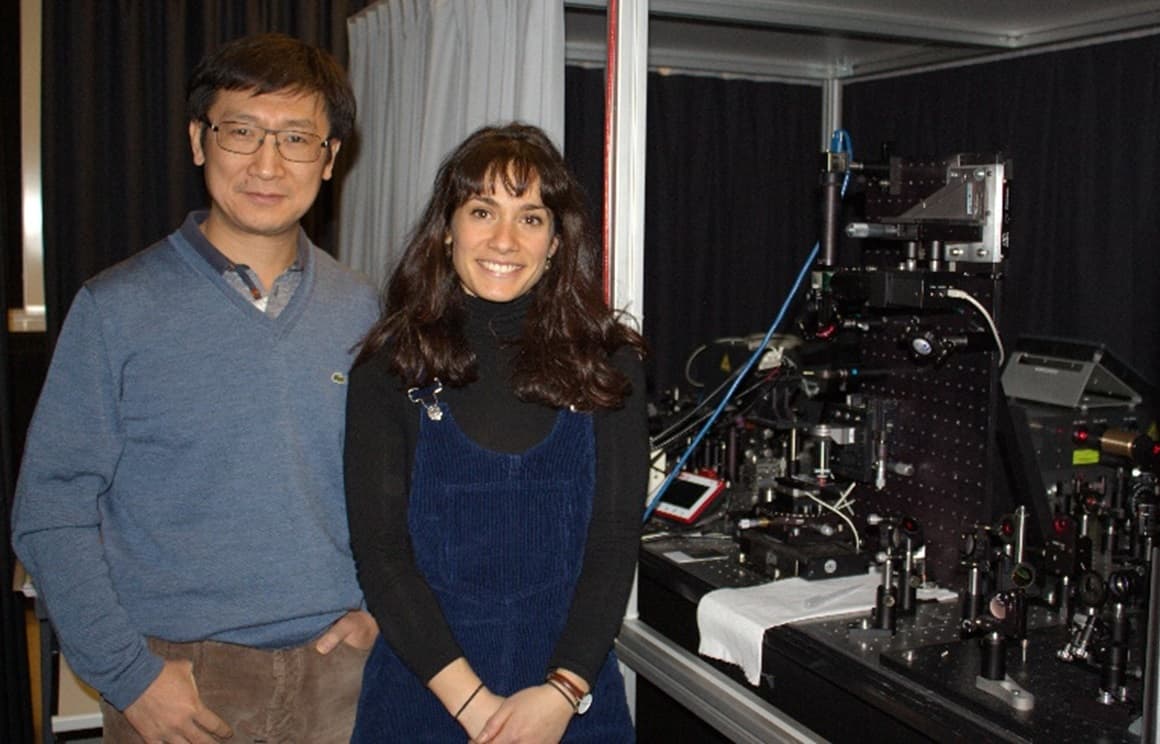
Researchers Ye Pu (left) and Giulia Panusa (right) in front of the multiphoton laser direct writing system. (Courtesy: Ye Pu)
Researchers in Switzerland have employed multiphoton laser direct writing (MP-LDW) to polymerize a monomer called phenylacetylene, which is only sensitive to deep ultraviolet light. They utilized MP-LDW and phenylacetylene to fabricate, for the first time, 1 μm wide light-guiding structures in polydimethylsiloxane (PDMS), in order to make smaller and more complex biomedical devices (Opt. Mater. Express 10.1364/OME.9.000128).
PDMS is an elastomer commonly used to fabricate optofluidic and microfluidic devices. Creation of these flexible light guides (waveguides) has become necessary in the development of biomedical and biosensing platforms, including biosensors, optogenetics, wearable photonics, optical printed circuit boards and microfluidic flow cytometry devices, for example.
Fabricating biomedical devices requires the creation of complex structures inside glass and polymer-based materials, which can be achieved using femtosecond laser micromachining. When passing through a medium, the high-intensity ultrafast laser light results in the simultaneous absorption of multiple photons through a nonlinear process. The combined energy of those photons triggers a molecular transition inside the material, which leads to structural modifications, such as association (photopolymerization) and dissociation (photolysis) of molecules.
Since most monomer molecules can only absorb deep ultraviolet light, photopolymerization usually relies on a photoinitiator to convert the absorbed light energy into chemical energy in order to proceed efficiently. Upon absorption of visible or ultraviolet light, a photoinitiator produces reactive species that transfer the chemical energy to monomer molecules and start a chain-growth polymerization. In biomedical applications, where biocompatibility is of great importance, ensuring that the photoinitiator is nontoxic is crucial. Eliminating the photoinitiator and minimizing the chemical complexity would be even more beneficial.
PDMS waveguide fabrication
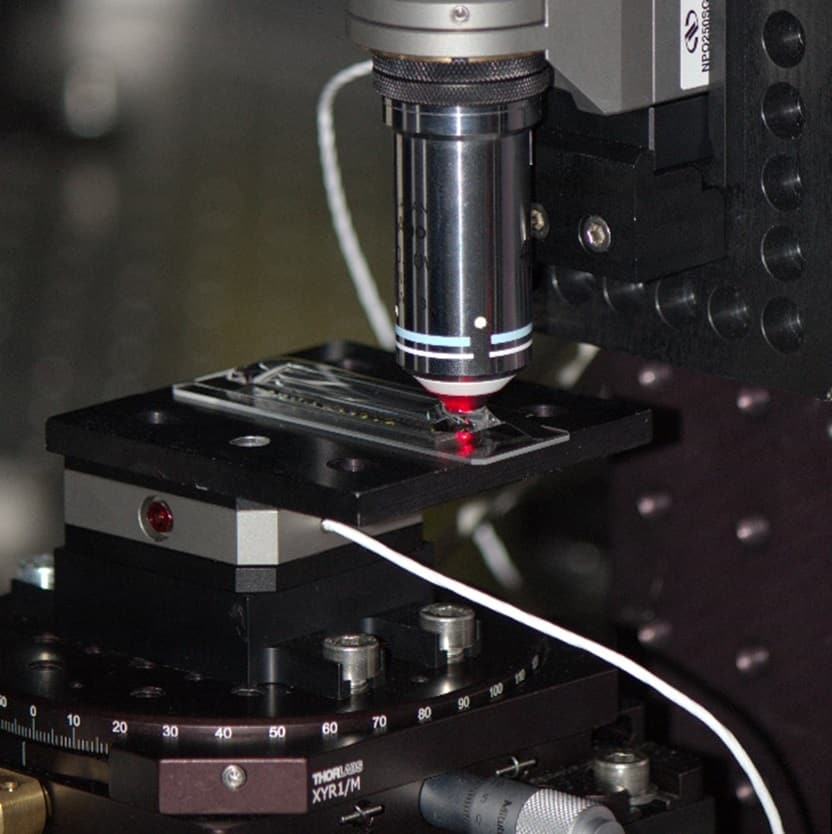
In this latest work, the researchers — from the École Polytechnique Fédérale de Lausanne (EPFL), led by Demetri Psaltis — fabricated PDMS optical waveguides for the first time without employing a photoinitiator, by using MP-LDW. Past studies reported 50 µm-wide waveguides with a refractive index change of approximately0.01 and between 0.3 and 0.6 dB/cm optical loss at 850 nm. The EPFL researchers achieved a PDMS waveguide with a core size of 1.3 µm and a high refractive index contrast (0.06 or above) between the waveguide core and the PDMS cladding.
PDMS waveguide fabrication using multiphoton laser direct writing. (Courtesy: Ye Pu)
The fabrication was performed with a femtosecond Ti:sapphire laser tuned to 680 nm. The resulting waveguides had a particularly low optical loss of 0.03 dB/cm in the 650-700 nm spectral band. This low light loss allows a light signal to travel efficiently though the waveguides before facing severe signal degradation.
The researchers used phenylacetylene as the monomer, whose absorption band falls in the deep ultraviolet band and is only accessible through multiphoton absorption. The dense -electrons in phenylacetylene molecules helped achieve the high refractive index contrast.
Team member Ye Pu believes that the new waveguides are the smallest ever created in PDMS. “Our flexible waveguides could be integrated into microfluidic lab-on-chip systems to eliminate bulky external optics needed to perform blood tests, for example,” he says.
To advance the device for future possible clinical applications, the researchers are now working to develop a control system to monitor the fabrication process during laser writing. This will also help to avoid material damage.
The researchers also plan to construct a flexible endoscope, which Pu suggests would allow imaging of several hard-to-reach places in the body, requiring only minimally invasive surgery.
Around the arid world, some 16,000 desalination plants are now purifying seawater and brackish aquifers, producing 95 million cubic metres of fresh, salt-free drinkable water daily. This is almost half the daily flow over Niagara Falls.
But there is a potentially-polluting price to pay: for every litre of fresh water, the same desalination plants produce around 1.5 litres of toxic brine. That adds up to enough in the course of a year to cover the whole of the US state of Florida to a depth of more than 30 cms.
A new study urges nations to explore better solutions – and new ways to exploit the minerals in the wastewater and support efforts to advance the declared UN sustainable development goal of reliable, safe water on tap for everybody in the world.
Reject brine has been used for aquaculture, with increases in fish biomass of 300%
Four out of ten of the world’s people face severe water scarcity. More than six out of ten experience at least one month a year in conditions of water scarcity. There are now desalination technologies at work in 177 countries: two thirds of them in nations with high incomes.
Small island nations depend on desalination technology for their survival, and eight countries could meet all their freshwater needs by evaporating sea water.
The waste tended to be directly discharged into the oceans, surface water or sewers, injected into deep wells or left to evaporate in ponds. Untreated, it was a threat to marine ecosystems. On land, it enhanced the increasing hazard of soil salination.
Exploitation possible
But such brines could be used effectively in aquaculture, or to nourish salt-tolerant crops. They were rich in sodium, magnesium, calcium, potassium, bromine, strontium, lithium, rubidium and even uranium: they could be exploited for industry and in agriculture. There aren’t the technologies yet to extract such elements economically, but the scientists make the case for trying.
“There is a need to translate such research and convert an environmental problem into an economic opportunity. This is particularly important in countries producing large volumes of brine with relatively low efficiencies, such as Saudi Arabia, UAE, Kuwait and Qatar,” said Manzoor Qadir, of UNU-INWEH, one of the authors.
“Using saline drainage water offers potential commercial, social and environmental gains. Reject brine has been used for aquaculture, with increases in fish biomass of 300% achieved. It has also been successfully used to cultivate the dietary supplement Spirulina, and to irrigate forage shrubs and crops (although this latter use can cause progressive land salinisation).”
Integrated policies
And researchers at the International Institute for Applied Systems Analysis in Austria also believe in a twofold approach to the looming world water crisis: they report in the journal Environmental Research Letters that they want to see the provision of water and sanitation – from any source – and action on climate in an integrated approach.
Both are among the 17 goals of sustainable development adopted by UN agencies and 93 nations. The IIASA researchers think, for example, that water pumping and treatment plants could also work with a nation’s electricity grids to make the most efficient use of both.
“The results of our analysis show that combining clean water and climate policies can increase implementation costs, but these increases are relatively small in comparison to the cost for implementing each policy on its own,” said Simon Parkinson, a researcher from IIASA and the University of Victoria, who led the study.
“Finding and improving synergies between decarbonisation and water efficiency is crucial for minimising joint policy implementation costs and uncertainties.”
Researchers at the Max Planck Institute for Quantum Optics in Garching, Germany, have succeeded in creating Schrödinger-cat states using a single rubidium-87 atom in an optical cavity to control a propagating light pulse. The feat could help advance the field of quantum state engineering with possible applications in quantum networks and quantum computing.
In 1935 physicist Erwin Schrödinger devised his famous thought experiment involving a cat that could, surprisingly, be both dead and alive at the same time. In his gedanken, the decay of a radioactive atom triggers a mechanism (the breaking of a vial containing a poisonous gas) that kills the cat. However, since the decay of the radioactive atom is a completely random and quantum phenomenon, we cannot know the moment at which the cat dies. Mathematically, the feline is in an entangled superposition of quantum states – known as the “Schrödinger-cat” state.
Recreating this state is no easy task, but researchers have managed to do this in recent years using the quantum superposition of coherent states of a laser field with different amplitudes, or phases, of the field. They have also created these states using a trapped ion (with the vibrational state of the ion in the trap playing the role of the cat) and coherent microwave fields confined to superconducting boxes combined with Rydberg atoms and superconducting quantum bits (qubits).
Controlled superposition of two states
A team led by Gerhard Rempe has now created entangled light-matter Schrödinger-cat states by reflecting coherent laser pulses from an optical cavity containing a single trapped atom that is in a controlled superposition of two states (“spin up” and “spin down”).
The optical cavity consists of two mirrors with a reflectivity of more than 99.99% facing each other such that they can reflect a light pulse back and forth around 10,000 times. The light pulse thus interacts very strongly with the trapped atom.
“We trap a single 87Rb atom in the resonator, which can then phase-shift an impinging light pulse,” explains study lead author Bastian Hacker. “If the atom is in an equal superposition of spin up and spin down states, the light pulse is brought into a superposition state as well.”
The technique is deterministic, he says, because the light pulse becomes entangled with the atom in every single trial.
“Cat states have been postulated to exist for decades now and the recipe to create them with an optical resonator, as in our study, was first put forward in a paper in 2005. To see this finally work is most exciting and it is one of the countless triumphs of quantum mechanics,” he tells Physics World.
Wigner function measured
To confirm that the light pulses are indeed in a Schrödinger-cat state, the researchers measured their Wigner function, which is an important characteristic of non-classical systems. “The properties of light pulses are described in so-called phase space in which each point represents one amplitude and phase of a light wave,” explains Hacker. “The Wigner function is a quantum mechanical probability distribution in phase space and it contains an unambiguous description of an optical state.”
In classical logic and classic physics, probability distributions are always positive and negative probabilities don’t exist, he says. In contrast, the Wigner function of special optical states like cat states may become negative. “This is a genuine quantum feature and such a state cannot be described by classical physics.”
A quantum-logic gate
The researchers did not stop there. As a first application of their proof-of-concept experiment, they made a quantum-logic gate between an atom and a light pulse, with a photonic qubit encoded in the phase of the light field.
“A quantum logic gate has qubits as input and output and performs an elementary computation on any combination of input states – much like a classical logical gate in any computer,” explains team member Severin Daiß. “In our experiment, one qubit is stored on the atom and a second qubit is encoded in the cat state.”
In this set up, the “0” qubit is the light field at a certain phase (the “living cat”) and the “1” qubit is the light field at the opposite phase (the “dead cat”). The gate works by sending the light pulse onto the optical resonator, which amplifies the light field at the location of the atom. “The atom and light field can thus both change each other’s state to perform a controlled-NOT (CNOT) operation, similar to a classical plus operation,” says Daiß. “But in contrast to a classical gate, certain input states lead to an entangled output between the atom and the light pulses – something that we have seen in our work.”
Cat states for quantum networks
Cat states may not only be good for addressing old philosophical questions on the scope of quantum mechanics, however, he says. They do, in fact, allow to encode qubits in such a way that optical losses can be detected and corrected. “This is in stark contrast to single photons, where such losses irreversibly delete the carried information. This means that cat states are attractive for applications in small-scale quantum networks in which atoms in a resonator act as sender and receiver nodes connected by optical fibres through which the states can propagate.”
The Max Planck researchers, reporting their experiments in Nature Photonics 10.1038/s41566-018-0339-5, are now working on improving their optical resonators to reduce losses. “Doing this would allow us to create larger and more complex states,” says Rempe. “We also want to create more powerful resonator-based quantum network nodes with independent control over more than one atom in the resonator.”
Saturn’s rings are just 100 million years old and formed when dinosaurs roamed Earth. This is much younger than Saturn, which formed about 4.5 billion years ago. Their age was determined by studying doppler-shifted radio signals from the doomed Cassini spacecraft. The signals were transmitted during the mission’s final orbits around Saturn and have also revealed startling details about the unseen interior of the planet.
Cassini used its Radio Science Subsystem to measure Saturn’s gravitational field. Saturn’s gravity tugged on the spacecraft, so any radio signals it beamed back to Earth exhibit a tiny Doppler shift, just 10 cm/s, as a consequence.
Radio transmissions made earlier in the mission, from outside of Saturn’s rings, gave a measurement of the gravitational field of both the planet and its rings. Cassini’s “grand finale” in 2017, however, saw the spacecraft’s orbit move inwards, between the planet and the rings, before the spacecraft entered Saturn’s atmosphere and was destroyed on 15 September 2017. By travelling between the planet and the rings, the radio signals were Doppler-shifted by gravity acting in different directions – the planet alone on one side, and the rings on the other. By disentangling these signals, it was possible to obtain a more accurate measurement of the gravity of the planet alone.
The gravitational field measurements were different to what scientists expected. To explain them, scientists led by Luciano Iess of Sapienza University of Rome have shown that the outer 15% of the planet – down to a depth of 9000 km below the cloud-tops – is rotating faster than the interior of the planet.
Massive jet
“We predict that there is a massive jet near the equator that rotates 4% faster than the rest of the planet,” says team member Burkhard Militzer, of the University of California, Berkeley.
The consequence of this jet, the origin of which is currently uncertain, is that by speeding up the rotation of the outer 15% of the planet, it increases the centrifugal force, resulting in part of the outer atmosphere uplifting slightly, affecting the planet’s gravitational pull. In comparison, Jupiter only experiences differential rotation in its outer 3%, to a depth of 3000 km, according to measurements by NASA’s Juno spacecraft.
The results are consistent with models of Saturn’s core being made of elements heavier than hydrogen and helium. These elements are believed to total 15–18 times the mass of Earth, which is about 15% of the mass of Saturn.
Bottom-up formation
The knowledge that Saturn contains a large core of heavy elements provides crucial insight into how Saturn, and possibly the other gas giant planets, formed. It bolsters models that depict these planets forming from the bottom-up, first assembling as a large rocky core and then accreting huge swathes of gas from the planet-forming disc that gave birth to the Solar System.
The findings from Cassini’s Radio Science Subsystem have also answered one other long-standing question about Saturn: the age of its rings. By disentangling the Doppler-shifted signals, the gravitational field from just the rings was also isolated. This allowed Iess’ team to measure the mass of just the rings, which they found to be 1.5 x 10¹⁹ kg. This is equal to about two-fifths of the mass of Saturn’s icy 198 km-wide moon, Mimas.
When the rings formed they were likely made from pure ice, but over the years meteoritic dust has polluted them. By knowing the mass of the rings, and how much of that mass is composed of dust (about 1%), the researchers were able to calculate how long it would have taken for the rings to accumulate that much dust. Their answer is about 100 million years. In other words, the rings probably formed during the time that dinosaurs roamed the Earth.
Raining ring particles
The results tally with other research described in the journal Icarus that reveals that Saturn’s rings will be short-lived, and that all the ring particles will have rained into Saturn’s atmosphere within 100-300 million years.
“I think it is incredibly telling that we have now seen several separate results, using very different techniques, that have all independently suggested a surprisingly short age for Saturn’s rings,” says Tom Stallard of the University of Leicester and a co-author of the Icarus paper.
However, Stallard points out that knowing the age of Saturn’s rings does not tell us how they formed. The leading theory is that an icy moon or a large comet crossed the Roche limit, which is the minimum distance and object can get to Saturn before the planet’s gravity tears them apart.
In cosmic terms, Saturn’s rings won’t last very long, and we may be very lucky to be around at the same time they are. “This result does suggest that the chances of detecting Saturn-like rings [around exoplanets] might be less likely than we might hope,” says Stallard.
Iess and colleagues describe their observations in Science.
The food and drink industry is the biggest manufacturing sector in the UK, accounting for around one-fifth of manufacturing turnover – more than automotive and aerospace combined. Yet the industry globally is faced with systemic and complex challenges, not least the growing demand from policy-makers and public for a more sustainable food system that makes better use of water, raw materials, energy and land.
And that’s just for starters. Throw in the obesity epidemic, the backlash against food-packaging waste, concerns about food safety and traceability, and it’s clear that the answers to these problems are going to require long-term investment, joined-up strategic thinking, and multidisciplinary collaboration across all the levels of the food industry supply chain.
Physics, it seems, has a pivotal role to play in elaborating some of those answers, judging from the collective conversation at last week’s Physics in Food Manufacturing Conference at Campden BRI, a food-science research and training centre in the UK.
“When physics and physicists are involved in solving the inherently multidisciplinary science and technology challenges in food manufacturing, we generate new approaches for compelling product innovation – reducing costs and time-to-market along the way,” explained John Bows, R&D director at PepsiCo Global Snacks in Leicester, UK, and also chair of the Physics in Food Manufacturing (PiFM) group of the Institute of Physics (IOP), which organizes the conference.
Those multidisciplinary challenges range from designing safe, nutritious and great-tasting food to the process technology and manufacturing know-how needed to deliver such innovation. “The critical enabler,” said Bows, “is the emerging academic/industry networks that we are initiating and strengthening through the activities of the PiFM group – and in particular through this annual conference.”
Broad church: delegates and exhibitors at the PiFM conference span a diverse range of subdisciplines, including soft-matter physics, materials and characterization, instrumentation, measurement and imaging, thermodynamics, modelling, fluid mechanics and rheology. (Courtesy: Campden BRI)
He continued: “In the three years since its formation, the PiFM group has created an incredible number of touch-points, connections and networks between physicists and the food industry, leading to new partnerships, research projects and early-years careers outreach. We have a great mix of academia and industry involvement and will continue to develop these connections.”
Many of those connections were front-and-centre at this year’s conference in a diverse programme of talks and posters that pulled together the latest research on diagnostic technologies (e.g. Raman spectroscopy for food security and fraud detection), measurement quantification (e.g. hyperspectral imaging to map food composition), as well as the applications of ultrasound in food processing (e.g. to control fat crystallization and structuring).
Physical and data modelling of foods was another prominent thread, ranging across fundamental mesoscale studies (at the length scales of colloids, polymers and bacteria) to understand complex soft and active materials; computer simulations that use the lens of soft-matter physics to develop cheaper snack products for emerging markets; and modelling the release of active molecular, oligomer and polymeric species during coffee brewing.
Building the pipeline
Beyond research and application, another big driver of the PiFM conference is careers and professional development – and how to build a sustainable pipeline of top physics talent into the food manufacturing industry.
“With a background in physics, I recognize the value that physicists can bring to our industry,” explained Martin Whitworth, principal scientist at Campden BRI and a member of the PiFM organizing committee. “A key need of the food manufacturing companies is for good scientific and technical staff, so we are keen to raise awareness among physicists that there are interesting careers to be had in the food industry.”
To this end, the new PiFM careers panel provided an opportunity for delegates to examine those pipeline issues in the round, with the discussion framed by representatives from coffee company Jacobs Douwe Egberts, multibillion-dollar snack company Mondelēz, Campden BRI and the University of Leeds School of Food Science and Nutrition.
Whitworth added: “Once physics academics, especially PhD supervisors, understand how interesting and non-trivial the physics underpinning many food manufacturing challenges is, then we see uptake of early-career researchers addressing those challenges – from generating new foundational scientific capability to solving specific industry problems. The careers-panel discussion was a useful one in this regard and we’d like to run something similar again next year, guided by the delegate feedback we receive.”
Yan Wong, an applications specialist at advanced instrumentation maker Renishaw, agreed: “I enjoyed the range of high-quality talks at PiFM – largely novel research with direct application to food manufacture – while the careers panel provided lots of good personal insights into the future of food research. Beccy Smith from Mondelēz was a great example of balancing family life with a successful scientific career, while Arwen Tyler from the University of Leeds shared the importance of social media in the context of scientific networking.”
Building momentum
For other delegates, your correspondent included, it was the event’s cross-disciplinary menu of physics research and application that most caught the eye. “As a first-time attendee, the PiFM meeting surprised me as to the extent that physics is now present in food applications,” noted John Gilchrist, technical director at Camlin Photonics, an optical spectroscopy and hyperspectral systems manufacturer.
He added: “Physics can be used to optimize manufacturing processes with appropriately robust modelling, while optical and acoustic inspection techniques provide valuable information on process performance and efficiency – ultimately helping manufacturers to improve their profits.”
For Bows, as head of the PiFM group, the conference is all about building momentum and strengthening partnerships across the food industry, food researchers and physics academia to address those long-term sector challenges. “A priority for the PiFM group this year is stronger outreach and continued connectivity to other professional-body food groups, food sector stakeholders and national funding bodies, with the aim of raising awareness of food and drink manufacturing challenges and opportunities for physics and physicists to engage,” he concludes.
The latest episode of Physics World Weekly has a focus on careers in physics. Our first guest is Alex Petkov, a PhD candidate who is doing a 6-week work placement with Physics World magazine. Petkov speaks about the unconventional route to a PhD he has embarked upon, which provides him with more time to develop his academic interests.
Later in the show, we are joined by two members of the Society for Radiological Protection – current president Amber Bannon and president elect Peter Bryant. Bannon and Bryant were visiting Physics World’s HQ at IOP Publishing to celebrate 30 years of co-publishing the Journal of Radiological Protection (one of our colleagues even baked a cake – see the episode image). They speak about the wide variety of careers in radiological protection and the skills required.
If you enjoy what you hear, you can subscribe to Physics World Weekly via the Apple podcast app or your chosen podcast host.