Molecules such as glycine, the simplest amino acid, can crystallise into different polymorphs with the same chemical composition but different structures. The two phases of glycine are α-glycine, which forms easily and is stable in bulk conditions, and β-glycine, which is difficult to produce and unstable in the bulk. However, β-glycine is piezoelectric; it generates electricity when compressed or bent and is therefore technologically useful.
In this work, the researchers developed a new method to produce glycine crystals. Using an electric field, they sprayed a glycine solution to create nanoscale droplets in which crystals form. By controlling the spraying conditions, they confined crystal growth at the nanoscale, thereby controlling how the crystals form. Crystals below 120 nm in size were pure β-glycine, above 130 nm were mostly α-glycine, and sizes between 120-130 nm produced a mixture of both polymorphs. This shows that crystal size (nanoconfinement) is the key parameter controlling which polymorph forms, and β-glycine is stable between 5 and 120 nm.
The crystals form in two steps. Firstly, nanoclusters form, then these clusters rearrange into crystals. β-glycine forms first because it has a lower interfacial energy, making it easier to create surfaces, and a lower nucleation barrier, so it forms faster. Overall, β-glycine is kinetically favourable. However, α-glycine has a lower bulk free energy and better packing. As crystals grow larger, they can rearrange into α-glycine, which is thermodynamically more stable. Under nanoconfinement, molecular rearrangement is restricted, preventing the formation of the more ordered α-phase and stabilising β-glycine.
This research is important because it shows how to precisely control which crystal form a material takes using nanoscale confinement, rather than relying on trial and error methods. It also provides a general strategy for stabilising metastable but functional materials, with potential applications in sensors, energy harvesting, and advanced functional materials.
Telltale patterns of antineutrino emissions could reveal whether fusion reactors have been reconfigured to produce material for nuclear weapons, say physicists in the US. Although commercial fusion power plants are still some years away, members of the team at Virginia Tech and Princeton University argue that it is nevertheless useful to develop robust ways of monitoring their output now, to ensure the technology is not misused.
“Neutrinos cannot be shielded, their signatures cannot be spoofed and they can be detected from a distance, either onsite or offsite, allowing for nonintrusive monitoring of reactor operation,” says team member Patrick Huber, a physicist at Virginia Tech’s Center for Neutrino Physics. Better still, the team’s calculations show that existing antineutrino detectors such as Virginia Tech’s mobile MiniCHANDLER are sensitive enough to spot these signatures.
The DT process and nuclear proliferation
Most fusion technologies rely on the deuterium-tritium (DT) fusion process, which occurs when a deuterium nucleus (a proton bound to a neutron) and a tritium nucleus (one proton and two neutrons) fuse to produce helium-4, a free neutron and large amounts of energy. Because fissile materials are not directly involved in this reaction, the nuclear proliferation risk of fusion reactors is widely regarded as being much lower than that of fission power plants.
That said, if neutrons released in the DT process were combined with small amounts of material such as uranium-238 or thorium-232 in the “blanket” that surrounds the DT fuel in the fusion reactor, it would, in principle, be possible to use the reactor to produce plutonium-239 or uranium-233. Both materials are used in nuclear weapons, and a gigawatt-scale fusion reactor operating in this mode could produce tens of kilograms per week – enough for several first-generation bombs.
Checking for nuclear fingerprints
Crucially, though, this clandestine production would not necessarily go unnoticed. Whenever radioisotopes in the blanket absorb neutrons during the fusion process, they give off a distinctive pattern of antineutrinos. And according to the Princeton-Virginia Tech team’s simulations, the current generation of antineutrino detectors is already capable of distinguishing this pattern from the one produced during normal reactor operations.
In the current study, which appears in Phys. Rev. Applied, the researchers focused on the plutonium antineutrino signal. Using a Monte Carlo particle transport code called MCNP6, they modelled the output of a simplified toroidal fusion reactor with an outer radius of 6.2 m and an inner radius of 2.0 m. This reference reactor would operate at a typical power density, and Huber explains that it would produce a total of 1500 MW of power through plasma fusion via the DT reaction. The team also analysed two designs for the “blanket”: one featuring a molten salt (LiF-BeF2 or FLiBe) and one that relied on dual-coolant lead-lithium (DCLL).
Next, the two Princeton members of the team, Alexander Glaser and Robert James Goldston, defined and evaluated a reference fissile material production scenario. As part of this, they estimated both the plutonium production rate and the energy release that occurs as some of the covertly introduced nuclear material undergoes fission. Huber explains that this evaluation provided the first part of the antineutrino background signal.
Glaser and Goldston then analysed the neutron activation and antineutrino signatures driven by neutrons emanating from the fusion plasma. These provided the second part of the background. Finally, the team used these signatures to assess the detectability of covert fissile material production against the combined background from neutron activation and cosmogenic antineutrinos.
Based on these simulations, the team concluded that a detector like MiniCHANDLER could pick up on the production of a few kg of plutonium over 30 days – a result that Huber says should be applicable to any fusion power system that relies on DT fusion. Importantly, he points out that unlike some alternatives, antineutrino-based monitoring does not require inspectors to have access to reactor buildings and could allow plants to be monitored around the clock.
Practical advantages
The idea of using antineutrinos to detect illicit nuclear material production is not new. It dates back to the 1970s, and the two Princeton team members have previously worked on nuclear monitoring and verification for a variety of nuclear reactors and nuclear fuel-cycle facilities (including some in Iran). Given the rapid development of fusion energy systems, Hubner tells Physics World it was “a natural next step” to consider non-intrusive, antineutrino-based monitoring options for them, too. He adds that the group has been studying possible safeguards for fusion reactors since the early 2010s and was part of an IAEA consultancy on the topic in 2013.
As well as optimizing the design of detector systems, Huber says he and his colleagues are also interested in studying thorium as an alternative “fertile” material. “Even though the fission signature would be weaker compared with the uranium reference case analysed in this study, the results we have reported on already suggest that such an effort is well justified,” he says.
How do we make good, well-informed decisions? This is the central question of author Helen Pearson’s new book Beyond Belief: How Evidence Shows What Really Works. It examines evidence-based decision-making and compares it with “conventional wisdom and questionable opinion”. Pearson is interested in how we can use scientific reasoning to empower decision-making using empirical evidence, rather than choices based on opinion or public sentiment.
Pearson uses human stories and historical narratives to outline “the evidence revolution”, in which academics, policy-makers and civilians have tried to embed evidence into decision-making. She tackles disciplines where evidence is seldom used, such as people management, or where its absence is surprising, like environmental conservation. Throughout Beyond Belief, Pearson asks us to understand what makes for good evidence, and how evidence can be better used in daily life.
An award-winning science journalist and editor at the journal Nature, Pearson is particularly good at establishing clear narratives based on a host of different scientific studies. She begins with the field of medicine, focusing on Iain Chalmers, one of the founders of the Cochrane Collaboration. Formed in 1993, it is considered to be a trailblazer in evaluating evidence-based healthcare. Indeed, the institution has influenced important changes to treatment, including the use of corticosteroids to save the lives of premature babies.
It seems obvious, Pearson suggests, that doctors would choose treatments based on rigorous evidence. Instead, she shows us that evidence-based medicine is a young field that only emerged in the 1970s. One particularly personal example she gives is the standard practice of shaving knee cartilage in meniscal tears – a procedure I nearly underwent in 2015 – which was shown to be no better than exercise therapy after a landmark trial in 2016. Beyond Belief offers a glimpse into how recent, and as-yet fragile, our reliance on evidence-based treatment is; as well as how much opposition it has faced from institutional inertia and scepticism.
The book is not just about medicine. It includes examples ranging from the roll-out of the pioneering Mexican social welfare scheme, PROGRESA, which helped to decrease poverty and improve health and education in the country; to the ineffective use of bat bridges over the UK’s A11 dual-carriageway. She also discusses using evidence to make management decisions, as opposed to relying on corporate wisdom or management consultancy. The examples are often surprising, underscoring Pearson’s central argument that evidence allows for better decisions, but getting people to use good evidence consistently is challenging.
Throughout the book, Pearson is engaging and often witty, while still discussing the complexities of implementing evidence-based best practice. Beyond Belief is highly readable too – even when navigating difficult concepts in meta-analyses. Pearson outlines the difficulties of teaching people how to use evidence, how to design studies well, and how studies can easily be misleading. She presents the enormous challenge of encouraging institutions to use evidence correctly, while remaining hopeful about our direction of travel.
There are places where tensions arise, one being in the chapter on policing. Pearson describes how evidence can be used in effective policing, for example, to support increasing patrols or stop-and-search in crime hot-spots. This reveals an interesting question about what the role of successful policing is – crime reduction, retributive justice or rehabilitation – and whose definition of justice that evidence is being used to support.
In these cases, the author’s arguments would have been strengthened if she had engaged more with the central premise of the book: that evidence always makes for better decisions. There are nuances that arise between evidence-based policy and harm reduction, and broader questions of trust that cause people to rebuke evidence entirely. A more serious conversation about these reservations might have deepened the argument in favour of empirical evidence, particularly in questions of social policy.
This discussion is not entirely absent. One particular strength of Beyond Belief is Pearson’s examination of COVID, drawn from her experience as a Nature editor during the pandemic. In this chapter, close to the book’s end, Pearson presents the difficulties of using evidence-based trials in acutely developing crises, in which scientists and public-health bodies have to adapt quickly to minimize harm. At a time when discussions about public health responses to COVID are so polarized, Beyond Belief provides a nuanced analysis of how we can arrive at a scientific conclusion under immense pressure.
At the heart of this book is Pearson’s passion and advocacy for a scientific approach to decision-making. She includes a call to action, empowering readers to be champions of evidence in their lives. Although only present in the short chapters towards the book’s end, her anecdotes about childcare, artificial intelligence and using your vote to support evidence through democracy, are useful reference tools. She also succeeds in her goal of starting a conversation about how we can best use evidence.
Ultimately, Beyond Belief sets out to demonstrate the ways in which evidence enters our lives and improves them. Pearson asks us to advocate for science in a world of increasing misinformation, and to challenge conventional wisdom while equipping us with the tools to do so. For that alone, her book is well worth reading.
The frequency of extreme weather events can be predicted more accurately than presently possible by combining artificial intelligence (AI) with physical climate modelling, using a protocol called rare-event sampling. That’s the conclusion of a study from researchers in the US and France. The researchers used the approach to model extreme heat events such as the one currently roasting Europe, but they believe it could also be applicable to many other extreme events in climate science.
As the global climate warms, extreme weather is becomingly increasingly deadly and difficult to predict, and quantifying the risks of such events is important for climate change adaptation and mitigation. “Very often the rarest events carry the largest impacts,” says climate physicist Amaury Lancelin of France’s Laboratory of Dynamic Meteorology.
Full global climate model simulations will need to run for an infeasibly long time to produce sufficient data for an estimate of the precise frequencies of rare events. Alexander Wikner of the University of Chicago in Illinois gives the example of an event that, on average, occurs once every century: “Each year you’re going to flip a coin that has a one-in-a-hundred chance of coming up heads,” he says. “On average, once every hundred years, you’ll get one head, but you could very easily get no heads or two or three heads.” A meaningful estimation of the frequency therefore would traditionally require around a thousand years’ worth of simulation – which is not computationally feasible in a physical model.
Deep-learning algorithms, which ignore the underlying climate physics and simply train themselves using pattern recognition, require up to 10,000 times less computing power. However, the reliability of these in modelling extremely rare events is questionable. For example, there is evidence that an AI model will not predict more extreme cyclones than it has seen in its training data, “which is a quite unnerving idea if we imagine that tropical cyclones will be getting more extreme in the future and we want to use an AI model to forecast them,” Wikner explains. They also produce no insight into the physics of the events.
Rare-event sampling (RES) refers to techniques that preferentially allocate computing resources to specific rare events of interest, thereby avoiding modelling long periods of time in which none of those events occur. The problem, of course, is that one has to have some idea what kinds of conditions increase the probability of a rare event occurring in order to know which periods to model in more detail.
In the new research, scheduled for publication in Physical Review Letters, Lancelin, Wikner and colleagues developed the AI+RES framework. An AI algorithm runs climatic simulations repeatedly and selects those that it predicts are most likely to lead to the rare event. A full climate model then simulates only these. The researchers used this protocol to compare the frequency of heatwaves at mid-latitudes, using the predictions of a relatively coarse-grained direct numerical simulation called PlaSim as the ground truth.
They found that their technique produced similar results to PlaSim with up to 1000 times lower computational resources. The researchers now hope to apply the technique to predict other types of extreme events and apply it to more sophisticated models.
“The reason we used PlaSim is that it is computationally quite cheap compared to state-of-the-art climate models so that we can actually verify that our methodology works,” says Lancelin. “Otherwise there is no way to know whether we have made a garbage prediction or not without the ground truth.” Knowing that the AI+RES model reproduces the PlaSim results correctly, however, the researchers now hope to apply computationally expensive models in situations where it was previously impossible, with confidence that the results are likely correct.
Climate scientist Robin Noyelle of ETH Zurich believes the work marks a significant contribution to ideas that were already “floating out there”. He says that, although RES has been in use for nearly ten years, selecting the best candidates for full modelling has always proved challenging: “People were using things that we thought were reasonable – I did that during my PhD – so if I want to look at hot summers, then I select on temperature.”
This approach fails for short-term extreme events, however, because of the dynamic nature of the atmosphere. The AI model itself also failed to produce good accuracy when emulating the events, but it was “basically free” in terms of the computing power required, and provided a good starting point for the physical models. “This coupling between the two ideas is really new,” Noyelle says.
The National Science Foundation (NSF) has announced a new initiative to convert new research into products and industries. The $1.5bn programme, called X-Labs, however, has been criticized by some in the US scientific community given that financing the plan could come via cutting the budgets of current NSF directorates by as much as 30%.
The NSF says that the first round of X-Labs funding will focus on two areas – one on quantum sensing and AI-driven computational imaging while the second area will be in the development of quantum information and computing.
The projects that are chosen will receive $1.5m over a nine-month period to carry out further work. The NSF will then select projects to move onto the next phase in which they will receive a further $10–50m per year for 2–3 years.
According to an NSF spokesperson, X-Labs are designed to “spur progress on platform technologies critical to US competitiveness”, supporting high-risk, high-impact research that requires “substantial resources beyond traditional mechanisms”. A key goal of the handful of labs, the spokesperson adds, is to “reduce the time it takes to go from insight to impact through this new investment framework”.
While critics don’t have an issue with the concept, there are concerns that it is coming at the expense of basic research. Former presidential science adviser and former NSF director Neal Lane told Physics World that X-Labs is a “terrible idea”.
“There’s been a push to get more practical and get NSF involved in ensuring that science it funds actually makes it to the marketplace,” adds Lane. “But suddenly it’s been taken to extremes by the Trump administration. They’re trying to cut as much basic research as possible and put it all into an experimental programme.”
‘Without precedent’
The X-Labs programme comes as the NSF – one of the main science funding agencies in the US – still lacks a director. The previous head, Sethuraman Panchanathan, resigned in April 2025 after receiving orders from the White house to cut the agency’s budget by more than 50% (US Congress later restored much of the funding).
The Trump administration has announced Jim O’Neill, a Silicon Valley investor, as the next director, but he has yet to go through the necessary Senate confirmation.
There is also no further movement on the new personnel that will make up the National Science Board, the body that acts at the NSF in a way similar to a company’s board. In April the US administration announced that it was terminating the positions of all 22-member NSB “effective immediately” without disclosing the reasons for the move.
“[That removal of the NSB] is quite without precedent,” adds Lane. “It seems to be an effort to simply eliminate the NSF.”
Science fiction has long embraced the idea of travelling backward in time, but the advent of Einstein’s general theory of relativity transformed these ideas from fantasies into potential – albeit contested – realities. In particular, solutions to the equations of general relativity known as closed time-like curves (CTCs) seem to allow a system’s trajectory to return to a previous point in time. Although the existence of CTCs has never been proven, their admissibility within general relativity has inspired many physicists to study their implications, which include increases in information processing speeds as well as retrograde time travel.
Inspired by the 2014 film Interstellar, in which a father sends messages to his daughter in the past, Kaiyuan Ji and Mark Wilde of Cornell University, together with Seth Lloyd at the Massachusetts Institute of Technology, have now investigated the potential advantages of a retrograde messaging channel based on a CTC. As well as deriving an exact expression for the information capacity of such a channel, they showed that this capacity exceeds that of regular channels that do not involve backward time travel.
Post-selected CTC models
To model their CTC, the researchers used an approach that Lloyd and his then-collaborators developed 15 years ago. This approach exploits the mathematical equivalence between a CTC and the combined operations of quantum teleportation and post selection, so it is often referred to as a post-selected CTC model. Previous analyses established that this model disallows time-travel paradoxes such as going back in time to kill your grandfather, while still preserving correlations between the system that travels backward in time and the environment.
The latter feature is important, Ji notes, because quantum CTC models without it have a distinct drawback: “If you travel through that closed time-like curve, you end up in the past, but basically you lost all the memory of what has happened before you do time travel,” he explains.
A further advantage of the team’s chosen model is that it does not prohibit causal loops in which correspondents in the past and future influence each other. To return to the Interstellar scenario, Ji explains that while the daughter is influenced by her father’s message, she also influences her father, because he witnessed how she decoded the message and therefore used that information to optimize his encoding protocols.
The existence of causal loops in the model allowed Ji and his colleagues to formulate an expression for the channel’s bit capacity. It also pointed towards the best way of maximizing that capacity. The optimal strategy, Ji explains, would involve the father using his memory from the past when encoding his message to the past, which makes sending messages to the past more efficient (and capable of a higher bit capacity) than sending messages to the future. “The causal loop is essential to the design of the optimal communication protocol in this retro causal communication setting,” he tells Physics World. “It is not possible in standard communication from the past to the future.”
Capacity for messages
The CTC can also be used to form a quantum channel capable of transmitting either regular classical data or quantum data back in time. Using their expression for the channel’s bit capacity, the researchers were able to show that its classical bit capacity is twice that of its quantum counterpart.
Nicole Yunger Halpern, a theoretical physicist at the University of Maryland who has studied some implications of CTCs for metrology but was not involved in the current work, describes the research as “creative and technically impressive”. She points out that while calculating a communication channel’s capacity is a common challenge in the field of information theory, obtaining straightforward answers can be difficult. “The authors combined this workaday task with a highly unusual (retrocausal) setting and, moreover, obtained a simple solution,” Halpern says.
Not everyone is sold on the mathematical format of post-selected CTC models, though. Scott Aaronson, a computer scientist at the University of Texas at Austin, US, who has previously studied the speed advantages of information processing using CTCs, believes that studies with this approach “attempt to model time travel but don’t fully succeed at it”. However, with respect to the question of channel capacity, Aaronson concedes it may be “interesting to prove things”.
While the current model considered the effects of distortion (“noise”) on messages in the channel, Ji suggests it might be interesting to broaden this to include noise in the memory of the process – like the father in Interstellar having a hazy recall of his daughter’s decoding protocol. Ji also notes that the post-selection CTC model has some mathematical equivalence with black hole final state projections, and he says it might be interesting to explore these connections, too.
Like a two-lane highway with one lane empty and the other clogged with traffic, superconducting diodes allow electrons to flow without resistance in one direction while encountering normal, resistive conditions in the other. First demonstrated experimentally in 2020, these devices have considerable potential as platforms for fundamental studies of quantum materials and as building blocks for superconducting electronics.
For many applications, being able to control the flow of electricity through the diode – or even reverse its polarity – is essential. In principle, there are several ways of doing this because the efficiency of the superconducting diode effect (SDE) depends on many factors. Examples include magnetic field, temperature and diode design as well as intrinsic properties such as the momentum of the Cooper-paired superconducting electrons and their spin-orbit coupling.
In practice, though, some of these properties are more easily changed than others. To return to the highway analogy, it’s much more straightforward to alter the flow of traffic by posting new road signs, rather than by rebuilding the road or redesigning the cars.
In a recent paper in Chinese Physics Letters, Yanwu Xie, Yishuai Wang, Wenze Pan and Meng Zhang of Zhejiang University in Hangzhou, China describe a new superconducting diode platform that makes it far easier to change the device’s configuration, and thus to control the flow of superconducting electrons through it. Physics World spoke to them about their research and its possible applications.
How did you get the idea for this new type of superconducting diode?
This work started with an unexpected experimental observation. While we were making routine current-voltage measurements on a conventional strip-shaped superconducting device constructed at the interface between two materials, LaAlO3 and KTaO3 (LAO/KTO), we noticed a pronounced difference between the critical currents in opposite directions. Given the growing interest in the SDE, this surprising result immediately caught our attention and prompted us to investigate its origin.
What is special about these two materials?
The properties of conventional superconducting diodes are typically locked into their fixed physical structures, such as Josephson junctions or patterned vortex pinning sites. This inflexibility makes post-fabrication tuning or reconfiguration of the diode characteristics extremely challenging.
Two-dimensional oxide interface superconductors such as LAO/KTO and LaAlO3/SrTiO3 are good candidates for overcoming this problem. The strong spin-orbit coupling near the interface enables possible finite-momentum Cooper pairing, while the extremely low superfluid density and intrinsic two-dimensional nature of the materials create ideal conditions for studying vortex dynamics and magnetic flux behaviour.
In addition, these systems have exceptional tuneability. Their superconducting states can be well controlled through both global substrate gating and local conductive atomic force microscope (cAFM) lithography, which opens new possibilities for post-fabrication SDE engineering.
What was the most challenging aspect of this research?
The most challenging part was unravelling the frustrating sample-to-sample variability we encountered early on. We now know that the SDE in conventional LAO/KTO devices stems from asymmetric vortex entry conditions caused by random, fabrication-induced edge imperfections. At the time, however, even devices with nominally identical geometries exhibited wildly different SDE efficiencies and polarities, showing no discernible systematic trend.
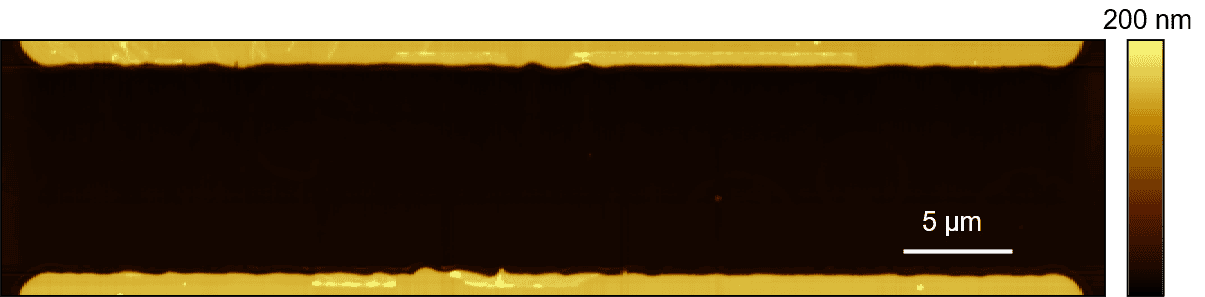
The breakthrough came when AFM imaging revealed random edge defects on the superconducting channels. To test whether these random imperfections were indeed the root cause, we used cAFM lithography to “straighten” the originally photolithography-produced rough channel boundaries. This atomic-scale trimming strongly suppressed the SDE, providing unambiguous evidence for the vortex edge asymmetry mechanism.
Channel edges: An atomic force microscopy (AFM) image of the LAO/KTO channel in the diode, showing the roughened edges. (Courtesy: Yanwu Xie)
We then turned this challenge into an opportunity. By using cAFM to re-shape the channel edges repeatedly and in a non-volatile way, we transformed a source of random sample variability into a tool for deterministic, on-demand quantum device control.
What are some possible applications for this editable superconducting diode?
The nonreciprocal transport of charge carriers – exemplified by p-n junctions in semiconductor diodes – is a cornerstone of modern electronics. Similarly, superconducting diodes are emerging as pivotal components for superconducting electronics. What distinguishes our approach is our ability to reversibly modify the diode polarity and efficiency within the same device through nanoscale control of the superconducting channel geometry. This editability may enable reconfigurable superconducting circuit elements and adaptive circuit architectures, while also providing a versatile platform for investigating the role of geometry-associated vortex dynamics in nonreciprocal superconducting transport.
What will you do next?
We plan to fully exploit the unique cAFM lithography capability of our oxide interface platform to systematically investigate how tailored vortex-boundary configurations shape the SDE. The diode performance can be further optimized by mapping out the precise relationship between channel geometry, vortex entry barriers and rectification efficiency.
In parallel, we plan to introduce artificial pinning centres (such as nanoscale insulating dot arrays) directly into the superconducting channel. This will allow us to engineer asymmetric vortex-pinning landscapes within the bulk of the channel. Combining this engineered flux pinning with the asymmetric vortex-boundary mechanism demonstrated in the current work offers a promising route toward achieving a robust, deterministic and highly controllable superconducting diode.
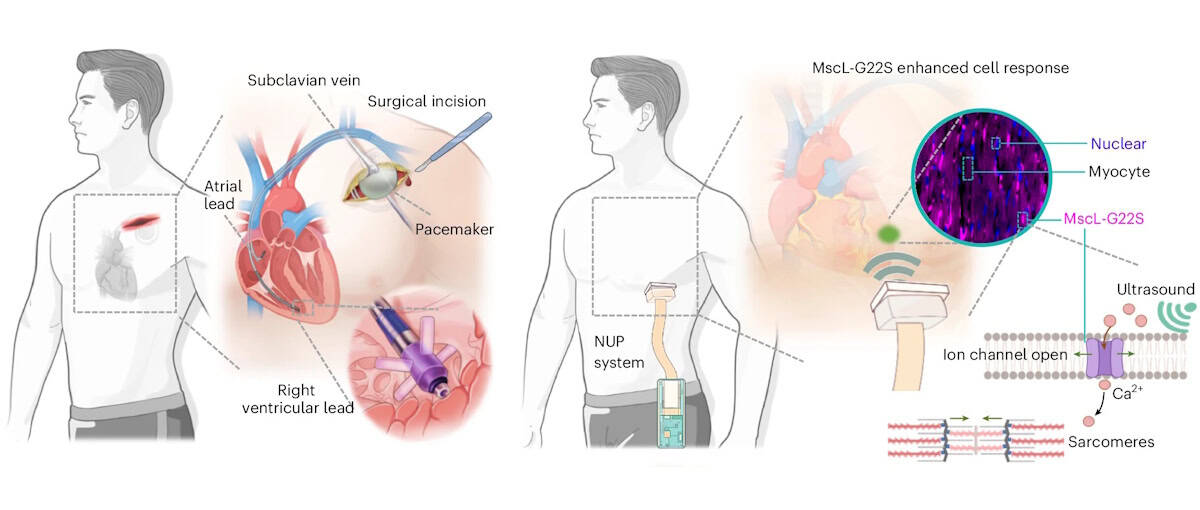
Traditional versus sonogenetic pacing Left: schematic illustration of the steps for traditional surgical implantation of a cardiac pacemaker. Right: operational workflow of the non-invasive ultrasound pacemaker with sonogenetics. Created in BioRender. (Courtesy: C Gong et al. Nat. Biomed. Eng. 10.1038/s41551-026-01673-z 2026, Springer Nature)
Cardiac arrhythmia – a disorder in which the heart beats too fast, too slowly or irregularly – affects millions of people worldwide. Currently, arrhythmias are treated using pacemakers to regulate the heart’s rhythm, but traditional pacemakers require invasive surgical implantation and intracardiac leads that risk infection and tissue injury. As an alternative, a research collaboration headed up at Massachusetts Institute of Technology (MIT) and the University of Southern California (USC) has developed a non-invasive pacemaker that’s worn like a sticker on the chest and stimulates the heart using ultrasound.
“Ultrasound offers a unique combination of deep tissue penetration, spatial focusing and non-invasive delivery,” explains first author Chen Gong from USC. Previous approaches for ultrasound-based cardiac pacing, however, lacked reliability or required the use of microbubbles. In this new study, Gong and collaborators employed a technique called sonogenetics, in which cardiac cells are genetically altered to increase their sensitivity to ultrasound. Once exposed to ultrasound waves, the engineered cells trigger the opening of ion channels that let in calcium, which signals the cells to squeeze and beat.
“Our central motivation was to address the limitations of conventional pacemakers, while preserving precise control of cardiac rhythm,” says Gong.
The team first examined whether ultrasound could modulate cardiac cells in vitro, using sonogenetically engineered human heart muscle cells. Ultrasound stimulation caused almost three-quarters of the engineered cells to beat in synchrony with the ultrasound waves. In contrast, unaltered cells did not exhibit such behaviour. Importantly, ultrasound exposure did not impact the cells’ expression of biomarkers for inflammation, myocardial injury or oxidative stress, demonstrating the safety of this approach.
The non-invasive ultrasound pacemaker
The researchers designed a sonogenetics-based non-invasive ultrasound pacemaker (NUP) capable of real-time imaging and steerable stimulation, describing the device in Nature Biomedical Engineering. The postage stamp-sized device, which sticks to the skin via a bioadhesive interface, incorporates a 64-channel phased-array transducer, as well as data acquisition, wireless transmission and power modules.
To assess whether this prototype NUP could achieve non-invasive cardiac pacing in sonogenetically engineered rats, they attached the device onto the rats’ chests and applied ultrasound stimulation through the chest wall to the heart.
At an acoustic pressure of 2 MPa and a 40 ms pulse duration, the NUP increased the rats’ heart rates from 240 to 360–540 bpm, with a higher pulse repetition frequency leading to increased heart rate. Upon stopping the ultrasound stimulation, the heart returned to its natural rhythm. In control rats without the genetic modification, NUP could not control the heart rate effectively.
The team demonstrated that the NUP could electrically steer the ultrasound beam focus with a spatial precision of less than 1 mm, enabling targeting of different regions of the heart to induce chamber-specific pacing. NUP also successfully treated cardiac arrhythmias induced in the engineered rats, returning their heart rates to normal levels. In contrast, ultrasound stimulation of control rats did not effectively treat their arrythmias.
“A major objective of this work was to move beyond proof-of-concept stimulation and demonstrate a wearable system that could realistically support daily use,” explains Qifa Zhou, group leader at USC. “The current prototype integrates imaging, stimulation, wireless communication and battery-powered operation into a wearable format.”
Clinical potential
For future clinical use, the NUP device needs to automatically detect the wearer’s heart rate, locate heart chambers and deliver stimuli. To achieve this, the researchers used a cloud-based, artificial intelligence (AI)-powered imaging feedback loop that determines the heart rate and stimulation coordinates, and steers the ultrasound beam to target sites.
To test its feasibility for human-scale applications, they assessed the acoustic energy penetration of the device. Using simulations and experiments on a pig heart beneath layers of tissue, they confirmed that, even after tissue attenuation, NUP could deliver sufficient ultrasound pressure (approximately 2 MPa) to a human heart to enable stimulation at clinically relevant pacemaker sites.
The team also assessed the biosafety of the NUP approach, finding that the delivered ultrasound energy remained below approved safety limits and generated minimal thermal effects during and after stimulation. They also confirmed that the sonogenetic engineering induced no off-target effects, immune responses or pathological changes in the rats.
“In the long term, we are optimistic about applying sonogenetics in humans,” explains co-author Gengxi Lu from MIT. “Sonogenetics is different from gene editing – it does not aim to rewrite a patient’s DNA sequence, but instead enables target cells to temporarily or controllably express ultrasound-responsive proteins. At the same time, extensive clinical validation will still be needed to establish safety and long-term effectiveness.”
The team is now focusing on clinical translation and validation of the NUP technology, which includes improving gene delivery strategies, validating the system in larger animal models, and developing closed-loop control approaches that combine real-time physiological sensing with adaptive stimulation. There’s also much engineering work to be done, such as device miniaturization, and improving battery life, skin coupling and motion robustness.
“For cardiac pacing, we envisage that the final goal of NUP technology is to be a permanent alternative to a long-term implanted pacemaker,” Xuanhe Zhao from MIT tells Physics World. “More broadly, we are interested in expanding ultrasound-enabled bioelectronic medicine beyond cardiac pacing toward other organs and therapeutic applications where non-invasive, spatially precise modulation could have clinical impact.”
When Ryan Hamerly was a 15-year-old at Boulder High School in Colorado, he spent his summer building a Tesla coil after seeing a classroom demonstration. “I thought that was really, really cool,” he recalls. “I wanted to make one myself, and as a result I ended up studying the theory of electricity and magnetism over one summer.”
In hindsight, Hamerly realizes he didn’t use much theory to construct the coil, which became part of a school physics project. “Most of the design was based on things I had read on the Internet,” he explains, “but I did try to teach myself electricity and magnetism – and it did work in the end.”
In 2006 Hamerly’s interest in physics took him to the California Institute of Technology (Caltech) for his undergraduate studies. Keen to do graduate research, Hamerly was most fascinated by fundamental theoretical problems in quantum field theory, such as dark matter and quantum gravity. But as he started toying between different options, he had a chance encounter with Hideo Mabuchi, an applied physicist at Stanford University.
“One thing that Hideo told me that I thought was particularly fascinating,” says Hamerly, “is that quantum field theory is just a generic tool that applies in many other fields.” He therefore ended up doing a PhD in optical and quantum computing under Mabuchi’s supervision, which he completed in 2016.
Hamerly then moved to Japan, where he studied at the National Institute of Informatics in Tokyo – a time he characterizes as “sort of a postdoc, but more an excuse to travel for a year”. He did, though, get a paper out of it “so it wasn’t wasted”. In Tokyo, Hamerly worked with Mabuchi’s longtime friend Yoshihisa Yamamoto – a quantum optics researcher who had previously led a group at Japanese telecoms giant NTT for over two decades.
Step into industry
When Hamerly returned to the US in 2017, he did a formal postdoc under quantum photonics engineer Dirk Englund at the Massachusetts Institute of Technology (MIT). And in a fortuitous turn of events, Yamamoto also came to the US to establish the Silicon Valley start-up NTT Research, with the intention of forming collaborations with US universities.
“[Yamamoto] just called me up and said they had a position at NTT to work in optical computing,” he says. “At the time it made most sense to stay at MIT working as a collaborator [rather than relocate to the NTT campus] because that was where a lot of our experiments were being done.”
Today, Hamerly is a senior research scientist at NTT Research’s Physics and Informatics (PHI) Lab in Sunnyvale, California. He divides his time between MIT – where his collaboration with Englund continues – and the PHI laboratory, about 15 km from Stanford. He works at the intersection of optics, deep learning and quantum computation. For example, one of Hamerly’s projects looks into ways to reduce the energy consumption of AI data centres using optical interconnects in place of electronic ones.
Researchers hope it might one day be possible to design processors that perform calculations using optical logic that are either impossible, or at least energetically unfeasible, using electronic logic. To this end, in January 2026 Hamerly co-founded Opticore – a company producing photonic integrated circuits for energy-efficient, high-speed AI – with UC Berkeley professors Mengjie Yu and Zaijun Chen, who was previously a postdoc in Englund’s MIT group.
Different setting, same science
Hamerly does not view his place at NTT Research as purely an industry position. “The mission at NTT Research is about generating ideas that will ultimately have some use in industry,” he explains, “but the fundamental focus is on those ideas and on the research.”
The mission at NTT Research is about generating ideas that will ultimately have some use in industry
His experience at NTT Research has shown him that an industrial lab can be smaller and more focused than one at a university – but that can be a double-edged sword. “[At a university] it’s nice to be able to go into seminar rooms and see a talk from a travelling world expert in a different field,” he says, “but on the other hand, the average person [at NTT] tends to be a lot more experienced and productive than say a graduate student in academia who is still learning.”
Starting out Ryan Hamerly recently helped launch photonic processor start-up Opticore alongside his academic collaborators. (Courtesy: NTT Research, Inc)
However, the chance to meet and interact with scientists from different areas is still the same. “Science is science, regardless of what institution you’re affiliated with,” he says. “We’re still doing the same things: we do research in a lab, we write up the results, submit them and publish them in journals, and we go to conferences and present our work.”
Hamerly still sees himself as principally a theorist. He spends much of his time writing computer code – occasionally for models that run on a supercomputer but usually for models that can run on his laptop. The rest of his time is focused on writing papers, travelling to present work, responding to reviews or in meetings.
Looking to the future, Hamerly believes that technology will impact research, but that the core elements of a researcher’s role are likely to remain similar for the foreseeable future. “The job of a researcher before the Internet, for example, is not too different from a post-Internet researcher,” he says, pointing to how you still have to communicate research via papers and conferences, and understand the field by reading others’ publications.
“There will definitely be changes in the way you do every one of these things in the next 10 years, especially with AI, but I don’t see any of them becoming optional.”
For young researchers entering the field, Hamerly advises keeping your options open. He did not envisage himself leaving full-time academia and work in an industrial lab, but switched because it offered a better opportunity to pursue the research he wanted to do. “They are both good routes to do research,” he concludes, “but you might find – based on which offers you get – that one is better than another.”