In scientific terms, fission and fusion are two sides of the same coin. The first produces energy by splitting big atomic nuclei into two or more pieces. The second produces it by combining two or more small nuclei into a larger one. In both cases, the difference between the mass you start out with and the mass you end up with determines how much energy you get, following Einstein’s famous equation E=mc2.
Practically speaking, though, fission and fusion are worlds apart. Fission power plants have been putting electrons on the grid since the 1950s. In 2024, they produced around 10% of the world’s total electricity – less than coal, gas or hydropower, but more than wind and solar.
Fusion power plants, in contrast, do not exist yet. Although the US National Ignition Facility (NIF) can generate more energy from a pellet of fusion fuel than it delivers to the pellet, not even its biggest fans would mistake it for a power plant. A Europe-based fusion experiment, ITER, remains under construction after years of delays. And so far, the private fusion companies that have sprung up in recent years have only designs, not working devices, to show for their efforts.
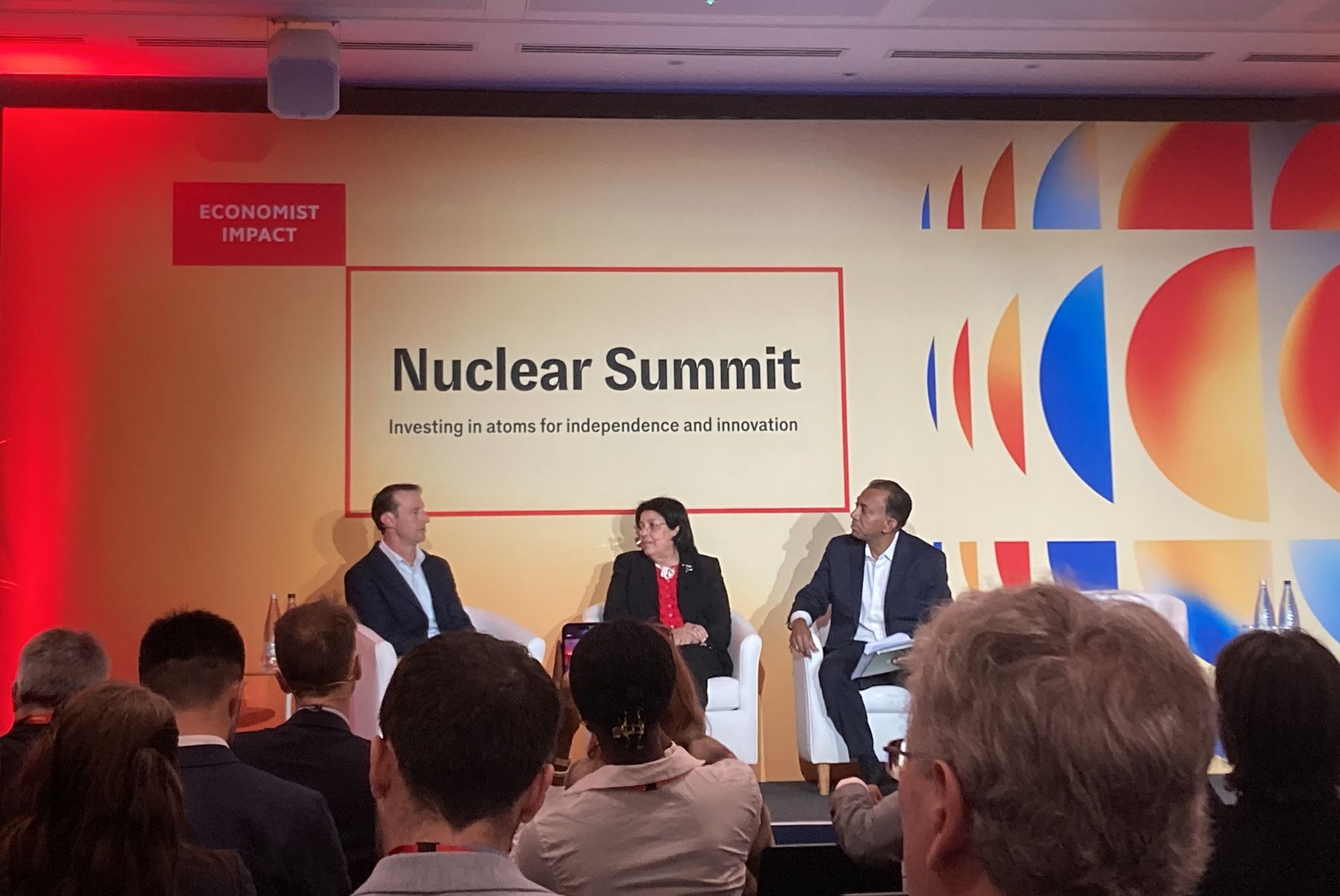
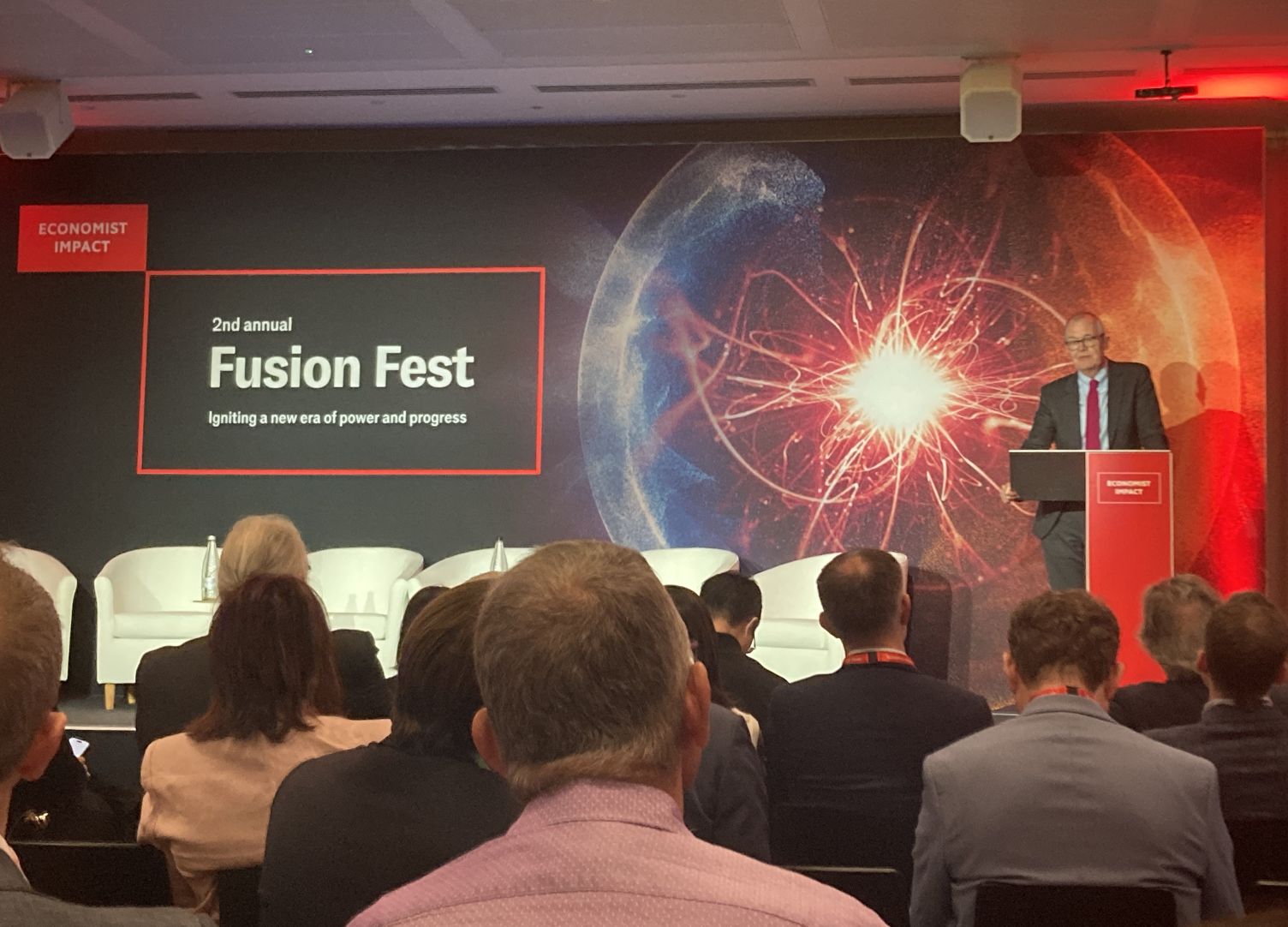
It’s an interesting question, then, why the vibes at last week’s Fusion Fest – which took place on 14 April in London, UK – were so much better than those at the Nuclear Summit held the next day in the same location. Both events took place under the auspices of The Economist newspaper. Both featured experts from finance, government, academic and policy circles. So why was the fusion gathering so bullish, and why was the fission one so downcast?
Fusion is having a moment
If you believe the speakers at Fusion Fest, they are optimistic because, after decades of being – as the old gibe has it – permanently 20 years in the future, fusion energy is finally ready for its close-up. “We are, I believe, at a pivotal moment in the field, and it’s a very exciting time to be in it,” Tim Bestwick, the interim chief executive of the UK Atomic Energy Authority (UKAEA), told the crowd at the opening session.
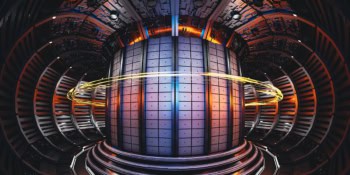
Later that day, a subsidiary of UKAEA, UK Fusion Energy Ltd, unveiled its strategy for building a pilot fusion power plant. Known as the Spherical Tokamak for Energy Production (STEP), it is receiving £1.3bn in UK government support and is scheduled to begin operations in 2040.
Other fusion organizations are promising results on even shorter timelines. A start-up called Pacific Fusion has pledged to build a power plant based on inertial fusion by the mid-2030s. Another company, Proxima Fusion, has a 2035 target for its stellarator-based technology. A third, Commonwealth Fusion Systems, is building a tokamak-style reactor that will, it claims, generate its first plasma (though admittedly not its first net energy) next year.
The spokespeople for these firms (and many others) have a strong incentive to be optimistic. They’re trying to attract funding, and in most cases, they’re relying on notoriously impatient venture capitalists rather than nations like the UK (and, on a far bigger scale, China) that can afford to take a longer view. A certain amount of pie-in-the-sky thinking is to be expected from them. Yet when The Economist’s global energy and climate innovation editor, Vijay Vaitheeswaran, asked a more diverse pool of attendees to predict when fusion would become cost-competitive with solar, the most popular choice was “within 20 years”. It certainly wasn’t “never”.
Bumps on the road to limitless energy
A few Fusion Fest speakers did mention some potential pitfalls. One area of concern is that suppliers of key components – high-grade optics for laser fusion, high-temperature superconducting wire for magnetic fusion, and so on – do not yet have the capacity to support a growing fusion sector. This is a financial problem as well as a technical one. Jeff Lawson, the chief executive of Inertia Fusion, warned the audience that fusion will only succeed commercially if it follows the example of solar power by using components manufactured cheaply and at scale. Otherwise, he said, it risks becoming more like nuclear fission, characterized by expensive, bespoke facilities.
In a similar vein, several speakers suggested that it would be a serious setback for the field if fusion – which produces far less radioactive waste than fission, carries no risk of meltdown and does not use materials that can be repurposed for nuclear weapons – ends up bearing the same regulatory burden as fission reactors. Indeed, one audience member drew murmurs of agreement by asking whether fusion experts should avoid using the word “reactor”, to remove any associations with fission nuclear power.
Nuclear’s (new) new dawn
With fusion’s enthusiasts promoting it as the clean, safe nuclear energy of the future, it’s easy for fission to get cast as the waste-producing, meltdown- and proliferation-prone nuclear energy of the past. Yet there are reasons to be optimistic about fission’s prospects, too. Recent increases in energy demand have triggered an uptick of interest in low-carbon baseload power. So, too, has the Iran War and the closure of the Strait of Hormuz, which threatens the world’s supply of fossil fuels in a way that hasn’t happened since the 1970s. Back then, France responded by building 57 new fission reactors. Could it happen again?
Charles Oppenheimer certainly thinks it could. The grandson of atom bomb pioneer J Robert Oppenheimer, he is the founder and chief executive of Oppenheimer Energy, which aims to accelerate reactor deployment. At the Nuclear Summit, Oppenheimer argued that “economic tailwinds” are producing a burst of optimism about nuclear power, as new concerns about energy security join older ones about climate change. But even he couldn’t avoid sounding a note of caution. “Institutional capital does not look at nuclear as an investible product,” Oppenheimer warned. “It looks at it as a field with a bad track record.” To counter this view, he argued, “we need to get something going to justify the optimism.”
Small reactors could be huge…
For many attendees, that “something” is small modular reactors (SMRs). Because they are designed to be somewhere between the size of a shipping container and a house, the idea is that SMRs could be assembled by the hundreds in factories, rather than constructed on-site in ones and twos. This would save time and money, which is essential in an industry with a reputation for high costs and long delays. As Tim Stone, a former chair of the UK Nuclear Industry Association, put it, the nuclear industry needs to treat “construct” as a dirty word: “Anyone who says ‘construct’ has to put £5 in the swear box,” he said.
SMRs promise other benefits, too. Their small size makes them less prone to catastrophic meltdowns, and they are poorly suited to producing material for nuclear bombs. For these reasons, some speakers expressed hope that they could be regulated like research reactors, not power plants. That would ease the burden on developers and further reduce the time required to constr – sorry, manufacture – them.
Another advantage of SMRs is that in principle, they can be installed in places where large-scale power plants would not make technical or economic sense. For example, the UK firm Cambridge Atomworks is developing a 5 MW SMR that is designed to supply power to mines in remote locations. According to its chief executive, Ian Farnan, such a reactor could compete with diesel generators on logistics and environmental considerations as well as price.
More promising still – at least from an investor perspective – is the prospect of using SMRs to power AI data centres. The largest such centres can consume as much as a gigawatt of electricity, and their developers are increasingly looking off-grid for ways of powering them. They also have stringent uptime requirements (the industry standard is “five nines”, or 99.999% availability) that make them awkward for variable energy sources such as wind and solar. With local communities unsurprisingly objecting to data centres that run on noisy, polluting gas generators, SMRs are an attractive alternative. “If you want clean, firm, reliable and shit-tonnes of power, it’s got to be nuclear,” summarized Amy Roma, a lawyer and nuclear energy policy expert at the law firm Orrick.
…but maybe not right away
Despite these developments, though, an SMR-led fission revival is far from guaranteed. James Walker, the chief executive of the SMR firm Nano Nuclear Energy, drew pained laughter from the audience when he declared that the problem with small modular reactors is “they’re not small and they’re not modular”. Robert Rudich, the chief business development officer at another SMR firm, CGE, agreed that this is something the industry needs to work on. “If we don’t bring [reactors] to a place where the private sector can help, we’re not going to get there,” he said. On the policy front, Najat Mokhtar, the deputy director general of the International Atomic Energy Agency, isn’t sure that regulators will go easy on SMRs. “The technology is evolving fast and the regulation and licensing is not,” she warned.
Fusion industry meets in London to discuss ‘one of the economic opportunities of the century’

With a technology that faces such knotty problems, it’s easy to be pessimistic. But it’s also easy to be optimistic about a technology that hasn’t matured enough to run into similar difficulties. This is the main reason for the different moods within fusion and fission. Though the fusion community may see the nuclear industry as a model of what not to do, many nuclear experts return the favour by regarding fusion as vapourware promised to gullible investors on impossible timelines. Will technical advances, climate concerns and the rising tide of world energy usage come together in a way that proves both sets of doubters wrong? Perhaps a future Fusion Fest and Nuclear Summit will hold the answers.
- This article was amended on 23/04/2026 to update Amy Roma’s affiliation and on 27/04/2026 to correct the nature of Pacific Fusion’s power-plant concept.