The frequency of extreme weather events can be predicted more accurately than presently possible by combining artificial intelligence (AI) with physical climate modelling, using a protocol called rare-event sampling. That’s the conclusion of a study from researchers in the US and France. The researchers used the approach to model extreme heat events such as the one currently roasting Europe, but they believe it could also be applicable to many other extreme events in climate science.
As the global climate warms, extreme weather is becomingly increasingly deadly and difficult to predict, and quantifying the risks of such events is important for climate change adaptation and mitigation. “Very often the rarest events carry the largest impacts,” says climate physicist Amaury Lancelin of France’s Laboratory of Dynamic Meteorology.
Full global climate model simulations will need to run for an infeasibly long time to produce sufficient data for an estimate of the precise frequencies of rare events. Alexander Wikner of the University of Chicago in Illinois gives the example of an event that, on average, occurs once every century: “Each year you’re going to flip a coin that has a one-in-a-hundred chance of coming up heads,” he says. “On average, once every hundred years, you’ll get one head, but you could very easily get no heads or two or three heads.” A meaningful estimation of the frequency therefore would traditionally require around a thousand years’ worth of simulation – which is not computationally feasible in a physical model.
Deep-learning algorithms, which ignore the underlying climate physics and simply train themselves using pattern recognition, require up to 10,000 times less computing power. However, the reliability of these in modelling extremely rare events is questionable. For example, there is evidence that an AI model will not predict more extreme cyclones than it has seen in its training data, “which is a quite unnerving idea if we imagine that tropical cyclones will be getting more extreme in the future and we want to use an AI model to forecast them,” Wikner explains. They also produce no insight into the physics of the events.
Rare-event sampling (RES) refers to techniques that preferentially allocate computing resources to specific rare events of interest, thereby avoiding modelling long periods of time in which none of those events occur. The problem, of course, is that one has to have some idea what kinds of conditions increase the probability of a rare event occurring in order to know which periods to model in more detail.
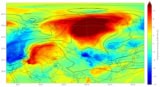
In the new research, scheduled for publication in Physical Review Letters, Lancelin, Wikner and colleagues developed the AI+RES framework. An AI algorithm runs climatic simulations repeatedly and selects those that it predicts are most likely to lead to the rare event. A full climate model then simulates only these. The researchers used this protocol to compare the frequency of heatwaves at mid-latitudes, using the predictions of a relatively coarse-grained direct numerical simulation called PlaSim as the ground truth.
They found that their technique produced similar results to PlaSim with up to 1000 times lower computational resources. The researchers now hope to apply the technique to predict other types of extreme events and apply it to more sophisticated models.
“The reason we used PlaSim is that it is computationally quite cheap compared to state-of-the-art climate models so that we can actually verify that our methodology works,” says Lancelin. “Otherwise there is no way to know whether we have made a garbage prediction or not without the ground truth.” Knowing that the AI+RES model reproduces the PlaSim results correctly, however, the researchers now hope to apply computationally expensive models in situations where it was previously impossible, with confidence that the results are likely correct.
Physics-based models still beat AI for predicting extreme weather events
Climate scientist Robin Noyelle of ETH Zurich believes the work marks a significant contribution to ideas that were already “floating out there”. He says that, although RES has been in use for nearly ten years, selecting the best candidates for full modelling has always proved challenging: “People were using things that we thought were reasonable – I did that during my PhD – so if I want to look at hot summers, then I select on temperature.”
This approach fails for short-term extreme events, however, because of the dynamic nature of the atmosphere. The AI model itself also failed to produce good accuracy when emulating the events, but it was “basically free” in terms of the computing power required, and provided a good starting point for the physical models. “This coupling between the two ideas is really new,” Noyelle says.