ICESat-2: from treetop to ocean floor

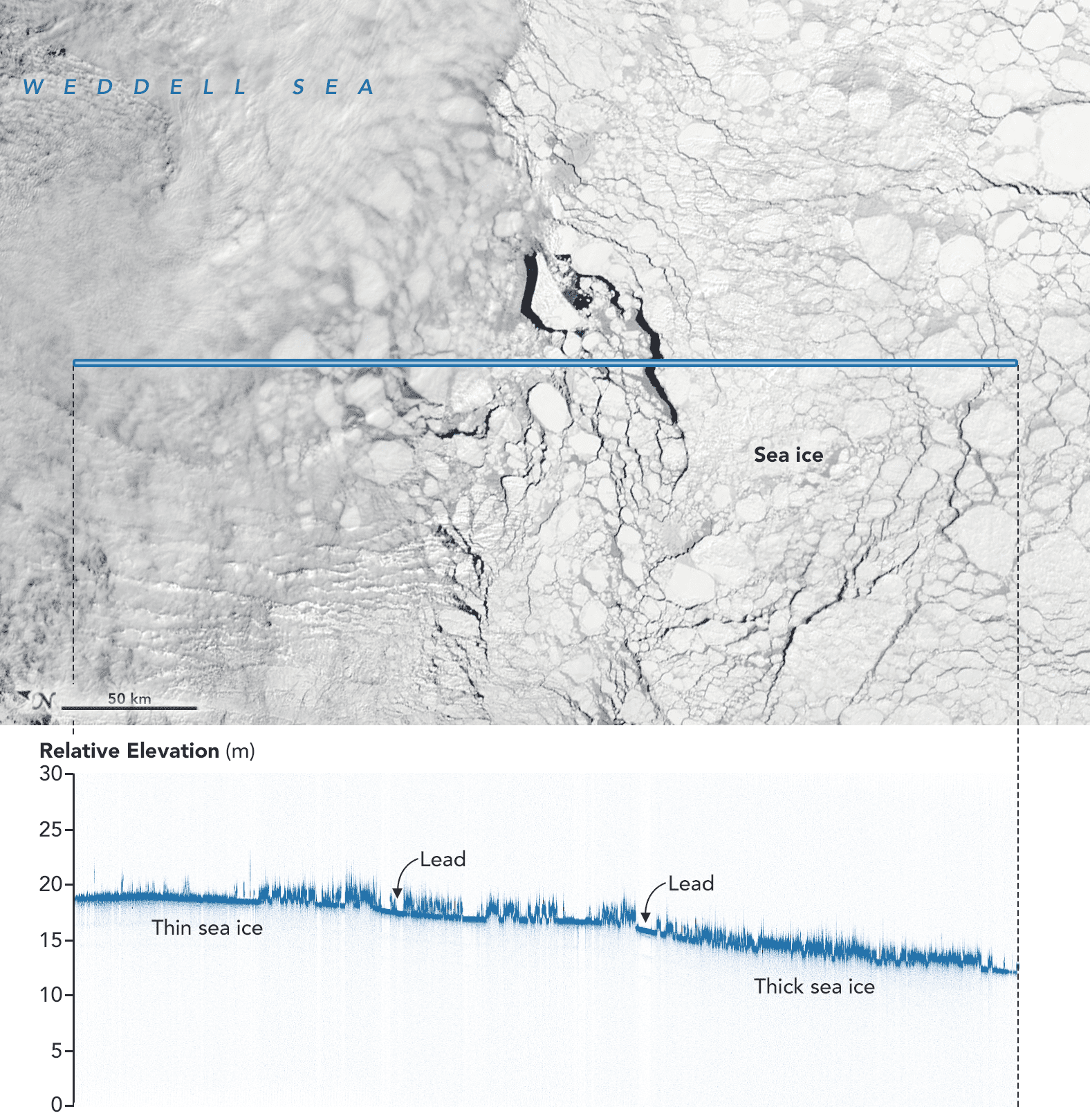
At the AGU Fall Meeting in Washington DC, NASA displayed images from its Ice, Cloud and land Elevation Satellite-2 (ICESat-2), which launched less than three months ago. The ATLAS (Advanced Topographic Laser Altimeter System) instrument onboard bounces a pulse of visible green laser light split into six individual beams off the Earth’s surface and measures the time for individual photons to return.

Not only can ATLAS measure ice elevations with an accuracy of roughly 1 cm to reveal ice structure, leads and more, but it also shows vegetation heights and, when the water is not too turbid, the depth of the ocean floor, as these images show.


AGU Fall Meeting: filmmaker discusses human tectonics

“The world needs everything that’s happening inside this building right now.” That was the message of film-maker and photographer James Balog during his plenary lecture at the AGU Fall Meeting in the Walter E Washington Convention Center in Washington DC. After touching on issues of “direct, wilful stupidity”, Balog told delegates that nothing consequential has ever been achieved without facing adversity, and proposed an amendment to the US Declaration of Independence to include an unalienable right to clean air, clean water, a stable climate and the pursuit of truth.

Balog used the primal elements of earth, air, water and fire to detail people’s impacts on their environment, a phenomenon that Balog dubs human tectonics. “Humans are a force of nature,” he said. “The human element is the only element that can choose to make changes in this world.”

Balog’s new documentary The Human Element will be shown tonight at the Smithsonian National Museum of Natural History. The film will be available on iTunes and other video platforms from 29 January 2019.

  • This article was amended on 17th December 2019 as the film will not be available for free and will be available on other video platforms in addition to iTunes.

Practical quantum computers remain at least a decade away

Significant technical and financial issues remain towards building a large, fault-tolerant quantum computer and one is unlikely to be built within the coming decade. That is according to a report by the National Academies of Sciences, Engineering, and Medicine (NASEM), which states that when quantum computers do become a reality they will expand the boundaries of humanity’s scientific knowledge and produce results that could “transform our understanding of the universe”.

The report — Quantum Computing: Progress and Prospects – highlights several technical problems that need to be overcome before a functional quantum computer could be built. They include boosting the ability of qubits to reject noise, developing quantum-error correction and overcoming the lack of ways to load large data inputs into a quantum computer. The 13-strong panel also says that the community needs to design improved quantum algorithms, develop a new “software stack” as well as tackle the present inability to measure the intermediate state of a quantum computer directly.

Given those technical challenges, the NASEM panel states that it is too early to predict the timeline for development of a practical quantum computer. While admitting that many quantum-computing researchers are already sharing advances, the panel calls for the community to hasten the process by constructing “an open ecosystem that enables cross-pollination of ideas and groups”. Financial investment is also critical, the report states, particularly if the US wants to retain a leading role in developing the technology given that both China and the European Union are devoting significant financial resources to the effort. Currently the US private sector plays a large role in the US quantum-computing effort, but the committee suggests that government funding “may be essential to prevent a significant decline”.

A privacy disaster

The report’s recommendations go beyond researchers building quantum computers, warning that such devices could compromise logarithmic-based public key cryptosystems, such as the current gold-standard RSA 2048. The panel urges that the community prioritize “the development, standardization, and deployment of post-quantum cryptography” to minimize “the chance of a potential security and privacy disaster”.

Ironically, the report declares that such an effort will reduce the usefulness of a quantum computer for cryptanalysis “and thus will reduce the extent to which the application will drive quantum computing R&D in the long term”. But overall, as panel member Bob Blakley, global director of information security innovation for CitiGroup, says, the trend in quantum computing “is somewhat toward optimism rather than pessimism”.

Working in high-energy physics in China

This short film shows you what it is like to work at the Institute of High Energy Physics (IHEP), a research institute of the Chinese Academy of Sciences. Located across different sites in China, IHEP boasts a range of opportunities for scientists and engineers at all stages of their career.

IHEP’s main campus in Beijing hosts the Beijing Electron-Positron Collider, the BESIII experiment, the Beijing Synchrotron Radiation Facility, along with most of IHEP’s research and administrative staff. To the south in Guandong province you will find the China Spallation Neutron Source, the Jiangmen Underground Neutrino Observatory and the Daya Bay Reactor Neutrino Experiment. Completing the array are the Sichuan Cosmic Ray Observatory in Sichuan province and Yangbajing Cosmic Ray Observatory in Tibet.

IHEP director Yifang Wang introduces these different projects and speaks about the varied career opportunities. IHEP’s projects are multidisciplinary, so the institute is seeking physicists, chemists and biologists to join its expanding research programme. China also has well publicised plans to build a successor to the large hadron collider at CERN. As these plans develop, new opportunities will emerge for both scientists and engineers.

Other IHEP employees featuring in the film are:

  • Yiming Li, an early career researcher who is excited about the prospect of designing next generation detectors.
  • Xinchou Lou, director of the experimental physics division. He speaks about the opportunities for people relocating to China, including Chinese language lessons and other personal support.
  • João Guimarães da Costa, a foreign national who explains why he chose IHEP over other institutes in Europe and the US.

This film was produced in partnership between IOP Publishing and the Institute of High Energy Physics, Chinese Academy of Sciences.

A list of IHEP’s current job opportunities can be found on the brightrecruits website.

Topological off-on switch could make new type of transistor

The ultrathin topological insulator sodium bismuthide (Na3Bi) can switch to being a conventional insulator when an electric field is applied. This “off-on” effect, discovered by researchers in Australia, the US and Singapore, could be exploited to make the first ever working transistors from topological materials.

Topological insulators, also known as 2D quantum spin Hall insulators, are materials that are electrical insulators in the bulk but can conduct electricity on their surface via special spin-polarized surface electronic “edge” states. “Electrons travelling along these ‘topologically protected’ states can only travel in one direction and thus do not back-scatter,” explains team leader Mark Edmonds of the School of Physics and Astronomy at Monash University in Australia. “This means they can carry electrical current with near-zero dissipation of energy since back-scattering is what causes electrical resistance in conventional conductors, which wastes energy. The materials could thus be used to make energy-efficient devices like transistors and might even be the answer to the increasing challenge of energy wasted in modern CMOS-based computing, which accounts for 8% of global electricity use, and which is doubling every decade.”

Looking for topological field-effect switching

Na3Bi belongs to the family of topological Dirac semimetals, which are good materials in which to look for topological field-effect switching because they lie at the boundary between conventional and topological phases, he says. Few layer Na3Bi has been predicted to undergo a transition from a topological insulator (with a bandgap of around 300 meV) to a conventional insulator (with a much lower energy bandgap) when an electric field is applied.

Researchers haven’t been able to test out this hypothesis in experiments until now, however, for want of Na3Bi films less than 10 to 15 nm thick.

Extremely thin, single-layer crystalline Na3Bi

Edmonds and colleagues have now succeeded in growing extremely thin, single-layer crystalline Na3Bi. The researchers say they can also control the thickness of a sample and, for example, make a film that is either a single layer thick or several layers thick. They grew their films using a technique called molecular beam epitaxy in ultrahigh vacuum at Monash and at the Australian Synchrotron, as well at the ALS Beamline 10.0.1 at the Lawrence Berkeley National Laboratory in the US.

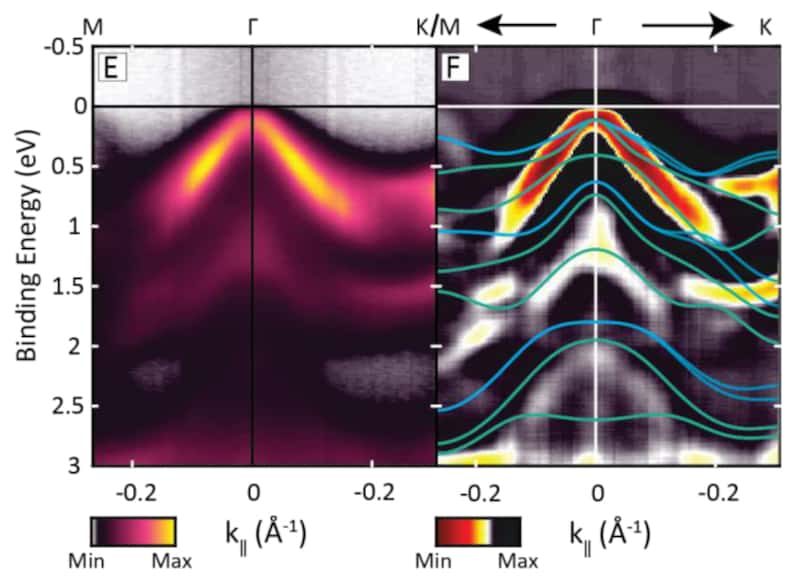
They studied their material using two very different techniques. The first is angle-resolved photoemission spectroscopy (ARPES), which provides information on the material’s electronic band structure and how it is modified when an electric field is applied. The second is scanning tunnelling spectroscopy (STS), which measures the local density of electronic states as a function of energy to directly probe the energy bandgap.

STS can also make out the topological edge states in Na3Bi when no electric field is applied, proving that the material is topologically insulating in this phase, says Edmonds.

The researchers backed up their findings using density-functional theory band structure and edge state calculations with and without an applied electric field.

Towards the first room-temperature topological transistor

“In a 2D topological insulator there is a band inversion of the valence and conduction bands,” explains Edmonds. “When an electric field is applied, the Stark effect results in band re-ordering such that band inversion no longer occurs. This completely closes the bandgap and then reopens it as a conventional insulator gap (90 meV) – that is, with no band inversion.”

ARPES

Such electrically driven switching is an important step for applications for materials, says team member Sung-Kwon Mo. Some other research efforts have pursued mechanisms like chemical doping or mechanical strain that are more challenging to control.

“The large bandgaps in both the conventional and topologically insulating phases are also much greater than the thermal energy (of 25 meV) at room temperature, which suggests that ultrathin Na3Bi is suitable for making a room-temperature topological transistor,” adds study author Michael Fuhrer.

The researchers, reporting their work in Nature 10.1038/s41586-018-0788-5, say they are now planning to make an electrical device that can measure the edge current turning on and off along the film edge when an electric field is applied. “This would be a demonstration of the first working topological transistor,” Edmonds tells Physics World.

Taking graphene from wonder material to real-world technologies

“It surprises me that people are still interested in graphene,” Kostya Novoselov told attendees at the launch of the  second world class graphene centre in Manchester, UK. Novoselov was awarded the 2010 Nobel laureate for his work isolating the material alongside Andre Geim at the University of Manchester. His remark highlights how unusual it is for an area of research to be simultaneously prolific in both fundamental discovery while also finding its foothold in industry. That two institutes dedicated to both aspects of the same material have found room to coexist in one city speaks volumes about the continued perceived potential of research in graphene and related materials, as well as the investment they still manage to attract. Can it outlive the hype? The level-headed engineers and partners at the Graphene Engineering and Innovation Centre (GEIC) put forward a convincing case that it can.

Launched on 11 December 2018, the GEIC aspires to provide a space that helps bridge the notorious gap between academic innovation and real-world adoption by industry. The phrase “fail fast” recurs throughout the launch, suggesting an Edison-like ethos embracing not just successful commercialization of new technologies but also the many inevitable and informative failures along the way. The $60m Masdar Building housing the GEIC provides a space where industry large and small can pursue projects that might be too risky or even expensive for their own facilities. As well as both industry-standard and bespoke graphene equipment the centre is staffed with engineers with extensive industry and commercial experience, as well as expertise in graphene.

The tipping point

On brand, the staff and engineers all hot-footed around the centre in flashy green graphene trainers. Products have incorporated graphene for a while, but largely as a gimmick for marketing. In contrast, these trainers genuinely exploit the thermal and mechanical properties of graphene to enhance their durability.

On brand: Engineers and staff sport graphene trainers at the launch.

BAC exhibited the BAC-MONO, a car that uses a graphene composite as part of the body work, exploiting graphene’s strength to reduce the mass of that part by 20%. The next step is to replace the rest of the body work. From aerospace, University of Lancashire  Juno team brought a demonstration drone, again leveraging mass reductions but also using the material’s conductivity for protection from lightning strikes.

Also exhibited at the launch was the ability to alter the thermal emissivity of graphene devices with an applied field, enabling thermal cloaking from an infrared camera. Other partners have used capacitance changes with applied pressure for applications ranging from sensing and diagnostic contact lenses to robotics and a talking T-shirt.

One area the GEIC does not aim to cover is the role of graphene in life sciences, since the specific facility needs for this sector are already catered for in University of Manchester. Nonetheless there were demos of how the large surface area and low cytotoxicity of graphene-related materials can lend them to functionalization with radioactive labels for medical imaging.

The talking Tshirt produced from graphene yarn.

Big companies hate risk, which makes their uptake of graphene particularly significant. Speaking to delegates about the uptake of graphene by companies like Ford who have used it in their engine bay, Graphene@Manchester CEO James Baker suggested that commercialization of graphene was teetering at a tipping point where it could really take off.

“I think graphene is already out there in products,” added Ian Kinloch, Director of Materials at University of Manchester’s School of Materials, suggesting that Ford as an example didn’t shout about the use of graphene in their cars because the material’s properties gave them a competitive advantage and they didn’t think consumer knowledge of the graphene contribution would sell more cars. “I think the applications are already out there and it will only leak out gradually over time that those products are using graphene, so I think the tipping point is already here.”

The raw materials

Travelling from across Europe and Canada to attend the GEIC launch, suppliers expressed their interest in droves. Stephen Hutchins, Technical Sales Director from Talga Technologies Limited – the product research and development strand of a company that owns natural mineral reserves in Sweden – told Physics World that their company had originally focused on mining. However finding themselves in possession of the Nunasvaara graphite deposit, which claims to be the highest grade JORC/NI 43-101 graphite mineral resource in the world, they decided to try moving up the supply chain and engage with producing graphene themselves.

Zen Graphene Solutions in Ontario is also looking to capitalize on their 1.4 million tonne graphite resources, which they describe as the largest and only high purity hydrothermal graphite mineralization being developed in the world.  A shortage of carbon has never really been the limiting factor in getting graphene to market but as their Head of Sales Phil Chataigneau explains, the flash precipitation of methane and carbon dioxide that produced the graphite affected the spacing between the carbon layers, facilitating production of high-quality graphene.

One of the stumbling blocks for industry has been the abundance of different types of graphene with varying purity, crystal quality and numbers of graphene layers, which all affect what sort of applications it will be suited to. The National Physical Laboratory (NPL), which led on the development of the ISO Graphene Standard and the the Graphene Service, is a Foundation partner with the GEIC. Its aims are to support the creation of a graphene community and and ecosystem within the GEIC to encourage early stage development and collaborations. Together with the National Graphene Institute, NPL has produced a guide for good practice and definitive terminology for graphene.

The BAC-mono uses graphene composites to reduce mass.

The graphene sell

Graphene was once talked about as the new gold. At the time it was isolated mechanically by exfoliation, a production approach that is only viable at small scales so that a kilogram would cost hundreds of thousands of dollars. Engineers and manufacturers working with ultrasonic and chemical exfoliation and chemical vapour deposition have pushed this price point down below $50 dollars a kilogram, so now the cost of graphene is not the issue. Even BAC’s graphene-enhanced sports car, with a maximum speed of 170 mph, an acceleration of 0-60mph in 2.8 seconds and only 30 units of that model in the world demands a comparatively modest price of £140,000.

Graphene may be cheap but it still attracts big money. The graphene sell was so attractive to energy giant Masdar that they provided 50% of the funding for the GEIC as well as their name. (The building housing the GEIC is named the Masdar Building.) The rest of the money came from the UK and Europe. Dispelling concerns over the effect of the UK’s withdrawal from the EU on the centre, Baker suggests the GEIC could help graphene “de-risk Brexit”. He adds that as for future extensions of the centre, he hopes to draw primarily on commercial investors anyway.

The GEIC opens for business in January 2019.

Image analysis technique may reduce unnecessary breast biopsies

3CB image analysis

Mammography can reduce breast cancer deaths by detecting tumours at their earliest, most treatable stages. However, up to 60% of women screened with mammography over 10 years have at least one false-positive result, necessitating additional diagnostic imaging and, in many cases, biopsies.

To reduce the number of unnecessary breast biopsies, a US research team has devised a novel image analysis technique that uses mammography to determine the biological tissue composition of a suspicious breast mass (Radiology 10.1148/radiol.2018180608).

“The call-back rate with mammography is much higher than ideal,” explains first author Karen Drukker from the University of Chicago. “There are costs and anxiety associated with recalls, and our goal is to reduce these costs but not miss anything that should be biopsied.”

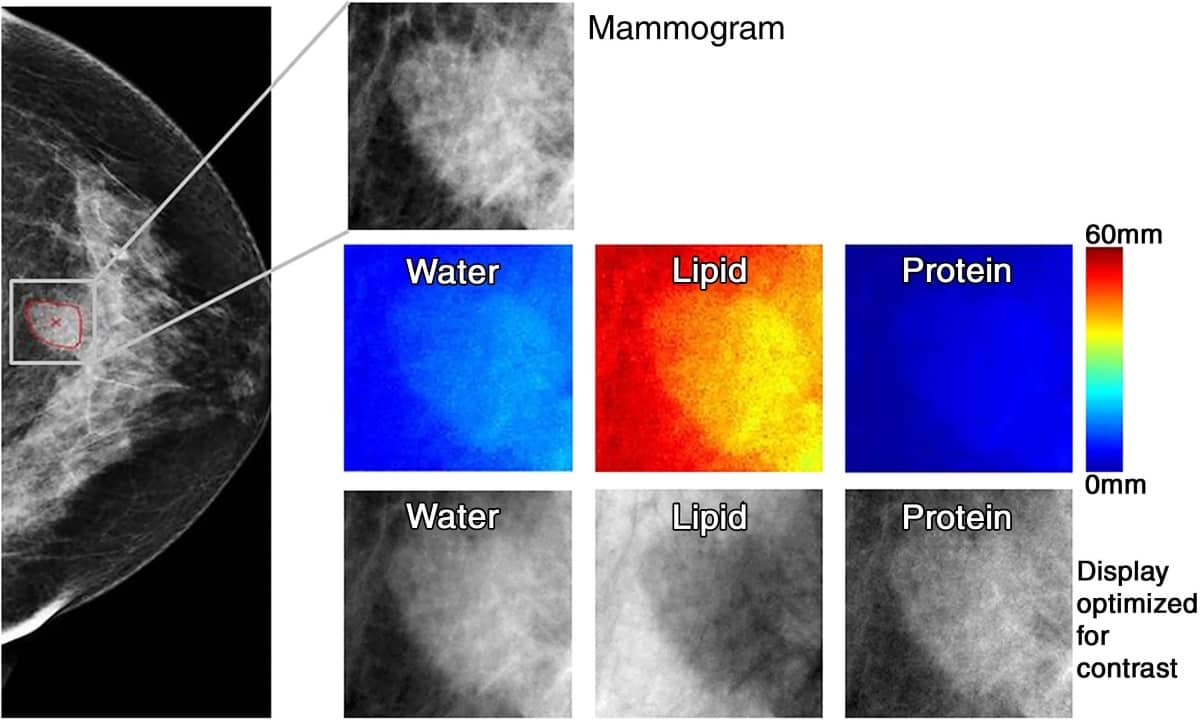
Drukker and colleagues employed three-compartment breast (3CB) imaging, a dual-energy mammography technique that does not require a contrast agent and delivers only 10% higher dose than standard mammograms. By measuring the water, lipid and protein tissue composition throughout the breast, 3CB might provide a biological signature for a tumour. For instance, more water in the tumour tissue might indicate angiogenesis, an early sign of cancer development.

For this prospective study, the team acquired dual-energy mammograms from 109 women with suspicious breast masses that typically would require further investigation, immediately prior to biopsy. The ensuing biopsies showed that 35 masses were invasive cancers, while the other 74 were benign.

The researchers derived 3CB images from these dual-energy mammograms and calculated the water, lipid and protein thickness at each pixel. They then combined this analysis with mammography radiomics, which uses artificial intelligence algorithms to analyse features and patterns in images.

The combination of 3CB image analysis and radiomics improved the positive predictive value in suspicious breast masses from 32% for conventional diagnostic digital mammography to 49%, with a sensitivity of 97%. This corresponds to a reduction in biopsies of almost 36%.

Drukker says that this combined 3CB–radiomics approach has the potential to play an increasingly prominent role in breast cancer diagnosis and perhaps also in screening. She notes that 3CB can easily be added to mammography without requiring extensive modifications of existing equipment. “The patient is already getting the mammography, plus we get all this extra information with only a 10% additional dose of radiation,” she points out.

This approach is still experimental and further work is needed to make it available to patients. The researchers plan to study how the combined 3CB–radiomics approach will help radiologists make their final determinations. They also want to study its use with digital breast tomosynthesis, which reduces the problem of overlapping breast tissue inherent to regular mammography. A tumour’s unique water-lipid-protein signature might be even clearer with tomosynthesis, says Drukker.

Beauty and the biased

When Physics World asked 15 physicists and authors, myself included, to name their favourite science books for the magazine’s 30th-anniversary issue, I knew immediately which I would choose (October 2018). My “must-read” pick was Sabine Hossenfelder’s exceptionally important Lost In Math: How Beauty Leads Physics Astray, which was released earlier this year.

Hossenfelder, a physicist based at the Frankfurt Institute for Advanced Studies, is an engaging and insightful writer who is funny, self-deprecating and certainly not afraid to be provocative. I enjoyed the book immensely, being taken on a journey through modern theoretical physics in which Hossenfelder attempts to make sense of her profession.

If there is one part of the book that particularly resonated with me it is the conclusion – “Knowledge is power”. This is a powerful closing statement that deserves to be widely read by all scientists, but especially by that particularly irksome breed of physicist who believes – when all evidence points to the contrary – that they are somehow immune to the social and cognitive biases that affect every other human.

In “Knowledge is power”, Hossenfelder adeptly outlines the primary biases that all good scientists have striven to avoid ever since the English philosopher Francis Bacon identified his “idols of the tribe” – the tendency of human nature to prefer certain types of incorrect conclusions. Her pithy single-line summary at the start of the chapter captures the key issue: “In which I conclude the world would be a better place if everyone listened to me.”

Along with my colleague Omar Almaini from the University of Nottingham, I teach a final-year module entitled “The politics, perception and philosophy of physics”. I say teach, but in fact, most of the module consists of seminars that introduce a topic for students to debate, discuss and argue for the remaining time. One issue we dissect is Richard Feynman’s oft-quoted definition of science as “the belief in the ignorance of experts”. Disagreeing with Feynman is never a comfortable position to adopt, but I think he does science quite a disservice here. The ignorance, and sometimes even the knowledge, of experts underpins the entire scientific effort. After all, collaboration, competition and peer review are the lifeblood of what we do.

Science, in my view, would be nothing without experts. The problem, however, is that with each of these come complex social interactions and dynamics, and bias – no matter how hard we try. For this and many other reasons, Lost In Math is now prominently on the module reading list.

The issue of bias was brought to a head at a CERN workshop on high-energy theory and gender in September, where theoretical physicist Alessandro Strumia from the University of Pisa claimed that women with fewer citations were being hired over men with greater numbers of citations. Following the talk, Strumia faced an immediate backlash in which CERN suspended him pending an investigation, while some 4000 scientists signed a letter that called his talk “disgraceful”.

On the evidence of his slides, I found Strumia’s talk to be poorly researched, ideologically driven, and an all-round embarrassingly biased tirade against women in physics. I suggest that Strumia needs to take a page – or many – out of Hossenfelder’s book. When I read through Strumia’s cliché-ridden and credulous arguments, almost every slide of his presentation reminded me of the wise thoughts of her final chapter.

One criticism that has been levelled at Hossenfelder’s analysis is that it does not offer solutions to counter the type of biases that she argues are prevalent in the theoretical-physics community and beyond. Yet Hossenfelder does devote an appendix – admittedly rather short – to listing some pragmatic suggestions for tackling the issues discussed in the book. These include learning about, and thus tackling, social and cognitive biases.

This is all well and good, except that there are none so blind as those who will not see. The type of bias that Strumia’s presentation exemplified is deeply ingrained. In my experience, his views are hardly fringe, both within and outside the physics community. You only have to look at the social-media furore caused by the now former Google engineer James Damore, who came up with a similarly pseudoscientific “analysis” of gender differences last year in his memo, Google’s Ideological Echo Chamber.

Just like Damore, Strumia is being held up by the usual suspects as the ever-so-courageous rational scientist speaking the truth, when, of course, he’s entirely wedded to a glaringly obvious ideology and unscientifically cherry-picks his data accordingly. In a masterfully acerbic and exceptionally timely blog post published soon after the Strumia storm broke, particle physicist Jon Butterworth from University College London highlighted a number of the many fundamental flaws at the core of Strumia’s over-emotional polemic.

Returning to Hossenfelder’s closing chapter, she highlights that the “mother of all biases” is the “bias blind spot”, or the insistence that we certainly are not biased. “It’s the reason my colleagues only laugh when I tell them biases are a problem, and why they dismiss my ‘social arguments’, believing they are not relevant to scientific discourse,” she writes. “But the existence of those biases has been confirmed in countless studies. And there is no indication whatsoever that intelligence protects against them; research studies have found no links between cognitive ability and thinking biases.”

Strumia’s diatribe is the perfect example of this bias blind spot in action. His presentation is also a case study in confirmation bias. If only he had taken the time to read and absorb Hossenfelder’s writing, Strumia might well have saved himself the embarrassment of attempting to pass off pseudoscientific guff as credible analysis. While the beauty of maths leads physics astray, it is ugly bias that will keep us in the dark.

BECCS it, says the CCC

The UK government’s advisory Committee on Climate Change (CCC) has had another look at biomass, following on from its earlier study, and thinks it could play a vital role in UK emission reduction, as can biomass energy with carbon capture and storage (BECCS) in many scenarios. In the new report the CCC says that “using biomass with CCS to store carbon and produce a useful energy service is likely to deliver more abatement than most other potential end-uses. Based on our current expectations of BECCS costs and technical performance, we conclude that biomass available for use in the energy system (i.e. after wood in construction opportunities have been satisfied) should be used with BECCS applications to the maximum extent possible”. So, it’s BECCS all the way, offering carbon negativity, a view partly shared by the IPCC in its recent climate review.

However, the CCC notes that “the use of BECCS is currently not incentivised by policy mechanisms intended to drive emissions reductions (e.g. Contracts for Difference and the EU Emissions Trading System)” and says “we would not expect BECCS to be deployed at scale immediately”. Nevertheless, it suggests that “the availability of incentives would encourage those making decisions now to factor it in (e.g. locating a biomass facility near to where CO2 infrastructure may be developed). The government should examine how BECCS can be incentivised with changes to existing policy mechanisms and/or new mechanisms.”

Given that there are issues with BECCS (and CCS generally), this “full ahead” proposal is a little surprising. CCS is still unproven on any significant scale, with there being uncertainty about the cost, capture rates and the viability of long term CO2 storage. However, the CCC says “our central estimate of future BECCS capture rates is 90% (meaning that 90% of the carbon in the biomass feedstock is captured and stored)”. But it also says that “BECCS can still deliver greater emissions savings than non-BECCS energy uses even at much lower rates of CO2 capture. Consequently, BECCS applications may make sense even with CO2 capture rates as low as 40%, below which the other bioenergy applications (e.g. aviation biofuel production) start to be preferred”. That, it says, “broadly supports our off-model analysis that shows (under our central assumptions) BECCS providing around twice as much GHG [greenhouse gas] abatement as the next best uses without CCS (e.g. production of aviation biofuel)”.

Which wood?

Where is all this biomass going to come from? CCC says that “by 2050 up to 1.7 million oven-dried tonnes of high-quality sawn wood suitable for construction and up to 27 million oven-dried tonnes of sustainably-produced biomass from forestry and agricultural residues and energy crops could be produced in the UK. Combined with imports enabled by strong sustainability governance, this would support an expansion of the use of wood in construction and mean that bioenergy could meet between 5% and 15% of the UK’s energy demand in 2050 (compared to around 7% today).”

It suggests that UK-sourced biomass could supply 5–10% of energy by 2050, the lower end of that range being just from organic wastes (after removal of anything that can be recycled or reused), the upper end needing over 1 million hectares of land for energy crops — around 7% of current farm land. And also more tree planting and more timber for use in construction, which is a form of carbon sequestration. Alternatively, or maybe additionally, tripling biomass imports could push the energy supplied up to 15%.

Given that there are issues with BECCS (and CCS generally), this “full ahead” proposal is a little surprising.

Dave Elliott

However, the CCC is clearly worried about some of the implications of imports. It wants better sustainability regulations and says “imports should only have a role if future efforts to develop this sustainability framework are successful (improved monitoring and transparency, closing gaps) and the UK can have confidence that all imports are both low-carbon and sustainable. This does not imply that the current imports are by definition unsustainable – instead, it recognises some ongoing uncertainty, public controversy and scope for improvement in the rules, particularly if scaling up imports”.

It is certainly true that the use of forest wood is controversial, unlike the use of farm and food wastes, converted to biogas via anaerobic digestion (AD), with multiple possible uses. Nevertheless, whatever the source and use, CCC evidently sees BECCS as best. Indeed, it says that “in many scenarios where the use of BECCS is excluded, as much if not more bioenergy feedstock is required to achieve the emissions reductions necessary to meet the same climate outcome. This is because biomass cannot be used as efficiently (in terms of emissions mitigation) as when BECCS is available”. But it does also say that “if substantial improvements in energy efficiency, shifts in diet, rapid electrification and low population growth” are possible, then “the use of large amounts of bioenergy without CCS may also be avoidable”.

Future worries

Some of that seems to be a sop to some on the “deeper green” end of the spectrum e.g. the CCC says that diet changes would help free up land (e.g. from meat growing), making it all easier. True enough. However, it’s not just deep greens who worry about biomass use and look to alternatives. As I noted in an earlier post, a study by Vivid Economics/ Imperial College London, for the US NRDC, claimed that deep decarbonisation of the UK power system was possible with renewables like wind and solar by 2030, without reliance on “expensive and controversial” biomass or CCS. Or indeed nuclear.

The CCC’s scenarios include all of those to varying degrees. Given the problems facing the use of forest-derived wood (recently critically reviewed again), it is easy to see why BECCS, using other types of biomass and wastes, might be talked up. Similarly, given the problems facing nuclear (for example with the recent demise of Toshiba’s Nugen project), it’s easy to see why fossil CCS might be talked up. But that too is looking pretty shaky. There is very little CCS included in the most recent BEIS scenario — just 1 GW by 2035. Instead most of the residual focus in this field is on Carbon Capture and Utilisation (CCU), since that avoids the problem of underground storage and offers potentially valuable synfuel products.

However, as POST, the Parliamentary Office of Science and Technology, has noted in a new briefing, CCU only has a “relatively small” direct CO2 mitigation potential, since the synfuels made would be burnt, releasing CO2 again. POST, perhaps a little optimistically, nevertheless adds “CCU could develop an early-stage market for wider CO2 capture technologies. This would help to develop capture carbon and storage (CCS), which is widely accepted to be a likely and substantial component of future mitigation efforts at the global level.” The government maybe has this in mind in its shift from using the label “CCS” to the use of “Carbon Capture, Utilisation and Storage” (CCUS), with some funding promised. CCU certainly make sense for some industrial applications.

For the moment, however, while CCU may potentially be a viable commercial option, full CCS may never be viable on a large scale. And by implication, that means the prospects of BECCS offering large-scale carbon negativity is in fact illusory, or at least uncertain. But POST, and it seems CCC, still seem wedded to CCS. So, evidently, is the government, with a fossil gas CCS project planned for Scotland “in the mid 2020s”. More immediately, there is a small prototype BECCS project underway at Drax, although with no carbon storage as yet. Time was when some saw BECCS as riding on the coat tails of CCS. Now if anything it might be the other way around, though it’s all rather uncertain: there may be better options.

BECCS may nevertheless have a place, along with other renewable energy options, including directly used biomass, as well as carbon sequestration via improved land/soil management. However, quite apart from the land-use issues, can we really look to large-scale storage of CO2 as a central way ahead for biomass? And do we really want to give fossil fuels a new lease of life with CCS? Why not just push renewables and efficiency harder? Starting by unblocking onshore wind.


AGU Fall Meeting: the other side of Antarctica

For years, East Antarctica appeared more stable than the west of the continent, where the Antarctic Peninsula in particular has seen ice shelves retreat and break up.

But recently scientists found that Totten Glacier, the largest glacier in East Antarctica, is retreating. And now, as Catherine Walker of NASA detailed to journalists at the AGU Fall Meeting, she’s discovered that four glaciers to the west of Totten, which had previously looked stable, are also losing ice.

These glaciers, in Vincennes Bay, have lost about 9 feet of height since 2008, Walker found using maps of ice velocity and surface height elevation. The maps are part of NASA’s Inter-mission Time Series of Land Ice Velocity and Elevation (ITS_LIVE) project. NASA will release some of this data in January 2019.

Walker also looked at model simulations of ocean temperature as well as measurements from Argo floats and seals tagged with sensors. The ocean has warmed since 1992, these data show. Walker says that waters around zero degrees in temperature are impinging on the coastline in this region now, and that’s enough to melt ice.

To the east of Totten, glaciers along the Wilkes Land coast have roughly doubled their rate of lowering since 2009; their surface elevation is now decreasing by around 0.8 feet every year. These changes are small compared to those in glaciers in West Antarctica but indicate widespread change in the east.

“Those two groups of glaciers drain the two largest subglacial basins in East Antarctica, and both basins are grounded below sea level,” said Walker. “If warm water can get far enough back, it can progressively reach deeper and deeper ice. This would likely speed up glacier melt and acceleration, but we don’t know yet how fast that would happen. Still, that’s why people are looking at these glaciers, because if you start to see them picking up speed, that suggests that things are destabilizing.”

If the Aurora subglacial basin melts that will bring 9 m of sea-level rise, whilst if the Wilkes basin melts that will raise sea-levels by 19 m, according to Walker.

There is, however, a lack of measurements around the glaciers on seafloor bathymetry, bedrock topography and hydrography, so it’s hard to predict how their melt will progress.

Observations galore

Alex Gardner of NASA JPL detailed how new satellites are coming online that will provide extra information on glacier ice. “The availability of observations will not be the limiting factor,” he said. Under ITS_LIVE, Gardner and colleagues are reanalysing optical and radar data from the last 30 years of satellite observations and bringing them together to make a more robust dataset. This puts data in the hands of researchers, Gardner said, predicting that there will be lots of observation-driven discoveries in the next five to ten years.

Copyright © 2026 by IOP Publishing Ltd and individual contributors